Source: The Conversation – in French – By Xiangyu Liu, Research Fellow, School of Environment and Science and Australian Rivers Institute, Griffith University
Café à emporter, thé ou chocolat chaud : lorsque ces boissons sont servies dans des gobelets contenant du plastique, la chaleur favorise la libération de microplastiques.Katerina Holmes/Pexels, CC BY
Les effets des microplastiques sur la santé humaine restent encore mal connus. Mais une étude australienne met en lumière une source d’exposition quotidienne souvent négligée : les gobelets utilisés pour les boissons chaudes à emporter.
Il est 7 h 45. Vous prenez un café à emporter dans votre café habituel, entourez le gobelet chaud de vos mains, en buvez une gorgée, puis partez au bureau.
Pour la plupart d’entre nous, ce gobelet paraît anodin : ce n’est qu’un contenant pratique pour transporter notre dose de caféine. Pourtant, s’il est en plastique, ou simplement doublé d’une fine couche de plastique, il y a de fortes chances qu’il libère des milliers de minuscules fragments de plastique directement dans votre boisson.
Rien qu’en Australie, quelque 1,45 milliard de gobelets jetables destinés aux boissons chaudes sont utilisés chaque année, auxquels s’ajoutent environ 890 millions de couvercles en plastique. À l’échelle mondiale, ce chiffre grimpe à près de 500 milliards de gobelets par an.
Dans une étude que j’ai cosignée et publiée dans la revue Journal of Hazardous Materials : Plastics, nous avons cherché à comprendre le comportement de ces gobelets lorsqu’ils sont exposés à la chaleur.
Le constat est sans appel : la chaleur est l’un des principaux facteurs qui favorisent la libération de microplastiques, et le matériau de votre gobelet compte bien plus que vous ne l’imaginez.
Que sont les microplastiques ?
Les microplastiques sont de minuscules fragments de plastique mesurant entre environ 1 micromètre et 5 millimètres, soit de la taille d’un grain de poussière à celle d’une graine de sésame.
Ils peuvent provenir de la dégradation d’objets en plastique plus volumineux, ou être libérés directement par des produits lors de leur utilisation normale. Ces particules se retrouvent ensuite dans l’environnement, dans notre alimentation et, au bout du compte, dans notre organisme.
À l’heure actuelle, nous ne disposons pas de preuves concluantes sur la quantité de microplastiques qui reste réellement dans notre organisme. Les études sur ce sujet sont particulièrement exposées aux risques de contamination et il est très difficile de mesurer avec précision la présence de particules aussi minuscules dans les tissus humains.
Par ailleurs, les scientifiques cherchent encore à comprendre les effets que les microplastiques pourraient avoir sur la santé à long terme. Des recherches supplémentaires sont indispensables. En attendant, il est utile d’identifier les sources potentielles de microplastiques dans notre vie quotidienne.
La température joue un rôle clé
Avec mes collègues, nous avons d’abord réalisé une méta-analyse (une synthèse statistique des travaux existants) en analysant les données de 30 études évaluées par les pairs. Nous avons examiné le comportement de plastiques courants, comme le polyéthylène et le polypropylène, dans différentes conditions. Un facteur s’est nettement distingué des autres : la température.
À mesure que la température du liquide contenu dans un récipient augmente, la libération de microplastiques tend elle aussi à augmenter. Dans les études que nous avons analysées, les quantités mesurées allaient de quelques centaines de particules à plus de 8 millions de particules par litre, selon le matériau et le protocole expérimental.
Fait intéressant, le « temps de contact », autrement dit la durée pendant laquelle la boisson reste dans le gobelet, n’apparaissait pas comme un facteur déterminant de manière constante. Cela suggère que laisser une boisson longtemps dans un gobelet en plastique est moins important que la température du liquide au moment où il entre en contact avec le plastique.
Le test de 400 gobelets à café
Pour vérifier si ces observations se retrouvaient dans des conditions réelles, nous avons collecté 400 gobelets à café de deux grands types dans la région de Brisbane : des gobelets en polyéthylène et des gobelets en carton doublés d’une fine couche de plastique, qui ressemblent à des gobelets en papier.
Nous les avons testés à 5 °C (la température d’un café glacé) et à 60 °C (celle d’un café chaud). Si les deux types de gobelets libéraient des microplastiques, nos résultats ont mis en évidence deux tendances majeures.
Premièrement, le matériau fait une différence. Les gobelets en carton revêtus d’une fine couche de plastique ont libéré moins de microplastiques que les gobelets entièrement en plastique, et ce quelle que soit la température.
Deuxièmement, la chaleur provoque une augmentation importante des émissions. Pour les gobelets entièrement en plastique, le passage d’une boisson froide à une boisson chaude a entraîné une hausse d’environ 33 % de la libération de microplastiques. Une personne qui boit chaque jour 300 millilitres de café dans un gobelet en polyéthylène pourrait ainsi ingérer jusqu’à 363 000 particules de microplastiques par an.
Mais pourquoi la chaleur a-t-elle un effet aussi marqué ?
À l’aide d’une imagerie à haute résolution, nous avons examiné les parois internes de ces gobelets. Nous avons constaté que les gobelets entièrement en plastique présentaient une surface beaucoup plus rugueuse, parsemée de « pics et de creux », que les gobelets en carton revêtus d’une fine couche de plastique.
Cette texture plus irrégulière facilite le détachement de particules. La chaleur accélère ce phénomène en ramollissant le plastique et en provoquant sa dilatation puis sa contraction, ce qui crée davantage d’irrégularités à la surface. Avec le temps, ces imperfections se fragmentent et se retrouvent dans notre boisson.
Réduire les risques
Il n’est pas nécessaire de renoncer à son café à emporter du matin, mais il est possible d’adopter quelques réflexes pour limiter les risques.
Pour les boissons chaudes, la meilleure option reste un gobelet réutilisable en acier inoxydable, en céramique ou en verre, des matériaux qui ne libèrent pas de microplastiques. Si l’on doit utiliser un gobelet jetable, nos travaux montrent que les gobelets en carton doublés d’une fine couche de plastique relâchent généralement moins de particules que ceux entièrement en plastique, même si aucun des deux n’est exempt de microplastiques.
Enfin, puisque c’est la chaleur qui déclenche la libération de particules de plastique, mieux vaut éviter de verser un liquide bouillant dans un récipient contenant du plastique. Demander au barista de laisser le café refroidir légèrement avant de le servir peut réduire les contraintes exercées sur le revêtement plastique du gobelet et, par conséquent, diminuer l’exposition aux microplastiques.
Mieux comprendre l’interaction entre la température et le matériau des gobelets nous permettra à la fois de concevoir de meilleurs produits et de faire des choix plus éclairés pour notre café quotidien.
L’auteur remercie le professeur Chengrong Chen pour sa contribution à cet article.
Xiangyu Liu est affilié au Solving Plastic Waste Cooperative Research Centre.
En dispensant les plateformes de diffusion en ligne des redevances destinées à soutenir les contenus canadiens, Ottawa met en danger toute une industrie. Après avoir souligné l’importance d’être « à la table » pour décider à l’international, Mark Carney met-il nos acquis culturels « au menu » ?
Le premier ministre Mark Carney nie avoir plié devant les États-Unis : il ne s’agit, dit-il, que du prolongement de l’orientation annoncée début juin, quand il avait demandé au CRTC de revoir sa décision sur la hausse de la contribution des plates-formes numériques.
Pourtant le 17 juillet, dans une lettre adressée à la Cour d’appel fédérale, le gouvernement ne parlait plus de modérer la contribution des diffuseurs en ligne, mais bien de l’abolir. Zéro. Si Ottawa confirme cette intention, ce ne sera plus un recul. Ce sera un effacement.
Cette décision porte en elle un risque de dérives qu’il faut nommer : sur le plan de la souveraineté politique, de l’indépendance de nos institutions et de l’avenir de nos milieux de création.
Rappelons d’abord que la Loi sur la diffusion continue en ligne a été adoptée en 2023, à partir de recommandations émises, après cinq ans de travaux, par un comité mandaté pour moderniser l’ancienne loi, vieille de 30 ans. C’est le CRTC qui a le mandat d’appliquer cette loi, notamment en fixant la contribution exigée des diffuseurs en ligne afin de soutenir la création de contenus canadiens, comme le font déjà toutes les entreprises canadiennes de radiodiffusion.
En 2024, le CRTC a annoncé une première contribution de base, à 5 %. Cette décision a aussitôt été contestée devant les tribunaux par diverses plateformes numériques, et pas un seul dollar n’a été versé à ce jour. Et le CRTC, après avoir complété ses évaluations, a annoncé en mai 2026 une contribution fixée en fin de compte à 15 %, notamment pour mieux soutenir la production francophone au pays.
Le 3 juin Marc Miller, ministre de l’Identité et de la Culture canadiennes, a demandé au CRTC de renverser cette décision afin, dit-il, d’éviter une hausse des frais d’abonnement pour les consommateurs. Puis six semaines plus tard, par la voix du haut fonctionnaire signant la lettre du 17 juillet, on apprend que l’abandon du principe même d’une contribution obligatoire pourrait se produire.
Mark Carney nous met « au menu »
Nombreux sont les commentateurs qui expliquent cette concession par la volonté du gouvernement canadien d’améliorer son rapport de force dans les négociations commerciales avec les États-Unis. Mais l’argument s’effrite dès qu’on le confronte aux faits : déjà l’abolition de la taxe sur les services numériques, qui remonte à juin 2025, n’avait eu aucun effet sur l’agressivité tarifaire américaine et sur les critiques répétées du président Trump à l’endroit du Canada.
On a aussi évoqué le souci de protéger la révision de l’ACEUM, dont l’échéance tombait le 1er juillet. Or, aucune négociation entre les deux pays n’avait lieu à ce moment. Et le 1er juillet l’administration Trump a simplement refusé de reconduire l’accord, avant d’annoncer, fin juillet, une nouvelle salve de tarifs.
L’argument de l’« abordabilité » des contenus pour les Canadiens cité par le ministre Marc Miller est fallacieux lui aussi. Une entreprise privée peut toujours justifier une hausse de tarifs par de multiples facteurs : augmentation des coûts, rentabilité exigée par les actionnaires, investissements nécessaires, etc. À moins qu’Ottawa n’ait obtenu de ces entreprises un engagement explicite (qu’on aimerait bien voir), rien ne garantit que les abonnements n’augmenteront pas, à court ou moyen terme. La Coalition pour la diversité des expressions culturelles soulignait souligne d’ailleurs que l’expérience observée dans d’autres pays, notamment en Europe, dément cet argument.
Nous voici donc sans le moindre effet d’apaisement, et sans le moindre gain. La question se pose : que pense-t-on obtenir avec ces concessions qui touchent aux principes fondamentaux de notre système de radiodiffusion ?
Mark Carney disait à Davos en janvier 2026 que « si vous n’êtes pas à la table, vous êtes au menu ». Dans les faits, il cuisine lui-même nos acquis culturels pour nourrir l’appétit vorace des géants américains de la « Big Tech ».
Une menace pour tout l’écosystème
Les récentes décisions ne répondent à aucune demande exprimée par les milieux de la production ou par la société civile. Au contraire, elles suivent près d’une décennie de représentations soutenues de la part des professionnels du cinéma, de la télévision, de la musique et de l’ensemble des guildes et associations sectorielles.
Plus troublant : plutôt que d’être communiquée par une politique publique, cette intention a été glissée dans une correspondance en réponse à la question d’un juge. La Cour en sait donc déjà plus que le CRTC, les intervenants du dossier et le public. Annoncer une orientation aussi lourde de conséquences par voie de plaidoirie plutôt que par un processus réglementaire ouvert est définitivement un raccourci démocratique.
C’est une dynamique que plusieurs chercheurs documentent aujourd’hui : la fusion croissante entre pouvoirs étatiques et pouvoirs technologiques et, par là, le lent effritement de nos souverainetés politique, numérique et culturelle. La politicologue Asma Mhalla, dans son livre Cyberpunk, parle d’une politique « post-légale » : « La loi existe, les résistances seraient théoriquement possibles, mais elles sont inaudibles ou impraticables. Le pouvoir centralisé n’avance pas contre elle mais à travers elles. »
Tout ça ouvre la porte pour dérèglementer l’ensemble de l’écosystème, ce qui causera d’immenses dommages au secteur audiovisuel canadien. La prochaine étape logique serait de réduire substantiellement le mandat même du CRTC qui, rappelons-le, mène ses décisions au terme d’un processus de gouvernance ouvert : audiences publiques, mémoires, conseillers représentant l’ensemble des provinces et territoires. Une gouvernance lente, certes, mais qui a l’avantage d’être transparente.
Un autre indice de cette orientation se manifeste dans la nouvelle Stratégie nationale sur l’intelligence artificielle, « L’IA pour tous » dévoilée le 4 juin 2026 par Mark Carney et le ministre de l’IA et de l’Innovation numérique Evan Solomon. On n’y trouve aucune mention du droit d’auteur, aucun mécanisme de rémunération pour l’utilisation de propriétés intellectuelles canadiennes par les systèmes d’IA, ni aucun cadre de gouvernance pour protéger les contenus créatifs. La seule mesure concrète destinée aux créateurs (un programme de technologies créatives de 50 millions $) reprend en fait un engagement déjà annoncé par le passé et jamais concrétisé.
Pourtant en mars 2026, lors d’un Sommet national sur l’intelligence artificielle et la culture tenu à Banff, plus de 300 représentants des milieux culturels, technologiques et de la recherche avaient formulé de nombreuses propositions constructives. La stratégie annoncée deux mois plus tard n’en a rien retenu de concret.
Saper nos atouts à l’international
Quant au financement annuel (600 millions $) annoncé en lieu et place des redevances, il ne peut pas remplacer un financement structurel et à long terme de l’industrie. Les difficultés des milieux de la création ne datent pas d’hier : l’érosion des redevances s’accélère depuis le milieu des années 2010, à mesure que les Canadiens délaissent le câble et le satellite pour des plateformes majoritairement américaines. À cela s’ajoute l’exil des revenus publicitaires, captés aujourd’hui majoritairement par les réseaux numériques de Meta et d’Alphabet.
Notre gouvernement se dirige, décision après décision, vers une marchandisation toujours plus poussée des politiques culturelles canadiennes, et leur assujettissement aux diktats économiques des plates-formes. Avec, comme effets potentiels, la disparition des petites entreprises, la consolidation accélérée autour de quelques groupes en mesure de rivaliser avec les multinationales, et l’acquisition d’actifs de propriété intellectuelle canadienne par des capitaux étrangers.
En somme, moins de diversité, moins de voix autochtones et moins de protection pour la production francophone. Nous ne pourrons bientôt plus maintenir ce qui fait notre force sur les marchés internationaux : l’audace créative, la prise de risque et l’indépendance éditoriale. Ajoutons à cela, les dommages potentiellement irréparables à notre crédibilité sur la scène internationale, en particulier auprès de l’Europe et de l’Australie, nos principaux alliés en matière d’encadrement de la culture et du numérique.
Nous avons connu, et évacué, l’époque de la collusion entre État et Église pour laisser la place, dans les marchés d’après-guerre, à l’alliance entre État et économie. Maintenant un autre régime se dessine, où le complexe techno-industriel devient plus puissant que les États eux-mêmes, au point de dicter la marche à suivre dans le monde entier.
Ce que nous devons craindre va bien au-delà des quelques millions de dollars en jeu : le Canada s’apprête à faire cavalier seul à la fois en matière d’environnement, d’encadrement du numérique et de protection de sa culture, ce qui risque seulement d’accélérer notre américanisation.
Catalina Briceño ne travaille pas, ne conseille pas, ne possède pas de parts, ne reçoit pas de fonds d’une organisation qui pourrait tirer profit de cet article, et n’a déclaré aucune autre affiliation que son organisme de recherche.
En dispensant les plates-formes de diffusion en ligne des redevances destinées à soutenir les contenus canadiens, Ottawa met en danger toute une industrie. Après avoir souligné l’importance d’être « à la table » pour décider à l’international, Mark Carney met-il nos acquis culturels « au menu » ?
Le premier ministre Mark Carney nie avoir plié devant les États-Unis : il ne s’agit, dit-il, que du prolongement de l’orientation annoncée début juin, quand il avait demandé au CRTC de revoir sa décision sur la hausse de la contribution des plates-formes numériques.
Pourtant le 17 juillet, dans une lettre adressée à la Cour d’appel fédérale, le gouvernement ne parlait plus de modérer la contribution des diffuseurs en ligne, mais bien de l’abolir. Zéro. Si Ottawa confirme cette intention, ce ne sera plus un recul. Ce sera un effacement.
Cette décision porte en elle un risque de dérives qu’il faut nommer : sur le plan de la souveraineté politique, de l’indépendance de nos institutions et de l’avenir de nos milieux de création.
Rappelons d’abord que la Loi sur la diffusion continue en ligne a été adoptée en 2023, à partir de recommandations émises, après cinq ans de travaux, par un comité mandaté pour moderniser l’ancienne loi, vieille de 30 ans. C’est le CRTC qui a le mandat d’appliquer cette loi, notamment en fixant la contribution exigée des diffuseurs en ligne afin de soutenir la création de contenus canadiens, comme le font déjà toutes les entreprises canadiennes de radiodiffusion.
En 2024, le CRTC a annoncé une première contribution de base, à 5 %. Cette décision a aussitôt été contestée devant les tribunaux par diverses plates-formes numériques, et pas un seul dollar n’a été versé à ce jour. Et le CRTC, après avoir complété ses évaluations, a annoncé en mai 2026 une contribution fixée en fin de compte à 15 %, notamment pour mieux soutenir la production francophone au pays.
Le 3 juin Marc Miller, ministre de l’Identité et de la Culture canadiennes, a demandé au CRTC de renverser cette décision afin, dit-il, d’éviter une hausse des frais d’abonnement pour les consommateurs. Puis six semaines plus tard, par la voix du haut fonctionnaire signant la lettre du 17 juillet, on apprend que l’abandon du principe même d’une contribution obligatoire pourrait se produire.
Mark Carney nous met « au menu »
Nombreux sont les commentateurs qui expliquent cette concession par la volonté du gouvernement canadien d’améliorer son rapport de force dans les négociations commerciales avec les États-Unis. Mais l’argument s’effrite dès qu’on le confronte aux faits : déjà l’abolition de la taxe sur les services numériques, qui remonte à juin 2025, n’avait eu aucun effet sur l’agressivité tarifaire américaine et sur les critiques répétées du président Trump à l’endroit du Canada.
On a aussi évoqué le souci de protéger la révision de l’ACEUM, dont l’échéance tombait le 1er juillet. Or, aucune négociation entre les deux pays n’avait lieu à ce moment. Et le 1er juillet l’administration Trump a simplement refusé de reconduire l’accord, avant d’annoncer, fin juillet, une nouvelle salve de tarifs.
L’argument de l’« abordabilité » des contenus pour les Canadiens cité par le ministre Marc Miller est fallacieux lui aussi. Une entreprise privée peut toujours justifier une hausse de tarifs par de multiples facteurs : augmentation des coûts, rentabilité exigée par les actionnaires, investissements nécessaires, etc. À moins qu’Ottawa n’ait obtenu de ces entreprises un engagement explicite (qu’on aimerait bien voir), rien ne garantit que les abonnements n’augmenteront pas, à court ou moyen terme. La Coalition pour la diversité des expressions culturelles soulignait souligne d’ailleurs que l’expérience observée dans d’autres pays, notamment en Europe, dément cet argument.
Nous voici donc sans le moindre effet d’apaisement, et sans le moindre gain. La question se pose : que pense-t-on obtenir avec ces concessions qui touchent aux principes fondamentaux de notre système de radiodiffusion ?
Mark Carney disait à Davos en janvier 2026 que « si vous n’êtes pas à la table, vous êtes au menu ». Dans les faits, il cuisine lui-même nos acquis culturels pour nourrir l’appétit vorace des géants américains de la « Big Tech ».
Une menace pour tout l’écosystème
Les récentes décisions ne répondent à aucune demande exprimée par les milieux de la production ou par la société civile. Au contraire, elles suivent près d’une décennie de représentations soutenues de la part des professionnels du cinéma, de la télévision, de la musique et de l’ensemble des guildes et associations sectorielles.
Plus troublant : plutôt que d’être communiquée par une politique publique, cette intention a été glissée dans une correspondance en réponse à la question d’un juge. La Cour en sait donc déjà plus que le CRTC, les intervenants du dossier et le public. Annoncer une orientation aussi lourde de conséquences par voie de plaidoirie plutôt que par un processus réglementaire ouvert est définitivement un raccourci démocratique.
C’est une dynamique que plusieurs chercheurs documentent aujourd’hui : la fusion croissante entre pouvoirs étatiques et pouvoirs technologiques et, par là, le lent effritement de nos souverainetés politique, numérique et culturelle. La politicologue Asma Mhalla, dans son livre Cyberpunk, parle d’une politique « post-légale » : « La loi existe, les résistances seraient théoriquement possibles, mais elles sont inaudibles ou impraticables. Le pouvoir centralisé n’avance pas contre elle mais à travers elles. »
Tout ça ouvre la porte pour dérèglementer l’ensemble de l’écosystème, ce qui causera d’immenses dommages au secteur audiovisuel canadien. La prochaine étape logique serait de réduire substantiellement le mandat même du CRTC qui, rappelons-le, mène ses décisions au terme d’un processus de gouvernance ouvert : audiences publiques, mémoires, conseillers représentant l’ensemble des provinces et territoires. Une gouvernance lente, certes, mais qui a l’avantage d’être transparente.
Un autre indice de cette orientation se manifeste dans la nouvelle Stratégie nationale sur l’intelligence artificielle, « L’IA pour tous » dévoilée le 4 juin 2026 par Mark Carney et le ministre de l’IA et de l’Innovation numérique Evan Solomon. On n’y trouve aucune mention du droit d’auteur, aucun mécanisme de rémunération pour l’utilisation de propriétés intellectuelles canadiennes par les systèmes d’IA, ni aucun cadre de gouvernance pour protéger les contenus créatifs. La seule mesure concrète destinée aux créateurs (un programme de technologies créatives de 50 millions $) reprend en fait un engagement déjà annoncé par le passé et jamais concrétisé.
Pourtant en mars 2026, lors d’un Sommet national sur l’intelligence artificielle et la culture tenu à Banff, plus de 300 représentants des milieux culturels, technologiques et de la recherche avaient formulé de nombreuses propositions constructives. La stratégie annoncée deux mois plus tard n’en a rien retenu de concret.
Saper nos atouts à l’international
Quant au financement annuel (600 millions $) annoncé en lieu et place des redevances, il ne peut pas remplacer un financement structurel et à long terme de l’industrie. Les difficultés des milieux de la création ne datent pas d’hier : l’érosion des redevances s’accélère depuis le milieu des années 2010, à mesure que les Canadiens délaissent le câble et le satellite pour des plates-formes majoritairement américaines. À cela s’ajoute l’exil des revenus publicitaires, captés aujourd’hui majoritairement par les réseaux numériques de Meta et d’Alphabet.
Notre gouvernement se dirige, décision après décision, vers une marchandisation toujours plus poussée des politiques culturelles canadiennes, et leur assujettissement aux diktats économiques des plates-formes. Avec, comme effets potentiels, la disparition des petites entreprises, la consolidation accélérée autour de quelques groupes en mesure de rivaliser avec les multinationales, et l’acquisitions d’actifs de propriété intellectuelle canadienne par des capitaux étrangers.
En somme, moins de diversité, moins de voix autochtones et moins de protection pour la production francophone. Nous ne pourrons bientôt plus maintenir ce qui fait notre force sur les marchés internationaux : l’audace créative, la prise de risque et l’indépendance éditoriale. Ajoutons à cela, les dommages potentiellement irréparables à notre crédibilité sur la scène internationale, en particulier auprès de l’Europe et de l’Australie, nos principaux alliés en matière d’encadrement de la culture et du numérique.
Nous avons connu, et évacué, l’époque de la collusion entre État et Église pour laisser la place, dans les marchés d’après-guerre, à l’alliance entre État et économie. Maintenant un autre régime se dessine, où le complexe techno-industriel devient plus puissant que les États eux-mêmes, au point de dicter la marche à suivre dans le monde entier.
Ce que nous devons craindre va bien au-delà des quelques millions de dollars en jeu : le Canada s’apprête à faire cavalier seul à la fois en matière d’environnement, d’encadrement du numérique et de protection de sa culture, ce qui risque seulement d’accélérer notre américanisation.
Catalina Briceño ne travaille pas, ne conseille pas, ne possède pas de parts, ne reçoit pas de fonds d’une organisation qui pourrait tirer profit de cet article, et n’a déclaré aucune autre affiliation que son organisme de recherche.
Source: The Conversation – in French – By Vikram Niranjan, Assistant Professor in Public Health, School of Medicine, Health Research Institute, University of Limerick
Les Allemands pratiquent depuis longtemps le Stoßlüften, qui consiste à ouvrir largement les fenêtres pendant quelques minutes, même en hiver. Les recherches montrent que cette méthode renouvelle efficacement l’air sans refroidir durablement le logement.
Le « house burping » (« faire roter sa maison ») envahit les réseaux sociaux : de courtes vidéos montrent des internautes ouvrant en grand toutes les portes et fenêtres de leur logement pour en chasser l’air vicié, qu’ils jugent chargé de germes. Derrière ce nom amusant se cache une vraie question : cette pratique rend-elle réellement un logement plus sain, ou ne fait-elle que remplacer les microbes de l’intérieur par la pollution de l’extérieur ?
En Allemagne, pourtant, cette tendance n’a rien de nouveau. Le Lüften (« aérer ») et le Stoßlüften (« aération choc ») consistent depuis longtemps à ouvrir largement les fenêtres pendant quelques minutes afin de renouveler rapidement l’air, y compris en plein hiver. Certains contrats de location allemands mentionnent même cette aération régulière parmi les obligations des occupants, principalement pour éviter l’humidité et les moisissures.
La logique sanitaire est simple. L’air intérieur accumule l’humidité produite par les douches et la cuisine, la fumée et les particules émises par les cuisinières et les bougies, les substances chimiques provenant des produits ménagers et des meubles, ainsi que les minuscules particules et virus que nous expirons.
Dans une précédente étude menée avec mes collègues, nous avons mis en évidence de nombreuses maladies associées à la pollution de l’air intérieur. Au fil du temps, ces polluants s’accumulent, en particulier dans les logements bien isolés qui retiennent à la fois la chaleur… et la pollution. En « faisant roter » la maison, l’arrivée soudaine d’air extérieur dilue ce mélange et en évacue une bonne partie vers l’extérieur.
Cette pratique est particulièrement importante pour les infections qui se transmettent par voie aérienne. Pendant la pandémie de Covid-19, les autorités sanitaires ont souligné qu’une meilleure ventilation (y compris en ouvrant simplement les fenêtres) pouvait réduire le risque de contamination en intérieur. Dans une étude menée dans des salles de classe, l’ouverture de toutes les portes et fenêtres a fait chuter les niveaux de dioxyde de carbone d’environ 60 % et réduit de plus de 97 % la « charge virale » simulée au cours d’une journée de huit heures, ramenant la zone présentant un risque élevé d’infection à environ 15 % de la pièce.
Les animaux de compagnie respirent le même air que nous et peuvent même constituer un signal d’alerte précoce. Des études vétérinairesétablissent un lien entre une mauvaise qualité de l’air intérieur et des irritations pulmonaires chez les chiens et les chats, en particulier près du sol où les particules se déposent. Un rappel que l’air vicié nuit à tous les occupants de la maison.
Mais l’air extérieur n’est pas toujours propre. Les particules fines issues du trafic routier et des usines, ainsi que des gaz comme le dioxyde d’azote, endommagent le cœur, les poumons et le cerveau. Ils sont aujourd’hui reconnus comme des causes majeures de maladies et de décès prématurés.
L’endroit où l’on vit change donc la donne. Dans de nombreuses villes, la majorité des particules fines présentes à l’intérieur des logements et des écoles proviennent en réalité de l’extérieur. Elles s’infiltrent par les interstices, les systèmes de ventilation et, bien sûr, les fenêtres ouvertes. Les logements situés à proximité d’axes très fréquentés ou d’autoroutes présentent généralement des concentrations plus élevées de particules liées au trafic et de dioxyde d’azote à l’intérieur, surtout lorsque les fenêtres donnant sur la route sont ouvertes.
Une étude menée dans des écoles de centre-ville a montré que plus un établissement est proche d’un axe routier important, plus les concentrations de PM2,5 liées au trafic (des particules microscopiques suffisamment petites pour pénétrer profondément dans les poumons), de dioxyde d’azote et de carbone suie mesurées dans les salles de classe sont élevées.
Autrement dit, ouvrir en grand les fenêtres donnant sur une route très fréquentée aux heures de pointe peut faire entrer une importante quantité de gaz d’échappement, ainsi que de poussières issues de l’usure des pneus et des freins, au moment où la pollution est à son maximum. Pour les personnes souffrant d’asthme, de maladies cardiaques ou de pathologies pulmonaires chroniques, cet apport supplémentaire de polluants peut annuler une partie des bénéfices liés à une meilleure ventilation.
La situation est différente dans les quartiers plus verts et plus calmes. Lorsque les logements et les écoles sont entourés d’arbres et d’espaces végétalisés, et qu’ils sont éloignés des grands axes, les concentrations de particules liées au trafic à l’intérieur sont généralement plus faibles. La végétation peut en effet filtrer une partie des particules présentes dans l’air et disperser les panaches de pollution provenant des routes voisines.
Le bon moment pour « faire roter » sa maison
Le moment choisi est lui aussi important. Dans de nombreuses villes, la pollution de l’air atteint un pic pendant les heures de pointe du matin et du soir, avant de diminuer en milieu de journée ou tard dans la nuit. Aérer brièvement en dehors de ces périodes – ou juste après une pluie, qui peut temporairement débarrasser l’air d’une partie de ses particules – permet souvent de mieux concilier réduction du risque d’infection et limitation de l’exposition à la pollution.
La mauvaise qualité de l’air intérieur ne nuit pas seulement aux poumons. Des études associent des concentrations plus élevées de particules fines et de dioxyde de carbone à une baisse de la concentration, un ralentissement des capacités cognitives ainsi qu’à un risque accru d’anxiété et de dépression. Un logement mal aéré peut ainsi éroder discrètement l’humeur et les performances intellectuelles de toutes les personnes qui y vivent.
La manière d’aérer compte aussi, tant pour le confort que pour la facture énergétique. Le Stoßlüften allemand, qui consiste à ouvrir toutes les fenêtres en grand pendant quelques minutes, renouvelle rapidement l’air sans refroidir autant les murs et les meubles que le fait de laisser une fenêtre entrouverte toute la journée. La ventilation traversante, en ouvrant des fenêtres situées sur des côtés opposés du logement, permet généralement de renouveler l’air encore plus rapidement.
Traiter une BPCO (bronchopneumopathie chronique obstructive), une maladie pulmonaire chronique favorisée notamment par une mauvaise qualité de l’air intérieur, peut coûter plusieurs milliers d’euros par an en médicaments et en hospitalisations, avec un fardeau qui dure toute la vie une fois la maladie diagnostiquée. À l’inverse, ouvrir les fenêtres cinq minutes en hiver ne représente que quelques centimes de chauffage perdus. Mieux vaut un peu d’air frais aujourd’hui que de lourdes dépenses médicales demain.
Pour la plupart des foyers, il est possible de trouver un juste milieu. « Faire roter » sa maison est surtout bénéfique lorsque l’on aère brièvement, en dehors des heures de forte circulation, et de préférence en ouvrant les fenêtres qui donnent sur une rue calme ou sur des espaces verts.
Cette tendance venue des réseaux sociaux n’est donc pas dénuée de fondement, même si son nom prête à sourire. Une maison qui n’est jamais aérée risque d’accumuler davantage de polluants intérieurs et d’air expiré, en particulier pendant les périodes où les virus circulent activement. Offrez donc à votre logement une petite « cure de fraîcheur » au bon moment : ouvrez grand les fenêtres quelques minutes, laissez l’air vicié s’échapper et faites entrer une bouffée d’air neuf. Vos poumons, votre cerveau… et même vos animaux de compagnie vous en remercieront.
Vikram Niranjan ne travaille pas, ne conseille pas, ne possède pas de parts, ne reçoit pas de fonds d’une organisation qui pourrait tirer profit de cet article, et n’a déclaré aucune autre affiliation que son organisme de recherche.
Source: The Conversation – France in French (3) – By Marco Chan, Senior Lecturer in Aviation Operations, Department of Aircraft and Aerospace Engineering, School of Engineering, Kingston University
L’ESSENTIEL
Après l’échec de la tentative franco-germano-espagnole, le Royaume-Uni, l’Italie et le Japon s’unissent pour développer un avion de combat de sixième génération
Les trois partenaires disposent des compétences technologiques nécessaires.
Mais ils doivent encore démontrer leur capacité à maîtriser les coûts et à produire l’appareil en série.
Le Royaume-Uni développe un avion de combat de nouvelle génération en collaboration avec l’Italie et le Japon. Le programme Global Combat Air Programme (GCAP) a pris une importance accrue depuis l’échec d’un projet concurrent, le Future Combat Air System (FCAS), mené par la France, l’Allemagne et l’Espagne.
Le futur appareil du GCAP, qui portera le nom de Tempest au Royaume-Uni, doit entrer en service d’ici à 2035. Pour Londres comme pour Rome, ce programme doit permettre de remplacer leurs flottes d’Eurofighter Typhoon par un avion de combat de pointe, capable notamment d’assurer la défense de leur espace aérien.
L’appareil pourrait également être engagé dans des missions menées par l’OTAN, notamment pour contribuer à la protection de l’espace aérien européen face à des adversaires dotés de capacités militaires avancées. De son côté, le Japon a lui aussi besoin d’un chasseur capable de défendre sa vaste zone maritime contre les violations de son espace aérien.
Ces trois partenaires peuvent-ils réussir là où le FCAS a échoué et mettre au point un avion de combat véritablement à la pointe de la technologie ?
Les avions de combat les plus avancés actuellement en service appartiennent à la « cinquième génération ». Le Tempest est, lui, présenté comme un avion de combat de sixième génération. La Chine et la Russie disposent déjà d’appareils de cinquième génération et développent leurs propres chasseurs de sixième génération.
De nombreux pays européens ont remplacé leurs flottes vieillissantes par des F-35 américains de cinquième génération. Mais les hésitations de l’administration Trump quant à son soutien à l’OTAN ont conduit certains gouvernements à reconsidérer leur dépendance aux équipements militaires américains.
Cela souligne l’importance d’une capacité industrielle et militaire souveraine pour les pays à l’origine du GCAP, lancé en 2022. Le 3 juillet 2026, le Royaume-Uni, l’Italie et le Japon ont signé un contrat de 4,6 milliards de livres sterling (environ 5,4 milliards) afin de faire entrer le programme dans sa prochaine phase de conception.
Le contrat a été attribué à Edgewing, une coentreprise réunissant trois groupes aéronautiques : le britannique BAE Systems, l’italien Leonardo et la Japan Aircraft Industrial Enhancement Company, elle-même financée conjointement par Mitsubishi Heavy Industries et la Society of Japanese Aerospace Companies.
L’attribution du contrat est intervenue après neuf mois de retard, le temps pour le Royaume-Uni de finaliser ses orientations en matière de dépenses de défense.
Ce qui distinguera les avions de combat de sixième génération de leurs prédécesseurs, c’est leur capacité à fonctionner comme un véritable « système de systèmes ». Ils embarqueront une multitude de capteurs destinés à recueillir des informations sur le théâtre des opérations. Ces données seront fusionnées en temps réel avec celles provenant de satellites, de bâtiments de guerre et de stations au sol, afin d’aider les pilotes dans l’accomplissement de leurs missions.
Les avions de combat les plus avancés, comme le Tempest, pourront également contrôler des drones, notamment des appareils dits « loyal wingmen » (« ailiers fidèles »). Ces drones assisteront les missions en remplissant diverses fonctions, par exemple en protégeant l’avion piloté. Quant à la technologie furtive – qui réduit les risques de détection par les radars et les capteurs infrarouges –, elle restera tout aussi essentielle qu’elle l’est déjà pour les avions de cinquième génération, comme le F-35.
Les pays impliqués dans le GCAP disposent-ils des capacités technologiques nécessaires pour construire un tel appareil ? Oui, avec toutefois quelques réserves. En 2016, le Japon est devenu le quatrième pays au monde à faire voler un démonstrateur furtif conçu sur son territoire. Construit par Mitsubishi, le prototype X-2 a démontré le savoir-faire du pays en matière de conception d’appareils furtifs, de matériaux absorbant les ondes radar et de poussée vectorielle, une technologie qui permet de diriger un avion en modifiant l’orientation des gaz d’échappement de ses moteurs.
Le Royaume-Uni a de son côté fait voler son propre démonstrateur furtif, le drone Taranis de BAE Systems, en 2013. Ce programme a validé les technologies britanniques de furtivité et de systèmes autonomes. Ces deux programmes ont directement alimenté le développement du GCAP, puisque BAE Systems et Mitsubishi Heavy Industries sont précisément les entreprises qui conçoivent aujourd’hui le Tempest.
L’Italie et le Japon accueillent également des chaînes d’assemblage final du F-35, les seules situées en dehors des États-Unis. Ils disposent ainsi d’une main-d’œuvre déjà expérimentée dans l’assemblage d’un avion furtif de cinquième génération, ainsi que dans la fabrication des ailes complètes du F-35. Des compétences directement mobilisables pour la construction du Tempest.
Mais les partenaires du GCAP doivent encore démontrer leur capacité à intégrer, au sein d’un même appareil, la furtivité, la fusion des données issues de multiples capteurs et l’intelligence artificielle. Autre incertitude, leur aptitude à maintenir durablement une chaîne de production destinée à équiper leurs flottes nationales. Il s’agit d’un défi industriel plus complexe qu’il n’y paraît, qui mériterait d’être examiné avec davantage d’attention.
Des partenaires sur un pied d’égalité
Le projet FCAS a achoppé sur des désaccords entre ses partenaires industriels, le français Dassault et Airbus, qui représentait l’Allemagne et l’Espagne. Les principaux points de friction portaient sur le leadership du programme, la répartition des tâches et les questions de propriété intellectuelle.
Les partenaires du GCAP disposent-ils de la discipline industrielle et organisationnelle nécessaire pour éviter le même écueil ? La structure même d’Edgewing, la coentreprise créée pour piloter le programme, repose sur plusieurs principes clés qui pourraient s’avérer déterminants pour sa réussite.
Les partenaires industriels du GCAP détiennent chacun 33,3 % du capital, sans qu’aucun pays ne soit désigné comme chef de file. Ils disposent également de la liberté de développer et de modifier les technologies du programme. Une différence majeure avec le F-35, dont les pays utilisateurs ne contrôlent pas les évolutions matérielles ou logicielles de l’appareil, celles-ci restant sous la supervision des États-Unis.
Le GCAP n’est pas à l’abri de difficultés futures. Mais il a réglé la question du leadership industriel avant même le lancement de la production, une différence qui pourrait s’avérer plus déterminante que n’importe quel choix technologique.
L’autre écueil réside dans l’évaluation des coûts. Une erreur en la matière pourrait même constituer un obstacle majeur pour le GCAP. En effet, historiquement, les programmes multinationaux de développement d’avions de combat ont souvent sous-estimé leur coût réel. Malgré les 8,6 milliards de livres sterling (10 milliards d’euros environ) prévus dans le Defence Investment Plan, le coût total du GCAP reste inconnu. Ni le prix unitaire de chaque appareil ni le nombre d’avions que le Royaume-Uni commandera n’ont encore été arrêtés.
Enfin, l’histoire nous enseigne également que les programmes de développement d’avions de combat sous-estiment souvent les besoins en formation des pilotes. En tant que pilote, je sais que la transition d’équipages expérimentés vers un nouvel appareil, même déjà bien éprouvé, exige des mois de formation théorique, de longues heures sur simulateur et de nombreux vols sous supervision avant une mise en service opérationnelle.
Les équipages du GCAP devront non seulement apprendre à piloter l’appareil, mais aussi à diriger d’autres aéronefs sans pilote, notamment les drones de type « loyal wingman ».
Rien n’indique toutefois que le Royaume-Uni, l’Italie et le Japon ne disposent pas des capacités technologiques nécessaires pour construire un véritable avion de combat de sixième génération à la pointe de l’innovation. Ont-ils pour autant la discipline industrielle et organisationnelle indispensable pour mener ce projet à bien ? Probablement, à condition que, dans les neuf ans à venir, les financements et les efforts de formation suivent le niveau d’ambition affiché.
Marco Chan ne travaille pas, ne conseille pas, ne possède pas de parts, ne reçoit pas de fonds d’une organisation qui pourrait tirer profit de cet article, et n’a déclaré aucune autre affiliation que son organisme de recherche.
La manière dont les parents consomment de l’alcool contribue à façonner ce que leurs enfants considèrent comme une pratique « normale ».Kelsey Knight/Unsplash, CC BY
Faut-il éviter de boire devant ses adolescents ? Sans prôner l’abstinence, une étude menée sur plus de vingt ans montre que la manière dont les parents consomment de l’alcool contribue à façonner ce que leurs enfants considèrent comme une pratique « normale ».
C’est vendredi soir. Vous vous servez un verre de vin tandis que votre adolescent est assis au comptoir de la cuisine, absorbé par son téléphone. Il lève à peine les yeux. Pourtant, il remarque bien plus de choses que vous ne l’imaginez.
Ma nouvelle étude montre que les habitudes de consommation d’alcool que les parents donnent à voir à la maison influencent durablement celles de leurs enfants.
Cette influence est particulièrement forte durant une période bien précise : lorsque les enfants ont entre 15 et 17 ans. C’est à cet âge que les adolescents commencent à découvrir les situations sociales où l’alcool est présent et à se construire une idée de ce qu’est une consommation « normale ».
Cela ne signifie pas qu’il faille renoncer totalement à l’alcool. En revanche, certains comportements peuvent être ajustés afin d’augmenter les chances que vos enfants développent, en grandissant, une relation saine avec l’alcool.
Vingt-trois ans de suivi
Mon étude s’appuie sur 23 années de données représentatives de la population australienne issues de l’enquête Household, Income and Labour Dynamics in Australia (HILDA). Elle a suivi plus de 6 600 personnes au fil du temps, en s’appuyant sur plus de 43 000 observations.
Pour estimer l’influence des parents, j’ai mis en relation la consommation d’alcool de chaque participant à un âge donné avec la consommation moyenne de sa mère et de son père lorsqu’il avait entre 12 et 18 ans. J’ai ensuite comparé l’intensité de cette relation aux différentes étapes de la vie.
J’ai constaté que l’influence des parents est la plus forte lorsque leurs enfants ont entre 15 et 17 ans. Elle diminue au cours de la vingtaine, puis réapparaît entre 28 et 37 ans chez les personnes devenues elles-mêmes parents. Cet effet s’exerce principalement entre parents et enfants du même sexe. Les mères influencent surtout leurs filles, et les pères leurs fils. En revanche, aucun effet mesurable n’a été observé de l’influence des pères sur leurs filles.
On observe toutefois une certaine influence des mères sur leurs fils, en particulier pendant l’adolescence, puis de nouveau à la fin de la vingtaine et durant la trentaine.
Lorsque les enfants deviennent à leur tour parents, ils semblent revenir aux habitudes de consommation d’alcool avec lesquelles ils ont grandi. Les filles s’inspirent davantage de l’exemple de leur mère, tandis que les fils devenus pères commencent à reproduire les comportements de leur père, qu’ils n’avaient pas nécessairement adoptés auparavant.
Génétique ou normes familiales ?
Les résultats plaident davantage en faveur de l’influence des normes familiales que de la génétique. Lorsque j’ai comparé les parents biologiques aux parents non biologiques – une catégorie qui englobe les beaux-parents, les parents adoptifs, les familles d’accueil et les autres personnes assumant un rôle parental sans lien de filiation –, le lien entre la consommation des mères et celle de leurs filles est resté tout aussi marqué, qu’il existe ou non un lien biologique.
Cela suggère que les filles apprennent des comportements plutôt qu’elles n’héritent d’une prédisposition immuable. Chez les garçons, les résultats sont plus nuancés, mais le constat général est le même : ce que les enfants observent compte.
Rien de tout cela ne signifie qu’un simple verre de vin bu devant votre adolescent lui sera préjudiciable. L’étude mesure des habitudes de consommation répétées sur plusieurs années, et non des épisodes isolés.
Ce qui semble compter, c’est le message de fond : à quelle fréquence l’alcool est présent, en quelles quantités et quelle place il occupe dans le quotidien. Est-il au cœur de chaque célébration ? La première réponse à une mauvaise journée ? Ou apparaît-il simplement de temps à autre, sans occuper une place particulière ?
Comment les adolescents construisent leur rapport à l’alcool
Mes résultats s’inscrivent dans un ensemble plus large de travaux sur la manière dont les parents influencent la consommation d’alcool de leurs enfants. Une revue d’études longitudinales a montré que plusieurs facteurs parentaux – l’exemple donné par les parents, la limitation de l’accès des adolescents à l’alcool, la supervision, la qualité de la relation et une communication claire – sont associés à une consommation d’alcool plus faible à l’âge adulte.
Une autre étude australienne a montré que les épisodes de forte consommation d’alcool des parents étaient associés à une probabilité plus élevée que leurs adolescents aient eux-mêmes déjà consommé de l’alcool. Les enfants semblent ainsi apprendre non seulement si les adultes boivent, mais aussi la place que l’alcool occupe dans la vie familiale quotidienne.
Des travaux longitudinaux australiens ont également montré que le fait, pour des parents, de fournir de l’alcool à leurs adolescents – même avec les meilleures intentions – est associé, à plus long terme, à une consommation plus importante et à davantage de problèmes liés à l’alcool, plutôt qu’à un apprentissage d’une consommation responsable.
La bonne nouvelle, c’est que les tendances générales évoluent dans le bon sens. En Australie, les adolescents sont aujourd’hui bien moins nombreux à boire qu’il y a vingt ans. En 2001, environ 70 % des jeunes de 14 à 17 ans avaient consommé de l’alcool au cours des douze mois précédents. En 2022-2023, cette proportion était tombée à environ 30 %.
Des baisses comparables ont été observées dans de nombreux pays à revenu élevé. Plusieurs facteurs peuvent l’expliquer : l’évolution des normes culturelles, une meilleure sensibilisation aux risques et, comme le suggère mon étude, des changements dans les comportements des parents qui se transmettent d’une génération à l’autre au sein des familles.
Concrètement, que peuvent faire les parents ?
L’objectif n’est pas d’être irréprochable. Il s’agit plutôt de réduire les risques, en instaurant à la maison des habitudes où l’alcool occupe une place moins centrale, moins chargée sur le plan émotionnel et moins accessible.
Les données disponibles plaident notamment pour :
maintenir une consommation d’alcool modérée et discrète. Les recommandations officielles préconisent de ne pas dépasser dix verres standard par semaine pour les adultes, tandis que l’abstinence reste l’option la plus sûre pour les moins de 18 ans ;
ne pas fournir d’alcool à ses adolescents, même avec les meilleures intentions. Des travaux australiens montrent que cette pratique est associée, à plus long terme, à une consommation plus importante et à davantage de problèmes liés à l’alcool ;
fixer des règles claires et parler de l’alcool de manière calme, régulière et cohérente. Une étude longitudinale a montré que les adolescents consommaient moins d’alcool lorsque des règles strictes s’accompagnaient d’échanges fréquents et de qualité avec leurs parents ;
être particulièrement attentif à sa propre consommation lorsque ses enfants ont entre 15 et 17 ans, car c’est à cet âge que l’influence de la famille semble la plus déterminante.
Si vos enfants sont déjà adultes, votre exemple peut continuer à compter. Mon étude montre que l’influence des parents réapparaît lorsque leurs enfants fondent à leur tour une famille, en particulier chez les filles. Les habitudes que vous avez transmises des années plus tôt peuvent ressurgir au moment où vos enfants devenus adultes décident du type de foyer qu’ils souhaitent construire.
Les parents ne contrôlent pas tout. Les amis, le stress ou encore le contexte social jouent eux aussi un rôle. En revanche, ils peuvent façonner le décor de fond : ce message discret mais constant qui indique à quoi sert l’alcool et quelle place il est censé occuper dans une vie ordinaire.
Sergey Alexeev ne travaille pas, ne conseille pas, ne possède pas de parts, ne reçoit pas de fonds d’une organisation qui pourrait tirer profit de cet article, et n’a déclaré aucune autre affiliation que son organisme de recherche.
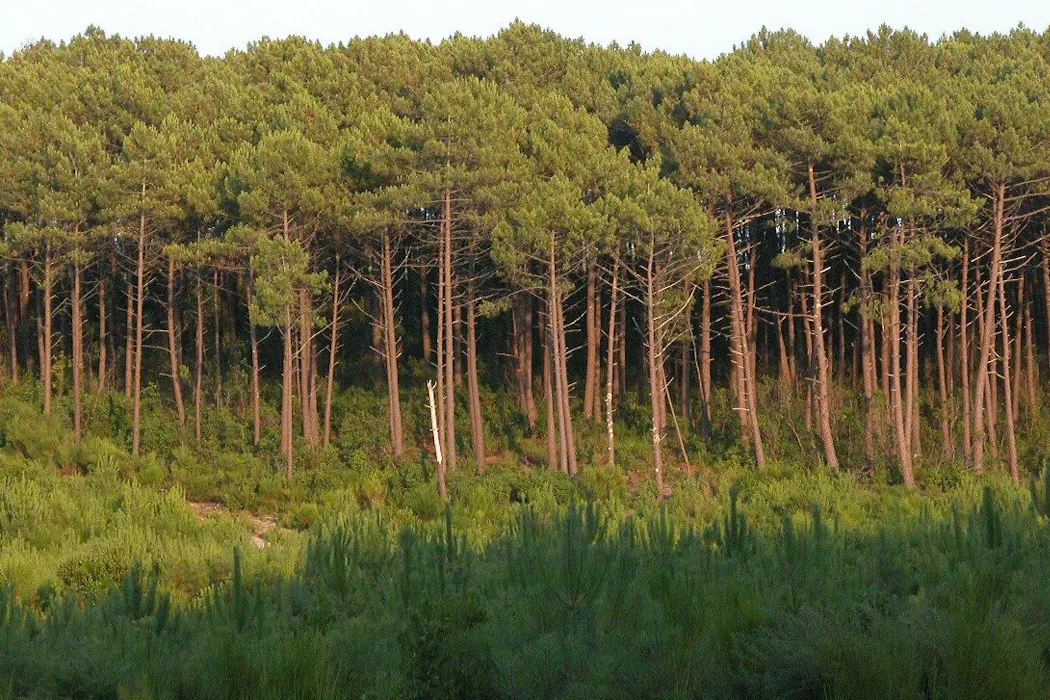
La forêt des Landes à La Teste-de-Buch (Gironde), en 2004. Larrousiney, CC BY
L’ESSENTIEL
Les forêts exploitées ne sont pas toujours des puits de carbone : elles peuvent parfois se retrouver à émettre plus de CO₂ qu’elles n’en stockent.
Pour connaître la tendance, il faut s’intéresser à l’évolution des végétaux, du sol forestier et à l’utilisation faite du bois prélevé sur le long terme.
Le pouvoir de séquestration de carbone de la forêt landaise semble mis à mal depuis le début des années 2000.
Les forêts sont souvent présentées comme un « poumon de la planète », et beaucoup d’espoirs reposent sur la filière forêt-bois pour compenser une partie des émissions humaines, comme en témoigne en France la Stratégie nationale bas carbone.
Les forêts sont en effet un important réservoir de carbone, puisque l’ensemble du carbone contenu dans les forêts et leurs sols est estimé à 714 gigatonnes de carbone (GtC), soit l’équivalent d’environ 80 % du carbone contenu dans l’atmosphère sous forme de dioxyde de carbone (CO₂).
Mais ce chiffre global agrège et aplatit le résultat de dynamiques locales, résultant elles-mêmes de décisions prises à des échelles régionales et plus globales.
La trajectoire carbone du massif des Landes de Gascogne est à ce titre des plus singulières. Elle mérite aujourd’hui toute notre attention. L’extension spectaculaire des plantations de pins au XIXᵉ siècle en a fait le plus vaste massif forestier planté d’Europe, mais face aux tempêtes, aux incendies et, plus généralement, au changement climatique, son fonctionnement est mis à rude épreuve depuis quelques décennies.
Il est ainsi probable que la filière forêt-bois se retrouve désormais à émettre plus de carbone qu’elle n’en stocke, dans le département des Landes. Comment en sommes-nous arrivés là ?
Le cycle de carbone de la forêt
Pour le comprendre, intéressons nous aux bases du fonctionnement du cycle du carbone. Une forêt, comme tout écosystème, peut être une source ou un puits de carbone. Une source de carbone désigne ici un environnement qui émet plus de carbone qu’il n’en stocke. Un puits de carbone, à l’inverse, est un environnement qui stocke plus de carbone qu’il n’en émet.
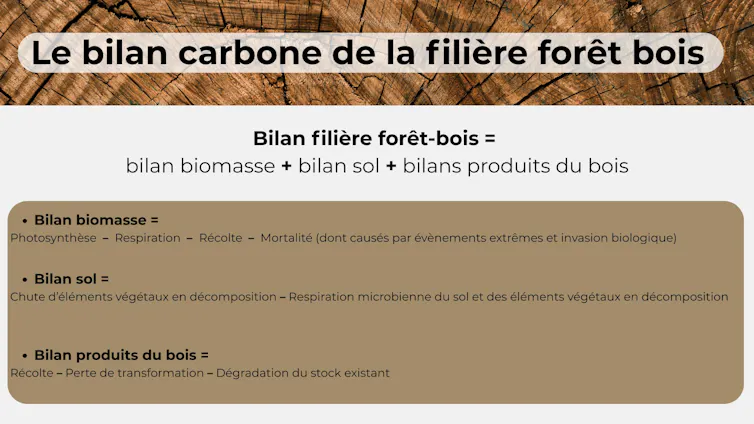
Pour savoir si la filière forêt-bois – c’est-à-dire la forêt et son système d’exploitation – représente un puits ou une source, on considère les bilans carbone de ses trois compartiments principaux : la biomasse, les sols et le bois prélevé dans la forêt.
Photosynthèse, respiration et mort des végétaux
Le compartiment de la biomasse correspond aux arbres, arbustes et autres végétaux qui pratiquent la photosynthèse et capturent ainsi du CO₂. Une partie de ce CO₂ est à nouveau libéré dans l’atmosphère lors de la respiration de ces mêmes végétaux.
QU’EST-CE QUE LA RESPIRATION ?
La photosynthèse permet aux plantes chlorophylliennes de capter du carbone atmosphérique. Ce CO₂, associé à de l’eau puisée par les racines dans le sol, va être transformé en sucres. Ces sucres vont ensuite être consommés par la plante pour produire de l’énergie, qui lui permettra de se développer. Lorsque les sucres sont transformés en énergie, l’arbre libère du CO₂ et de l’eau. C’est ce qu’on appelle la respiration de la plante.
Il faut également avoir en tête que, chaque année, des végétaux meurent ou bien perdent des branches, des feuilles, des racines. Ces végétaux morts vont alors, par leur décomposition, relâcher dans le sol le carbone qui est stocké dans leurs tissus. Le bois peut être récolté pour l’industrie ou l’artisanat, parfois après une tempête.
Dans ce cas, le carbone reste dans les différents produits du bois (construction, papier, énergie, chimie…). Lors d’un incendie, la combustion des végétaux renvoie le carbone dans l’atmosphère. Lors d’une attaque de ravageurs, le carbone peut être réparti dans différents compartiments, selon l’usage fait du bois.
Les sols forestiers, cruciaux mais oubliés
Le compartiment des sols est souvent moins bien connu du grand public. Pourtant la quantité de carbone qui y est stockée est souvent plus importante que celle que l’on trouve dans les arbres, arbustes et végétaux. Le carbone arrive dans les sols par les racines des plantes et par la chute des végétaux, branches et feuilles mortes.
Décomposés par des bactéries, champignons ou vers de terre, ils constituent la matière organique des sols. Le sol émet également du CO₂ à travers la respiration des racines et des organismes qui décomposent les végétaux morts.
Le devenir du bois peut tout changer
Le dernier compartiment est celui du bois prélevé dans le massif forestier et exploité pour un usage industriel ou artisanal. Pour calculer son bilan carbone, il faut regarder la différence entre le carbone constituant les objets lorsqu’ils sont fabriqués et le carbone émis lorsqu’ils sont détruits.
Le temps de résidence du carbone dans les objets est important à prendre en compte : plus l’objet est utilisé longtemps avant d’être détruit, plus le carbone reste longtemps hors de l’atmosphère.
Des cycles influencés par l’humain
Ces différents flux de carbone entre l’atmosphère, la biomasse, le sol et les produits en bois sont façonnés par des processus à la fois sociaux et écologiques. De fait, bien que la photosynthèse ou la dégradation du bois soient des processus en apparence naturels, ils sont influencés à de nombreux égards par des facteurs humains. L’efficacité de la photosynthèse dépend ainsi des essences d’arbres sélectionnés, de l’agencement spatial de la plantation, de l’âge moyen de la récolte, voire des apports d’engrais.
La décomposition de la matière organique du sol, la mortalité des arbres dépendent du climat, de la flore bactérienne et des évènements climatiques extrêmes, eux-mêmes modifiés par les activités humaines locales. La dégradation des objets en bois dépend des dynamiques socioéconomiques favorisant l’orientation vers des produits à durée de vie plus ou moins longue : le bois de construction tend à accumuler des stocks de carbone tandis que le bois-énergie utilisé comme combustible constitue un stock virtuellement nul.
Ainsi, ces facteurs humains, liés à des décisions économiques, politiques et à l’évolution de l’organisation de la société, influencent grandement les quantités de carbone absorbées et rejetées par les forêts et l’ensemble de la filière, c’est-à-dire l’évolution des stocks de carbone ou trajectoire carbone.
Cycle du carbone dans un massif forestier. Les flèches représentent le passage du carbone d’un compartiment à l’autre. Les processus par lesquels le carbone circule sont indiqués dans les rectangles aux angles arrondis. Revue Forestière française, Fourni par l’auteur
Le plus grand massif forestier de France
Qu’en est-il maintenant des forêts qui nous intéressent ?
Plus grand massif de France hexagonale, le massif des Landes de Gascogne concentre actuellement 5 % de la surface forestière française (16 % des conifères) et 9 % de l’extraction nationale de bois (19 % de l’extraction de conifères) sur seulement 2 % du territoire national. Il est constitué quasi exclusivement de monoculture de pin maritime (87 % en 2020) sur des terres à 90 % privées.
L’existence de séries statistiques anciennes, conservées aux archives départementales à Mont-de-Marsan, témoigne du caractère profondément historique, organisé et documenté de cette forêt et de son exploitation. Nous avons pu y trouver les données statistiques relatives à la filière forêt-bois dans le département des Landes (récoltes, surfaces plantées, essences d’arbres) depuis la seconde moitié du XIXᵉ siècle. Elles permettent de donner une image quantifiée des changements qui ont affecté l’histoire de ce massif.
Du pâturage aux pins
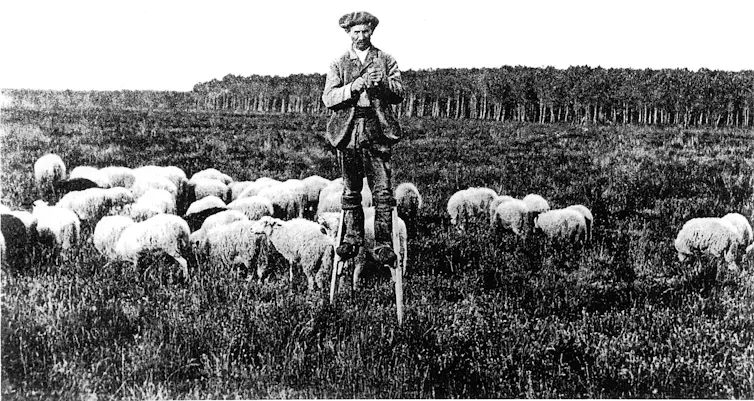
Jusqu’à la fin de la première moitié du XIXᵉ siècle, l’utilisation du territoire répondait aux besoins et activités de sa population locale : un modèle de pâturage extensif sur des terres communales entretenues par des paysans métayers permettait de fertiliser des cultures vivrières sur des étendues de landes et de pâtis.
Ce socio-écosystème a connu une transformation majeure avec la loi « relative à l’assainissement et la mise en culture », votée en 1857.
Cette loi oblige alors les communes des Landes, avec le soutien financier, administratif et humain de l’État, à planter des pins puis à vendre les terres communales plantées, qui sont ainsi privatisées. En trente ans, la superficie plantée en pin double quasiment, et l’organisation de la société change de façon rapide et brutale.
L’activité se déplace vers l’exploitation de la forêt, d’abord du bois, pour la fabrication de charbon de bois – dans lequel le stock de carbone est virtuellement nul, puisqu’il est aussitôt réémis par la combustion du charbon – puis de la résine des pins, pour la synthèse de différents produits (principalement, la térébenthine et la collophane…).
Du gemmage au charbon minier
L’extraction de résine, appelée gemmage, et sa transformation, deviennent ainsi les activités économiques principales des Landes vers 1880 et jusqu’à la Seconde Guerre mondiale.
Après 1880, la surface forestière continue d’augmenter progressivement jusqu’aux années 1930, et l’extraction de bois augmente en parallèle, tout en changeant d’usage. Il n’est plus utilisé pour produire du charbon de bois, mais pour soutenir les besoins de l’industrie du charbon minier, par exemple pour construire les galeries minières et les rails qui permettent de sortir le charbon de la mine. Ces nouveaux usages conservent le carbone dans le bois plus longtemps : leurs durées de vie sont alors de quelques décennies.
La Seconde Guerre mondiale cause une pénurie de main-d’œuvre dans les Landes, qui mène à une baisse d’entretien des parcelles forestières, ce qui favorise l’embroussaillement et la propagation d’incendies gigantesques, en 1940 et en 1949.
L’essor de la trituration
D’autre part, les produits issus de la pétrochimie remplacent progressivement les produits issus de la résine de pin, et l’activité de gemmage est progressivement abandonnée et remplacée par l’exploitation du bois pour un nouvel usage : la trituration, destinée à la fabrication de papier et de bois de placage.
Cette nouvelle activité change le mode d’exploitation forestière. Les plantations sont densifiées, les pins abattus plus jeunes, les nouvelles plantations s’accompagnent souvent de fertilisation azotée, les différentes étapes de l’exploitation forestière sont de plus en plus mécanisées.
Le gemmage est complètement abandonné au début des années 1970, définitivement supplanté par la papeterie et par l’industrie du bois d’œuvre, qui deviennent les activités économiques principales de la filière, occupant cependant une main-d’œuvre beaucoup plus faible.
Tempêtes, incendies et bois-énergie
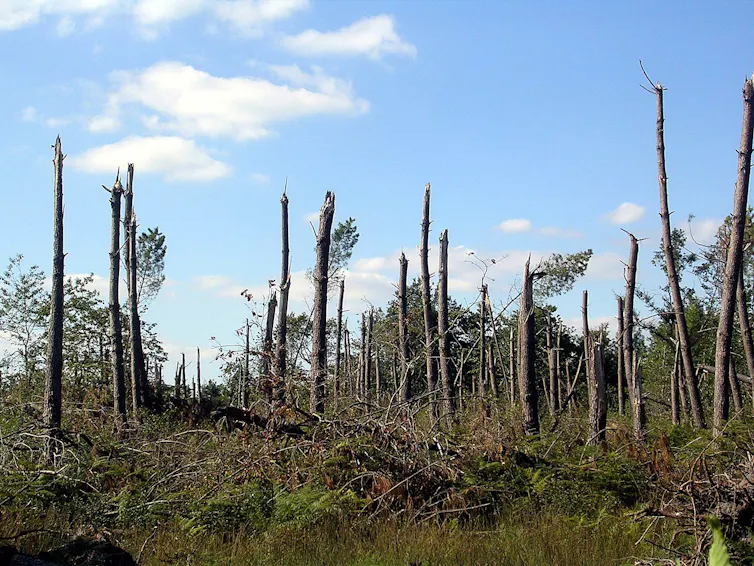
Les années 2000 marquent ensuite l’entrée dans une période de plus grande instabilité climatique, avec la répétition d’événements destructeurs. Les tempêtes de 1999 et 2009 affectent de vastes surfaces de forêt. Leurs conséquences sont visibles dans la hausse phénoménale de la récolte apparente du bois qui s’ensuit, utilisé rapidement et majoritairement pour la trituration. L’extraction du bois dans les années qui suivent diminue sensiblement, le temps que la biomasse se renouvelle. Les parcelles sont majoritairement replantées en pin.
La période qui suit la tempête Klaus (2009) est également marquée par le retour du bois-énergie pour le chauffage au bois, qui avait été abandonné depuis la fin de la production de charbon.
Dégâts de la tempête Klaus sur la forêt des Landes (2009). Jibi44, CC BY
Outre le développement des politiques dites « Climat-Énergie » qui ont favorisé le développement du bois-énergie en substitution des combustibles fossiles, cette reconversion partielle de la filière est une manière pour de nombreux exploitants forestiers de s’assurer un revenu à court terme dans le contexte post-tempête. On note aussi que les tempêtes auraient poussé certains propriétaires à commercialiser de nouvelles ressources, particulièrement les souches, pour l’industrie papetière.
Les incendies terribles qui ravagent les forêts des Landes et de Gironde, en 2022 et en 2026, ravagent à leur tour de vastes superficies du massif et modifient profondément son fonctionnement : à l’inverse du bois récolté après les tempêtes, le bois consumé lors des incendies ne peut plus être utilisé.
Chronique de 1850 à 2022 (a) des surfaces forestières du département des Landes ; (b) de l’extraction de bois de la forêt par type de peuplement (l’ampleur des grands incendies est également figurée) et (c) par destination de la récolte ; (d) de l’emploi lié à la filière forêt-bois dans le département des Landes. RFF, Fourni par l’auteur
Retracer les cycles passés
Ces éléments statistiques sur l’évolution de la forêt et des usages du bois nous ont permis de modéliser la trajectoire carbone de la filière dans les Landes, c’est-à-dire de retracer les tendances du bilan carbone au cours de ces différentes périodes.
Au cours de la période d’établissement du massif forestier (1850-1880), celui-ci agit logiquement comme un accumulateur de carbone, tant dans la biomasse en place que dans la matière organique du sol. Dans un second temps (1880-1940), l’augmentation du stock d’objets en bois, notamment pour l’industrie et le bois d’œuvre, contribue au stockage de carbone dans la filière bois – davantage d’ailleurs que la biomasse du massif elle-même, qui stocke un peu moins de carbone qu’auparavant.
La période de prédominance du bois d’œuvre et de la papeterie (1940-début des années 2000), le modèle montre que la forêt est dense et très productive, et que cela s’accompagne d’un important stockage de carbone. Cette accumulation du carbone dans la biomasse est surprenante au premier abord, car, dans la même période, les prélèvements de bois totaux et par hectare augmentent.
Notre approche de modélisation permet d’estimer qu’un tel stockage ne peut s’expliquer que par une accélération de la vitesse de croissance de la biomasse, pouvant être due à différents facteurs : sélection d’essences à croissance rapide, mais aussi changements environnementaux propices à la croissance (pouvoir fertilisant de la hausse des concentrations atmosphériques en CO₂ ou des dépôts atmosphériques d’azote).
De puits à source de carbone
Mais depuis le début des années 2000, notre modélisation suggère que le pouvoir de séquestration de carbone de la forêt landaise s’effondre : tant le sol que la biomasse émettent plus de carbone qu’ils n’en absorbent de l’atmosphère, en lien avec cette période de plus grande instabilité climatique (combustion de bois et extraction massive).
Le carbone stocké dans les objets suit, lui-même, une trajectoire incertaine : le changement progressif des usages du bois, depuis les tempêtes, d’objets au potentiel de stockage fort vers d’autres où le carbone réside moins longtemps, comme le papier ou le bois-énergie, fait que ce stock d’objets commence également depuis les années 2010 à émettre plus de carbone qu’il n’en absorbe.
Bilan carbone des trois compartiments principaux de la filière. Une valeur positive indique un stockage sur la période et un chiffre négatif une émission. RFF, Fourni par l’auteur
Quelle alternative durable ?
L’augmentation historique de la surface forestière du massif des Landes n’est donc pas une garantie d’un stock de carbone pérenne. Au contraire, cette approche de modélisation permet de mettre en lumière le fait que l’accroissement du stock de bois sur pied s’est progressivement accompagné d’une hausse de son extraction, qui tend à maximiser la production à un niveau proche des limites de la capacité biologique du milieu.
Ainsi, nos recherches montrent que, si dans un premier temps, la mise en place d’une vaste plantation forestière peut s’accompagner d’un accroissement des stocks de carbone, capable d’atténuer le réchauffement climatique, le niveau d’extraction du milieu forestier est trop intensif pour permettre à la forêt de jouer longtemps ce rôle de puits de carbone, sans même parler du puits de carbone non réalisé en l’absence d’une gestion plus durable de la forêt. Face à l’ampleur des dérèglements climatiques en cours, la fragilité de ce stock de carbone est révélée.
Cette modélisation suggère que, pour la première fois de son histoire, le massif forestier landais contribue positivement à l’accroissement de l’effet de serre. Les incendies de 2022 et de 2026 qui ravagent les forêts des Landes et de Gironde en sont un marqueur de plus. La combustion entraîne d’importantes émissions de carbone vers l’atmosphère tandis que le bois calciné ne peut plus assurer sa fonction de photosynthèse et sert encore, tout juste, à produire du charbon de bois.
Ces résultats suggèrent que c’est la nature même de l’exploitation de cette forêt qui se trouve remise en cause par les événements climatiques de ces dernières décennies.
Des alternatives durables existent et permettraient de rendre la forêt plus résiliente. Des forêts multispécifiques, gérées sur des cycles de récoltes longs, favorisent par exemple le stockage du carbone dans la biomasse sur pied. La réorientation de la filière vers des objets à longue durée de vie est aussi une piste prometteuse pour accroître les stocks de carbone dans les produits manufacturés du bois.
Les solutions existent, leur mise en œuvre est nécessairement complexe et implique une concertation entre différents acteurs et des arbitrages entre différents intérêts.
La thèse de Thérèse Rabotin bénéficie d’un financement MITI pour projets interdisciplinaire du CNRS.
Julia Le Noë a reçu des financements du projet MOBIDYC (ANR-23-ERCB-0006-0) gérée par l’Agence Nationale de la Recherche ainsi que des projets SLAM-B (ANR-22-PEXF-0003) et PREFALIM (ANR-23-PEXF-0004) du PEPR exploratoire FairCarboN et a bénéficié d’une aide de l’État gérée par l’Agence Nationale de la Recherche au titre de France 2030 portant la référence ANR.
Gilles Billen ne travaille pas, ne conseille pas, ne possède pas de parts, ne reçoit pas de fonds d’une organisation qui pourrait tirer profit de cet article, et n’a déclaré aucune autre affiliation que son organisme de recherche.
Boutons à gauche, boutons à droite : l’histoire méconnue d’une vieille convention vestimentaireKristina Chuprina/Pexels, CC BY
L’emplacement des boutons sur les vêtements masculins et féminins est l’un de ces héritages du passé qui ont survécu à la mécanisation de l’industrie textile. Une convention devenue si banale que l’on en a oublié l’origine.
Imaginez que vous êtes dans un magasin de vêtements proposant des articles pour toute la famille. Vous prenez une chemise blanche à boutons pour l’essayer. Le modèle est très sobre. A-t-elle été conçue pour être portée par une femme ou par un homme ?
Un détail peut vous mettre sur la piste : sur de nombreuses chemises pour femmes, les boutons sont cousus à gauche, tandis que sur les chemises pour hommes, ils se trouvent généralement à droite. Les fermetures éclair des pantalons et des vestes suivent parfois la même logique.
Mais pourquoi les vêtements ne se ferment-ils pas du même côté selon qu’ils sont destinés aux hommes ou aux femmes ? Les spécialistes de la mode et les historiens comme nous se penchent depuis longtemps sur cette différence entre les sexes. La réponse tient en grande partie aux traditions, à l’histoire et à la manière dont les vêtements étaient confectionnés autrefois. Même un détail aussi anodin qu’une fermeture Éclair peut raconter une histoire du passé.
Les vêtements sont pleins d’histoires cachées
Aujourd’hui, lorsqu’on regarde un vêtement, on pense surtout à sa couleur, à son confort ou à son style. Mais les vêtements font aussi partie de ce que les historiens appellent la culture matérielle, c’est-à-dire l’ensemble des objets du quotidien utilisés par les sociétés. L’étude de cette culture matérielle permet de mieux comprendre la manière dont les gens vivaient, travaillaient et pensaient autrefois.
Les systèmes de fermeture, comme les boutons ou les fermetures Éclair, ne sont pas seulement des éléments pratiques. Ils s’inscrivent aussi dans des traditions de conception qui, au fil des siècles, se sont associées à des différences entre les vêtements masculins et féminins.
L’une des explications les plus courantes à la présence des boutons de part et d’autre selon le sexe remonte à l’histoire de la mode européenne. Il y a plusieurs siècles, les femmes de la noblesse portaient souvent des robes complexes, ornées de nombreux boutons et systèmes de fermeture, si sophistiquées qu’elles avaient besoin d’aide pour s’habiller.
Selon certains historiens, les boutons étaient placés de manière à faciliter le travail des domestiques chargés d’habiller leur maîtresse, un détail qui reflétait les distinctions sociales de l’époque.
Environ 90 % des personnes sont droitières. Lorsqu’une femme de chambre se tenait face à une noble pour l’habiller, des boutons placés sur le côté gauche du vêtement étaient idéalement positionnés pour être manipulés de la main droite, sa main dominante. Faites l’essai en boutonnant la veste d’un ami ou d’une peluche en lui faisant face : on comprend immédiatement pourquoi cette disposition facilitait tant le travail des domestiques.
Les hommes, en revanche, s’habillaient généralement seuls. Leurs chemises, pantalons et uniformes étaient donc conçus pour être fermés facilement par celui qui les portait, avec des boutons placés à droite afin de pouvoir les manipuler naturellement de la main droite.
Les vêtements masculins étaient avant tout conçus en fonction d’impératifs de praticité et de fonctionnalité. Certains historiens avancent également que les traditions militaires ont pu influencer l’emplacement des boutons. Les hommes portaient souvent leur épée sur le côté gauche et la dégainaient de la main droite. Le sens de fermeture des vestes, des chemises et des pantalons aurait ainsi permis d’éviter que le tissu ne s’accroche à l’arme ou ne gêne le mouvement.
Les habitudes de la mode ont la vie dure
Lorsque les vêtements ont commencé à être fabriqués en usine au début du XIXe siècle, les marques ont eu besoin de modèles standardisés. Les chaînes de production fonctionnent plus efficacement lorsque les patrons sont uniformisés. Les traditions concernant l’emplacement des boutons ont donc été conservées, même lorsque leur origine est tombée dans l’oubli.
Lorsque les fermetures Éclair se sont popularisées au début du XXe siècle, les fabricants de vêtements ont simplement repris les mêmes conventions de fermeture pour les modèles masculins et féminins. Plutôt que d’inventer de nouvelles règles, ils ont conservé les schémas hérités des boutons. C’est pourquoi les fermetures Éclair suivent souvent le même « sens » que les anciens systèmes de fermeture.
Aujourd’hui, de plus en plus de marques proposent des vêtements unisexes ou non genrés conçus pour être portés par tout le monde, et nombre de créateurs ne respectent plus la vieille règle des boutons à gauche pour les femmes et à droite pour les hommes. Après tout, il ne s’agit que d’une convention vestimentaire : rien n’impose que les boutons ou les fermetures Éclair soient placés différemment selon le sexe.
Il est désormais tout à fait admis de s’affranchir de ces anciennes conventions. Si vous confectionnez vos propres vêtements, libre à vous de placer les systèmes de fermeture – boutons, fermetures Éclair, pressions, liens, bandes autoagrippantes (Velcro) ou même un dispositif inédit de votre invention – où bon vous semble.
Les auteurs ne travaillent pas, ne conseillent pas, ne possèdent pas de parts, ne reçoivent pas de fonds d’une organisation qui pourrait tirer profit de cet article, et n’ont déclaré aucune autre affiliation que leur organisme de recherche.
Élever des adolescents peut être difficile, même dans les meilleures conditions. Pour certaines familles, les défis sont encore plus grands. Elles doivent faire face à la pauvreté, au chômage, aux conflits, aux déplacements forcés, aux maladie et aux chocs climatiques. Dans ces conditions, les parents et tuteurs peuvent eux-mêmes ne bénéficier que d’un soutien très limité.
Les gouvernements et les ONG ont de plus en plus recours à des programmes d’accompagnement parental dans le cadre de leurs efforts visant à réduire la violence envers les enfants et à améliorer le bien-être des adolescents. Ces programmes aident les parents et les adolescents à renforcer leurs liens, à mieux communiquer, à résoudre ensemble les problèmes et à gérer les conflits. Ils sont généralement dispensés en petits groupes, au cours de plusieurs séances hebdomadaires animées par des facilitateurs formés.
De nombreux programmes d’accompagnement parental sont d’abord testés dans le cadre d’études rigoureuses. Les familles sont réparties de manière aléatoire entre le groupe bénéficiant du programme et un groupe témoin. Cela permet de déterminer si le programme est bien la cause réelle des améliorations observées. Ces essais se déroulent généralement dans des conditions soigneusement contrôlées.
En tant que chercheuses spécialisées dans les programmes de soutien parental, nous souhaitions répondre à une question importante : un programme de soutien parental qui donne de bons résultats dans le cadre d’une étude scientifique soigneusement contrôlée peut-il encore bénéficier aux familles lorsqu’il est mis en œuvre à grande échelle par les services habituels des pouvoirs publics et des ONG ?
Notre récente étude a cherché à répondre à cette question dans huit pays africains.
Nos conclusions
Plutôt que de mener une nouvelle expérience, nous avons analysé les données recueillies dans le cadre de la mise en œuvre à grande échelle de ces programmes. Nous avons rassemblé des informations provenant de plus de 120 000 adolescents et personnes en charge d’enfants dans ces huit pays.
Nous avons également examiné comment les expériences des familles avaient évolué après leur participation à un programme. Ces programmes ont été mis en œuvre par les services publics et les ONG qui existent au Botswana, en République démocratique du Congo, en Eswatini, en Afrique du Sud, au Soudan du Sud, en Tanzanie, en Zambie et au Zimbabwe. Ces pays offraient des contextes très variés.
Nous avons observé des améliorations constantes en matière de pratiques parentales, de santé mentale et de prévention de la violence. Dans les huit pays, les personnes en charge des adolescents et ces derniers ont fait état d’une diminution des niveaux de violence physique et émotionnelle après avoir participé au programme.
Nous avons également constaté des améliorations dans les pratiques parentales, notamment une implication plus positive et une meilleure supervision des adolescents. Les parents ont signalé moins de stress parental lié à leur rôle et moins de symptômes dépressifs. De même, les adolescents ont déclaré une amélioration de leurs symptômes dépressifs et de leurs problèmes comportementaux.
Il est important de constater que ces programmes peuvent faire la différence dans des conditions réelles, car les interventions qui fonctionnent bien dans le cadre d’études de recherche perdent souvent de leur efficacité lorsqu’elles sont transposées dans la prestation de services courants.
Programmes de soutien parental
Les programmes de soutien parental varient, mais beaucoup partagent une approche similaire. Les programmes « fondés sur des données probantes » ont fait l’objet d’évaluations rigoureuses et des recherches ont démontré qu’ils amélioraient le bien-être pour les enfants et les familles.
Il s’agit de programmes pratiques, axés sur l’acquisition de compétences. Ils aident les parents et les adolescents à mieux communiquer, à gérer les conflits au sein du foyer et à réduire le recours aux punitions sévères. Ils favorisent également l’établissement de relations plus solidaires.
Les séances peuvent inclure des jeux de rôle, des activités de résolution de problèmes ou des discussions portant sur le stress, la pression exercée par les pairs et les finances familiales.
Il est important de noter que ces programmes ne visent pas à promouvoir une « parentalité parfaite », ni à rejeter la faute sur les parents. De nombreuses familles élèvent leurs enfants dans des conditions extrêmement difficiles, avec un soutien très limité.
Le programme que nous avons étudié, Parenting for Lifelong Health for Teens, a été développé en collaboration avec l’Organisation mondiale de la santé et l’Unicef. Il a d’abord été testé en Afrique du Sud avant d’être adopté par les services gouvernementaux et les ONG dans plusieurs pays africains. Il a également été mis en œuvre en Asie du Sud-Est et en Amérique latine.
Pourquoi le passage à grande échelle est difficile
L’extension des programmes implique parfois de les mettre en œuvre avec moins de ressources, moins de supervision ou davantage d’interruptions. Le personnel peut présenter des niveaux de formation et de soutien variables. Dans les contextes humanitaires, les conflits, les épidémies ou les catastrophes climatiques peuvent perturber la mise en œuvre.
C’est pourquoi nous avons cherché à comprendre si les programmes d’éducation parentale restaient utiles dans ces conditions réelles.
Les programmes étudiés dans notre enquête ont été mis en œuvre dans des contextes très différents. Certains se sont déroulés dans des zones touchées par des conflits et des déplacements de population, notamment dans certaines régions du Soudan du Sud et de la République démocratique du Congo.
D’autres ont été mis en œuvre pendant les confinements liés à la COVID-19. Au Botswana, en Afrique du Sud et au Zimbabwe, la mise en œuvre s’est faite par téléphone et via WhatsApp. La connectivité Internet limitée et l’accès restreint aux données ont souvent constitué un obstacle.
L’étude s’est principalement concentrée sur les adolescentes et leurs figures d’attachement, car bon nombre des programmes de services à plus grande échelle étaient conçus pour soutenir les filles confrontées à des risques liés à la violence, au VIH et à la vulnérabilité sociale.
Nos conclusions
Dans l’ensemble, les scores mesurant les maltraitances physiques ont diminué d’environ deux tiers après la participation au programme, même si l’ampleur de ce changement variait selon les pays et les contextes. Nous avons observé des changements positifs dans beaucoup de situations, qu’il s’agisse des communautés touchées par un conflit ou des situations de pandémie.
La violence psychologique et l’acceptation des châtiments corporels ont également diminué dans tous les pays.
Nous avons observé des tendances similaires dans les témoignages des personnes en charge des adolescentes et de ces dernières. C’est un résultat important car il montre que les effets observés ne se limitent pas au point de vue d’un seul groupe.
Nous avons également constaté des différences substantielles entre les pays en ce qui concerne les niveaux de référence de la violence, des troubles de santé mentale et du stress familial. Ce rappelle qu’il n’existe pas de « contexte africain » unique, et les programmes doivent s’adapter à des réalités sociales et économiques très différentes.
Pourquoi est-ce important ?
Dans de nombreux pays africains, la prévention de la violence, la santé mentale et le soutien aux familles sont encore abordés séparément dans les politiques publiques. Or, les relations familiales quotidiennes sont au coeur de ces trois enjeux. Le soutien parental est de plus en plus reconnu comme un moyen de prévenir la violence.
Nos résultats suggèrent qu’aider les personnes en charge des enfants et les adolescents à construire des relations plus solidaires peut améliorer le bien-être et la sécurité.
Notre étude présente certaines limites. Nous ne pouvons pas conclure que le programme était la seule cause des améliorations observées. Cependant, la cohérence des résultats d’un pays à l’autre, d’une organisation à l’autre et d’un groupe de participants à l’autre suggère que les programmes de soutien parental fondés sur des données probantes peuvent être utiles lorsqu’ils sont déployés à grande échelle dans des conditions difficiles.
Ces dernières années, les gouvernements du monde entier se sont engagés à prévenir la violence à l’encontre des enfants. Ce n’est qu’une première étape. Les gouvernements ont également besoin d’approches pratiques, adaptables et réalistes, pouvant être mises en œuvre par le biais des systèmes existants. Nos résultats suggèrent que le soutien parental fondé sur des données probantes peut constituer l’une de ces approches.
///
Inge Vallance travaille à l’Université d’Oxford. Son poste est financé par des fonds de recherche externes, notamment des subventions qui ont soutenu les travaux de recherche présentés dans cet article. Elle n’a aucun intérêt financier dans le programme Parenting for Lifelong Health.
Genevieve Haupt Ronnie travaille à l’Université du Cap. Son poste est financé par des fonds de recherche externes, notamment des subventions qui ont soutenu les travaux de recherche présentés dans cet article. Elle n’a aucun intérêt financier dans le programme Parenting for Lifelong Health.
Source: The Conversation – (in Spanish) – By Juan Carlos Velasco, Profesor de Investigación. Grupo "Filosofía Social y Política" (FISOPOL). Jefe del Departamento de Filosofía Teórica y Práctica, Instituto de Filosofía (IFS-CSIC)
RTVE
En el tablero de la geopolítica contemporánea, los migrantes han dejado de ser únicamente personas que buscan un futuro mejor para convertirse, en no pocas ocasiones, en instrumentos de presión utilizados no solo por actores estatales. La utilización de movimientos de población –propios o foráneos– como palanca estratégica revela una realidad incómoda: las crisis migratorias no son siempre fenómenos espontáneos. Detrás de los cruces masivos de fronteras hay decisiones políticas, cálculos diplomáticos y desigualdades globales que convierten el sufrimiento humano en moneda de cambio internacional.
En distintos puntos del mundo, ciertos movimientos de población, sobre todo cuando se producen de manera masiva y en un corto periodo de tiempo, han sido utilizados no tanto para conquistar territorio, sino para enviar mensajes políticos, forzar negociaciones o desestabilizar al vecino. Esta instrumentalización no es la única clave explicativa, pero ayuda a comprender por qué las fronteras, lejos de ser meras líneas de demarcación jurisdiccional, se transforman en escenarios de confrontación y negociación entre Estados.
Ceuta, un pulso local con relevancia global
En este contexto, Ceuta y Melilla ocupan un lugar singular. Son las únicas fronteras terrestres de la Unión Europea con África y constituyen enclaves europeos en territorio marroquí sometidos a un régimen jurídico excepcional. Su particular configuración las convierte en espacios especialmente sensibles a las tensiones políticas y diplomáticas. Se trata de dos localidades rodeadas de algunos de los sistemas de vallados más sofisticados del mundo, con un control cotidiano de extrema dureza y fronteras físicamente muy cerradas.
También en el plano jurídico reina la confusión. Aunque en Marruecos circula la idea de que pisar suelo ceutí abre automáticamente la puerta a Europa, la normativa española y comunitaria es inequívoca. La entrada irregular en los enclaves no permite viajar a la Península sin controles documentales estrictos. Esta ambigüedad, alimentada a veces de manera interesada, facilita que los flujos migratorios se utilicen como mecanismo de presión en momentos de fricción bilateral.
Los episodios de mayo de 2021 y julio de 2026 ilustran esta dinámica con claridad. En 2021, unas 10 000 personas cruzaron la frontera en apenas 48 horas. Aquel ingreso masivo se produjo en un contexto de tensión diplomática por la acogida de Brahim Gali, líder del Frente Polisario, para ser atendido de coronavirus en un hospital de Logroño. El número de migrantes que entraron a Ceuta desde el 30 de julio de 2026 se eleva a 72 000. Desde esa fecha se han contabilizado 77 autopsias a cuerpos hallados en el mar. La ONG Caminando Fronteras cifra en 141 los fallecidos
El acuerdo UE–Turquía de 2016 es un ejemplo paradigmático de cómo la externalización del control fronterizo genera vulnerabilidades estratégicas. Ankara utilizó a los refugiados como palanca de negociación y logró generosas contrapartidas monetarias a cambio de frenar su flujo hacia la UE. Ese precedente ayudó a consolidar un sistema de extorsiones sistematizado. Los estados vecinos aprendieron que abrir o cerrar el grifo migratorio es una herramienta de negociación poderosa. Delegar el control crea puntos de presión que esos países saben explotar.
Detrás de estas maniobras geopolíticas se oculta un coste humano devastador, a menudo silenciado por los análisis geopolíticos. Las decisiones tomadas en despachos lejanos se traducen, en última instancia, en vidas perdidas. Los migrantes, aun cuando fueran conscientes de que son utilizados para intereses espurios, carecen de alternativas reales. La falta de oportunidades y de vías legales empuja a muchas personas migrantes a asumir riesgos extremos, convirtiéndolos en el eslabón más frágil de un sistema que los instrumentaliza.
La tragedia de este mismo verano revela la dimensión humana de estas estrategias y cuestiona que la cooperación económica sea suficiente para garantizar sólidas relaciones de apoyo entre estados.
España, atrapada en una bisagra geopolítica
Este escenario se inscribe en un marco europeo marcado por un giro sostenido hacia la securitización. Desde comienzos del siglo XXI, España ocupa una posición singular en la política migratoria de la Unión. Su condición de frontera exterior, ubicada además en la línea geopolítica y geoeconómica que separa el Norte y el Sur global, la sitúa en el punto de colisión de dos lógicas: la securitaria, que prioriza la vigilancia, la contención y la externalización; y la humanitaria, que insiste en que la migración es un fenómeno estructural que exige protección y derechos.
El fortalecimiento de Frontex (el organismo de la Unión Europea encargado de proteger sus fronteras exteriores) y la expansión de las políticas de externalización han desplazado el centro de gravedad de la acción comunitaria. La prioridad ya no es la solidaridad interna, sino evitar que los flujos lleguen a territorio europeo. Para España, esto implica una creciente dependencia operativa de las estructuras europeas y una presión política para alinearse con la narrativa del “control eficaz”, lo que reduce su margen de actuación autónoma.
Ceuta y Melilla funcionan, en este sentido, como laboratorios a pequeña escala de la política fronteriza europea: allí se ensayan y se hacen visibles las tensiones entre control, externalización y derechos.
El posicionamiento de los socios europeos influye de manera decisiva en esta ecuación. Los Estados del norte y del este tienden a reforzar la securitización, mientras que los países del sur reclaman corresponsabilidad y mecanismos de reparto que reconozcan la carga diferencial que soportan las fronteras exteriores. España ocupa una posición bisagra: es frontera exterior y, por tanto, actor securitario; es país mediterráneo y, por tanto, actor solidario; es socio europeo y, por tanto, actor condicionado; y es potencia regional, lo que la convierte en actor negociador.
La tensión entre securitización y solidaridad no es un dilema pasajero, sino una estructura permanente de la política migratoria europea. En ella, España debe equilibrar la gestión de la frontera con la preservación de los principios democráticos y humanitarios que sustentan su acción exterior, consciente de que la forma en que responda a estos desafíos definirá no solo su relación con Marruecos, sino también la naturaleza del proyecto europeo en su conjunto.
Juan Carlos Velasco no recibe salario, ni ejerce labores de consultoría, ni posee acciones, ni recibe financiación de ninguna compañía u organización que pueda obtener beneficio de este artículo, y ha declarado carecer de vínculos relevantes más allá de sus funciones como Investigador Principal del Proyecto “Desigualdades, privilegios y justicia global – PRIVILEGIA” (PID2022-136448OB-I00), financiado por el Plan Estatal de I+D del Ministerio de Ciencia, Innovación y Universidades.