
Source: The Conversation – Africa – By Timothy Clack, Chingiz Gutseriev Fellow, University of Oxford
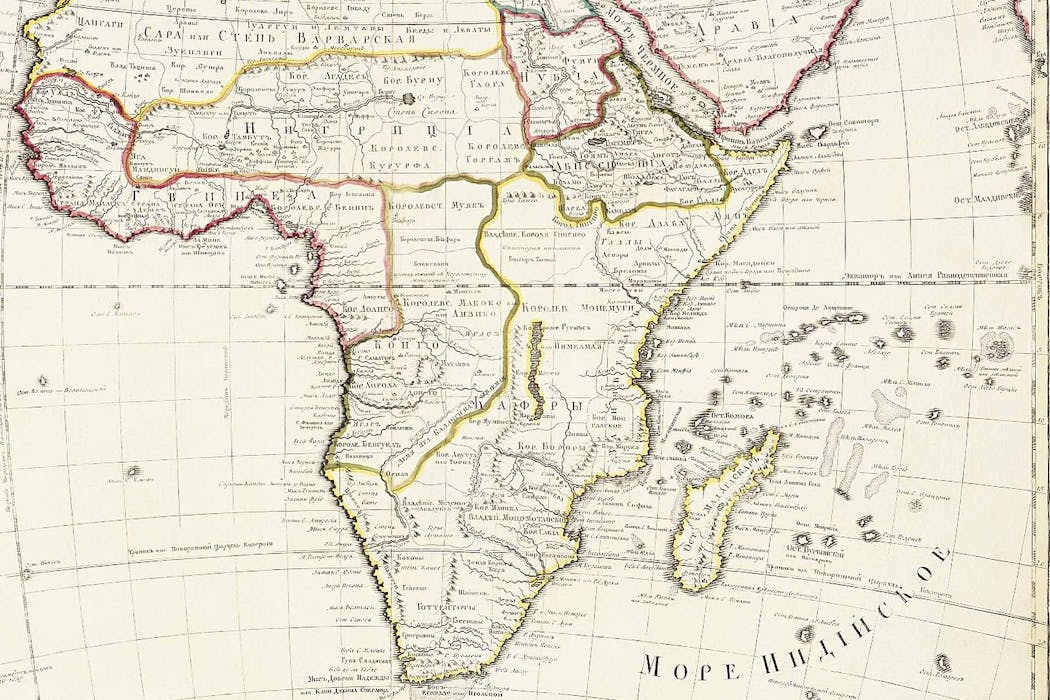
Colonialism has been a central part of history around the world, differing only in form over time and space. After all, whenever people have moved from one place to another, they have colonised spaces and other people or forms of life.
In Africa, colonialism has mostly been studied as something imposed from outside, for example from Europe in the 19th and 20th centuries. A recent special issue of the journal Azania sought to address this. Scholars looked at the topic from an angle that’s so far been neglected – the archaeology and history of colonialism from within Africa.
We introduced the journal issue with an essay revisiting basic ideas, reviewing literature and presenting new case studies.
We note, for example, that colonialism has a deep and complex history. There have been different kinds and degrees of colonialism. These range from expansion, trade, exchange and sharing cultural practices to settlement, domination, exploitation, control and imperialism.
These developments have taken place in a myriad of different settings. From Mesopotamia, Ancient Egypt, Phoenicia, Classical Greece and Rome, and China, to multiple locations in the Americas, including the Inka and the Aztecs, and Europeans, especially after 1492.
Global and local factors shape distinctive patterns of power, subjugation, consumption, extraction, exploitation and cultural exchange through time.
Important questions emerge when this is recognised. Examples include:
-
what historical justice looks like
-
which episodes get remembered and forgotten
-
which victims are ignored or compensated
-
which colonisers face consequence.
Colonialism from outside
In the 19th and 20th centuries, during the the so-called “Scramble for Africa”, seven European countries colonised almost the whole of the continent. The signatures left behind by Belgium, Britain, France, Germany, Italy, Portugal and Spain were wide and varied. They included:
-
drawing national boundaries
-
infrastructure geared towards extraction (like megaports, railways and roads)
-
administration (like bicameral governments, courts and churches)
-
defence (military structures and installations).
European colonialism even shaped the way most of us perceive the world via the instruments used to map time and space.
Earlier, large parts of Africa were colonised by Ottoman and Arab empires. Oman, for example, colonised the Swahili coast in the 18th and 19th centuries across a territory extending from areas of Somalia through to Madagascar.
Parts of Africa which had previously been under Islamic rule, in turn, experienced European colonialism differently. This had long-term implications for education, health and economic growth.
Taken together, these legacies, over time, developed into global organising principles for imagining Africa.
But this formulation ignores African agency and political processes. It is often forgotten, for example, that the Almoravids, a dynasty which rose to power in southern Morocco during the 11th century, exerted control over European soil. Africans have been colonisers too.
Colonialism from within
Africa has also experienced diverse colonial episodes from within. Examples include empires such as Egypt and Kush in north Africa, and Dahomey and Songhai in west Africa.
Rulers of these empires sought to annex territories, establish settlements, subjugate others, control resources and impose laws and customs. The archaeological indications of these can be seen in a number of ways. They include new settlement types, changes in material culture and the adoption of new languages and religions, particularly Islam and Christianity.
Resistance to colonialism is also visible in the historical record and expressed in many ways. This included insurgencies, protests and propaganda as well as myth, art, music, literature and non-cooperation.
In the 19th century, Shaka, for example, transformed a small Zulu chieftainship in southern Africa into an aggressive and successful state that absorbed neighbouring groups. The aftershock of the Zulu expansion was the Mfecane. This was a process that saw leaders establish their own polities. Soshangane, for instance, was a Ndwandwe general defeated by Shaka who established the Gaza state in contemporary Mozambique. It incorporated in it both Shona and Tsonga people.
Another example comes from the Mursi of south-western Ethiopia. They undertook several large-scale migrations over the past 200-300 years. This movement became part of their group identity. They displaced, assimilated and dominated other populations. The material traces they left have been explored by archaeological research. This has helped to interpret their activities, and also challenges their oral histories.
Cultural exchange and innovation
Colonialism is a generative process, with innovation emerging from cultural contact, relationships between colonisers and colonised, and material exchange.
Colonial processes have multi-directional influence. European colonialism, for example, shaped how Europeans dealt with the rest of the world. And, in turn, it contributed to how the western world was constructed. Ideas and materials flowed into the metropolitan centres of Europe as much as from them. In certain respects, Britain was colonised through contact with, for example, Africa, Australasia and North America, as much as those areas were colonial creations.
Colonialism often creates victims and oppressors. But it is also about consumption, innovation and exchange.
Archaeology offers a useful way to study colonialism because it leaves material and intangible indicators which the discipline has methods to interpret.
There is a need for more work on the processes and character of colonialism within Africa. This will enable comparisons and understanding, and correct a skewed picture of world history. A richer understanding of colonialism, including neocolonialism, may also inform debates about its legacy, and about decolonisation and restitution.

Timothy Clack receives research funding from the Arts and Humanities Research Council (AHRC), British Academy, British Institute in Eastern Africa (BIEA), Christensen Fund, McDonald Institute for Archaeological Research, Natural Environment Research Council (NERC), Royal Anthropological Institute, and University of Oxford.
Shadreck Chirikure receives funding from the British Academy, UKRI, the University of Oxford, the University of Cape Town, the National Research Foundation of South Africa, and the Royal Society.
– ref. Colonialism in Africa: archaeology offers a deeper view – https://theconversation.com/colonialism-in-africa-archaeology-offers-a-deeper-view-275495