
Source: The Conversation – UK – By David Harnesk, Associate Professor, Sustainability Science, Lund University
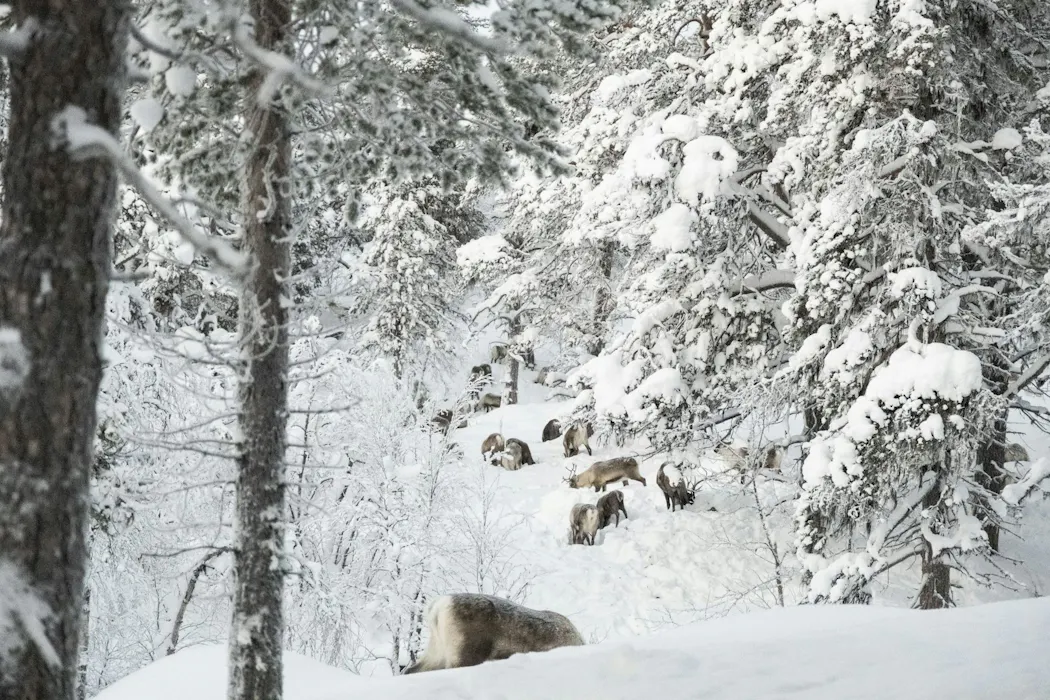
Political debates about the future of forests in Sweden and the EU are reaching an impasse. Producing more wood comes at the expense of nature and the storage of carbon within trees and soils. Conserving and restoring more forests may limit commercial wood production.
But it is important for both economists and conservationists to recognise how these forests support reindeer (Rangifer tarandus tarandus). This species evolved in conjunction with the natural dynamics of boreal forest ecosystems in northern Fennoscandia – an area covering the Scandinavian peninsula, mainland Finland, Karelia and the Kola peninsula.
Boreal forests are coniferous woodlands that encompass most of the northern regions of the planet. These cold regions tend to be scarcely populated.
In northern Sweden, boreal forests play a critical role in the livelihoods and cultural practices of the Indigenous Sámi people, especially reindeer pastoralism. Sámi reindeer-herding communities hold grazing, customary and Indigenous rights to these forests and other areas.
Reindeer herders and their herds are usually divided into winter groups to graze with their herds as efficiently as possible. While each Sámi reindeer herding community has its own ecological conditions and decision-making processes, intact boreal forest ecosystems enable reindeer to survive snow periods when food sources are in short supply.
The wellbeing of reindeer that evolved in northern Fennoscandia is linked to the health of boreal forests. Ground lichens and hanging-tree lichens are a major part of reindeer’s winter diet. These lichens thrive in forests associated with a high influx of light and limited availability of nutrients that the northern climate and recurring forest fires have historically created.
Forest degradation
But in northern Fennoscandia, about 90% of forests have been managed – mostly by a few state and private organisations – using rotation forestry to increase wood production. This involves cutting down almost all trees in an area, intensely disturbing the soil, then replanting trees close together. This has radically transformed these forest landscapes since the 1950s.

Elle Eriksson, CC BY-NC-ND
While increasing wood production, intact boreal forests and the valuable ecosystems associated with them have been lost. There are also now fewer forest fires. This results in dense, young forests that don’t support healthy growth of lichen and movement of reindeer herds.
When food is scarce and fragmented, the wellbeing of reindeer is threatened. The 71% decline in the area of lichen-abundant forests over the last 60 years is compounded by climate change. The increased rainfall on snow, for example, contributes to the creation of ice formations that block reindeer from accessing the remaining ground lichens.
This has consequences for Sámi reindeer herding communities. Their workloads get more intense and they have to resort to emergency feeding of (grain-based) reindeer feed in corrals.
As economists and conservationists argue about production versus restoration and conservation, the wellbeing of reindeer and its importance for Sámi livelihoods and cultural practices is being neglected. Meanwhile, the situation for reindeer will get even worse unless forests are managed in ways that support reindeer.
Production, restoration and conservation
EU-initiatives like the nature restoration law (including legally binding targets for restoring degraded ecosystems) and regulation on land use, land use change and forestry (including carbon-removal targets) could help reverse this trend.
My colleagues and I recently showed how those EU-initiatives align with the wellbeing of reindeer, and that working in tandem with reindeer herders could deliver multiple benefits.

Elle Eriksson, CC BY-NC-ND
Forest restoration that supports the wellbeing of reindeer includes well-planned, high-intensity thinning of trees to “open up” dense forests. Removing logging residues, such as twigs and branches, can further support ground lichen growth.
Prescribed burning to deplete nutrients followed up with manual scattering of lichen fragments (so called lichen transplantation) can restore lichen-rich, open forests. The large-scale removal of dense areas of non-native lodgepole pine trees that limit grazing and movement of reindeer herds is also critical.
Restoration efforts like these can be rolled out across managed forests to accommodate reindeer pastoralism while maintaining wood production.

David Harnesk, CC BY-NC-ND
Forest conservation efforts include protection schemes that connect fragmented lichen-rich areas. Such old, natural forests support biodiversity and store much more carbon than managed forests.
But conservation schemes must be flexible enough to allow for continued use by Sámi reindeer herders and allow for the thinning of areas that have become too dense for grazing.
Reindeer depend on intact boreal forests. Sámi reindeer herders hold rights to these lands and have specialist knowledge about reindeer. They know where and how to restore degraded forests and conserve ecosystem values to support their wellbeing. Collaborating with Sámi reindeer herders in forest management is therefore critical. But success hinges on effectively involving Sámi reindeer herding communities and other reindeer herders.

David Harnesk has received government-funded research council grants from the Swedish Research Council, Formas, and NordForsk.
– ref. How reindeer herds, nature and Sámi culture can thrive when forests are restored across northern Europe – https://theconversation.com/how-reindeer-herds-nature-and-sami-culture-can-thrive-when-forests-are-restored-across-northern-europe-280187