
Source: The Conversation – UK – By Ed Hutchinson, Professor, MRC-University of Glasgow Centre for Virus Research, University of Glasgow
The world is full of animal viruses, and we’re pretty sure that one of them will cause the next pandemic. To prevent pandemics, we need to predict which of the vast number of animal viruses are most likely to infect humans. A new study, published in Nature, sets out an elegant and powerful way for scientists to sift through the enormous diversity of animal viruses without risking being infected by them in the process.
In this study, a team of researchers in the UK used cutting-edge lab techniques to track down a previously obscure virus infecting bats in Kenya. Here’s what they did, and how they may have helped us to get ahead of the next pandemic.
Fortunately, most animal viruses will never cause pandemics because when they try to infect human cells, they fail at the first step.
To infect a cell, the first thing a virus has to do is to bind to an “entry receptor”. This is a specific molecule on the cell’s surface that the virus attaches to so it can enter the cell.
When a virus infects a new host species, it has a problem. The cells will be coated with different molecules from the ones the virus is used to, and often the virus has nothing to grab hold of. Viruses are adept at all the stages of cellular breaking and entering, but none of them matters if they can’t even get hold of the door handle.
If we could predict which viruses could use the entry receptors found on human cells, we would know which viruses we needed to take special care around to reduce the risk of pandemics. However, for most viruses, we don’t know what their entry receptors are, let alone if human cells carry them.
Finding the door handle
In this new study, the researchers set out on a hunt for viruses that could bind to human entry receptors. They chose the alphacoronavirus family. This group of viruses includes two common cold viruses, so clearly some of them can infect humans. They also include many viruses that infect other animals, particularly bats.
Alphacoronaviruses are distant cousins of the betacoronaviruses and hence of SARS-CoV-2, which famously jumped from bats to humans to cause the COVID pandemic. Could an alphacoronavirus do something similar?
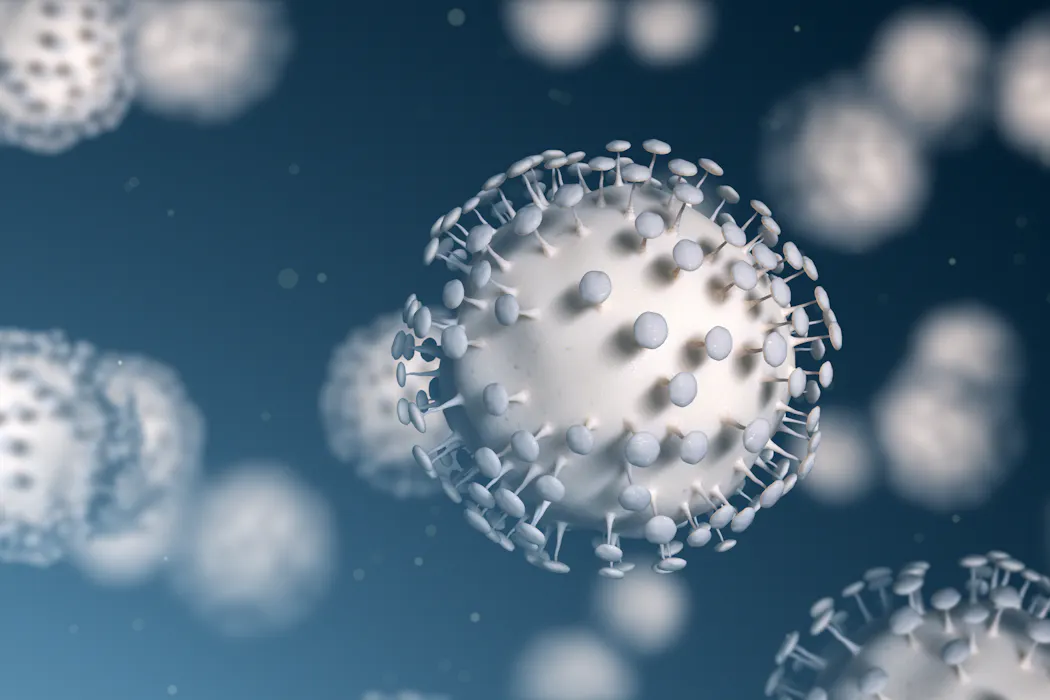
The entry receptors of almost all alphacoronaviruses, like those of the vast majority of viruses, are not known. What we do have is the virus’s genome sequences. From these, the team identified the genes of the spike proteins. If you picture a virus, such as SARS-CoV-2, the spike proteins are the bits that stick out from the surface of the virus. Their job is to bind to entry receptors.
Not unreasonably, the scientists wanted to study viral receptor binding without spending any time in the presence of potentially dangerous pathogens. They did this by creating particles called “pseudotyped viruses”: dummy virus particles that carry the spike proteins of a real virus on their surface.
Pseudotyped viruses can bind to cells but cannot replicate. As a result, they are entirely safe to work with.
Wildscope/Wikimedia Commons, CC BY
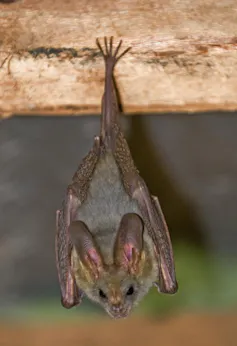
As expected, pseudotypes of the two common cold viruses grabbed firmly on to human cells. Comfortingly, most of the other alphacoronaviruses could not. But there was one exception. The coronavirus KY43, a rather obscure virus previously identified in heart-nosed bats in Kenya, bound very well to a protein found on human cells.
How worried should we be about KY43? Related viruses are found in bats around the world, but, fortunately, most of them are not very good at binding to the human version of their entry receptor. The ones that can bind to human proteins are found in a relatively small region of east Africa, and people living in the part of Kenya where the virus was first identified don’t seem to show any evidence of infection.
This is reassuring, though not surprising. There are multiple steps needed for a virus to break into a human cell, after all, and binding was just the first of them. But this work marks KY43 as a virus to keep an eye on.
More generally, this paper is a powerful proof of concept for how we could carry out pre-pandemic risk assessment. Screens like this can be safely applied to any virus that we have a genome sequence for. More broadly, it should be possible to design similar screens for many of the other things a virus needs to do in order to pose a threat to humans.
The world is overflowing with animal viruses, most of which will never hurt us. But some of them could. Work like this will help us spot the ones we need to take more care of.

Ed Hutchinson receives funding from the UK Medical Research Council and the Wellcome Trust. He is a board member of the European Scientific Working group on Influenza and chairs the virus division of the Microbiology Society.
– ref. Scientists have found a safer way to hunt for the next pandemic virus – https://theconversation.com/scientists-have-found-a-safer-way-to-hunt-for-the-next-pandemic-virus-281287