
Source: The Conversation – UK – By Aditi Upmanyu, PhD candidate in English Literature, University of Oxford
In his biography of Mary Wollstonecraft, written after her death, her husband William Godwin remarked of her travel writing: “If ever there was a book calculated to make a man fall in love with its author, this appears to me to be the book.”
Today, however, Wollstonecraft is best known for a different work: A Vindication of the Rights of Woman (1792). While this landmark text helped lay the foundations of western feminist thought, focusing solely on it risks narrowing our view of a writer who was far more radical and prolific than this single book suggests.
Wollstonecraft wrote across genres – from fiction, travel and children’s books to literary criticism, translations and political essays. Tracing this wide-ranging authorship reveals that her lifelong concerns – women’s education, gender inequality and resistance to political authority did not start or end with A Vindication of the Rights of Woman.
The novelist
Wollstonecraft believed in the political power of storytelling. Writing in The Cambridge Companion to Mary Wollstonecraft, literature professor Claudia L. Johnson observes that “novels are the very bookends of Wollstonecraft’s life as a writer”.
In the preface to Mary: A Fiction (1788), Wollstonecraft declares her intention to reveal the “mind of a woman who has thinking powers”. The novel traces the fictional Mary’s emotional and intellectual life through intense relationships with both a man and a woman. The novel emphasises female intimacy and friendship – at times bordering on the homoerotic – and rejects the plot of conventional domestic fulfilment.
This reimagination of domesticity becomes even more polemical in the unfinished novel Maria: or, The Wrongs of Woman (1798), where Wollstonecraft explores marital oppression, parental neglect, sexual violence and moral rigidity.
Maria is forcibly separated from her infant daughter and imprisoned in a “madhouse”, where she suffers further abuse and torture. The novel includes a graphic narration of sexual exploitation through Jemima, a working-class asylum attendant of illegitimate origins who has endured rape, prostitution and abortion. Maria and Jemima’s friendship introduces radical class solidarity forged through shared suffering.
The novel presents a bleak vision in which women’s most meaningful relationships lie beyond heteronormative family structures.
The travel writer
Wollstonecraft’s Letters Written During a Short Residence in Sweden, Norway and Denmark (1798) was the most popular of her works in her own lifetime.
It was written during an intensely turbulent period, marked by her abandonment by her first lover, Gilbert Imlay, after which she made two suicide attempts. The event left her a single, unwed mother to her daughter Fanny.
Letters departs from Wollstonecraft’s usual rational tone. Instead, this book explores emotional intensity and imagination. She writes at the outset: “I determined to let my remarks and reflections flow unrestrained.” It signposted a literary style that privileges feeling and self-exploration.
But beyond personal reflection, Letters also traces her inner growth alongside her observations of society as she travels across Scandinavian terrain. She reflects on landscape, commerce and social organisation, and through them considers broader questions of civilisation and progress. Here emerges a distinctive, female romantic imagination, grounded in sensibility and subjective experience.
Wollstonecraft’s merging of the personal and the political, so central to her writing, finds its fullest expression in this work. The Letters significantly influenced Romantic poets such as Robert Southey and Samuel Taylor Coleridge.
The children’s author
A deep intellectual investment in women’s education runs throughout Wollstonecraft’s career, evident even in the self-explanatory title of her early work, Thoughts on the Education of Daughters (1787).
This commitment takes a fictional form in Original Stories from Real Life (1791), a children’s book featuring illustrations by the poet William Blake. It traces the moral and intellectual development of two young girls under the guidance of a maternal governess. Wollstonecraft drew on her own year-long experience as a governess to the aristocratic Kingsborough family in Ireland between 1786 and 1787.
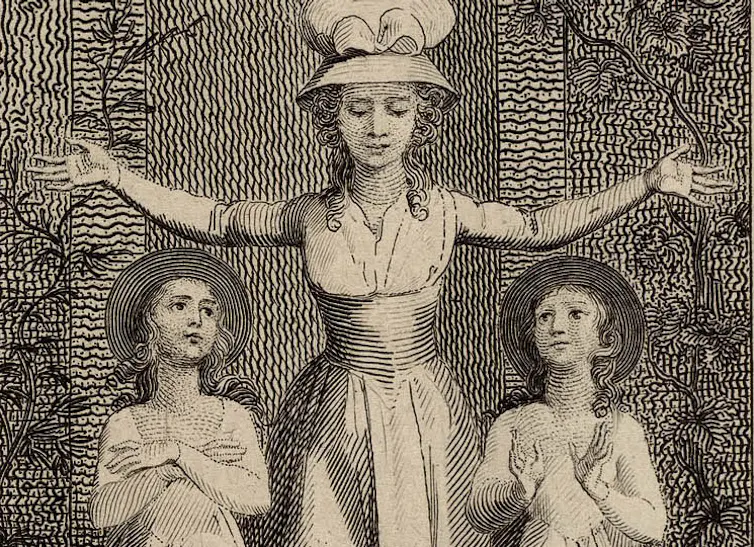
William Blake Archive

Influenced by enlightenment, the book presents learning as both structured instruction and experience shaped by nature and society. For Wollstonecraft, education cultivates judgement, self-discipline and moral awareness.
Her interest in childhood care and its formative role in later years is further reflected in three unfinished works: Lessons, Hints and Fragments of Letters on the Management of Infants. The works were all published posthumously in a compilation by Godwin in 1798. These works explore the issues of women’s health and nutrition, and rethink maternity as an acquired practice, rather than innate feelings women automatically possess.
An autodidact herself, Wollstonecraft saw the improvement of women’s education as essential to their development as rational citizens. Thus, pedagogy becomes the cornerstone of broader social reform, linking the cultivation of the mind to the possibility of equality between the sexes.
The reviewer, correspondent and translator
Wollstonecraft wrote extensively for Joseph Johnson’s progressive journal, the Analytical Review, contributing reviews of contemporary poetry and novels.
WikiCommons, CC BY-SA

These reviews reveal Wollstonecraft as an active participant in contemporary literary culture. This sustained engagement with the ideas of her time helped shape her own trajectory as a writer.
Her reviews were public yet often anonymous, but her letters offer a more intimate record of her voice. Wollstonecraft’s prolific correspondence suggests a life lived, in part, through letters. She wrote frequently to her sisters, her husband Godwin and fellow women writers such as Amelia Opie and Mary Hays. These letters reveal the complexity and contradictions of her character, and her reflections on motherhood, morality and intellectual life.
Wollstonecraft also participated in a wider transnational literary culture, translating works primarily from French, German and Dutch. Her own writings continued to circulate in translation across Europe after her death, distinctly contributing to the development of feminist thought well beyond England.
This article features references to books that have been included for editorial reasons, and may contain links to bookshop.org. If you click on one of the links and go on to buy something from bookshop.org The Conversation UK may earn a commission.

Aditi Upmanyu does not work for, consult, own shares in or receive funding from any company or organisation that would benefit from this article, and has disclosed no relevant affiliations beyond their academic appointment.
– ref. The many literary lives of Mary Wollstonecraft – author of novels, travel writing and children’s books – https://theconversation.com/the-many-literary-lives-of-mary-wollstonecraft-author-of-novels-travel-writing-and-childrens-books-279885