Bad Bunny’s Super Bowl show is part of long play drawn up by NFL to score with Latin America

Source: The Conversation – USA (2) – By Jared Bahir Browsh, Assistant Teaching Professor of Critical Sports Studies, University of Colorado Boulder

Bad Bunny performs on stage on Dec. 11, 2025, in Mexico City, Mexico. Emma McIntyre/Getty Images

Donald Trump, it is fair to assume, will be switching channels during this year’s Super Bowl halftime show.

The U.S. president has already said that he won’t be attending Super Bowl LX in person, suggesting that the venue, Levi’s Stadium in Santa Clara, California, was “just too far away.” But the choice of celebrity entertainment planned for the main break – Puerto Rican reggaeton star Bad Bunny and recently announced pregame addition Green Day – didn’t appeal. “I’m anti-them. I think it’s a terrible choice. All it does is sow hatred. Terrible,” Trump told the New York Post.

National Football League Commissioner Roger Goodell likely didn’t have the sensibilities of the U.S. president in mind when the choice of Bad Bunny was made.

One of the top artists in the world, Bad Bunny performs primarily in Spanish and has been critical of immigration enforcement, which factored into the backlash in some conservative circles to the choice. Bad Bunny’s anti-ICE comments at this year’s Grammy Awards will have only stoked the ire of some conservatives.

But for the NFL hierarchy, this was likely a business decision, not a political one. The league has its eyes on expansion into Latin America; Bad Bunny, they hope, will be a ratings-winning means to an end. It has made such bets in the past. In 2020, Shakira and Jennifer Lopez were chosen to perform, with Bad Bunny making an appearance. The choice then, too, was seen as controversial.

A man dressed in silver sings while crouched over a woman.
Shakira and Bad Bunny perform during the Pepsi Super Bowl LIV Halftime Show on Feb. 2, 2020, in Miami, Fla.
Al Bello/Getty Images

Raising the flag overseas

As a teacher and scholar of critical sports studies, I study the global growth of U.S.-based sports leagues overseas.

Some, like the National Basketball Association, are at an advantage. The sport is played around the globe and has large support bases in Asia – notably in the Philippines and China – as well as in Europe, Australia and Canada.

The NFL, by contrast, is largely entering markets that have comparatively little knowledge and experience with football and its players.

The league has opted for a multiprong approach to attracting international fans, including lobbying to get flag football into the 2028 Olympics in Los Angeles.

Playing the field

When it comes to the traditional tackle game, the NFL has held global aspirations for over three-quarters of a century. Between 1950-1961, before they merged, the NFL and American Football League played seven games against teams in Canada’s CFL to strengthen the relationship between the two nations’ leagues.

Developing a fan base south of the border has long been part of the plan.

The first international exhibition game between two NFL teams was supposed to take place in Mexico City in 1968. But Mexican protest over the economy and cost of staging the Olympics that year led the game, between the Detroit Lions and Philadelphia Eagles, to be canceled.

Instead, it was Montreal that staged the first international exhibition match the following year.

In 1986, the NFL added an annual international preseason game, the “American Bowl,” to reach international fans, including several games in Mexico City and one in Monterrey.

But the more concerted effort was to grow football in the potentially lucrative, and familiar, European market.

After several attempts by the NFL and other entities in the 1970s and ’80s to establish an international football league, the NFL-backed World League of Football launched in 1991. Featuring six teams from the United States, one from Canada and three from Europe, the spring league lost money but provided evidence that there was a market for American football in Europe, leading to the establishment of NFL Europe.

But NFL bosses have long had wider ambitions. The league staged 13 games in Tokyo, beginning in 1976, and planned exhibitions for 2007 and 2009 in China that were ultimately canceled. These attempts did not have the same success as in Europe.

Beyond exhibitions

The NFL’s outreach in Latin America has been decades in the making. After six exhibition matches in Mexico between 1978 and 2001, the NFL chose Mexico City as the venue of its first regular season game outside the United States.

In 2005, it pitted the Arizona Cardinals against the San Francisco 49ers at Estadio Azteca in Mexico City. Marketed as “Fútbol Americano,” it drew the largest attendance in NFL history, with over 103,000 spectators.

The following year, Goodell was named commissioner and announced that the NFL would focus future international efforts on regular-season games.

The U.K. was a safe bet due to the established stadium infrastructure and the country’s small but passionate fan base. The NFL International Series was played exclusively in London between 2007 and 2016.

But in 2016, the NFL finally returned to Mexico City, staging a regular-season game between the Oakland – now Las Vegas – Raiders and Houston Texans.

And after the completion of upgrades to Latin America’s largest stadium, Estadio Azteca, the NFL will return to Mexico City in 2026, along with games in Munich, Berlin and London. Future plans include expanding the series to include Sydney, Australia, and Rio de Janeiro, Brazil, in 2026.

The International Player Pathway program also offers players from outside the United States an opportunity to train and earn a roster spot on an NFL team. The hope is that future Latin American players could help expand the sport in their home countries, similar to how Yao Ming expanded the NBA fan base in China after joining the Houston Rockets, and Shohei Ohtani did the same for baseball in Japan while playing in Los Angeles.

Heading south of the border

The NFL’s strategy has gained the league a foothold in Latin America.

Mexico and Brazil have become the two largest international markets for the NFL, with nearly 40 million fans in each of the nations.

Although this represents a fraction of the overall sports fans in each nation, the raw numbers match the overall Latino fan base in the United States. In recent years the NFL has celebrated Latino Heritage Month through its Por La Cultura campaign, highlighting Latino players past and present.

Latin America also offers practical advantages. Mexico has long had access to NFL games as the southern neighbor to the United States, with the Dallas Cowboys among the most popular teams in Mexico.

For broadcasters, Central and South America offer less disruption in regards to time zones. Games in Europe start as early as 6:30 a.m. for West Coast fans, whereas Mexico City follows Central time, and Brasilia time is only one to two hours ahead of Eastern time.

A man in a bowtie holds three trophies.
Bad Bunny poses with the Album of the Year, Best Música Urbana Album and Best Global Music Performance awards during the 68th Grammy Awards on Feb. 1, 2026, in Los Angeles.
Matt Winkelmeyer/Getty Images for The Recording Academy

The NFL’s expansion plans are not without criticism. Domestically, fans have complained that teams playing outside the U.S. borders means one less home game for season-ticket holders. And some teams have embraced international games more than others.

Another criticism is the league, which has reported revenues of over US$23 billion during the 2024-25 season – nearly double any other U.S.-based league – is using its resources to displace local sports. There are also those who see expansion of the league as a form of cultural imperialism. These criticisms often intersect with long-held ideas around the league promoting militarism, nationalism and American exceptionalism.

Bad Bunny: No Hail Mary attempt

For sure, the choice of Bad Bunny as the halftime pick is controversial, given the current political climate around immigration. The artist removed tour dates on the U.S. mainland in 2025 due to concerns about ICE targeting fans at his concerts, a concern reinforced by threats from the Department of Homeland Security that they would do just that at the Super Bowl.

But in sticking with Bad Bunny, the NFL is showing it is willing to face down a section of its traditional support and bet instead on Latin American fans not just tuning in for the halftime show but for the whole game – and falling in love with football, too.

The Conversation

Jared Bahir Browsh does not work for, consult, own shares in or receive funding from any company or organization that would benefit from this article, and has disclosed no relevant affiliations beyond their academic appointment.

ref. Bad Bunny’s Super Bowl show is part of long play drawn up by NFL to score with Latin America – https://theconversation.com/bad-bunnys-super-bowl-show-is-part-of-long-play-drawn-up-by-nfl-to-score-with-latin-america-271068

Here are Canada’s 2026 Winter Olympic medal hopefuls, from hockey to freestyle skiing

Source: The Conversation – Canada – By Taylor McKee, Assistant Professor, Sport Management, Brock University

Game Plan. Best Ever ‘88. Own the Podium. The messaging from the Canadian government’s Olympic high-performance sport initiatives over the past 50 years makes the stakes clear: winning is important.

Gone are the days of Canadian athletes being satisfied with simply making it to the Olympics. An expectation of excellence now pervades the Olympic program. Athletes are considered ambassadors of their countries and symbols of national pride.

This year in Italy, that expectation will be front and centre amid recent geopolitical tensions. It’s no wonder the new slogan is one that evokes unity and patriotism: “We Are All Team Canada.”

While there is little doubt that all Olympic athletes are expected to play and perform under pressure, Canada’s historical successes at the Winter Games have created heightened expectations. The country set a record for the most gold medals won by a host nation at a single Winter Olympics with 14 in Vancouver in 2010.

When I ask my undergraduate students which Canadian athletes they believe feel the most pressure to win gold at the Olympics, most say hockey, though that may be too simple an answer.

Curling hopefuls

It is certainly true that Canadians expect strong results from men’s and women’s hockey teams, and for good reason. Canada is the most successful ice hockey nation in Olympic history, with 23 medal wins.

Yet many Canadian hockey fans recognize the strength of other hockey nations. Canadians both love and loathe the Swedes, Finns, Slovaks, Czechs and Americans that play for their National Hockey League teams. A loss to those players and those teams is devastating, but explicable.

Curling presents a different story. Here, expectations are clear: gold medals. Casual Olympic viewers may not realize that Scots and Swiss make up the top-three men’s curling rinks in the world, and the Swiss women have won two of the last four World Championships.

That said, Canada’s teams are formidable. The men’s rink, led by Brad Jacobs, won gold in 2014 in Sochi, and the women’s rink, led by Rachel Homan, is currently ranked No. 1 in the world. Far from a golden fait accompli, Canada’s curlers are among the most heavily scrutinized athletes heading to Milan Cortina.

Speed skating hopefuls

Canada has realistic medal potential in both short-track and long-track speed skating. Laurent Dubreuil is a defending silver medallist in the 1000m and finished fourth in the 500m in Beijing 2022.

Ivanie Blondin and Isabelle Weidemann are members of the defending gold medallist Team Pursuit team and silver medallists in other distances. The Team Pursuit event is among the most exciting long-track events at the Olympics and certainly worth circling on the viewing calendar.

On short track, the location of some of the highest drama and most intense finishes at every Olympics, Canada has some serious medal potential with a full complement of 10 skaters headed to Milan.

The women’s team features four-time Olympic medallist Kim Boutin, who will compete at her third consecutive Olympic Winter Games. Boutin received medals in all three women’s individual events at PyeongChang 2018 and later added bronze in the 500m at Beijing 2022. Over the past decade, she has earned 17 medals at the ISU World Short Track Championships and two more world titles at the 2025 Championships, winning gold in the women’s 3000m relay and the mixed relay.

Freestyle skiing hopefuls

Many Canadians might assume speed skating has produced the most medals for Canada over the years. Speed skating accounts for 23 total events between short and long-track at this year’s Olympics, and Canada won their first speed skating medal in 1932.

However, despite it only being added as a full medal sport in 1992, Canada has won 30 total medals in a different sport, including the distinction of Canada’s first home gold medal won by Alexandre Bilodeau in 2010: freestyle skiing.

Equal parts agility and artistry, freestyle skiing is definitely one of Games’ most beguiling and exhilarating watches.

Comprised of eight separate disciplines, Canada has numerous medal threats, headlined by “greatest mogul skiier of all time” Mikaël Kingsbury, fresh off of a Jan. 10 victory in men’s moguls at Val St. Côme, marking a staggering 100 career World Cup victories for the skier.

And then, there’s hockey.

Ice hockey hopefuls

The centre of the women’s hockey is a binary system: two stars bound together, their combined gravity ordering the remaining planets, paling in size and importance to their suns.

This year marks a new era, as professional women’s players will compete for the first time at the Olympics, following the establishment of the Professional Women’s Hockey League.

Since 1990, only one team other than Canada and the U.S. — Finland in 2019 — has reached the Ice Hockey World Championships gold medal game. Canada won bronze that year.

Gold medallists in five of seven previous Olympics, the Canadian women’s team enters as a slight underdog this year, with Team USA defending their World Champion title.

Given the storied history of these two teams and the heightened tension currently between the two nations, their matchup will assuredly be among the most exciting 60 minutes played this year.

On the men’s side, a long, protracted wait is over: NHL players return to the Olympics. Canadian captain Sidney Crosby will be aiming for his third Olympic gold.

Alongside the return of pro talent comes a familiar source of tension for Canadian hockey fans: consternation around goaltending.

Canada remains one of the tournament’s favourites, shimmering with a galaxy of superstars on forward and defence, yet persistent concerns over net-minding continue to fuel doubt among some fans.

No shortage of Olympic hopefuls

There are many more medal hopefuls for Team Canada heading into Milan Cortina, from alpine skiiers and ski cross athletes to snowboarding, figure skating and freestyle skiing.

But simply taking in the Games when possible can be a rewarding experience in and of itself.

While cynicism and skepticism towards the International Olympic Committee and Olympic movement are certainly warranted, the Winter Olympics will provide the opportunity for Canadian athletes to achieve global sporting excellence.

While we know that pressure creates diamonds, these athletes may soon prove that it can produce gold, too.

The Conversation

Taylor McKee receives funding from the Social Sciences and Humanities Research Council of Canada

ref. Here are Canada’s 2026 Winter Olympic medal hopefuls, from hockey to freestyle skiing – https://theconversation.com/here-are-canadas-2026-winter-olympic-medal-hopefuls-from-hockey-to-freestyle-skiing-274407

Tariffs are reshaping Canadian manufacturing, but not all workers are being impacted the same way

Source: The Conversation – Canada – By Marshia Akbar, Research Lead on Labour Migration at the CERC Migration and Integration Program, TMU, Toronto Metropolitan University

American tariffs have reshaped Canada’s manufacturing sector, but labour-market impacts have not been evenly shared across workers.

The United States imposed tariffs on Canadian steel, aluminum, automobiles and auto parts as part of a broader protectionist push under Donald Trump’s administration. Canada’s government responded with its own counter-tariffs and trade measures, but disruptions to the industry were already underway by that point.

Manufacturing is a major source of employment for both immigrant and Canadian-born workers. It includes everything from automotive and aerospace parts to food processing and steel products, and it contributes roughly 10 per cent of Canada’s GDP.

Manufacturing is particularly vulnerable to U.S. tariffs because of its deep integration with cross-border supply chains. More than 60 per cent of Canada’s manufacturing sector has substantial trade exposure to the U.S., making it the primary channel through which tariffs affect the Canadian economy.

As firms adjusted to rising costs and trade uncertainty, immigrant and Canadian-born workers experienced different forms of employment risk at different points in 2025.

A sector under strain

A recent report shows that between January and September 2025, Canada’s manufacturing sector experienced lower production, fewer jobs and higher prices.

After momentum earlier in the year, manufacturing jobs fell sharply in the spring, with the largest consecutive job losses occurring in April, when 30,600 jobs were lost, and May, when a further 12,200 jobs disappeared. Overall, employment fell by nearly 43,000 workers between March and May.

This was followed by persistent instability rather than sustained recovery later in the year. Employment rebounded in September, with 27,800 jobs gained, and rose again in October, but these gains were partially reversed in November, when 9,300 jobs were lost.

Firms responded to the tariff shocks through delayed and incremental employment cuts, but these sector-wide adjustments were experienced differently by immigrant and Canadian-born workers.

Immigrant workers are more vulnerable

Not all workers felt the shocks from the labour market equally. Immigrant workers were disproportionately affected by tariff-related employment adjustments and are particularly vulnerable when manufacturing employment becomes unstable.

Manufacturing is a critical source of employment for immigrants, particularly in large metropolitan regions and along industrial corridors.

In March 2025, immigrants accounted for 30 per cent of employment in Canada’s manufacturing sector, compared with 70 per cent of Canadian-born workers. By December 2025, however, the immigrant share had declined to 28 per cent, while the share of Canadian-born workers increased to 72 per cent.


Read more:
Canadian immigrants are overqualified and underemployed — reforms must address this


This disparity was compounded by a structural educational mismatch. While 80 per cent of workers in the sector don’t have a university degree, immigrant workers were more than twice as likely as Canadian-born workers to be university educated.

Nevertheless, these higher education levels often do not translate into higher-paid roles within manufacturing.

Lower wages amplify employment risk

Wage data shows that many immigrant manufacturing workers are concentrated in lower-paid or more labour-intensive jobs that are particularly vulnerable during an economic downturn.

Throughout 2025, immigrant workers earned roughly $2.50 to $3 less per hour than Canadian-born workers. This gap did not narrow even when wages recovered later in the year.

Average hourly wages for all workers increased from $34.43 in March to $35.29 in December. Yet the wage gap for immigrant workers widened slightly — from $2.52 to $2.56.

Lower pay combined with higher educational attainment points to persistent credential under-utilization, meaning workers possess skills or qualifications that are not fully used or rewarded in their jobs. This under-utilization increases immigrant workers’ exposure to employment instability when trade disruptions occur.

How job loss patterns shifted

Job loss also unfolded differently over time. In the first half of 2025, unemployed former workers who were immigrants were more likely to report layoffs — temporary or permanent — as the cause of their joblessness.

That share remained consistently high — at 66 per cent in June — before gradually declining later in the year. By December, 51 per cent of immigrant former workers reported job loss as the reason for unemployment.

In contrast, job loss became increasingly concentrated among Canadian-born workers in the second half of the year. In March, only 53 per cent reported job loss as the reason for unemployment. This share rose steadily throughout the rest of the year, reaching 71 per cent by December.

These trends indicate that firms initially relied more heavily on reductions in immigrant labour, and later expanded layoffs to include Canadian-born workers as tariff pressures persisted.

Differential adjustment strategies

U.S. tariffs reshaped Canadian manufacturing not through a single employment shock, but through different labour-adjustment strategies over time.

Highly educated immigrant workers, many of whom were concentrated in lower-paid roles, were more exposed to early layoffs, wage penalties and unstable employment. As tariff pressures deepened, job loss became more concentrated among Canadian-born workers as longer-term restructuring took place.

These patterns matter for policy. If manufacturing is to remain a viable pillar of the Canadian economy in an era of trade disruption, policy responses must recognize these unequal adjustment patterns and address the underlying vulnerabilities that leave some workers more exposed than others.

This could include targeted income supports and rapid-response training for displaced workers, and tailored settlement and employment services for immigrant workers who, as a group, are concentrated in lower-wage and more unstable jobs.

In addition, better co-ordination between trade, industrial, and immigration policies could help ensure that adjustment costs are not disproportionately borne by already vulnerable workers.

The Conversation

Marshia Akbar receives funding from the Social Sciences and Humanities Research Council of Canada (SSHRC).

Devaanshi Khanzode does not work for, consult, own shares in or receive funding from any company or organisation that would benefit from this article, and has disclosed no relevant affiliations beyond their academic appointment.

ref. Tariffs are reshaping Canadian manufacturing, but not all workers are being impacted the same way – https://theconversation.com/tariffs-are-reshaping-canadian-manufacturing-but-not-all-workers-are-being-impacted-the-same-way-274269

Whether it’s Valentine’s Day notes or emails to loved ones, using AI to write leaves people feeling crummy about themselves

Source: The Conversation – USA (2) – By Julian Givi, Assistant Professor of Marketing, West Virginia University

People seem to intuitively understand something meaningful should require doing more than pushing a button or writing a prompt. design master/iStock via Getty Images

As Valentine’s Day approaches, finding the perfect words to express your feelings for that special someone can seem like a daunting task – so much so that you may feel tempted to ask ChatGPT for an assist.

After all, within seconds it can dash off a well-written, romantic message. Even a short, personalized limerick or poem is no sweat.

But before you copy and paste that AI-generated love note, you might want to consider how it could make you feel about yourself.

We research the intersection of consumer behavior and technology, and we’ve been studying how people feel after using generative AI to write heartfelt messages. It turns out that there’s a psychological cost to using the technology as your personal ghostwriter.

The rise of the AI ghostwriter

Generative AI has transformed how many people communicate. From drafting work emails to composing social media posts, these tools have become everyday writing assistants. So it’s no wonder some people are turning to them for more personal matters, too.

Wedding vows, birthday wishes, thank you notes and even Valentine’s Day messages are increasingly being outsourced to algorithms.

The technology is certainly capable. Chatbots can craft emotionally resonant responses that sound genuinely heartfelt.

But there’s a catch: When you present these words as your own, something doesn’t sit right.

When convenience breeds guilt

We conducted five experiments with hundreds of participants, asking them to imagine using generative AI to write various emotional messages to loved ones. Across every scenario we tested – from appreciation emails to birthday cards to love letters – we found the same pattern: People felt guilty when they used generative AI to write these messages compared to when they wrote the messages themselves.

When you copy an AI-generated message and sign your name to it, you’re essentially taking credit for words you didn’t write.

This creates what we call a “source-credit discrepancy,” which is a gap between who actually created the message and who appears to have created it. You can see these discrepancies in other contexts, whether it’s celebrity social media posts written by public relations teams or political speeches composed by professional speechwriters.

When you use AI, even though you might tell yourself you’re just being efficient, you can probably recognize, deep down, that you’re misleading the recipient about the personal effort and thought that went into the message.

The transparency test

To better understand this guilt, we compared AI-generated messages to other scenarios. When people bought greeting cards with preprinted messages, they felt no guilt at all. This is because greeting cards are transparently not written by you. Greeting cards carry no deception: Everyone understands you selected the card and that you didn’t write it yourself.

We also tested another scenario: having a friend secretly write the message for you. This produced just as much guilt as using generative AI. Whether the ghostwriter is human or an artificial intelligence tool doesn’t matter. What matters most is the dishonesty.

There were some boundaries, however. We found that guilt decreased when messages were never delivered and when recipients were mere acquaintances rather than close friends.

These findings confirm that the guilt stems from violating expectations of honesty in relationships where emotional authenticity matters most.

Somewhat relatedly, research has found that people react more negatively when they learn a company used AI instead of a human to write a message to them.

But the backlash was strongest when audiences expected personal effort – a boss expressing sympathy after a tragedy, or a note sent to all staff members celebrating a colleague’s recovery from a health scare. It was far weaker for purely factual or instructional notes, such as announcing routine personnel changes or providing basic business updates.

What this means for your Valentine’s Day

So, what should you do about that looming Valentine’s Day message? Our research suggests that the human hand behind a meaningful message can help both the writer and the recipient feel better.

This doesn’t mean you can’t use generative AI as a brainstorming partner rather than a ghostwriter. Let it help you overcome writer’s block or suggest ideas, but make the final message truly yours. Edit, personalize and add details that only you would know. The key is co-creation, not complete delegation.

Generative AI is a powerful tool, but it’s also created a raft of ethical dilemmas, whether it’s in the classroom or in romantic relationships. As these technologies become more integrated into everyday life, people will need to decide where to draw the line between helpful assistance and emotional outsourcing.

This Valentine’s Day, your heart and your conscience might thank you for keeping your message genuinely your own.

The Conversation

The authors do not work for, consult, own shares in or receive funding from any company or organization that would benefit from this article, and have disclosed no relevant affiliations beyond their academic appointment.

ref. Whether it’s Valentine’s Day notes or emails to loved ones, using AI to write leaves people feeling crummy about themselves – https://theconversation.com/whether-its-valentines-day-notes-or-emails-to-loved-ones-using-ai-to-write-leaves-people-feeling-crummy-about-themselves-271805

Greenland’s ‘green mining’ row highlights the key tensions in the energy transition

Source: The Conversation – UK – By Narmin Nahidi, Assistant Professor in Finance, University of Exeter

pathdoc/Shutterstock

Green finance is built on a promise: that capital can be redirected to support the transition to a low-carbon economy while avoiding the environmental mistakes of the past. That promise is getting harder to keep.

The technologies needed for decarbonisation of electric vehicles, wind turbines, batteries and grid infrastructure rely on large quantities of critical minerals. Extracting those materials, even from remote places such as Greenland, remains environmentally disruptive, socially contested and politically fraught.

Sustainable finance shapes investment decisions across energy, infrastructure and manufacturing. The ethical frameworks this finance is based on often assume that environmental harm can be minimised through better disclosure, cleaner technologies and improved governance.

The extraction of critical minerals challenges that assumption. Mining is land intensive, energy hungry and often polluting. Recycling of existing batteries, electronics and turbines, and substitution away from scarce materials can reduce demand.

But most projections from the world’s energy watchdog, the International Energy Agency, show that demand for critical minerals will rise sharply under clean energy transitions . Similar bodies show that extraction of raw materials such as lithium, cobalt, nickel and rare earth elements will rise sharply over the next two decades.

This is because the transition away from fossil fuels depends on large volumes of new infrastructure including electric vehicle batteries, wind turbines and grid storage, which cannot be supplied from recycled materials alone.

Recent research and policy assessments suggest this contradiction is becoming more acute, not less. Recent analyses of critical mineral supply chains show that extraction and processing remain highly concentrated in a few countries particularly China, Australia, Chile and the Democratic Republic of Congo.

These supply chains are environmentally intensive, involving significant land use, water consumption and pollution. These supply chains are slow to scale because it takes years to obtain permits for new mines, requires large upfront investment, and depends on the construction of extensive infrastructure. Yet global climate targets assume rapid expansion of clean-energy technologies.

In Greenland, environmental regulation and local political decisions have delayed or halted mining projects that are often considered key to the green transition.

Greenland is geologically rich. The island is home to significant deposits of rare earth elements, graphite, zinc and other minerals considered critical by both the EU and the US. These materials are central to clean-energy supply chains and have become strategically important as governments seek to reduce dependence on China, a superpower which dominates global processing capacity.

At the same time, Greenland’s environment is exceptionally fragile. Arctic ecosystems recover slowly from industrial disruption, infrastructure is limited and mining projects face high logistical and financial costs. These constraints have already shaped political choices.

In 2021, Greenland’s government introduced restrictions on uranium mining, effectively blocking the development of the large Kvanefjeld rare earth project. That decision reflected environmental and social priorities. It also highlighted the economic and legal pressures that arise when sustainability policies collide with global demand for transition minerals.

When green finance meets geopolitics

In a world of geopolitical competition, governments are increasingly treating access to critical minerals as a matter of national security as well as climate policy. Policy statements and strategy documents from the US, the EU and other major economies now frame mineral supply not just as an environmental issue, but as essential to economic resilience, defence capability and technological leadership.

This shift has encouraged public financial support, diplomatic engagement and strategic partnerships aimed at securing future supply, including increased foreign interest in Greenland’s mineral sector. While Greenland retains control over its resources, international attention reflects the growing geopolitical importance of potential new supply sources.

Projects justified as supporting the energy transition may be driven as much by geopolitical urgency as by environmental benefit. Academic research on critical mineral supply chains shows that when geopolitical and industrial priorities shape governance frameworks, local environmental risks and community consent are often marginalised in favour of strategic and economic goals


Read more:
The economics of climate risk ignores the value of natural habitats


Tension in Greenland

Despite international interest, large-scale mining in Greenland has not taken off. Environmental safeguards, political opposition, infrastructure gaps and high costs have slowed development. This reality complicates the assumption that new mineral frontiers can quickly solve clean-energy supply bottlenecks through investment alone.

For investors, Greenland raises difficult questions about how environmental, social and governance (ESG) standards apply to transition minerals. Financing a rare earth mine may reduce long-term emissions by enabling renewable technologies, yet still impose immediate environmental damage. Standard ESG metrics struggle to capture this trade-off. They are better suited to assessing corporate behaviour than to resolving conflicts between global climate goals and local environmental harm.

lone husky howling on greenland icy landscape
Current geopolitical dynamics have huge consequences for Greenland’s environment.
Kedardome/Shutterstock

In Greenland, the debate over “green mining” (the idea that mineral extraction can be made environmentally acceptable through cleaner technologies, higher standards and better governance) is not a case of poor regulation or weak oversight. Instead, it reflects a jurisdiction that has deliberately placed environmental limits on extraction, even as it faces economic and strategic pressure as a result.

As governments continue to pursue ambitious climate targets under national and international commitments, similar dilemmas will emerge elsewhere. Green finance cannot avoid the material foundations of the energy transition.

Sustainable finance frameworks must evolve to handle situations where environmental protection constrains access to strategically important resources. Greenland shows how protecting the environment can clash with efforts to secure the minerals needed for the energy transition, and that this tension is far from resolved.

Without clearer rules on how to balance climate benefits against local ecological costs and without genuine respect for sovereignty and community choice, green finance risks becoming reactive, stretched between environmental principles and geopolitical realities.

The transition to a low-carbon economy requires minerals. But Greenland highlights that how those minerals are sourced and who bears the environmental cost remains unresolved.


Don’t have time to read about climate change as much as you’d like?

Get a weekly roundup in your inbox instead. Every Wednesday, The Conversation’s environment editor writes Imagine, a short email that goes a little deeper into just one climate issue. Join the 47,000+ readers who’ve subscribed so far.


The Conversation

Narmin Nahidi does not work for, consult, own shares in or receive funding from any company or organisation that would benefit from this article, and has disclosed no relevant affiliations beyond their academic appointment.

ref. Greenland’s ‘green mining’ row highlights the key tensions in the energy transition – https://theconversation.com/greenlands-green-mining-row-highlights-the-key-tensions-in-the-energy-transition-274336

Canada should be wary of embracing ‘total national defence’ to ward off an American invasion

Source: The Conversation – Canada – By James Horncastle, Assistant Professor and Edward and Emily McWhinney Professor in International Relations, Simon Fraser University

As the Donald Trump administration in the United States continues to threaten Canadian sovereignty — including a recent suggestion that Alberta could secede from Canada and join the U.S. — Canadians, like many others in the world, finds themselves in a period of extreme uncertainty.

Trump’s continued violations of the rules-based international order means Canada can no longer rely on its partners to the same extent as it has in the past.

The world must, as Prime Minister Mark Carney recently noted, accept the current climate as it is, rather than looking to the past.


Read more:
Mark Carney’s Davos speech marks a major departure from Canada’s usual approach to the U.S.


To do so, Canada must develop a defence policy that can meet the country’s needs. The Canadian government’s recent budget envisions a significant increase in defence spending over the next several years. The problem Canada faces, however, is one that all middle powers face: an inability to compete with great powers in a conventional war.

The Canadian government must therefore pursue non-conventional means to overcome conventional weakness. Simultaneously, the country must be cognizant of the implications of alternative defence policies. The former Yugoslavia provides a harrowing example.


Read more:
How could Canada deter an invasion? Nukes and mandatory military service


How to ward off an invasion

The turmoil created by the mercurial American president has caused Canada to examine how it could resist a U.S. invasion in a series of war games. Inevitably, Canada was unable to defeat the U.S. in these exercises, and was forced to rely on unconventional warfare.


Read more:
Amid U.S. threats, Canada’s national security plans must include training in non-violent resistance


One way Canada is considering addressing this issue is by creating a civilian defence force and incorporating “total national defence” principles. This development is not completely new; Canada has been considering it for some time.


Read more:
Why annexing Canada would destroy the United States


Total national defence in theory

Total national defence is not a new concept. After the Second World War, it became clear to many medium-sized countries that they could not compete with the great powers in a conventional war.

In the 1950s, Yugoslavia spent 22 per cent of its GDP on defence, yet still recognized it was unlikely to defeat a great power in a conventional war. Yugoslavia, and other countries, needed an alternative. Enter total national defence.

The concept of total national defence seeks to mobilize all aspects of society for the war effort. Given the uniqueness of each country, no country’s total national defence system looks the same as the other. What’s important for Canada’s examination, however, is the command-and-control elements of the system.

The biggest vulnerability is the enemy eliminating their command-and-control functions early in the conflict. The U.S., as seen in Iraq in 1991, excels at these types of operations. Russia, while not as effective, attempted to do the same against Ukraine in the early phases of its full-fledged invasion.

For a smaller country to survive such an attack, it needs to ensure that resistance can continue regardless if centralized command is compromised.

Under the theory of total national defence, countries decentralize command and control functions to prevent them being eliminated.

The extent to which countries do so varies. Individual units may operate at the local level without centralized guidance to maintain the struggle against an opponent. In short, even if an opponent succeeds in eliminating the central command of a state, its army and people can continue the struggle.

Canada’s chosen example: Finland

Canada, as it considers implementing such a policy, has looked to Finland for inspiration. Prior to joining NATO, Finland was a relatively small country that could not rely upon allies for defence.

What Canadian officials found in Finland impressed them. Finnish officials have long relied upon extensive joint-use facilities, such as bunkers. It also uses conscription to maintain a strong deterrent.

But Canada and Finland are fundamentally different countries. The persistent threat of Russian invasion has, over time, normalized policies like conscription among the Finnish. Furthermore, and most critically, Finland is, unlike Canada, a unitary state and not a federation.

Canada’s worst-case scenario: Yugoslavia

Much like the former Yugoslavia, Canada is a federation. It has stark regional differences, both in terms of culture and economics.

The divisions in Canada aren’t as entrenched as those in Yugoslavia in the 1980s. Nevertheless, as CSIS recently warned Parliament, the divides are real and outside forces could magnify and exploit them.

U.S. Treasury Secretary Scott Bessent’s recent encouragement of Albertan separatism, and Albertan separatist meetings with Trump officials, are examples of how foreign entities can magnify these divides.

Yugoslavia’s embrace of total national defence relied on the unity of the people to overcome the weaknesses of a decentralized command structure. Without it, not only would the effectiveness of such a defence have been compromised but, more worryingly, separatist forces could have used such decentralized forces for their own purposes.

In fact, separatists did so , using these decentralized defence forces for their own purposes against Yugoslavia. That helped fuel the former country’s conflicts and ultimate dissolution in the 1990s.

Learning from the past

But just because Yugoslavia’s embrace of total national defence and a civilian defence force helped facilitate the breakup of the country doesn’t mean that will happen to Canada. Too often, people assume that history is repetitive.

Instead, the past is an inventory of ideas. Yugoslavia’s embrace of total national defence failed, but Canada can learn lessons about what worked and what will not in a federation, and in doing so improve its own capabilities.

Canada is wise to pursue non-conventional defence strategies. The country, and its defence planners, however, must ensure they’re drawing from the right examples.

The Conversation

James Horncastle does not work for, consult, own shares in or receive funding from any company or organisation that would benefit from this article, and has disclosed no relevant affiliations beyond their academic appointment.

ref. Canada should be wary of embracing ‘total national defence’ to ward off an American invasion – https://theconversation.com/canada-should-be-wary-of-embracing-total-national-defence-to-ward-off-an-american-invasion-274295

ChatGPT is in classrooms. How should educators now assess student learning?

Source: The Conversation – Canada – By Sarah Elaine Eaton, Professor and Research Chair, Werklund School of Education, University of Calgary

Generative artificial intelligence (GenAI) is now a reality in higher education, with students and professors integrating chatbots into teaching, learning and assessment. But this isn’t just a technical shift; it’s reshaping how students and educators learn and evaluate knowledge.

Our recent qualitative study with 28 educators across Canadian universities and colleges — from librarians to engineering professors — suggests that we have entered a watershed moment in education.

We must grapple with the question: What exactly should be assessed when human cognition can be augmented or simulated by an algorithm?

Research about AI and academic integrity

In our review of 15 years of research that engages how AI affects cheating in education, we found that AI is a double-edged sword for schools.

On one hand, AI tools like online translators and text generators have become so advanced that they can write just like humans. This makes it difficult for teachers to detect cheating. Additionally, these tools can sometimes present fake news as facts or repeat unfair social biases, such as racism and sexism, found in the data used to train them.


Read more:
I used AI chatbots as a source of news for a month, and they were unreliable and erroneous


On the other hand, the studies we reviewed showed AI can be a legitimate assistant that can make learning more inclusive. For instance, AI can provide support for students with disabilities or help those who are learning an additional language.

Because it’s nearly impossible to block every AI tool, schools should not just focus on catching cheaters. Instead, schools and post-secondary institutions can update their policies and provide better training for both students and teachers. This helps everyone learn how to use technology responsibly while maintaining a high standard of academic integrity.

Participants in our study positioned themselves not as enforcers, but as stewards of learning with integrity.

Their focus was on distinguishing between assistance that supports learning and assistance that substitutes for it. They identified three skill areas where assessment boundaries currently fall: prompting, critical thinking and writing.

Prompting: A legitimate and assessable skill

Participants widely viewed prompting — the ability to formulate clear and purposeful instructions for a chatbot — as a skill they could assess. Effective prompting requires students to break down tasks, understand concepts and communicate precisely.

Several noted that unclear prompts often produce poor outputs, forcing students to reflect on what they are really asking.

Prompting was considered ethical only when used transparently, drawing on one’s own foundational knowledge. Without these conditions, educators feared prompting may drift into over-reliance or uncritical use of AI.

Critical thinking

Educators saw strong potential for AI to support assessing critical thinking. Because chatbots can generate text that sounds plausible but may contain errors, omissions or fabrications, students must evaluate accuracy, coherence and credibility. Participants reported using AI-generated summaries or arguments as prompts for critique, asking students to identify weaknesses or misleading claims.

These activities align with a broader need to prepare students for work in a future where assessing algorithmic information will be a routine task. Several educators argued it would be unethical not to teach students how to interrogate AI-generated content.

Writing: Where boundaries tighten

Writing was the most contested domain. Educators distinguished sharply between brainstorming, editing and composition:

• Brainstorming with AI was acceptable when used as a starting point, as long as students expressed their own ideas and did not substitute AI suggestions for their own thinking.

• Editing with AI (for example, grammar correction) was considered acceptable only after students had produced original text and could evaluate whether AI-generated revisions were appropriate. Although some see AI as a legitimate support for linguistic diversity, as well as helping to level the field for those with disabilities or those who speak English as an additional language, others fear a future of language standardization where the unique, authentic voice of the student is smoothed over by an algorithm.

• Having chatbots draft arguments or prose was implicitly rejected. Participants treated the generative phase of writing as a uniquely human cognitive process that needs to be done by students, not machines.

Educators also cautioned that heavy reliance on AI could tempt students to bypass the “productive struggle” inherent in writing, a struggle that is central to developing original thought.


Read more:
What are the key purposes of human writing? How we name AI-generated text confuses things


Our research participants recognized that in a hybrid cognitive future, skills related to AI, together with critical thinking are essential skills for students to be ready for the workforce after graduation.

Living in the post-plagiarism era

The idea of co-writing with GenAI brings us into an post-plagiarism era where AI is integrated into into teaching, learning and communication in a way that challenges us to reconsider our assumptions about authorship and originality.

This does not mean that educators no longer care about plagiarism or academic integrity. Honesty will always be important. Rather, in a post-plagiarism context, we consider that humans and AI co-writing and co-creating does not automatically equate to plagiarism.

Today, AI is disrupting education and although we don’t yet have all the answers, it’s certain that AI is here to stay. Teaching students to co-create with AI is part of learning in a post-plagiarism world.

Design for a socially just future

Valid assessment in the age of AI requires clearly delineating which cognitive processes must remain human and which can be legitimately cognitively offloaded. To ensure higher education remains a space for ethical decision-making especially in terms of teaching, learning and assessment, we propose five design principles, based on our research:

1. Explicit expectations: The educator is responsible for making clear if and how GenAI can be used in a particular assignment. Students must know exactly when and how AI is a partner in their work. Ambiguity can lead to unintentional misconduct, as well as a breakdown in the student-educator relationship.

2. Process over product: By evaluating drafts, annotations and reflections, educators can assess the learning process, rather than just the output, or the product.

3. Design assessment tasks that require human judgment: Tasks requiring high-level evaluation, synthesis and critique of localized contexts are areas where human agency is still important.

4. Developing evaluative judgment: Educators must teach students to be critical consumers of GenAI, capable of identifying its limitations and biases.

5. Preserving student voice: Assessments should foreground how students know what they know, rather than what they know.

Preparing students for a hybrid cognitive future

Educators in this study sought ethical, practical ways to integrate GenAI into assessment. They argued that students must understand both the capabilities and the limitations of GenAI, particularly its tendency to generate errors, oversimplifications or misleading summaries.

In this sense, post-plagiarism is not about crisis, but about rethinking what it means to learn and demonstrate knowledge in a world where human cognition routinely interacts with digital systems.

Universities and colleges now face a choice. They can treat AI as a threat to be managed, or they can treat it as a catalyst for strengthening assessment, integrity and learning. The educators in our study favour the latter.

The Conversation

Sarah Elaine Eaton receives funding from the Social Sciences and Humanities Research Council of Canada and the University of Calgary.

Rahul Kumar has received funding from SSHRC in the past.

Robert Brennan receives funding from the Natural Sciences and Engineering Research Council of Canada (NSERC).

Beatriz Antonieta Moya Figueroa does not work for, consult, own shares in or receive funding from any company or organisation that would benefit from this article, and has disclosed no relevant affiliations beyond their academic appointment.

ref. ChatGPT is in classrooms. How should educators now assess student learning? – https://theconversation.com/chatgpt-is-in-classrooms-how-should-educators-now-assess-student-learning-270933

Addressing climate change without the ‘rules-based order’

Source: The Conversation – Canada – By Matthew Hoffmann, Professor of Political Science and Co-Director of Environmental Governance Lab, University of Toronto

At the recent World Economic Forum in Switzerland, Canadian Prime Minister Mark Carney proclaimed “a rupture” in the global “rules-based order” and a turn to great power rivalry.

While its demise is not certain, even the current disruption to global order, largely due to the Donald Trump administration in the United States, promises profound impacts on the global response to climate change. The world is at risk of losing even the insufficient progress made in the last decade.

But it’s unclear what that effect will be. That uncertainty is both a cause for concern and a source of hope. The climate crisis is not slowing, and humanity must figure out how to navigate the disruption.


Read more:
Venezuela attack, Greenland threats and Gaza assault mark the collapse of international legal order


Unfortunately, much of what we know about how climate politics works has depended on a relatively stable rules-based order. That order, however problematic, provided institutions like the United Nations Framework Convention on Climate Change and the Paris Agreement.

It also established trade rules for energy technology, co-operative agreements on public and private climate finance, and parameters for how civil society and states interact. It structured the opportunities and obstacles for acting on climate change.

Everyone who cares about climate action must now grapple with how climate politics can function in a new world of uncertainty. It won’t be easy.

But, to inject a slight note of hope, I’m not convinced that meeting the climate challenge is harder now. It’s difficult in a different way. Let’s be clear: the rules-based order was not producing effective global co-operation on climate change.

Limited successes of the rules-based order

Canadian Prime Minister Mark Carney’s speech in Davos where he noted the ‘rupture’ in the global rules-based order.(The Journal)

The U.S. has consistently been an obstacle to global climate action. As Carney noted, under the the rules-based order “the strongest would exempt themselves when convenient.” Clearly the U.S. decided from very early on that a stable climate was not a public good it was willing to seriously support.

The U.S. failed to see benefits from climate action that outweighed the perception of costs and has consistently been influenced by status quo, fossil-capital economic interests.

That’s not to say there was no progress under the old rules-based system. At least five sources of progress are worth highlighting:

Possibilities for progress

These sources of past progress on climate action could survive the current disruption and play a role in increasing momentum in the global response to climate change. But uncertainties and questions are more plentiful than answers.

A coalition of the ambitious is clearly what Carney’s speech is seeking to catalyze among middle powers. He was not talking about climate change, but a commitment to climate action could and should be a cornerstone that a new order is built upon. This may even attract one of those competing great powers that he alluded to — China. Will China see climate leadership as a means to enhance its global position?

The political economy of renewable energy has momentum that is at least somewhat insulated from the current disruption. How insulated it remains depends on a number of uncertainties.

What will trade rules and practices look like moving forward? What happens within the fossil-fuel energy sector as the U.S. continues to engage in resource imperialism? How will resource competition and co-operation in the renewables sector (over critical minerals, for example) play out moving forward?

Can experimental efforts be a source of resistance and change within the U.S., especially among individual states? And can they play the same role that they did previously, catalyzing further innovation and public support?

Public support for climate action in this new era will likely vary wildly by country. How will growing dissatisfaction with the status quo play out as it intersects with increasingly severe climate impacts?

This could generate further support for right-wing populism. However, affordability and inequality concerns could also become the foundation for building support for climate action and a just transition.

Does the Paris Agreement survive this? It could become a backbone institution for the coalition of the ambitious. The U.S. is gone, again. Maybe other recalcitrant governments should be sidelined from multilateral climate efforts as well, and those willing to act can proceed.

If full global co-operation around climate change is no longer even a façade of the possible now, then the imperative to bring everyone along at each step in the process may evaporate.

None of the ways forward I’ve laid out here are easy. Even if the positive possibilities materialize, they do not guarantee decarbonization and a just transition that is fast and effective enough to matter; to head off the worst of climate change.

What is clear, though, is that like Carney, climate scholars and activists may need to let the fiction of the global rules-based order go. It was not working either in addressing climate change or enhancing justice. Perhaps its disruption is an opportunity to build better foundations for a just and effective global response to climate change.

The Conversation

Matthew Hoffmann receives funding from Social Science and Humanities Research Council and the Lawson Climate Institute.

ref. Addressing climate change without the ‘rules-based order’ – https://theconversation.com/addressing-climate-change-without-the-rules-based-order-273745

El Helicoide caraqueño: del brutalismo arquitectónico a la brutalidad

Source: The Conversation – (in Spanish) – By Tulio Alberto Álvarez-Ramos, Profesor/Investigador Instituto de Investigaciones Jurídicas de la Universidad Católica Andrés Bello. Jefe de Cátedra de Derecho Constitucional de la Universidad Central de Venezuela, Universidad Católica Andrés Bello

Edificio El Helicoide, en Caracas. Damián D. Fossi Salas/Wikimedia Commons

Mi esposa me pidió algo que parecía sencillo: acercarla al Helicoide para tomar unas fotografías. Artista plástica, suele recorrer Caracas buscando en cada edificio las huellas de la ciudad que fuimos y la que aún disfrutamos. En las visitas, sus grupos de amigos celebran la diversidad de estilos, la modernidad truncada y las cicatrices arquitectónicas que marcan nuestro paisaje.

El Helicoide, levantado en tiempos de la dictadura de Marcos Pérez Jiménez e hibernado en las administraciones democráticas posteriores, fue concebido como un manifiesto del brutalismo: hormigón desnudo, monumentalidad sin ornamentos, funcionalidad que pretendía simbolizar progreso.

Mercedes me recordó que esa estética buscaba revelar la expresividad de los materiales, la honestidad del hormigón. Pero en Caracas, esa sinceridad se volvió metáfora de otra brutalidad: la del poder que encierra y castiga.

Esta vez, el paseo dominical no me fue grato. Durante años lo visité para acompañar a amigos condenados por haber defendido la vida en aquella célebre jornada cívica del 11 de abril de 2022. Hasta que un día normal de visita, la amenaza se hizo explícita: “Si entra, no sale; si regresa, se queda aquí”. El Helicoide se convirtió así en un fantasma personal, un recordatorio de cómo el hormigón puede ser cómplice del terror.

Sin dignidad y sin Dios

El ejercicio del poder revela siempre una tensión entre el bien y el mal. Su peor rostro se muestra en la violencia y humillación de quienes padecen persecución por causa de la justicia. La tortura, física y mental, constituye uno de los crímenes más horrendos, pues destruye cuerpos y también almas.

El Helicoide se inscribe en una genealogía de lugares donde la brutalidad se institucionalizó: la ESMA en Argentina, convertida hoy en espacio de memoria; los centros de detención en Cuba; Tadmur, conocido como “el reino de la muerte y la locura”, en Siria; Bagram en Afganistán, donde prisioneros fueron encadenados y golpeados hasta la muerte; y los centros clandestinos de la Stasi en Alemania Oriental. Todos comparten una misma lógica: el poder que se cree absoluto y convierte al ser humano en objeto de sufrimiento.

Orden de cierre, pero no de olvido

El anuncio de Delcy Rodríguez, el 30 de enero de 2026, sobre el cierre del Helicoide y otros centros de detención, fue presentado como un gesto de apertura y reconversión hacia espacios comunitarios. Sin embargo, la memoria no se borra con decretos. El Helicoide no es solo un edificio: es un símbolo de represión documentado en informes internacionales que lo señalan como escenario de tortura y violaciones sistemáticas de derechos humanos.

En 2019, la Alta Comisionada Michelle Bachelet, tras su visita a Venezuela, incluyó al Helicoide en su informe como centro de detención del Servicio Bolivariano de Inteligencia Nacional (SEBIN). Allí se denunciaron torturas, tratos crueles e inhumanos, falta de acceso a abogados y condiciones degradantes para los presos políticos. Un año después, la Misión Internacional de Determinación de los Hechos del Consejo de Derechos Humanos de la ONU identificó al Helicoide como uno de los principales centros de tortura en el país, junto con la sede de la Dirección General de Contrainteligencia Militar (DGCIM). El informe detalló prácticas sistemáticas como descargas eléctricas, asfixia, violencia sexual y aislamiento prolongado, calificándolas como crímenes de lesa humanidad (ONU, 2020).

Los informes posteriores (2021–2024) confirmaron que el Helicoide seguía siendo utilizado para detenciones arbitrarias y torturas. Testimonios lo describieron como un “laberinto de miedo” y lo señalaron como “símbolo de la represión institucionalizada”. La arquitectura brutalista que alguna vez pretendió representar modernidad se convirtió en arquitectura del dolor, un espacio donde la dignidad humana fue sistemáticamente negada.

La Comisión Interamericana de Derechos Humanos también ha denunciado al Helicoide. En 2025 solicitó una visita para verificar las condiciones de los detenidos, subrayando las denuncias de tortura y hacinamiento. Ese mismo año, en un comunicado reiteró su competencia sobre Venezuela y describió al Helicoide como “símbolo del horror”. La Corte Interamericana de Derechos Humanos, en una sentencia de agosto de 2025, reafirmó su jurisdicción sobre el país y vinculó su supervisión con centros como el que nos ocupa.

Existe plena coincidencia de los órganos internacionales en materia de derechos humanos: el Helicoide es un escenario de crímenes contra la humanidad. Su cierre administrativo no borra las huellas del dolor ni las responsabilidades históricas que allí se gestaron.

Presentado en el MoMA de Nueva York

El Helicoide, que en 1961 alcanzó protagonismo internacional al ser presentado en el debate arquitectónico del MoMA de Nueva York, fue concebido como símbolo de modernidad y progreso bajo el signo del brutalismo. Hoy, sin embargo, carga con una triste fama: emblema de brutalidad, represión y tortura. Esta paradoja no es ajena a la historia urbana latinoamericana: Venezuela, como tantos países de la región, heredó los sueños de civilización y modernidad, pero los distorsionó bajo dictaduras, populismos y regímenes autoritarios.

El Helicoide encarna esa contradicción: una obra monumental que debía ser centro comercial futurista, convertida en cárcel de cuerpos y esperanzas. La arquitectura, pensada como motor de desarrollo, se transformó en escenario de indignidad e impunidad.

Hoy, lo que representó un desafío arquitectónico constituye un reto para instaurar en nuestro país la Justicia y restaurar la dignidad humana como centro de toda acción política. Como proclamaron nuestros hermanos argentinos, después de superar la prueba y asumir el costo de los errores de su clase política. Nunca más.

The Conversation

Tulio Alberto Álvarez-Ramos no recibe salario, ni ejerce labores de consultoría, ni posee acciones, ni recibe financiación de ninguna compañía u organización que pueda obtener beneficio de este artículo, y ha declarado carecer de vínculos relevantes más allá del cargo académico citado.

ref. El Helicoide caraqueño: del brutalismo arquitectónico a la brutalidad – https://theconversation.com/el-helicoide-caraqueno-del-brutalismo-arquitectonico-a-la-brutalidad-274825

¿Podemos anticiparnos a las sequías? Lecciones desde una cuenca semiárida del Mediterráneo

Source: The Conversation – (in Spanish) – By Dariana Isamel Avila Velasquez, Investigadora predoctoral en Ingeniería del Agua y Medioambiental, Universitat Politècnica de València

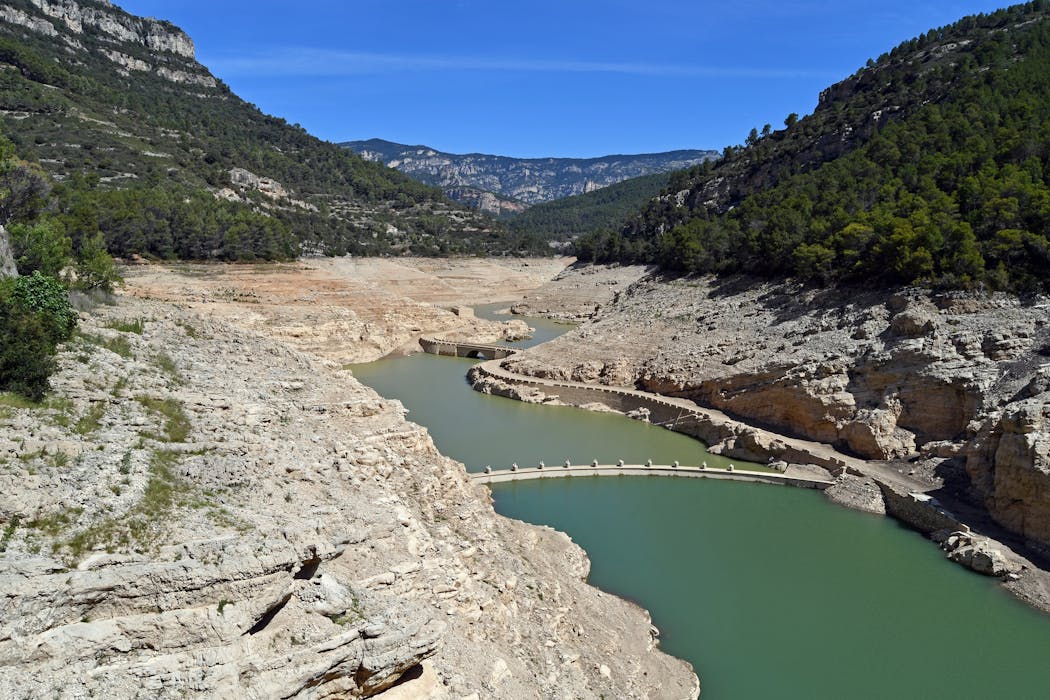
Embalse de Ulldecona (Castellón) durante un periodo de sequía. Guillermo Guerao Serra/Shutterstock

La sequía es uno de los riesgos climáticos más relevantes en el Mediterráneo, especialmente en cuencas semiáridas como la del Júcar, en el este de España.
Aunque sabemos que el clima de la región es naturalmente variable, en las últimas décadas las sequías se han vuelto más intensas y duraderas, generando una creciente preocupación social, e impactos económicos y ambientales.

Hasta ahora, gran parte de los estudios de sequías se ha centrado en analizar las series históricas o las proyecciones de cambio climático a medio y largo plazo. Estos escenarios de varias décadas son útiles para comprender las tendencias generales, pero resultan poco prácticos para la gestión cotidiana.

España cuenta con sistemas muy completos para monitorizar la sequía a nivel nacional y además con informes de seguimiento dentro de la propia cuenca. Estas herramientas permiten saber qué está ocurriendo en la actualidad o qué ocurrió en los últimos meses. Pero conocer el presente no es lo mismo que anticipar el futuro cercano.


Leer más:
Soluciones basadas en la naturaleza frente a eventos climáticos extremos en cuencas mediterráneas


Del Júcar al resto de cuencas semiáridas del mundo

Entre la monitorización inmediata y los escenarios climáticos a medio-largo plazo faltaba una herramienta intermedia: las predicciones estacionales que ayuden a saber qué podría pasar en los próximos meses.

La Demarcación Hidrográfica del Júcar (DHJ) representa un ejemplo adecuado para abordar este reto. Situada en el este de la península ibérica, se caracteriza por un clima mediterráneo semiárido. En la mayor parte de su territorio predominan los veranos largos, secos y muy calurosos, a menudo acompañados de olas de calor, y con la lluvia concentrada en pocos episodios intensos, sobre todo a finales de verano y en otoño.

Aunque la precipitación media anual ronda los 500 mm, esta cifra esconde una enorme variabilidad espacial: en las zonas más meridionales apenas se alcanzan los 300 mm al año y pueden pasar largos periodos sin lluvias. Esta combinación de escasez de precipitación y altas temperaturas hace que la Demarcación Hidrográfica del Júcar sea especialmente vulnerable a la sequía y un laboratorio natural ideal para estudiar hasta qué punto podemos anticiparnos a ella.

Nuestro estudio aborda justamente esta cuestión. Por un lado, evaluamos cuán fiables han sido las predicciones estacionales en el pasado. Por otro, analizamos cómo estos modelos de predicción meteorológica pueden utilizarse ahora de forma operativa, a través de la plataforma WATER4CAST, que ofrece predicciones reales con varios meses de antelación para la Demarcación Hidrográfica del Júcar, la zona en la que trabaja nuestro equipo de investigación.

Para abordar estas cuestiones, se combinaron distintos modelos climáticos estacionales disponibles a través del Servicio de Cambio Climático de Copernicus a partir de datos históricos de precipitación y temperatura. Y, después, aplicamos un método de inteligencia artificial que corrige el sesgo y mejora la adaptación de los modelos de predicción a la escala local.

A partir de estas predicciones se calcularon los índices de sequía meteorológicas más utilizados internacionalmente: el Índice de Precipitación Estandarizado (SPI) y el Índice Estandarizado de Precipitación-Evapotranspiración (SPEI). Y lo hicimos en distintas escalas temporales: 6, 12, 18 y 24 meses, lo que permitió evaluar no solo los déficit de lluvia, sino también el efecto del aumento de la temperatura, clave en un Mediterráneo cada vez más cálido.

Metodología del estudio, adaptada de artículo: Avila-Velasquez, D.I., Macian-Sorribes, H. & Pulido-Velazquez, M. ¿Qué tan fiables son las predicciones de sequía? Fiabilidad de las predicciones estacionales multimodelo de sequías meteorológicas en una cuenca mediterránea semiárida. Earth Syst Environ (2025). https://doi.org/10.1007/s41748-025-00965-9.
CC BY

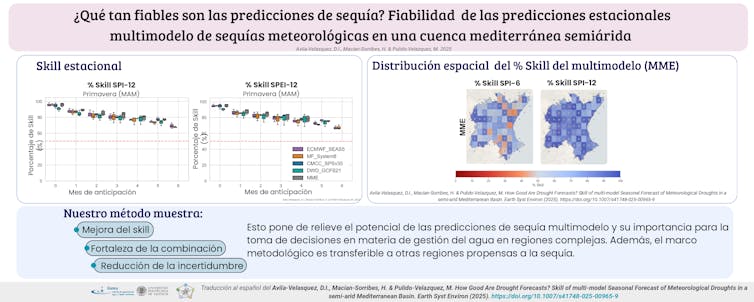
Los resultados de nuestro trabajo muestran que las predicciones estacionales de sequías meteorológicas alcanzan alta fiabilidad, hasta casi el 90 %, para escalas temporales de 6 meses en el mismo mes de emisión, y mantienen su fiabilidad incluso a 3 meses de anticipación. En escalas más largas, de 12, 18, y 24 meses, los modelos conservan información útil hasta los 6 meses de anticipación.

Esto nos permite asegurar que sí es posible anticipar parcialmente las sequías con varios meses de antelación, abriendo una ventana de acción para la gestión del agua en la Demarcación Hidrográfica del Júcar.

Resultados adaptados al español del estudio: Avila-Velasquez, D.I., Macian-Sorribes, H. & Pulido-Velazquez, M. How Good Are Drought Forecasts? Skill of multi-model Seasonal Forecast of Meteorological Droughts in a semi-arid Mediterranean Basin. Earth Syst Environ (2025). https://doi.org/10.1007/s41748-025-00965-9.
CC BY


Leer más:
¿Puede la inteligencia artificial ayudar a predecir inundaciones?


Una esperanza para una mejor gestión del agua y del riesgo a sequías

Más allá de la evaluación científica, nuestro estudio demuestra que estas predicciones pueden aplicarse de manera operativa. Los modelos se integran en la plataforma WATER4CAST, que actualmente ofrece predicciones estacionales reales, permitiendo acercar la ciencia al mundo de la gestión del agua y el riesgo. De este modo, los índices y los modelos multimodelo dejan de ser solo herramientas académicas y se convierten en un apoyo práctico para embalses, agricultura y alertas tempranas de sequías.

Plataforma de WATER4CAST con la predicción del índice de sequia del SPI-12, para la demarcación hidrográfica del Júcar.
CC BY

En un contexto de cambio climático, donde la frecuencia e intensidad de las sequías está aumentando, este enfoque permite tomar decisiones más anticipadas, basadas en evidencia científica, y refuerza la resiliencia de las regiones vulnerables. La combinación de múltiples modelos e índices de sequía ofrece una visión más completa del fenómeno y reduce la incertidumbre asociada a los predicciones tradicionales.

Aunque ninguna predicción puede ser perfecta, esta investigación evidencia que las predicciones estacionales de sequías meteorológicas son una herramienta prometedora para anticiparse a los riesgos hídricos, optimizar la gestión del agua y aumentar la capacidad de adaptación frente a un Mediterráneo cada vez más cálido y seco.

The Conversation

Dariana Isamel Avila Velasquez recibe fondos de la ayuda de Formación de profesorado Universitario FPU del Ministerio de Ciencia, Innovación y Universidades (FPU20/0749). Ella trabaja para la Universitat Politècnica de València, en el Instituto de Ingeniería del Agua y Medioambiente (IIAMA), es investigadora predoctoral.

Héctor Macian-Sorribes trabaja para la Universitat Politècnica de València, en el Instituto de Ingeniería del Agua y Medioambiente (IIAMA), es investigador senior y profesor asociado

Manuel Pulido-Velázquez es IP (junto con Félix Francés) del proyecto Enhanced Integrated Multiscale Forecasting System for Agriculture, Water and the Environment (WATER4CAST 2.0) financiado por el Programa para la promoción de la investigación científica, el desarrollo tecnológico y la innovación en la Comunitat Valenciana para grupos de investigación de excelencia (CIPROM/2023/000) de la Conselleria de Educación, Cultura, Universidades y Empleo – Generatitat Valenciana – en el marco del cual se desarrolla esta investigación.

ref. ¿Podemos anticiparnos a las sequías? Lecciones desde una cuenca semiárida del Mediterráneo – https://theconversation.com/podemos-anticiparnos-a-las-sequias-lecciones-desde-una-cuenca-semiarida-del-mediterraneo-270851