Avec sa troisième Stratégie nationale bas carbone, la France impose aux entreprises de réduire leurs émissions de gaz à effet de serre de 50 % d’ici à 2030.
Une analyse souligne que la géographie de la décarbonation de l’industrie et celle de la réindustrialisation « verte » sont les deux faces d’une même pièce.
D’anciens bastions industriels attirent les investissements, de Dunkerque à Fos-sur-Mer.
Depuis 2021, la France connaît une vague d’investissements dans de nouveaux secteurs industriels – hydrogène ou batteries électriques – et dans la décarbonation des anciennes industries sidérurgiques et pétrochimiques. Cette dynamique est soutenue par plusieurs politiques industrielles, comme la Stratégie nationale pour le développement de l’hydrogène décarboné et la Stratégie nationale sur les batteries.
Pour analyser cette tendance, nous avons constitué une base de données réalisée dans le cadre du projet « Réindustrialisation, Transitions et Logistique dans la Vallée de la Seine ». Notre découverte ? Les investissements industriels annoncés en France sont concentrés dans les ports et les anciens bastions industriels, qui ont connu depuis des décennies des vagues de désindustrialisation.
Cette situation n’est pas propre à la France ; ils concernent d’autres pays comme le Royaume-Uni.
L’objectif de cet article est de dépasser une lecture simpliste en termes de « dépendance au sentier » qui consisterait à conclure que cette concentration a lieu là où sont présentes les industries à décarboner.
Car il faut considérer plusieurs facteurs : les effets de masse critique, que ce soit des fournisseurs et des clients, l’existence préalable d’infrastructures, ainsi que l’action publique à différentes échelles – de l’Union européenne, aux État en passant par les opérateurs de réseaux.
Zones industrialo-portuaires
Si la réalité de la réindustrialisation de la France fait l’objet de débats, nous pouvons affirmer que :
des mutations industrielles de grande ampleur sont en cours, en lien avec la décarbonation de l’économie ;
les investissements liés à la décarbonation ne sont pas uniformes et se concentrent notamment dans quelques territoires maritimes.
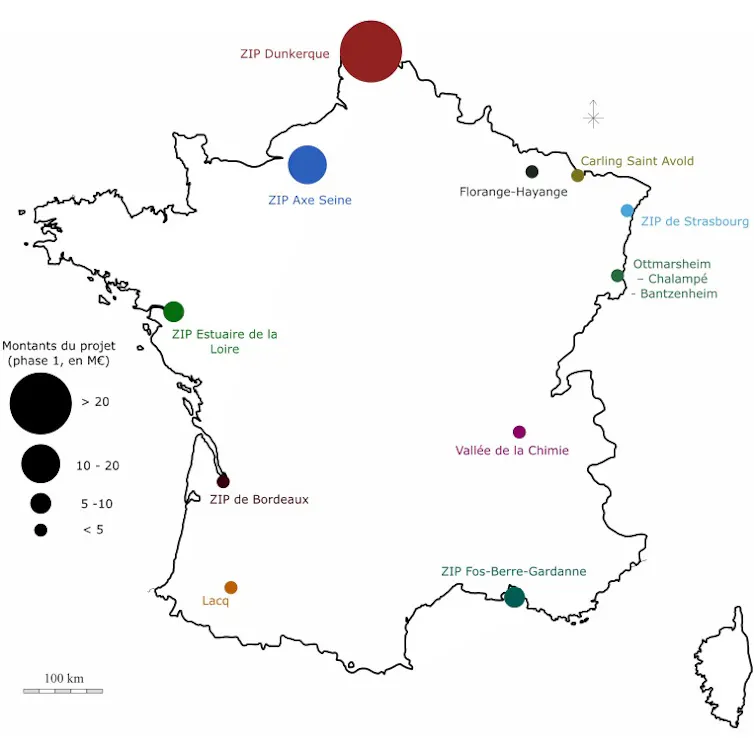
Depuis 2022, les territoires maritimes de quatre grands ports captent 25 % des montants d’investissements annoncés en France : Haropa, fruit de la fusion des ports du Havre, Rouen et Paris, Dunkerque, Marseille-Fos et Nantes-Saint-Nazaire. En 2023, 43 % des montants annoncés pour toute la France, soit 12 milliards d’euros d’investissement, concernent ces quatre zones industrialo-portuaires.
Ces anciennes zones industrielles bénéficient d’un savoir-faire industriel et surtout d’infrastructures telles que des terminaux portuaires spécifiques, ou des réseaux de pipelines. Ces atouts facilitent l’arrivée de ces investissements massifs.
Montants des investissements industriels annoncés par commune, entre 2008 et 2025. Projet « Réindustrialisation, Transitions et Logistique dans la Vallée de la Seine », Fourni par l’auteur
À Dunkerque (Nord), les projets de gigafactories côtoient la transformation de la sidérurgie d’ArcelorMittal. À Fos-sur-Mer (Bouches-du-Rhône), les investissements annoncés concernent aussi bien l’hydrogène que les carburants de synthèse ou la production de panneaux photovoltaïques. Dans la vallée de la Seine, les projets portent notamment sur l’hydrogène, le recyclage et les carburants de synthèse.
Un observateur attentif notera que certains de ces projets annoncés sont à l’arrêt, ou abandonnés, comme la giga-usine de panneaux solaires de Carbon à Fos-sur-Mer ou la plus grande usine de recyclage moléculaire des plastiques Eastman à Port-Jérôme-sur-Seine (Seine-Maritime).
L’existence d’une masse critique
Sans surprise, les investissements dans la décarbonation se situent dans les espaces fortement carbonés. La carte des émissions de CO₂ en France est très proche de la carte des investissements. Depuis 2020, le coefficient de corrélation entre les émissions de CO₂ et les montants investis – agrégés par commune – est de 0,77 ; ce qui indique une forte corrélation.
En revanche, les mécanismes sous-jacents sont moins connus et tout aussi importants. L’analyse des motivations des industriels dans le cadre du projet « Réindustrialisation, Transitions et Logistique » montre que les investissements dans les zones les plus carbonées sont en partie motivés par l’existence d’une masse critique.
Masse critique de clients, par exemple pour les usines d’hydrogène qui trouvent à proximité d’importants clients souhaitant décarboner leur process industriel. Masse critique de fournisseurs de CO₂, concernant par exemple les projets de captage de CO₂ pour l’incorporer dans des carburants de synthèse – e-SAF pour l’aviation, e-methanol.
Le fait de disposer d’émetteurs importants de CO2 devient paradoxalement un atout !
Du rôle des politiques publiques
Un autre facteur déterminant concerne les politiques publiques déployées à plusieurs échelles. Ces dernières priorisent la décarbonation des activités industrielles les plus émettrices de CO₂, la création de nouveaux secteurs énergétiques et des infrastructures permettant de les déployer.
Au niveau européen, on retrouve ainsi le Green Deal ou le package Fit for 55. Ces mesures ne ciblent pas directement les anciens territoires industriels français ; toutefois, en identifiant les industries qui y sont implantées, elles les priorisent indirectement.
Au niveau hexagonal France 2030 se focalise explicitement les projets de décarbonation de l’industrie, d’hydrogène, de recyclage ou de batteries, avec le support de l’Ademe. Les subventions sont décisives, comme à Dunkerque où le projet Prologium a bénéficié de 1,5 milliard d’euros d’aides de l’État et où le four électrique d’Arcelor est financé à hauteur de 50 % par l’État.
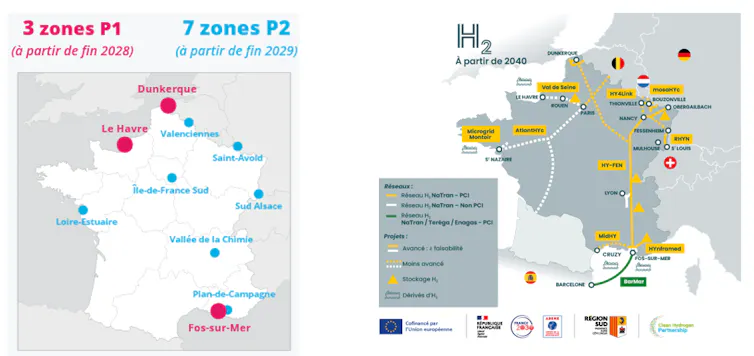
Carte des zones industrielles bas-carbone. Réalisée par les auteurs, d’après les données de l’Ademe, CC BY
L’exemple des Zones industrielles bas carbone, programme piloté par l’Ademe visant au déploiement de solutions innovantes pour atteindre la neutralité carbone en 2050, identifie les territoires les plus émetteurs (Figure 3), dans les grands ports maritimes et dans les anciens bastions industriels de l’est de la France et du Rhône.
Les opérateurs d’infrastructure – électricité avec RTE, gaz avec Natran – conforte cette géographie en priorisant le déploiement de capacité électrique et de transport de nouvelles molécules, comme l’hydrogène ou le CO₂, dans les anciennes zones industrielles.
Zones prioritaires de déploiement des capacités électriques pour RTE et projet de réseau de distribution d’hydrogène de Natran. RTE, 2025 ; Natran, 2025, CC BY
Incertitudes d’une réindustrialisation durable
Une question demeure : ces nouveaux investissements vont-ils permettre de compenser les crises passées et les fermetures annoncées dans des entreprises de l’ère du carbone ?
Malgré les promesses, les incertitudes entourant les projets de gigafactories dans les Hauts-de-France, les arrêts des projets Carbon à Fos-sur-Mer ou Eastman à Port-Jérôme-sur-Seine, en raison des atermoiements des réglementations européennes, laissent planer le doute. La concentration actuelle des investissements ne garantit pas encore une réindustrialisation durable, mais expose ces territoires aux incertitudes des transformations en cours.
Nathan Gouin a reçu des financements de Délégation Interministérielle au Développement de Vallée de la Seine, dans le cadre du projet “Réindustrialisation, Transitions et Logistique”
Marie-Laure Baron a reçu des financements de Délégation Interministérielle au Développement de Vallée de la Seine, dans le cadre du projet “Réindustrialisation, Transitions et Logistique”.
Source: The Conversation – France (in French) – By Jean-Christophe Blanchard, Docteur en histoire, ingénieur d’études au Centre de Recherche Universitaire Lorrain d’Histoire, Université de Lorraine
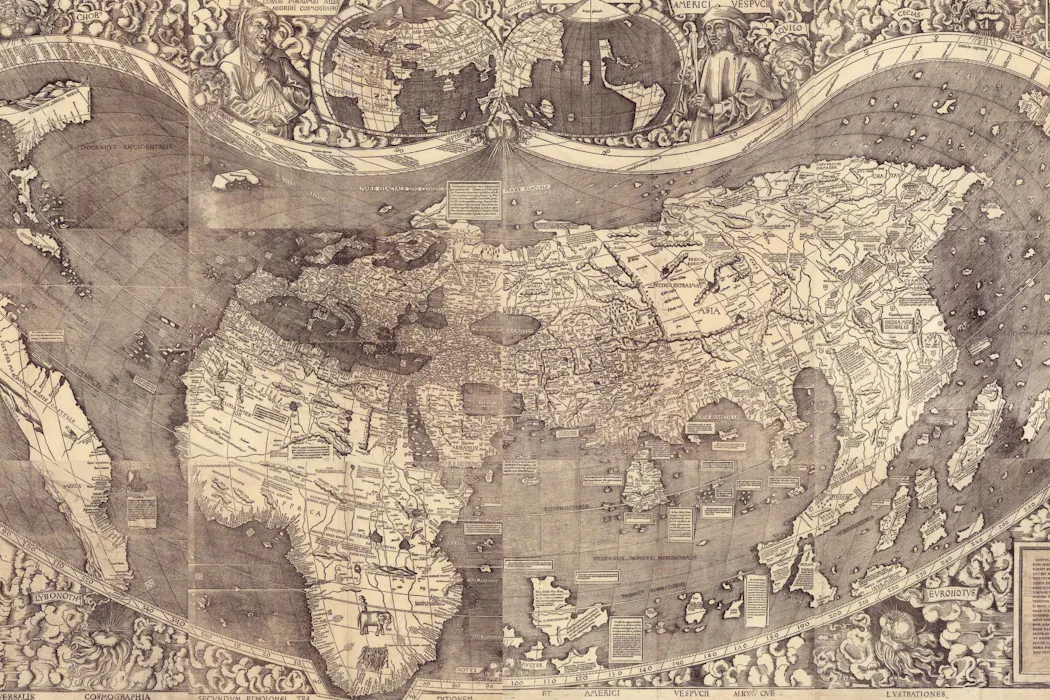
*Universalis cosmographia secundum Ptholomaei traditionem et Americi Vespucii aliorumque lustrationes*, Martin Waldseemüller, Strasbourg, 1507.Fourni par l’auteur
L’ESSENTIEL
Les 2, 3 et 4 octobre prochains se tiendra à Saint-Dié-des-Vosges la 37ᵉ édition du Festival international de géographie.
Le festival commémore un fait historique : c’est à Saint-Dié que le « nouveau continent » reçut son nom, America, au début du XVIᵉ siècle, en hommage à Amerigo Vespucci.
Les recherches géographiques vosgiennes mettent en évidence l’intégration de la principauté lorraine aux réseaux savants européens.
En 1941, depuis son exil américain, Stefan Zweig, dans Amerigo. Récit d’une erreur historique, ouvrait le chapitre consacré au baptême de l’Amérique par cet appel à l’indulgence :
« Nul ne doit se juger coupable de manquer de culture géographique s’il n’a jamais entendu le nom de la petite ville de Saint-Dié. »
Cet exorde est-il encore d’actualité ? Il pourrait sembler que non. Depuis 1990, le Festival international de géographie commémore cet événement et réunit au mois d’octobre des personnalités du monde entier dans cette « petite ville » des Vosges où fut baptisé le Nouveau Monde.
Pourtant, quand la Library of Congress présente le seul exemplaire connu de la mappemonde de Martin Waldseemüller (acquise en 2001), elle propose comme lieu d’impression Strasbourg plutôt que Saint-Dié. Et la « petite ville » redevient invisible.
Le Gymnase vosgien, une communauté d’humanistes
Le choix de la plus grande bibliothèque du monde ne rend pas justice à cette commune vosgienne. C’est en effet en ses murs que le nouveau continent reçut son nom, America, dans les premières années du XVIᵉ siècle. René II de Lorraine, roi de Naples et de Jérusalem (1493-1508), qui projeta un temps le voyage vers Naples, y encourageait les travaux du Gymnase vosgien, une communauté d’humanistes qui s’intéressaient particulièrement à la géographie.
Le duc, qui avait reçu du Portugal la copie française de la Lettera di Amerigo Vespucci sulle isole trovate in quatro suoi viaggi (Lettre à Soderini, Lisbonne, 4 septembre 1504), comprit l’intérêt qu’elle pouvait avoir pour leurs travaux. Cette lettre qui contenait le récit de quatre voyages du Florentin, déjà connu grâce aux éditions de son Mondus novus, fut donc transmise au cénacle de Saint-Dié qui travaillait à une nouvelle édition de la Géographie de Ptolémée.
Aussitôt traduite en latin, la lettre fut insérée par Mathias Ringmann dans la Cosmographiae Introductio (1507) qui accompagnait la nouvelle représentation du monde conçue par Martin Waldseemüller et, en hommage à Vespucci, il fut décidé de nommer le nouveau continent America.
Les recherches géographiques vosgiennes démontrent l’intégration de la principauté lorraine aux réseaux savants de l’Europe. À ce titre, la provenance portugaise de la Lettre doit d’abord être soulignée. Elle dénote l’intérêt de René II pour ce qui se passait en dehors de ces principautés.
Le duc de Lorraine s’est passionné pour les explorations maritimes menées par les Portugais et les Espagnols. Par ailleurs, avant de venir s’installer dans le val de Galilée – une ancienne communauté de communes située dans les Vosges –, les savants qui se sont penchés sur le berceau de cette mappemonde avaient étudié dans diverses villes européennes. Basin avait fréquenté l’Université de Bologne, l’helléniste Mathias Ringmann, ancien étudiant de Heidelberg, était passé par Paris et par Strasbourg, Waldseemüller étudia un temps à Fribourg-en-Brisgau, il avait noué des relations à Strasbourg et à Bâle avant de s’implanter à Saint-Dié. Les idées, les livres et les hommes circulaient aussi en dehors des réseaux princiers.
Un monde élargi
Antoine de Lorraine, fils de René II, devenu duc en 1508, fut lui aussi attentif à l’élargissement du monde. Il se montra intéressé par le progrès des sciences géographiques et des techniques de navigation. Sa bibliothèque, dont une partie est connue grâce à un inventaire, en témoigne. Les travaux du Gymnase vosgien, et plus particulièrement la Cosmographiae Introductio, n’y apparaissent pas, mais on y trouve deux cartes de France (une « grande gallicane en parchemin » et une autre plus petite), un Livre du compas de la navigation, une édition imprimée du Nouveau Monde et enfin, un autre manuscrit intitulé La Navigation et découverte des Indes supérieures.
Le premier volume peut être mis en regard d’un manuscrit du XVᵉ siècle, conservé à Paris à la Bibliothèque nationale de France (ms.fr. 25376), intitulé Le livre du compas, c’est assavoir le livre de navighier, qui concerne la Méditerranée. Le deuxième est une version de la traduction française du Mundus novus, d’Amerigo Vespucci, plusieurs fois rééditée de 1515 à 1529. Le troisième est à rapprocher de l’un des quatre manuscrits du récit d’Antonio Pigafetta décrivant l’expédition de Magellan, parti autour du monde vers les îles Moluques (1519-1522) (New-Haven, Beinecke Library, ms. 351). Les cartes et le Livre du compas pourraient avoir été hérités de René II, le Nouveau Monde et le texte de Pigafetta sont en revanche contemporains d’Antoine.
Cadeaux diplomatiques
Ce dernier eut la possibilité de se confronter à la matérialité de cet élargissement de l’horizon connu. L’Amérique fut baptisée sous le règne de René II, mais Antoine vit se concrétiser ce qui auparavant n’était encore qu’une abstraction, une idée. Il eut le privilège de recevoir quelques artefacts autochtones envoyés du Mexique à Charles Quint par Hernàn Cortès.
Ce dernier recherchant le soutien du Habsbourg dans sa conquête de l’Empire aztèque les avait expédiés vers l’Espagne en 1519. Dès 1520, ce trésor fut exposé à Bruxelles. Albrecht Dürer put y admirer ces objets merveilleux lors de son voyage à travers les Pays-Bas et en consigna le souvenir dans son journal.
En 1523, Charles offrit à sa tante Marguerite d’Autriche, gouvernante des Pays-Bas, une partie de ce trésor. Soixante-dix-huit « accoustremens de plumes, venuz des Indes », transférés de Bruxelles à Malines, furent inventoriés dans la « librairie » de l’archiduchesse en 1524. Le 6 juillet 1528, Marguerite donnait à Antoine de Ville, ambassadeur du duc de Lorraine, quatorze de ces précieux artefacts pour lui en faire présent. Il s’agissait majoritairement d’équipements militaires ainsi que de pièces de textile ornées d’or et de plumes.
Ce cadeau diplomatique intervenait dans le contexte de la succession de Charles d’Egmont, qui opposait les ducs de Clèves et de Lorraine à l’empereur à propos du duché de Gueldre. À la fin des années 1520, alors que reprenaient les hostilités avec le royaume de France, il était impératif pour Charles Quint de trouver des solutions pacifiques à ce conflit.
L’activité diplomatique qui se déploya alors lui permit, outre d’éviter le mariage de François de Lorraine et d’Anne de Clèves, de conclure avec Charles d’Egmont le traité de Gorinchem (octobre 1528). Prudemment, après la mort de Charles d’Egmont (1538), le duc de Lorraine renonça à son héritage gueldrois ; non sans concession de l’empereur qui lui accorda une réelle autonomie de son duché par le traité de Nuremberg (1542).
Antoine, descendant du baptiseur de l’Amérique, ne prit pas le risque de rivaliser avec celui qui régnait entre autres sur la Nouvelle-Espagne, le Pérou, la Nouvelle-Grenade et le Río de la Plata. En acceptant les artefacts autochtones et la négociation, le duc de Lorraine put profiter des largesses de celui qui gouvernait un empire sur lequel le soleil ne se couchait jamais. Il poursuivait ainsi l’œuvre de son père et garantissait la pérennité de ses principautés.
Cela ne suffit pas, cependant, pour que l’on se souvienne outre-Atlantique à l’aube du XXIᵉ siècle de la « petite ville » lorraine où fut baptisée l’Amérique.
Jean-Christophe Blanchard ne travaille pas, ne conseille pas, ne possède pas de parts, ne reçoit pas de fonds d’une organisation qui pourrait tirer profit de cet article, et n’a déclaré aucune autre affiliation que son organisme de recherche.
Source: The Conversation – France in French (3) – By Jean-Pierre Darnis, Full professor at the University of Côte d’Azur, director of the master’s programme in “France-Italy Relations”. Associate fellow at the Foundation for Strategic Research (FRS, Paris) and adjunct professor at LUISS University (Rome), Université Côte d’Azur
L’ESSENTIEL
Le discours de Léon XIV en matière de politique internationale dessine une vision qui condamne les logiques de puissance et les impérialismes au profit de la diplomatie, du droit et des institutions multilatérales.
L’Europe occupe une place centrale dans cette vision : le pape voit l’Union européenne comme une construction dépassant les rivalités nationales.
Durant son séjour en France, il a combiné valorisation de l’héritage chrétien national et dénonciation des nationalismes, tout en soulignant que l’accueil des étrangers et des marginalisés serait un marqueur de son pontificat.
L’Europe occupe une place centrale dans cette vision : Léon XIV défend l’Union européenne comme un dépassement des rivalités nationales, tout en réinterprétant les « racines chrétiennes » du continent à la lumière de son histoire et de son évolution culturelle.
Le pape cherche en France un équilibre entre identité et ouverture : il valorise l’héritage chrétien national tout en dénonçant les nationalismes et en affirmant l’accueil des étrangers et des marginalisés comme un marqueur de son pontificat.
La culture de la force et de la violence est rejetée, ce qui aboutit à une condamnation des jeux de puissance et des impérialismes. Fait remarquable, ce texte emprunte à la théorie politique pour construire un récit moral. L’encyclique condamne le pragmatisme et le réalisme cynique, auxquels elle oppose la défense du multilatéralisme.
Le rejet explicite de la Realpolitik renvoie d’ailleurs à un débat ancien, celui qui a opposé au XIXᵉ siècle le Vatican de Pie IX à l’Allemagne du chancelier Otto von Bismarck. La dialectique du Kulturkampf voyait s’affronter la vision transnationale du Vatican et celle de l’État-nation moderne. La reprise du combat contre la Realpolitik n’est donc pas anodine. Elle représente une prise de position dans laquelle le multilatéralisme, la diplomatie et la concertation apparaissent comme les seules voies pour la paix face à un réalisme qui se traduit de manière quasi automatique par le recours à la force : la compétition entre États et l’absence d’autorité supérieure font de la puissance et, en dernier ressort, de la force, les instruments privilégiés de l’action internationale.
Ainsi, ces définitions historiques et politiques contribuent aujourd’hui à définir des catégories morales. De ce point de vue, il faut noter que la défense du multilatéralisme n’est pas celle d’un principe abstrait : elle traduit une vision institutionnelle du nouveau pape qui, à Ankara en novembre 2025, lors de son premier déplacement international, esquissait déjà une défense des institutions multilatérales – référence reprise lors du discours prononcé à Paris devant l’Unesco, ce 25 septembre.
L’Europe comme dépassement des nationalismes
Magnifica Humanitas pose les bases de la prise de position sur l’Europe telle qu’évoquée dans le discours prononcé par Léon XIV à Metz. Déjà lors de sa visite en Espagne, en juin dernier, le pape avait parlé de la « vocation spécifique » de l’Europe en appelant à faire progresser le processus de l’Union européenne, qualifié de « don pour toute la famille humaine ». L’UE apparaît comme un lieu privilégié d’appréciation de la complexité : la capacité de concilier les exigences politiques modernes avec la conscience des aspects négatifs des définitions identitaires, et donc des vulnérabilités nationalistes, est mise en avant par le disciple de saint Augustin, qui relie cette vocation à la mission que l’Europe doit accomplir.
Dans le discours de Metz, on peut aussi observer comment le pape réactualise le discours sur les « racines chrétiennes de l’Europe » en l’interprétant d’une façon qui prend en compte l’évolution historique et culturelle qu’il associe au fait religieux en général et à l’évolution chrétienne.
Ici encore, le mécanisme est celui d’invoquer des figures fondatrices, comme Robert Schuman et Alcide De Gasperi, pour associer la perception d’une histoire personnelle à la dimension chrétienne qui débouche sur une réalisation institutionnelle. Léon XIV contrecarre les récits nationaux, en citant Schuman pour souligner la nécessité de surmonter l’opposition entre identités culturelles et en insistant sur la dimension chrétienne de l’Europe, perçue comme un processus fondé sur le droit et la paix, qui vise à encadrer la puissance, voire à y renoncer.
Réconcilier identité nationale et projet européen
Les conséquences de cette vision sont extrêmement claires : le rejet des impérialismes et des nationalismes apparaît comme une indication politique très nette. Il faut cependant remarquer comment le pape, lors de la veillée du 25 septembre au Stade de France, à Saint-Denis, a placé sa rencontre avec les jeunes sous l’égide de l’histoire sainte de la France. Par certains côtés, la mise en exergue des figures historiques d’une Église nationale pourrait apparaître comme contradictoire par rapport à la vision politique qui rejette le nationalisme en soutenant le processus d’Union européenne.
C’est probablement le signe d’une tentative de conciliation entre la dimension d’une identité nationale concentrée sur l’exemplarité des figures religieuses, et donc détachée de la composante politique, alors que le projet politique, la « mission » exprimée par le pape, trouve dans l’UE et dans les institutions un lieu de réalisation privilégié. Dans le contexte d’une Église française traversée par d’importantes mutations, parfois porteuses de tensions, et d’une société déjà marquée par les enjeux de l’élection présidentielle de 2027, le pape cherche à incarner une vision susceptible de rassembler l’ensemble des catholiques, sans renoncer à porter avec force un message d’accueil des étrangers et des personnes marginalisées. La déclaration de Metz, qui insiste particulièrement sur ce point, comme la visite à la maison Bakhita à Paris en témoignent. Il entend également se démarquer clairement des tentations nationalistes.
Une Église contre la brutalisation du monde
Le discours de Metz est chargé de la symbolique spécifique associée, d’un côté, à Robert Schuman et, de l’autre, à un territoire, la Moselle, qui illustre le dépassement des rivalités meurtrières entre la France et l’Allemagne. Le message s’étend donc outre-Rhin ainsi qu’à une Europe entière dans laquelle les forces nationalistes connaissent actuellement un regain qui pourrait entraîner des conséquences centrifuges sur l’UE.
Il ne s’agit probablement pas ici d’opérer un rejet violent qui séparerait le bon grain de l’ivraie, mais d’offrir une lecture inclusive permettant de faire entendre dans l’ensemble des composantes de la société, et donc des croyants, les messages fondamentaux d’une Église qui s’oppose à la brutalisation du monde et, d’une manière plus spécifique, au retour des nationalismes en Europe.
La grande ferveur observée autour de la visite de Léon XIV en France est certainement interprétée par le pape comme un signe en ce sens dont il conviendra d’analyser la portée dans les prochains mois.
Jean-Pierre Darnis ne travaille pas, ne conseille pas, ne possède pas de parts, ne reçoit pas de fonds d’une organisation qui pourrait tirer profit de cet article, et n’a déclaré aucune autre affiliation que son organisme de recherche.
Les centres de calcul et de données sont des infrastructures critiques dans notre monde numérique. Leurs tailles et leurs capacités de calcul explosent, en lien avec l’essor de l’intelligence artificielle générative.
De nombreux projets de constructions sont en cours, en France et à l’étranger.
Mais à l’heure où leur rentabilité est questionnée, et où certains peinent à être alimentés avec suffisamment d’électricité, se posent des questions simples et néanmoins cruciales : que sont ces centres de données et de calculs, au juste ? De quoi dépendent-ils ?
Le développement des usages du numérique s’appuie sur des centres de données ou data centers qui constituent le socle physique principal du monde numérique et de l’IA. Ils permettent, par exemple, le stockage sécurisé des transactions et des données des clients des banques, la diffusion de films et de séries en streaming, les jeux en ligne avec les questions de latence des temps de réponse, la gestion des interactions des réseaux sociaux en temps réel, l’archivage de photos ou de vidéos, les services numérisés de l’État et les enjeux de souveraineté, etc.
Le terme data center se traduit en français par « centre de données » ou « centre de traitement des données » ou encore historiquement « centre informatique ». Mais, avec l’essor de l’IA (intelligence artificielle) et des besoins croissants en calcul haute performance, les infrastructures modernes ne se limitent plus au stockage de données : elles peuvent aussi intégrer des capacités massives de traitement et de calculs intensifs.
À strictement parler, il faudrait donc appeler ces infrastructures critiques « centres de données et de calcul » (CDC), ou bien en anglais, Compute and Data Center. Celles-ci sont ancrées dans le réel, ce qui contraste avec une perception quelque peu « éthérée » du numérique, donnée en partie par son ubiquité, et aussi par le vocabulaire utilisés (cloud computing, fog computing).
Visite guidée d’un centre de données et de calcul
Un CDC est une installation industrielle conçue pour des opérations de stockage et de traitement de données qu’on peut décomposer en plusieurs zones :
salles des machines abritant des serveurs, c’est-à-dire des machines physiques ou virtuelles qui exécutent des applications et stockent des données, des baies de stockage de données (cartes mémoire, disques) et des équipements de réseaux de communications (routeurs, commutateurs, câbles et équipements pour interconnecter les serveurs et assurer la connectivité externe) ;
zones de refroidissement : climatisation, ventilation ou systèmes de refroidissement liquide pour maintenir une température optimale ;
infrastructures électriques : pour éviter les coupures et assurer un service sans interruption 24 heures sur 24, 7 jours sur 7, des systèmes dits « redondants » assurent l’alimentation électrique (onduleurs, générateurs, batteries). La consommation d’énergie électrique s’explique par des serveurs informatiques énergivores, le refroidissement et le fonctionnement sans interruption avec des lignes électriques redondantes pour assurer une qualité de service qui peut être pondérée en fonction des usages ;
zones des systèmes d’information, sécurité informatique (cyberattaques, fuites de données, pannes), logiciels (systèmes d’exploitation, virtualisation, gestion des données, outils de monitoring, sauvegardes et archivages…) ;
zones logistiques : sécurité physique, contrôle d’accès, caméras, détecteurs d’incendie, etc. (logiciels, systèmes d’exploitation, virtualisation, gestion des données, outils de monitoring…) ;
zones de vie et de travail.
Avant de pouvoir installer un CDC quelque part, tous ces sous-ensembles doivent être caractérisés avec précision, en fonction des spécificités des territoires les accueillant, car la nature des équipements, les techniques de calcul et celles de refroidissement auront un impact sur les ressources nécessaires (énergie électrique et eau) et les populations concernées.
Une taille en expansion explosive
Résumons le chemin parcouru. Notre point de départ est en 1946 : le premier ordinateur électronique, l’ENIAC, composé de relais et de tubes électroniques, d’une puissance électrique de 150 kilowatts, en gros l’équivalent de 150 aspirateurs allumés, d’un poids de 30 tonnes, pour une performance de calcul de 5 000 additions par seconde.
Dans les années 1970, les ordinateurs IBM dépassent le million d’opérations par seconde grâce aux progrès technologiques (les transistors, puis les circuits intégrés qui possèdent quelques dizaines puis quelques milliers de transistors sur un substrat de silicium).
Aujourd’hui, les progrès spectaculaires en microélectronique permettent de fabriquer des processeurs intégrant plus de 100 milliards de transistors sur des surfaces de silicium de quelques centimètres carrés, et de produire industriellement des supercalculateurs dont la complexité dépasse aujourd’hui un milliard de milliards (10¹⁸) d’opérations par seconde pour moins de 20 mégawatts de puissance électrique (soit 20 000 aspirateurs !).
Autrement dit, en huit décennies, les performances d’un supercalculateur ont été multipliées par un facteur de l’ordre de 200 000 milliards ! Ceci a permis la miniaturisation des fonctions de calcul (apparition du premier PC, des ordinateurs portables avec batteries intégrées, des tablettes, des smartphones…) et la naissance d’un monde numérique interconnecté.
Les architectures informatiques
Il est à noter que les principes d’architectures des Central Processing Unit (CPU), énoncés au siècle dernier par John von Neumann et inspirés des travaux d’Alan Turing, s’appliquent toujours.
Ils reposent sur une unité arithmétique et logique, une unité de contrôle, une zone mémoire pour stocker les données et les instructions, et enfin les entrées/sorties pour assurer la communication avec le monde extérieur. Bien entendu, les technologies et les fonctionnalités sont aujourd’hui plus performantes et conduisent à cinq niveaux superposés : les circuits intégrés englobant des unités de traitement indépendantes (les « cœurs ») ; les MCM (pour Multi Chips Module ou intégration 3D de puces silicium CPU, GPU, mémoire) ; les calculateurs et serveurs ; et, enfin, les CDC.
Les goulots d’étranglement et les limites physiques sont les mêmes pour ces différents niveaux d’intégration : gestion des espaces mémoire, communications – en particulier calculs et mémoires, parallélisme, performances en vitesse et consommation d’énergie…
Il existe plusieurs modèles de CDC, adaptés aux différents besoins en matière de sécurité, de souveraineté et de sobriété :
les CDC gérés en interne pour ses propres besoins ;
les CDC externalisés, en louant de l’espace dans un data center tiers pour y installer ses propres équipements ;
les CDC cloud d’opérateurs, où les ressources sont virtualisées et accessibles à la demande ;
les CDC dits « hyperscale » pour gérer des volumes de données massifs et, plus récemment, des baies de calculs GPU adaptés aux intelligences artificielles génératives.
Le développement massif des IA génératives bouleverse ces organisations
Les accélérateurs GPU distribuent les calculs matriciels sur des milliers d’unités (cœurs), contrairement aux CPU, limités à quelques cœurs plus complexes et aux traitements séquentiels. Dotés de mémoires intégrées très rapides, mais limitées en capacité, ils offrent ainsi un gain de performance pour les apprentissages et les inférences des IA génératives, au prix de puissances électriques de plus en plus élevées de plusieurs centaines de watts.
La dimension des matrices (ou des paramètres) dans les modèles de langage joue un rôle clé dans leurs performances et dans leurs besoins en ressources. Pour un LLM (Large Language Models) conçu pour traiter des tâches complexes de compréhension et de génération de langage, la taille est généralement mesurée en milliards de paramètres sollicitant plusieurs dizaines de milliers de GPU. Pour donner un ordre de grandeur, la multiplication de deux matrices de dimension 4096×4096, nécessite un nombre d’opérations arithmétiques de l’ordre de 68 milliards (sans optimisation).
Cette augmentation rapide du nombre de GPU pour les apprentissages et les inférences, liée à une augmentation de la densité et de la puissance électrique des circuits intégrés a pour conséquence la multiplication de projets de CDC dépassant aujourd’hui un milliard de watts de puissance électrique.
Les impacts environnementaux et sociétaux des centres de données et de calculs
Les CDC s’ajoutent ainsi aux centrales électriques, aux réseaux de transport et de communications, aux chaînes de production, et ils en dépendent.
Leur fonctionnement a des impacts environnementaux et sociétaux : ressources nécessaires pour les équipements et le fonctionnement (énergie électrique, eau), artificialisation des sols, émissions (bruit, îlots de chaleur) et rejets (groupes électrogènes diesel, gaz réfrigérants), enfin, gestion de l’obsolescence des matériels…
Les défis sont donc nombreux (sobriété énergétique, sécurité, suivi des impacts) et nécessiteront des efforts d’adaptation, de créativité, de régulation et de transparence.
Cette expansion fulgurante se heurte ainsi à des limites économiques et physiques. Comme le soulignent les actualités récentes, l’infrastructure IA progresse à un rythme que le marché peine à suivre. Selon le PDG d’IBM, équiper plus de 100 gigwatts (GW) de capacité des CDC pourrait coûter entre 6 000 milliards et 8 000 milliards de dollars. Pour rentabiliser un tel investissement, il faudrait générer des revenus à une échelle sans précédent.
À Loughton, à moins de 30 kilomètres de Londres, un autre défi se pose : trouver suffisamment d’électricité pour alimenter le méga data center IA de Nscale, d’une puissance de 90 mégawatts (MW). Le projet, déjà retardé, bute sur une contrainte simple mais critique : l’insuffisance des capacités du réseau électrique local !
Michel Robert ne travaille pas, ne conseille pas, ne possède pas de parts, ne reçoit pas de fonds d’une organisation qui pourrait tirer profit de cet article, et n’a déclaré aucune autre affiliation que son organisme de recherche.
Source: The Conversation – in French – By Jean-Daniel Lalau, Professeur de nutrition, PériTox, UMR_I 01, Université de Picardie Jules Verne, et service d’endocrinologie-diabétologie-nutrition, CHU d’Amiens, Université de Picardie Jules Verne (UPJV)
L’ESSENTIEL
Wegovy et Mounjaro sont les deux grands représentants des nouveaux traitements médicamenteux de l’obésité.
Ils sont désormais remboursables sous conditions en médecine de ville.
Le traitement nutritionnel et l’activité physique adaptée doivent être maintenus tout au long de la prescription.
Wegovy et Mounjaro font partie de ces nouveaux traitements médicamenteux de l’obésité, administrés par voie injectable. Jusqu’alors, leur coût élevé – pour les doses les plus fortes (en euros par mois, près de 200 euros pour le Wegovy et un peu plus de 430 euros pour le Mounjaro) n’était pas pris en charge par l’Assurance-maladie.
Le remboursement est partiel, à hauteur de 65 %. Il en résulte un reste à charge qui s’élève, en arrondissant, de 50 à 150 euros par mois, selon le produit et la posologie.
De plus, l’accès au remboursement se fait sous condition : un âge de 18 ans et plus, un indice de masse corporelle (IMC) initial supérieur ou égal à 40 kg/m², ou alors à 35 kg/m² couplé à une comorbidité, c’est-à-dire à une pathologie bien spécifique. Assez nombreuses, les pathologies concernées sont listées sur le site de l’Assurance-maladie. Citons notamment l’hypertension artérielle, le diabète de type 2, l’apnée du sommeil et les lombalgies.
Enfin, le sujet doit être en échec d’un traitement nutritionnel bien conduit (sa perte de poids à six mois doit être inférieure à 5 %), et augmenter l’activité physique.
Pour donner lieu à remboursement, la première prescription de Wegoy ou Mounjaro doit être délivrée par un médecin considéré par l’Assurance-maladie comme un « expert dans la prise en charge de l’obésité ». Il s’agit principalement des médecins spécialistes en endocrinologie-diabétologie-nutrition exerçant en centre hospitalier universitaire (CHU), dans un centre spécialisé de l’obésité (CSO) ou en lien avec un CSO, en structure de soins médicaux et de réadaptation (SMR, mentions « gastro-entérologie » et « endocrinologie, diabétologie, nutrition »).
Le renouvellement de la prescription peut ensuite être effectué par tout médecin.
Une piqûre de rappel sur le mécanisme d’action…
Wegovy et Mounjaro sont des peptides (des « mini-protéines ») qui se présentent sous forme de seringues injectables par voie sous-cutanée. Ces médicaments reproduisent tous deux l’action du GLP-1 (glucagon-like peptide-1), une hormone sécrétée par l’intestin. On parle ainsi d’ « analogues du GLP-1 » ou « d’agonistes du récepteur du GLP-1 »). Ces agents ralentissent la vidange gastrique, réduisent l’appétit et les compulsions et favorisent la satiété. Leurs effets secondaires sont de même nature.
On notera toutefois une différence entre les deux spécialités pharmaceutiques. Le Mounjaro correspond à ce que l’on appelle un double agoniste, pour l’hormone GLP-1 donc, aussi pour une autre hormone intestinale : le GIP (glucose-dependent insulinotropic polypeptide). Cette particularité lui confère encore plus de puissance d’action.
Comment choisir entre le Wegovy et le Mounjaro ? Le choix est laissé au prescripteur. Les critères seront l’efficacité, la tolérance et le reste à charge : le Mounjaro est plus puissant et mieux toléré (au plan intestinal), tandis que le reste à charge est moindre avec le Wegovy.
Des premiers résultats souvent bons, ou même excellents
L’efficacité des traitements médicamenteux de l’obésité est avérée. La perte moyenne de poids est d’environ 15 % à un an et plus avec le Wegovy (à 2,4 mg dans l’essai STEP-1) et de 15 à 21 % en fonction de la dose avec le Mounjaro (de 5 à 15 mg, essai SURMONT-1).
En moyenne, disons-nous. Dans les faits, un petit contingent de patients perd peu. Selon l’autorisation de mise sur le marché (AMM), il est recommandé d’interrompre le traitement en cas de perte de poids inférieure à 5 % (dans un intervalle de six à douze mois après le démarrage du traitement, à la dose maximale tolérée). En revanche, d’autres personnes peuvent perdre plus de 20 %. Du jamais vu jusqu’alors avec des médications !
À ce sujet, on dispose de peu d’éléments prédictifs de l’importance de la perte de poids. Il est logique toutefois d’attendre un surcroît d’efficacité dans l’obésité rapidement évolutive, pas trop ancienne, avec hyperphagie (chez ceux qui mangent en grande quantité) et avec les doses les plus élevées. À noter aussi que les résultats sont meilleurs chez les femmes, mais l’écart est faible, et moins bons en cas de diabète de type 2 associé.
L’efficacité, cependant, ne doit pas être évaluée à l’aune de la seule perte de poids. En effet, l’objectif thérapeutique est plus large : il est d’abord et avant tout l’amélioration de la qualité de vie.
« Est-ce que c’est dangereux, docteur ? »
Le questionnement des patients sur la dangerosité des traitements émerge rapidement en consultation lors de la présentation d’une nouvelle médication, et sans doute plus fortement encore à la suite des ravages provoqués par les premiers médicaments antiobésité (dont le tristement célèbre Médiator). Aussi une information circonstanciée est-elle requise pour aller au-devant des appréhensions.
En l’occurrence, les médicaments dont nous parlons ici sont certes récents, mais ils sont utilisés depuis quelques années dans plusieurs pays, et ce, après plusieurs années encore d’études précliniques et cliniques. Surtout, ils appartiennent à la famille des incrétino-mimétiques (qui reproduisent les effets du GLP-1 et du GIP) qui est ancienne (le précurseur, le Byetta, a intégré le marché américain en 2005).
Ces agents ont d’abord été utilisés comme antidiabétiques, avec pour la première fois une perte de poids significative. Cette perte a conduit à proposer une posologie plus forte pour l’obésité (le sémaglutide à 1 mg – commercialisé sous le nom d’Ozempic – est ainsi passé à 2,4 mg sous la dénomination Wegovy), ou à combiner les actions sur le GLP-1 et le GIP comme évoqué pour le Mounjaro.
Fait essentiel : cette classe de médicaments s’est avérée cardioprotectrice. Nous nous inscrivons ici à l’opposé des premiers médicaments antiobésité néfastes pour le cœur !
Ne pas confondre « effets indésirables » et « danger »
Les médicaments efficaces et dénués d’effets secondaires n’existent pas. En l’occurrence, les effets secondaires sont ici surtout d’ordredigestif. Ils peuvent se révéler gênants, sans être graves pour autant : il s’agit de nausées, de vomissements ou de diarrhées, parfois une constipation.
Ces effets surviennent principalement durant la phase d’augmentation de la posologie, ils cessent généralement secondairement. Le taux d’arrêt est d’ailleurs faible (mais il est vrai que l’on poursuit parfois un traitement antiobésité qui n’est pas parfaitement toléré, mais qui s’avère efficace sur le poids).
Une grande prudence doit toutefois être accordée aux situations de perte de poids importante et rapide. Il convient de soulever alors les hypothèses suivantes : intolérance gastro-intestinale ? Trouble de la conduite alimentaire méconnu ? Réduction trop importante de l’alimentation ?
On comprend ainsi l’importance d’identifier les personnes à risque de carences nutritionnelles avant d’instaurer le traitement. Il y a un risque, en particulier, de réduction de la masse et de la fonction musculaire (sarcopénie). Une grande vigilance s’impose de ce fait chez le sujet âgé.
Il faut aussi connaître les antécédents biliaires en raison du risque accru de lithiase (le ralentissement de l’intestin déjà évoqué pour l’estomac touche aussi les voies biliaires).
Le médicament, une facilité ?
On pourrait objecter que recourir à ces médicaments antiobésité revient à chercher un résultat rapide en s’affranchissant des modifications du mode de vie. Mais force est de reconnaître qu’il n’y a pas d’autre traitement aussi efficace, si l’on excepte la chirurgie de l’obésité qui est invasive et qui impose des contraintes ; quant aux modifications du comportement alimentaire, elles sont plus que difficiles à mettre en place et à maintenir.
Fait choquant, les consultations de diététique, d’activité physique adaptée et de psychologie sont peu ou pas remboursées (et l’on regrette très vivement que les diététiciens français soient quasiment les seuls en Europe à avoir un parcours de formation de deux ans seulement). Les médecins nutritionnistes, eux, sont peu nombreux, en corrélation inverse même avec la médiatisation de leur discipline.
Qu’il soit bien dit, enfin, que le traitement médical ne peut pas guérir la ou les causes de l’obésité.
Des médicaments à prendre toute sa vie ?
Le groupe de travail sur les traitements médicamenteux de l’obésité « recommande de ne pas faire des prescriptions à titre temporaire ». Nous pensons pour notre part que cette position peut être nuancée. Il est raisonnable d’espérer, en effet, que certains patients puissent, sinon maintenir, à tout le moins préserver une perte de poids significative après arrêt.
Pourquoi cela ? Parce qu’après avoir obtenu un résultat important sur le poids après tant d’années d’échec et de perte d’estime de soi, la restauration de la confiance en soi et de la mobilité peut faire mieux adhérer aux préceptes d’une vie saine et tenter de s’émanciper de la médication.
L’étude SURMOUNT-4 a d’ailleurs montré qu’un patient participant à l’essai sur six mois conservait au moins 80 % de sa perte de poids initiale après arrêt du tirzépatide (le principe actif du Mounjaro).
En outre, le raisonnement ne doit pas nécessairement se tenir selon la loi du « tout ou rien » (soit la pleine dose, soit plus rien) : on peut très bien imaginer une réduction à terme de la dose ou un recours à la forme orale qui devrait bientôt être disponible (pour le sémaglutide). Cela permettrait ainsi de disposer de formules moins efficaces pour le poids, certes, mais qui pourraient jouer le rôle de consolidation de l’importante perte de poids initiale.
Une avancée majeure, mais avec des implications
Le remboursement de ces médicaments représente une avancée majeure, mais avec des implications.
Pour le sujet soigné, il incombe de maintenir les habitudes de vie saines tout au long du traitement.
Les prescripteurs, eux, ont une double tâche : délivrer une information circonstanciée avant la mise en place du traitement ; assurer ensuite un suivi régulier de l’efficacité et de la tolérance, selon une approche biopsychosociale dépassant le seul plan pondéral.
La collectivité, enfin, doit être informée des bonnes pratiques de prescription et de l’impact médico-économique.
Jean-Daniel Lalau déclare des activités de travaux scientifiques, conseil, conférence ou colloque pour le compte de AstraZeneca, Boehringer Ingelheim, Eli Lilly, Novo Nordisk, Sanofi.
Après les accusations d’antisémitisme à l’encontre de Jordan Bardella et l’affaire du policier municipal de Carcassonne, le Rassemblement national est à nouveau soupçonné d’accueillir des militants racistes ou antisémites.
Le début de campagne du RN a confirmé une stratégie économique « attrape-tout » (retraite à 60-62 ans et réduction massive des déficits) aux dépens de sa crédibilité. Par ailleurs, le parti n’a pas clarifié ses positions sur l’Europe et sur l’Ukraine.
Le RN est aujourd’hui le grand favori du scrutin présidentiel de 2027. Ces faiblesses pourraient-elles le handicaper ?
Si elle aborde incontestablement cette précampagne présidentielle en position de force dans les intentions de vote, Marine Le Pen est aujourd’hui confrontée à plusieurs difficultés, qui révèlent certaines lignes de tension persistantes au sein de son mouvement.
Trois grands défis se dessinent du point de vue programmatique, organisationnel et stratégique, qui constituent autant d’enjeux fondamentaux pour une possible victoire en mai prochain.
Sortir de l’ambiguïté programmatique
Face aux inquiétudes très fortes des Françaises et des Français, un premier défi pour le RN concerne son programme pour la présidentielle.
L’économie politique de Marine Le Pen est avant tout un « social-populisme » de crise qui place la question sociale au cœur des préoccupations sur les salaires, les baisses de TVA ou les retraites. Si ce social-populisme a fait ses preuves auprès des catégories populaires – employés, ouvriers – qui votent en masse pour le RN, il s’agit aussi, on le voit, pour Marine Le Pen de séduire le peuple de droite et de rassurer des milieux entrepreneuriaux encore méfiants face aux promesses de la candidate d’extrême droite.
Ce grand écart programmatique n’est pas nouveau et la précampagne témoigne de la continuité d’une stratégie « attrape-tout » amorcée dès 2017, visant à proposer un package sur mesure à chaque segment de l’électorat – retraite à 60-62 ans d’un côté, réduction massive des déficits de l’autre –, aux dépens de la cohérence doctrinale, nonobstant de nombreuses interrogations en matière de chiffrage.
Quant aux canicules de l’été, elles auront mis en lumière l’absence de véritable réflexion écologique au sein d’un parti qui a longtemps voulu minimiser les effets du changement climatique et s’en remet désormais à son « plan clim’ ». Parallèlement, le RN continue, comme ses alliés européens, de vouloir détricoter le Pacte vert de l’UE et tente d’instrumentaliser électoralement le coût de la transition écologique et de « l’écologie punitive » pour le portefeuille des Françaises et des Français.
Le retour des vieux démons ?
Le second grand défi auquel le RN est confronté est d’ordre organisationnel.
Les tensions qui se sont fait jour entre les proches de Marine Le Pen et ceux de Jordan Bardella depuis juillet – avec notamment l’expulsion de François Durvye – nous renvoient à l’histoire d’une famille politique déchirée par les factions, les ambitions personnelles et le combat des chefs depuis les années 1970, et dont la scission mégrétiste de 1999 avait constitué un épisode particulièrement délétère pour le parti.
De nombreuses interrogations ont émergé ces dernières semaines quant au rôle et à l’implication réelle de Jordan Bardella dans la suite de la campagne. Les controverses suscitées par la tournée européenne de ce dernier et ses prises de positions contradictoires sur le voile ou les retraites laissent planer le doute quant à l’alignement du président du RN avec les orientations de sa candidate.
Le retour en grâce de Marion Maréchal après son échappée chez Éric Zemmour, et l’importance croissante des proches de Marine Le Pen – Philippe et Nolwenn Olivier, Marie-Caroline Le Pen en tête – sont autant d’indicateurs du népotisme d’un clan qui a, lui aussi, traditionnellement prévalu au sein du parti, et qui revient en force aujourd’hui. Le prochain congrès d’octobre livrera de précieuses indications quant aux équilibres internes et au poids des proches de Jordan Bardella dans le futur organigramme du RN.
Côté forces vives, l’affaire du policier municipal de Carcassonne a posé de nouveau l’épineuse question des « brebis galeuses », évoquées par Jordan Bardella, et de l’ancrage du vivier militant du RN dans les milieux d’extrême droite les plus radicaux. Les scrutins récents ont illustré la difficulté de trouver des personnalités crédibles sur le terrain – on se souvient de l’échec du « plan Matignon » aux législatives de 2024 –, doublée, déjà, de révélations sur le profil sulfureux de certains candidats et la présence de propos racistes, antisémites et complotistes sur les réseaux sociaux.
Le troisième et dernier grand défi est d’ordre stratégique et renvoie à la recherche d’un équilibre toujours précaire entre radicalité et crédibilité, qui est au cœur de la « dédiabolisation » depuis l’arrivée de Marine Le Pen à la présidence du parti en 2011.
Là encore, la précampagne illustre l’enjeu pour la candidate d’extrême droite d’articuler une offre politique crédible et suffisamment rassurante pour un électorat modéré de second tour, sans pour autant se départir de son agenda radical qui continue, lui, de parler à sa base traditionnelle.
Côté crédibilité, Marine Le Pen tente, on le voit, d’endosser l’habit de présidente en promettant un plan de rétablissement des finances publiques de 125 milliards d’euros d’économies, une trajectoire budgétaire vertueuse et un dégraissage de l’État, de nature à séduire par ailleurs l’électorat de droite qu’elle convoite pour avril prochain.
Ses propositions récentes sur le logement viennent largement s’appuyer sur ce socle radical, qu’il s’agisse de la priorité qui serait donnée aux Françaises et aux Français ou de la promesse d’expulser les familles délinquantes des logements sociaux.
Un parti et une candidate prêts pour 2027 ?
Plusieurs défis majeurs se posent donc au Rassemblement national et à sa candidate pour l’élection présidentielle du printemps prochain.
Le parti va devoir sortir de l’ambiguïté et préciser sa ligne programmatique et stratégique. S’il préserve ses mesures radicales sur l’immigration ou la sécurité, il lui faut convaincre de la crédibilité de son projet sur les enjeux de la dette, des retraites ou des déficits publics, en particulier pour parachever sa conquête de la droite et de l’électorat senior, indispensable à sa victoire.
Cette clarification s’avère d’autant plus nécessaire que le RN a considérablement élargi son assise depuis 2017 et qu’il attire aujourd’hui un électorat beaucoup plus hétérogène sociologiquement, avec des attentes diverses, voire antinomiques. Sur les retraites, 37 % des sympathisants du RN veulent par exemple diminuer l’âge de départ, 39 % le maintenir et 21 % l’augmenter, des positions difficiles à concilier (enquête électorale Cevipof).
La formation lepéniste devra aussi clarifier ses positions sur l’Europe et sur l’Ukraine, et les relations qu’elle entend établir avec les institutions européennes, à un moment où la France aura plus que jamais besoin de la stabilité financière et géopolitique que lui assure son appartenance à l’Union européenne et à la zone euro.
Enfin se pose la question pour le RN de sa faiblesse organisationnelle et de la persistance d’un ADN d’extrême droite au sein des cadres du parti et de ses élites intermédiaires au plan local. Avec en ligne de mire la question centrale des alliances en vue des législatives. À cet égard, la réintégration de Marion Maréchal, avocate de longue date de l’union des droites, fournit d’ores et déjà quelques éléments de réponse quant au périmètre autour du RN dans l’hypothèse d’un succès à la présidentielle.
Gilles Ivaldi ne travaille pas, ne conseille pas, ne possède pas de parts, ne reçoit pas de fonds d’une organisation qui pourrait tirer profit de cet article, et n’a déclaré aucune autre affiliation que son organisme de recherche.
Source: The Conversation – (in Spanish) – By Álvaro Gómez Peña, Profesor Titular de Prehistoria, Departamento de Prehistoria y Arqueología, Universidad de Sevilla
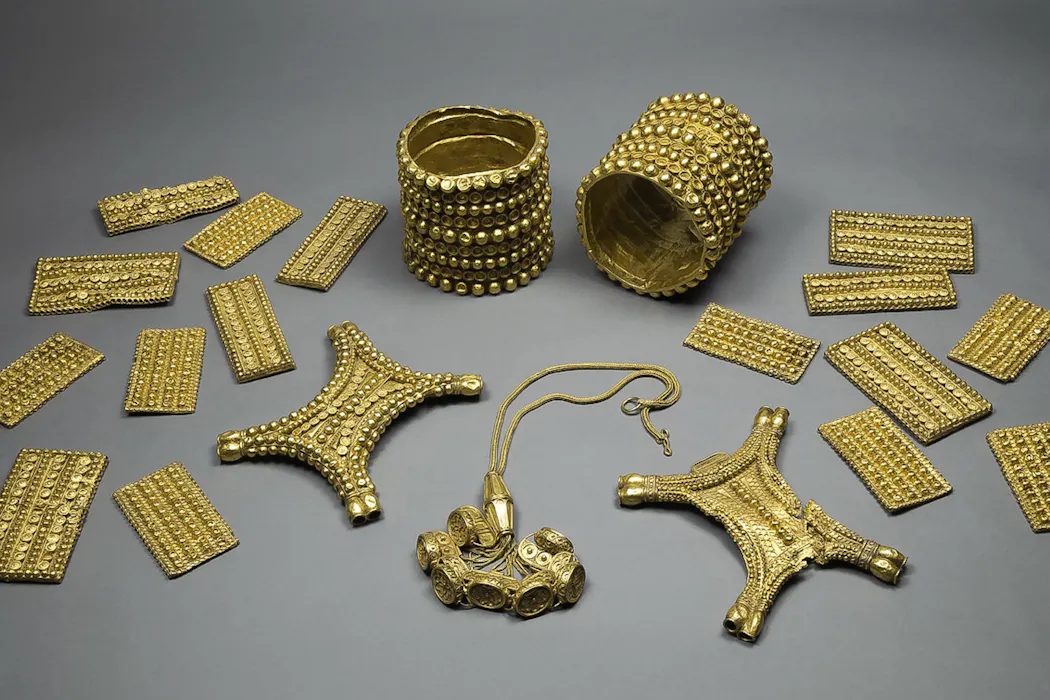
Tesoro de El Carambolo.Museo Arqueológico de Sevilla. Autor de la fotografía: J. Morón
En 1958, la Real Sociedad de Tiro de Pichón de Sevilla estaba inmersa en unas obras, a tres kilómetros de la ciudad, para ampliar sus instalaciones. El 30 de septiembre, en plenas excavaciones, un obrero descubrió por casualidad un brazalete de oro. No lo sabía, pero pertenecía a lo que después se definiría como el tesoro tartésico de El Carambolo (en Camas, Sevilla).
Al completo, el tesoro se compone de veintiún piezas de oro entre las que se encontraron un collar, dos brazaletes, dieciséis placas rectangulares y dos pectorales, y que pesaban en total casi tres kilogramos de oro, algo excepcional en hallazgos de este tipo. No sabemos por qué, pero el tesoro había sido ocultado alrededor de 2 500 años antes en el patio de un santuario, hacia el siglo VI a. e. c., y ahí llevaba desde entonces.
Por su importancia y singularidad, el anuncio tuvo una gran repercusión en la prensa internacional. Desde entonces, estas piezas constituyen uno de los conjuntos más importantes de la arqueología española. Pero, además de ser objetos, ¿cuál era su historia, su significado en la cultura tartésica?
Hasta ahora, las principales interpretaciones han sugerido que las joyas fueron llevadas por reyes y sacerdotes. Sin embargo, nuestra nueva investigación, publicada recientemente en la revista Archivo Español de Arqueología, propone que fue realmente una mujer quien vistió la mayor parte de estas alhajas de oro.
Propuesta de colocación de las joyas
La nueva interpretación se basa en varios paralelos arqueológicos del Mediterráneo y en el mito mesopotámico del “Descenso de Inanna/Ishtar al Inframundo”. Ambos nombres corresponden a la misma diosa, que recibe culto en la misma región geográfica. Inanna era el nombre que recibía por parte del pueblo sumerio durante el III milenio a. e. c., mientras que los acadios la denominaron Ishtar durante el II y I milenio a. e. c.
El mito cuenta que Ishtar viajó al infierno para asistir al funeral del Toro Celeste, marido de la diosa del inframundo, Ereshkigal. Para atravesar las siete puertas de esta región, el guardián allí presente le ordenó que dejara una joya en cada una de ellas. Por este motivo Ishtar fue quitándose su corona, sus collares, su pectoral y sus aros de oro. Estas mismas piezas decoran algunas imágenes en terracota tanto de Inanna como de Ishtar, depositadas como ofrendas en los templos de Próximo Oriente.
Colocación del collar junto a algunos paralelos procedentes de la isla de Chipre. A. Escultura de piedra de una posible sacerdotisa localizada en Arsos (Chipre), ca. siglo VI a. e. c. (Karageorghis, 1977, lám. 36, a). B. Terracotas procedentes de Kouklia (Chipre), ca. siglos VIII-VII a. e. c. (The British Museum, n.º inv. 1899,1129). Brazaletes de El Carambolo junto a imágenes de diosas mediterráneas y proximoorientales con piezas similares: A. Escultura procedente de la necrópolis púnica de Puig des Molins (Ibiza, España), ca. siglos IV-II a. e. c. (Museo Arqueológico Nacional, n.º inv. 1923/60/513) B. Terracota con posible representación de la diosa Ishtar procedente de Susa (Irán), ca. siglos XV-XII a. e. c. (Musée du Louvre, n.º inv. SB 7778).
El uso de este relato en la nueva investigación está justificado porque ambas diosas son las antecesoras directas de la fenicia Astarté. Según nuestra propuesta, se establece un paralelismo entre las joyas de El Carambolo y aquellas con las que se adornó Ishtar antes de descender al inframundo.
En el caso del tesoro sevillano, las joyas fueron portadas por dos personajes. El primero sería una sacerdotisa que representaba a Astarté. El segundo, un monarca o un sacerdote. La sacerdotisa habría llevado las piezas decoradas con rosetas, un símbolo relacionado con la identificación de Astarté con Venus. Se trata de ocho placas dispuestas como una corona, un pectoral y los dos brazaletes. También habría estado adornada con el collar. El segundo personaje habría utilizado el resto de las piezas, las ocho placas restantes, formando otra corona y el segundo pectoral en el centro del pecho.
Pectorales sobre personajes masculinos y femeninos repartidos a lo largo del Mediterráneo y Próximo Oriente: A. Estela de guerrero tartésica de Cortijo de la Reina II (Córdoba, España), ca. siglos IX-VI a. e. c. (Murillo Redondo et al., 2005, p. 26, fig. 4). B. Cardiophylax etrusco (Etruria Central, Italia), ca. siglo VIII a. e. c. (Musée du Louvre, n.º inv. MND 2299; Br 4403). C. Cardiophylax o amuleto grabado en una estela daunia (Museo Archeologico Nazionale di Manfredonia, n.º inv. Lillo 005). D. Terracota con posible representación de la diosa Ishtar procedente de Susa (Irán), ca. siglos XV-XII a. e. c. (Musée du Louvre, n.º inv. SB 7783). E. Lekythos en forma de Afrodita portando el kestos himas de bandas cruzadas en el pecho (Phanagoria, Grecia), ca. siglo IV a. e. c. (Museo Hermitage, n.º inv. Фа.1869-9). F. Imagen de la diosa Vanth representada en urna cineraria romana procedente de Chiusi (Italia), ca. siglo II a. e. c. (Worcester Art Museum, n.º inv. 1926.19).Coronas de El Carambolo junto a sus paralelos más estrechos procedentes del Mediterráneo oriental: A. Placa de corona o diadema articulada hallada en Amathus (Chipre), ca. siglos VIII-VII a. e. c. (The British Museum, n.º inv. 1891,0630.2). B. Bajorrelieve de la reina Kubaba divinizada (Carchemish, Turquía), ca. siglo VIII a. e. c. (Museo de las Civilizaciones de Anatolia). C-D. Posibles coronas descubiertas en Latakia (Siria), ca. siglos VIII-VII a. e. c. (The Walters Art Museum, n.º inv. 57.968 y 57.969).
El ritual
Las joyas de El Carambolo formaron parte del atuendo empleado por estos personajes durante la celebración del matrimonio sagrado. Este rito consistía en la unión simbólica de una diosa y un rey, y su objetivo era representar la renovación anual de la fertilidad de la naturaleza y del ciclo de los astros en el firmamento. También se buscaba con él asegurar la prosperidad y el orden del territorio gobernado, así como la continuidad de la estirpe real.
Este tipo de ritual está documentado en varios templos del Mediterráneo donde se rendía culto a Astarté, así como en santuarios de Próximo Oriente dedicados a Inanna e Ishtar. Según esta interpretación, Dumuzi/Tammuz, pareja de la diosa, descendía al inframundo en junio, durante el solsticio de verano. Allí permanecía hasta el solsticio de diciembre, momento en el que se celebraba su regreso. El matrimonio sagrado tenía así una finalidad política y religiosa, escenificándose mediante el intercambio de joyas y otros símbolos de poder.
El santuario de El Carambolo como escenario del mito
Esta nueva propuesta también encuentra estrechos paralelos en otros elementos sagrados que se han encontrado asociados al santuario. Es el caso de algunas ofrendas, sus altares y la decoración de algunos de sus suelos.
El primero de estos objetos es la pequeña escultura de bronce con la imagen de Astarté encontrada en el cerro de El Carambolo. Por la inscripción que presenta en su base se sabe que estuvo dedicada a un culto de carácter funerario.
Estatuilla de Astarté localizada en las cercanías del santuario tartésico de El Carambolo. Museo Arqueológico de Sevilla, n.º inv. CE11136
El segundo es el altar con forma de piel de toro hallado en el interior de una de sus capillas, relacionado con la piel del Toro Celeste después de su sacrificio. Su muerte y el posterior banquete funerario explican en el mito mesopotámico el viaje de la diosa al inframundo.
El tercer elemento son los pavimentos de conchas encontrados en los espacios de acceso a varias estancias del templo. Estos suelos pueden relacionarse con las valvas mágicas que Ereshkigal ordenó colocar en el umbral del mundo de los muertos. Según el mito, estas conchas permitieron que su hermana Ishtar regresara libre de impurezas al mundo de los vivos.
En definitiva, esta interpretación muestra que en el santuario de El Carambolo se celebró periódicamente un matrimonio sagrado entre una sacerdotisa como manifestación de Astarté y un monarca. Durante esta festividad, ambos personajes lucieron las joyas que componen el tesoro. El hecho de que la mayor parte fueran destinadas a esta diosa fenicia hacen de ella la figura central en la ceremonia.
De este modo, casi 70 años después de que se calificaran a estas piezas como dignas del rey tartésico Argantonio, puede llegarse a la conclusión de que estamos ante un tesoro digno de Astarté.
¿Quiere recibir más artículos como este?Suscríbase a Suplemento Cultural y reciba la actualidad cultural y una selección de los mejores artículos de historia, literatura, cine, arte o música, seleccionados por nuestra editora de Arte + Humanidades Claudia Lorenzo.
Las personas firmantes no son asalariadas, ni consultoras, ni poseen acciones, ni reciben financiación de ninguna compañía u organización que pueda obtener beneficio de este artículo, y han declarado carecer de vínculos relevantes más allá del cargo académico citado anteriormente.
Source: The Conversation – in French – By Yannick Simonin, Virologiste spécialiste en surveillance et étude des maladies virales émergentes. Professeur des Universités, Université de Montpellier
L’ESSENTIEL
Après une année 2025 déjà record en France, le nombre de cas d’infections par le virus du Nil occidental a atteint un nouveau palier exceptionnel en 2026.
S’il est très souvent asymptomatique, ce virus peut provoquer de graves complications neurologiques, parfois mortelles.
La circulation de ce virus transmis par les moustiques risque d’augmenter encore, en raison du changement climatique qui allonge la durée d’activité de ces insectes, accroît leur durée de vie et modifie leur métabolisme.
En ce début d’automne 2026, la France enregistre un nombre record de cas d’infection par le virus du Nil occidental (West Nile Virus, en anglais), aussi bien chez l’être humain que chez les chevaux, tous deux hôtes « accidentels » de ce virus qui infecte principalement les oiseaux.
Le 21 septembre 2026, plus de 250 cas équins et 117 cas humains avaient déjà été signalés, dépassant très largement les 62 cas recensés sur l’ensemble de l’année dernière, qui constituait déjà une année record ! Nos voisins européens ne sont pas épargnés, puisque plus de 1 500 cas ont déjà été identifiés sur le continent, où près de 80 décès ont malheureusement été recensés.
Le nombre d’infections de ce virus transmis par le moustique commun devrait encore augmenter dans les semaines à venir. Quelles régions sont touchées, quels facteurs expliquent cette situation exceptionnelle, et doit-on s’en alarmer ? Point de situation sur ce virus considéré comme émergent en Europe.
De l’Afrique à l’Europe
Le virus du Nil occidental tire son nom du lieu où il a été isolé pour la première fois, en 1937 : dans le district du Nil occidental, au nord de l’Ouganda.
On ne connaît pas encore très bien tous les rouages de l’introduction de ce virus en Europe, mais on sait qu’il est probablement arrivé sur le continent initialement avec des oiseaux migrateurs originaires d’Afrique, avant de se propager aux oiseaux résidents.
Le premier foyer européen a été identifié en France, en 1962-1963, en Camargue. Cependant, les enquêtes sérologiques (qui consistent à rechercher dans le sang des anticorps spécifiques du virus, témoignant d’une exposition passée) ont révélé que le virus du Nil occidental circulait sur le continent dès les années 1950. Il est ensuite resté discret jusqu’en 1996, où une épidémie majeure est survenue en Roumanie : environ 400 cas avaient été recensés. D’autres suivront, dans le sud, l’est, puis l’ouest de l’Europe.
Mais l’année de rupture, pour l’Europe, est en 2018. Le virus s’étend alors largement vers l’ouest du continent et provoque la plus grande épidémie jamais enregistrée, selon le Centre européen de prévention et de contrôle des maladies (European Centre for Disease Prevention and Control – ECDC) : 2 083 cas et 181 décès dans une douzaine de pays, dont la France, soit davantage de malades en une seule année que les dix années précédentes réunies.
Depuis, l’aire de répartition du virus ne cesse de s’étendre chaque année. L’Allemagne, les Pays-Bas puis la Belgique ont enregistré leurs premiers cas. Ce virus est devenu endémique dans certaines régions du sud de l’Europe, notamment dans le sud de la France.
Autrefois cantonné aux régions méditerranéennes, le virus du Nil occidental ne cesse de poursuivre son expansion géographique en Europe.
Dans notre pays, le bulletin de Santé publique France en date du 21 septembre 2026 est sans appel : 117 cas autochtones (autrement dit contractés sur le territoire) d’infections par le virus du Nil occidental ont été détectés. Le record de 2025 (62 cas et les 5 premiers décès jamais répertoriés sur notre territoire) est donc d’ores et déjà largement dépassé.
Par ailleurs, plus de 250 cas équins ont été rapportés, soit plus du double du précédent record. Pas moins de 16 départements sont touchés, dont pour la première fois l’Aude, la Seine-et-Marne, la Drôme, le Rhône, l’Isère, la Loire-Atlantique, le Maine-et-Loire et le Loiret, qui ont ainsi enregistré leur tout premier cas… La région PACA est la plus concernée, avec 39 cas humains répertoriés.
Plus inquiétant encore, la Nouvelle-Aquitaine, touchée pour la première fois en 2023, enregistre de nouveaux cas cette année. Et l’Île-de-France, qui, à la surprise des spécialistes, a enregistré des premiers cas l’an passé, se retrouve confrontée à nouveau à la circulation du virus. Essonne, Seine-Saint-Denis, Val-d’Oise, Val-de-Marne, Seine-et-Marne : la liste des départements touchés s’allonge…
Cette récurrence de cas montre que ce virus est probablement en phase d’installation dans de nouvelles régions. Et ce n’est pas fini : la situation devrait continuer à se dégrader dans les prochaines semaines. En effet, le virus est connu pour provoquer des infections jusqu’au mois de novembre, et les conditions climatiques actuelles sont favorables à l’activité des moustiques.
Un cycle de transmission complexe
Le virus du Nil occidental est un arbovirus (de l’anglais arthropod-borne virus, autrement dit un virus transmis par des arthropodes, sous-entendu « hématophages », c’est-à-dire se nourrissant de sang). Il appartient au genre Orthoflavivirus, composé de plus de 70 membres, parmi lesquels le virus de la dengue, le virus Zika ou encore le virus de la fièvre jaune. On en connaît au moins sept lignées, mais seules les lignées 1 et 2 ont, pour l’heure, été associées à des épidémies chez l’être humain.
Une des particularités de ce virus par rapport à d’autres (comme ceux de la dengue, le chikungunya ou le Zika) est qu’il n’est pas transmis par le moustique-tigre, mais par le moustique commun, appelé Culex pipiens. Or, celui-ci est présent sur l’ensemble du territoire hexagonal et il est le moustique le plus répandu en Europe.
Les oiseaux – notamment les passereaux (comme les moineaux, les mésanges, les hirondelles…), les strigiformes (chouettes) – sont considérés comme le réservoir principal du virus du Nil occidental. Les moustiques s’infectent après un repas de sang pris sur des oiseaux porteurs du virus.
Lorsqu’un moustique pique un oiseau infecté, le virus peut se multiplier dans son organisme avant d’infecter, lors du repas sanguin suivant, un nouvel hôte, tel que l’être humain ou le cheval.
Cycle de transmission du virus du Nil occidental en Europe. Yannick Simonin, Fourni par l’auteur
Ainsi, contrairement à la plupart des autres arbovirus connus pour circuler en France, le virus du Nil occidental se transmet de l’animal à l’être humain, ce qui en fait un cas typique de zoonose (une zoonose est une maladie se transmettant d’une espèce animale à l’être humain).
Cependant, contrairement à la plupart des autres arbovirus qui circulent en France, tel que la dengue ou le chikungunya, par exemple, le virus du Nil occidental ne peut pas se transmettre d’un être humain à un autre par l’intermédiaire des moustiques. Et ce, même lorsqu’une personne développe des symptômes. L’hypothèse est que la charge virale sanguine (la quantité de particules virales en circulation dans le sang) est trop faible pour permettre une infection.
Toutefois, leur capacité à amplifier le virus reste bien moindre que celle des oiseaux. Ces mammifères pourraient néanmoins jouer un rôle dans le maintien du virus dans certains écosystèmes et contribuer indirectement à l’exposition des populations humaines.
Pas de transmission d’humain à humain
Si le virus ne se transmet pas d’humain à humain par piqûres de moustiques, d’autres voies de contamination peuvent exister. Le virus peut en particulier se transmettre par transfusion sanguine ou par transplantation d’organes.
En 2025, en France, deux personnes ont ainsi été contaminées à la suite d’une transplantation de reins. Le donneur, un homme dans la cinquantaine décédé d’une hémorragie cérébrale, s’est avéré avoir été infecté par le virus avant sa mort, mais sans avoir développé de signes cliniques (à l’exception de quelques petites lésions diffuses sur la peau de son abdomen et de ses jambes).
L’existence de telles voies de transmission alternatives nécessite donc de revoir nos stratégies de don du sang et de transplantation d’organes en période de circulation du virus.
En France, un dispositif de sécurisation des dons se déclenche dès que le virus est détecté chez l’être humain. Quand un premier cas est confirmé dans un département, les dons de sang y sont systématiquement dépistés.
Par ailleurs, les voyageurs revenant d’une zone à risque (comme les États-Unis) sont soit testés, soit écartés du don pendant vingt-huit jours en période de saison de circulation vectorielle. Pour les greffons, la même logique s’applique, avec une exception pour les organes vitaux transplantés sans attendre les résultats lorsque l’urgence l’impose. La France va même plus loin dans les départements les plus exposés, en dépistant les dons avant l’apparition du premier cas humain.
Reste que ce dispositif a ses limites : les deux greffés de 2025 avaient reçu les reins d’un donneur vivant dans un département qui ne figurait pas encore sur la liste des zones à risque. D’où l’intérêt de surveiller en amont les oiseaux, les moustiques et les chevaux, qui signalent la présence du virus souvent bien avant les premiers cas humains.
Un virus très souvent asymptomatique, mais parfois mortel
À l’origine, le virus du Nil occidental était considéré comme un virus bénin. En effet, dans la grande majorité des cas, il ne provoque pas de symptômes, et l’on a longtemps considéré qu’il n’était, au pire, responsable que d’une fièvre passagère.
On estime aujourd’hui que, après une infection, environ 20 % des personnes infectées développent des symptômes. Le plus souvent, il s’agit d’un syndrome pseudo-grippal peu spécifique : fièvre, maux de tête, faiblesse généralisée, douleurs musculaires et articulaires, auxquels s’ajoutent parfois des éruptions cutanées ou des atteintes oculaires.
Cette dernière se traduit par une encéphalite (inflammation du cerveau), une méningite (inflammation des enveloppes qui l’entourent) ou une paralysie flasque aiguë, proche de celle de la poliomyélite. Ces formes sévères de la maladie touchent principalement les personnes âgées, ainsi que les patients porteurs de maladies chroniques : maladies cardiovasculaires, diabète, cancer…
Il s’agit là d’une dimension souvent oubliée du fardeau de cette infection, qui ne se résume pas au simple décompte des décès.
Le virus du Nil occidental est aujourd’hui l’arbovirus responsable du plus grand nombre de décès en Europe avec une moyenne de 80 décès enregistrés par an ces cinq dernières années : en 2025, 97 décès y ont été recensés pour un peu plus de 1 100 cas. Cette année près de 80 décès sont déjà recensés, l’Italie payant le tribut le plus lourd avec plus de 50 décès enregistrés début septembre. Rappelons que l’an dernier, la France a malheureusement enregistré ses cinq premiers décès liés à ce virus.
Un virus redoutable pour les chevaux Du côté vétérinaire, les chevaux sont particulièrement sensibles à l’infection. Ils sont, de ce fait, utilisés comme indicateurs de sa circulation, notamment en Camargue, où des cas sporadiques d’infection sont régulièrement détectés depuis le début des années 2000.
Chez ces animaux, l’infection peut entraîner des signes cliniques sévères, notamment neurologiques, avec le développement d’une encéphalite. La mortalité peut alors atteindre 30 à 40 % des animaux infectés présentant des symptômes. De quoi inquiéter propriétaires et éleveurs des zones touchées.
Un diagnostic difficile
Diagnostiquer la maladie n’est pas chose aisée. En effet, ses symptômes n’ont rien de caractéristique, et ne suffisent jamais à eux seuls à déterminer la cause de l’infection. Pour cette raison, le nombre de cas identifiés est très largement sous-évalué, car, dans notre pays, les formes asymptomatiques et les formes fébriles sont très peu diagnostiquées.
Il est possible de détecter le virus dans le sang, les urines ou le liquide céphalo-rachidien, mais cette fenêtre de détection est étroite, et s’est souvent déjà refermée lorsque le patient consulte. Le diagnostic repose donc habituellement sur la recherche d’anticorps (de type IgM), qui apparaissent précocement, dans le sérum prélevé environ cinq à huit jours après le début des signes cliniques.
Mais cette approche présente une limite de taille : ces anticorps peuvent réagir de façon croisée avec ceux dirigés contre des virus proches, comme le virus Usutu ou encore celui de la dengue, ce qui impose parfois des analyses complémentaires (appelées « séroneutralisation »), bien plus longues et complexes.
En matière de prise en charge, les patients les plus atteints sont hospitalisés pour recevoir des soins de support (hydratation, assistance respiratoire si nécessaire…), tandis que les formes bénignes se traitent par de simples antalgiques.
Reste le plus frustrant : il existe un vaccin équin efficace, qui protège bien les chevaux, mais aucun vaccin humain. Cette situation s’explique notamment par la difficulté à identifier des cibles vaccinales suffisamment efficaces, mais aussi par la complexité des essais cliniques, compte tenu du caractère imprévisible de la localisation et de l’intensité des foyers de transmission.
Par ailleurs, il n’existe aucun traitement antiviral spécifique, comme pour la majorité des arbovirus… Des programmes de recherche sont en cours pour essayer de combler ce manque, mais les résultats ne sont pas attendus avant plusieurs années.
Cette hausse, amorcée avec la rupture de 2018 et confirmée depuis, est, pour de nombreux spécialistes, inéluctable.
Les explications sont multiples. Si la circulation des oiseaux migrateurs, réservoirs du virus, favorise la réintroduction régulière de nouvelles souches virales sur le continent européen, l’un des facteurs les plus importants est sans doute le changement climatique.
En effet, les moustiques ne pouvant pas réguler leur température, ils sont extrêmement sensibles aux variations climatiques. Or, les modifications climatiques en cours dans certaines régions allongent leur période d’activité. On observe ainsi des moustiques Culex pipiensde plus en plus tôt dans l’année tandis que leur disparition survient de plus en plus tardivement. Cette situation allonge d’autant la fenêtre pendant laquelle le virus peut circuler.
Il s’agit là d’un point crucial : pour transmettre le virus, un moustique doit d’abord l’héberger assez longtemps pour que celui-ci se réplique, franchisse la paroi de son intestin et colonise ses glandes salivaires. Or, ce délai, de l’ordre d’une à deux semaines, se raccourcit nettement quand il fait chaud (jusqu’à un certain seuil). Conséquence : le moustique devient infectieux plus vite et il vit assez longtemps pour piquer davantage.
À cela s’ajoutent les épisodes de canicule et d’orages, qui multiplient les points d’eau stagnante et chaude où les Culex pondent volontiers. Par ailleurs, en période de sécheresse prolongée, les moustiques et les oiseaux ont tendance à se concentrer autour des rares points d’eau disponibles, ce qui favorise les contacts entre oiseaux et, par conséquent, la circulation du virus. Enfin, des hivers plus doux permettent une meilleure survie des moustiques et favorisent ainsi le maintien de populations plus importantes d’une année à l’autre.
Face à cette situation, il est impératif de renforcer les réseaux de surveillance. C’est tout l’intérêt de l’approche Une seule santé (One Health, en anglais) : surveiller conjointement les oiseaux, les chevaux et les moustiques permet de détecter le virus avant qu’il ne provoque les premiers cas humains, et donc d’agir avant les premiers cas humains plutôt qu’après.
Enfin, en attendant un vaccin humain qui se fait désirer, la protection repose sur des gestes simples : éliminer les eaux stagnantes autour de chez soi, où les moustiques pondent, et se protéger des piqûres, répulsifs, vêtements couvrants, moustiquaires, en particulier à la tombée du jour et la nuit, quand les moustiques Culex sont les plus actifs.
Yannick Simonin a reçu des financements de Horizon Europe, ANR, ANRS-MIE, PREZODE, région Occitanie, Université de Montpellier.
El acceso a un alquiler asequible es una de las principales preocupaciones de las familias. No es de extrañar. Según los últimos datos disponibles, solo en Cataluña uno de cada cuatro hogares destina más del 40 % de sus ingresos a pagar el alquiler. Es una proporción que pone de manifiesto que el problema es real y exige respuestas.
Ahora bien, antes de proponer soluciones conviene mirar qué pasa en los países que obtienen mejores resultados. Los datos europeos muestran que la tasa de sobrecarga de los costes de la vivienda es significativamente inferior en países como Alemania (13,2 %) o Finlandia (12,3 %) que en España (26,8 %). La pregunta relevante no es si existe un problema, sino qué podemos aprender de estos países.
El problema de la vivienda también es de salarios
Cuando hablamos de acceso a la vivienda, a menudo olvidamos una evidencia elemental: un alquiler resulta más asequible cuando los ingresos son más elevados. Según datos de la OCDE, en 2025, el salario medio en Finlandia era un 44 % más alto que el español, y en Alemania, un 56 %. Eso significa que una familia finlandesa o alemana puede dedicar un porcentaje menor de sus ingresos a pagar el mismo alquiler que un español.
Por eso es un error desvincular la política de vivienda de las políticas económicas que incentiven un cambio de modelo productivo. En España continúa habiendo una especialización excesiva en sectores económicos de bajo valor añadido. El turismo es el ejemplo más evidente. Aproximadamente el 13 % de los puestos de trabajo en España están vinculados a actividades turísticas. Se trata de un sector fundamental para la economía, pero que, de media, genera salarios inferiores que los sectores tecnológicos o profesionales.
Construir más es imprescindible
Cambiar el modelo productivo de la economía para que genere puestos de trabajo con más valor añadido es esencial, más allá del problema de la vivienda. Sin embargo, se necesita aumentar la oferta de vivienda de manera inmediata. La teoría económica es sencilla: cuando hay pocas viviendas disponibles y mucha demanda los precios suben. Por lo tanto, si queremos reducir la presión sobre los alquileres necesitamos aumentar el número de viviendas. Una parte importante de este esfuerzo tendría que proceder de viviendas sociales.
La media europea se sitúa en torno al 8 % del parque residencial, mientras que en España continúa estando muy por debajo de esa cifra. Según el Ministerio de Vivienda y Agenda Urbana, el parque de vivienda social en España representa aproximadamente el 3,4 % del total. Esta cifra es muy reducida si la comparamos con la de Finlandia. En este país, la vivienda social representa el 11 % del total. Por tanto, si España consiguiera aproximarse a estas cifras, las tensiones del mercado de alquiler disminuirían sustancialmente.
Las regulaciones pueden ayudar (o lo contrario)
Ante la subida de alquileres es natural que aparezcan propuestas para limitar los precios. En algunos casos, determinadas regulaciones pueden corregir comportamientos abusivos o mejorar la transparencia del mercado. El problema es pensar que la medida de control de los precios resuelve, por sí sola el problema.
Cuando los rendimientos generados por los alquileres se reducen significativamente o hay incertidumbre entre los propietarios sobre el rendimiento futuro de sus activos, pueden optar por vender las viviendas, retirarlas del mercado de alquiler residencial o destinarlas a otros usos. El resultado es que la oferta disponible disminuye y aumenta el precio. Esta preocupación no es únicamente teórica. En San Francisco, la ampliación de los controles de alquiler provocó una reducción del 15 % del parque de viviendas disponibles para alquilar.
Finlandia ofrece un modelo a seguir. El sistema finlandés se basa en la combinación de un parque de vivienda social sustancial con rentas reguladas y, el resto, un mercado privado no regulado. Este modelo, y unos sueldos más altos, permiten que casi el 90 % de los hogares finlandeses destine menos del 40 % de sus ingresos a pagar el alquiler.
Menos eslóganes y más grúas
No existe una solución mágica al problema de la vivienda. Pero la evidencia apunta en una dirección muy clara: se necesita una economía que genere salarios más altos.
También se necesitan muchas más grúas y mucha más construcción residencial, ampliar de manera sostenida el parque de vivienda social, y evitar la tentación de creer que los problemas de escasez se resuelven regulando precios.
Sergi Basco no recibe salario, ni ejerce labores de consultoría, ni posee acciones, ni recibe financiación de ninguna compañía u organización que pueda obtener beneficio de este artículo, y ha declarado carecer de vínculos relevantes más allá del cargo académico citado.
Source: The Conversation – in French – By Thierry Vircoulon, Chercheur associé au Centre Afrique de l’Institut Français des Relations Internationales, membre du Groupe de Recherche sur l’Eugénisme et le Racisme, Université Paris Cité
Au début du XXIᵉ siècle, le problème des « minerais de conflit » a progressivement remplacé celui des « diamants de conflit ». Ces deux notions soulignent le lien existant entre l’exploitation des ressources minières et le financement des guerres.
En République démocratique du Congo (RDC), des recherches menées depuis 2003 ont montré que des groupes armés et l’armée congolaise se finançaient grâce à l’exploitation artisanale des “minerais 3T” (coltan, cassitérite et wolframite) et de l’or. Extraits de mines artisanales dans l’Est de la RDC, ces minerais sont à la fois des moyens et des buts de guerre pour les protagonistes de ce système de conflit.
En réponse à ce problème, gouvernements, industriels et organisations de la société civile ont progressivement mis en place un système d’approvisionnement responsable. Celui-ci repose sur la traçabilité et la certification.
Nous avons étudié la gouvernance des ressources naturelles, notamment le lien entre ressources minières et conflits en RDC. Présenté depuis une dizaine d’années comme la solution au problème des minerais de conflit, ce dispositif comporte pourtant plusieurs failles.
Une politique complexe
L’approvisionnement responsable est devenu progressivement un standard international à travers plusieurs initiatives. En 2008, des organisations de l’industrie électronique ont créé la Responsible Minerals Initiative (RMI).
En 2010, l’Organisation de coopération et de développement économiques (OCDE) a publié une méthodologie sur le « devoir de diligence raisonnable » pour les chaînes d’approvisionnement en minerais provenant de zones de conflit ou à haut risque. Cette méthodologie définit les mesures que les entreprises peuvent prendre pour identifier, prévenir et atténuer les risques liés à l’approvisionnement en minerais provenant de zones de conflit.
En 2010, la CIRGL a adopté l’Initiative régionale contre l’exploitation illégale des ressources naturelles, comprenant notamment un mécanisme de certification, l’harmonisation des législations, une base de données sur les flux de minerais, la formalisation de l’exploitation artisanale, la promotion de l’ITIE et un mécanisme d’alerte.
Adopté en 2011, le mécanisme régional de certification classe les sites miniers en trois catégories selon leur situation sécuritaire et sociale. Une quatrième catégorie – les sites bleus – a été introduite en 2021 :
Rouge : présence de groupes armés, forces de sécurité impliquées dans l’exploitation minière; enfants de moins de 15 ans ou femmes enceintes au travail sur le site ; production et exportation interdites.
Jaune : situation partiellement satisfaisante ; exploitation temporairement autorisée pendant six mois en attendant une amélioration.
Vert : site sous contrôle des autorités et sans violations graves des droits humains ; production autorisée pour un an, sous réserve de renouvellement.
Bleu : site non encore inspecté ou dont la qualification est expirée, mais ne présentant pas, a priori, de problème connu ; il est autorisé à produire jusqu’à 36 mois avant inspection.
Créée en 2009 en RDC, puis étendue au Rwanda, au Burundi et à l’Ouganda, l’ITSCI a mis en place le principal système de traçabilité des 3T dans les Grands Lacs. Elle couvre environ 3 000 sites miniers dans la région et permet notamment de suivre les minerais grâce à un étiquetage des lots et à la certification de leur origine.
L’ITSCI forme des auditeurs, supervise l’étiquetage des lots de minerais et assiste les entreprises dans la mise en place d’une politique de diligence raisonnable. Elle publie également des alertes et des informations sur la production minière. Son financement repose sur les cotisations de ses membres, mais aussi sur les volumes de minerais certifiés. Elle réunit des entreprises de l’amont et de l’aval de la chaîne et son siège se trouve à Londres.
La certification RMI
La Responsible Mineral Initiative (RMI) possède un champ géographique et minéral plus large que l’ITSCI : elle concerne notamment l’or, les 3T, le cobalt et le mica et ne se limite pas aux Grands Lacs. La RMI fournit aux entreprises une méthodologie de diligence raisonnable, des outils d’évaluation des risques, des bases de données, des cartes de risques et des mécanismes de plainte.
Pour être certifiées par la RMI, les entreprises doivent être auditées par des organismes indépendants sélectionnés par elle qui évaluent leur politique de diligence raisonnable. Les fonderies et les raffineries étant les acteurs clés des chaînes d’approvisionnement, elles constituent la cible privilégiée de la RMI.
En théorie, les efforts communs de la CIRGL, des États, de l’ITSCI et de la RMI ont abouti à un système de certifications multiples censé garantir un approvisionnement responsable. Ce système repose sur une division du travail entre les différents acteurs.
La CIRGL établit les règles. Les États autorisent les mines et les exportations. L’ITSCI assure la traçabilité des 3T. Pour sa part, la RMI vérifie la conformité des politiques d’approvisionnement des entreprises internationales avec les standards internationaux.
Mais, en pratique, la fiabilité de ces multiples certifications qui couvrent l’ensemble du système de la production minière (les mines, les minerais et les entreprises) n’est pas complètement garantie.
Les failles de l’approvisionnement responsable
La première faille concerne la classification des mines artisanales en RDC. L’introduction de la catégorie « bleu » en 2021 permet à des sites miniers non inspectés de produire et d’exporter. Cette catégorie a été créée en raison du manque de moyens humains et financiers de l’administration congolaise pour les inspections de terrain. Elle réduit toutefois la fiabilité du système, puisqu’elle autorise une exception au principe d’inspection des sites.
Plus grave encore, des miliciens bénéficiaient de l’exploitation de certains sites miniers certifiés : d’après l’ONU, ils étaient actifs dans la zone minière de Rubaya en 2023 et 2024 alors qu’elle était classée comme site vert et que sa production était donc autorisée.
Ces situations révèlent au minimum le manque de rigueur et, au pire, la corruption des responsables de la certification.
L’autre faille est la contrebande de minerais entre la RDC et ses voisins, notamment le Rwanda. La production rwandaise étant considérée comme propre, des minerais congolais issus de zones de conflit sont introduits au Rwanda et mélangés à sa production. Cette contrebande explique en grande partie la croissance des exportations rwandaises de 3T et d’or.
Bien que niée par le gouvernement rwandais, cette contrebande a été dénoncée par les États-Unis, qui ont sanctionné trois entreprises minières rwandaises en 2026. Par prudence, plusieurs compagnies internationales ont cessé de se fournir en RDC et au Rwanda.
Les systèmes de certification de l’ITSCI et de la RMI dépendent essentiellement de l’indépendance et de l’intégrité des auditeurs. Comme dans tout processus d’audit, le problème du conflit d’intérêts (risque de collusion entre auditeurs et audités ou d’autocensure des auditeurs) ne peut être ignoré en raison de récents scandales.
En effet, les organismes de certification sont confrontés à un double objectif contradictoire : un objectif financier (certifier un grand nombre de sites miniers et d’entreprises) et un objectif réputationnel (effectuer des audits rigoureux). Par exemple, le financement de l’ITSCI dépend largement des volumes de minerais dont l’origine est certifiée. Cette situation peut inciter les organismes de certification à hésiter avant de refuser une certification ou de suspendre une certification existante.
Enfin, la certification est en train de devenir un marché lucratif et concurrentiel. La RMI a critiqué l’ITSCI et, depuis 2023, la RMI ne reconnaît plus officiellement la certification de l’ITSCI. La bataille des certificateurs ne fait que commencer.
Trois problèmes persistants
En définitive, dans les Grands Lacs, les initiatives de certification ont visé à réduire l’écoulement des minerais de conflit sur le marché international et, ce faisant, la conflictualité.
Face à leur incapacité à atteindre pleinement cet objectif – le financement des groupes armés et de l’armée congolaise par le commerce des minerais continue, et les conflits aussi comme le montre la deuxième rébellion du M23 -, leur rhétorique s’est faite plus modeste.
Elle se contente maintenant de garantir aux entreprises un approvisionnement responsable en 3T dans les Grands Lacs. L’objectif de pacification a cédé le pas à un objectif industriel. Or, les efforts réels de traçabilité et de certification se heurtent encore à trois problèmes :
la corruption des administrations chargées d’appliquer le dispositif de certification des mines et d’exportation des minerais (notoire en RDC, la corruption n’épargne pas les autres États de la région);
la contrebande qui permet de commercialiser des minerais de conflit comme des minerais propres à partir des pays voisins de la RDC;
les conflits d’intérêt qui peuvent influencer les audits, et ce d’autant plus que la certification se transforme en marché lucratif.
La certification est donc au mieux un des outils d’une politique de bonne gouvernance minière, mais elle ne saurait être le remède au problème des minerais de conflit.
Marc-André Lagrange a participé à la rédaction de cet article.
Thierry Vircoulon travaille comme chercheur associé à l’Institut Français des Relations Internationales, fait partie du Groupe de Recherche sur l’Eugénisme et le Racisme et enseigne à l’Institut d’Etudes Politiques de Lille.