
Source: The Conversation – Canada – By Rassim Khelifa, Assistant Professor, Department of Biology; Canada Research Chair Tier 2 in Global Change Biology, Concordia University
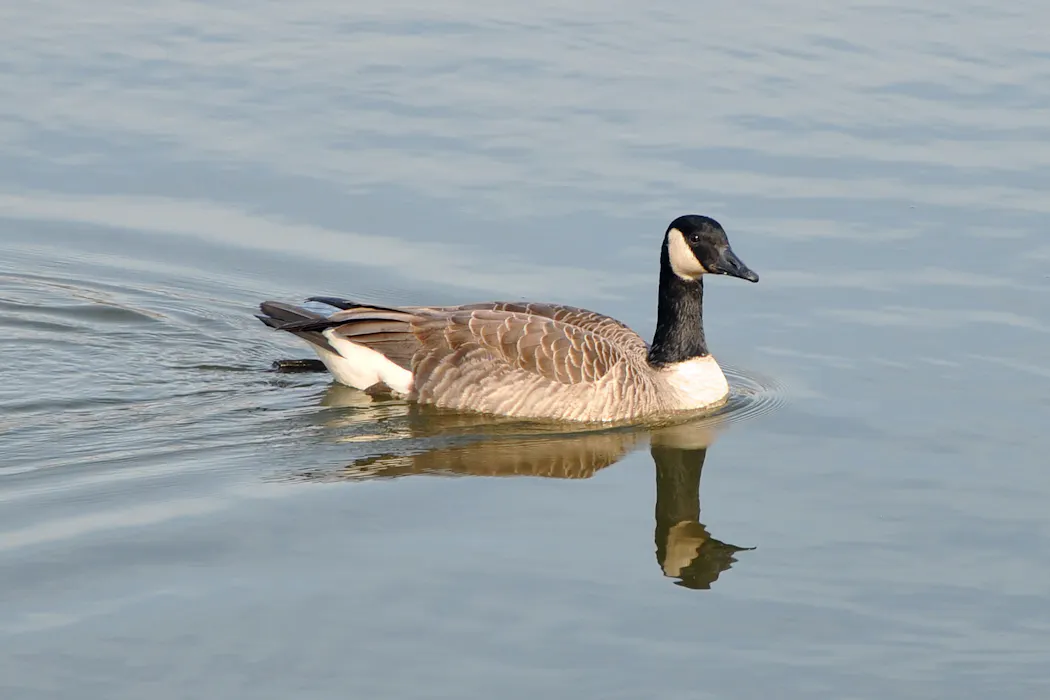
Canada geese are real-life gangsters. They are large, bold, highly adaptable and thrive in urban landscapes. Wherever they go, they leave their distinctive signature: cigar-shaped green feces.
The population of Canada geese has expanded rapidly in many North American cities, thanks to favourable urban environments — with abundant food from lawns, safe nesting sites and few predators — and supportive conservation actions over the past three decades.
These geese are indeed adorable, but in large numbers they can become a nuisance. They damage crops and compete with other water birds. They produce feces that are unpleasant to step on and carry pathogens — contaminating lawns and leading to the ecological collapse of water bodies.
A single goose can defecate every 20 minutes. Now, imagine how much fecal matter is produced every day by hundreds or thousands of geese in a city. There have been almost no efforts to explore beneficial uses for this waste.
Our research findings, published in the Journal of Environmental Management, suggest that goose poop could be used to create both a source of protein for animal feed and an agricultural fertilizer — using one of nature’s recycling powerhouses, the black soldier fly.
Goose feces to create poultry feed
The larvae of the black soldier fly are known for their remarkable ability to consume and break down organic waste, including animal waste from farms. They have never before been tested on Canada goose feces.
In our study, we fed black soldier fly larvae three different food diets: a standard nutrient-rich feed mixture of corn, wheat and alfalfa (the control), a mix of this feed and goose feces and finally a diet of only goose feces.
We also added another variable, sterilizing some of the feces. This was to help us understand whether fecal microorganisms have any effect on digestion.
The results were surprising: the insect was able to complete its full life cycle on Canada goose feces alone. In fact, it was able to consume a little more than half of this waste. The trade-off was a reduced body size and shorter lifespan, but this was not an issue because it did the job.
The larvae grew faster and gained a higher body weight when the feces were not sterilized, which suggests that microbes in the feces do provide some kind of benefit for insect development. Notably, the larvae that consumed the mixture of goose poop and nutrient-rich feed grew even better than those fed with the nutrient-rich feed alone, and they achieved similar fitness as adults.
These results suggest that black soldier fly larvae and goose poop could be used to power a large-scale organic waste treatment system. Goose feces could be collected from city parks and green spaces and transported to a facility where larvae could be reared on the waste.
These larvae could then be used as protein to feed poultry and in aquaculture, in a circular, “upcycling” approach to urban waste management.
Nutrient-rich fertilizer
Larval digestion also produces a residue known as frass. Black soldier fly frass has been tested in several studies, mainly on terrestrial crops where it has improved plant growth and yield.
We decided to test the potential of frass produced using Canada goose feces — as a fertilizer for duckweed, a fast-growing aquatic plant with high protein content used in animal feed, biofuel production and wastewater treatment.
For this experiment, we tested three different potential duckweed fertilizers. The first (the control) was an ideal solution containing the nutrients necessary for duckweed growth. The second was untreated Canada goose feces. The third was frass from the digestion of Canada goose feces by the black soldier fly larvae.
Duckweed growth increased by 30 per cent when the frass was applied, compared to the control fertilizer. We also found that duckweed roots grown in frass from feces were smaller than those grown in untreated feces — a typical response to a more nutrient-rich environment, where roots can readily access the nutrients.
A sustainable circular economy
Insect-based waste treatment facilities already exist at industrial scale. Entosystem, a company in Québec that produces insect proteins for feeding farm and domestic animals, uses black soldier fly larvae to convert food and organic waste into protein and fertilizer.
Biotechnology company Oberland Agriscience in Nova Scotia also uses black soldier fly larvae, combined with technologies like AI and robotics to transform organic waste into animal feed and soil products. NRGene in Saskatchewan is a research and demonstration centre also testing the black soldier fly for optimizing large-scale conversion of waste to protein.
Similar systems could be used for upcycling goose feces by the black soldier fly, rather than directing this waste to traditional waste facilities or landfills.
In this way, waste is converted into valuable resources for the agri-food industry: larvae can be used as feed for poultry or in aquaculture, frass can be applied as an organic fertilizer for various crops.
This eco-friendly approach reframes an urban wildlife conflict as an opportunity. It contributes to a sustainable circular economy where waste materials are reused, recycled or transformed into new resources.

Rassim Khelifa receives funding from NSERC CRC Tier 2 (CRC-2022-00134) and NSERC Discovery Grant (RGPIN-2024- 04564).
Rassim Khelifa is a member of The Quebec Centre for Biodiversity Science and The Canadian Society for Ecology and Evolution.
Carlos Antonio Lopez Manzano receives funding from Fonds de recherche du Québec – Nature et technologies (FRQNT) through the Merit Scholarship for Foreign Students (PBEEE). Member of the Quebec Centre for Biodiversity Science (QCBS) and the Aquatic Resources Quebec (RAQ).
– ref. We found a way to turn the poop of Canada geese into chicken feed and crop fertilizer – https://theconversation.com/we-found-a-way-to-turn-the-poop-of-canada-geese-into-chicken-feed-and-crop-fertilizer-281226