
Source: The Conversation – Canada – By Natasha Henry-Dixon, Assistant Professor of African Canadian History, York University, Canada
During Black History Month more than two years ago, in February 2024, the Ontario Conservative government announced it would introduce mandatory curriculum expectations focused on the history of Black Canadians for Grades 7, 8 and 10, with new learning to start in September 2025.
The government then postponed this and other curricular changes.
In February 2026 (during Black History Month), the Ministry of Education released the new curriculum expectations, now to come into effect this coming September.
Decades of advocacy
Despite decades of advocacy, there has never been a singular historical fact that all students in Ontario have had to learn about Black Canadians’ 400-year presence in what is now Canada.
To date, inclusion of Black history has been based on the voluntary efforts of individual educators or some school board equity initiatives.
As highlighted in the Ontario Human Rights Commission’s Dreams Delayed report, the Black community has long criticized the over-emphasis on Black American history and the exclusion of the rich and diverse histories and contributions of Black Canadians.
I have been waiting with bated breath.
I am a historian of Black Canada, an assistant professor and a curriculum consultant specializing in Black Canadian history. I have taught Black Canadian history at the elementary and secondary levels and facilitated professional development for educators on the same subject for more than 20 years.
I’ve also studied the Ontario curriculum pertaining to Black Canadian history since 1999. During the early stages of the development of the new expectations, I was invited to review only initial drafts.
Read more:
‘Dreams delayed’ no longer: Report identifies key changes needed around Black students’ education
According to the Ontario Ministry of Education, “the 2026 revisions to the Grades 7 and 8 history curriculum were made in collaboration with Black history organizations, academic scholars, subject matter experts, subject division experts, parent and education organizations, and francophone partners,” but only generalized detail is provided about the process.
Questions have been raised about this because of the final output. I’ve examined the released revised history curriculum and present here an assessment.
New expectations
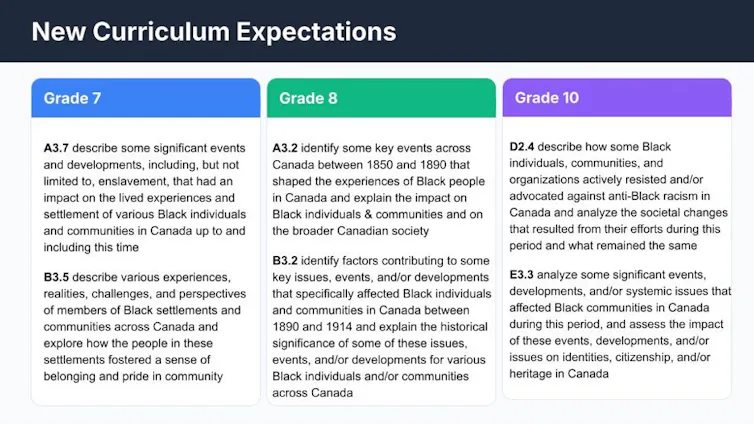
The new mandated expectations pertaining to Black Canadian history were included in a revision of the Grades 7, 8 and 10 history curriculum. These are the grades where students learn Canadian history. The number of expectations regarding Black history is reasonable because there is a lot to cover in the history curriculum overall.
(Natasha Henry-Dixon)
However, unlike all of the other specific expectations in the history curriculum, the “Black-specific expectations” are the only ones that don’t have any supporting topic suggestions or optional topics.
While specific curriculum expectations for Grades 7 and 8 don’t have any framing questions like other ones do, the Grade 10 expectations have two framing questions: “In what ways did the actions of various Black individuals, communities and organizations during this period help shape strategies and initiatives combating anti-Black racism today?” and “How did Black communities contribute to Canada’s identity and heritage during this period?”
Read more:
Black Londoners of Canada: Digital mapping reveals Ontario’s Black history and challenges myths
The ministry could argue that such open expectations give teachers room to teach what they’d like. But teachers should receive as much informed guidance as possible, particularly because most have not taught any Black history content before.
Black Canadian history topic suggestions
There are Black Canadian historical subjects included as topic suggestions in other specific expectations throughout the history curriculum.
The ministry has maintained all of the topic suggestions from the current (soon-to-be-retired) version. I compared these using my 2016 master’s study, Lend Me Your Ear, where I evaluated the 2013 social studies, history and geography curriculum.
There are also very broad topics in the history curriculum — such as immigration and analyzing the social and political values and significant aspects of life for some different groups and communities. Black Canadian experiences could be included, if a teacher chooses to do so.
Some information excluded
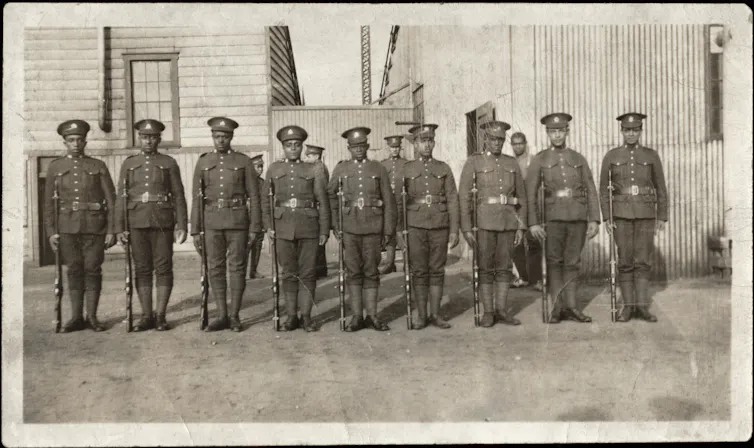
In the revised history curriculum, two topics have been cut from Grade 10. The No. 2 Construction Battalion, the all-Black segregated military unit in the First World War, was removed.
(F 2076 Alvin D. McCurdy fonds/Archives of Ontario/Wikimedia)
These soldiers and their descendants received an apology from the federal government in 2022 for the appalling mistreatment they endured in their service to Canada.
Black History Month was suggested as a Canadian commemoration in the soon-to-be former version, but was the second topic cut from the new version.
(National Archives of Canada/C-029977/Wikimedia)
2026 marks 100 years that Black people have commemorated Black history in the month of February and the 30th anniversary since Black History Month has been recognized at the federal level in Canada. Ironically, this elimination was made public during Black History Month.
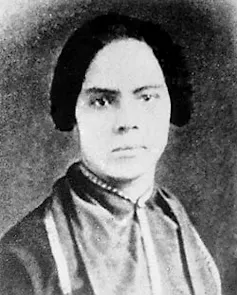
For some of the topics, their inclusion left out some information. In Grade 7, Black Loyalists in Ontario were not recognized. Mary Ann Shadd Cary’s last name “Cary” was not used in Grade 8. She married Thomas Cary in 1856 and used that last name throughout her life.
The inclusion of the Black Cross Nurses in Grade 10 excludes the main organization they were an auxiliary of: the Universal Negro Improvement Association (UNIA).
More was possible
The ministry missed the opportunity to include a range of new topics to demonstrate more meaningful integration of Black Canadian history.
New topics would provide more explicit examples of the contributions of diverse Black individuals to Canada’s foundation, the obstacles they faced in the pursuit of full citizenship and equality and the many ways they resisted that helped build a more inclusive and prosperous country.
A major omission is the longstanding cultural tradition of Emancipation Day (Aug. 1), which commemorates the abolition of British slavery.
The occasion has been marked for 192 years and was recognized federally in 2021. This treatment maintains the relegation of Black Canadian history to the periphery.
My grade
I give the new expectations a “D,” a marginal pass, only because they were actually implemented.
The revisions instituted two expectations per grade on Black Canadian history that is now part of the official curriculum policy. In this respect, the changes advance the cause long lobbied for by the Black community.
However, the new expectations miss the mark.
They lack substance and leave gaps that can further perpetuate the nonexistent and inconsistent teaching of Black Canadian history.
Given the nature of the content, and because this is the ministry’s first foray into mandating Black history in Canada, the regularly opaque revision process should have been more transparent. One wonders if issues and questions raised could have been avoided if the process was more collaborative. Questions include:
• Was feedback gathered from collaborators really considered or was checking the box that they met with them the total sum of the “collaboration?”
• Who was involved internally and externally? What are their expertise and credentials? Were they involved from beginning to end?
• What feedback was provided and implemented or not? Why?
• What kind of professional development will be provided? Who will deliver it?
• What instructional resources will be provided and who will develop them?
• How will accountability and the impact of the curriculum expectations be measured?
The new expectations establish a standard that needs to be greatly improved upon in the next cycle of revisions. Hopefully this happens in my lifetime and more valuable time isn’t lost. I’ll continue to hold my breath until then.

Natasha Henry-Dixon reviewed early drafts of the curriculum revision.
– ref. A historian of Black Canada gives a report card on Ontario’s new mandated Black history education – https://theconversation.com/a-historian-of-black-canada-gives-a-report-card-on-ontarios-new-mandated-black-history-education-279144