
Source: The Conversation – UK – By Linda Woodhead, F.D. Maurice Professor of Religion, King’s College London
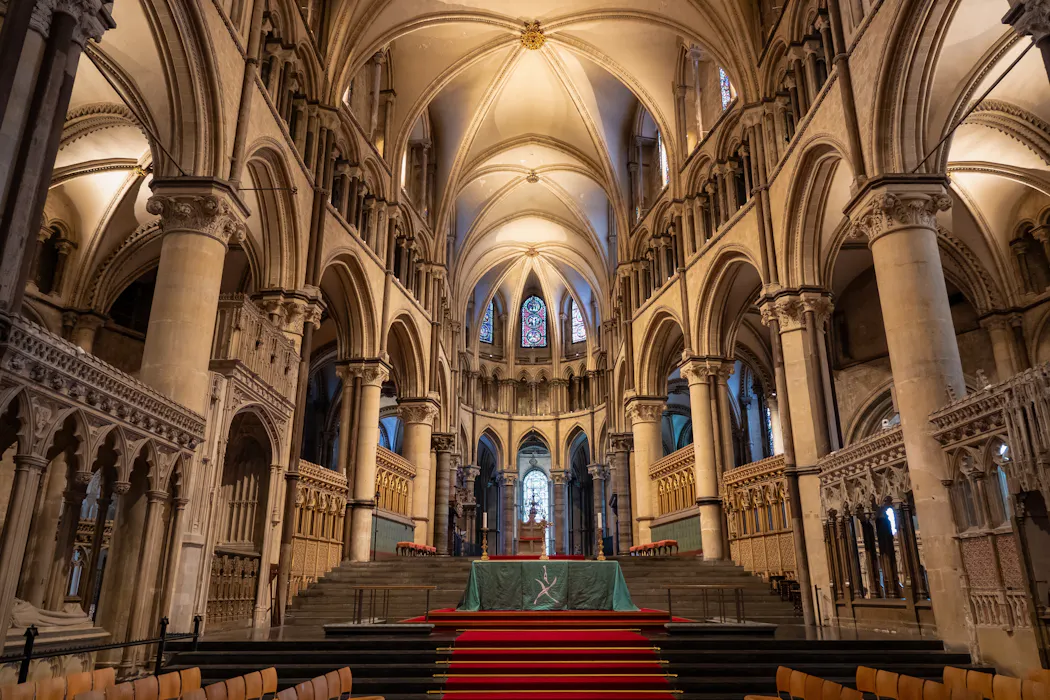
In the same week that a new archbishop of Canterbury was installed, YouGov admitted that a poll suggesting there was a “quiet revival” of Christianity was a dud. It had been inflated by fraudulent results and should be ignored.
To those of us who study the bigger picture of religion in Britain, this comes as no surprise. There are good reasons to doubt that Britain is experiencing a Christian revival today – but that does not mean it is dying out.
Read more:
Is there really a religious revival in England? Why I’m sceptical of a new report
To understand what is happening in Britain, it is helpful to compare it with the US, which has has long been viewed as exceptionally religious in comparison. Recent evidence suggests something less clear-cut.
In a major recent study, sociologist Christian Smith assembles the data. In the 1970s and ’80s, only around one in ten Americans identified as “nonreligious”. But from 1991, the proportion of people who identify as such has risen steeply, reaching 29% in 2021.
Today, 43% of young American adults aged 18-29 say they are nonreligious, and only a quarter of generation Z are regular church attenders.
In Britain, being nonreligious was much more common, much earlier. Today, around half the population say they have “no religion” – a proportion that has remained rather stable since the 2010s, according to the reliable British Social Attitudes survey.
By contrast, the proportion saying they are Christian has fallen steadily to around 40% today. Levels of regular weekly churchgoing are around 5%.
In other words, the decline of Christianity started later in the US than in Britain, and has not yet gone as far. But in America, it has been swifter, more dramatic and shows no sign of slowing down.
American-style Christianity can no longer be assumed to be the future for the churches in Britain. Such religion has always been more enthusiastic, congregational and separate from the state.
When Christianity last experienced a revival in the US, with the rise of the New Christian Right and televangelism in the 1980s, conservative and fundamentalist churches were prominent, and megachurches did well. Some blamed the decline of churches in Britain on the fact that they were not more like American ones. They were said to be insufficiently enthusiastic and self-promoting.
Megachurches never really took off in Britain, except for a few examples in big cities that tend to serve diaspora communities. And though the last archbishop, Justin Welby, hoped that an evangelical revival would reverse church decline, this failed to materialise.
The resilience of old churches
But Britain’s churches are not doomed. In light of the recent Christian decline in America, the stately power and traditional ways of the UK’s older churches may turn out to be an asset.
Though few people attend regularly, the Church of England, the Roman Catholic Church and the Church of Scotland are still the largest and most powerful of the UK churches. Institutional embeddedness matters.
The Church of England is constitutionally established, and all these churches play a central role in the school system by way of state-supported faith schools. Although the Church of England is not funded through taxation like some of its sister churches in Scandinavia, its considerable wealth – around £11 billion – protects it.
If generation Z show an interest in religion, it is traditional forms that appeal to them as much as the trendier forms that seek the attention of youth. We see this not just in Christianity, where both the Roman Catholic Church and Orthodox Churches are reporting new interest, but also in Orthodox Judaism and, to some extent, in Islam.
Still, the traditional churches are unlikely to return to a position like they held in society as recently as the 1980s. Today, revival is virtually impossible. When American evangelist Billy Graham won converts in Britain, he was not winning over people who had grown up nonreligous, he was speaking to people with a Christian background.
It is sometimes suggested that war or social collapse could lead to a revival of Christianity. That is possible, but history suggests that a plethora of different intense, sectarian kinds of religion and spirituality emerge in such situations.
Others argue that the Holy Spirit stirs individual hearts and minds, irrespective of the state of the churches. That is how Protestant Christians have often thought about revival, perhaps recalling Methodist enthusiasm or the chapel movement in Wales.
The striking thing about such revivalism, however, is how quickly it can fade. The chapels are mostly closed now. The Methodists are dying out. “Nonconformity” as a whole, still a major force in England in the 1950s, is almost forgotten.
Though the Christian nationalists on the American right are currently very loud, they have had no impact on the continued decline of Christianity in the US or the alienation of young people. Attempts by some on Britain’s political right to talk up Christianity are even less likely to succeed. They are reviving words, not religion.
What we have in Britain today is a landscape in which the historic churches appear a little stronger than once thought, and revivalist forms of Christianity weaker. Overall, however, Christianity occupies a much diminished space. Other world religions, especially Islam, are stable or growing.
“Nonreligion” is the biggest affiliation after Christianity, but that label hides diversity. Some of the nonreligious are atheist, some agnostic, and some are actively interested in new forms of spirituality, magic and supernaturalism. Although old landmarks remain, like church steeples on the horizon, the religious landscape of Britain is greatly changed.

Linda Woodhead receives funding from the Economic and Social Research Council and the Arts and Humanities Research Council (UK research councils)
– ref. There may not be a Christian revival, but Britain’s traditional churches aren’t doomed – https://theconversation.com/there-may-not-be-a-christian-revival-but-britains-traditional-churches-arent-doomed-279291