
Source: The Conversation – Canada – By John Duncan, Director of the Ethics, Society and Law Program; Academic Director of the Ideas for the World Program, University of Toronto
The Iranian regime is certainly brutal. But it’s also powerful as it continues to project its might after a month of illegal air strikes by the United States and Israel.
Read more:
Iran’s attacks drone on, with the U.S. at risk of losing the war
Iran is in the top 10 per cent of countries by size and population, has the third largest proven petroleum reserves and controls strategically crucial geography.
Furthermore, both the regime and many ordinary Iranians are prepared to defend the country. Since 1953, when the U.S. helped orchestrate a coup to overthrow Iran’s democratically elected Prime Minister Mohammad Mosaddegh, Iranians have understood they’re in America’s crosshairs.
This was especially true after the 1979 Islamic Revolution that overthrew the shah and during the U.S.-backed Iraq war against Iran that killed a million Iranians in the 1980s. As a result, Iran has spent decades beefing up and decentralizing its military capability.
In contrast, Dan Caine, chairman of the Joint Chiefs of Staff, warned U.S. President Donald Trump in February that the U.S. was short on both munitions and allied support for a war against Iran. Israel, America’s partner in war, is also short, especially in interceptor munitions. Trump and Israeli leader Benjamin Netanyahu dismissed the concerns, which suggests they planned a short war.
What are Trump’s options?
Critics have accused Trump of dragging the U.S. — or allowing it to be dragged — into a “forever war.” Those critics include those in his MAGA base, a problem for Trump as he anticipates November’s mid-term elections.
One unconventional option that might expedite victory, discussed during Trump’s first term, is to use nuclear weapons against Iran. Trump has said nukes won’t be used, but he’s well-known for erratic reversals.
A nuclear strike might expedite surrender, but it took two strikes on Japan in 1945 before the Japanese surrendered, and, failing an Iranian surrender, several strikes might be required to destroy the military capability distributed across Iran’s 31 provinces. Because many Americans would be appalled by a nuclear attack, putting the mid-terms at risk, the nuclear option is unlikely.
Much of the concern about Trump’s election machinations heading into the mid-terms is focused on the manipulation of procedures and officials. The legacy of the Jan. 6, 2021 attacks on the U.S. Capitol is one extreme possibility, as is manipulating the Iran war to achieve electoral gains.
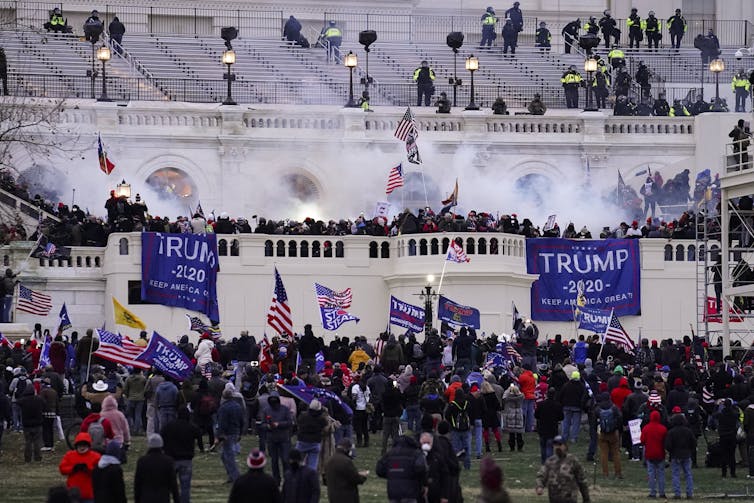
(AP Photo/John Minchillo)
Trump will probably lean into his rhetorical strengths and try to convince Americans the U.S. has won when it hasn’t. Claiming victory in the face of its absence is not new to him. Even in his second term, Trump continues to push the false claim that he won the 2020 election.
Consider the bizarre drama that started on March 21 when Trump and Iran exchanged dire threats. Then, out of the blue, Trump declared the existence of peace talks, which Iran denied. Perhaps they are imaginary talks on the way to an imaginary victory for Trump.
Read more:
Why Donald Trump is such a relentless bullshitter
Mission accomplished?
It seems clear Trump is planning to declare victory well ahead of the mid-terms — and in part because of them. Such a strategy would involve baiting opponents into “forever war” criticisms, only to ridicule them in stump speeches, generating the image of a president who finishes his wars.
A declared victory in Iran and a timely exit, in addition to the liberation of Venezuela and a possible Cuban coup, might all coalesce into potent election messaging for the Republicans.
Soon enough, Trump may announce something akin to former president George W. Bush’s premature proclamations about the Iraq War in 2003 by saying something like this:
“Major combat operations in Iran have ended. The United States and Israel have prevailed. We do not know the day of final victory, but we have seen the turning of the tide.”
If successful, he will secure two more years “like nobody’s ever seen before” of Republican congressional dominance.
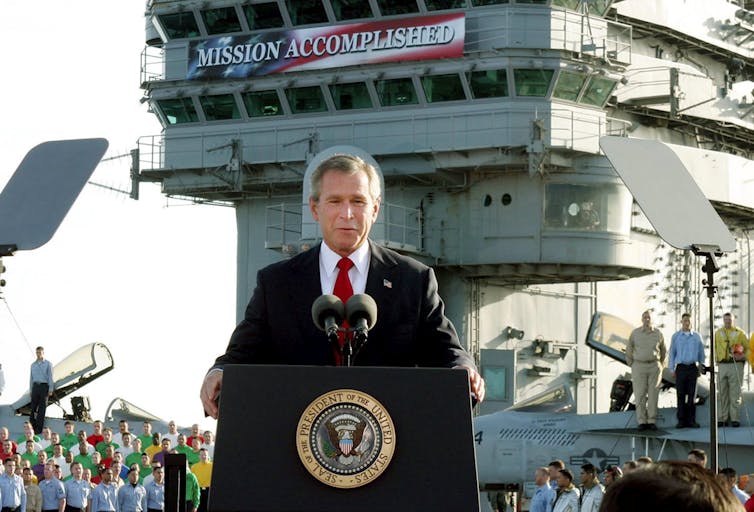
(AP Photo/J. Scott Applewhite)
Major obstacles
The battle for November will feature a few competing narratives in the U.S. But there are four major hurdles for Trump in particular.
- Information: For voters to be convinced that Trump is a decisive crusader against evil rather than another “forever war” president, right-wing media must sell yet another big lie, mainstream media must continue to pull its punches and the Democrats must continue to flounder.
- Affordability crisis: Trump also has to ensure he doesn’t “win” in Iran while losing on affordability at home. Most American oil comes from the U.S., Canada and Mexico, so the U.S. is protected from global supply disruptions, but global markets push up prices everywhere. Trump’s mere declaration of talks recently brought oil prices down, but only temporarily.
- Allies needed: Because voters will want to see a significant military withdrawal, Trump needs other countries to manage the chaos he’s created. But after disrespecting allies for months, he is struggling to establish a “coalition of the willing” on which to offload the conflict.
- Iranians must co-operate: But because the U.S. and Israel have twice attacked Iran during diplomatic negotiations, Iran needs other stakeholders in the process. Without them, Iran will not be incentivized to stop fighting and nothing will belie an imaginary Trump victory more than ongoing Iranian attacks.
Democracy waning
Whichever scenario prevails, Americans will likely lose. Their complete war costs could include repercussions from the unprecedented illegal bombing of Iran, as well as from unnecessarily turning regional allies into targets.
All of this is tied to what many Americans regard as increasing Israeli aggression, including the killing of 70,000 people in Gaza, which the U.S. has facilitated with funding, political cover and its widely mocked Board of Peace.
America’s democracy, economy and credibility are waning as Trump shamelessly pursues self-aggrandizement and self-enrichment.
“That makes me smart,” he might say, but only a failed leader serves his own interests at the expense of his country.

John Duncan is affiliated with Science for Peace, a charitable organization dedicated to popular education and research on the intersections of demilitarization, decarbonization and social justice.
– ref. Why Donald Trump will try to declare victory in Iran well before November – https://theconversation.com/why-donald-trump-will-try-to-declare-victory-in-iran-well-before-november-279059