
Source: The Conversation – USA (3) – By Candace Lukasik, Assistant Professor of Religion, Mississippi State University
Two months ago, Terez Metry arrived at a Department of Homeland Security office in Nashville with her husband, a U.S. citizen, expecting a routine step in beginning her green card application. The couple had prepared documents for a Form I-130 petition and anticipated an interview about their marriage.
But the appointment took a different turn. Instead of leaving together, immigration officers detained Metry and transferred her to an immigration detention facility in Alabama.
Metry’s family had fled Egypt during the Arab Spring – the 2011 wave of uprisings across the Middle East and North Africa – and came to the United States when she was a teenager. Their asylum claim was denied, and Metry was unaware that a removal order had been issued when she was 13. She is now 28.
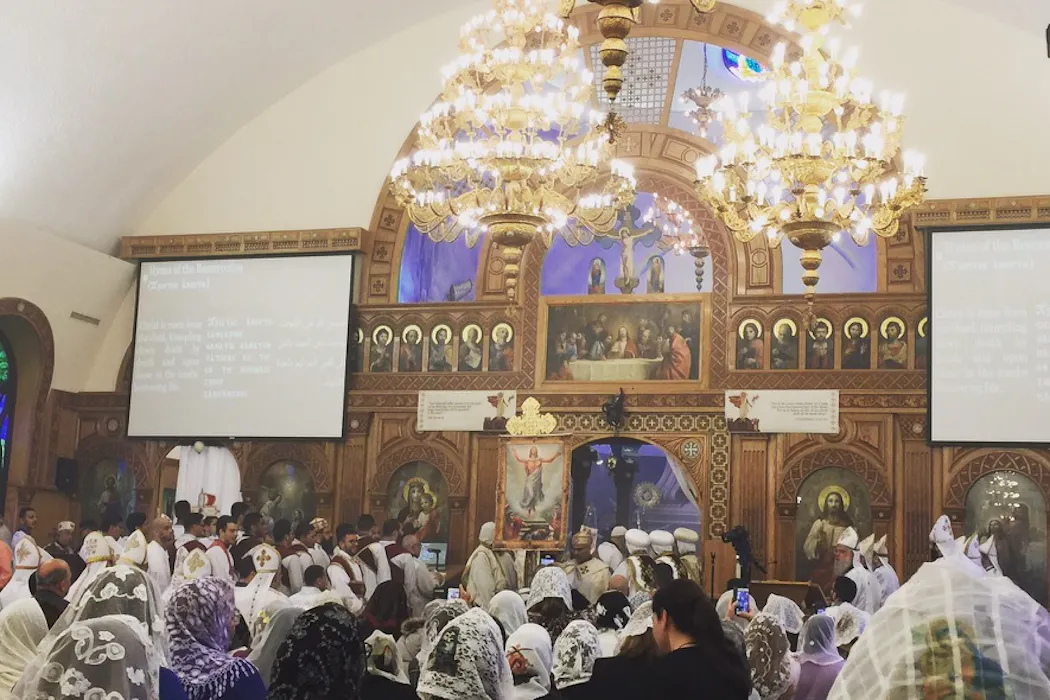
Metry is a Coptic Christian. Copts belong to one of the oldest Christian communities in the world and make up about 10% of Egypt’s population.
A majority of Coptic Christians live in Egypt. They face discrimination and periodic violence; they are often described in political, religious, and advocacy discourse as a persecuted minority. This framing has generated concern among many American Christians and spurred political mobilization on their behalf.
Yet, as Metry’s case reveals, such concern does not translate into preferential treatment: When these Christians arrive in the U.S., they are subject to the same immigration system that detains and deports other migrants.
I am an anthropologist of religion who has spent more than a decade studying Coptic Orthodox Christian migration between Egypt and the U.S. Between 2016 and 2022, I conducted fieldwork and interviews with Coptic migrants for my book, “Martyrs and Migrants.” I spoke with diversity visa applicants in rural Upper Egypt, asylum-seekers in New York courtrooms, and working-class communities in Nashville, Tennessee.
Across these sites, my research shows how two realities – the narrative of Christian persecution abroad and the suspicion surrounding migrants in the U.S. – collide in the lives of Copts themselves.
The global politics of persecution
Over the past two decades, attacks on churches and episodes of sectarian violence in Egypt have drawn international attention. These concerns intensified after the Arab Spring uprisings and escalated with the rise of militant organizations such as the Islamic State group.
In 2015, Islamic State group militants executed 21 Christian migrant workers – 20 Egyptian Copts and one Ghanaian man – on a beach in Libya. Images of their deaths quickly became potent symbols of Christian suffering across global media and church networks.
While Coptic Christians have long faced discrimination and intermittent violence in Egypt, attacks during this period intensified in both scale and public visibility.

AP Photo/Nariman El-Mofty
In 2017 alone, the Islamic State group claimed responsibility for two bombings of churches in Egypt on Palm Sunday as well as the mass shooting of pilgrims traveling to a monastery in southern Egypt. Accounts of the victims circulated widely online and received international news coverage.
In the U.S., evangelical leaders, advocacy organizations and some politicians often talk about the “persecuted church” – a framework that became especially influential in American religious freedom activism from the 1990s onward. Churches, nonprofits and policy advocates highlighted violence against Christians abroad through media campaigns, prayer initiatives and political lobbying, presenting it as a global crisis requiring American attention.
At a 2017 summit in Washington, D.C., for example, evangelical leader Franklin Graham described violence against Christians in the Middle East and Africa as a “Christian genocide,” urging believers to recognize the scale of the threat and respond collectively.
In my research attending international religious freedom conferences in Washington D.C., I found that stories like these helped many American Christians feel a strong sense of connection to Christians in the Middle East, whose suffering was often understood as part of a broader global struggle facing Christianity.
Yet this powerful narrative sits uneasily alongside how Middle Eastern Christians are treated in the U.S., where they may encounter not protection but the everyday suspicions faced by migrants from the region.
When Coptic Christian migrate
In Egypt, Copts live as a religious minority in a Muslim-majority society, where they have long faced restrictions on building and repairing churches – often requiring state permits that are difficult to obtain. Additionally, they are underrepresented in state institutions such as the military, judiciary and senior government positions; they also face periodic episodes of sectarian violence.
Moving to the U.S., a country where Christianity is the majority religion, might seem like a natural refuge.
But migration often reveals a different reality.
In 2019, for example, Romany Erian Melek Hetta, a Coptic Christian asylum-seeker, visited the Museum of the Bible in Washington, D.C. According to media reports, while waiting for a friend outside the museum, security officers questioned him about his identity and later reported him to the FBI as a possible security threat. This triggered a counterterrorism investigation.
Cases like this echo patterns I encountered in my ethnographic research among Coptic migrants in the New York–New Jersey area, who frequently described being perceived as suspicious or potentially threatening in everyday encounters. Some altered their dress, names or public presentation to avoid being mistaken for Muslim or Arab. As one priest in my fieldwork recalled of the period after 9/11, “We had the wrong complexion … You felt like you were a target and it wasn’t your fault.”
In everyday life in the U.S., Coptic migrants like Hetta are often seen simply as people from the Middle East. As scholars of post-9/11 racialization have shown, people taken to be Arab or Middle Eastern were widely cast as potential security threats, regardless of their religious identity.
For example, Magdy Beshara was the Coptic owner of the St. George’s Shell gas station in Bayville, New Jersey. Shortly after 9/11, the FBI came to the family’s home in the middle of the night, asking Beshara whether Marwan al-Shehhi, one of the 9/11 hijackers, had worked at the gas station.
For my book I interviewed Beshara’s stepson, who described the aftermath of the initial FBI raid: “People would drive by and say ‘We’re going to kill you terrorists’ and throw a big liquor bottle at me and my sister.”
Under the USA Patriot Act – a law passed after 9/11 that expanded the federal government’s surveillance and search powers – agents confiscated items from the family’s gas station and home. According to Beshara’s stepson, their mail was opened, their phones were tapped and they were followed to school by federal agents. The family also reported receiving death threats and said that when they asked local police to intervene, their requests were not acted upon.
Beshara’s stepson told me the experience forced him to draw a distinction. “It made me feel weird to say out loud, but I always thought to myself, ‘I’m not a Muslim, I’m a Christian.’ I felt like I was putting them down to say, ‘Hey, look, I’m the good guy.’ I felt like we had to do anything to defend ourselves.”
At school, he was bullied and physically assaulted on dozens of occasions. At one point in the months following the raid, an unknown assailant set the family’s house on fire while he and his little sister were sleeping. All of this took place even after the FBI notified Beshara that he was no longer a subject of investigation, since al-Shehhi, in fact, did not work at the gas station.
Even though Beshara was a Christian, that did not shield him from suspicion or discrimination. Government surveillance tied to counterterrorism and prejudice from neighbors continued to shape how he was seen.

AP Photo/Paola Crociani
Between persecution and suspicion
These dynamics become especially visible in moments of enforcement, where the gap between political rhetoric and immigration policy comes into sharp relief.
In 2017, federal immigration raids detained Iraqi nationals across the U.S., many of them Chaldean Christians – an Eastern Catholic community from Iraq with ancient roots in Mesopotamia.
These arrests prompted a class action lawsuit on behalf of those detained in the Detroit area, which was later expanded to include roughly 1,400 Iraqi nationals nationwide with final deportation orders.
Such cases unfold even as American Christians continue to say Middle Eastern Christians are uniquely deserving of protection – a disconnect between advocacy for “persecuted Christians” abroad and the realities of immigration enforcement at home.
In my own work as an expert witness for Coptic asylum-seekers, I have observed similar patterns across a detention system stretching from New Jersey to Louisiana. Some migrants are released while their cases proceed; others remain in prolonged legal limbo.
What I have found is that in practice, the line between “persecuted Christian” and “suspect migrant” is not just blurred – it is continually being redrawn by the state and reproduced in everyday encounters.

Candace Lukasik received funding from the Social Science Research Council, the American Academy of Religion, the Louisville Institute, and the Orthodox Christian Studies Center at Fordham University.
– ref. American politicians talk about persecuted Christians abroad – but here’s what happens when those Christians migrate to the US – https://theconversation.com/american-politicians-talk-about-persecuted-christians-abroad-but-heres-what-happens-when-those-christians-migrate-to-the-us-276186