
Source: The Conversation – UK – By Olga Fotakopoulou, Associate Professor in Developmental Psychology, Birmingham City University

New UK government guidance recommends that screen time for children under two should be avoided, except for shared activities such as video calls. For children aged two to five, a maximum of an hour a day is suggested. The guidance also outlines that watching screens together is better than children viewing alone.
This echoes guidance from the World Health Organization recommending no screen time for infants under two, and no more than one hour per day for older children aged four and under.
The early years, especially from birth to age six, are a critical period for developing social and communication skills. This is when children are learning how to connect with others, communicate their needs and understand the signals people give them. Given the increasing presence of touchscreen technologies in young children’s environments, understanding how these tools influence early developmental trajectories is essential.
Touchscreen technology offers new opportunities for learning and play. But there are also questions about its impact on children’s social development, communication and school readiness. Researchers and health organisations have been working to consider how digital media interacts with children’s development and shapes their early experiences.
Excessive touchscreen use has been associated with delays in expressive language, reduced attention spans, and poorer interactions between parents and children.
Yet the picture is not one-sided. My research with colleagues highlights that early exposure to multi-modal technologies – tools that combine sound, images, touch and movement – can shape children’s social development in both positive and negative ways.
Language skills and collaboration
On the positive side, interactive and engaging uses of technology can foster language development. Studies show that digital platforms encouraging storytelling, role play and collaborative activities can enhance children’s competence in communication.
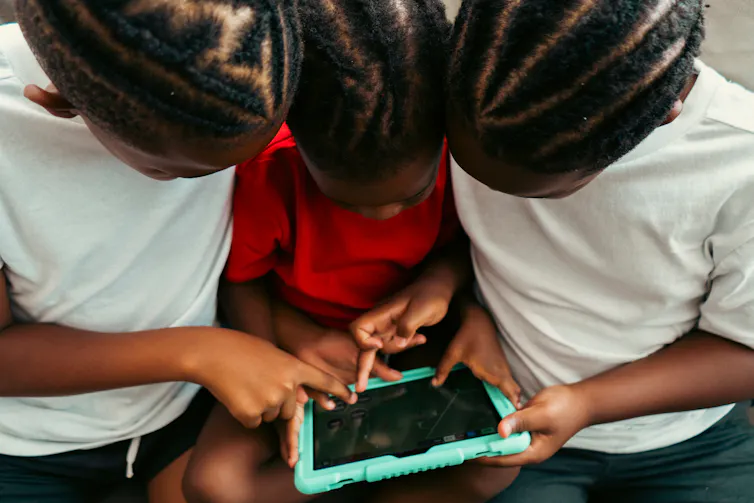
Touchscreens can also help children to work together on shared tasks. Multi-touch interfaces promote joint problem-solving, turn-taking and dialogue. This can strengthen cooperation and peer relationships.
In classrooms, tablets often become focal points for group activities. Children share knowledge, assist one another and collaborate on projects, which can enhance social interaction skills and confidence.
Touchscreens also create opportunities for social play and communication across distance. Video-communication apps such as Skype and FaceTime allow children to maintain relationships with family and friends, supporting emotional bonds and social connection.
Mkosi Omkhulu/Shutterstock
Creative expression is another area where digital tools can shine. Drawing, animation, and storytelling apps encourage children to share ideas and collaborate. This can promote cooperation and social bonding.
Passive use
However, these benefits coexist with significant challenges. Excessive screen time can reduce opportunities for face-to-face interaction, limiting children’s practice of conversational skills and emotional understanding. When children use screens passively or in isolation, they may become less engaged in socialising with others.
Parents’s use of screens is another concern. When parents are absorbed in their own devices, they talk less with their children. This reduces opportunities for educationally meaningful conversations.
Touchscreen use can also affect communication more directly. Studies show that electronic books may shift parents’ attention toward the device rather than the story, displacing meaningful conversation and reducing the quality of shared reading experiences. Some research suggests that heavy touchscreen use may make it harder for children to pick up social and emotional cues. This may affect their ability to decode social situations.
Importantly, the impact of touchscreen use is shaped by several mediating factors. Children learn more effectively when adults or their classmates model how to use touchscreen devices. As the government guidance states, it’s also better if adults watch screens together with their child, rather than their child watching alone.
Parents’ views and wider culture matter too. In research I carried out with colleagues, we found that cultural perceptions about what makes a good childhood shaped parents’ choices. In Portugal and Norway, strong cultural emphasis on outdoor play, social interaction, and connection with nature led parents to prioritise these activities over touchscreen use.
These cultural expectations influence how parents interpret and regulate young children’s digital practices, showing that attitudes toward technology are closely tied to wider national discourses about childhood. Educational settings further influence this. The way technology is integrated into classrooms can reinforce social behaviour.
These findings have important implications for school readiness. Social communication skills, such as turn-taking, listening, expressing ideas, and understanding others, are foundational for success in early education. Touchscreens can support these skills when used interactively and collaboratively. But when screen use replaces conversation, imaginative play or peer interaction, it may hinder the development of the very abilities children need for school and their social lives.
The evidence suggests that the question is not whether children should use touchscreens, but how. High-quality, interactive, and socially supported digital experiences can enrich development. Passive or excessive use can undermine it.
However, it’s vital to recognise that not all digital content is created equal. The quality and context of technology use can have a significant impact. As digital technologies continue to evolve, ensuring that young children’s screen experiences are balanced, meaningful, and socially engaging will be essential.

I have received funding from EU and Nuffield Foundation (but not for this project).
– ref. UK government recommends maximum two hours of screen time for younger children: what the evidence says – https://theconversation.com/uk-government-recommends-maximum-two-hours-of-screen-time-for-younger-children-what-the-evidence-says-275752