
Source: The Conversation – Canada – By Kurt Michael Downes, PhD Candidate, Kinesiology, University of Windsor
When the World Athletics Indoor Championships get underway in Kujawy Pomorze, Poland, on March 20, be sure to tune in to the men’s seven-event heptathlon and the women’s five-event pentathlon.
The move indoors means there are fewer events compared to the men’s decathlon (10 events) and women’s heptathlon held at outdoor events like the World Athletics Championships in Tokyo last fall and the Olympics, but these events deserve the spotlight — and not just for the incredible athleticism.
The real lessons these events offer have less to do with medals and extend far beyond winning and losing. Instead, this sport setting provides an opportunity to reimagine how we develop athletes. What if the blueprint for building better athletes isn’t about doing multiple sports, but instead about doing multiple events?
Each year, North American sport is confronted with the same problem: Growing numbers of children are pressured by parents, coaches and leagues to commit to a single sport. Before they even reach their teens, kids are “encouraged” (and by encouraged we mean pressured) to spend more time specializing in their sport to gain a competitive edge. Yet, research suggests the opposite is true: Studies consistently link early specializaton to burnout, higher rates of overuse injuries and sport dropout.
Interestingly, this paradox suggests the very pathway thought to build champions often pushes promising athletes out of sport. An alternative may be found in track and field’s combined events. The decathlon and heptathlon require athletes to run, jump and throw across a slate of events, unlike single-sport specialists.
The advantage is that the combined events allow athletes to develop every major athletic quality: speed, power, endurance, agility and strength. When you add both linear and rotational movements, you get one of the most complete athlete-development systems in sport.
In essence, the combined events represent a more updated and advanced version of the Long-Term Athlete Development Plan, a program designed to outline appropriate stages of athletic growth, build on fundamental movement skills and develop sport-specific competency while reducing injury and burnout.
As such, we ask whether a run-jump-throw system based on the combined events model could be the answer to early specialization in youth sport.
The problem of early specialization
Early sport specialization often refers to year-round participation in a single sport, a trend now common across youth athletics. Examples include young hockey, basketball and soccer players who are pushed toward club or academy teams with daily programs to stay competitive and ensure the “right” people can see them play.
These clubs and academies come with hefty tuition, major travel expenses and logistics, and they may even require kids to leave home and find room and board.
But even outside these commitments, young athletes and their families often feel the need to hire extra personal skills trainers, find additional practice time, compete on multiple teams and more throughout the year in order to keep up with their peers and squeeze every ounce of performance out of their young bodies in and out of season. Once involved in a youth sport at a competitive level, there is no time (or money) for other sports.
At first glance, practice and competition in a single sport seems like a surefire plan for success; with a “more hours equals better” mindset, how could it not? Unfortunately, research tells a different story. Studies consistently show that early specialization is not the most effective pathway to high performance, and a singular focus on one sport instead becomes a risky gamble in long-term athlete development.
Kids who focus on one sport routinely face repetitive overuse injuries, ranging from stress fractures to tendinitis and the loss of motivation to participate in sport.
What’s most concerning is that youth sport dropout rates average roughly 35 per cent per year, and early specialization is consistently linked with even higher dropout risk driven by less play, more pressure and an unbalanced developmental path.
Enter the combined events
Since reports suggest early specialization limits an athlete’s growth, we suggest looking to one of sport’s most multifaceted disciplines as the remedy. In track and field, the decathlon and heptathlon demand a broad skill set that spans the full range of athletic abilities.
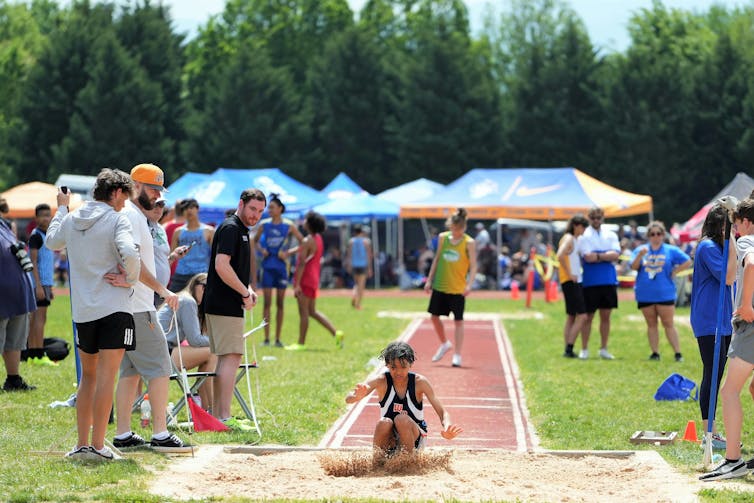
Over the course of two demanding days, combined-event athletes sprint, hurdle, jump, throw and run. Scaled-down developmental versions also exist, offering age- and skill-appropriate movements instead of early mastery of a single sport.
This diversity can also align with what sport scientists describe as windows of trainability: periods when young athletes are especially primed to develop speed, agility, co-ordination and endurance. Training across multiple disciplines ensures these important windows of development are not missed.
The difference with early specialization is undeniable. While a young soccer player may log thousands of contacts with the ball by age 12, an athlete in youth combined events is learning to hurdle, jump, throw and pace distance runs. This variety builds broad physical literacy, spreads stress across the body and reduces the overuse injuries common in single-sport pathways. It provides the range, balance and adaptability youth athletes need in order to avoid the pitfalls of early specialization.
(Pexels/Chris I)
Why it matters for kids in sport
Ultimately, the combined events are the antidote for early specialization. Training across the sprints, jumps, throws and distance events keeps kids moving in different ways and across different planes. It avoids the monotony and repetitive stress that pushes so many away from sport.
Long-term athlete development models, which are the gold standard of athlete development across sports, promote broad skill development. Here’s why there’s such a strong case for the combined events:
-
Fewer injuries: Combined-event training spreads physical stress, lowering the risk of overuse injuries. Research shows that early specialization increases injury risk, while variety builds resistance..
-
Stronger foundations: A mix of running, jumping and throwing helps develop comprehensive physical literacy through a wide mixture of skills, which in turn allows athletes to grow healthier and reach higher levels in sport.
-
More fun, less burnout: Keeping practices fresh with new challenges increases motivation. It reduces burnout and keeps kids engaged in sport..
For parents, coaches, schools, clubs and policymakers, the combined events have a format that can be easily delivered and easily integrated into youth sport. As an example, a youth athlete playing soccer (the most highly participated sport in Canada for ages five to 17), can become more athletically proficient during the off-season.
The goal is not to replace soccer. Instead, introducing the principles of combined events can enhance performance and enjoyment. First-step acceleration helps with breakaway speed, jumping develops power for change of direction and throwing builds muscular co-ordination and trunk strength. The combined events’ weekly rotation through sprints, jumps, throws and endurance work is supported by science.
Burnout to balance
Early specialization can look like a shortcut, but it often leads to injuries, burnout and kids leaving sport. The path meant to create champions can end careers before they start.
Combined events offer a better way, blending power, endurance, technical skill and adaptability.
The science is clear: broad experiences in childhood lay the best foundation for long-term success. Most kids won’t become decathletes or heptathletes, but the message is simple: variety matters, but only when it’s balanced, intentional and developmentally appropriate. The right mix of skills develops better young athletes and keeps them engaged.

Kurt Michael Downes receives funding from the Coaching Association of Ontario (CAO). He is the President and Head Coach of the Border City Athletics Club (a not-for-profit organization) and serves on the boards of Family Fuse and Resilient Kids Canada (both not-for-profit organizations).
Kevin Milne does not work for, consult, own shares in or receive funding from any company or organisation that would benefit from this article, and has disclosed no relevant affiliations beyond their academic appointment.
– ref. The case for combined events: How decathlon and heptathlon training could solve a crisis in youth sport – https://theconversation.com/the-case-for-combined-events-how-decathlon-and-heptathlon-training-could-solve-a-crisis-in-youth-sport-270263