
Source: The Conversation – UK – By Sam Power, Lecturer in Politics, University of Bristol

Peter Mandelson is under criminal investigation after documents released by the US government appeared to show that he released sensitive information to Jeffrey Epstein and his associates while he was a government minister.
He could potentially face charges of misconduct in public office. This is a law, as outlined by Spotlight on Corruption, that more often than not covers offences conducted by serving police officers and prison staff.
In Mandelson’s case, the police are likely to be looking at four specific elements: whether he was a public officer, whether he wilfully misconducted himself (which is a weird way to put it but I didn’t write the law), whether this happened to such a degree that it amounted to an abuse of public trust in the office holder, and whether all of the above happened without reasonable justification.
Mandelson was appointed by Keir Starmer to serve as his ambassador to the US and questions remain about how thoroughly he was vetted or how much Starmer knew about his relationship with Epstein. Either way, it is worth restating that Mandelson was literally known as The Prince of Darkness. It is also worth restating that he twice resigned during the New Labour years following allegations of impropriety.
Starmer, Johnson and standards in public office
Starmer may not like it but his approach to standards is aligned with former prime minister Boris Johnson. When he came into office, Starmer updated the ministerial code in a number of small but important ways. And, in the foreword he said that “restoring trust in politics is the greatest test of our era”. Where he differs from Johnson is that I genuinely think Starmer and his team believe that.
However, neither of them think (or thought) – as far as I can see – that improving trust has all that much to do with matters of ethics, standards or corruption. Or trust. Take, for example, something we hear again and again about the Starmer administration’s fundamental political approach – the so-called “pothole strategy”. This is the idea that fixing things like potholes and delivering tangible everyday improvements in people’s lives will rebuild public faith in politics.
This is underpinned by the five missions of government, its “plan for change”: kickstarting economic growth, building an NHS fit for the future, creating safer streets, breaking down barriers to opportunity and making Britain a clean energy superpower.
All of these may be laudable goals but they don’t amount to a genuine reflection on how to restore trust in politics. That is entirely absent from governmental priorities. Indeed, in the very next sentence in the ministerial code, Starmer wrote: “The British people have lost faith in [politics’] ability to change their lives for the better.” The pothole strategy writ large. Implicit in this is that standards and ethics are secondary. That if you deliver, the trust will come.
Johnson made the same miscalculation. He too assumed that the public cares more about outcome than process. That if you fix the potholes, standards can come second. Both prime ministers have misread the terrain in that they have effectively seen this as a zero-sum game.
Johnson didn’t like the idea of standards, and simply thought that if he did a good enough job the people wouldn’t care either. Starmer, I suspect, thinks that they do matter, but are also something that can be put in a box to be managed later. Neither are correct. Standards, delivery and trust are not mutually exclusive but fundamentally interconnected.
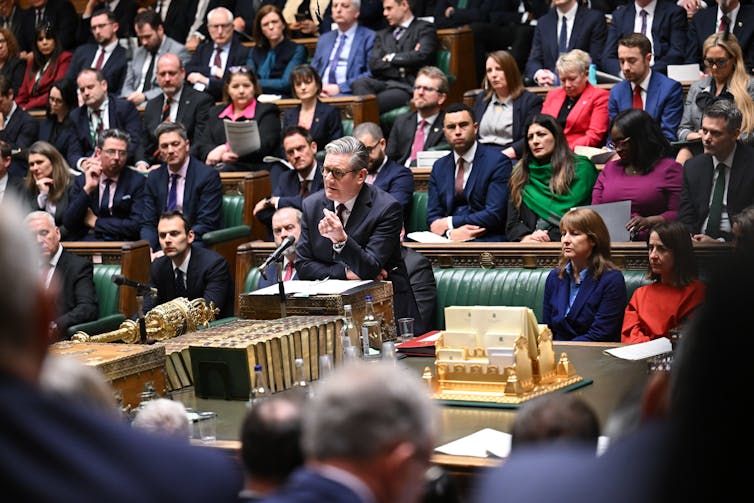
Flickr/UK Parliament, CC BY-ND
The appointment of Mandelson is actually a pretty good microcosm of this. He had a well-known and chequered record. But he was also (until he obviously wasn’t) believed to be good at his job. He was seen as someone who delivered. Michael Gove, editor of The Spectator, thought so at least when in May last year he described Mandelson as someone who was “thoughtful and original”, had a “breadth of vision” and an “intrinsically worthwhile … skillset to interpret the British government to Americans”. The Guardian headline, when a trade deal was (briefly) secured with the US, said: “Cometh the hour, cometh the Mandelson.”
He was also, of course, good friends with Epstein, a convicted paedophile. And the public takes a pretty dim view of this kind of thing – while at the same time wanting someone to fix their potholes. The research bears this out. A UCL study found that “in short, the public does care about integrity”.
Standards and growth are not mutually exclusive
As someone who spends their life studying ethics, standards and corruption, I think there are reasons to be cheerful. Johnson didn’t care, Starmer does. He just has the wrong diagnosis. And I hope his team is beginning to realise this after this sordid affair, because it’s not too late.
Starmer’s government is about to deliver an elections bill, which offers a prime opportunity to tighten the rules in British politics. If it is truly ambitious and caps donations, it would prevent the overreach of a wealthy elite (and isn’t the Epstein story just a truly horrific example of this?).
Meanwhile, the Lobbying Act is in dire need of reform. In fact, some reports have discussed the manner in which Mandelson lobbied Barack Obama’s chief economic adviser Larry Summers (someone also linked to Epstein) in an attempt to water down restrictions on banking activities. These kinds of informal advances are proximate to concerns subsequently raised during the Greensill scandal which engulfed David Cameron a few years ago.
And the UK’s Ethics and Integrity Commission, if properly supported, could chart a new path in our understanding of standards in public life. This is a new body (which has largely subsumed the Committee on Standards in Public Life), but little is known about its role beyond that. A clear steer (and further investment) from the government would help to clarify this.
And the best thing is you can do all these things and fix the potholes as well. Standards are, when it comes down to it, pretty cheap. It’s just a shame some of our politicians are as well.

Sam Power has received funding from the Economic and Social Research Council and the Engineering and Physical Sciences Research Council.
– ref. The British public has lost faith in politics – the Peter Mandelson scandal must be a wake-up call for Keir Starmer – https://theconversation.com/the-british-public-has-lost-faith-in-politics-the-peter-mandelson-scandal-must-be-a-wake-up-call-for-keir-starmer-275113