
Source: The Conversation – UK – By Robert W Jones, Professor of Eighteenth-Century Studies, University of Leeds
It is a truth, though not one universally acknowledged, that a country house possessed of spacious grounds must be in want of a large fortune. A film or television company might offer one, or at least an honourable provision.
The forthcoming marriage of Harewood House in west Yorkshire to Netflix, is much like any other in this respect. The union will produce a new version of Pride and Prejudice by Jane Austen (from whose work I have been very obviously scrumping), to be released later this year. Harewood will become Pemberley, Mr Darcy’s famously enticing home. Yorkshire will pose as Derbyshire.
Harewood is a grand house. Whether it is too grand for Pemberley is hard to say. In the book, Mr Darcy’s annual income of £10,000 is a huge sum. But the house might be contested in other ways too.
The estate has been the seat of the Lascelles family since 1738, when the Gawthorpe and Harewood Castle estates were acquired with money gained in the West Indies, from owning enslaved people, plantations, ships, warehouses and their associated goods and crops (as the estate’s website explains). The current owners, aware of the implications of the source of their inheritance, are among the cofounders of the Heirs of Slavery group, which advocates for compensation to address the ongoing consequences of slavery.
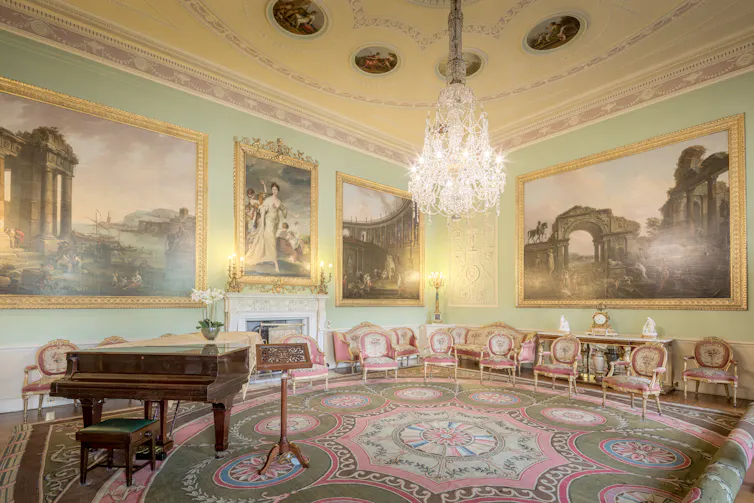
Built between 1759 and 1771, the house boasts interiors designed by fashionable architect Robert Adam and furniture by Thomas Chippendale. Its serious art collection features Sir Joshua Reynolds, J.M.W Turner, Thomas Gainsborough and Sir Thomas Lawrence. Reynolds’s painting Mrs Hale as Euphrosyne (1762-64) graces, as she should, the splendid Adam-designed music room.
Historian Mark Girouard’s classic study Life in an English County House: A Social and Architectural History (1978) still helpfully explains places like Harewood. He writes that these houses served several functions; business and work for much of the time, though the labour that sustained its splendours occurred in the Caribbean. They were also spaces intended for leisure and diverse forms of public and private sociability. Each activity was allocated (if imperfectly) different spaces within the house.
Michael D Beckwith/Wiki Commons, CC BY-SA

More recent studies academic studies, such as Karen Lipsedge’s Domestic Space in the British Eighteenth-Century Novel (2012) have developed this interest, explaining how space and gender interconnect. The music room at Harewood, with Mrs Hale as its central focus, would have held a special function in this respect.
Visiting Pemberley
Great houses like Harewood were designed to receive and impress guests. Any visitor would have needed to negotiate the shifting codes of privacy and publicity that might be in play (they were never static).
Read more:
Netflix to remake Pride and Prejudice – why Jane Austen novels make perfect period adaptations
The further into a house you were allowed, the more you entered a private realm where distinctions of rank might be in abeyance. In Pride and Prejudice the awful Lady Catherine de Bourgh knows this, doesn’t care and ploughs on. She enters the intimate space of the Bennet family’s drawing room where she expects to be accorded all respective and deference. Brilliantly, she isn’t. But she cannot be refused either and is guided to the more public realm of the garden.
In their Georgian heydays great houses like Harewood would have received many inveigling visitors, though they were not all like the bumptious, bungling de Bourgh. It is in this capacity that Pemberley is encountered in Pride and Prejudice, though its eligible but prideful owner (Darcy) has made the house intriguing long before.
Elizabeth and her aunt and uncle, the Gardiners, take their tour of the Derbyshire at the opening of the third volume of the novel. Elizabeth is still composing herself after the horrors of Darcy’s proposal and the revelations of his letter, detailing Mr Wickham’s atrocious conduct with its obvious implications for her young sister. As soon as Elizabeth sees the house and its grounds, she is taken with it and reflects: “To be mistress of Pemberley might be something.”
While the house is praised repeatedly in the novel, it is the views from Pemberley, not the “fine carpets and satin curtains” (which any house might have) which appear to attract Elizabeth most. There are several references to windows, and what can be seen from them in these scenes.
If Darcy is redeemed in Elizabeth’s eyes at Pemberley, it is partly because he proves himself to be a good landlord. The change in Austen scholarship, especially since the last Pride and Prejudice adaptation, has been tremendous. Elizabeth has appeared more and more independent, less easily impressed by Darcy. Her perspective is now seen as far more important than all his trees, however much they convey his status.
Harewood and its prospects have changed too since Austen’s day. The landscape has altered. From some of Harewood’s windows you can still see what remains of Lancelot “Capability” Brown’s improvements: his clumps of trees and the great lake he introduced. But the Victorians removed a great deal.
What will the new Elizabeth see from Harewood — and what, in turn, will the viewer see? How might the new Darcy delight and interest his guest? Not by plunging into the lake surely. And from which window might Elizabeth finally catch that brilliant view?

Robert W Jones does not work for, consult, own shares in or receive funding from any company or organisation that would benefit from this article, and has disclosed no relevant affiliations beyond their academic appointment.
– ref. Netflix’s new Pride and Prejudice features Harewood House as Pemberley – here’s what the estate reveals about Austen’s world – https://theconversation.com/netflixs-new-pride-and-prejudice-features-harewood-house-as-pemberley-heres-what-the-estate-reveals-about-austens-world-277786