
Source: The Conversation – UK – By Matthew Powell, Teaching Fellow in Strategic and Air Power Studies, University of Portsmouth
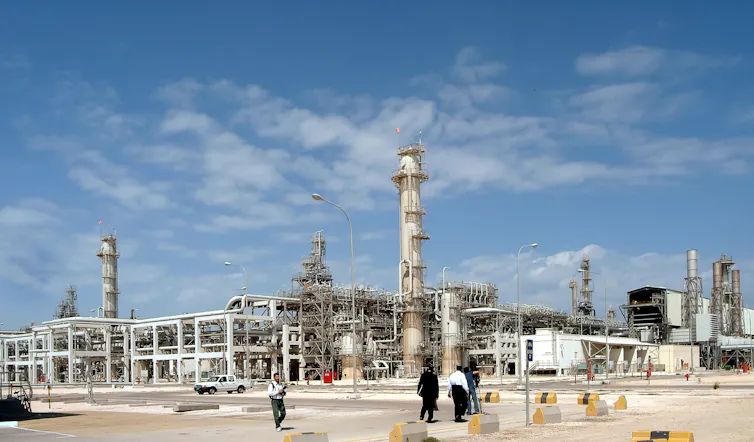
Iran targeted energy facilities across the Middle East on March 18, including the world’s largest liquefied natural gas hub in Qatar, in retaliation for Israeli strikes on an Iranian gas field hours earlier.
Iran has gone on to attack other energy facilities across the Gulf. This has included hitting a Saudi refinery on the Red Sea and setting two Kuwaiti oil refineries ablaze in an intensification of its campaign against energy infrastructure in the region.
As an expert on military strategy, I see the Iranian attacks on Gulf energy facilities as part of a broader strategic agenda the regime in Tehran has employed to try and ensure its survival.
Iran’s attacks on energy infrastructure since the start of the conflict have been accompanied with wider missile and drone strikes against US military bases and infrastructure in the region. Through these attacks, which have killed seven American service personnel so far, the regime has looked to demonstrate its capacity and capability not only to international audiences but also the Iranian population.
This includes, perhaps most importantly, those responsible for maintaining Iran’s internal security. If those tasked with this responsibility began to doubt the regime’s capacity to respond to attack, they might become less inclined to suppress rebellions and uprisings.
The ability to exercise force has long been central to maintaining the regime’s domestic political position in Iran. This has been demonstrated by the brutal repression of various protest movements over the past decade or so.
Plamen Galabov / Shutterstock
In its attacks on Gulf energy infrastructure, Iran has two main goals. The first is to hit the Gulf states economically in the hope that this will reduce their willingness to provide support to the US.
Gulf countries are heavily reliant on the export of energy for revenue. In Qatar, for example, earnings from the hydrocarbon sector accounted for 83% of total government revenues in 2023. These revenues help Gulf states maintain the low tax regime that is enjoyed by their populations.
If these revenues reduce substantially because energy cannot be processed, some of these nations may begin to question their alliances with the US. Such a scenario would reduce the ability of the US to conduct military operations in the Middle East and project its power and influence on the region.
The war is already having a significant impact on these countries. Goldman Sachs has estimated that Qatar and Kuwait could see their GDP drop by 14% if the war lasts until the end of April. Likewise, Capital Economics has suggested that GDP in the region could fall by between 10% to 15% if the conflict causes lasting damage to energy infrastructure.
Rifts do not yet appear to be emerging between the US and its Middle Eastern allies. But Tehran will be calculating that prolonged attacks – alongside continued disruption to the vital strait of Hormuz shipping lane – will add strain to relations.
Raising energy prices
Iran’s second, and wider, goal is to raise global energy prices. The Middle East is a key energy supplier globally, so disruption to supplies in this region can have an almost immediate impact on prices.
The price of a barrel of Brent crude, the global benchmark for oil pricing, has increased from around US$68 (£51) on February 27 to nearly US$100. This has so far largely been the result of disruption to the strait of Hormuz, which has prevented the Gulf states from supplying their energy to global markets.
But Tehran’s calculation appears to be that further efforts to reduce Gulf energy supplies will force nations worldwide, who are having to implement costly policies to reduce the impact of increased energy prices on their populations, to question the actions of the US in Iran.
In the Philippines, which is highly dependent on the Gulf oil, the government has told its agencies to cut electricity and fuel use by between 10% and 20%. Vietnam has introduced work-from-home policies for many public sector workers. And the UK government has announced a £53 million support package for people who rely on oil for central heating.
Iran’s final strategic consideration is that attacking energy facilities may help erode domestic support for Trump in the US. This could force a change in political direction. The price of petrol has already increased to an average of US$3.60 per gallon in the US – a level not seen since the opening days of Russia’s 2022 invasion of Ukraine.
This price increase will be passed on to consumers, creating a headache for Trump ahead of midterm elections in November. Trump’s platform of reducing the inflation seen under the Biden administration was a key part of the election campaign that successfully returned him to the White House.
Iran’s attacks on energy infrastructure are likely to continue. This is because they enable the regime in Tehran to increase the costs of the war even to those who are not directly involved, ramping up global pressure on the US to draw the conflict to a close.

Matthew Powell does not work for, consult, own shares in or receive funding from any company or organisation that would benefit from this article, and has disclosed no relevant affiliations beyond their academic appointment.
– ref. Why Iran is attacking Gulf energy infrastructure – https://theconversation.com/why-iran-is-attacking-gulf-energy-infrastructure-278815