
Source: The Conversation – UK – By Emilie Rutledge, Senior Lecturer in Economics, The Open University
At the end of 2025, the Gulf states received high praise for their economic resilience. According to reports by the World Bank and the World Economic Forum, the region was stable, modern and reliable.
Now the six countries of the Gulf Cooperation Council (GCC) – Bahrain, Kuwait, Oman, Qatar, Saudi Arabia and the United Arab Emirates – are watching on nervously. The economic damage done by what has become a regional conflict, bringing an abrupt loss of stability, could be huge.
Aside from Saddam Hussein’s foray into Kuwait in 1991, these six countries have successfully steered clear of conflict on their home turf over a long perriod. They avoided the revolutionary upheavals which affected Egypt (1952), Iraq, Syria and Iran (1979). They steered clear of any spillover from the long-running Israel-Palestine conflict.
The group was mostly unaffected by the war between Iran and Iraq. And aside from a short-lived uprising in Bahrain in 2011, the GCC emerged largely unscathed from the regional turmoil of the Arab Spring in 2010 which spread from Tunisia and and Egypt and led to violent instability which continues to this day in Libya, Yemen and Syria.
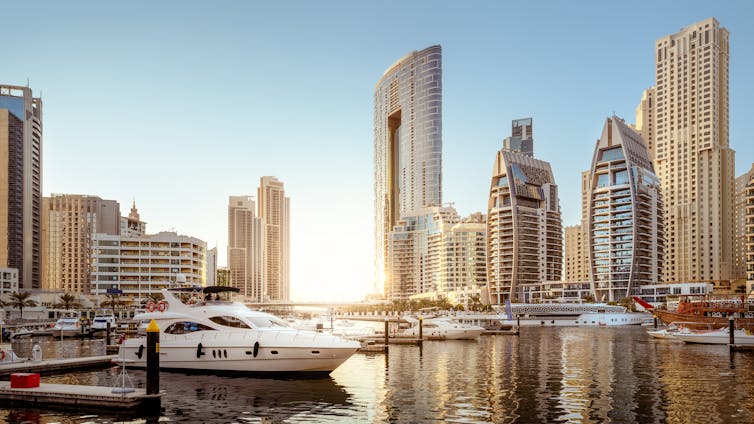
The GCC’s comparative stability underpins its attractiveness as a global hub for money and modernity. Success in luxury tourism has filled places such as Dubai and Abu Dhabi with five (and even a seven) star hotels. Only France has more Michelin-starred restaurants than the United Arab Emirates (UAE). There is cutting-edge technology in Qatar’s energy sector, and a vast AI campus in the UAE.
It is these kinds of projects which led the World Bank and the World Economic Forum to publish glowing reports on the region recently. Both organisations agreed in late 2025 that oil wealth was being wisely invested for the future.
The general view was that the GCC was a place of economic stability and diversity. A director of the World Bank, Safaa El Kogali, said that the region’s embrace of a digital future had been nothing short of “remarkable”.
But US military bases in all GCC countries have come under attack. Drones have hit oil tankers. The Strait of Hormuz, vital for the transit of much of the world’s energy is effectively closed.
Missiles from Iran directly hit three Amazon web service facilities, one in Bahrain and two in the UAE, leading the company to recommend that GCC businesses back up their data and migrate it to data centres in the US.
Stock markets across the world have fallen sharply. Energy bills and petrol prices have soared as oil and gas refineries have been shut in Kuwait, Saudi Arabia, Qatar and the UAE.
Under fire
Despite efforts to diversify economies away from oil, for now the region is still clearly dependent on oil exports and food imports, hence the worries over Hormuz. There are fears for its numerous desalination plants, which provide drinking water (as well as filling infinity pools and keeping golf courses green).
And its status as a safe and sunny sanctuary for conference conveners, influencers, holiday makers and owners of second homes is now being questioned.
frank_peters/Shutterstock
Even if the conflict were to end soon, reputational damage has been done. People are fleeing the area, as images of smoke filled skies fill screens.
This will inevitably dampen foreign direct investment in the immediate future. The course and duration of the conflict will determine the degree to which the region can bounce back and continue to attract holidaymakers and young professionals and those seeking a life with more sun and less tax.
From a geopolitical perspective, the region’s recent success – aside from its vast and easily extracted natural resources – has rested largely on the assumed political stability that was underwritten by hosting US military bases and buying US military hardware. Both of these could now prove to be an economic liability.

Emilie Rutledge does not work for, consult, own shares in or receive funding from any company or organisation that would benefit from this article, and has disclosed no relevant affiliations beyond their academic appointment.
– ref. The Middle East conflict has swiftly exposed economic vulnerability in the region – https://theconversation.com/the-middle-east-conflict-has-swiftly-exposed-economic-vulnerability-in-the-region-277666