
Source: The Conversation – Indonesia – By Nikita Sud, Professor of the Politics of Development, University of Oxford
Adopted in December 2015, the Paris Agreement commits countries to keeping global temperature rise below 2°C above pre-industrial levels.
All 195 signatories set their own plans to meet this shared goal. However, UN climate negotiations acknowledge that wealthy nations bear the greatest responsibility for climate change.
Because of their wealth and historically higher emissions, developed countries made a nonbinding commitment in Paris to raise at least US$100 billion a year by 2025 to help developing nations shift to renewable energy and adapt to climate change.
But for developing countries such as Indonesia, meeting these targets is not just a matter of political will. It requires massive financial mobilisation, and current funding levels may not be enough to bridge the gap.
The trillion-dollar gap
The OECD says the US$100 billion target was met for the first time in 2022. Still, many countries in the Global South — across Asia, Africa and Latin America — argue the funds are far from enough.
At every UN climate summit since Paris, countries in the Global South have called for more funding to meet tougher climate targets.
At the second-to-last summit in Baku, Azerbaijan, developed countries agreed to “help channel” at least US$300 billion a year to developing countries by 2035. But the Global South countries pushed for more.
In 2025, COP30 held in Belem in Brazil called for mobilising at least US$1.3 trillion a year by 2035 for climate action.
Where does the money promised by the industrialised, developed Global North to the South for historical overuse of the global carbon budget actually go, and what does it fund? And does it really help countries on the front-line of climate change to cut emissions and adapt to its effects?
To find out, I examined the largest climate finance deal signed between several developed countries and a Global South country, Indonesia.
Not a partnership
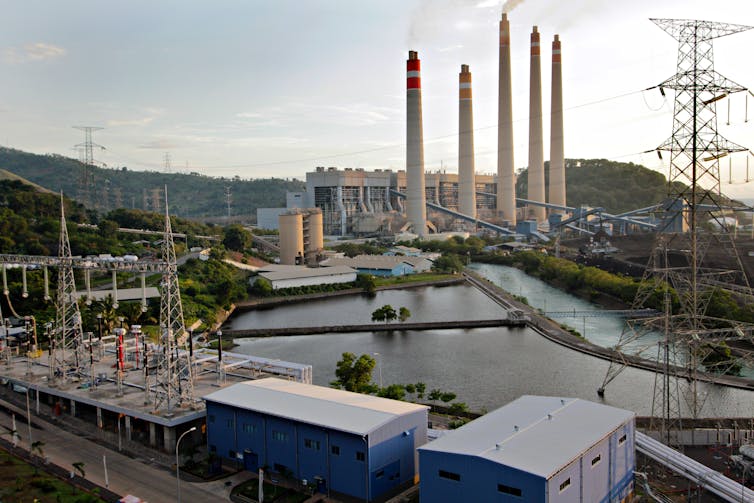
Indonesia is the world’s fourth most populous country and the 17th largest economy. It is also the largest exporter of coal, and an archipelago of more than 17,500 islands that are highly vulnerable to rising seas and intensifying storms.
Cpaulfell/Shutterstock
To meet the Paris climate goals, Indonesia pledged to source 29% of its energy from renewables by 2030 — or 41% with international support. In 2022, that support seemed to arrive through a US$20 billion Just Energy Transition Partnership (JETP).
JETPs are designed to help fast-growing, coal-reliant emerging economies speed up their shift to clean energy. The funding blends public and private money, including grants, concessional loans, and commercial debt and equity investments.
Despite the size of this supposed transfer of wealth, my research indicates that Indonesia’s JETP has delivered very little so far.
One reason is governance. The JETP secretariat — meant to serve as the agreement’s planning hub — had to get its policy and investment plans approved by developed-country partners. Although it was chaired by an Indonesian appointed by the Energy and Mineral Resources Ministry, there was no dedicated funding to hire a proper JETP team.
Once touted as Indonesia-led, the JETP was soon beholden to the interests of developed countries. Its working groups for technical planning, policy, finance and justice were funded respectively by the OECD-led International Energy Agency, the Washington-headquartered World Bank, the multilateral Asian Development Bank (whose largest shareholders are the US and Japan) and the UN Development Programme.
Companies from the donor countries also dominated discussions about JETP funding. One of the first proposed projects was the early closure of the Cirebon-1 coal power plant in Java, the largest stake of which is owned by Japan’s Marubeni Corp (32.5%). Recent reports indicate the plans to retire the plant early have now been shelved.
‘An instrument of control’
“Justice” is a common tagline in climate finance initiatives, including JETPs.
My research shows that JETP documents include justice “standards”, such as preserving cultural heritage or respecting labour rights. But these remain guidelines that are not legally binding.
According to the JETP secretariat, by mid-2024, 19 programmes totalling US$144.6 million had been launched, or were in the final phase of discussions. Yet, Eco-Business reported in October 2024 that none of the pledged transition finance had “translated into new clean energy projects or the early retirement of coal-fired power plants”.
Instead, the initial funding from the US, Germany and Canada was reportedly going towards paying consultants for feasibility studies or technical assistance.
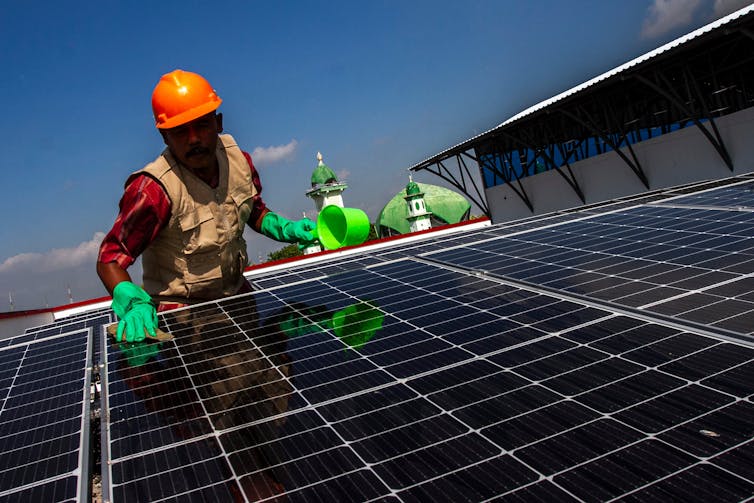
Follow-on funding to build renewable projects is not guaranteed after feasibility studies have concluded. In fact, some programmes credited to JETP assistance, like Germany’s energy transition mechanism partnership fund, were already sanctioned under other schemes, like the Asian Development Bank’s flagship Energy Transition Mechanism. This is not JETP-specific cash that will add to an Indonesia-led energy transition.
Kemarrravv13/Shutterstock
Indonesian policymakers I have spoken to are candid about the politics of climate finance. They see it as driven less by justice than by self-interest. One policymaker in the energy sector described the JETP as “an instrument of control” used by G7 countries to counter China’s influence in Southeast Asia.
At the onset of Trump’s second presidency, with a US withdrawal from the Paris Agreement — and from Indonesia’s JETP — looming, Indonesian policymakers began calling JETP a failure. Others took a more pragmatic view, suggesting the process had accelerated discussion around energy transition in Indonesia.
Today, as developed economies face fiscal pressures and rethink their aid budgets, climate finance — often drawn from aid commitments — looks increasingly uncertain.
As climate funding tightens, justice for historical emissions and support for those disadvantaged by the renewable transition risk slipping further down the agenda. The same fate might await substantive partnerships between developed and developing countries to meet climate goals.

Nikita Sud menerima dana dari Oxford University’s John Fell OUP Research Fund (Number 0012658) and a Leverhulme Research Fellowship (RF-2024-551).
– ref. The world’s largest climate finance deal was built to flounder: why funding fails to reach the front-line – https://theconversation.com/the-worlds-largest-climate-finance-deal-was-built-to-flounder-why-funding-fails-to-reach-the-front-line-273805