
Source: The Conversation – UK – By Ian Williams, Professor of Applied Environmental Science, University of Southampton
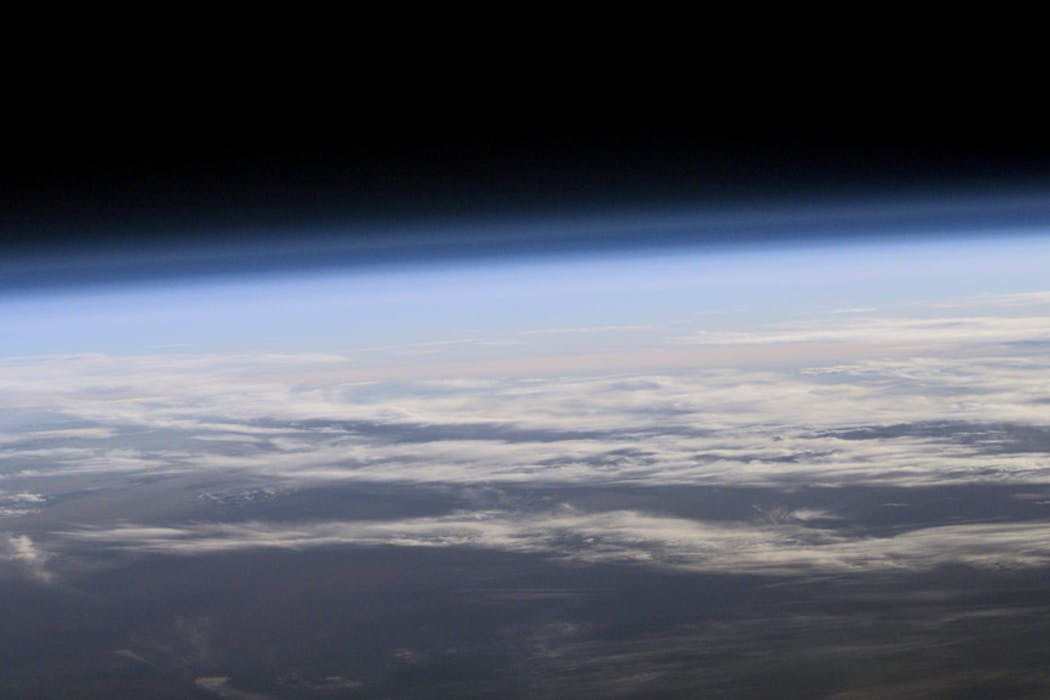
Look up on a clear night and you’ll see the streaks of our new space age. What you
don’t see is the growing fallout for the atmosphere that keeps us alive.
A wave of satellite launches and reentries is changing the chemistry and physics of the middle and upper atmosphere.
Studies warn of ozone depletion, stratospheric heating and new metal aerosols from burning spacecraft. The pace is accelerating fast and unless we redesign how we use and retire satellites, we risk swapping one environmental problem (congestion in Earth orbit from too many spacecraft) for another (an atmosphere seeded with rocket soot and satellite ash).
The problem is that most satellites are de-orbited when they reach the end of their lives. Essentially, they self-destruct in the Earth’s atmosphere, disintegrating as they are heated to thousands of degrees Celsius. But there is an increasing move to extend the lives of satellites in orbit by, for example, refuelling them. They could also be de-orbited in a gentler manner, so that parts can be reused.
Orbital launches hit fresh records in 2024 and 2025 as companies raced to establish and refresh mega-constellations, which are large networks of many satellites launched to provide a particular service, such as internet access.
SpaceX’s Starlink is one example. Independent estimates report between 259 and 271 launches in 2024 and more than 315 in 2025, driven largely by commercial broadband fleets. That launch pace means unprecedented reentry traffic: thousands of satellites self destructing in the atmosphere.
Researchers estimate that by the 2030s, re-entering satellites could inject thousands to tens of thousands of tonnes of alumina (aluminium oxide) and other metals into the middle atmosphere each year.
Why does that matter? Alumina can catalyse the chemistry that destroys the ozone layer, which protects the Earth’s surface from harmful solar radiation. Meanwhile, rocket exhaust – especially black carbon (soot) from rocket engines powered by hydrocarbon propellants – warms the stratosphere (the layer of the atmosphere immediately above the one where we live) and alters winds.
Modelling suggests that the growth in space launches could measurably thin global ozone and delay its recovery after the success of the Montreal Protocol – the 1987 agreement designed to reduce the use of ozone-harming chemicals.
Crucially, scientists are now detecting the chemical footprints of launches in the atmosphere. Research aircraft have sampled “exotic” metals (aluminium, copper, lithium and more) embedded in stratospheric particles, consistent with rocket and satellite reentries.
Not just a traffic problem
Treating end-of-life space vehicles via “just burn it up” may clear orbits, but it risks trading orbital debris for atmospheric pollution.
One study forecast that by 2040, alumina from reentries could rival meteoric dust, shifting polar temperatures and winds – the same regions most sensitive to ozone chemistry.
Independent analyses show that black carbon emissions from rockets can warm the stratosphere by up to a few degrees and slow jet streams under highgrowth scenarios, raising concerns about undesirable impacts on climate change and ozone chemistry.
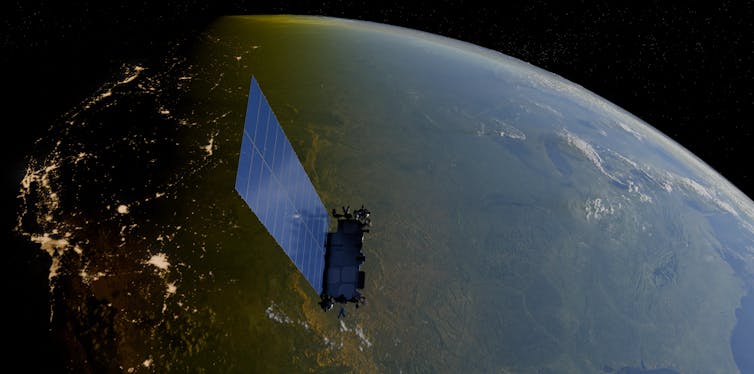
Wikideas1, CC BY

There are terrestrial risks too. While the individual risk from falling debris remains very low, the collective risk is rising as reentries multiply, prompting calls for tighter limits on uncontrolled descents.
Astronomy is already feeling the strain. Simulations indicate that, if constellations reach projected sizes by decade’s end, a large fraction of images from some space and ground-based observatories will be spoiled by satellite streaks – a product of the large number of satellites passing in front of the telescope.
A better path
There is another way forward. A circular economy for space applies the same principles that
aims to transform modern waste policy on Earth. This means designing products to last and keep them in service, eliminate pollution, and recover value at end of life. Our research shows it’s not only technically possible – it’s financially attractive.
It’s something we are exploring at the Southampton Space Institute, which opened in 2025. My colleague and I estimate the reuse and scrap value of orbital debris at US$570 billion (£419 billion) – US$1.2 trillion (£900 billion), spanning between 5,312 and 19,124 tonnes of recoverable material. That economic signal can justify investment in the technologies and markets that turn “junk” into feedstock – raw materials or components that can be used for other purposes.
We can also extend the lives of satellites by servicing them – for example, refuelling them when they are running low on propellant. Northrop Grumman’s Mission Extension Vehicles have already docked with an ageing satellite in geostationary orbit, adding years of service and avoiding premature disposal.
The active removal of space debris could also help. The European Space Agency’s
ClearSpace1 project plans to demonstrate the first capture and de-orbit of space debris in 2029. The UK’s Clear mission will also remove multiple items of space debris – as a kind of “garbage collection” that reduces the risk of them colliding with satellites.
Satellites and rockets should be built for repair, refuelling and gentle de-orbiting, so that parts can be retrieved and reused. The choice of materials used could also minimise ozone damaging residues in the atmosphere.
Policymakers can accelerate this by making manufacturers responsible for their products along the entire life-cycle (so-called extended producer responsibility). Financial incentives such as refundable bonds for companies that de-orbit their satellites could also help, along with licence conditions that favour satellite servicing over disposal in Earth orbit.
The science in this area is still maturing. We need coordinated measurements and modelling of soot, alumina and metals in the middle atmosphere. The direction of travel is clear: under high growth scenarios, space launches and routine burn-ups of satellites can slow ozone healing and reshape the stratosphere. Under smarter, circular economy scenarios, we can have a clean sky.
So the options are: keep launching, burning and polluting the atmosphere or build a circular space economy that extends, services and recovers parts from satellites.
If we get this right, future generations will inherit both a darker, quieter sky and a resilient, circular space industry – and they’ll wonder why we ever thought that leaving satellites in space was a good plan.

Ian Williams receives funding from UK Research Councils, including the Engineering and Physical Sciences Research Council’s Impact Acceleration Account.
– ref. Space launches are changing the chemistry of Earth’s atmosphere, studies warn – here’s what can be done – https://theconversation.com/space-launches-are-changing-the-chemistry-of-earths-atmosphere-studies-warn-heres-what-can-be-done-277264