
Source: The Conversation – Canada – By Michal Perlman, Professor of Applied Psychology and Human Development, University of Toronto
Children’s experiences during early years form the foundation for their development.
For many children in Canada and across the globe, these early experiences include substantial exposure to early learning and child care. And government investments in early learning and care in Canada and elsewhere has increased dramatically.
Research has shown that exposure to high-quality early learning and care is associated with positive outcomes for children — and these associations are strongest for children from families with fewer resources, including lower incomes.
But what exactly is high-quality early learning and child care? As I have examined in my research with a number of colleagues, quality is multi-dimensional, encompassing both structural features (like educator/child ratios and the group size) and also what children experience.
The latter includes the quality of interactions between children and their educators. Robust evidence demonstrates that the quality of educator-child interactions is a stronger predictor of developmental and learning outcomes compared to other aspects of quality.
Yet despite decades of investment and reform, national and international evidence consistently indicates that, in many cases, the quality of these interactions in early learning and care settings is average at best.
Monitoring, improving child-care quality
An important mechanism for improving quality, increasing accountability and providing evidence for planning in early learning and child care: quality ratings and improvement systems (QRISs or quality ratings for short).
These ratings and improvement systems are structured around ongoing — commonly annual — measurements of program quality, including systematic assessments of educator-child interactions.
QRISs generally involve evaluations by external assessors that are conducted in early childhood education and child-care settings. Results from these assessments:
• Inform the development of targeted quality improvement plans for the learning and care setting and for individual educators.
• Can be publicly available to help parents decide where to send their children (although posting scores is not required).
• Can inform how quality improvement and system expansion dollars are allocated.
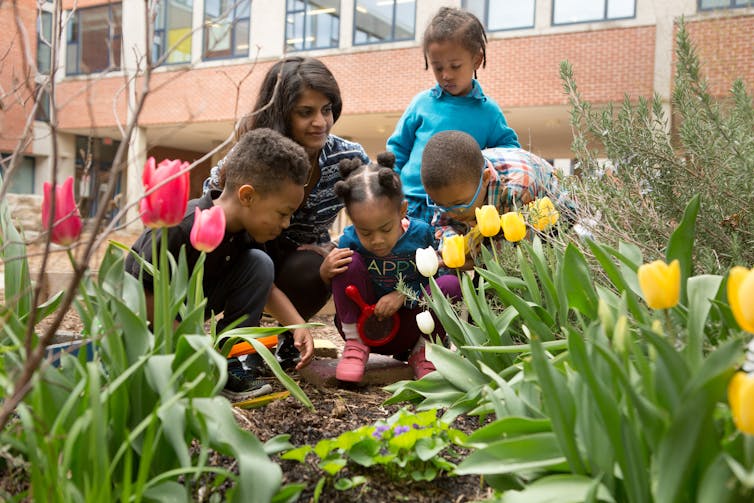
(Allison Shelley/The Verbatim Agency/EDUimages), CC BY-NC
Important features
For quality ratings and improvement systems to work, they need to have a few important features. For starters, they need to capture key aspects of quality. This means measuring what matters most, not merely what is most readily captured.
Most states in the United States operate quality ratings and improvement systems that involve visiting assessors who observe environments, including hard-to-capture qualities of educator/child interactions.
In Canada, the City of Toronto has operated such a system for years, as have several other Ontario municipalities. Prince Edward Island is in the process of implementing one.
In the face of substantial government spending on early learning and child care and the potential impact on children served by these programs, the cost of implementing quality ratings and improvement systems and their related assessments is small.
Given the high-stakes nature of assessments, they must be:
-
Valid: This means they’ve been tested to ensure they capture what they are intended to.
-
Reliable: Different assessors can consistently apply the standards they set across contexts and time periods.
Using valid and reliable measures is needed for the assessments to be fair. But developing such measures requires specific methodological and statistical expertise. Fortunately, several existing and efficient measures are available to capture quality.
City of Toronto’s quality assessment
The City of Toronto developed the assessment for quality improvement (AQI) with help from my team and me at the University of Toronto.
The city’s quality ratings and improvement system is built around the AQI which includes a suite of measures designed to assess global classroom quality (including educator-child interaction) in infant, toddler and pre-school centre classrooms, as well as in-home child-care and outdoor environments.
Results track inequity in access to early learning and child-care programs as well as the quality of these programs, enabling evidence-informed quality improvement. For example, early learning and care practitioners might receive coaching or assistance working on goals that emerge from the assessment.
Read more:
Home child care in Canada should be affordable, high-quality — and licensed
The City of Toronto also uses assessment for quality improvement scores to determine what organizations or services are eligible to provide care to children whose families receive a child-care subsidy. The scores are posted online so that parents and other stakeholders can use this information when choosing care for their children.
P.E.I. is conducting annual assessment of all early learning and child-care classrooms in the province, relying upon the same assessment for quality improvement tool.
Assessments of individual educators
Current quality ratings and improvement systems focus on observing aspects of caregiver-child interactions in classrooms, but don’t systematically consider individual educators’ work with children.
Research increasingly shows that educators in the same classroom interact with children differently. This raises concerns about inclusion, equity and whether all children in early learning and care settings experience high-quality interactions — and how these are guided and informed by relevant policy and professional education.
Findings about differences in how individual educators interact with children suggest policymakers should additionally use more specialized quality improvement measures that consider individual educators’ responsiveness. Use of such individualized assessment, when it comes with coaching and support, has been shown to improve the quality of educator interactions with children.
Ongoing quality assessments matter for knowing our public investments in early learning and child care are synonymous with stable high-quality experiences for children. They provide actionable, evidence-based information that can guide how resources are allocated.
Systems like these have been in place for decades in the U.S. There is growing momentum toward quality-assessment approaches in Canada that are both methodologically sound and capable of informing meaningful action. When these approaches are combined with tailored coaching and supports for improvement, they merit increasing attention and support.

Michal Perlman receives funding from the Social Sciences and Humanities Research Council of Canada, Canadian Institutes of Health Research, Lawson Foundation, McCain Foundation and others.
– ref. Good-quality child care? What parents should consider, and how it can be assessed – https://theconversation.com/good-quality-child-care-what-parents-should-consider-and-how-it-can-be-assessed-274370