
Source: The Conversation – Canada – By Jennifer Guthrie, Assistant Professor of Microbiology and Immunology, Western University
Norovirus outbreaks have repeatedly shadowed major international events, and the Olympics are no exception. When thousands of athletes from around the world gather in one place, attention is usually on records broken and medals won. Yet the size and intensity of the Games can create conditions that allow infectious microbes to spread.
The outbreak at the 2026 Milan-Cortina Winter Games has already affected several teams, illustrating the real-world impact of such infections. Highly contagious and able to survive for days on surfaces, norovirus is one example of a pathogen that can move efficiently in these environments.
While norovirus outbreaks are often reported on cruise ships and in schools, global sporting events present additional challenges. Meals are served in centralized facilities, training and recreational spaces are shared and participants travel from countries around the world. In these environments, norovirus can spread rapidly through shared spaces and close contact.
Outbreaks at events like the Olympics are more than logistical setbacks. They reveal how the virus’s biology and the realities of mass gatherings make containment difficult.
What is norovirus?
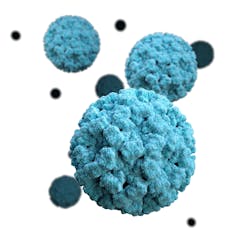
(CDC/ Jessica A. Allen)
Norovirus is a highly contagious virus that causes acute gastroenteritis, an inflammation of the stomach and intestines. It is the leading cause of food-borne illness worldwide, causing hundreds of millions of cases each year.
Although infections are often brief, typically lasting 24 to 72 hours, symptoms can be intense. Sudden onset vomiting, watery diarrhea, nausea, stomach cramps and sometimes low-grade fever or body aches are common. Most healthy adults recover quickly, but young children, older adults and people who become dehydrated can experience serious complications.
One reason norovirus spreads so efficiently is its extremely low infectious dose: fewer than 20 viral particles may be enough to cause illness. By comparison, many other viruses require far higher doses to trigger infection.
In practical terms, microscopic contamination on food, surfaces or hands can be enough to make someone sick. The virus spreads primarily through the fecal–oral route, via contaminated food or water, direct person-to-person contact or touching contaminated surfaces and then the mouth.
Norovirus is also remarkably resilient. It can survive on surfaces for days, withstand freezing temperatures and resist many common disinfectants. It is not reliably killed by alcohol-based hand sanitizers, making thorough hand-washing with soap and water essential. Adding to the challenge, infected individuals can spread the virus before symptoms appear and may continue shedding it for days after recovery.
These characteristics of high infectivity, environmental persistence, and the ability to spread before and after symptoms appear make norovirus particularly difficult to control, especially in settings where large numbers of people live, eat and interact in close proximity.
Why the Olympics are a perfect storm
The Olympic Games bring together thousands of athletes, coaches, support staff and spectators for several weeks of intense competition. With back-to-back events, team meetings and travel between venues, athletes are in near-constant contact with teammates, competitors and staff. In the shared spaces of the Olympic Village, even small exposures can allow infections to move quickly.
The rapid turnover of participants and the arrival of athletes from multiple countries further increase the risk. Different viral strains can be introduced, and those infected may unknowingly carry the virus to others or even back home.
In this environment, speed is everything: norovirus can cause illness within a day or two of exposure, allowing outbreaks to spread quickly and challenging even the most well-prepared health teams.
Containment challenges during major sporting events
Isolation, sanitation and rapid testing are critical but difficult at scale. Containing norovirus during a global event like the 2026 Winter Olympics highlights the practical hurdles organizers face. In early February, a norovirus cluster among the Finland women’s hockey team forced the postponement of their opening game against Canada, as more than a dozen players were either ill or quarantined, showing how quickly an infectious outbreak can disrupt competition plans.
Testing is a key limitation. Norovirus is often diagnosed based on symptoms, and although laboratory tests are available, results may be delayed and capacity strained during a massive event. Because people can spread the virus before symptoms appear, transmission may already be underway by the time cases are confirmed.
Sanitation must also intensify quickly. Norovirus survives on surfaces and requires chlorine-based disinfectants applied thoroughly to high-touch areas across venues and athlete housing. Scaling these measures across large facilities demands rapid co-ordination and staffing.
Isolation is another essential tool. Separating symptomatic or exposed athletes can interrupt transmission but may disrupt team routines. After one player on Switzerland’s women’s hockey team tested positive, the entire team entered precautionary isolation and missed the opening ceremony, showing how a single case can have wide-reaching effects.
Containment ultimately depends on co-ordination among organizers, medical teams and public health authorities, along with clear communication to safeguard both health and competition.
Beyond the Games
The Olympics showcase the best of global unity, but they also reveal how tightly interconnected our world has become.
Managing infectious diseases at events of this scale requires constant preparedness, reminding us that public health planning is as essential as athletic preparation.

Jennifer Guthrie receives funding from the Canada Research Chairs program, the Canadian Institutes of Health Research, and the Natural Sciences and Engineering Research Council of Canada.
– ref. When norovirus hits the Olympics: The science behind the spread – https://theconversation.com/when-norovirus-hits-the-olympics-the-science-behind-the-spread-275782