Les chats peuvent aussi souffrir de démence : les huit signes à surveiller

Source: The Conversation – in French – By Emily Blackwell, Senior Lecturer in Animal Behaviour and Welfare, University of Bristol

Les changements de comportement peuvent être un signe de démence chez les chats. larisa Stefanjuk/ Shutterstock

Tous comme les humains, les chats subissent un déclin cognitif en vieillissant pouvant aller jusqu’à de la démence : quels en sont les signes et comment accompagner, au mieux, votre chat vieillissant ?


De nombreux propriétaires de chats ne réalisent pas que, tout comme les humains, les chats peuvent souffrir de démence. Un article scientifique récent a même mis en évidence de nombreuses similitudes entre la démence féline et la démence humaine, concluant que les troubles cognitifs peuvent se développer de manière similaire.

Certains symptômes de la démence chez les chats sont même similaires à ceux que l’on observe chez les humains, mais pas tous, bien sûr. Il est important de connaître les signes à surveiller afin de pouvoir prodiguer les meilleurs soins à votre animal pendant cette phase de sa vie.

Le syndrome de dysfonctionnement cognitif félin (également appelé démence féline) est un déclin des capacités cognitives d’un chat lié à l’âge. Il se caractérise généralement par des changements de comportement qui ne peuvent être attribués à d’autres troubles médicaux.

La démence féline serait très fréquente chez les chats âgés. Une étude a révélé qu’à l’âge de 15 ans, plus de la moitié des chats présentaient des signes de démence. Cependant, certains comportements associés à cette maladie ont également été observés chez des chats âgés de seulement 7 ans. Une autre enquête menée auprès de propriétaires de chats a également révélé qu’environ 28 % des chats âgés de 11 à 14 ans présentaient au moins un changement de comportement associé à la démence. (NDLT : l’espérance de vie d’un chat domestique varie entre 13 et 20 ans)

Les changements de comportement sont souvent les premiers signes indiquant qu’il pourrait y avoir un problème. Il existe huit signes à surveiller qui peuvent indiquer que votre chat souffre de démence.

1. Vocalisations inhabituelles : votre chat peut commencer à vocaliser de manière excessive ou dans des situations nouvelles. Un exemple courant est celui des miaulements bruyants pendant la nuit.

2. Modifications de leurs interactions avec les humains : les chats atteints de démence peuvent parfois rechercher davantage d’attention ou devenir « collants ». À l’inverse, ils peuvent également interagir moins qu’auparavant, sembler irritables ou ne pas reconnaître les personnes familières.

3. Changements dans leur sommeil : vous remarquerez peut-être des changements dans les habitudes de sommeil de votre chat, qui deviendra souvent agité la nuit et dormira davantage pendant la journée.

4. Souillures dans la maison : les changements dans les habitudes d’élimination peuvent être le signe de plusieurs troubles différents, mais faire ses besoins en dehors du bac à litière peut être un signe courant de démence chez les chats.

5. Désorientation : tout comme les personnes atteintes de démence, les chats peuvent montrer des signes de confusion ou sembler se perdre. Cela peut se traduire par une perte de repères, un regard fixe sur les murs, le fait de rester coincé derrière des objets ou de se diriger du mauvais côté de la porte.

Un chat tuxedo noir et blanc est couché sur le ventre de son propriétaire pendant que celui-ci le caresse
Les chats atteints de démence peuvent devenir plus collants qu’auparavant.
Creative Family/Shutterstock

6. Changements de niveau d’activité : Un chat atteint de démence peut être plus ou moins actif que d’habitude. Il peut jouer moins souvent ou être moins enclin à explorer. Vous remarquerez peut-être également qu’il passe moins de temps à prendre soin de lui, par exemple en se toilettant ou en se lavant moins souvent.

7. Anxiété apparente : un chat atteint de démence peut montrer des signes d’anxiété dans des situations où il se sentait auparavant en confiance, par exemple en présence de personnes, dans des lieux ou face à des sons familiers. Un chat anxieux peut se cacher plus souvent, se réfugier sous le lit ou sur les placards pour s’échapper.

8. Problèmes d’apprentissage : Les chats atteints de démence peuvent avoir plus de difficultés à accomplir des tâches qu’ils avaient apprises auparavant, comme trouver leur gamelle, et peuvent avoir du mal à en apprendre de nouvelles.

Bien s’occuper de son chat

Il existe un chevauchement important entre les symptômes de la démence féline et d’autres pathologies courantes, telles que l’arthrite et les maladies rénales. Si vous constatez l’un de ces changements de comportement chez votre chat, consultez votre vétérinaire afin d’écarter ces autres problèmes.

Les recherches sur la démence féline sont limitées. La plupart de nos connaissances en matière de prévention et de traitement sont extrapolées à partir de recherches menées sur les humains et les chiens. Et, comme pour ces autres espèces, il n’existe aucun remède contre la démence chez les chats. Il existe toutefois des moyens de limiter l’impact de la maladie.

Certaines modifications de leur environnement peuvent aider à stimuler les chats, en activant leur cerveau et en favorisant la croissance des nerfs. Mais il faut tenir compte de la gravité de la démence de votre chat avant d’apporter ces changements.

Chez les chats en bonne santé ou légèrement atteints, on pense que le fait de les inciter à jouer ou de simuler la chasse à l’aide de jouets interactifs et de les encourager à explorer leur environnement à travers des jeux de cache-cache permet de retarder la progression des troubles cognitifs.

Mais chez les chats souffrant de troubles cognitifs sévères, changer leur environnement pourrait entraîner de la confusion et de l’anxiété, ce qui aggraverait les symptômes comportementaux.

Des changements alimentaires, notamment l’ajout de compléments alimentaires contenant des antioxydants (vitamines E et C) et des acides gras essentiels, peuvent également contribuer à réduire l’inflammation cérébrale et à ralentir la progression de la maladie.

Cependant, seuls les compléments alimentaires spécifiques aux chiens ont été testés dans le cadre de recherches scientifiques et ont prouvé leur efficacité pour améliorer les capacités cognitives des chiens. Mais si vous souhaitez tout de même donner ces compléments à votre chat, veillez à ne lui donner que des compléments approuvés pour les félins. Les compléments alimentaires pour chiens ne doivent pas être donnés aux chats, car ils peuvent contenir des substances toxiques pour eux, telles que l’acide alpha-lipoïque.

La démence féline est une maladie très répandue et difficile à traiter. Connaître les symptômes à surveiller peut permettre à votre chat d’être diagnostiqué plus tôt. Cela vous permettra également d’apporter les changements nécessaires à son environnement ou à son alimentation, ce qui améliorera sa qualité de vie.

The Conversation

Emily Blackwell reçoit des financements de Cats Protection, Zoetis, Defra et Waltham Petcare Science Institute.

Sara Lawrence-Mills reçoit un financement de Zoetis.

ref. Les chats peuvent aussi souffrir de démence : les huit signes à surveiller – https://theconversation.com/les-chats-peuvent-aussi-souffrir-de-demence-les-huit-signes-a-surveiller-264544

Titanic : le navire qui cache la flotte d’épaves en danger

Source: The Conversation – in French – By Laurent Urios, Ingénieur de Recherche en microbiologie de l’environnement, Université de Pau et des pays de l’Adour (UPPA)

L’épave du « Titanic » est en danger et pourrait se briser d’ici 2030. Ce n’est pourtant qu’un cas parmi des millions d’autres. Saviez-vous que les bactéries sont impliquées dans la dégradation des épaves, mais aussi dans leur transformation en oasis de vie ? Mieux connaître ces microorganismes et leurs interactions avec les navires est urgent pour protéger notre patrimoine historique.


La découverte de l’épave du RMS Titanic en 1985 a provoqué un engouement extraordinaire autour de ce navire, son histoire, sa fin tragique et le repos de cette épave dans l’obscurité des profondeurs glacées de l’Atlantique. Les images ont révélé un navire brisé recouvert d’étranges concrétions ressemblant à des stalactites de rouille appelées rusticles.

Elles sont faites notamment à partir du métal de l’épave et leur origine est liée aux microorganismes qui utilisent le fer de l’épave pour leur développement, participant ainsi à la corrosion.

Les interactions entre les bactéries et les matériaux sont au cœur de mes recherches. Les bactéries qui se multiplient à la surface des matériaux peuvent participer à leur protection ou à leur dégradation. Le cas du fer est particulier, car c’est un élément indispensable aux êtres vivants. Mais la biocorrosion, conséquence de son utilisation par les microorganismes, est un phénomène qui touche de nombreux secteurs : industries, installations en mer, sur terre ou souterraines… et bien sûr les épaves métalliques.

Les plongées successives sur le Titanic ont montré un affaiblissement des structures de l’épave rongées par la corrosion et s on effondrement a été évoqué pour 2050, voire 2030. Ceux qui se passionnent pour le Titanic s’alarment : comment sauver cette épave ? Et d’ailleurs, pourquoi faudrait-il sauver le Titanic ?

Qu’est-ce qu’une épave ?

Pourquoi sauver une épave ? Parce qu’elle nous touche, parce qu’elle provoque en nous des sensations, de l’émerveillement. Une épave, c’est un souvenir, un témoin d’une histoire, d’un événement, un vestige d’une création humaine qui a eu une fin le plus souvent tragique. Tout comme un monument historique à terre, une épave gisant sous les eaux témoigne de notre histoire.

La différence, c’est que si tout le monde peut voir le monument, très rares sont ceux qui peuvent voir l’épave. Et pourtant, elle est là, artéfact de notre patrimoine historique. Aux termes de notre législation, c’est un bien culturel maritime. Selon la charte de l’Unesco de 2001, ratifiée par la France en 2013, elle peut faire partie du patrimoine culturel immergé. À ces titres, elle doit être protégée. Est-ce tout ? Non, loin de là. Une épave peut aussi être porteuse d’économie, par les activités de loisirs qui sont menées autour d’elle, comme la plongée sous-marine, ou comme site de ressources halieutiques.

Épave du SG11 ex-Alice Robert torpillé au large de Port-Vendres le 2 juin 1944.
Laurent Urios, Fourni par l’auteur

Une oasis de vie

Dès le moment où l’épave se pose sur le fond, sa colonisation commence. Ce sont d’abord des microorganismes planctoniques qui se fixent sur les surfaces. Cette première étape favorise l’arrivée d’autres organismes, notamment des larves d’animaux vivant fixés sur des substrats durs, comme les gorgones ou les coraux, ainsi que des algues. Tout ce petit monde va attirer ceux qui s’en nourrissent, puis les prédateurs de ces derniers et ainsi de suite… pour aboutir à la formation d’un véritable écosystème récifal, dont les limites sont approximativement celles du site de l’épave, même si la zone d’influence de cet écosystème peut aller bien au-delà.

L’épave se transforme en un récif animé, une oasis de vie gisant sur un morne fond de sable à l’apparence d’un désert sous-marin. Ainsi vont les choses, tant que l’épave tient bon. Tempêtes, filets de pêche, corrosion, avec le temps l’épave s’affaiblit et commence à craquer, d’abord dans ses parties les moins solides, puis dans son ossature. C’est la vie ! Ou justement, c’est la fin de la vie… En perdant ses volumes, l’épave offre de moins en moins de surfaces dures à la colonisation. Les populations d’organismes fixés décroissent, ce qui rend le récif moins attirant pour leurs prédateurs. Plus l’épave se désagrège, plus l’oasis de vie se réduit, jusqu’à disparaître avec le vestige. Plus de vestige, plus d’écosystème récifal, donc, mais encore ? Moins d’attrait pour les plongeurs et pour les pêcheurs, donc moins d’intérêt économique. En enfin, c’est la disparition d’un témoignage de notre histoire, d’une partie de notre patrimoine. Lorsqu’un monument historique tombe en ruine, il se trouve souvent quelqu’un pour tenter de le sauver de l’oubli. Pourquoi en serait-il autrement pour une épave ?

Épave du Prosper Schiaffino dit le Donator qui a sauté sur une mine en 1945 entre Porquerolles et Port Cros.
Laurent Urios, Fourni par l’auteur

Les racines du mal

Quel est le point commun entre le Titanic et nombre d’épaves des deux derniers siècles, dont celles des deux guerres mondiales ? Elles sont en alliages ferreux. Et le fer dans l’eau, ça rouille, surtout en eau salée. En réalité, c’est beaucoup plus compliqué que cela et c’est justement cette complexité qui est au cœur du problème : comment lutter contre un phénomène mal compris ? Pour espérer sauver une épave, il faut d’abord comprendre les mécanismes qui causent sa perte. La corrosion d’une épave métallique n’est pas qu’une affaire de physico-chimie entre l’épave et l’eau dans laquelle elle baigne.

Les microorganismes colonisateurs jouent plusieurs rôles, à la fois dans l’accentuation et dans la protection contre la corrosion. Leur développement a comme effet à court terme l’initiation de l’écosystème récifal. À moyen et long terme, ces bactéries peuvent protéger ou accentuer la corrosion. La prolifération bactérienne s’accompagne de la production de substances organiques qui les enveloppent, formant ainsi ce que l’on appelle un biofilm sur la surface colonisée. D’autres composés peuvent être produits et s’accumuler, par exemple du calcaire. L’ensemble peut agir comme une barrière à l’interface entre le métal et l’eau, avec un effet protecteur. Certains groupes bactériens sont particulièrement attirés par ces épaves, par exemple les zétaprotéobactéries. Elles sont capables d’oxyder le fer. Elles trouvent donc sur ces épaves des conditions favorables à leur développement, avec pour conséquence un rôle dans les mécanismes de la corrosion au cours du temps. Les zétaproteobactéries ne sont pas les seules. La diversité bactérienne colonisant les épaves métalliques est importante. Tout ce petit monde forme des communautés qui varient selon les épaves et les conditions environnementales où elles gisent.

Comprendre la composition et la dynamique des communautés au sein de ces biofilms est nécessaire pour savoir de quelles manières elles participent au devenir de l’épave et pour imaginer des solutions de préservation aussi bien pour les épaves métalliques que pour d’autres structures immergées. En effet, les épaves métalliques ne sont qu’une catégorie de structures immergées. Pour les autres types de structures, les problèmes de conservation, de durabilité de leurs matériaux se posent de la même façon, avec le risque de coûts non négligeables engendrés pour leur entretien. Être en mesure de protéger notre patrimoine historique et culturel immergé va donc bien au-delà. Mais le temps s’écoule et à chaque instant la corrosion poursuit son œuvre, grignotant sans relâche. Les recherches ont besoin de temps et surtout de moyens. Il est difficile de financer des projets regroupant des microbiologistes, des archéologues, des chimistes, des océanographes pour travailler de façon globale sur cette problématique. La rareté des publications scientifiques sur le sujet en atteste et les connaissances sont balbutiantes. Or, dans cette course, il n’y a pas de seconde place : une fois détruite, l’épave est perdue. 2030 pour le Titanic ? Quelle échéance pour les épaves des deux guerres mondiales ? Il y a urgence.

The Conversation

Laurent Urios ne travaille pas, ne conseille pas, ne possède pas de parts, ne reçoit pas de fonds d’une organisation qui pourrait tirer profit de cet article, et n’a déclaré aucune autre affiliation que son organisme de recherche.

ref. Titanic : le navire qui cache la flotte d’épaves en danger – https://theconversation.com/titanic-le-navire-qui-cache-la-flotte-depaves-en-danger-265033

Nouvelle paralysie des administrations fédérales aux États-Unis : ce que nous enseigne le « shutdown » de 2013

Source: The Conversation – France in French (3) – By Gonzalo Maturana, Associate Professor of Finance, Emory University

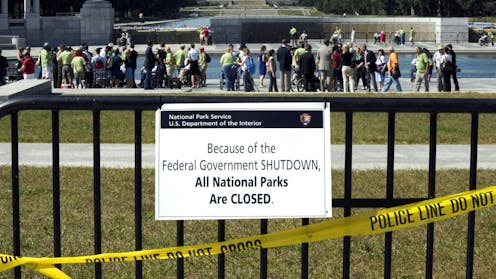
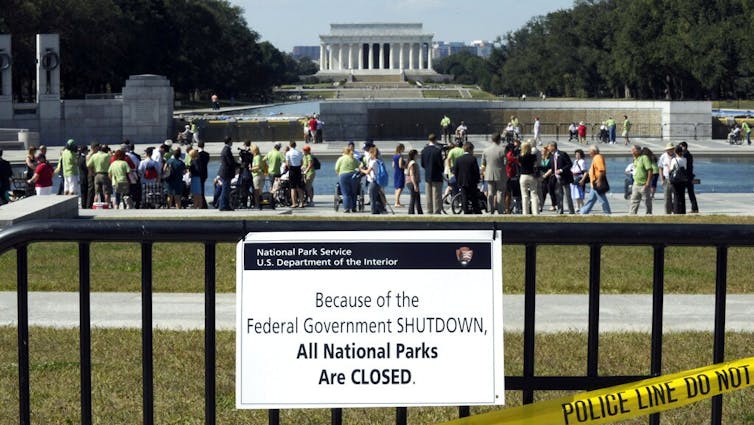
Un panneau indique la fermeture des services fédéraux lors du « shutdown » gouvernemental de 2013. AP Photo/Susan Walsh

Ce 1er octobre 2025, l’échec des négociations budgétaires au Congrès a mené à un shutdown. Concrètement, l’administration fédérale pourrait cesser de fonctionner. Une étude sur celui de 2013 – 16 jours durant – révèle des effets négatifs à long terme : un turnover plus élevé, des pertes de productivité mesurables et des coûts de recrutement exorbitants.


Alors que l’année fiscale fédérale touche à sa fin, une perspective malheureusement familière est discutée à Washington : une possible paralysie de l’administration fédérale. Pour les fonctionnaires fédéraux, cela ne pouvait arriver à un pire moment.

Dans le paysage politique divisé et polarisé des États-Unis, les démocrates et les républicains comptent sur des projets de loi de financement provisoires à court terme pour maintenir le gouvernement en activité, en l’absence d’accords budgétaires à plus long terme.

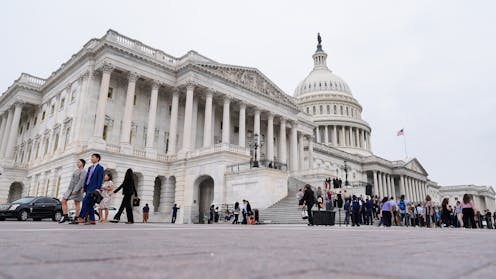
Alors que les partis sont éloignés d’un accord sur les termes d’une résolution budgétaire, même à court terme, le gouvernement doit cesser de fonctionner le 1er octobre 2025, à moins d’un accord de la dernière chance. Si ce shutdown se produit, cela marquerait un autre moment difficile cette année pour des fonctionnaires qui ont fait face à la suppression de plus de 300 000 emplois. Cette procédure de licenciement massif tient aux efforts de l’administration Trump pour restructurer ou supprimer en grande partie certaines agences gouvernementales. L’objectif : accroître leur efficacité.

Avec un potentiel shutdown, des centaines de milliers d’employés fédéraux seraient mis à pied – renvoyés chez eux sans salaire jusqu’à ce que le financement du gouvernement fédéral reprenne.

En tant qu’économistes spécialisés dans les marchés du travail et de l’emploi du secteur public, et ayant examiné des millions de dossiers du personnel fédéral liés à de telles fermetures gouvernementales dans le passé, nous avons constaté que les conséquences vont bien au-delà des images désormais familières de parcs nationaux fermés et de services fédéraux bloqués. Sur la base de notre étude du shutdown d’octobre 2013 au cours de laquelle environ 800 000 employés fédéraux ont été mis à pied pendant 16 jours, la fermeture des agences fédérales laisse un effet négatif durable sur ces fonctionnaires, remodelant leur composition et affaiblissant leur performance pour les années à venir.

Congé forcé pour les fonctionnaires fédéraux

Des millions d’États-Uniens interagissent chaque jour avec le gouvernement fédéral. Plus d’un tiers des dépenses nationales états-uniennes sont acheminées par le biais de programmes fédéraux, notamment Medicare. Les fonctionnaires fédéraux gèrent par exemple les parcs nationaux, rédigent des règlements environnementaux et aident à assurer la sécurité du transport aérien.

Quelles que soient les tendances politiques de chacun, si l’objectif est d’avoir un gouvernement qui s’acquitte efficacement de ces responsabilités, il est essentiel d’attirer et de retenir une main-d’œuvre compétente.

La capacité du gouvernement fédéral à le faire peut être de plus en plus difficile, en partie parce que les shutdown prolongées peuvent avoir des effets secondaires.

Lorsque le Congrès ne parvient pas à approuver des crédits, les agences fédérales doivent licencier des fonctionnaires dont les emplois ne sont pas considérés comme « exemptés » – parfois communément qualifiés d’essentiels. Ces fonctionnaires exclus continuent de travailler, tandis que d’autres n’ont pas le droit de travailler ou même de faire du bénévolat jusqu’à ce que le financement du gouvernement fédéral reprenne.

Le statut spécifique de ces « congés » imposés aux fonctionnaires pendant ce shutdown reflète les sources de financement de ces postes et les catégories de mission données, et non les performances d’un individu. Par conséquent, il ne donne aucun signal sur les perspectives d’avenir pour un fonctionnaire et agit principalement comme un choc pour le moral. Il est important de noter que les congés ne créent pas de pertes de richesse à long terme ; les arriérés de salaire ont toujours été accordés et, depuis 2019, sont légalement garantis. Les fonctionnaires touchent leur salaire, même s’ils peuvent faire face à de réelles contraintes financières à court terme.

Un observateur cynique pourrait qualifier les congés de congés payés, mais les données racontent une autre histoire.

Moral en berne des fonctionnaires

À l’aide de nombreux dossiers administratifs sur les fonctionnaires civils fédéraux du shutdown d’octobre 2013, nous avons étudié la façon dont ce choc moral s’est répercuté sur le fonctionnement des agences gouvernementales. Les fonctionnaires exposés à des congés lors du shutdown étaient 31 % plus susceptibles de quitter leur emploi dans l’année.

Ces départs n’ont pas été rapidement remplacés, ce qui a forcé les agences à compter sur des travailleurs temporaires coûteux et a entraîné des déclins mesurables dans les fonctions essentielles telles que les paiements, l’application des lois et les processus pour délivrer des brevets.

En outre, nous avons constaté que cet exode s’est renforcé au cours des deux premières années suivant un shutdown. Elle se stabilise ensuite par une baisse permanente des effectifs, ce qui implique une perte durable de capital humain. Le choc moral est plus prononcé chez les jeunes femmes et les professionnels très instruits qui ont beaucoup d’opportunités extérieures. En effet, notre analyse des données d’enquête d’un shutdown ultérieur en 2018-2019 confirme que c’est le moral, et non la perte de revenus, qui est à l’origine de ces départs massifs.

Les fonctionnaires qui se sont sentis les plus touchés ont signalé une forte baisse de leur capacité d’action, d’initiatives et de reconnaissance. De facto, ils étaient beaucoup plus susceptibles de planifier un départ.

L’effet de la perte de motivation est frappant. À l’aide d’un modèle économique simple où l’on peut s’attendre à ce que les travailleurs accordent de la valeur à la fois à l’argent et à leur objectif, nous estimons que la baisse de la motivation intrinsèque après un shutdown nécessiterait une augmentation de salaire d’environ 10 % pour compenser.

1 milliard de dollars pour des recrutements temporaires

Certaines personnes ont soutenu que ce départ de fonctionnaires est nécessaire, une façon de réduire le gouvernement fédéral pour « affamer la bête ».

Les preuves brossent un tableau différent. Les agences les plus durement touchées par les licenciements se sont tournées vers des entreprises de recrutement temporaire pour combler les emplois non pourvus. Au cours des deux années qui ont suivi le shutdown de 2016, ces organismes ont dépensé environ 1 milliard de dollars de plus en sous-traitants qu’ils n’ont économisé en salaires.

Les coûts vont au-delà des dépenses de remplacement, car la performance du gouvernement en souffre également. Les organismes qui ont été les plus touchés par le shutdown ont enregistré des taux plus élevés de paiements fédéraux inexacts pendant plusieurs années. Même après une récupération partielle de la main-d’œuvre fédérale, les pertes se sont élevées à des centaines de millions de dollars que les contribuables n’ont jamais récupérés.

Agences scientifiques sans scientifiques

D’autres postes nécessitant des compétences spécialisées ont également connu un déclin. Les poursuites judiciaires ont diminué dans les agences qui ont manqué d’avocats expérimentés, et les activités de brevetage ont chuté dans les agences scientifiques et d’ingénierie après le départ d’inventeurs clés.

Les estimations officielles des coûts du shutdown se concentrent généralement sur les effets à court terme sur le PIB et des arriérés de salaire. Nos résultats montrent qu’une facture encore plus importante se présente plus tard sous la forme d’un turnover plus élevé du personnel, de coûts de main-d’œuvre plus élevés pour combler les postes non pourvus et des pertes de productivité mesurables.

Chocs brutaux

Les shutdown sont des chocs brutaux et récurrents qui démoralisent les fonctionnaires et érodent leurs performances. Ces coûts se répercutent sur tous ceux qui dépendent des services gouvernementaux. Si le public veut des institutions publiques efficaces et responsables, alors nous devrions tous nous soucier d’éviter ces blocages gouvernementaux.

Après une année déjà mouvementée, il n’est pas clair si un shutdown à venir ajouterait considérablement la pression sur les fonctionnaires fédéraux ou aurait un effet plus limité. Beaucoup de ceux qui envisageaient de partir sont déjà partis par le biais de rachats de leurs congés ou de licenciements forcés cette année. Ce qui est clair, c’est que des centaines de milliers d’employés fédéraux sont susceptibles de connaître une autre période d’incertitude.

The Conversation

Les auteurs ne travaillent pas, ne conseillent pas, ne possèdent pas de parts, ne reçoivent pas de fonds d’une organisation qui pourrait tirer profit de cet article, et n’ont déclaré aucune autre affiliation que leur organisme de recherche.

ref. Nouvelle paralysie des administrations fédérales aux États-Unis : ce que nous enseigne le « shutdown » de 2013 – https://theconversation.com/nouvelle-paralysie-des-administrations-federales-aux-etats-unis-ce-que-nous-enseigne-le-shutdown-de-2013-266384

Even a government shutdown that ends quickly would hamper morale, raise costs and reduce long-term efficiency in the federal workforce

Source: The Conversation – USA (2) – By Gonzalo Maturana, Associate Professor of Finance, Emory University

Congress failed to reach a deal in time, leaving the federal government shut down. AP Photo/Mariam Zuhaib

The U.S. government shutdown couldn’t come at a worse time for federal workers.

With a government shutdown, hundreds of thousands of federal employees would be furloughed – sent home without pay until funding resumes. And ahead of the shutdown, President Donald Trump suggested that a prolonged lapse in funding could open the door to “irreversible” changes, such as reducing parts of the federal workforce.

The shutdown marks another difficult moment this year for a federal workforce that has so far shed more than 300,000 jobs. This is largely due to ongoing Trump administration efforts to downsize parts of the federal government and restructure or largely eliminate certain government agencies with the stated aim of increasing efficiency.

As a team of financial economists who study labor markets and public sector employment and have examined millions of federal personnel records spanning such government shutdowns in the past, we have found that the consequences reach far beyond the now-familiar images of closed national parks and stalled federal services. Indeed, based on our study of an October 2013 shutdown during which about 800,000 federal employees were furloughed for 16 days, shutdowns leave an enduring negative effect on the federal workforce, reshaping its composition and weakening its performance for years to come.

What happens to workers

Millions of Americans interact with the federal government every day in ways both big and small. More than one-third of U.S. national spending is routed through government programs, including Medicare and Social Security. Federal workers manage national parks, draft environmental regulations and help keep air travel safe.

Whatever one’s political leanings, if the goal is a government that handles these responsibilities effectively, then attracting and retaining a talented workforce is essential.

Yet the ability of the federal government to do so may be increasingly difficult, in part because prolonged shutdowns can have hidden effects.

When Congress fails to pass appropriations, federal agencies must furlough employees whose jobs are not deemed “excepted” – sometimes commonly referred to as essential. Those excepted employees keep working, while others are barred from working or even volunteering until funding resumes. Furlough status reflects funding sources and mission categories, not an individual’s performance, so it confers no signal about an employee’s future prospects and primarily acts as a shock to morale.

Importantly, furloughs do not create long-term wealth losses; back pay has always been granted and, since 2019, is legally guaranteed. Employees therefore recover their pay even though they may face real financial strain in the short run.

A cynical observer might call furloughs a paid vacation, yet the data tells a different story.

A sign in front of a national memorial.
National Parks are among the federal services that typically close during a shutdown, as happened in 2013.
AP Photo/Susan Walsh

Immediate consequences, longer-term effects

Using extensive administrative records on federal civilian workers from the October 2013 shutdown, we tracked how this shock to morale rippled through government operations. Employees exposed to furloughs were 31% more likely to leave their jobs within one year.

These departures were not quickly replaced, forcing agencies to rely on costly temporary workers and leading to measurable declines in core functions such as payment accuracy, legal enforcement and patenting activity.

Further, we found that this exodus builds over the first two years after the shutdown and then settles into a permanently lower headcount, implying a durable loss of human capital. The shock to morale is more pronounced among young, female and highly educated professionals with plenty of outside options. Indeed, our analysis of survey data from a later 2018-2019 shutdown confirms that morale, not income loss, drives the exits.

Employees who felt most affected reported a sharp drop in agency, control and recognition, and they were far more likely to plan a departure.

The effect of the motivation loss is striking. Using a simple economic model where workers can be expected to value both cash and purpose, we estimate that the drop in intrinsic motivation after a shutdown would require a roughly 10% wage raise to offset.

Policy implications

Some people have argued that this outflow of employees amounts to a necessary trimming, a way to shrink government by a so-called starving of the beast.

But the evidence paints a different picture. Agencies hit hardest by furloughs turned to temporary staffing firms to fill the gaps. Over the two years after the shutdown we analyzed, these agencies spent about US$1 billion more on contractors than they saved in payroll.

The costs go beyond replacement spending, as government performance also suffers. Agencies that were more affected by the shutdown recorded higher rates of inaccurate federal payments for several years. Even after partial recovery, losses amounted to hundreds of millions of dollars that taxpayers never recouped.

Other skill-intensive functions declined as well. Legal enforcement fell in agencies that became short of experienced attorneys, and patenting activity dropped in science and engineering agencies after key inventors left.

Official estimates of shutdown costs typically focus on near-term GDP effects and back pay. But our findings show that an even bigger bill comes later in the form of higher employee turnover, higher labor costs to fill gaps, and measurable losses in productivity.

Shutdowns are blunt, recurring shocks that demoralize the public workforce and erode performance. These costs spill over to everyone who relies on government services. If the public wants efficient, accountable public institutions, then we should all care about avoiding shutdowns.

After an already turbulent year, it is unclear whether a shutdown would significantly add to the strain on federal employees or have a more limited effect, since many who were considering leaving have already left through buyouts or forced terminations this year. What is clear is that hundreds of thousands of federal employees will experience another period of uncertainty.

This story was updated on Oct. 1, 2025, to include details of the shutdown.

The Conversation

The authors do not work for, consult, own shares in or receive funding from any company or organization that would benefit from this article, and have disclosed no relevant affiliations beyond their academic appointment.

ref. Even a government shutdown that ends quickly would hamper morale, raise costs and reduce long-term efficiency in the federal workforce – https://theconversation.com/even-a-government-shutdown-that-ends-quickly-would-hamper-morale-raise-costs-and-reduce-long-term-efficiency-in-the-federal-workforce-265723

How safe is your face? The pros and cons of having facial recognition everywhere

Source: The Conversation – Global Perspectives – By Joanne Orlando, Researcher, Digital Wellbeing, Western Sydney University

Maria Korneeva / Getty Images

Walk into a shop, board a plane, log into your bank, or scroll through your social media feed, and chances are you might be asked to scan your face. Facial recognition and other kinds of face-based biometric technology are becoming an increasingly common form of identification.

The technology is promoted as quick, convenient and secure – but at the same time it has raised alarm over privacy violations. For instance, major retailers such as Kmart have been found to have broken the law by using the technology without customer consent.

So are we seeing a dangerous technological overreach or the future of security? And what does it mean for families, especially when even children are expected to prove their identity with nothing more than their face?

The two sides of facial recognition

Facial recognition tech is marketed as the height of seamless convenience.

Nowhere is this clearer than in the travel industry, where airlines such as Qantas tout facial recognition as the key to a smoother journey. Forget fumbling for passports and boarding passes – just scan your face and you’re away.

In contrast, when big retailers such as Kmart and Bunnings were found to be scanning customers’ faces without permission, regulators stepped in and the backlash was swift. Here, the same technology is not seen as a convenience but as a serious breach of trust.

Things get even murkier when it comes to children. Due to new government legislation, social media platforms may well introduce face-based age verification technology, framing it as a way to keep kids safe online.

At the same time, schools are trialling facial recognition for everything from classroom entry to paying in the cafeteria.

Yet concerns about data misuse remain. In one incident, Microsoft was accused of mishandling children’s biometric data.

For children, facial recognition is quietly becoming the default, despite very real risks.

A face is forever

Facial recognition technology works by mapping someone’s unique features and comparing them against a database of stored faces. Unlike passive CCTV cameras, it doesn’t just record, it actively identifies and categorises people.

This may feel similar to earlier identity technologies. Think of the check-in QR code systems that quickly sprung up at shops, cafes and airports during the COVID pandemic.

Facial recognition may be on a similar path of rapid adoption. However, there is a crucial difference: where a QR code can be removed or an account deleted, your face cannot.

Why these developments matter

Permanence is a big issue for facial recognition. Once your – or your child’s – facial scan is stored, it can stay in a database forever.

If the database is hacked, that identity is compromised. In a world where banks and tech platforms may increasingly rely on facial recognition for access, the stakes are very high.

What’s more, the technology is not foolproof. Mis-identifying people is a real problem.

Age-estimating systems are also often inaccurate. One 17-year-old might easily be classified as a child, while another passes as an adult. This may restrict their access to information or place them in the wrong digital space.

A lifetime of consequences

These risks aren’t just hypothetical. They already affect lives. Imagine being wrongly placed on a watchlist because of a facial recognition error, leading to delays and interrogations every time you travel.

Or consider how stolen facial data could be used for identity theft, with perpetrators gaining access to accounts and services.

In the future, your face could even influence insurance or loan approvals, with algorithms drawing conclusions about your health or reliability based on photo or video.

Facial recognition does have some clear benefits, such as helping law enforcement identify suspects quickly in crowded spaces and providing convenient access to secure areas.

But for children, the risks of misuse and error stretch across a lifetime.

So, good or bad?

As it stands, facial recognition would seem to carry more risks than rewards. In a world rife with scams and hacks, we can replace a stolen passport or drivers’ licence, but we can’t change our face.

The question we need to answer is where we draw the line between reckless implementation and mandatory use. Are we prepared to accept the consequences of the rapid adoption of this technology?

Security and convenience are important, but they are not the only values at stake. Until robust, enforceable rules around safety, privacy and fairness are firmly established, we should proceed with caution.

So next time you’re asked to scan your face, don’t just accept it blindly. Ask: why is this necessary? And do the benefits truly outweigh the risks – for me, and for everyone else involved?

The Conversation

Joanne Orlando receives funding from NSW Department of Education and previously from office of eSafety Commissioner.

ref. How safe is your face? The pros and cons of having facial recognition everywhere – https://theconversation.com/how-safe-is-your-face-the-pros-and-cons-of-having-facial-recognition-everywhere-265753

The 5 big problems with Trump’s Gaza peace plan

Source: The Conversation – Global Perspectives – By Ian Parmeter, Research Scholar, Middle East Studies, Australian National University

The 20-point plan announced by US President Donald Trump at a joint news conference with Prime Minister Benjamin Netanyahu comes close to living up to Trump’s hype. It is a bold attempt to address all of the issues that need to be resolved if there is to be lasting peace in Gaza.

Could it work? Both sides are tired of the war. Throughout history, quite a number of wars have simply come to an end when both sides were too exhausted to continue. Two-thirds of Israelis want the war to end, and though polling of Palestinians is difficult, they clearly want the devastation and suffering in Gaza to stop, too.

So, this plan, despite its limitations, could come at the right time.

However, there are many outstanding questions about the feasibility of the plan and to what extent it is likely to be successful. Given the Middle East’s violent history, it’s impossible to be optimistic at this point.

Here are five main reasons for concern.

1. Trust is lacking

There’s zero trust between both sides right now. And several aspects of the plan are so vague, there is a big risk both sides could accuse the other of breaking their promises.

The last ceasefire between the two sides only lasted two months before Netanyahu backed out, blaming Hamas for not releasing more hostages before negotiations on the next phase could proceed.

2. The plan is asymmetrical

The deal favours Israel more than it does Hamas. Hamas is essentially being asked to give up all of the remaining Israeli hostages it holds and all of its weapons at the same time, rendering it entirely defenceless.

Hamas, with its lack of trust in Israel and Netanyahu, in particular, may fear the Israeli leader could use this as an opportunity to attack it again without worrying about harming the hostages.

Hamas was also not invited to negotiate the terms of the agreement. And it now faces an ultimatum: accept the terms or Israel will “finish the job”.

Given the asymmetry of the plan, Hamas may decide the risks of accepting it outweigh the potential benefits, despite its offer of amnesty for Hamas fighters who lay down their arms.

Israel is being asked to make some compromises in the plan. But how realistic are these?

For example, the deal envisions a future when the Palestinian Authority (PA) can “securely and effectively take back control of Gaza”. Netanyahu has previously said he would not accept this.

Likewise, it would also be very difficult for Netanyahu to accept “a credible pathway to Palestinian self-determination and statehood”, as outlined in the plan. He has firmly rejected this in the past, most recently in his defiant address to the UN General Assembly last week.

3. Important details are lacking

The implementation strategy of the plan is extraordinarily vague. We know nothing at this stage about the “International Stabilisation Force” that would take the place of the Israeli military after it withdraws from Gaza.

Which countries would participate? It would obviously be a mission fraught with danger to the personnel involved. Netanyahu has previously mentioned an Arab force taking over in Gaza, but no Arab states have yet put their hands up for this.

There is also no timeframe in the plan for the Palestinian Authority reforms, nor any details on what these reforms would entail.

Presumably, there would need to be new elections to install a credible leader in place of current President Mahmoud Abbas. But how that would be done and whether the people of Gaza would be able to take part is still unknown.

In addition, the details of the civil authority that would oversee the reconstruction of Gaza are very unclear. All we know is that Trump would appoint himself chair of the “Board of Peace”, and former British Prime Minister Tony Blair would also somehow be involved.

This board would need the absolute confidence of the Netanyahu government and Hamas to be effective. Trust is always in short supply in the Middle East.


Read more:
The Palestinian Authority is facing a legitimacy crisis. Can it be reformed to govern a Palestinian state?


4. No mention of the West Bank

The West Bank is clearly a flashpoint. There are disputes and clashes every day between the Israeli settlers and Palestinian residents, which are only likely to get worse.

Just last month, the Israeli government gave final approval to a controversial plan to build a new settlement that would effectively divide the West Bank in two, making a future, contiguous Palestinian state unviable.

The West Bank must be central to any overall settlement between Israel and Palestine.

5. Israel’s right-wing cabinet remains an obstacle

This could be the ultimate deal breaker: the hardline right-wing members of Netanyahu’s cabinet, Bezalel Smotrich and Itamar Ben-Gvir, have said they will not accept anything less than the complete destruction and elimination of Hamas.

And although Hamas would be disarmed and politically sidelined under this plan, its ideology would remain intact, as would a significant number of its fighters.

So, does it have a chance?

If Hamas accepts Trump’s plan, we could soon have the answers to several of these questions.

But it is going to require a great deal of work by the United States to maintain the pressure on Israel to stick to the deal. The chief Palestinian mediators, Qatar and Egypt, would also need to maintain pressure on Hamas so it doesn’t breach the conditions, as well.

Netanyahu is likely assuming there will be sufficient off-ramps for him to get out of the agreement if Hamas doesn’t live up to it. Netanyahu has already done this once when he backed out of the ceasefire in March and resumed Israel’s military operations.

In his forceful speech to a partially empty UN General Assembly hall last week, Netanyahu didn’t indicate he was thinking of walking away from any of the red lines he had previously set to end the war. In fact, he condemned the states recognising a Palestinian state and vowed, “Israel will not allow you to shove a terror state down our throats.”

Given this, Netanyahu would not have agreed to Trump’s plan at all if the US leader hadn’t put pressure on him. At the same time, Trump said at his news conference with Netanyahu that if Hamas fails to live up to the agreement or refuses to accept it, Israel would have his full backing to finish the job against Hamas.

This promise may be enough for Netanyahu to be able to persuade Smotrich and Ben-Gvir to support the plan – for now.

The Conversation

Ian Parmeter does not work for, consult, own shares in or receive funding from any company or organisation that would benefit from this article, and has disclosed no relevant affiliations beyond their academic appointment.

ref. The 5 big problems with Trump’s Gaza peace plan – https://theconversation.com/the-5-big-problems-with-trumps-gaza-peace-plan-266355

12,000-year-old rock art marked ancient water sources in Arabia’s desert

Source: The Conversation – Global Perspectives – By Maria Guagnin, Director, Ha’il Archaeology Identification Project, University of Sydney; Max Planck Institute of Geoanthropology

Sahout Rock Art and Archaeology Project

About 12,000 years ago, high up on a cliff in the desert of northern Arabia, an artist – or perhaps artists – was hard at work.

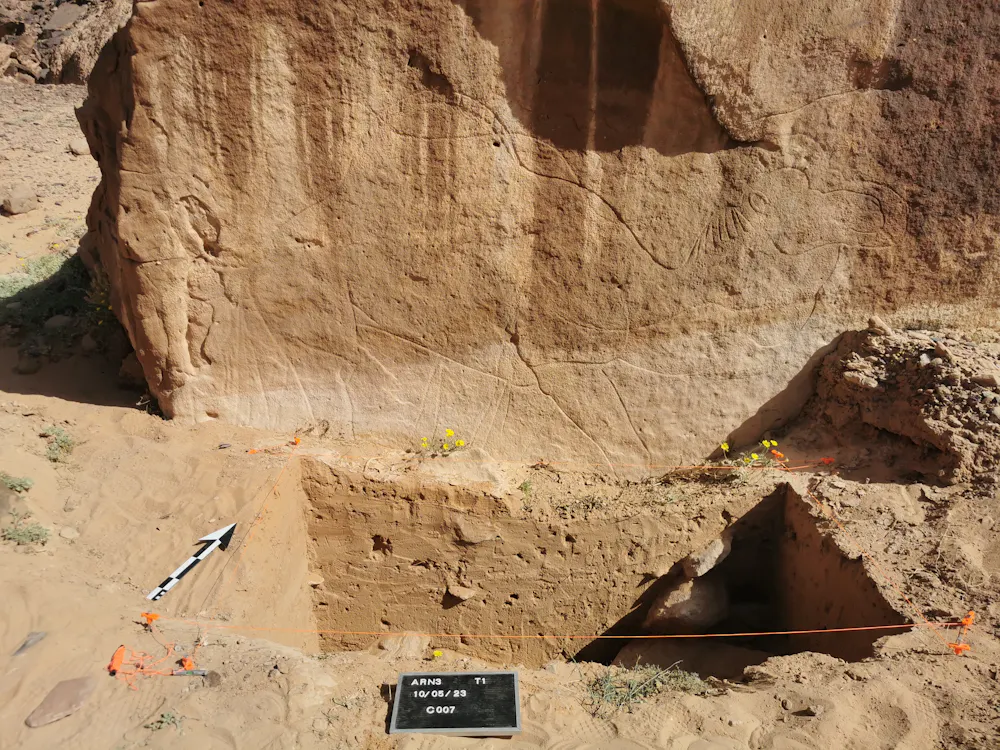
Standing on a narrow ledge and with primitive tools, they engraved into the rock an image of a life-sized camel. This wasn’t the first artwork of its kind: in fact, there was already an entire row of fresh camel engravings on the 39-metre-high cliff face, below which a shallow lake sparkled in the sunshine.

Over thousands of years, these engravings weathered the elements. They gradually eroded until they were almost invisible and had been forgotten.

That is, until our international team discovered them and more than 170 others while on a field trip to the region, which sits near the southern edge of the Nefud Desert in Saudi Arabia, roughly two years ago.

As we explain in a new study, published today in Nature Communications, the engravings would have marked important desert water sources – and demonstrate the resilience and innovation of people who lived in such a harsh, arid environment.

A barren, rocky desert under a clear blue sky.
The engravings are near the southern edge of the Nefud Desert in Saudi Arabia.
Sahout Rock Art and Archaeology Project

Searching for clues

Our earlier research had shown that between 10,000 and 6,000 years ago Arabia was much wetter than it is today.

Grasslands had spread into areas that are now desert, and cattle herders used these pastures for their herds.

The rock art they left behind is well known from two UNESCO World Heritage sites.

We could see there was also older rock art at these UNESCO sites. It was much larger and more detailed, showing life-sized and naturalistic camels and wild donkeys. But it was not clear how old it was. So in May 2023 we set out to find more of this ancient rock art in the hope of finding clues about its age.

A sand-coloured rock face, featuring an engraving of a large camel.
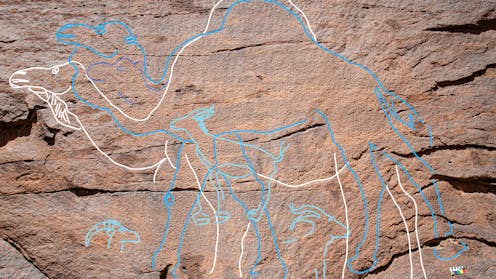
The newly discovered engravings include 130 images of large, life-sized animals – camels, ibex, wild donkeys, gazelles and aurochs.
Sahout Rock Art and Archaeology Project

Life-sized engravings

In total, we identified more than 60 rock art panels containing 176 engravings in three previously unexplored areas – Jebel Arnaan, Jebel Mleiha and Jebel Misma. The engravings include 130 images of large, life-sized animals – camels, ibex, wild donkeys, gazelles and aurochs. Some are almost three metres long and more than two metres high.

We reached the first panel via a long off-road track which cut through a beautiful mountain landscape. A cool breeze made the heat of the emerging Saudi summer bearable.

The rock art panel showed two large camels, one on top of the other. The older camel looked as though it was in motion and about to stand up, the other like it was striding across the rock surface.

We were excited to find undisturbed archaeological layers directly beneath the engraved camels. In one sealed layer we even found an engraving tool that was once used to make rock art.

Luminescence dating – a dating method that measures when sediment was last exposed to sunlight – revealed the layer in which the tool was found is about 12,000 years old.

The same layer also contained artefacts that are typical for this time, including small arrowheads, stone beads and even a bead made from a seashell.

A hand holding a small arrowhead.
An arrowhead uncovered during excavations.
Michael Petraglia

A far-reaching network

These artefacts tell us the people who made the rock art were part of a far-reaching network. They used the same stone tools and jewellery as communities in the Levant, 400 kilometres further north.

Significantly, our team also discovered the rock art was placed near ancient seasonal lakes.

At the end of the last ice age, during the Last Glacial Maximum, the climate was extremely dry.

These lakes, dated at roughly 15,000 years, are the first evidence of surface water returning to Arabia following the extremely arid period. And they move the timeline of the returning humid conditions back thousands of years, enlarging the opportunity window for humans to settle in these dry inland conditions.

Our results show 12,000 years ago, humans were able to use these seasonal lakes to survive in the desert. They marked these water sources, and the paths leading to them, with monumental rock art.

We don’t know why they did this. But even for us today, the camel is a striking symbol for survival in the desert.

The Conversation

Maria Guagnin received funding from a British Academy/Leverhulme Small Research Grant (SRG2223231473) for fieldwork and research.

Ceri Shipton, Frans van Buchem, and Michael Petraglia do not work for, consult, own shares in or receive funding from any company or organisation that would benefit from this article, and have disclosed no relevant affiliations beyond their academic appointment.

ref. 12,000-year-old rock art marked ancient water sources in Arabia’s desert – https://theconversation.com/12-000-year-old-rock-art-marked-ancient-water-sources-in-arabias-desert-266144

We teach young people to write. In the age of AI, we must teach them how to see

Source: The Conversation – Global Perspectives – By T.J. Thomson, Senior Lecturer in Visual Communication & Digital Media, RMIT University

Vikas Anand Dev/Unsplash

From the earliest year of school, children begin learning how to express ideas in different ways. Lines across a page, a wobbly letter, or a simple drawing form the foundation for how we share meaning beyond spoken language.

Over time, those first marks evolve into complex ideas. Children learn to combine words with visuals, express abstract concepts, and recognise how images, symbols and design carry meaning in different situations.

But generative artificial intelligence (AI), software that creates content based on user prompts, is reshaping these fundamental skills. AI is changing how people create, edit and present both text and images. In other words, it changes how we see – and how we decide what’s real.

Take photos, for example. They were once seen as a “mirror” of reality. Now, more people recognise their constructed nature.

Similarly, generative AI is disrupting long-held assumptions about the authenticity of images. These can appear photorealistic but can depict things or events that never existed.

Our latest research, published in the Journal of Visual Literacy, identifies key literacies at each stage of the AI image generation process, from selecting an AI image generator to creating and refining content.

As the way people make images changes, knowing how generative AI works will let you better understand and critically assess its outputs.

Textual and visual literacy

Literacy today extends beyond reading and writing. The Australian Curriculum defines literacy as the ability to “use language confidently for learning and communicating in and out of school”. The European Union broadens this to include navigating visual, audio and digital materials. These are essential skills not only in school, but for active citizenship.

These abilities span making meaning, communicating and creating through words, visuals and other forms. These abilities also require adapting expression to different audiences. You might text a friend informally but email a public official with more care, for example. Computers, too, demand different forms of literacy.

In the 1960s, users interacted with computers through written commands. By the 1970s, graphical elements like icons and menus emerged, making interaction more visual.

Generative AI is often a mix between these two approaches. Some technologies, like ChatGPT, rely on text prompts. Others, like Adobe’s Firefly, use both text commands and button controls.

The user interface of Adobe Firefly shows eight photorealistic images, generated by AI, seemingly depicting the Sydney Opera House in Sydney Harbour.
Adobe Firefly provides a suite of options for adjusting visual output, including whether the visual style is photorealistic, whether the image orientation is square, horizontal, or vertical, and whether any visual effects are desired.
T.J. Thomson

Software often interprets or guesses user intent. This is especially true for minimalistic prompts, such as a single word or even an emoji. When these are used for prompts, the AI system often returns a stereotypical representation based on its training data or the way it’s been programmed.

Being more specific in your prompt helps to arrive at a result more aligned with what you envisioned. This highlights that we need “multimodal” literacies: knowledge and skills that cut across writing and visual modes.

What are some key literacies in AI generation?

One of the first generative AI literacies is knowing which system to use.

Some are free. Others are paid. Some might be free but built on unethical datasets. Some have been trained on particular datasets that make the outputs more representative or less risky from a copyright infringement perspective. Some support a wider range of inputs, including images, documents, spreadsheets and other files. Others might support text-only inputs.

After selecting an image generator, you need to be able to work with it productively.

If you’re trying to make a square image for an Instagram post, you’re in luck. This is because many AI systems produce images with a square orientation by default. But what if you need a horizontal or vertical image? You’ll have to ask for that or know how to modify that setting.

What if you want text included in your image? AI still struggles with rendering text, similarly to how early AI systems struggled with accurately representing human fingers and ears. In these cases, you might be better off adding text in a different software, such as Canva or Adobe InDesign.

Many AI systems also create images that lack specific cultural context. This lets them be easily used in wider contexts. Yet it might decrease the emotional appeal or engagement among audiences who perceive these images as inauthentic.

A humanoid robot holds a newspaper with a headline about the economy.
AI often struggles with rendering text. Here’s how AI did with a request to create an image that included this headline, ‘Give the A.I. Economy a Human Touch.’
The authors via Midjourney, CC BY-NC-SA

Working with AI is a moving target

Learning AI means keeping pace with constant change. New generative AI products appear regularly, while existing platforms rapidly evolve.

Earlier this year, OpenAI integrated image generation into ChatGPT and TikTok launched its AI Alive tool to animate photos. Meanwhile, Google’s Veo 3 made cinematic video with sound accessible to Canva users, and Midjourney introduced video outputs.

These examples show where things are headed. Users will be able to create and edit text, images, sound and video in one place rather than having to use separate tools for each.

Building multimodal literacies means developing the skills to adapt, evaluate and co-create as technology evolves.

If you want to start building those literacies now, begin with a few simple questions.

What do I want my audience to see or understand? Should I use AI for creating this content? What is the AI tool producing and how can I shape the outcome?

Approaching visual generative AI with curiosity, but also critical thinking is the first step toward having the skills to use these technologies intentionally and effectively. Doing so can help us tell visual stories that carry human rather than machine values.

The Conversation

T.J. Thomson receives funding from the Australian Research Council. He is an affiliate with the ARC Centre of Excellence for Automated Decision Making & Society.

Daniel Pfurtscheller previously received funding from the Tyrolean Science Fund and the Austrian Science Fund, for research unrelated to this article.

Katharina Christ works in a project funded by the Klaus Tschira Foundation. This research is unrelated to the content of this article.

Katharina Lobinger has previously received funding from the Swiss National Science Foundation and the Federal Office of Communications in Switzerland.

Nataliia Laba has previously received Research Training Program funding from the Australian Government Department of Education.

ref. We teach young people to write. In the age of AI, we must teach them how to see – https://theconversation.com/we-teach-young-people-to-write-in-the-age-of-ai-we-must-teach-them-how-to-see-259283

Kamala Harris’ candid memoir reveals her ‘ideal’ vice president – and why she thinks she lost

Source: The Conversation – Global Perspectives – By Bruce Wolpe, Non-resident Senior Fellow, United States Study Centre, University of Sydney

It is downright eerie to read, right now, Kamala Harris’ memoir of her 2024 presidential campaign. These events feel so far away now, when we read them from within the frequent shocks of the Trump presidency, from troops on the streets of Washington to the indictment of former FBI director James Comey. But the chapter titles – beginning “July 21. 107 Days to the Election” – remind us the election was just last year.

“It says a lot about how traumatised we both were by what happened that night that Doug and I never discussed it with each other until I sat down to write this book,” Harris reflects about election night: her campaign at an end and Trump triumphant.

The book is not the whole story – not by a long shot. But her words about these events resonate with a ring of truth.


Book review: 107 Days – Kamala Harris (Simon & Schuster)


The first chapter, Sunday July 21, covers the day Joe Biden – who disintegrated before our eyes in his catastrophic debate with Trump – withdrew from the race, with no road to victory.

He did want to endorse Harris, but “not for a day, maybe two”. She told him that would be “ruinous”. She argued that she was not just “the candidate in the strongest position to win”, but “the only person” who would preserve Biden’s legacy. “At this point, anyone else was bound to throw him – and all the good he had achieved – under the bus.”

She draws on her call notes to supply the reactions of various senior Democrats to the news that day, from Bill Clinton (“Oh my god, I’m so relieved!”) to Gavin Newsom:

Hiking. Will call back. (He never did.)

Throughout, Harris is relentlessly sharp in recollecting the campaign – and very candid on all the principals, including the love of her husband, Doug Emhoff.

It takes courage to write about such an agonising, devastating defeat – after an historic, exhilarating campaign – so quickly and so personally. Memoirs are rarely written this quickly. (We are still waiting, five years later, for the second volume of Barack Obama’s memoirs.)

In writing this book, she got by with a little help from a “special friend”: Pulitzer prize winning Australian author Geraldine Brooks. Harris’ acknowledgements note her deep appreciation of working with Brooks, whose “ferocious and brilliant artistic insights were indispensable.”

The book fully reflects that. And who knows? Brooks one day might collaborate with Kamala on an inaugural address.

Candid, but loyal about Biden

Harris is candid about Biden’s decline, but still essentially loyal.

“On his worst day, he was more deeply knowledgeable, more capable of exercising judgment, and far more compassionate than Donald Trump at his best,” she writes. “There was a distinction between his ability to campaign and his ability to govern.”

Bob Woodward, the dean of presidential journalists, reached the same conclusion in his last book, War.

Harris writes:

of all the people in the White House, I was in the worst position to make the case that he should drop out. I knew it would come off to him as incredibly self-serving if I advised him not to run. He would see it as naked ambition.

The choice, she says, should not “have been left to an individual’s ego, an individual’s ambition. It should have been more than a personal decision.”

In other words, this was a decision his family and associates did not want to make. But it was imperative the national interest be placed above Biden’s personal interest.

The Harris campaign kept the core of Team Biden. “I didn’t have time to build a new plane; I had to fly the aircraft available.”

One of Biden’s closest advisors, Mike Donilon (criticised in Jake Tapper and Alex Thompson’s recent Biden book, Original Sin) left Harris’ campaign two weeks in.

She describes him, during Biden’s 2024 campaign, filtering poll data and presenting “the numbers in soothing terms […] really there was nothing to see here”. At these briefings (which “made no sense to me”), she writes, “Doug had wanted to stop sitting next to me because he got tired of me kicking him under the table when I asked a question and got a nonanswer.”

Pete Buttigieg ‘too big of a risk’ as VP

Harris delivers the goods on her vice-presidential search. She admits Pete Buttigieg (a personal friend) was her first choice and the “ideal partner” – but the then transportation secretary, with his husband and children, was “too big of a risk” for “a Black woman married to a Jewish man”.

Josh Shapiro, governor of Pennsylvania, came across to her as wanting a co-presidency. “At one point, he mused that he would want to be in the room for every decision […] I had a nagging concern that he would be unable to settle for a role as number two.”

She viewed senator and retired astronaut Mark Kelly of Arizona very favourably, but was afraid the Trump attack machine would try to take him down on his (excellent) military service record – just like the Republicans did to John Kerry in 2004. The man who led that effort, Chris LaCivita, was now a top Trump campaign aide.

Could a captain, used to deference and respect, adapt to an opponent’s national campaign specifically designed to disrespect him, to cut a hero down to something small?

Of course, the military service slander she feared with Kelly was employed against her eventual choice. Minnesota governor Tim Walz, who served in the National Guard for 24 years, was accused by vice president JD Vance of “stolen valor” for his misstatement, while arguing for an assault weapons ban, that “these weapons of war that I carried in war” had no place on civilian streets, though he didn’t serve in combat.

Harris found the chemistry she wanted with the “genuinely self-deprecating” Walz: an all-American decent guy next door, with great values and common sense. “He had no fixed ideas about what the role of vice president would be, saying he would do whatever I found was most useful for him to do.”

She writes that her senior staff favoured Walz, “to a person”, as did her sister – while husband Doug Emhoff, interestingly, leaned towards Shapiro.

We will never know if Shapiro or Kelly would have carried their swing states, perhaps changing the outcome of the election.

‘Don’t ever let them make you cry’

Trump’s outrages on the campaign trail were rife. Harris takes us behind the scenes to reveal her reactions to key moments, like Trump’s infamous statement to the National Association with Black Journalists: “I didn’t know she was Black until a number of years ago when she happened to turn Black and now she wants to be known as Black.” (Her mother is Indian; her father Jamaican.)

To campaign aide Brian Fallon, who wanted her to “punch back with a big speech about my racial identity”, she retorted:

Today he wants me to prove my race. What next? He’ll say I’m not a woman and I’ll need to show my vagina?

Harris takes us into her July 25 meeting with Israel’s Benjamin Netanyahu during her campaign. She also tells us she believes Israel was right to respond to “the atrocities of October 7”, but criticises the “ferocity” of Netanyahu’s response, including “the number of innocent Palestinian women and children killed and his failure to prioritize the lives of the hostages”. She was tough.

“I interrupted to reiterate the need for an immediate ceasefire and a day-after plan that gave Palestinians some kind of political horizon.” Netanyahu did not like what he was hearing – especially from her. “He wanted Trump in the seat opposite him. Not Joe. Not me.”

Harris does acknowledge Biden gaffes, like when he put on the MAGA hat of a Trump supporter he was joking with, who offered it to him. Her internal monologue went: “Don’t take it […] Don’t put it on.” Then: “He put it on.” That photo carried the caption, “Biden endorses Trump over Harris.” A bad day on a trail that had only 107 days.

When Harris talks about being a woman in politics, she sounds a lot like Julia Gillard.

“As any woman in a public-facing job knows, it takes us longer,” she writes about the two hours she needed to get ready on the campaign trail – make-up, hairstyling, “more complicated apparel choices”. Women are still judged on these seeming trivialities, she writes, over “the consequential matters we’re engaged in”.

She relates a conversation with German chancellor Angela Merkel. “They used to call me this – this ugly bird. And at first it hurt me deeply.” Angela leant towards Kamala. “Don’t ever let them make you cry.”

Harris never does.

‘I know Donald Trump’s type’

Harris’ speeches hit Trump where it hurts. As California’s attorney general, she told crowds:

I took on predators of all kinds […] Predators who abused women, who ripped off consumers, cheaters who broke the rules for their own game. So hear me when I say […] I know Donald Trump’s type.

The crowds “exploded” at this line, she writes.

There are phrases in English that do a lot of work for you. “I know his type” is one of them. We’ve all said it about someone of low character whom we’ve personally known.

She had big rallies. And big money. She was fully competitive.

Harris told America what Day One of President Kamala Harris would look like. “When elected, I will walk in with a to-do list full of priorities on what I will get done for the American people.”

By contrast: “On day one, if elected, Donald Trump would walk into that office with an enemies list.” Does anyone following American politics today doubt that?

By her own account, the wisest advisor in her campaign was David Plouffe, who ran Barack Obama’s successful 2008 campaign. But like a Shakespearean ghost, Plouffe’s warnings haunt this play. He counselled her Trump was doing better than in 2016 and 2020, and the assassination attempt had pushed his turnout up 20%. “Whatever you think his turnout will be, add ten per cent.”

Her campaign strategists were not happy about Harris’ continued praise for Biden in her speeches, urging her to stop. Plouffe put it bluntly: “People hate Joe Biden.” Harris quotes those words twice.

Why does she believe she lost?

This is her verdict: “One hundred and seven days were not, in the end, long enough to accomplish the task of winning the presidency.”

Maybe.

Trump got three million more votes in 2024 than he did in 2020. Harris got six million fewer votes than she and Biden did in 2020.

All that Harris was proud of – the landmark legislation on infrastructure, health care and clean energy – would not deliver their full benefits before the election. In the run up to November, she writes, inflation and interest rates were high, and there was no immediate relief.

Harris wanted to talk directly to Trump supporters, but it never happened. She wrote:

I wished I could ask every one of them. What are you angry about? What about me makes you angry? Is it your health care, your grocery bills, a backbreaking job that doesn’t pay what you’re worth – and what can I do to help you?

She did not reach them.

She combated Trump’s strength on immigration and border issues, and the issue of Gen Z facing a future without good prospects. An anti-trans campaign ripped across the country: “Kamala is for they/them. President Trump is for you.” It was reported more than US$21 million was spent by Trump and Republicans on anti-trans and anti-LGBTQ television ads as of October 9 2024.

Harris peaked in mid-September. She never had a lead clear of the polls’ margin of error.

On election day, she believed she would win.

The Conversation

Bruce Wolpe donated to the Biden-Harris campaign. He has served on the staffs of the Democrats in Congress and former Prime Minister Julia Gillard.

ref. Kamala Harris’ candid memoir reveals her ‘ideal’ vice president – and why she thinks she lost – https://theconversation.com/kamala-harris-candid-memoir-reveals-her-ideal-vice-president-and-why-she-thinks-she-lost-266047

When China makes a climate pledge, the world should listen

Source: The Conversation – UK – By Myles Allen, Head of Atmospheric, Oceanic and Planetary Physics, University of Oxford

A few years ago, one of us (Myles Allen) asked a Chinese delegate at a climate conference why Beijing had gone for “carbon neutrality” for its 2060 target rather than “climate neutrality” or “net zero”, both of which were more fashionable terms at the time.

Her response: “Because we know what it means.”

It was a revealing answer: China, unlike many other countries, tends not to make climate commitments that it doesn’t understand or intend to keep. And that’s why its latest pledge – cutting greenhouse gas emissions by 7%–10% by 2035, as part of its commitments under the Paris agreement – matters more than the underwhelmed response might suggest.

To be fair on those other countries, lofty goals have played a role in driving the climate conversation about what is possible: there is always the argument that it is better to aim for the moon and miss than aim for the gutter and hit it.

But the climate crisis needs more than aspirations. It needs concrete, plausible plans.

That’s what makes China’s pledge so significant: Beijing has form in only promising what it plans to deliver. Having promised to peak emissions this decade, barely 50 years after it began to industrialise in earnest, it looks set to achieve that. And in the process, become a world leader in wind power, solar energy and electric vehicles.

Meanwhile, in the scientific literature…

A paper appeared in the journal Nature Communications at the end of August that provides some context for China’s announcement and ought to have received much more attention.

In it, climate scientists Junting Zhong and co-authors describe what they call a “reality-aligned scenario”. This means a pathway for emissions over the coming century that is consistent with emissions to date and countries’ near-term commitments.

The paper is provocatively titled “Plausible global emissions scenario for 2°C aligned with China’s net-zero pathway” (provocative because of the implication that some other scenarios out there are, well, less plausible).

In their scenario, global carbon dioxide emissions peak this decade and reach net zero around 2070, accompanied by immediate, sustained but not particularly dramatic reductions in emissions of methane and other greenhouse gases. In response, global warming is expected to peak at just over 2°C towards the end of this century before declining below 2°C early in the next.

Crucially, Zhong and his colleagues break out China’s contribution. In their scenario, the country’s carbon dioxide emissions would peak in the next few years before a steady decline brings them close to zero by 2060. Methane emissions would begin to decline immediately.

Train carrying coal
China is the world’s biggest emitter of methane, a potent but short-lived greenhouse gas. Much of it comes from coal mines.
Jiaye Liu / shutterstock

There is much to discuss in the relationship between this scenario and China’s latest emission pledge. How much of that 7%-10% reduction in all greenhouse gases by 2035 will be delivered by (very welcome) cuts in methane emissions? Breaking out separate contributions of long-lived (CO₂) and short-lived (like methane) greenhouse gases would be helpful to understand the implications of China’s pledges for global temperature.

Zhong and colleagues see land use changes (such as reforestation) playing only a minimal role in China’s long-term climate plan. So why does Beijing’s new pledge put so much emphasis on planting trees? Is this just a stopgap, or the start of a bigger reliance on land-based carbon dioxide removal?

And while renewables are central to China’s strategy, the country will also need to store captured carbon (from power plants or factories) on a massive scale. The real question may be around how China is going to deliver all this.

That’s why the phrase “while striving to do better” in President Xi’s announcement is so important. The world has a keen interest in China over-delivering.

Why the silence?

But perhaps the most remarkable aspect of all this is how little discussion there has been of the work by Zhong and his colleagues. It was clearly relevant: it came out just as China was preparing its pledge, it was published in one of the world’s top scientific journals, and one co-author has a prominent role in the IPCC. Yet despite all that, it received almost no online attention.

Perhaps most climate commentators were too preoccupied with responding to a very different document: a “critical review” commissioned by the US Department of Energy of greenhouse gas impacts on the US climate.

Whether or not you agreed with their conclusions, Zhong and his team’s paper was rigorous, transparent and peer-reviewed. The US review was none of those things, and already widely criticised as flawed. Yet it dominated headlines and commentary for weeks.

While the world’s second-largest emitter was debating a dodgy dossier, a carefully presented and comprehensive scenario, directly relevant to the climate policies of the world’s largest emitter, passed largely unnoticed.

That’s a missed opportunity. China’s targets aren’t just slogans or aspirations – they are statements of intent, grounded in what the country believes it can deliver. And where China goes, others will follow. Paying attention to analyses like the one from Zhong and his colleagues help us understand both China’s role and the world’s chances of keeping warming below 2°C.

That’s why President Xi’s call to “do better” applies not just to countries, but to scientists, commentators and climate policy-watchers too. Don’t be distracted by the usual suspects flooding the zone.


Don’t have time to read about climate change as much as you’d like?

Get a weekly roundup in your inbox instead. Every Wednesday, The Conversation’s environment editor writes Imagine, a short email that goes a little deeper into just one climate issue. Join the 45,000+ readers who’ve subscribed so far.


The Conversation

Myles Allen’s research receives funding from UKRI, the Oxford Martin School, Horizon Europe and VietJet Air. He chairs the scientific advisory board of Puro.Earth.

Kai Jiang does not work for, consult, own shares in or receive funding from any company or organisation that would benefit from this article, and has disclosed no relevant affiliations beyond their academic appointment.

ref. When China makes a climate pledge, the world should listen – https://theconversation.com/when-china-makes-a-climate-pledge-the-world-should-listen-266346