Beavers can turn streams into carbon stores – we measured how much

Source: The Conversation – UK – By Joshua Larsen, Associate Professor in Water Science, University of Birmingham

WildMedia/Shutterstock

Across Europe, beaver numbers are increasing after a long period of decline. As these aquatic mammals recolonise rivers, they are gradually rebuilding wetlands that once existed across many river valleys.

As geographers, we have been investigating how these changes could also affect the movement of carbon through river systems.

To find out, we measured the full carbon balance of a wetland created by beaver damming. Our new study shows that a wetland created by beaver damming can store carbon at rates up to ten times higher than an equivalent stretch of river and floodplain without beavers.

Over just 13 years, the wetland we studied in northern Switzerland locked away more than 1,100 tonnes of carbon. That’s comparable to two Olympic swimming pools filled with charcoal.

So when beavers dam rivers, they can also fundamentally change how carbon is stored in river landscapes.

Our team studied a wetland where beavers have been active for more than a decade.

We monitored the site intensively for a full year to measure the flow of water, the amount of carbon dissolved in the water, released greenhouse gases (such as carbon dioxide and methane) and plant growth across the wetland. We also sampled and analysed sediments and dead wood that had accumulated since the beavers arrived.

By combining these measurements, we have built one of the most complete carbon budgets for a beaver landscape in Europe.

The results surprised us.

Despite some seasonal carbon emissions during summer, the wetland acted as a strong carbon sink. Each year it stored around 98 tonnes of carbon that would otherwise have flowed downstream or returned into the atmosphere.

But this annual carbon balance is strongly linked to water flow and the extent of flooding, which can vary year-to-year. What really determines long-term benefits is how much carbon ultimately becomes buried and stored in the landscape for decades.

drone shot of woodland with river running through
Researchers studied a beaver wetland in Switzerland.
Christof Angst, CC BY-NC-ND

When a dam slows the water, sediments begin to settle. These sediments carry organic material such as leaves, soil and plant fragments that contain carbon. Instead of washing away downstream, the material becomes buried in wetland soils.

Beaver dams also raise water levels and can flood existing vegetation. Some trees die and fall into the water, adding large amounts of dead wood that slowly stores carbon over long periods.

Meanwhile, a new succession of wetland plants and algae growing in the wetland absorb carbon from the atmosphere.

Over time, the wetland becomes a natural storage system. Sediment, wood and vegetation build up layer by layer. This locks carbon into the landscape and eventually fills the wetland.

In the wetland we studied, sediments contained up to eight times more organic carbon than nearby forest soils.

researcher in waterproof clothing standing in stream, surrounded by green grass and trees
Researcher collecting water samples to analyse dissolved carbon concentrations.
Annegret Larsen, CC BY-NC-ND

Wetlands usually produce methane, a powerful greenhouse gas. This has raised concerns that beaver ponds might actually worsen climate warming.

But in our study, methane emissions were extremely small – less than 0.1% of the total carbon balance.

Most greenhouse gas emissions came from carbon dioxide released from sediments exposed during the drier summer periods. Even then, these emissions were smaller than the amount of carbon being stored in sediments and wood.

Over the course of one year, the wetland stored more carbon than it released.

With and without beavers

To understand the role of the animals themselves, we compared the beaver wetland with a scenario where the same river remained a normal flowing stream with a forested floodplain.

Forests are already important carbon stores. Trees capture carbon as they grow, and some of that carbon remains locked in soils and dead wood.

Without beaver dams, the river would stay largely confined to its channel. Water would move quickly downstream, carrying sediments and carbon away rather than trapping them across the floodplain.

Our calculations show that this forested river corridor would store only a small fraction of the carbon held in the beaver wetland. So the presence of beavers increased carbon storage by about an order of magnitude over the course of a decade.

As beaver populations expand across Europe, they could improve carbon storage in river landscapes. When we scaled our results up to the area of floodplains in Switzerland suitable for beaver recolonisation, we estimated that the potential carbon storage could offset roughly 1–2% of the country’s annual emissions.

That might sound small. But it would happen without any expensive technology, infrastructure or active intervention. It would simply come from allowing a native species to rebuild the wetlands that once existed along many of these rivers.

Beavers are not going to solve climate change, but our research shows these natural engineers can quietly help river landscapes store more carbon for decades to come.

The Conversation

Joshua Larsen receives funding from UK Research and Innovation (UKRI)

Annegret Larsen receives funding from the Swiss Federal Office for the Environment.

Lukas Hallberg does not work for, consult, own shares in or receive funding from any company or organisation that would benefit from this article, and has disclosed no relevant affiliations beyond their academic appointment.

ref. Beavers can turn streams into carbon stores – we measured how much – https://theconversation.com/beavers-can-turn-streams-into-carbon-stores-we-measured-how-much-278489

La théorie des cordes a-t-elle été découverte par accident ?

Source: The Conversation – France in French (2) – By Piotr Tourkine, Physicien théoricien, Université Savoie Mont Blanc

Gabriele Veneziano au bord du lac d’Annecy (Haute-Savoie), l’été où il mit le doigt par hasard sur une formule qui allait mener à la découverte de la théorie des cordes. G. Veneziano, avec son aimable autorisation, Fourni par l’auteur

Une plongée dans l’histoire de la théorie des cordes, ou quand une solution suggérée pour un problème donné éclaira en réalité un domaine bien plus vaste.


La physique théorique a connu trois grandes révolutions au tournant du XXᵉ siècle : la mécanique quantique et les deux théories de la relativité, restreinte et généralisée. La mécanique quantique décrit l’infiniment petit. La relativité restreinte et sa célèbre formule E = mc² décrivent la physique des objets se déplaçant aux vitesses proches de la lumière. La relativité générale décrit la force de gravité comme provenant de la courbure de l’espace-temps.

Prises ensemble, elles ont bouleversé notre compréhension de l’espace-temps, de la matière, et des interactions fondamentales. Les implications de ce bouleversement ne sont encore aujourd’hui pas totalement comprises.

En effet, on ne sait pas utiliser ce cadre pour décrire certaines situations extrêmes, comme l’espace-temps à l’intérieur des trous noirs, ou au moment du Big Bang – deux situations où les effets quantiques et gravitationnels sont simultanément importants. C’est dans cet entrelacs que réside le mystère central de la « gravité quantique », que la physique moderne cherche à élucider, et pour lequel la théorie des cordes propose un cadre qui unifie relativité générale et physique quantique.

Du point de vue de l’histoire des sciences, un élément remarquable de cette théorie sophistiquée est qu’elle a, en fait, été découverte par hasard, au sein d’un domaine bien différent de la gravité quantique : celui de la physique des particules subatomiques !

Gabriele Veneziano et les particules subatomiques

Genève, fin des années 1960. Gabriele Veneziano a 26 ans, il vient de finir son doctorat de physique nucléaire en Israël et se trouve en visite au CERN. À l’époque, les physiciens théoriciens du monde entier se heurtaient à un problème coriace : la méthode qui avait permis de comprendre les interactions entre électrons et lumière (qu’on appelle aujourd’hui la théorie quantique des champs) semblait ne pas fonctionner pour décrire les interactions entre les autres particules subatomiques.

En particulier, on ne comprenait pas l’interaction nucléaire forte, qui régit les interactions entre les briques élémentaires de la matière : protons, neutrons, etc. Celles-ci forment un véritable zoo de particules qu’on nomme les hadrons.

Une nouvelle approche est alors explorée : le « bootstrap ». Ne pouvant trouver la bonne théorie pour décrire les hadrons individuellement, les physiciens se posèrent la question dans l’autre sens : quelles sont les propriétés générales que doit satisfaire n’importe quelle théorie ? La réponse : au minimum, elle doit satisfaire simultanément aux exigences de la mécanique quantique et de la relativité restreinte.

Cette approche par exemple permet de montrer qu’une interaction fondamentale ne peut excéder une certaine intensité sans briser les lois de la mécanique quantique (un peu comme il existe une vitesse maximale en relativité). En clair : si l’on mélange les lois de la mécanique quantique et celles de la relativité restreinte, tout n’est pas permis, et les lois physiques possibles deviennent fortement contraintes.

C’est dans ce cadre que Gabriele Veneziano proposa en 1968 une fonction mathématique très particulière – la fonction bêta d’Euler – pour modéliser les hadrons et leurs interactions. À ce moment, on ne connaissait pas la théorie qui permettrait d’expliquer d’où sort cette formule : on savait seulement qu’elle satisfaisait, pour la première fois, toutes les propriétés mathématiques recherchées. Son papier eut un succès immédiat, car la formule répondait à de nombreuses questions en même temps.

Sérendipité et théorie des cordes

La sérendipité est souvent idéalisée comme un heureux hasard. Mais, en science, elle prend une forme plus subtile : elle naît de l’interaction entre un contexte de recherche fertile et une capacité à reconnaître qu’une solution trouvée pour un problème donné éclaire en réalité un domaine bien plus vaste.

Le cas de la formule de Veneziano est emblématique. Quelques années après l’article de Veneziano, les physiciens Leonard Susskind, Yoichiro Nambu et Holger Bech Nielsen comprirent (indépendamment) que cette formule décrivait en fait non pas des hadrons mais des « cordes quantiques », c’est-à-dire des objets microscopiques filiformes, qui vibrent à la manière de minuscules cordes de violon.

Et c’est là que ça devient vraiment intéressant.

Les cordes et le… graviton ?

Depuis les années 1970, à mesure que l’on explore cette interprétation, d’autres indices troublants apparaissent. La théorie semble invariablement contenir une particule particulière : le graviton, censé véhiculer la force de gravitation quantique. De plus, elle exige l’existence de dimensions d’espace supplémentaires – un prix qui semble alors trop élevé pour une théorie censée décrire les hadrons !

Et surtout, comment une théorie inventée pour décrire les interactions de la matière à l’intérieur du noyau atomique pouvait-elle contenir une théorie qui décrit tout autre chose – la gravité quantique ?

Comme, à la même époque (autour de 1973), la théorie quantique des champs finit par expliquer les interactions fortes grâce à la découverte de la chromodynamique quantique, et notamment de la liberté asymptotique, le modèle de Veneziano est laissé de côté dans ce contexte.

Mais quelques physiciens visionnaires, comme Joël Scherk et John Schwarz, pressentirent que cette théorie, à cause de son mystérieux graviton, possédait un potentiel unique pour s’attaquer à la gravité quantique.

Dix ans plus tard, en 1984, Michael Green et John Schwarz confirmèrent cette intuition et démontrèrent que la théorie des cordes est bel et bien une véritable théorie de gravité quantique.

On voit donc que la découverte de la théorie des cordes est l’illustration même de la sérendipité : une théorie née d’un certain questionnement éclaire le cœur d’un aspect tout autre de la science.

Gabriele Veneziano lui aussi contribuera notablement au développement de la théorie des cordes, notamment en étudiant les liens entre celle-ci et la structure microscopique de l’espace-temps.

La théorie de cordes aujourd’hui

Aujourd’hui, la théorie des cordes est bien plus qu’une simple théorie candidate de la gravité quantique. Aux côtés de la théorie quantique des champs, elle constitue un cadre conceptuel et mathématique d’une richesse inégalée, capable d’unifier des idées venues de la physique des particules, de la relativité, de la théorie des champs, du chaos et des mathématiques pures et produire des avancées conceptuelles et techniques dans ces domaines.

Par exemple, le modèle de Veneziano et ses généralisations, dont on sait aujourd’hui qu’ils proviennent de la théorie des cordes, exhibent des propriétés mathématiques remarquables liées à la fonction zêta de Riemann. Ces propriétés s’expliquent physiquement par la façon dont deux cordes ouvertes s’attachent pour former une corde fermée.

Plus encore, le programme du « bootstrap », qui avait donné naissance à la théorie des cordes, connaît aujourd’hui une nouvelle vie : grâce à la puissance des ordinateurs modernes et à des idées venues de la théorie des cordes et de la théorie des champs, les physiciens appliquent ces idées pour décrire des phénomènes très divers, allant des transitions de phase à la physique hadronique et même à la gravité quantique.

Mais il reste un mystère fondamental : pourquoi cette théorie, née « par hasard », semble-t-elle si naturellement adaptée à décrire la gravité quantique ? Était-ce vraiment un hasard… ou un indice que la seule façon d’unifier les trois théories qui forment le socle de la physique du XXᵉ siècle est la théorie des cordes ? On pourrait bien avoir une réponse à cette question mathématique dans les années qui viennent.

The Conversation

Piotr Tourkine a reçu des financements de l’Agence Nationale de la Recherche (ANR-22-CE31-0017).

ref. La théorie des cordes a-t-elle été découverte par accident ? – https://theconversation.com/la-theorie-des-cordes-a-t-elle-ete-decouverte-par-accident-273306

Les manchots d’Afrique sont en danger : comment éviter leur extinction

Source: The Conversation – in French – By Jacqui Glencross, Seabird ecologist, University of St Andrews

L’Afrique du Sud abrite 88 % des colonies mondiales de manchots d’Afrique. L’espèce est classée en danger critique d’extinction par l’Union internationale pour la conservation de la nature. Cela signifie qu’il existe un risque élevé que ces oiseaux disparaissent à l’état sauvage suite au déclin rapide de leur population.

Cette espèce était autrefois abondante le long des côtes d’Afrique du Sud et de Namibie. Mais sa population a chuté d’environ 78 % au cours des 30 dernières années, en raison du manque de nourriture, des marées noires et des changements climatiques dans l’environnement marin. Les manchots d’Afrique se nourrissent principalement d’anchois et de sardines.

Les changements dans les conditions océaniques et la surpêche ont rendu plus difficile pour les manchots de trouver suffisamment de nourriture. Ces dernières années, les organisations de conservation, les scientifiques et les agences gouvernementales ont intensifié leurs efforts pour enrayer ce déclin.

L’une des avancées les plus significatives a été une décision de justice rendue en mars 2025 qui a soutenu la mise en place de zones d’interdiction de pêche améliorées autour des principales colonies de reproduction, afin de protéger les zones d’alimentation des manchots. Robben Island (à 11 km au nord-ouest du Cap) est l’une de ces colonies.

La protection des eaux adjacentes aux colonies de reproduction est essentielle pour le rétablissement à long terme de l’espèce. Le manque de nourriture dans ces zones, dû en partie à la concurrence avec la pêche à la senne coulissante (qui utilise un grand filet pour encercler les bancs de poissons), a été directement lié au déclin de la survie des poussins et à l’effondrement continu de la population.

Le procès (mené par les organisations BirdLife South Africa et Southern African Foundation for the Conservation of Coastal Birds) a conclu que la pêche ne pouvait plus être pratiquée dans un rayon de 20 km autour de Robben Island.

Nous sommes des chercheurs spécialistes des manchots, issus de l’université de St Andrews, de l’université d’Exeter, du ministère sud-africain des Forêts, de la Pêche et de l’Environnement, et de BirdLife South Africa.

Nos travaux ont examiné en détail les interactions entre les manchots et les activités de pêche, et peuvent fournir des informations utiles pour orienter la gestion de leurs besoins respectifs.

Chevauchement avec l’industrie de la pêche

Des recherches sur les effets de la pêche sur les populations de manchots ont principalement porté sur des paramètres tels que la quantité de poissons prélevés par la pêche. Mais la technologie permettant de suivre les lieux de pêche et les déplacements des animaux nous permet désormais d’avoir une vision précise à l’échelle spatiale. Nous pouvons voir où et dans quelle mesure la pêche commerciale et les pingouins se chevauchent, ce qui nous aide à identifier les zones qui devraient être protégées.

Nos récentes recherches ont utilisé les données de suivi des manchots des îles Robben et Dassen, dans la province du Cap-Occidental en Afrique du Sud. Nous avons mesuré le chevauchement spatial au niveau de la population entre les manchots et la pêche locale. Une petite partie des manchots a été suivie à l’aide d’appareils GPS, ce qui nous a permis de simuler les déplacements de la majeure partie de la colonie.

Savoir où une grande partie de la population de manchots partage un espace particulier avec des navires de pêche permet de cibler plus facilement les zones à protéger et les périodes où cela est nécessaire. Cela présente des avantages à la fois pour l’industrie de la pêche (en lui permettant de pêcher dans des zones moins importantes pour les manchots) et pour ces derniers (en réduisant la concurrence avec la pêche pendant la saison de reproduction).

Nous avons également développé une nouvelle mesure, l’« intensité du chevauchement », qui permet non seulement de déterminer l’espace partagé par les manchots et les navires de pêche, mais aussi le nombre de manchots concernés. Les mesures traditionnelles du chevauchement spatial se contentent de calculer le pourcentage de zone partagée entre les prédateurs (manchots) et les navires de pêche. Mais cela peut conduire à une sous-estimation considérable du degré réel d’interaction, en particulier lorsque seules quelques zones sont partagées mais que de nombreux animaux les utilisent.

Cela permet de mieux comprendre la pression écologique et la concurrence, ce que le chevauchement de zones seul ne permet pas. Par exemple, cela suggère une concurrence plus forte pour les proies que ne le laissent entendre les mesures de chevauchement spatial. Cette méthode peut non seulement être étendue à d’autres colonies, mais aussi, plus largement, à d’autres espèces et écosystèmes.

Nos résultats montrent que le chevauchement augmente fortement les années où les poissons se font rares. En 2016, une année où les stocks de poissons étaient faibles, environ 20 % des manchots se nourrissaient dans les mêmes zones que les navires de pêche actifs. Cependant, les années où les stocks de poissons étaient plus importants, le chevauchement est tombé à seulement 4 %. Cette tendance indique que la concurrence entre les manchots et la pêche s’intensifie lorsque les proies sont limitées. Le risque est le plus élevé pendant les périodes sensibles telles que l’élevage des poussins, lorsque les adultes doivent se nourrir efficacement pour subvenir aux besoins de leurs petits.

Un nouvel outil pour la gestion des risques

En quantifiant l’intensité du chevauchement au niveau de la population, notre étude offre un nouvel outil puissant pour évaluer les risques écologiques et soutenir la gestion des pêcheries basée sur les écosystèmes. Elle fournit également des conseils pratiques pour la conception de zones marines protégées dynamiques qui répondent aux changements en temps réel dans les interactions prédateurs-proies.

Nos résultats montrent en outre que la nouvelle zone d’interdiction de pêche autour de Robben Island protégera une zone d’alimentation clé au nord-est de la colonie. Cette région était auparavant l’une de celles où le chevauchement entre les manchots et les navires de pêche était le plus important.

Une surveillance continue sera essentielle pour déterminer comment le chevauchement évolue en réponse à la nouvelle interdiction de pêche à la senne coulissante pendant dix ans autour des deux colonies. Des évaluations similaires devraient également être menées sur d’autres sites de reproduction, y compris d’autres îles concernées par l’interdiction. Les zones d’alimentation des manchots et les zones couvertes par les zones d’interdiction de pêche varient d’une colonie à l’autre.

Par ailleurs, au cours des dernières années, des ponts-bascules ont été installés dans certaines colonies (y compris Robben Island) afin de peser les manchots lorsqu’ils partent se nourrir et lorsqu’ils reviennent. Les données recueillies à l’aide de ces grandes balances nous en apprendront davantage sur l’impact des fermetures sur le succès de l’alimentation des manchots.

The Conversation

Jacqui Glencross does not work for, consult, own shares in or receive funding from any company or organisation that would benefit from this article, and has disclosed no relevant affiliations beyond their academic appointment.

ref. Les manchots d’Afrique sont en danger : comment éviter leur extinction – https://theconversation.com/les-manchots-dafrique-sont-en-danger-comment-eviter-leur-extinction-277329

Can’t stop endlessly scrolling? Tips to help you take back control

Source: The Conversation – Global Perspectives – By Sharon Horwood, Senior Lecturer in Psychology, Deakin University

It’s called the infinite scroll – a design feature on social media, shopping, video and many other apps that continuously loads content as you reach the bottom of the page. Handy? Yes. Clever? Also yes. Devious? Very much so. The infinite scroll is likely the main reason you find it so hard to stop scrolling once you begin.

To understand why this design feature is so devious, we need to understand the psychology and behaviours it taps into.

First, the infinite scroll takes away a natural stopping point – where you might decide that’s enough social media for today. For example, Instagram feeds once stopped after all chronologically new posts from followed accounts had been viewed, and even told us we were “all caught up” for the day. Now, algorithmic feeds combined with the infinite scroll mean there’s no way to ever be caught up with it all.

The second reason you find it so hard to stop scrolling is the promise of something good that might be just about to pop up in your feed. The algorithm “knows” what you like. So, hand-in-hand with the infinite scroll, it keeps feeding you all those tasty tid-bits.

Putting it bluntly, these features help create an addiction of sorts. The promise of a little hit of dopamine when we see content we love. And addictions are hard to beat – but not impossible.

Here are some quick wins and longer-term solutions if you want to break free from the grip of the scroll.

The quick wins

Create a break

Your device might be the problem, but it can also be part of the solution. Start by using your phone’s screen time features – such as Android’s Digital Wellbeing or Apple’s Screen Time.

You can also install a more sophisticated third-party app that forces you to break the patterns of mindless scrolling behaviour.

Apps such as One Sec, ScreenZen, Opal and Freedom can short-circuit the automatic habits associated with scrolling in various ways. These include putting mandatory pauses before social media apps open, or applying colour filters (like grayscale) to make apps less appealing.

They can even hard-block apps for specific periods of time if you really need a tough love approach.

Remove social media apps

This one’s usually met with an audible gasp when I suggest it, but you might find you adapt to not having social media at your fingertips faster than you’d imagine. You’re not deleting your accounts – just making it harder to open them and scroll.

Schedule some scrolling time

If you can’t imagine life without scrolling, schedule time each day for just that activity. It could be in your lunch break or when you get home from work: give yourself the freedom to scroll for the amount of time you set (say, 15 minutes) and don’t feel guilty about it. Just remember you still have to close the apps and get on with your life as soon as the time is up.

The hard work

The above might limit your scrolling in the short term, but long-term benefits (and emotional freedom) will likely take a bit more work.

The “easy” tips often work for a little while, when you’re motivated to change and feeling optimistic. But time and the pressures of life can start to erode your convictions.

So, to gain true freedom from scrolling, think about social media and whether it’s a relationship that serves you well. If you feel like it’s controlling you far more than you are controlling it, here are some things to consider. Be warned, they might not be easy.

What’s the deeper reason?

Think deeply about why you’re scrolling so much in the first place. Is it a lack of willpower? Are you avoiding something or someone? Are you suppressing feelings that you would prefer not to acknowledge?

All of these things can be reasons why we seek distraction. You might be avoiding a big thing (the state of a relationship) or a small thing (cooking dinner), but either way, scrolling is the symptom, not the disease. So, consider if scrolling might be part of a bigger problem you need to deal with instead.

Who’s benefiting whom?

Consider how much you really “need” social media. Do you actively use it in a way that benefits you (for example, as a business platform) or did you sign up out of curiosity years ago and have never really questioned why you’re still using it?

If it’s the latter, apply a critical lens to the platforms you use and how they serve you. On average, Australians use six to seven different social media platforms regularly. Think about what you might gain from spending less time scrolling, but also think about whether your life would be worse without some of them.

If you can’t think of a really compelling reason as to why it would be worse, it might be time to say goodbye to a few.

These “hard” options will take time and effort, and require you to reflect on your habits. But, like with most things, the reward for effort is likely to be greater, and last longer.

The Conversation

Sharon Horwood does not work for, consult, own shares in or receive funding from any company or organisation that would benefit from this article, and has disclosed no relevant affiliations beyond their academic appointment.

ref. Can’t stop endlessly scrolling? Tips to help you take back control – https://theconversation.com/cant-stop-endlessly-scrolling-tips-to-help-you-take-back-control-278418

Babies learn a lot in their first year. But their behaviour doesn’t always tell the full story

Source: The Conversation – Global Perspectives – By Eylem Altuntas, Researcher, Speech & Language Development, The MARCS Institute for Brain, Behaviour and Development, Western Sydney University

RDNE Stock Project/Pexels

Anyone who has spent time with a baby knows how unpredictable the first year can feel. One week a baby suddenly seems to “get” something new. The next week, that same response may disappear.

Parents often describe this as progress coming in bursts rather than in a straight line. These changes can be exciting to watch, but they can also raise questions. Did my baby forget? Did something go wrong?

Our new research, published in Language Learning and Development, suggests early language learning unfolds in much the same way. We found babies can pick up how speech sounds are made as early as four months old.

But this early ability does not simply grow stronger month by month. Instead, as babies move through the first year, the way they show what they know can change, even while learning continues quietly in the background.

Learning about speech

In earlier research, we showed babies as young as four months can learn patterns about how speech sounds are made.

After a short game involving two made-up “mini-languages”, four-month-olds could link what they had heard with what they later saw, even when the test was completely silent.

This told us babies were not just remembering individual sounds. They were picking up something more general about speech, such as whether sounds were made with the lips or with the tongue tip.

For many researchers, and for parents following this work, that raised a natural question: if babies can do this so early, what happens next?

Watching learning change over time

To find out, we followed the same babies over time and tested them again at seven and ten months. We also tested a separate group of ten-month-olds who had never seen the task before.

This allowed us to watch how learning changed within the same children, while also seeing how babies at the same age responded when everything was new.

The task itself was designed to be simple and engaging. Babies first learned links between made-up words and cartoon animals. For example, a word like “buviwa”, made using the lips, might always appear with a kangaroo, while a word like “dazolu”, made using the tongue tip, appeared with a kookaburra. Each “language” followed a clear pattern based on how its sounds were made.

Later, babies watched silent videos of a person speaking new words and then saw an animal image. Because the videos were silent, babies had to rely on what they had learned earlier, rather than matching sound and sight in the moment.

At four months, babies showed a clear response, paying closer attention when the talking face matched the animal they had learned. At seven months, this clear response was no longer there, which at first surprised us.

But at ten months, a different pattern emerged. Babies paid more attention when something did not match what they had learned. This response was especially clear in babies who were seeing the task for the first time, and became stronger when results from both ten-month-old groups were considered together.

Reorganising language systems

When we look at these findings together, the pattern starts to make sense.

Younger babies often prefer what feels familiar, while older babies tend to focus more on what is new or unexpected. Seven months appears to be a transitional period. Learning is still happening, but it is not expressed as a clear preference in either direction. Rather than signalling a loss of ability, the shift we see reflects a change in how babies respond as they mature.

This period of change fits with what is happening more broadly in babies’ lives. Between about seven and ten months, babies are becoming increasingly tuned to the sounds of the language they hear every day. They are also beginning to recognise common words and link sounds to meaning.

During this time, their language system is not just growing, it is reorganising. When that happens, learning can look uneven from the outside.

Many parents notice similar moments at home. A baby who once turned immediately toward a familiar voice may suddenly seem less responsive, only to show new signs of understanding weeks later.

These moments can be worrying, especially when progress is expected to be steady. Our findings suggest some of these changes may reflect learning in motion rather than learning lost.

Behaviour doesn’t always tell the full story

For parents, this work is a reminder that behaviour does not always tell the full story. If a baby doesn’t show a clear response at a particular age, it does not necessarily mean they have stopped learning or missed an important step.

For researchers and clinicians, the findings highlight the limits of relying on single tests at single ages. Early language learning is flexible and changing. To understand it properly, we need to look at how babies develop over time, not just how they perform at one moment.

Importantly, the results show babies don’t learn in a straight line, and quiet moments are not empty ones. Even when progress is hard to see, learning may still be unfolding, preparing the ground for what comes next.

The Conversation

Eylem Altuntas does not work for, consult, own shares in or receive funding from any company or organisation that would benefit from this article, and has disclosed no relevant affiliations beyond their academic appointment.

ref. Babies learn a lot in their first year. But their behaviour doesn’t always tell the full story – https://theconversation.com/babies-learn-a-lot-in-their-first-year-but-their-behaviour-doesnt-always-tell-the-full-story-274032

Trump’s war language is aggressive and extreme. It also offers some insight into his thinking

Source: The Conversation – Global Perspectives – By Rodrigo Praino, Professor & Director, Jeff Bleich Centre for Democracy and Disruptive Technologies, Flinders University

US President Donald Trump speaks in a way unlike any of his predecessors. His distinctive and highly recognisable style may even play a role in his appeal to his political base. Since the infamous Access Hollywood tapes, he has got away with saying things none of his predecessors would have ever dreamed of saying in public. This is particularly striking in a country that was shocked to learn in the 1970s that Richard Nixon used dirty words in the Oval Office.

Scholars have described Trump’s rhetorical style as “unbalanced vituperation”, stressing his constant use of demeaning language, false equivalences and exclusion.

Even more strikingly, a recent study found Trump’s use of violent vocabulary, especially language linked to war and crime, represents a radical departure from US political tradition.

Since the beginning of the war with Iran, Trump’s rhetoric has become even more combative and outrageous, marking an even sharper shift from the language used by his predecessors in similar occasions.

What effect does this have and what does it tell us about the commander-in-chief’s state of mind?

Demeaning opponents

Trump announced the death of Iran’s Supreme Leader Ayatollah Ali Khamenei by calling him a “wretched and vile man”. Later, in a Truth Social post, he called him “one of the most evil people in history” and referred to “his gang of bloodthirsty thugs”.

A few days later, he continued denigrating leaders of the Iranian regime, describing them as “deranged scumbags” whose killing was for him a “great honor”. He has also insulted Mojtaba Khamenei, who succeeded his father as Iran’s Supreme Leader, describing him as “unacceptable” and a “lightweight”. He also stated during an interview that he believes Mojtaba is alive but “damaged”.

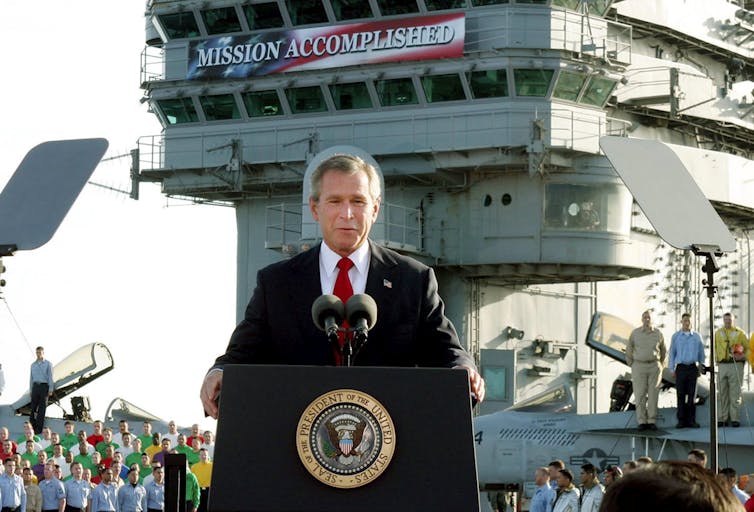
Americans are no strangers to their presidents using strong language to describe adversaries. Ronald Reagan famously referred to the Soviet Union as an “evil empire”, and George W. Bush warned of an “Axis of Evil”.

Yet such rhetoric rarely extended to personal insults against individual foreign leaders. Leaders generally bring a mood to these speeches that recognises their words will be frightening for many people. It also acknowledges that in a war situation, lives will inevitably be lost.

George W. Bush, for example, simply stated that US forces “captured Saddam Hussein alive”. Barack Obama announced to the nation Osama bin Laden’s killing by addressing the mastermind of the worst terrorist attack on US soil simply as “Osama bin Laden, leader of al Qaeda, and a terrorist”.

Constant threats

Trump has also shown little restraint in issuing threats. At the beginning of the conflict he stated in an interview that they had not even started hitting Iran hard and that the “big wave” was coming soon. He later posted on Truth Social that he was ready to hit Iran “twenty times harder” and threatened to “make it virtually impossible for Iran to ever be built back, as a Nation, again”, adding that “death, fire and fury will reign [sic] upon them”. At one point, he even suggested that he might strike Iran’s Kharg Island oil export hub again “just for fun”.

This language is not only vitriolic. It also is in sharp contrast with the rhetoric of past US presidents who often emphasised restraint in the use of force and showed willingness to de-escalate military conflicts.

Previous presidents have been very clear about the strength of the US military, but they have also tried to focus on diplomacy and negotiation.

Obama, talking about Syria, famously remarked that “the United States military doesn’t do pinpricks”. Yet, moments later, he asked Congress to postpone a vote authorising the use of force while his administration pursued diplomatic options.

Nixon stated during the Vietnam war that “The peace we seek to win is not victory over any other people, but the peace that comes ‘with healing in its wings’; with compassion for those who have suffered; with understanding for those who have opposed us; with the opportunity for all the peoples of this Earth to choose their own destiny”.

Trump’s threats of escalation also raise concerns about the safety of civilians and the protection of critical infrastructure. He recently stated he “didn’t do anything to do with the energy lines, because having to rebuild that would take years”. This remark suggests some awareness of the consequences of such actions.

Even so, earlier presidents often distinguished explicitly between military targets and civilian populations. George H. W. Bush, during the Gulf War, declared “our quarrel is not with the people of Iraq. We do not wish for them to suffer”.

In 2023, George W. Bush warned Iraqi military and civilian personnel: “do not destroy oils wells, a source of wealth that belongs to the Iraqi people. Do not obey any command to use weapons of mass destruction against anyone, including the Iraqi people”.

Words matter

It is still unclear why Trump’s rhetoric is so violent and so far removed from the language of virtually every US president before him. A 2020 study found Trump’s foreign policy rhetoric often aims to create a sense of crisis to mobilise his domestic base – or distract from political troubles at home.

Some observers argue Trump has used, or even manufactured, national crises as a mechanism to expand executive power through emergency declarations. Whether this is the case in the current war with Iran remains to be seen.

But words certainly matter.

On December 19 1945, US President Harry S. Truman issued a special message to Congress recommending the Department of War and the Department of the Navy be merged into a single “Department of National Defense”. Between 1947 and 1949, Congress and the executive branch implemented this proposal. Many other countries went through a similar process in the postwar period, replacing the language of “war” from the name of their departments and ministries with the more restrained term “defence”.

Seventy-six years later, in 2025, Trump reversed that tradition with an executive order renaming the Department of Defense as the US Department of War.

This same executive order clearly states that the new name demonstrates a willingness to fight wars at a moment’s notice. And the reason is not only to defend, but to “secure what is ours”.

Viewed in light of the current war with Iran, those words provide some insight into the administration’s thinking. They also invite reflection on other words coming out of the administration and its supporters, including the “Gulf of America”, the idea of Canada as the “51st state”, and even the far-fetched “Trump 2028” chant.

The Conversation

Rodrigo Praino receives funding from the Australian Research Council and the Department of Defence.

ref. Trump’s war language is aggressive and extreme. It also offers some insight into his thinking – https://theconversation.com/trumps-war-language-is-aggressive-and-extreme-it-also-offers-some-insight-into-his-thinking-278427

As the war drags on, what does victory look like for the US, Israel and Iran?

Source: The Conversation – Global Perspectives – By Amin Saikal, Emeritus Professor of Middle Eastern Studies, Australian National University; The University of Western Australia; Victoria University

As the Middle East war enters its third week, there is no sign from either Iran or the United States and Israel that they will stop the fighting any time soon. It is getting more violent and nasty by the day.

The Iranian Islamic regime is fighting for its survival, while the US and Israel want to substantially degrade or destroy it.

The Iranian side lacks the US and Israeli firepower, yet it has proved to be more resilient than its adversaries may have expected. It has resolved to fight for as long as possible and inflict as much economic pain regionally and globally as is necessary.

So where do things go from here? What do the US and Israel want to achieve in the war, and how might it end?

Trump’s incoherent objectives

The US and Israel launched this “war of choice” against Iran on February 28. Trump evidently expected the formidable US air and naval power, as well as Israeli air power, would rapidly prevail.

At a minimum, Trump was anticipating the Iranian regime would then accept his demand for a favourable nuclear deal. But he was also suggesting broader aims aligned with Israeli Prime Minister Benjamin Netanyahu’s objectives – to force Iran to forfeit its long-range ballistic missiles and sever its ties with regional proxies.

This would then open the way for Iran’s restless population to resume their protests, aiming to topple the regime and replace it with one acceptable to Washington and Jerusalem.

But this has not happened.

It is now abundantly clear the US and Israel started a war without a clear goal, strategy, timeline, end game or justification. There was also no adherence to international law.

The Trump administrations’s objectives have been confusing and contradictory, with different narratives being spun by the president and his main advisers.

They have included everything from freeing the oppressed Iranian people to removing a direct threat to America and destroying Iran’s nuclear program and missile capability. (Never mind Trump previously claimed he had “obliterated” Iran’s nuclear program in last year’s bombing campaign.)

Trump has also called for regime change, or as he put it, “a little excursion” to get rid of “some evil” leaders.

Trump attempts to clarify reasons for Iran war.

Trump has further claimed the human and economic cost of the war – including oil and gas shortages worldwide – will be temporary. But when the fighting will stop is anyone’s guess. Trump has insisted the war is already won, then said it will only end when he feels it in his “bones”.

In the meantime, the US has intensified its air bombardment of Iran, claiming to have hit 15,000 targets and destroyed every military site on Kharg Island in the Persian Gulf, the main terminal for exporting 90% of the country’s oil.

Trump is now reportedly considering sending US forces to occupy the island, while inviting US allies, as well as China, to help reopen the Strait of Hormuz to oil shipments.

Inviting China to such a coalition is a fanciful idea – it has good relations with Iran. Most other countries have thus far refused to commit.

Israel’s one clear goal

While Trump’s goals seem to change by the minute, Netanyahu has a more clear war objective. He wants to destroy not only the Islamic regime but also diminish the Iranian state, no matter the consequences for the Iranian people and territorial integrity.

He has also lately been vocal about his ambition for a Biblical notion of “greater Israel”, based on the Book of Genesis, spanning from the Euphrates River to the Nile River. The US ambassador to Israel, Mike Huckabee, backed him on this in a recent interview with Tucker Carlson.

Although Netanyahu has been widely condemned for voicing these ambitions, he has not backed away from them.

Meanwhile, Israel has also just sent troops into southern Lebanon for what it calls “limited and targeted ground operations” against Hezbollah, though many fear this could lead to a prolonged occupation. Israel’s defence minister says residents will not be permitted to return until the safety of northern Israel is secured.

Iran’s strategy: hold on

Whatever one’s view of the Iranian regime, it has been more goal-oriented and strategic than its adversaries. It has also displayed a remarkable degree of entrenchment and durability.

The regime rapidly replaced the slain supreme leader with his son, Mojtaba Khamenei, though he has not yet been seen in public.

Despite all the internal and external pressure the regime is facing, the members of its heavily armed and well-structured security and bureaucratic apparatus have remained solidly loyal.

And though thousands joined street protests against the regime before they were quashed in January, other Iranians have united behind the regime. Many Iranians have historically been motivated to support the regime against external aggression, due to civilisational pride, a Shia tradition of martyrdom and a strong sense of nationalism.

On the battlefield, the regime is pursuing a strategy of asymmetrical warfare, with the aim of outlasting the US and Israel and inflicting as much damage as possible. This entails turning the war into a regional conflict to pressure the Arab states in the Persian Gulf to push the Trump administration for an end to the war – and perhaps reconsider their reliance on the US as a security provider.

The regime has managed to hold out so far, and rejected any negotiations.

Two possible outcomes

As the situation stands now, the scene is set for a long, bloody and destructive war. Each of the protagonists has painted itself into a corner and doesn’t know how to get out.

There are two possible ways the war could end.

The first is centred on hardware. Whichever side depletes its stocks of missiles and interceptors first could signal a desire to end the fighting.

The second possibility is that Trump claims he has degraded the regime sufficiently and declares a kind of victory. He has hinted at this already given the domestic opposition to the war (including some of his influential MAGA supporters), the growing economic costs of the war, and the impending midterm elections.

If this happens, the Islamic regime will also claim victory, given it has held on and remains intact.

Whatever the outcome, the Iranian and Lebanese civilians would have borne the brunt of this war, and the region will transition to another historical phase of uncertainty and instability in a highly polarised world.

The Conversation

Amin Saikal does not work for, consult, own shares in or receive funding from any company or organisation that would benefit from this article, and has disclosed no relevant affiliations beyond their academic appointment.

ref. As the war drags on, what does victory look like for the US, Israel and Iran? – https://theconversation.com/as-the-war-drags-on-what-does-victory-look-like-for-the-us-israel-and-iran-278520

Attacks on hospitals are surging in war zones. What do the laws of war say about protecting them?

Source: The Conversation – Global Perspectives – By Shannon Bosch, Associate Professor (Law), Edith Cowan University

Afghanistan says at least 400 people have been killed in a Pakistani airstrike on a drug rehabilitation hospital in Kabul on Monday night, with potentially hundreds more wounded.

Pakistan has denied deliberately targeting the health-care facility. In a statement on X, the Pakistani Information and Broadcasting Ministry said the strikes “precisely targeted military installations and terrorist support infrastructure including technical equipment storage and ammunition storage of Afghan Taliban”.

Attacks on health-care facilities are surging worldwide.

On March 14, an Israeli airstrike hit a health-care facility in Lebanon, killing 12 doctors, nurses and paramedics. The strike brought the number of health-care workers killed in Lebanon in recent days to 31.

Since early March, the World Health Organization (WHO) has verified 27 attacks on health-care facilities in Lebanon alone, as Israeli strikes in Lebanon and joint US–Israeli operations in Iran have intensified.

The Office of the High Commissioner for Human Rights (OHCHR) and the WHO condemned these attacks as violations of international law.

So, what laws protect medical facilities, staff and patients during conflict? And do they lose this protection if facilities are used to shelter combatants?

What the ‘laws of war’ say about protecting hospitals

International humanitarian law contains detailed rules to protect medical personnel, facilities and the sick and wounded during armed conflict.

Under these “laws of war”:

  • medical personnel, including doctors, nurses and paramedics, must be respected and protected while performing their duties

  • there are special protections for ambulances and transport used exclusively for medical purposes

  • these protections extend to the wounded and sick in their care. This includes enemy fighters who require treatment and are no longer taking part in hostilities

  • impartial humanitarian organisations must be allowed to provide medical assistance. Consent to their work cannot be refused arbitrarily

  • medical facilities must display the distinctive protective emblems of the Red Cross, Red Crescent or Red Crystal. Medical personnel must carry identification and armlets displaying these emblems

  • misusing these symbols to shield military operations is prohibited. Doing so may amount to perfidy, a type of deliberate deception which is a war crime under international law

  • deliberately attacking medical personnel or facilities displaying these emblems can also constitute a war crime.

Shattered glass surrounds a damaged hospital ward.
Damage caused by US and Israeli attacks on Shahid Motahhari Hospital in Tehran.
Anadolu/Getty

Where did these rules come from?

The laws protecting medical services in war emerged in response to the enormous suffering witnessed in 19th and 20th-century conflicts.

The first treaty protecting wounded soldiers and medical personnel dates back to 1864, when states adopted the original Geneva Convention.

Today, the 1949 Geneva Conventions, their Additional Protocols, together with a body of customary international law, form a near-universal legal framework binding all parties to conflict. This includes non-state armed groups.

These rules require warring parties to respect and protect medical personnel, facilities and the wounded and sick in all circumstances.

Why are attacks on health care increasing?

In January, Médecins Sans Frontières (MSF) reported attacks on medical facilities and personnel had reached unprecedented levels around the world. In 2025 alone, there were 1,348 attacks on health-care facilities, double the number reported in 2024.

The law itself has not changed. But warfare has. Recent conflicts in South Sudan, Ukraine, Gaza, Iran and Lebanon are taking place in densely populated urban environments. Armed groups operate within complex civilian settings, often near hospitals and clinics.


Read more:
Attacks on health care during war are becoming more common, creating devastating ripple effects


This has shifted the narrative used by some warring parties. What were once described as “mistaken attacks” are now frequently justified on grounds of military necessity. States often claim insurgents are exploiting hospitals or ambulances to gain military advantage.

Israel, for example, has accused Hezbollah and Hamas of using medical infrastructure for military purposes.

Can hospitals lose their protection if fighters are hiding inside?

Yes. Hospitals can lose their special protection if they are used, outside their humanitarian role, to harm the enemy.

However, the law sets a very high threshold for this.

Medical personnel may carry light weapons for self-defence. Armed guards may be present to protect the facility. The presence of wounded fighters receiving treatment does not change this – protections still apply.

Protection may be lost only if hospitals are used for activities such as:

  • launching attacks

  • serving as an observation post

  • storing weapons

  • acting as a command or liaison centre

  • sheltering able-bodied combatants.

Even then, in cases of doubt hospitals must be presumed protected.

Importantly, verifying a hospital is being misused does not give parties a free licence to attack.

Before launching an attack on a compromised medical facility, international humanitarian law requires a warning to be issued, and reasonable time allowed for the misuse to stop.

If the warning is ignored, the attacking party must still comply with the core principles of international humanitarian law:

Proportionality

The expected military advantage must be weighed against the humanitarian consequences of the attack. This includes long-term impacts on health-care services. If the expected civilian harm would be excessive, the attack must be cancelled.

Precautions

All feasible precautions must be taken to minimise harm to patients and medical staff. This may include facilitating evacuations, planning for disruption to medical services, and helping restore health-care capacity after the attack.

Even when a facility loses protection, the wounded and sick must still be respected and protected.


Read more:
Health-care workers should not be a target. In Gaza, their detention and death affect the entire population


Are attacks on health care becoming normalised?

The UN Security Council, WHO, MSF and the OHCHR have expressed concern attacks on medical personnel and facilities – and the lack of accountability for them – are becoming dangerously normalised.

The legal framework protecting hospitals and health-care workers already exists.

States and armed groups must disseminate the law and train their military forces.

National legal systems are expected to investigate and prosecute those perpetrating war crimes against the wounded and sick, medical personnel and their facilities, or misusing protective emblems for military advantage.

In practice, however, investigating attacks during active conflict is extremely challenging. Territorial states are often unwilling or unable to pursue prosecutions.

Can we reverse this trend?

Open-source investigative groups such as Forensic Architecture, Bellingcat, Mnemonics and Airwars now play a growing role in preserving satellite imagery, geo-location data, and videos uploaded to social media. These allow independent fact-finding missions to conduct credible investigations. They may pursue accountability even when territorial states are unwilling or unable to do so.

Without such accountability, places meant to save lives during conflict may increasingly become targets themselves.

The Conversation

Shannon Bosch does not work for, consult, own shares in or receive funding from any company or organisation that would benefit from this article, and has disclosed no relevant affiliations beyond their academic appointment.

ref. Attacks on hospitals are surging in war zones. What do the laws of war say about protecting them? – https://theconversation.com/attacks-on-hospitals-are-surging-in-war-zones-what-do-the-laws-of-war-say-about-protecting-them-278414

Is Israel running low on missile interceptors? How long can it withstand Iran’s retaliatory attacks?

Source: The Conversation – Global Perspectives – By James Dwyer, Lecturer, School of Social Sciences, University of Tasmania

As the US–Israeli war with Iran enters its third week, reports are emerging that Israel is potentially running out of air defence interceptors due to Iran’s retaliatory attacks.

The Israel Defence Forces (IDF) and Israeli foreign minister have denied the reports. The government did reportedly approve around US$826 million (A$1.17 billion) for “urgent and essential defence procurement” over the weekend, however.

It’s difficult to gauge just how many interceptors are remaining, as the IDF does not disclose this type of information. But the possibility of this occurring was not entirely unexpected before Israel and the US began bombing Iran more than two weeks ago.

What are these interceptors?

Israel has a sophisticated and layered air defence system, capable of repelling attacks from ballistic missiles, cruise missiles, aircraft, drones and artillery shells at multiple altitudes, both inside and outside the atmosphere.

The famous “Iron Dome” makes up just one of these layers – it intercepts short-range artillery shells and rockets.

While there are technological differences between all of these systems, they are comprised of three basic elements:

  • the IDF personnel to operate them
  • the radar systems to detect incoming attacks
  • the interceptors themselves.

Israel has a new “Iron Beam” laser system that can be used to destroy missiles and drones, but the most common interceptors are surface-to-air missiles.

Ballistic missile defence interceptors, in particular, are incredibly complex and expensive weapons. The more capable they are, the more expensive they are to build. They are also limited in number. A sustained attack can quickly deplete even Israel’s stockpile.

Why might Israel be running low?

The 12-day war that Israel fought with Iran last year significantly depleted both its stockpile of anti-ballistic missiles, as well as that of its ally, the United States.

One Washington-based research centre calculated that Israel and the US intercepted 273 of 322 Iranian missiles they attempted to stop in the war, an 85% success rate.

Given a large number of these interceptors were used so recently, Israel and the US are unlikely to have fully replenished their stockpiles before launching the current war.

Another sign this is the case: the US is reportedly moving parts of its THAAD missile defence system from South Korea to the Middle East. This means the US will need to carry more of the defensive burden in the region, which could quickly deplete its own assets.

Ballistic missiles are also very difficult to intercept due to the speed and altitude they attain. Several interceptors are usually required to ensure each incoming missile is stopped. Iran is also using cluster munitions on some of its ballistic missiles, which further compounds the problem.

Iran has cheap, easy-to-replace drones, which it is using to try to overwhelm Israeli and American air defence systems, as well. These can also be launched from dispersed locations that are difficult to detect, making them harder to destroy on the ground than ballistic missiles.

Iran has so far launched more than 500 missiles and 2,000 drones since the war began.

Jet fighters can help defend against these drone attacks and have done so with great success, but the missiles they fire are also more expensive than the drones themselves. And other weapons platforms (such as the Iron Beam) are currently in limited supply.

The US and Israel are not the only ones reportedly running low on interceptors. The Persian Gulf states have also come under Iranian attack, and are burning through what defensive assets they have.

The Iranians have specifically targeted missile defence radars across the region, with reports they have successfully destroyed or damaged several systems.

All of this, of course, raises the question of why Israel and the US would start another conflict in the first place if their stockpiles were not fully replenished. There could be several potential reasons:

  • they had managed to rebuild their stockpiles faster than anyone anticipated, though this is unlikely

  • they were confident they could destroy a sufficient amount of Iran’s offensive weapons before they ran out of defensive munitions

  • they believed Iran would want to end the war sooner than it has.

How long can Iran keep this up?

There’s no way of knowing what Iran’s strategy is, besides extending the war as long as possible and creating chaos in the region and with global energy markets.

Some have speculated Iran may be deliberately holding back its more advanced missile technologies to use after the US and Israeli interceptors are depleted. But other analysts say there is no evidence this is the case. This would also be a risky strategy on Iran’s part.

One thing is certain, though: the US and Israel do have finite numbers of interceptors at their disposal. Iran, too, will not be able to keep up the same level of attacks indefinitely.

While the economic impacts of the war are placing significant pressure on all parties – and the world more widely – Iran seems to be in a better position for a longer conflict, given the costs involved for the US and Israel and their reluctance to commit to a potentially even more disastrous ground invasion.

The Conversation

James Dwyer does not work for, consult, own shares in or receive funding from any company or organisation that would benefit from this article, and has disclosed no relevant affiliations beyond their academic appointment.

ref. Is Israel running low on missile interceptors? How long can it withstand Iran’s retaliatory attacks? – https://theconversation.com/is-israel-running-low-on-missile-interceptors-how-long-can-it-withstand-irans-retaliatory-attacks-278404

All 5 fundamental units of life’s genetic code were just discovered in an asteroid sample

Source: The Conversation – Global Perspectives – By Kliti Grice, John Curtin Distinguished Professor of Organic and Isotope Geochemistry, Curtin University

Ryugu sample in its return capsule. JAXA

A new study reveals all five fundamental nucleobases – the molecular “letters” of life – have been detected in samples from the asteroid Ryugu.

Asteroid particles offer a glimpse into the chemical ingredients that may have helped kindle life on Earth. The Ryugu samples were returned from space in 2020 by Japan Aerospace Exploration Agency’s (JAXA) Hayabusa2 mission.

In 2023, an international team reported they had found one of the nucleobases in these samples – uracil. Now, in a study published in Nature Astronomy today, a team of Japanese scientists has confirmed all five nucleobases are present in this pristine asteroid material.

This means these ingredients for life may have been widespread throughout the Solar System in its early years.

Why look for nucleobases?

Nucleobases are nitrogen-containing organic molecules that form the “letters” of genetic information in DNA and RNA. The five main nucleobases are adenine and guanine (known as purines), as well as cytosine, thymine and uracil (known as pyrimidines).

These molecules combine with sugars and phosphates to yield nucleotides – the building blocks of genetic material. Without nucleobases, the genetic code that allows organisms to grow, reproduce and evolve would not exist.

How the five nucleobases make up RNA and DNA.
Wikimedia Commons, CC BY-SA

By studying purines and pyrimidines in Ryugu samples, scientists can reconstruct the chemical history of primitive asteroids. In turn, this gives us a better understanding of how the building blocks of life may have been formed and existed across the Solar System.

Hayabusa2 delivered a total of 5.4 grams of pristine asteroid material. Researchers have to use ultra-clean lab conditions to avoid contaminating it. They extracted organic molecules using water and hydrocholoric acid, and then purified them for further detection.

They found all five nucleobases in the two Ryugu samples they analysed, in roughly similar amounts.

Microscope images of Ryugu samples collected from the first and second touchdown sites of the Hayabusa2 mission.
JAXA/JAMSTEC

Key components of genetic material – in space

The new results align with previous findings on space rocks. The Murchison meteorite that fell in Australia in 1969, and the Orgueil meteorite in France, 1864, have previously yielded a rich variety of organic molecules, including nucleobases.

Of course, meteorites that land on Earth can be contaminated by their journey and landing. But pristine samples from NASA’s mission to asteroid Bennu also yielded all five nucleobases in 2025.

Asteroids such as Ryugu, Bennu, and the parent body of the Orgueil meteorite are remnants of the early Solar System. They can preserve materials largely unchanged for about 4.5 billion years.

Interestingly, these asteroids show chemical differences. Murchison is enriched in purines, while Bennu and Orgueil contain more pyrimidines. It is thought this balance may be influenced by ammonia, a key molecule that can shape which nucleobases can form.

By peering into Ryugu’s relatively pristine samples and comparing them with meteorites like Murchison and Orgueil, researchers are tracing the cosmic journey of life’s probable molecular ingredients.

Their results suggest key components of genetic material may have formed in space and later delivered to the early Earth. In other words, the story of life on our planet may be deeply connected to the chemistry of such ancient asteroids.

A coloured view of 162173 Ryugu taken by JAXA’s space probe Hayabusa2 in 2018.
JAXA/Hayabusa2

A path for the ingredients of life

Together, these discoveries show that carbon-rich asteroids throughout the Solar System contain diverse prebiotic chemistry. However, the precise mixture of molecules – such as the balance between purines and pyrimidines – varies depending on the asteroid’s chemical environment and history.

Because the Ryugu samples were collected directly in space and protected from Earth’s contamination, they provide one of the clearest views of ancient Solar System chemistry.

The discovery of all five nucleobases on Ryugu suggests the molecular ingredients of life may have been already forming in space billions of years ago. Asteroids may have helped deliver those ingredients to the early Earth – making the origin of life part of a much larger cosmic chemical story.

The Conversation

Kliti Grice receives funding from the ARC.

ref. All 5 fundamental units of life’s genetic code were just discovered in an asteroid sample – https://theconversation.com/all-5-fundamental-units-of-lifes-genetic-code-were-just-discovered-in-an-asteroid-sample-278099