Social media videos are claiming that mouthwash can raise risk of blood pressure – and potentially damage heart health.
According to some of these videos, this is caused by mouthwash wiping out “good” oral bacteria that are important for the cardiovascular system. While it’s a striking message, don’t throw your mouthwash away just yet. The reality is far more complex.
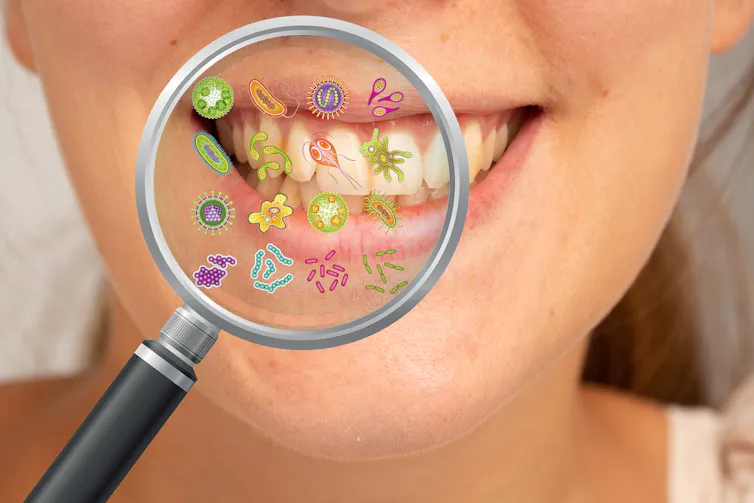
Our mouths contain a wide variety of bacteria. Together, these bacteria form a balanced and diverse microbiome which helps prevent the overgrowth of other bacteria linked to disease, supports normal metabolic functions and contributes to both good oral and overall health.
One of the important roles these oral bacteria have is converting the nitrate in our food (typically from sources such as leafy greens) into nitrite. When we swallow nitrite, the body turns it into nitric oxide. This happens via the nitrate-nitrite-nitric oxide pathway, also called the enterosalivary pathway. It’s one example of how bacteria contribute to keeping the body healthy.
But according to some online influencers, the reason mouthwash harms heart health is because it affects the “healthy” bacteria – the ones that produce nitric oxide.
Mouthwash and heart health link
Several small studies have actually found that giving people mouthwash can change the balance of bacteria in the mouth. This may reduce the bacteria’s ability to turn nitrate from vegetables into nitrite, which the body needs to make nitric oxide.
One study of 19 healthy volunteers found that the adults who used chlorhexidine mouthwash for seven days saw a small increase in blood pressure and reduced levels of nitrite.
An intervention study also reported that rinsing with 0.12% chlorhexidine gluconate mouthwash twice daily for one week significantly increased blood pressure in 27 healthy adults.
In another trial of 15 adults who already had high blood pressure, three days of chlorhexidine use further increased blood pressure.
The key detail that may be missed out of some of these online social media videos is the type of mouthwash used in these studies.
Many of the studies which have found a link between mouthwash use and blood pressure gave participants chlorhexidine. This is a strong, over-the-counter antiseptic mouthwash only recommended for short-term use in people with gum disease or after dental procedures where its antimicrobial effects are beneficial.
Chlorhexidine disrupts oral bacteria to help with infection control – including the bacteria that convert nitrate into nitrite. This makes it an ideal mouthwash to use for researchers wanting to study the nitrate-nitrite-nitric oxide pathway. However, it also means the findings may not reflect what happens with milder, everyday mouthwashes.
A trial with 12 healthy adults investigated the effect of three different mouthwashes (and gargling water, which acted as a control) on oral bacteria.
After drinking a nitrate-rich juice, researchers measured how much nitrate was converted to nitrite by oral bacteria. Water and the mild mouthwash (which didn’t contain harsh ingredients such as chlorhexidine) caused a typical response, where nitrate was converted into nitrite.
But the cetylpyridinium chloride mouthwash (which also has strong, anti-bacterial effects) partially blocked the conversion of nitrate to nitrite. The strongest chlorhexidine mouthwash almost completely stopped this process. This is consistent with their stronger antibacterial effects. The stronger types of mouthwash were also linked to higher systolic blood pressure.
Alcohol (ethanol) is another common ingredient in many mouthwashes, although formulations usually also include other active ingredients – such as essential oils. This makes it difficult to isolate the specific effects of alcohol.
As an antimicrobial, alcohol may influence the oral microbiome. Some studies have even suggested a possible association between mouthwashes containing alcohol and increased oral cancer risk. However, there are currently no studies that have specifically examined the effects of ethanol-only mouth rinses on the oral microbiome or cardiovascular health.
Overall, the body of evidence suggests that a mild, over-the-counter mouthwash, like the kind most people buy at stores, may be less likely to significantly interfere with nitrate-to-nitrite conversion or affect blood pressure.
In a long-term study of 354 adults, better routine oral hygiene, such as brushing and flossing, was linked to a lower risk of cardiovascular death over nearly 19 years. Regular mouthwash use did not appear to have any influence on heart health outcomes. This was true for milder mouthwashes containing flouride and alcohol, as well as stronger, anti-bacterial mouthwashes such as chlorhexidine and cetylpyridinium chloride.
The type of mouthwash matters
Together, these studies suggest that some types of mouthwash (such as chlorhexidine) disrupt beneficial oral bacteria and the nitrate-nitrite-nitric oxide pathway when used long term. But more research needs to be done to truly understand the long-term effects of other types of mouthwash on cardiovascular health – including mild everyday mouthwash brands and those containing alcohol.
Mouthwash comes in different types for different purposes, so it’s important to check the active ingredient on the back of the packaging. Alcohol-free and milder mouthwashes appear to have less effect on the heart-healthy bacteria than stronger types.
However, be aware to check the ingredients as even alcohol-free options can contain antibacterial agents such as cetylpyridinium chloride. As such, it’s best to choose one that fits your needs and use it in moderation. Strong mouthwashes containing chlorhexidine are best reserved for helping gum disease or oral infections.
It’s also worth noting that oral health and untreated infections can also contribute to heart disease more broadly. For example, a systematic review of 82 studies concluded that chronic oral disease and tooth loss was associated with risk of heart problems. This is why maintaining a healthy balance of mouth bacteria matters beyond your teeth.
Take care of your oral and overall health by keeping up with brushing, flossing, visiting your dentist and choosing a mouthwash that works for you.
Joanna L’Heureux does not work for, consult, own shares in or receive funding from any company or organisation that would benefit from this article, and has disclosed no relevant affiliations beyond their academic appointment.
Source: The Conversation – UK – By Benedict Morrison, Senior lecturer in Film, Television, Literature, and Queer Studies, University of Exeter
In her 1998 essay What’s a Good Gay Film?, film critic B. Ruby Rich considered what queer audiences were looking for.
She wrote that queer cinema-goers were seeking “films of validation and a culture of affirmation: work that can reinforce identity, visualise respectability, combat injustice and bolster social status”. They were tired, she argued, of stereotypes of queer suffering and trauma. Instead, they required “nothing downbeat or too revelatory; and happy endings, of course”.
But if a straightforward happy ending is what you are after, Departures is not the film for you. This miraculously self-financed and stylish debut feature is not purely affirmative. At times, the screen shimmers with sadness. And yet, wryly and playfully, the film also resists becoming gloomy. Tonally sophisticated, it combines the bleak with the whimsical, ultimately sidestepping the crude dichotomy of happy or unhappy endings altogether.
The film opens with a love-scarred Benji (played by the film’s writer and co-director Lloyd Eyre-Morgan) recalling a recent relationship. In flashback, he remembers meeting handsome Jake (David Tag) in the airport as they both wait for a flight to Amsterdam. Jake bewilders Benji: his flirtation is suggestive but always deniable, never quite declaring itself. Charismatic and assertive, Jake engineers it so that they sit together on the flight, telling the air steward that he is Benji’s carer – a description which quickly becomes grimly ironic.
The trailer for Departures.
Later, Jake rejects the suggestion that he is gay but demands that Benji give him a blowjob regardless. Monthly trips to Amsterdam follow and the two men develop a form of intimacy, but one which affords the softer, more pliable Benji little power.
In such a brief synopsis, the scenario risks sounding cliched. Familiar narrative devices pile up: the physically asymmetrical gay relationship in which the self-consciousness of one man makes them susceptible to the coercive manipulations of the more assured partner in a whirlwind of sex and drugs and emotional control. A comparable dynamic played out in another recent queer film, Pillion.
Benji, longing for this to be more than a once-monthly dose of overseas sex, withstands put-downs and disappointments. His quiet, emotional expressions of desire (played movingly by Eyre-Morgan) contrast with Jake’s struggle to accept his attraction to men. Tag is excellent and his portrayal of Jake is sometimes harsh and defensive, but also shows vulnerability, which prevents him from becoming a one-dimensional monster. Because of these tensions, the relationship’s unhappy ending feels like a dead cert.
Lessons from Heartstopper
Departures takes familiar cliches and gives them new life, turning them into something unexpectedly revealing. Its understated story recalls many films about gay suffering – from A Single Man to All of Us Strangers – but it refuses to stay within that familiar emotional frame.
Instead, the film disrupts expectations through bold, stylised touches that feel borrowed, perhaps improbably, from the Heartstopper playbook. The result is a work that plays with recognisable influences while twisting them into something more strange, lively and original.
Heartstopper, the popular Netflix queer teen drama, deliberately avoids the more difficult or painful stories often told about queer life. Instead, it offers the kind of wish-fulfilling, happy endings that Rich suggested many queer viewers have long desired. Every glance, touch and kiss between its characters is punctuated with playful on-screen doodles — bursts of electricity, fluttering butterflies and swirling text that insist we are watching Love with a capital L.
Departures borrows these same twee, saccharine stylistic gestures, but uses them in a very different context. Applied to a darker, sometimes even sordid story about control and sadness, they take on a mischievous, unsettling edge.
As Benji’s voiceover details his suffering, scratchy lettering and illustrations dance around the screen. When he first sees Jake and his weary voiceover acknowledges the pain to come, doodled hearts burst around the handsome stranger to the music of Gershwin’s Rhapsody in Blue. As Benji submissively performs oral sex for Jake, the Hallelujah Chorus plays and animated fireworks fill the screen. And as Jake prepares to get into a fight with Benji’s friends, the needle of a Toxic Masculinity Meter shoots up to maximum. Here is a version of Heartstopper for an audience which knows that happy endings are often only the stuff of comic books.
In Departures, the collision of the sombre, unsettling narrative with the comic stylings of those twitching onscreen graphics suggests a more complex emotional situation in which neither cynicism nor romanticism is left unchecked. Instead, they synthesise in a complex portrait of Benji, who can neither maintain nor give up his romantic belief that Jake might love him.
Colliding styles
One of the film’s most striking ways of expressing this tension comes in a series of non-narrative sequences. Here, the characters dance – or perhaps merely convulse – under harsh strobe lights, their bodies flickering in and out of view, shifting into new poses and even seeming to become different selves between flashes.
It’s a simple but powerful device, inspired by the club scenes the men encounter on their trips to Amsterdam. Yet it opens up something more unsettling: brief glimpses of gay men caught between pleasure and pain, ecstasy and distress, moving to the uncertain rhythm of a contemporary queer world where nothing quite feels stable or fixed.
In the 1990s, Rich rejected the idea of easy affirmation, describing herself instead as an “old-time outlaw girl” who craved films “that push the edge, upset convention, defy expectation, speak the unspeakable, grab me by the throat and surprise me with something I’ve never seen before”.
Departures may work with familiar characters and a recognisable story, but its force lies in how it collides styles and tones in unexpected ways. It’s the kind of film that, in Rich’s terms, grabs you by the throat. What stays with me most is its sardonic yet romantic energy and the strangely undefeated presence of Benji at its centre.
This film deserves to find an audience who want more than easy viewing. It deserves viewers who will dance along to its tonal shifts and cherish the funny, sad, ironic almost-happy ending it serves up in its closing credits.
Benedict Morrison does not work for, consult, own shares in or receive funding from any company or organisation that would benefit from this article, and has disclosed no relevant affiliations beyond their academic appointment.
L’Afrique a du mal à relever le défi de retenir les professionnels de santé dont elle a besoin.
L’Organisation mondiale de la santé estime à 11 millions le déficit mondial en professionnels de santé d’ici 2030. L’Afrique doit faire face à une pénurie comprise entre cinq et six millions de professionnels. Ce déficit est calculé en fonction de la charge de morbidité et des besoins de santé de la population. Il s’agit de la taille et de la structure de la population, ainsi que de la prévalence des maladies et des facteurs de risque. Il tient aussi compte du type et de la fréquence des interventions sanitaires prévues ou nécessaires pour traiter les maladies, affections et facteurs de risque identifiés.
Cette pénurie est très inégale. Bon nombre des 83 pays qui se situent déjà en dessous du seuil minimum recommandé en matière de main-d’œuvre se trouvent en Afrique. En 2022, seuls quatre pays (Seychelles, Namibie, Maurice et Afrique du Sud) dépassaient le ratio recommandé de 4,45 médecins, infirmiers et sages-femmes pour 1 000 habitants.
Madagascar, le Malawi, le Togo, le Bénin, le Soudan du Sud, le Tchad, la République centrafricaine et le Niger ont déclaré moins de 0,5 médecin, infirmier et sage-femme pour 1 000 habitants en 2018. Dans de nombreux pays africains, il est difficile de fournir des services de base, de réduire les décès évitables et de parvenir à une couverture sanitaire universelle.
En revanche, l’Europe fait état d’un ratio compris entre 5,43 et 20,0 médecins, infirmiers et sages-femmes pour 1 000 habitants.
Dans le même temps, les pays plus riches tels que le Royaume-Uni, les États-Unis, le Canada et l’Australie dépendent de plus en plus de personnel formé à l’étranger. En 2023, près de la moitié des nouveaux médecins rejoignant le marché du travail britannique avaient été formés à l’étranger.
Ce phénomène est souvent qualifié de « fuite des cerveaux », qui s’explique par des facteurs répulsifs (faibles salaires, mauvaises conditions de travail) et des facteurs « d’attraction » (meilleurs salaires et opportunités à l’étranger).
Je m’intéresse à ce sujet, en tant que travailleuse internationale : je suis une chercheuse sud-africaine en éducation sanitaire travaillant au Royaume-Uni, où je forme des professionnels de santé et mène des recherches sur les questions liées à la main-d’œuvre.
Dans un article récent, je soutiens que cette explication est incomplète. Le cadre « push-pull » (répulsion-attraction) passe à côté d’un point crucial : les flux de professionnels de santé ne sont pas aléatoires. Ils se déplacent systématiquement des pays les plus pauvres vers les plus riches — une tendance qui suit de près les lignes tracées par l’histoire coloniale.
Le terme « fuite des cerveaux » suggère un flux naturel, presque inévitable, de talents. Mais la migration des professionnels de santé n’est ni neutre ni équitable ; elle est façonnée par l’histoire, l’économie et le pouvoir.
Je soutiens que ce phénomène ne se résume pas à une « fuite des cerveaux » motivée par des choix individuels. Il s’inscrit plutôt dans un système mondial plus profond et inégalitaire, façonné par l’héritage colonial — avec des implications majeures pour les politiques de santé, d’éducation et de main-d’œuvre.
Cela permet de recentrer le débat : il ne s’agit plus de blâmer les médecins et les infirmières qui partent, mais de s’intéresser aux systèmes qui déterminent ces choix en premier lieu.
Ma recherche s’appuie sur une perspective décoloniale pour repenser la migration des professionnels de santé. Plutôt que de considérer la migration comme une série de décisions individuelles, elle examine les systèmes mondiaux qui structurent ces décisions.
La décolonialité soutient que le colonialisme européen a créé une matrice de pouvoir qui continue d’organiser :
le pouvoir (qui contrôle les ressources et la main-d’œuvre)
la connaissance (quelle expertise est valorisée)
l’être (qui est valorisé).
À travers ce prisme, je soutiens que la migration des professionnels de santé ressemble moins à un marché du travail neutre ou à un malheureux sous-produit de la mondialisation, et davantage à une continuation de l’exploitation historique. En d’autres termes, les mêmes hiérarchies mondiales façonnées pendant le colonialisme influencent toujours qui contrôle et tire profit des ressources et de la main-d’œuvre africaines, quelle expertise est reconnue, et comment les travailleurs internationaux sont perçus et traités.
Pouvoir : Premièrement, les pays plus riches sous-investissent souvent dans la formation de leur propre main-d’œuvre, puis recrutent dans des pays disposant de bien moins de ressources. Cela entraîne un transfert de capital humain du Sud vers le Nord. Les pertes financières sont considérables : une étude a estimé que les pays d’Afrique subsaharienne ont perdu des millions, voire des milliards de dollars, en raison de l’émigration de médecins, tandis que les pays d’accueil ont réalisé des économies sur les coûts de formation.
Connaissances : Deuxièmement, les hiérarchies mondiales du savoir influencent la mobilité professionnelle. La formation médicale en Europe et en Amérique du Nord est souvent considérée comme la référence absolue, tandis que les diplômes délivrés par des établissements africains peuvent être remis en question ou nécessiter une validation supplémentaire. Cela renforce l’idée selon laquelle partir vers le nord est nécessaire pour progresser dans sa carrière et acquérir une légitimité.
Bien-être : Troisièmement, de nombreux professionnels de santé formés à l’étranger sont confrontés à une discrimination qui a un impact négatif sur leur bien-être et leur progression de carrière.
Ils risquent en outre une déprofessionnalisation. Les professionnels de santé internationaux pouvant être employés à des postes d’un niveau inférieur à celui pour lequel ils sont qualifiés, cela peut entraîner une perte de leurs compétences. Cela reflète la déshumanisation et l’exploitation coloniales.
En bref, les systèmes mondiaux favorisent les départs et profitent davantage aux pays d’accueil qu’aux pays d’origine.
Si la migration des professionnels de santé est façonnée par des inégalités structurelles, les solutions doivent également agir à ce niveau.
1. Investir dans les professionnels de santé locaux et les retenir
Les gouvernements africains devraient s’attaquer aux facteurs « d’incitation » en développant les possibilités de formation et d’emploi, en améliorant les conditions de travail et en garantissant une rémunération équitable et des perspectives de carrière, afin de faire du maintien sur place une option viable et attrayante. La formation des professionnels de santé devrait être alignée sur les besoins sanitaires locaux, afin de donner aux professionnels de santé les moyens de répondre avant tout aux besoins de santé de la population dans leur propre contexte.
2. Réformer le recrutement mondial et redistribuer les ressources
Les pays à revenu élevé doivent réduire leur dépendance au recrutement international en investissant davantage dans la formation nationale. Des codes de recrutement éthiques existent mais ne sont pas appliqués de manière cohérente. Il existe également de solides arguments en faveur de mesures de réparation – notamment une compensation financière ou des investissements – afin de compenser les pertes subies par les pays qui forment des professionnels de santé qui émigrent ensuite.
Des partenariats plus équilibrés, tels que les programmes de migration circulaire (dans le cadre desquels les professionnels de santé rentrent chez eux après avoir suivi une formation à l’étranger) ou les accords bilatéraux de formation (dans lesquels l’expertise des deux pays est reconnue et les deux contextes en tirent profit), pourraient favoriser l’échange de compétences sans vider de manière permanente les capacités. Mais ceux-ci doivent inclure des parcours clairs pour le retour et des investissements significatifs dans les systèmes de santé des pays d’origine.
3. Reconnaître et valoriser les connaissances et les professionnels du Sud
S’attaquer à la « colonialité du savoir » signifie reconnaître la légitimité de la formation et de l’expertise développées dans les contextes africains. Dans le même temps, s’attaquer à la « colonialité de l’être » nécessite de lutter contre le racisme, les préjugés et la discrimination sur les lieux de travail du secteur de la santé à l’échelle mondiale.
Perspectives
Lorsque les systèmes de santé africains peinent à retenir leur personnel, ce n’est pas uniquement dû à une mauvaise planification nationale. Bon nombre de ces systèmes fonctionnent sous le poids de l’héritage de l’exploitation coloniale.
Reconnaître cette réalité plus profonde ouvre de nouvelles possibilités. Un système de santé mondial plus équitable est possible – mais seulement s’il ne repose plus sur la perte de l’Afrique au profit d’autrui.
Danica Sims bénéficie d’un financement de l’université d’Oxford pour ses travaux de recherche. Elle est rattachée à l’université d’Oxford et à l’université de Johannesburg.
The day after Péter Magyar ousted Victor Orbán as prime minister of Hungary, he gave a combative press conference. He spoke in Hungarian, but was talking to the world – and particularly to Europe.
“We will do everything to restore the rule of law, plural democracy, and the system of checks and balances,” Magyar said, calling his election a historic moment for Hungary.
During 16 years in power, Orbán and his Fidesz party managed to take control of many of Hungary’s levers of power, from the judiciary to state-owned media, and weakened the institutions that could keep them accountable. Orbán liked to call it an illiberal democracy.
Magyar also urged the Hungarian president to move swiftly to install him as prime minister, before any more damage could be done by Orbán’s loyalists. “We know that people have been destroying documents, just like in the old communist age, that shredders are working full time,” he said.
In this episode of The Conversation Weekly podcast, Zsolt Enyedi, professor of political science at the Central European University and an expert in Hungarian politics, explains how Magyar, a former member of Fidesz, manage to beat Orbán, his former boss.
Magyar’s moment
Enyedi describes Magyar as a centre-right figure with some nationalistic attributes, who is a bit eurosceptic with “some reservations against progressive way of speaking”. However, Enyedi says Magyar changed since first entering politics in 2024, when he gave an explosive interview criticising Orbán’s regime.
Back then he was “clearly someone who reproduced many of the ideological panels of this Orbánist regime, but he was very critical of the corruption that exists in the regime”. He was likened to a clean, young version of Orbán himself.
Since then, Magyar has spent two years travelling around Hungary speaking to people across the country on the campaign trail. “He started to understand better the enormous harm done by the Fidesz regime, and he also became more pro-European in his rhetoric, embracing the democratisation agenda,” says Enyedi.
Magyar is now able to “provide the lowest common denominator for all pro-democratic forces,” says Enyedi. “In that sense, he’s more than simply representative of one political ideological current.”
As European leaders breathe a sign of relief at Magyar’s victory, Enyedi says although Europe has not gained an “enthusiastic partner”, he will be a much more constructive one. “Partly out of conviction, partly because he needs EU money and he needs that money soon. So he cannot play games. He has to make a deal with the EU leadership.”
Listen to the interview with Zsolt Enyedi on The Conversation Weekly podcast. This episode was written and produced by Gemma Ware, Mend Mariwany and Katie Flood. Mixing by Eleanor Brezzi and theme music by Neeta Sarl.
Listen to The Conversation Weekly via any of the apps listed above, download it directly via our RSS feed or find out how else to listen here. A transcript of this episode is available via the Apple Podcasts or Spotify apps.
Source: The Conversation – France (in French) – By Raphaël Belmin, Chercheur en agronomie, photographe, accueilli à l’Institut sénégalais de recherches agricoles (ISRA, Dakar), Cirad
Entre embargo, polycrise et pénuries, l’île résiste à une crise alimentaire majeure. Par quels mécanismes et pour combien de temps ?R. Belmin/Cirad, CC BY-NC-ND
Comment éviter l’effondrement alimentaire lorsqu’un pays vit sous embargo durable et voit ses alliances se fragiliser ? Une étude récente à Cuba met en évidence la réactivation d’une agroécologie déjà mobilisée lors des crises antérieures, aujourd’hui réinvestie sous des formes plus hybrides et décentralisées.
Depuis la révolution de 1959, nourrir la population est un pilier du projet politique cubain. L’État a fait de l’alimentation un service public : centralisation des importations, planification de la production et rationnement à travers la libreta, un carnet distribué à chaque famille permettant d’accéder à des produits de première nécessité dans des magasins d’État à prix subventionnés.
L’objectif était clair dès l’origine : garantir un accès universel à l’alimentation. Cuba n’a pas dévié de cet objectif, malgré l’embargo durable mis en place par les États-Unis dès 1962. Dans ce contexte, l’alliance cubaine avec l’Union soviétique a longtemps permis de stabiliser ce modèle en assurant énergie, pesticides et engrais agricoles, semences et plants, fournitures vétérinaires et devises.
Un modèle alimentaire étatique sous dépendance extérieure (années 1960-1980)
Le système cubain reposait alors sur un appareil productif fortement centralisé. L’agriculture d’État – le sector estatal – a regroupé les exploitations héritières des grandes entreprises agricoles nationalisées après 1959. Ces fermes publiques, gérées par des entreprises d’État, fonctionnaient avec des salariés agricoles rémunérés par un salaire fixe, des objectifs de production planifiés et des circuits d’approvisionnement centralisés en pesticides, en engrais et en énergie. À leur apogée dans les années 1980, les entreprises agricoles d’État couvraient près de 80 % de la surface agricole nationale, ne laissant que 20 % entre les mains du secteur privé.
Cette architecture institutionnelle et productive a tenu tant que des appuis extérieurs amortissaient les chocs, qu’ils soient internes ou géopolitiques. Mais, au début des années 1990, l’effondrement de l’Union soviétique a provoqué à Cuba une chute brutale des échanges commerciaux, des soutiens financiers ainsi que des approvisionnements en énergie, en engrais et en pesticides. Fragilisé dans ses bases économiques et productives, le pays s’est vu contraint de réinventer son modèle agricole.
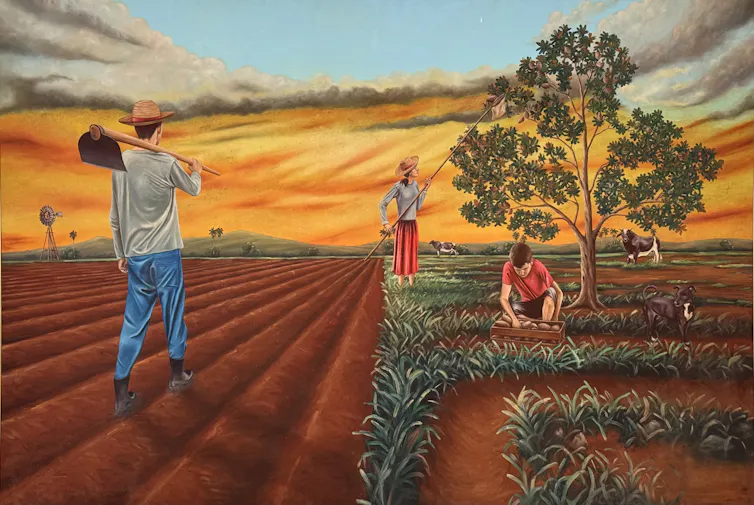
Peinture ornant les murs d’une station de recherche agricole cubaine. Dans la pensée révolutionnaire cubaine, l’agriculture d’État incarne la souveraineté nationale : travailler la terre devient un acte politique, garant de l’autonomie alimentaire et de la dignité collective. Crédit photo : R. Belmin/Cirad. CC BY-NC-ND
De l’agroécologie contrainte à l’institutionnalisation politique (années 1990-2010)
Ce contexte de pénurie du début des années 1990, connu sous le nom de « períodoespecial » (« période spéciale »), a entraîné un virage profond du système productif cubain. Diversification des cultures, recyclage de la matière organique, traction animale, production de bio-intrants (produit d’origine biologique utilisé en agriculture pour remplacer ou réduire les intrants chimiques, ndlr) : une agroécologie de survie s’est progressivement installée et diffusée à grande échelle, à la fois dans les campagnes et au cœur des villes.
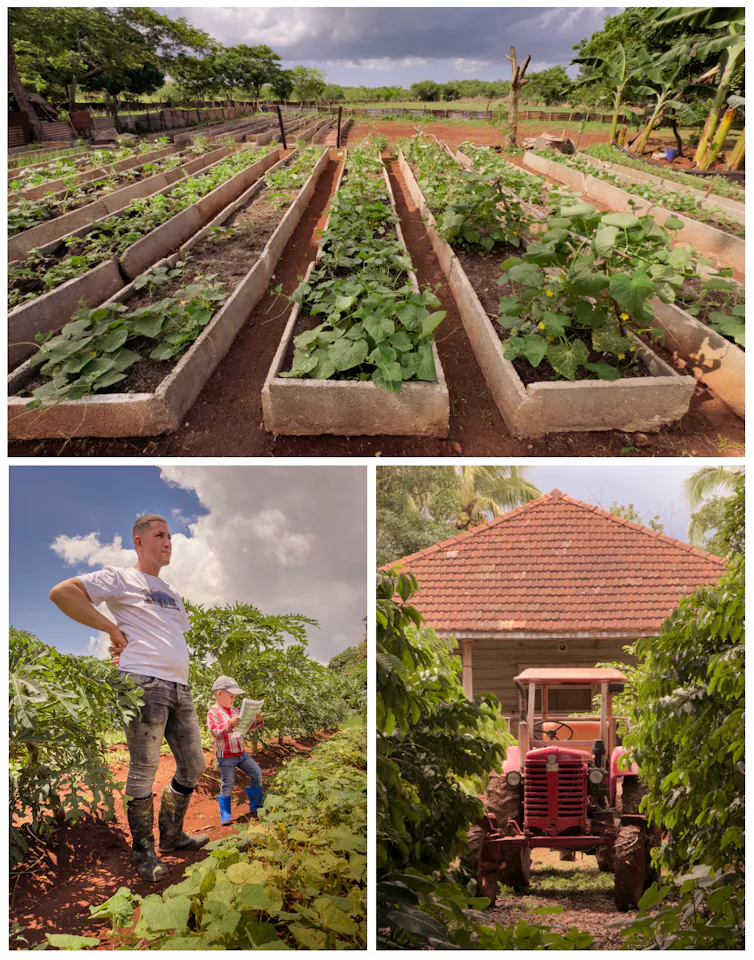
Ces transformations sont, d’une part, encouragées par une politique agraire consistant à transformer certaines fermes d’État en coopératives et à redistribuer des terres en usufruit à des producteurs. Elles sont, d’autre part, accompagnées par un vaste programme étatique d’agriculture urbaine et suburbaine visant à rapprocher producteurs et consommateurs, sur des bases majoritairement organiques : exploitations maraîchères de petite taille, souvent conduites en planches bio-intensives (voir photo ci-dessous), avec des modes de rémunération réformés pour être davantage incitatifs.
D’abord vécue comme une adaptation pragmatique à la pénurie, cette dynamique a ensuite été institutionnalisée, jusqu’à constituer un référentiel politique et idéologique articulant souveraineté alimentaire, justice sociale et résilience nationale.
Les années 2000 et 2010 ont ensuite été marquées par une forme de normalisation relative. Le soutien vénézuélien, la reprise partielle des importations et le retour d’engrais et de pesticides de synthèse ont relégué l’agroécologie au second plan dans certaines filières, sans toutefois effacer les compétences et les pratiques acquises. Les données nationales indiquent une augmentation sensible de la production agricole, notamment pour les racines et tubercules (manioc, malanga, igname, pomme de terre…), les légumes et les légumineuses, malgré des niveaux d’intrants durablement inférieurs à ceux de la période pré-1990.
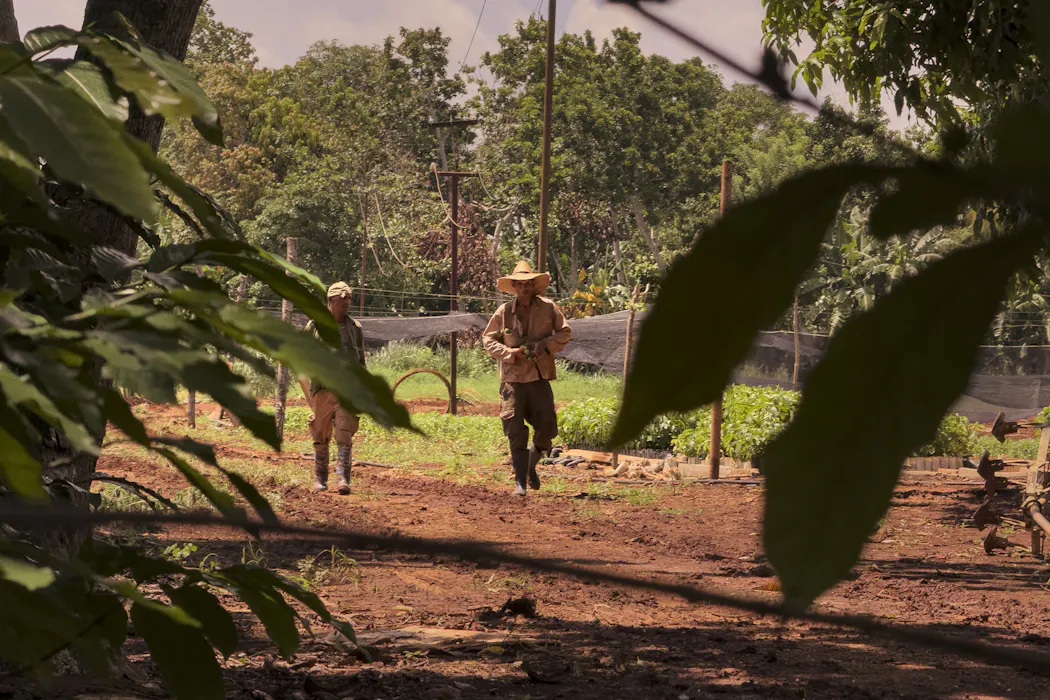
Les exploitations agroécologiques cubaines sont le plus souvent de petites fermes familiales diversifiées, peu mécanisées et cherchant l’autonomie en intrants et en énergie. On y trouve des cultures maraîchères diversifiées, des haricots, des racines et tubercules, des bananes plantains, des fruits et des céréales. Dans les zones urbaines et périurbaines, la crise des années 1990 a favorisé l’essor des canteros (photo du haut), des planches de culture surélevées conduites en bio-intensif, permettant de produire davantage sur de très petites surfaces grâce au travail manuel et au recyclage local de la matière organique. Dans un contexte de forte raréfaction des intrants, ces systèmes ont permis d’améliorer l’efficacité d’usage des ressources. Crédit photo : R. Belmin/Cirad. CC BY-NC-ND
Cuba en polycrise : un système alimentaire centralisé devenu vulnérable (années 2020)
Mais au tournant des années 2020, l’accumulation de chocs énergétiques, économiques et géopolitiques révèle la vulnérabilité structurelle du modèle alimentaire centralisé cubain et précipite son entrée en polycrise.
La dégradation de la situation au Venezuela à partir de 2016 entraîne une chute des livraisons pétrolières, tandis que le durcissement de l’embargo américain complique l’accès aux engrais, aux pesticides, à l’énergie et aux financements. À ces contraintes externes, s’ajoutent des fragilités internes : forte dépendance aux importations alimentaires, vétusté des infrastructures et dysfonctionnements logistiques persistants. Si bien que, à partir de 2017, la production agricole nationale recule dans la plupart des filières stratégiques – riz, légumes, légumineuses, racines et tubercules, fruits et agrumes.
En 2020, cette fragilité bascule en crise systémique : la pandémie de Covid-19 interrompt brutalement les recettes touristiques, principale source de devises du pays. Privé de ressources extérieures, l’État cubain voit ses marges de manœuvre financières se contracter fortement, fragilisant le modèle centralisé d’approvisionnement, de distribution et de don. La réunification monétaire engagée en 2021, en générant une forte inflation, accentue encore cette dynamique.
Résultat : Cuba importe aujourd’hui 70 % à 80 % de son alimentation, pour un coût annuel proche de deux milliards de dollars (plus de 1,6 milliard d’euros). Si les produits alimentaires sont partiellement exemptés de l’embargo depuis 2000, ces importations s’effectuent sous fortes contraintes, notamment l’obligation de paiement comptant, sans accès au crédit. À l’inverse, les engrais et pesticides agricoles et l’énergie restent fortement affectés par le durcissement des sanctions.
Dans ce contexte, l’accès économique à l’alimentation se dégrade fortement. Le système de rationnement de la libreta, longtemps pilier de la sécurité alimentaire, ne couvre plus qu’une part limitée des besoins.
Cette situation révèle une tension structurelle : un système fortement centralisé et dépendant d’approvisionnements extérieurs, qui devient particulièrement vulnérable lorsque ces flux se contractent. Pensé comme un dispositif de sécurisation alimentaire universel, le modèle étatique cubain se trouve ainsi confronté à une accumulation de chocs qu’il peine à absorber.
« Cuba : la colère monte contre les pénuries alimentaires » : un reportage de 2024 sur France 24.
Résister sous contrainte : l’agroécologie comme ressort discret de la résilience cubaine
Cependant, malgré la dégradation marquée de la sécurité alimentaire, certains indicateurs nutritionnels restent étonnamment stables. La prévalence de la sous-alimentation chronique demeure limitée, la mortalité infantile reste basse, et la disponibilité énergétique alimentaire est comparable à la moyenne mondiale, largement au-dessus du seuil critique de 2 100 calories (kcal) par personne et par jour. Ce décalage entre fragilisation du système centralisé et maintien relatif des équilibres alimentaires interroge les ressorts réels de la résilience cubaine.
Des travaux récents expliquent ce paradoxe par un déplacement progressif du centre de gravité du système alimentaire cubain. À mesure que les dispositifs étatiques d’approvisionnement s’affaiblissent, les capacités productives et adaptatives du secteur non étatique prennent le relais. La résilience du système alimentaire cubain ne repose plus sur son architecture centralisée, mais sur un basculement vers des dynamiques décentralisées.
Les fermes du secteur non étatique assurent aujourd’hui l’essentiel de la production alimentaire nationale : avec environ 40 % des terres cultivées, elles contribuent à plus de 80 % de l’offre alimentaire. Dans un contexte de contraintes croissantes, elles constituent également le principal foyer d’innovation agroécologique.
Elles expérimentent de nouvelles techniques culturales, investissent dans les énergies renouvelables, développent des circuits courts, et réhabilitent des techniques de conservation et de transformation, comme la déshydratation de fruits et de plantes aromatiques, la fabrication de coulis de tomate, de fromage de chèvre et de pickles de légumes en saumure. La polycrise agit ainsi comme un catalyseur, accélérant la décentralisation de la production et de l’innovation.
L’agroécologie s’impose à Cuba comme une stratégie d’adaptation à l’incertitude et aux pénuries, sans pour autant relever d’une logique d’autarcie stricte. Les fermes restent hybrides, ajustant en permanence leurs stratégies aux conditions d’accès aux ressources. Les producteurs alternent entre autoproduction de bio-intrants et recours aux engrais importés, et combinent traction animale et mécanisation afin d’assurer la continuité des travaux agricoles malgré les contraintes énergétiques. Les productions alimentent à la fois les circuits étatiques (magasins publics, hôpitaux, libreta) et des marchés locaux informels, devenus essentiels pour l’écoulement des surplus et l’accès à la liquidité.
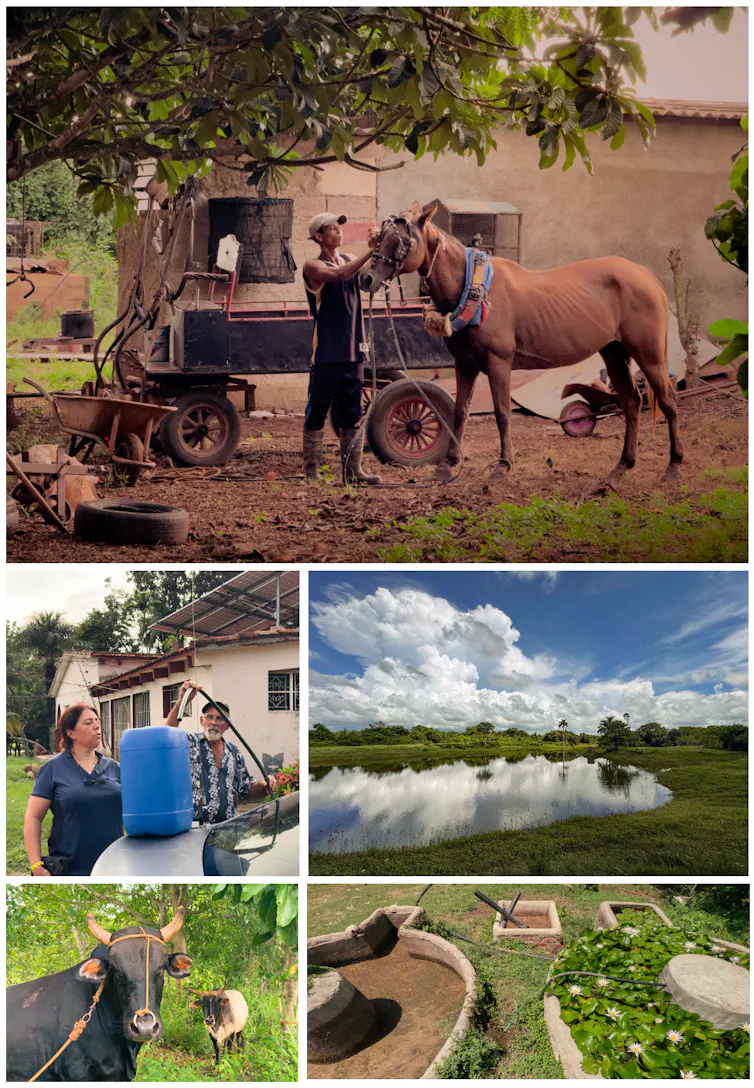
Face aux pénuries d’énergie et d’intrants, les exploitations agricoles cubaines cherchent à renforcer leur autonomie en mobilisant des ressources locales : petits méthaniseurs produisant du biogaz à partir de déchets organiques, dispositifs de récupération d’eau de pluie ou encore recours à des sources d’énergie éolienne, solaire et hydraulique. Pour autant, il ne s’agit pas d’une recherche d’autonomie totale. Les systèmes restent fondamentalement versatiles, capables d’alterner entre ressources locales et intrants importés selon les contraintes. Ainsi, la traction animale (bœufs pour le labour, chevaux pour le transport) coexiste avec le recours au tracteur et à des circuits informels d’approvisionnement en carburant. Crédit photo : R. Belmin/Cirad. CC BY-NC-ND
Cette capacité à naviguer entre différents régimes techniques et institutionnels, plutôt qu’à s’enfermer dans un modèle unique, constitue un ressort central de la résilience cubaine. Elle s’accompagne toutefois d’une fragilité croissante : l’émigration des jeunes actifs réduit la main-d’œuvre disponible, compromettant la transmission des savoir-faire et limitant les capacités d’innovation dans des systèmes intensifs en travail.
Il n’existe pas de chiffre unique permettant de quantifier précisément le nombre d’exploitations agroécologiques à Cuba. Une étude de référence avance que plus de 200 000 producteurs participent au mouvement agroécologiqueCampesino a Campesino, couvrant plus d’un million d’hectares et représentant environ de 50 % à 60 % du secteur paysan. Cependant, seule une fraction de ces exploitations – environ 3 600 fermes – disposent d’une certification agroécologique par l’Asociación Nacional de Agricultores Pequeños (ANAP).
Ces chiffres doivent toutefois être interprétés avec prudence : ils agrègent des niveaux d’engagement très hétérogènes et incluent des fermes de démonstration ou expérimentales accompagnées par des programmes publics ou de coopération, dont la représentativité reste à documenter.
Bio-intrants et biofabriques : un révélateur des tensions du modèle cubain
Les bio-intrants offrent un point d’entrée particulièrement révélateur des tensions et des capacités d’adaptation du système alimentaire cubain.
Dans un contexte de pénurie chronique d’engrais de synthèse et de pesticides de synthèse importés, les bio-intrants – notamment à base de microorganismes autochtones bénéfiques – occupent une place stratégique dans la capacité du système agricole cubain à continuer de produire. Cuba dispose à cet égard d’un capital scientifique ancien en microbiologie agricole et d’un réseau historique de biofabriques publiques pensées comme des infrastructures de souveraineté technologique et alimentaire.
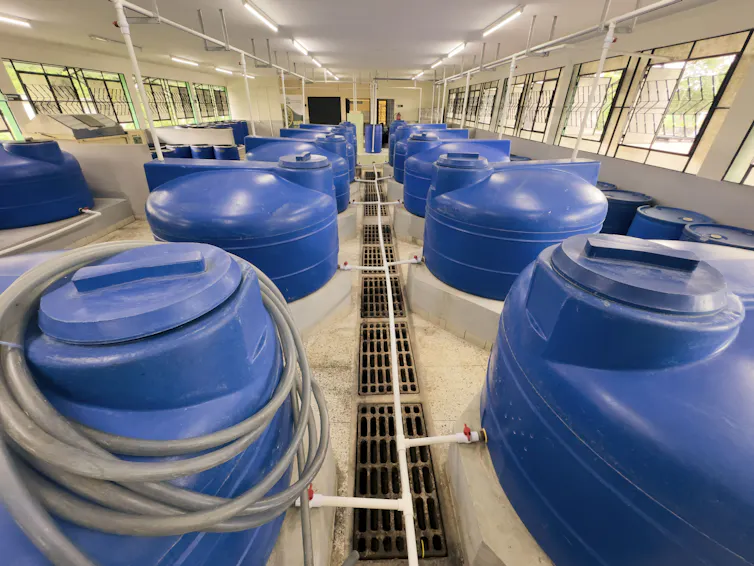
La biofabrique IHPLUS de la station Indio Hatuey (province de Matanzas) produit un biofertilisant à base de microorganismes, avec une capacité de 1 million de litres par an. Autrefois largement diffusé, le biofertilisant connaît depuis deux ans une chute drastique de production, inhérente à des difficultés structurelles, au premier rang desquelles les coûts élevés du carburant freinant la distribution. Crédit photo : R. Belmin/Cirad. CC BY-NC-ND
À l’image du secteur agricole dans son ensemble, les biofabriques étatiques voient leur fonctionnement fortement contraint par les pénuries d’énergie et d’intrants. L’augmentation du coût du carburant freine la distribution et a conduit à l’arrêt des services techniques qui assuraient la promotion et la diffusion du produit dans les territoires. Les difficultés de transport limitent également la capacité des agriculteurs à s’approvisionner directement à l’usine, comme ils le faisaient auparavant. À cela s’ajoutent des contraintes d’accès aux substrats, aux milieux de culture, aux emballages et aux pièces détachées, indispensables à la production régulière de bio-intrants.
Il en résulte un décalage croissant entre l’existence d’une infrastructure publique formelle et sa capacité opérationnelle à répondre aux besoins des producteurs.
Face à ces limites, des formes d’innovation paysanne et collective se développent à l’échelle locale : à l’image des fermes Cinco Palmas et de Punta Las Cuevas (photos ci-dessous), où la production artisanale de bio-intrants soutient la production de plantules, alimente d’autres exploitations et s’insère dans des circuits courts. Loin d’émerger ex nihilo, ces dynamiques mobilisent et recomposent des savoirs, des réseaux et des dispositifs hérités, réactivés et adaptés aux contraintes contemporaines. Elles illustrent plus largement un déplacement des capacités d’innovation du système cubain, du secteur étatique vers des formes décentralisées et informelles.
Cependant, cette agroécologie décentralisée reste largement invisible et peu reconnue dans les cadres réglementaires existants, ce qui limite sa diffusion et sa montée en échelle. C’est à cette interface que s’inscrivent différents projets de recherche qui visent à documenter les pratiques émergentes, à en évaluer les performances et à analyser les conditions institutionnelles de leur reconnaissance.
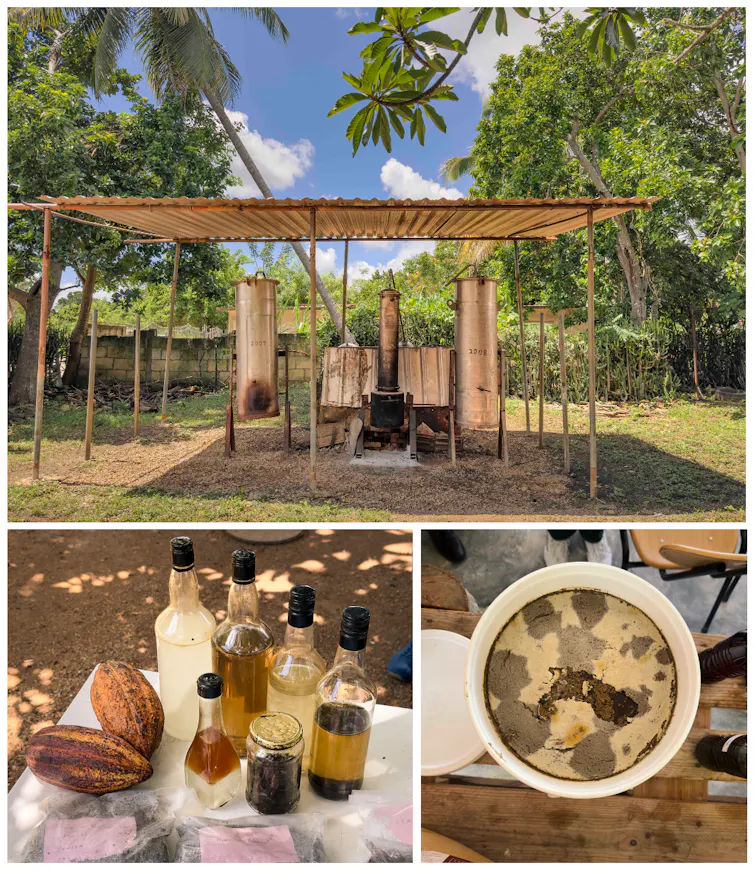
Face aux pénuries d’intrants importés, une dynamique d’innovation décentralisée émerge à Cuba : à la ferme, les producteurs fabriquent leurs propres biopesticides à base d’huiles essentielles, biofertilisants, éliciteurs et microorganismes autochtones bénéfiques (MAB), renforçant l’autonomie productive et la résilience des systèmes agricoles. crédit photo : R. Belmin/Cirad. CC BY-NC-ND
Quand l’agroécologie redéfinit le rôle de l’État
L’expérience cubaine montre qu’un système alimentaire peut encaisser des chocs extrêmes et s’adapter par la transformation de ses structures sans s’effondrer. Sous embargo, crises économiques multiples et recompositions géopolitiques régionales, Cuba évite encore une crise nutritionnelle majeure. Mais cette résilience ne tient plus à la planification centralisée : elle repose désormais sur un basculement vers des formes décentralisées et hybrides d’agroécologie portées par le secteur non étatique.
Paradoxalement, ce mouvement d’autonomisation productive et de décentralisation n’entre pas frontalement en tension avec l’État : il trouve aujourd’hui un écho explicite dans le discours officiel. Le décret-loi 128/2025 sur la promotion de l’agroécologie, entré en vigueur en septembre 2025, inscrit l’agroécologie comme levier stratégique de souveraineté alimentaire, de préservation des écosystèmes et de protection de la santé publique.
Ce texte marque une inflexion importante, puisque l’État ne se présente plus seulement comme planificateur et distributeur, mais aussi comme facilitateur d’une transition visant à renforcer l’autonomie en intrants, la relocalisation productive et la résilience territoriale.
Les auteurs ne travaillent pas, ne conseillent pas, ne possèdent pas de parts, ne reçoivent pas de fonds d’une organisation qui pourrait tirer profit de cet article, et n’ont déclaré aucune autre affiliation que leur organisme de recherche.
Source: The Conversation – UK – By Michael Toomey, Lecturer in Politics and International Relations, University of Glasgow
Hungary’s Tisza party won parliamentary elections on April 12, bringing an end to the 16-year tenure of Viktor Orbán as prime minister. The result is a seismic one for Hungarian domestic politics. But it is also a major development in the trajectory of Hungary’s relations with the EU.
Throughout Orbán’s term, but particularly since the full-scale Russian invasion of Ukraine in 2022, he was consistently a thorn in the side of the EU. He flouted European norms, values and legislation as he went about building what he called an “illiberal state”.
One example was his 2011 decision to lower the mandatory retirement age for Hungarian judges and prosecutors from 70 to 62. This forced a large proportion of the country’s judiciary into retirement, allowing Orbán to replace them with party loyalists. The European Court of Justice ruled against the change in 2013, but many of Orbán’s appointees remained in their positions.
Orbán’s continued defiance of EU policies eventually resulted in the suspension of his Fidesz party from the powerful European People’s Party grouping in the European parliament. Its membership of the alliance was terminated two years later. The European Commission’s 2022 decision to withhold €30 billion (£26.1 billion) in funds from Hungary caused relations to plummet further.
And Orbán subsequently sought to leverage the EU’s need for solidarity and unanimity to support Ukraine and sanction Russia. Hungarian obstinance and disruption became so frequent that the country has been described by some political figures in Europe as not being aligned with European or Ukrainian interests when it comes to Russia.
In a thinly veiled reference to Orbán during a 2024 parliamentary speech, the president of the European Commission, Ursula von der Leyen, said: “There are still some who blame this war not on the invader but on the invaded. Not on Putin’s lust for power but on Ukraine’s thirst for freedom. So I want to ask them: would they ever blame the Hungarians for the Soviet invasion of 1956?”
A true low point in EU-Hungary relations was reached in early April 2026 when leaked audio recordings showed Orbán and his foreign minister, Peter Szijjarto, actively coordinating with the Russian government. The recordings show that Szijjártó had used breaks in closed EU ministerial sessions two years earlier to call his Russian counterpart, Sergei Lavrov, and brief him on the state of internal discussions.
Szijjártó is also accused of sharing confidential documents with Lavrov relating to minority language requirements in Ukraine’s EU accession negotiations. The French foreign minister, Jean-Noël Barrot, has described this as a “betrayal”. Had Orbán managed to prevail in the recent elections, the relationship between the EU and Hungary is likely to have reached a breaking point.
Rupture or continuity?
As it is, EU officials will be breathing a sigh of relief. The incoming prime minister, Péter Magyar, has a huge incentive to restore Hungary’s relations with the EU – if for no other reason than to secure the release of roughly €17 billion in allocated EU funds that are still suspended. Warmer relations would also help Hungary access a possible further €17 billion in discounted defence loans.
Given the global economic ramifications of the war in Iran and the costs Magyar will incur as he reforms and dismantles Orbán’s oligarchic economic system, his government will rely on these funds to ease some of the budgetary pressures they will face.
However, unfreezing these funds is not a foregone conclusion. Von der Leyen has already announced that reforms will need to be made in order to achieve this and has presented Hungary’s incoming government with 27 conditions that will need to be satisfied.
Some of these reforms will be relatively easy for Magyar to achieve. For instance, tackling corruption was an explicit part of Tisza’s election manifesto. However, other EU funds that were suspended due to infringements on LGBTQ+ rights or asylum procedures will be more politically costly to access.
Hungarians remain deeply conservative and more eurosceptic than the average European. According to a 2025 survey conducted on behalf of the European Commission, only 55% of Hungarians consider the country’s EU membership to be “a good thing”. This is lower than the EU average of 62%. Reforms that are seen to be at odds with Hungarian values may thus provoke domestic resistance.
Perhaps of most global interest will be how Magyar approaches the war in Ukraine. He has indicated an interest in rapprochement with Ukraine as part of his broader goal of realigning Hungary with the EU and Nato. Most notably, he has stated that Orbán should lift his veto on the provision of a €90 billion EU loan to Ukraine.
However, there may also be more continuity with the Orbán regime than those in Brussels might like. Magyar has stated that he intends to continue importing Russian energy until at least 2035 and that he will need to put any future possibility of Ukrainian EU membership to a referendum.
In a country where opinion polls show 50% of voters – and 36% of Tisza voters – see Ukraine as a threat, such a referendum would be highly likely to upend the entire process of Ukraine’s EU accession.
Orbán’s downfall is undoubtedly a positive for EU-Hungary relations. However, while Magyar himself has asserted his determination to restore a friendly relationship, this reset will face multiple sizeable tests over the coming months and years.
Michael Toomey does not work for, consult, own shares in or receive funding from any company or organisation that would benefit from this article, and has disclosed no relevant affiliations beyond their academic appointment.
US President Donald Trump’s recent intemperate exchanges with the pope, his depiction of himself as a Christ-like figure and his threat to wipe out the civilisation of Iran have raised questions about his mental capacity to carry out his job.
This week, former CIA Director John Brennan joined calls for the 25th Amendment of the US Constitution to be invoked to remove Trump from the presidency, which he said was “written with Donald Trump in mind”.
So what is the 25th Amendment and how would it work?
What does the amendment say?
The amendment is designed to clarify some constitutional ambiguities in the event the president is unable to continue in the role. The first three sections of the amendment are straightforward and uncontroversial.
Section 1 simply states that if a vice president succeeds on the death or resignation of the president, they become president (that is, not merely acting president).
Section 2 provides the mechanism for filling a vacancy in the vice presidency.
Section 3 provides for the president to temporarily hand over the powers and duties of office to the vice president during a period of incapacity (for example, such as undergoing anaesthetic).
Section 4 is a much more complex and potentially difficult arrangement to relieve a president of the duties and responsibilities of office temporarily. The 25th Amendment tackles the problem of presidents who are unfit to continue in office, but don’t recognise their disability.
It is this section of the amendment that is currently making news because of the reaction to Trump’s recent social media posts and behaviour, and the efforts of some leading figures in Washington to invoke the 25th Amendment provision to remove Trump from the presidency.
The disability clause
Section 4 of the amendment works like this. The vice president and a majority of departmental heads declare to the speaker of the House of Representatives and the president pro tem of the Senate – the Senate’s second-highest ranking official – that the president is “unable to discharge the powers and duties of his office”. If approved, the vice president becomes acting president until such time as the president submits “a written declaration to the contrary.”
After that declaration is made, the president resumes the powers and duties of office unless the vice president and a majority of the heads of the executive departments challenge the president’s response within four days.
If that happens, Congress has 21 days to debate and decide the issue by a two-thirds vote of both houses.
It should be noted the amendment refers to “a majority of the principal officers of the executive departments” and not the Cabinet, as is often mentioned when the disability clause is reported in the media. Trump’s Cabinet consists of 21 members, only 15 of whom are principal officers of executive departments.
So, if the disability provision were to be implemented, the vice president would need eight of the department heads to join him.
The process also depends on the willingness of just one person – the vice president – to implement it, because the procedure doesn’t work with only a majority of the departmental heads.
Finally, even if the amendment was implemented, it wouldn’t actually remove Trump from the presidency. He would remain president, albeit relieved of the powers and duties of office for a temporary period. And JD Vance would only have the title of acting president.
How would it work in Trump’s case?
Even assuming the very unlikely possibility that Vance and eight of the 15 department heads would be willing to implement it, there would be a lot of uncertainty about how the 25th Amendment would work against Trump.
The major weakness of the amendment in Trump’s case would be the provision that allows the president to override the determination of the vice president and the majority of department heads by simply informing Congress that “no inability exists”.
No medical evidence is required, and the amendment doesn’t define “inability”.
Whatever his mental state may be, Trump is not physically disabled, so there would appear to be no physical impediment to him signing a piece of paper declaring that “no inability exists.”
The amendment doesn’t even require Congress to review the president’s “no inability exists” letter. Trump would be restored to the presidency the moment he transmitted the document.
For the process to be taken further, the vice president would have to move against Trump a second time, both houses of Congress would have to debate Trump’s mental state, and super-majorities in both chambers would be necessary to relieve Trump of his duties again. It would risk the 25th Amendment turning into a constitutional crisis.
All of this means any claim the 25th Amendment was “written with Donald Trump in mind” must be questioned. It may be appropriate for a president who is suffering major physical disabilities, such as Woodrow Wilson following his stroke in 1919, or James Garfield’s slow lingering death in 1881. But it is less well equipped to deal with a president who may or may not be mentally incapacitated but is physically able to fight back.
The 25th Amendment is about dealing with the temporary disability of a president not a method of impeaching the president by other means. Impeachment remains the only constitutional way of holding a president to account.
John Hart does not work for, consult, own shares in or receive funding from any company or organisation that would benefit from this article, and has disclosed no relevant affiliations beyond their academic appointment.
This week, Nicole Kidman revealed she is training to become a death doula. She told an audience at the University of San Francisco it “may sound a little weird”, but she was inspired after her mother died in 2024.
Observing how her family wasn’t able to provide the support they hoped they could, Kidman wished there were “people in the world that were there to sit impartially and just provide solace and care”. This is how she came to explore the field of death doulaship.
The concept of a doula is often familiar: you might have heard of a birth doula, who supports a family through pregnancy. A death doula works in a similar capacity, as a community partner offering support to the dying.
There is no singular definition for doulas, but those within the field often describe their work as “holding space” for their client. They act as a neutral third-party, working between the family, end-of-life care professionals and funeral professionals.
Though there are training programs that offer certifications for death doulas, their work varies widely depending on the preferences of the doula and the type of assistance sought by the client.
You may have even acted as a death doula within your own community, aiding the dying or their loved ones without the official title.
A new model for dying
Dying, death and funerals were once a sacred communal process taken care of by family in the comfort of their home. As death became institutionalised, medicalised and professionalised over the late 19th and early 20th centuries, loved ones were pushed to the wayside as they did not have the proper training to care for the dead in the eyes of the industry.
By the mid 1900s, the family parlor was no longer the central meeting spot to lament over mortality, and the funeral industry as we understand it today was in full swing.
This shift slowly gave way to a host of paraprofessionals. Death doulas and death midwives, an ancient practice, reemerged in the early 2000s.
Stemming from the Greek term δούλα, meaning female servant, doulas serve as community helpers in liminal periods, most commonly birth and death. They seek to fill the gaps medical and funeral personnel are unable to attend.
Not everyone who acts in this role calls themselves a “death doula”. They are also known as soul guides, compassionate companions and vigilers, among other titles.
I volunteered, researched and worked in thanatology – the study of death and dying – for over a decade before completing my death doula training. The hands-on experience I gained working with death before my training program was crucial in shaping my ability to communicate about mortality.
Most people want to talk about death, but they’re faced with the conversation too late. In their most vulnerable hour, the dying and their loved ones are expected to make impossible decisions with little guidance. That’s where death doulas come in.
Easing the burden
Kidman said “as my mother was passing, she was lonely, and there was only so much the family could provide”.
The assistance and support of third-party advocates, like death doulas, helps ease the burden on family members and offers a neutral perspective during a vulnerable period.
I came into this work because I experienced deaths at a young age, and I understood my capacity to deal with death. Similarly to Kidman, many doulas I have interviewed came to the work after a loss of their own, with a newfound desire to share what they learned through their experience to help others in an inevitable time of need.
Death doulas can specialise their work, electing to work with pets, stillbirths, children, cognitive decline and many other types of loss.
Some doulas may enter work with a client years before a death, working on more administrative tasks like advanced care planning. Others may join right before a death occurs, focusing on sitting bedside. A third doula may specialise their work around funeral planning, coming in to help facilitate an at-home funeral.
No two doula practices are identical, just like no two deaths are identical.
If you are wondering if you should join a death doula training program, my response would be that increasing your death literacy is always beneficial, but there are many ways to get a death education.
Before diving in, explore what is drawing you to the profession and if you want to do this work for others or if you are seeking the knowledge for yourself. Both are wonderful motivations, but they could lead to different outcomes in the type of program you choose to attend or the kind of death education you seek.
We’re all going to die, and it’s never too soon to start talking about it.
Symon Braun Freck receives funding from the University of Melbourne as part of her research. Symon also runs a consulting firm (SBF Creative), a death-tech company (AI Death Doula), and a personal blog, all focused on thanatology. She received her death doula training from the University of Vermont. Symon is a Certified Thanatologist through ADEC and affiliated with NEDA, The Open to Hope Foundation, and Death with Dignity.
Source: The Conversation – Global Perspectives – By Sarah Lawson, Academic Registrar at St Barnabas College in the University of Divinity, PhD Candidate in Ancient Linguistics, Faculty of Arts and Education, CSU, Charles Sturt University
Ludo Studio
Most of us are used to thinking of “religion” in terms of a belief in God or gods. Perhaps the big hitters of world belief systems come to mind – Judaism, Christianity, Islam, Hinduism, Sikhism, Buddhism or, in Australia, the Dreamtime.
But philosophers of religion and human belief systems tend to make it a bit more complicated for us. They like to expand what we think of as religious belief.
One philosopher, William James, defined religion as “the belief that there is an unseen order, and that our supreme good lies in harmoniously adjusting ourselves [to it]”.
When we think of religion this way, we can conceive of a lot more “unseen orders” or religions in the world than just the big, organised religions and belief in supernatural phenomena.
For example, most of us believe in the unseen order of “queuing” and believe that our greater good comes from harmoniously adjusting ourselves to its rules. These might include “first come, first serve,” “no cuts,” “join at the end,” “leaving the queue forfeits your place” and more.
Other unseen orders we interact with daily might include “manners”, “tall-poppy-ism,” or even “civil law”. James helps us understand how these beliefs function cognitively and emotionally, and how they affect our behaviour just like a traditional religion.
In Bluey, one of the most interesting religions is “Play”.
Play, religion and Bluey
Play functions as a unifying unseen order all the characters align themselves to throughout the show.
The cast whole-heartedly believe in this unseen order of Play, with rules which ought to be harmoniously followed in order to reach the supreme good. This unifying belief centres the characters on the good of bonding, love and fun.
The pursuit of these ideals is rewarded both within the show by the characters and metatextually as the “gods” of the show (Joe Brumm and the other writers) bend the world towards them.
So, what are the central beliefs of the religion of Play in Bluey? My research found four key rules which the characters consistently adjust themselves to.
1. Don’t interrupt or stop. No one in the show ever willingly interrupts or stops mid-game, best illustrated by the episode Stumpfest.
2. Follow the agreed rules. Rules and “playing properly” are very important to the characters, most aptly illustrated by the episodes Shadowlands and Library.
3. Be enthusiastic. There are no half-measures or dissent allowed, illustrated by Octopus and Whale Watching.
4. Games should have happy endings, because the real world often doesn’t. This is the theme of the 2024 special The Sign.
‘Contextualising’ religions
The religion of Play is not without difficulties. The show spends a surprising amount of time questioning and exploring these rules, especially when they harm or hinder rather than help the characters seek good.
This is parallel to the process of “contextualising” real-life organised religions. Contextualising is when the practices or beliefs of religions are explored and changed over time to better suit the time and place the religion finds itself in and allow more people to comfortably and positively engage with the greater good of the religion.
For example, many houses of worship have adjusted standing and kneeling practices for prayer to accommodate folks with physical disabilities and an ageing population. Likewise, many religious services that were once performed in ceremonial languages (like Latin, Sanskrit or Classical Arabic) are now done in the contemporary language of the community.
Bluey can offer us some lessons in contextualising our own religions, beliefs or non-religion.
In the episode Shop we see worrying too much about how the unseen order works (the rules of a game) can stop you from engaging in the unseen order (having fun). Engaging is far more important than rules.
Episodes Charades and Helicopter teach inclusion and flexibility in play. Modifying the rules is acceptable so that more people can join in.
In Copycat we see the benefit of stories and playing out games with sad or unexpected endings. Different practices can illuminate more depth or diversity.
In Driving, Chilli interrupts to understand the game better, and can then better align her enthusiasm to the game. Some rules are less important than others – breaking a minor rule might be necessary to follow a more important rule.
And in Pass the Parcel, a parent changes the practice of the game, back to how he played as a child with only one prize rather than a prize in every layer. This change to the unseen order is at first taken with great difficulty by the children and parents alike, but in the end is appreciated: the reward is greater than the growing pains.
Adjustment and contextualisation can be hard, but also rewarding.
What we can learn about practicing religion
The rules of the belief system are only a means to an end. The rules are a way of aligning oneself with the unseen order for the greater good. The rules are not the greater good in and of themselves.
Bluey teaches us three important lessons about practicing religion through its depiction of the religion of play:
participation in the unseen order is more important than the specific rules
extreme and rigid adherence to the rules can be harmful to those around us and ourselves
there is more than one way to practice an unseen order without giving up the supreme good that we all seek.
There is more than one way to play a game, just as there is more than one way to practice a religion.
Sarah Lawson does not work for, consult, own shares in or receive funding from any company or organisation that would benefit from this article, and has disclosed no relevant affiliations beyond their academic appointment.
In 2022, the founders of chatbot startup Character.AI launched a platform where anyone could create interactive characters powered by artificial intelligence (AI).
The app exploded, quickly growing to more than 20 million users who created more than 10 million chatbot characters.
Many of the users creating those characters were young people – until they weren’t. In November 2025, under mounting public and legal pressure surrounding youth suicides linked to its use, Character.AI banned users under 18. The decision was made after a number of attempts to improve youth safety, including parental controls and stricter content filters.
The ban is an attempt to keep teens safe from potential harm. But the more creative, playful and emotionally expressive AI experiments they were doing have also been silenced.
In 2026, three in ten US teenagers use AI daily. The idea of using AI for companionship has dominated media headlines and app stores, with hundreds of apps on offer.
Media coverage of AI companions taps into two primary fears. One is that young people will replace human friendships with AI. The other is that engaging with sycophantic chatbots instead of real people will result in teens losing their social skills.
These concerns are important. But companionship accounts for a surprisingly small share of why young people actually use AI. A recent Pew Research Center survey found the top uses by teens are seeking information (57%), doing homework (54%) and “for fun” (47%). Only a small percentage (12%) used AI for emotional support or advice. Romance and loneliness alleviation frequently rank among the lowest motivations for teen AI use: 4–6% and 8–11%, respectively.
When the public narrative almost exclusively frames AI chatbots as companions, it risks overlooking the bulk of how teenagers spend their time with AI.
Our team set out to understand what young people choose to do with AI when they’re free to use it outside of school contexts – seeking fun, messing around, and creating characters of their own design.
AI as entertainment
Before the ban, Character.AI was a popular “AI entertainment” destination for young people. It still has a viral TikTok channel, and has characters from popular youth media, from Peppa Pig to Call of Duty.
Our team spent more than eight months, between July 2024 and March 2025, immersed in Character.AI’s official community on online chat platform Discord, with more than 500,000 members. We systematically analysed 2,236 posts by young people aged 13–17. Of those users the majority, 68.2%, identified as female or non-binary; and 59% had created their own AI characters.
Through an analysis of youth discussion on the platform, we identified three core intents behind engagement with Character.AI: restoration, exploration and transformation.
Restoration
my favourite period comfort bot is Percy Jackson
Young people used characters for emotional comfort, venting, escapism and mood management. Rather than mirroring a formal clinical practice, we observed youth discussing “comfort bots” where young people engaged in soft, tender and gentle roleplay with familiar characters.
Beloved book characters would comfort people on their period, or characters from popular comics would give someone a pep talk for an upcoming math test.
Exploration
Character.AI has helped me find that creative spark within myself
Young people explored boundaries, engaged in creative world-building, and extended their fandoms. One teen wrote a three-book-long saga through character interactions. Another created a troupe of travelling theatre characters inspired by their love of theatre. They reported this use transferred skills into the real world, boosting creativity and improving their writing.
Transformation
I have characters who struggle with mental health issues and I tend to project on my personas during RP [roleplay]
Young people used AI to try on different identities, process real-life relationships, and re-author difficult real-life scenarios. Some people created “clones” of themselves, with superpowers or self-affirming versions of themselves.
Inspired by reality, they discussed creating characters that reflected real-world challenging relationships, such as “toxic friends”, “annoying sister”, or “foster care agent”.
Characters created with purpose
We also mapped seven distinct character archetypes young people were creating and discussing:
Soother – emotionally supportive figures
Narrator – a cast of characters for roleplays
Trickster – jesting, testing and transgressive chats
Icon – remixed celebrities or fandom figures
Dark Soul – angsty, emotionally complex characters
Proxy – modelled after real people in their lives, and
Mirror – clones of the self.
These archetypes are a central finding of our research. Instead of sycophantic or romantic chatbot engagement, young people are purposefully creating characters that are angsty, transgressive, playful, creative and reflective.
This shows we need to stop treating “companion AI” as if it’s one homogeneous thing. Treating AI chatbots as a single category is like treating all screen time as the same experience, whether a child is watching Bluey with family or doomscrolling short-form content at night, alone on their phone when they should be sleeping.
Towards better chatbots
The American Academy of Paediatrics recently shifted screen-time guidelines from set time limits to a framework that accounts for the individual child, their use, family relationships and their environment.
The same logic should apply to AI chatbots. This means moving beyond asking adults about their child’s use of AI, testing AI products with fake accounts that assume certain use cases, and banning access before listening to young people – their experiences, their experiments and their ideas for the future.
Banning is a reaction to bad design, but it doesn’t lead to better, safer AI products for teens.
The answer is not to permanently keep young people away from AI. Rather, it’s to build AI that deserves their trust, fosters their creativity and keeps them grounded in the physical world with families, friendships and communities.
Annabel Blake is a Design Researcher at Canva with a focus on AI, and conducted this research independently as part of their PhD.
Eduardo Velloso has recently received funding from Google. He has previously received research funding from Meta, Microsoft, and Snap.
Marcus Carter is a recipient of an Australian Research Council Future Fellowship (#220100076) on ‘The Monetisation of Children in the Digital Games Industry’. He has previously received funding from Meta, TikTok and Snapchat, and has consulted for Telstra. He is a previous president and board member of the Digital Games Research Association of Australia.