Lebanon’s political elites are using displacement and humanitarian crisis to delay elections again

Source: The Conversation – Global Perspectives – By Jasmin Lilian Diab, Assistant Professor of Migration Studies; Director of the Institute for Migration Studies, Lebanese American University

Long-time Lebanese power broker and speaker of the parliament Nabih Berri speaks during a legislative session.
AP Photo/Hussein Malla

Lebanon was meant to be preparing for key parliamentary elections in May 2026. Then came the return of war.

Two days after the U.S. and Israel launched their military operation in Iran on Feb. 28, Hezbollah and Israel resumed their own full-scale hostilities. That marked the final collapse of a much-violated ceasefire that for a little over a year had barely kept a lid on fighting. With Israel’s full-scale bombardment of the country and invasion of southern Lebanon again underway, the Lebanese parliament on March 9 postponed scheduled elections by extending its own mandate by two years.

Its justification was a now familiar one: war, instability and a security situation deemed incompatible with democratic process. As conflict escalates across the region and further destabilizes Lebanon with the possibility of long-term Israeli occupation, officials insist that elections are simply not feasible.

But this is not the first time Lebanese elections have been postponed.

Since 2013, the Lebanese government has delayed parliamentary elections multiple times, citing among other factors the war in neighboring Syria, political deadlock and disputes over electoral law. Each delay has been framed as temporary, necessary and exceptional. Yet taken together, they reveal a pattern: Elections in Lebanon seem to be always approaching – and continually postponed.

This is not simply a story of crisis interrupting democracy. It is a story of how crisis is used to govern it.

Crisis as justification and opportunity

There is little question that the latest postponement of elections comes amid trying conditions – airstrikes, displacement and mounting insecurity – that make the logistics of an election extremely difficult.

A pile of building rubble from an airstrike.
A man stands atop the rubble as smoke rises from a building destroyed in an Israeli airstrike in Beirut’s southern suburbs on March 14, 2026.
AP Photo/Hassan Amma

Indeed, on its face the parliament’s decision appears pragmatic. Elections require mobility, stability and functioning institutions, all of which are currently under strain.

But arguments for postponement obscure an important reality: Political crises in Lebanon have contributed to a self-fulfilling logic that protects the political status quo.

The extension of parliament’s term was announced by Speaker Nabih Berri, a central figure in the country’s political order since Lebanon’s civil war ended in 1990. That order has long been defined by power-sharing among entrenched elites, as well as a system widely criticized for enabling corruption, patronage and institutional paralysis.

The current system was formalized in the Taif Agreement, which formally ended Lebanon’s devastating 15-year civil war. The accord distributed power along sectarian lines, with key state positions allocated to religious communities. While intended to ensure representation, it instead entrenched elite bargaining and veto power, making consensus both necessary and perpetually elusive.

Over time, this has produced a political system defined less by governance than by managed deadlock – where institutional paralysis is not incidental but built into the system itself. This fragility is compounded by the interplay of domestic and external forces, including the significant political and military role of Hezbollah. Emerging out of the Lebanese civil war and the broader context of Israeli occupation in the 1980s, Hezbollah developed as an armed resistance movement and later consolidated its position as both a political actor and a military force operating alongside the state, complicating the already tenuous balance of power.

This fragility is further reflected in repeated institutional deadlock, including prolonged presidential vacuums like between 2014 and 2016. Then, Hezbollah and its allies blocked consensus over a candidate, leaving the country without a head of state for over two years.

The politics of delay

Within Lebanon’s fractured political context, postponing elections has serious consequences. Fundamentally, it changes when and how political accountability happens in ways that benefit those already in power. In Lebanon, elections increasingly function as deferred events: always anticipated but continually postponed.

This prolongs the tenure of a political class that has faced sustained public anger since the 2019 uprising, when mass protests erupted across the country over economic mismanagement, corruption and deepening inequality. The movement forced the resignation of the government and exposed the fragility of the state’s political and economic order.

While this challenges individual leaders and the broader system of governance, it did not translate into sustained structural reform or a meaningful reconfiguration of power. Instead, the post-2019 period has been marked by deepening economic collapse, institutional paralysis and repeated political deadlock that has included prolonged delays in government formation.

Two people carry an injured man at a protest.
Civil defense workers carry an injured protester after a clash with riot police during 2019 demonstrations in Beirut.
AP Photo/Hussein Malla, File

Election delays also narrow the space for political alternatives. New parties, independent candidates and reformist movements rely on electoral cycles to gain visibility and legitimacy. Postponing elections thus also defers possibilities for political transformation.

Finally, postponement reinforces a system in which accountability is continually suspended. Without elections, there is no formal mechanism through which citizens can register discontent or enact change.

In this sense, delay is not simply a byproduct of instability. It is a political outcome with clear beneficiaries in power, both within the Lebanese state and among actors such as Hezbollah, whose influence is often reinforced in periods of internal and external crisis.

Crucially, elections are never canceled outright. They are deferred, extended, rescheduled. While the promise of democratic participation remains, its realization is continually pushed into the future.

Displacement and exclusion

The current crisis also raises deeper questions about who is able to participate in Lebanon’s political life. Escalating violence in the south has displaced thousands, disrupting livelihoods, mobility and access to basic services. Participation in elections becomes not only difficult but, for many, secondary to survival.

This dynamic is not new. Periods of conflict in south Lebanon, from the prolonged Israeli occupation prior to 2000 to the 2006 Israel-Hezbollah war, have repeatedly disrupted electoral participation, displacing communities and reshaping who is able to vote, where, and under what conditions. Electoral processes have, at times, proceeded despite such disruptions, but often in ways that marginalize those most affected by violence.

This follows a broader pattern in which those most affected by crises in Lebanon are also those least able to shape the country’s political outcomes.

Lebanon’s electoral system has long been marked by exclusion: from diaspora voters who face logistical and administrative barriers to those displaced – entirely excluded from the political process.

Today, renewed conflict, including Israeli military operations in the south, intensifies these constraints.

The postponement of elections, then, is marked by both genuine logistical constraints and facilitating the interests of entrenched political elites.

It also risks deepening existing inequalities. Large segments of the population, particularly those in the majority-Shiite south, will face disproportionate barriers to participation as displacement, insecurity and the destruction of infrastructure make voter registration, campaigning and access to polling stations significantly more difficult.

These are the same communities whose political representation is most directly shaped by cycles of violence, displacement and uncertainty.

Men in military fatigues hold flags.
A 2016 photo shows Hezbollah fighters holding flags and marching in south Lebanon.
AP Photo/Mohammed Zaatari, File

Why elections still matter

All this does not mean that elections no longer matter in Lebanon. On the contrary, their repeated deferral points to their continued importance. But it also highlights the fragile nature of democratic processes within a system shaped by entrenched power and persistent instability.

At the same time, there are ongoing, if uneven, efforts to reckon with this paralysis. Reform-oriented political actors and segments of civil society have continued to push for electoral transparency, diaspora participation in elections and institutional reform.

International actors, including the International Monetary Fund and the European Union, have also tied financial assistance and recovery frameworks to governance reforms, including calls for credible and timely elections. Yet these pressures have so far yielded limited structural change, often absorbed into the same status quo they seek to transform.

Meanwhile, the escalation of violence in the south and the persistent possibility of expanded military confrontation continues to reshape the conditions under which any future election might take place.

In Lebanon, democracy is not suspended in times of crisis but stretched. And in that stretching, the distance between citizens and political change continues to grow. That will only continue unless emerging pressures, both domestic and international, are able to create forms of genuine accountability.

The Conversation

Jasmin Lilian Diab does not work for, consult, own shares in or receive funding from any company or organization that would benefit from this article, and has disclosed no relevant affiliations beyond their academic appointment.

ref. Lebanon’s political elites are using displacement and humanitarian crisis to delay elections again – https://theconversation.com/lebanons-political-elites-are-using-displacement-and-humanitarian-crisis-to-delay-elections-again-263677

An ancient oracle warned invading Persia would backfire – from Croesus to Trump, rulers have failed to listen

Source: The Conversation – Global Perspectives – By Peter Edwell, Associate Professor in Ancient History, Macquarie University

Photo by Stefano Bianchetti/Corbis via Getty Images

Invasions of ancient Persia were always daunting tasks. They often led to disaster.

In the 6th and 5th centuries BCE, the Persian empire came to dominate a vast and varied geography with Iran at its heart.

Comprising modern Iran, Iraq, Turkey, the Persian Gulf and parts of other neighbouring countries, the Persian Empire was established and ruled by the Achaemenids. This powerful dynasty lasted all the way to about 330 BCE when Alexander the Great defeated its last ruler, Darius III.

But in the early days of this Achaemenid Persian expansion (546 BCE), the legendary King Croesus (from Lydia, in western Turkey) decided to challenge it.

Reputedly the richest man in the world, Croesus consulted the famed Oracle of Apollo at Delphi (in Greece). The oracle, according to ancient writer Herodotus, told Croesus:

that if he should send an army against the Persians he would destroy a great empire.

Croesus’ subsequent invasion and defeat by the Persian king, Cyrus, saw the destruction of his own empire. The oracle accurately foretold the outcome but not as Croesus had hoped.

Croesus wasn’t the last ruler to invade Persia and realise he’d bitten off more than he could chew.

From the 6th century BCE to the 4th century CE, Greeks and Romans invaded Persia multiple times. The risks were high, the logistics complicated.

In fact – as US President Donald Trump is now discovering – wars like these, in this part of the world, are a lot easier to start than they are to end.

Complex and high-risk

The vast resources and manpower of the Achaemenid empire, together with its varied geography, made any invasion of Persia complex and high-risk.

When Alexander the Great (also known as Alexander III of Macedon) invaded in 334 BCE, he led stunning military successes against the Persians over the next few years.

But by the time of his premature death in Babylon in 323 BCE, organisation of the vast territory he had conquered was a hodge-podge of short-term arrangements.

Over time, the memory of Alexander in the Iranian territories he conquered was one of contempt. The Persian territory he conquered couldn’t be held by his successors.

Around 70 years after Alexander’s death, a new dynasty emerged in Iran.

Known as the Arsacid Parthians, they would dominate much of the former Achaemenid territory for centuries.

The Arsacid Parthians became the key rivals of the Romans as they (the Romans) expanded further east from the 1st century BCE onwards.

The first invasion of the Parthian empire by the Romans ended in total disaster – for the Romans.

The Roman general Crassus invaded Parthian imperial territory in southern Turkey in 53 BCE. The Parthian army annihilated Crassus’ forces near the city of Carrhae. Around 20,000 Roman soldiers died (including Crassus and his son) and 10,000 were captured.

This disaster would live in the Roman memory for centuries.

‘A source of constant wars and great expense’

Even when Roman invasions of the Parthian empire in the 2nd century CE were successful, there was often a sting in the tail. The emperor Trajan invaded all the way to the Persian Gulf in 116/117 CE but couldn’t hold any of his gains.

Later in the 2nd century CE, Roman invasions of the Parthian empire did see territorial gains in Mesopotamia (southern Turkey).

But one contemporary Roman writer, Cassius Dio, thought these gains were more trouble than they were worth:

He [emperor Septimius Severus] used to declare that he had added a vast territory to the empire and had made it a bulwark of Syria. On the contrary, it is shown by the facts themselves that this conquest has been a source of constant wars and great expense to us.

From loss to ultimate humiliation

In the 3rd century CE, the Sasanian dynasty took control of Iran and Mesopotamia from the Parthians. The Sasanian Persians inflicted serious defeats on invading Roman armies in the centuries ahead.

The Roman emperor Gordian III died in battle against the Sasanians in 244 CE. He led a large-scale invasion of the Persian empire but died trying to attack the capital, Seleucia-Ctesiphon. His successor (Philip I) signed a humiliating peace treaty to ransom what was left of the army.

But the ultimate humiliations for Roman emperors were yet to come.

In 260 CE, the emperor Valerian was captured by the Persian king, Shapur I.

Legendary accounts claimed Valerian served as a footstool for Shapur when he mounted his horse.

Rock reliefs from the 3rd century depicting Valerian and Philip I in subjection to Shapur survive in Iran to this day.

Around a century later, the emperor Julian died while invading the Persian empire. Leading an army of 60,000 men, Julian suffered a heavy defeat and was killed north of the Persian capital, Seleucia-Ctesiphon.

The ensuing peace treaty saw Rome lose key territory and fortresses in northern Mesopotamia.

It would take more than a century for Rome to recover from this defeat.

Most ancient invasions of the Persian empire caused serious problems for those who prosecuted them.

The varied and sometimes harsh nature of the geography was an important factor. The national resolve and military preparedness were others.

While the current US-Israel war against Iran is different in many ways to ancient wars directed at Persia, the 3rd-century Sasanian rock reliefs are reminders of what can go wrong.

The Conversation

Peter Edwell receives funding from the Australian Research Council.

ref. An ancient oracle warned invading Persia would backfire – from Croesus to Trump, rulers have failed to listen – https://theconversation.com/an-ancient-oracle-warned-invading-persia-would-backfire-from-croesus-to-trump-rulers-have-failed-to-listen-279750

Iran’s president appeals to Americans − but does his office still hold any real power?

Source: The Conversation – Global Perspectives – By Roxane Razavi, Visiting scholar in contemporary Middle Eastern history, Princeton University

Iranian President Masoud Pezeshkian attends the Quds Day march in Tehran on March 13, 2026. Hassan Ghaedi/Anadolu via Getty Images

Iranian President Masoud Pezeshkian penned an open letter to “the people of the United States” on April 1, 2026, in which he implored Americans to “look beyond” misinformation that portrayed Iran as a threat to the world.

It was, perhaps, his most prominent intervention during the current conflict. Despite being the president of a country in the midst of crisis, Pezeshkian hasn’t had the highest of war profiles.

Criticized by conservatives at home for his conciliatory tone, the reformist politician has also been sidelined by Iran’s adversaries. Western media initially appeared more interested in the musings of Pezeshkian’s son, Yousef. President Donald Trump has barely mentioned Pezeshkian, other than in an oblique social media post on April 1 in which he claimed “Iran’s new regime president” had asked the U.S. for a ceasefire – something denied by Iran.

International attention has instead largely centered on the role of Iran’s supreme leader. First, it was about who would succeed Ali Khamenei after his killing in the first strikes of the war, and then what was known about his successor and son, Mojtaba Khamenei.

As a researcher of contemporary Iranian politics, I think this focus on the supreme leader over the president inadvertently confirms a trend in Iran that has been happening for years: the cementing of a political structure that increasingly resembles a centralized dictatorship.

A man clasps his hands while sat in front of a photo of three men.
Iranian President Masoud Pezeshkian records a video message on March 20, 2026.
AA Video/Anadolu via Getty Images

An uneasy balance

The concentration of power around one figure sits uneasily with one of the founding impulses of the 1979 revolution that ushered in the Islamic Republic. A wide spectrum of revolutionary actors – Islamists, leftists and secular nationalists – were involved in the ousting of the shah. But they shared at least one principle: the rejection of monarchy.

The idea that one generation could not determine the political future of the next was precisely what many revolutionaries, despite their internal differences, had fought against.

As such, the system that initially emerged in 1979 was neither a pure theocracy nor a conventional republic. The supreme leader would exercise ultimate religious and political authority, and an elected president was to embody the republican dimension of the state. This second part gave institutional form to the revolutionary promise that people, through elections, would periodically renew political authority.

In the first decade after the revolution, this balance functioned, albeit in a fragile and conflictual manner.

The authority of Ruhollah Khomeini, the Islamic Republic’s first supreme leader, coexisted with the presidency – most notably during the brief presidency of Abolhassan Bani Sadr. Elected in 1980, Bani Sadr quickly came into conflict with clerical factions over the direction of the revolution and the conduct of the Iran-Iraq war.

Accused of political incompetence, Bani Sadr was impeached by parliament in 1981 and subsequently fled into exile.

A man in glasses stands behind microphones
Iran’s first post-revolution president, Abolhassan Bani Sadr, in exile in France in 1981.
Marc Bulka/Gamma-Rapho via Getty Images

The presidency of his successor, Ali Khamenei, marked a period of relative alignment with the supreme leader. Operating under Khomeini’s authority, Khamenei operated less as an autonomous political force than as an instrument embedded within a broader clerical and revolutionary consensus.

The dynamic between president and supreme leader was further redefined by the 1989 constitutional revision following Khomeini’s death and the elevation of Khamenei from president to supreme leader. The post of prime minister was abolished, consolidating executive authority in the presidency. At the same time, the institutional and political supremacy of the supreme leader was strengthened.

The weakening presidency

The presidency of Mohammad Khatami, who was elected in 1997, demonstrated that the office could still function as a significant locus of power. As Khatami’s tenure showed, presidents were still able to shape public discourse and policy agendas, particularly in areas such as cultural policy, foreign relations and economic management.

But a major turning point in the power of the office occurred in 2009 with the contested reelection of the hard-liner president, Mahmoud Ahmadinejad, amid widespread allegations of electoral fraud.

It led to mass demonstrations that became known as the “Green Movement.” The state responded with the repression of protesters, followed by a consolidation of the security apparatus – particularly the expanding influence of the Islamic Revolutionary Guard Corps around the supreme leader.

At the same time, it marked the beginning of Ahmadinejad’s falling out of favor. His populist rhetoric and attempts to build an independent political base led to confrontations with clerical authorities in the early 2010s. It also exposed the regime’s intolerance for even a relatively autonomous presidency.

It contributed to a power struggle between Ahmadinejad and Supreme Leader Ali Khamenei that became public in 2011 when the then-president sought to dismiss Intelligence Minister Heydar Moslehi – only to be overruled by Khamanei.

Ahmadinejad was subsequently excluded from the 2017 presidential race by the Guardian Council, a body handpicked by the supreme leader. In so doing, Khamenei made it clear that while the office of the presidency could remain, it would cease to function as an independent center of decision-making and power.

Since then, presidents have continued to be elected, but their capacity to reshape the political order has been diminished sharply.

Two women hold posters with a man's face on it.
Supporters of hard-line Iranian President Mahmoud Ahmadinejad.
Salah Malkawi/Getty Images

The presidency of Hassan Rouhani briefly appeared to be an exception. His election in 2013, and the subsequent negotiation of the Joint Comprehensive Plan of Action, generated both domestic expectations and significant international attention.

Yet the durability of the agreement remained contingent on decisions taken beyond the presidency, both internationally and domestically. Its eventual unraveling during the first Trump administration confirmed suspicions among Iranian hard-liners around the supreme leader that reform, an independent power center in the presidency and diplomacy with the U.S. had been a mistake.

With even the limited form of democratic expression as embodied through an elected president suppressed, political disengagement has followed. Although voter turnout remained significant in the years immediately following 2009, a longer-term trend has seen people give up faith in elective politics in Iran. In the last election, held in 2024, just 39.9% of Iranians turned out to vote.

Consolidation of power

This diminishing of the role of the presidency and political legitimacy forms the background to any questions of succession now. But by reducing the political future of the country to the identity of future supreme leaders, observers risk normalizing the transformation of what was historically a contested and hybrid political system into one defined by a single office.

The bloody suppression of the January 2026 protests, the constraints imposed by wartime conditions and the increasing marginalization of elective institutions have all contributed to weakening the presidency.

The fallout of the current war may, of course, see a reorganization of political institutions in Iran. But for now, when Pezeshkian seeks diplomacy with Americans, the pertinent question is: Does his office still matter?

The Conversation

Roxane Razavi receives funding from the EHESS (PhD funding).

ref. Iran’s president appeals to Americans − but does his office still hold any real power? – https://theconversation.com/irans-president-appeals-to-americans-but-does-his-office-still-hold-any-real-power-278705

Where is transatlantic intelligence-sharing headed under the Trump administration?

Source: The Conversation – Global Perspectives – By Hager Ben Jaffel, Docteure en relations internationales spécialisée dans la sociologie du renseignement et de la sécurité, Institut catholique de Lille (ICL)

Repeated threats to annex Greenland, controversial diplomatic statements, and, more broadly, the antagonistic stance of the American executive toward Europeans point to an unprecedented climate of distrust among transatlantic allies, of which the latest Davos forum provided a revealing example. But what about alliances between intelligence services?

Often perceived as domestic instruments of political power, intelligence services are, in fact, highly internationalised and enjoy significant autonomy in their dealings with foreign counterparts, though this can occasionally be disrupted by political interference.

A history of long-standing collaborations

Cooperation between intelligence services is not new. Some partnerships date back at least to the First World War and are often the result of agreements between services themselves rather than formal decisions by governments. Whether bilateral or multilateral, these alliances underpin a wide range of activities: liaison officers posted abroad, listening stations, participation in international conferences, and routine exchanges of information.

International cooperation built on common ground and trust

Research in the social sciences has shown how, over time, a dense network of relationships has developed around shared interests. Counterterrorism, nuclear non-proliferation and other perceived imminent threats have provided strong justification for cooperation, including the exchange of data on individuals, organizations or states considered “dangerous.” The widely held belief that sharing information helps prevent attacks has also encouraged the expansion of surveillance mechanisms – often at the expense of robust democratic oversight.

One example is the many partnerships between the National Security Agency (NSA) and several European counterparts. These collaborations have enabled the pooling of advanced technologies – such as artificial intelligence and algorithmic analysis – to collect and process large volumes of private communications. This work also depends on explicit alliances between intelligence agencies and major tech companies, which have become key intermediaries that, willingly or not, make their users’ data available to intelligence services.

The solidarity and trust on display should not obscure the fact that international cooperation remains a space marked by strong rivalries. Services compete to access information, shape priorities and secure an advantageous position in relationships where resources – financial, human, or technical – are unevenly distributed. In this context, espionage between services and other disloyal practices are also part of the game.

These dynamics suggest that intelligence alliances follow a logic of their own rather than unwavering loyalty to political authority. It is in this context that the Danish military intelligence service monitored the communications of several European political leaders on behalf of the NSA. Above all, because they possess in-depth knowledge of the threats facing the world, intelligence services are able to position themselves at the heart of security decision-making, making political leaders dependent on their expertise.

Continuity despite political interference

That said, these alliances are not immune to political pressures. Disputes between intelligence services and political leaders have always existed, but the openly hostile attitude of the “reactionary internationale” embodied by the Trump administration and its MAGA supporters has raised concerns about a possible breakdown – or at least a significant weakening of cooperation.

Faced with an unfavourable political context, they are often able to adjust and even turn the situation to their advantage.

Several European intelligence services have thus strengthened their cooperation, even raising the possibility of creating a European Five Eyes – in reference to the Anglosphere intelligence alliance linking Australia, Canada, New Zealand, the United Kingdom and the United States to countries in Europe and Asia.

Others have specifically developed units to better anticipate the unpredictability of the American executive, with tangible effects: staffing in the unit dealing with the United States within France’s DGSE has increased, and the budgets of several European intelligence services are set to rise, benefiting from broader increases in defence spending.

More broadly, history shows that ties between services remain strong even when governments hold divergent positions. In the early 2000s, exchanges between the DGSE and the CIA continued despite disagreements over the war in Iraq.

A more recent example is Brexit, which did not lead to any major rupture in relations between the British police and their European counterparts, who continue to facilitate the flow of intelligence.

As in any relationship, signs of caution, distrust, or even ambivalence can emerge. For example, the British and Danish intelligence services have indicated that they are limiting – but not completely halting – their exchanges with their American counterparts, concerned about the legal implications and, more broadly, the politicisation of US intelligence. Irritated by repeated provocations over Greenland, the Danish military intelligence service went so far as to designate the United States as a national security threat, alongside China and Russia.

Nonetheless, it would be incorrect to assume that, under more normal circumstances, intelligence sharing would happen without any restrictions. Services do not share all their secrets, all the time, with everyone. On the contrary, the restraint shown by some reflects a routine asymmetry in exchanges that persists and can even be heightened during periods of turbulence.

Signs of continuity are evident, underscoring a key reality: intelligence primarily falls under the purview of career professionals, not politicians. Earlier this year, the Davos forum hosted European and Anglo-American intelligence chiefs, including the CIA, in a key meeting to preserve ties with the “Old Continent”.

Trump and the ‘deep state:‘ a love-hate relationship

Concerns among European services are partly linked to Donald Trump’s stated desire to dismantle the “deep state.” While he did follow through on some threats by dismissing personnel within intelligence agencies, these institutions have neither disappeared nor ceased to function. In practice, the executive branch remains dependent on them.

The appointment of controversial figures to lead several agencies, instead of career officials, reflects an effort to align leadership more closely with political and ideological priorities. Current international developments show that intelligence services remain essential to the implementation of foreign policy. Long criticised, the CIA now appears to have returned to favour with the White House, taking advantage of the opportunities offered by the fight against drug trafficking and the conflict in Iran to reaffirm its relevance and legitimacy to political power.

Taken together, these developments highlight the complexity of the relationship between intelligence services and political power – one shaped by both distance and proximity.


A weekly e-mail in English featuring expertise from scholars and researchers. It provides an introduction to the diversity of research coming out of the continent and considers some of the key issues facing European countries. Get the newsletter!


The Conversation

Hager Ben Jaffel ne travaille pas, ne conseille pas, ne possède pas de parts, ne reçoit pas de fonds d’une organisation qui pourrait tirer profit de cet article, et n’a déclaré aucune autre affiliation que son organisme de recherche.

ref. Where is transatlantic intelligence-sharing headed under the Trump administration? – https://theconversation.com/where-is-transatlantic-intelligence-sharing-headed-under-the-trump-administration-279135

A New York Times critic used AI to write his review – but criticism is deeply human

Source: The Conversation – Global Perspectives – By Bec Kavanagh, Senior Tutor in Publishing & Creative Writing, The University of Melbourne

Alex Preston, and the book he reviewed, with the help of AI. Hachette/Allen & Unwin

An author and freelance journalist has admitted to using AI to help him write a book review for the New York Times.

Alex Preston’s review of Jean-Baptiste Andrea’s novel Watching Over Her, published by the New York Times in January 2026, draws phrases and full paragraphs from Christobel Kent’s Guardian review. The “error” was brought to light by a reader, who alerted the New York Times to the similarities.

Preston told the Guardian he is “hugely embarassed” and “made a huge mistake”.

a man in a buttoned long sleeved t-shirt
Alex Preston has admitted to using AI to help write a book review.
Hachette

The Times promptly dropped Preston, calling his “reliance on A.I. and his use of unattributed work by another writer” a “clear violation of the Times’s standards”. An editor’s note now precedes the review online, advising readers of the issue and providing a link to the Guardian review.

Preston’s apology to the Guardian raises more questions than it resolves. The portion quoted online seems to speak more to the issue of unattributed work than his use of AI. It reads: “I made a serious mistake in using an AI tool on a draft review I had written, and I failed to identify and remove overlapping language from another review that the AI dropped in.” This implies that if he had removed the “overlapping” language, the issue would have been avoided.

As a literary critic and scholar, I believe the deeper question isn’t whether or not critics should do more to hide their use of AI – but the ethics of using it at all.

Why AI can’t do criticism

The role of the critic isn’t to summarise or repackage art, but to actively participate in a conversation about it. “Good criticism thrives in the complexity of its environment,” writes critic Jane Howard, who is also The Conversation’s Arts + Culture editor. “Each review sits in conversation with every other review of a piece of art, with every other review the critic has written.”

In other words, the critic is in conversation with both the artist and the audience. The critic’s emotional and intellectual engagement with art – and their translation and communication of meaning – is intrinsic to their role as mediator. That role is deeply human.

Perhaps information can be outsourced, but emotional engagement can’t. Nor can an individual perspective, filtered through one human’s reading, viewing, listening and experiences.

Art and AI controversies

There are valid arguments outlining the functional uses of AI, and warning against significant climate repercussions. But there is also an escalating concern around the intrusion of AI into creative expression.

book cover - Shy Girl - with sad dog
Shy Girl was cancelled due to AI accusations against its author.

Last month, author Mia Ballard was accused of using AI to write her horror novel, Shy Girl. It was withdrawn from publication in the UK and cancelled from scheduled publication in the US, after “readers on platforms such as Goodreads and Reddit had questioned whether sections of the text bore hallmarks of AI-generated prose”, according to the Guardian.

In 2023, German artist Boris Eldagsen sparked controversy when he revealed that his prize-winning photograph The Electrician was AI generated. In 2025, Tilly Norwood, the first fully AI-generated “actress” ignited debate around whether so-called synthetic actors were a tool for creative expression, or a threat to human creators.

In 2025, writers were “horrified” to discover that their work had been pirated by Meta to train AI systems.

If the question that underlies these examples is “what is the role of art”, this latest debacle adds “and what is the responsibility of the critic”?

Breaking a pact

Art criticism in Australia is what Howard describes as a “niche within a niche”. The sector is unbearably small, so most critics have an additional day job and are in close professional and personal proximity to the artists whose work they review.

Some critics of the critics, such as writer Gideon Haigh, have suggested this has led to a culture of what literary academic Emmett Stinson called “too-nice” criticism.

But I would argue generosity is fundamental to public-facing criticism – and that the critic reviewing in the public sphere has a responsibility to writers and readers.

The writer might safely assume that when we’re publishing a review that surmises their book’s successes and failings against its ambition, we have, at the very least, taken the time to read and carefully consider their work, and our own response to it.

This unspoken pact is broken when the writer begins to use AI – particularly when a professional reviewer like Preston seems to outsource his assessment to it.

Such fiascos point to a disturbing future where readers’ opportunities to build community and develop empathy through engagement with literature is outsourced entirely to AI.

Australian literature academic Julieanne Lamond has said “when we write reviews we have to do it ‘naked’ – as individual readers, with a public to judge our judgements”. In other words, we sit at the middle of a pact between the writer of a book and their potential readers.

Criticism can be literature

Done well, criticism is literature. As Australian author, playwright and critic Leslie Rees argued in 1946, good literary criticism is a “real and creative service to literature”.

book cover: Watching Over Her
Watching Over Her is at the centre of a controversy over the use of AI in writing a New York Times book review.

Popular criticism, written for the general public and published as journalism, might sit on a different playing field from scholarly criticism. But its obligation to readers – to convey real and honest opinions about books and bring readers into a conversation about literature – is no less significant. There is a shared obligation to be honest, and surely this honesty extends to a transparency about AI use.

French professor and essayist Phillipe Lejeune, best known for his work on autobiography, used the term the “autobiographical pact” to describe the relationship between the writer of a memoir and the reader. That is, the reader accepts what the memoirist says as truth, based on the writer’s acknowledgements of their own biases and subjectivity.

We might transfer a similar pact to the reviewer and their reader. Should the reader not be able to trust that the review they’re reading is the critic’s own?

Hannah Bowman, a literary agent from Liza Dawson Associates, recently described mistrust as the book industry’s greatest peril: “it’s essential for all parties in the publishing process to have transparency and clarity in conversations about how AI tools are being used by any party, especially in the creative process”.

In failing to disclose his use of AI, Preston has not only embarrassed himself, but broken the trust of his readers.

The Conversation

Bec Kavanagh is a freelance critic for The Guardian.

ref. A New York Times critic used AI to write his review – but criticism is deeply human – https://theconversation.com/a-new-york-times-critic-used-ai-to-write-his-review-but-criticism-is-deeply-human-279742

Trump risks falling in to the ‘asymmetric resolve’ trap in Iran − just as presidents before him did elsewhere

Source: The Conversation – Global Perspectives – By Charles Walldorf, Professor of Politics and International Affairs, Wake Forest University

Little has seemingly gone as Washington planned in the war against Iran.

The Iranian people have not risen up, one hard-line leader has been replaced by another, Iranian missiles and drones keep hitting targets across the Middle East, Iran closed the Strait of Hormuz, driving oil and gas prices up worldwide, and in sharp contrast to Trump’s demand for “unconditional surrender,” Tehran has rejected a 15-point U.S. plan for a ceasefire.

So how did things go so wrong?

As a scholar who researches U.S. forever wars, I believe the answer is simple: Trump, like other U.S. presidents before him, has fallen into what I call the trap of asymmetric resolve. In short, this occurs when a stronger power with less determination to fight starts a military conflict with a far weaker state that has near boundless determination to prevail. Victory for the strong becomes tough, even close to impossible.

When it comes to Iran, the Islamic Republic wants – and needs – victory more than the United States. Unlike the U.S., the Iranian government’s very existence is on the line. And that gives Tehran many more incentives – and in many cases very effective countermeasures – through which to fight on.

The trap of asymmetric resolve

Typically, in asymmetric wars the stronger side does not face the same potential for regime death as the weaker side. In short, it has less on the line. And this can lead to lesser resolve, making it hard to sustain the costs of war required to defeat the weaker, more determined rival.

Such dynamics have played out in conflicts dating back to at least the sixth century B.C., when a massive Persian army under Darius I was checked by a much smaller, determined Scythian military, leading in the end to a humiliating Persian retreat.

For the U.S. in the modern era, wars of asymmetric resolve have likewise not been kind.

In the Vietnam War, an estimated 1.1 million North Vietnamese civilians and Viet Cong fighters died compared to 58,000 U.S. troops. Yet, the U.S. proved no match for the North’s resolve. After eight years of brutal war, the U.S. gave up, cut a deal, withdrew and watched North Vietnam roll to victory over the South.

In 2001, the U.S. unseated the Taliban in Afghanistan, set up a new government and built a large Afghan army supported by U.S. firepower. Over the next 20 years, the remnants of the Taliban lost about 84,000 fighters compared to around 2,400 U.S. troops, yet the U.S. ultimately sued for peace, cut a deal and left. The Taliban immediately returned to power.

Many other great powers have fallen into this same trap – and at times in the same countries. Despite far fewer casualties than the Afghan resistance, the mighty Soviet Union suffered a humiliating defeat in its nine-year war in Afghanistan during the 1980s. The same happened to the French in Vietnam and Algeria after World War II.

Asymmetric resolve in the Iran war

A similar asymmetry is now playing out in Iran.

Unlike 2025’s 12-day war that largely targeted Iranian military installations, including its nuclear sites, Trump and the Israelis are now directly threatening the survival of the Iranian government. Killing the supreme leader, a slew of other powerful figures, and encouraging a popular uprising made this crystal clear.

Tehran is responding as it said it would were its survival to be at stake. Prior to the current war, Iran warned it would retaliate against Israel, Arab Gulf nations and U.S. bases across the region, as well as largely close the Straight of Hormuz to commercial traffic.

In short, it is going all-in to cause as much pain as it can to the U.S. and its interests.

Iran has suffered the disproportionate number of loses in the current war, both in terms of human casualties and depleted weaponry. As of mid-March, there have been upward of 5,000 Iranian military casualties and more than 1,500 Iranian civilian deaths, compared to 13 dead U.S. service members.

Yet, Tehran isn’t backing down, saying on March 10, “We will determine when the war ends.”

Such Iranian resolve seemingly confounds Trump. Before the war, he wondered why Iran wouldn’t cave to his demands, and he has since conceded that regime change – seemingly a major U.S. goal at the war’s onset – is now a “very big hurdle.”

This conflicts with how Iran was being presented to the American public prior to the war. Secretary of State Marco Rubio said in January that “Iran is probably weaker than it’s ever been.” It has no ballistic missiles capable of hitting the U.S. homeland, a decimated nuclear program and fewer allies than ever across the Middle East.

No wonder a Marist poll from March 6 found that 55% of Americans viewed Iran as a minor threat or no threat at all.

With Iran proving resilient, American public opinion on the war has been definitively negative. This aspect of war resolve can be especially challenging for democracies, where a disgruntled public can vote leaders out of power.

Fading or low U.S. public support for war was likewise a primary driver in past U.S. asymmetric quagmires.

Indeed, the Iran war is more unpopular than just about any other U.S. war since World War II, with polling consistently finding around 60% of Americans in opposition.

For Iran, as a nondemocracy there are far less reliable figures to compare this to on its side. Before the war, the government faced a major public crisis with widespread protests, but for many reasons – including its brutal crackdown and a potential “rally around the flag” effect – Iranian public opinion has proved far less salient.

What’s next?

The Trump administration is attempting to mitigate the impact that asymmetrical resolve has by saying the length and scope of the operation will remain limited.

To reassure the public and calm financial markets, Trump keeps promising a short war and delaying bigger strikes to give space for negotiations that he, not the Iranians, says are ongoing.

History suggests that once faced with a smaller military power showing greater resolve, the larger power has two trajectories. It can succumb to the hubris of power and escalate, such as was the case in Vietnam, Iraq and Afghanistan. Or it can wind down the conflict in an attempt to save face.

Often in the past, leaders of a stronger side opt for the first option of escalation. They just can’t escape thinking that a little more force here or there wins the conflict. President Barack Obama wrongly thought a surge of 30,000 additional U.S. troops into Afghanistan would bring the Taliban to their knees.

Despite signs that he wants out of the Iran war, Trump could still fall to the hubris of power. More U.S. troops are on the way to the Gulf, and B-52 bombers have been flying over Iran for the first time.

As Korea, Vietnam, Iraq and Afghanistan show, following hubris into escalation against a determined foe like Iran will probably come at great cost to the U.S.

The other option – that of winding down the war – is still available to Trump.

And Trump has gone down this route before. He signed a deal in 2020 with the Taliban to end the war in Afghanistan rather than surge more troops in. And just last year, Trump declared victory and walked away from an air war in Yemen when he realized ground forces would be required to overcome the resolve of the Houthis.

The U.S. president could try the same with Iran – saying the job is done then walking away, or entering real, sustained negotiations to end the war. Either way, he’ll need to give something up, such as unfettered access through Hormuz or sanctions relief.

Trump likely won’t like that. But polling suggests Americans will take it. After all, who wants another Vietnam?

The Conversation

Charles Walldorf is a Senior Fellow at Defense Priorities.

ref. Trump risks falling in to the ‘asymmetric resolve’ trap in Iran − just as presidents before him did elsewhere – https://theconversation.com/trump-risks-falling-in-to-the-asymmetric-resolve-trap-in-iran-just-as-presidents-before-him-did-elsewhere-279374

How Taiwan is viewing the Iran war – and what it reveals about US credibility

Source: The Conversation – Global Perspectives – By Bonnie Yushih Liao, Assistant Professor of Diplomacy & International Relations, Tamkang University

The United States and Israeli strikes on Iran have become increasingly concerning for the world due to the risks of further escalation and the impact on energy markets.

In Taiwan, however, the focus has shifted in a different direction.

Rather than treating the war as geographically distant, Taiwanese political leaders and analysts are viewing it as a real-time indicator of how the United States operates under strategic pressure.

The key question is less about whether the United States would act if a conflict with China were to break out in the Indo-Pacific region, and more about how it would manage competing pressures if multiple crises unfolded at once.

A test of limits, not intentions

There is growing recognition in Taiwan that US resources are not unlimited.

The Middle East war has caused energy prices to fluctuate and stoked fears of rising inflation in the United States, demonstrating the domestic costs of military operations.

US President Donald Trump’s approval ratings have also taken a hit, with some in his own party now questioning his rationale for going to war.

Some reports have indicated US supplies of interceptor missiles are running low. The US military has, for example, had to move some THAAD missile interceptors from South Korea to the Middle East. The US has also struggled to defend against Iran’s use of asymmetrical fighting tactics.

This has direct implications for the deterrence Washington has long maintained in the Indo-Pacific. This deterrence depends not only on US war-fighting capability, but on the expectation this capability will remain intact under strain.

Conflicts elsewhere may not weaken the US resolve to intervene if China were to invade or pressure Taiwan in some fashion. But they can drain American resources and influence where these items are prioritised.

Shifting thresholds for the use of force

The US has also framed its strikes on Iran as a “preventive” action aimed at mitigating a future threat rather than responding to an imminent attack. This raises broader questions about the changing threshold for the use of force in the Indo-Pacific.

For Taiwan, this is not an abstract notion. If the threshold for military action is lowered from imminent threat to potential risk, the strategic environment becomes less predictable in the Indo-Pacific.

This broadens the range of circumstances under which force by the United States may be justified.

The speed with which the Trump administration has acted in Iran has also increased uncertainty for regional partners like Japan and South Korea in assessing when and how the United States would act against China.

The US’ NATO partners weren’t told about the Iran strikes before they happened. This could make Japan and South Korea similarly worried about a lack of communication on potential US actions over Taiwan.

Wars rarely follow anticipated pathways

The Iran war has also raised broader questions about how the United States adapts as crises evolve.

Much of the discussion around Taiwan has traditionally centred on the possibility of a large-scale Chinese invasion. However, recent developments suggest escalation may be less linear than this.

Rather than following a single, predictable pathway, conflicts can develop through a sequence of smaller decisions, the ambiguity over signals sent by an adversary, or rapidly changing political conditions.

This has contributed to a shift in strategic discussion in Taiwan. Recent defence policy debates and security forums have increasingly examined scenarios in which China pressured Taiwan with grey-zone tactics, blockades and incremental escalatory moves, rather than focusing solely on full-scale invasion.

As a result, attention is shifting to how such pressure might build over time – through cyber operations, maritime restrictions or limited military actions – and possibly spiral out of control.

The current crisis in the Strait of Hormuz has been watched closely in Taiwan as an example of how disruption of a strategic chokepoint can quickly impact the world. This raises questions about whether similar dynamics could emerge in the Taiwan Strait, and how prepared external actors – including the US – would be to respond.

The US has also been unable to prevent the Iran war from spilling over into the Persian Gulf states. This raises questions about whether a war over Taiwan could be contained or produce wider regional effects.

The risk of misinterpretation

For Taiwan, the most immediate challenge comes from how China interprets US actions in Iran. If Beijing concludes that diminishing military resources or domestic pressures would limit the US’ ability to wage a sustained conflict in the Indo-Pacific, it may reassess the risks of applying coercive pressure on Taiwan.

This does not imply immediate conflict is likely over Taiwan. However, it increases the likelihood that China would try to pressure or coerce Taiwan just below the threshold of full-scale war.

History suggests that escalation is often shaped by how situations are interpreted by adversaries, rather than by clear shifts in power. When states believe conditions are more favourable than they actually are, the risk of misjudgement increases.

For Taiwan, the challenge is therefore not only to assess developments in the Middle East, but to ensure that its own position is not misunderstood. This involves:

  • maintaining credible defensive capabilities
  • reinforcing internal cohesion against possible threats
  • signalling clearly that any attempt at coercion would face robust resistance.

Deterrence depends not only on what a country can do, but what others believe it will do — and whether those beliefs discourage risk-taking.

The Conversation

Bonnie Yushih Liao does not work for, consult, own shares in or receive funding from any company or organisation that would benefit from this article, and has disclosed no relevant affiliations beyond their academic appointment.

ref. How Taiwan is viewing the Iran war – and what it reveals about US credibility – https://theconversation.com/how-taiwan-is-viewing-the-iran-war-and-what-it-reveals-about-us-credibility-279102

Why a second global shipping chokepoint could soon live up to its name as the ‘Gate of Tears’

Source: The Conversation – Global Perspectives – By Flavio Macau, Associate Dean – School of Business and Law, Edith Cowan University

Luke Dray/Stringer/Getty

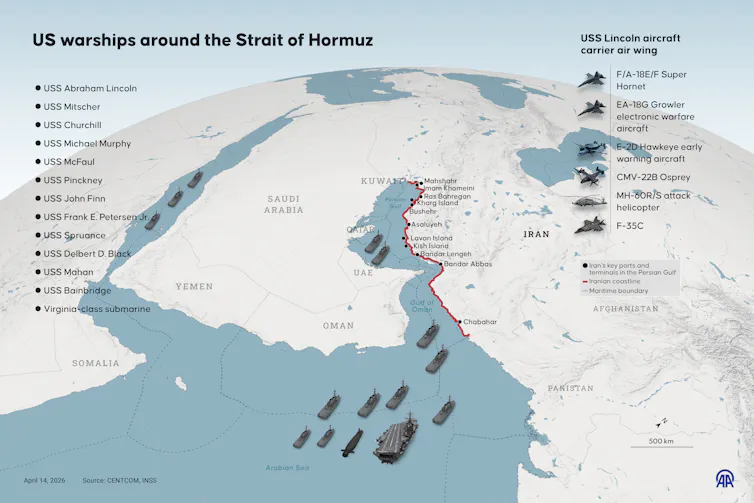
If you’d never heard of the Strait of Hormuz before, you probably have by now. Iran’s effective closure of the waterway, which usually carries about 20% of the world’s oil and gas, has put severe pressure on the global economy.

Now, some analysts are warning a new flashpoint could emerge: the Bab el-Mandeb Strait.

That’s because on March 28, the Houthis, a military group that controls large parts of northern Yemen and is aligned with Iran, entered the war, launching missiles towards Israel for the first time since the war with Iran began.

Yemen is situated on one side of the strait, and the Houthis have previously attacked shipping in the Red Sea, causing major disruption in late 2023 and 2024.

Bloomberg now reports Iran has approached the Houthis to prepare for a similar campaign.

Here’s why all eyes will be back on the Houthis, Bab el-Mandeb and the Red Sea, and what disruption of a second major chokepoint could mean for the world economy.

What is the Bab el-Mandeb Strait?

The Bab el-Mandeb Strait is about 30 kilometres wide at its narrowest point. It is situated between Yemen on the Arabian Peninsula to the northeast and Eritrea and Djibouti in Africa on the west.

Its name literally means “Gate of Tears” in Arabic, after its famously treacherous sailing conditions.

It has become so important because, along with the Suez Canal in Egypt, it allows ships to transit directly between the Mediterranean Sea and the Indian Ocean by passing through the Red Sea and the Gulf of Aden.

Before the Suez Canal’s opening in the 19th century, ships had to travel all the way around the southern tip of Africa to join these two points.

An oil tanker leaving Saudi Arabia to go to the Netherlands, for example, only has to travel 12,000 kilometres if it goes via the Red Sea, compared with more than 20,000 kilometres going south around Africa.

As you’d expect, that’s much faster too. According to the US Energy Information Administration (EIA), a trip between the Arabian Sea and the Netherlands that takes 34 days the long way around is shortened to just 19 days.

What passes through it?

In normal times, as much as 14% of global maritime trade goes through the Bab el-Mandeb Strait.

Detailed data on what passes through the Bab el-Mandeb Strait is somewhat limited. But fossil fuels are a major component.

The International Energy Agency (IEA) estimates that in 2025 about 4.2 million barrels of crude oil and petroleum liquids crossed the Bab al-Mandeb Strait per day. That’s about 5% of global production.

Given most ships use the Suez Canal as well, official data from the Suez Canal Authority allow us to paint a detailed picture of Red Sea shipping.

In the final quarter of 2025, about 40% of the 3,426 ships passing through the Suez Canal transported fossil fuels: (1,330 oil tankers, 88 liquefied natural gas (LNG) ships).

Bulk and general cargo made up another 40% (1,339 ships), typically transporting agricultural commodities such as corn, wheat and soybeans, and also coal and iron ore. Container ships made about 13% of the traffic (459 ships).

Notably, total traffic through the Red Sea has declined considerably since Houthi attacks on shipping in late 2023 and 2024, even though these attacks have largely stopped.

Can the strait be closed?

The Bab el-Mandeb Strait can’t be “closed” entirely. Its narrowest point is still a considerably wide waterway. And unlike the Strait of Hormuz, the Bab el-Mandeb Strait is not a “cul-de-sac”, where the passage is closed at one end with only one way out. Ships can still exit to the Mediterranean via the Suez Canal.

That’s little comfort for those bound for Asia, which would then have to round Africa to do so, adding weeks to the journey.

Notably, Saudi Arabia had already built a “Plan B” to avoid the Strait of Hormuz, called the East-West pipeline. This pipeline connects Abqaiq in the north with Yanbu on the Red Sea, and had already begun pumping oil at almost full capacity in response to the conflict.

But oil bound for Asia from this new exit point still has to pass through Bab el-Mandeb to avoid the long way around, meaning it could be disrupted.

We’ve been here before

To get a sense of how the Houthis could disrupt shipping again, we can look to the most recent Red Sea crisis.

According to the International Maritime Organization (IMO), 67 incidents were recorded between November 2023 and September 2024. Some ships only suffered minor equipment damage. But others faced severe fires, flooding and structural damage after being hit by missiles or drones.

However, there have been relatively few attacks since 2024. And the strait was never totally “closed” per se: some ships continued to pass through throughout the crisis.


Read more:
Today’s global economy runs on standardized shipping containers, as the Ever Given fiasco illustrates


The mere threat of attacks

These same tactics would probably apply today. But for shipping companies, the mere threat of attacks may be enough to slow or restrict shipping. There are significant risks to civilian crew, who face a threat to life.

Adding to this, insurance costs could become prohibitive enough to close the route in practical terms. Back in 2024, insurance costs were about 0.6% of the value of the cargo on a ship. After the Red Sea crisis, this rose as high as 2%.

The effective closure of both the Strait of Hormuz and Bab el-Mandeb at the same time would be severely disruptive to global supply chains and the global economy.

The Conversation

Flavio Macau does not work for, consult, own shares in or receive funding from any company or organisation that would benefit from this article, and has disclosed no relevant affiliations beyond their academic appointment.

ref. Why a second global shipping chokepoint could soon live up to its name as the ‘Gate of Tears’ – https://theconversation.com/why-a-second-global-shipping-chokepoint-could-soon-live-up-to-its-name-as-the-gate-of-tears-279548

What caused the blood red skies in Western Australia? A weather expert explains

Source: The Conversation – Global Perspectives – By Steve Turton, Adjunct Professor of Environmental Geography, CQUniversity Australia

The apocalyptic red skies in Western Australia have generated considerable international media attention. Crimson dust whipped up by the strong outer winds of Severe Tropical Cyclone Narelle created this unusual phenomenon.

Spectacular weather events like this are not common in northwest Australia. They occur under very specific environmental conditions. Most of the tropical cyclones hitting this arid region don’t cause red skies. Mega dust storms which do change the colour of the sky often take place during prolonged droughts. Perhaps the most memorable storm traversed over Melbourne on 8 February 1983, turning the sky red-brown and later pitch black.

A screen shot of a New York Times piece about the red dust storm.
The New York Times and other international media published stories about Australia’s blood red dust storm.
New York Times

So what caused Cyclone Narelle’s dust storm and why was the sky so vividly red? Four factors came together to create these conditions: a very dry and exposed landscape with red soils, a lack of preceding rain, very strong winds ahead of the rain bands from the cyclone, and a particular wind direction.

Why was the dust storm so spectacular?

Australia’s northwest is one of just a few places in the world where tropical cyclones affect an otherwise arid desert climate. Other locations include the Arabian Peninsula and semi-arid parts of India and Pakistan. These dry regions have very little natural vegetation to protect fragile soils from cyclonic winds. In the northwest of WA, the iron-rich soils which attract many big mining companies also give the region its exceptional red appearance.

According to the Bureau of Meteorology, in the six weeks prior to Cyclone Narelle, the greater northwest region had experienced 10-50 mm of rainfall and the barren landscape was very dry. This was a crucial factor behind the size and magnitude of the red-tinged dust storm.

In the Southern Hemisphere, tropical cyclones rotate in a clockwise direction due to the “Coriolis Force”, which applies movement on rotating objects. This explains how the dust storm developed. Strong winds to the south of the cyclone’s eye were coming from the northeast to southeast direction, and hence off the dry landscape.

After tracking in a southerly direction, close to the North West Cape of WA, Narelle eventually crossed the coast near Coral Bay and headed inland, where it weakened.

Narelle’s large area of gale-force winds extended 200-260 kilometres from the centre. These very strong winds in the southwest area of the cyclone blew across the dry Pilbara landscape, picking up fine red sediments ahead of the bands of rain and transporting them westwards. These blood-red dust storms hit coastal towns in the Gasgoyne and Pilbara regions.

The large, flat terrain of the Pilbara would also have created a long wind “fetch” (the distance the wind blows over open terrain). This would have picked up greater numbers of dust particles.

As the cyclone moved through, humidity increased rapidly, followed by dense cloud and finally heavy rain. This is why the apocalyptic dust was short lived – it was washed out of the atmosphere and back to earth.

An orange-coloured picture of a verandah and the sky.
The dust cloud as it approaches.
Good Morning Australia/Facebook

Why was the sky so red?

The Pilbara’s deep red soils are rich in iron oxides. These soils form the basis of the multi-billion dollar iron ore mining industry.

Understanding the physics of the atmosphere is important. Airborne dust particles scatter shorter wavelengths (blue and green light) more effectively. Longer wavelengths (red and orange light) pass through or dominate what reaches your eyes. The red soil particles made the light an even deeper shade of red. Hence, the sky appeared deep orange red, or even blood coloured.

Due to the right mix of environmental conditions, the Narelle dust storm involved a very high dust concentration, thick enough to significantly filter and tint all incoming sunlight. This created the Mars-like or “apocalyptic” appearance. Cyclone Narelle also approached the North West Cape in the early morning, when sunlight has to travel through more atmosphere. This meant more scattering occurred and made the red tones even stronger.

Mega dust storms are a regular feature during prolonged droughts in central, southern and eastern Australia. A striking example was the “Red Dawn” dust storm in Sydney on 23 September 2009. Residents woke to an eerie red dawn due to a huge dust cloud.

Huge dust storms like this are usually produced by strong cold fronts and severe thunderstorms that force fine sediment particles up into the atmosphere. These particles are typically moved towards the east, even making their way into the upper levels of the troposphere. Occasionally the dust is deposited as far away as the Southern Alps of Aotearoa/New Zealand.

Spectacular weather events such as this stand out on the global stage. A rare combination of the Pilbara’s exceptionally red soils, cyclonic winds from the right direction and perfect pre-rain timing allowed atmospheric dust to build to very high concentrations. Certainly a feast for the eyes and record books.

The Conversation

Steve Turton has previously received funding from the Australian and Queensland Governments.

ref. What caused the blood red skies in Western Australia? A weather expert explains – https://theconversation.com/what-caused-the-blood-red-skies-in-western-australia-a-weather-expert-explains-279557

New Israeli law could mean death penalty by default for Palestinians convicted of deadly attacks

Source: The Conversation – Global Perspectives – By Shannon Bosch, Associate Professor (Law), Edith Cowan University

Israel’s parliament, the Knesset, this week passed legislation that would vastly expand capital punishment in Israel and in the occupied Palestinian territories.

The changes, made via an amendment to Israel’s penal law, allow for executions without proper appeal, pardons or meaningful judicial discretion.

According to media reports, 62 of 120 Knesset members voted in favour of the bill on Monday, including Prime Minister Benjamin Netanyahu, and 48 voted against. The remainder absented themselves from the vote or abstained.

UN experts and Amnesty International have warned these new death sentencing rules would apply almost exclusively to Palestinians.

It would, they argue, entrench discrimination already identified by the International Court of Justice as amounting to apartheid. UN experts said of the bill:

Since Israeli military trials of civilians typically do not meet fair trial standards under international human rights law and humanitarian law, any resulting death sentence would further violate the right to life […] Denial of a fair trial is also a war crime.

This development is a significant change for Israel, which has not executed anyone for more than 60 years. It reverses decades of global movement towards abolition, while normalising executions in an occupied territory.

Death penalty as the default

These changes were made via legislation brought by National Security Minister Itamar Ben-Gvir and his far-right Otzma Yehudit party.

The Penal Bill (Amendment ― Death Penalty for Terrorists) amends both Israeli civil law (applicable to Israeli settlers) and Israeli military law (applicable to Palestinians) in the occupied West Bank.

The law states, according to a Deutsche Welle media report:

Palestinians in the occupied West Bank convicted of terrorism in military courts will face a mandatory death sentence or, in the wording of the bill “his sentence shall be death, and this penalty only.” Only if the court determines that there are “special reasons” can it then commute the death sentence to life in prison.

Under this change:

  • prosecutors do not need to request the death penalty
  • the defence minister may submit an opinion to the judicial panel of three military officials who only need a simple majority to impose the death penalty
  • judges need to record exceptional reasons for imposing a life sentence over the death penalty
  • avenues for appeal would be tightly restricted
  • there would be no possibility of a pardon
  • people sentenced to death would be detained in isolated facilities that would have restricted visitor access, with legal counsel only by video link
  • executions (by hanging) would take place within 90 days of the final judgement.

Another yet-to-be-passed bill that may still be brought before the Knesset – the Prosecution of Participants in the October 7 Massacre Events Bill – would also see more death sentences handed down.

It establishes ad hoc military tribunals with retrospective jurisdiction to prosecute those accused of participating in the October 7 2023 Hamas-led attacks on southern Israel.

These tribunals would:

  • consist of a retired district court judge and two officers qualified to serve as judges
  • be authorised to depart from ordinary rules around evidence and procedure
  • be able to impose the death penalty via a simple majority, without prosecutors requesting it.

Appeals and clemency mechanisms would again be extremely limited.

Taken together, the two amendments significantly expand the scope of capital punishment in Israel. They also remove many procedural safeguards.

Supporters argue capital punishment could deter future attacks and preclude hostage-taking for prisoner exchanges.

Yet, historically, Israel’s intelligence services have opposed death sentences. They have argued it may encourage armed groups to kidnap Israelis as bargaining chips to prevent executions.

International humanitarian law

Critics have argued the new changes place Israel in breach of international humanitarian law and international human rights law.

As critics point out, Israel’s new death penalty rules limit access to legal counsel. They also:

  • restrict appeals
  • allows trials before ad hoc military tribunals for new capital offences
  • mandate executions be carried out within 90 days.

This all runs counter to international humanitarian law.

Significant legal concerns are raised by Israel enforcing new capital offences in the occupied territory after the International Court of Justice concluded Israel’s occupation violates international law and must cease.

These concerns are compounded by longstanding criticisms of Israeli military courts in the occupied West Bank, where conviction rates for Palestinian defendants reportedly exceed 99%.

International human rights law

Under international human rights law people should be guaranteed equality before the law and protected from discrimination.

But the changes passed by the Knesset this week subject Palestinians to death sentences as the default, while Israeli citizens accused of killing Palestinians would appear before civil courts. Here, capital punishment would be discretionary and far more limited. This entrenches a discriminatory system.

Critics argue this amounts to collective punishment against Palestinians, which is prohibited under the Geneva Convention.

The European Union has warned that executions through hanging would also violate the absolute prohibition on cruel, inhuman or degrading treatment.

Taken together, the two new amendments normalise state-sanctioned executions and violate Israel’s obligations under international law.

The Conversation

Shannon Bosch does not work for, consult, own shares in or receive funding from any company or organisation that would benefit from this article, and has disclosed no relevant affiliations beyond their academic appointment.

ref. New Israeli law could mean death penalty by default for Palestinians convicted of deadly attacks – https://theconversation.com/new-israeli-law-could-mean-death-penalty-by-default-for-palestinians-convicted-of-deadly-attacks-279458