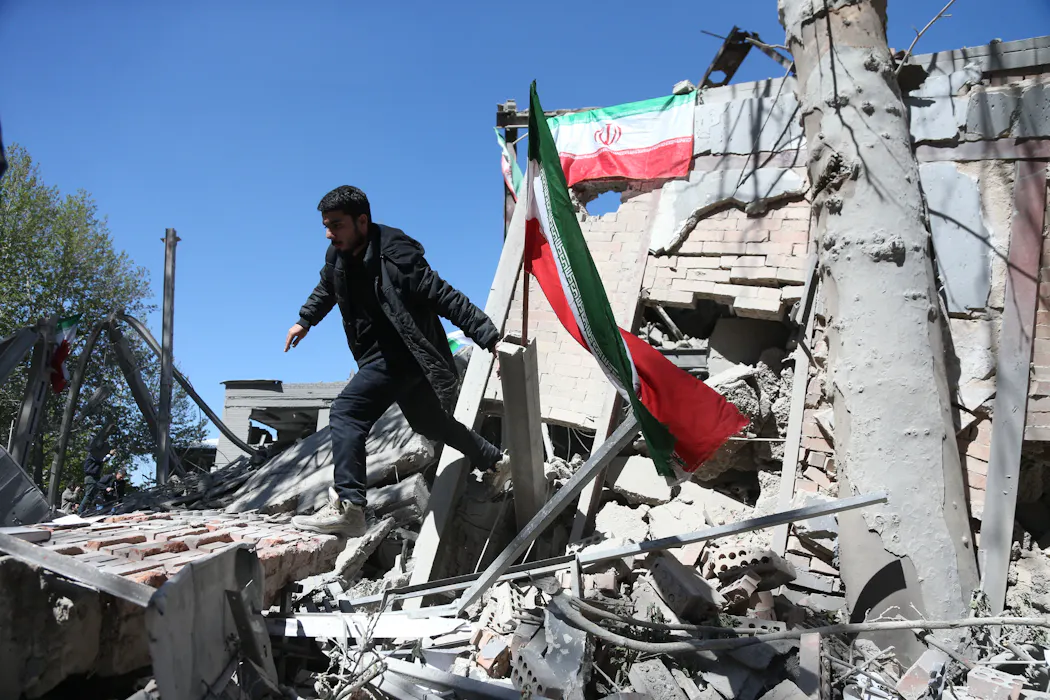
A man walks in the rubble of a damaged Sharif University of Technology in Tehran, Iran, following U.S. and Israeli airstrikes. Shadati/Xinhua via Getty Images
President Donald Trump’s rapid and dramatic turn from threatening to kill “an entire civilization” in Iran on the morning of April 7, 2026, to announcing a two-week ceasefire later that day left many observers with a sense of whiplash.
While it is difficult to predict whether the ceasefire between the U.S. and Iran will hold or how events will unfold, the dynamics of the conflict so far reveal multiple vulnerabilities in the short term and numerous detrimental effects on the region in the medium to long term.
Already, the truce has shown signs of strain. Iran and the U.S. almost immediately offered dueling narratives about the agreement, including whether it would cover the war in Lebanon. Iran and Pakistan, the primary mediator, asserted that it would, while the U.S. and Israel, which pledged to honor the U.S. agreement, said it would not. Indeed, a day after the ceasefire came into force, Israel conducted some of its most intense bombing in Lebanon to date.
Over the past decade, there has been a shift in regional alliances in the Middle East, leading to increasingly assertive foreign policies by many countries and a deepening rivalry between Iran and Saudi Arabia. The current war only fuels these dynamics, incentivizing competition and offering governments and militant groups new opportunities to exert leverage over opponents.
The current reality also underlines the idea that external intervention and privileging war over diplomacy has made conflict resolution ever more difficult in a region with a long history of imperial expansion, great power competition and bitter political divides.
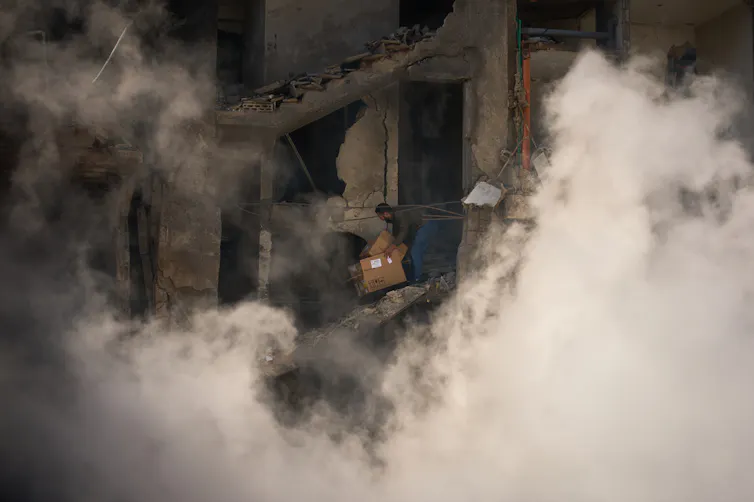
A Lebanese man gathers his belongings from his home, which was destroyed in an Israeli airstrike a day after the ceasefire with Iran went into effect. AP Photo/Emilio Morenatti
Regional fault lines
One of the more remarkable aspects of the war in Iran that began on Feb. 28 was how quickly it escalated in terms of geographic scope and the actors pulled into it.
The three key countries involved – Israel, the U.S and Iran – are all facing internal political tensions, polarization and legitimacy crises.
Outside countries such as China, Russia and Pakistan have deployed their own strategic interests and diplomatic tools in the conflict in indirectly getting involved.
The conflict has also drawn in a variety of regional governments and other groups, from [Saudi Arabia and the Gulf states] to Hezbollah in Lebanon and the Houthis in Yemen.
All of that is bound to deepen the fault lines that make regional tensions and sectarian conflict more likely in the long run.
Meanwhile, public opinion in the Arab world shows profound damage to the United States’ reputation in the region and a loss of credibility in the international legal and humanitarian system.
I think these developments are also deeply troubling for the long term.
Events since the war began have been bad enough. The war has led to over 1,200 Iranian civilian deaths, over 3.2 million Iranians temporarily displaced and significant damage to Iranian infrastructure. Thirteen American soldiers have also died in the course of the conflict, as have more than two dozen in Israel and the Gulf states.
The Houthis and the politics of regional instability
The Houthis in Yemen, one of the conflict participants that remained surprisingly silent at the outbreak of the war, are instructive for understanding the region’s complicated and fractured dynamics.
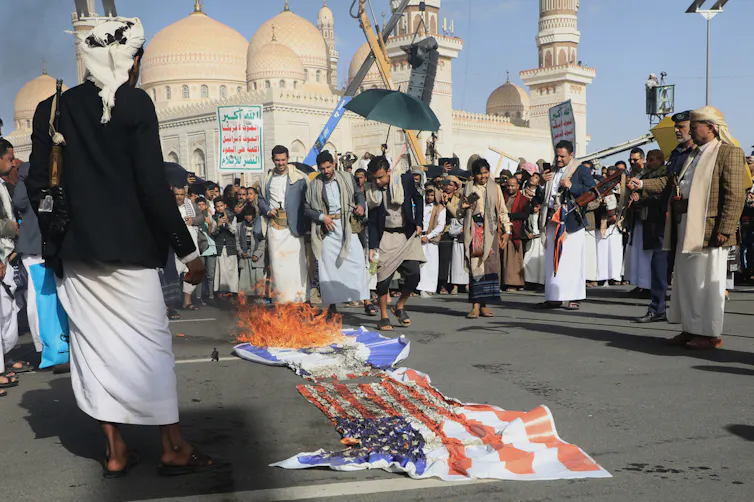
Houthi supporters burn American and Israeli flags during a rally against the war on Iran in Sanaa, Yemen, on April 3, 2026. AP Photo/Osamah Abdulrahman
Avowed opponents of Israel, the Houthis declared war against the country following the Hamas attacks of Oct. 7, 2023, and Israel’s subsequent war in Gaza.
In 2024, the Houthis attacked maritime shipping in the Red Sea near the Bab el-Mandeb Strait, a key maritime choke point. That prefigured, in a much smaller and less consequential way, Iran’s own actions in blocking the Strait of Hormuz during the current crisis.
That Houthi campaign to block maritime shipping resulted in a U.S.-led international coalition and significant military strikes against the insurgent group, their redesignation as a foreign terrorist organization, and ultimately a ceasefire deal between the U.S. and the Houthi movement in May 2025.
Yet the underlying regional disputes and domestic fractures that the Houthis were part of were never resolved.
Eventually, the Houthis reentered the fight against Israel amid the latest war in Iran, attacking Israel on March 28.
They refrained from attacks in the Red Sea and currently are observing the ceasefire. But entering the war enabled a weakened Houthi movement to signal resolve, military capacity and commitment to its alliance with Iran, just as Yemen continues to face an economic and severe humanitarian crisis. The Houthis now also have added leverage to play the role of spoiler amid ongoing diplomacy.
The costs of diplomacy avoidance
Of course, the Houthis are not the only movement that will perceive the war on Iran as an opportunity to exert regional influence.
Just as the Houthis and their enemies are using regional conflicts to boost their domestic legitimacy and strategic advantages, so too are the more salient participants − Iran, Israel and the U.S. − relitigating their own past conflicts on the battlefield.
Amid all of these current regional trends of crises and contestation, the United States’ own strategic goals have remained remarkably unclear. The Trump administration has vacillated from a focus on regime change to preventing Iran from developing nuclear capabilities.
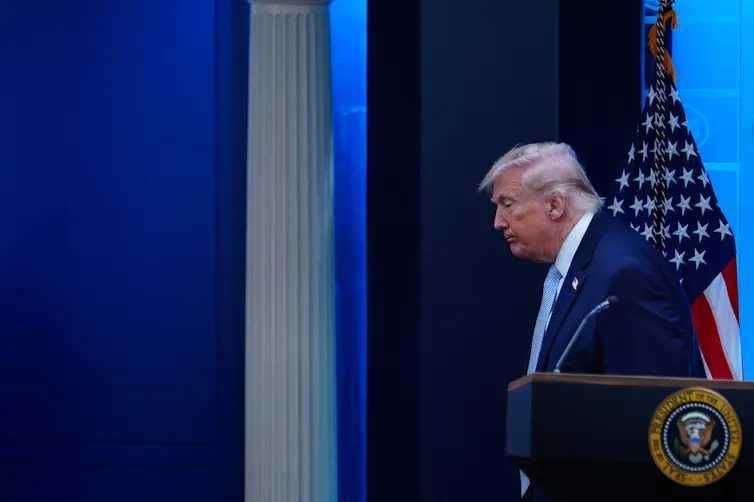
President Donald Trump departs a news conference on April 6, the day before threatening to destroy Iran’s civilization − and then agreeing to a ceasefire. AP Photo/Julia Demaree Nikhinson
So far, there are no indications that talks with Iran to extend the ceasefire into a full diplomatic agreement will successfully prevent Iran from pursuing uranium enrichment. Indeed, one of the contested points of the framework for talks with Iran is the apparent acceptance of Iran’s right to nuclear enrichment.
In 2018, Trump abandoned the Joint Comprehensive Plan of Action, or so-called Iran deal. In it, Iran agreed to terms, including limiting uranium enrichment, that would block its path to a nuclear weapon, should it have desired one.
Under the Iran deal, Tehran had also complied with inspections by the International Atomic Energy Agency. It was not until much after American withdrawal from the agreement that Iran once again started stockpiling uranium and pursuing enrichment.
In her 2020 book on the tenuous 22-month diplomatic process leading to the Iran deal, aptly titled “Not for the Faint of Heart,” Ambassador Wendy Sherman wrote how complex, challenging and delicate such multiparty negotiations can be.
But the recent war on Iran suggests that the current machine-gun politics approach toward Tehran and the Middle East favored by the U.S. and Israel comes with serious costs and risks.
In the course of a war with unclear targets, vague strategic objectives and high human costs, the region is far less stable than it was when the conflict began. That has made the path to long-term durable peace all the more difficult now that diplomacy is back on the table.
Ioana Emy Matesan does not work for, consult, own shares in or receive funding from any company or organization that would benefit from this article, and has disclosed no relevant affiliations beyond their academic appointment.
Wednesday’s ceasefire announcement by President Donald Trump, linked to Iran reopening the Strait of Hormuz, prompted immediate optimism shipping would quickly resume. It didn’t.
The following morning, traffic remained minimal. A handful of vessels, largely linked to Iran, made the transit. But most of the ships waiting in the Gulf stayed put. Iran announced shortly afterwards that it would effectively close the strait because of Israel’s attacks on Lebanon.
The reality is the strait was never closed. Framing the issue as “open” or “closed” misses the point.
Ships are not being physically blocked. They are being deterred.
Over recent weeks, Iran has demonstrated both the capability and intent to target commercial shipping. Attacks and credible threats against vessels have driven daily transits down from around 130 to just a handful. Until that risk changes, ships will not return in meaningful numbers.
So what can be done to turn this around?
Both walking and talking
The ceasefire declarations have added to the uncertainty rather than resolved it.
Tehran’s messaging has been more ambiguous, including references to requiring vessels to inform Iranian authorities before transiting.
Some interpret this as a precursor to attempts to exert control over the waterway through a toll.
This ambiguity matters. Shipping is a commercial activity driven by risk calculations. Operators and crews will not move on the basis of political statements, particularly when recent experience suggests those statements may not hold.
In practice, restoring traffic through the strait will likely occur in two phases.
The first is reducing the threat. That can occur through military means, diplomacy, or a combination of both, but it must materially degrade Iran’s ability and willingness to target shipping.
The second is reassurance.
Even if Iran’s attacks on civilian shipping stop as a result of the ceasefire, shipping will not immediately return. Confidence has been shaken and will take time to rebuild.
A credible reassurance effort would include limited naval escorts, at least initially. It’s notable the US did not move immediately to demonstrate confidence in the ceasefire by escorting US flagged and crewed commercial vessels out of the Gulf.
That would have sent a clear signal to industry, helped restore confidence in transits and undercut subsequent Iranian claims that ships require approval from its armed forces.
Given Iran’s interest in maintaining the ceasefire, it would have been unlikely to challenge ships under US naval protection. The US hesitation has instead created space for Iran to entrench its position, pushing vessels closer to its coastline and reinforcing its ability to shape how the strait is used.
An effective reassurance campaign would also involve a broader international presence to provide surveillance, information-sharing and rapid response capability. The international community should move quickly to establish this. Its very establishment would help restore confidence in transits.
We have seen this model before. The International Maritime Security Construct, established in 2019 following Iranian attacks in the Gulf of Oman, focused on transparency, coordination and reassurance rather than large-scale convoy operations.
I served as the construct’s Director of Plans in 2020. A similar, but more effective, approach is likely to be required again. It is not a silver bullet, but reassurance is layered, and this would at least provide the clarity and communication shippers need.
Diplomacy will also matter. Clear, coordinated messaging from the international community, backed by explicit economic consequences for any renewed attacks on merchant shipping, will be essential to rebuilding confidence.
The question of tolls
There has also been speculation about whether Iran might seek to impose a toll on vessels transiting the strait.
The legal position here is clear. The Strait of Hormuz is an international strait under the United Nations Convention on the Law of the Sea. Ships enjoy the right of transit passage through the strait. Charging vessels for passage would cut directly against that principle and set a dangerous precedent for other strategic waterways.
There are early signs Iran is testing the boundaries. Reports of radio calls warning vessels they require approval to transit, and suggestions that ships should notify Iranian authorities before transiting, point to an attempt to exert greater control over the strait.
That should be resisted.
Allowing a toll, or even limited restrictions, to take hold in the Strait of Hormuz would have far-reaching consequences, undermining the central principle of maritime trade: freedom of navigation. Regardless of Donald Trump’s flippant comments, the international community is unlikely to accept any enduring Iranian toll system.
If Iran attempts to pursue one, it should face clear economic consequences, including sanctions.
Questions remain about whether mines have been laid in or near the strait. Even the suggestion adds to uncertainty and reinforces the need for a coordinated international response, including transparent assessments of the threat environment.
A clear, public assessment from the international community on whether the strait has in fact been mined would go a long way. It should be an early priority for any coalition effort.
The bottom line
Ultimately, shipping will return to the Strait of Hormuz not when it is declared open, but when it is assessed to be safe enough.
That will require a sustained period without attacks, a visible international effort to secure the waterway, and clear signalling that the rules governing international straits will be upheld.
Until then, the ships will wait.
Jennifer Parker does not work for, consult, own shares in or receive funding from any company or organisation that would benefit from this article, and has disclosed no relevant affiliations beyond their academic appointment.
My earliest memories are of Methodist Mission quarters in the diocese of Dilkusha, Fiji. Dilkusha, the name of a minor Indian principality, was mentioned in E.M. Forster’s classic novel A Passage to India: its name literally means “Heart’s Delight” in Hindi–Urdu.
Dilkusha was the Indian wing of the much larger Fijian diocese of Davuilevu (in Fiji’s Rewa province), site of the famous Baker Hall – named after Reverend Thomas Baker, an Australian Methodist evangelist who ended up in the pot of a disgruntled Fijian chief on July 20 1867.
We were told the reverend had humiliated the high chief in front of his people by touching his hair: a clear affront to Fijian aristocratic protocol. His spare boots, however, survived. They may be seen in the Fiji Museum.
Baker Hall in Davuilevu, probably taken around 1930. Praveen Chandra
Dilkusha, the lesser sister diocese, had no such epic tale. But it quickly became a vibrant centre for Australian Christian evangelists, eager to convert Indian heathens. My father, grandson of an indentured labourer on his mother’s side, came here in the mid-1940s as a primary school teacher.
In the end my father, like Mr Biswas in V.S. Naipaul’s great novel on the plantation Indian diaspora, built a house of his own in the adjoining village of Waila (Realm of Floods). But when I remember my homeland, it is through the decade I spent in Dilkusha Methodist quarters, in the 1950s and early 1960s.
We were part of an enclosed community run by successive Methodist priests. Our joys were few: fishing or canoeing in the great Rewa River below, attending Sunday church services or walking across the paddock to the Boys’ Hostel.
Dilkusha’s history was rich – but for me, it was a drab world. And then magic occurred: we discovered Aladdin’s cave.
Across the river from us, in Nausori Town, a Gujarati Muslim entrepreneur built a cinema hall – Empire Theatre – and my life changed.
Dilkusha, Fiji, in the early 1960s. The old church is on the left and further up is the Dilkusha orphanage. Praveen Chandra
Cinema was my world
I was five years old in 1950, a year short of six, when you could enter school and would be considered mature. Then, in 1951, Raj Kapoor’s film Awaara (The Vagabond), about geneticism and social determinism, came to Empire Theatre. Aged six, my life began to change.
I was never good at reading, unlike my Dilkusha mate Sarwesh (“Tomato”) Thakur, who was an exceptional reader. At school, we learned to read in English, but we spoke in Fiji Hindi at home. My father’s side of the family, however, were more comfortable with Fijian, or iTaukei – the language of the country’s First Nation peoples.
It mattered little that I wasn’t a good reader (or a reader at all). On Saturdays, I entered a world of my own. Over a period of time, I had a repertoire of films in me, thanks to the weekly allowance of a shilling from my parents and another shilling from my Dādī (grandmother), Nausori market’s foremost coconut-oil seller. (I have yet to work out why she did it for me alone when she had some 20 other grandchildren!)
Vijay Mishra (far right), with friends from the Empire Theatre days. Vijay Mishra
So cinema – and Empire Theatre – became my world. It was my literature, my culture, my dream world. It was my escape from failure to compete with my peers, and my school of drama – indeed, my language too. I look back and ask myself how I could have lived without the Saturday matinees – the 10am Hindi film and the 2.30pm Hollywood film.
I lived for Saturdays until I left Fiji aged 18, in 1964. In the Empire Theatre’s downstairs, one shilling (ten cents) seats, infested with khaṭmal (bed bugs), my fantasies were created.
While the films I watched there would connect me with the India I had never physically inhabited, the worlds they opened to me were like temples of desire: elusive and mysterious, as well as enchanting. This would change – but long after I had left Fiji, after I had become a film scholar, writing from distant, sometimes cold lands.
Years later, writing from Perth, Australia, I watched Bollywood fantasies shift from their roots in melodrama to an endorsement of a nation ideologically defined as Hindu. This often involved demonising India’s non-Hindus, especially its age-old Muslim inhabitants. Under Prime Minister Narendra Modi, elected in 2014, this is also the nation’s political agenda.
It is strikingly displayed in the jingoistic espionage thrillers Dhurandhar I (The Stalwart, 2025) and Durandhar II (The Revenge, 2026) – the latter currently screening in Perth. These films, based on the adventures of an Indian spy in Karachi, Pakistan, define an Indian nation obsessed by the spectres of an enemy that is both another nation (Pakistan) and a “nation”, the Muslim minority within India.
Fantasies on film
Back in 1950s Dilkusha, my Empire Theatre fantasies were of a different order. They began with the Arabian Nights. The defining film in that genre, Homi Wadia’s Alibaba and the Forty Thieves (1954), was properly introduced to me when my father’s friend, the cook at Dilkusha Boys’ Hostel, took me to watch it one Wednesday night in 1955.
Alibaba and the Forty Thieves was a first film love. IMDB
I knew the Alibaba tale, but Wadia’s rendition is a great piece of cinema. It captured Oriental fantasies way better than his Hollywood counterparts. I have seen it more than any other film – and consider it the finest version of an Arabian Nights tale ever.
I also loved sentimental songs from the films of Bollywood’s Golden Age, roughly spanning the films made between Deedar (Sight, 1951) and Gumrah (Infidelity, 1963) – and often marked by a final shot of the lonely hero walking away towards the horizon.
It was in Empire Theatre that I saw the original version of Aah (Sighs, 1953), actor and director Raj Kapoor’s homage to P.C. Barua’s foundational 1935 Bollywood film Devdas (based on a Bengali novel by Saratchandra Chatterjee). Sadly, soon after its initial release, the tragic ending of Aah was changed and the original is no longer available.
Barua’s film had celebrated the entry of the English melodramatic “Man of Feeling” – for whom sentiment and sensibility were allied with true virtue – into the Indian film aesthetic for the first time. (The concept goes back to 18th-century English writer Henry Mackenzie, whose novel The Man of Feeling named it.) The sentimental hero, unable to declare his love, takes to drinking and dies a lonely man.
Raj Kapoor’s Shree 420 (1955) transformed the Man of Feeling into a picaro figure around whom the tensions of tradition and modernity in capitalist India unfold. It also holds a special place, with its appealing cosmopolitanism noted as well in Salman Rushdie’s The Satanic Verses.
Singing in the rain: Raj Kapoor and Nargis in Shree 420, 1955. Praveen Chandra
In spite of Shree 420’s political message, melodrama remained the overarching genre of Bollywood films. Melodramatic sentimentality found its consummate expression in the films of Dilip Kumar, Bollywood’s finest actor. We sang our own songs of love and longing through films such as Deedar (Sight, 1951), Daag (Blemish, 1952) and Madhumati (1958).
But we also felt at home in his phenomenal banditry drama of peasant rebellion, Gunga Jamna (1961), because of Dilip Kumar’s extraordinary mastery of Avadhi, a Hindi dialect very close to Fiji Hindi. Although the film’s theme of agrarian rebelliousness against the landed gentry was not uncommon, we were attracted to its use of a language that returned the one repressed in us.
Bollywood and Indian nationalism
When I left for New Zealand in February 1964, my relationship with Empire Theatre came to an end. I never returned to that theatre, but it had already made me.
Some 35 years later, quite suddenly, in the subzero temperatures of Edmonton, Canada, where I was a professor of English at the University of Alberta, Wordsworth’s sense of place and spots of time resurfaced as the repressed “aching joys” of times past. The second millennium, too, was coming to an end.
Vijay Mishra around the time he left Fiji, aged 18. Vijay Mishra
Sitting at my desk in an office overlooking the Saskatchewan River, I took out my Waterman fountain pen to write the first sentence of what would grow into a book, Bollywood Cinema: Temples of Desire (2002).
In that first sentence, written in longhand, I described cinemas, recalling films seen in Empire Theatre as “the temples of modern India”. While in the book I wrote the films remained temples of desire, Bollywood cinema this century embodies a different kind of desire: a desire where the nation itself is at the centre.
The founding fathers of independent India (notably Mahatma Gandhi and Jawaharlal Nehru, India’s first prime minister) established a multicultural India within a secular state. But under Modi and his Bhartiya Janata Party (the BJP), India has been discarding these credentials in favour of a religiously sanctioned nation state.
Bollywood’s new nationalism is a radical refashioning of Gandhi’s idea of the nation, which was based on the principle of denial. He promoted fasting, vegetarianism and non-violence as ways of “renouncing” the self – and hence, the nation.
Naturally, that idea produced cinema such as Guru Dutt’s classic Pyaasa (The Thirsty One, 1957) and Kaagaz Ke Phool (Paper Flowers, 1959), which positioned the hero as renouncer: the melodramatic sentimentalist whose life was one of sacrifice. The songs the hero sang embodied mourning and melancholy.
No foundational film captured that renouncer ideal better than the 1935 version of Devdas, in both Bengali and Hindi, about two lovers – Debdas and Parbati – divided by class. Essentially, it is a film about a Man of Feeling, for whom abjection and denial define love, with death the redemptive act.
Bollywood cinema endlessly reprised the narrative – finding in it, precisely if absurdly, the ideal of renouncement. The better known 1955 Bimal Roy version endorses this reading.
Director P.C. Barua, Amar Mullick and Chandrabati in Devdas, 1935 – a film that captured the renouncer ideal. Wikipedia
But in the 21st century, the Man of Feeling’s sentimentality has been repackaged as glossy spectacle.
Sanjay Leela Bhansali’s 2002 remake of Devdas was the most expensive production in Indian film history at the time. Its extravagance pushes the old sentiments of the Man of Feeling aside, presenting the historical past as bold, eye-catching performance.
The operatic form of Bhansali’s Devdas, with its elaborate sets and costumes, and its overwhelming “item numbers” (where the song is carefully choreographed), emphasises a new Indian modernity and self-assuredness. The renouncement theme of earlier versions is less important.
It is as if, in the new tech-savvy India, one lives with the sentimental past only as spectacle. A decade later, under Modi, this would become a national mantra.
Aishwarya Rai and Shah Rukh Khan in Sanjay Leela Bhansali’s extravagant remake of Devdas, 2002. IMDB
Shammi Kapoor and desire
The cinema of desire and spectacle had existed last century, too (a point, regrettably, not made in the book I wrote) – but with a difference. In the 1960s, Bollywood superstar Shammi Kapoor began to redefine the Bollywood hero by embracing, through bodily gestures, the nation itself as the object of desire.
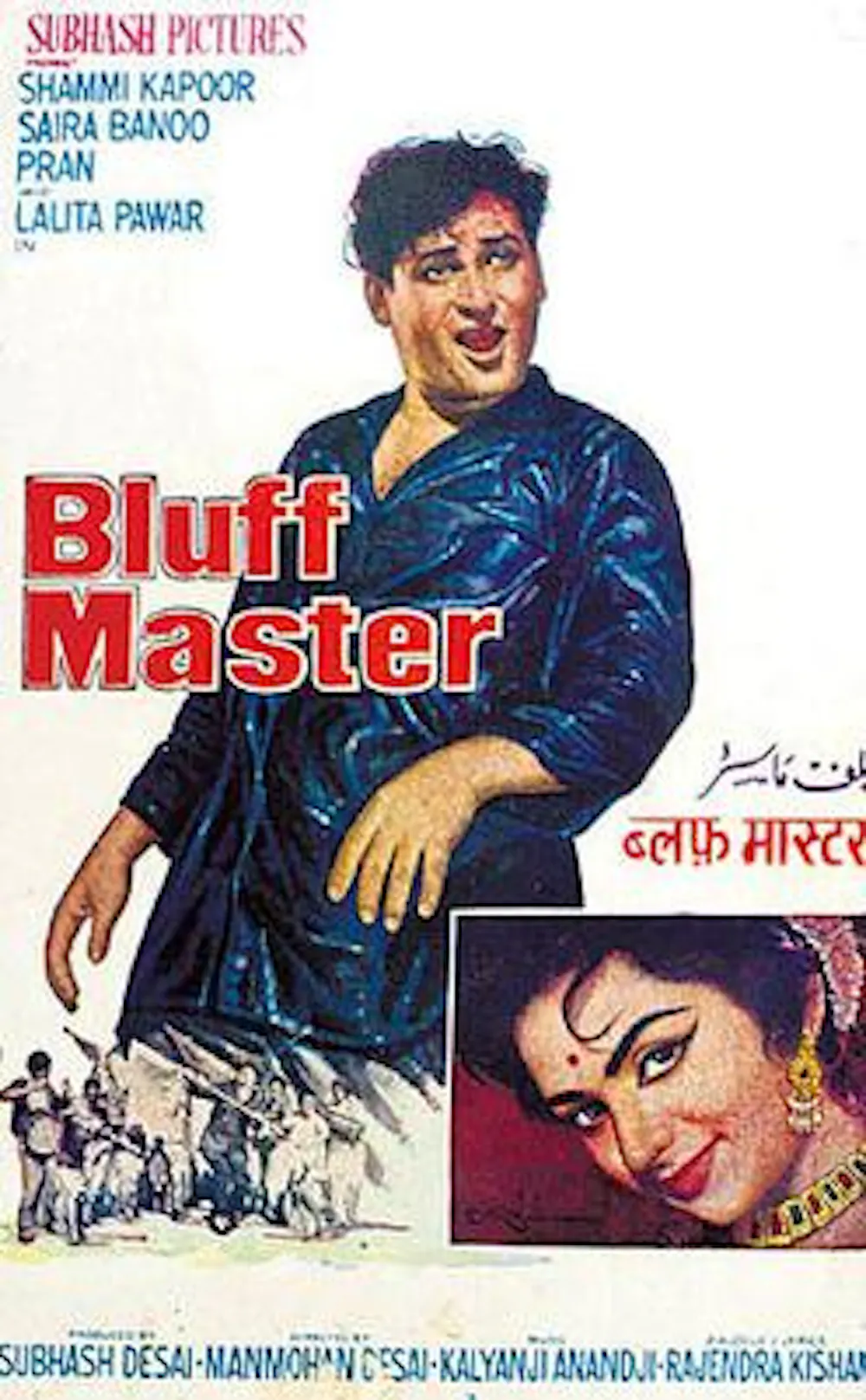
The ‘Elvis inspired’ Shammi Kapoor in Bluff Master, 1963. Wikipedia
His homoerotic moves, with Elvis Presley-inspired pelvic gyrations and gestures, marked his signature style – notably in Junglee (1961), Bluff Master (or Wild, 1963) and Laat Saheb (Leisured Dandy, 1967).
In films such as these, the Indian nation suddenly came alive. Here was an actor who would show us how to enjoy a nation, to embrace it. He spoke through his body – and unlike the dominant sentimental heroes of melodrama, there were no songs of loss and love-longing. Desire had to be grasped and experienced.
Kapoor also made me and my Empire Theatre friends enjoy the Fijian nation state – which we felt was ours, as much as the First Nation people’s – after some 80 years of longing for a faraway nation, as descendants of indentured labourers.
Our forefathers and mothers had come to Fiji as the answer to its dwindling supply of labour. From May 1879 until 1917, 87 shiploads of Indians travelled to Fiji to work out their five years of indentured slavery – the girmit (from the word agreement). The first ship brought 463 immigrants. Conditions on the cane plantations were miserable and the Indians called that part of their lives narak (hell). Once the five years of servitude were over, the Indians were given a certificate of residence.
Only after another five years would they become eligible for a paid ticket back to India. But few returned.
After all those years, Shammi Kapoor, in a strange sort of a way – and belatedly – reminded us the Fijian nation state was ours too, and that we too could enjoy it, which we did as we guzzled large quantities of Fiji’s national drink, yaqona (kava).
In spite of this, we Fiji Indians – who had no other homeland – lost our nation in 1987, because we forgot the First Nation people (who also guzzled huge amounts of yaqona) enjoyed the same nation differently. That difference led to a military coup that pitted two incommensurable readings of the nation against one another: one ancestral or “nativist” and culturally rooted, the other a reading of the nation as an abstract democratic polity with equal rights.
Shammi Kapoor (in Bluff Master) spoke through his body – his acting was an early demonstration of how to enjoy, not renounce, a nation. Vijay Mishra
Hindu superheroes and spectacle
Indian cinema now is unabashedly – even uncritically – celebratory. The nation state itself functions as its revisionist historical backdrop. In many ways, Bollywood films now are a propagandist instrument of Modi’s Hindu India, as it repackages and reformulates its narratives into an Indian version of Marvel Comics.
The superheroes re-enact the roles of Hindu gods – notably the great epic god Rama, whose life combines heroism with the possibilities of a new, paradise-like nation state. This is promised by Hindutva politics.
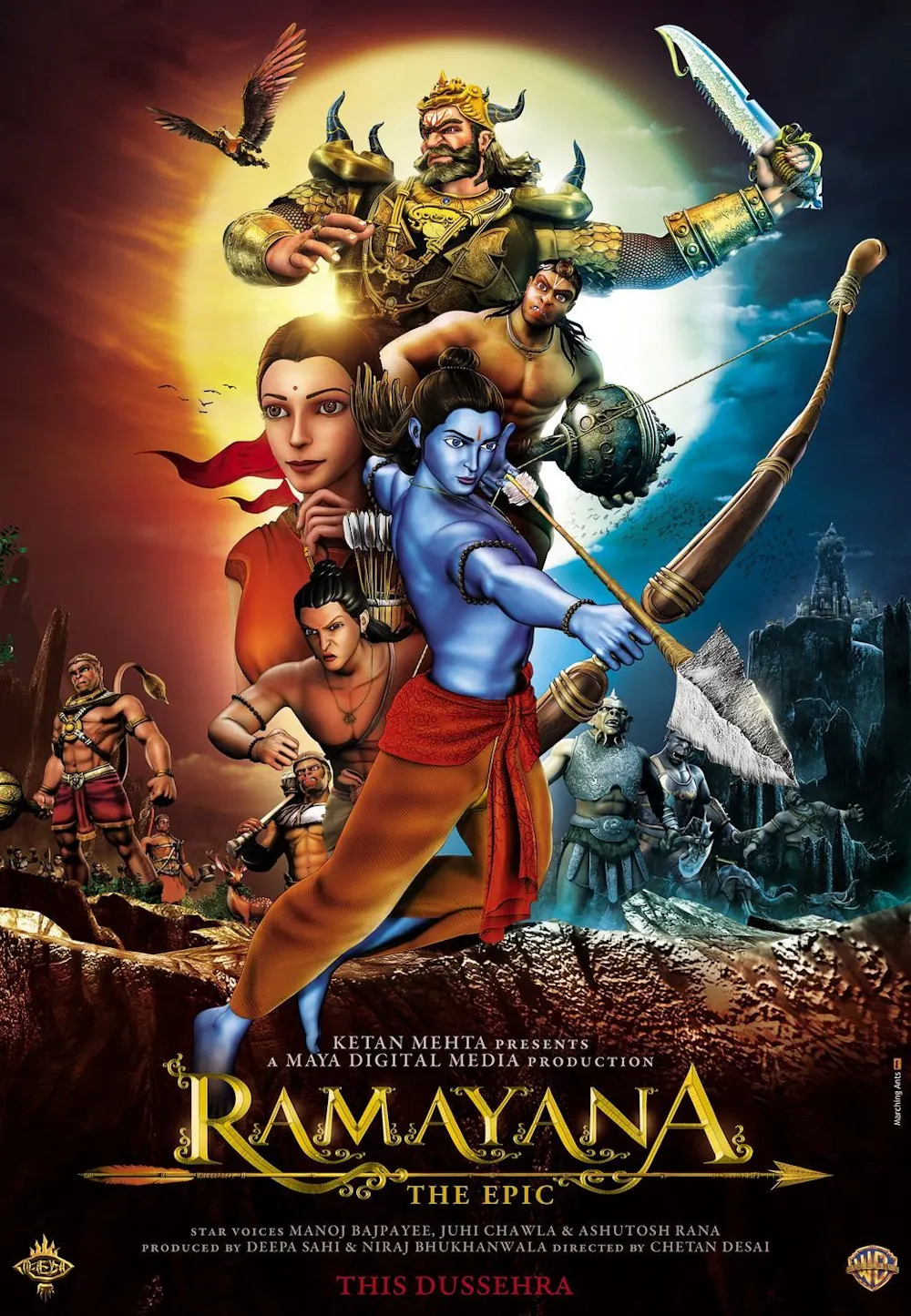
Ramyana is an example of how Bollywood now makes Hindu narratives into a version of Marvel Comics. IMDB
Indeed, a new Bollywood film, Ramyana (2026), following Rama’s life story and clash with a demon king that will “determine the fate of gods and mortals”, will be released this year, directed by Nitesh Tiwari.
Hinduism does not have a unified system of personal and common law – and for almost two millennia, Hindus have not had an empire comparable to the Ottomans or the Mughals. In the absence of a sophisticated technology of writing and reproduction, historical documentation and its preservation of Hindu empires did not carry the same weight. Dates and detailed references to governance are simply not readily available.
Indian history, based on documentary evidence and accounts of witnesses, was thus principally written by the Muslim Mughals or British colonials. Bollywood steps in to fill the void, turning once again to fantasy linked to a revisionist version of Indian history.
Bhansali’s body of work traces Bollywood’s shift from last century’s mournful detachment from the nation – and, in the case of Shammi Kapoor, a subdued libidinal desire for it – to today’s nationalism. In Saawariya (The Beloved, 2007), Bhansali’s first major work after Devdas, the familiar theme of love-in-estrangement (key to Bollywood’s old sentimental melodramas) is depicted with a new colour and excitement.
Bhansali self-assuredly confronts Luchino Visconti’s 1957 Italian romantic melodrama Le Notti Bianche (White Nights) – based on Dostoevsky’s 1848 short story. Visconti’s manifestly fake scenery functioned like “stilled” photographs. Bhansali takes this up to create a dream scenario, its scenes dominated by blue and red colour palettes. The new India does not just imitate, but transforms the borrowed text.
Bhansali’s films also transform the sentimental Bollywood song – traditionally the cornerstone of Indian popular cinema – into a choreographed item number.
Song-in-performance once made concessions to Indian Muslim culture, through chaste Urdu poetry and the qawwali, or the dance of the courtesan – marks of cultural incorporation for a multicultural society. But as early as 1999, in films such as Hum Dil De Chuke Sanam (I Gave My Heart Away, My Love), that concession is gone, and the display of the body elicits a collective erotic or libidinal desire in viewers.
Now, Bollywood cinema characteristically doubles as both digital spectacle and sociopolitical statement.
Celebration and protests
This self-assuredness made its way into Bhansali’s other work, too. Goliyon Ki Raaslila: Ram-Leela (A Dance of Gunshots: Ram-Leela, 2013), set among two warring families in Bhansali’s home state of Gujarat, takes Shakespeare’s Romeo and Juliet as its source.
The tragic ending is maintained, but the spectacle is what truly impresses the viewer, with its lavish, computer-generated arrangements of props, scenery and backgrounds.
The film was originally titled Ram Leela. But in this new India, Hindu sensitivities dictate culture. Critics petitioned a Delhi court, saying “the movie hurt the religious sentiments of Hindus as it contains sex, violence and vulgarity”, according to the Times of India. There was also unease about the film’s depiction of Hindu history.
The staged performance of the final episode of the Rāmāyaṇa (the Ram-Leela) – which marks the triumph of Lord Rama over the demon kind Ravana – is presented as a grand spectacle without its redemptive religious meaning.
This cinematic style is maintained in Bajirao Mastani (2015), another tale of doomed love, this time set during the Maratha Empire’s ascendancy.
This empire (1674–1818), which originated with a Hindu warrior, is revered by Hindu nationalists today. The film follows the life and career of Bajirao Ballal, the peshwa, or chief minister, of the Maratha Empire from 1720 to 1740. His conquests contributed to the decay of the Muslim Mughal Empire.
Ram-Leela had a unified narrative, while Bajirao Mastani functions as a series of set pieces with item numbers. Yet in both films, a Hindutva cultural unity of the nation is endorsed.
This is true, too, when the source text is pure fantasy. Bhansali’s Padmavaat (2018) tells the story of a 14th-century Muslim emperor’s attack on a kingdom after forcefully abducting Hindu queen, Padmavati. Bhansali transformed 16th-century poet Malik Muhammad Jayasi’s epic poem Padmaavat (written in the Hindi dialect of Avadhi, as a grand Hindu epic of love) into a heroic romance in which the queen and other aristocratic Hindu woman would rather commit sati (self-immolation) than succumb to rape.
In 2018, this film too – essentially a romance – sparked controversy. There were months of protest across India, as well as a physical attack on the director and threats of violence against the lead actress. Again, fantasy is read as real, lived history.
For Bhansali, however, fealty to history (authentic or otherwise) is not the aim. His fealty is to the power of the moving image, which is then consumed uncritically as either Hindu triumphalism or Muslim depravity.
Hindu propaganda on film
In some films, Bollywood nationalism has taken the form of uncompromised Hindu propaganda, including the outright demonisation of Muslims. Chhaava (The Lion Cub, 2025) is based on the despised Mughal emperor Aurangzeb, who ruled from 1658 to 1707 – and under him, the Mughal empire reached its greatest extent. In the film, he is depicted as nothing but a tyrannical ruler.
Director Vivek Agnihotri’s The Kashmir Files (2022) and The Bengal Files (2025) ostensibly deal with the ethnic cleansing of Hindus on the part of Muslims, but that history – and its portrayal – is contested. In Singapore, The Kashmir Files was banned for its “provocative and one-sided portrayal” of Muslims. In India, Modi praised it as reflecting the “truth”.
The exceptionally popular Dhurandhar franchise (The Stalwart, 2025, and The Revenge, 2026) “paints Pakistan as a lawless, almost barbaric land that’s pathologically hostile towards India”, according to critic Uday Battia. These films have been criticised for their “hyper-nationalist tone”, as well as historical inaccuracies.
The Durandhar franchise ‘paints Pakistan as a lawless, almost barbaric land’. IMDB
Bollywood often chooses fantasy over history. It embraces the nation anew – but within its own conventions of an imagined world.
International Bollywood
Originally, Bollywood mostly meant Hindi–Urdu cinema produced in Bombay/Mumbai. Now, Indian commercial cinema in all its languages (especially Hindi, Tamil, Telegu and Punjabi) are effectively Bollywood.
Two remarkable examples explain the emergence of Bollywood as an international home of Indian popular cinema.
In the past, films made in Dravidian languages (non-Sanskrit or Prakrit based languages) were markedly different from the Hindi (Bollywood) films. Different cultural nuances were often highlighted, especially in their song and dance sequences. The generally Shaivite religious ideology (where the worship of Lord Shiva takes pride of place) gave them a different cultural complexion.
In the Bahubali films, however, a pan-Indian world view took over as they internalised Bollywood. The dubbed Hindi version was read as a Bollywood film in both India and the Indian diaspora.
The narrative of the films may have been pure fiction, but they were styled in the great pan-Indian epic tradition of the Mahābhārata, one of two Sanskrit epic poems of ancient India.
Rajamouli’s next film, RRR (2022), won the Oscar for Best Original Song in 2023. The song, Naatu Naatu, was performed (albeit with some non-Indian dancers) on the Oscars stage, to great aplomb.
For RRR, the song was filmed at Mariinskyi Palace, the official residence of the president of Ukraine, before war broke out. The song’s item number has received around 69 million views on YouTube to date. Many commentators have referred to the song, the Oscar performance and the item number in the film itself, as “Bollywood”. In fact, the film originated in “Tollywood” – the name given to films in the Telegu language.
RRR, like Bahubali before it, is structured on the cinematic principles that define the “new” Bollywood. Thematically, it works on the desire of the nation as a Hindu entity to be embraced uncritically.
Rajamouli’s films, like many of Bhansali’s, have a militaristic temper, whether through a version of Bahubali’s reworking of the old myths, where gods enter the spirit of humans, or through RRR’s political rebellion, where revolutionaries against the British Empire are recast as modern-day Lord Ramas.
In extending and embracing a new Hindutva triumphalism, and internalising it, the new hegemony of Bollywood is complete. The joys of Empire Theatre are now no more than a receding memory.
Vijay Mishra has received funding from Australian Research Council in the past.
Microscopic image showing newly discovered Asgard archaeon (_Nerearchaeum marumarumayae_) derived from microbial mats that offers clues to the formation of complex life. Debnath Ghosal
On the shores of the west coast of Australia lies a window to our past: the stromatolites and microbial mats of Gathaagudu (Shark Bay).
To the untrained eye they look like a collection of rocks and slime – but they are in fact teeming with microbial life. And these stromatolites are living “relics” of ancient ecosystems that thrived on Earth billions of years ago.
If you wade past, it feels like you’re walking back through time. In fact, the first bubbles of oxygen that filled the atmosphere on early Earth likely came from ancient stromatolites. You could say we owe our very existence to these piles of rocks.
So, what other secrets of our past could these ecosystems tell us? Through decades of research, we know how early life has woven its path through these “living rocks”. But most recently our team embarked on the greatest genealogy search of them all: searching for our great microbial ancestors, the Asgard archaea.
And in a new paper, published today in the journal Current Biology, we report how this search led to the discovery of a key clue that could help explain how complex life evolved on Earth.
A field of stromatolites in Shark Bay, Western Australia. Brendan Burns
The cells that comprise complex life
Asgard archaea were originally named after Norse gods. This fascinating group of microbes sits on the cusp of one of the most significant events in the evolution of life: the origin of the complex cells that make up plants and animals, known as eukaryotes.
Evidence suggests Asgard archaea are the closest relatives of eukaryotes. And that on an early Earth it was the “marriage” of an ancient Asgard archaeon and a bacterium that led to the first eukaryotes.
They formed an ancient partnership. They shared resources and physically interacted, leading to the first complex cells. Like a Romeo and Juliet tale of two distant families coming together, Asgard archaea and bacteria decided it was time to break from traditional family values.
But we have never seen a model of how this may have occurred. Until now.
Holding up a mirror to the ancient past
Our team used the mats of Shark Bay as a “seed” to establish cultures of these ancient microbes. We are one of only four groups worldwide to achieve this, through years of research with a dedicated team of graduate students nurturing the Asgards like offspring.
But the Asgards were not alone. We found them together with a sulphate-loving bacterium. Could this be a model of how complex life may have started on a primitive Earth?
We began by sequencing the Asgards’ DNA to decipher exactly how these microbes tick at the genetic level. We also used artificial intelligence to model how proteins could have behaved in a world before eukaryotes. Evidence suggested these two microbes were sharing nutrients. In other words, they were cooperating.
But we wanted to delve deeper. What do our great microbial ancestors look like? Here we turned to electron cryotomography, a high-resolution imaging approach that allowed us to observe cells and structures at a nanometre scale.
And here we showed – for the first time – an Asgard archaeon and a bacterium directly interacting. Tiny nanotubes were connecting the two organisms – perhaps reflecting what their great-ancestors did on an early Earth that ultimately led to the explosion of complex life as we know it.
Microbial mat from Gathaagudu (Shark Bay, Australia). Inset: Microscopic image showing Asgard archaeon and bacterium derived from these mats interacting as a model for evolution of complex cells. Iain Duggin/Bindusmita Paul/Debnath Ghosal/Matthew Johnson/Brendan Burns.
Weaving western science with Indigenous knowledge
This was a major discovery – one that originated in Gathaagudu, a World Heritage Site with significant environmental and cultural values.
Aboriginal people first inhabited Gathaagudu over 30,000 years ago. We wanted to recognise and celebrate the language of the Malgana people, one of the traditional language groups of Gathaagudu. We also wanted to connect western science with Indigenous Knowledge in a meaningful way.
To this end and working closely with the world’s foremost Malgana language expert, Kymberley Oakley, and Aboriginal elders, a name was granted for our novel Asgard archaeon from the language of the Malgana people: Nerearchaeum marumarumayae. The species name – marumarumayae – is derived from the Aboriginal language of the Malgana people, meaning “ancient home”, a reference to stromatolites being of ancient origin in Earth’s history.
Weaving Aboriginal language into the naming of our new microbe represents a fitting connection between unique Aboriginal culture in Australia and the ancient microbe discovered that calls the mats of Gathaagudu “home”.
Gathaagudu is under threat from global change, from increased heatwaves, cyclonic events and human activity. And among the values to preserve and conserve are the significant Aboriginal connections as well as the trails of life going back through evolutionary time.
With our study we have peered into our past. And maybe like the Montagues and Capulets of Shakespeare, we see distant families of microbes coming together to bridge the divide and ultimately form the early eukaryotes that eventually led to us: a fragile branch on the evolutionary tree of life.
Brendan Paul Burns receives funding from the Australian Research Council.
Kymberley Oakley does not work for, consult, own shares in or receive funding from any company or organisation that would benefit from this article, and has disclosed no relevant affiliations beyond their academic appointment.
Just hours after the leaders of the United States, Israel and Iran reached a temporary ceasefire, it was clear that each party had its own version of what had been agreed to.
Hundreds of people in Lebanon have been killed in Israeli airstrikes in the past 24 hours, immediately threatening to undermine the fragile agreement.
Iran had insisted hostilities in Lebanon cease as part of the deal, but Israel argued Lebanon was not included. The result is an ongoing proxy conflict alongside the main war, which has been paused for two weeks.
Given the US seems uninterested in addressing the intractable issues at the heart of tensions in the Middle East, this result was somewhat inevitable. It seems the most likely outcome now is the US will back out while claiming victory, leaving the region’s prewar status quo largely intact.
The importance of Lebanon
Lebanon has not been an official part of the war in the region, and is not a party to the ceasefire. So why is it so central to the conflict?
Since the Iranian revolution of 1979, the Iranian regime has funded and armed anti-Israel movements in the region including Hezbollah in Lebanon, Hamas in Gaza and the Houthis in Yemen.
Throughout its history as a nation, Israel has at times occupied and held security “buffer zones” around its territory.
Israel has diplomatic agreements with Egypt and Jordan, leaving the focus on Iran and the proxies it supports. The proxies closest to Israel, and therefore of most concern from the government’s perspective, are Hamas in Gaza and Hezbollah in Lebanon.
Since the October 7 attacks, the Israeli government has taken an offensive military approach to dealing with both groups. From the perspective of Israel, Hamas and Hezbollah are just as severe security threats as Iran.
While both proxy groups have been severely degraded since 2023, they are still operating.
Since the onset of the conflict with Iran, the Israeli government has taken the opportunity to extend a security buffer zone in southern Lebanon. Under President Benjamin Netanyahu, Israel is very unlikely to give up this ambition.
For Trump’s part, it is unclear whether he could persuade Netanyahu to abandon it, or if he even wants to try.
Will the ceasefire survive?
Unless the US can bring Israel into line and convince Netanyahu to stop its action in Lebanon, the ceasefire will fall apart.
Iran has insisted fighting in Lebanon must end as part of the agreement. This is the regime’s way of protecting and supporting its much-diminished proxies. As negotiations get underway for a more lasting deal, the issue of Lebanon will become a key sticking point.
This is in part because resisting Israel and the US is not just politically expedient for Iran; it is at the core of the Iranian regime’s identity and existence.
While deeper antagonism that drives tensions in the region remains unaddressed, there’s little prospect of lasting peace.
Trump seems set on a US withdrawal from the war with Iran. The US leaves behind a security environment that upholds the existing tensions in the region. Iran and Israel will continue to engage in the tit-for-tat violence that led us here.
A flawed exit strategy
A key issue with Trump’s approach in the Middle East is he has no real interest in resolving the core issue of Israel’s place in the region. He’s shown little grasp of the deeper historical roots at play.
What seems to be front of mind for Trump is the unpopularity of the war within the US. With Trump’s approval ratings at a record low and the conflict already dragging on longer than many expected, the president is looking for a way out.
This might be why Iran’s ten-point plan, which was previously “not good enough”, is now a “workable basis on which to negotiate”.
While there are competing versions of the ten points, they all include conditions the US could never reasonably accept, such as leaving control of the Strait of Hormuz in Iranian hands.
Iran also insists it wants to reserve the right to enrich uranium, something that would be contrary to the stated basis for this war in the first place: Iran’s ability to develop nuclear weapons.
By declaring the conditions suddenly right for a ceasefire, Trump is stating a reality he’d like to see, rather than describing tangible changes on the ground.
In practice, the US has already ceded ground to Iran, which has indicated it is not willing to compromise on anything. While Iran’s military capability to interfere in the region may be diminished for now, the will remains.
So with the ten points as a basis of negotiation, it is hard to see a path towards lasting peace in the next fortnight. Instead the US is likely to exit, leaving behind a lot of damage, but little materially changed.
Jessica Genauer does not work for, consult, own shares in or receive funding from any company or organisation that would benefit from this article, and has disclosed no relevant affiliations beyond their academic appointment.
When news of the fragile ceasefire between the United States, Israel and Iran first broke, it came via a post on X by Pakistan’s Prime Minister, Shehbaz Sharif.
Securing such a big diplomatic win is highly significant for Pakistan, irrespective of how the agreement has since been tested.
Pakistan will remain central to ongoing peace negotiations, with talks between the parties being held in the country on April 10.
So how did Pakistan manage to bring the parties together? It harnessed long-running relationships, shared histories and security agreements to flex its diplomatic muscles.
Pakistan and Iran go back a long way
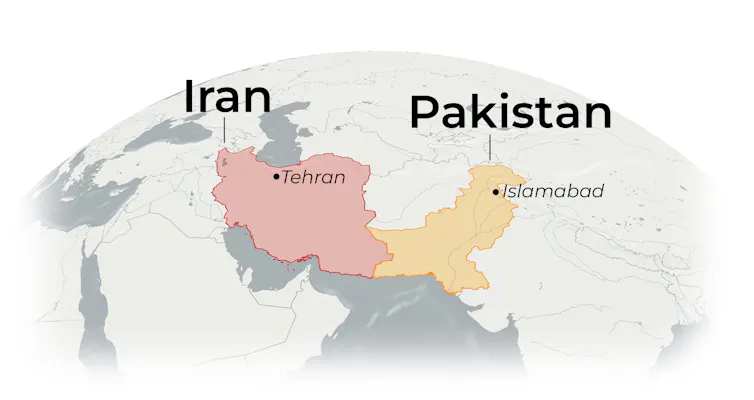
Pakistan and Iran have a long history as friends and allies. Sharing more than 900 kilometres of border, the countries have been involved in dispute mediation for one another since Pakistan’s creation in 1947.
During Iran’s monarchical period, which ended in 1979, Pakistan relied on Iran’s mediation in its disputes with Afghanistan, and active support in Pakistan’s wars with India in 1965 and 1971.
But the relationship has not been free of challenges. Pakistan’s Prime Minister Z A Bhutto, according to some sources on the ground, resented the Iranian Shah’s overbearing attitude.
The closeness has held since the Islamic regime took over. With nearly 20% of Pakistan’s population being comprised of Shia Muslims, the dominant form of Islam in Iran, there’s long been a close relationship between those Pakistani Muslims and the Iranian regime.
Iran has used these communities to spread their version of Islam and politics, but it has walked a fine line. The regime has ensured tensions do not exceed beyond certain point where the Pakistani government considers it to be a destabilising factor and a threat to Pakistan’s security.
Because of this shared history and the geographic proximity, the Iranian regime is at least willing to listen to Pakistan.
Eyeing regional and national security
This is particularly so because of Pakistan’s own security situation, especially in the event that a weakened or fragmented Iran would result in the emergence of multiple smaller states.
Pakistan’s geographically largest province, Balochistan, has been experiencing renewed militancy spearheaded by separatist group the Baloch Liberation Army. The militants have attacked multiple military targets, law enforcement agencies and public servants, especially those hailing from the Punjab province (the largest in terms of population and resources).
There has been a growing sense in Pakistan that a weakened or fragmented Iran could further strengthen the appeal of Baloch Liberation Army ideology. The Pakistani government doesn’t want a situation where calls for a greater Balochistan encompass areas on both sides of its border with Iran.
Another consideration is that Pakistan has a nuclear program. The Pakistani government may fear its nuclear arsenal being next in line for targeting by foreign countries, and therefore seek to de-escalate tensions across the region.
It’s also worth noting the potentially precarious position Pakistan finds itself in geographically. The spectre of being sandwiched between an Israeli-controlled Iran, and close Israel ally India, would be something to be avoided.
It’s likely the Iranian regime is aware of these concerns and appreciates that Pakistan’s mediation is grounded in the latter’s own security concerns. But from an Iranian perspective, that’s hardly a bad thing: it means exploring all possible scenarios to reach a ceasefire and a settlement.
Friends in MAGA places
Pakistan is highly credible with the Trump regime. This is primarily because of the dominant role the Pakistani military has played in shaping the country’s foreign policy. This influence has existed for almost 80 years, but has ramped up recently.
In 2022, General Asim Munir took over as the Chief of Army Staff. He was promoted to the rank of Field Marshal in the wake of Pakistan-Indian “mini-war” in May 2025.
Currently occupying the position of Chief of Defence Forces with a guaranteed command of the military for the next five years with the possibility of extension until 2035, he has emerged as the strongest army general to have ruled Pakistan in decades.
Munir has established a cordial relationship with US President Donald Trump. He visited the administration twice, including a meeting in the Oval Office. This was before Australian Prime Minister Anthony Albanese had secured even a telephone phone call with the president.
The Pakistani Prime Minister, Shehbaz Sharif, shakes hands with US Secretary of State, Marco Rubio, as Field Marshal Asim Munir watches on. Andrew Harnick/Getty
Munir has also guided Pakistan’s Gulf policy, particularly the signing of a Strategic Mutual Defence Agreement with Saudi Arabia in September 2025. The agreement builds on the decades of a defence relationship between Pakistan and Saudi Arabia. It includes the clear articulation that any attack on one is considered an attack on both.
Though Pakistan is careful to stress that it does not extend a nuclear umbrella to Saudi Arabia, the agreement signals regional deterrence and ability of the two states collaborating against opponents.
The agreement was followed by a Strategic Defense Agreement between Saudi Arabia and the US during the Crown Prince Mohammed bin Salman’s visit to Washington in November 2025.
Effectively, therefore, a tripartite quasi alliance has emerged between the US, Saudi Arabia and Pakistan.
And then there’s China
At the same time, Pakistan also maintains strong military, economic, and political relations with China. Beijing has been keen to de-escalate the situation in the Gulf due to China’s reliance on oil supplies from the region.
This interest was categorically expressed during the visit by Pakistan’s Foreign Minister, Ishaq Dar, to China on March 31.
Coming soon after Pakistan’s quadrilateral meetings with Saudi, Egyptian and Turkish foreign ministers, the negotiations established Pakistan’s credentials as a state that has the backing of significant Muslim majority states. Combined with the support of China, Pakistan was in prime position to explore solutions to the conflict, without Trump losing face.
Samina Yasmeen does not work for, consult, own shares in or receive funding from any company or organisation that would benefit from this article, and has disclosed no relevant affiliations beyond their academic appointment.
After successfully completing their mission to the Moon, the Artemis II crew is about to return to Earth.
The four astronauts set a new record for how far humans have travelled from Earth, reaching a maximum distance of 406,771 kilometres from our home planet.
Their journey back will culminate in a high-speed, hypersonic and extremely hot re-entry into Earth’s atmosphere before their spacecraft splashes down in the Pacific Ocean off the coast of California at roughly 8pm April 10 local time.
The re-entry will be the last challenge the crew will have to endure on their epic ten-day mission. It comes with many dangers – but their spacecraft is equipped with an array of technology to keep them safe.
A speedy re-entry
The Orion capsule carrying the Artemis II astronauts will be travelling at more than 11 km/s (40,000 km/h) when it reaches Earth’s atmosphere. This is 40 times faster than a passenger jet travels.
If we instead consider kinetic energy, which is the energy an object possesses due to its motion, upon re-entry the Orion capsule will have almost 2,000 times as much kinetic energy per kilogram of vehicle as a passenger jet.
Like any spacecraft returning home, it will have to slow down and reduce its kinetic energy to almost zero so parachutes can be deployed and it can land safely on Earth.
Spacecraft reduce their kinetic energy by performing a controlled re-entry through Earth’s upper atmosphere, where they use aerodynamic drag against the atmosphere as a brake to decelerate.
Unlike an aeroplane, which is generally designed to be aerodynamic and minimise drag forces to reduce fuel consumption, re-entering spacecraft do the opposite. They are designed to be as un-aerodynamic as possible to maximise drag and help them slow down.
This deceleration during re-entry can be extremely harsh.
Deceleration and acceleration are generally discussed in g-forces – or “g’s” for short. This is the deceleration or acceleration force divided by the standard acceleration we all feel from Earth’s gravity. A Formula One driver will experience over 5 g’s while cornering, which is close to the maximum g-forces a human can sustain without passing out.
Small, uncrewed re-entry capsules such as NASA’s OSIRIS-REx capsule which brought back samples from asteroid Bennu, just barrel into the atmosphere and rapidly decelerate. These entries occur very quickly, in less than a minute. But g-forces in that case can be upwards of 100 – fine for robotic vehicles, but not for humans.
Crewed vehicles such as NASA’s Orion capsule use lift forces to slow the entry down in time. This lowers the g-forces down to more manageable levels that humans can survive and makes re-entry last for several minutes.
The four Artemis II astronauts set a new record for how far humans have travelled from Earth, reaching a maximum distance of 406,771 kilometres from our home planet. NASA
A very hot re-entry
The Orion capsule will re-enter the atmosphere moving at more than 30 times the speed of sound.
A shock wave will envelop the spacecraft, creating air temperatures of 10,000°C or more – about twice the temperature of the surface of the Sun.
The extreme heat turns the air that crosses over the shock wave into an electrically charged plasma. This temporarily blocks radio signals, so the astronauts will be unable to communicate during the harshest parts of their descent.
Making sure it’s a safe re-entry
Spacecraft survive the extremely harsh re-entry environment through careful design of their trajectories to minimise heating as much as they can.
The craft also carries a thermal protection system. It’s effectively an insulating blanket which protects the spacecraft and its crew or cargo from the harsh hypersonic flow occurring outside.
The thermal protection system is tailored precisely for the vehicle and its mission. Materials that can take more heat are put on the surfaces where the environment is expected to be harshest, and thicknesses are precisely adjusted too.
These materials are designed to glow red hot and degrade during the entry – but they will survive. The red-hot glow also radiates heat back out to the atmosphere instead of allowing it to be absorbed by the spacecraft.
This precise design is how Artemis is to able to pass through air at 10,000°C while maintaining a maximum heat shield surface temperature of only around 3,000°C.
An image of the JAXA Hayabusa spacecraft reentering Earth’s atmosphere on June 13, 2010, with the spacecraft bus burning up behind it. NASA
Most spacecraft are protected by materials called ablatives. These are generally made out of carbon fibre and a type of glue known as phenolic resin.
These ablative heat shields absorb energy and inject a relatively cool gas into the flow along the surface of the vehicle, helping to cool everything down.
The ablative heat shield material used on the Orion capsule is called AVCOAT. It is a version of the material which protected the Apollo capsule when it returned from the Moon in the late 1960s and early 1970s.
While the Artemis I mission – an uncrewed test flight – was a great success, the heat shield ablation during re-entry was much larger than expected. Large chunks of material separated from the heat shield in some places.
The heat shield of NASA’s Orion spacecraft after the Artemis I mission. NASA
After lengthy inspections and analysis, engineers did decide to go ahead with the same type of heat shield on the Artemis II mission.
They believe Artemis I lost chunks of its heat shield due to a pressure buildup inside the material during the “skip” part of its entry, where the spacecraft exited the atmosphere to cool down before performing a second entry where it landed.
For Artemis II, the engineers have instead decided to modify the trajectory slightly to still use lift, but include a less defined “skip”.
It is amazing to see what NASA and the astronauts have achieved on this mission so far. But like many others, I’ll be relieved when I see them welcomed safely home on Earth.
Chris James receives funding from the Australian Research Council, the Commonwealth Defence Science and Technology Group, the US Office of Naval Research, and the US Air Force Office of Scientific Research.
Around 153 BCE, Cato the Elder, one of Rome’s most prominent senators, began ending every single one of his speeches with the same words: “Carthago delenda est”, or “Carthage must be destroyed”.
The genocide actually happened: Rome destroyed Carthage and its entire civilisation.
Fast forward to today and the commander-in-chief of the most powerful military in the world, the president of the United States, has declared a “whole civilisation will die tonight, never to be brought back again”, in reference to Iran.
Donald Trump’s words were even stronger than Cato’s. Fortunately, the follow-up was not and the episode ultimately ended in a two-week ceasefire between US-Israel and Iran.
Trump’s words are unprecedented both in form and in substance.
While US presidents have used plenty of profanities and expletives in private conversations, with Lyndon Johnson and Richard Nixon probably winning any foul-language competition anywhere in the world, Trump is believed to be the only president to have ever deliberately used “fuck” in public.
In substance, no modern US president has ever threatened or incited genocide.
Trump’s infamous “a whole civilisation will die tonight” comment, though, can only be interpreted as an open threat to all 93 million Iranian citizens.
The closest parallel anywhere in the modern world may actually be the Iranian chants “death to America” and “death to Israel”, which have featured prominently in pro-regime rallies since the 1979 revolution.
But even there, the late Iranian Supreme Leader Ayatollah Ali Khamenei said in 2019 the chants weren’t aimed at the US or the American people themselves, but at America’s rulers.
Is this language illegal?
Trump’s language, and that of other members of his administration, is deeply concerning and disturbing.
If these words turned into action, they would certainly constitute war crimes.
If Trump really meant he was willing to use the US military against Iran’s civilian population, this action would fall squarely within the definition of genocide provided by Article II of the 1948 United Nations Convention on the Prevention and Punishment of the Crime of Genocide:
acts committed with intent to destroy, in whole or in part, a national, ethnical, racial or religious group.
In other words, any action taken in the spirit of that post would constitute genocide and blatant violation of international law.
More broadly, the legality of the whole US attack on Iran is deeply contentious: most international and US law experts seem to agree the war violates the UN Charter.
There are also serious questions pertaining US constitutional law. The US Constitution does not grant the president the power to declare war – this power belongs to Congress.
Presidents should therefore seek congressional approval before waging war. At the time of writing, the war has been going on for 41 days and no Congressional approval has been obtained.
What can be done about this?
Probably nothing. The US political system does not include an easy way to remove a sitting president.
In the few hours between the infamous statement and the ceasefire declaration, several US political leaders talked about invoking the 25th Amendment.
Under that provision, the vice president and a majority of the cabinet can remove a president from office when they believe the president “is unable to discharge the powers and duties of his office”.
It is unlikely JD Vance and most of the cabinet would be willing to make this case.
The only other avenue would be impeachment by the House of Representatives followed by removal by the Senate. Trump was impeached twice during his first term and acquitted by the Republican majority in the Senate both times.
Currently, Republicans control both chambers, making this option also very unlikely.
Will this have lasting consequences?
Definitely. As political scientist Joseph S. Nye Jr – who identified the concept of soft power – famously explained, soft power is “the ability to get what you want through attraction rather than coercion or payments. It arises from the attractiveness of a country’s culture, political ideals, and policies”.
The US has enjoyed significant soft power throughout the Cold War and beyond.
Now 93 million Iranians have been threatened with the destruction of their entire civilisation by the president of the US, we must ask how far American soft power can realistically go in Iran and around the world moving forward.
In ancient Rome, Cato the Elder died three years before Rome destroyed Carthage. He never saw his words become action.
Hopefully neither Trump nor anyone else will ever see the destruction of Iranian civilisation. But Trump is definitely overseeing the instantaneous destruction of American soft power.
Rodrigo Praino receives funding from the Australian Research Council and the Department of Defence.
Source: The Conversation – Global Perspectives – By Amin Saikal, Emeritus Professor of Middle Eastern Studies, Australian National University; The University of Western Australia; Victoria University
President Donald Trump’s acceptance of a Pakistani proposal for a two-week ceasefire in the war with Iran brings a sigh of relief to the international community.
Just hours before, many had been alarmed by Trump’s threats to bomb Iran back to “the stone age” and destroy its “civilisation”.
The ceasefire provides a breathing space for hammering out a “definitive agreement concerning long-term peace with Iran, and peace in the Middle East”, according to Trump.
However, the road to a final settlement will be complex and bumpy, though not insurmountable.
Underestimating the enemy
After six weeks of escalating war and rhetoric, starting with joint US-Israel attacks on Iran and the latter’s robust response, the three combatants have not only inflicted serious blows on each other. The region and the world have also suffered from a massive oil, liquefied gas and inflationary crisis as Tehran closed the Strait of Hormuz.
This was not something Trump had expected. He initially anticipated the combined US and Israeli military power would rapidly prevail. This would force Tehran, which had suppressed widespread public protests early in the year, to capitulate and thus open the way for favourable regime change.
But the Iranian government proved to be more resilient, entrenched and resourceful than anticipated. The government was also strategic in fighting back by hitting US assets across the Persian Gulf and Israel, as well as closing the strait.
Meanwhile, Trump could not solicit active support from US allies for his joint war endeavours with Israeli Prime Minister Benjamin Netanyahu. Netanyahu is under indictment by the International Criminal Court for war crimes in Gaza.
The allies had not been consulted. They didn’t consider it to be in their individual national interests to participate in a war contrary to international law and the United Nations Charter.
Costing billions
Further, the United States’ global adversaries, Russia and China – both having strategic cooperation agreements with Iran – vehemently opposed the war. They joined scores of other countries around the world in calling for de-escalation and measures to avoid more economic repercussions.
The conflict widened. Israel unleashed a campaign to occupy southern Lebanon in response to attacks from Iran-aligned Lebanese paramilitary group Hezbollah.
The costs of the war then soared for all sides. For the US alone, the price tag amounted to at least US$1billion (A$1.4 billion) a day. This added substantially to the federal debt of close to $40 trillion (A$56.6 trillion).
The situation evolved into a race between missiles and interceptors; it would just be a matter of who ran out first.
It was recently reported that Israel was getting low in interceptors and the Israel Defence Forces (IDF) faced a shortage of manpower.
Unpopular in the US
On the other hand, despite the US and Israeli decapitation of its leadership, air supremacy and bombardment of thousands of military and non-military targets, the Islamic Revolutionary Guard Corps (IRGC) maintained a sustained retaliatory capability. It managed to fire dozens of advanced missiles and drones on a daily basis against targets in the Gulf and Israel.
More importantly, the war proved increasingly unpopular in the United States. As the public felt the effects of it on the rising cost of living and at the petrol stations, some 61% of citizens opposed the war. Trump’s ratings plummeted in the opinion polls.
In view of these variables, Trump could not possibly stand by his promise of escalating Operation Epic Fury to the level of erasing such a sizeable country as Iran. Iranian cultural and patriotic features, as well as the devotion of the country’s many citizens to Shia Islam, mitigated against outside aggression, as in previous occasions in its history.
Long road ahead
This is not to claim that negotiating and concluding a comprehensive agreement for an enduring peace between the US and Iran will be easy.
But a crucial section of Trump’s acceptance of the ceasefire, which gives us an insight into his thinking, is as follows:
we received a 10 point proposal from Iran (in response to the US 15-point proposal), and believe it is a workable basis on which to negotiate. Almost all of the various points of past contention have been agreed to between the United States and Iran, but a two week period will allow the Agreement to be finalized and consummated.
The ten points include a secession of hostilities on all fronts, including Lebanon, though Israel has since claimed Lebanon is not included in the ceasefire.
the US must fundamentally commit to guaranteeing non-aggression
the continuation of Iran’s control over the Strait of Hormuz
removal of primary and secondary sanctions on Iran
and acceptance of Iran’s right that it can enrich uranium for its nuclear program (for peaceful purposes).
It is now incumbent on Trump to pull into line Netanyahu, who has toiled for a long time not only to destroy the Iranian government, but also to reduce the Iranian state as a regional actor.
If this happens and all the parties negotiate in good faith, there is room for optimism. We could potentially see the dawn of a post-war regional order based more on a localised collective security arrangement than on a regional supremacy of one actor over another.
Amin Saikal does not work for, consult, own shares in or receive funding from any company or organisation that would benefit from this article, and has disclosed no relevant affiliations beyond their academic appointment.
Source: The Conversation – Global Perspectives – By Adrian Beaumont, Election Analyst (Psephologist) at The Conversation; and Honorary Associate, School of Mathematics and Statistics, The University of Melbourne
United States President Donald Trump’s net approval has fallen to a record low on the Iran war, while Democrats had a 25-point swing in their favour in a federal special election. On current polling, Democrats are likely to win the US House but not the Senate at midterm elections this November.
In analyst Nate Silver’s aggregate of US national polls, Trump’s net approval has dropped 4.1 points since March 5 to -16.9, with 56.5% disapproving and 39.5% approving.
Trump’s net approval is at a record low, below his previous lows of -15.0 in November 2025 and February. It’s also below what any past president since Harry Truman had at this point in their term, with Trump during his first term the closest at -12.8.
On four issues tracked by Silver, Trump’s net approval is -10.7 on immigration, -21.8 on the economy, -24.2 on trade and -33.6 on inflation. The Iran war has caused a slump for Trump recently on the economy, trade and inflation but not immigration.
Silver also has an aggregate of US support for the Iran war. Net support had fallen to a low of -18.1 on April 4, but has recovered to -15.1 now, with 53.8% opposed to the Iran war while 38.7% support it.
The polls will not have caught up to the ceasefire announcement between the US and Iran on Wednesday AEST. But the benchmark US S&P 500 stock market index was up 2.5% in last night’s trading session. Since a low on March 30, the S&P has surged 6.9% and is now only 2.3% below its peak in the week before the Iran war began.
Trump is likely to recover some ground on the stock market surge, particularly if fuel prices fall back. I believe as long as nothing goes badly wrong with the US stock market or the overall US economy, Trump will not become very unpopular.
Democrats have big swing in Georgia
A special election runoff occurred Wednesday AEST in Georgia’s 14th federal seat, and I covered this for The Poll Bludger.
At the March 10 jungle primary for this seat, a Republican and a Democrat had qualified. At the 2024 presidential election, Trump had defeated Democrat Kamala Harris by 37 points in Georgia 14.
While the Republican won by 55.9–44.1, this 12-point Republican margin was a 25-point drop from Trump’s 2024 margin. I also covered a Wisconsin Supreme Court election which the left-wing judge won by 20 points. Wisconsin voted for Trump by 0.9 points in 2024.
This Poll Bludger post covered the results of recent European elections and the upcoming Hungarian election on Sunday and three Canadian byelections on Monday.
Midterm elections in November
At November midterm elections, all of the House of Representatives and one-third of the Senate will be up for election. In Silver’s aggregate of the generic ballot polls, Democrats currently lead Republicans by 47.9–42.4, a 5.5-point margin. There has been very little change since January.
If Democrats win the House popular vote by this margin in November, they are very likely to gain control of the House. At 2024 elections, Republicans won the House by 220–215 and the Senate by 53–47.
There will be 35 seats up for election in the Senate in November (33 regular and two special elections). Republicans hold 22 and Democrats 13, but only two Republican seats are thought vulnerable: Maine and North Carolina.
At the 2024 presidential election, Harris won Maine by 6.9 points and Trump only won North Carolina by 2.2 points. Trump won all other states Republicans are defending by at least a double-digit margin. Even if Democrats win nationally by 5.5 points, they would gain only two seats on a uniform swing and Republicans would hold the Senate by 51–49.
It’s become increasingly difficult for Democrats to win the Senate, as the two senators per state rule skews Senate elections towards low-population, rural states.
US unemployment rate is low due to people leaving workforce
The March US unemployment rate was 4.3%, down 0.1% from February. Trump’s first full month in office was February 2025, when the unemployment rate was 4.2%. By this measure, there has hardly been any change in the US jobs situation.
However, the employment population ratio (the percentage of eligible Americans that are employed) was down 0.1% from February to 59.2% in March. This measure has dropped 0.5% since December and 0.7% since February 2025 (when it was 59.9%). The unemployment rate only remains low because of people leaving the workforce.
In Australia, the February unemployment rate was 4.3%, the same as in the US. But Australia’s employment population ratio is much higher than the US at 64.0%.
Adrian Beaumont does not work for, consult, own shares in or receive funding from any company or organisation that would benefit from this article, and has disclosed no relevant affiliations beyond their academic appointment.