Source: – By Anne Choquet, Enseignante chercheure en droit, laboratoire Amure (UBO, Ifremer, CNRS), Ifremer
« Rien sur nous sans nous », tel est l’adage du Groenland, reprenant ainsi le slogan historique des groupes sociaux et nationaux marginalisés. À l’heure des velléités états-uniennes, de nouvelles coopérations avec la France émergent, notamment scientifiques.
La visite très médiatisée d’Emmanuel Macron au Groenland, une première pour un président français, marque une nouvelle dynamique de la politique étrangère dans l’Arctique. Elle met en lumière la solidarité transpartisane des acteurs politiques en France à l’égard du Danemark et du Groenland. Le pays signifie Terre des Kalaallit – en groenlandais Kalaallit Nunaat – du nom des Inuit, le plus grand groupe ethnique de l’île. La « terre verte » a gagné en visibilité stratégique et écologique en affrontant de nouveau les aspirations impériales de Donald Trump.
Cette multiplication de rencontres signale un tournant : le Groenland n’est plus perçu comme une simple périphérie du royaume du Danemark, mais comme un partenaire politique, économique et scientifique en devenir. Avec quelles formes de coopération ?
Développement d’un axe arctique
En octobre 2015, François Hollande se rend au pied du glacier islandais Solheimajökull. Ce déplacement, survenu peu avant la COP21 à Paris, vise à alerter sur les effets des changements climatiques et à souligner l’intérêt d’un traité international sur la question – ce qui sera consacré avec l’adoption de l’accord de Paris. Dix ans plus tard, l’Arctique reste un espace d’alerte écologique mondial. Sa calotte glaciaire a perdu 4,7 millions de milliards de litres d’eau depuis 2002.
Dans le contexte des tensions géopolitiques arctiques, le rapprochement franco-groenlandais brise l’imaginaire d’une France exclusivement tournée vers le Sud, l’Atlantique ou les espaces indopacifiques. On peut y voir l’émergence d’un axe arctique, certes encore peu exploré malgré quelques prémices sur le plan militaire, notamment avec des exercices réguliers de l’Otan. Quelques jours avant la visite présidentielle, deux bâtiments de la Marine nationale naviguent le long des côtes groenlandaises, en route vers le Grand Nord, afin de se familiariser avec les opérations dans la région. Plus largement, la France détient le statut d’État observateur au sein du Conseil de l’Arctique depuis 2000. Elle formalise son intérêt stratégique pour cette zone en 2016, avec la publication d’une première feuille de route pour l’Arctique.
Présence face aux puissances traditionnelles
Cette approche s’inscrit dans le cadre plus large d’une volonté européenne de renforcer sa présence dans une région longtemps dominée par les puissances traditionnelles locales :
les États côtiers de l’Arctique (A5) : Canada, Danemark, États-Unis, Fédération de Russie et Norvège ;
Fin 2021, l’Union européenne lance le programme Global Gateway, pour mobiliser des investissements et financer des infrastructures. Conforme à cette initiative, l’Union européenne et le Groenland, territoire d’outre-mer non lié par l’acquis communautaire signent en 2023 un partenariat stratégique relatif aux chaînes de valeur durables des matières premières.
La montée en exergue de la « Terre verte » sur la scène internationale se traduit par le déploiement progressif de sa diplomatie extérieure, malgré son statut d’entité territoriale non souveraine. Le territoire dispose de représentations officielles à Bruxelles (la première à l’étranger, ouverte en 1992), à Washington D.C. (ouverte en 2014), à Reykjavik (ouverte en 2017) et à Pékin (ouverte en 2021). De leur côté, les États-Unis ouvrent un consulat à Nuuk en 2020, sous la première présidence Trump. L’Union européenne y inaugure un bureau en mars 2024, rattaché à la Commission européenne, dans le cadre de sa stratégie arctique.
L’annonce faite par le président Macron lors de sa visite à Nuuk de l’ouverture prochaine d’un consulat général français au Groenland confirme cette tendance.
Du lundi au vendredi + le dimanche, recevez gratuitement les analyses et décryptages de nos experts pour un autre regard sur l’actualité. Abonnez-vous dès aujourd’hui !
Sa position géostratégique au cœur de l’Arctique et ses richesses en minerais en font un territoire d’intérêt croissant pour plusieurs puissances extérieures comme les États-Unis, la Chine et l’Union européenne.
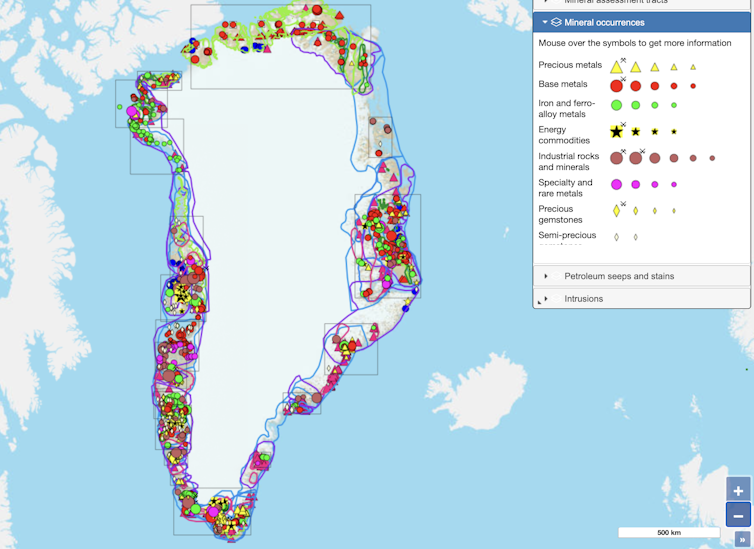
Le Groenland possède des gisements de minerais rares, essentiels aux technologies modernes : terres rares, uranium, zinc, plomb, etc. Greenland portal
Parmi les ressources d’intérêts, « on y trouverait un nombre considérable de minéraux (rares). Certains sont considérés comme stratégiques, dont le lithium, le zirconium, le tungstène, l’étain, l’antimoine, le cuivre sédimentaire, le zinc, le plomb (à partir duquel on produit du germanium et du gallium), le titane et le graphite, entre autres ». Le Groenland bénéficie notamment de contextes géologiques variés favorables à la présence de gisements de [terres rares] attractifs pour les compagnies d’exploration.
La stratégie polaire de la France à horizon 2030 propose plusieurs pistes « comme l’installation d’un bureau logistique, l’implantation dans une station déjà opérée par des universités, la création d’une infrastructure en lien avec les autorités et municipalités groenlandaises ». La recherche française s’y est affirmée, notamment grâce au soutien déterminant de l’Institut polaire français Paul-Émile-Victor (Ipev).
L’Université Ilisimatusarfik, la seule université groenlandaise, située à Nuuk, a déjà des partenariats avec des universités et grandes écoles françaises, notamment grâce au réseau européen Erasmus + auquel est éligible le Groenland. Elle entretient des relations privilégiées avec des universités françaises par le biais du réseau d’universités, d’instituts de recherche et d’autres organisations que constitue l’Université de l’Arctique (Uarctic). Sont membres uniquement trois universités françaises : Aix Marseille Université, Université de Bretagne Occidentale et Université de Versailles Saint-Quentin-en-Yvelines.
« Rien sur nous sans nous »
Du côté groenlandais, une invitation à un renforcement de la coopération bilatérale avec la France s’observe dans la stratégie pour l’Arctique. La France est expressément citée à côté de l’Allemagne, de la Belgique, des Pays-Bas, du Luxembourg, de l’Espagne, de l’Italie, de la Pologne et de la République tchèque.
Ce croisement stratégique invite au développement de partenariats bilatéraux nouveaux et structurants.
Si le Groenland accepte une coopération internationale, ce n’est pas à n’importe quel prix. Le Kalaallit Nunaat cherche à être plus qu’une plateforme extractiviste, et à ne pas être vu uniquement comme un réservoir de ressources à exploiter. La vision stratégique nationale actuellement promue invite à une approche plus diversifiée qui mêlerait les différentes industries au sein desquelles le Groenland souhaite investir. Toute évolution devra nécessairement compter sur la volonté de la population groenlandaise, composée en très grande majorité d’Inuits. Comme l’affiche avec force le territoire notamment dans sa stratégie pour l’Arctique » : « Rien sur nous sans nous ».
Cet article a été co-rédigé avec Arthur Amelot, consultant expert auprès de la Commission européenne.
Anne Choquet est membre du Comité National Français des Recherches Arctiques et Antarctiques (CNFRAA).
Florian Aumond est membre du Comité national français des recherches arctiques et antarctiques.
Source: – By Valentina Napolitano, Sociologue, chargée de recherche à l’IRD (LPED/AMU), spécialiste des questions migratoires et des conflits au Moyen-Orient, Institut de recherche pour le développement (IRD)
La chute du régime de Bachar Al-Assad en décembre 2024 a ravivé les débats sur le retour chez eux des réfugiés syriens installés au Moyen-Orient. Pourtant, les discussions publiques restent souvent déconnectées des réalités vécues par les premiers concernés. Une enquête menée en mai 2025 en Jordanie, où le nombre de réfugiés syriens s’élève aujourd’hui à un peu moins de 600 000 personnes, révèle la complexité des trajectoires et des choix familiaux, entre attente, espoir et inquiétude.
La question du retour des réfugiés syriens qui avaient fui leur pays en guerre pour s’installer dans divers pays du Moyen-Orient (près de 5 millions vivant principalement en Turquie, au Liban et en Jordanie) s’est posée avec urgence dès la chute du régime de Bachar Al-Assad, en décembre 2024. Ce retour faisait déjà partie des « solutions durables » envisagées, dès 2016, par les acteurs humanitaires et les gouvernements hôtes pour mettre fin à la « crise des réfugiés ».
Les débats autour de cette question se limitent, pour l’essentiel, à une quantification du nombre des retours attendus et des retombées qu’ils auraient sur la reconstruction de la Syrie en termes socio-économiques et politiques. Mais on se demande trop peu, voire pas du tout, ce que souhaitent les réfugiés syriens eux-mêmes.
En mai 2025, nous avons effectué une enquête qualitative en Jordanie (dans le camp de Zaatari, ainsi que dans les villes d’Irbid et de Zarqa) qui nous a permis, au fil des douze entretiens réalisés, de mieux comprendre les projets d’avenir des réfugiés syriens dans le pays. Il en ressort que le choix de rentrer en Syrie ou de rester en Jordanie résulte d’une imbrication complexe de facteurs sociaux, économiques, politiques, d’âge et de genre.
Entre camps et villes : de l’urgence à l’attentisme
En décembre 2024, la Jordanie accueillait près de 650 000 Syriens officiellement enregistrés par le Haut Commissariat des Nations unies pour les réfugiés (UNHCR). Depuis, plus de 75 000 d’entre eux sont rentrés en Syrie selon les chiffres diffusés par l’Agence en mai 2025. Ce nombre est voué à augmenter avec la fin de l’année scolaire.
Les attitudes des réfugiés syriens vis-à-vis de la perspective du retour varient significativement en fonction du lieu d’installation en Jordanie et des conditions socio-économiques qui en découlent. Près de 80 % des Syriens résident dans des villes, notamment à Irbid, Mafraq et Zarqa, et les 20 % restants vivent au sein des trois camps de réfugiés qui ont été érigés près de la frontière avec la Syrie : Zaatari, Al-Azraq et Marajeeb Al Fohood.
Malgré l’assistance fournie par les acteurs humanitaires aux réfugiés du camp, ce lieu demeure très inhospitalier. Des familles entières l’ont déjà quitté pour revenir en Syrie, certaines dès l’annonce de la chute du régime. C’est pourquoi plusieurs unités d’habitation ont déjà été abandonnées ou démantelées.
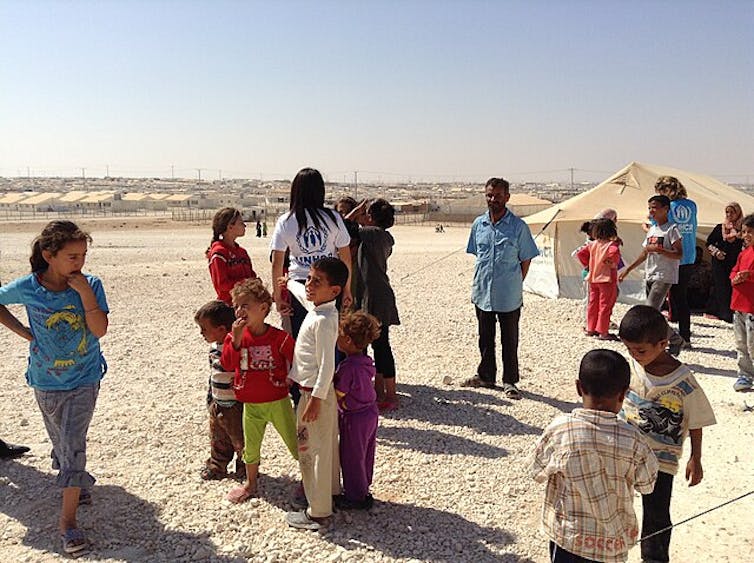
Unités d’habitation démantelées dans le camp de Zaatari, en Jordanie. Photo : Valentina Napolitano. Fourni par l’auteur
D’autres familles préparent également leur retour en mettant de l’argent de côté, car un déménagement peut coûter environ 500 dinars jordaniens (environ 610 euros), sachant que les bus gratuits mis à disposition par l’UNHCR jusqu’à la frontière ne permettent de transporter que cinquante kilos de bagages par famille.
Pour la famille de Mohammad, la cinquantaine, originaire du village de Sheykh Meskin, près de Deraa, la situation est des plus compliquées. Depuis plusieurs années, Mohammad a perdu son travail dans un centre de santé de l’UNHCR. L’Agence onusienne et les autres acteurs humanitaires sont les principaux pourvoyeurs d’emploi au sein du camp, mais seul un membre par famille est autorisé à y travailler. La famille de Mohammad survit aujourd’hui uniquement grâce à l’aide humanitaire versée par l’UNHCR ; or celle-ci a drastiquement diminué en 2025, passant de 22 à 15 dinars jordaniens par personne et par mois (soit 18 euros par mois). « Nous sommes arrivés en 2013, nous avons vieilli ici ! », raconte Maryam, la mère de famille, en évoquant la dureté des conditions de vie endurées à Zaatari. Elle montre ensuite la photo du potager qui entoure leur maison à Deraa, en Syrie. Les mûrs, encore débout, s’apprêtent à être réhabilités pour garantir une vie plus digne à leurs enfants, dont la plupart n’ont connu que le camp de Zaatari comme lieu de vie.
À l’inverse de cette famille, de nombreux Syriens n’ont plus de logement où rentrer. La majorité des familles réfugiées en Jordanie sont originaires du sud de la Syrie, notamment de la ville de Deraa et de sa campagne, largement détruites par la guerre, d’où la réticence d’une grande partie d’entre eux à rentrer au pays dans l’immédiat.
Pour la famille Nasser, la question du logement est centrale, du fait de l’agrandissement de sa famille depuis le départ pour la Jordanie. Initialement composée du père, mécanicien âgé d’une quarantaine d’années, d’une épouse et de deux enfants, le foyer s’est étendu avec un deuxième mariage. Aujourd’hui, il compte douze enfants, dont l’une âgée de 20 ans et ayant fondé son propre foyer.
« Nous sommes arrivés ici avec une famille, maintenant nous sommes trois familles… En Syrie nous n’avons plus de maison et le HCR ne nous accorde pas le droit de déplacer les caravanes avec nous. »
Alors qu’aucun plan de reconstruction n’a encore été mis en place par les nouvelles autorités en Syrie, les réfugiés du camp se trouvent face à l’interdiction de ramener vers leur pays d’origine les préfabriqués qui leur ont été attribués par le HCR ou qu’ils ont achetés de leur propre initiative afin d’élargir leur lieu de vie. À leur départ, ces préfabriqués sont démontés par les autorités jordaniennes, qui revendent ensuite les matériaux sur le marché.
« Jordanie : dans le camp de Zaatari, les réfugiés syriens n’envisagent pas encore un retour au pays », France 24 (11 décembre 2024).
La situation des Syriens que nous avons rencontrés en milieu urbain est différente. S’ils estiment que le retour en Syrie est inévitable à long terme, notamment en raison de l’absence de perspective d’intégration durable en Jordanie, pays qui n’est pas signataire de la Convention de Genève pour les réfugiés de 1951, la date de ce retour reste toutefois subordonnée à l’amélioration des conditions socio-économiques dans leur pays.
Liens familiaux et prise de décision sur le retour
Dans les milieux urbains jordaniens, les Syriens ont souvent atteint une certaine stabilité, avec un meilleur accès à l’éducation et à l’emploi, et ils disposent d’un logement digne. C’est pour cette raison que plusieurs familles vivant à Irbid et à Zarqa souhaitent attendre l’amélioration des conditions de vie dont ils espèrent qu’il suivra la levée des sanctions internationales visant la Syrie. Aujourd’hui, pour Umm Diab, 46 ans et mère de neuf enfants, arrivée à Irbid en 2013, retourner en Syrie serait « un retour à l’âge de pierre », tellement les conditions de vie y sont dures. Les Syriens manquent de services de base tels l’électricité, l’eau et le carburant.
Les familles syriennes en Jordanie ont, au fil des années, reconstitué des systèmes informels de soutien fondés sur la parenté, l’origine villageoise ou les liens de voisinage. Ces réseaux fournissent des aides dans tous les domaines, de la mise en commun des fonds pour le loyer et l’accès à l’aide alimentaire aux soins aux enfants et à la recherche d’un travail informel.
Les femmes syriennes que nous avons rencontrées ont expliqué qu’elles cherchent toujours à vivre à proximité de leurs sœurs, cousins ou beaux-parents, ce qui leur permet de partager des responsabilités telles que les départs à l’école ou les tâches ménagères et même de répartir les rôles dans la parentalité. Rompre avec ces liens, même au nom du retour au pays, comporte des risques, spécialement pour les femmes.
En effet, environ un tiers des ménages de réfugiés syriens en Jordanie sont dirigés par des femmes, dont beaucoup sont veuves, divorcées ou vivent séparées de leurs maris qui travaillent à l’étranger, particulièrement dans les pays du Golfe comme l’Arabie saoudite, le Koweït et les Émirats arabes unis. Pour ces femmes, l’idée de retourner en Syrie seule est intimidante. La peur de la violence, le manque de services de base et l’absence d’une présence masculine en Syrie pèsent lourdement sur ces décisions.
C’est le cas d’Umm Diab, dont le mari a commencé à travailler au Koweït avant même le début du conflit. Pour elle, rentrer seule en Syrie avec ses enfants signifierait la perte des liens familiaux avec ses frères et sœurs et avec ses voisins qui l’ont soutenue dans son quotidien de femme seule durant son séjour en Jordanie.
De nombreuses femmes ont acquis une indépendance financière en exil ; mais le retour en Syrie pourrait engendrer la perte de leurs revenus. Par ailleurs, les décisions concernant le retour sont encore souvent prises, ou du moins fortement influencées par des hommes absents car, nous l’avons évoqué, travaillant dans le Golfe. En même temps, la séparation temporaire des membres d’une même famille est aussi envisagée afin de préparer les conditions du retour de l’ensemble du noyau familial. Dans l’une des familles rencontrées à Zaatari, c’est l’homme qui est rentré en premier en Syrie, son épouse et ses enfants devant le rejoindre une fois la scolarité de ces derniers terminée. À l’inverse, dans un autre cas, c’est la femme, accompagnée des enfants, qui est rentrée en Syrie, tandis que l’homme est resté en Jordanie pour continuer à bénéficier du taux de change favorable et leur envoyer de l’argent.
Outre l’importance des liens familiaux et d’interdépendance qui se sont restructurés en exil, le choix du retour est aussi vécu de manière différente en fonction de l’âge.
Près de 49 % de la population syrienne en Jordanie a entre 0 et 17 ans. Majoritairement née en exil ou arrivée très jeune, cette composante de la population a des perceptions et des attitudes différentes à l’égard du retour. Umm Firas, mère de six enfants, résidente de Zarqa, à l’est d’Amman, explique que tous ses enfants parlent un dialecte jordanien en dehors de la maison, ce qui reflète selon elle leur degré d’insertion dans la société hôte, notamment en milieu urbain.
Par ailleurs, la question de l’éducation des enfants en d’autres langues, avec la prééminence de l’anglais en Jordanie, facteur à prendre en compte dans les autres pays du refuge syrien (notamment en Turquie ou plus loin en Europe), apparaît comme une autre entrave au possible retour.
En outre, alors que l’âge de mariage demeure très bas, les jeunes entre 18 et 25 ans ont dans la plupart des cas déjà établi leur propre famille, ce qui est le cas d’une des filles d’Umm Firas, 22 ans, mariée et mère de deux enfants. Les choix du retour de ces deux familles se trouvent donc imbriqués.
Pour les plus jeunes, retourner en Syrie peut par ailleurs devenir un choix contraint, notamment en raison de l’impossibilité, pour les plus éduqués d’entre eux, de trouver un emploi en Jordanie, mais aussi face au durcissement sécuritaire exercé à leur encontre par les autorités locales.
Une politique d’accueil de plus en plus contraignante
L’évolution de la politique d’accueil jordanienne à l’égard des Syriens constitue un dernier élément essentiel pour comprendre les choix du retour, lequel devient inexorable face à des contraintes économiques et sécuritaires de plus en plus importantes. Avant même que la chute du régime d’Assad se profile, la Jordanie était confrontée à de très grandes difficultés pour pouvoir continuer à financer l’accueil des réfugiés syriens.
La diminution des aides devrait en outre entraîner la fermeture du camp de Marajeeb al Fohood, financé et géré par le Croissant-Rouge des Émirats arabes unis, qui a vu le départ de près de 350 personnes en mai dernier. Les Syriens du camp d’al-Azraq, notamment ceux détenus dans le « village n°5 », considéré comme un centre de rétention sécuritaire, font l’objet de procédures d’extradition vers la Syrie. C’est le cas d’un fils d’Umm Firas, détenu pendant plus de six mois en raison de soupçons de proximité avec des groupes salafistes, qui a finalement été renvoyé en Syrie et a rejoint la maison de son grand-père.
La diminution des aides internationales s’est aggravée avec l’arrivée de la nouvelle administration américaine et la suspension des aides pourvues à travers USAID. Les employés de nombreuses organisations internationales, dont le HCR, vont voir leurs contrats arriver à terme d’ici l’été, avec la fermeture des centres d’enregistrement de l’Agence à Irbid et Zarqa.
Des travailleuses de l’UNHCR au camps de Zaatari, Jordanie, août 2013. United Kingdom Foreign and Commonwealth Office
À cela s’ajoutent les restrictions liées à l’arrivée à échéance de l’accord Jordan Compact, conclu entre l’Union européenne et la Jordanie, et qui avait permis l’attribution de 200 000 permis de travail à des Syriens (limités principalement aux secteurs non qualifiés de l’agriculture et du bâtiment) en échange d’aides au développement versées par l’UE. Désormais, les Syriens doivent payer des frais de permis de travail, à l’instar des autres travailleurs migrants, ce qui constitue pour les réfugiés en Jordanie un obstacle majeur susceptible d’accélérer leur retour au pays.
Dans le même temps, on constate, paradoxalement, un relâchement des restrictions sécuritaires mises en œuvre pour contrôler le camp de Zaatari. La sortie des Syriens du camp est permise à travers une demande de « vacances » (Igâze) ou grâce à la possession d’un permis de travail valide. De nombreux réfugiés se procurent un faux permis exclusivement pour pouvoir circuler en dehors du camp.
Depuis décembre, le système s’est assoupli : certaines personnes sont désormais autorisées, de manière informelle, à franchir le barrage qui entoure le camp, ce qui traduit une volonté des autorités jordaniennes de rendre la vie sur place plus viable, dans l’objectif d’y maintenir les habitants. Le camp de Zaatari joue un rôle stratégique dans la mise en visibilité de l’accueil jordanien et dans la levée de fonds internationaux, ce qui explique la volonté du gouvernement de conserver ce lieu le plus longtemps possible, afin de continuer à bénéficier des aides internationales.
Une multiplicité de facteurs à prendre en compte
Malgré les changements politiques et les appels à la reconstruction en Syrie, de nombreux réfugiés syriens restent incertains quant à leur avenir. Pour eux, la question n’est pas seulement de savoir si la Syrie est devenue un lieu de vie sûr, mais aussi de savoir si les conditions sociales, économiques et familiales sont réunies pour affronter ce changement après de longues années où ils ont dû reconstruire leurs vies en exil.
Loin donc des seuls points de passage des frontières sous observation des acteurs humanitaires et politiques, c’est au sein des espaces domestiques, à travers la Jordanie et les autres pays d’accueil des réfugiés, qu’il faut prêter attention aux attentes multiples et parfois contradictoires des familles syriennes afin de continuer à garantir l’accès aux droits, au travail et à l’éducation, et de préserver les réseaux d’entraide – autant d’éléments à prendre en compte pour un retour volontaire et digne en Syrie.
Les auteurs ne travaillent pas, ne conseillent pas, ne possèdent pas de parts, ne reçoivent pas de fonds d’une organisation qui pourrait tirer profit de cet article, et n’ont déclaré aucune autre affiliation que leur organisme de recherche.
Source: – By Paolo Mazza, Associate Professor of Finance, LEM-CNRS 9221, IÉSEG School of Management
Les actifs potentiellement taxés : actions cotées et non cotées, obligations, produits dérivés, fonds d’investissement et fonds négociés en bourse (ETF), contrats d’assurance épargne, contrats d’assurance placement, cryptomonnaies, devises… et l’or.Max.ku/Shutterstock
Le 1er janvier 2026, la Belgique taxera de 10 % les plus-values d’actifs financiers tels que les actions, les obligations, les assurances-épargne, l’or ou les cryptomonnaies. La fin d’une ère où les riches contribuables affluaient massivement vers le Plat pays ?
La Belgique est à un tournant historique. Le pays, longtemps considéré comme un quasi-paradis fiscal en raison de l’absence de taxation des plus-values sur actions, s’apprête à instaurer un impôt sur ces gains. Cette taxe de 10 % sur les plus-values d’actifs financiers entre en vigueur le 1er janvier 2026.
Derrière la volonté affichée de justice fiscale, ce changement majeur soulève de nombreuses interrogations sur ses implications économiques et financières. Plusieurs chercheurs belges, dont le professeur de finance Georges Hübner et l’économiste Bruno Colmant, ont mis en garde contre une série d’effets secondaires. Ces derniers peuvent freiner le développement du marché boursier, pénaliser les épargnants, et nuire à l’investissement productif.
Cette réforme intervient dans un contexte international où la taxation du patrimoine progresse, même dans des économies traditionnellement libérales. Alors quels seront les effets économiques concrets d’une telle mesure ?
Réforme historique en Belgique
Depuis des décennies, la taxation des plus-values figure régulièrement parmi les projets de réforme fiscale en Belgique. Malgré l’évolution des majorités gouvernementales, aucune mesure n’avait jusqu’ici abouti. Ce statu quo s’explique par plusieurs facteurs : volonté de maintenir l’attractivité du pays pour les capitaux, difficulté de mettre en œuvre une taxation efficace et crainte d’effets négatifs sur l’économie réelle.
Le projet de loi prévoit une taxe de 10 % sur les plus-values d’actifs financiers tels que les actions cotées et non cotées, les obligations, les instruments du marché monétaire, les produits dérivés, les fonds d’investissement et les fonds négociés en bourse (ETF). Elle concerne également les contrats d’assurance épargne et les contrats d’assurance placement, ainsi que les crypto-monnaies, les devises et l’or. La taxe entrerait en vigueur le 1er janvier 2026.
Du lundi au vendredi + le dimanche, recevez gratuitement les analyses et décryptages de nos experts pour un autre regard sur l’actualité. Abonnez-vous dès aujourd’hui !
Une exonération générale de 10 000 euros est prévue. Les actionnaires détenant au moins 20 % d’une entreprise bénéficieront d’un traitement spécifique : un taux progressif par tranche allant de 1,25 % à 10 %, après exonération d’une première tranche d’un million d’euros. Une exonération totale sera prévue après dix ans de détention des actifs. Les banques prélèveront une taxe à… la source.
Moins de liquidité sur les marchés
L’une des conséquences les plus documentées de la taxation des plus-values est la réduction de la liquidité des marchés. Ce phénomène, connu sous le nom d’« effet lock-in » a été analysé, notamment par les économistes Feldstein, Slemrod et Yitzhaki. Ils soulignent que la taxation des plus-values entraîne une diminution significative du volume de transactions sur les marchés boursiers. Lorsque la vente d’un actif déclenche un événement fiscal, les investisseurs sont incités à conserver leurs titres plus longtemps pour éviter d’avoir à payer l’impôt.
En Belgique, la Bourse de Bruxelles souffre d’une faible liquidité relative par rapport à ses homologues européennes. Un tel bouleversement réglementaire pourrait être dommageable. Une moindre liquidité réduit l’incitation des entreprises à se financer via des introductions en bourse (IPO), au détriment de l’innovation et de la croissance économique.
Alourdissement administratif
L’instauration d’une taxe sur les plus-values d’actifs financiers suppose de suivre avec précision leur prix d’acquisition, leur durée de détention et les éventuelles pertes. Imposer une taxation aussi complexe risque d’accroître considérablement la charge administrative, tant pour les particuliers que pour l’État, puiqueque toutes les transactions doivent être précisément documentées.
La proposition de texte a été proposé par Jan Jambon, vice-premier ministre de Belgique, ministre des finances et des pensions. AlexandrosMichailidis/Shutterstock
En pratique, le traitement d’opérations complexe – splits, fusions, rachats, pertes reportées – pourraient multiplier les litiges fiscaux, notamment pour les titres non cotés, où la valorisation objective est difficile. En 2023, en Belgique, il y a eu près de 20 000 litiges fiscaux portés devant les tribunaux, dont près de 15 000 étaient reportés de l’année précédente et près de 17 000 toujours en cours à la fin 2023.
Le calcul de la période de détention poserait aussi un problème majeur puisqu’il est question d’une exonération pour la détention de plus de dix ans. Quelle méthode de valorisation serait utilisée ? First-in-first-out (FIFO) ? Last-in-first-out (LIFO) ? Autant de questions auxquelles le projet actuel de loi ne répond guère. Dans la première approche, les plus-values seraient calculées sur la base du prix du premier achat de l’actif. Dans la seconde approche Last-in-first-out (LIFO), sur la base du dernier achat de l’actif. Si l’investisseur a acheté de manière régulière le titre, ce prix initial pourrait être largement désavantageux. Dans ce cadre, une approche pondérée serait préférable.
Le casse-tête fiscal des cryptoactifs
La réforme entend également s’appliquer aux gains sur cryptoactifs. La taxation des plus-values dans cet univers volatile est complexe. Il serait difficile, voire impossible, pour un État de contrôler et d’évaluer correctement les transactions sur cryptoactifs, ouvrant la porte à l’arbitrage fiscal et à la sous-déclaration.
Un autre risque souvent négligé concerne la transmission d’entreprises familiales. En Belgique, celles-ci représentent environ 70 % des PME. Elles possèdent un actif patrimonial important, mais peu de liquidités disponibles. D’où l’adage « Riches en actifs, pauvres en cash ».
La taxation des plus-values pourrait freiner les donations et successions d’entreprises, en imposant des coûts supplémentaires au moment du transfert. Hansmann dans The Ownership of Enterprise rappelle que les incitations fiscales jouent un rôle clé dans la pérennité des entreprises familiales. Une taxation immédiate des plus-values sur les actions non cotées, souvent difficile à valoriser objectivement, peut forcer les héritiers à vendre tout ou partie de l’entreprise pour payer l’impôt. Ce mécanisme est qualifié de « fiscalité destructrice ».
Et créer un effet domino : ventes forcées, délocalisations, absorptions par des groupes étrangers, etc.
Détournement vers l’immobilier
L’instauration d’une taxe sur les plus-values financières, sans réforme équivalente sur l’immobilier, risque de distordre la concurrence entre classes d’actifs. Les investisseurs pourraient être incités à privilégier l’immobilier locatif, déjà fiscalement favorisé, au détriment des actions et des investissements productifs. Comme le montre Thomas Piketty dans Capital in the Twenty-First Century, l’absence de fiscalité efficace sur le capital renforce la concentration des richesses.
Ce phénomène risque de ralentir encore davantage l’investissement en actions productives en Belgique, renforçant des tendances déjà observées ces dernières décennies. Il y a également un risque majeur de bulle immobilière sur le marché belge, si cette classe d’actif devenait le berceau d’un arbitrage anti-taxe.
Un alignement européen… au prix de l’attractivité ?
Le pari du gouvernement belge est risqué. En voulant taxer davantage les plus-values au nom de l’équité, il pourrait paradoxalement créer des effets secondaires négatifs : fragiliser la capacité des entreprises à se financer, appauvrir l’offre d’investissement pour les épargnants, moins de liquidité sur les marchés et pousser davantage de capitaux vers l’étranger ou vers des actifs moins productifs.
La taxation des plus-values sur actions représente un tournant majeur pour la Belgique, qui rompt avec une tradition d’attractivité fiscale. Si l’objectif de justice sociale est compréhensible, les conséquences économiques potentielles ne doivent pas être sous-estimées. Pour réussir cette réforme sans nuire à son économie, la Belgique devra soigneusement calibrer ses règles d’application et accepter de corriger rapidement ses erreurs si les premiers effets négatifs se font sentir.
Paolo Mazza ne travaille pas, ne conseille pas, ne possède pas de parts, ne reçoit pas de fonds d’une organisation qui pourrait tirer profit de cet article, et n’a déclaré aucune autre affiliation que son organisme de recherche.
The demise of one of Hong Kong’s last major pro-democracy parties, the League of Social Democrats, is the latest blow to the city’s crumbling democratic credentials.
The league is the third major opposition party to disband this year. The announcement coincides with the fifth anniversary this week of the national security law, which was imposed by Beijing to suppress pro-democracy activity.
The loss of this grassroots party, historically populated by bold and colourful characters, vividly illustrates the dying of the light in once-sparkling Hong Kong.
The city is now greyed and labouring under a repressive internal security regime that has crushed civil society’s freedoms and democratic ambitions.
Authoritarian crackdown
The world witnessed Hong Kong at its brightest during the 2014 Umbrella Movement, when hundreds of thousands of pro-democracy protesters camped out on city streets for several months.
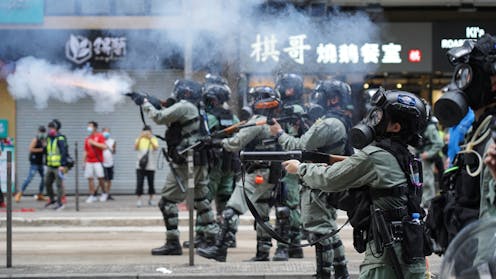
We also saw the brutal sequel in 2019, when paramilitarised police sought to put down further civil unrest and protesters fought back.
Since then, “lawfare” has been the preferred strategy of China’s national government and its Hong Kong satellite. The new approach has included a vast security apparatus and aggressive prosecutions.
When Beijing intervened in July 2020, it was nominally about national security. In reality, the new law was designed and used to bring Hongkongers to heel.
Civil freedoms were further curtailed by a home-grown security law, introduced last year to fill the gaps.
International standards such as the Johannesburg Principles, endorsed by the United Nations, require national security laws to be compatible with democratic principles, not to be used to eliminate democratic activity.
Prison or exile
The League of Social Democrats occupied the populist left of the pro-democracy spectrum. It stood apart from contemporaries such as the Democratic Party and the Civic Party, which were dominated by professionals and elites, and have since been disbanded.
The League was most notably represented by the likes of “Long Hair” Leung Kwok-hung– known for his Che Guevara t-shirts and banana-throwing – and broadcaster and journalism academic Raymond Wong Yuk-man, also known as “Mad Dog”.
Despite their rambunctious styles, these men had real political credentials and were repeatedly elected to legislative office. But Leung is now imprisoned for subversion, while Wong has left for Taiwan.
Leung Kwok-hung was sentenced to subversion under the national security law. Edwin Kwok/Shutterstock
Party leaders such as Jimmy Sham Tsz-kit and Figo Chan Ho-wun were also prominent within the Civil Human Rights Front. It was responsible for the annual July 1 protest march that attracted hundreds of thousands of people every year. The front is yet another pro-democracy organisation that has dissolved.
Sham and Chan have been jailed for subversion and unlawful assembly under the colonial-era Public Order Ordinance, which has been used to prosecute hundreds of activists.
Zero tolerance
The demise of these diverse organisations are not natural occurrences, but the result of a deliberate authoritarian programme.
Under China, Hong Kong’s political system has been half democratic at best. But it now resembles something from the darkest days of colonialism, with pre-approved candidates, appointed legislators and zero tolerance for critical voices.
Activists and watchdogs are stymied by the national security law. It criminalises – among other things – engagement and lobbying with international organisations and foreign governments.
Then there are the millions of ordinary Hongkongers whose dreams of a liberal and self-governing region under mainland China’s umbrella – as promised in the lead up to the 1997 handover – have been shattered.
But countless ex-protesters remain in the city, where it is impermissible to speak critically of power, and where mandatory patriotic education may ensure new generations will never even think to speak up.
Much blame lies with the British, who failed to institute democratic elections until the last gasp of their rule in Hong Kong. This was despite the colony tolerating liberalism and habit-forming democratic activity over a longer period.
Now China, after almost three decades in charge, has responded to democratic challenges by defaulting to authoritarian control. Hong Kong can only be grateful it has been spared a Tiananmen-style incident. Nor has it experienced the full genocidal extent of the so-called “peripheries playbook” Beijing has used in Tibet and Xinjiang.
Turmoil and authoritarian swings in the United States and elsewhere give China an opportunity to present as a voice of reason on the international stage.
But we should not forget its commitment to repressive politics at home, nor what its support of belligerent regimes such as Putin’s Russia might mean for Taiwan, the region and the world.
Above all, we should not forget the people, in Hong Kong and elsewhere, who made it their life’s work to achieve democracy only to be rewarded with prison or exile.
Brendan Clift does not work for, consult, own shares in or receive funding from any company or organisation that would benefit from this article, and has disclosed no relevant affiliations beyond their academic appointment.
In 1962, poet and Auschwitz survivor Yehiel Dinur took the stand in Jerusalem in the trial of Nazi war criminal Adolf Eichmann. Dinur was a much-anticipated witness, bearing the audience’s hope this man, a poet, would be able to explain – to capture and to transmit – the experience of Auschwitz, and of the Holocaust; that he could speak the unspeakable. Prosecutor Gideon Hausner hoped such a witness might “do justice to the six million personal tragedies”.
Dinur used the name Katzetnik 135633 in his writings, also translated as “Prisoner 135663”. On the stand, he said: “I believe wholeheartedly that I have to continue to bear this name until the world awakens.”
Awakening, understanding, empathy and change are the sentiments many survivors hope for, or ask for, during and after periods of trauma. The 20th century saw many of those pleas. The 21st century has done no better at honouring the promise, captured in the title of the 1984 Argentinian commission report on forced disappearances, Nunca Mas: never again. No matter how many such pleas appear before the courts, before the aggressors, before those in solidarity, the horrors of war, torture, starvation and genocide seem to happen again – and again.
Three recent books from the region where war was been raging since the Hamas attacks on Israel on October 7 2023, and the ensuing war on Gaza, are part of these pleas.
Review: Eyes on Gaza – Plestia Alaqad (Macmillan), Letters from Gaza – edited by Mohammed Al-Zaqzooq & Mahmoud Alshaer (Penguin), Gates of Gaza – Amir Tibon (Scribe)
Eyes on Gaza is an on-the-ground account of the death and destruction of the first 45 days of the war by now 23-year-old Palestinian journalist Plestia Alaqad, who moved to Melbourne with her family in November 2023. Letters from Gaza is a collection of 50 stories, poems and fragments from Palestinian writers enduring the past 20 months. And Gates of Gaza is the story of Israeli journalist Amir Tibon, a resident of Nahal Oz, one of the border kibbutz attacked by Hamas on October 7.
Plestia Alaqad. Plestia
These are all first-person testimonies of experiences of being under attack, though those attacks differ. We might say they fit into the genre adopted in truth commissions, such as the Truth and Reconciliation Commission in South Africa: a response to the nation’s years of living under the apartheid laws, discarded when Nelson Mandela took power in 1994.
The commission was one effort to heal from this past. But, like the Eichmann trial, it needed stories to explain the histories of violence, and it needed the pain to be voiced to explain its impacts on communities, families and relationships.
The use of people’s narratives to “bear witness” to the complex layers of legally sanctioned and militarily executed pain, loss and the traumas they can produce, is sometimes effective in helping audiences understand them. The Bringing Them Home Report in 1997 used this form to explain the incidence and impacts of the forced removal of Indigenous children by the Australian state. It was effective as one form of creating a shared reality for all in Australia, who then understood the term “stolen generations” and the pain, loss and genocidal intent to which this phrase refers.
More recently, the Yoorrook Justice Commission in Victoria, Australia’s first formal truth-telling inquiry into historic and ongoing systemic injustices perpetrated against First Nations Peoples by colonisation, has also brought histories of loss, dispossession and abuse to light, using stories. Stories can make sense of the impact incurred through the intertwined web of policies, statistics, discrimination and quotidian violence at the hands of the state.
The work of testimony
The narratives in these books written since October 7 2023 are part of this genre of testimony or storytelling. But at least two of these books are not attempting to explain the past. They might be described better as pleas to stop what the International Court of Justice has called “a plausible genocide” happening in the present.
They are, in one reading, wishes for the world to understand the experience of pain, rage, loss, fear, distress and defeat that accompanies destruction and unbearable loss. A wish for the world to hear, or perhaps feel, the words on the page – and make the pain stop.
They wish the world would “awaken” to what is happening right now.
The dynamic of awakening is the stock in trade of truth commissions. One party testifies or speaks to an experience, and the audience wakes up to what has been happening. As a result, they either change or facilitate change. The truth, captured as testimony, is supposed to set people free. Not just the speaker, but the community of speakers weighed down by history – or by the struggles of the past or the present.
In legal forms the reason to speak is clear. The reason to speak in literature, biographies and works of nonfiction is less clear. What does the author want from us, the readers? But perhaps more importantly, what can we offer?
She wants the genocide to stop. She wants a free Palestine. She wants her home and her life back. The stories in this book show readers outside Gaza some of the life and death of those first six and a half weeks.
Her last entry before she leaves Gaza for Egypt – and then Australia – is dated Day 45. During those 45 days, she puts on a press helmet and jacket, which both give her protection and weigh her down. And then she speaks: to cameras, to followers, to anyone who will listen. Her social media feeds documenting the war gained worldwide attention, her Instagram following rising from around 3,700 to 4.1 million today.
There are too many deaths to be witnessed – by her and the reader. She describes genocide as an understatement for what is occurring in Gaza: “we lose more people than our hearts can handle”. She has seen so much death, heard so many screams. By day 30,
all you can hear is a voice crying for help from under the rubble. You turn your back and walk away, because there’s nothing you can do to help.
But Plestia’s project is more than documenting death. She is careful to show many aspects of life in Gaza. She shows how Palestinians retain relationships, family and pets. How a young boy just needs his “pot plant” from his destroyed house, under skies filled with drones and bombs. This is a plea for the genocide to stop, but it is also a celebration of being Palestinian. It is an homage to life in Gaza.
It is also a plea to see Palestinians as more than numbers – and more than how they are depicted by Israel.
“The world,” she says, “sometimes treats us like terrorists, trying to justify its complacency in allowing us to be massacred. And we know the perception, we read the propaganda just like everyone else. But the reality is that we’re the opposite.”
She describes gentle moments of love and care between her fellow journalists and the people they interview. The children they bring sweets for, the “bird lady” who renames her tortoise “Plestia” after her. Both Plestia the tortoise and the “bird lady” are now living in a tent. She speaks of the doctors who work tirelessly.
In the midst of brutal amputations and unimaginable burns, she recounts the care of a doctor giving cream for a skin rash that has tormented her, diagnosed as a product of her anxiety. Anxiety seems a gentle diagnosis for symptoms produced by witnessing and documenting such brutality.
Anxiety over her helplessness, perhaps, over the lack of sleep, of nourishing food: dwindling even in those first 45 days. Anxiety seems like a Western preoccupation, from this writing distance. What Plestia experiences seems more like layers of embodied distress. Her empathy allows her to feel, perhaps too much. Empathy can be an enemy.
Around page 100, she begins to deteriorate. “It’s funny how genocide changes a person,” she writes, describing herself as “Genocide Plestia”. She’s devastated, exhausted. She has lost hope. The journal entries are shorter, more repetitive.
They recite her helplessness with what Jacqueline Rose, co-director of the Birkbeck Institute for the Humanities, has called the “repetitive thud of referentiality”.
You feel Plestia’s effort to try to speak with some life in the pages, to use writing as a therapeutic tool. You wish it for her, but she has trouble summoning the energy, the life, any hope. As she poignantly quips: “Fake it till you make it doesn’t work during a Genocide”. What is there to say in such relentless days of loss?
You want Plestia to get up, you want a happy ending, for a conclusion to the painful story, but the problem is time. The reader’s time, the reality of time since she wrote her book.
Day 45, her last day in Gaza, is Monday November 20 2023. I read this book in June 2025, 646 days later – and it hasn’t stopped. When Plestia leaves Gaza and finally arrives here in Melbourne, the conditions she describes have been ongoing for more than 20 months. A recently released survey by the Palestinian Center for Policy and Survey Research estimates almost 84,000 people died in Gaza between October 2023 and early January 2025, as a result of the war. And that was six months ago.
50 letters from Gaza
The numbers are a way of reducing the experience of grief, devastation, loss (and the viewer’s guilt) to simple digits. Digits have no face and no sound. This is helpful to viewers, but it does not do justice to the 84,000, as Gideon Hausner knew well. No one awakens by hearing the numbers. But they matter.
In Letters from Gaza, psychologist Ahmed Mortaja fears becoming a news story, “a dull number … I don’t want my name and my family name to be reduced to mere numbers, whether odd or even”.
This book, a fragmented collection of 50 poems, stories and accounts, is devoted to giving life to those numbers. To animating the loss, so readers can apply their own imaginations, so we can understand the incomprehensible. It is a collection of fragments of lives since October 7 2023, squeezed into expressive pages. There is no “letter” more than six pages long. They are backed up against each other, permeating one another.
Each letter tells a different story and the same story. Each finds a detail that has no language: flowers in a girl’s hair, dreams of careers that will perhaps never be, the sounds of explosions. They are stories of the impossible search for bread, the longing for a bed and a pillow. And, as in Plestia’s account, they evoke the relentless buzz of the drones in the sky in Gaza: everywhere, all day, every day since October 7 2023. Like tinnitus, like torture.
The book begins with an effort to give names to numbers. On the first page, in the publisher’s note, we read that two of the authors, Sara al-Assar and Basma al-Hor, cannot be contacted. Because of communication lines and constant displacements, the details “may not reflect their current location or circumstances”. Authors may have died or been further displaced. Communication towers are destroyed. Tents are moved as people are moved on. Tents are destroyed.
In Plestia’s accounts, there are displacements to safe zones that then become unsafe, so they move again and again – until the only choice is tents, often without food or blankets. She describes seeing 33,000 people in a displacement shelter, this number increasing daily. Just as numbers are not people, tents are not homes. In Letters from Gaza, the displaced tents are character, metaphor and reality.
The stories are different, as are the deaths and losses within them, but these painful accounts help explain each other. The personal stories help animate words like displacement, refugee camp, genocide, so they do not fall into the pile of legal terms disconnected from names.
But after the United Nations declarations in the opening pages, we hear no more of law – and little of justice. As Palestinian human rights lawyer and founder of the Palestinian Centre for Human Rights, Raji Sourani said: Gaza is in danger of becoming “the graveyard of international law”. What is left are stories. The short stories, poems and brief accounts are packaged so they do not ask too much of the reader – just enough to provoke tears, and perhaps donations. Many readers will feel some of the helplessness in these pages.
There are stories of hunger; the loss of grandmothers and children. I cried many times reading this book, but the next story would quickly arrive and sometimes bring relief. There is something sad, but ordinary, about details like a cat who finds a tent too hot. Unlike Plestia’s clear analysis and summation of the genocide in Gaza, the politics of this book are comparably quiet. Not absent, but quiet. The word genocide is mentioned four times, “Holocaust” only once. (I counted.)
In Letters from Gaza, no one says Israel, only “the occupiers”. Husam Maarouf writes, “we no longer want anything from you […] Only to die in safety.” His entry is dated March 1 2024; he may well be dead. Batool Abu Akleen makes simple requests of the reader (or perhaps of God): “I want a grave, I don’t want my corpse to rot in the open road.” But the book seems to intentionally not accuse. We are told:
this is not a book about war. It is a book about human souls that strive to avoid being hunted down by war. It is about how innocents are forced to learn how to survive when everything around them is about killing, destruction and death.
But the accusation is there. How could it not be? Against Israel as occupier and aggressor – and the reader as bystander.
Accusation sometimes comes embedded in questions. “Is one person’s pain greater than another’s?” asks Gaza poet and teacher Doha Kahlout. This question resonates with one inscribed on the Holocaust Memorial Tree in Hungary: “Whose agony is greater than mine?”
When comparing agony, only one can live
Jewish author, philosopher and psychoanalyst Jessica Benjamin, writing on Palestine and Israeli peace struggles, cautions against pitting stories from Israel and Palestine against each other, such that “only one can live”. Only one story, one narrative, one version of pain and loss.
Holding multiple stories of suffering in mind is very difficult: for the survivor, for the listener and even for the psychoanalyst. Many survivors suffer symptoms of trauma that reduce the world to interpretation through their experience of its painful histories.
In Eyes of Gaza, writing from Melbourne, Plestia shows a moment of this:
On the train home, I see a lady with a suitcase, and the first thing that I think of is displacement, imagining how everyone in Gaza carries their whole life in their bag […] Then the announcement: Next Stop […] And I’m snapped back into reality.
In this moment, the suitcase is only read through the lens of the past. It’s what is described colloquially as living in the past – a type of banal flashback, often a symptom of trauma. But when pain colonises bodies and narratives, recognising the pain of others is difficult to see. It may be impossible to see the experiences of the other’s world through any other lens than one’s own pain. Whose agony is greater than mine? is a competitive statement, not a question.
In the war of greater pain, an Israeli child in fear may be read against a Palestinian child enduring the loss of their limbs and their whole family. Only one (story) can live.
To hold two competing stories of pain, loss and agony in mind requires a feat of mental health endurance few are capable of: the Nelson Mandelas of this world. Working in the field of transitional justice, I have met a few.
Most have experienced great loss and know there is no comparison at the level of agony. They resist “the repetitive thud of referentiality” because it drowns out conversation, annihilating curiosity and empathy alike. They know all stories must have their time.
In October 2023, “liberal” London Jewish journalist and filmmaker Michael Segalov, once a “staunch defender of Israel”, tried to hold competing stories. He wrote about seeing Israel–Palestine through the lens of “fear and trauma – of the Shoah, of the Nakba, of generations now born into perpetual fear”.
Early Jewish settlers were not “imperial soldiers”, but “a persecuted population failed by global governments pre and post Holocaust”, he points out. But by 1948, the year after the UN resolution that called for Palestine to be divided into Arab and Jewish states, “more than 750,000 Palestinians were made refugees, 15,000 killed”.
“While these lands might well feel a Jewish ancestral home,” he wrote, “within living memory, it was shared with another people: the majority.” In 1922, in the first census carried out under the British Mandate, the population of Palestine was 763,550: 89% were Arabs and 11% Jewish.
As Palestinian psychiatrist Eyad El Sarraj stressed while talking with Jessica Benjamin during peace negotiations, we must “stand simultaneously for the recognition of all injuries, while at the same time being clear that one side was coming from the position of Occupied and less powerful, the other Occupying and dominating”. Stories matter, politics matters.
And some stories take more time than others – some stories are given more time than others. This is a matter of politics and practicality.
Surviving the October 7 attacks
Israeli journalist Amir Tibon and his family survived the October 7 attack on Kibbutz Nahal Oz, on the Gaza border; they are now internal refugees in northern Israel. He and his partner settled in Nahal Oz and raised a family. On the morning of October 7, they heard the sounds of the attack and raced to their safe room, spending the next five hours in there trying to keep their children – Galia, 3 years old and Carmel, aged 19 months – quiet.
Amir Tibon and his family survived the Oct 7 attack on Kibbutz Nahal Oz, on the Gaza border. Scribe
In discussing Tibon’s book, Gates of Gaza: a story of betrayal, survival and hope in Israel’s borderlands, I risk comparison and competition. Sometimes stories speak to each other, even when they speak to the silences. I resisted this one’s proximity to the above stories. But that is also to resist reality. It is to resist the importance of difference. All experience is valuable, but sometimes comparison reveals inequality.
Plestia knows this well. The survivor guilt of which she writes is part of the hierarchy experienced by all survivors of mass violence. That she and her family survived, that she migrated, is to feel guilt for escaping the fate of those who have been starved, tortured, obliterated.
Yehiel Dinur spoke from this position of guilt on the stand in 1962, saying he was speaking for those who died in Auschwitz. In the face of others’ death, all survivors struggle with justification. Competition is one form of this: Whose agony is greater than mine?
Tibon was a resident of Nahal Oz, having moved there with his partner because of its beauty, nine years before October 7. He describes it as having “a strong, left-wing, liberal political leaning”, and says residents of the border areas are “some of the strongest advocates of Israeli–Palestinian peace”. He writes that the kibbutz movement has, “for decades”, been in favour of “a compromise that would allow Jews and Arabs to share this land, with agreed-upon borders – borders that, of course, would have to be protected”.
In the 300-plus pages, Tibon describes the morning of October 7 in detail. The fear of his children and his partner as they stayed quiet in a safe room for some five hours. The sounds of shootings and desperation as he read pleas and accounts from other residents on the community’s WhatsApp group as the attacks unfolded.
The narrative of that morning is interspersed with accounts from people who survived in his community: his parents, some of those who attended the Nova music festival, and Israeli Defense Force (IDF) soldiers. The narrative moves between that morning and a history of the kibbutz, framed in a history of Israel’s political lurching between right and left – and back again – over the 87 years since its recognition as a nation state by the UN.
In one reading, this is a history book of 87 years – not just an account of five hours. It is a particular history.
The narrative of those five hours is intense, peppered with stories of his parents racing from Tel Aviv to the kibbutz. Tibon’s father is a crucial figure in this narrative. A retired IDF general with “more than three decades” in the military, including combat experience, he seemingly has the capacity to assess situations and navigate a war zone with skill. It is his father who finally knocks on the “safe room” door in the afternoon (about halfway through the book). Tibon reports hearing “a strong bang and a familiar voice” from inside.
The father, we could say, is the embodiment of Tibon’s feelings for – and belief in – a strong, kind Israel. An army general, protective husband and grandfather (in Hebrew, Saba), he is longed for by Tibon’s young children, who “loved their grandparents”, particularly his father, “who pampered and spoiled them at every opportunity”. This grandfather’s presence at the safe-room door allows the family to re-enter the safety of Israel.
If the father is Israel, the sleeping children are its citizens. Carmel and Galia slept through much of the conflict, barely awakened by gunshots. They were rushed to the safe room the moment the shots were heard.
Once you know the stories from Letters of Gaza, it is hard not to compare this to the waking of Mohammed Al Zaqzooq’s three boys – Baraa, Jawad and Basil – to the sound of “Huge missiles in large numbers making terrifying sounds” and the need to flee. Not least, because Amir’s children were barely awakened by shots outside. Their safe room kept the noise muffled and the danger at bay. This is not to say their fear won’t impact on their actions later. Transgenerational trauma has a way of influencing the future.
Mohammed’s children moved quickly, within half an hour, to a refugee camp. At the time of writing, they remain there. His story is five pages long. Amir’s is 300-plus. Amir, an author and award-winning diplomatic correspondent for Haaretz, Israel’s liberal paper of record, has access to a computer, electricity and the security required to think, research and write.
But why does he write this book? In the acknowledgements, he describes himself as needing to be encouraged, unsure of the worth of telling the story of his five hours in the safe room. But he describes much more than five hours.
His book is a story of Israel – and particularly, of its informal settlements. In the early 1950s, he writes, 20 young soldiers – ten men and ten women – were taken by bus to this site to settle it. Nahal Oz is so close to Gaza, it has “agricultural lands which literally touch the border fence”. The kibbutzim functioned as a kind of human border, with increased populations: the 20 broke into couples, then families. Within a few years, they had a small farming community, with a person devoted to security.
Empty land?
This is not a story of military invasion and colonisation, however. It is a story of settlement on land represented as empty. We know this story well in Australia. In this context, it can be a plea for a recognition of innocence.
As Amir tells it, there were no Palestinians in the place before: no one was removed or relocated. Only in passing does he mention the Bedouin who passed through the area before.
In Australia, Irene Watson and Aileen Moreton-Robinson have, in different ways, explained lands do not need to be sites of permanent agriculture to be crucial to the survival of some groups or nations. Borders and settlements can disturb land, law and life regardless of whether houses are demolished or not.
The beauty of Nahal Oz, Amir writes, was due to its access to water and its site on fertile land, where trees provided shelter and probably food. Its loss was likely no small thing to people who required sustenance and shelter as they moved through. After the settlement, they no longer could.
After Israel set up its border there, only Israelis could pass through without being subject to the checkpoints that are well documented sites of humiliation and arbitrary punishment for Palestinians.
By 1997, the walls went up near Nahal Oz. But the walls to shield Nahal Oz from Gaza – and particularly from its people – were not enough. Amir describes the elaborate and extensive tunnels used by Palestinian soldiers to enter Israel (he calls them “terrorists” and “suicide bombers”).
The tunnels became the problem of Palestinian attacks on Israeli settlers. To deal with this problem, the concrete walls were built, reaching 160 metres underground, preventing any permeation. Then, on October 7, the walls could not provide security. Then, there was only the safe room.
The safe room is an obvious metaphor in this book. It is Israel under attack. One of these rooms has been built into every house in the kibbutz, so families can be safe from the mortar attacks from Gaza – a regular occurrence since the 1987 Intifada.
Plestia tells us that the materials for a safe room are not allowed to be brought into Gaza. There are no safe rooms there. Tibon doesn’t mention this; maybe he doesn’t even know this fact, which is its own symptom of the political and social environment in Israel.
He does describe “the unimaginable destruction that Israel has unleashed on Gaza in the aftermath” of the October 7 attacks. He is critical of this “destruction”, though he does not use the term genocide. (There are those who wait for the International Court of Justice to decide if it was more than “plausible” – and there are those who cannot wait.)
Tibon is critical of Israel’s right wing, which cultivates war. He wants peace. But peace here is its own violence.
Like the rhetoric of reconciliation in South Africa, calls for peace can do violence to historical experiences of injustice. There, reconciliation discourse has been criticised, along with its apolitical leanings. Reconciliation in South Africa has largely meant people subject to historical injustices must reconcile themselves to their losses and their reality.
A story attributed to Father Mxolisi Mapanbani, of Tom and Bernard and the bicycle, has been used many times to critique “reconciliation” rhetoric in South Africa. It is helpful here.
Tom and Bernard are friends and live opposite each other. One day, Tom stole Bernard’s bicycle. Every day, Bernard saw Tom cycling to school on it. After some time, Tom went up to Bernard and said, “Let us reconcile and put the past behind us.” Bernard said, “Okay, let’s reconcile – what about the bicycle?” “Oh no,” said Tom, “I’m not talking about the bicycle, I’m talking about reconciliation.”
In the Australian context, after Kevin Rudd’s apology to the stolen generations in 2008, human rights and social justice campaigner Tom Calma described this form of reconciliation as the “unfinished business of justice”.
The apology might have offered some form of acknowledgement, and gone some way toward creating a shared reality on the injustices of the past, but while justice remains unfinished, many are not at peace.
Amir wants peace. He doesn’t want to live in a safe house – but he wants his house and his family to live securely in Nahal Oz. He wants Palestinians to be at peace with this reality.
The word “peace”, like “reconciliation”, does a lot of work to present Tibon on the side of “the good”. Just like, in Letters From Gaza, the relative lack of the word “genocide” keeps the accusation at bay and politics in the background – and it keeps its calls for recognition of suffering at the fore. In this book about “human souls”, the editors call for a recognition of shared humanity.
Tibon is careful not to group “terrorists” under that name – though he uses a Hebrew word that means exactly that. (Mehablim, he calls the people who attacked Nahal Oz.) Why? Though he writes in English and undoubtably spoke Hebrew throughout the siege, why does he speak of the Palestinian attackers as Mehablim?
The answer might be found in the fact no Palestinian name, beyond former Palestinian leader Yasser Arafat, appears in these pages. He has interviewed many people, but none of them are Palestinian. Their narrative remains outside his text.
We must find the humanity of the Palestinians in other stories.
If the safe room is a metaphor for Israel, the tent – as described in so many of the stories in Letters from Gaza, and in Plestia’s account of those 45 days – is a metaphor for the lives of Palestinians in Israel, and perhaps the world’s eyes.
A tent is permeable, fragile, disposable. Bodies within it are subject to displacement, starvation, genocide. Every house in Tibon’s kibbutz has a safe room. There have been at least seven bombings of tent camps in Gaza. How can you not do the maths?
Stories, awakening and halting the bombs
Stories demand people are not reduced to mathematics. They place the reader in the scene and plead for identification and understanding. Writing on the Eichmann trial, Holocaust historian and legal scholar Lawrence Douglas describes “the words of the survivors that built a bridge from the accused to the world of ashes”.
Afrikaaner journalist and poet Antje Krog writes, on the Truth and Reconciliation Commission in South Africa, “In all the stories a landscape is created.”
But this landscape, if it is to have any effect, must be mapped across previous perceptions. For that, it must do damage to the secure world – the pre-existing imaginative landscape – of the reader or of the listener.
Moral philosopher Rai Gaita describes remorse as “a dying to the world”: a little death is required of the listener or reader who is implicated as a bystander, encountering the suffering of others. A death of complacency. A small disintegration that may mean our own peaceful worlds are no longer tenable.
This is why stories, particularly, are mobilised in truth commissions. They animate the impossible numbers – the dry policies and repetitive loss – with scenes of humanity. Testimony – personal stories – link the words (genocide, massacre, terror) to an imagination of a scene, a person, a child or a parent. To people we can identify or empathise with.
Like the two worlds connected in Ahmed Mortaja’s poem, Hubb and Harb, In Letters from Gaza:
tonight I will fall asleep telling myself that the noise outside is fireworks, a celebration and nothing more.
That the frightened screams of children are the gleeful terror of suspense before something long-awaited, like Eid.
Tonight, I will fall asleep scrolling through the photos on my phone, telling myself that my evening with friends wasn’t that great – really, I was bored – so now I’m skimming through memories to pass the time.
If empathy were all it took to halt the counting of the 646 days in Gaza, then Letters from Gaza and Eyes on Gaza would achieve their aim. But empathy rarely produces political change.
Stories – the 50 voices in Letters from Gaza, accounts like Plestia’s – make us cry, perhaps make us donate, but they do not halt the bombs. This, and more, might be what Yehiel Dinur meant when he asked for the world to “awaken”, that it change, that it stop what Tibon calls “the unimaginable destruction”.
Until then, Dinur pledged to remain Katzetnik 135633. Until then, we will likely only know “Genocide Plestia”: “it’s funny how genocide changes a person”.
Juliet Rogers does not work for, consult, own shares in or receive funding from any company or organisation that would benefit from this article, and has disclosed no relevant affiliations beyond their academic appointment.
The greenhouse effect was discovered more than 150 years ago and the first scientific paper linking carbon dioxide levels in the atmosphere with climate change was published in 1896.
But it wasn’t until the 1950s that scientists could definitively detect the effect of human activities on the Earth’s atmosphere.
In 1956, United States scientist Charles Keeling chose Hawaii’s Mauna Loa volcano for the site of a new atmospheric measuring station. It was ideal, located in the middle of the Pacific Ocean and at high altitude away from the confounding influence of population centres.
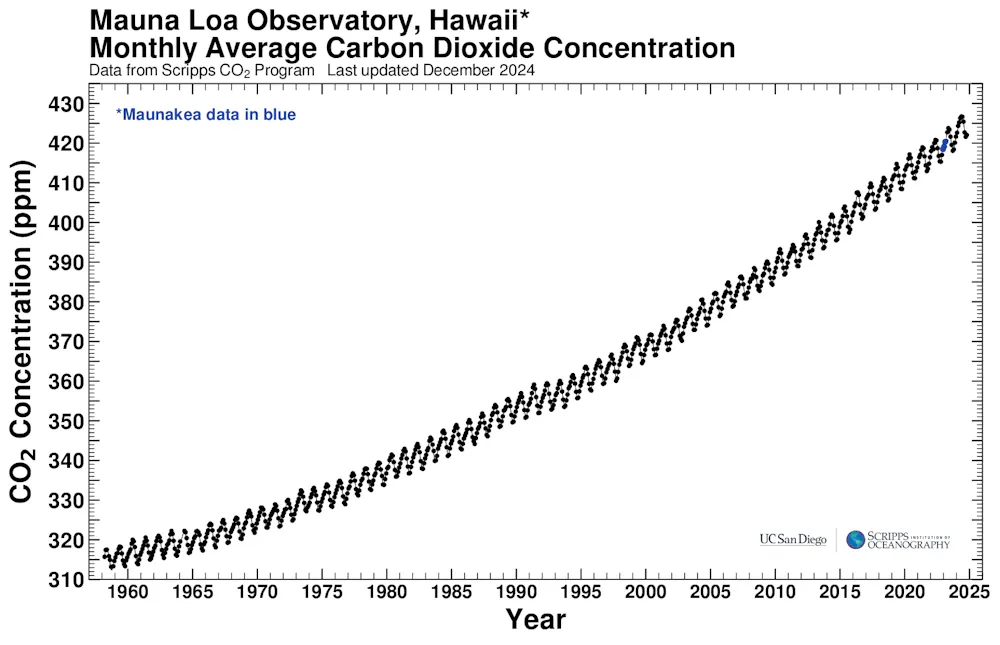
Data collected by Mauna Loa from 1958 onward let us clearly see the evidence of climate change for the first time. The station samples the air and measures global CO₂ levels. Charles Keeling and his successors used this data to produce the famous Keeling curve – a graph showing carbon dioxide levels increasing year after year.
But this precious record is in peril. US President Donald Trump has decided to defund the observatory recording the data, as well as the widespread US greenhouse gas monitoring network and other climate measuring sites.
We can’t solve the existential problem of climate change if we can’t track the changes. Losing Mauna Loa would be a huge loss to climate science. If it shuts, other observatories such as Australia’s Kennaook/Cape Grim will become even more vital.
The first year of measurements at Mauna Loa revealed something incredible. For the first time, the clear annual cycle in atmospheric CO₂ was visible. As plants grow in summer, they absorb CO₂ and draw it out of the atmosphere. As they die and decay in winter, the CO₂ returns to the atmosphere. It’s like Earth is breathing.
Most land on Earth is in the Northern Hemisphere, which means this cycle is largely influenced by the northern summer and winter.
The annual cycle of carbon dioxide is largely due to plant growth and decay in the northern hemisphere.
It only took a few years of measurements before an even more profound pattern emerged.
Year on year, CO₂ levels in the atmosphere were relentlessly rising. The natural in-out cycle continued, but against a steady increase.
Scientists would later figure out that the ocean and land together were absorbing almost half of the CO₂ produced by humans. But the rest was building up in the atmosphere.
Crucially, isotopic measurements meant scientists could be crystal clear about the origin of the extra carbon dioxide. It was coming from humans, largely through burning fossil fuels.
Mauna Loa has now been collecting data for more than 65 years. The resulting Keeling curve graph is the most iconic demonstration of how human activities are collectively affecting the planet.
When the last of the Baby Boomer generation were being born in the 1960s, CO₂ levels were around 320 parts per million. Now they’re over 420 ppm. That’s a level unseen for at least three million years. The rate of increase far exceeds any natural change in the past 50 million years.
The reason carbon dioxide is so important is that this molecule has special properties. Its ability to trap heat alongside other greenhouse gases means Earth isn’t a frozen rock. If there were no greenhouse gases, Earth would have an average temperature of -18°C, rather than the balmy 14°C under which human civilisation emerged.
The greenhouse effect is essential to life. But if there are too many gases, the planet becomes dangerously hot. That’s what’s happening now – a very sharp increase in gases exceptionally good at trapping heat even at low concentrations.
Greenhouse gases are the reason Earth isn’t an icebox. But the rate humans are emitting them is leading to very rapid changes. Reid Wiseman/NASA, CC BY-NC-ND
Keeping our eyes open
It’s not enough to know CO₂ is climbing. Monitoring is essential. That’s because as the planet warms, both the ocean and the land are expected to take up less and less of humanity’s emissions, letting still more carbon accumulate in the air.
Continuous, high-precision monitoring is the only way to spot if and when that happens.
This monitoring provides the vital means to verify whether new climate policies are genuinely influencing the atmospheric CO₂ curve rather than just being touted as effective. Monitoring will also be vital to capture the moment many have been working towards when government policies and new technologies finally slow and eventually stop the increase in CO₂.
The US administration’s plans to defund key climate monitoring systems and roll back green energy initiatives presents a global challenge.
Without these systems, it will be harder to forecast the weather and give seasonal updates. It will also be harder to forecast dangerous extreme weather events.
Scientists in the US and globally have sounded the alarm about what the closure would do to science. This is understandable. Stopping data climate collection is like breaking a thermometer because you don’t like knowing you’ve got a fever.
If the US follows through, other countries will need to carefully reconsider their commitments to gathering and sharing climate data.
Australia has a long record of direct atmospheric CO₂ measurement, which began in 1976 at the Kennaook/Cape Grim Baseline Air Pollution Station in north-west Tasmania. This and other climate observations will only become more valuable if Mauna Loa is lost.
It remains to be seen how Australia’s leaders respond to the US retreat from climate monitoring. Ideally, Australia would not only maintain but strategically expand its monitoring systems of atmosphere, land and oceans.
Alex Sen Gupta receives funding from the Australian Research Council.
Katrin Meissner receives funding from the Minderoo Foundation and has received funding from the Australian Research Council in the past.
Timothy Raupach receives funding from QBE Insurance, Guy Carpenter, and the Australian Research Council.
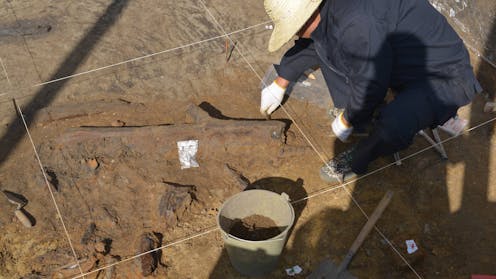
Ancient wooden tools found at a site in Gantangqing in southwestern China are approximately 300,000 years old, new dating has shown. Discovered during excavations carried out in 2014–15 and 2018–19, the tools have now been dated by a team of archaeologists, geologists, chronologists (including me) and paleontologists.
The rare wooden tools were found alongside an assortment of animal and plant fossils and stone artifacts.
Taken together, the finds suggest the early humans at Gantangqing were surprisingly sophisticated woodworkers who lived in a rich tropical or subtropical environment where they subsisted by harvesting plants from a nearby lake.
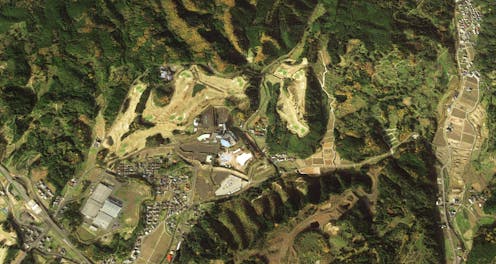
The location of the Gantangqing site and excavation trenches. Liu et al. / Science
Why ancient wooden tools are so rare
Wood usually decomposes relatively rapidly due to microbial activity, oxidation, and weathering. Unlike stone or bone, it rarely survives more than a few centuries.
Wood can only survive for thousands of years or longer if it ends up buried in unusual conditions. Wood can last a long time in oxygen-free environments or extremely dry areas. Charred or fire-hardened wood is also more durable.
At Gantangqing, the wooden objects were excavated from low-oxygen clay-heavy layers of sediment formed on the ancient shoreline of Fuxian Lake.
Wooden implements are extremely rare from the Early Palaeolithic period (the first part of the “stone age” from around 3.3 million years ago until 300,000 years ago or so, in which our hominin ancestors first began to use tools). Indeed, wooden tools more than even 50,000 years old are virtually absent outside Africa and western Eurasia.
As a result, we may have a skewed understanding of Palaeolithic cultures. We may overemphasise the role of stone tools, for example, because they are what has survived.
What wooden tools were found at Gantangqing?
The new excavations at Gantangqing found 35 wooden specimens identified as artificially modified tools. These tools were primarily manufactured from pine wood, with a minority crafted from hardwoods.
Some of the tools had rounded ends, while others had chisel-like thin blades or ridged blades. Of the 35 tools, 32 show marks of intentional modification at their tips, working edges, or bases.
Two large digging implements were identified as heavy-duty digging sticks designed for two-handed use. These are unique forms of digging implements not documented elsewhere, suggesting localised functional adaptations. There were also four distinct hook-shaped tools — likely used for cutting roots — and a series of smaller tools for one-handed use.
Nineteen of the tools showed microscopic traces of scraping from shaping or use, while 17 exhibit deliberately polished surfaces. We also identified further evidence of intensive use, including soil residues stuck to tool tips, parallel grooves or streaks along working edges, and characteristic fracture wear patterns.
The tools from Gantangqing are more complete and show a wider range of functions than those found at contemporary sites such as Clacton in the UK and Florisbad in South Africa.
The team used several techniques to figure out the age of the wooden tools. There is no way to determine their age directly, but we can date the sediment in which they were found.
Using a technique called infrared stimulated luminescence, we analysed more than 10,000 individual grains of minerals from different layers. This showed the sediment was deposited roughly between 350,000 and 200,000 years ago.
Dating the different layers of sediment excavated at the site produced a detailed timeline. Liu et al. / Science
We also used different techniques to date a mammal tooth found in one of the layers to roughly 288,000 years old. This was consistent with the mineral results.
Next we used mathematical modelling to bring all the dating results together. Our model indicated that the layers containing stone tools and wooden implements date from 360–300,000 years ago to 290–250,000 years ago.
What was the environment like?
Our research indicates the ancient humans at Gantangqing inhabited a warm, humid, tropical or subtropical environment. Pollen extracted from the sediments reveals 40 plant families that confirm this climate.
Plant fossils further verify the presence of subtropical-to-tropical flora dominated by trees, lianas, shrubs and herbs. Wet-environment plants show the local surroundings were a lakeside or wetlands.
Animal fossils also fit this picture, including rhinoceros and other mammals, turtles and various birds. The ecosystem was likely a mosaic of grassland, thickets and forests. Evidence of diving ducks confirms the lake must have been at least 2–3 metres deep during human occupation.
The site contained evidence of plants such as storable pine nuts and hazelnuts, fruit trees such as kiwi, raspberry-like berries, grapes, edible herbs and fern fronds.
There were also aquatic plants that would have provided edible leaves, seeds, tubers and rhizomes. These were likely dug up from shallow mud near the shore, using wooden tools.
These findings suggest the Gantangqing hominins may have made expeditions to the lake shore, carrying purpose-made wooden digging sticks to harvest underground food sources. To do this, they would have had to anticipate seasonal plant distributions, know exactly what parts of different plants were edible, and produce specialised tools for different tasks.
Why the Gantangqing site is important
The wooden implements from Gantangqing represent the earliest known evidence for the use of digging sticks and for the exploitation of underground plant storage organs such as tubers within the Oriental biogeographic realm. Our discovery shows the use of sophisticated wood technology in a very different environmental context from what has been seen at sites of similar age in Europe and Africa.
The find significantly expands our understanding of early hominin woodworking capabilities.
The hominins who lived at Gantangqing appear to have lived a heavily plant-based subsistence lifestyle. This is in contrast to colder, more northern settings where tools of similar age have been found (such as Schöningen in Germany), where hunting large mammals was the key to survival.
The site also shows how important wood – and perhaps other organic materials – were to “stone age” hominins. These wooden artifacts show far more sophisticated manufacturing skill than the relative rudimentary stone tools found at sites of similar age across East and Southeast Asia.
The excavation, curation, and research of the Gantangqing site were supported by
National Cultural Heritage Administration (China), Yunnan Provincial Institute of
Cultural Relics and Archaeology, Yuxi Municipal Bureau of Culture and Tourism,
Chengjiang Municipal Bureau of Culture and Tourism, Australian Research Council
(ARC) Discovery Projects, Strategic Priority Research Program of the Chinese
Academy of Sciences, Hong Kong Research Grants Council (RGC), National Natural
Science Foundation of China (NSFC).
Satellite photo of rural Saga prefecture, Japan, showing farmland disuse, consolidation and intensification and urban development.Google Earth Pro, CC BY-NC-ND
Since 1970, 73% of global wildlife has been lost, while the world’s population has doubled to 8 billion. Research shows this isn’t a coincidence but that population growth is causing a catastrophic decline in biodiversity.
Yet a turning point in human history is underway. According to UN projections, the number of people in 85 countries will be shrinking by 2050, mostly in Europe and Asia. By 2100, the human population is on course for global decline. Some say this will be good for the environment.
In 2010, Japan became the first Asian country to begin depopulating. South Korea, China and Taiwan are following close behind. In 2014, Italy was the first in southern Europe, followed by Spain, Portugal and others. We call Japan and Italy “depopulation vanguard countries” on account of their role as forerunners for understanding possible consequences in their regions.
Given assumptions that depopulation could help deliver environmental restoration, we have been working with colleagues Yang Li and Taku Fujita to investigate whether Japan is experiencing what we have termed a biodiversity “depopulation dividend” or something else.
Get your news from actual experts, straight to your inbox.Sign up to our daily newsletter to receive all The Conversation UK’s latest coverage of news and research, from politics and business to the arts and sciences.
Since 2003, hundreds of citizen scientists have been collecting biodiversity data for the Japanese government’s Monitoring Sites 1,000 project. We used 1.5 million recorded species observations from 158 sites.
These were in wooded, agricultural and peri-urban (transitional spaces on outskirts of cities) areas. We compared these observations against changes in local population, land use and surface temperature for periods of five to 20 years.
Our study, published in the journal Nature Sustainability, includes birds, butterflies, fireflies, frogs and 2,922 native and non-native plants. These landscapes have experienced the greatest depopulation since the 1990s.
Due to the size of our database, choice of sites and the positioning of Japan as a depopulation vanguard for north-east Asia, this is one of the largest studies of its kind.
Japan is not Chernobyl
Biodiversity continued to decrease in most of the areas we studied, irrespective of population increase or decrease. Only where the population remains steady is biodiversity more stable. However, the population of these areas is ageing and will decline soon, bringing them in line with the areas already seeing biodiversity loss.
Unlike in Chernobyl, where a sudden crisis caused an almost total evacuation which stimulated startling accounts of wildlife revival, Japan’s population loss has developed gradually. Here, a mosaic pattern of changing land use emerges amid still-functioning communities.
While most farmland remains under cultivation, some falls into disuse or abandonment, some is sold for urban development or transformed into intensively farmed landscapes. This prevents widespread natural succession of plant growth or afforestation (planting of new trees) that would enrich biodiversity.
In these areas, humans are agents of ecosystem sustainability. Traditional farming and seasonal livelihood practices, such as flooding, planting and harvesting of rice fields, orchard and coppice management, and property upkeep, are important for maintaining biodiversity. So depopulation can be destructive to nature. Some species thrive, but these are often non-native ones that present other challenges, such as the drying and choking of formerly wet rice paddy fields by invasive grasses.
Vacant and derelict buildings, underused infrastructure and socio-legal issues (such as complicated inheritance laws and land taxes, lack of local authority administrative capacity, and high demolition and disposal costs) all compound the problem.
An abandoned house, or akiya, in Niigata prefecture, Japan. Peter Matanle, CC BY-NC-ND
Even as the number of akiya (empty, disused or abandoned houses) increases to nearly 15% of the nation’s housing stock, the construction of new dwellings continues remorselessly. In 2024, more than 790,000 were built, due partly to Japan’s changing population distribution and household composition. Alongside these come roads, shopping malls, sports facilities, car parks and Japan’s ubiquitous convenience stores. All in all, wildlife has less space and fewer niches to inhabit, despite there being fewer people.
What can be done?
Data shows deepening depopulation in Japan and north-east Asia. Fertility rates remain low in most developed countries. Immigration provides only a short-term softer landing, as countries currently supplying migrants, such as Vietnam, are also on course for depopulation.
Our research demonstrates that biodiversity recovery needs to be actively managed, especially in depopulating areas. Despite this there are only a few rewilding projects in Japan. To help these develop, local authorities could be given powers to convert disused land into locally managed community conservancies.
Nature depletion is a systemic risk to global economic stability. Ecological risks, such as fish stock declines or deforestation, need better accountability from governments and corporations. Rather than spend on more infrastructure for an ever-dwindling population, for example, Japanese companies could invest in growing local natural forests for carbon credits.
Depopulation is emerging as a 21st-century global megatrend. Handled well, depopulation could help reduce the world’s most pressing environmental problems, including resource and energy use, emissions and waste, and nature conservation. But it needs to be actively managed for those opportunities to be realised.
Don’t have time to read about climate change as much as you’d like?
Kei Uchida received funding from JSPS Kakenhi 20K20002.
Masayoshi K. Hiraiwa does not work for, consult, own shares in or receive funding from any company or organisation that would benefit from this article, and has disclosed no relevant affiliations beyond their academic appointment.
After the Egyptian pharaoh Hatshepsut died around 1458 BCE, many statues of her were destroyed. Archaeologists believed that they were targeted in an act of revenge by Thutmose III, her successor. Yet the condition of the statues recovered in the vicinity of her mortuary temple varies and many survive with their faces virtually intact.
Now a new study by archaeologist Jun Yi Wong re-examines the original excavations and offers an alternative explanation. Much of the damage may in fact be from the “ritual deactivation” of the statues and their reuse as raw material. We asked him to explain.
Who was Queen Hatshepsut and why was she important?
Hatshepsut ruled as the pharaoh of Egypt around 3,500 years ago. Her reign was an exceptionally successful one – she was a prolific builder of monuments, and her reign saw great innovations in art and architecture. As a result, some regard her as one of the greatest rulers – male or female – in ancient Egypt. She has also been described as the “first great woman in history”.
Hatshepsut was the wife and half sister of pharaoh Thutmose II. Following the premature death of her husband, she acted as regent for her stepson, the young Thutmose III. However, about seven years later, Hatshepsut ascended the throne and declared herself ruler of Egypt.
Why was it believed her statues were destroyed in revenge?
After her death, Hatshepsut’s names and representations such as statues were systematically erased from her monuments. This event, often called the “proscription” of Hatshepsut, is currently part of my wider research.
There’s little doubt that this destruction began during the time of Thutmose III, since some of Hatshepsut’s erased representations were found concealed by his new constructions.
The statues that formed the subject of my recently published study were discovered in the 1920s. By this time, Thutmose III’s proscription of Hatshepsut was already well known, so it was immediately (and rightly) assumed it was caused during his reign. Some of the broken statues were even found underneath a causeway built by Thutmose III, so there is little doubt that their destruction took place during his reign.
Because the statues were found in fragments, early archaeologists assumed that they must have been broken up violently, perhaps due to Thutmose III’s animosity towards Hatshepsut. For instance, Herbert Winlock, the archaeologist who led the excavations of 1922 to 1928, remarked that Thutmose III must have “decreed the destruction of every portrait of (Hatshepsut) in existence” and that
Every conceivable indignity had been heaped on the likeness of the fallen Queen.
The problem with such an interpretation is that some of Hatshepsut’s statues have survived in relatively good condition, with their faces virtually intact. Why was there such a great variation in the treatment of the statues? That was essentially the main question of my research.
How did you go about finding the answer?
It was clear that the damage to Hatshepsut’s statues was not caused solely by Thutmose III. Many of them were left exposed and not buried, and many were reused as building material. Indeed, not far from where the statues were discovered, the archaeologists found a stone house that was partially built using fragments of her statues.
Of course, the question is to what extent these reuse activities added to the damage of the statues. Fortunately, the archaeologists who excavated the statues left behind field notes that are quite detailed.
Based on this archival material, it is possible to reconstruct the locations in which many of these statues were found.
The results were quite intriguing: statues that are scattered over large areas, or have significant missing parts, tend to have sustained significant damage to their faces. In contrast, statues found in a relatively complete condition typically have their faces fully intact.
In other words, statues that were subjected to heavy reuse activities are far more likely to have sustained facial damage.
Therefore, it is likely that Thutmose III was not responsible for the facial damage sustained by the statues. Instead, the destruction that he was responsible for was far more specific, namely the breaking of these statues across their neck, waist and knees.
This form of treatment is not unique to Hatshepsut’s statues.
Fascinating. So what does this mean?
The practice of breaking royal statues across their neck, waist and knees is common in ancient Egypt. It’s often referred to as the “deactivation” of statues.
For the ancient Egyptians, statues were more than just images. For example, newly made statues underwent a rite known as the opening of the mouth, where they were ritually brought to life. Since statues were regarded as living and powerful objects, their inherent power had to be neutralised before they could be discarded.
Indeed, one of the most extraordinary discoveries in Egyptian archaeology is the Karnak Cachette, where hundreds of royal statues were found buried in a single deposit. The vast majority of the statues have been “deactivated”, even though most of them depict pharaohs who were never subjected to any hostilities after their death.
This suggests that the destruction of Hatshepsut’s statues was motivated mainly by ritualistic and pragmatic reasons, rather than revenge or animosity. This, of course, changes the way that her relationship with Thutmose III is understood.
Jun Yi Wong receives funding from the Andrew W. Mellon Foundation.
The US president, Donald Trump, says that Israel has agreed to terms for a 60-day ceasefire in Gaza. If that sounds familiar, it is.
The idea of a two-month truce has been discussed since the collapse of the last shortlived ceasefire in March. A similar proposal was floated in May, but Hamas viewed it as an enabling mechanism for Israel to continue the war after a brief pause, rather than reaching a permanent peace deal.
As the devastation in Gaza worsens by the day, will this time be any different?
The proposal, put forward by Qatari mediators, reportedly involves Hamas releasing ten living hostages and the bodies of 18 deceased hostages over the 60-day period, in exchange for the release of a number of Palestinian prisoners.
Get your news from actual experts, straight to your inbox.Sign up to our daily newsletter to receive all The Conversation UK’s latest coverage of news and research, from politics and business to the arts and sciences.
The remaining 22 hostages would be released if a long-term deal is reached. The 60-day ceasefire period would also involve negotiations for a permanent end to hostilities and a roadmap for post-war governance in Gaza.
But the plan is similar to the eight-week, three-phase ceasefire from January to March of this year, which collapsed after the first phase of hostage exchanges. Since then peace talks have hit a recurrent impasse.
For Hamas, a long-term ceasefire means the permanent end to the war and the withdrawal of Israeli forces from Gaza. Israel, meanwhile, wants to see the complete removal of Hamas from power, the dismantling and disarming of its military wing and the exile of remaining senior Hamas leaders.
But despite the persistent challenges, there are several reasons that this attempt for a ceasefire might be different. First and foremost is the recent so-called “12-day war” between Israel and Iran, which Israel has trumpeted as a major success for degrading Iran’s nuclear capabilities (although the reality is more nuanced).
The perceived win gives Israel’s prime minister, Benjamin Netanyahu, political maneuverability to pursue a ceasefire over the objections of far-right hardliners in his coalition who have threatened to bring down the government in previous rounds.
The Iran-Israel war, in which the US controversially carried out strikes on Iran’s nuclear sites, also revived Trump’s interest in the Middle East. Trump entered office just as the phased Gaza ceasefire deal was being agreed. But Trump put little diplomatic pressure on Israel to engage in serious talks to get from the first phase of the agreement to phase two, allowing the war to resume in March.
Now however, after assisting Israel militarily in Iran, Trump has significant leverage he can use with Netanyahu. He will have the chance to use it (if he chooses) when Netanyahu visits Washington next week.
Both men also view Iran’s weakened position as an opportunity for expanding the Abraham accords. This was the set of agreements normalising relations between Israel and several Arab states, including the United Arab Emirates, Bahrain, Sudan and Morocco, which Trump brokered at the end of his first term.
Netanyahu has long eyed a US-backed deal with Saudi Arabia, and a smaller-scale declaration with Syria is reportedly now under discussion as well. But those deals can’t move forward while the war in Gaza is going.
Additional obstacles
However, the recurrent obstacles to a deal remain – and it’s unclear if the proposed terms will include guarantees to prevent Israel resuming the war after the 60-day period.
New issues have also arisen since the last round of talks that could create further challenges. Hamas is demanding a return to traditional humanitarian aid distribution in Gaza – or at least the replacement of the controversial US and Israeli-backed Gaza Humanitarian Foundation (GHF).
The GHF’s four distribution sites, located in militarised zones, replaced over 400 previously operating aid points, and more than 400 people have been killed while seeking aid near the sites, since May 26. More than 170 international non-governmental organisations and charities have called for the GHF to be shut down.
Israel’s military control over Gaza has also become further entrenched since the last ceasefire. More than 80% is thought to be covered by evacuation orders – and new orders for north Gaza and Gaza City were issued on June 29 and July 2 respectively.
Israeli officials have described the renewed operations as military pressure on Hamas to accept a ceasefire. But Netanyahu has also spoken openly about long-term military occupation of Gaza.
He recently stated that Israel would remain in “full security control of Gaza” even after the war. Even if a temporary ceasefire is agreed, the road ahead is strewn with difficulties in moving towards a long-lasting ceasefire or reaching an acceptable “day-after” agreement.
Still, the current moment offers an opportunity for a breakthrough. Trump has a renewed interest in getting to a ceasefire and Netanyahu has a rare political window to enter an agreement and get hostages home. Hamas, meanwhile, has been weakened, not only by Israel’s relentless military pounding, but by increasing disillusionment from the people of Gaza, who are desperate for an end to the war.
There is no shortage of reasons to end the war in Gaza. The only question is if Israel and Hamas have the will to do so.
Julie M. Norman does not work for, consult, own shares in or receive funding from any company or organisation that would benefit from this article, and has disclosed no relevant affiliations beyond their academic appointment.