Why is US health care still the most expensive in the world after decades of cost-cutting initiatives?

Source: The Conversation – USA (3) – By Patrick Aguilar, Managing Director of Health, Washington University in St. Louis

Two-thirds of Americans are very worried about being able to pay for their health care. Morsa Images/DigitalVision via Getty Images

In announcing its “Great Healthcare Plan” in January 2026, the Trump administration became the latest in a long history of efforts by the U.S. government to rein in the soaring cost of health care.

As a physician and professor studying the intersection of business and health, I know that the challenges in reforming the sprawling U.S. health care system are immense. That’s partly for political and even philosophical reasons.

But it also reflects a complex system fraught with competing interests – and the fact that patients, hospitals, health insurance companies and drug manufacturers change their behaviors in conflicting ways when faced with new rules.

Soaring costs

U.S. health care is the most expensive in the world, and according to a poll published in late January 2026, two-thirds of Americans are very worried about their ability to pay for it – whether it’s their medications, a doctor’s visit, health insurance or an unpredictably costly medical emergency.

Disputes over health policy even played a central role in the federal government shutdown in fall 2025.

Trump’s health care framework outlines no specific policy actions, but it does establish priorities to address a number of longtime concerns, including prescription drug costs, price transparency, lowering insurance premiums and making health insurance companies generally more accountable.

Why have these challenges been so difficult to address?

Drug price sticker shock

Prescription drug costs in the U.S. began rising sharply in the 1980s, when drugmakers increased the development of innovative new treatments for common diseases. But efforts to combat this trend have resembled a game of whack-a-mole because the factors driving it are so intertwined.

One issue is the unique set of challenges that define drug development. As with any consumer good, manufacturers price prescription drugs to cover costs and earn profits. Drug manufacturing, however, involves an expensive and time-consuming development process with a high risk of failure.

Patent protection is another issue. Drug patents last 20 years, but completing costly trials necessary for regulatory approval takes up much of that period, reducing the time when manufacturers have exclusive rights to sell the drug. After a patent expires, generic versions can be made and sold for significantly less, lowering the profits for the original manufacturer. Though some data challenges this claim, the pharmaceutical industry contends that high prices while drugs are under patent help companies recover their investment, which then funds the discovery of new drugs. And they often find ways to extend their patents, which keeps prices elevated for longer.

Then there are the intermediaries. Once a drug is on the market, prices are typically set through negotiations with administrators called pharmacy benefit managers, who negotiate discounts and rebates on prescription drugs for health insurers and employers offering benefits to their workers. Pharmacy benefit managers are paid based on those discounts, so they do not have an incentive to lower total drug prices, though new transparency rules enacted Feb. 3 aim to change payment practices. Drugmakers often raise the list price of drugs to make up for the markdowns that pharmacy benefit managers negotiate – and possibly even more than that.

In many countries, centralized government negotiators set the price for prescription drugs, resulting in lower drug prices. This has prompted American officials to consider using those prices as a reference for setting drug prices here. In its blueprint, the Trump administration has called for a “most-favored nation” drug pricing policy, under which some U.S. drug prices would match the lowest prices paid in other countries.

This may work in the short term, but manufacturers say it could also curtail investment in innovative new drugs. And some industry experts worry that it may push manufacturers to raise international prices.

Policy experts have questioned whether TrumpRx will bring down drug prices.

In late 2025, 16 pharmaceutical companies agreed to most-favored nation pricing for some drugs. Consumers can now buy them directly from manufacturers through TrumpRx, a portal that points consumers to drug manufacturers and provides coupons for purchasing more than 40 widely used brand-name drugs at a discount, which launched Feb. 5. However, many drugs available through the platform can be purchased at lower prices as generics

Increasing price transparency

Fewer than 1 in 20 Americans know how much health care services will cost before they receive them. One fix for this seems obvious: Make providers list their prices up front. That way, consumers could compare prices and choose the most cost-effective options for their care.

Spurred by bipartisan support in Congress, the government has embraced price transparency for health care services over the past decade. In February 2025, the Trump administration announced stricter enforcement for hospitals, which must now post actual prices, rather than estimates, for common medical procedures. Data is mixed on whether the approach is working as planned, however. Hospitals have reduced prices for people paying out of pocket, but not for those paying with insurance, according to a 2025 study.

For one thing, when regulations change, companies make strategic decisions to achieve their financial goals and meet the new rules – sometimes yielding unintended consequences. One study found, for example, that price transparency regulations in a series of clinics led to an increase in physician charges to insurance companies because some providers who had been charging less raised their prices to match more expensive competitors.

Additionally, a 2024 federal government study found that 46% of hospitals were not compliant. The American Hospital Association, a trade group, suggested price transparency imposes a high administrative burden on hospitals while providing confusing information to patients, whose costs may vary depending on unique aspects of their conditions. And the fine for noncompliance, US$300 per day, may be insufficient to offset the cost of disclosing this information, according to some health policy experts.

Beyond high costs, patients also worry that insurers won’t actually cover the care they receive. Cigna is currently fighting a lawsuit accusing its doctors of denying claims almost instantly – within an average of 1.2 seconds – but concerns about claims denial are rampant across the industry. Companies’ use of artificial intelligence to deny claims is compounding the problem.

Two health care workers speak with a child lying on a hospital gurney
Fewer than 1 in 20 Americans know how much health care services will cost before they get them.
FS Productions/Tetra Images via Getty Images

Curbing the rise in health insurance premiums

Many Americans struggle to afford monthly insurance premiums. But curbing that increase significantly may be impossible without reining in overall health care costs and, paradoxically, keeping more people insured.

Insurance works by pooling money paid by members of an insurance plan. That money covers all members’ health care costs, with some using more than they contribute and others less. Premium prices therefore depend on how many people are in the plan, as well as the services insurance will cover and the services people actually use. Because health care costs are rising overall, commercial insurance companies may not be able to significantly lower premiums without reducing their ability to cover costs and absorb risk.

Nearly two-thirds of Americans under age 65 receive health insurance through employers. Another 6.9% of them get it through Affordable Care Act marketplaces, where enrollment numbers are extremely sensitive to premium costs.

Enrollment in ACA plans nearly doubled in 2021, from about 12 million to more than 24 million, when the government introduced subsidies to reduce premiums during the COVID-19 pandemic. But when the subsidies expired on Jan. 1, 2026, about 1.4 million dropped coverage, and for most who didn’t, premiums more than doubled. The Congressional Budget Office projects that another 3.7 million will become uninsured in 2027, reversing some of the huge gains made since the ACA was passed in 2010.

When health insurance costs rise, healthier people may risk going without. Those who remain insured tend to need more health services, requiring those more costly services to be covered by a smaller pool of people and raising premium prices even higher.

The Trump administration has proposed routing the money spent on subsidies directly to eligible Americans to help them purchase health insurance. How much people would receive is unclear, but amounts in previous proposals wouldn’t cover what the subsidies provided.

To sum it up, health care is extremely complicated and there are numerous barriers to reforms, as successive U.S. administrations have learned over the years. Whether the Trump administration finds some success will depend on how well the policies are able to surmount these and other obstacles.

The Conversation

Patrick Aguilar does not work for, consult, own shares in or receive funding from any company or organization that would benefit from this article, and has disclosed no relevant affiliations beyond their academic appointment.

ref. Why is US health care still the most expensive in the world after decades of cost-cutting initiatives? – https://theconversation.com/why-is-us-health-care-still-the-most-expensive-in-the-world-after-decades-of-cost-cutting-initiatives-273743

What is and isn’t new about US bishops’ criticism of Trump’s foreign policy

Source: The Conversation – USA (3) – By Gerard F. Powers, Director of Catholic Peacebuilding Studies, University of Notre Dame

Cardinals Robert McElroy, Joseph Tobin and Blase Cupich issued a statement on U.S. foreign policy on Jan. 19, 2026. Gregorio Borgia/Gregory Bull/AP Photo

In recent weeks, Catholic leaders have been increasingly outspoken in their criticism of the Trump administration’s foreign policy, especially its military intervention in Venezuela and saber-rattling over Greenland.

On Jan. 19, 2026, the three cardinals heading U.S. archdioceses – Blase Cupich of Chicago, Robert McElroy of Washington, D.C., and Joseph Tobin of Newark – issued a rare joint statement. “The United States has entered into the most profound and searing debate about the moral foundation for America’s actions in the world since the end of the Cold War,” they began, calling for “a genuinely moral foreign policy.”

The cardinals quoted Pope Leo XIV’s annual address to the Vatican’s diplomatic corps, delivered earlier that month, in which he deplored that “a zeal for war is spreading,” and the norm governing the use of force “has been completely undermined.”

In follow-up interviews, Cupich criticized the U.S. operation to capture President Nicolás Maduro for sending a message that “might makes right.” Tobin noted that some members of the Trump administration seemed to be advancing “almost a Darwinian calculus that the powerful survive and the weak don’t deserve to.”

As a former foreign policy adviser to the U.S. Conference of Catholic Bishops, and now director of Catholic peacebuilding studies at Notre Dame’s Kroc Institute, I know how rare it is that the cardinals’ short statement became headline news – especially because what they said mostly reiterated long-standing church teachings.

A man with gray hair and a black suit with a clerical collar smiles as he sits in front of a bright blue curtain.
Military Services Archbishop Timothy Broglio speaks during a press conference at a plenary assembly in Baltimore on Nov. 11, 2025.
AP Photo/Stephanie Scarbrough

More novel, however, were statements by Archbishop Timothy Broglio, who leads the Archdiocese for the Military Services. In December 2025, Broglio issued a detailed critique of the morality and legality of the Trump administration’s strikes against boats in the Caribbean. In a January interview with the BBC, when asked if an invasion of Greenland could be considered just, he said, “I cannot see any circumstances that it would.”

It is unusual for an archbishop of the military services to question the morality of specific U.S. military interventions. After doing so, it is even more unusual to call on the nation’s leaders to respect the consciences of military personnel “by not asking them to engage in immoral actions,” and to remind service members that “it would be morally acceptable to disobey (such an) order.”

All of these statements continue U.S. bishops’ legacy of opposing virtually every major U.S. military intervention since Vietnam, except the invasion of Afghanistan.

Just war

That opposition reflects the Catholic Church’s centuries-old “just war” tradition and its increasingly restrictive approach to what counts as “just.”

Just war criteria limit when, why and how force may be used. According to the Catholic catechism, going to war is legitimate in cases where there are not other means of stopping “lasting, grave, and certain harm,” there is reasonable chance of success, and war will not produce “evils and disorders graver than the evil to be eliminated.”

In other words, war should be “a last resort in extreme situations, not a normal instrument of national policy,” as the cardinals noted in their statement. The Catholic Church presumes that war is a failure of politics.

That restrictive approach, which some conservative Catholics dub “functional pacifism,” has put church leaders in opposition to U.S. military interventions that reflect a much more permissive interpretation of just war. The permissive approach presumes that war might be a last resort, but it remains a form of politics – one tool in the foreign policy toolbox.

Cold War criticism

These contrasting approaches were especially evident in the nuclear debate of the early 1980s and the debate over the 2003 Iraq invasion.

When Ronald Reagan first took office, his administration launched a massive nuclear buildup and deployed intermediate-range nuclear weapons in Europe, arguing that Americans were falling behind the Soviets in the Cold War.

A man in a suit and striped tie, standing at a lectern in front of a presidential seal, raises his arm in a thumbs-up gesture.
President Ronald Reagan discusses the production of the MX nuclear missile during a news conference on May 14, 1984.
AP Photo/Scott Stewart

In 1983, the U.S. bishops issued a highly influential letter, The Challenge of Peace, that opposed core elements of the administration’s nuclear policy. They called for a halt to the arms race, opposed the first use of nuclear weapons, and were skeptical of the morality of even a limited second, or retaliatory, use.

Their 103-page letter did not have a direct impact on U.S. nuclear policy, but it helped ensure that the just war tradition was no longer dismissed as outdated by policymakers and analysts. The pastoral was required reading in military academies.

One of the architects of Reagan’s Strategic Defense Initiative, Chief of Naval Operations Adm. James Watkins, was troubled by the church’s criticism of deterrence, according to journalist John Newhouse. Watkins saw missile defense as a morally superior alternative, which is how the so-called “Star Wars” program was sold to a skeptical Congress and public.

No preventive war

Debate about overly permissive use of force reached its zenith in the lead-up to the Bush administration’s invasion of Iraq in 2003. The administration argued that military force should not be restricted to defense against aggression. Preventive war was justified, in this view, to remove the potential danger Iraq posed in the aftermath of 9/11: a rogue regime, with weapons of mass destruction, and ties to global terrorists.

Pope John Paul II, U.S. bishops and Catholic leaders around the world vociferously objected, saying such a doctrine would emasculate the just war tradition and international law. As then-Cardinal Joseph Ratzinger – who later became Pope Benedict – said in 2002, “The concept of ‘preventive war’ does not appear in the Catechism of the Catholic Church.”

As early as May 2002, U.S. bishops embarked on a series of meetings with White House officials, urging them not to go to war. In March 2003, John Paul sent the Italian Cardinal Pio Laghi to hand-deliver a letter to President George W. Bush urging the same.

A man in a suit and blue tie sits in an ornate white chair, next to another seated man in white robes reading into a microphone.
During remarks on June 4, 2004, Pope John Paul II reminded President George W. Bush of the Vatican’s opposition to the war in Iraq.
Eric Vandeville/Gamma-Rapho via Getty Images

New context

It is not new for the church’s more idealist and cosmopolitan approach to international affairs to be in deep tension with a realist, “anti-globalist” U.S. foreign policy. In fact, the bishops have been more outspoken in the past than now.

But what is new, at least since the end of the Cold War, is church leaders’ growing concern about an intentionally norm-busting foreign policy. Past administrations offered legal and moral justifications for military inventions, such as the Bush administration’s claims that Iraq was a just war.

Trump, however, has abandoned any pretenses of his predecessors, telling The New York Times, “I don’t need international law.” The only limit on his international power, he said, is “my own morality.”

The bishops’ statements on his administration’s foreign policy are few and modest compared to the past. But with an American pope leading the way, they may prove the first salvo in more public and vigorous opposition by Catholic leaders.

The Conversation

Gerard F. Powers received a grant from the Nuclear Threat Initiative that helped support the Catholic Peacebuilding Network’s Project on Revitalizing Catholic Engagement on Nuclear Disarmament. He is an expert consultant (unpaid) to the Holy See Mission to the UN. From 1987-2004, Powers was a senior advisor on international policy for the U.S. Conference of Catholic Bishops.

ref. What is and isn’t new about US bishops’ criticism of Trump’s foreign policy – https://theconversation.com/what-is-and-isnt-new-about-us-bishops-criticism-of-trumps-foreign-policy-274499

Winter sports scream glamour, but women’s ski-wear falls short when it comes to actually skiing

Source: The Conversation – UK – By Tamsin Johnson, PhD candidate in visual cultures, Nottingham Trent University

Kiselev Andrey Valerevich/Shutterstock

Marks and Spencer is one of the latest UK high-street brands to launch a ski-wear collection. Even supermarket Lidl are in on the action, with their ski range starting from £3.99. This follows earlier moves by fast-fashion retailers such as Topshop who launched SNO in the mid 2010’s and Zara’s imaginatively titled Zara Ski collection, which launched in 2023.

Fast fashion brand PrettyLittleThing’s Apres Ski edit (a collection of clothes chosen for a specific theme) tells potential shoppers that going skiing is “not necessarily essential” which is good, because many of the products in the collection are listed as athleisure, not sportswear.

It’s not just the high-street. Kim Kardashian’s shapewear brand Skims has recently collaborated with The North Face and has dressed the USA team for the 2026 Winter Olympics – though these are strictly designed to serve the athletes during down-time, not for the piste.

Alongside dedicated ski-wear lines, the apres-ski aesthetic has become a recurring seasonal trend over recent years, expanding well beyond the slopes. You may have noticed the slew of ski-themed sweatshirts across the market. One of these, an Abercrombie & Fitch sweatshirt, went viral in January after a buyer noticed that the depicted resort was actually Val Thorens, France – not Aspen, Colorado, as the text printed on the garment claimed.

It is not only the quality of ski-themed fashion products that are a cause for concern, but also those designed for the slope. Many of these high-street collections have received criticism from consumers, with some claiming that the garments are “not fit for purpose”. Meanwhile, many influencers have taken to social media to warn their followers to avoid skiing in garments from fast fashion brands. Such were the complaints that Zara Ski reportedly renamed its products “water resistant” instead of “waterproof”.

These collections respond, in part, to a genuine need for women’s sportswear that is practical, fashionable and most critically, affordable. Ski and performance wear in general is costly and such collections, being both fashionable and relatively low-cost make for an attractive prospect. And yet, if these garments are so poorly suited to skiing, then what are they for?

The visual allure of skiing

Despite sports playing a key role in challenging gender ideology and perceptions of female physicality, the perceived importance of femininity and how women look while doing sports has lingered. Images of sportswomen frequently fixate on gender difference and femininity is foregrounded over athleticism. Here, the glamorous image of skiing has much to account for.

Glamour relies on distance and difference to conjure a feeling of longing. For many, the novelty of eating fondue at 3,000ft is out of reach, as is the ever-increasing price of a lift pass.

1983 Ski Time by Warren Miller.

Throughout the 20th century, the glamour of skiing has been defined by women’s fashion. In the 1920s, Vogue magazine featured illustrations of elongated skiing women on their covers. Designer Pucci’s aerodynamic one-piece ski suit premiered in Harper’s Bazaar magazine in 1947 whilst Moncler’s ski anoraks – photographed on Jackie Kennedy in 1966 – gave birth to a vision of American ski “cool”. Changing ski fashions were recorded in photographer Slim Aarons’ resort photography, capturing the leisure class on and off piste between the 1950s and 1980s.

Women’s fashionable ski-wear has taken many forms since the activity first became popular in the 1920s. It was during this decade that skiing became a marker of affluence. Leather, gaberdine, fur and wool were popular materials in early women’s ski-wear and were selected for their natural properties; water-repellence, insulation, breathability.

By the mid-century, women’s ski-wear became more focused on silhouette and excess fabric was considered unfeminine. Equally, ski-wear gradually became more colourful and in the fashion press, women were even encouraged to match their lipstick to their ski ensemble. By the 1980s, ski-wear aligned with the fashionable “wedge” silhouette; causing the shoulders of ski jackets to widen and salopettes (ski trousers with shoulder braces) to draw even tighter.

These historic developments parallel today’s aesthetic ski trend where fashion and image arguably comes before function. For example, PrettyLittleThing’s models are photographed on fake slopes, holding vintage skis. The glamorous image of the skiing woman lies not only in the clothing but in her stasis. The suggestion is that ski culture does not necessarily require skiing at all: it may simply involve occupying the most visible terrace, Aperol in hand.

No wonder then, that so many fast-fashion ski lines for women are deeply unpractical – they appear designed less for physical exertion than for visual consumption. They sell women on the alluring glamour of skiing, while leaving them out in the cold.

There is an additional irony here: climate change means that skiing is becoming increasingly exclusive. Lower-level resorts are closing as the snow line moves up, meaning fewer options and increased demand. In this sense, the image of skiing looks to become even more glamorous via increasing inaccessibility and therefore distance. Fast-fashion has a negative impact on the environment, and the ski aesthetic risks damaging the very thing it claims to celebrate.


Looking for something good? Cut through the noise with a carefully curated selection of the latest releases, live events and exhibitions, straight to your inbox every fortnight, on Fridays. Sign up here.


This article features references to books that have been included for editorial reasons, and may contain links to bookshop.org. If you click on one of the links and go on to buy something from bookshop.org The Conversation UK may earn a commission.

The Conversation

Tamsin Johnson receives funding from the AHRC via the Midlands4Cities doctoral partnership. Tamsin is the current secretary of the British Society of Sports History and part-time Lecturer at Nottingham Trent University.

ref. Winter sports scream glamour, but women’s ski-wear falls short when it comes to actually skiing – https://theconversation.com/winter-sports-scream-glamour-but-womens-ski-wear-falls-short-when-it-comes-to-actually-skiing-274788

Why Aristotle would hate Valentine’s Day – and his five steps to love

Source: The Conversation – UK – By Janset Özün Çetinkaya, Teaching Associate in Philosophy, University of Nottingham

Valentine’s Day is traditionally a time of heart-shaped balloons, overpriced roses and fully-booked restaurants. Couples kiss and hold hands, smiling selfies celebrate a day of public displays of devotion.

Why do so many of us feel such pressure to offer grand gestures, buy pricey gifts, and go through elaborate displays of affection? Presumably, to prove our love. Valentine’s Day is a showy, one-day-a-year demonstration that promises to do just that.

For the ancient Greek philosopher Aristotle (384-322BC), however, this approach misunderstands the nature of love. For him, the true form of love wasn’t intense passion or grand gestures on one day of the year. Instead, it’s a steady commitment to help your beloved grow into their best version through everyday practices of care.

Aristotle wrote extensively about love, friendship and their place in a good life. His main book on ethics, the Nicomachean Ethics (350BC) – affectionately named after his son – is a classic work on virtue and happiness.

As a keen observer of human life, Aristotle’s philosophy was based on a real understanding of human beings – our emotions, needs, habits and the ways we live alongside each other. Humans are social animals, he argued, so we must live in a society and work toward a common good. More than this, we are “pairing” creatures. Coupling and sharing a life matters deeply. Interestingly, he believed this means learning to love ourselves, as well as others.


Read more:
Valentine’s Day: a brief history of the soulmate – and why it’s a limited concept


The five steps to love

Aristotle said we should love ourselves the most. This could sound like a celebration of narcissism, a gospel for the selfie age. But Aristotle meant that truly loving someone means loving them as another self, extending our self-love to another – a process with five parts.

First, loving yourself means desiring and promoting your own good. Do the same for your loved one. Desire and promote whatever is in their interest. Second, work for their own safety and security as you would your own. Third, self-love means enjoying your own company and taking pleasure in reminiscing about past times and looking forward to good times to come. Desire and enjoy their company, too, in a shared life of interests, commitments and hopes.

Painting of a woman looking in a mirror
Psyche by Berthe Morisot (1876). Aristotle believed you should love a partner as yourself.
Thyssen-Bornemisza Museum

Fourth, make sure your desires are rational, and only desire things that are part of a “fine and noble life” – a life that is virtuous, rational and filled with meaningful relationships. Fifth, openly express and experience your pains and pleasures. Consistently pursue what brings you pleasure and avoid whatever brings pain. For your beloved, recognise and share in their pains and pleasures, as if they were your own.

Love, Aristotle says, comes from the sense that the lover is “mine”. If that sounds icky to a modern ear, the point isn’t about ownership. When I say “my beloved is mine”, I mean “we belong together in a shared life”. I do not own my finger, it belongs to my hand, which is a part of me. Likewise, I don’t own my beloved, but they belong to our loving relationship, of which I, too, am part.

Love, friendship and skill

Aristotle also described lovers as friends – not any old good friends but each other’s other halves. Like friends, lovers hang out, have each other’s back and support one another. As lovers, they treat each other as a part of themselves. Aristotle thinks it’s a big red flag if your lover doesn’t care as much about your feelings and needs as their own, no matter how grand their gestures and gifts.

Love was not a passive feeling for Aristotle, but a practice requiring skill. A lover, he argues, makes themselves better for their beloved, unlike a carpenter who makes a table for himself. Loving is a practice of constant self-improvement for the sake of another person. Being a good lover means striving to be a better person, so that you and your beloved bring out the best in each other.

For Aristotle, love is not about how your Valentine makes you feel on a single night of the year. Gifts and gestures are nice, but the real proof of love is nothing you can buy. Loving another as much and as well as you love yourself is the real proof, one that takes time and practice. To quote Aristotle, “one swallow does not make spring” – nor does one magical night really show our love.


Looking for something good? Cut through the noise with a carefully curated selection of the latest releases, live events and exhibitions, straight to your inbox every fortnight, on Fridays. Sign up here.


The Conversation

The authors do not work for, consult, own shares in or receive funding from any company or organisation that would benefit from this article, and have disclosed no relevant affiliations beyond their academic appointment.

ref. Why Aristotle would hate Valentine’s Day – and his five steps to love – https://theconversation.com/why-aristotle-would-hate-valentines-day-and-his-five-steps-to-love-275460

Love stories of the Berlin Wall – couples reunited via tunnels, hot air balloons and zip wires

Source: The Conversation – UK – By Kelly Hignett, Senior Lecturer in History, Leeds Beckett University

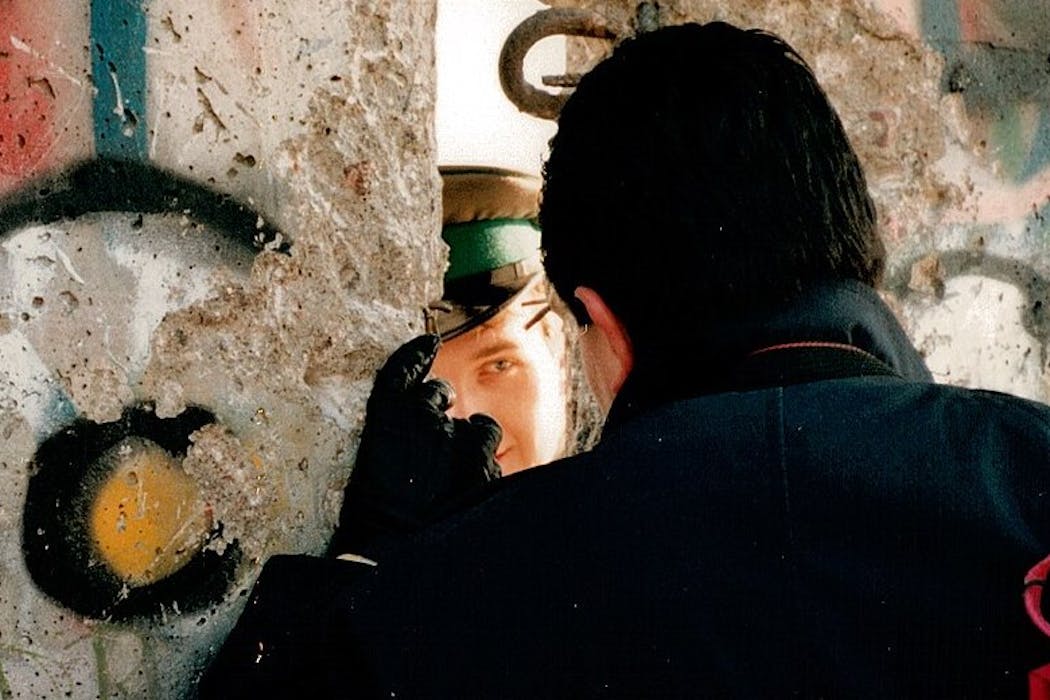
An East German guard talks to a Westerner through a hole in the Wall in November 1989. Sharon Emerson, CC BY-SA

The people of Berlin woke on August 13 1961 to discover that their city had been split in two.

Despite the earlier cold war division of Germany into east and west after 1945, the border between the two halves of Berlin had remained open, allowing most Germans to travel, mix and mingle freely across the city. This abruptly changed in 1961 when the East German authorities closed the Berlin border and began constructing a wall across the city, a formidable barrier which would stand for almost 30 years. Overnight, families, friends and lovers were cruelly separated.

The Berlin Wall inspired David Bowie’s song Heroes (1977), with its poignant lyrics about two lovers, divided by the wall, dreaming of freedom together. However, there are many real-life examples of couples who found themselves divided by the wall, forced to undertake dangerous, daring escape attempts to overcome their separation.

East German propaganda portrayed the division of Berlin as an act of “fraternal love”, necessary to protect their citizens from the dangerous influences of the capitalist west. In reality, the construction of the wall was more like the jealous actions of a spurned lover, as East German authorities tried to halt the increasing number of people who were fleeing the communist state via Berlin, estimated to have reached 3.5 million, or around one-sixth of the East German population, by 1961.

The border closure meant countless German families, friends and lovers were cut off overnight.

Faced with the prospect of indefinite separation from their loved ones in the West, many East Germans tried to cross the border illegally. The risks were high. If intercepted, they could be arrested, imprisoned or even killed. The guards stationed along the wall were ordered to “shoot to kill” and at least 140 escapees died.

Despite the heightened stakes, around 5,000 East Germans successfully escaped through Berlin from 1961-89, utilising an array of daring methods, such as tunnelling, travelling over the wall by zipline or hot air balloon and concealing themselves in specially modified vehicles. For many of these people, their desire to escape was fuelled by love.

The love stories of the wall

Many east-west German couples who refused to see the Berlin Wall as a barrier to their love have shared stories of their daring escapes. Leslie Colitt’s East German fiancée Ingrid disguised herself as his sister and used her American passport to bluff her way past the border guards and into West Berlin.

When Heinz Meixner decided to smuggle both his fiancée Margarete and her mother out of East Berlin in 1963, he did it in style, using a specially modified sports car. With both women carefully concealed inside the vehicle, Heinz casually drove up to the border, before suddenly zooming past the unsuspecting guards, ducking underneath the checkpoint barrier with only two inches to spare and skidding to safety in West Berlin.

In 1971, Regina Albrecht faced a long and perilous journey to happiness, when she escaped East Germany to reunite with her boyfriend, Eckhard. Albrecht endured cramped conditions hidden behind the fuel tank of a modified car, as she travelled through Romania, Yugoslavia and into Austria, before travelling on to West Germany, where she and Eckhard married.

Over 70 tunnels were constructed underneath the Berlin Wall, although many were ultimately unsuccessful. In 1962, a tunnel constructed by a group of engineering students in West Berlin allowed 29 East Germans to crawl to freedom, reuniting many loved ones.

Tunneller Claus’s wife Inge and baby son both made it safely through, while group leader Joachim later fell in love with Eveline, a young woman who had escaped through the tunnel that night. However, another group member, Wolfdieter, who had acted as a courier in exchange for securing his girlfriend Renate’s safe passage from East Berlin, had to wait a little longer for his happy ending. Both Wolfdieter and Renate were caught and imprisoned in East Berlin, although they later reunited and married in 1966.

Similarly, while Joachim Neumann had escaped to West Berlin using a fake passport in 1961, his girlfriend Christa had been caught, imprisoned and was stuck in the east. In 1964, Joachim oversaw construction of a tunnel which enabled 57 East Germans to cross to West Berlin, including Christa. The couple went on to marry and have a family together.

Two become one

The fall of the Berlin Wall in November 1989 was widely celebrated across West and East Germany, leading to many joyous and jubilant reunions. This included former lovers Sigrid and Erik Krause, who had married in 1957, been separated by the division of Berlin in 1961 and subsequently divorced. However, 30 years later, the fall of the wall allowed them to rekindle their romance and remarry.

A couple shares their story of love separated by the Wall – and eventual reunion.

Personal reunions were accompanied by political fusion, with German reunification in October 1990. However, the subsequent decades of integration have produced challenges as well as opportunities. One recent survey indicated that today, while public opinion still perceives reunification positively, around one-third of Germans are unsatisfied with the level of unity that exists, a figure that rises to half among people in the former East Germany.

Recent research also suggests that the cold war division of Germany may have had an enduring legacy on romantic relations. Only 5% of German couples are composed of East-West partnerships, some of whom have spoken about the challenges they have faced. So, while the Berlin Wall may have crumbled, there are indications that an “invisible wall” continues to divide German minds – and hearts – today.


Looking for something good? Cut through the noise with a carefully curated selection of the latest releases, live events and exhibitions, straight to your inbox every fortnight, on Fridays. Sign up here.


The Conversation

Kelly Hignett does not work for, consult, own shares in or receive funding from any company or organisation that would benefit from this article, and has disclosed no relevant affiliations beyond their academic appointment.

ref. Love stories of the Berlin Wall – couples reunited via tunnels, hot air balloons and zip wires – https://theconversation.com/love-stories-of-the-berlin-wall-couples-reunited-via-tunnels-hot-air-balloons-and-zip-wires-275351

Vagus nerve stimulation: from TikTok tips to clinical trials

Source: The Conversation – UK – By Arshad Majid, Professor of Cerebrovascular Neurology, School of Medicine and Population Health, University of Sheffield

Manu5/Wikimedia, CC BY-SA

The vagus nerve has quietly shaped how our bodies function for thousands of years. Recently, it has moved into the spotlight, especially in wellness culture, where manipulating it is often described as a way to calm the body, reset the nervous system or even treat a wide range of conditions.

As someone who researches the vagus nerve in clinical settings, I think it is important to explain what it actually does, what we know so far and where claims run ahead of the evidence.

The vagus nerve is one of 12 cranial nerves that emerge directly from the brain. It is the longest of them, extending from the brainstem through the neck and into the chest and abdomen. Along the way it connects to the heart, lungs, gastrointestinal tract and liver. You cannot see or feel it directly, but it helps regulate everything from your heartbeat to digestion.

Its name comes from the Latin word for “wanderer”, reflecting its long route through the body. One of the most important things to understand is that it is primarily a sensory nerve. Roughly 80% of its fibres carry information from the body back to the brain, acting as a constant internal monitoring system. Only about 20% of the fibres send signals from the brain to the organs.

In practice, this means the vagus nerve continually informs the brain about what is happening inside the body, including heart rate, digestion and inflammation.

Rest and digest

The vagus nerve is a major component of the autonomic nervous system, which controls functions we do not consciously regulate. This system has two main branches.

The sympathetic nervous system drives the fight-or-flight response. It increases heart rate, raises blood pressure and prepares the body for action.

The parasympathetic nervous system has the opposite effect. It slows the heart, supports digestion and promotes a calmer physiological state. The vagus nerve is the primary nerve of this system and is often described as supporting “rest and digest” functions.

This connection explains why the vagus nerve is linked to relaxation and stress regulation. But the relationship is often oversimplified in popular culture.

Many techniques promoted online, such as slow breathing, humming, singing or splashing cold water on the face, are said to stimulate the vagus nerve. These activities do not switch the vagus nerve on or off.

What these activities can do is indirectly influence vagal activity by signalling that the body is safe. Slow breathing with a long exhale, for example, can reduce heart rate and promote a calmer state. You might notice a slowing pulse or a general sense of settling.


Read more:
Conscious breathing can reduce anxiety and depression – tips for how to do it


In some people this effect is clear. In others it is minimal. Importantly, strong evidence on how reliably these techniques influence vagus nerve activity is still limited, and responses vary widely between people.

Medical vagus nerve stimulation

In clinical medicine, vagus nerve stimulation has been used for decades. There are two main approaches.

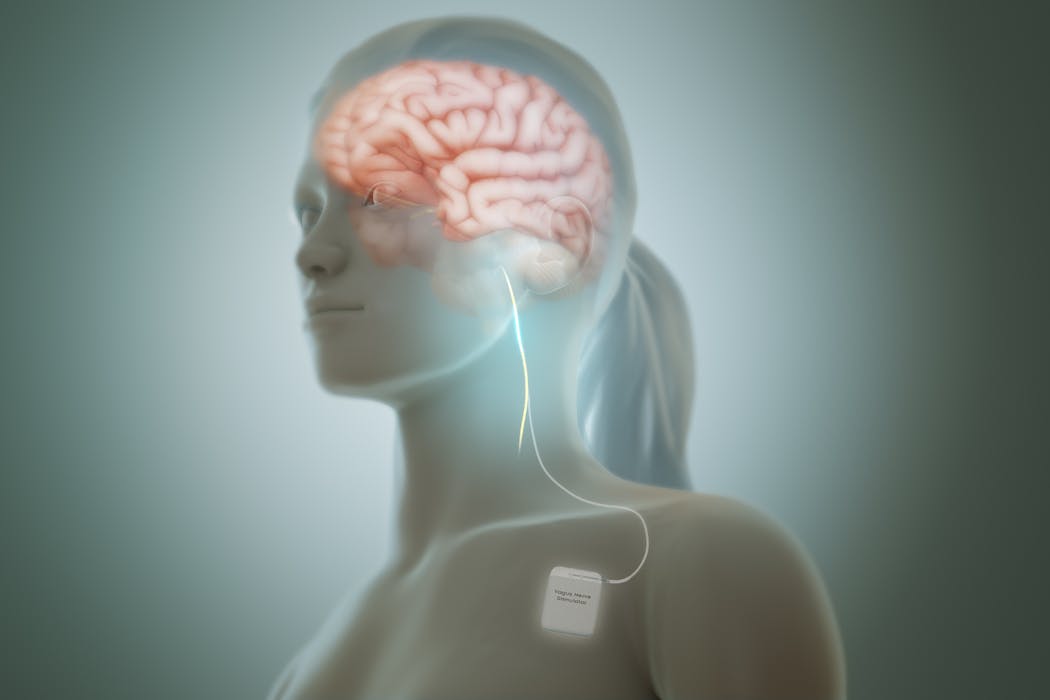
The first is invasive vagus nerve stimulation. This involves surgically implanting a small pacemaker-like device in the chest, with wires wrapped around the vagus nerve in the neck. The device delivers regular electrical stimulation directly to the nerve.

In the US, this treatment is approved for drug-resistant epilepsy and depression. It can be effective but is used less often in the UK because it requires surgery, ongoing care and significant cost.

The second approach, and the focus of much current research, is non-invasive vagus nerve stimulation. Studies show that a small branch of the vagus nerve supplies part of the outer ear. By placing electrodes on specific areas of the ear, researchers can stimulate this branch electrically without surgery.

Brain imaging studies suggest this produces patterns of activity similar to those seen with implanted devices. This gives researchers confidence that similar neural systems are being influenced, even if it is not always possible to confirm that only the vagus nerve is involved.

Medical vagus nerve stimulation devices must meet strict safety and evidence standards. They have to demonstrate clinical benefit in trials and continue to be monitored after approval.

Consumer wellness devices are not held to the same standards. Many can be sold without strong evidence that they stimulate the vagus nerve or improve health outcomes. This does not mean they are necessarily harmful, but claims about their effects should be treated cautiously.

Stroke recovery

One of the most promising areas of research is stroke rehabilitation. After a stroke, many patients experience weakness in one arm that can affect independence for years.

In ongoing research, my colleagues and I are investigating whether non-invasive vagus nerve stimulation, paired with physical rehabilitation, can improve arm function after stroke. The aim is to enhance neuroplasticity, the brain’s ability to reorganise and form new connections, allowing healthy areas to take over lost functions.

This is being tested in a large clinical trial, in which neither participants nor researchers know who is receiving active stimulation until the end of the study. This helps reduce bias. If the results are positive, this approach could change how stroke rehabilitation is delivered.

Vagus nerve stimulation does not work the same for everyone. Some people experience headaches or worsening migraines. A small minority report changes in mood. In my own case, stimulation produces low mood, which is a recognised but uncommon response.

This variability is one reason why one-size-fits-all advice about stimulating the vagus nerve can be misleading.

The vagus nerve is not a cure-all. Most conditions involve multiple biological and psychological factors, and no single nerve explains or fixes them all.

It is, however, a crucial pathway linking the brain and body. As research progresses, we are likely to see more targeted, properly tested therapies using vagus nerve stimulation for specific conditions.

For now, the key message is caution without cynicism. The vagus nerve is real and important. The science is advancing. But meaningful benefits depend on careful research, appropriate use and an honest understanding of what the evidence does and does not yet show.


Strange Health is hosted by Katie Edwards and Dan Baumgardt. The executive producer is Gemma Ware, with video and sound editing for this episode by Anouk Millet. Artwork by Alice Mason.

In this episode, Dan and Katie talk about social media clips via TikTok from drjoedamiani, ayuswellness and prettyspatricia.

Listen to Strange Health via any of the apps listed above, download it directly via our RSS feed or find out how else to listen here. A transcript is available via the Apple Podcasts or Spotify apps.

The Conversation

Arshad Majid receives funding from the National Institute of Health research (NIHR) EME Programme for the TRICEPS trial which is investigating tVNS in stroke recovery.

ref. Vagus nerve stimulation: from TikTok tips to clinical trials – https://theconversation.com/vagus-nerve-stimulation-from-tiktok-tips-to-clinical-trials-274240

Valentine’s day: can 36 questions really change your love life?

Source: The Conversation – UK – By Viren Swami, Professor of Social Psychology, Anglia Ruskin University

LightField Studios/Shutterstock

About a decade ago, author Mandy Len Catron wrote an essay for the New York Times about “36 questions that lead to love”. The idea suggests that two people can grow closer – and even fall in love – by answering a series of increasingly intimate questions.

Catron described how in 2014 she and an acquaintance went on a date together. During the evening, they took turns asking and answering 36 questions. Before that meeting the pair both admitted to a slight mutual attraction, but the exercise changed this fairly dramatically.

Within weeks they had developed strong feelings for each other. The following year they moved in together, had children in 2021 and in 2025, more than a decade after their first date, they got married – and the 36 questions were included in a bowl at the reception bar.

The idea behind the 36 questions is simple enough – that by answering a series of intimate questions, two people become vulnerable and develop a close connection. But can the 36 questions really cause two people to fall in love?

In the 1990s, US psychologist Arthur Aron and his colleagues developed a sharing game that could be used to develop feelings of closeness between strangers. They wanted to provide researchers with a fast track to developing closeness in the lab, for studies involving participants who didn’t know each other.

The task is simple. Two strangers sit across from each other and take turns asking and answering 36 questions arranged in three sets. The task takes about 45 minutes to complete, with the questions becoming increasingly intimate and personal.

One question from the first set asks the strangers to describe their perfect day, while a question from the final set asks them to describe whose death they would find most disturbing.

Why does it work?

The main mechanism that helps build closeness in the 36 questions is reciprocal self-disclosure. This is when sharing intimate information about oneself prompts the other person to share similarly intimate information about themselves.

Reciprocal self-disclosure is an important part of relationship development. When people engage in reciprocal self-disclosure, they signal to each other that they’re willing to be responsive and share their vulnerabilities. In turn, this process helps to build mutual trust and liking, leading to greater feelings of closeness and intimacy.

Imagine that, over the course a conversation, I share with you that I’ve been struggling with my mental health. In sharing this information, you infer that I trust you and that I want to have an authentic, honest and meaningful relationship with you. This, in turn, might encourage you to share something intimate about your own mental health, which encourages deeper trust and connection between us.

Woman and man sitting on sofa talking together.
Just how magic are those 36 questions?
Prostock-studio/Shutterstock

What about romantic love?

But can the 36 questions really cause people to fall in love? In the original study, Aron and his co-researchers suggested that the 36 questions – sometimes called the “fast friends procedure” – could create real feelings of “interpersonal closeness” between strangers.

To test this, they randomly assigned strangers to take part in the fast friends procedure or to a small-talk exercise, which also included 36 questions but that did not increase in intensity over the sets. In a series of studies, Aron and his fellow researchers found that participants who’d completed the fast friends task felt closer to each other than those who had engaged in small talk.

A 2021 study found that participants engaging in the fast friends task not only felt closer than those who engaged in small talk, but also felt greater liking for their partners, believed their partners were more responsive, enjoyed the interaction more and had more fun.

However, Aron and his co-researchers also cautioned that the fast friends procedure does not produce feelings of loyalty, dependence or commitment between strangers – key ingredients for love. The procedure also does necessarily produce respect for the other person, which takes time to develop, nor does it produce feelings of passion, romance and physical and sexual attraction.

Although the fast friends procedure might not cause strangers to fall in love, it could help existing couples maintain their feelings for each other.

In studies where existing couples take part in the procedure with other couples they haven’t met before, the participants later report greater closeness to the couples they interacted with. But they also report greater closeness to and passionate love for their own partners.

The procedure could actually help foster loving relationships of all kinds. One group of researchers adapted the 36 questions to make them suitable for children aged eight to 13 and their parents. When the researchers asked parents and their children to take turns asking and answering the question, the children seemed to end the task feeling more loved.

The fast friends procedure also shows promise in developing closeness outside the lab and in different circumstances. In educational settings such as schools and universities, the task seems to be both an effective ice-breaker and a way to promote closeness and friendship formation. There’s even some evidence that tasks that promote closeness could increase productivity and creativity among team members working together.

The fast friends procedure could also be used to reduce prejudice and stigmatising views. In a 2015 study, heterosexual people took part in the fast friends task with a stranger who revealed they were gay or a lesbian.

These heterosexual participants reported stronger feelings of closeness and lower sexual prejudice at the end of the task compared to the start. Other studies have suggested that the procedure could also reduce racial prejudice and ageism.

So don’t let romantic couples usurp the 36 questions. If you’re spending Valentine’s day with friends, it could be a great way to deepen your bond.

The Conversation

Viren Swami does not work for, consult, own shares in or receive funding from any company or organisation that would benefit from this article, and has disclosed no relevant affiliations beyond their academic appointment.

ref. Valentine’s day: can 36 questions really change your love life? – https://theconversation.com/valentines-day-can-36-questions-really-change-your-love-life-273611

Will artificial snow save the ski industry in the long run – or curse it?

Source: The Conversation – UK – By Paolo Aversa, Professor of Strategy, King’s College London

At the Winter Olympics, athletes race down immaculate white slopes. The snow looks perfect. But it is largely manufactured.

In Italy, where rising temperatures and declining snowfall were felt earlier than in other Alpine regions, technological fixes began in the 1990s. Today, reliance on artificial snow is widespread: around 95% of Italian ski resorts use snowmaking, and more than 70% of slopes are covered by artificial snow during the season.

Modern snowmaking uses a large fan-like “snow canon” to spray tiny droplets of water into cold air, where they freeze before landing on the ground. Vehicles known as piste bashers (in Europe) or snowcats (in North America) then compress and groom that new snow until it forms a more stable base. The process does not rely on chemical additives. It has become so effective that it can now guarantee competition-grade conditions even when natural snowfall is increasingly unreliable.

Together with colleagues at the Universities of Oxford and Trento, I have been part of the Hot Snow project, investigating what all this means for the ski industry.

Snow canon with mountain backdrop
A ‘snow canon’ blasts tiny droplets into the air, where they freeze into snowflakes before landing.
Gherzak / shutterstock

We know that continuous innovation – often referred to by the industry as “technical snow” – has helped protect winter sports. Yet we found it also carries a less visible risk: successful adaptation through artificial snow can make the ski industry complacent about climate change.

How artificial snow really works

In leading resorts, artificial snowmaking process is data-driven and highly automated. At the touch of a tablet, operators can adjust the quality and density of new snow, depending on temperature, humidity and the sort of surface they want to create. This produces snow that can be more controllable and durable than natural snowfall.

Snowmaking systems have become more energy efficient over time. Production is optimised to exploit the coldest possible weather windows, reducing energy use per cubic metre of snow. In regions such as the Dolomites, where the Olympic ski races are being held, resorts largely rely on renewable electricity and rainwater stored in artificial basins.

close up of snow cannon
A snow cannon fires out water mist that will fall as snow.
Beekeepx / shutterstock

Even so, artificial snow remains energy intensive. In Italian ski resorts, snowmaking accounts for around 30–40% of total energy consumption, with annual costs of €50 million to €100 million (£44 million to €88 million). Across the Alps, total energy demand for artificial snow is estimated at around 2,100 gigawatt-hours per winter season – roughly equivalent to the total annual domestic electricity use of Milan.

The water footprint is just as significant. Artificial snow production in Italy alone consumes around 100-150 million cubic metres of water each year – roughly equivalent to the annual water use of between 1 million and 1.5 million people.

In regions where winter precipitation is becoming less reliable and summers are growing hotter and drier, this growing competition for water adds another layer of pressure, particularly for mountain communities and downstream users. For this reason, ski resorts increasingly rely on artificial reservoirs to store water which, though useful in dry seasons, are often harmful to mountain landscapes and ecosystems.

When adaptation becomes a trap

The effectiveness of snowmaking is both a blessing and a curse.

Across Europe, artificial snow now underpins much of the ski industry. In many regions, slopes depend on it to open at all. This technological success creates what economists call a lock-in effect. Resorts continue to invest heavily in snow cannons, reservoirs and grooming vehicles, even in areas where artificial snow may soon become unviable.

Bare mountainside with single strip of snow
In a dry or warm winter, snowmaking is crucial. This photo was taken in the Dolomites in January 2018: a bare mountainside with machine-made snow.
Stefano Politi Markovina / shutterstock

At the same time, rising infrastructure costs requires a constant increase in consumer prices. Ski pass prices have increased by around 40% since 2021, further turning skiing into a sport accessible only to those with deep pockets. Each new investment further entrenches this trajectory, making it progressively harder to step back and rethink alternatives for the future of these resorts.

The illusion of control

Some snowmaking systems can technically operate even when air temperatures rise above freezing, albeit at a very high energy cost. One manufacturer has demonstrated technology capable of producing snow at ambient temperatures of up to 20°C. That possibility reinforces a dangerous narrative: that innovation alone will solve the problem.

But climate projections suggest there will come a point when even artificial snow cannot compensate for warming conditions at many altitudes. In Italy, most resorts located around 1,000 metres above sea level have abandoned hopes of operating consistently, while skiing in the Apennines – once a preferred destination for central and southern Italy – has largely shut down.

When artificial snow stops being viable, the transition is often abrupt. Resorts are left with stranded assets and communities face sudden economic shocks. This is what we describe as an “expiring industry”, one that can appear economically healthy today while facing a clear climate-driven end date.

The danger is not collapse tomorrow, but delay today. As long as slopes remain open and bookings stay strong, there is little incentive to invest in alternatives. After all, winter tourism is still worth over €11 billion (£9.6 billion) a year to the Italian economy alone.

What should change

Those who benefit from the status quo are unlikely to propose alternative futures. Public policy therefore plays a crucial role in shaping which futures remain possible.

Continuing to subsidise ski infrastructure may keep slopes open for a few more seasons, but it also deepens reliance on winter snow in places where long-term viability is increasingly uncertain. It risks diverting public money, attention and political capital away from transitions that could actually endure.

A different approach would make public support conditional. Resorts could be required to disclose water and energy use transparently, and to present credible plans to diversify beyond winter-only tourism rather than simply extending it. This would also mean scrutinising claims that lift infrastructure can function as sustainable, year-round transport — a justification often used to secure public funding, but rarely realised in practice.

I’m a passionate skier myself. As a Veneto native, the Dolomites are my favourite place to ski. So this is not about blaming skiers or dismissing snowmaking technology, which has helped sustain jobs in the mountain communities of my region.

The problem is mistaking successful short-term adaptation for a viable long-term strategy. When technological fixes stand in for long-term planning, they delay investment in alternatives and leave regions more exposed when climate limits are finally reached.

As long as artificial snow keeps slopes white against an increasingly green landscape, it is easy to believe alpine skiing will always be there. But this is not simply kicking the can down the road. It is pushing it uphill. And metre by metre, the slope is getting steeper.

The Conversation

Paolo Aversa works on the Hot Snow project with professor Juliane Reinecke at the University of Oxford and professor Alberto Nucciarelli and Dr Edoardo Trincanato at the University of Trento.

The research has been supported by The Center of Sustainable Business at King’s Business School, The Fondazione CARITRO, and the Center for Sports and Business at the Stockholm School of Economics.

ref. Will artificial snow save the ski industry in the long run – or curse it? – https://theconversation.com/will-artificial-snow-save-the-ski-industry-in-the-long-run-or-curse-it-275270

Toronto’s Project South charges point to systemic issues beyond police corruption

Source: The Conversation – Canada – By Tandeep Sidhu, Assistant Professor, Department of Sociology and Criminology, University of Manitoba

The Toronto Police Service is embroiled in an unprecedented crisis following a criminal investigation that led to several officers being charged with a list of drug trafficking, theft, conspiracy, fraud and other offences related to an organized crime investigation.

Project South was a seven-month long investigation that disrupted a criminal network that used information supplied to them via police databases.

The details of Project South were disclosed during a news conference that featured senior police officers bizarrely wearing bullet-proof vests. The core of these allegations involve claims of officers leaking information to this network that contributed to a series of violent crimes, including a conspiracy to murder a correctional officer.

Image management strategies activated

Toronto police Chief Myron Demkiw promised that no stone would be left unturned in the investigation and said the actions of a few officers did not define the force. He requested an independent external investigation before announcing the Project South charges.

The head of the Toronto Police Association, Clayton Campbell, similarly said there is “nothing our members hate more than a corrupt cop.”

Ontario’s inspector general of policing announced the province will lead a review of police services to address corruption in policing.

These public statements and requests for a probe are best understood through the lens of police image management, which refers to the array of what are essentially marketing strategies employed by police services to maintain their public image.

The police employ a series of strategic communications in times of crisis, and in their routine corporate communications, to convey a curated image to the public. Like other public relations strategies, this can obscure systemic issues in policing.

The statements from Demkiw and Campbell serve several functions, all of which are intended to safeguard the public image of policing. They disavow the charged officers, protect the reputation of the larger policing community and demonstrate a public-facing commitment to change.

Demkiw’s request for an external investigation, outlined during the news conference, is a strategy that allows the Toronto Police Service to be seen as taking the issue seriously and pre-empts public calls for such a response.

Police misconduct in Toronto and beyond

Allegations of misconduct against the Toronto Police Service have persisted for decades and include charges of corruption, theft, evidence management, misleading the court and fraud, among other offences.

A 2020 study investigating the experiences of inner-city Toronto residents subjected to police raids also demonstrated that allegations of theft, violence and intentional property damage are commonplace.

Some researchers have argued that a double standard exists for police services in terms of officers accused of corruption and other forms of misconduct. They argue that police often demand harsh sentences and punishment for members of the public, but face less severe consequences when misconduct is addressed internally.

A lesser-known form of police misconduct surrounds the abuse of police databases. Officers across Canada have used databases to stalk former partners, interfere in investigations for friends and family, form intimate relationships, access the personal information of and monitor lawyers and leak information.

While Campbell noted that searches on police databases leave digital footprints, this does little to prevent their abuse.

Like ticket-fixing, database abuse is difficult to detect. The true scope of database abuse is immeasurable, owing to the vast volume of data and searches officers perform, which makes it difficult to distinguish legitimate policing activity from illegitimate activity. What is known about its prevalence should be regarded as the tip of the iceberg.

Why bother?

So what value does an “independent” probe into Ontario police services offer? Considering the hard-to-detect nature of many forms of police misconduct, the efficacy of such an initiative is debatable.

There is also an inherent contradiction at play. The probe is being directed at all Ontario police services, suggesting that these forms of misconduct are systemic.

But Ontario Premier Doug Ford referred to a “few bad apples” in response to the public uproar following the Project South charges, suggesting there’s no systemic issue in place.

So why launch such an expansive probe that will likely cost taxpayers millions of dollars if these acts of misconduct are limited to a select few officers?

Demkiw’s request for an independent probe is an admission that police misconduct is systemic, but places the onus for repair onto an independent institutional body. As I’ve argued previously, police services cannot be trusted to repair these issues. This strategy not only allows police forces to appear as though they take internal corruption seriously, but insulates them from future criticism when officers engage in misconduct.

Considering there are already calls for Demkiw to resign, inaction would mark the end of his career.

Nonetheless, while the probe promises to investigate the “totality of the landscape” of policing in Ontario, the public should regard these efforts as a form of image management that insulates police forces from serious, genuine scrutiny.

Better ways to prevent corruption

While the police are mitigating the damage stemming from Project South, the question of how to prevent these abuses arises.

The existing mechanisms for detecting database abuse, for example, are inherently reactive. These issues are brought to the attention of the police following the misconduct.

One strategy to address this issue is a more robust system of random audits that function as a general “integrity check” on the police use of databases. This would function in tandem with a requirement that officers provide a detailed explanation of why searches on people are performed, creating a more substantive digital footprint that may be audited.

This strategy will inherently be met with resistance from police unions and researchers who partner with the police who have drawn attention to the occupational stress stemming from police reporting requirements.

But the research drawing attention to report writing and its proposed relationship to occupational stress fails to adequately consider that report writing is not only an expected function of the police — it may also be a critical avenue for accountability.

The Conversation

The authors do not work for, consult, own shares in or receive funding from any company or organisation that would benefit from this article, and have disclosed no relevant affiliations beyond their academic appointment.

ref. Toronto’s Project South charges point to systemic issues beyond police corruption – https://theconversation.com/torontos-project-south-charges-point-to-systemic-issues-beyond-police-corruption-275408

What the troubling use of the term ‘ghettos’ reveals about Denmark’s attitude towards immigration

Source: The Conversation – UK – By Garbi Schmidt, Professor of Cultural Encounter Studies and a member of the inter-institutional research group on migration, Roskilde University

Few countries talk about “ghettos” the way Denmark does. For more than a decade, the term has shaped national debates about migration, integration and who truly belongs.

What began as a policy tool to identify struggling neighbourhoods has evolved into a social experiment in how to manage so-called “parallel societies”. These are predominantly migrant communities considered by politicians to be functioning separately from mainstream Danish life.

In 2010 the then government created a “ghetto list”. This list ranks public housing areas with more than 1,000 residents where unemployment levels and crime rates are higher than average. These areas are also ranked on income and education levels, along with whether more than half of the residents come from non‑western countries.

Over the years, these areas have become shorthand for failed integration. Danish politicians use the list as a roadmap for intervention: tearing down apartment blocks, forcing long-term tenants to relocate. The goal, they say, is to “mix” populations and prevent segregation.

While the government replaced the official term “ghettoområder” (ghetto areas) with “parallelsamfundsområder” (parallel-society areas) in 2021 to reduce stigma, the criteria and policies affecting these neighbourhoods have largely stayed the same.

The first ghetto

For anyone outside Denmark, this language of “the ghetto” or “parallel societies” can sound unsettling. In most European countries, the word still evokes a dark past. From medieval Jewish quarters, to the Nazi-era ghettos where Jews were confined before being deported to death camps – the word ghetto has such a complex history.

Modern housing estates were once a point of pride in the Danish welfare model – clean, affordable and surrounded by green space. So why use such a charged term to describe them?

As part of my research, I look at the historical development of the ghetto in Denmark and Danish culture, and how this has changed over the years.

Indeed, it was back in 1692 when the idea of the ghetto first emerged in Denmark. This was after police constable Claus Rasch proposed confining the city’s Jewish population – of which there were very few – to a designated district. In a long letter to King Christian V, he suggested that all Jews be moved to the Christianshavn area.

There, he argued, they could continue their businesses, but their daily lives should be closely regulated so they would not disturb their Christian neighbours or cause “a scandal”.

The Jewish quarter Rasch imagined strongly resembled the ghettos across Europe that had existed for more than 150 years. Such ghettos were established specifically to enforce a clear boundary between Christians and Jews. And their creation was driven by prejudice and fear.


Read more:
Think twice before copying Denmark’s asylum policies


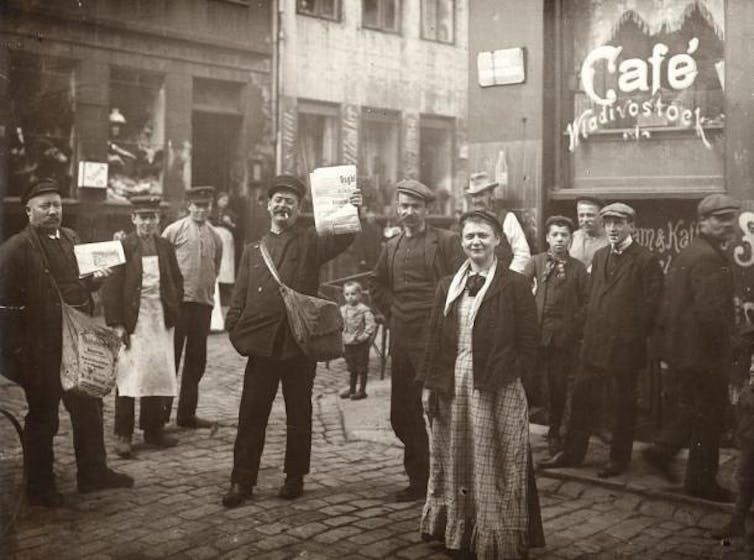
The answer from the king was a firm no. But a little more than two centuries later, in 1908, Danish newspapers began writing about a ghetto in a squalid part of Copenhagen. This ghetto had, the press reported, been established by Russian Jews in the slum then existing in the streets just east of Kongens Have, in the inner city of the capital.

Black and white photo of people standing on the street.
A Jewish newspaper vendor in the last century’s Eastern European ghetto in Vognmagergade, Copenhagen.
Copenhagen Museum and Josefine Ørskov

Inhabitants of this ghetto included Jewish immigrants who had fled the Russian empire due to religious and political persecution, along with others who wanted to find jobs and a better life. Emigration to North America was the final goal. A life in the slums of Copenhagen was only seen as a stop on the way.

Danish newspapers wrote with a mix of curiosity and excitement about the new “exotic” residents, who looked different and spoke Yiddish and Russian. Though these articles didn’t encourage people to visit the ghetto for a Sunday outing.
Quite the opposite. The area was poor and considered to be full of people with bad morals. Crime, drunkenness and suspicious political ideas were all part of its reputation. In other words, the ghetto was seen as dangerous.

Building division

Today’s “ghetto” or parallel society policies are built on that same instinct: that certain groups must be managed or dispersed to preserve cohesion.

Officially, the Danish government says it wants to break down parallel societies and promote integration. But in practice, the strategy has meant displacement. Families who have lived in the same neighbourhoods for decades are being moved, sometimes against their will, to prevent “concentrations” of non-western residents.

View of Superkilen park
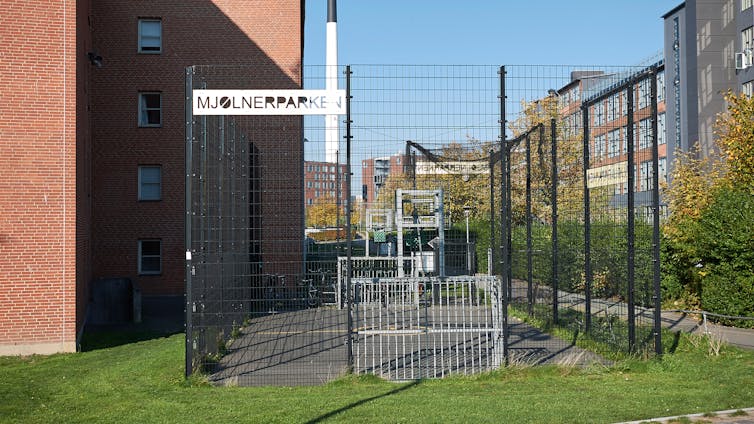
Mjølnerparken in Copenhagen, a public housing estate that for years appeared on Denmark’s official ‘ghetto list’. The area has since undergone extensive renovation and social interventions as part of state efforts to dismantle so-called ‘parallel societies’.
Shutterstock/simona flamigni, CC BY

In 2024, the European Court of Justice (ECJ) ruled that Denmark’s housing policy – used to reshape these districts – amounted to racial discrimination. And at the end of last year, the ECJ said the legislation may be unlawful.

As Britain’s Labour government looks to Denmark for inspiration on asylum and migration reform, it’s worth paying attention to this parallel story. Denmark’s housing and asylum systems are two sides of the same coin: both built on the idea that tighter control creates cohesion.

But the Danish experience suggests something different – that in trying to dismantle “parallel societies”, the country may be building new divisions of its own.


This article was commissioned as part of a partnership between
Videnskab.dk and The Conversation. You can read the article in Danish here.

The Conversation

Garbi Schmidt has received funding from the Carlsberg Research Foundation

ref. What the troubling use of the term ‘ghettos’ reveals about Denmark’s attitude towards immigration – https://theconversation.com/what-the-troubling-use-of-the-term-ghettos-reveals-about-denmarks-attitude-towards-immigration-268581