Moroccan dinosaur’s fearsome tail spikes evolved much earlier than we thought – new discovery

Source: The Conversation – Africa (2) – By Kawtar Ech-charay, Geologist Faculty of Sciences Dhar El Mahraz of Fez, Université Sidi Mohammed Ben Abdellah

In the heart of the Middle Atlas Mountains in central Morocco, a global team of palaeontologists and geologists has discovered new remains of a very unusual dinosaur. It belonged to the group called ankylosaurs, plant eaters whose bodies were covered in bony plates.

The fossils reveal a heavily armoured dinosaur. It has distinctive outward-pointing spikes along its body. These fossils are now considered to represent the oldest known ankylosaur remains in the world – it lived about 165 million years ago. As geoscientists who were part of the team that discovered and examined them, we had the unique opportunity to study these remarkable specimens firsthand.

This species, named Spicomellus afer, literally meaning a spiky armoured dinosaur from Africa, was first described in 2021 from a single rib discovered at the same site in Morocco. At the time, the discovery was extraordinary because of the rarity of ankylosaur fossils from the Middle Jurassic, around 165 million years ago.

The rib represented the earliest evidence of this dinosaur group, which is otherwise best known from the Late Jurassic and Cretaceous periods, between about 145 million and 66 million years ago. The original rib of Spicomellus afer is housed at the Natural History Museum in London.

The new fossils come from the same Middle Atlas locality and are curated at Sidi Mohamed Ben Abdellah University in Fez.

These additional bones provide new insights into the anatomy of this remarkable dinosaur. Key parts of the new discovery are spiked ribs nearly one metre long, a cervical (neck) half-ring, and parts of the pelvic bones.

These fossils show that this ankylosaur was covered in spikes. These spikes were not just part of the outer covering; some were fused directly to its skeleton. The findings also show that the tail weapons characteristic of ankylosaurs evolved much earlier than scientists had previously believed. The research also suggests that ankylosaur armour may have served a dual purpose early in the group’s evolutionary history: as a defensive shield and as a means of display.

The tail: defence and display

Spicomellus had a stiffened tail with fused vertebrae. This likely served as a defensive shield against predators. Its body spikes added protection and made it a formidable target.

These features push back the origin of ankylosaur tail weapons by millions of years. This evidence shows that complex defensive adaptations evolved much earlier than previously thought.

The tail and armour may also have functioned in display or social signalling. So, defence and communication may have shaped its evolution.

Geological context

The fossils were found in the Jurassic red beds of the Middle Atlas Mountains in Morocco. Red beds are sedimentary rocks, mainly sandstones and mudstones, coloured reddish by iron oxides. They typically form in continental environments such as rivers and floodplains under semi-arid to arid climates.

The Middle Atlas is characterised by high plateaus, forested mountains and many lakes, making it an important ecological region. Geologically, it preserves extensive Jurassic sedimentary successions, including the red beds that record the tectonic and climatic history of the Atlas system.

In this region, a sauropod dinosaur (Cetiosaurus moghrebiensis) was first reported in 1955. More recently, in 2019, our team, led by dinosaur researcher Susannah Maidment, described a stegosaur (Adratiklit boulahfa). We also identified teeth belonging to the oldest known turiasaur and reported remains of the earliest known cerapodan dinosaur.

The sites lie about 150km south of Fez, near Boulemane, at nearly 1,900 metres above sea level. Beyond the town, rough mountain tracks lead to the red sandstone outcrops, and the final approach often requires hiking across steep and rugged slopes. Harsh sun, strong winds and winter snow make fieldwork challenging. So each fossil recovered reflects both its scientific importance and the considerable effort required to reach these remote locations.

The region was once a marginal marine environment, with rivers, floodplains and possibly coastal settings under a warm climate. These conditions shaped both the habitat of the dinosaurs and the preservation of their remains.

Global collaboration

This discovery and its interpretation result from close international collaboration between palaeontologists and geologists from the UK, Morocco and the US.

The fossils were prepared, curated and studied at the Department of Geology in the Faculty of Sciences Dhar El Mahraz in Fez, using equipment provided through the University of Birmingham’s Research England International Strategy and Partnership Fund. Additional support was provided by the British Institute of Libyan and Northern African Studies, the Natural History Museum’s Science Investment Fund, and the University of Birmingham’s International Science Partnerships Fund.

Future work will focus on detailed anatomical (body structure) and histological (tissue) analyses of the material, alongside continued field exploration to identify additional specimens.

These efforts aim to refine our understanding of the early evolution, functional morphology and palaeoecology of armoured dinosaurs in north Africa. We hope to explain why they looked the way they did and how they lived in their ancient environment.

The Conversation

The authors do not work for, consult, own shares in or receive funding from any company or organisation that would benefit from this article, and have disclosed no relevant affiliations beyond their academic appointment.

ref. Moroccan dinosaur’s fearsome tail spikes evolved much earlier than we thought – new discovery – https://theconversation.com/moroccan-dinosaurs-fearsome-tail-spikes-evolved-much-earlier-than-we-thought-new-discovery-264394

The transactional — and optimizable — connections of ‘cozy video games’

Source: The Conversation – Canada – By Christina Fawcett, Instructor, Department of English, University of Winnipeg

Cozy is a vibe. So much so that even video games have been getting cozy.

“Cozy gaming” — a genre of low-stress, relaxing video games focused on comfort and non-violent gameplay, such as farming or decorating — has grown into one of the medium’s most popular and commercially successful trends.

In 2016, ConcernedApe released Stardew Valley and introduced us to the pastoral pleasures of farming parsnips and foraging for berries. The lightning-in-a-bottle moment for cozy gaming, however, hit in 2020 with Nintendo’s Animal Crossing: New Horizons. It offered players an escape, if only virtually, from the confines of COVID-19 quarantine.

In many ways, this genre subverts typical video game traits by focusing on comfort over high scores, celebrating connection over competition.

But while cozy games offer players the comfort and connection of a social circle, they also structure relationships through systems of exchange where care, friendship and intimacy are earned through repeatable actions.

Rewarding repetition

So, what counts as a cozy video game?

Daniel Cook and other game designers agree that cozy games tend to have high emotional investment: they invite us to care. They also promote a slow pace of play and a focus on sociability, encouraging us to explore these game worlds and pay attention to feelings — not just our own, but also those of the fictional characters we meet.

Repetitive tasks, as the bane of the modern work world, paradoxically make games cozy. Completing small, simple tasks gives us a dopamine rush of satisfaction and achievement, especially when that success isn’t tied to real-world stability.

While video game studies scholars have long argued that repetition helps players master difficult challenges in “hard-core” games, repetitive, easy actions in casual gaming can also make play feel meaningful — just in a different way.

Stardew Valley and Animal Crossing: New Horizons, two of the best known cozy games of the past decade, demonstrate that planting digital crops and harvesting virtual friendships help us feel invested. Seemingly small gestures in these spaces have a big emotional impact: they remind us it’s the little things that matter.

Simulating community

In Stardew Valley — rendered in nostalgic 8-bit graphics — your grandfather bequeaths you his small farm. Settling into the community, you quickly discover how gift-giving, reciprocity and everyday conversation build friendships and potential romances.

Farming, fishing, mining and forestry fit around your daily rounds as you interact with the townsfolk. Each inhabitant of Stardew Valley has their own favourite items, which you can offer to winnow your way into these characters’ hearts.

Similarly, Animal Crossing: New Horizons encourages you to connect with your fellow islanders on a lush, deserted island getaway. Its universe is populated with an array of randomly assigned anthropomorphic characters (who also enjoy gifts). Everything, from bunches of weeds to harvested fruit, will earn positive responses, and you’re likely to receive luxuries like clothing and furniture in return.

Animal Crossing also facilitates a digital community through island visits. Through Nintendo Switch Online, players can hang out on other people’s islands.

This proved a boon during the COVID-19 pandemic, when its popularity skyrocketed — more than 49 million copies have now been sold. Virtually dropping in on real friends while the world socially distanced and restricted travel made many players feel less lonely.

A screenshot of a video game about being on a deserted island.
Cozy video game ‘Animal Crossing: New Horizons’ encourages a low-stress, relaxing focus on comfort and non-violent gameplay. The genre has grown into one of the medium’s most popular and commercially successful trends.
(Nintendo), CC BY

Nintendo has banked on players wanting more of these repetitive tasks and social game play with its recent release, Pokémon Pokopia. As an addition to its lucrative Pokémon franchise, Pokémon Pokopia reframes its capture-and-battle game series about magical creatures through the cozy comforts of gardening, crafting and farming.

Players can curate a charming rural space, befriending Pokémon along the way. Pokémon Pokopia’s promotional material exhorts players to “Get to know your Pokémon pals at your own pace as you all work together to build a cozy utopia,” using the marketable language of community and comfort.

Quantifying connections

Comfort, escapism and community have obvious market and player appeal.

And in this way, the rise of the cozy games genre may seem all positive, but these games also offer social ideals that need to be considered critically. Stardew Valley and Animal Crossing: New Horizons, for example, encourage users to see intimacy and relationships as quantifiable, even transactional.

Players that accrue friendship points in Animal Crossing: New Horizons get interpersonal perks like nicknames and personal visits. While many neighbourly actions have point value, islanders prefer gifts. Friendship points are invisible in game play, but online guides track the six levels of friendship available. Maxing out friendships gets you gifts in return, and this pattern of investment and exchange shapes the player’s activities.

Stardew Valley puts friendship progress on display through bright red heart icons. The game’s “Gift Log” formalizes the expectation that players will buy villagers’ favour, and its catalogue of loves, likes, neutrals and dislikes ensures gifting is impactful and cost-effective. With trackers built directly into the interface, friendships and romances are represented as achievable tasks, gamified to return new conversations, storylines and yet more gifts.

Managing and maximizing cozy community games’ friendship systems may take time, but the end result is material gain.

The Pokémon Pokopia world is no exception. It locks players’ access to valuable game resources behind friendships with particular Pokémon: Scyther has the chops to harvest lumber, and Hitmonchan knows how to smash rocks and might just teach your Ditto. By turning friendships into goals, players approach interpersonal connections as extractive, a way to advance in the game and not just a pleasure in itself.

This kind of cozy gaming is clearly big business. For instance, even with its $99.99 retail price, Pokémon Pokopia sold 2.2 million units in its first four days. The genre’s broad appeal makes community seem accessible (even if the pricetags aren’t).

As a respite from social isolation, economic anxiety or geopolitical instability, cozy games provide players with a soothing fantasy — which might say as much about their anxieties as it does about their needs — one handful of parsnips at a time.

The Conversation

Christina Fawcett does not work for, consult, own shares in or receive funding from any company or organisation that would benefit from this article.This research is funded by a 2025-27 SSHRC Insight Development Grant.

Andrea Braithwaite receives funding from a SSHRC Insight Development Grant. She is the President of the Canadian Game Studies Association.

ref. The transactional — and optimizable — connections of ‘cozy video games’ – https://theconversation.com/the-transactional-and-optimizable-connections-of-cozy-video-games-274610

Are aliens real? Scientists have been hunting for extraterrestrial life since the time of Aristotle

Source: The Conversation – Canada – By Robert William Smith, Professor of History, University of Alberta

Do aliens exist? Could Earth really be the only planet hosting intelligent life?

Debates over the existence of extraterrestrials date back to the earliest Indigenous and western thought.

The tools generating the evidence within western science, however, have changed — from the philosophical and theological arguments of the Ancient Greeks to the development of increasingly sophisticated telescopes and space travel and exploration.

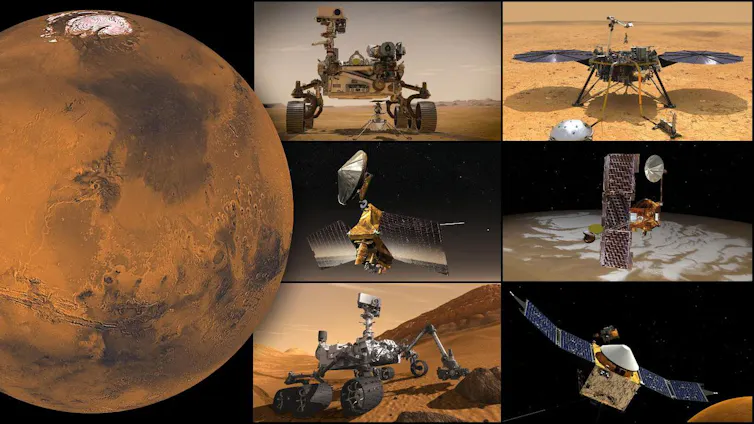
These include NASA’s missions to Mars, using a fleet of robotic orbiters, landers and rovers, and the development of the James Webb Space Telescope, which orbits the sun 1.5 million kilometres away from the Earth.

A collage of images with Mars on the left and six of NASA's Mars orbiters and rovers.
NASA’s Mars missions, clockwise from top left: Perseverance rover and Ingenuity Mars helicopter, InSight lander, Odyssey orbiter, MAVEN orbiter, Curiosity rover, and Mars Reconnaissance orbiter.
(NASA/JPL-Caltech)

Philosophy and theology

Aristotle’s views on the nature of the cosmos dominated the Ancient Greek world. He argued that there’s only one world, at the centre of which is an immobile Earth. The planets move around the Earth. Beyond them is the sphere of the stars, or heaven.

“It is clear then that there is neither place, nor void, nor time, outside the heaven,” he wrote in On the Heavens. “Hence whatever is there, is of such a nature as not to occupy any place, nor does time age it.”

an 1866 engraving of two men
Aristotle teaching Alexander the Great. An 1866 engraving by Charles Laplante, a French engraver and illustrator.
(Wikimedia Commons)

Aristotle’s teachings later created a storm in the Catholic Church, with various theologians worrying that Aristotle’s ideas were becoming too dominant. Étienne Tempier, bishop of Paris, responded to these criticisms by issuing the Condemnation of 1277, prohibiting the teaching of some 219 propositions — many of them derived from the teachings of Aristotle — and warning that those who disobeyed could be excommunicated.

In Proposition 34, Tempier took aim at those who, following Aristotle, claimed God could not have created other worlds. He argued that to adopt this position was to deny God’s omnipotence.

One theologian who pushed the argument about omnipotence further was Nicholas of Cusa. In his book, Of Learned Ignorance, published in 1440, he explicitly speaks of a plurality of inhabited worlds.

The invention of the telescope

A century later, Nicholas Copernicus lifted the Earth into the heavens in his book, On the Revolutions of the Heavenly Spheres, as the first thinker to suggest the Earth revolved around the sun. The Earth thus became a planet. And if planet Earth contains life, then was it not reasonable to argue that the other planets could also contain life?

An image of the Heliocentric Solar System.
Nicolaus Copernicus’ Heliocentric Solar System.
(Wikimedia Commons)

The invention of the telescope in the early 17th century gave this notion further impetus. The telescope revealed, for example, that the moon is not perfectly spherical as Aristotelians believed, but is covered by craters and mountains and so is quite Earth-like.

By the end of the century, Bernard Le Bovier de Fontenelle had penned the first “scientific blockbuster,” Conversations on the Plurality of Worlds. Fontenelle speculated about living beings on all the planets of our solar system, as well as on planets orbiting other stars.

There was, however, little empirical evidence for these claims — a situation that would persist until after the Second World War.

The race to Mars

After the Second World War, national governments started to pour money into science, which was now seen as crucial to national well-being, and both astronomy and planetary science boomed.

In the United States, the space race with the Soviet Union and the battle for prestige also propelled spacecraft throughout the solar system.

At the beginning of the 20th century, a controversy had raged around some long, straight markings that people claimed to see on the surface of Mars. Some people believed that Martians had constructed canals to bring water from the planet’s poles to arid desert regions.

Rare film and photos of NASA’s 1964-65 Mariner 4 mission along with thoughts from scientists on the project. (Computer History Archives Program)

In 1964, the U.S. launched the Mariner 4 on a mission to Mars. The spacecraft flew by Mars in July 1965, taking the first photos of another planet from space. Instead of evidence of canals, these 21 photographs revealed the planet to have a cratered, moon-like surface.

By 1976, two American spacecraft were orbiting Mars, while on the planet’s surface, two other spacecraft conducted experiments, including scooping up and analyzing Martian soil to search for signs of life.

the moon's craters in a black and white photo
The first photograph taken on the surface of Mars, by NASA’s Viking 1 spacecraft, in July 1976.
(NASA/JPL)

The James Webb Telescope

We now tackle the question of extraterrestrial life with even more powerful scientific tools. In 1995, astronomers Michel Mayor and Didier Queloz discovered the first planet orbiting a sun-like star, named “51 Pegasi b” or “Dimidium.”

As of now, NASA has confirmed more than 6,000 exoplanets, or planets outside our solar system, and billions are believed to exist.

The James Webb Space Telescope, located beyond the moon and some 1.5 million kilometres from Earth, is investigating the atmospheres of some of these exoplanets.

The Earth’s atmosphere blocks most of the infrared light from astronomical objects reaching Earth-bound telescopes. But the James Webb’s location enables its giant mirror to gather infrared light, which the spacecraft’s instruments then analyze, allowing astronomers to learn about the composition of exoplanet atmospheres.

The telescope has also employed instruments that block the light of the star around which an exoplanet is travelling so that the exoplanet itself can be imaged. There is as yet no confirmed evidence of life in an exoplanet’s atmosphere.

In 2025, however, a paper published in Nature claimed that a rock sample taken from an ancient dry riverbed in Jezero Crater on Mars by NASA’s Perseverance Mars rover could contain “potential biosignatures” of ancient microbial life.

So what are we to make of this ongoing search for extraterrestrial life? A quotation often attributed to science-fiction writer Arthur C. Clarke puts it well: “Sometimes I think we’re alone in the universe, and sometimes I think we’re not. In either case, the idea is quite staggering.”

The Conversation

Robert William Smith does not work for, consult, own shares in or receive funding from any company or organisation that would benefit from this article, and has disclosed no relevant affiliations beyond their academic appointment.

ref. Are aliens real? Scientists have been hunting for extraterrestrial life since the time of Aristotle – https://theconversation.com/are-aliens-real-scientists-have-been-hunting-for-extraterrestrial-life-since-the-time-of-aristotle-279727

Christian satellite TV has broadcast evangelical faith – and end-times prophecies – into Iran for decades

Source: The Conversation – USA (3) – By Febe Armanios, Professor of History, Middlebury College

Satellite dishes hang from a housing complex in Tehran on March 29, 2026, amid U.S.-Israeli military operations in the region. Morteza Nikoubazl/NurPhoto via Getty Images

When the United States and Israel began striking Iran on Feb. 28, 2026, images of smoke billowing over Iranian cities began to dominate the news. But another feature of those skylines has remained constant: the thousands of satellite dishes that dot Tehran’s rooftops, picking up signals that originate far beyond Iran’s borders – despite attempts to confiscate them.

For two decades, Christian television channels produced in the United States and Europe have made their way into Iranian homes. Some of this programming echoes apocalyptic ideas from American figures promoting the war, drawing on scriptural interpretations long present in evangelical teachings. Writer Hal Lindsey popularized such ideas in the 1970s with “The Late Great Planet Earth,” a best-selling book that cast Persia as the foretold antagonist in an imminent end-times conflict that would usher in Jesus’ second coming.

In my 2025 book, “Satellite Ministries: The Rise of Christian Television in the Middle East,” I show how these broadcasts became tools for spreading such messages to Christians and potential converts – positioning the region at the center of a long-running “faith war.”

Satellite missions

Of course, Christianity itself was born in the Middle East, and the region’s deep, diverse traditions long predate any Western missionary activity. Ancient communities such as the Assyrians, Copts, Maronites and Armenians have preserved their liturgical and theological heritage across generations, and form some of the oldest continuous Christian traditions in the world.

A line of people in dark clothing stands in the aisle of a church, leading up to a few clergymen in white robes.
Worshippers attend services at Saint Joseph’s Church, an Assyrian Chaldean Catholic church in Tehran, in 2009.
Kaveh Kazemi/Getty Images

But evangelical churches have proselytized in the region for two centuries. Over the past 50 years, evangelical media outlets have flourished during moments of conflict and where weak government control has created openings for proselytism.

During the Lebanese Civil War, which took place from 1975-1991, U.S. evangelicals such as former business executive George Otis and Christian Broadcasting Network founder Pat Robertson established the channel now known as Middle East Television. The Christian network transmitted its signal from Israeli-occupied southern Lebanon from 1981 to 2000, operating in a legal gray area that bypassed Israeli and Lebanese media regulations.

The station’s primary goal was to convert Israeli Jews to Christianity and, in doing so, to help trigger a series of end‑times events. This ambition was consistent with prophetic frameworks popular in American evangelical churches at the time.

A similar pattern emerged after 9/11 and during the Iraq War that began in 2003. Like many other evangelicals, Paul Crouch, founder of the Trinity Broadcasting Network, believed the U.S. invasion was an opportunity to launch “spiritual warfare” – a battle between good and evil in the Middle East. He visited Iraq and distributed satellite television equipment so locals could receive evangelical programming in Arabic.

Many evangelicals interpreted the Iraq conflict through an apocalyptic lens, viewing the turmoil as evidence of biblical prophecy. Some, like Oklahoma pastor Mark Hitchcock, even claimed that the fall of Baghdad and the toppling of Saddam Hussein echoed scriptural descriptions of destroying “Babylon” before Christ’s return.

This proved to be a powerful fundraising tool among North American donors eager to accelerate what they saw as a divine timetable.

Persian broadcasts

In Iran, Western evangelicalism’s history dates to the 19th century. But arguably its most striking form emerged about two decades ago, when Christian networks began using new technologies to get around decades of restrictions in media and religion.

After the Iranian Revolution in 1979, the Islamic Republic allowed Armenian and Assyrian Christians to practice their ancient faiths in their own languages. The government officially recognizes them as religious minorities. However, it effectively criminalized Protestant activities in Persian, which it associated with Western missions.

A man in an ornate blue robe holds up an item covered in lace as he stands in front of a mural of Mary and the infant Jesus.
Armenians celebrate the new year with a ceremony at the Holy Mary Armenian Church in Tehran on Jan. 1, 2026.
Fatemeh Bahrami/Anadolu via Getty Images

Because evangelicals – a small fraction of Iran’s Christian believers – relied on Persian for worship, the prohibition led to church closures, the persecution of their leaders and a strict ban on missionary activities. Converting from Islam to another religion is illegal in Iran, and converts risk punishment.

By 2006, Christian organizations abroad turned to satellite broadcasts as an easier way of reaching Iranian audiences. Satellite dishes, though officially prohibited, were widespread and difficult for authorities to control. Tracking who actually watches these channels is extremely difficult, but producers claim that Christian broadcasts helped foster secretive house churches across Iran.

A street full of satellite dishes, with a camouflage-colored tank nearby and shops lining the street.
A picture from Iran’s ISNA news agency shows soldiers destroying satellite dishes with an army tank in Shiraz on Sept. 28, 2013.
Mohsen Tavaro/ISNA News Agency/AFP via Getty Images

Huddled in living rooms, often guided by television programs and companion WhatsApp groups, believers held Bible studies and group prayers. Many converts kept their beliefs hidden to avoid persecution.

While precise numbers are difficult to confirm, Western governments and human rights groups have reported a rise in arrests of converts over the years. Some of those organizations say the Islamic Republic has accused converts of collaborating with foreign agents.

3 channels

As I discuss in my book, three major Persian Christian channels illustrate different approaches to this digital mission work.

SAT-7 PARS, founded by British missionary Terence Ascott and a coalition of Western evangelical organizations, adopted a cautious strategy that, according to the channel’s slogan, aimed to “make God’s love visible.” It emphasized children’s programming and shows highlighting Western ideas about women’s rights and family life. Even this softer approach faced resistance: In its early years, SAT-7’s translation offices in Tehran were repeatedly raided, staff members were detained, and translation operations were relocated to England and Cyprus.

Trinity Broadcasting Network’s Nejat, which means “salvation,” and the Christian Broadcasting Network’s Mohabat TV, which means “love,” embraced a more confrontational stance. Reza Safa, an Iranian convert who became a Pentecostal preacher in Sweden and the United States, partnered with Crouch to launch Nejat. Safa portrayed Christianity as locked in a struggle with what he called the “demonic” forces of extremist Islam.

Mohabat TV also emphasized elements of this spiritual warfare, as well as miraculous “signs and wonders.” The channel documented secret baptisms of Iranian converts.

Perhaps the most provocative development has been the introduction of Christian Zionist teachings into Iranian satellite feeds. Christian Zionism teaches that the modern state of Israel plays a central role in biblical prophecy. In recent years, Mohabat TV has aired high-production documentaries such as “In the Footsteps of Jesus,” a Persian-language film about the “Holy Land” that portrays Israel not as a political adversary, but as a nation all Christians must cherish.

Language of war

At the start of the 2026 war, the Yahsat satellite service – an Emirati carrier that hosts Persian-language Christian channels, among other feeds – experienced disruptions. The Iranian government has often been accused of jamming satellite signals.

Meanwhile, religious language about the conflict continues to escalate in American politics, with some evangelical commentators referencing apocalyptic prophecies.

Since the early 1980s, evangelical TV ministries in the region have advanced a similar message about politics, religion and the end times – under the banner of conversion.

The Conversation

Febe Armanios does not work for, consult, own shares in or receive funding from any company or organization that would benefit from this article, and has disclosed no relevant affiliations beyond their academic appointment.

ref. Christian satellite TV has broadcast evangelical faith – and end-times prophecies – into Iran for decades – https://theconversation.com/christian-satellite-tv-has-broadcast-evangelical-faith-and-end-times-prophecies-into-iran-for-decades-280349

From sunsets to the night sky: how technology can help you to notice nature in new ways

Source: The Conversation – UK – By Alex Smalley, Research Fellow in Environmental Psychology, University of Exeter

Northern Lights were spotted across the UK in 2024. Alyssa Glen/Shutterstock

On a chilly yet beautifully clear evening last November, I sat on a video call with colleagues and happened to mention the live feed from the International Space Station – a real-time broadcast from onboard cameras as the station orbits earth.

Several people hadn’t heard of it, and so I dug out the link and sent it over. We then turned to Nasa’s spot the station smartphone app, which shows you the ageing satellite’s orbital track and provides a countdown to when you can next see it. Again, I found the link and shared it on the chat.

I suddenly realised the station was going to pass directly overhead – in just a few minutes. Video beamed from the station as it advanced over the Atlantic, crossed the terminator (the line that separates day from night), and hurtled towards the southwestern tip of the UK, where I live.

Running outside, I took my phone and the live feed with me. And as I looked up at the bright, impossibly fast-moving smudge traversing the sky above, the feed showed the station’s birdseye view – and perhaps the view of the astronauts aboard – looking down on me, too.

Just 25 years ago, this kind of experience would have been hard to imagine. Yet as our lives have become increasingly interwoven with technology, so too have our encounters with the world around us. And nowhere is this more true than when it comes to viewing the night sky.

Smartphone apps now help us to identify planets, catch views of satellite clusters (for better and worse), and plan how to view supermoons. These experiences could be crucial in helping to reconnect people with the night sky and preserve a darkness that is increasingly under threat.

Simulations that allow people to view the Earth from afar, via apps or computer games, could even recreate a fascinating phenomenon reported by astronauts: the overview effect. Recently referred to by the Artemis II crew, the overview effect is described as a “a profound reaction to viewing the Earth from outside its atmosphere”. It represents a powerful form of awe and wonder and digital tools might help us unlock similar feelings from Earth too.

On May 11 2024, residents marvelled at the aurora borealis (northern lights) across parts of the UK including in southern England where they are rarely seen. The sightings made headlines across Europe, an excitement that was made possible by digital technology and heightened by digital shares and updates.

Public interest began with the National Oceanic and Atmospheric Administration’s Deep Space Climate satellite picking up particularly strong solar winds. This triggered an alert to users of Lancaster University’s Aurorawatch app. These stargazers started taking photos of the northern lights, which they promptly shared via social media.

The display happened close to midnight when most people in the UK were in bed – but still scrolling. And as real-time images of the aurora quickly circulated online, masses of people went outside to see it for themselves. But, as one witness reported, many people struggled to make out the display: “I could see nothing by eye, but it was there on the camera screen, and on my phone camera too.” And so images of the sky were captured through ultra-sensitive smartphones.

From webcams in bird boxes to big-budget nature documentaries, these digital connections have come to define modern interactions with the natural world. They are now interwoven into everyday routines.

Ten million people watched the first episode of BBC’s Planet Earth III in 2023 – the same number who visit the Peak District in a year. Nature-based “relaxation” videos have achieved viral status on YouTube, amassing hundreds of millions of views each. Spotify, Audible and Netflix have made nature content a core offering to their combined half a billion subscribers. Instagram is home to pictures of 346 million sunsets – and counting.

Online relationships

Being online can also have serious consequences for mental health, but when it comes to the natural world, digital connections could also provide exciting opportunities to bolster wellbeing. Growing research has shown that engaging with digital forms of nature can lead to improvements in emotion regulation, stress reduction and attention restoration – a pathway that is already being explored by apps hoping to boost wellbeing for people who spend large amounts of time online.

These digital encounters also have the potential to affect how people behave towards the environment.

Some academics are worried that these trends might be degrading our relationship with nature, but there is substantial nuance to be found here. The real value in these experiences may lie not in their ability to simulate natural worlds, but in their capacity to stimulate interest in nature.

Harnessing technology to “rewild” our digital lives could be especially relevant when it comes to an emerging generation of young people. Take for example, the perspectives of generation alpha, the first wave of which are entering their late teens, and who, after gen Z, represent the second cohort of digital natives – hyper-connected visual learners who have never known a world without smartphones, social media, instant access to information, and for some, artificial intelligence.

Perhaps, as some have suggested, modern and digital tools could even mean that young people’s opportunities to connect with nature are unprecedented.

And so, as with some other innovations, these technological connections might enhance human experience, understanding and capability.

It could be time to recognise and embrace digital tools as part of the dynamic, evolving, and exciting way we interact with the natural world – approaches that might bring us closer to nature at a time when its future hangs in the balance.

The Conversation

Alex Smalley is scientific advisor to Portal Labs Ltd. He has received funding from the Wellcome Trust via the Centre for Cultures and Environments of Health.

ref. From sunsets to the night sky: how technology can help you to notice nature in new ways – https://theconversation.com/from-sunsets-to-the-night-sky-how-technology-can-help-you-to-notice-nature-in-new-ways-279506

The UK is alarmingly unprepared for the threats it faces – security expert explains why

Source: The Conversation – UK – By Andrew Neal, Personal Chair of International Security, University of Edinburgh

Martin Hibberd/Shutterstock

Lord Robertson, former UK defence secretary and Nato chief, has said that the UK’s national security is “in peril”. He is right. There is no secret about what the threats are. In addition to the woeful news from the Middle East and Ukraine every day, stories of sabotage, hacking, Russian reconnaissance of undersea cables and the testing of the UK’s defensive reactions keep coming.

The country’s leaders need to spell out what these threats mean for the UK. They must also be honest about our minimal defensive capabilities.

Russia arguably does not have the capacity or intent to launch a ground invasion of the UK. Yet if tensions were to escalate, Russia certainly has the capacity to attack the UK by air and sea. Its long-range bombers routinely test the limits of UK airspace and perform targeting runs for air-launched cruise missiles.

The UK has little in the way of land-based anti-aircraft and anti-missile defences. Most of what we have is ship and aircraft based. This has the advantage of mobility, but as we saw with the recent Hezbollah drone strike on an RAF Cyprus base and the slow deployment of UK destroyer HMS Dragon in response, it is spread thin.

The surface combatant fleet currently stands at 17 (six destroyers and 11 frigates). This is a quarter of its size in 1990, and below the target of 19, which itself is below what internal Ministry of Defence assessments reportedly claim is the “bare minimum”.

The UK remains almost defenceless against drone strikes. Ukraine and Iran have shown that cheap drones get through defences by sheer numbers. Missile defences like Patriot – deployed by many US allies in Europe, the Middle East and Asia, but not the UK – have a limited number of expensive shots which are quickly depleted. The Royal Navy’s ship-based Sea Viper system is designed to defend fleets, not cities. Ukraine has developed sophisticated and cost-effective defences based on acoustic listening devices, multiple perimeters, anti-drone drones and mobile gun emplacements. The UK needs similar resources in reserve.

Britain’s nuclear deterrent remains an important insurance policy against nuclear attack, not only for the UK but perhaps also for Europe, though its dependence on the US may be problematic in the long term. However, below the level of escalation to full-scale nuclear war, it serves no functional role in our defence and security. The UK is not going to threaten a nuclear strike, and therefore suicide, in response to cable sabotage or drone strikes on British bases. The threshold for nuclear use is exceptionally high, even for our enemies, and this is a good thing.

John Healey speaking to soldiers
Defence secretary John Healey on a recent visit to British Forces at an air base in Qatar.
Ministry of Defence

The current state of unpreparedness has been years in the making. Defence spending, understandably, fell from 5% of GDP after the cold war. During the 1990s and 2000s it stayed at around 2.4% of GDP, although still steadily declining as a proportion of public spending. Austerity from 2010 onwards saw real cuts in percentage of GDP, leading to a loss of personnel and capability.

Ukraine defence start-ups can design, produce, test and deploy in weeks, with needs communicated directly from the battlefield. The UK’s sclerotic procurement systems and big defence companies would take years to produce the same results. The vested interests around them – a mix of defence nationalism, pork barrel politics, trade unions and a revolving door with government and the military – need to be pushed aside.

The UK has a nascent defence startup culture promising to bring new products to market rapidly. It needs investment and regulatory support. They were expecting this after the publication of the strategic defence review, but are still waiting. Meanwhile, Europe is already building new arms production facilities.

The recent air and naval operation to end a month-long loiter by Russian vessels shows that Russia is interested in vulnerabilities in the UK’s undersea data and energy connections. While questions remain about what exactly Russia may have done, or left behind, the threat is clear: as a highly connected island country, it would be simple for Russia to disrupt the economy. Repair would be slow and difficult.

On a geopolitical scale, European security has depended on the US for decades through Nato. US commitment is now seriously in doubt. Even if it does not formally pull out of the alliance, the credibility of its deterrent effect is shot. Is the US going to defend Europe if attacked by Russia? Even having to ask the question shows that the damage is done.

Rebuilding capacity

The government has offered, in its strategic defence review, a serious plan to close vulnerabilities and build up UK defence capacity. The Treasury and electoral concerns appear to be holding up its implementation.

The UK has some capable systems, but they would be quickly depleted in conflict. Estimates vary widely, but Russia may be producing 30,000 attack drones a year, and Iran anywhere between 5,000 and 12,000 a month. Meanwhile, the UK military has adopted a number of small-scale systems with units in the tens.

Our army and navy are the smallest they’ve been for centuries. Previous strategic reviews assumed that technology would substitute for personnel. We are witnessing a new revolution in military affairs in which even our newest military assets are too few, too fragile and too slow to arrive. Ukrainian start-ups can build in a week what would take us ten years. Ukraine still needs us, but we need them to share their expertise and model of innovation.

War may come whether we like it or not, and to be unprepared would be reckless. Credible defences have a deterrent effect, reducing the chance of war. While the possibility of a wider war in Europe remains small, it is no longer unthinkable.

The Conversation

Andrew Neal does not work for, consult, own shares in or receive funding from any company or organisation that would benefit from this article, and has disclosed no relevant affiliations beyond their academic appointment.

ref. The UK is alarmingly unprepared for the threats it faces – security expert explains why – https://theconversation.com/the-uk-is-alarmingly-unprepared-for-the-threats-it-faces-security-expert-explains-why-280621

Archaeologists have discovered 12,000-year-old dice – here’s what they reveal about the history of play

Source: The Conversation – UK – By Aris Politopoulos, Assistant Professor in Archaeology and Cultural Politics, Leiden University

Humans have always been playful. But for much of our history, play has left little trace. Unlike tools or bones, games rarely preserve and the fleeting pleasures they produce are even harder to recover.

The recent discovery of 12,000-year-old dice, published in American Antiquity, however, sheds new light on the playfulness of human societies in the deep past.

Archaeologist Richard J. Madden identified 565 dice from sites across North America including Wyoming, Colorado and New Mexico. They dated from the 19th century all the way back to 12,000 years ago. The recognition of these artefacts as dice pushes back the material evidence for human play by thousands of years, which Madden interprets as evidence of games of chance and gambling. He believes that his study shows that Native Americans were gambling with dice 6,000 years earlier than anyone else.

To identify these objects as dice, Madden gathered data on comparable objects from archaeological publications and databases of remains, building on an earlier, comprehensive study of Native American play objects.

These objects do not resemble the six-sided dice we use today. Instead, they are binary: flat, round, or rectangular pieces marked on one side and blank on the other. If you are a Dungeons and Dragons geek like us, you might call such a casting device a d2. In effect, you can compare throwing one of these ancient dice to a coin toss – although this discovery also underscores that dice are much older than coins.

Richard Madden talks about his discovery.

When evaluating groundbreaking research of this kind it is crucial to think about the nature of the archaeological record in this very deep past. We are dependent on a very limited range of objects, since many do not survive in the ground. Many times when we play, even in the present, we don’t use any material objects at all. Think of a game of tag or hide and seek. Now consider a similar game taking place 12,000 years ago. Could an archaeologist ever find evidence for that?

Even when play requires materials, such as in board games, the evidence is often not preserved. Indeed, ethnographic studies have shown that people frequently play board games in ways that archaeologists would almost never detect. For many games people scoop out holes and draw lines in the ground as boards and use stones, seeds, shells and even dried animal droppings as pawns.

Natural objects also work: two-sided sticks and cowry shells can be used as binary dice. This is not only a thing of the past or of foreign places. Around the world, play takes place every day that makes creative use of all sorts of objects – bottle caps, tin cans, twine, sticks and stones and other titbits – that are not easily identifiable as playthings. That is why to us, archaeologists who study play, dice are particularly special finds, because they are unambiguously playthings.

Ancient dice

Archaeologists find dice more often than you may think, in all sorts of interesting forms. One of the most famous examples are astragalus bones, the ankle bones of hooved animals (mostly sheep and goat). They have four distinct sides and have been commonly used as dice.

One of the oldest games in human history, the game of 20 squares (a later version of the Royal Game of Ur), is known to have used such dice because astragalus bones have been found in the drawers of game boxes. In many cases, rather than harvesting these bones from butchered animals, people replicated them in other materials such as stone, glass or metal. Ivory examples were found with the games in the Egyptian tomb of Tutankhamun. This suggests that people began making dice-like objects only after they had already been using naturally occurring objects suited to the same purpose.

In his study, Madden argues that dice are a continuous evolution of the type of economic transactions that underpin gambling. We would like to take the argument in a different direction. Play exists outside of gambling and the contextual analysis required to truly identify gambling in the past is absent from this study. Moreover, this study positions play exclusively in functionalist terms, particularly evolutionary and economic frameworks.

We have argued elsewhere that studies like these rarely consider a fundamental point: that play frequently exists for play’s sake. Sometimes you flip the coin to win it, but often you flip it just for fun.

Though we are not convinced these ancient Native American people were running prehistoric gambling rings, this is an exciting find. What these and other dice in archaeological contexts worldwide point to is the fascinating beauty of play, now and in the past. So the next time you roll some dice, realise you are taking part in the same sense of play – the suspense, the joy, the sting of a bad throw – that people also felt 12,000 years ago.

The Conversation

Aris Politopoulos receives funding from the Starting grant Archaeological Futures and the Ammodo Science Award for Groundbreaking Research for the Past♥Play project. Aria is a board member of Stichting VALUE.

Angus Mol receives funding from the Dutch Research Council (NWO) under the NWO-VIDI Playful Time Machines grant and the Ammodo Science Award for Groundbreaking Research for the Past♥Play project. He is a board member of Stichting VALUE.

Walter Crist receives funding from European Cooperation in Science and Technology (COST) for GameTable: Computational Techniques for Tabletop Games Heritage, and from Game-in-Lab for the project Play and the City: Investigating the Cultural Heritage of Games of the City of Rome. He is on the board of trustees of the Cyprus American Archaeological Research Institute (CAARI).

ref. Archaeologists have discovered 12,000-year-old dice – here’s what they reveal about the history of play – https://theconversation.com/archaeologists-have-discovered-12-000-year-old-dice-heres-what-they-reveal-about-the-history-of-play-280545

Akira returns to cinemas – why the legendary anime demands a rewatch

Source: The Conversation – UK – By Tony Milligan, Teaching Associate in Philosophy, School of History, Philosophy and Digital Humanities, University of Sheffield

The classic 1988 anime Akira returns to cinema screens on April 17. Set in a dystopian neo-Tokyo, it is one of the few pieces of cyberpunk manga which has translated well onto the screen. Its ultimate message is disturbing: we are no better or worse than the elites who are using technology to dominate us. All of us are just part of a bigger game. A game involving power and our limited ability to wield it.

Directed by the original manga creator, Katsuhiro Otomo, the hand-drawn animation is incredible, the storyline complex and the violence relentless. Along with Blade Runner (1982) and William Gibson’s novel Neuromancer (1984), Akira is considered one of the big-three classics of cyberpunk – a genre defined by high tech and low life. They’re all centered around rogue loners who investigate mysteries, only to be accidentally drawn into conflict with powerful elites. And they’re each set in an imagined near future where bodies are replicated, modified and occasionally rendered monstrous.

Akira goes for the monstrous option, driven by a relentless pursuit of power which is simultaneously natural to humans and destructive of our humanity. Otomo’s anti-hero, Kaneda, is a biker drawn from the subculture of real tribal bōzōzuku biker gangs which had tens of thousands of members in early 1980s Japan.

Otomo’s tale shows a deep familiarity with Japanese sub-cultures and societal unease about the legacy of the atomic bomb and aversion to mutation.

The trailer for Akira.

In the film, Kaneda tries to rescue his friend Tetsuo but stumbles into a conflict between hardened idealistic terrorists and a top-secret military project. The latter is trying to accelerate the drug-induced development of telepathic powers that are wielded by a group of captive children. Tetsuo has become part of the program and shows incredible power, but he cannot contain it within his body.

The emphasis on power is welcome. Tetsuo has always been relegated to second place in the biker gang to Kaneda and cannot bear it. The other effects are less welcome. As with the faltering Japanese economy, artificially accelerated development spirals out of control, eventually forcing military forces and terrorists to collaborate to contain Tetsuo and the mysterious Akira. Much of neo-Tokyo is destroyed in the process. Once again, the narrative strongly echoes the legacy of the atomic bomb.

Akira and cyberpunk

Akira is a good watch and, if you have the patience, a good read. Patience is certainly a important virtue for Akira fans. They have been waiting decades to see a live action version. The latest collapse of attempts to bring it to the screen in 2025 helped to prompt this year’s return of the anime.

But how accurately does cyberpunk’s vision of the future align with the real history that unfolded after the genre’s golden age in film and literature? Though it got plenty wrong, cyberpunk did anticipate some defining features of contemporary life – most notably anti-elite populism and political protest. Cyberpunk, including Akira, is broadly anti-authoritarian, yet it is often set in worlds where no viable alternative appears to exist. As a result, dissent in cyberpunk tends to be more expressive than goal-oriented, with violence frequently emerging as one of its most potent forms of articulation.

This is, arguably, a reasonable anticipation of a long-term trend within political dissent. Particularly where (as in cyberpunk) an association is drawn between technology and elite control. It is worth noting that driverless Waymo taxis were a popular target for protesters during the 2025 riots in Los Angeles.

So there is a similarity up to a point. But cyberpunks like Kaneda and Tetsuo, and their counterparts in the other genre classics, faced off against power more than wealth. Today’s left and left-right crossover dissent focuses upon bankers and it trades upon an idea of finance capital in which banking dominates industry. Cyberpunk was anti-authority, but had a better idea of who was actually in charge – elites for whom wealth was primarily corporate and only a means to advancing power.

In our world – the actual world of advancing technology – nobody really knows how much is owned by the wealthiest corporate tech figures such as Elon Musk (Tesla and Space-X), Larry Ellison (Oracle), Mark Zuckerberg (Meta) and Jeff Bezos (Amazon). But we do know that none of them are bankers. Their wealth underpins their power, and as in cyberpunk they seek broader forms of social and political influence.

Unlike cyberpunk elites, they face limits to their ability to wield such influence. The brief Musk team-up with Donald Trump was a marriage made in the divorce courts, with little prospect of lasting the course. In Akira, elites are far less constrained, particularly in the military.

Akira focuses upon power, as opposed to mere wealth, by using a secretive military program as the driver of the plot. But it does so with moral ambiguity. There are no monsters in charge. The military is under the command of The Colonel, who is not a particularly bad or unsympathetic character. He just happens to be someone on a different side from Kaneda and the terrorist underground that Kaneda has fallen in with for reasons more to do with assertive sexual attraction rather than politics.

Ultimately, Tetsuo and Kaneda cannot come up against The Colonel as good guys versus the bad guy, or as friends to the many set against the enemy elite. Kaneda wields power ruthlessly within his biker gang and Tetsuo desperately wants power. Both are constrained only by their attraction to the (secondary) female characters. The desire for power is represented as natural and, by the end, as a cosmic urge which is slowly making its way into consciousness through humans. Albeit at the expense of our small and vulnerable bodies.

Within this narrative there is a longing for power inside all of humanity. A longing which is both constructive and destructive. To renounce it would be to renounce our humanity. To imagine that we can wield it indefinitely is the great illusion. Eventually the temple bell rings and it is over. This makes power-wielding elites no better or worse than the rest of us. The distinction between the experimenters and those of us experimented upon ceases to matter.

This article features references to books that have been included for editorial reasons, and may contain links to bookshop.org. If you click on one of the links and go on to buy something from bookshop.org The Conversation UK may earn a commission.

The Conversation

Tony Milligan does not work for, consult, own shares in or receive funding from any company or organisation that would benefit from this article, and has disclosed no relevant affiliations beyond their academic appointment.

ref. Akira returns to cinemas – why the legendary anime demands a rewatch – https://theconversation.com/akira-returns-to-cinemas-why-the-legendary-anime-demands-a-rewatch-279830

Students expect their university will mishandle sexual misconduct, if they ever report it

Source: The Conversation – USA (2) – By Heather Hensman Kettrey, Associate Professor of Sociology, Clemson University

Although sexual misconduct is common on college campuses, most people do not officially report their experience. salim hanzaz/iStock/Getty Images Plus

Sexual misconduct – including sexual harassment, stalking, intimate partner violence and sexual assault – is a common problem on U.S. college campuses.

According to the 2024 Higher Education Sexual Misconduct and Awareness Survey, about 1 in 5 women and transgender or nonbinary undergraduates experienced sexual assault during college. The survey included 180,323 undergraduate, graduate and professional students across 10 schools. One in 17 undergraduate men also reported experiencing sexual assault.

Despite how common these experiences are, only 16% of sexual misconduct victims reported the incident to a school resource, like campus police or a student counseling office. Among those who did seek formal support, fewer than half found the advice or support given to be helpful.

As a sociologist, psychologist and Ph.D. student who study sexual harm, we wanted to understand how members of a campus community expected their university would support students who experience sexual misconduct.

We found that many students, whether or not they had experienced sexual misconduct themselves or knew someone who had, did not trust their university to handle these situations appropriately.

Understanding people’s perceptions

In 2022, we surveyed about 2,500 students at a large U.S. university to examine their experiences and perceptions of sexual misconduct.

Before our 2022 survey, we also conducted interviews and focus groups with a separate group of 67 students, faculty and staff at the same university. These conversations provided detailed insights that helped us better understand our survey findings.

Because we were interested in general perceptions of university support, participants did not need to have personal experience with sexual misconduct.

We asked participants how they believed their university would support students who experienced sexual assault or other forms of sexual harm.

Although our questions focused on sexual misconduct, many participants brought up how their university handled other types of harm, such as racism and anti-LGBTQ+ incidents. They used these observations to surmise how they believed university officials might respond to sexual misconduct.

A person wears a white shirt that says 'Consent is simple' with a checkmark box below it that is checked and says 'yes,' as well as other words like 'Not Tonight' crossed out.
A person wears a sexual violence awareness shirt at a rally at Misericordia University near Dallas, Pa., in April 2025.
Jason Ardan/Citizens’ Voice via Getty Images

Lacking trust in their schools

Research shows that anywhere between 50% to 90% of college students who experience sexual assault also feel institutional betrayal.

Institutional betrayal refers to situations in which people feel their school or another institution failed to protect them from harm or to respond adequately after harm occurred.

Both sexual misconduct and institutional betrayal are linked to anxiety, post-traumatic stress symptoms and other negative mental health outcomes.

While some participants shared their own experiences of sexual misconduct, many displayed what scholars call secondary institutional betrayal. This occurs when people feel betrayed based on how they see their institution respond to others who have been harmed.

Anticipating a negative response

Many of those we talked to said they believed their university often responded inadequately to sexual misconduct.

Participants in our interviews and focus groups also pointed to what they saw as inadequate responses to other types of harm.

For example, multiple participants described their university failing to reprimand a student group for using words like “degeneracy” and “deviant” to publicly shame LGBTQ+ students.

Participants felt that their university’s failure to address harmful behavior signaled a lack of support for victims of sexual misconduct.

“If the university isn’t going to socially advocate for these students in terms of injustice and discrimination, what makes us think that they would trust us and validate us in situations of sexual violence?” one student said.

A common theme from our interviews and focus groups was that participants believed their university avoided addressing harmful behavior because administrators prioritized the institution’s reputation over student well-being. They described the university as risk-averse, seeking to stay out of the news and avoid lawsuits.

In the words of one participant, the university does more to exercise “damage control” than to “try and help the victim.”

Different kinds of harm are connected

Our study was conducted with a small sample on a single campus.

However, we suspect that our findings may be valuable to other college campuses.

Research shows that different forms of harm are connected: Sexual misconduct is more common on campuses where more students report discrimination based on marginalized identities.

For this reason, some scholars have recommended addressing sexual misconduct and discrimination simultaneously.

This approach may become more difficult in light of a 2025 Trump administration executive order banning diversity, equity and inclusion initiatives. Since the order was issued, universities have largely eliminated programs that support marginalized students. For example, some campuses have closed women’s centers and multicultural centers, leaving fewer avenues to report discrimination.

Universities could explore other ways to promote inclusion and protect students from harm.

For instance, universities could hold community meetings to better understand students’ experiences of harm on campus. They could also reach out to students and other community members to gather ideas for improvement.

These suggestions are starting points and have not yet been formally tested. It is important for campus administrators and researchers to evaluate strategies that prevent harm – both physical and otherwise – and to strengthen trust across the campus community.

The Conversation

Heather Hensman Kettrey has received funding from the Department of Justice Office on Violence Against Women. The perspectives expressed here are those of the authors and do not represent the perspectives of their employer.

Heidi Zinzow receives funding from the South Carolina Opioid Recovery Funds, the Bureau of Justice Assistance, and the Agency for Healthcare Research and Quality. The perspectives expressed here are those of the authors and do not represent the perspectives of their employer.

The perspectives expressed here are those of the authors and do not represent the perspectives of their employee.

ref. Students expect their university will mishandle sexual misconduct, if they ever report it – https://theconversation.com/students-expect-their-university-will-mishandle-sexual-misconduct-if-they-ever-report-it-279739

Washington DC’s 240 million-gallon sewage spill is a symptom of nationwide trouble

Source: The Conversation – USA (2) – By Marccus D. Hendricks, Associate Professor of Urban Studies and Environmental Planning, University of Maryland

A pipe carries water and raw sewage into the C&O Canal, parallel to the Potomac River. Chip Somodevilla/Getty Images

When 240 million gallons of raw sewage spilled into the Potomac River in Washington, D.C., starting in mid-January 2026 and running though mid-March, it was estimated to be the largest sewage spill in U.S. history. But it wasn’t the first, nor will it be the last.

In fact, around the nation, sewage spills are contaminating waterways and communities with unsettling frequency. Sewer systems are designed to be invisible. If toilets flush, most people forget they exist. This invisibility has contributed to chronic underinvestment. Pipes, pump stations and treatment facilities around the country were built in the mid-20th century and are now at or beyond their designed lifespan.

Between December 2019 and February 2020, a series of sewer main breaks in the city of Fort Lauderdale, Florida, led to the release of approximately 219 million gallons of raw sewage into environmentally sensitive waterways. In 2021, the Los Angeles Hyperion Water Reclamation Facility spilled 12.5 million gallons of untreated wastewater into Santa Monica Bay. These events were the results of various aspects of underinvestment, including deferred maintenance and upkeep, delayed replacement and capacities too low for current needs.

The D.C. spill dumped the equivalent of three days’ worth of sewage from 800,000 average U.S. homes, enough to fill 360 Olympic-size swimming pools with raw waste.

As an environmental planning scholar and former senior adviser for the White House Council on Environmental Quality during the implementation of the Bipartisan Infrastructure Law of 2021, I have seen how serious these events can be. But any tallying of sewage spills must also include floods, disasters and heavy rainfalls that have caused backups and overflows of various sizes in cities across the country.

A surge of water bubbles up to the surface of flowing water.
Raw sewage flows out of the ground and into the Potomac River on Jan. 23, 2026.
AP Photo/Cliff Owen

What causes sewer overflows?

Sewer pipes overflow when pipes crack or collapse, or when the flow is blocked and waste backs up into the streets, local waterways or even homes, spreading bacteria and other contamination wherever the water reaches.

The U.S. Environmental Protection Agency estimates that there are between 23,000 and 75,000 sewer overflows into the environment each year in the U.S., which does not count backups into homes and other buildings.

There are often local reports from government or nonprofit agencies, which indicate that, for instance, in Houston in 2022 and 2023 more than 1,200 sewage overflows spilled over 800,000 gallons of sewage each year. And in San Francisco, the Public Utilities Commission discharges about 1.2 billion gallons of combined stormwater runoff and sewage into San Francisco Bay each year.

But there is no nationwide reporting system, so some number of overflows are unreported. And some leaks may even go unnoticed: Many sewer systems don’t have automated leak detection systems, and many waterways don’t have continuous water quality monitoring.

There are two main categories of sewage spills.

In dry weather, the problem is usually structural. Sewage pipes can collapse or crack open because of tree roots breaking into sewer lines. Mechanical failures at pumping stations meant to keep the sewage moving also can cause backups. And spills also happen when pipes are blocked by a buildup of material – such as fats, oils, grease or so-called flushable wipes, which are not safe to flush.

In wet weather, the problem typically has to do with the amount of water flowing into the system. When rainwater enters the sewage system, or groundwater enters a cracked pipe, it can overload the line and either burst a pipe or cause a backup.

Some of the larger sewage spills in recent years have come in wet weather, especially as more extreme rainstorms become more common.

A large pipe emerges from the ground and then goes back in, with a piece of construction equipment in the foreground.
Fort Lauderdale, Fla., had to rebuild sections of its sewer systems after a series of spills.
Joe Raedle/Getty Images

A systemic challenge

Wastewater spills rarely result from a single failure, though. There are many factors. Some involve deferred maintenance on aging systems and overlapping government jurisdictions. Environmental conditions also play a role, including more frequent and intense storms and sea-level rise. On top of that come population growth and development that often outpaces capacity of the existing systems.

I have seen how treating sewage releases as isolated incidents in need of a short-term fix misses an opportunity to strengthen the system for the long term. Response, containment, emergency repair, and remediation of spill sites and the larger system are essential. Fixing a pipe just addresses a symptom, however; I believe preventing future failures requires a strategic approach to systemwide rehabilitation.

Many sewage systems in the U.S. are not regularly surveyed or have not been surveyed completely since their construction decades ago. Without knowing the condition and actual capacity of the pipes and pump stations, it is impossible to identify areas where spills are most likely to occur, or to determine how to prevent those problems.

Assessments conducted solely by utility agencies rarely inspire public confidence. Research I have been part of has found that third-party audits or collaborations with universities and nongovernment organizations, with findings published in full, can build public trust and identify where attention is most needed.

A complicating factor is that there are often overlapping political jurisdictions with different levels of responsibility for sewer systems.

The District of Columbia’s Potomac Interceptor, the pipe that spilled so much sewage over 55 days in early 2026, is primarily operated by DC Water, a public agency independent of the district’s municipal government. But it also carries about 60 million gallons of wastewater daily from areas near Dulles Airport in Virginia and portions of Montgomery County, Maryland, to its D.C. treatment plant, which discharges treated water into the Potomac River. Local and state authorities in those areas all play roles in response, monitoring and maintenance of the system in their regions.

Each entity has its own planning, budget and priorities. The complexity can create inconsistent standards, unequal investment and gaps in emergency planning.

Signs carry warnings in English and Spanish, telling people to stay away from the water, which is contaminated with sewage.
When sewage spills happen, signs warn the public in clear terms about the danger.
Heather Diehl/Getty Images

More storms and collapses are coming

Changing environmental conditions are a present reality. Across the Eastern Seaboard, Southeast and Midwest, heavy downpours are more intense and unpredictable. Past designs for sewage systems are not big enough to handle the amount of water involved in the most extreme storms.

Preventive investment in repairs and upgrades may lack glamour, but I believe it is far less costly and disruptive than emergency repairs.

Moreover, infrastructure failures disproportionately affect those least able to absorb the impacts. My work has found that people who live in neighborhoods whose public services are neglected in other ways are also more likely to have neglected sewer systems, including basement backups and service disruptions, often with little official attention.

The spill into the Potomac has contaminated the region of the nation’s capital; its health reflects public priorities. Fixing a sewer line and containing contamination is necessary, but I believe it can be the beginning, not the end, of a broader conversation about planning, funding and governing 21st-century infrastructure in the district and across the nation.

The Conversation

Marccus D. Hendricks receives funding from the JPB Environmental Health Fellowship Program at the T.H. Chan School of Public Health of Harvard University; Award ID 03055-00001, the State of Maryland through the University of Maryland Grand Challenges Program, and the National Institute On Minority Health And Health Disparities of the National Institutes of Health under Award Number DP2MD019355.

ref. Washington DC’s 240 million-gallon sewage spill is a symptom of nationwide trouble – https://theconversation.com/washington-dcs-240-million-gallon-sewage-spill-is-a-symptom-of-nationwide-trouble-277720