The flu is everywhere. So why aren’t Canadians getting vaccinated for viral illnesses?

Source: The Conversation – Canada – By Andrea DeKeseredy, PhD student, Sociology, University of Alberta

The death of Prashant Sreekumar made headlines across Canada when the 43-year-old father of three died in the emergency room of Edmonton’s Grey Nuns hospital after waiting for eight hours with chest pains.

Recently, there have been other reports of preventable deaths in Alberta ERs. Alberta doctors have called the emergency room situation a disaster, citing a tsunami of seasonal respiratory illnesses that have overwhelmed hospitals and led to crowded emergency departments.

Widespread vaccination for common respiratory illnesses, including COVID-19 and the flu, would help to relieve the pressure on hospitals. Yet vaccination rates for seasonal illness are falling across Canada. Our research shows that conflicting messages across levels of government and skepticism about whether the vaccines work may be helping to fuel the emergency-room surge.

This winter is not the first bad virus season in Alberta, nor is it the first time we’ve seen patients die waiting for care. During the 2022-23 viral illness season, a “tripledemic” of viruses rolled across the country, as COVID-19, influenza and respiratory syncytial virus (RSV) circulated simultaneously.

Our research showed how this tripledemic also slammed working parents trying to maintain their jobs while they and their children were infected over and over again.

This year could prove even worse. The 2025-26 season marks a new height in influenza cases, rising above a three-season high. Hospitals across the country have been flooded with patients, and burnt-out health-care workers have been putting in extra shifts.

Despite all of this — and the overwhelming research that shows influenza vaccines keep people out of the hospitalfewer Canadians are getting vaccinated. With declining seasonal vaccination rates each year, Canada now falls far short of the vaccination coverage needed to protect at-risk groups such as seniors or people with chronic illness, which is 80 per cent.

Who do Canadians trust on health care?

Our research explored parental decision-making in Alberta during the tripledemic to understand why, or why not, people get themselves and their kids vaccinated for COVID-19 and influenza. Using Viewpoint Alberta survey data, we found that who parents trust and the messages governments provide around vaccination strongly influence whether they and their kids get shots.

During the pandemic, parents in Alberta faced conflicting messages from governments. Despite the promotion of vaccination by the federal government and public health agencies, the provincial United Conservative Party government took a strong stance against enforcing COVID-19 protective measures. For those who trusted the provincial government, this essentially negated any pro-vaccination messaging provided by other institutions.

Our study found that those who trusted the federal government as a source of health information were more likely to have vaccinated their children for COVID-19 than those who supported the Alberta government’s messaging. The same was true for those who trusted Alberta Health Services and the Chief Medical Officer of Health. Those who placed their trust in the elected UCP government had much lower vaccination rates.

Trust is important, but it’s not the only factor keeping seasonal vaccination rates low. The question of who is perceived to benefit from vaccination also shaped parents’ decisions.

Are seasonal vaccines worth the trouble?

In addition to looking at survey data, we also interviewed parents to better understand how they made their decisions regarding seasonal vaccination for themselves and their children.

We were surprised to learn that after repeated viral illness infections, parents were actually less likely to vaccinate their children. Persistent illness contributed to a sense that infection was both inevitable and mild, often not even worth preventing. Some parents were also skeptical of the novelty of the COVID-19 vaccine compared to more established vaccinations, despite assurances from health-care professionals.

These parents did not hold “anti-vaxxer” beliefs; instead they believed that viral illness season was inevitable, and of little risk to themselves and their children. On top of this, the struggle to balance work and child care already made it difficult for many families to get vaccinated. Because the vaccine didn’t prevent infections altogether, many parents believed it was not worth the added effort.

Canada needs a new approach

Canada does not have the resources to continue this yearly severe illness cycle. Without better uptake of seasonal vaccines, we are doomed to repeat the same mistakes year after year, resulting in more needless deaths and health system crises.

Clear and consistent messaging is key, and the messages of provincial leaders must match those of the federal government. Our research shows that all levels of government have a role to play in building public trust in seasonal vaccines, and in making sure those shots are accessible to everyone. Vaccines must be available freely, widely and early, without pre-booking and payment requirements.

The tragedy of patients dying while waiting for care in a busy emergency room illustrates the dangers of overcrowded facilities. Higher vaccination rates could help prevent respiratory illnesses from overwhelming hospitals. Our governments need to step up and step forward to build public trust and accessibility for seasonal vaccines.

The Conversation

Andrea DeKeseredy receives funding from the Social Sciences and Humanities Research Council (SSHRC).

Michelle Maroto receives funding from the Social Sciences and Humanities Research Council (SSHRC).

Amy Kaler does not work for, consult, own shares in or receive funding from any company or organisation that would benefit from this article, and has disclosed no relevant affiliations beyond their academic appointment.

ref. The flu is everywhere. So why aren’t Canadians getting vaccinated for viral illnesses? – https://theconversation.com/the-flu-is-everywhere-so-why-arent-canadians-getting-vaccinated-for-viral-illnesses-273354


What Canada can learn from Mexico’s approach to U.S. trade

Source: The Conversation – Canada – By Wolfgang Alschner, Hyman Soloway Chair in Business and Trade Law, L’Université d’Ottawa/University of Ottawa

When United States President Trump imposed tariffs on Canada and Mexico in early 2025, the two countries reacted very differently. Canada led with an “elbows up” campaign involving counter-tariffs and boycotts of American alcohol.

Mexico, by contrast, struck a more conciliatory tone and cautiously started to align its trade policy with the U.S. As Canada prepares for a turbulent 2026, Mexico’s experience offers valuable lessons.

Both Mexico and Canada depend heavily on trade with the U.S: both send three-quarters of their exports there. The Canada-United States-Mexico Agreement (CUSMA) underpins tariff-free access to the U.S. for most North American goods. But the deal is in jeopardy.

The U.S. alleges Mexico and Canada are being used as trans-shipment hubs for Chinese goods. These tensions will come to a head in July 2026 when CUSMA is up for review.

Mexico’s calibrated response

To pre-empt American concerns, Mexico has begun cautiously aligning with U.S. trade policy. As early as 2023, it pledged to work with the U.S. on foreign investment screening to address security issues around rising Chinese investment.

In late December 2025, Mexico followed up by raising tariffs on 1,400 Chinese items to between 35 to 50 per cent, including in sectors like electric vehicles and steel.

It would be wrong to dismiss these measures as capitulations to American demands. Instead, Mexico has cleverly navigated trade tensions with the U.S. while protecting its own values and interests. Mexico’s latest duty increases aim to protect domestic industries and counteract trade imbalances with China.

By raising duties only in select sectors, Mexico avoided putting duties on everyday consumer goods, which have driven up prices in the U.S. In addition, while the U.S. is imposing tariffs on friends and foes alike, the Mexican tariffs explicitly exempt countries with which it has free-trade agreements, supporting its broader trade diversification agenda.

Unlike the U.S. tariffs, which violate international trade law, Mexico’s measures are also fully consistent with its international obligations. As a developing country, Mexico committed to higher tariff ceilings at the World Trade Organization (WTO) than the U.S. This allows it to unilaterally raise tariffs up to the maximum levels permitted under international trade law.

Although China has criticized the move, Mexico’s non-discriminatory application of tariffs to all non-FTA partners avoids singling out any specific country and is legal.

Alignment without subordination

Mexico’s strategy offers a template for aligning with the U.S. without sacrificing sovereignty or respect for the rule of law. It is a far cry from a full North American customs union that some hope to achieve as part of the upcoming CUSMA review, which would unduly tie Mexican and Canadian trade policy to the whims of Washington, D.C.

It also demonstrates Mexico’s ability to walk the tight rope of seeking common ground with the U.S. while diversifying its trade and protecting its industry.

It is also superior to alternative ways of aligning with the U.S. Deals struck by the U.S. with Malaysia and Cambodia committed these countries to aligning with American import restrictions and export controls whenever it is in the U.S. national interest, effectively forcing them to forgo an autonomous trade policy altogether.

Canada also learned its lesson when it copied an illegal 100 per cent U.S. tariff on Chinese electric vehicles in 2024, only to face both U.S. auto tariffs and Chinese retaliation the following year.

Smartly, Ottawa has now partially reversed course by agreeing to allow 49,000 Chinese electric vehicles into the Canadian market at a tariff rate of 6.1 per cent. In return, China is expected to lower tariffs on Canadian canola to 15 per cent by March.

What Canada should do differently

In 2026, Canada will feel growing pressure to align with some U.S. trade-restrictive measures and, like Mexico, should do so smartly. Unlike Mexico, Canada has lower tariff bindings and cannot raise import duties without violating its commitments. Canada needs a bespoke approach, similar to Mexico’s, but implemented differently.

First, Canada should renegotiate its tariff bindings at the WTO in sectors critical to its industrial base. The European Union, for example, is preparing to increase its tariffs on imported steel by renegotiating its bindings at the WTO. This would provide a long-term solution offering predictability for both the affected Canadian sectors and trading partners and would be fully lawful.

In the steel sector, this route is preferable to the current Canadian tariff-rate quota regime, which is both WTO-illegal and hitting Canada’s closest free-trade agreement partners hard.

Second, Canada should actively pursue safeguard measures in sectors affected by trade diversion. U.S. tariffs have closed off the American market and diverted goods to Canada.

Safeguards are WTO-compliant trade defence instruments explicitly designed to counteract an unexpected surge of imports threatening serious injury to a domestic industry. That scenario has already played out in the Canadian lumber and downstream industry and will likely affect other sectors subject to U.S. tariffs.

Third, using the recent rapprochement with China as a blueprint, Canada should strive for similarly nuanced solutions in future partnerships. Rather than dropping electric vehicle tariffs altogether, Canada has negotiated a compromise that let some Chinese vehicles in, but not enough to endanger either its domestic auto-sector or relations with the U.S.

As U.S. trade representative Jamieson Greer recently stated, the U.S. is not asking its trading partners to mirror its trade policy. Rather, it’s looking for “similar trade actions” with “equivalent restrictive effect.”

This pragmatic formulation allowed Mexico to have its cake and eat it too: selectively align with the U.S. in key sectors to preserve its market access, protect domestic industries from trade diversion and avoid upsetting key trading partners elsewhere through WTO-illegal actions. Canada would be wise to follow Mexico’s lead. The recent China deal is a step in the right direction.

The Conversation

Wolfgang Alschner has received research grants from the Social Sciences and Humanities Research Council of Canada.

ref. What Canada can learn from Mexico’s approach to U.S. trade – https://theconversation.com/what-canada-can-learn-from-mexicos-approach-to-u-s-trade-273101

Spain high-speed train crash: signalling vulnerabilities could be key to understanding the accident

Source: The Conversation – Global Perspectives – By Carlos Gutiérrez Hita, Profesor titular de Universidad. Economía industrial (transporte, energía, telecomunicaciones), Universidad Miguel Hernández

A tragic accident on the high-speed train line between Andalusia and Madrid has exposed the urgent need to upgrade Spain’s railway system.

At 19:45 on Sunday January 18, a modern Iryo high-speed train collided with a Renfe train at the switch (turnout) leading into Adamuz station in Córdoba province, Andalusia. The Iryo 6189 service, travelling from Málaga to Madrid, had registered for the track change, but the current information is that the last three carriages literally jumped over the diverted switch that gives access to the track adjacent to the platform, leaving the main track clear.

This caused the last three carriages to derail and collide with the Renfe Alvia 2384 service, which was travelling in the opposite direction from Madrid to Huelva. The collision was violent, though the combined speed of the two trains is still unknown.

Rail liberalisation in Spain

The Spanish passenger rail market was opened up to new competitors in May 2021, but until early 2023 the only trains permitted to run on the Andalusia-Madrid corridor were those operated by the state-owned company Renfe. The reason was that the blocking and safety system on these tracks had not been updated.

Following pressure from new operators OUIGO (owned by French state-owned company SNCF) and Iryo (owned by Trenitalia and its Spanish partners AirNostrum and Globalia), which were already active on the Madrid-Barcelona and Madrid-Levante routes, the Andalusian route was opened up to competitors. This increased the frequency of services and expanded the choice available to users.

The high-speed line from Madrid to Andalusia was inaugurated in 1992, making it the oldest in Spain. Although it has been improved and upgraded in several areas, its safety systems are in urgent need of renovation.

Signalling systems

Across the EU’s nearly 227,000km of railway tracks, there more than 25 different, non-interoperable train protection and signalling systems. These systems (the German LZB, the French Crocodile, the Italian BACC, the Spanish Asra, and so on) control and enable the safe movement of trains.

The German LZB (Linienzugbeeinflussung) signalling system remains in operation on the Andalusia-Madrid railway corridor, installed for the high-speed line. Although efficient, this system is surpassed by the European Rail Traffic Management System (ERTMS), which is already installed on the newest lines.

The ERTMS specifications come from European Union Council Directive 96/48/EC. The aim is for this trans-European system to completely replace national systems and be fully deployed throughout the EU by 2050. The intermediate target is for it to be in use by 2030 on the 51,000km of train lines that make up the nine main corridors of Europe’s core rail network.

In Spain, the new ERTMS system currently exists alongside the old LZB system, which modern trains “read” with a technical workaround known as Specific Transmission Modules (STMs).

Possible causes of the accident

The causes of the accident are still unclear, but it is unlikely to be a fault with the train for several reasons: the trains involved are modern and new, with little wear and tear, and the last technical inspection of the Iryo 6189 train had been carried out four days earlier. Inspections cover many things, including the condition of the wheel flanges, possible stress fractures, the different types of brakes, and so on.

As far as we know, the infrastructure at the point of the accident is also new, meaning the track geometry (curves, straight sections, slopes, ramps) should be in perfect condition. This leaves the possibility that the switch point may not have functioned properly.

At all intermediate stations that are not high-capacity, there are passing tracks or sidings where trains can park and let other trains pass that may be coming behind them and not stopping at that station.

The Iryo train unit was changing tracks to park. One possible hypothesis is that the switch mechanism initially worked correctly due to the signal sent by the LZB reading STM system, but that, for some reason, the switch point moved to the “straight” position prematurely. This would have caused the right wheel of the Iryo unit to collide, jumping over to the adjacent track due to centrifugal force and speed, in the opposite direction to the switch, towards the Renfe unit, which was travelling in the opposite direction. The Renfe train was dragged from the cab down to a currently unknown number of carriages, as can be seen in the images released.

Another possibility is that there was an object on the track, but this would have caused the train to derail from the front.

A deteriorating network

Spain’s high-speed railways, once an emblem of reliability, modernity and vision for the future, have gradually deteriorated. Delays have gone from being rare and brief to lengthy, which has led Renfe to withdraw its commitment to punctuality and ticket refunds. Ongoing incidents affecting the infrastructure managed by the state-owned company ADIF – involving overhead lines, brakes and couplings (such as in the tunnel connecting Madrid’s Atocha and Chamartín stations) – have also undermined user confidence.

Additionally, political ups and downs have prevented the development of a single, agreed-upon plan for the viability, modernisation and structure of the network, which would provide a safe means of transport to meet the growing demand for rail services instead of air travel for distances of up to 800-1,000 kilometres.

The reality is that at this moment there are at least 39 dead, dozens injured and a starkly poor impression of the Spanish railway system. Political and technical leaders must take responsibility, regardless of their ideologies and survival strategies. At stake is a transport system used by a growing number of people in the business and tourism sectors alike, and a major component of the country’s infrastructure.


A weekly e-mail in English featuring expertise from scholars and researchers. It provides an introduction to the diversity of research coming out of the continent and considers some of the key issues facing European countries. Get the newsletter!


The Conversation

Carlos Gutiérrez Hita receives funding from the Spanish Ministry of Science, Innovation and Universities, and from the Valencian regional Ministry of Education, Culture, Universities and Employment.

ref. Spain high-speed train crash: signalling vulnerabilities could be key to understanding the accident – https://theconversation.com/spain-high-speed-train-crash-signalling-vulnerabilities-could-be-key-to-understanding-the-accident-273865

The flu is everywhere. So why aren’t Canadians getting vaccinated for viral illness?

Source: The Conversation – Canada – By Andrea DeKeseredy, PhD student, Sociology, University of Alberta

The death of Prashant Sreekumar made headlines across Canada when the 43-year-old father of three died in the emergency room of Edmonton’s Grey Nuns hospital after waiting for eight hours with chest pains.

Recently, there have been other reports of preventable deaths in Alberta ERs. Alberta doctors have called the emergency room situation a disaster, citing a tsunami of seasonal respiratory illnesses that have overwhelmed hospitals and led to crowded emergency departments.

Widespread vaccination for common respiratory illnesses, including COVID-19 and the flu, would help to relieve the pressure on hospitals. Yet vaccination rates for seasonal illness are falling across Canada. Our research shows that conflicting messages across levels of government and skepticism about whether the vaccines work may be helping to fuel the emergency-room surge.

This winter is not the first bad virus season in Alberta, nor is it the first time we’ve seen patients die waiting for care. During the 2022-23 viral illness season, a “tripledemic” of viruses rolled across the country, as COVID-19, influenza and respiratory syncytial virus (RSV) circulated simultaneously.

Our research showed how this tripledemic also slammed working parents trying to maintain their jobs while they and their children were infected over and over again.

This year could prove even worse. The 2025-26 season marks a new height in influenza cases, rising above a three-season high. Hospitals across the country have been flooded with patients, and burnt-out health-care workers have been putting in extra shifts.

Despite all of this — and the overwhelming research that shows influenza vaccines keep people out of the hospitalfewer Canadians are getting vaccinated. With declining seasonal vaccination rates each year, Canada now falls far short of the vaccination coverage needed to protect at-risk groups such as seniors or people with chronic illness, which is 80 per cent.

Who do Canadians trust on health care?

Our research explored parental decision-making in Alberta during the tripledemic to understand why, or why not, people get themselves and their kids vaccinated for COVID-19 and influenza. Using Viewpoint Alberta survey data, we found that who parents trust and the messages governments provide around vaccination strongly influence whether they and their kids get shots.

During the pandemic, parents in Alberta faced conflicting messages from governments. Despite the promotion of vaccination by the federal government and public health agencies, the provincial United Conservative Party government took a strong stance against enforcing COVID-19 protective measures. For those who trusted the provincial government, this essentially negated any pro-vaccination messaging provided by other institutions.

Our study found that those who trusted the federal government as a source of health information were more likely to have vaccinated their children for COVID-19 than those who supported the Alberta government’s messaging. The same was true for those who trusted Alberta Health Services and the Chief Medical Officer of Health. Those who placed their trust in the elected UCP government had much lower vaccination rates.

Trust is important, but it’s not the only factor keeping seasonal vaccination rates low. The question of who is perceived to benefit from vaccination also shaped parents’ decisions.

Are seasonal vaccines worth the trouble?

In addition to looking at survey data, we also interviewed parents to better understand how they made their decisions regarding seasonal vaccination for themselves and their children.

We were surprised to learn that after repeated viral illness infections, parents were actually less likely to vaccinate their children. Persistent illness contributed to a sense that infection was both inevitable and mild, often not even worth preventing. Some parents were also skeptical of the novelty of the COVID-19 vaccine compared to more established vaccinations, despite assurances from health-care professionals.

These parents did not hold “anti-vaxxer” beliefs; instead they believed that viral illness season was inevitable, and of little risk to themselves and their children. On top of this, the struggle to balance work and child care already made it difficult for many families to get vaccinated. Because the vaccine didn’t prevent infections altogether, many parents believed it was not worth the added effort.

Canada needs a new approach

Canada does not have the resources to continue this yearly severe illness cycle. Without better uptake of seasonal vaccines, we are doomed to repeat the same mistakes year after year, resulting in more needless deaths and health system crises.

Clear and consistent messaging is key, and the messages of provincial leaders must match those of the federal government. Our research shows that all levels of government have a role to play in building public trust in seasonal vaccines, and in making sure those shots are accessible to everyone. Vaccines must be available freely, widely and early, without pre-booking and payment requirements.

The tragedy of patients dying while waiting for care in a busy emergency room illustrates the dangers of overcrowded facilities. Higher vaccination rates could help prevent respiratory illnesses from overwhelming hospitals. Our governments need to step up and step forward to build public trust and accessibility for seasonal vaccines.

The Conversation

Andrea DeKeseredy receives funding from the Social Sciences and Humanities Research Council (SSHRC).

Michelle Maroto receives funding from the Social Sciences and Humanities Research Council (SSHRC).

Amy Kaler does not work for, consult, own shares in or receive funding from any company or organisation that would benefit from this article, and has disclosed no relevant affiliations beyond their academic appointment.

ref. The flu is everywhere. So why aren’t Canadians getting vaccinated for viral illness? – https://theconversation.com/the-flu-is-everywhere-so-why-arent-canadians-getting-vaccinated-for-viral-illness-273354

Why Keir Starmer had to speak out against Trump over Greenland after staying quiet on Venezuela

Source: The Conversation – UK – By Jason Ralph, Professor of International Relations, University of Leeds

The Labour government came into office promising to “use realist means to pursue progressive ends”. US president Donald Trump’s recent actions over Venezuela and Greenland have tested Keir Starmer’s ability to deliver on that promise.

When the prime minister said he had been “a lifelong advocate of international law” there was a reasonable expectation that he would condemn the US action in Venezuela. Some feared that his ambiguity on that issue was a betrayal of progressive values.

However, US action in Venezuela came at a sensitive moment in the UK’s efforts to achieve a progressive end to the war in Ukraine. US cooperation is vital if Russia is to be forced to negotiate a peace that respects the Ukrainian right to self-determination. That means persuading the US to put pressure on Russia – something that would be impossible if Starmer had alienated Trump by condemning his illegal action in Venezuela.

Starmer has shown that he is able to handle Trump’s unpredictable personality. His ambiguity on Venezuela immediately prior to the Paris meeting that agreed security guarantees for Ukraine can be interpreted in these terms. He knew that the progressive strategy on Ukraine was reliant on a delicate alignment of US power.

When it emerged that British forces had helped the US seize a Russian-flagged oil tanker linked to Venezuela the stakes were raised. Trump’s actions were certainly a grab for Venezuela’s oil but the consequences could work toward progressive ends if Russian investments in Venezuela’s oil industry are written off and Russia’s ability to avoid sanctions by operating a “shadow fleet” are weakened. For the progressive realist then, Starmer’s ambiguity on Trump’s illegal action in Venezuela could be a worthwhile, if regrettable, trade-off.

The word “regret” shouldn’t be lightly passed over. Progressive realists need not be “theological” in the application of international law, and Starmer knows that good legal prosecutors exercise political judgment. But there is a danger.

The risk of not properly condemning Trump on Venezuela was that it could set the world on a slippery slope. It could simply encourage Trump’s imperialist ambitions. That seems to have happened very quickly and Starmer’s speech on Greenland was designed to stop the slide.

Starmer reminded us that “Britain is a pragmatic country”. It will, in other words, compromise with the US to find solutions to problems like Russia. But as Starmer said, “being pragmatic does not mean being passive. And partnership does not mean abandoning principle”.

The principle at stake in Greenland is the same as Venezuela: national self-determination. So why is he drawing the line now?

Starmer’s press conference.

As a realist, Starmer has shown his willingness to compromise on Venezuela. He has listened to Trump’s concerns on Ukraine and has made the case for greater defence spending across Europe. But as a progressive he has also shown there is a limit to how far he can compromise with the US, and he has drawn a line on Greenland.

This is because the argument that the US needs to annex Greenland to pressure Russia makes no sense. Greenland is already part of an anti-Russian alliance: Nato. No positive outcome can emerge from US pressure on Greenland.

European governments made that clear in Paris and Starmer’s speech reinforced the point. The pettiness of Trump’s statement linking the Greenland issue to Norway’s decision not to grant him the Nobel prize adds to the sense that US policy is now based on the personal ambitions of an imperial president. Against this backdrop, progressive realism means no longer compromising with the US.

A breach of trust

Another principle at stake in Greenland is multilateral cooperation based on respect. International relations academics have longed called the transatlantic region a “security community” because it goes beyond transactional deals. It is based on trust that comes from a sense of “we-ness”. Starmer is trying to maintain that community by speaking over Trump and appealing to the narrative of transatlantic solidarity that existed through the second world war, the cold war and the war on terror.

The question, though, is whether that narrative still has power in the US. Trump is intent on putting “America first” and is not concerned about niceties like respect, trust and gratitude. It might seem hard to imagine that the rest of his country will follow him, but recall that America’s founding father, Alexander Hamilton, famously dismissed Thomas Jefferson’s argument that the US owed France a debt of gratitude for its support during the revolutionary wars. When it came to matters of war and peace, Hamilton argued, former allies were on their own.

The UK has aligned itself with the US for decades because it shared values and could leverage US power in the service of its moral as well as material interests. If the Trump administration and the wider Maga movement in Congress continues to undermine the transatlantic security community, and international society more generally, then this relationship may no longer serve Britain’s interests. Progressive realism may have justified strategic ambiguity on Venezuela, but the opposite now appears to be true when it comes to US imperialism towards Greenland.

The Conversation

Jason Ralph has previously received funding from Research Councils UK and the European Union. He is a member of the UK Labour Party.

Jamie Gaskarth is affiliated with Associate Fellow, Chatham House.

ref. Why Keir Starmer had to speak out against Trump over Greenland after staying quiet on Venezuela – https://theconversation.com/why-keir-starmer-had-to-speak-out-against-trump-over-greenland-after-staying-quiet-on-venezuela-273836

How to involve men and boys in tackling misogyny? Start by treating them not just as perpetrators

Source: The Conversation – UK – By Ellie Buxton, Doctoral researcher in Social Policy , Loughborough University

PeopleImages/Shutterstock

Almost half (45%) of teachers across primary and secondary schools in the UK describe misogynistic attitudes and behaviour among boys as being a problem, according to a YouGov survey in 2025. Additionally, 54% of secondary school teachers indicate that boys very or fairly often openly express misogynistic attitudes or behaviour in school.

This gives a sense of why the government is calling for a “whole of society” approach in its strategy to tackle violence against women and girls. The strategy, published in late December 2025, focuses largely on young people, and calls for a “generational shift” in awareness of violence against women.

In addition to strengthening law enforcement responses and increasing support for victims, the strategy introduces measures to support young people who exhibit harmful behaviour. For example, a helpline to support those who display abusive behaviours in their romantic or family relationships.

Another aspect is implementing the recently overhauled sex and relationships curriculum in schools. This includes topics such as misogyny, masculinity and harmful content and communities online.

The government’s strategy largely uses gender-neutral language, which avoids positioning boys as potential perpetrators. Importantly, it also includes support for boys who are themselves victims of harmful behaviour.

But some have interpreted the strategy to mean that men and boys are the targets of the changes. This is problematic because research suggests that approaches which frame boys and young men only as potential perpetrators risk triggering defensive responses, backlash and disengagement.

This was apparent in my own ongoing PhD research into men’s perspectives on misogyny and responses in the UK. I ran focus groups with 35 men over the age of 18 from across the whole of the UK.

I asked them what they thought about misogyny and how, or if, we should address it. At times, this question sparked a feeling of being “blamed” for the problem among some of the men I spoke to. In several of the focus groups, the men felt a sense of unease and unfairness towards prevention measures which are focused on men and boys.

How do we get men involved?

Experts in the field of violence prevention have long discussed the importance of involving men and boys in the prevention of violence against women and girls.

As Australian sociologist Michael Flood explains, this is based on the rationale that, while most men do not use violence, it is primarily men who are responsible for this violence when it does occur.

Violence is also shaped by cultural ideas around masculinity and what it means to be a man. For example, research has found that young men who conform to rigid ideals of masculinity – acting tough, not asking for help – are much more likely to experience and perpetuate different forms of violence. Therefore, we cannot expect to achieve a reduction in violence against women without the involvement of men.

So, how do we have these conversations effectively?

An encouraging finding from my focus groups was widespread support for education which addresses issues such as gender inequality, misogyny and violence against women in a way that doesn’t place blame on men and boys. Experts I spoke to as part of my research suggested that using positive and collaborative approaches, such as participant-led workshops and active bystander training, are more likely to lead to sustained and meaningful engagement.

A number of UK organisations are already seeing success with this approach. For example, Beyond Equality, is a charity focused on the wellbeing of men and boys which aims to end gender-based violence. They facilitate discussion-based workshops in a variety of settings, including schools and workplaces. These workshops encourage boys to reflect on the meanings of masculinity, gender expectations, and sexist attitudes and behaviours.

In facilitating these sessions, Beyond Equality focuses on personal development. Their compassionate, participant-led approach encourages boys and young men to reflect on their role in contributing to positive social change. Their recent survey found that 84% of pupils stated that the workshops helped them to learn more about masculine stereotypes, healthy relationships and tackling gender-based violence.

Anonymous men sitting in a circle talking
A collaborative, problem-solving approach can help involve men in tackling misogyny.
Rawpixel.com/Shutterstock

Involving men and boys as part of the solution to misogyny and violence against women, rather than just treating them as the problem, is also important. A recent project, facilitated by researcher Sophie King-Hill, involved collaboratively working with young people to design a resource for relationship and sex education. Such approaches centre the voices of young people in the solutions to harmful types of behaviour which are relevant to their lives.

Bystander interventions are another strategy which may be effective. Through the bystander approach, boys and men are encouraged to intervene when they witness misogynistic behaviours.

Evaluations of bystander programmes focused on addressing gender-based harms have shown that people feel more confident about intervening following the training. This approach encourages joint responsibility for tackling the problem. And it provides a positive and constructive pathway through which men and boys can be involved.

In moving forward with their action plan, I am hopeful that the government will take onboard this growing research base. Only through positive and collaborative approaches – not blame and targeting – can we engage men as part of the solution to misogyny and violence against women.

The Conversation

Ellie Buxton does not work for, consult, own shares in or receive funding from any company or organisation that would benefit from this article, and has disclosed no relevant affiliations beyond their academic appointment.

ref. How to involve men and boys in tackling misogyny? Start by treating them not just as perpetrators – https://theconversation.com/how-to-involve-men-and-boys-in-tackling-misogyny-start-by-treating-them-not-just-as-perpetrators-272927

The next generation of driverless cars will have to think about what’s on the road, not just see it

Source: The Conversation – UK – By Daniel Zhou Hao, Lecturer in AI and Robotics, School of Computing and Mathematical Sciences, University of Leicester

Autonomous vehicles have made remarkable progress over the past decade. Driverless cars and buses that once struggled to stay in lane can now navigate busy city streets, recognise pedestrians and cyclists, and respond smoothly to traffic signals.

Yet one challenge remains stubbornly difficult. The hardest situations on the road are not the common ones but the rare and unpredictable events – what AI researchers call “long-tail scenarios” or “edge cases”, because they occur as outliers on any event distribution curve.

Examples include unexpected roadworks, unusual behaviour from other road users, and other subtle situations where there is a very low probability of something happening – but which would have a significant impact on the vehicle and journey.

Addressing these issues needs more than just better sensors – it requires vehicles that can reason about uncertainty. The most promising class of AIs yet developed to do this are known as “vision-language-action” (VLA) models. These take visual inputs from sensors, form an internal reasoning process often described as “thinking in steps”, then (almost instantaneously) generate actions such as steering or braking.

VLA models are not new. In robotics research, they have been developed for years as a way of connecting perception, symbolic reasoning and physical behaviour. For example, my research group at the University of Leicester has been examining how robots can reason about ambiguous physical situations, rather than simply react to sensor inputs.

But the recent unveiling of an open-source platform of VLA models by Nvidia, the world’s leading AI chip-manufacturer and most valuable company, has brought global attention to whether this is the technological leap needed to make autonomous vehicles both safe enough and cheap enough to make them a common sight on all our roads.

What’s most notable about Nvidia’s VLA platform – called Alpamayo and launched by the company’s CEO, Jensen Huang, at the Las Vegas Consumer Electronics Show (CES) on January 5 – is the scale and levels of investment it brings: industrial-level data, simulation and computing applied directly to the complex and safety-critical task of driving.

Huang confirmed that German car manufacturer Mercedes will use Alpamayo technology in its new CLA models – but this does not mean these cars will be fully autonomous at launch. There again, I believe this technology is an important step towards a mobility future dominated by autonomous vehicles.

Nvidia’s Alpamayo AI system will feature in Mercedes’ latest CLA models. Video: The Robot Report.

Why long-tail scenarios are so hard for AI

In machine learning, systems are typically trained on large volumes of representative data. For driving, this means countless examples of clear roads, standard junctions and predictable traffic flows. Autonomous vehicles perform well in such conditions because they closely resemble what the system has already seen.

The difficulty lies at the edges of this data. Long-tail scenarios occur infrequently but account for a disproportionate share of risk. A pedestrian stepping into the road from behind a parked van, a temporary lane closure that contradicts road markings, or an emergency vehicle approaching from an unexpected direction are all situations that demand judgement rather than rote response.

Human drivers handle these moments by reasoning. We slow down when something might happen, anticipate uncertainty and err on the side of caution. Most autonomous systems, by contrast, are built to react to recognised patterns. When these patterns break down, so can the system’s confidence.

How Alpamayo works

Alpamayo is neither a self-driving car nor a single AI model. It is an open-source ecosystem designed to support the development of reasoning-based autonomous systems. It combines three main elements: a large, open-source AI model (developed by Nvidia) that links perception, reasoning and vehicle actions; extensive real-world driving datasets from different countries and environments; and simulation tools for testing decisions in complex scenarios.

Alpamayo’s models are designed to produce “intermediate reasoning traces”: internal steps that reflect how a decision was reached. In practical terms, this means a system can explain (and learn from) why it chose to slow down, wait or change course in response to uncertainty.

In contrast, traditional autonomous driving software is usually organised as a pipeline. One system detects objects, another predicts their motion, and a third plans how the vehicle should respond. This structure is efficient and well understood, but can struggle when situations fall outside its predefined assumptions – particularly when multiple plausible outcomes must be considered, rather than a single predicted one.

The power of reasoning that Alpamayo is instilled with should be better able to deal with the unexpected. A system trained to think about what could happen, rather than what usually happens, has a better chance of coping with long-tail scenarios that fall outside its training data. It also makes the system more transparent, allowing engineers and regulators to inspect decisions rather than treating them as outputs from a black box.

Tech pioneer Bill Gates experiences an autonomous vehicle controlled by Wayve technology in downtown London.

However, despite the excitement around the recent Nvidia presentation, Alpamayo is not being presented as a finished self-driving solution. Large reasoning models are computationally demanding and unlikely to run directly in vehicles. Instead, they are intended as research tools: systems that can be trained, tested and refined offline, with their insights later distilled into smaller onboard computers in autonomous vehicles.

Seen this way, Alpamayo represents a shift in how autonomy is developed. Rather than hand-coding ever more rules for rare cases, the aim is to train systems that can reason their way through uncertainty.

This is just part of a wider trend in AI-centric approaches to autonomy. In the UK, autonomous vehicle tech company Wayve has attracted attention for its work on embodied AI. This is where a single learning system learns driving behaviour directly from experience, without relying heavily on detailed maps or hand-engineered rules.

While Wayve’s approach does not emphasise explicit reasoning traces in the same way as Alpamayo, both reflect a move away from rigid pipelines toward systems that can adapt more flexibly to new environments. Each, in its own way, is aimed at improving how autonomous vehicles cope with the long tail of real-world driving.

The Conversation

Daniel Zhou Hao does not work for, consult, own shares in or receive funding from any company or organisation that would benefit from this article, and has disclosed no relevant affiliations beyond their academic appointment.

ref. The next generation of driverless cars will have to think about what’s on the road, not just see it – https://theconversation.com/the-next-generation-of-driverless-cars-will-have-to-think-about-whats-on-the-road-not-just-see-it-273291

Developmental language disorder can have life-long effects – and it’s easily missed in multilingual children

Source: The Conversation – UK – By Teresa Garrido-Tamayo, Visiting Researcher in Speech and Language Sciences, Newcastle University

Marko Poplasen/Shutterstock

Six-year-old Antoni, born in the UK to Polish parents, speaks only a few English words in class and often looks confused when the teacher gives instructions. He could simply be adjusting to English – or the problem could be developmental language disorder (DLD), a condition that severely impairs a child’s ability to learn, use and understand spoken language.

Such challenges are increasingly common for parents and teachers. In England, for example, around 21% of schoolchildren are growing up with a first language other than English. While most children’s language development – whether monolingual or multilingual – is typical, the average classroom includes two DLD-affected children. DLD’s prevalence, roughly 8%, is similar worldwide, from China to Mexico.

Even so, DLD remains under-recognised and under-served – especially compared to other developmental conditions, such as dyslexia, autism or attention deficit hyperactivity disorder (ADHD).

Identifying DLD in multilingual children can be difficult. Each language a child learns develops at its own pace, depending on factors such as how often they hear and use it. For example, multilingual children may temporarily lag behind their monolingual peers in vocabulary in one language, but this should not be mistaken for DLD.

Children with DLD show problems across all their languages and need specialist help. In contrast, those with typically developing language only struggle in the language they need more exposure to, like English at school.

Learning two or more languages promotes linguistic, social and cognitive strengths in all children. Contrary to longstanding myths that multilingualism harms language development, learning multiple languages does not cause or exacerbate DLD. Support for DLD should sustain all of a child’s languages, as these are critical for wellbeing, identity and family relationships.

Happy children
DLD support should include all a child’s languages.
Tom Wang/Shutterstock

The impact of DLD is lifelong and extends far beyond language. It has consequences for mental health, socialisation, literacy, academic performance, and quality of life. Accurate, timely diagnosis and support are essential, not just for individual life chances, but also for society. Adults with DLD are more likely to have difficulty getting a job and have a criminal record.

Addressing DLD

These are key signs that a multilingual child may be at risk for DLD, suggesting an approach to a speech and language therapist. These if they:

  1. are slower to say first words, or put words together, than siblings

  2. struggle to understand what others say or follow instructions

  3. have trouble expressing thoughts or telling stories

  4. rely excessively on gestures (like pointing) to communicate instead of words

  5. are slower to learn English in school than peers with similar age, cultural and linguistic backgrounds

  6. struggle to interact with children who speak the same languages.

Following referral, speech and language therapists gather information from parents, teachers, tests and other sources, aiming to understand the child’s abilities in all their languages.

In linguistically diverse countries, there are still considerable obstacles, however. UK-based speech and language therapists, for example, still lack reliable tools to equally assess English and the children’s additional languages. With few speech and language therapists having multilingual proficiency, and a shortage of appropriately trained interpreters, DLD can be missed – or typical multilingual development mislabelled as disordered – thus delaying or misdirecting support.

Progress is being made, with promising new tools like the UK bilingual toddlers assessment tool and the language impairment testing in multilingual settings battery. The former uses two-year-olds’ vocabulary in British English and their other language, alongside their exposure to each language, to determine whether their language development may be at risk.

Similarly, the Litmus battery includes tools for assessing the language skills of multilingual children from a range of ages and language backgrounds, such as phonological memory and storytelling.

More recently, our team is developing a dynamic assessment resource at Newcastle University that uses enjoyable activities to detect DLD. It explores multilingual children’s learning potential – not just their existing skills – in language and communication areas affected by the condition, such as telling stories or recognising emotions in people’s voices.

Detecting DLD is the first step. Support from family, schools and speech and language therapists can then transform a multilingual child’s life outcomes, helping them grow up healthier and happier.

The Conversation

Teresa Garrido-Tamayo received PhD funding from the Economic and Social Research Council via the Northern Ireland and North East Doctoral Training Partnership from 1st October 2019 to 31st May 2023.

Laurence White received funding from the Economic and Social Research Council from 1st August 2013 to 31st July 2016 (ES/K010123/1 – “Lexical Development in Bilingual Toddlers” – Principal Investigator, Caroline Floccia, University of Plymouth).

Carolyn Letts does not work for, consult, own shares in or receive funding from any company or organisation that would benefit from this article, and has disclosed no relevant affiliations beyond their academic appointment.

ref. Developmental language disorder can have life-long effects – and it’s easily missed in multilingual children – https://theconversation.com/developmental-language-disorder-can-have-life-long-effects-and-its-easily-missed-in-multilingual-children-263059

How George Orwell’s Nineteen Eighty-Four predicted the global power shifts happening now

Source: The Conversation – UK – By Emrah Atasoy, Associate Fellow of English and Comparative Literary Studies & Honorary Research Fellow of IAS, the University of Warwick and Upcoming IASH Postdoctoral Research Fellow, the University of Edinburgh, University of Warwick

Orwell’s dystopian masterpiece envisaged a world dominated by three rival blocs that are constantly at war with one another. U.J. Alexander/Shutterstock

There’s nothing new about calling George Orwell’s most influential novel prescient. But the focus has usually been on his portrayal of the oppressive aspects of life in Oceania, the superstate in which Nineteen Eighty-Four is set.

Today, however, a different feature – which as recently as 2019, some critics dismissed as “obsolete” – is getting more attention: its vision of a world divided into three spheres, controlled by autocratic governments that constantly form and then break alliances.

In 2022, Vladimir Putin initiated Russia’s full-on invasion of Ukraine. This year began with the US mounting a raid on Venezuela and snatching its president, while Donald Trump speculated about US actions against various other countries in Latin America and Greenland. Meanwhile, Xi Jinping regularly repeats China’s intention to “reunify” with Taiwan – by force if necessary.

“Orwell-as-prophet” commentators began showing more interest in the superstate idea early in the decade, often leading with references to Putin’s imperial ambitions. This trend became more pronounced when Trump’s second term began.

Last year, American historian Alfred McCoy led with a tripolar reference in his Foreign Policy essay: “Is 2025 the New 1984?” A Bloomberg report on the Trump-Putin summit in Alaska last August was headlined: “It Looks Like a Trump-Putin-Xi World, But It’s Really Orwell’s”. The article described Nineteen Eighty-Four’s fictional model of global affairs as “prophetic”.

Many observers now see Big Brother-like leaders wielding power in Washington, as well as in Moscow and Beijing. In her first essay of 2026, Anne Applebaum wrote in The Atlantic that: “Orwell’s world is fiction, but some want it to become reality.”

The American journalist and historian noted a dangerous desire of some for “an Asia dominated by China, a Europe dominated by Russia, and a Western Hemisphere dominated by the United States”. Social media is awash with comments and maps in the same vein.

Orwell’s influences

Analysts have claimed that elements of Orwell’s portrayal of politics inside Oceania paralleled various parts of dystopian novels written before Nineteen Eighty-Four. They cite, in particular, the potential influence of Jack London’s The Iron Heel (1908) and Aldous Huxley’s Brave New World (1932) – works Orwell discussed in a 1940 essay.

Then there’s Yevgeny Zamyatin’s novel We (1921), which Orwell wrote about in 1946, and Arthur Koestler’s Darkness at Noon (1940), which he wrote about in 1941. Both inspired him with their criticism of the real Soviet Union.

Could these or other utopian and dystopian texts – such as Ayn Rand’s Anthem (1938), Sinclair Lewis’s It Can’t Happen Here (1935), and Noël Coward’s play Peace in Our Time (1946) – have given him ideas about future geopolitics?

In fact, most of the works mentioned downplay or ignore international issues. Koestler focuses on one unnamed totalitarian country, Zamyatin and Huxley on a single world-state, London and Lewis on an America transformed by a domestic tyrannical movement, and Coward a Britain conquered by Hitler.

Two other novels provide partial precedents. The first is The War in the Air (1908) by H.G. Wells, an author Orwell read throughout his life. It has a tripolar side, depicting a war between Germany, the US and Britain, and a Chinese and Japanese force. The second is Swastika Night by Katharine Burdekin (writing as Murray Constantine).

Orwell never referred to Swastika Night in any publication, and his most prominent biographer, D.J. Taylor, has claimed there is no definitive evidence that he read it. However, as it was a Left Book Club selection and he was a Left Book Club author, Orwell would at least have known about it. The novel describes a world divided into two rival camps, not three, but portrays allies becoming rivals. The competing superstates are Nazi Germany and imperial Japan, who were on the same side when the book was written.

In his own words

The most satisfying place to look for inspiration for Nineteen Eighty-Four’s geopolitical vision, though, is in Orwell’s own experiences and non-fiction reading. Before the 1940s, Orwell spent a lot of time learning and writing critically about three oppressive systems: capitalism, fascism and Soviet communism.

In terms of capitalism, working as a colonial police officer in Burma in the 1920s left him disgusted with what he called the “dirty work of empire”. Living in England later led him to write works on class injustices such as The Road to Wigan Pier (1937).

In terms of fascism, he wrote scathingly about Hitler and Franco. Orwell was also appalled by accounts of repression under Stalin. His time fighting in Spain reinforced his dark view of Moscow and he saw erstwhile allies become arch-enemies as the anti-Franco coalition broke down, and the Soviets began treating groups that had been part of it as villains.

Second world war news stories had an impact as well. In 1939 and 1941 respectively, newspapers were full of reports of Moscow and Berlin signing a non-aggression pact, and then of Moscow switching sides to join the Allies.

And in a 1945 essay, Orwell mocked news of many people on the left embracing the fervently anti-Communist Chinese Nationalist Party leader, Chiang Kai-shek, once he was with the Allies – seemingly having forgetten their earlier disdain for Chiang’s brutal effort to exterminate the Chinese Communist Party.

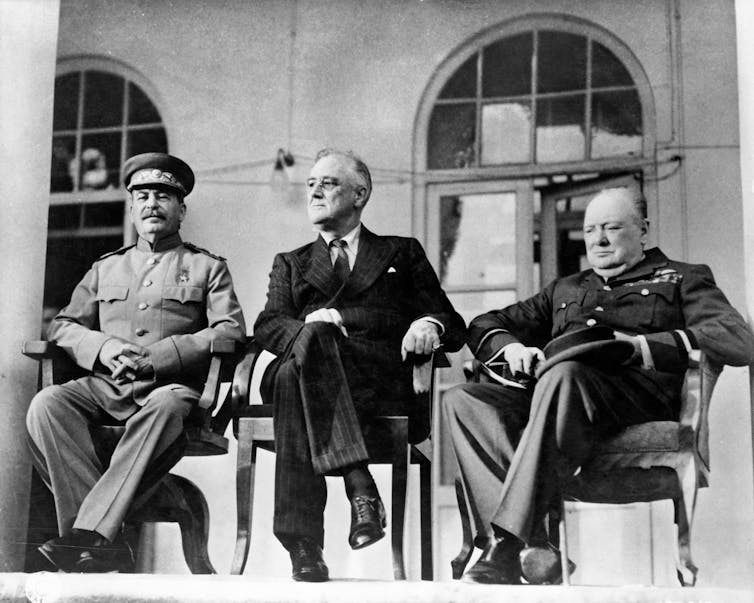
WInston Churchill, Franklin D Roosevelt and Josef Stalin site on chairs together.
Carving up the world: Stalin, Roosevelt and Churchill at the Tehran conference in 1943.
U.S. Signal Corps photo

But perhaps the most notable 1940s news story of all relating to Nineteen Eighty-Four’s geopolitics has been flagged by Taylor as one that broke in 1943. He notes that Orwell sometimes claimed a key inspiration for his final novel were the reports of Roosevelt, Stalin and Churchill talking at the 1943 Tehran conference about carving up the post-war world into three spheres.

Nineteen Eighty-Four has had extraordinary longevity as a go-to text for political commentary. There are many explanations for its staying power, but right now a key feature of it may be its relevance to thinking about both repression of dissent and Newspeak-style propaganda in many individual countries – and the unsettling geopolitical tensions in the world at large.

The Conversation

The authors do not work for, consult, own shares in or receive funding from any company or organisation that would benefit from this article, and have disclosed no relevant affiliations beyond their academic appointment.

ref. How George Orwell’s Nineteen Eighty-Four predicted the global power shifts happening now – https://theconversation.com/how-george-orwells-nineteen-eighty-four-predicted-the-global-power-shifts-happening-now-273122

How two acclaimed US films reveal the failures of leftwing revolutionary politics

Source: The Conversation – UK – By Gregory Frame, Teaching Associate in Media and Cultural Studies, University of Nottingham

Donald Trump’s victory in November 2024 led to considerable soul-searching among those on the left of US politics. Having failed to defeat a convicted criminal they beat once before, the Democrats spent most of 2025 licking their wounds as Trump launched what they saw as a full-frontal assault on US democracy.

This new year has begun with fresh outrages at home and abroad, with the administration acting with increasingly horrifying impunity.

Coupled with the continued rise of rightwing populism and authoritarianism the world over, Trump 2.0 has felt like an existential crisis for the left.

The country has been here before. Leftwing protest movements in the 1960s in the US contributed to great legislative change – particularly in the area of civil rights – but they were often caricatured as unpatriotic, particularly in relation to the war in Vietnam. The feeling that the country was coming apart at the hands of young, violent radicals led the conservative “silent majority” to deliver Richard Nixon’s 1968 election victory.

Since then, mainstream leftwing politics in the US has recoiled from the idealism of the 1960s and instead offered change mostly in small increments. But this has arguably not proven a particularly successful strategy either over the past half century or more.

In the context of yet another defeat and the latest round of introspection, it seems appropriate, then, that two films concerned with the failures of leftwing revolutionary politics of the 1960s and 1970s should emerge almost simultaneously with Trump’s resurgence.

Exploring leftwing activism

Though very different in style and tone, Paul Thomas Anderson’s One Battle After Another (2025) and Kelly Reichardt’s The Mastermind (2025) both critique what they see as the strategic inadequacy and self-indulgence of leftwing activism, as well as explore its personal cost.

One Battle After Another sees former revolutionary Pat Calhoun, aka “Bob” (Leonardo Di Caprio) trying to rescue his daughter Willa (Chase Infiniti) from the clutches of a psychopathic white supremacist colonel, Lockjaw (Sean Penn). Though Bob had in a previous life resisted the federal government’s cruel, racist immigration policies through a series of daring raids on detention centres, fatherhood and excessive cannabis use have dulled his revolutionary edge.

Instead, Bob is now a somewhat incompetent buffoon. The film mines, for comedic purposes, his shambolic attempts to communicate with the “French 75” – the revolutionary army of which he was once part, modelled on real-life revolutionary groups of the 1960s and 1970s like the Weathermen.

Stumbling around in his bathrobe, he has forgotten all the codes and conventions necessary to navigate this world. From passwords to pronouns, Bob is out of step with the times.

However, the film finds room to poke fun at the sanctimony of the left too. As Bob grows increasingly aggressive when unable to secure information regarding a crucial rendezvous point, the thin-skinned radical to whom he is speaking on the phone informs him that the language Bob is using is having a detrimental impact on his wellbeing. If Bob lacks the competence to support the revolution, the people in charge of it are too fragile to achieve one either.

By contrast, The Mastermind follows J.B. Mooney (Josh O’Connor) in his attempts to evade the clutches of the authorities after he orchestrates the theft of four artworks from a suburban museum. Husband, father, and the son of a judge, Mooney is privileged, directionless, disorganised, selfish and, it seems, oblivious to the impact of the war in Vietnam as conflict rages all around him.

His disorganisation is obvious from the moment he realises his children’s school is closed for teacher training on the day of the heist. His privilege is clear when all he has to do is mention his father’s name when first questioned by police to get them off his back.

Even his attempts to convince his wife, Terri (Alana Haim), that he did this for her and their kids is inadequate, as he stumbles into admitting he also did it for himself.

While on the run from the authorities, Mooney appears ignorant of what is really going on around him, from the young Black men who discuss their imminent deployment to Vietnam, to the news broadcast of the realities of the war. Without spoiling anything, Mooney is, in the end, unable to avoid the effects of Vietnam on US society altogether.

Telling moments in both films also suggest the wavering commitment to revolution among its former acolytes. In The Mastermind, Mooney hides out at the home of Fred (John Magaro) and Maude (Gaby Hoffmann), a couple with whom he attended art college.

Despite her activist past, Maude refuses to let him stay for longer than one night for fear of unwanted attention from the authorities. In One Battle After Another, Bob’s willingness to take risks with his safety and freedom declines when he becomes a parent, and he is – rather problematically – quick to judge Willa’s mother, Perfidia (Teyana Taylor), for continuing to do so.

Political cinema of the 1970s

Both films can’t help but recall the similarly political work produced in US cinema in the late 1960s and early 1970s, such as Five Easy Pieces (1970), Two-Lane Blacktop (1971) and Chinatown (1974). In the midst of the Nixon-era backlash to the radicalism of the 1960s, these films have a tone of defeatist resignation, featuring directionless protagonists and unhappy endings.

The Mastermind’s conclusion is comparable to these earlier examples: its conclusion sees the police at a Vietnam protest, patting each other on the back, having rounded up another bunch of protesters and sent them to the can.

Though One Battle After Another is considerably more effervescent in its style, it too sees leftwing revolutionary politics as something of a dead end. Smaller scale victories are possible, with Sergio (Benicio Del Toro) continuing to fight the good fight for undocumented immigrants, and Willa running off to join a Black Lives Matter protest at the film’s end.

But watching both films from the perspective of a new year in which the Trump administration threatens violent upheaval at home and abroad, I think of Captain America’s (Peter Fonda) mournful lament towards the end of counterculture classic Easy Rider (1969): “We blew it.”


Looking for something good? Cut through the noise with a carefully curated selection of the latest releases, live events and exhibitions, straight to your inbox every fortnight, on Fridays. Sign up here.


The Conversation

Gregory Frame does not work for, consult, own shares in or receive funding from any company or organisation that would benefit from this article, and has disclosed no relevant affiliations beyond their academic appointment.

ref. How two acclaimed US films reveal the failures of leftwing revolutionary politics – https://theconversation.com/how-two-acclaimed-us-films-reveal-the-failures-of-leftwing-revolutionary-politics-270729