Medicare is experimenting with having AI review claims – a cost-saving measure that could risk denying needed care

Source: The Conversation – USA (3) – By Grace Mackleby, Research scientist of Health Policy and Economics, University of Southern California

A new pilot brings some automated treatment decisions from Medicare Advantage to traditional Medicare. Doomu/iStock via Getty Images

Medicare has launched a six-year pilot program that could eventually transform access to health care for some of the millions of people across the U.S. who rely on it for their health insurance coverage.

Traditional Medicare is a government-administered insurance plan for people over 65 or with disabilities. About half of the 67 million Americans insured through Medicare have this coverage. The rest have Medicare Advantage plans administered by private companies.

The pilot program, dubbed the Wasteful and Inappropriate Service Reduction Model, is an experimental program that began to affect people enrolled in traditional Medicare from six states in January 2026.

During this pilot, medical providers must apply for permission, or prior authorization, before giving 14 kinds of health procedures and devices. The program uses artificial intelligence software to identify treatment requests it deems unnecessary or harmful and denies them. This is similar to the way many Medicare Advantage plans work.

As health economists who have studied Medicare and the use of AI in prior authorization, we believe this pilot could save Medicare money, but it should be closely monitored to ensure that it does not harm the health of patients enrolled in the traditional Medicare program.

Prior authorization

The pilot marks a dramatic change.

Unlike other types of health insurance, including Medicare Advantage, traditional Medicare generally does not require health care providers to submit requests for Medicare to authorize the treatments they recommend to patients.

Requiring prior authorization for these procedures and devices could reduce wasteful spending and help patients by steering them away from unnecessary treatments. However, there is a risk that it could also delay or interfere with some necessary care and add to the paperwork providers must contend with.

Prior authorization is widely used by Medicare Advantage plans. Many insurance companies hire technology firms to make prior authorization decisions for their Medicare Advantage plans.

Pilots are a key way that Medicare improves its services. Medicare tests changes on a small number of people or providers to see whether they should be implemented more broadly.

The six states participating are Arizona, New Jersey, Ohio, Oklahoma, Texas and Washington. The 14 services that require prior authorization during this pilot include steroid injections for pain management and incontinence-control devices. The pilot ends December 2031.

If the Centers for Medicare & Medicaid Services, which administers Medicare, deems the pilot successful, the Department of Health and Human services could expand the program to include more procedures and more states.

Introducing a hurdle

This pilot isn’t changing the rules for what traditional Medicare covers. Instead, it adds an extra hurdle for medical providers before they can administer, for example, arthroscopic treatment for an osteoarthritic knee.

If Medicare issues a denial rather than authorizing the service, the patient goes without that treatment unless their provider files an appeal and prevails.

Medicare has hired tech companies to do the work of denying or approving prior authorization requests, with the aid of artificial intelligence.

Many of these are the same companies that do prior authorizations for Medicare Advantage plans.

The government pays the companies a percentage of what Medicare would have spent on the denied treatments. This means companies are paid more when they deny more prior authorization requests.

Medicare monitors the pilot program for inappropriate denials.

What to watch for

Past research has shown that when insurers require prior authorization, the people they cover get fewer services. This pilot is likely to reduce treatments and Medicare spending, though how much remains unknown.

The Centers for Medicare & Medicaid Services chose the services targeted by the pilot because there is evidence they are given excessively in many cases.

If the program denies cases where a health service is inappropriate, or of “low value” for a patient’s health, people enrolled in traditional Medicare could benefit.

But for each treatment targeted by the pilot, there are some cases where that kind of health care is necessary.

If the program’s AI-based decision method has trouble identifying these necessary cases and denies them, people could lose access to care they need.

The pilot also adds to the paperwork that medical providers must do. Paperwork is already a major burden for providers and contributes to burnout.

AI’s role

No matter how the government evaluates prior authorizations, we think this pilot is likely to reduce use of the targeted treatments.

The impact of using AI to evaluate these prior authorizations is unclear. AI could allow tech companies to automatically approve more cases, which could speed up decisions. However, companies could use time saved by AI to put more effort into having people review cases flagged by AI, which could increase denials.

Many private insurers already use AI for Medicare Advantage prior authorization decisions, although there has been limited research on these models, and little is known about how accurate AI is for this purpose.

What evidence there is suggests that AI-aided prior authorization leads to higher denial rates and larger reductions in health care use than when insurers make prior authorization decisions without using AI.

Two wooden cubes marked yes and no with robot hand pointing to no
Traditional Medicare is experimenting with using AI to assist in deciding whether treatment recommended by health providers is necessary.
Dragon Claws/iStock via Getty Images

The bottom line

Any money the government saves during the pilot will depend on whether and how frequently these treatments are used inappropriately and how aggressively tech companies deny care.

In our view, this pilot will likely create winners and losers. Tech companies may benefit financially, though how much will depend on how big the treatment reductions are. But medical providers will have more paperwork to deal with and will get paid less if some of their Medicare requests are denied.

The impact on patients will depend on how well tech companies identify care that probably would be unnecessary and avoid denying care that is essential.

Taxpayers, who pay into Medicare during their working years, stand to benefit if the pilot can cut long-term Medicare costs, an important goal given Medicare’s growing budget crisis.

Like in Medicare Advantage, savings from prior authorization requirements in this pilot are split with private companies. Unlike in Medicare Advantage, however, this split is based on a fixed, observable percentage so that payments to private companies cannot exceed total savings, and the benefits of the program are easier for Medicare to quantify.

In our view, given the potential trade-offs, Medicare will need to evaluate the results of this pilot carefully before expanding it to more states – especially if it also expands the program to include services where unnecessary care is less common.

The Conversation

Grace Mackleby receives funding from Arnold Ventures and the Commonwealth Foundation.

Jeff Marr receives funding from Arnold Ventures and the National Institute on Aging.

ref. Medicare is experimenting with having AI review claims – a cost-saving measure that could risk denying needed care – https://theconversation.com/medicare-is-experimenting-with-having-ai-review-claims-a-cost-saving-measure-that-could-risk-denying-needed-care-273754
Lüften sounds simple – but ‘house-burping’ is more complicated in Pittsburgh

Source: The Conversation – USA (3) – By William Bahnfleth, Professor of Architectural Engineering, Penn State

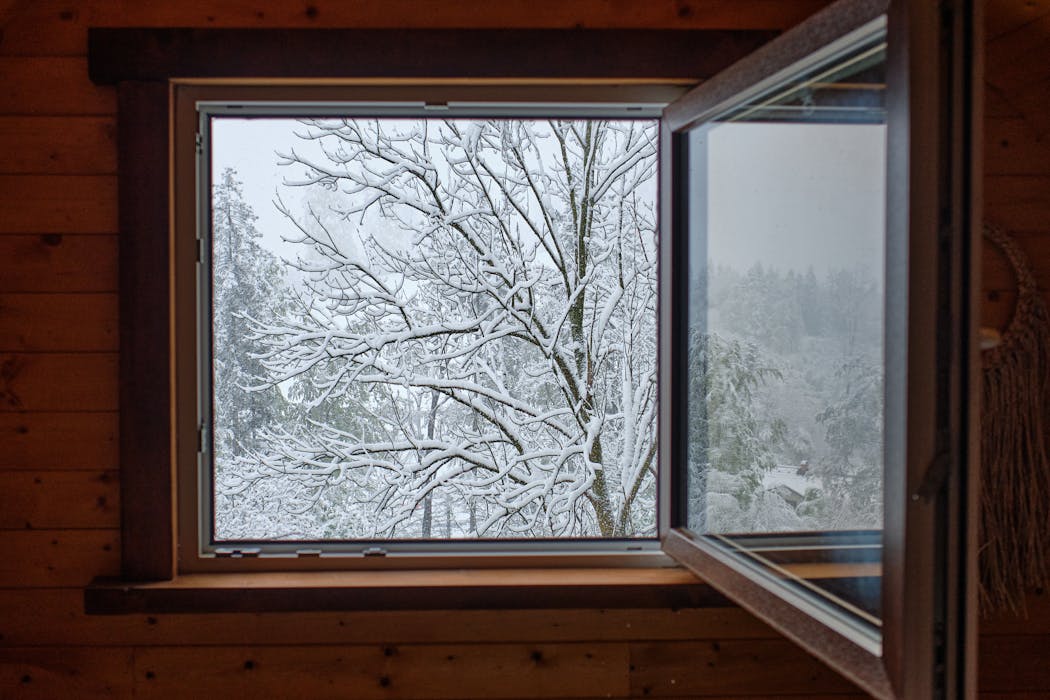
Lüften refers to the German practice of opening windows and sometimes doors to rapidly fill a house with outdoor air, at least a couple of times daily. Jan Nevidal/Getty Images

Recently, the German term “lüften” has been circulating on social media and trending on Google. The term refers to the practice of opening windows and doors to replace stale indoor air with outdoor air, a longtime practice in many European homes. Americans have dubbed it “house burping” in many videos on Instagram, TikTok and YouTube.

William Bahnfleth, a professor of architectural engineering at Penn State, has personal and professional experience with lüften. He spoke to The Conversation’s Pittsburgh Editor Cassandra Stone about the science behind it and how Pittsburgh homeowners can best navigate the “house burping” trend.

What does “lüften” actually mean in Germany and other parts of Europe, and how is it different from the way Americans typically ventilate homes?

Literally, “lüften” means “to air out.” It refers to opening windows – and sometimes doors – to rapidly flush a house with outdoor air, typically at least twice daily. This improves indoor air quality and controls humidity to prevent condensation, which can damage buildings and promote mold growth.

The practice is not unique to Germany, although it may not go by that name in other regions. I spent a sabbatical leave at the Technical University of Denmark in Copenhagen, and upon arriving at the house I’d been assigned, I found instructions to air it twice a day for about 15 minutes. The stated purpose in this case was to prevent excessive humidity, because the climate in Denmark can be cool and damp. Moisture produced by bathing, laundry and cooking can raise indoor humidity to high levels if not controlled. The house also had a shower squeegee to remove water from walls and a sensor-controlled bathroom exhaust fan. Without mechanical cooling, opening windows for a bit early in the day kept the house comfortable as weather warmed.

Lüften is uncommon in the U.S., even in older, naturally ventilated homes. Americans tend to rely on HVAC systems for thermal comfort with windows closed, disconnecting indoor air quality from temperature control. The way American buildings are heated and cooled actually discourages window opening. After returning from Denmark, I started opening windows during mornings in cooling season – and leaving them open until it became too hot or humid indoors – and briefly in winter. This reduced summer cooling costs and improved indoor air quality all year – I was surprised how many days I could skip the air conditioner.

Is there scientific evidence that short, intense “airing out” improves air quality more effectively than just cracking a window all day?

It depends on whether a “cracked” window admits a lot of outdoor air or a little. Opening windows continuously provides better ventilation than brief, 5- to 10-minute periods, but with potential downsides for thermal comfort and energy use.

The best approach today is continuous outdoor air supply at design standard levels via an energy recovery ventilator. The ventilator uses fans to bring in a reliable outdoor air supply that’s partially conditioned by exchanging heat and moisture with exhausted air, providing good indoor air quality with low energy impact and stable indoor conditions. Researchers have also investigated “smart ventilation” systems that maintain desired average ventilation rates by bringing in more outdoor air to reduce operational strain and reduce energy costs– a kind of “next-generation lüften.”

One important aspect of indoor air quality that may not be improved by lüften is indoor particle control. Small particles that come from cooking, some cleaning activities or burning candles, for example, are the most harmful contaminants in most indoor environments. In urban areas, outdoor particle levels may exceed acceptable limits, so opening windows may release indoor pollutants such as cooking fumes and lower humidity inside, but it can also let in bad air from cars and industry.

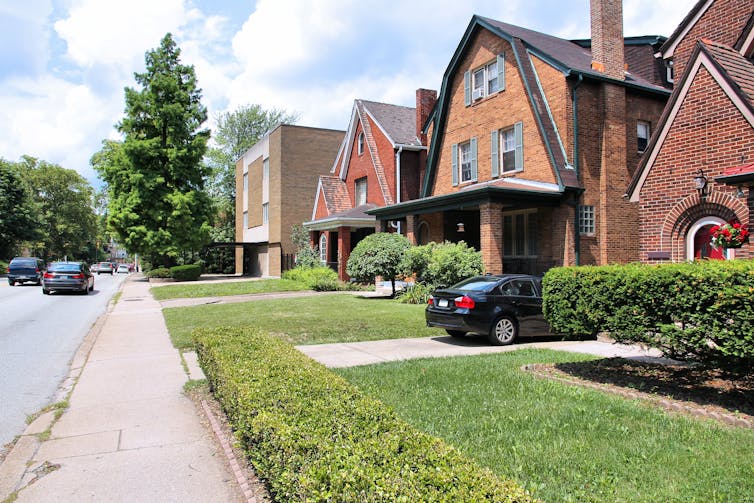
Historic, stately homes in a Pittsburgh area neighborhood.
Pittsburgh has older homes that could benefit from lüften to balance out the dampness, but the city struggles with outdoor air pollution and poor air quality at times.
tupungato/Getty Images

Pittsburgh struggles with outdoor air pollution at times. How should locals think about the trade-off between bringing in outdoor air and introducing pollutants into the home?

“Fresh air” isn’t a synonym for outdoor air because it’s not actually “fresh” in many locations. It’s best to filter outdoor air to remove particles before bringing it into the house, which can be done with an energy recovery ventilator. Unit prices range from $600 to $1,500 on average, but these ventilators can reduce utility bills by 10% or more by preconditioning incoming fresh air with the outgoing air’s energy.

If that isn’t possible, portable air purifiers are a good solution with many benefits, such as a reduced risk of transmitting airborne respiratory infections, control of seasonal allergens such as pollen, resilience during wildfires, better air quality when you are using your wood-burning fireplace, and capturing emissions from cooking.

Can lüften make an older, damp home more comfortable?

It can lower humidity in the air, which reduces the potential concentration, but it doesn’t eliminate indoor sources of moisture. If a house is damp, especially if there are specific wet spots, the owner should try to identify and fix the causes. Lüften, and ventilation in general, are mitigation measures, not solutions.

Why do you think practices like lüften persist culturally?

The simplest answer is that they actually work. It’s a good place to start with taking responsibility for managing the air quality in your home. The better understanding of the causes and effects of poor indoor air quality, and the technology available to measure and control it, can beneficially update a good historical practice to obtain even more value from it.

The Conversation

William Bahnfleth does not work for, consult, own shares in or receive funding from any company or organization that would benefit from this article, and has disclosed no relevant affiliations beyond their academic appointment.

ref. Lüften sounds simple – but ‘house-burping’ is more complicated in Pittsburgh – https://theconversation.com/luften-sounds-simple-but-house-burping-is-more-complicated-in-pittsburgh-274507

How to ensure affordable, safe and culturally grounded housing for Indigenous older adults

Source: The Conversation – Canada – By Hai Luo, Associate Professor, Faculty of Social Work, University of Manitoba

A good home, or Minosin Kikiwa in Cree, is the foundation of dignity in later life, according to the Indigenous seniors who spoke to us. Yet “every year the rent goes sky-high and it’s tough to be homeless,” an anonymous participant said.

As members of the Indigenous Seniors Research Committee, we came together in the fall of 2022 with the goal of examining the housing and care needs of older Indigenous adults in Winnipeg. In 2023-24, we spoke with 48 Indigenous older adults between the ages of 55 and 83 and nine knowledge keepers. What we found out, and compiled in our report Minosin Kikiwa – “A Good Home”: Indigenous Older Adults in Winnipeg, is critical to share.

It turns out that many Indigenous Elders are struggling to find affordable and safe homes to age with dignity after decades of contributing to their families and communities. The evidence we’ve collected suggests a housing crisis that is not only economic but also cultural.

Affordability at the breaking point

A little more than half of the older Indigenous participants rented their housing, and 21 per cent were precariously housed or homeless. Many relied on social or income assistance they found lacking.

One participant who used a walker described having to keep working to afford the $1,050 monthly rent for a one-bedroom apartment. Another senior told us:

“[You] can’t move because [you] can’t afford it. You can’t afford it. You can’t even get a stinking room at the hotel [per month]. They’re charging over $650 for a bedbug-infested party room and people breaking in.”

Others described paying most of their fixed income for apartments with poor or unsafe conditions. One participant recalled living in a rooming house where individuals with questionable unsafe behaviours were allowed to move in. “My ex-landlady didn’t care who was in there…she was not maintaining the place.”

As committee co-chair Joanne Mason put it: “Getting a place to rent is impossible, and the ones that are for rent are dilapidated and often not well-kept at very high prices.”

Colonial legacies on housing

Indigenous older adults’ housing challenges cannot be separated from Canada’s history. Child welfare removals, residential schools and racism disrupted education, employment and the transfer of intergenerational wealth. As a result, many Indigenous older adults entered later life with mortgages or debts, and without personal savings.

As committee member Kathy Mallet explained: “The colonial system gave us (Indigenous Peoples) that legacy, and so now we’re paying for it.”

Cumulative poverty and other disadvantages compound this problem. As one participant shared, “You don’t raise four children and be wealthy when you retire.” Other low-income Indigenous participants told us they had no choice but to keep working in paid employment into their later years. Seventy-three per cent of our participants reported they either have “some difficulty” or “great difficulty” making ends meet.

These were no golden years of retirement.

Home is more than family

Housing is more than physical buildings, it is also about community and wellness.

Minosin Kikiwa for Indigenous older adults is defined as a safe, affordable and accessible space that fosters a holistic balance of physical, spiritual, mental and emotional well-being through deep connections to family, kin, community and culture.

Homes are places where one connects with family, passes on culture and finds rest. Yet restrictive housing policies frequently undermine this. One participant shared that overnight guests were forbidden in their building. “Visitors have to be out of the building by 10:30…that’s not a home.”

As Lucille Bruce, co-chair of the Indigenous Seniors Research Committee, explained: “They want to be within their communities where families can visit and where services are delivered in culturally relevant ways by Indigenous agencies.”

Intergenerational connections are disrupted when grandchildren and other family members are prevented from staying with renters due to these culturally insensitive policies, which worsens the isolation and cultural deprivation experienced by many.

When policy fails community

Winnipeg has one of the largest populations of urban Indigenous Peoples in Canada with 12.4 per cent of Winnipegers (90,990) identifying as Indigenous in 2021. The housing and later-life struggles of Indigenous older adults in the city reflect those faced by Indigenous older adults in urban settings across Canada.

Statistics Canada found that the life expectancy of an Indigenous person is about 7.8 years shorter than that of non-Indigenous Canadians. Other researchers have linked precarious housing to poor health, food insecurity and social isolation, all of which increase mortality.

Governments need to be accountable to Indigenous older adults. Public funds currently flow into dilapidated spaces and rooming houses that function as de facto “nursing homes” for low-income Indigenous older adults. As one participant stated, shelters and transitional housing too often become places “where our people come to die.”

Researchers note that government programs framed as reconciliation often amount to tokenistic gestures, with a lack of meaningful Indigenous leadership. Policy frameworks have failed to address deep-rooted challenges such as generational poverty, inadequate financial support that does not adjust for inflation, and the lack of safe, affordable and culturally representative housing options for urban Indigenous seniors.

Institutional systems, including the historical trauma of residential schools and restrictive modern housing policies (for example, prohibiting overnight guests), continue to displace Indigenous seniors from their families and communities, creating significant barriers to accessing necessary resources.

Moving toward dignity and justice

We believe that housing policy must prioritize Indigenous leadership in design, construction, ownership and governance. Housing programs should also be connected with stable and publicly funded supports for health, income and community well-being, shifting away from short-term or symbolic solutions toward lasting and transformative change.

In light of Minosin Kikiwa, we call for governments and housing providers to help ensure affordability while centring Indigenous values and leadership. Affordability should extend beyond just subsidies to building and sustaining safe, accessible and culturally relevant housing.

Housing for Indigenous older adults must transcend basic shelter to become a sanctuary of dignity and cultural sovereignty, a place where ceremonies, traditional foods and the passing of sacred knowledge are protected, not prohibited. This is no longer merely a policy suggestion, it is a fundamental requirement of reconciliation to ensure that aging in community is a right, not a privilege, for Indigenous seniors.

The Conversation

Hai Luo receives funding from the Manitoba Research Alliance’s Partnership Grant (SSHRC) – Community-Driven Solutions to Poverty: Challenges and Possibilities and the Winnipeg Friendship Centre. She is affiliated with Indigenous Seniors Research Committee of Winnipeg and Centre on Aging, University of Manitoba.

Laura Funk has received past funding for research, from the Social Sciences and Humanities Research Council of Canada and similar agencies. She is affiliated with the University of Manitoba and is a board member of the community-based Manitoba Seniors Equity Action Coalition.

Malcolm Disbrowe received funding from the Social Sciences and Humanities Research Council. He is affiliated with the College of Community and Global Health at the University of Manitoba and First Nations Health and Social Secretariat of Manitoba.

ref. How to ensure affordable, safe and culturally grounded housing for Indigenous older adults – https://theconversation.com/how-to-ensure-affordable-safe-and-culturally-grounded-housing-for-indigenous-older-adults-265949

The penis evolved to be noticed – but the artful fig leaf has hidden it for centuries

Source: The Conversation – Global Perspectives – By Darius von Guttner Sporzynski, Professor of History, Australian Catholic University

Wawel Royal Castle National Art Collection, Kraków/Wikimedia Commons, CC BY

A new evolutionary study has found human penises are large compared with other primates: for two reasons. The first is reproduction. The second is that size works as a signal, attracting potential mates and intimidating rivals. In evolutionary terms, the penis is big because it is meant to be noticed.

That finding lands awkwardly in a world that has spent centuries hiding, shrinking, censoring or symbolically neutralising the penis whenever it becomes too visible.

A single object captures this tension between biological display and cultural embarrassment: the fig leaf.

The fig leaf’s story begins, as so many Western stories do, in Genesis. Adam and Eve eat from the tree of knowledge, realise they are naked, and stitch fig leaves together to cover themselves. Nakedness becomes linked with moral awareness, guilt and self-consciousness.

Nudity no longer neutral

Early Christian art absorbed this lesson. In late antique mosaics and medieval manuscripts, Adam and Eve clutch leaves over their groins with a mixture of alarm and regret. Nudity is no longer neutral. It signals sin, punishment, or humiliation. The only bodies shown naked are the damned.

A naked man and woman, touching hands, with fig leaves covering their genitals
Workshop of Giovanni della Robbia Adam and Eve Walters Front Installation.
Wikimedia Commons

Then comes a sharp reversal. Ancient Greek and Roman sculpture, rediscovered in Renaissance Italy, presents the naked male body as strong, balanced, and admirable. Heroes, gods, and athletes are unclothed because they have nothing to hide. Their genitals are visible, proportioned, and unremarkable. This is not erotic display so much as confidence made stone.

Michelangelo’s David sits squarely in this tradition. Carved between 1501 and 1504, he is naked, alert and physically present. His body is not idealised into abstraction. It is specific, human, and unmistakably male. Florentines reportedly threw stones when the statue was first installed. Before long, authorities added a garland of metal fig leaves to protect public sensibilities, which remained in place until around the 16th century.

This was not an isolated decision. Over the next century, the Reformation fractured Christian Europe, giving birth to Protestantism, and the Catholic Church doubled down on moral discipline. Naked bodies in art became political liabilities. The Council of Trent’s decrees on religious imagery reflected concerns that the prominent display of naked bodies in sacred art risked drawing attention to human physicality rather than directing devotion towards God. This led to what later historians have called the “Fig Leaf Campaign”.

Across Rome and beyond, sculpted genitals were chipped away, painted over, draped, or concealed with leaves. Michelangelo’s Last Judgement in the Sistine Chapel was altered after his death by Daniele da Volterra, who was hired to cover up visible genitalia with drapery. He earned the nickname “the breeches maker” for his efforts.

Classical statues in the Vatican acquired permanent marble underwear. A literal drawer of removed stone penises is rumoured to have existed. Whether or not that is true, the impulse behind it certainly was.

Strikingly, the fig leaf does not erase the penis. It points to it. The cover announces the presence of something that must not be seen. As several writers note, concealment tends to sharpen attention rather than dull it. The fig leaf becomes a visual alarm bell.

Resisting biology

This brings us back to the present. The new evolutionary research argues human penis size evolved partly because it is visible.

For most of our species’ history, before clothes, the penis was on display during daily life. It became a cue others learned to read quickly and unconsciously. Larger size was associated with attractiveness and with competitive threat.

From that perspective, centuries of fig leaves look less like moral refinement and more like cultural resistance to biology. The body insists on signalling. Society keeps trying to mute the signal.

This fig leaf was designed to cover the plaster cast of Michaelangelo’s David presented to Queen Victoria, around 1857.
V&A Museum/Wikimedia, CC BY

Victorian Britain provides a late and almost comic example. When Queen Victoria was presented with a plaster cast of David, in around 1857, a detachable fig leaf was hastily produced and kept on standby for royal visits.

The leaf survives today, displayed separately in the Victoria and Albert Museum. The statue stands naked again, but the object designed to hide him has become a museum piece in its own right.

Even now, museums still debate whether to remove historic coverings. Social media platforms struggle to define what kinds of nudity are acceptable. Statues are boxed up for diplomatic visits. The anxiety persists, even if the fig leaf itself has become unfashionable.

Evolutionary biology suggests the human penis became prominent because it mattered socially – but our cultural history shows centuries of effort devoted to pretending it does not. The fig leaf sits at the centre of this contradiction: a small, awkward object carrying an enormous cultural load.

The Conversation

Darius von Guttner Sporzynski does not work for, consult, own shares in or receive funding from any company or organisation that would benefit from this article, and has disclosed no relevant affiliations beyond their academic appointment.

ref. The penis evolved to be noticed – but the artful fig leaf has hidden it for centuries – https://theconversation.com/the-penis-evolved-to-be-noticed-but-the-artful-fig-leaf-has-hidden-it-for-centuries-274286

An ‘AI afterlife’ is now a real option – but what becomes of your legal status?

Source: The Conversation – Global Perspectives – By Wellett Potter, Senior Lecturer in Law, University of New England

ziphaus/Unsplash

Would you create an interactive “digital twin” of yourself that can communicate with loved ones after your death?

Generative artificial intelligence (AI) has made it possible to seemingly resurrect the dead. So-called griefbots or deathbots – an AI-generated voice, video avatar or text-based chatbot trained on the data of a deceased person – proliferate in the booming digital afterlife industry, also known as grief tech.

Deathbots are usually created by the bereaved, often as part of the grieving process. But there are also services that allow you to create a digital twin of yourself while you’re still alive. So why not create one for when you’re gone?

As with any application of new technology, the idea of such digital immortality raises many legal questions – and most of them don’t have a clear answer.

Your AI afterlife

To create an AI digital twin of yourself, you can sign up for a service that provides this feature, and answer a series of questions to provide data about who you are. You also record stories, memories and thoughts in your own voice. You might also upload your visual likeness in the form of images or video.

The AI software then creates a digital replica based on that training data. After you die and the company is notified of your death, your loved ones can interact with your digital twin.

But in doing this, you’re also delegating agency to a company to create a digital AI simulation of yourself after death.

From the get go, this is different to using AI to “resurrect” a dead person who can’t consent to this. Instead, a living person is essentially licensing data about themselves to an AI afterlife company before they’ve died. They’re engaging in a deliberate, contractual creation of AI-generated data for posthumous use.

However, there are many unanswered questions. What about copyright? What about your privacy?. What happens if the technology becomes outdated or the business closes? Does the data get sold on? Does the digital twin also “die”, and what effect does this have for a second time on the bereaved?

What does the law say?

Currently, Australian law doesn’t protect a person’s identity, voice, presence, values or personality as such. In contrast to the United States, Australians don’t have a general publicity or personality right. This means, for an Australian citizen, there’s currently no legal right for you to own or control your identity – the use of your voice, image or likeness.

In short, the law doesn’t recognise a proprietary right in most of the unique things that make you “you”.

Under copyright law, the concept of your presence or self is abstract, much like an idea is. Copyright doesn’t offer protection for “your presence” or “the self” as such. That’s because there has to be material form in specific categories of works for copyright to exist: these are tangible things, such as books or photos.

However, typed responses or the voice recordings submitted to the AI for training are material. This means the data used to train the AI to create your digital twin would likely be protectable. But fully autonomous AI generated output is unlikely to have any copyright attached to it. Under current Australian law, it would likely be considered authorless because it didn’t originate from the “independent intellectual effort” of a human, but from a machine.

Moral rights in copyright protect a creator’s reputation against false attribution and against derogatory treatment of their work. However, they wouldn’t apply to a digital twin. This is because moral rights attach to actual works created by a human author, not any AI-generated output.

So where does that leave your digital twin? Although it’s unlikely copyright applies to AI-generated output, in their terms and conditions companies may assert ownership of the AI-generated data, users may be granted rights in outputs, or the company may reserve extensive reuse rights. It’s something to look out for.

There are ethical risks, too

Using AI to make digital copies of people – living or dead – also raises ethical risks. For example, even though the training data for your digital twin might be locked upon your death, others will be accessing it in the future by interacting with it. What happens if the technology misrepresents the deceased person’s morals and ethics?

As AI is usually probabilistic and based on algorithms, there may be risk of creep or distortion, where the responses drift over time. The deathbot could lose its resemblance to the original person. It’s not clear what recourse the bereaved may have if this happens.

AI-enabled deathbots and digital twins can help people grieve, but the effects so far are largely anecdotal – more study is needed. At the same time, there’s potential for bereaved relatives to form a dependence on the AI version of their loved one, rather than processing their grief in a healthier way. If the outputs of AI-powered grief tech cause distress, how can this be managed, and who will be held responsible?

The current state of the law clearly shows more regulation is needed in this burgeoning grief tech industry. Even if you consent to the use of your data for an AI digital twin after you die, it’s difficult to anticipate new technologies changing how your data is used in the future.

For now, it’s important to always read the terms and conditions if you decide to create a digital afterlife for yourself. After all, you are bound by the contract you sign.

The Conversation

Wellett Potter is a member of the Copyright Society of Australia and the Asia-Pacific Copyright Association.

ref. An ‘AI afterlife’ is now a real option – but what becomes of your legal status? – https://theconversation.com/an-ai-afterlife-is-now-a-real-option-but-what-becomes-of-your-legal-status-274021

Firefighters face repeat trauma. We learned how to reduce their risk of PTSD

Source: The Conversation – Global Perspectives – By Meaghan O’Donnell, Professor and Head, Research, Phoenix Australia, Centre for Posttraumatic Mental Health, The University of Melbourne

In their day-to-day work, first responders – including police, firefighters, paramedics and lifesavers – often witness terrible things happening to other people, and may be in danger themselves.

For some people, this can lead to post-traumatic stress disorder (PTSD), which usually involves intrusive memories and flashbacks, negative thoughts and emotions, feeling constantly on guard, and avoiding things that remind them of the trauma.

But our research – which tested a mobile app focused on building resilience with firefighters – shows PTSD isn’t inevitable. We found depression, anxiety and PTSD symptoms were less likely when firefighters used a mental health program that was self-led, specifically addressed trauma and focused on teaching practical skills.

First responders’ mental health

First responders report high rates of psychiatric disorders and often have symptoms of depression (such as persistent feelings of sadness), anxiety (such as nervousness or restlessness) and post-traumatic stress (including distressing flashbacks).

Sometimes symptoms aren’t severe enough for a diagnosis.

But left untreated,these “sub-clinical” symptoms can escalate into PTSD, which can severely impact day-to-day life. So targeting symptoms early is important.

However, stigma – as well as concerns about confidentiality and career implications – can prevent first responders from seeking help.

What we already knew about building resilience

For the past decade, we have been testing a program designed to give people exposed to traumatic events the skills to manage their distress and foster their own recovery.

The “Skills for Life Adjustment and Resilience” (SOLAR) program is:

  • skills-based – it teaches people specific strategies and tools to improve their mental health
  • trauma-informed, meaning it has been designed for people who have been exposed to trauma, and avoids re-traumatisation
  • and has a psychosocial focus, focusing on what people can do in their relationships, behaviour and thinking to improve their mental health.

Participants complete modules focused on:

  • the connection between physical health and mental health
  • staying socially connected
  • managing strong emotions
  • engaging and re-engaging in meaningful activities
  • coming to terms with traumatic events
  • managing worry and rumination.

The SOLAR program trains coaches to deliver these modules in their communities. Importantly, these coaches don’t necessarily have specific mental health training, such as Australian Red Cross volunteers, community nurses and case workers.

What our new research did

The evidence shows the SOLAR program is effective at improving wellbeing and reducing depression, post-traumatic stress and anxiety symptoms.

But working with firefighters in New South Wales, they told us they wanted a self-led program they could complete confidentially, independently of their employer, and in their own time – a mobile app. So we wanted to test if the program would still be effective delivered this way.

A total of 163 firefighters took part in our recent randomised control trial, either using the app we co-designed with them, or a mood monitoring app.

A mood monitoring app tracks daily emotions to help understand patterns in how someone is feeling. There is evidence to show it can be useful for some people in reducing symptoms.

But this kind of app doesn’t teach a person practical skills that can be applied to different situations. And it does not specifically address stressful or traumatic experiences. So we wanted to test if taking a skills approach made a significant difference.

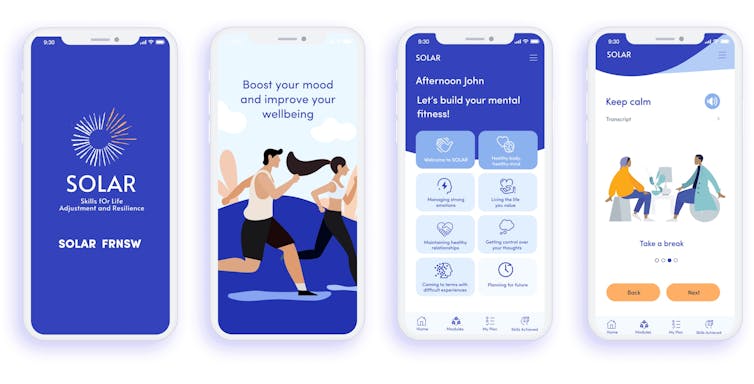
Four screenshots of the mobile app modules in progress.
The app was self-directed, so firefighters could complete modules in their own time.
Spark Digital

What we found

Eight weeks after they started using one of the two apps, we followed up with the firefighters.

The study found those who used the SOLAR app had significantly lower symptoms of depression, anxiety and post-traumatic stress, compared to those in the mood monitoring group.

We followed up with participants again three months after their post-treatment assessment.

We found:

  • depression was much lower in the group who learned practical skills about trauma, compared to those who used the mood monitoring app, and
  • anxiety and post-traumatic stress symptoms had reduced significantly for both groups since starting their program (but there was no real difference between them).

What does this mean?

Both apps improved mental health.

But the results show using the SOLAR app, which focused on building skills and specifically addressing trauma, reduced mental symptoms more quickly. It was especially useful for tackling depression longer term.

Firefighters also told us they liked the app. This is important – an app is only effective when people use it.

Around half of the firefighters started using it completed all the modules. This is much higher than usual for mental health apps. Typically, only around 3% of those who start using a mental health app complete them.

The more modules a firefighter completed, the more their mental health improved.

The takeaway

It’s common for firefighters and other first responders to struggle with mental health symptoms. Our study demonstrates the importance of intervening early and teaching practical skills for resilience, so that those symptoms don’t develop into a disorder such as PTSD.

A program that is self-led, confidential and evidence-based can help protect the mental health of first responders while they do the work they love, protecting us.

The Conversation

Meaghan O’Donnell (Phoenix Australia) receives funding from government funding bodies such as National Health and Medical Research Council, and Department of Veterans’ Affairs, and philanthropic bodies such as Wellcome Trust Fund (UK), Latrobe Health Foundation, and Ramsay Health Foundation. Funding for this study in this Conversation article was from icare, NSW.

Tracey Varker (Phoenix Australia) receives funding from government funding bodies such as Department of Veterans’ Affairs, and philanthropic foundations such as Latrobe Health Services Foundation. Funding for the study described in this Conversation article was from icare NSW.

ref. Firefighters face repeat trauma. We learned how to reduce their risk of PTSD – https://theconversation.com/firefighters-face-repeat-trauma-we-learned-how-to-reduce-their-risk-of-ptsd-269283

Winter Olympic security tightens as US-European tensions grow

Source: The Conversation – Global Perspectives – By Keith Rathbone, Senior Lecturer, Modern European History and Sports History, Macquarie University

Since the murder of 11 Israeli hostages at the 1972 Munich Summer Olympics, security has been fundamental for games stakeholders.

The 2024 Paris games set new benchmarks for security at a mega-event, and now the presence of American security officials in Milan Cortina threatens to darken this year’s Winter Olympics before they even start.

Security at the games

The scale of security at the games has magnified considerably since the 1970s.

For the 2024 Olympics, the French government mobilised an unprecedented 45,000 police officers from around the nation.

For the opening ceremony, these forces cordoned off six kilometres of the Seine River.

Advocates point to Paris as an example of security done correctly.

Milipol Paris – one of the world’s largest annual conferences on policing and security – pointed to lower crime across the country during the games and a complete absence of any of the feared large security events. It stated:

The operation demonstrated the effectiveness of advanced planning, inter-agency cooperation and strong logistical coordination. Authorities and observers are now reflecting on which elements of the Paris 2024 model might be applied to future large-scale events.

However, critics complained the security measures infringed on civil liberties.

Controversy as ICE heads to Italy

Ahead of the Milan Cortina games, which run from February 4-23, Italian officials promised they were “ready to meet the challenge of security”.

A newly established cybersecurity headquarters will include officials from around the globe, who will sift through intelligence reports and react to issues in real time.

As well as this, security will feature:

  • 6,000 officers to protect the two major locations – Milan and Cortina d’Ampezzo
  • a no-fly zone around key sites
  • a constant restricted access cordon around some sites (as seen in Paris).

Some of the security officers working in the cybersecurity headquarters will come from the United States.

Traditionally the US diplomatic security service provides protection for US athletes and officials attending mega-events overseas. It has been involved in the games since 1976.

Late last month, however, news broke that some of the officers will be from “a unit of US Immigration and Customs Enforcement (ICE)”.

US and Italian officials were quick to differentiate between Homeland Security Investigations (HSI), which handles cross-border crime, and Enforcement and Removal Operations, the department responsible for the brutal crackdown on immigrant communities across the US.

The HSI has helped protect athletes at previous events and will be stationed at the US Consulate in Milan to provide support to the broader US security team at the games.

But the organisation’s reputation precedes them, and Italians are wary.

In Milan, demonstrators expressed outrage. Left-wing Mayor Giuseppe Sala called ICE a “a militia that kills” while protests broke out in the host cities.


Read more:
Shooting of Alex Pretti in Minneapolis has put America’s gun lobby at odds with the White House


US-European relations are stretched

The presence of ICE has also illuminated fractures within Italian Prime Minister Giorgia Meloni’s governing coalition.

Foreign Minister Antonio Tajani defended the inclusion of the US officers, saying “it’s not like the SS are coming”, referring to the Nazis paramilitary force in Germany.

However, local officials, including those from Meloni’s centre-right coalition, expressed concerns.

The tension inside Meloni’s government reflects broader concerns on the continent about US-European relations.

US Vice President JD Vance and Secretary of State Marco Rubio will attend the opening ceremony in Milan, despite some Europeans viewing Vance as the mouthpiece for US President Donald Trump’s imperial agenda.


Read more:
The Making of an Autocrat: podcast out now


Trump’s desire to take over Greenland has undermined American and European support for trans-Atlantic amity and the NATO alliance.

Just ahead of the Olympics, Danish veterans marched outside the US Embassy after Trump disparaged NATO’s contribution to US-led operations in Iraq and Afghanistan. These protests added to Danes’ fears about Trump’s Greenland ambition.

Tensions in Denmark remain high as the Americans and the Danes gear up to play ice hockey in the opening round robin of the men’s competition.

Elsewhere, politicians in the US on both sides have raised concerns that Trump’s bombastic rhetoric will make it harder for American athletes to compete and win.

A double standard?

Critics argue there is an American exception when it comes to global politics interfering in international sport.

Under Trump, the US has attacked Iran and Venezuela, called on Canada to become its 51st state, threatened to occupy Greenland and engaged in cross-border operations in Mexico.

Despite this, US competitors can still wear their nation’s colours at the Olympics.

Compare this to Belarussian and Russian athletes, who are only eligible to compete as Individual Neutral Athletes after the Russian invasion of Ukraine, and only under the condition they have not been publicly supportive of the invasion. An International Olympic Committee (IOC) body assesses each competitor’s eligibility.

Israeli athletes have also been under the spotlight amid geopolitical tensions in the region.

Following the Israeli invasion of Gaza in October 2023, a panel of independent experts at the United Nations urged soccer’s governing body FIFA to ban Israeli athletes, stating:

sporting bodies must not turn a blind eye to grave human rights violations.

But FIFA, and the IOC, have recently defended Israeli athletes’ right to participate in international sport in the face of boycotts and protests.

Competitors from Israel can represent their country at the Winter Olympics.

The political developments which have caused ructions worldwide ironically come after the IOC’s 2021 decision to update the Olympic motto to supposedly recognise the “unifying power of sport and the importance of solidarity”.

The change was a simple one, adding the word “together” after the original three-word motto: “faster, higher, stronger”.

It remains to be seen whether the Milan Cortina games live up to every aspect of the “faster, higher, stronger – together” motto, not just the first three words.

The Conversation

Keith Rathbone does not work for, consult, own shares in or receive funding from any company or organisation that would benefit from this article, and has disclosed no relevant affiliations beyond their academic appointment.

ref. Winter Olympic security tightens as US-European tensions grow – https://theconversation.com/winter-olympic-security-tightens-as-us-european-tensions-grow-274530

I studied 10 years of Instagram posts. Here’s how social media has changed

Source: The Conversation – Global Perspectives – By T.J. Thomson, Associate Professor of Visual Communication & Digital Media, RMIT University

Antoine Beauvillain/Unsplash

Instagram is one of Australia’s most popular social media platforms. Almost two in three Aussies have an account.

Ushering in 2026 and what he calls “synthetic everything” on our feeds, Head of Instagram Adam Mosseri has signalled the platform will likely adjust its algorithms to surface more original content instead of AI slop.

Finding ways to tackle widespread AI content is the latest in a long series of shifts Instagram has undergone over the past decade. Some are obvious and others are more subtle. But all affect user experience and behaviour, and, more broadly, how we see and understand the online social world.

To identify some of these patterns, I examined ten years’ worth of Instagram posts from a single account (@australianassociatedpress) for an upcoming study.

This involved looking at nearly 2,000 posts and more than 5,000 media assets. I selected the AAP account as an example of a noteworthy Australian account with public service value.

I found six key shifts over this timeframe. Although user practices vary, this analysis provides a glimpse into some larger ways the AAP account – and social media more broadly – has been changing in the past decade.

Reflecting on some of these changes also provides hints at how social media might change in the future, and what that means for society.

1. Media orientations have shifted

When it launched in 2010, Instagram quickly became known as the platform that re-popularised the square image format. Square photography has been around for more than 100 years but its popularity waned in the 1980s when newer cameras made the non-square rectangular format dominant.

Instagram forced users to post square images for the platform’s first five years. However, the balance between square and horizontal images has given way to vertical media over time.

On the AAP account that shift happened over the last two years, with 84.4% of all its posts now in vertical orientation.

A chart shows the mix of media types by orientation that were posted to the AAP's Instagram account between 2015 and 2025.
The use of media in vertical orientation spiked on the AAP Instagram account in 2025.
T.J. Thomson

2. Media types have changed

As with orientations, the media types being posted have also changed. This is due, in part, to platform affordances: what the platform allows or enables a user to do.

As an example, Instagram didn’t allow users to post videos until 2013, three years after the platform started. It added the option to post “stories” (short-lived image/video posts of up to 15 seconds) and live broadcasts in 2016. Reels (longer-lasting videos of up to 90 seconds) came later in 2020.

Some accounts are more video-heavy than others, to try to compete with other video-heavy platforms such as YouTube and TikTok. But we can see a larger trend in the shift from single-image posts to multi-asset posts. Instagram calls these “carousels”, a feature introduced in 2017.

The AAP went from publishing just single-image posts in the first years of the account to gradually using more carousels. In the most recent year, they accounted for 85.9% of all posts.

A graph shows the different types of media posts published on the AAP's Instagram account between 2015 and 2025.
Following the introduction of carousel posts on Instagram in 2017, the AAP account’s use of them peaked in 2025 with 85.9% of all posts.
T.J. Thomson

3. Media are becoming more multimodal

A typical Instagram account grid from the mid-2000s had a mix of carefully curated photographs that were clean, colourful and simple in composition.

Fast-forward a decade, and posts have become much more multimodal. Text is being overlaid on images and videos and the compositions are mixing media types more frequently.

A grid of 15 Instagram posts show colourful photos, engaging use of light, and strategic use of camera settings to capture motion.
A snapshot of an Instagram account’s grid from late 2015 and early 2016 showed colourful photos, engaging use of light, and strategic use of camera settings to capture motion.
@australianassociatedpress

There are subtitles on videos, labels on photos, quote cards, and “headline” posts that try to tell a mini story on the post itself without the user having to read the accompanying post description.

On the AAP account, the proportion of text on posts never rose above 10% between 2015 and 2024. Then, in 2025, it skyrocketed to being on 84.4% of its posts.

A grid of 15 Instagram posts show text overlaid on many of the photos or text-only carousel posts.
In 2025, posts on Instagram had become much more multimodal. Instead of just one single photo, the use of carousel posts is much more common, as is the overlaying of words onto images and videos.
@australianassociatedpress

4. User practices change

Over time, user practices have also changed in response to cultural trends and changes of the platform design itself.

An example of this is social media accounts starting to insert hashtags in a post comment rather than directly in the post description. This is supposed to help the post’s algorithmic ranking.

A screenshot of an Instagram post shows a series of related hashtags in a comment.
Many social media users have started putting hashtags in a comment rather than including them in the post description.
@australianassociatedpress

Another key change over this timeframe was Instagram’s decision in 2019 to hide “likes” on posts. The thinking behind this decision was to try to reduce the pressure on account owners to make content that was driven by the number of “like” interactions a post received. It was also hypothesised to help with users’ mental health.

In 2021, Instagram left it up to users to decide whether to show or hide “likes” on their account’s posts.

5. The platform became more commercialised

Instagram introduced a Shop tab in 2020 – users could now buy things without leaving the app.

The number of ads, sponsored posts, and suggested accounts has increased over time. Looking through your own feed, you might find that one-third to one-half of the content you now encounter was paid for.

6. The user experience shifts with algorithms and AI

Instagram introduced its “ranked feed” back in 2016. This meant that rather than seeing content in reverse chronological order, users would see content that an algorithm thought users would be interested in. These algorithms consider aspects such as account owner behaviour (view time, “likes”, comments) and what other users find engaging.

An option to opt back in to a reverse chronological feed was then introduced in 2022.

Screenshot of the Instagram interface where a friend has sent a message describing shenanigans at a tram stop.
Example of a direct message transformed into AI images with the feature on Instagram.
T.J. Thomson

To compete with apps such as Snapchat, Instagram introduced augmented reality effects on the platform in 2017.

It also introduced AI-powered search in 2023, and has experimented with AI-powered profiles and other features. One of these is turning the content of a direct message into an AI image.

Looking ahead

Overall, we see more convergence and homogenisation.

Social media platforms are looking more similar as they seek to replicate the features of competitors. Media formats are looking more similar as the design of smartphones and software favour vertical media. Compositions are looking more multimodal as type, audio, still imagery, and video are increasingly mixed.

And, with the corresponding rise of AI-generated content, users’ hunger for authenticity might grow even more.

The Conversation

T.J. Thomson receives funding from the Australian Research Council. He is an affiliate with the ARC Centre of Excellence for Automated Decision Making & Society.

ref. I studied 10 years of Instagram posts. Here’s how social media has changed – https://theconversation.com/i-studied-10-years-of-instagram-posts-heres-how-social-media-has-changed-272898

China’s new literary star had 19 jobs before ‘writer’ – including bike courier and bakery apprentice

Source: The Conversation – Global Perspectives – By Wanning Sun, Professor of Media and Cultural Studies, University of Technology Sydney

Wavie/Unsplash

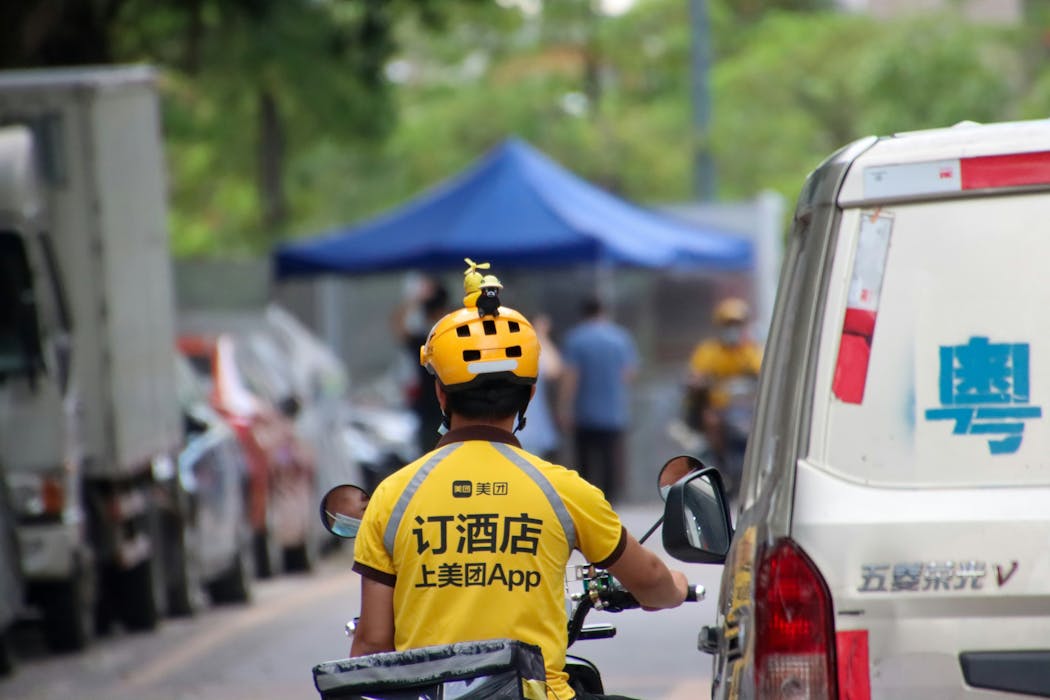
Delivering parcels is just one of the 19 different jobs Hu Anyan cycles through over 20 years, as tracked in his Chinese bestseller I Deliver Parcels in Beijing. He also tries his luck working as a convenience-store clerk, a cleaner and in a bike shop, a warehouse, a vegetable market and even an anime design company – always at the very bottom of the ladder.


Review: I Deliver Parcels in Beijing – Hu Anyan (Allen Lane)


Some jobs last weeks, some days, some barely survive the training shift. Bosses disappear, wages evaporate, contracts turn out to be imaginary and rules are invented on the spot. With a blend of hope and resignation, Hu repeatedly comes to realise the true qualifications for survival in the city are a strong back, a flexible sense of dignity and a high tolerance for absurdity.

A smiling man in a hoodie
Hu Anyan.
Penguin

Hu, now aged 47, grew up in Guangzhou, a major city in south China. He has worked in cities big and small, including a brief stint across the border in Vietnam.

They are “places with apparent unlimited potential for development, yet I seemed to have gotten nowhere,” he writes. They promise opportunity, then charge rent on his naivety and optimism. He seems to move through the world with a certain innocence about how it truly works, yet possesses an uncommon capacity for deep, searching reflection.

He writes with dry humour and an eye for the absurd – security guards guarding nothing, managers creating chaos and delivery algorithms ruling lives with godlike indifference. But he also writes like a field researcher issued a hard hat instead of a research grant. His prose has a forensic, documentary precision – wages counted to the cents, shifts timed, fines itemised, and injustices recorded without melodrama.

When he completed his trial as a parcel deliverer, he writes:

an assistant foreman […] told me that although the probationary period wasn’t paid, he would make it up by giving me three extra days of vacation. […] But it wasn’t even a month before the same guy had a dispute with the other foreman and quit. No one mentioned those paid days off ever again.

China’s ‘development didn’t suit me’

This reporting of everyday injustice at work is peppered with occasional philosophical reflections on human nature and the meaning of work. He calmly observes of mean and unhelpful co-workers: “Selflessness may be a noble virtue, but I suppose it isn’t fundamental to being human.”

The real charm is his tone. Even when dealing with exploitation, Hu delivers it with light-footed sarcasm, letting absurdity do the heavy lifting. Writing about heavy workload in the delivery company he works for, he simply comments “capitalists aren’t known for sympathising with workers”.

At times, he reveals his battles with social anxiety, depression and occasional bouts of illness. In one memorable scene, he describes going back and forth between hospitals, community clinics and small medical offices, carefully comparing prices before settling on where to get an IV drip to bring his fever down.

That kind of careful penny-pinching, being unable to justify spending even on one’s own health, feels painfully familiar to anyone trying to survive on very little.

Hu’s story is a personal one about structural inequality and everyday injustice. But he doesn’t sound resentful that China’s economic growth hasn’t benefited him. He just states, matter-of-factly, that China’s “development didn’t suit me”.

His personal account also functions as a practical lesson in the political economy of labour. In that sense, the lesson is not uniquely Chinese. Rather than relying on theories of profit and value, he uses his experience as a courier to show how the gig economy of late capitalism operates globally.

He meticulously calculates how the supposed average monthly pay of 7,000 yuan a month (around A$1,435) he could expect to earn translates in reality. It means working 26 days a month, 11 hours a day – to earn 30 yuan (A$6.16) an hour and 0.5 yuan (ten cents) a minute.

I had to complete a delivery every four minutes in order not to run at a loss. If that becomes unworkable, I would have to consider a change of job.

‘Oddly soothing’

For urban educated readers, both in China and elsewhere, who are crushed by emails, mortgages, childcare and performance anxiety, it can be oddly soothing to read about a life lived under more precarious conditions.

Hu’s calm endurance could work like a psychological release valve – things are hard, yes, but not this hard. The result lets middle-class readers feel ethically awake without feeling accused. This makes the book as reassuring as it is unsettling.

A book cover with an illustration of a man carrying a large pile of parcels

I Deliver Parcels in Beijing is also popular with Hu’s social peers – the urban underclasses and rural migrant workers: it shows that their struggles and small victories are worthy of being recorded and remembered.

A key, albeit implicit, theme circulating the book is unequal access to social mobility. Each of the 19 jobs Hu cycled through may look different on the surface, but rather than climbing a social ladder, he merely shuffles horizontally, stagnating on the same rung: “twelve years have passed, and with the same workload as before, my pay was somehow still lower”.

There is much musing about the meaning of freedom in the book. But freedom, for Hu, is not about the right to vote, but to choose who one wants to be, rather than what society expects one to become.

There’s no cataloguing of human rights abuses – the familiar trope of English-language coverage of China. Nor is the book a sociological exercise by an intellectual, for whom Hu’s world might be an object of study. And it certainly isn’t some diasporic Chinese writer’s rendition of China, often calibrated to the expectations of festival-going, liberal middle-class readers abroad.

Instead, the book speaks from inside the experience it describes, with no apparent desire to translate itself – at least initially – into the moral or political idioms readers might expect. That’s precisely where its quiet power lies.

It doesn’t tell you what to think about China – it shows you a life you would otherwise almost never get to see. The translation, superbly done, helps enhance this objective.

The luxury of being noticed

Like worker-poet Zheng Xiaoqiong and worker-photographer Zhan Youbing, Hu the worker-writer becomes a self-appointed “surrogate ethnographer”, patiently recording rules, rhythms, hierarchies, and survival strategies from the inside. He produces not theory, but something more valuable: reality, rendered with authenticity and credibility.

“I often sat in Jingtong Roosevelt Plaza after finishing my deliveries and watched the passers-by and the salespeople in stores, and the different delivery drivers back and forth,” he writes. “Mostly I supposed they were numb, thinking nothing at all, mechanically going about their days like I once did.”

Social researchers outside China dream of accessing the trove of evidence-based, granular, situated knowledge this book contains – but they rarely do.

Hu is one of the millions of internal labour migrants in China who struggle to survive at the bottom of the social ladder – and a rare case of a worker who became a recognised writer. He has published two books since this one.

His rise was not the result of structural change, but exceptional literary talent and sharp intellectual acuity. Meanwhile, the great majority of China’s urban underclasses and rural migrant workers remain locked in the kind of precarious, exhausting existence Hu describes – without the chance to turn their experiences into art, and without the luxury of being noticed at all.

The Conversation

Wanning Sun does not work for, consult, own shares in or receive funding from any company or organisation that would benefit from this article, and has disclosed no relevant affiliations beyond their academic appointment.

ref. China’s new literary star had 19 jobs before ‘writer’ – including bike courier and bakery apprentice – https://theconversation.com/chinas-new-literary-star-had-19-jobs-before-writer-including-bike-courier-and-bakery-apprentice-272447

Increasing math scores: Why Ontario needs early numeracy screening

Source: The Conversation – Canada – By Michael Slipenkyj, Postdoctoral Fellow, Math Lab, Department of Cognitive Science, Carleton University

Ontario’s 2024-25 Education Quality and Accountability Office (EQAO) standardized test results were recently released, and almost half (49 per cent) of Grade 6 students in English-language schools didn’t meet the provincial standard in mathematics.

These unsatisfactory results should not come as a surprise, and they cannot be attributed to lost time during COVID-19.

Ontario students have been struggling in math for many years. For instance, in 2018-19 and 2015-16, respectively, 52 per cent and 50 per cent of Grade 6 students failed to meet the provincial standard. What can be done to change this situation?

Setting stronger foundations in early math

We know from research in mathematical cognition that children’s early number knowledge (for example, at four-and-a-half years old) predicts their mathematical achievement later in school.


Read more:
New research shows quality early childhood education reduces need for later special ed


Because later learned skills build on earlier ones, kids who fall behind early may never catch up. Just as children need to get comfortable putting their face in the water before they can learn the front crawl, they need to become proficient with counting before they can learn addition and subtraction.

The best ways to support math learning are to:

  1. Provide lessons with clear skill progressions;

  2. Conduct regular assessments so teachers know what their students are learning; and

  3. Ensure that students get plenty of targeted practice on skills they have not yet mastered.

We should equip our students with solid foundational numeracy skills in the early years and check that they are on track before the first EQAO tests in Grade 3.

Roots of the problem, solutions

Clearly, policy initiatives like the $60 million “renewed math strategy”, making new teachers pass a math test and the “back to the basics” math curriculum, have done little to improve low math achievement.

Young children with educators seen in a classroom at tables doing various activities with building blocks and other materials.
The skills that children learn later are scaffolded upon earlier learning.
(Allison Shelley/The Verbatim Agency for EDUimages), CC BY-NC

After the 2024-25 results were announced, the Elementary Teachers’ Federation of Ontario released a statement calling for EQAO funding to be redirected to classrooms, saying “EQAO assessments shift accountability from the government’s chronic underfunding of public education to educators.”

The province agrees that math scores are too low. In the aftermath of the results release, Ontario Education Minister Paul Calandra held a news conference to say the results weren’t “good enough.” He announced the formation of a two-person advisory committee to review the situation and provide “practical recommendations that we can put into action.”

Early universal numeracy screening

As researchers studying mathematical cognition and learning, we have an evidence-based recommendation to help improve children’s math scores: schools should use universal screening to identify and track students’ numeracy learning much earlier than Grade 3 (when the first EQAO tests are given).

Screeners that assess foundational numeracy skills and other forms of assessment are critical for evaluating gaps in students’ numerical knowledge and providing them with targeted supports before they start to fall behind.

Instead of waiting for provincial results at the end of Grade 3 to identify struggling learners, we need to equip students with necessary skills and knowledge earlier.

Measuring foundational skills is critical for mathematics because more advanced skills like geometry, algebra, calculus require students to have fluent access to foundational knowledge. For example, fluent division skills support converting fractions to decimals (for instance, one quarter equals 0.25).

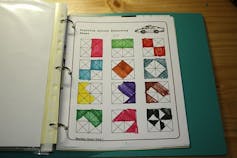
A page showing children's colouring covering various squares coloured to express different fractions.
More complex skills like fractions are assessed in later grades.
(Jimmie Quick/Flickr), CC BY

Extensive store of knowledge needed

Children who lack foundational skills will continue to struggle across grades as the expectations become more advanced. Research has found that kindergarteners with lower counting skills are more likely to under-perform in math in Grade 7. These basic skills have also been linked to other metrics of academic success.

For example, children with strong foundational numerical skills are more likely to take advanced math classes in high school or pursue post-secondary education. Importantly, students who acquire foundational skills also develop more confidence in their mathematics abilities and are less likely to develop math anxiety.

By Grade 6, students need to have acquired a rich and extensive store of knowledge for learning the more complex math required in later grades.

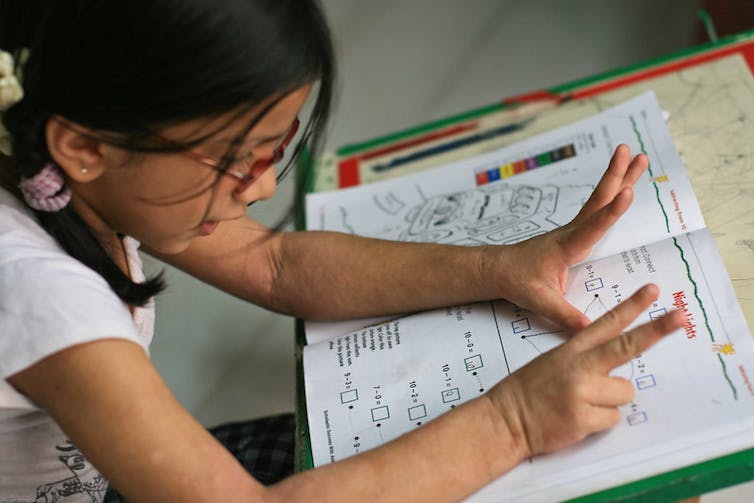
A child at a desk looking happy doing work.
Students who acquire foundational skills develop more confidence in their math abilities.
(Bindaas Madhavi/Flickr), CC BY-NC

The right to calculate

Human rights commissions have called for changes in education to ensure the “right to read” is protected for all students, including those with reading disabilities. We believe all students also have a right to high-quality math instruction — the right to calculate.

In efforts to connect math researchers and educators, we established the Assessment and Instruction for Mathematics (AIM) Collective. The AIM Collective is a community of researchers and educators, from universities and school districts across the country, committed to improving early math education in Canada.

Universal screening is one of the topics that AIM members have discussed in depth, because teachers often have mixed reactions to policies on screening.

However, educators we’ve partnered with have found that early math screening is a helpful teaching tool that helps educators target instruction to support children’s math learning.

Reaching full potential in math

Alberta now mandates universal numeracy screening. The Math Lab at Carleton University, where we are engaged in research, was involved in constructing grade-specific numeracy screeners for students in kindergarten to Grade 3 now in use in Alberta as well as other provinces.

Universal literacy screening is already mandated for students in Ontario from senior kindergarten to Grade 2. Initiating early universal numeracy screening is one step towards ensuring Ontario students reach their full potential in math.

Critically, screening must be accompanied by targeted support. Helping students reach their full math potential will contribute to a thriving Ontario.

As such, we call on the government to invest more in numeracy screening and earlier educational supports for struggling students.

The Conversation

Michael Slipenkyj is partly supported by a Mitacs internship with Vretta Inc., a Canadian educational technology company.

Heather P. Douglas has developed an early numeracy screener that is being used in four provinces in Canada. She collaborates with Vretta Inc., an educational technology company on a project to develop a digital version of the early numeracy screener. The project is funded by a Micas Accelerate grant.

Jo-Anne LeFevre has developed an early numeracy screener that is being used in four provinces in Canada. She collaborates with Vretta Inc., an educational technology company on a project to develop a digital version of the early numeracy screener, funded a Mitacs Accelerate grant.

Rebecca Merkley collaborates with Vretta Inc., a Canadian educational technology company. The project is funded by a Mitacs Accelerate grant titled: “A Research-Driven Approach to Assessment in Early Math Education”.

ref. Increasing math scores: Why Ontario needs early numeracy screening – https://theconversation.com/increasing-math-scores-why-ontario-needs-early-numeracy-screening-273339