In The Stranger François Ozon captures the many ambiguities of Albert Camus’s novel

Source: The Conversation – UK – By Debra Kelly, Professor of French and Francophone Studies, Cultural Historian, University of Westminster

Director François Ozon’s new film adaptation of Albert Camus’s novel L’Étranger (The Outsider, 1942) confronts a considerable task: turning a brief, philosophical novel into a cinematic experience.

Though the book is short, it is dense and readers often discover it requires multiple readings. Camus’s spare prose conceals profound questions about morality, society and human existence. Translated into over 75 languages with millions of copies sold, The Outsider has inspired stage, screen, radio and even graphic and manga adaptations. It has long been a set text in schools and universities, often perplexing young readers, just as it did a young Ozon. This film offers an invitation to return and reflect on Camus’ work.

The story follows Meursault (Benjamin Voisin), a French-Algerian office worker living in Algiers. The novel famously opens with the death of his mother, whose funeral he attends with apparent emotional detachment. He begins a relationship with Marie (Rebecca Marder), who formerly worked in the same office and becomes involved with Raymond (Pierre Lottin), a neighbour entangled in a violent dispute.

The trailer for The Stranger.

Meursault’s life changes dramatically when he shoots a young Arab man on a sun-drenched beach. The act leads to his arrest and the second part of the novel focuses on his imprisonment and trial. Throughout, Meursault remains a detached observer of the absurdity of existence and the moral expectations of society.

Ozon’s adaptation closely follows this narrative while expanding certain perspectives giving the film its own vitality and richness.

Camus and the challenges of adaptation

In a recent Curzon audience Q&A, Ozon observed that this is a novel every reader has already visualised and staged in their own mind. The director faced not only the expectations of readers’ imagined versions of the story but also the iconic stature of Camus himself.

Born into a poor French settler family in Algeria, afflicted by tuberculosis, Camus rose to become a journalist, playwright, actor, philosopher, member of the French Resistance, world-famous novelist and Nobel laureate (in 1957). His death at the age of 46 in a fatal car accident little more than two years later, with an unused train ticket to Paris in his pocket, added a mythic aura to his life and work.

Shot compellingly in black and white, Ozon’s film moves fluidly between the opening 1930s archive images of Algiers to the film’s recreated streets and natural landscapes with their play of light and shadow. The heat of the sun, the glare of the sea and the tactile presence of sand are central to the story, while also reflecting Camus’s own love of Algeria’s natural riches.

Camus described the story as both abstract and intensely physical – rooted in flesh and heat. Ozon’s film captures that tension between the intellectual and the sensory.

The title of the novel sets up the ambiguities of interpreting and adapting it. Published as The Outsider in the UK and The Stranger in the US, both titles seemingly settle the possibilities of Meursault’s status.

In French, “étranger” may mean stranger, foreigner or outsider – a multiplicity Ozon preserves in his adaptation. Voisin, incarnating Meursault’s stillness and silences on screen, moves between these roles. Among the French quarter’s neighbours, cafes and small businesses, he is just another man. Algerian passers-by, merely glimpsed here, are the strangers, foreigners, outsiders.

Among the Arab prisoners Meursault is imprisoned with, he is suddenly “the foreigner”. The film traces his inexorable shift from detached observer to condemned outsider. The confrontation with the chaplain, a climactic moment in the novel, is key to Ozon’s own vision. Here, Meursault refuses conventional consolation, embodying the “rebel” of Camus’s later philosophical work.

Reclaiming Camus’s ambiguities

The colonial context of L’Etranger has often been politically contested. Camus’s unfinished autobiographical novel, Le Premier Homme (The First Man, 1994) was found at the scene of his death. It reflects his position on Algeria (and on poverty, class and education), which is more complex than trial by the political convictions of various critics allows.

Camus’s detachment from Algerian nationalist movements, along with his choice not to name Arab characters in his fiction (or to avoid them altogether), drew sustained criticism from the French Left and Algerian nationalists in the 1950s and 60s. His vision of a multicultural Algeria – seen by some as utopian and by others as implicitly racist – was later criticised by postcolonial scholars as well. However, these ambiguities are inseparable from Camus’s literary and moral vision and his lived experience.

Ozon’s adaptation speaks to contemporary audiences by giving form to these ambiguities. By expanding the presence of his lover Marie, Ozon provides subtle insights into Meursault, a man condemned because he doesn’t play the game and refuses to lie, as Camus later described him in a 1955 American edition of the novel. Ozon also gives agency to the murdered man’s sister Djemila (also nameless in the novel). These female performances provide the film’s emotional centre.

The film’s careful attention to Algeria, both past and present, meanwhile, reframes The Stranger as a story not just of one man, but of a society. Following the bloody civil war in 1990s Algeria, Camus was “recuperated” by Algerian dissidents against the rise of fundamentalism and reclaimed by new generations of Algerian writers. The final scene of the film honours the murdered “Arab” with the name Moussa, which has been taken from Kamel Daoud’s knowing re-telling, Meursault, Contre-enquête (The Meursault Investigation; 2012).

In doing so, Ozon takes his own place in reclaiming Camus’s moral fable in all its ambiguities. The Stranger retains Camus’s philosophical challenge: to confront the absurdity of existence without surrendering to despair.

This article features references to books that have been included for editorial reasons, and may contain links to bookshop.org. If you click on one of the links and go on to buy something from bookshop.org The Conversation UK may earn a commission.

The Conversation

Debra Kelly does not work for, consult, own shares in or receive funding from any company or organisation that would benefit from this article, and has disclosed no relevant affiliations beyond their academic appointment.

ref. In The Stranger François Ozon captures the many ambiguities of Albert Camus’s novel – https://theconversation.com/in-the-stranger-francois-ozon-captures-the-many-ambiguities-of-albert-camuss-novel-279718

As a philosopher, I’m convinced that Trump isn’t lying − he’s doing something worse

Source: The Conversation – USA – By Robert B. Talisse, W. Alton Jones Professor of Philosophy, Vanderbilt University

Polls indicate mounting regret and disappointment among Trump supporters. Farknot_Architect, iStock/Getty Images Plus

For much of his political career, dishonesty has been without cost for Donald Trump. He entered into national politics with the birther lie, claiming that Barack Obama was not born in the U.S., and that did not prevent Trump from winning the 2016 GOP nomination.

His persistent false statements about crowd sizes, electoral outcomes and the birthplace of his father barely garner press coverage today.

What’s more, the admission that Trump lies seems to have had little impact. On the campaign trail during the 2024 presidential race, vice-presidential candidate JD Vance acknowledged that Trump’s story that Haitian immigrants were eating pets in Ohio had been “created.” That confession had no discernible effect on Trump’s popularity. In fact, some measures indicate that Trump’s supporters admire his untruthfulness.

More recently, however, things have changed. Data now indicates mounting regret and disappointment among his base.

The administration’s failure to sustain convincing messaging about the Iran war, the Epstein files, the tariffs and inflation have left some supporters feeling duped and abandoned by Trump.

The president’s recent approval numbers are registering this shift.

This might suggest that fact-checking efforts are paying off. But, as a philosopher who studies the cognitive and emotional aspects of citizenship, I think this is incorrect. There is a better explanation for why, at this point, Trump’s followers are reacting negatively to his assertions.

Trump’s false assertion that immigrants were eating dogs did not diminish his popularity.

When falsehoods aren’t lies

Although fact-checking can be successful in establishing the facts among people who have not already made up their minds, it is generally ineffective among true believers. Once someone has formed an opinion, debunking their belief can backfire, driving them to commit even more strongly to their mistake.

To explain the emerging shift among Trump’s base requires looking elsewhere. Specifically, I think it requires abandoning the idea that Trump’s more outlandishly false statements are lies at all.

I realize that this may sound odd.

To explain, let’s begin by noting that it is surprisingly difficult to give an adequate definition of lying. Intuitive characterizations – “A lie is something that isn’t true” – fall short.

For example, lying isn’t merely uttering a falsehood. Honest mistakes and statements made from lapses of memory are not lies. You could say instead that lying is deliberately asserting what one knows to be false.

But that won’t work, either.

President Bill Clinton lied when he claimed that “there is not a sexual relationship,” which, at the moment he said it, was true.

At the very least, the definition of lying must include speaking with the aim of causing one’s audience to adopt a falsehood. But that would make stage actors liars.

We should say instead that lying is a matter of speaking with the intent to deceive. Though difficulties remain, that’s a workable definition.

Betrayal by contempt

In a May 9, 2026, speech to GOP lawmakers, President Donald Trump speaks about the war in Iran as a ‘short-term excursion.’

Given the ease with which many of Trump’s false statements are debunked, I think it’s unlikely that he aims to deceive anyone. No one really believes that Trump has stopped eight wars, defeated inflation, brought gasoline prices below US$2, cut a deal with the CEO of Sharpie or has 100% approval for his military incursion in Iran – all things he has said.

As he is not attempting to deceive, Trump isn’t lying when he makes such claims. Rather, he is doing something else entirely, something arguably more pernicious.

From my perspective as a political philosopher, these and other similar claims indicate he is speaking falsely as a way of demeaning or taunting his detractors. By resolutely asserting unbelievable falsehoods, Trump is expressing contempt. He is deriding the enterprise of journalism, in effect forcing reporters to write stories about his incredible statements, thereby indirectly controlling the news cycle.

It seems to me that his purpose is not to convince anyone, but rather to declare to the press, and perhaps also to his opposition, “You cannot stop me.” For a political movement rooted in the idea that U.S. politics is a swamp in need of draining, Trump’s defiant style has been successful.

But here’s the catch. It appears that Trump’s supporters are now beginning to feel that they, too, are on the receiving end of his contempt.

His recent claims that grocery prices are falling, his tariffs are working, the economy is roaring and the operation in Iran is a “little excursion” that has already been successful are not only obvious falsehoods.

In asserting them, Trump belittles those who must bear the effects of a struggling economy and an ill-conceived war. From this perspective, the shift among his base is not due to their realization that Trump lies. It’s that he has betrayed them.

The Conversation

Robert B. Talisse does not work for, consult, own shares in or receive funding from any company or organization that would benefit from this article, and has disclosed no relevant affiliations beyond their academic appointment.

ref. As a philosopher, I’m convinced that Trump isn’t lying − he’s doing something worse – https://theconversation.com/as-a-philosopher-im-convinced-that-trump-isnt-lying-hes-doing-something-worse-279093

In his efforts to remake federal architecture, Trump repudiates the ‘republican ideals’ that have long informed it

Source: The Conversation – USA (2) – By Kevin D. Murphy, Professor and Chair of History of Art, Vanderbilt University

Work crews prepare for the construction of a new ballroom after the demolition of the East Wing of the White House in October 2025. Andrew Leyden/Getty Images

Sand was thrown in the gears of President Donald Trump’s grand White House ballroom plans on March 31, 2026, when U.S. District Court Judge Richard Leon ordered a pause on construction.

The president, the judge wrote, was the “steward” of the residence, not its “owner.” In response, the Justice Department filed an emergency motion, asking that construction be allowed to resume due to security risks caused by the project being in a state of limbo.

Presidents of the United States, unlike other world leaders, have not typically sought to impress their own architectural tastes on national monuments.

In this regard, Trump is the exception. His approach to remaking federal architecture has mirrored his approach to university funding and immigration enforcement: move fast, break things.

But Trump’s imposition of his aesthetic preferences doesn’t just threaten to erase chapters in the story of the nation’s federal architecture. It also risks undoing the legacies of presidential wives, influential designers and the egalitarian ideals that many of these buildings embody.

Gaudy grandeur

Since his second term began in January 2025, Trump has paved over the storied White House Rose Garden – established by first lady Ellen Wilson in 1913 and redesigned by renowned horticulturalist Bunny Mellon in 1962 – complaining that ladies’ high-heeled shoes sank into the ground. The art deco bathroom off the Lincoln Bedroom now reflects Trump’s penchant for polished marble. And gold-colored decorative elements have been affixed to the simple woodwork throughout the White House, with some of the ornamentation brought from Mar-a-Lago, Trump’s Florida estate.

Most notably, the East Wing, which housed the offices of the first lady and her staff, was flattened in fall 2025 to make way for a grand ballroom projected to cost some US$400 million. The building, if completed as planned, will dwarf the historic White House.

The ballroom also reflects Trump’s taste for grandiosity and opulence – the same aesthetic that’s reflected in the 250-foot “Independence Arch” that Trump has proposed for Washington.

Trump has repeatedly complained that public buildings in Washington lack grandeur. He was even quoted by Golf Magazine in 2017 as having described the White House as a “real dump,” although he later denied it.

Yet many of the structures he has demolished or has sought to revise embody, in their form and decoration, certain republican ideals, such as government by the people, civic virtue and opposition to concentrated power.

Buildings that embody egalitarianism

Trump has added accents to the White House to mimic the imposing homes of British and European monarchs. But the residence’s original “republican simplicity” – a concept attributed to Thomas Jefferson – actually had a purpose: It signaled the egalitarian outlook of the founders.

In 1792, when Jefferson was George Washington’s secretary of state, he anonymously entered the competition to design a new presidential home. His submission, which didn’t end up winning, was inspired by Renaissance architecture like Andrea Palladio’s Villa Rotonda. Completed around 1570 in northern Italy, the Villa Rotonda features symmetrical facades and harmonious proportions that have been equated with Renaissance humanism and rationalism.

Elsewhere, Jefferson advocated for modeling the young nation’s government architecture on the classical tradition, due to its associations with ancient Greek and Roman democracy. This often meant using classical design principles like restraint, order and geometric harmony, and adapting them by either simplifying the elements or using locally available materials instead of the expensive marble and other stones favored by the ancients.

A repudiation of ‘republican simplicity’

In August 2025, Trump signed an executive order, Making Federal Architecture Beautiful Again, directing that this same classical style inform the design of all future federal buildings.

Yet Trump’s own vision for the White House design doesn’t align with this directive. For one, the sheer enormity of the proposed ballroom transgresses the foundational belief in classical restraint.

The columns that support the massive south portico – which in an earlier iteration was reached by a grand staircase that didn’t lead to an entrance – have Corinthian capitals, the most ornate type of decorative top for a column. In contrast, Ionic capitals, which are more restrained, currently grace the columns at the entrance of the White House. One of Trump’s appointees, however, wants to swap these out in favor of Corinthian capitals.

And the temple-style portico on the east façade of the planned ballroom is awkwardly shifted to the far north end, rather than being centered as the classical tradition would dictate.

Glossing over history

This is not to say that classical principles have never run up against contemporary design trends.

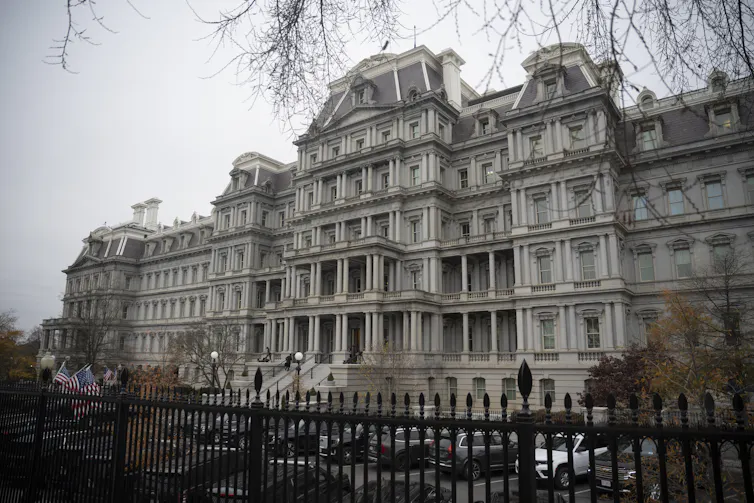
In 1888, architect Alfred B. Mullett completed the State, War and Navy Building, now known as the Eisenhower Executive Office Building. Mullet had been inspired by Boston’s Old City Hall, which had been completed in 1865 and was itself inspired by the government architecture of the French Second Empire.

Trump has said that he finds the Eisenhower building’s gray granite façade dreary, and that he’d like to paint it white. Yet the material itself is a crucial element, tying the structure to the “Boston Granite Style.”

If the office building is painted white – in a process that would degrade the granite – a visual key to understanding its architectural and political history would be lost.

Architectural historian Henry-Russell Hitchcock argued how forward-looking the building was for its time, and showed how how it mirrored the first skyscrapers erected in New York City: Richard Morris Hunt’s Tribune Building and the Western Union Building designed by Hunt’s pupil George B. Post.

For these reasons, preservationists have sued Trump to try to prevent these alterations.

Stately, ornate, granite building.
President Donald Trump wants to paint the Eisenhower Executive Office Building white.
Celal Güne/Anadolu via Getty Images

Design that’s bottom up, not top down

I think it’s also important to note that in the original design and construction of many of the buildings Trump disparages, women played outsized roles.

As I note in my 2025 book, “Women Architects at Work: Making American Modernism,” which I co-authored with Mary Anne Hunting, the contributions of women in architecture and design have often been overlooked.

The Trump administration’s projects in and around Washington will only further obscure the women who shaped the federal buildings and landscapes of the capital.

While the Rose Garden reflected the efforts of Bunny Mellon and Jacqueline Kennedy, the East Wing came under the watchful eye of Edith Roosevelt, the wife of President Theodore Roosevelt. Edith worked hand-in-hand with famed classicist architect Charles Follen McKim on its redesign as the primary entrance, in 1902. And had it not been for the public fundraising efforts of Jacqueline Kennedy, the capital may never have had a performing arts venue of national significance, the Kennedy Center for the Arts. In early 2026, the Trump administration announced that the center would close for two years to undergo an estimated US$200 million renovation.

While all buildings are living organisms that are frequently adapted to changing functional requirements, they are also the repositories of national memory.

In 1961, a young Daniel Patrick Moynihan, who, as a U.S. senator from New York, would later go on to advocate for historic preservation, penned “Guiding Principles for Federal Architecture” on behalf of an ad hoc government committee on office space.

“The development of an official style must be avoided,” he wrote. “Design must flow from the architectural profession to the Government, and not vice versa.”

As Judge Leon made clear in his ballroom ruling, no government officials – not even presidents – “own” federal architecture. The American people do. And it’s up to their representatives in Congress to decide whether to destroy or renovate it, bearing in mind that it’s an inextricable part of the country’s history.

This article was written with the collaboration of Mary Anne Hunting, Ph.D., an independent scholar in New York City.

The Conversation

Kevin D. Murphy does not work for, consult, own shares in or receive funding from any company or organization that would benefit from this article, and has disclosed no relevant affiliations beyond their academic appointment.

ref. In his efforts to remake federal architecture, Trump repudiates the ‘republican ideals’ that have long informed it – https://theconversation.com/in-his-efforts-to-remake-federal-architecture-trump-repudiates-the-republican-ideals-that-have-long-informed-it-276565

I found a new meteor shower, and it comes from an asteroid getting broken down by the Sun

Source: The Conversation – USA – By Patrick M. Shober, Postdoctoral Fellow in Planetary Sciences, NASA

This composite image shows the Geminid meteors, captured in 2020 using Global Meteor Network software. Aleksandar Merlak

Across the Earth, every night, thousands of automated stargazers are waiting to take pictures of shooting stars. I am one of the scientists who study these meteors.

Most movies and news alerts focus on large asteroids that could destroy the Earth. And your phones notifies you every few months that an object nine washing machines wide is going to just narrowly skim past. However, the small dust and rubble that enter our atmosphere daily tell an equally interesting story.

My planetary science colleagues and I use camera observations of the night sky to better understand dust, car-sized asteroids and debris from comets in our solar system.

In a study published in March 2026, I searched through millions of meteor observations collected by all-sky camera networks based in Canada, Japan, California and Europe and found a small, recently formed cluster. The 282 meteors associated with this cluster tell the story of an asteroid that got a little too close to the Sun.

Meteor formation

When a sand-sized crumb of space rock hits our atmosphere, it heats up almost instantly, vaporizing its surface layer and turning it into an electrically charged gas. The whole fragment starts to glow — this is what we call a meteor. If the object is larger, like a boulder, and brighter, it’s called a bolide or a fireball. On average, these objects hit our atmosphere going over 15 miles per second. For small dust or sand-sized objects, the whole process lasts only a fraction of a second before they completely disappear.

Most of these sand-sized fragments in the solar system originate from comets – cold, icy objects from the outer reaches of the solar system. As comets pass by the Sun, their icy components turn to gas, releasing tons of dust. This is why comets are often called “dirty snowballs” and appear fuzzy in telescopic images.

Asteroids, on the other hand, are leftovers from the early solar system that formed closer to the Sun. They are dry and rocky, and do not have the same ices that give comets their characteristic tails.

What does it mean to be active?

Astronomers call an asteroid or comet “active” when it sheds dust, gas or larger fragments. This activity is caused by some external force on the object in space, like heat from the Sun, a small impact, or when asteroids spin too fast and fly apart.

Understanding and identifying activity helps scientists better understand how these objects change over time.

For comets, sublimation of ices – when solid ice turns directly into gas, skipping the liquid phase – is the primary culprit. However, for asteroids, the reason for activity can vary greatly.

For example, NASA’s OSIRIS-REx mission, which launched into space to study an asteroid named Bennu, saw activity from its surface, with heat stress and small impacts among the leading explanations.

Other sources for asteroid activity include breakup when an asteroid spins too fast, tidal forces ripping apart asteroids during close encounters with a planet, or gas release.

Researchers most commonly search for activity using telescopes. Astronomers can look for a “tail” or fuzziness around the object. This tail is a clear sign that there is gas and dust around the body. But there is another way to search for activity – meteor showers.

Finding hidden asteroids via meteor showers

The most famous active asteroid is 3200 Phaethon. It is the parent body of the Geminid meteor shower that occurs every year in mid-December. During past close approaches with the Sun, Phaethon released vast amounts of dust and larger fragments. These morsels of Phaethon have spread out along its entire orbit over time, leading to the present Geminid meteor stream.

Each meteor shower we observe occurs when the Earth passes through one of these debris streams. So if astronomers can detect meteor showers, they can also be used to find active objects in space.

At first, debris shed by an asteroid or comet travels closely together. Imagine squeezing a single drop of food dye into a moving stream of water: Initially, the dye stays in a tight, concentrated cloud. But as it flows, the water’s swirling currents pull at the dye, causing it to spread out and fade.

In space, the gravitational tugs from passing planets act like those currents. They pull on the individual meteor fragments in slightly different ways, causing the once-tight stream to gradually drift apart until it completely dilutes into the background dust of our solar system.

The discovery of a rock-comet

In a study published in March 2026 in the Astrophysical Journal, I used millions of observations of meteors to search for recent, unknown activity from asteroids near the Earth. I found one clear cluster of 282 meteors that stood out.

What makes this discovery so exciting is that we are essentially witnessing a hidden asteroid being baked to bits. This newly confirmed meteor stream follows an extreme orbit that plunges almost five times closer to the Sun than Earth does.

Based on how these meteors break apart when they hit our atmosphere, we can tell they are moderately fragile, but tougher than stuff from comets. This finding tells us that intense solar heat is literally cracking the asteroid’s surface, baking out trapped gases and causing it to crumble. This is likely a major source of past Phaethon activity and the main reason the meteorites on Earth are so diverse.

The search for the source

Why does finding a hidden, crumbling asteroid matter? Meteor observations act as a uniquely sensitive probe that lets us study objects that are completely invisible to traditional telescopes.

Beyond solving astronomical mysteries, analyzing this debris helps us understand the physical evolution of asteroids and comets in our solar system. More importantly, it reveals hidden populations of near-Earth asteroids, which is vital information for planetary defense.

The new meteor shower’s parent asteroid remains elusive. However, NASA’s NEO Surveyor mission, launching in 2027, offers a promising solution. This space telescope, dedicated to planetary defense and the discovery of dark, hazardous, Sun-approaching asteroids, will be the ideal tool for searching for the shower’s origin.

The Conversation

Patrick M. Shober receives funding from the NASA Postdoctoral Program.

ref. I found a new meteor shower, and it comes from an asteroid getting broken down by the Sun – https://theconversation.com/i-found-a-new-meteor-shower-and-it-comes-from-an-asteroid-getting-broken-down-by-the-sun-277557

Undertone: this creepy sound horror is utterly terrifying

Source: The Conversation – UK – By Laura O’Flanagan, PhD Candidate, School of English, Dublin City University

Undertone is the terrifying feature film debut from Canadian director Ian Tuason, which promises to be the “scariest movie you will ever hear”.

Evy (Nina Kiri) is a podcast host caring for her dying mother (Michèle Duquet) at home. Told only from Evy’s perspective, the film moves from initially creepy to utterly horrifying over a tense, tight 93-minute running time.

Evy’s Undertone podcast explores supernatural phenomena. Her co-host Justin (Adam DiMarco) is in another time zone, so they record online in the middle of the night, Evy’s time. This veers close to the “witching hour”, but as Evy is the podcast’s resident sceptic – the voice of reason opposing Justin’s belief in the paranormal – she is unbothered. Until she’s not.

For this week’s instalment, Evy and Justin react to a series of mysterious recordings involving a couple: Jessa (Keana Lyn Bastidas), who has begun talking in her sleep, and her husband Mike (Jeff Yung), who records her. These clips lend the story a naturally escalating structure, as the material grows increasingly distressing and the sense of dread intensifies.

As elements from the recordings seep into Evy’s world and her sense of reality begins to shift, Kiri proves superb in the role. Alone onscreen aside from her unconscious mother, she balances a raw fragility with intense emotional control. Kiri carries the film almost entirely, with supporting characters reduced to voices in her headphones or on her phone.

Undertone’s domestic setting has an uncanny familiarity to it, with soft furnishings, lamps and religious artwork bathed in cold, often unpredictably flickering light. Compounding the disquiet is the fact that Tuason used his childhood home in Toronto as his filming location, inspired by caring for his own ailing parents.

The result is an uneasy intimacy which blurs the line between personal memory and horror. This, combined with Evy’s mother’s impending death and the harrowing implications of the audio clips, makes the film a disturbing yet consistently absorbing experience.

At times, though, Tuason leans too heavily on religious iconography to generate unease, diluting some of the originality. The film also flirts with shock value using inherently distressing subject matter, rather than fully earning its impact.

Sound as terror

Sound design is Undertone’s real strength. As podcast host Justin says: “Don’t be afraid of the dark, be afraid of the silence.”

The film captures the sound of podcasting with close, warm, immaculately clear voices and achieves an intimate, studio-polished quality. Building the sense of unease, there are authentic-sounding sleep-talking recordings, nursery rhymes played backwards, exaggerated household noises such as taps and whistling kettles, and prolonged silences.

Other horror films such as Berberian Sound Studio, The Black Phone and Keeper have harnessed the unsettling potential of sound in recent years, exploring the eerie power of disembodied voices.

This is a lineage Undertone joins while carving out a more intimate horror. Tuason’s film also makes narrative use of the podcast hosts’ editing skills to great effect, as they speed up, slow down, reverse and replay the recordings over and over, trying to glean some sense from them. In doing so, sound becomes Undertone’s primary source of terror, placing its audience in the same position as Evy.

Undertone is a confident debut from Tuason, who understands exactly where the film’s power lies. By grounding its horror in voice and sound, the film becomes an experience that feels immediate and inescapable.

In placing us so firmly within Evy’s singular perspective, Undertone crosses the boundary between listener and participant, resulting in a work which fulfils its promise of terror. It is not for the faint of heart.

The Conversation

Laura O’Flanagan does not work for, consult, own shares in or receive funding from any company or organisation that would benefit from this article, and has disclosed no relevant affiliations beyond their academic appointment.

ref. Undertone: this creepy sound horror is utterly terrifying – https://theconversation.com/undertone-this-creepy-sound-horror-is-utterly-terrifying-279915

Embryo fossil found in South Africa is world’s oldest proof that mammal ancestors laid eggs

Source: The Conversation – Africa (2) – By Julien Benoit, Associate professor in Vertebrate Palaeontology, University of the Witwatersrand

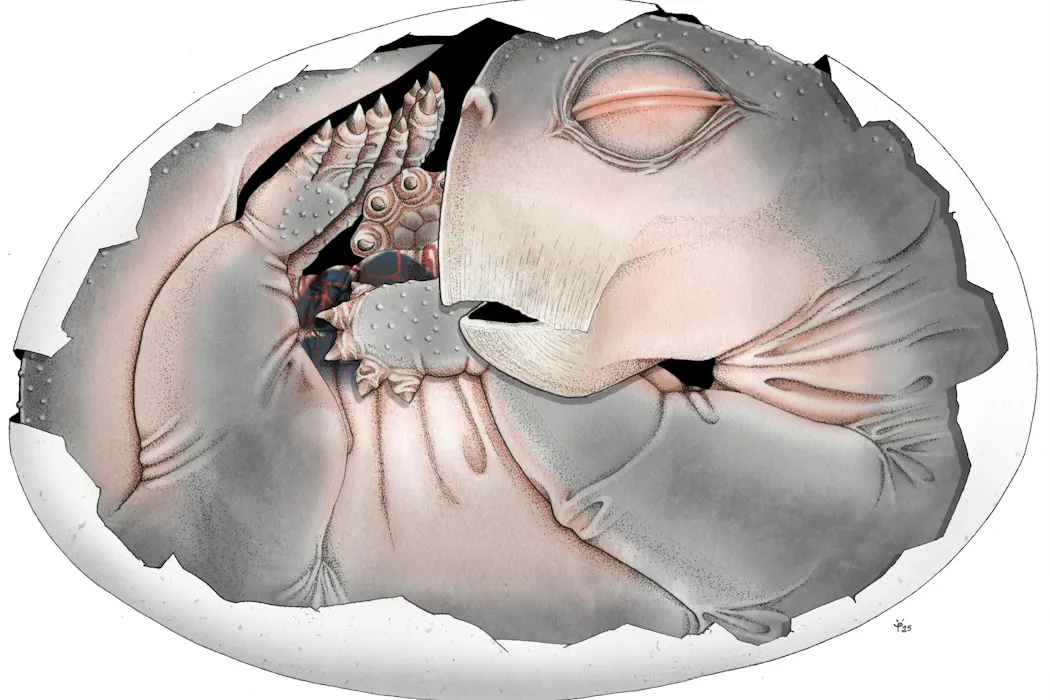
Artist’s impression of _Lystrosaurus_ embryo. Artist: Sophie Vrard, CC BY

Between 280 and 200 million years ago, a group of animals evolved which would eventually give rise to mammals, including humans: the therapsids. They were first described more than 150 years ago, based on fossils from South Africa. Since then, many more fossils have been discovered.

James Kitching, one of the most talented South African fossil hunters of the 20th century, excavated many thousands of therapsids from the rocks of the Karoo (a semi-arid region of the country’s interior). He also found fossilised dinosaur eggs, but neither he nor any palaeontologist after him ever found therapsid eggs.

They should exist, because some mammals (platypus and echidnas) do lay eggs. But Kitching began to doubt that therapsids laid eggs: perhaps, he thought, they were, like most of their mammalian descendants, already viviparous (giving live birth)?

We are scientists who study extinct animals and the environments they lived in millions of years ago to understand more about the evolution of life. In our new paper we describe, for the first time, the embryo-containing fossilised egg of a 250 million-year-old mammalian ancestor.

It finally shows that therapsids were indeed egg-laying (oviparous). This discovery sheds new light on the reproduction and survival strategy of that group of animals.

Hand holding what looks like a stone egg
The egg about to be synchrotron scanned at the ESRF.
Author provided, CC BY

A 20-year-old mystery

The fossil egg and embryo we described was discovered near Oviston, in the Eastern Cape province of South Africa, by John Nyaphuli, a palaeontologist from Bloemfontein, in 2008. It’s been kept in the National Museum in Bloemfontein. We knew that it belonged to a species that lived 252 million to 250 million years ago called Lystrosaurus, but we didn’t know whether the species was an egg-layer. The adult looked like a pig, with naked skin, a beak like a turtle, and two tusks sticking out and pointing down.

The reason it took 20 years to prove that it had been in an egg is that this fossil preserves no shell. Only a curled-up embryo is visible. If there was a shell, it was likely leathery or had dissolved. Only the most advanced dinosaurs laid hard-shelled eggs.

So how could we find out whether this young creature had once been inside an egg?

The answer to this question lay in the advanced technology of the European Synchrotron Radiation Facility at Grenoble, France. There, we used a powerful X-ray source to image the inside of the bones of the embryo. Under this treatment, the fossil unveiled all its long-kept secrets – most crucially, its stage of development.

3D reconstruction of the embryo based on synchrotron scan performed at the ESRF.
Author supplied, CC BY

We discovered that the lower jaws of its beak were not completely fused. This developmental trait is only found in modern turtles and birds in which jaw bones fuse long before they are born so that their beak is strong enough for the hatchling to catch and crush its food.

This meant that our curled up Lystrosaurus embryo had died in ovo (in an egg), tightly nestled in its soft, leathery eggshell. This was the evidence palaeontologists had been looking for.

Thanks to the synchrotron-assisted examination of its lower jaw, we could finally demonstrate that this embryo was indeed that of an unhatched Lystrosaurus baby.

Famous survivor

What does it unravel about the survival strategy of Lystrosaurus?

Lystrosaurus is a herbivorous (plant-eating) therapsid famous for surviving the “Great Dying”, which was a major mass extinction of species 252 million years ago. During this event, 90% of all living things on Earth died. Life almost ceased to exist, which makes this the second most important event in the history of life on Earth after the origin of life itself.

How Lystrosaurus survived this is still an intriguing mystery, but the egg gives a possible clue. The fossil we describe shows that the animal laid arguably large eggs for its body size. Large eggs are produced by species that feed their embryos with yolk rather than milk. The young develop to an advanced stage in the egg and then they hatch. In contrast, monotremes (the platypus and echidnas), which feed milk to their young, lay small eggs because the baby is fed after hatching. The large size of its egg implies that Lystrosaurus did not feed milk to its young.


Read more:
A secret mathematical rule has shaped the beaks of birds and other dinosaurs for 200 million years


More relevant to its survival strategy, this further indicates two things. Firstly, it means that the egg was less prone to desiccation (drying out). The larger the egg, the smaller its surface area (comparatively speaking), so Lystrosaurus eggs would lose less water through their leathery shell than those of other species of that time. Given the dry environment during and in the immediate aftermath of the extinction, this was a significant advantage, especially since hard-shelled eggs would not evolve for another 50 million years, at least.

Secondly, a large egg implies that Lystrosaurus was likely precocial, meaning that the babies likely hatched at an advanced stage of their development. Lystrosaurus hatchlings were big enough to feed by themselves and run away from predators, and would reach maturity faster so they could reproduce early.


Read more:
How predators may have shaped the way some southern African lizards survive and reproduce


Growing up fast, reproducing young and proliferating were the secrets of Lystrosaurus survival.

Our ability to identify the fossil egg adds to our understanding of the origin of mammalian reproductive biology and lactation, and the survival strategy of Lystrosaurus in the most devastating biological crisis. This is significant to better grasp how modern species might cope with the current sixth mass extinction of species.

The Conversation

Julien Benoit receives funding from the DSTI-NRF African Origins Platform and GENUS Centre of Excellence in Palaeosciences.

Vincent Fernandez works for the ESRF synchrotron and was awarded beamtime at the ESRF for this experiment.

Jennifer Botha does not work for, consult, own shares in or receive funding from any company or organisation that would benefit from this article, and has disclosed no relevant affiliations beyond their academic appointment.

ref. Embryo fossil found in South Africa is world’s oldest proof that mammal ancestors laid eggs – https://theconversation.com/embryo-fossil-found-in-south-africa-is-worlds-oldest-proof-that-mammal-ancestors-laid-eggs-277673

After ceasefire, negotiating a lasting deal with Iran would require overcoming regional rivalries and strategic incoherence

Source: The Conversation – Global Perspectives – By Ioana Emy Matesan, Associate Professor of Government, Wesleyan University

A man walks in the rubble of a damaged Sharif University of Technology in Tehran, Iran, following U.S. and Israeli airstrikes. Shadati/Xinhua via Getty Images

President Donald Trump’s rapid and dramatic turn from threatening to kill “an entire civilization” in Iran on the morning of April 7, 2026, to announcing a two-week ceasefire later that day left many observers with a sense of whiplash.

While it is difficult to predict whether the ceasefire between the U.S. and Iran will hold or how events will unfold, the dynamics of the conflict so far reveal multiple vulnerabilities in the short term and numerous detrimental effects on the region in the medium to long term.

Already, the truce has shown signs of strain. Iran and the U.S. almost immediately offered dueling narratives about the agreement, including whether it would cover the war in Lebanon. Iran and Pakistan, the primary mediator, asserted that it would, while the U.S. and Israel, which pledged to honor the U.S. agreement, said it would not. Indeed, a day after the ceasefire came into force, Israel conducted some of its most intense bombing in Lebanon to date.

As an expert in Middle East politics, I believe that the involvement of so many governments and militant groups – in both the negotiation process and in terms of the regional effects of the conflict – make it more difficult to uphold a ceasefire.

Over the past decade, there has been a shift in regional alliances in the Middle East, leading to increasingly assertive foreign policies by many countries and a deepening rivalry between Iran and Saudi Arabia. The current war only fuels these dynamics, incentivizing competition and offering governments and militant groups new opportunities to exert leverage over opponents.

The current reality also underlines the idea that external intervention and privileging war over diplomacy has made conflict resolution ever more difficult in a region with a long history of imperial expansion, great power competition and bitter political divides.

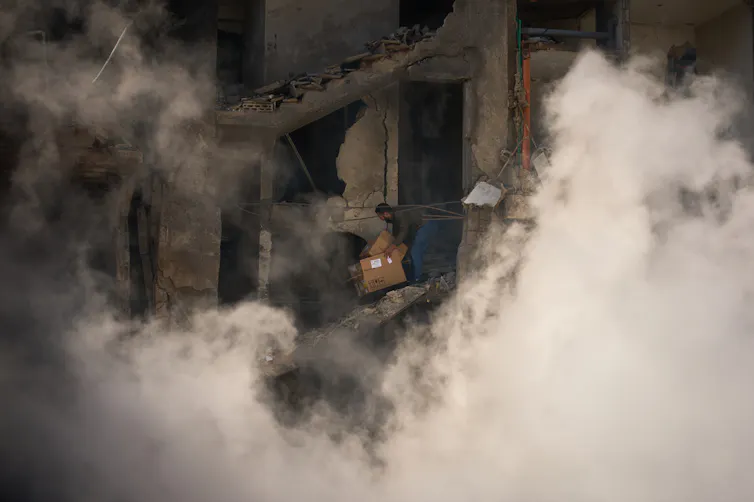
A man stands in a destroyed building as smoke rises around him.
A Lebanese man gathers his belongings from his home, which was destroyed in an Israeli airstrike a day after the ceasefire with Iran went into effect.
AP Photo/Emilio Morenatti

Regional fault lines

One of the more remarkable aspects of the war in Iran that began on Feb. 28 was how quickly it escalated in terms of geographic scope and the actors pulled into it.

The three key countries involved – Israel, the U.S and Iran – are all facing internal political tensions, polarization and legitimacy crises.

Outside countries such as China, Russia and Pakistan have deployed their own strategic interests and diplomatic tools in the conflict in indirectly getting involved.

The conflict has also drawn in a variety of regional governments and other groups, from [Saudi Arabia and the Gulf states] to Hezbollah in Lebanon and the Houthis in Yemen.

All of that is bound to deepen the fault lines that make regional tensions and sectarian conflict more likely in the long run.

Meanwhile, public opinion in the Arab world shows profound damage to the United States’ reputation in the region and a loss of credibility in the international legal and humanitarian system.

I think these developments are also deeply troubling for the long term.

Events since the war began have been bad enough. The war has led to over 1,200 Iranian civilian deaths, over 3.2 million Iranians temporarily displaced and significant damage to Iranian infrastructure. Thirteen American soldiers have also died in the course of the conflict, as have more than two dozen in Israel and the Gulf states.

That’s to say nothing of the toll in Lebanon, where more than 1,500 people have died and more than 1 million displaced since the beginning of March.

The Houthis and the politics of regional instability

The Houthis in Yemen, one of the conflict participants that remained surprisingly silent at the outbreak of the war, are instructive for understanding the region’s complicated and fractured dynamics.

As a religious rebel movement that follows the Zaydi branch of Shia Islam, the Houthis, who took over Yemen’s capital in 2014, have been the target of sustained military operations by Saudi Arabia and the United Arab Emirates since 2015. This has only pushed them closer to Tehran.

Protesters burn flags at a demonstration.
Houthi supporters burn American and Israeli flags during a rally against the war on Iran in Sanaa, Yemen, on April 3, 2026.
AP Photo/Osamah Abdulrahman

Avowed opponents of Israel, the Houthis declared war against the country following the Hamas attacks of Oct. 7, 2023, and Israel’s subsequent war in Gaza.

In 2024, the Houthis attacked maritime shipping in the Red Sea near the Bab el-Mandeb Strait, a key maritime choke point. That prefigured, in a much smaller and less consequential way, Iran’s own actions in blocking the Strait of Hormuz during the current crisis.

That Houthi campaign to block maritime shipping resulted in a U.S.-led international coalition and significant military strikes against the insurgent group, their redesignation as a foreign terrorist organization, and ultimately a ceasefire deal between the U.S. and the Houthi movement in May 2025.

Yet the underlying regional disputes and domestic fractures that the Houthis were part of were never resolved.

Eventually, the Houthis reentered the fight against Israel amid the latest war in Iran, attacking Israel on March 28.

They refrained from attacks in the Red Sea and currently are observing the ceasefire. But entering the war enabled a weakened Houthi movement to signal resolve, military capacity and commitment to its alliance with Iran, just as Yemen continues to face an economic and severe humanitarian crisis. The Houthis now also have added leverage to play the role of spoiler amid ongoing diplomacy.

The costs of diplomacy avoidance

Of course, the Houthis are not the only movement that will perceive the war on Iran as an opportunity to exert regional influence.

Just as the Houthis and their enemies are using regional conflicts to boost their domestic legitimacy and strategic advantages, so too are the more salient participants − Iran, Israel and the U.S. − relitigating their own past conflicts on the battlefield.

Amid all of these current regional trends of crises and contestation, the United States’ own strategic goals have remained remarkably unclear. The Trump administration has vacillated from a focus on regime change to preventing Iran from developing nuclear capabilities.

A man in a suit walks away from a lectern.
President Donald Trump departs a news conference on April 6, the day before threatening to destroy Iran’s civilization − and then agreeing to a ceasefire.
AP Photo/Julia Demaree Nikhinson

So far, there are no indications that talks with Iran to extend the ceasefire into a full diplomatic agreement will successfully prevent Iran from pursuing uranium enrichment. Indeed, one of the contested points of the framework for talks with Iran is the apparent acceptance of Iran’s right to nuclear enrichment.

In 2018, Trump abandoned the Joint Comprehensive Plan of Action, or so-called Iran deal. In it, Iran agreed to terms, including limiting uranium enrichment, that would block its path to a nuclear weapon, should it have desired one.

Under the Iran deal, Tehran had also complied with inspections by the International Atomic Energy Agency. It was not until much after American withdrawal from the agreement that Iran once again started stockpiling uranium and pursuing enrichment.

In her 2020 book on the tenuous 22-month diplomatic process leading to the Iran deal, aptly titled “Not for the Faint of Heart,” Ambassador Wendy Sherman wrote how complex, challenging and delicate such multiparty negotiations can be.

But the recent war on Iran suggests that the current machine-gun politics approach toward Tehran and the Middle East favored by the U.S. and Israel comes with serious costs and risks.

In the course of a war with unclear targets, vague strategic objectives and high human costs, the region is far less stable than it was when the conflict began. That has made the path to long-term durable peace all the more difficult now that diplomacy is back on the table.

The Conversation

Ioana Emy Matesan does not work for, consult, own shares in or receive funding from any company or organization that would benefit from this article, and has disclosed no relevant affiliations beyond their academic appointment.

ref. After ceasefire, negotiating a lasting deal with Iran would require overcoming regional rivalries and strategic incoherence – https://theconversation.com/after-ceasefire-negotiating-a-lasting-deal-with-iran-would-require-overcoming-regional-rivalries-and-strategic-incoherence-280243

What will it take to get ships going through the Strait of Hormuz again?

Source: The Conversation – Global Perspectives – By Jennifer Parker, Adjunct Professor, Defence and Security Institute, The University of Western Australia; UNSW Sydney

Wednesday’s ceasefire announcement by President Donald Trump, linked to Iran reopening the Strait of Hormuz, prompted immediate optimism shipping would quickly resume. It didn’t.

The following morning, traffic remained minimal. A handful of vessels, largely linked to Iran, made the transit. But most of the ships waiting in the Gulf stayed put. Iran announced shortly afterwards that it would effectively close the strait because of Israel’s attacks on Lebanon.

The reality is the strait was never closed. Framing the issue as “open” or “closed” misses the point.

Ships are not being physically blocked. They are being deterred.

Over recent weeks, Iran has demonstrated both the capability and intent to target commercial shipping. Attacks and credible threats against vessels have driven daily transits down from around 130 to just a handful. Until that risk changes, ships will not return in meaningful numbers.

So what can be done to turn this around?

Both walking and talking

The ceasefire declarations have added to the uncertainty rather than resolved it.

Washington has asserted that the strait is open.

Tehran’s messaging has been more ambiguous, including references to requiring vessels to inform Iranian authorities before transiting.

Some interpret this as a precursor to attempts to exert control over the waterway through a toll.

This ambiguity matters. Shipping is a commercial activity driven by risk calculations. Operators and crews will not move on the basis of political statements, particularly when recent experience suggests those statements may not hold.


Read more:
Will the conflict in Lebanon destroy the US-Iran ceasefire? Maybe, but it was already shaky


The importance of reassurance

In practice, restoring traffic through the strait will likely occur in two phases.

The first is reducing the threat. That can occur through military means, diplomacy, or a combination of both, but it must materially degrade Iran’s ability and willingness to target shipping.

The second is reassurance.

Even if Iran’s attacks on civilian shipping stop as a result of the ceasefire, shipping will not immediately return. Confidence has been shaken and will take time to rebuild.

A credible reassurance effort would include limited naval escorts, at least initially. It’s notable the US did not move immediately to demonstrate confidence in the ceasefire by escorting US flagged and crewed commercial vessels out of the Gulf.

That would have sent a clear signal to industry, helped restore confidence in transits and undercut subsequent Iranian claims that ships require approval from its armed forces.

Given Iran’s interest in maintaining the ceasefire, it would have been unlikely to challenge ships under US naval protection. The US hesitation has instead created space for Iran to entrench its position, pushing vessels closer to its coastline and reinforcing its ability to shape how the strait is used.

An effective reassurance campaign would also involve a broader international presence to provide surveillance, information-sharing and rapid response capability. The international community should move quickly to establish this. Its very establishment would help restore confidence in transits.

We have seen this model before. The International Maritime Security Construct, established in 2019 following Iranian attacks in the Gulf of Oman, focused on transparency, coordination and reassurance rather than large-scale convoy operations.

I served as the construct’s Director of Plans in 2020. A similar, but more effective, approach is likely to be required again. It is not a silver bullet, but reassurance is layered, and this would at least provide the clarity and communication shippers need.

Diplomacy will also matter. Clear, coordinated messaging from the international community, backed by explicit economic consequences for any renewed attacks on merchant shipping, will be essential to rebuilding confidence.

The question of tolls

There has also been speculation about whether Iran might seek to impose a toll on vessels transiting the strait.

The legal position here is clear. The Strait of Hormuz is an international strait under the United Nations Convention on the Law of the Sea. Ships enjoy the right of transit passage through the strait. Charging vessels for passage would cut directly against that principle and set a dangerous precedent for other strategic waterways.

There are early signs Iran is testing the boundaries. Reports of radio calls warning vessels they require approval to transit, and suggestions that ships should notify Iranian authorities before transiting, point to an attempt to exert greater control over the strait.

That should be resisted.

Allowing a toll, or even limited restrictions, to take hold in the Strait of Hormuz would have far-reaching consequences, undermining the central principle of maritime trade: freedom of navigation. Regardless of Donald Trump’s flippant comments, the international community is unlikely to accept any enduring Iranian toll system.

If Iran attempts to pursue one, it should face clear economic consequences, including sanctions.

Questions remain about whether mines have been laid in or near the strait. Even the suggestion adds to uncertainty and reinforces the need for a coordinated international response, including transparent assessments of the threat environment.

A clear, public assessment from the international community on whether the strait has in fact been mined would go a long way. It should be an early priority for any coalition effort.

The bottom line

Ultimately, shipping will return to the Strait of Hormuz not when it is declared open, but when it is assessed to be safe enough.

That will require a sustained period without attacks, a visible international effort to secure the waterway, and clear signalling that the rules governing international straits will be upheld.

Until then, the ships will wait.

The Conversation

Jennifer Parker does not work for, consult, own shares in or receive funding from any company or organisation that would benefit from this article, and has disclosed no relevant affiliations beyond their academic appointment.

ref. What will it take to get ships going through the Strait of Hormuz again? – https://theconversation.com/what-will-it-take-to-get-ships-going-through-the-strait-of-hormuz-again-280275

May elections: what five politics experts are looking out for

Source: The Conversation – UK – By Jonathan Tonge, Professor of Politics, University of Liverpool

Darren Baker/Shutterstock

On May 7 2026, voters in England, Scotland and Wales will head to the polls. Parliamentary elections are taking place in the devolved Welsh Senedd Cymru and Scottish Parliament, and local elections for over 4,850 councillor roles could have huge implications for local governments throughout England. With all to play for, we asked five experts to tell us what they will be keeping their eye on.

Can Reform compete across the UK?

Jonathan Tonge, Professor of Politics, University of Liverpool

The 2026 elections will reveal whether Reform UK will peak as an English nationalist party, or if they can compete as a genuine nationwide force. Last year’s local elections confirmed that Reform can seriously harm the Conservatives. This year, contests are across councils held mainly by Labour, making the English elections about Reform’s threat to Keir Starmer’s party.

Nigel Farage’s party, which currently has eight MPs, has led opinion polls in England since May 2025, when it won the highest vote in English local elections. Reform took control of ten councils (from a starting point of zero), and gained nearly 700 new councillors. Of these, eight were county council gains from the Conservatives, with another taken from a Liberal Democrat-led coalition. The tenth gain was from Labour in the only metropolitan borough contested, Doncaster.

Reform’s likely gains in English councils aren’t guaranteed elsewhere in the UK however. The party’s polling in Scotland is around ten percentage points behind what it is in England. It may be that Reform is battling Labour for second place, while the Scottish National Party (SNP) continues to dominate.

Reform’s polling in Wales is higher (in the mid-to-high-20% range) but again, the real battle is with Labour for runner-up, as Plaid Cymru seems set to top the poll.

Scottish Parliament, Senedd Cymru, Birmingham Council dome
Elections in the Scottish Parliament, Senedd Cymru, and local councils across England will drastically reshape the UK’s political landscape this May.
Wangkun Jia/shutterstock, trabantos/shutterstock, Juan Garcia Hinojosa/Shutterstock


Read more:
Why did the polls get the Caerphilly byelection wrong? They ignored the fact Reform is an English nationalist party


Local results could force tricky coalitions

Alex Nurse, Reader in Urban Planning, University of Liverpool

Local elections are often concerned with local issues – think potholes and bin collections. Councils are also obliged by law to spend a lot of their time and budget on initiatives like adult social care, but these issues are often lost in the broad brush strokes of election campaigns.

It will be interesting to see how the ascendant Greens and Reform present their vision for local government, and what compromises they make to win over local voters. In the recent Gorton and Denton byelection, Green candidate Hannah Spencer made scarce mention of the environment and instead focused heavily on the cost of living and the broader social contract. Similarly, Reform’s promise to mimic the US Department of Government Efficiency (Doge) following the 2025 elections came up short after its newly elected councillors found local authorities already cut to the bone from years of austerity.

I’ll also be watching to see how the fragmented opinion polls translate into council seats. While we might be expecting a wipeout for Labour and the Conservatives, it remains to be seen how many councils the other parties will win wholesale, and where there will be situations of no overall control, requiring tricky coalition building. This might involve attempts to form a coalition of like-minded councillors, as seen in Bristol. However, the reality is often that parties attempt to go it alone, by entering minority government and living vote by vote, as seen in places like Sheffield or Wirral.


Read more:
How ordinary neighbourhoods became battlegrounds in the politics of ‘broken Britain’


Challenges to inclusive Scottish identity

Murray Leith, Professor of Political Science and Director of the Centre for Migration, Diaspora, Citizenship and Identity, University of the West of Scotland

The SNP has long predicated its sense of national identity on a civic and inclusive
Scottishness. Its message throughout the past 19 years has been that anyone who believes in Scotland can be Scottish. While other parliamentary parties have challenged and attacked myriad SNP platforms and policies in the last two decades, none disagree with this political elite consensus.

However, this agreement has not been as duly accepted by people in Scotland who
are less accepting of incomers and migrants (from the rest of the UK and beyond) claiming Scottish identity. Scotland has shifted from an emigrant nation to an immigrant nation in recent years. Without immigration, Scotland’s population would have shrunk. While migration policy remains reserved to Westminster, it looms large in the minds of voters – so much so, that the SNP has made devolving immigration power to Scotland one of its 14 key manifesto pledges.

Reform UK is openly challenging this inclusive and welcoming political consensus. In his first speech, Malcolm Offord, Reform’s Scottish leader spoke of strangers and uncontrolled immigration destabilising communities. Given recent polling and the possibility that Reform may be the official opposition in the next Scottish parliament, the SNP may soon be facing an opposition that proposes a less inclusive vision of Scottishness.

A potentially huge turnover on councils

Hannah Bunting, Senior Lecturer in Quantitative British Politics and Co-director of The Elections Centre, University of Exeter

In the English local elections, I’m keeping an eye out for how many incumbents lose their seats. We know that voters are disillusioned with the two main parties and looking for alternatives. Last year in the 2025 locals, and in many council byelections since, less than 40% of Labour and Conservative incumbents were re-elected. According to our data at The Elections Centre, this figure hasn’t dropped below 70% since 1973.

There are also many more vacancies this year compared to 2025, with Labour defending half of the nearly 5,000 up for grabs, and the Conservatives defending another quarter of them. If this rate of losses continues, we are going to see thousands of new councillors elected, with huge implications for local governments.

Two Labour strongholds, Sunderland and Barnsley, are currently polling in favour of Reform, as is Walsall, which has been held by the Conservatives since 2004. The Greens are making headway in the inner boroughs of London, and councils with “no overall control” may be more common than ever in the capital after these contests. Labour has the furthest to fall, and all eyes will be on how many gains Reform and the Greens make, alongside how many areas turn to the Liberal Democrats as an alternative.


Read more:
What the Caerphilly byelection could reveal about Reform, Labour and Wales’ political future


A proportional system in the Senedd

Anwen Elias, Reader in Politics, Aberystwyth University

Changes to the way Welsh voters elect the Senedd – a proportional system where one vote is cast for a political party’s list of candidates across 16 new constituencies – will require parties to campaign very differently compared to previous elections. The extent to which they can adapt will affect how they perform.

Under the previous electoral system, most Senedd members (40 out of 60) were elected under first-past-the-post, with the rest elected through proportional regional lists. There was an incentive to focus attention and resources on key seats where a political party had the best chances of winning. Under the new system parties will need to gain support from across Wales if they want to ensure a strong presence in the Senedd.

This requires a different kind of campaign strategy and organisation, which is likely to be especially challenging for parties with fewer resources. Within constituencies – some of which are huge – political parties will have to mobilise activists in areas where historically they might not have had a much presence or electoral support. Parties with the available resources for a coordinated national campaign and a strong media, and social media, presence will have a clear advantage under this new system.

The Conversation

Alex Nurse receives funding from the Economic and Social Research Council.

Anwen Elias receives funding from the Economic and Social Research Council.

Hannah Bunting receives funding from the Economic and Social Research Council (ESRC).

Murray Leith has previously received funding from the European Union and the Scottish Government. He is a member of the Electoral Reform Society.

Jonathan Tonge does not work for, consult, own shares in or receive funding from any company or organisation that would benefit from this article, and has disclosed no relevant affiliations beyond their academic appointment.

ref. May elections: what five politics experts are looking out for – https://theconversation.com/may-elections-what-five-politics-experts-are-looking-out-for-279260

Five warning signs that rivers are polluted – even when they look clean

Source: The Conversation – UK – By Jess Neumann, Associate Professor of Hydrology, University of Reading

Howard Pimborough/Shutterstock

After months of relentlessly miserable weather for most of the UK, spring brings renewed enthusiasm for spending time outdoors hiking, wild swimming, paddling or on walks.

Millions of people visit lakes and riversides every year. Yet with constant, and sadly necessary, reminders about sewage and water pollution, it’s not surprising that people are increasingly worried about whether the water they see is safe.

Cocktails of contaminants created by sewage systems, agricultural pollutants and urban runoff are currently at the forefront of public, scientific and regulatory focus.

Not one UK river was free from chemical contamination, and only 14% were classified as having “good ecological status” at the last assessment.

In 2024 alone, raw and partially treated sewage was discharged in to watercourses for more than 3.6 million hours. With around 15,000 sites regularly discharging effluent, in addition to ongoing inputs from agriculture, transport and other industries, the 2025 results due to be published this year are not expected to show significant improvement.

Given this, many people who spend time around rivers want to know how to identify pollution.

A sewage pipe pours water into a river.

diegorayaces/Shutterstock

It’s worth remembering that pollution isn’t always visible.

River contaminants take many forms. Some, like oil sheens, excrement, sanitary products and fly-tipping are visible and often odorous. Others such as nutrients including phosphates and nitrates, heavy metals, microplastics, and chemicals like ammonia and Pfas “forever chemicals” are invisible to the naked eye.


Read more:
Why we keep swimming in polluted waters – researchers


Pollutants may enter rivers from points such as discharge pipes, but also from farmland or roads, making them difficult to trace. Assuming you’re not armed with specialist pollution testing kit, identifying contamination often relies on observing indirect signs. Here are five indicators to look out for along with the conditions in which they are most likely to appear:

1. Sewage fungus

Look out for a pungent, gelatinous, fuzzy carpet along the river bed, often found downstream of sewage outfall pipes.

Although not technically a fungus, these slimy, brownish-grey growths of bacteria and microorganisms thrive in nutrient-rich waters. Sewage fungus reduces oxygen levels in water, suffocating and physically smothering aquatic life.

2. Algal blooms

Look out for thick green mats or scum on the surface of the water, often looking like pea soup or spilled paint in green, blue-green, or brownish-black colours. Odours may be musty, earthy or grassy.

Algae is a natural part of aquatic ecosystems. Warm and dry weather combined with overloads of nitrogen and phosphorus nutrients, can trigger excessive algal growth. Algal blooms block light and use up available oxygen during their decomposition in a process known as eutrophication. The effects of algal blooms, especially blue-green algae can be catastrophic to aquatic life, and toxic to humans and pets.

3. Murky water

Look out for colours that are different to what’s expected, and cannot be easily explained by what you know about the local landscape.

Sewage tends to present as grey, cloudy or milky, sometimes accompanied by bubbles, foam and a foul odour. Green or blue-green is indicative of algal blooms. Unusual colours like orange, red, yellow, or black may suggest industrial leaching or chemical dumping. Soil erosion can cause large quantities of suspended solids giving rivers a murky brown appearance that reduces light penetration and can suffocate organisms.

However, not all colours are a cause for concern. Heavy rain will naturally suspend particles and transport sediments giving rivers a temporary murky appearance. Local geology and soils may result in tea-coloured water caused by high iron content, or oily sheens caused by aerobic iron-fixing bacteria in boggy areas. You may even spot harmless dyes used by water companies and contractors to trace drainage leaks and misconnections.

4. White foam

Look out for bright white or milky-grey foam that doesn’t easily disperse. It is often accompanied by a perfume, soapy or detergent-like smell.

Man-made foam from sewage, detergents, fire-fighting activities, pesticide runoff and industrial processes causes oxygen depletion in water. They can contain noxious forever chemicals known to cause serious health conditions in humans and wildlife.

Understanding river foam requires a discerning eye – not all foam is bad. Natural foam, while aesthetically unpleasant, can be formed by decaying leaves and plants. White-to-brown in colour, natural foam smells earthy or slightly fishy. It can collect in large clumps and is common on windy days, following heavy rain and in turbulent and nutrient-rich waters. In the absence of other environmental impacts like dead fish, algal blooms, or obviously stagnant water, natural foam is rarely problematic.

5. Aquatic life

Look out signs of distress including fish gasping at the surface, dead fish, or unusual behaviour from animals that live in and around the river.

Pollution causes a decrease in dissolved oxygen, which alongside drought and temperature extremes are leading causes of fish deaths and wildlife distress.

The presence of species such as kingfishers, water voles, frogs and riverflies indicate a cleaner river environment. A prolonged and noticeable absence of wildlife using the river is a concerning sign.

Interpreting the signs and taking action

Even with these indicators, identifying pollution is not always clear-cut. Many of these signs can overlap or have natural explanations, making it difficult to draw firm conclusions based on appearance alone.

To build a clearer picture, it’s important to consider additional information. For example:

  • Are there unusual smells?
  • Is there a visible discharge point nearby?
  • Have there been reports of people or animals becoming ill after contact with the water?
  • Has there been recent sewage discharge in the area?
    In England, water companies provide near real-time data on sewage discharges through monitoring systems. However, these show how long spills occur, not the volume or concentration of pollutants, so they offer only part of the picture.

If you suspect serious pollution, it should be reported immediately to the relevant environmental authority.

While the current state of our waterways is concerning, understanding the signs of pollution and taking action are important steps toward improvement. Being well informed could help avoid turning your day out on the water into an unpleasant and potentially unhealthy experience for you and your friends and family.

The Conversation

Jess Neumann works at the University of Reading as an Associate Professor of Hydrology. She is a trustee of River Mole River Watch, a water quality charity who work with, advise, and receive funding from environmental and conservation organisations and agencies, water companies, commercial services, local authorities and community groups. She is a Director of the UK Chapter for the International Association for Landscape Ecology.

ref. Five warning signs that rivers are polluted – even when they look clean – https://theconversation.com/five-warning-signs-that-rivers-are-polluted-even-when-they-look-clean-279881