Valentino shaped the runway – and the red carpet – for 60 years

Source: The Conversation – Global Perspectives – By Jye Marshall, Lecturer, Fashion Design, School of Design and Architecture, Swinburne University of Technology

Valentino, who died on Monday at 93, leaves a lasting legacy full of celebrities, glamour and, in his words, knowing what women want: “to be beautiful”.

The Italian fashion powerhouse has secured his dream of making a lasting impact, outliving Karl Lagerfeld and Yves Saint Laurent.

Valentino was known for his unique blend between the bold and colourful Italian fashion and the elegant French haute couture – the highest level of craftsmanship in fashion, with exceptional detail and strict professional dressmaking standards.

The blending of these styles to create the signature Valentino silhouette made his style distinctive. Valentino’s style was reserved, and over his career he built upon the haute couture skills he had developed, maintaining his signature style while he led his fashion house for five decades.

But he was certainly not without his own controversial views on beauty for women.

Becoming the designer

Born in Voghera, Italy, in 1932, Valentino Clemente Ludovico began his career early, knowing from a young age he would pursue fashion.

He drew from a young age and studied fashion drawing at Santa Marta Institute of Fashion Drawing in Milan before honing his technical design skills at École de la Chambre Syndicale de la Couture Parisienne, the fashion trade association, in Paris.

He started his fashion career at two prominent Parisian haute couture houses, first at Jean Dessès before moving to Guy Laroche.

He opened his own fashion house in Italy in 1959.

His early work had a heavy French influence with simple, clean designs and complex silhouettes and construction. His early work had blocked colour and more of a minimalist approach, before his Italian culture really came through later in his collections.

He achieved early success through his connections to the Italian film industry, including dressing Elizabeth Taylor fresh off her appearance in Cleopatra (1963).

Black and white photograph.
Elizabeth Taylor wearing Valentino while dancing with Kirk Douglas at the party in Rome for the film Spartacus.
Keystone/Getty Images

Valentino joined the world stage on his first showing at the Pritti Palace in Florence in 1962.

His most notable collection during that era was in 1968 with The White Collection, a series of A-line dresses and classic suit jackets. The collection was striking: all in white, while Italy was all about colour.

He quickly grew in international popularity. He was beloved by European celebrities, and an elite group of women who were willing to spend the money – the dresses ran into the thousands of dollars.

In 1963, he travelled to the United States to attract Hollywood stars.

The Valentino woman

Valentino’s wish was to make women beautiful. He certainly attracted the A-list celebrities to do so. The Valentino woman was one who would hold themselves with confidence and a lady-like elegance.

Valentino wanted to see women attract attention with his classic silhouettes and balanced proportions. Valentino dressed women such as Jackie Kennedy, Audrey Hepburn, Julia Roberts, Gwyneth Paltrow and Anne Hathaway.

His aristocratic taste inherited ideas of beauty and old European style, rather than innovating with new trends. His signature style was formal designs that had the ability to quietly intimidate – including the insatiable Valentino red.

Red was a signature colour of his collections. The colour provided confidence and romance, while not distracting away from the beauty of the woman.

French influence

Being French-trained, Valentino was well acquainted with the rules of couture.

With this expertise, he was one of the first Italian designers to be successful in France as an outsider with the launch of his first Paris collection in 1975. This Paris collection showcased more relaxed silhouettes with many layers, playing towards the casual nature of fashion.
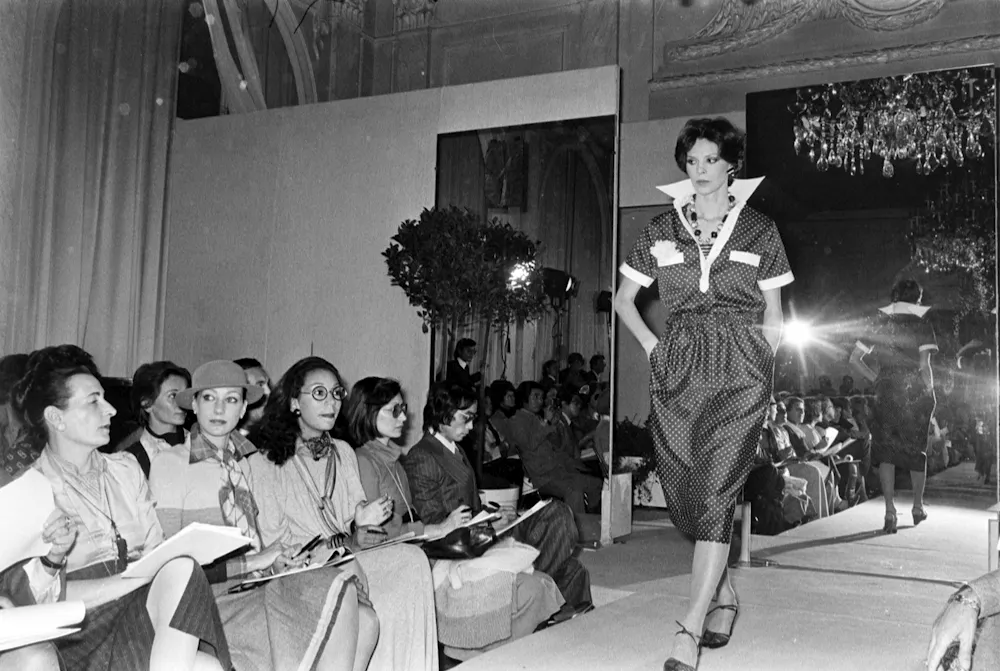
A woman in a polka-dot dress.
A model in the Valentino Spring 1976 ready to wear collection walks the runway in Paris in 1975.
Guy Marineau/WWD/Penske Media via Getty Images

While his design base was in Rome, many of his collections were shown in Paris over the next four decades. His Italian culture mixed with the technicality of Parisian haute couture made Valentino the designer he was.

Throughout his career, his designs often maintained a classic silhouette bust, matched with a bold Italian colour or texture.

Unlike some designers today, Valentino’s collections didn’t change too dramatically each season. Instead, they continued to maintain the craftsmanship and high couture standards.

Quintessentially beautiful” is often the description of Valentino’s work – however this devotion to high beauty standards has seen criticism of the industry. In 2007, Valentino defended the trend of very skinny women on runways, saying when “girls are skinny, the dresses are more attractive”.

Critics said his designs reinforce exclusion, gatekeeping fashion from those who don’t conform to traditional beauty standards.

The Valentino runways only recently have started to feature more average sized bodies and expand their definition of beauty.

The $300 million sale of Valentino

The Valentino fashion brand sold for US$300 million in 1998 to Holding di Partecipazioni Industriali, with Valentino still designing until his retirement in 2007.

Valentino sold to increase the size of his brand: he knew without the support of a larger corporation surviving alone would be impossible. Since Valentino’s retirement, the fashion house has continued under other creative directors.

Valentino will leave a lasting legacy as the Italian designer who managed to break through the noise of the French haute couture elite and make a name for himself.

The iconic Valentino red will forever be remembered for its glamour, and will live on with his legacy. A true Roman visionary with unmatched craftsmanship.

The Conversation

Jye Marshall does not work for, consult, own shares in or receive funding from any company or organisation that would benefit from this article, and has disclosed no relevant affiliations beyond their academic appointment.

ref. Valentino shaped the runway – and the red carpet – for 60 years – https://theconversation.com/valentino-shaped-the-runway-and-the-red-carpet-for-60-years-273891

What a bear attack in a remote valley in Nepal tells us about the problem of aging rural communities

Source: The Conversation – Global Perspectives – By Geoff Childs, Professor of Sociocultural Anthropology, Washington University in St. Louis

Dorje Dundul ponders a life living with increased risk of bear attacks. Geoff Childs, CC BY-SA

Dorje Dundul recently had his foot gnawed by a brown bear – a member of the species Ursus thibetanus, to be precise.

It wasn’t his first such encounter. Recounting the first of three such violent experiences over the past five years, Dorje told our research team: “My wife came home one evening and reported that a bear had eaten a lot of corn from the maize field behind our house. So, we decided to shoo it away. While my wife was setting up camp, I went to see how much the bear had eaten. The bear was just sitting there; it attacked me.”

Dorje dropped to the ground, but the bear ripped open his shirt and tore at his shoulder. “I started shouting and the bear ran away. My wife came, thinking I was messing with her, but when she saw the wounds, she knew what had happened.”

Researchers Dolma Choekyi Lama, Tsering Tinley and I spoke with Dorje – a 71-year-old resident of Nubri, a Buddhist enclave in the Nepalese highlands – as part of a three-year study of aging and migration.

Now, you may be forgiven for asking what a bear attack on a septuagenarian has to do with demographic change in Nepal. The answer, however, is everything.

In recent years, people across Nepal have witnessed an increase in bear attacks, a phenomenon recorded in news reports and academic studies.

Inhabitants of Nubri are at the forefront of this trend – and one of the main reasons is outmigration. People, especially young people, are leaving for education and employment opportunities elsewhere. It is depleting household labor forces, so much so that over 75% of those who were born in the valley and are now ages 5 to 19 have left and now live outside of Nubri.

It means that many older people, like Dorje and his wife, Tsewang, are left alone in their homes. Two of their daughters live abroad and one is in the capital, Kathmandu. Their only son runs a trekking lodge in another village.

Scarcity of ‘scarebears’

Until recently, when the corn was ripening, parents dispatched young people to the fields to light bonfires and bang pots all night to ward off bears. The lack of young people acting as deterrents, alongside the abandonment of outlying fields, is tempting bears to forage closer to human residences.

Outmigration in Nubri and similar villages is due in large part to a lack of educational and employment opportunities. The problems caused by the removal of younger people have been exacerbated by two other factors driving a rapidly aging population: People are living longer due to improvements in health care and sanitation; and fertility has declined since the early 2000s, from more than six to less than three births per woman.

These demographic forces have been accelerating population aging for some time, as illustrated by the population pyramid constructed from our 2012 household surveys in Nubri and neighboring Tsum.

A not-so-big surprise, anymore

Nepal is not alone in this phenomenon; similar dynamics are at play elsewhere in Asia. The New York Times reported in November 2025 that bear attacks are on the rise in Japan, too, partly driven by demographic trends. Farms there used to serve as a buffer zone, shielding urban residents from ursine intruders. However, rural depopulation is allowing bears to encroach on more densely populated areas, bringing safety concerns in conflict with conservation efforts.

Dorje can attest to those concerns. When we met him in 2023 he showed us deep claw marks running down his shoulder and arm, and he vowed to refrain from chasing away bears at night.

So in October 2025, Dorje and Tsewang harvested a field before marauding bears could get to it and hauled the corn to their courtyard for safekeeping. The courtyard is surrounded by stone walls piled high with firewood – not a fail-safe barrier but at least a deterrent. They covered the corn with a plastic tarp, and for extra measure Dorje decided to sleep on the veranda.

He described what happened next:

“I woke to a noise that sounded like ‘sharak, sharak.’ I thought it must be a bear rummaging under the plastic. Before I could do anything, the bear came up the stairs. When I shouted, it got frightened, roared and yanked at my mattress. Suddenly my foot was being pulled and I felt pain.”

Dorje suffered deep lacerations to his foot. Trained in traditional Tibetan medicine, he staunched the bleeding using, ironically, a tonic that contained bear liver.

Yet his life was still in danger due to the risk of infection. It took three days and an enormous expense by village standards – equivalent to roughly US$2,000 – before they could charter a helicopter to Kathmandu for further medical attention.

And Dorje is not the only victim. An elderly woman from another village bumped into a bear during a nocturnal excursion to her outhouse. It left her with a horrific slash from forehead to chin – and her son scrambling to find funds for her evacuation and treatment.

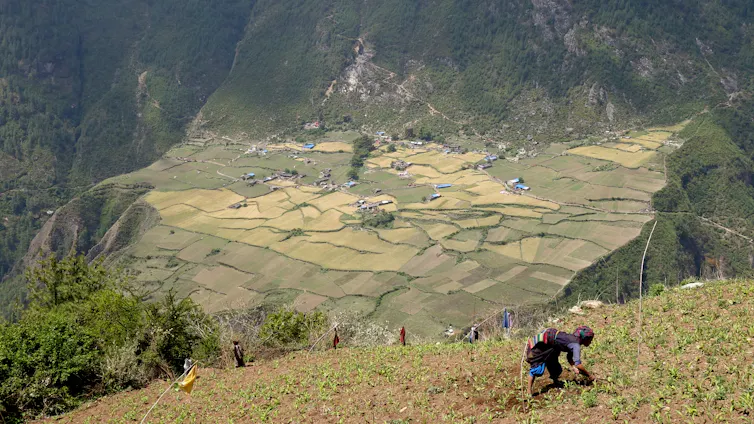
A woman in the foreground bendds over infront of a valley
A woman weeding freshly planted corn across the valley from Trok, Nubri.
Geoff Childs, CC BY-SA

So how should Nepal’s highlanders respond to the increase in bear attacks?

Dorje explained that in the past they set lethal traps when bear encroachments became too dangerous. That option vanished with the creation of Manaslu Conservation Area Project, or MCAP, in the 1990s, a federal initiative to manage natural resources that strictly prohibits the killing of wild animals.

Learning to grin and bear it?

Dorje reasons that if MCAP temporarily relaxed the regulation, villagers could band together to cull the more hostile bears. He informed us that MCAP officials will hear nothing of that option, yet their solutions, such as solar-powered electric fencing, haven’t worked.

Dorje is reflective about the options he faces as young people leave the village, leaving older folk to battle the bears alone.

“At first, I felt that we should kill the bear. But the other side of my heart says, perhaps I did bad deeds in my past life, which is why the bear bit me. The bear came to eat corn, not to attack me. Killing it would just be another sinful act, creating a new cycle of cause and effect. So, why get angry about it?”

It remains to be seen how Nubri’s residents will respond to the mounting threats bears pose to their lives and livelihoods. But one thing is clear: For those who remain behind, the outmigration of younger residents is making the perils more imminent and the solutions more challenging.

Dolma Choekyi Lama and Tsering Tinley made significant contributions to this article. Both are research team members on the author’s project on population in an age of migration.

The Conversation

Geoff Childs receives funding from the National Science Foundation.

ref. What a bear attack in a remote valley in Nepal tells us about the problem of aging rural communities – https://theconversation.com/what-a-bear-attack-in-a-remote-valley-in-nepal-tells-us-about-the-problem-of-aging-rural-communities-271377

Europe has five options for responding to Trump’s Greenland threats. None of them look good

Source: The Conversation – Global Perspectives – By Jun Du, Professor of Economics, Centre Director of Centre for Business Prosperity (CBP), Aston University

Johannes Madsen/Shutterstock

European negotiators believed they had bought stability in July 2025 amid the global trade turmoil sparked by Donald Trump’s liberation day tariffs. The EU’s deal with the US involved eliminating tariffs on American goods, purchasing US energy and committing to American investment. But six months later, as the US president made his intentions regarding Greenland clear, it collapsed.

Trump has now threatened new tariffs on eight European countries, the UK among them. The tariffs punish countries that sent military personnel to Greenland in support of Danish sovereignty.

The president has said 10% tariffs will apply to all goods entering the US from the eight countries from February 1, rising to 25% on June 1 until he is able to buy territory.

This isn’t an aberration. The US offered to buy Greenland in 1946. And before that it purchased Alaska (in 1867, from Russia), Florida (in 1821, from Spain) and Louisiana (in 1803, from France). What’s different now is the coercion mechanism – tariffs rather than a negotiated price.

Greenland offers Arctic shipping routes, rare earth deposits and missile defence positioning. Trump’s “Golden Dome” defence system needs more than military bases – it requires sovereign control to deploy classified systems without Danish oversight.

This is the same logic that drove pressure on Panama to renegotiate US control of the canal. This showed how existing arrangements aren’t enough – Washington wants exclusive control.

The tariff threats serve multiple purposes: punishing countries that showed solidarity with Denmark, testing whether economic pressure can fracture Nato from within, and of course generating revenue.

US tariff income hit US$264 billion (£197 billion) in 2025, up US$185 billion from 2024 after new tariffs kicked in. This is a windfall that makes security dependent allies who cannot retaliate reliable payers.

The usual playbook won’t work

When China faced US tariffs in 2025, it retaliated hard. China targeted soybeans from swing states, restricted rare earths with new export licences and slowed regulatory approvals for US tech companies. Beijing could absorb pain and inflict it back. That was a trade war fought with trade weapons.

Europe’s position is different. Brussels is now discussing the anti-coercion instrument – the so-called “trade bazooka”.

This law gives the EU teeth to hit back against economic blackmail from a non-EU country and overrides existing trade deals. In practice, this could restrict US companies from public procurement and impose retaliatory tariffs on €93 billion (£81 billion) of American goods.


Read more:
Tariffs may bring a US$50 billion monthly boost to the US government. But ordinary Americans won’t feel the benefit


But the EU requires unanimity for serious trade retaliation, and member states differ vastly in their US market exposure and Nato security dependence. Any serious escalation risks the security guarantee, a constraint China never faced.

And these tariffs aren’t really about trade anyway. Fighting a territorial objective with trade weapons is bringing the wrong tools to the job.

If trade diplomacy cannot solve a territorial problem, what can? The conventional playbook offers escalating retaliation — measured responses or catastrophic threats meant to deter a rational actor. But that assumes your opponent isn’t playing a game where brinkmanship is the point. Given those constraints, we have identified five options. None of them is comfortable.

1. Accept the new reality

Treat US tariffs as a permanent feature of transatlantic trade rather than a disruption to negotiate away. Price them into business planning and stop expending political capital on deals that probably won’t hold.

2. Diversify faster

The EU-Mercosur agreement signed in the same week between Brussels and the South American trading bloc wasn’t a coincidence. It was agreed in the knowledge that higher US tariffs were a distinct possibility one day.

For the UK, diversifying means accelerating its own negotiations (the Comprehensive and Progressive Agreement for Trans-Pacific Partnership – CPTPP, the Gulf and India). Every percentage point shifted from the US reduces Washington’s leverage.

3. Address the security dependence

European defence spending has risen sharply since Russia’s full-scale invasion of Ukraine — from €251 billion in 2021 to €343 billion in 2024. But capability takes longer than building up budgets. The Greenland tariffs illustrate the cost of dependence. When your security guarantor becomes your economic coercer, your options narrow dramatically.

4. Reconsider the UK-EU relationship

The crisis creates opportunity for both sides. These options require coordination across member states with vastly different US exposure and Nato dependence. Bringing Britain closer strengthens Europe’s negotiating position while giving the UK strategic options beyond an increasingly transactional US relationship.

The slow reset has been constrained by reluctance to make Brexit look costless. But when both face a direct challenge to the post-war order from their principal security guarantor, the calculation changes. Closer alignment becomes mutual strategic necessity.

5. Hold the line together

The worst outcome would be European countries peeling away from Denmark to escape tariffs. That is precisely what the policy is designed to achieve. This is the logic of political deterrence, which would suggest that showing solidarity will prevent further demands. If this cracks, there is likely to be more of the same from the US.

Whether Trump will ultimately acquire Greenland remains uncertain. Conventional wisdom says he won’t, but conventional wisdom has been wrong before. What’s clear is that this isn’t a tariff dispute requiring trade concessions. It’s a structural shift in transatlantic relations, and European strategy needs to adjust accordingly.

The Conversation

The authors do not work for, consult, own shares in or receive funding from any company or organisation that would benefit from this article, and have disclosed no relevant affiliations beyond their academic appointment.

ref. Europe has five options for responding to Trump’s Greenland threats. None of them look good – https://theconversation.com/europe-has-five-options-for-responding-to-trumps-greenland-threats-none-of-them-look-good-273885

¿Es posible perder peso eliminando el gluten de la dieta, como afirma Matt Damon?

Source: The Conversation – (in Spanish) – By Guy Guppy, Lecturer in Performance Nutrition and Exercise Physiology, Kingston University

Cuando Matt Damon atribuyó recientemente su pérdida de peso a una dieta sin gluten, reavivó un debate familiar sobre este controvertido enfoque alimenticio. Pero aunque las afirmaciones de la estrella de la Odisea han suscitado debate, la ciencia que hay detrás de la pérdida de peso cuenta una historia mucho más matizada que la simple eliminación de una sola proteína.

El gluten es una proteína natural que se encuentra en cereales como el trigo, la cebada y el centeno, lo que significa que se consume habitualmente en alimentos cotidianos como el pan, la pasta y los cereales. Para la mayoría de las personas, el gluten no causa ningún problema de salud.

Sin embargo, para quienes padecen la enfermedad celíaca, que afecta a alrededor del 1 % de la población, es esencial evitarlo. Esta enfermedad autoinmune desencadena una respuesta al gluten, dañando el revestimiento del intestino delgado y dificultando la absorción de nutrientes.

También existe la intolerancia al gluten, o sensibilidad al gluten no celíaca, una afección asociada a síntomas como hinchazón y reflujo. Las personas con esta afección también suelen experimentar problemas más allá del sistema digestivo, como dolores de cabeza y erupciones cutáneas.

A pesar del creciente número de personas que refieren estos síntomas, la intolerancia al gluten sigue siendo objeto de acalorados debates en cuanto a sus causas y tratamiento. Actualmente, el único enfoque recomendado es adoptar una dieta sin gluten.

Para el resto de personas, aquellas que no padecen celiaquía ni intolerancia al gluten, evitar los alimentos ricos en gluten puede ser innecesario y potencialmente problemático.

Los alimentos ricos en gluten, como el pan, la pasta y los cereales, no solo aportan carbohidratos, sino que también son excelentes fuentes de fibra y vitaminas del grupo B.

Eliminar estos alimentos puede contribuir inadvertidamente a deficiencias nutricionales. Sin embargo, el mercado de productos sin gluten sigue creciendo, y las previsiones sugieren que alcanzará los 13 700 millones de dólares estadounidenses (casi 11 700 millones de euros) en 2030.

Dado que Damon no reveló ninguna afección médica al hablar de sus objetivos de pérdida de peso, la explicación más probable de sus resultados radica en su dieta y comportamiento generales, más que en el gluten en sí. Una investigación publicada en Nutrients no encontró diferencias significativas entre las dietas sin gluten y las ricas en gluten en cuanto a la grasa corporal o el peso corporal entre adultos sanos.

Mecánica, no magia

La pérdida de peso que muchas personas experimentan con las dietas sin gluten a menudo se debe a la mecánica y no a la magia. Dado que el gluten se encuentra en muchos alimentos ricos en energía y basados en carbohidratos, las personas que lo eliminan suelen suprimir alimentos como la pizza, la comida rápida y la pasta.

Esta restricción de carbohidratos conduce a una reducción del glucógeno, la forma almacenada de carbohidratos en el cuerpo humano. Cuando se almacena glucógeno, también se almacena agua junto con él.

Por lo tanto, cuando los niveles de glucógeno disminuyen, el peso del agua también lo hace, creando la ilusión de una rápida pérdida de grasa. Este fenómeno explica por qué las personas suelen ver resultados espectaculares en la primera o segunda semana de cualquier nueva dieta o programa de ejercicio.

Más allá de la reducción de la ingesta de carbohidratos, las personas que siguen dietas sin gluten suelen pasar a consumir más alimentos integrales naturalmente libres de gluten. Esta reestructuración de la dieta suele dar lugar a un menor consumo de calorías en general.

Un pequeño estudio preliminar, publicado en Frontiers of Sports and Active Living, descubrió que seguir una dieta sin gluten durante seis semanas provocaba una reducción significativa del peso corporal en comparación con una dieta de control. Pero estos cambios probablemente fueron el resultado de un déficit calórico y una pérdida de líquidos, más que de cualquier ventaja metabólica derivada de la eliminación del gluten.

Hay otro factor en juego. Los carbohidratos derivados del trigo contienen azúcares fermentables llamados fructanos, que son descompuestos por las bacterias del intestino grueso. Esta fermentación produce gases que pueden causar hinchazón, dolor y cambios en las deposiciones. Cuando se eliminan estos alimentos, los síntomas desaparecen y el estómago puede parecer más plano, un cambio estético que las personas pueden confundir con la pérdida de grasa.

El gluten puede tener beneficios para la salud

Adoptar una dieta sin gluten que no sea médicamente necesaria podría, en realidad, aumentar los riesgos para la salud. Un amplio estudio publicado en el BMJ encontró una asociación entre una mayor ingesta de gluten y un menor riesgo de enfermedades cardíacas.

Del mismo modo, las investigaciones han revelado una relación entre el bajo consumo de gluten y el aumento del riesgo de diabetes tipo 2.

El culpable de estas preocupantes relaciones podría ser los productos sin gluten que llenan las estanterías de los supermercados. Cuando se elimina el gluten de un producto, cambia la textura y la palatabilidad del alimento. Para compensarlo, los fabricantes añaden otros ingredientes para mejorar el sabor y la consistencia.

¿El resultado? Se ha demostrado que los productos sin gluten contienen significativamente menos proteínas, más grasas saturadas, menos fibra y más azúcar que sus homólogos convencionales. Con el tiempo, este perfil nutricional puede conducir a una dieta deficiente y, por lo tanto, a una mala salud.

Así que, aunque la gente pueda creer que dejar de consumir gluten provoca la pérdida de peso, la realidad suele ser diferente. Los cambios sutiles en la estructura y la composición de la dieta, junto con las modificaciones en el comportamiento, suelen ser la verdadera razón.

The Conversation

Guy Guppy no recibe salario, ni ejerce labores de consultoría, ni posee acciones, ni recibe financiación de ninguna compañía u organización que pueda obtener beneficio de este artículo, y ha declarado carecer de vínculos relevantes más allá del cargo académico citado.

ref. ¿Es posible perder peso eliminando el gluten de la dieta, como afirma Matt Damon? – https://theconversation.com/es-posible-perder-peso-eliminando-el-gluten-de-la-dieta-como-afirma-matt-damon-273931

Agatha Christie : la reine du crime était aussi la reine du châtiment

Source: The Conversation – in French – By Nicolas Bareït, Maître de conférences HDR en droit privé et sciences criminelles, Université de Pau et des pays de l’Adour (UPPA)

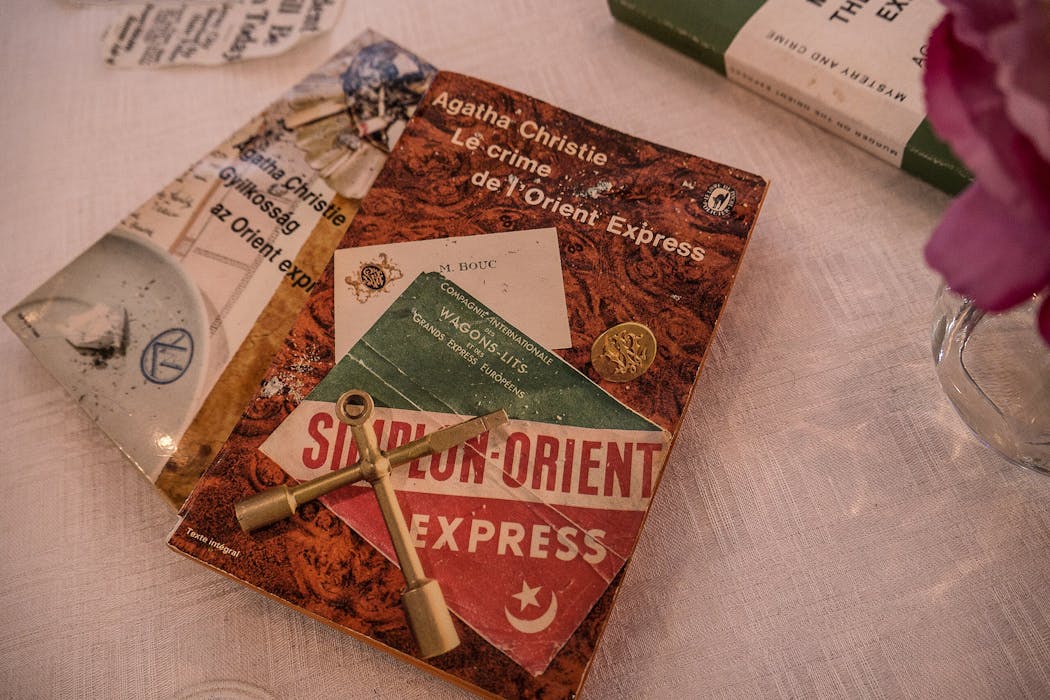
*Le Crime de l’Orient-Express* (1934) est, avec *Ils étaient dix* (1939), l’un des romans d’Agatha Christie ayant connu le plus de succès. Photo tirée d’une Exposition à l’Institut du monde arabe, Paris, 2014., CC BY

Agatha Christie, souvent surnommée la reine du crime, demeure l’autrice de fiction la plus vendue au monde : plus de 2 milliards d’exemplaires de ses livres ont été écoulés depuis leur première publication. Ses intrigues captivantes – de Ils étaient dix au Crime de l’Orient-Express – ont été traduites dans plus de 100 langues, plaçant Christie non seulement au sommet du genre policier mais aussi parmi les auteurs les plus lus de tous les temps. Mais l’habileté littéraire dissimule un autre aspect de son œuvre et de sa personnalité : Agatha Christie était aussi, dans ses livres, la reine de la répression.


Pourquoi (re)lire Agatha Christie ? Pour prendre conscience du fonds idéologique de son œuvre. Pour saisir ce qui peut échapper à la (première) lecture, le lecteur étant implacablement pris et entraîné par la mécanique de l’intrigue policière, tournant les pages vers la résolution finale tant attendue. Les énigmes policières, qui pourraient sembler n’être que des constructions abstraites suspendues dans le vide, des casse-têtes brillants mais sans enjeux concrets, des jeux pour divertir l’esprit, portent, en leur sein ou dans le décor fictionnel dans lequel elles s’inscrivent, un discours sur la société. Lire le Meurtre de Roger Ackroyd pour la prouesse littéraire, oui, bien sûr, il le faut. Mais le relire aussi pour y percevoir « l’arrière-fable », selon une expression du philosophe Michel Foucault, et décrypter les messages ainsi adressés au lecteur, à son insu souvent.

Les romans policiers à énigme ne sont donc pas des produits littéraires jetables, dont la relecture serait du temps perdu. Bien au contraire : délivré de l’emprise de l’intrigue, le lecteur y gagne une nouvelle intelligence du texte. Il peut prendre le temps de discerner certains fils dans la trame policière qui disent quelque chose de la philosophie ou de la politique de l’auteur.

Alors, relisez Agatha Christie. Les rééditions infinies de ses textes vous y encouragent. Relisez-la en usant d’une clé de lecture tout à fait efficace pour avoir accès à sa vision du monde : les représentations de la justice pénale. Tous ces romans et nouvelles sont, en effet, porteurs d’une philosophie répressive singulière. Une philosophie répressive, c’est-à-dire une manière de concevoir les fonctions sociales de la peine.

Trois modèles de justice pénale

Il est plusieurs conceptions possibles de la sanction pénale, qui peuvent d’ailleurs coexister. La peine peut tout d’abord être la réponse violente à l’infraction, le prix à payer par le criminel pour le crime qu’il a commis – le prix du sang. Il s’agit alors de justice rétributive : l’harmonie du monde est rétablie dès lors que le mal infligé à la victime est compensé par le mal subi par l’auteur du crime. La peine peut ensuite être un moyen d’empêcher un nouveau passage à l’acte, de dissuader les potentiels récidivistes. La justice pénale est, dans ce cas, utilitariste et elle se fonde sur l’idée que les individus peuvent être corrigés, améliorés. Enfin, la peine peut perdre son nom et devenir une « mesure » de justice restaurative : l’État est laissé de côté, l’objectif est dès lors de permettre à l’auteur et à la victime de l’infraction de trouver ensemble, par le dialogue, une issue satisfaisante à leur conflit.

Qu’en est-il chez Agatha Christie ? Dans son œuvre, la justice pénale est résolument rétributive. Elle est même, par certains de ses aspects, réactionnaire. Ne vous fiez pas trop aux aimables photographies présentant la romancière dans son bureau en inoffensive grand-mère. Tous ses récits à énigme enseignent que la justice humaine est inefficace, que les procédures légales tournent à vide, que les procès ne permettent pas d’aboutir à la vérité. Ce sont des agents d’une justice supérieure, surnaturelle, qui triomphent chez elle : le silencieux et mélancolique Harley Quinn, l’avocat des morts, messager de l’au-delà. Mais aussi Hercule Poirot – personnage à la vanité assumée et délicieusement comique, méthodique jusqu’à l’obsession, qui se prend pour Dieu le Père et qui finira sa carrière en assassin. Enfin Miss Marple, à l’apparence bienveillante, mais redoutablement lucide et plus perfide qu’il n’y paraît, incarnation de la déesse grecque de la vengeance Némésis. Némésis et non Thémis, la déesse de la justice.

Némésis l’implacable

Pour Agatha Christie, la vengeance est une forme de justice, et c’en est la forme la plus efficace. En effet, selon elle, le meurtre appelle la mort du meurtrier. Pas de place pour le pardon, ni pour la correction des comportements. Non, elle est très claire, elle l’écrit noir sur blanc dans son Autobiographie : les criminels doivent soit être exécutés, soit accepter d’être des cobayes pour la science, « la marque de Caïn enfin effacée de leur front ». Elle écrit ceci non pas en 1930 mais en 1977.

Toutes les morts se valent d’ailleurs. Que le criminel se suicide, qu’il succombe lors d’un accident ou qu’il soit exécuté sur le gibet, toutes ces issues sont satisfaisantes pour l’écrivain, dès lors que le prix du sang est payé.

Notre sensibilité européenne actuelle sera peut-être heurtée, mais l’évidence s’impose : Agatha Christie défend la peine de mort, c’est la seule peine qui lui semble juste. Il est d’ailleurs intéressant de relever qu’à chaque réforme adoptée en Angleterre en faveur de l’abolition de la peine capitale, Agatha Christie a fait connaître sa désapprobation dans ses récits de fiction. Relisez le Train de 16 h 50, relisez le Crime d’Halloween. Dès 1930, elle faisait dire à Miss Marple :

« Les scrupules humanitaristes modernes à propos de la peine capitale m’exaspèrent. »

Rétablir l’ordre du monde

Le monde littéraire d’Agatha Christie est un monde ordonné, un monde harmonieux, une bibliothèque où chaque ouvrage est à sa place. Le cadavre qui y surgit doit être évacué, les taches de sang effacées, la vérité dévoilée et le meurtrier châtié. Et peu importe le temps qui passe : la prescription de l’action publique n’existe pas dans l’œuvre d’Agatha Christie (elle n’existait pas non plus en droit anglais à l’époque où elle écrivait). Némésis possède une mémoire d’éléphant. C’est pourquoi Hercule Poirot peut enquêter seize ans après les faits dans Cinq petits cochons. Idem pour Miss Marple qui intervient dix-huit ans après l’affaire, dans la Dernière Énigme.

Réordonner le monde dérangé par le meurtre passe aussi par un moyen plus doux : le mariage. Innombrables sont les romans d’Agatha Christie dans lesquels l’intrigue policière se double d’une intrigue amoureuse trouvant son dénouement dans un mariage ou dans un projet de mariage. Hercule Poirot n’est pas qu’un détective, c’est aussi un entremetteur, un facilitateur de fiançailles. Or, réunir des amants, c’est, de fait, rétablir l’ordre du monde : l’infraction a sectionné le lien social, le mariage le retisse. Si, comme dans les contes de fées, le héros se marie à la fin d’un roman d’Agatha Christie, ce n’est pas par goût frivole du happy end, mais c’est encore pour traduire une philosophie pénale qui a été distillée dans l’esprit de millions de lecteurs, en sourdine.

Relire Agatha Christie, c’est finalement se donner les moyens de prendre conscience qu’un texte littéraire – même un texte relevant de la littérature populaire – est porteur d’un discours philosophique, social ou politique. Relire Agatha Christie, c’est également comprendre qu’il est possible d’aimer un auteur, sans nécessairement adhérer aux valeurs qu’il diffuse.

The Conversation

Nicolas Bareït ne travaille pas, ne conseille pas, ne possède pas de parts, ne reçoit pas de fonds d’une organisation qui pourrait tirer profit de cet article, et n’a déclaré aucune autre affiliation que son organisme de recherche.

ref. Agatha Christie : la reine du crime était aussi la reine du châtiment – https://theconversation.com/agatha-christie-la-reine-du-crime-etait-aussi-la-reine-du-chatiment-273855

Why Philly has so many sinkholes

Source: The Conversation – USA (2) – By Laura Toran, Professor of Environmental Geology, Temple University

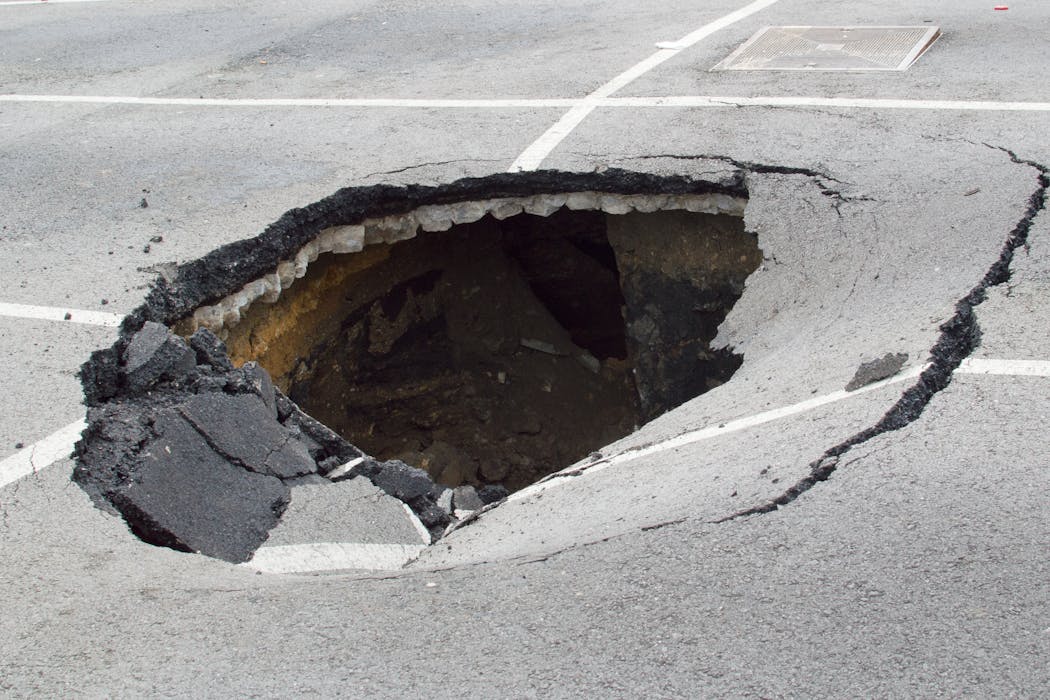
Sinkholes form when underground rock dissolves or sediment washes away and the surface collapses. Luis Diaz Devesa/Moment Collection/Getty Images

In early January, a giant sinkhole formed at an intersection in the West Oak Lane neighborhood of North Philadelphia after a water main break. Just two weeks earlier, the city reopened a section of the Schuylkill River Trail in Center City that had been shut down for two months due to a sinkhole. Last summer, some residents of Point Breeze in South Philly also waited two months for a sinkhole on their block to be repaired.

Laura Toran is a hydrogeologist and professor emeritus of environmental geology at Temple University. The Conversation U.S. asked her what causes sinkholes, whether Philly is particularly prone to them, and why repairs can take so long.

What are sinkholes and how do they happen?

A sinkhole is a hole that opens up in the ground due to some change in the subsurface.

There are two categories of change that create sinkholes. One type is associated with carbonate rock. This is a type of rock that can develop caves because the rock dissolves when underground water is even slightly acidic. When the bridge over one of these caves collapses, a sinkhole occurs.

The second type is associated with water supply or sewage pipes buried underground. The sediment next to the pipes can erode or wash away when there is a leak in the pipes. That leaves a gap, and if the collapse at the surface becomes big enough, it becomes a sinkhole.

What do we know about the sinkholes in West Oak Lane and on the Schuylkill River Trail?

West Oak Lane experienced two recent water main breaks. Debris from the flowing water made it hard to get to the leak.

A sinkhole formed while the water department attempted to fix a broken pipe in West Oak Lane.

Fixing a big leak is a complex job. You have to stop the leak, clear out the debris, get the parts for repair, do the pipe repair, then repair the road. This example also shows that repair teams need to look around to see whether other sections of pipe might be aging and repair them while they have a hole opened up, so you don’t want to rush the job.

The sinkhole on the Schuylkill River Trail late last year, which took two months to fix, was also the result of a pipe leak. The water department had to get involved in the repair, alongside the parks and recreation department. I should point out that the city has a limited budget for pipe repair. As one of the oldest cities in the country, Philadelphia has a lot of work to keep up with.

That said, I would rather try to fix a pipe leak than a carbonate rock sinkhole. With the cavities in carbonate rock, you don’t really know how big they are, and a typical solution is to fill them with concrete. Sometimes you have a much bigger cavity than your supply of concrete.

Is Philly prone to sinkholes?

The Philadelphia region has both types of sinkholes. Within the city, there isn’t carbonate rock present, but just outside the city, such as the King of Prussia area, we see carbonate rock that is subject to sinkholes.

The sinkholes that occur in Philly are where pipes leak and the surrounding soil gets washed away. Because we have the right geology for sinkholes in our region and we have an extensive water network that is aging, sinkholes are somewhat common.

Some regions have even more sinkholes than we see here, however. Florida is entirely underlain by carbonate rock, and sinkholes are quite common.

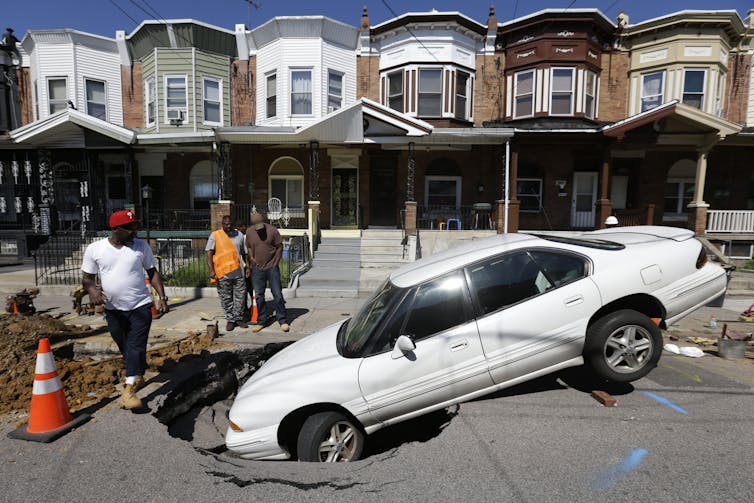
Front half of white sedan in a sinkhole on residential street
Philly has been dealing with sinkholes for years. This one opened up overnight on a street in the city’s Hunting Park section in July 2013.
AP Photo/Matt Rourke

Can nearby residents know when a sinkhole is forming?

We have a map of carbonate rock in the state, but not all carbonate rock develops sinkholes. Where and when in the carbonate rock a sinkhole is likely to develop is unpredictable.

Sinkholes in Philadelphia tend to also be unpredictable because the driving factor is happening underground and out of sight. We don’t know when a pipe leak is going to occur. Sometimes there is a sagging at the surface before a bigger hole opens up. Sometimes we see the leak before the sinkhole occurs. But not all leaks or sagging ground will lead to a sinkhole, and there won’t necessarily be any warning.

That said, it is important to report leaks and sagging ground so that they can be investigated before getting worse. Report leaks to the Philadelphia Water Department by calling their emergency hotline at 215-685-6300.

If we could replace all the aging infrastructure in the city, we would have fewer sinkholes. However, that would be costly and disruptive, so it really isn’t practical. In the meantime, the city just has to fix new sinkholes as they occur.

Read more of our stories about Philadelphia and Pennsylvania, or sign up for our Philadelphia newsletter on Substack.

The Conversation

Laura Toran receives funding from the National Science Foundation (federal), the Pennsylvania Department of Transportation, and the William Penn Foundation (private).

ref. Why Philly has so many sinkholes – https://theconversation.com/why-philly-has-so-many-sinkholes-273082

Some hard-earned lessons from Detroit on how to protect the safety net for community partners in research

Source: The Conversation – USA (2) – By Carrie Leach, Research Assistant Professor, Wayne State University

To get seniors online, the author provided them with computers and internet access. David Goldman/AP Photo

For the past 10 years, I have worked on closing the communication gaps that keep older adults at arm’s length from research that could improve their lives.

I worked with Detroiters to bridge the digital divide by developing tools that make it easier for older adults to get online, allowing them to connect to health information and learn about benefits they’re eligible for. I have also codesigned projects with members of the community to help improve older residents’ access to services.

My overriding goal is to help older minority adults connect with research so they are not left out of the very studies meant to reduce health disparities in aging. My work has focused on older adults in Detroit, a majority minority city, to help improve health for all residents.

Despite my best intentions, I recently had an experience where my work created unintended harm for vulnerable people.

I want to share my experience as a cautionary example of how researchers can fail to understand the government benefits that low-income older adults rely on, especially when it comes to research stipends.

Detroit seniors, unplugged

Recently, I completed a project that aimed to bridge both the digital divide and the divide between Detroit residents and researchers.

This project was inspired by the COVID-19 pandemic, when it became clear how hard it was going to be to connect with Detroit residents. Delivering environmental education and outreach is part of my work at the Center for Urban Responses to Environmental Stressors, also known as CURES. In response to the disconnect caused by the lockdown, our team was fortunate to get funding to deliver computers to 1,700 older Detroiters. Our community partners and advisory board members helped us distribute them.

But we soon learned many of the recipients didn’t know how to use the computers, and some couldn’t get online. At the time, Detroit had one of the lowest internet connectivity rates in the nation. Rates were as low as 40% in 2020.

Detroit has used some creative approaches to getting its residents online.

Poor connectivity has been called a “super-determinant” of health. Not being able to access the internet harms individuals because they are cut off from resources that could make them healthier – such as telehealth appointments, for example. It also creates health inequities for groups of people when research lacks a diversity of perspectives.

Naturally, our next step was to develop tools to help the people who received computers get plugged in. We applied for funding, won it – and soon I was working alongside community health and aging advocates, researchers, service providers and housing administrators to develop and refine a technology tool kit.

Once the tool kit was ready, we distributed it widely. The tool kit is designed to cover the basics for older adults who are new computer users. For example, we included directions for connecting to Wi-Fi and creating an email account. We made this resource available for anyone who is interested in using it.

Intro to Research 101

Our community partners next gathered a cohort of 10 Detroiters who were 65 or older so they could learn how to get involved in virtual research. We developed an online research readiness curriculum to introduce them to the basics of how research is done.

Remembering the challenges of COVID-19, we set a goal of engaging the older adults entirely online. Our early meetings started with 45 minutes spent troubleshooting cameras and microphone connections. A few months later, we were all camera-ready in less than nine minutes.

Because I value their time, I budgeted to pay everyone involved in the project. It is difficult for people to take part in programs when they can’t afford to cover basic expenses, and payment can help relieve these financial pressures. What I didn’t realize is that these modest amounts of money could be treated by HUD as income and trigger increases in rent.

But that is exactly what happened.

The older adults involved in our project lived in HUD housing, and their rental costs are based on their income.

We paid residents $120 monthly. This stipend increased their incomes, which in turn led to increases in their rent, sometimes by the same amount as the stipend. Having higher housing costs left them in worse shape than before they joined our project. The stipends were designed to phase out after 10 months, but it was unclear when their rents would be adjusted again. By being involved, their finances became more precarious.

In my opinion, this illustrates how research involvement, even when designed to be fair and respectful, can create an unintended financial strain for people whose budgets leave no room for error.

My privilege was a blind spot.

Problem-solving through partnership

I would likely never have known about the problem if the housing administrator, who was one of my project partners, had not spoken up on behalf of the residents involved in the project. The residents did not come to me to report the issue. They went to a person they already knew and trusted to talk about the unexpected burden.

Some residents stopped accepting payments for their participation, but they still faced months of higher rental costs while we worked to get their money back.

That relief eventually came, thanks to a vigilant HUD administrator, weeks of calls and emails, and late nights spent reviewing HUD’s policies.

In the end, HUD emailed to say it had agreed to exempt the stipends from the residents’ income because we argued that the payments were “temporary, sporadic and nonrecurring.” In response, the HUD site administrator immediately made adjustments, and the overpayments were returned to the residents.

Everyone involved was hugely relieved.

Learning from my mistake

And that may have been the end of the story if one of my community partners, Zachary Rowe, hadn’t encouraged me to write about what happened so that others could learn from our experience.

In my view, this cautionary tale reveals a critical gap in how researchers engage and support people who are underrepresented in studies, including those who rely on housing assistance and other safety net programs. Without attention to these details, efforts to broaden participation in studies can unintentionally exclude or burden the very people researchers are working to include. Experiences like this reinforce that institutions must adapt their policies so paying people for their time never jeopardizes their basic needs.

Researchers, university research review boards and community partners could all benefit from plain‑language guidance about how earnings interact with safety net programs, benefits and income rules. Projects should start with collaborative efforts to anticipate the real-world implications of engagement.

This kind of persistent troubleshooting supports ethical practices and helps build the kind of trust that makes long‑term research partnerships possible.

I view the additional effort and advocacy required to take these precautions as part of the work of shaping who gets represented in research at all. If engaging people with complex lives and constrained resources were easy, our study samples would already be diversified.

Sharing these difficult experiences can be uncomfortable, but it can also help researchers, institutions and partners do better for those who might otherwise be harmed along the way.

The Conversation

Carrie Leach receives funding from NIH.

ref. Some hard-earned lessons from Detroit on how to protect the safety net for community partners in research – https://theconversation.com/some-hard-earned-lessons-from-detroit-on-how-to-protect-the-safety-net-for-community-partners-in-research-271361

What air pollution does to the human body

Source: The Conversation – USA (3) – By Jenni Shearston, Assistant Professor of Integrative Physiology, University of Colorado Boulder

I grew up in rural Colorado, deep in the mountains, and I can still remember the first time I visited Denver in the early 2000s. The city sits on the plain, skyscrapers rising and buildings extending far into the distance. Except, as we drove out of the mountains, I could barely see the city – the entire plain was covered in a brown, hazy cloud.

That brown, hazy cloud was mostly made of ozone, a lung-irritating gas that causes decreases in lung function, inflammation, respiratory symptoms like coughing, and can trigger asthma attacks.

Denver still has air pollution problems, due in part to its geography, which creates temperature inversions that can hold pollution near the ground. But since 1990, ozone has decreased 18% across the U.S., reducing the smog that choked many cities in the 1960s and 1970s. The concentration of tiny dustlike particles of air pollution called PM2.5 has also decreased, by 37% since 2000.

These decreases occurred largely because of one of the most successful public health policies ever implemented by the United States: the Clean Air Act, first passed in 1970. The Clean Air Act regulates air pollution emissions and authorizes the Environmental Protection Agency to set air quality standards for the nation.

For years, when the Environmental Protection Agency assessed the economic impact of new regulations, it weighed both the health costs for Americans and the compliance costs for businesses. The Trump administration is now planning to drop half of that calculation – the monetary health benefits of reducing both ozone and PM2.5 – when weighing the economic impact of regulating sources of air pollution.

I am an environmental epidemiologist, and one of the things I study is people’s exposure to air pollution and how it affects health. Measuring the impact of air quality policies – including quantifying how much money is saved in health care costs when people are exposed to less air pollution – is important because it helps policymakers determine if the benefits of a regulation are worth the costs.

What air pollution does to your body

Breathing in air pollution like ozone and PM2.5 harms nearly every major system in the human body.

It is particularly hard on the cardiovascular, respiratory and neurological systems. Numerous studies have found that PM2.5 exposure is associated with increased death from cardiovascular diseases like coronary heart disease. Even short-term exposure to either PM2.5 or ozone can increase hospitalizations for heart attacks and strokes.

What’s in the air you breathe?

In the respiratory system, PM2.5 exposure is associated with a 10% increased risk for respiratory diseases and symptoms such as wheezing and bronchitis in children. More recent evidence suggests that PM2.5 exposure can increase the risk of Alzheimer’s disease and other cognitive disorders. In addition, the International Agency for Research on Cancer has designated PM2.5 as a carcinogen, or cancer-causing agent.

Reducing air pollution has been proven to save lives, reduce health care costs and improve quality of life.

For example, a study led by scientists at the EPA estimated that a 39% nationwide decrease in airborne PM2.5 from 1990 to 2010 corresponded to a 54% drop in deaths from ischemic heart disease, chronic obstructive pulmonary disease, lung cancer and stroke.

In the same period, the study found that a 9% decline in ozone corresponded to a 13% drop in deaths from chronic respiratory disease. All of these illnesses are costly for the patients and the public, both in the treatment costs that raise insurance prices and the economic losses when people are too ill to work.

A smoggy view of a street with 1950s-vintage cars in downtown LA.
Smog defined Los Angeles for years, including in December 1956. The photo was taken looking down Grand Avenue.
Bettmann via Getty Images

Yet another study found that nationally, an increase of 1 microgram per square meter in weekly PM2.5 exposure was associated with a 0.82% increase in asthma inhaler use. The authors calculated that decreasing PM2.5 by that amount would mean US$350 million in annual economic benefits.

Especially for people with lung diseases like asthma or sarcoidosis, increased PM2.5 concentrations can reduce quality of life by worsening lung function.

Uncertainty doesn’t mean ignore it

The process of calculating precisely how much money is saved by a policy has uncertainty. That was a reason the Trump administration stated for not including health costs in its cost-benefit analyses in 2026 for a plan to change air pollution standards for power plant combustion turbines.

Uncertainty is something we all deal with on a daily basis. Think of the weather. Forecasts have varying degrees of accuracy. The high temperature might not get quite as high as the prediction, or might be a bit hotter. That is uncertainty.

The EPA wrote in a notice dated Jan. 9, 2026, that its historical practice of providing estimates of the monetized impact of reducing pollution leads the public to believe that the EPA has a clearer understanding of these monetary benefits than it actually does.

Therefore, the EPA wrote, the agency will stop estimating monetary benefits from reducing pollution until it is “confident enough in the modeling to properly monetize those impacts.”

This is like ignoring weather forecasts because they might not be perfect. Even though there is uncertainty, the estimate is still useful.

Estimates of the monetary costs and benefits of regulating pollution sources are used to understand if the regulation is worth its cost. Without considering the health costs and benefits, it may be easier for infrastructure that emits high levels of air pollution to be built and operated.

A woman wears a face mask to filter the air while standing on a subway platform.
On days with poor air quality, like this one in New York in June 2025, more cities are issuing alerts, and more people are wearing face masks to reduce their exposure to harmful particles.
Selcuk Acar/Anadolu via Getty Images

What the evidence shows

Several studies have shown the impact of pollution sources like power plants on health.

For example, the retirement of coal and oil power plants has been connected with a reduction in preterm birth to mothers living near the power plants. Scientists studied 57,000 births in California and found the percentage of babies born preterm to mothers living within 3.1 miles (5 kilometers) of a coal- or oil-fueled power plant fell from 7% to 5.1% after the power plant was retired.

Another study in the Louisville, Kentucky, area found that four coal-fired power plants either retiring or installing pollution-reduction technologies such as flue-gas desulfurization systems coincided with a drop in hospitalizations and emergency department visits for asthma and reduced asthma-medication use.

Reducing preterm birth, hospitalizations, emergency department visits and medication use saves money by preventing expensive health care for treatment, hospital stays and medications. For example, researchers estimated that for children born in 2016, the lifetime cost of preterm birth, including medical and delivery care, special education interventions and lost productivity due to disability in adulthood, was in excess of $25.2 billion.

Circling back to Denver: The region is a fast-growing data center hub, and utilities are expecting power demand to skyrocket over the next 15 years. That means more power plants will be needed, and with the EPA’s changes, they may be held to lower pollution standards.

The Conversation

Jenni Shearston has received funding from the National Institutes of Health.

ref. What air pollution does to the human body – https://theconversation.com/what-air-pollution-does-to-the-human-body-273456

What ‘hope’ has represented in Christian history – and what it might mean now

Source: The Conversation – USA (3) – By Joanne M. Pierce, Professor Emerita of Religious Studies, College of the Holy Cross

Pope Leo XIV closes the Holy Door of St. Peter’s Basilica’s to end the 2025 ordinary Jubilee year at the Vatican on Jan. 6, 2026. Yara Nardi/Pool photo via AP

Pope Leo XIV closed the door at St. Peter’s Basilica on Jan. 6, 2026, just days into the new year. The act formally brought the Vatican’s Holy Year 2025 – designated as “Pilgrims of Hope” – to an end.

In 2022, after the COVID-19 pandemic ended, Pope Francis announced his intention to proclaim a Jubilee year, urging the faithful to look to the future “with an open spirit, a trusting heart and far-sighted vision.” That is why, as Francis explained, he chose the motto of the Jubilee: “Pilgrims of Hope.”

Ironically, 2025 was a turbulent year the world over. After so much military aggression in Ukraine, rampant starvation in Gaza and increasing violence of all kinds within the United States, people in many parts of the world were left much more despairing than hopeful for 2026.

Religions typically try to offer hope in the face of despair. As a scholar of Catholicism, I know that even amid violent persecutions, devastating wars and staggering death tolls from epidemics, Christians have repeatedly turned to their holy texts for hope.

So what is the meaning of hope in the Christian tradition?

Western antiquity

Christianity was shaped by its roots in Judaism, but also its rejection of Greco-Roman religious culture, especially its polytheism.

Many ancient Greek authors wrote about a divine spirit of hope – Elpis. As early as the late eighth century B.C.E., the poet Hesiod composed a mythic poem, “Works and Days,” about Pandora and her box of woes. The god Zeus warned that Pandora was not to open the box, given to her as a gift. But in the end, she did – and released all of the entrapped evils to trouble the world. But Elpis – that is, Hope – had also been placed in the box and was kept inside when Pandora closed the lid quickly. The moral of the story is that hope still remains with humanity.

In ancient Rome, hope was venerated as a minor goddess, Spes, but usually on a communal, national level. Politically, Spes represented the collective hope for the Roman Republic or support for the semi-divine emperors of the later empire; temples were erected in her honor, and her image could be found on coins.

Hebrew Scriptures

But for monotheistic Judaism, hope was not an external divine spirit or goddess to be invoked in times of personal or communal need.

In the ancient Near East, the authors of books of the Hebrew Bible spoke frequently about hope. Often expressed with the word “tikvah,” hope is presented in the Bible as a human reaction to God’s promises, “an inner attitude of inner expectation”: a confident trust based on God’s past works.

Early in the Book of Job, the reader meets Job, a righteous man whose faith is tested through the sudden loss of his children, wealth and health. His friend Eliphaz urges him not to give up hope in the midst of Job’s terrible sufferings. He asks: “Is your fear of God not your confidence, and the integrity of your ways your hope?” Job is already living a life of faith and obedience; his reaction should not be to collapse in despair, but to carry on in hope, trusting in God’s wisdom and mercy.

The Psalms were composed as poems or hymns used in worship. In Psalm 62, the psalmist reminds himself and all God’s people of this hope: “My soul, wait in silence for God alone, for my hope is from Him. … Trust in Him at all times, you people.”

The prophets were understood to have been sent by God to chastise the people of Israel for falling into idolatry and other evils and to urge repentance. And some of them stress hope in God as the source for strength in rejecting these worldly temptations and turning back to following the teachings of the Scriptures. The prophet Jeremiah, for example, addresses God as “the hope of Israel” as they repent.

Christian Scriptures

The New Testament, compiled in the first century C.E. contains frequent references to the Old Testament as interpreted through the lens of Jesus’ teaching.

The Gospels rarely use the word hope itself, but imply it obliquely in connection with other elements of faith, such as belief and trust. The Epistles, or letters, by early Christian apostles and their followers, contain frequent references to hope.

For example, in several Epistles, the apostle Paul speaks often about the Christian hope in God through Jesus Christ. In the “Letter to the Romans,” Paul states that, even among difficulties, “hope does not disappoint us, because God’s love has been poured into our hearts.” He praises the Christians in Thessalonika for “your work of faith and labor of love and endurance in hope of our Lord Jesus Christ, before our God and Father.”

But in his first “Letter to the Corinthians,” Paul addresses different kinds of spiritual gifts – some very striking, such as speaking in tongues or healing others. But he then writes a section specifically exploring the most important gift of all, love – in Greek, “agape” – and refers to its relationship with both faith and hope. He closes with a frequently quoted text about what he described as the three greatest Christian virtues: faith, hope and love.

Contemporary hope

Throughout the next centuries, Christian theologians and popes reflected on the nature of hope – either in itself, or within the framework of all three of these virtues.

And so, on Dec. 24, 2025, Francis opened the door of St. Peter’s Basilica to declare the beginning of the Catholic Church’s celebration of the Holy Year, with hope as the special theme.

He would not live to close it. But Leo XIV did, with the following words at the final Jubilee Mass:

“Has the Jubilee taught us to flee from (the) type of efficiency that reduces everything to a product and human beings to consumers? After this year, will we be better able to recognize a pilgrim in the visitor, a seeker in the stranger, a neighbor in the foreigner, and fellow travelers in those who are different?”

From his very first speech after being elected pope, Leo called Christians to reach out to others, build bridges, engage in dialogue and be present to one another.

Perhaps this is what continuing to hope means for the world in 2026.

The Conversation

Joanne M. Pierce does not work for, consult, own shares in or receive funding from any company or organization that would benefit from this article, and has disclosed no relevant affiliations beyond their academic appointment.

ref. What ‘hope’ has represented in Christian history – and what it might mean now – https://theconversation.com/what-hope-has-represented-in-christian-history-and-what-it-might-mean-now-273097

American border crackdown forces Venezuelan migrants on a perilous journey back south

Source: The Conversation – Canada – By Guillermo Candiz, Assistant Professor, Human Plurality, Université de l’Ontario français

Since February 2025, thousands of Venezuelan asylum-seekers have been turned away from the United States-Mexico border and denied the right to apply for protection in the U.S. Along with other Venezuelans who were living in the U.S. and have been deported, they’ve been forced to head south, either back to Venezuela or to other countries in Central and South America.

This phenomenon — commonly described as reverse migration — raises important questions about the capacity or willingness of countries in the region to ensure the safety and security of these migrants.

As part of ongoing research, we talked to asylum-seekers and collected their insights during our field work in Costa Rica in November and December 2025. Our interviews revealed that those who abandoned the hope of crossing into the U.S. made the decision for many reasons.

Expecting a better life in Venezuela was not among them. Instead, many faced repeated obstacles along the way, which accumulated over time into what can be described as journey fatigue.

Exhaustion

The migrants we interviewed experienced physical exhaustion from long periods of waiting, economic hardship, fear and incidents of violence in Mexico, as well as fraud and theft, while access to institutional or humanitarian support steadily declined.

The final blow for most of them came from changes in the U.S. asylum and temporary protection policies. These included the termination of the two‑year humanitarian parole program, the freezing of asylum application processing for Venezuelans and nationals of 18 other countries and the inclusion of Venezuelans in travel bans restricting entry for citizens of 39 countries.

These policy shifts were combined with the abrupt cancellation of what was known as the CBP One mobile application and all previously approved appointments made using the app.

The U.S. Customs and Border Protection’s app allowed asylum-seekers to submit biographic information to set up an appointment prior to their scheduled arrival at a port of entry. This sudden change dashed the hopes of thousands who had been waiting for an opportunity to request asylum at the U.S. border.

Decisions to head back south rather than continue pursuing entry into the U.S. are made under conditions of high uncertainty. Migration regimes, support infrastructure and facilitation networks change rapidly — some disappearing as others emerge — and often without clear mechanisms for sharing information among migrants or those trying to help them.

In this environment, many people remain trapped for months in waiting spaces, with no real possibility of moving forward and no means of survival while waiting, resorting to begging or informal work.

A Venezuelan couple we interviewed at the Costa Rica–Panama border described how they often sang in restaurants or begged to feed their family, pay for bus travel between countries, and, at times, secure a roof over their heads when shelters run by religious organizations were unavailable.

Not safe to return

For international organizations and receiving countries, “voluntary return” is often presented as a preferred solution.

The International Organization for Migration (IOM) administers the Assisted Voluntary Return and Reintegration (AVRR) Program. As we learned during our Costa Rican field work, the IOM facilitates the return of Venezuelans to their home country when they reach Panama.

But whether a return is feasibile depends directly on conditions in the country of origin. Most Venezuelan migrants we interviewed didn’t think it was safe for them to return home.

U.S. intervention creates more uncertainty

The recent U.S. intervention in Venezuela and the capture of President Nicolás Maduro did nothing to change this political scenario.

Instead, it has injected regional uncertainty that transcends Venezuela’s borders. After Maduro’s capture, Vice President Delcy Rodríguez assumed the role of interim president, suggesting the country’s authoritarian regime can survive the U.S. intervention.


Read more:
The Colombian border is one of the biggest obstacles to building a new Venezuela


The Trump administration says it will oversee Venezuela during an unspecified transition period, but the implications are unclear.

The post-invasion situation does not include the transition of power to opposition leaders like González Urrutia or Corina Machado, even though Machado just handed over her Nobel Peace Prize to Trump.

Settling elsewhere

Within this tense and uncertain climate, many displaced Venezuelans heading south consider settling in Chile, Colombia or Costa Rica as alternative destinations.

That’s despite the fact that these countries lack the institutional capacity and infrastructure to absorb sustained reverse migration and are showing growing signs of rejecting Venezuelans.

This is evident with the recent election of Jose Antonio Kast in Chile, whose campaign focused on controlling “irregular immigration,” threatening mass deportations of migrants — mostly Venezuelans — and fuelling a climate of social hostility.

As we found during our research in Costa Rica, the country’s asylum system is stretched to the limit and appointments to put in a refugee claim can take more than two years to be scheduled, not counting the adjudication process.

These delays and the uncertainty of outcomes for migrants cause anxiety among displaced people and discourage them from attempting to seek protection in Costa Rica.

Research on transit migration to the U.S. or Europe has shown that these movements are fragmented, multi-directional and often circular. Policy changes — both in countries of destination and transit — new opportunities for social support or jobs, new intimate relationships or new information on possibilities of border crossing reshape migration trajectories.

Venezuelan reverse migration reflects similar dynamics, but unfolds in even more uncertain and precarious ways because the capacity of various states to meet the needs of displaced people is severely limited. This leads to even more severely fragmented routes for return migrants than for those travelling north.

Global North must step up

In light of these dynamics, it’s crucial to reaffirm the international protection regime and to recognize the historical responsibility of northern countries — including the United States, Canada and EU member states — to ensure effective access to asylum for people displaced by violence, conflict and persecution.

Any reform of regional migration governance must begin from this core principle.

We therefore call on governments, international organizations, humanitarian groups and civil society to uphold international protection regimes and to design responses that reflect the complex realities of shifting migration flows and the rights of people on the move.

The Conversation

Guillermo Candiz receives funding from Social Sciences and Humanities Research Council.

Tanya Basok receives funding from Social Science and Humanities Research Council of Canada

ref. American border crackdown forces Venezuelan migrants on a perilous journey back south – https://theconversation.com/american-border-crackdown-forces-venezuelan-migrants-on-a-perilous-journey-back-south-272974