Guillermo de Toro’s Frankenstein: beguiling adaptation stays true to heart of Mary Shelley’s story

Source: The Conversation – UK – By Sharon Ruston, Professor of English and Creative Writing, Lancaster University

Frankenstein has clearly been a labour of love for the director Guillermo del Toro. I am editing Frankenstein for The Oxford Complete Works of Mary Shelley so have spent a lot of time with her tale too. While del Toro’s deviates in noticeable but interesting ways from Shelley’s novel, the film remains true to the heart of her story with its obvious compassion and empathy for the Creature created in an unorthodox experiment by a young scientist.

The film is grand and lush, the costumes are incredibly opulent, the settings awe-inspiring, and the score emotional. I watched it in a sold out 600+ seat cinema in Manchester, filled with a young audience mainly in their 20s and late teens who laughed, cried and winced along with the action on screen.


Read more:
Frankenstein at 200 and why Mary Shelley was far more than the sum of her monster’s parts


It is divided into two parts – scientist Victor Frankenstein’s (Oscar Issac) narrative and then the Creature’s (Jacob Elordi) narrative – framed by and interspersed with the story of a ship caught in the ice and a captain faced with mutinous sailors who want to give up on their foolhardy mission and return home. This very much follows Shelley’s original tale.
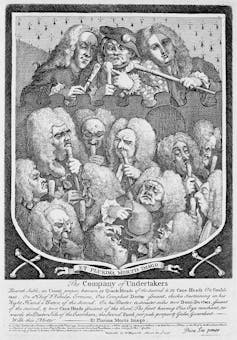
A cartoon of undertakers in wigs.
A Consultation of Physicians, or The Company of Undertakers is an engraving by the English artist William Hogarth that satirises the medical profession.
Wellcome

The main narrative in the film has been moved to 1857; Shelley’s book is set in the 1790s. This enables a far greater range of technology to be employed – from early photography, flushable toilets, and gigantic voltaic piles, which were the first electrical batteries.

However, many scenes evoke earlier times, such as the gowns and wigs of the medical professionals who reject Victor Frankenstein’s heretical experiments with corpses. These have an 18th-century aesthetic, wearing large white wigs like those depicted in William Hogarth’s 1736 engraving A Consultation of Physicians, or The Company of Undertakers.

The film makes full use of historical medical knowledge. For example, one breakthrough in Victor’s experiments comes when he is given a map of the lymphatic system, which is said to be the fifth long lost Evelyn Table. The real four tables are from 17th-century Italy and were an educational tool to demonstrate the vein, artery and nervous systems. Famously, these wooden boards were pasted with real human tissue.


Read more:
The dark history of medical illustrations and the question of consent


Just as the surgeon who gathered the material for the Evelyn Tables is unlikely to have asked for the patient’s consent before their death, Victor is relentless in his search for body parts to build his monster. One of the most visceral scenes is of him surrounded by piles of heads, legs, and other human parts, sawing off what he intends to use, and lugging sacks of unwanted bits of bodies to be slung into the gutter.

Throughout, Victor is brilliant but single-minded to the point of monomania. He is likened, as he is in the novel’s subtitle, to the mythological figure Prometheus who stole fire from the gods to give to humans. But, unlike Prometheus, Victor’s actions seem to lack much altruistic purpose.

The one character who sees through him is Elizabeth Lavenza (Mia Goth), newly imagined as the intended wife of Victor’s brother William (Felix Kammerer). Elizabeth in this version is herself an amateur entomologist (a scientist who studies insects). Her scarab necklace, with its Egyptian symbolism, is a symbol of renewal and rebirth – a symbol of her affinity with creatures that are often misunderstood.

Del Toro creates animosity between Victor and his father Leopold (Charles Dance) to prepare us for the inadequacies of Victor’s relationship with his creation. He also leans into the theory that Victor and his Creature are doubles. Nowhere is this more clear than when the scientist identifies himself as Victor and the monster applies that name to himself. Both characters also emit the same animalistic growl when they are angry.

There are also visual signs of this doubling. At first, the monster is practically naked bar a few bandages until he acquires a long coat from a fallen soldier and other swaddling layers, which only enhances his formidable size.

When Victor begins to hunt the Creature, he is dressed in a similarly huge fur coat. His gait is ambling, much like the creatures in his first steps, as he drags his prosthetic leg across the snow in pursuit. Their resemblance seems to signify a merging of identities. It is difficult to know who is the hunter and who is hunted.


Read more:
Two centuries on, Frankenstein is the perfect metaphor for the Anthropocene era


Created from a process declared unholy, obscene and an abomination, and declared by Victor to be a mistake, the Creature endures. In fact, as it all ends we are left with a final close up of the monster’s face, cementing del Toro’s sympathy with the Creature.

In the film, the Creature is, throughout, afraid, attempting to be gentle, wanting to find affection at the hands of the humans he encounters but most often instead encounters pain and suffering. Ultimately, he is not of “the same nature” as humans, which allows for some intriguing differences.

Despite this, he insists that he is not a “something” but a “someone”. Those watching will be left with the Creature’s words reverberating in their heads, words which shine a harsh light on us all: “the world will hunt you and kill you just for being who you are.”

The Conversation

Sharon Ruston does not work for, consult, own shares in or receive funding from any company or organisation that would benefit from this article, and has disclosed no relevant affiliations beyond their academic appointment.

ref. Guillermo de Toro’s Frankenstein: beguiling adaptation stays true to heart of Mary Shelley’s story – https://theconversation.com/guillermo-de-toros-frankenstein-beguiling-adaptation-stays-true-to-heart-of-mary-shelleys-story-267570

Drought, sand storms and evacuations: how Iran’s climate crisis gets ignored

Source: The Conversation – UK – By Sanam Mahoozi, PhD Candidate Journalism, City St George’s, University of London

Iran and Israel fought a 12-day war in June. Although a ceasefire was declared the same month, news coverage of Iran continues to focus on the conflict’s aftermath and the Middle East’s tense political situation.

Meanwhile, Tehran – home to more than 10 million people – is facing one of its worst water shortages in decades. Dams near the capital are at their lowest levels for nearly 70 years – the Karaj dam (one of the city’s major suppliers), which has 25 million cubic metres of water storage, is 86% empty.

In the centre of the country, the city of Isfahan is sinking as subsidence swallows cars and pedestrians. Land subsidence is mainly caused by over-extraction of ground water for agriculture – more than 90% of Iran’s water is extracted for agricultural use. Many of Iran’s iconic lakes have turned into a bed of salt.

Even though schools and roads in Tehran were evacuated in September due to their risk of collapsing, international media coverage of this major environmental problem remains alarmingly low – limited mostly to local and Persian-language diaspora outlets.

Earlier this year, the country’s southern provinces were blanketed by sand and dust storms that sent thousands to hospitals and disrupted infrastructure. Again, this went mostly unreported outside Iran.


Wars and climate change are inextricably linked. Climate change can increase the likelihood of violent conflict by intensifying resource scarcity and displacement, while conflict itself accelerates environmental damage. This article is part of a series, War on climate, which explores the relationship between climate issues and global conflicts.


There has also been little international coverage of the environmental impact of the war on Iran.

In contrast, local media have reported that Israel’s missile attacks on oil depots close to Tehran released 47,000 tons of greenhouse gases into the city’s atmosphere, causing air pollution. They claimed surface and groundwater systems, soil and wider ecosystems have all been damaged by the leakage of industrial wastewater, urban sewage and other forms of pollution including noise, vibration, radiation and heat – all of which pose a threat to the lives of humans, animals and plants.

For months, international news outlets have focused their coverage of Iran on questions about its nuclear programme and worsening ties with the west. They have covered espionage, sanctions, cybersecurity and Iranian officials’ statements about uranium enrichment and nuclear weapons.

This is not surprising. An analysis by the Reuters Institute for the Study of Journalism at the University of Oxford found that newsrooms covering the Middle East will mainly report on war and conflict. Other academic studies underline that long-term but far-reaching environmental issues are far down their list of priorities.

Iran is being hit by a major drought.

Even inside Iran, the news media has largely concentrated on the war. During the conflict, conservative Iranian state-affiliated news outlets such as Tasnim, Mizan and Kayhan focused almost entirely on military developments and official narratives of “national defence” and “foreign threats.”

But when the fighting ended, some Iranian newspapers, particularly those which advocate for gradual social, political and press freedom (along with the state-run IRNA news agency), started to cover the drought and water shortages. The conservative Iranian news media outlets are now covering these stories a little, but less so than the reformist media, such as Payamema and Shargh.

Today, the Middle East faces some of the world’s worst environmental crises — including droughts, floods, sand and dust storms with enormous consequences. Across Iran’s provinces, many rivers and wetlands have dried up. Air pollution is getting worse and power cuts are devastating lives and livelihoods.

What does the world know?

My research looks at how the media reports climate change across the Middle East and North Africa, and particularly in Iran.

I also write for news organisations about water and climate change. In doing this research, I have found that Iran’s environmental problems are largely driven by decades of government mismanagement and the overexploitation of water resources — including excessive dam construction and groundwater use for agriculture.

Even on the few occasions when international media outlets have covered Iran’s water crisis in recent months, the lead section of the coverage is often tied to the war. While reporting on war is essential to expose its human costs and security, environmental coverage is equally important. Climate change will not pause for a ceasefire, and neglecting it risks overlooking a crisis that affects everyone.


Don’t have time to read about climate change as much as you’d like?

Get a weekly roundup in your inbox instead. Every Wednesday, The Conversation’s environment editor writes Imagine, a short email that goes a little deeper into just one climate issue. Join the 45,000+ readers who’ve subscribed so far.


The Conversation

Sanam Mahoozi does not work for, consult, own shares in or receive funding from any company or organisation that would benefit from this article, and has disclosed no relevant affiliations beyond their academic appointment.

ref. Drought, sand storms and evacuations: how Iran’s climate crisis gets ignored – https://theconversation.com/drought-sand-storms-and-evacuations-how-irans-climate-crisis-gets-ignored-266725

Inside the far-right social media ecosystem normalising extremist ideas in UK politics

Source: The Conversation – UK – By Ed Harrison, PhD Candidate, Institute for Digital Security and Behaviour, University of Bath

Last September, Reform leader Nigel Farage dismissed a policy of mass deportations as a “political impossibility”. Now, a year on, the party has pledged to deport up to 600,000 illegal migrants and retrospectively strip indefinite leave to remain from people already settled in the UK.

This is a drastic lurch to the right, even for Reform. Only last year the party was saying it seeks to represent the “silent majority” and keep out “extremists”.

In explaining this shift, Reform politicians would probably claim this is what the silent majority wants. They would point to a hardening of public opinion on illegal migration.

They would want to avoid the accusation they have given in to extremists by proposing these policies. Reform has, after all, sought to distance itself from the far-right with every step it takes towards the mainstream.

But an analysis of social media suggests something else. Many people and groups on the radical and far-right are harnessing a process known as audience capture in order to influence political policy.

A group of anonymous X accounts is said to follow a “posting-to-policy” strategy. These accounts – some of which are run by disaffected Westminster professionals – post to inject their grievances into online discourse.

Their goal is to see their narratives circulate and gain popularity within rightwing networks. Once established, they hope political actors, many of whom follow them, will take up the ideas.

Use and discussion of the “Boriswave” is an example of this. The term, which refers to a rise in non-EU immigration under former prime minister Boris Johnson, originated and proliferated from this network. It is now commonly used in the mainstream and was deployed by Reform to justify its proposal to revoke indefinite leave to remain.

Another example is the motability scheme, a programme that helps eligible disabled individuals lease a car. It was first highlighted and heavily criticised by anonymous accounts on X for being wasteful and subject to fraudulent abuse, and has dominated much of the discussion on welfare reform in 2025. Conservative leader Kemi Badenoch recently promised to restrict eligibility to the scheme.

While many of these accounts are anonymous, some are more out in the open. Online conservatives such as Connor Tomlinson and Steven Edington have boasted of how their work has helped move Reform to the right.

Further to the online activities of aggrieved anonymous online users and disaffected conservatives, are the cases of ex-Reform politicians MP Rupert Lowe and Advance UK leader Ben Habib. Both left the party in acrimonious circumstances, both now lead alternative movements, and both are pushing Reform to adopt more radical policies.

Lowe has called Reform’s pledge to deport up to 600,000 illegal migrants “pathetic” and has suggested it be quadrupled. Habib attended the far-right Unite the Kingdom protests in September.

Add these forces together and you get what amounts to a rightwing arms race – communities of social media users pushing for more radical policies in an attempt to change the norms and policies of Reform and the right.

How an idea spreads

To explore this dynamic, and how Reform’s recent u-turn has been shaped by it, we analysed the online networks that drove conversation about “mass deportations” on X over the past year. Using computational methods, we identified four distinct sub-communities defined by their retweet relationships. These sub-communities were formed around far-right influencers, radical right influencers, Advance UK/free-marketeer influencers – and around the Reform party.

Reposting network of discussion of mass deportation on X:

A table categorising rightwing voices online.
The online conservative voices influencing Reform policy.
CC BY-ND

Discussion of mass deportations in 2024 was almost exclusively dominated by the far-right and the anonymous accounts of the radical right. Fast forward to April 2025 and we find Lowe, Habib and a wider range of rightwing influencers have entered the conversation in support of the policy.

Finally, in September, following Reform’s August announcement, you can see Farage and key Reform personnel supplant the influencers as players in a movement they had little role in creating. In doing so, the party has aligned itself with a policy that less than a year ago it vehemently rejected.

This offers only a snapshot of discussions on social media and cannot account for the wider political and socioeconomic factors influencing these shifts. It does, however, demonstrate how narratives in far-right and fringe online ecosystems can migrate into more mainstream discourse over time and help shape the norms and policies of whole political movements.

It is difficult to imagine this happening without the new role of X under Elon Musk. With far-right figures now allowed back onto the platform, and the liberalisation of its algorithms to push more extreme content, the result has been the amplification and normalisation of more radical views and rhetoric.

Researchers have highlighted how, as a result of this, social media begins to function like a funhouse mirror, distorting political reality. Because online debate is dominated by a small number of extreme voices (10% of users produce 97% of political content), it projects a skewed and unrepresentative picture of public opinion.

This, in turn, blurs users’ sense of which norms and views are mainstream. The fact that offline, the majority is said to oppose the retrospective removal of indefinite leave to remain, only adds weight to the argument that Reform’s policy shifts are being driven by a small number of influential online voices rather than the voices of the masses.

Where once social media played a role more akin to that of a town hall, allowing people to express their views and support for political parties, it is now increasingly reflective of the strategic activities of a select influential few.

While the extent of this is unclear, we have to wonder if Reform’s perceptions of public opinion are being distorted by the funhouse mirror that X has increasingly become. And while the party is polling ahead of all others, that has implications for the future direction of the UK.

The Conversation

The authors do not work for, consult, own shares in or receive funding from any company or organisation that would benefit from this article, and have disclosed no relevant affiliations beyond their academic appointment.

ref. Inside the far-right social media ecosystem normalising extremist ideas in UK politics – https://theconversation.com/inside-the-far-right-social-media-ecosystem-normalising-extremist-ideas-in-uk-politics-266948

Which cooking oil is best? Asking how they’re made could tell you more

Source: The Conversation – UK – By Serge Wich, Professor of Primate Biology, Liverpool John Moores University

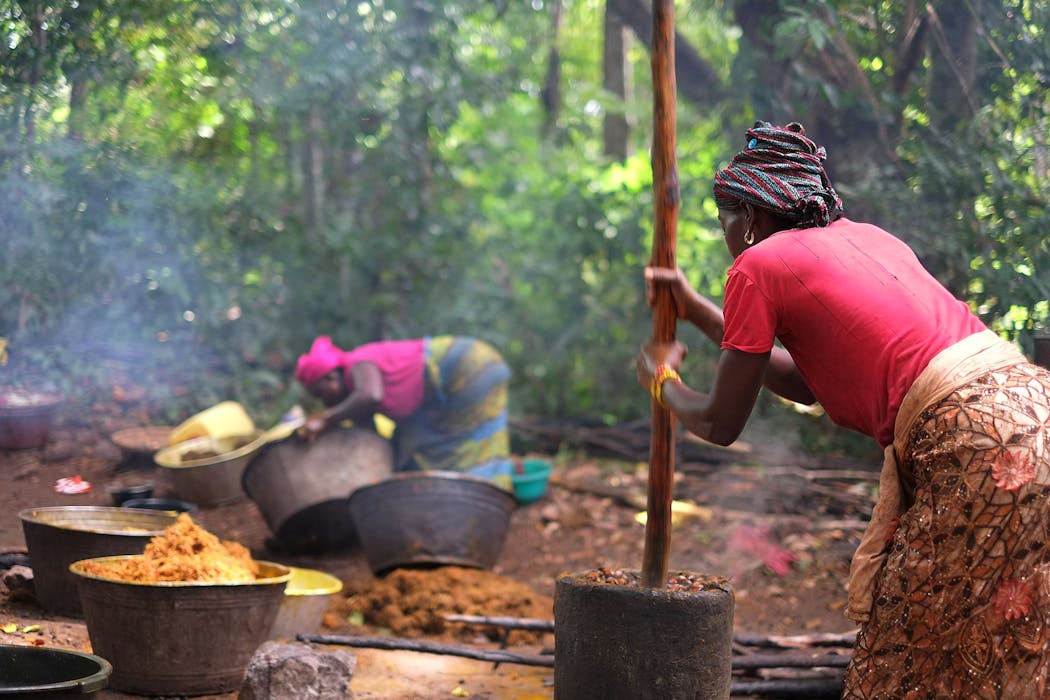
Traditional palm oil extraction in Guinea plays important cultural and nutritional roles. Uzabiaga, 2017, Wikimedia Commons.

Vegetable oils are everywhere, and almost everyone has an opinion about them. From clever marketing in supermarket aisles to headlines about deforestation, they have become both the heroes and villains of the modern diet. But vegetable oils are vital to our lives and can help to address food insecurity.

Consumers trying to make ethical and sustainable purchases find themselves at odds with a marketplace where clickbait often masks reality and reliable information about traceability is often missing or hard to find. A pot of “palm-oil-free” peanut butter does not necessarily disclose what the palm oil was replaced with, or how and where the peanuts were produced.

In a market flooded with controversy and conflicting messages, informed consumption is a challenge. Which oils should we really be using and what’s the truth behind their production?

Consumers are entitled to clear ingredient transparency. More accurate information enables us to make choices that genuinely align with our values. Our recent research across three studies explores how nutrition, sustainability and transparency intersect in the world of vegetable oils.


Read more:
Iceland advert: conservation is intensely political, let’s not pretend otherwise


Few foods illustrate the complexity of our global food system quite like vegetable oils. Used in cooking, processed foods, cosmetics, plastics and biodiesel, the global demand has quadrupled in 50 years, making vegetable oils a cornerstone of both diets and economies. An estimated 37% of agricultural crop land is used by oil crops, such as soybean, oil palm, rapeseed and sunflower.

Yet, this demand also drives major health and environmental pressures. With 2 billion more mouths to feed in the coming decades, several hundred million hectares of land – ten times the area of the UK – will need to be allocated to vegetable oil production. Decisions about which crops are used and how they are produced will have critical environmental and social consequences.

Vegetable oil crops, including soy and maize, take up 37% of the world’s agricultural crop land and are among the fastest growing commodities.
Erik Meijaard, CC BY-NC

Don’t call me fat

“Fat” has long-held negative connotations. This has led to extreme health advice calling for anything from the total omission of seed oils to eating a stick of butter as a snack or adding a shot of coconut oil to one’s coffee.

Alongside this, alarmist marketing campaigns have painted certain vegetable oils, most notably palm oil, as the agent of mass extinction and deforestation.

But behind every bottle on a supermarket shelf lies a more complex story: a network of farmers, factories and policies that shape not only what we eat but also how land is used and how livelihoods are sustained.

We need to stop treating dietary fat as a villain. Yes, trans-fats are harmful, but evidence on saturated fats is mixed and context-specific. Frying risks are overlooked and fat replacers are often oversold.

Importantly, a global “fat gap” coexists with obesity – really, some people need more fat in their diet. The idea that some fats are good for you and others aren’t isn’t clear cut.

The consumer blind spot

Claims about the foods we consume can become part of popular discourse. Take WWF’s 2009 claim that 50% of supermarket products contain palm oil. Is it true now? Our findings suggest at least not everywhere.

How easily could it be proved to be true then? Ever? It’s hard to tell, without clear historical evidence of how the original claim was made. But has this claim encouraged millions of consumers to avoid palm oil? Absolutely.

This is not a matter of overturning palm oil’s bad reputation, but one of noting the sheer lack of clarity and transparency in ingredient information. Many food products list only “vegetable oil” without specifying type or origin and sustainability labels are inconsistent and easily manipulated.

This lack of transparency fuels misinformation and prevents consumers from aligning purchases with their values. This fundamentally slows down any efforts from consumers and policymakers to improve sustainability within the food system.

The human dimension: culture and equity

Vegetable oils are more than ingredients. They’re woven into our culture, economies and identity. From palm oil in south-east Asia and west Africa to olive oil in the Mediterranean, their value extends beyond nutrition or environmental metrics.

Which oil a consumer chooses depends on culture, price, taste, and many perception, some better informed than others.
Erik Meijaard, CC BY-NC

In an era of rising food insecurity, affordable oils remain a vital source of nutrition and income for millions. Calls to eliminate certain oils can carry hidden social costs, undermining livelihoods in producing regions. No oil is inherently good or bad.

Rather than asking which oil is best, we should question how our oils are made, who benefits, and which systemic changes truly serve people and the planet.

Ultimately, companies need to disclose sourcing origins and processing methods, and policymakers must mandate labelling that disclose an ingredient’s true environmental and social effects. Only then consumers can know how best to choose a varied mix of traceable oils, without the hype.

Technology such as QR codes and mobile applications can already enable this and by demanding greater traceability, shoppers can help shift towards fairer and more sustainable food systems.


Don’t have time to read about climate change as much as you’d like?

Get a weekly roundup in your inbox instead. Every Wednesday, The Conversation’s environment editor writes Imagine, a short email that goes a little deeper into just one climate issue. Join the 45,000+ readers who’ve subscribed so far.


The Conversation

Serge Wich is a professor at Liverpool John Moores University. He receives funding from United Nation Environmental Programme (UNEP) under the Global Environment Facility (GEF) Congo Basin Impact Program (PCA/2022/5067) to conduct research on vegetable oils in Central African countries. He is also a member of the IUCN Global Oil Crops Task Force.

Erik Meijaard works for Borneo Futures and consults to Soremartec SA and Soremartec Italia, Ferrero Group, in the framework of its Sustainable Nutrition Scientific Board. Erik co-chairs the IUCN Global Oil Crops Task Force. We thank Emily Meijaard for developing the initial pitch and story line.

ref. Which cooking oil is best? Asking how they’re made could tell you more – https://theconversation.com/which-cooking-oil-is-best-asking-how-theyre-made-could-tell-you-more-267266

Russia now has a strategy for a permanent state of hybrid war

Source: The Conversation – UK – By Stefan Wolff, Professor of International Security, University of Birmingham

Drone incursions into Poland, fighter jets in Nato airspace, election interference in Romania and Moldova and “little green men” (soldiers of unconfirmed origin) in Estonia. These are just a few examples of the tactics Russia has been using in the past few weeks.

They appear to be part of a much broader strategy variously referred to as the “Gerasimov doctrine”, non-linear war or new-generation warfare. What lies behind these terms is the very worrying and very real “weaponisation of everything” – Moscow’s strategy to reshape international order.

As a researcher on great-power rivalries in Eurasia, I’ve observed this kind of hybrid warfare long before the full-scale invasion in Ukraine. We saw it most obviously with Russian interference in the 2016 US presidential elections. But it has intensified since the Ukraine conflict began in 2022.

These tactics cover a broad spectrum. They range from information operations, including propaganda and disinformation campaigns, to attacks on critical infrastructure, such as undersea cables. They involve the use of drones to disrupt air traffic and malicious cyber-attacks against Russia’s enemies. They have also included assassination campaigns against defectors and dissidents in the UK and elsewhere.

Russia is struggling to retain its traditional influence in post-Soviet regions like the south Caucasus and central Asia. Meanwhile it has also sought to extend its influence elsewhere, such as in Latin America or Africa.

But the main focus of the Kremlin’s hybrid warfare is Europe. The continent has become a key battleground in Moscow’s attempts to restore Russia to its erstwhile great-power status and reclaim a Soviet-style sphere of influence.

At the heart of these efforts is the war against Ukraine. For Russia, victory there is more than the mere military defeat of Ukraine and the permanent weakening of the country along the lines of Moscow’s frequently stated war aims: annexation of one-fifth of Ukrainian territory, limits on the country’s armed forces and no prospect of Nato membership.

While clearly important for Putin, he needs Russia’s victory to signal the extent of his power and at the same time to highlight western impotence to prevent Ukraine’s defeat.

Weakening the west

To win the war against Ukraine, the Kremlin needs to weaken the west and its resolve. In this sense, the intensification of the Kremlin’s hybrid war against Kyiv’s European allies is a tool Moscow uses as part of its broader war effort.

But weakening the west is also an end in itself. A strong EU and Nato alliance would prevent Russia from reclaiming its sphere of influence in central and eastern Europe.

Europe has been slow to rise to the challenge of upping its defence game against Russian aggression. But in the end the simple numbers do not favour Russia. The size of the EU’s economy is roughly ten times the size of Russia’s, and its population is more than three times that of Russia.

The EU’s defence expenditure in 2024 stood at just under US$400 billion (£298 billion), up 19% from 2023, and equal to 1.9% of member states’ GDP. According to the International Institute for Strategic Studies, Russia, by comparison, spent US$145 billion, or an ultimately probably unsustainable 6.8% of its total GDP.

In terms of purchasing power parity (the buying power of different countries’ currencies using a common “basket of goods”), Russia still marginally outspends the EU. But not if non-EU Nato members such as the UK and Norway are factored into the equation.

So far, Russia has not been able to decisively outperform Ukraine’s military on the battlefield. With the transatlantic alliance – and hence US support – still by and large intact and a more assertive coalition of European allies backing Kyiv emerging, this is unlikely to change soon.

That is why Russia employs its wide range of hybrid warfare tools against European societies. It needs to sow doubt over their ability to prevail, to cause perceived hardship that makes supporting Ukraine unattractive, and to support populist allies who promote pro-Russian narratives, be they government parties in Hungary or Slovakia or opposition parties in Germany and elsewhere.

Permanent state of war

From the Kremlin’s perspective, the logic is probably very simple. Using the full spectrum of hybrid warfare signals that Russia has the capability and the will to make the costs for supporting Ukraine unacceptable for Europe.

With European support for Kyiv ebbing away, Russia will either defeat Ukraine outright on the battlefield or force the country into humiliating concessions at the negotiation table. Either outcome will damage European credibility and morale and allow Moscow to set the terms of a reshaping of the continent’s security order along the lines of one of the Kremlin’s favourite current talking points – “indivisible security”.

Indivisible security was one of the themes of Vladimir Putin’s speech at the annual meeting of the Valdai discussion club – a gathering of Russian and pro-Russian foreign and security policy analysts. By this he simply means a prioritisation of Russian interests over those of its neighbours – in other words a western recognition of a Russian sphere of influence.

But it would be a mistake to assume that recognising such a Russian sphere of influence would satisfy the Kremlin today in the same way as it may have satisfied Soviet rulers during the cold war. On the contrary, a Russian victory in and beyond Ukraine would most likely encourage dreams of further expansion.

The 2025 annual report of the Valdai club, written by some of Russia’s leading foreign policy thinkers, is instructive in this respect. Titled “Dr Chaos or how to stop worrying and love the disorder”, the report posits that the very purpose of war may have changed from victory to “maintaining a balance necessary for a period of relative peaceful development”.

If turned into actual policy, the kind of hybrid warfare the Kremlin has pursued against Europe for more than a decade, becomes a permanent feature of Russia’s relations with Europe. This is a vision that exposes the limits of Russia’s aspirations – managing chaos and loving disorder – and the dangers they imply for the rest of the world.

The Conversation

Stefan Wolff is a past recipient of grant funding from the Natural Environment Research Council of the UK, the United States Institute of Peace, the Economic and Social Research Council of the UK, the British Academy, the NATO Science for Peace Programme, the EU Framework Programmes 6 and 7 and Horizon 2020, as well as the EU’s Jean Monnet Programme. He is a Trustee and Honorary Treasurer of the Political Studies Association of the UK and a Senior Research Fellow at the Foreign Policy Centre in London.

ref. Russia now has a strategy for a permanent state of hybrid war – https://theconversation.com/russia-now-has-a-strategy-for-a-permanent-state-of-hybrid-war-266936

Can Netanyahu survive peace?

Source: The Conversation – UK – By John Strawson, Emeritus Professor of Law, University of East London

Now a ceasefire has come into effect in Gaza, Israel’s long-serving prime minister, Benjamin Netanyahu, faces the dilemma of how to campaign ahead of the next national elections. These elections must be held, at the latest, in one year’s time.

In a meeting at the Knesset in Jerusalem on October 13, both Netanyahu and opposition leader Yair Lapid made speeches that seemed to open the election campaign. Netanyahu chose to cast himself as war victor, while Lapid emphasised the liberal values contained in Israel’s declaration of independence.

Donald Trump also addressed Israeli lawmakers at the Knesset and, in his speech, paid many compliments to Netanyahu. He even directed a request to Israel’s president, Isaac Herzog, to pardon Netanyahu over longstanding fraud and bribery charges – something Herzog has already suggested.

But the US president also issued Netanyahu with a warning that Israel could not fight the world. Netanyahu has received a lesson in big power politics over the past month that will not have been welcomed.

It came after his miscalculation in attacking Qatar on September 9, where Hamas representatives were discussing the possibility of a plan to end the war in Gaza. Netanyahu was called to the White House and made to apologise to the Qatari government.

He was then pressured into signing up to Trump’s 20-point peace plan, which includes a “realistic pathway” to Palestinian self-determination and statehood. This is something Netanyahu has long opposed and puts him in a difficult position with his electoral base, which is vociferously against a Palestinian state.

The question now is can Netanyahu turn Trump’s plan to his advantage and win the next election?

Some commentators, such as Middle Eastern affairs expert Shira Efron, think Netanyahu has not realised that the Gaza deal represents a defeat for his government. Efron says the agreement contradicts what Netanyahu has sold Israelis for two years: the promise of total victory and the destruction of Hamas.

However, I think this underestimates a politician who has made a career out of turning obstacles into opportunities. His first election as Israel’s prime minister in 1996, for example, came despite trailing his rival Shimon Peres by a substantial margin in opinion polls at the start of the election campaign.

He has also learned to build coalitions with figures on the left, like former Israeli prime minister Ehud Barak, the centre like Benny Gantz and, of course, with the far-right politicians Bezalel Smotrich and Itamar Ben Gvir.


Read more:
Itamar Ben-Gvir and Bezalel Smotrich: the Netanyahu government extremists sanctioned by the UK


His speech in the Knesset during Trump’s visit was vintage Netanyahu. He spun the peace deal, which he was forced to sign, into a massive victory for Israel’s war aims in Gaza. Only weeks before he had been saying that Hamas could only be crushed by conquering Gaza City.

It is true that the living hostages have now been freed. But, in deploying 7,000 armed men to control areas in Gaza vacated by Israeli forces, Hamas hardly seems destroyed. Netanyahu has nonetheless convinced himself – and will now try to convince the electorate – that he has led Israel to total victory.

Prospects of success

Opinion polls since the October 7 Hamas attacks in 2023 have not made good reading for Netanyahu. However, despite this disaster taking place on his watch, Netanyahu’s polling has never been disastrous.

Current polls suggest that, if elections were held today, his Likud party would be the biggest single party in the Knesset. However, his ruling coalition would be unlikely to return to power. The same polling gives the Netanyahu bloc 51 seats compared to 55 for the opposition, with the balance held by Arab parties.

The opposition bloc ranges from the right, led by former Israeli prime minister Naftali Bennett, to the dovish Democrats. They are united in opposition to Netanyahu’s style of government and his judicial reforms, but they have not yet found a convincing narrative of what they stand for.

Whereas Netanyahu unites his bloc, the opposition is divided between several strong personalities. The leaders that make up this so-called “change bloc” – Naftali Bennett, Avigdor Lieberman, Benny Gantz, Yair Lapid and Yair Golan – all think they should be Israel’s next prime minister.

But unlike the last election in 2022, where these parties fought as divided incumbents after a short period in office, they have begun coordinating well in advance of the elections.

The election will be held in the wake of the still palpable trauma after October 7 and exhaustion from two years of war fought on many fronts. Despite this, Israel’s civil society remains healthy.

This has been best exemplified by the Hostages and Missing Family Forum, a body that has not only campaigned publicly for the hostages return but also provided vital services to the families and released hostages. The big question will be the effect of such movements on the way Israelis vote.

Much, of course, will also depend on how Trump’s peace plan develops on the ground. If the US and its allies can deploy an international stabilisation force and create a semblance of a governing authority in Gaza to take over from Hamas, then calm may be maintained. This could boost Netanyahu’s reelection chances if he can spin it as a win for Israel.

Looming over the plan is the decommissioning of Hamas – not just guns and rockets but also dismantling its network of tunnels beneath Gaza. This process is unlikely to be smooth. It is possible that Trump’s plan will still allow Netanyahu some more opportunities to demonstrate military prowess ahead of the election. This might help mobilise support for his coalition, particularly among the far right.

Since the start of the war in Gaza, the Israeli prime minister has compared himself to Winston Churchill, Britain’s leader during the second world war. Churchill did indeed win the war, but went on to lose elections in 1945. Netanyahu will be working hard to prove that part of the comparison wrong.

The Conversation

John Strawson does not work for, consult, own shares in or receive funding from any company or organisation that would benefit from this article, and has disclosed no relevant affiliations beyond their academic appointment.

ref. Can Netanyahu survive peace? – https://theconversation.com/can-netanyahu-survive-peace-267383

The BBC is a partisan battleground – why does Japan’s public broadcaster escape the same fate?

Source: The Conversation – UK – By Steven David Pickering, Honorary Professor, International Relations, Brunel University of London

William Barton/Shutterstock

Public service broadcasters are supposed to be the most trusted news outlets in democratic societies. Funded through models like licence fees and free from advertising, they are meant to stand apart from commercial media.

But our new study of trust in the BBC in the UK and NHK in Japan shows that reality is more complicated. Politics and ideology divide trust in public broadcasters in very different ways.

Like the BBC, NHK is a nationwide broadcaster with a mandate to serve the public interest and a fee-based funding model – making it a useful comparison. But there are differences: NHK’s budget is approved every year by parliament, and its style is often seen as cautious or technocratic. Unlike the BBC, it has not become a lightning rod for partisan battles.

In the UK, the BBC commands middling levels of trust overall, but those levels are deeply polarised. And the results of a recent survey reveal that the public is worried about political interference in the BBC.

As part of our TrustTracker research, we asked people how much they trust the BBC on a scale from one (“not at all”) to seven (“completely”). We ran this survey every month for 19 months, from December 2022 to June 2024. We also asked them how they voted at the 2019 general election.

On that 1-7 scale, average trust in the BBC was 3.6. As far as political affiliation, the people most trusting of the BBC were Lib Dem voters, giving an average of 4.5 on the 1-7 scale. Next up were Labour voters, coming in around 3.9. Conservative voters were nearer 3.2, while people who voted for the Brexit party, the predecessor of Reform, averaged just 2.2.

This is a divide that we don’t really see in Japan: there is much less polarisation around NHK than there is for the BBC.

In Japan, trust in NHK clusters in the mid-3s across the major parties. Supporters of the ruling Liberal Democratic party (LDP, centre-right) tend to rate NHK a little lower than average, while backers of the Constitutional Democratic party (CDP, centre-left) rate it slightly higher. Supporters of the Japan Innovation party (JIP, right-leaning) and the Japanese Communist party (JCP, left) fall in between, but the differences are modest.

In Japan, NHK isn’t the partisan lightning rod that the BBC has become. Trust levels are modest and remarkably uniform, suggesting that while it may be seen as dull or technocratic, it is not a site of political polarisation.

Partisan battleground

The UK’s partisan divide around media becomes even more apparent when we look beyond the Beeb. Many people have little trust in the news they read on social media. But people who voted for the Brexit party in 2019 trust the BBC even less than social media.

That tells us something important. The BBC has become the focal point for wider partisan scepticism about the media. In our study, Conservative voters show lower trust than Labour or Lib Dem voters, but it is Brexit party supporters who are the most hostile, rating the BBC even less trustworthy than social media news.

This division has been baked in for years. When we look back to the 2016 referendum, Leave voters average about 3.0 on our BBC trust scale, compared with 4.1 among Remain voters. That gap highlights how Brexit now functions as a shorthand for a wider political divide in the UK, one that still shapes how people view certain issues, including the BBC.

The BBC has become a political lightning rod: rejected by anti-establishment voters on the right, and strongly embraced by liberal-centrist voters.

Why the difference?

The contrast is not just about governance models or funding arrangements. The BBC’s licence fee and NHK’s parliamentary budget oversight play a role, but the bigger story is political culture.

In the UK, criticism of the BBC has become part of political identity on the right. Conservative politicians and sections of the press have long accused it of bias, not only in its coverage of Europe, immigration and culture, but also in its metropolitan outlook.

These debates escalated after Brexit, when the BBC came under fire from both Conservative MPs and the Brexit Party, which cast the broadcaster as out of touch with “ordinary people”.

The BBC is not simply one broadcaster among many; it has become a symbol around which partisan distrust gathers.

In Japan, NHK attracts none of this polarisation. Across supporters of all mainstream parties, trust in NHK sits at a broadly similar, middling level. Small anti-NHK protest parties exist, but they remain fringe. Mainstream parties have not made hostility to NHK a defining issue.

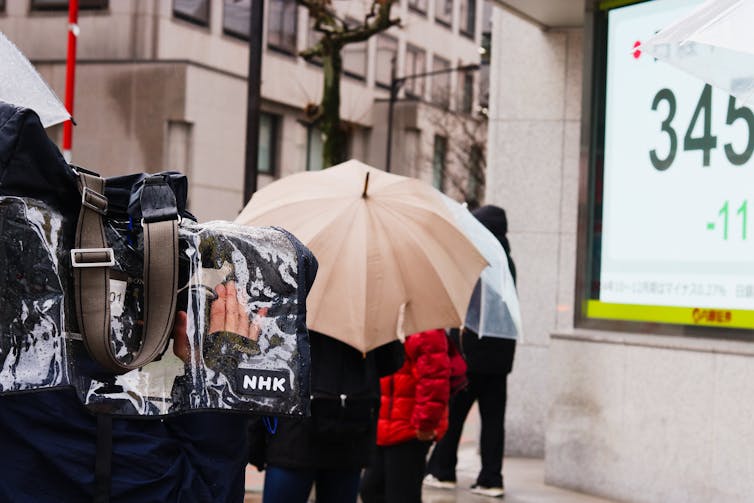
An NHK cameraman films a reporter with an umbrella on a rainy day
Trust levels in Japan’s NHK broadcaster are modest yet steady across the political spectrum.
Ned Snowman/Shutterstock

As a result, NHK is seen less as a political symbol and more as a technocratic background institution: rarely inspiring enthusiasm, but also not a target of partisan attack or polarisation.

One of the BBC’s founding principles is that it needs to entertain. But this opens it to both loyalty and attack. Supporters value the passion it inspires, but this comes at the cost of deep political polarisation.

NHK, by contrast, avoids such extremes by being more technocratic. This also means it struggles to command the same public enthusiasm or cultural weight as the BBC. Whether broadcasters should aspire to one model or the other depends on whether stability or symbolism is more important in sustaining public trust.

At a time when misinformation spreads rapidly and public trust in institutions is under strain, public broadcasters are supposed to provide a shared ground of reliable information. Our findings suggest they still do, but in different ways.

The Conversation

Steven David Pickering received funding from the UK Research and Innovation’s Economic and Social Research Council (UKRI-ESRC, grant reference ES/W011913/1).

Yosuke Sunahara receives funding from Japan Society for the Promotion of Science (JSPS, grant reference JPJSJRP 20211704).

Martin Ejnar Hansen does not work for, consult, own shares in or receive funding from any company or organisation that would benefit from this article, and has disclosed no relevant affiliations beyond their academic appointment.

ref. The BBC is a partisan battleground – why does Japan’s public broadcaster escape the same fate? – https://theconversation.com/the-bbc-is-a-partisan-battleground-why-does-japans-public-broadcaster-escape-the-same-fate-266315

El infundado temor de volver a coger peso tras un cáncer de mama

Source: The Conversation – (in Spanish) – By Cristina Roldán Jiménez, Profesora de Fisioterapia, Universidad de Málaga

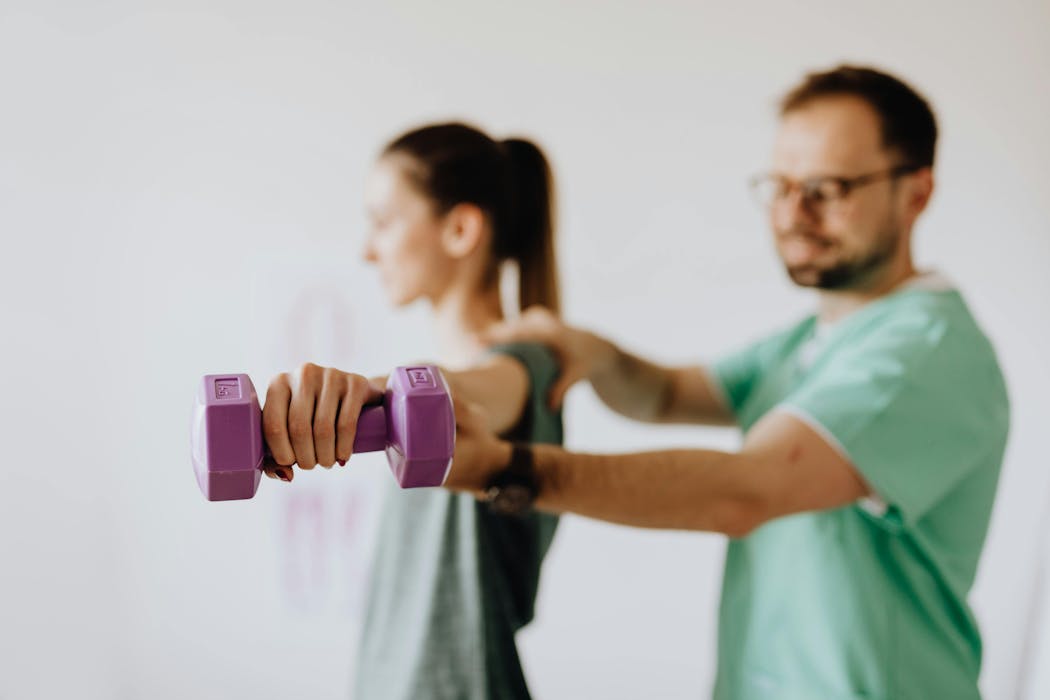
La fisioterapia permite realizar un enfoque terapéutico y personalizado de la actividad física, incluido el ejercicio de fuerza, en las pacientes de cáncer de mama que han sufrido una intervención quirúrgica. Kaboompics.com/Pexels, CC BY

Cada año, más de 2 millones de personas reciben el diagnostico de cáncer de mama en el mundo. Aunque puede afectar a ambos sexos, es mucho más prevalente en mujeres; de hecho, es el tipo de cáncer más frecuente en la población femenina.

Gracias a los avances médicos, muchas pacientes superan la enfermedad, pero deben hacer frente a cambios físicos, psíquicos, sociales, familiares y laborales que les obligan a llevar una nueva vida en cuestión de semanas.

Y en el caso de haber sufrido una cirugía, hay que añadir una cicatriz interna: el miedo a coger peso con los brazos y realizar actividades cotidianas. ¿Está justificada esa aprensión?

El miedo al linfedema

La limitación del uso del brazo después de una operación por cáncer de mama ha sido un palo en la rueda en la recuperación de estas pacientes desde hace décadas. Su supuesta justificación era la posibilidad de que los tratamientos oncológicos dañen el sistema linfático, que podría entenderse como un sistema circulatorio independiente (a través de sus canales, vasos y capilares, repartidos por todo el organismo, circula la linfa).

En ciertas zonas, como la axila, encontramos ganglios linfáticos, una especie de pequeñas estaciones que depuran la linfa retirando sustancias que deben de ser eliminadas del organismo. Además, esos ganglios guardan relación con el sistema inmunitario. En algunas ocasiones, están afectados por el tumor y es necesario extirparlos, lo que afecta a la circulación del sistema linfático. Otras veces, la aplicación de radioterapia en la zona también puede alterar esa circulación, aumentando el riesgo de linfedema.

El linfedema es una acumulación de líquido (linfa) en la extremidad superior, lo que provoca síntomas como dolor y pesadez, así como alteraciones de la función y el aspecto externo del brazo.

Siempre se creyó que la actividad de la extremidad superior aumentaba el riesgo de padecer linfedema, por lo que se recomendaba no usarla. Por ejemplo, en los años 70 se aconsejaba evitar cualquier ejercicio que aumentase el flujo sanguíneo, y en los años 80 había una larga lista de cosas que no podía hacer la paciente con su brazo.

Del “reposo oncológico” al movimiento como motor de recuperación

Tales prohibiciones se sumaban a la prescripción de reposo, cuyo objetivo era aliviar el cansancio. De hecho, hasta 1989 no se publicó el primer estudio sobre los beneficios del ejercicio aeróbico en el paciente oncológico y, concretamente, en las mujeres con cáncer de mama.

A principios del siglo XXI empezaron a aparecer publicaciones que referían los posibles beneficios del ejercicio para la función física y el peso corporal en las pacientes. Además, caminar durante la quimioterapia o la radioterapia parecía mitigar el cansancio. Actualmente, las principales organizaciones oncológicas indican que la actividad física debe formar parte del tratamiento del cáncer.

Mujer haciendo ejercicio
Las principales guías oncológicas recomiendan que las pacientes con cáncer de mama realicen ejercicio físico adaptado desde el momento del diagnostico y a lo largo del tratamiento de la enfermedad.
Pexels

¿Qué ejercicio se puede hacer después de una cirugía por cáncer de mama?

Tanto el ejercicio aeróbico como el de fuerza están recomendados antes, durante y después de un cáncer de mama, lo que incluye el ejercicio con pesas en las extremidades superiores. Multitud de estudios indican que esta actividad no solo es segura, sino que además mejora los síntomas en aquellas pacientes que ya tienen linfedema. De hecho, también se aconseja para prevenir su aparición.

Pero sabemos que decir no es hacer: múltiples barreras dificultan la práctica de ejercicio en las pacientes. En un período de tiempo muy corto, han sufrido muchos cambios físicos: pérdida de masa muscular, pérdida de función, aumento de peso, cansancio, dolor… También ignoran qué hacer o cuándo empezar.

El papel de la fisioterapia

En primer lugar, debemos tener en cuenta que el ejercicio es recomendable siempre y cuando sea individualizado. Y aquí entra entra en juego la fisioterapia, imprescindible para realizar un enfoque terapéutico y personalizado del ejercicio.

De la mano de la fisioterapia, la paciente tiene que empezar a mover el brazo justo después de la cirugía. Poco a poco deben ir incluyéndose movimientos y actividades en el día a día, hasta comenzar a coger peso en torno a la cuarta o sexta semana tras la operación.


Leer más:
Mamografías periódicas y ejercicio físico, claves en el pronóstico del cáncer


Aunque es esperable dejar un período de recuperación e ir aumentando el peso paulatinamente, no hay tope en la cantidad que puede cogerse. Cualquier pauta que contemple una limitación está basada en el mito que relaciona esa actividad con la aparición de linfedema.

Un mito por desterrar

Hacer frente a una enfermedad como el cáncer de mama y sus secuelas es una experiencia difícil. Unirlo, además, a la falsa creencia de que la paciente ya no podrá volver a realizar actividades cotidianas, como coger a un nieto en brazos o ser independiente para hacer la compra, sólo conduce al miedo, a la fragilidad y a una privación de los beneficios que procura el ejercicio.

Aunque ya la ciencia nos ha mostrado que usar el brazo después de una cirugía por cáncer de mama es seguro y beneficioso, aún queda por difundir este mensaje que llegue a toda la sociedad.

The Conversation

Cristina Roldán Jiménez no recibe salario, ni ejerce labores de consultoría, ni posee acciones, ni recibe financiación de ninguna compañía u organización que pueda obtener beneficio de este artículo, y ha declarado carecer de vínculos relevantes más allá del cargo académico citado.

ref. El infundado temor de volver a coger peso tras un cáncer de mama – https://theconversation.com/el-infundado-temor-de-volver-a-coger-peso-tras-un-cancer-de-mama-265544

Hay tantos “idiomas del amor” como especies en el planeta

Source: The Conversation – (in Spanish) – By Federico Zurita Martínez, Profesor del Departamento de Genética. Imparto docencia en Genética y en el Master en "Cultura de Paz, Conflictos, Educación y Derechos Humanos" en la Universidad de Granada., Universidad de Granada

Apareamiento de escarabajos de la especie _Rhagonycha fulva_. Wirestock Creators/Shutterstock

Nunca una termita subterránea como Reticulitermes grassei construirá el termitero de una especie que anida en la madera, como Kalotermes flavicollis. Tampoco una cigüeña levantará un nido de paloma ni una abeja fabricará un panal de avispa. A una cebra no hay que enseñarle a huir de una leona, ni a un ñu de un cocodrilo.

Son comportamientos que no se aprenden y forman parte del repertorio innato de cada especie. Están controlados por los genes y , por tanto, se heredan. Surgen de forma automática cuando aparece el estímulo específico, y todos los individuos de la especie responden de manera prácticamente idéntica.

Señales que seducen (y a quién)

Las diferencias anatómicas, fisiológicas y de comportamiento entre los dos sexos atraen al sexo contrario. El abanico de plumas de un pavo real “enamora” a las hembras de pavo real, pero las gallinas son insensibles a él. Se han descrito hasta 14 000 cantos distintos en pájaros: cada especie tiene su propio “idioma musical”. Para las hembras, el canto de un macho de su especie es afrodisíaco y el de un macho de otra, irrelevante.

La melena de un león atrae a las leonas, pero no a las tigresas. Además se ha descrito que la longitud de dicha pelambrera está relacionada con el éxito en la competencia con otros machos y con la esperanza de vida reproductiva del ejemplar que la porta. Se ha visto también que sus crías tienen una mayor tasa supervivencia.

El dorso plateado de un gorila surge tras una descarga notable de testosterona, indica madurez sexual y liderazgo, y resulta irresistible para las hembras de gorila, pero no para las de chimpancé.

El dorso plateado de los gorilas se relaciona con la descarga de testosterona.
Wikimedia Commons., CC BY

Los órganos que emiten señales en los machos, coevolucionan con los órganos receptores que poseen las hembras de esa especie al unísono: ellos emiten señales, ellas desarrollan sentidos que las interpretan y reaccionan en consecuencia a esas señales. Si la evolución concertada de los dos sexos se desacompasa, la especie se acaba extinguiendo, cosa que ha ocurrido infinidad de veces a lo largo de la evolución.

También ocurre que, a veces, esos sistemas no son perfectos. Un león puede rugir con fuerza, lucir una melena espléndida y defender con éxito su territorio, pero tener fertilidad reducida por un recuento bajo de espermatozoides o, incluso, esterilidad si no tiene espermatogénesis. La apariencia no siempre correlaciona exactamente con la salud reproductiva.

Feromonas teledirigidas

Junto a los estímulos visuales y sonoros, hay otro lenguaje químico: las feromonas. Las feromonas sexuales son moléculas que se liberan al medio por uno de los sexos y que no se ven, pero son detectadas por el sexo opuesto, y funcionan en este como seductoras.

También son específicas de especie, reforzando así el aislamiento reproductivo: evitan que hembras de una especie respondan a las feromonas emitidas por machos de otra, lo que supondría un gasto de energía inútil ya que, en caso de producirse, la cópula no sería productiva. Están ampliamente distribuidas en el reino animal, lo que evidencia un origen evolutivo muy antiguo.

Nosotros, los humanos

Nuestra especie no puede escapar por completo de su propia biología: emitimos y descodificamos señales constantemente. Por ejemplo, las secreciones de las glándulas areolares de la madre estimulan el reflejo de succión en los recién nacidos humanos. Está demostrado que los bebés responden a su olor incluso antes de haber sido alimentados previamente. Inducen respuestas como la orientación de la cabeza y movimientos orales en el bebé, facilitando la localización del pezón y el reflejo natural de succión.

Por otra parte, la androstadienona, una potencial feromona humana derivada de la testosterona que se encuentra en el sudor, el semen y otros fluidos corporales masculinos, parece estar implicada en el atractivo sexual, aunque su efecto depende del contexto.

Al igual que en otras especies, respondemos a estas señales, aunque en nosotros se añade una complejidad extraordinaria: la que aporta la cultura, esa segunda naturaleza que poseemos.

El tiempo no pasa en balde

De la misma manera que un león envejecido pierde parte de su melena y resulta menos atractivo para el sexo opuesto, en los humanos hay señales que evidencia la pérdida de vigor reproductivo. Un ejemplo evidente es la simetría facial, que suele asociarse a belleza y salud. Con la edad, el rostro refleja el paso del tiempo y esa percepción de atractivo tiende a disminuir. La pérdida de tersura en la piel y la flacidez muscular contribuyen también a ello.

De alguna manera el envejecimiento lanza señales de que nuestro potencial reproductivo decae. A todo eso se suman otros factores: la expresión, la voz, los recursos que posee cada individuo o la salud que proyecta.

Catherine Hakim, en su libro Capital erótico: el poder de fascinar a los demás, analiza cómo estos aspectos influyen en la percepción de atractivo. En los humanos, cortejo y elección de pareja combinan instintos, feromonas y cultura en una mezcla compleja y variable según el contexto social.

Lo fascinante es pensar que detrás de cada persona que nos atrae hay millones de años de evolución y siglos de cultura compartida, organizados en lo más recóndito de nuestro ser.

The Conversation

Las personas firmantes no son asalariadas, ni consultoras, ni poseen acciones, ni reciben financiación de ninguna compañía u organización que pueda obtener beneficio de este artículo, y han declarado carecer de vínculos relevantes más allá del cargo académico citado anteriormente.

ref. Hay tantos “idiomas del amor” como especies en el planeta – https://theconversation.com/hay-tantos-idiomas-del-amor-como-especies-en-el-planeta-265494

“Lo estás haciendo bien”: un mensaje básico en matemáticas, sobre todo para las niñas

Source: The Conversation – (in Spanish) – By María Villarroya Gaudó, Profesora Titular de Universidad del área de Arquitectura y Tecnología de Computadores. Instituto de Investigación en Ingeniería de Aragón, Universidad de Zaragoza

BearFotos/Shutterstock

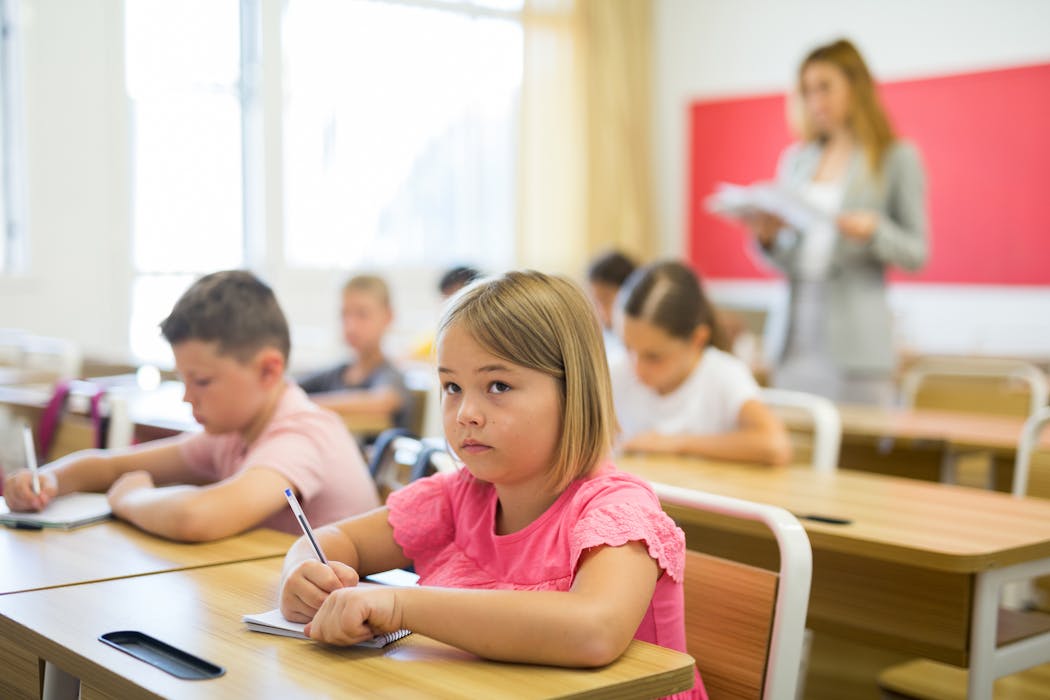
Niños y niñas comienzan su etapa académica, a los 5 años, con aptitudes matemáticas similares, pero tan pronto como un año después, a los 6, se observa que las niñas van tomando miedo a la asignatura y pierden confianza: piensan que se les da mal.

Si pensamos que una materia académica se nos da mal, lo que se denomina “baja autoconfianza”, es más probable que nuestros resultados sean peores y nuestro interés disminuya. Si nos estresamos ante a un examen de matemáticas (algo que ocurre a muchos niños ya a los seis años), también se notará en nuestro rendimiento.

Nuestro grupo de investigación hizo una encuesta a 2 000 escolares de primaria en Aragón para investigar qué papel juegan el miedo y la autoconfianza de niños y niñas a lo largo de la educación primaria, tanto en matemáticas como en lengua.

Encontramos que en el primer ciclo (entre 6 y 7 años, 1º y 2º de primaria) niñas y niños mostraban preferencias similares entre ambas asignaturas y además pensaban que eran igual de buenos en las dos. Sin embargo, en el segundo ciclo (8 y 9 años) ya aparecen diferencias: los niños se consideran mejores en matemáticas que las niñas, y estas se sienten más competentes en lengua.

En tercer ciclo (10-11 años) esta diferencia continúa creciendo. Por ejemplo, solo el 54,9 % de las niñas pensaban que se les dan bien o muy bien las matemáticas, frente al 71,5 % de los niños.

Pero curiosamente, en la asignatura de matemáticas no hay diferencias estadísticamente significativas entre los resultados académicos de las niñas y los niños en Aragón. Es decir, las niñas y niños tienen resultados igual de buenos, pero ellas sienten que se les da peor. Y este sentimiento les aleja de las matemáticas.

Ansiedad matemática

También observamos diferencias en la preocupación ante los exámenes. Ya las más pequeñas se preocupan más que ellos por las pruebas escolares de cualquier asignatura, especialmente en matemáticas.

Esta preocupación aumenta con los años en todos los estudiantes, pero la brecha de género persiste. En tercer ciclo, muchas declaran estar muy preocupadas con frecuencia. En cambio, en lengua, la preocupación es similar en ambos géneros, incluso entre los niños, que en general se sienten menos competentes en esa asignatura.


Leer más:
La primera infancia, clave para evitar estereotipos sobre las carreras científicas


Evitar la competitividad y las prisas

Está demostrado que cambiar la manera en la que enseñamos y examinamos las matemáticas tiene un gran impacto en los resultados, el miedo y la autoconfianza, particularmente de las alumnas. Se consigue, por ejemplo, quitando los límites de tiempo estresantes, haciendo actividades colaborativas en vez de competitivas y reduciendo la importancia de los errores.

Hay más factores que influyen, como ciertos estereotipos: las matemáticas se consideran para gente “brillante”, y desde muy pequeñas, las chicas se consideran más trabajadoras, pero menos inteligentes. Los estereotipos también hacen que a veces los profesores subestimen la capacidad matemática de sus alumnas. La opinión de las familias también puede tener un gran impacto sobre la autopercepción de los alumnos, incluso cuando obtienen buenas notas.

Por otro lado, muchas maestras de primaria sienten ansiedad por las matemáticas, y estos sentimientos se transmiten a las alumnas y no a los alumnos, probablemente porque se se ven reflejadas en ellas.

Desconocimiento de los docentes

En nuestro estudio, analizamos brevemente la opinión de los profesores. Queríamos saber si eran conscientes de la autopercepción negativa de sus alumnas. El 90 % del profesorado pensaba que las chicas nunca o casi nunca sentían que se les daban mal las matemáticas. Si los docentes no detectan esta situación, porque las niñas tienen buenos resultados o, al menos, resultados acordes con los que obtienen en otras asignaturas, es difícil que pueden aplicar medidas para reforzar la autoestima de las alumnas.

Recordemos que las matemáticas son importantes en el día a día, imprescindibles incluso para hacer un bizcocho de chocolate. Además son necesarias en un gran número de profesiones tecnológicas, muchas que ya conocemos y otras que ni siquiera somos capaces de imaginar. No podemos permitirnos que los miedos y falsas creencias alejen a muchas niñas de las matemáticas, y menos que condicionen su futuro profesional.


Leer más:
¿Por dónde perdemos a las científicas? El mayor ‘agujero’ es el de la confianza


Cambiar el método

Debemos darles a las niñas todas las oportunidades. Para ello hay que modificar la forma de enseñar y, sobre todo, de examinar las matemáticas. Hay que apoyar al profesorado, combatir los estereotipos y promover palabras de aliento desde las familias y la sociedad para cambiar esta tendencia. A nosotras alguien nos dijo que lo hacíamos bien y por ello disfrutamos tanto de nuestra profesión. Díganselo más a muchas más niñas. “Lo estáis haciendo bien”.

The Conversation

María Villarroya Gaudó es investigadora del Instituto de Investigación en Ingeniería de Aragón de la Universidad de Zaragoza. Ha recibido fondos de Instituto de las Mujeres, FECyT y Cátedra de Igualdad y Género de la Universidad de Zaragoza y el Gobierno de Aragón para el proyecto Una ingeniera en cada cole y el libro 10001 amigas ingenieras. Ella es Profesora Titular de la Universidad de Zaragoza y miembro de la Asociación de Mujeres Investigadoras y Tecnólogas en Aragón.

Elena Fillola es miembro de la Asociación de Mujeres Investigadoras y Tecnólogas, en la rama de Aragón.

ref. “Lo estás haciendo bien”: un mensaje básico en matemáticas, sobre todo para las niñas – https://theconversation.com/lo-estas-haciendo-bien-un-mensaje-basico-en-matematicas-sobre-todo-para-las-ninas-260762