Source: The Conversation – (in Spanish) – By Javier Belloso Ezcurra, Profesor Departamento Estadística, Informática y Matemáticas, Universidad Pública de Navarra
El dilema de un coche oculto como premio en un concurso de televisión nos sirve para comprender el problema de Monty Hall. Roman Petrov / Unsplash., CC BY
Imagine que participa en un concurso de televisión donde ganar un coche es el premio. Frente a usted hay tres puertas cerradas: detrás de una hay un coche y detrás de las otras dos, sendas cabras. Para ganar el coche, tiene que acertar la puerta tras la que está. Y puede ser cualquiera de las tres.
El presentador le pide que elija una. Lo hace. Después, él abre una de las puertas no elegidas y muestra una cabra. Entonces llega la pregunta clave: ¿quiere mantener su elección o cambiar a la otra?
La mayoría de la gente cree que da igual: al principio, con tres puertas, la probabilidad de esconder el coche se repartía 33–33–33; ahora que hay dos, nos quedamos con 50–50. Pero no es así.
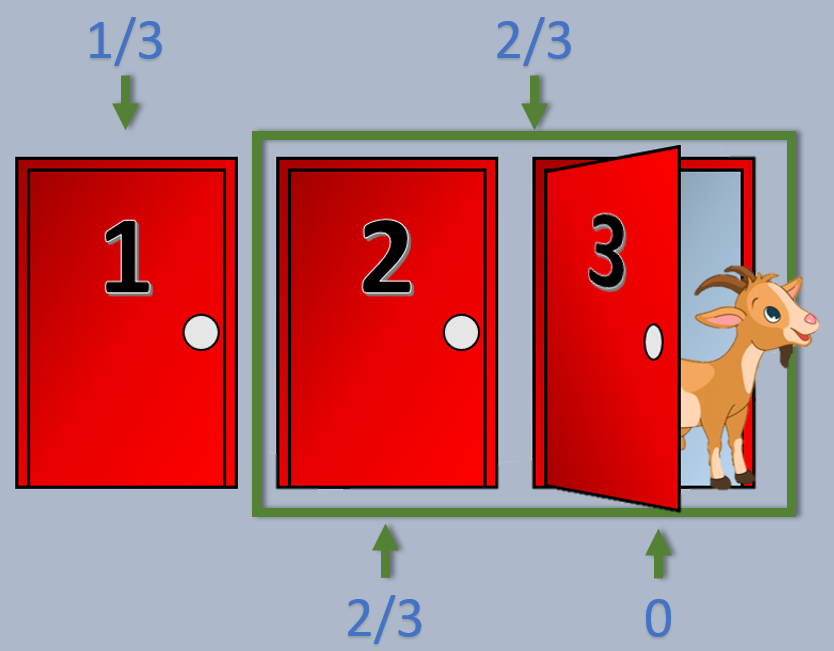
El coche tiene una probabilidad de 1/3 de estar detrás de la puerta elegida por el jugador. Las otras dos puertas tienen una probabilidad de 2/3. Joaquín Córdova / Wikimedia Commons., CC BY
Ilusiones estadísticas
Este pequeño juego fue bautizado como el problema de Monty Hall, en honor al nombre del presentador del concurso televisivo estadounidense Let’s Make a Deal. El problema fue planteado y resuelto por el matemático Steve Selvin, en 1975. Y se ha convertido en uno de los rompecabezas más famosos de la estadística, porque desafía nuestra intuición de una forma casi incómoda.
En ocasiones, se describe como una ilusión estadística, incluso en publicaciones especializadas, por la distancia entre lo que sentimos que debería ocurrir y lo que realmente ocurre.
Cuando el anfitrión abre una puerta, las probabilidades para los dos conjuntos no cambian, pero las probabilidades se mueven a 0 para la puerta abierta; y 2/3 para la puerta cerrada (2). Joaquín Córdova / Wikimedia Commons., CC BY
Lo fascinante es que, detrás de esta decisión aparentemente trivial, se esconde que, cuando recibimos nueva información –a pesar de que parezca irrelevante– nuestras probabilidades cambian, aunque no siempre sepamos cómo actualizarlas correctamente. Entramos en el terreno de las matemáticas, la probabilidad condicionada y el teorema de Bayes, donde todo se vuelve menos intuitivo.
Sin embargo, podemos explicarlos sin necesidad de todo esto: basta con la lógica, la proporcionalidad y el sentido común para entender por qué la elección del presentador ha hecho que la balanza se incline claramente y una de las puertas sea más prometedora que la otra a la hora de esconder el coche.
Suponemos que el concursante ha elegido la puerta A, aunque el razonamiento sería exactamente el mismo si hubiera elegido la B o la C.
Si el concursante ha elegido la puerta A, entonces, le toca el turno al presentador que puede abrir la B o la C indistintamente, siempre con la única condición de no mostrar el coche, de modo que se mantenga el enigma de dónde está, que es la clave del juego.
Supongamos que ha abierto la B, abrir la C habría llevado exactamente al mismo punto. Al hacerlo quedan dos opciones ya que B está descartada:
Si el coche está en A, podía haber abierto B o C indistintamente (ambas tienen cabra). Por tanto, la probabilidad de que abra B no es del 100 %, sino del 50% compartida con C.
Si el coche está en C, entonces la puerta B es la única que podía haber abierto. En ese caso, la probabilidad de que abra B es del 100 %. El doble que el anterior.
Esto implica que el hecho de que el presentador haya abierto B es más compatible con el escenario “el coche estaba en C” que con el escenario “el coche estaba en A”.
Desde el otro lado
Damos la vuelta al razonamiento y pensamos en términos del concursante, que es quien tiene que tomar la decisión. Al observar que el presentador ha abierto la B, y como esa acción es más probable cuando el coche está en C que cuando está en A, entonces, para él, pasa a ser más probable que el coche esté en C que en A.
Por tanto, si es más probable que el coche esté en C, entonces cambiar a C incrementa la probabilidad de ganar, porque el comportamiento del presentador revela información que favorece ese escenario más que el otro.
¿En qué medida? teniendo en cuenta que una es el doble de la otra (de 50 % a 100 %) y no hay más opciones, para completar el 100 % como suma de ambas nos queda un reparto de 33%-66% para las opciones A y C, respectivamente.
La intución puede fallar
En la motivación del presentador, al abrir la puerta B, tiene más peso el hecho de que el coche esté tras la puerta C que tras la puerta A. Y, por eso, es más probable que esté tras esa puerta. Esta es la razón por la cual, si el concursante cambia de elección, las probabilidades de ganar son mayores.
Esta explicación vale si el concursante ha elegido A. Para las otras dos opciones el planteamiento es el mismo: si elige B, se intercambia A con B. Si elige C, se intercambia A con C.
En el fondo, el problema de Monty Hall nos recuerda que la intuición puede fallar, hasta en situaciones simples. Actualizar la información correctamente no solo cambia el resultado: cambia nuestra comprensión de cómo funciona realmente el azar.
Y aceptar esa idea, aunque desafíe lo que “nos parece lógico”, es parte esencial de pensar mejor.
Javier Belloso Ezcurra no recibe salario, ni ejerce labores de consultoría, ni posee acciones, ni recibe financiación de ninguna compañía u organización que pueda obtener beneficio de este artículo, y ha declarado carecer de vínculos relevantes más allá del cargo académico citado.
Source: The Conversation – (in Spanish) – By Estefanía Hita Egea, Docente y formadora de profesorado experta en tecnología educativa y liderazgo, UNIR – Universidad Internacional de La Rioja
Los primeros tres años de vida son decisivos para el desarrollo infantil. En este periodo se sientan las bases del lenguaje, la seguridad emocional y la forma en la que los niños se relacionan con su entorno. Lo que ocurre en este periodo influye en el aprendizaje y el bienestar a lo largo de toda la vida.
Por eso, la educación de 0 a 3 años no es solo una ayuda para conciliar. Es una herramienta clave para reducir desigualdades. Actuar en esta etapa permite compensar diferencias sociales antes de que se hagan visibles en la escuela.
Sin embargo, no todos los niños acceden a las mismas condiciones. El precio, los horarios, la estabilidad de los centros o la calidad de los proyectos cambian mucho según el lugar. Estas diferencias aparecen incluso antes de que los niños empiecen a hablar, y tienen consecuencias reales en su desarrollo.
España tiene una alta tasa de escolarización en la etapa de 0 a 3 años, con un 41,8 % de niños escolarizados, por encima de la media de la OCDE. Pero escolarizar no es lo mismo que garantizar igualdad de oportunidades. Lo importante no es solo cuántos niños asisten, sino en qué condiciones lo hacen.
La educación infantil como ascensor social
Hasta los tres años se desarrollan capacidades fundamentales para aprender. El lenguaje, la atención o la regulación emocional dependen en gran medida de los entornos en los que crecen los niños. Cuando estos entornos son estables y de calidad, los beneficios se mantienen en el tiempo.
Actuar pronto es más eficaz que intervenir tarde. Corregir desigualdades cuando ya están consolidadas resulta más difícil y costoso. Por eso, la etapa de 0 a 3 años tiene un enorme potencial como ascensor social.
Pero este ascensor solo funciona con equipos estables, profesionales bien formados y una relación cercana con las familias.
España: una responsabilidad compartida
En España, esa etapa infantil sigue sin ocupar un lugar claro en las políticas educativas. El Gobierno central, las comunidades autónomas y los ayuntamientos comparten competencias. Sin embargo, la responsabilidad se reparte de tal forma que, en la práctica, nadie la asume del todo.
La falta de una apuesta clara y sostenida convierte dicho periodo de la vida en un espacio frágil. Las decisiones suelen depender del presupuesto disponible y cambian con facilidad. Esto afecta a la estabilidad de los centros, a los equipos educativos y a las familias.
Aunque la escolarización ha crecido, las condiciones son muy desiguales según el territorio. Precios, horarios y calidad varían de una comunidad a otra, e incluso entre municipios. Con frecuencia, cada administración traslada el problema a la siguiente, sin poner en el centro lo que está en juego.
El caso del País Vasco ilustra bien estas tensiones entre administraciones. En municipios como Vitoria-Gasteiz, Oiartzun, Andoain o Irún, entre otros,familias y profesionales han alertado del impacto que determinados cambios en financiación y organización pueden tener sobre proyectos educativos ya consolidados.
Las decisiones, centradas fundamentalmente en criterios económicos y en el debate sobre el modelo de gestión y el reparto de responsabilidades sobre el reparto de responsabilidades entre el Gobierno autonómico y los ayuntamientos, afectan directamente a la estabilidad de los equipos, a la continuidad de los proyectos ya consolidados y a la posibilidad de generar vínculos educativos sólidos con los niños y sus familias. Cuando ninguna administración asume plenamente esta etapa como una prioridad educativa, son las familias y los propios centros quienes soportan las consecuencias.
Esta situación no es exclusiva del País Vasco. En otras comunidades autónomas se repite un patrón similar: cambios en regulación, financiación o ratios que responden más a la contención del gasto que a una planificación educativa a largo plazo. Aunque los contextos territoriales son distintos, el resultado se repite. Cuando la educación de 0 a 3 años queda atrapada en un juego de responsabilidades compartidas pero no asumidas, su potencial para reducir desigualdades se debilita de forma significativa.
Europa: cuando invertir en la infancia es una prioridad
En otros países europeos, la educación en esa etapa entiende de otra manera. No es un recurso complementario, sino una política educativa básica. Forma parte del estado del bienestar.
En Finlandia, por ejemplo, todas las familias tienen derecho a una plaza tras el permiso parental. El sistema combina educación, salud y apoyo a las familias. La pregunta no es cuánto cuesta, sino qué aporta.
En países como Suecia o Dinamarca ocurre algo similar. Los equipos son estables y los proyectos no dependen de decisiones puntuales. Existe un acuerdo amplio sobre la importancia de invertir en la primera infancia.
Estos países han entendido que invertir al principio reduce problemas después. Por eso, la educación de 0 a 3 años no se discute como un gasto, sino como una inversión social.
El reto pendiente
La etapa de 0 a 3 años es breve, pero fundamental. Una educación infantil de calidad en estos años no solo acompaña el desarrollo madurativo, sino que ayuda a prevenir desigualdades antes de que aparezcan en la escuela.
Aunque España ha avanzado en escolarización, el verdadero reto está en cómo se cuida esa etapa. Garantizar condiciones estables, profesionales formados y proyectos educativos sólidos requiere una apuesta clara y compartida por parte del Gobierno central, las comunidades autónomas y los ayuntamientos. Cuando estas decisiones se toman solo desde el criterio económico, se pierde de vista lo más importante: el desarrollo infantil.
Estefanía Hita Egea no recibe salario, ni ejerce labores de consultoría, ni posee acciones, ni recibe financiación de ninguna compañía u organización que pueda obtener beneficio de este artículo, y ha declarado carecer de vínculos relevantes más allá del cargo académico citado.
En los últimos tiempos estamos volviendo a un ambiente internacional de confrontación geopolítica y económica. Junto con el temor a los conflictos bélicos, asistimos a la vuelta a tensiones proteccionistas que parecían cosa del pasado.
¿Es natural y sano que cada uno defienda lo suyo frente a sus rivales? En economía, ¿debe una región o una empresa luchar contra la competencia hasta eliminarla? ¿Puede la confrontación ser una fuente de autodesarrollo? ¿Qué podemos aprender de un contexto de confrontación constante como el boxeo?
La competencia es el pilar de la economía de mercado
En economía, la competencia se considera un pilar fundamental para el buen funcionamiento de los mercados y el crecimiento a largo plazo: incentiva la eficiencia global del sistema, conduce a un mejor uso de los recursos, a la innovación y al progreso tecnológico.
Las empresas, para conseguir atraer a los clientes, deben realizar mejoras continuas en la oferta. Eso incluye adaptaciones a los diferentes segmentos y ofertas con condiciones más ajustadas. Como resultado, mejora el bienestar de los consumidores y el crecimiento económico.
Por esa razón, la competencia debe protegerse a través de normas, procedimientos e instituciones (como las autoridades de defensa de la competencia existentes a nivel europeo, estatal y autonómico).
Competencia y empresa
En las memorias de sostenibilidad de las empresas también se considera a la competencia como uno de los stakeholders o partícipes sociales. Sin embargo, los criterios de la relación con este grupo están poco desarrollados.
En la lógica empresarial domina la confrontación. Tiene sentido, dado que la base de la competencia es el enfrentamiento en los mercados, la rivalidad, la lucha.
Además, la estrategia empresarial está repleta de lenguaje bélico: guerras comerciales, estrategias defensivas y ofensivas, dominio del mercado, poder de negociación, tomado de los tratados de estrategia militar, como el clásico “El Arte de la Guerra”, de Sun Tzu.
Las empresas, siguiendo esa lógica de rivalidad, tratan de destruir a sus competidores y adquirir posiciones dominantes. Por su parte, las autoridades públicas deben poner freno a estas prácticas, limitando la excesiva concentración en los mercados y evitando así los posibles abusos de poder.
Respetar al rival merece la pena
Ahora, hagamos un paralelismo entre la competencia entre empresas y el boxeo. Desde el punto de vista psicológico, se han identificado capacidades transformativas de los elementos involucrados en el combate. Como en la economía, un reto desafiante hace crecer significativamente los niveles de motivación, resiliencia y autoexigencia.
Algo similar ocurre en la empresa. La comparación con competidores de referencia se convierte en la base de un proceso de mejora continua que propicia el crecimiento de la organización.
Para que surjan oportunidades hay que sembrar
En el deporte y en la empresa, el respeto y reconocimiento mutuo abonan el campo de la colaboración y el crecimiento compartido. Aunque en un principio no parezcan los socios idóneos, también son posibles las alianzas entre competidores. Lógicamente son más sencillas cuando la competencia no es directa y se pueden aprovechar las complementariedades entre los colaboradores.
Esto ocurre cuando los competidores están especializados en segmentos de actividad diferentes o tienen fuertes capacidades en zonas geográficas diversas, sean de distribución o acceso a autorizaciones.
Las farmacéuticas o las empresas cerveceras intercambian habitualmente licencias y marcas. De esa manera pueden acceder, con menor inversión y riesgo, a negocios que quedarían fuera de su alcance.
También en el deporte el respeto en la confrontación directa puede abonar el campo para nuevas oportunidades. Es el caso de los boxeadores Marco Antonio Barrera y Erik Morales. Durante años protagonizaron una rivalidad épica que, además de forjarlos como leyendas, los hizo reconocerse mutuamente. Años después, dirigen juntos uno de los pódcast en español más exitosos sobre boxeo. Juntos han demostrado que la competencia puede dar pie no solo al rendimiento sino también al crecimiento en distintos ámbitos.
Coopetir: colaborar y competir a la vez
El término coopetición, acuñado en 1996 por los profesores e investigadores Adam Brandenburger y Barry Nalebuff, combina cooperación y competencia, y consiste, básicamente, en la colaboración estratégica entre empresas que, al mismo tiempo, compiten en otros ámbitos del mercado. Las empresas pueden colaborar con rivales para alcanzar objetivos que ninguna podría lograr por sí sola. Pueden acceder a tecnologías, compartir costos o ampliar mercados.
Aunque tradicionalmente las empresas consideran que la competencia es incompatible con la cooperación, en la práctica esto es cada vez más común y una acción estratégica en diversos sectores. Grandes rivales, como Apple y Samsung en el suministro de componentes, o DHL y UPS compartiendo capacidades logísticas, han protagonizado grandes acuerdos cooperativos.
La competencia respetuosa favorece a todos. A nivel colectivo, actúa como un mecanismo dinamizador de la economía, promoviendo la eficiencia, la innovación y el bienestar social. Individualmente, incentiva la mejora y crecimiento de los propios competidores. Y, por último, hace posible que surjan oportunidades de colaboración que no podrían generarse en entornos empresariales hostiles.
En definitiva, la competición debe venir acompañada de respeto. Y el respeto es contrario a la destrucción. De esta manera, además de mejorar el funcionamiento de los mercados, se abrirán más oportunidades para las empresas, más allá del puro incentivo de ganar a sus competidores.
Ñ
Las personas firmantes no son asalariadas, ni consultoras, ni poseen acciones, ni reciben financiación de ninguna compañía u organización que pueda obtener beneficio de este artículo, y han declarado carecer de vínculos relevantes más allá del cargo académico citado anteriormente.
Buque Kairos de la “flota fantasma” rusa, sancionado por la Unión Europea, el Reino Unido y Suiza por el tráfico ilegal de petróleo.Todor Stoyanov-Raveo/Shutterstock
Las cifras extraídas de la base de datos LSEG (London Stock Exchange Group) indican un incremento significativo en el tránsito de petróleo ruso por aguas españolas. Antes de las sanciones que la Unión Europea (UE) impuso a Rusia con motivo de la invasión de Ucrania, el puerto de Ceuta ocupaba la posición 90.ª en el ranking europeo de descargas de petróleo ruso. Hoy, está en la 11.ª posición.
Mientras Bruselas trata de bloquear este tráfico, la “flota fantasma” rusa utiliza puertos españoles para exportar crudo a Europa. El objetivo es eludir las sanciones impuestas por la UE. Las consecuencias son económicas y geopolíticas, pero también medioambientales.
El sur de Europa como vía de entrada
Las sanciones a Rusia han redefinido el mapa de flujos de petróleo y gas rusos hacia la UE. La normativa vigente prohíbe la entrada de los barcos de la “flota fantasma” en puertos europeos. Sin embargo, la realidad es otra. Aunque en diciembre de 2025 el número de buques sancionados ascendía a casi 600, la lentitud en trasponer la Directiva UE 2024/1226 y en aplicar de forma efectiva las restricciones aprobadas por la UE genera una laguna jurídica que es aprovechada por la flota rusa.
Así, se han detectado violaciones de las sanciones europeas por entradas de buques sancionados en países como Chipre, España, Estonia, Grecia, Malta y Países Bajos.
Al cerrarse el norte de Europa, la flota rusa ha encontrado una vía alternativa de entrada en los países del sur. Entre 2022 y 2025, los países con más descargas de buques con petróleo de origen ruso fueron Italia, Grecia y España. La mayoría de estos buques han sido sancionados en algún momento posterior a su atraque en puertos europeos.
Pese a las prohibiciones, el crudo ruso sigue llegando a la UE, a menudo haciendo escalas en otros países. Los cargamentos provienen principalmente de Rusia, pero también de Egipto y Turquía, que actúan como intermediarios.
Esta infraestructura operativa no surgió de la noche a la mañana. La Unión Europea no empezó a sancionar oficialmente a buques de la “flota fantasma” hasta junio de 2024. Ese retraso hizo que Rusia tuviera tiempo suficiente para reorganizar su estrategia logística para exportar petróleo a la UE.
En el sur se han dado cada vez más casos de traspase de petróleo de un barco a otro en alta mar, con los daños medioambientales que esto pueda ocasionar. Eligen el sur porque necesitan aguas tranquilas y una ubicación estratégica para conectar con Asia, algo que el mar del Norte no ofrece.
Así actúa la “flota fantasma”
Las implicaciones de la operación de la “flota fantasma” van más allá de cuestiones económicas o geopolíticas. Estos buques generan riesgos físicos y medioambientales significativos. Se trata de una flota con barcos de gran edad y una operación insegura y precaria. Los petroleros con una antigüedad de entre 16 y 22 años son los más sancionados. Según el KSE Institute ucraniano, a partir de los 15 años decae el mantenimiento y las aseguradoras de primer nivel retiran su cobertura.
Para operar sorteando las restricciones legales, los buques suelen cambiar su bandera, su nombre o el armador. Las cinco banderas más sancionadas son las de Rusia, Gambia, Sierra Leona, Camerún y Omán. Los buques más antiguos, con máximo riesgo físico y medioambiental, utilizan principalmente la bandera rusa, seguida por la de países con regulación laxa como Curazao, Benín, Comoras, Guyana y Omán.
Además, la propiedad del buque se esconde para evitar posibles sanciones: las tres compañías con el mayor número de buques sancionados tienen su sede en UAE (Emiratos Árabes Unidos).
España ha pasado a ser un enclave protagonista en la red de flujos del petróleo ruso. Entre los 20 puertos de la UE donde se han producido más atraques de buques posteriormente sancionados se encuentran Ceuta (11.º), Huelva (17.º) y Cartagena (20.º).
Principales rutas de buques sancionados (2022-2025). A la izquierda, el país de carga, a la derecha, el país de destino. Los autores, CC BY-SA
El riesgo físico y medioambiental en estos puertos derivado de la operación de la “flota fantasma” es elevado. Los buques sancionados por dos jurisdicciones (por ejemplo, UE y EE. UU.) tienen entre 15 y 30 años de antigüedad, con banderas de países variados. Por otro lado, la flota de buques sancionados por tres jurisdicciones destaca por su alto volumen de comercialización y la utilización de la bandera rusa.
Perfil de riesgo que suponen los buques en puertos españoles (2022-2025) según su antigüedad, con cada color indicando una procedencia. Los autores, CC BY-SA
El caso de Ceuta presenta el escenario más preocupante desde el punto de vista medioambiental. Se trata de un puerto con un alto volumen de descargas, la mayoría desde buques posteriormente sancionados por hasta dos y tres jurisdicciones, con antigüedad de entre 15 y 28 años y banderas como las de Sierra Leona, Camerún y Panamá. Estos buques operan con estándares de seguridad poco estrictos.
Perfil de riesgo en el puerto de Ceuta (2022-2025) según la antigüedad de los buques, con cada color indicando el país de la bandera. Los autores, CC BY-SA
Un problema creciente
Los datos revelan un caso flagrante. Se trata de un buque con bandera de Camerún, sancionado el 25 de febrero de 2025 por la UE, que descargó en Ceuta casi 900 000 barriles de crudo el 12 de septiembre de 2025. Este barco provenía del puerto de Murmansk (Rusia).
Además, la “flota fantasma” rusa busca nuevas entradas a la UE. Puertos como los de El Hierro, Motril y Vilagarcía de Arousa, que no habían recibido cargamentos antes de las sanciones a Rusia, sí lo han hecho tras el estallido de la guerra. En 2023, por ejemplo, fueron descargados en ellos más de 1 800 000 barriles por buques provenientes de Rusia con una antigüedad de entre 15 y 23 años.
El volumen de operaciones de la “flota fantasma” rusa en aguas españolas está aumentando. España importa millones de barriles de petróleo ruso transportados en buques antiguos e inseguros. Esto no solo contraviene la normativa europea sobre las sanciones a Rusia, sino que genera riesgos medioambientales y físicos que no pueden ignorarse.
La solución a este problema implica no solo aplicar las sanciones vigentes a los buques de la “flota fantasma” rusa, sino también buscar vías para impedir el atraque y las operaciones de trasvase de buques sospechosos. Si no se actúa ya, la próxima noticia podría ser una catástrofe ecológica como la ocurrida a finales de 2002 frente las costas de Galicia.
Orkestra-Instituto Vasco de Competitividad se financia en parte a través de convenios de investigación sobre temas diversos relacionados con energía y medioambiente firmados con el Ente Vasco de la Energía, Iberdrola, Petronor e Ihobe-Agencia Vasca del Medioambiente.
Antonio García-Amate no recibe salario, ni ejerce labores de consultoría, ni posee acciones, ni recibe financiación de ninguna compañía u organización que pueda obtener beneficio de este artículo, y ha declarado carecer de vínculos relevantes más allá del cargo académico citado.
Source: The Conversation – UK – By Ignazio Cabras, Professor of Regional Economic Development, Northumbria University, Newcastle
English pubs will receive a 15% discount on their business rates from April this year. The government deal, which also applies to music venues, follows a backlash from landlords who were facing a steep increase in their tax bills.
Some industry campaigners have said the support package – worth around £1,600 per pub – will allow landlords to breathe a sigh of relief. Some opposition politicians think it doesn’t go far enough.
Either way, it’s been a tough few years. High energy costs, inflation and wage increases have contributed to the serious financial difficulties facing many pubs.
The sector was also among the worst affected (alongside retail and leisure) by the social distancing and lockdowns of COVID. The government responded at the time by giving pubs significant business rate discounts in a show of support.
Then, in November 2025, it was announced that those discounts would be reduced and then phased out completely. This move, combined with big increases in the rateable values of pub premises, left landlords with the prospect of much higher bills.
But pubs are far more than cash machines for the Treasury. To many, they represent a vital part of British traditions and heritage. They also play a pivotal role in building and maintaining social relationships among the people who live near them.
Whether that’s a family meeting up for Sunday lunch, university students at their society gathering, or some elderly fans of real ale, pubs have a clear and long-standing role in creating community cohesion.
Several scientific studies have measured their positive effects on people, economies and societies.
One, for example, confirms the strong link between pubs and local community events. It has also been shown that pubs are often more effective than other organisations at stimulating a wide range of social activities. This could include everything from sports teams and quiz nights to hosting book groups, as well as charitable and volunteering initiatives.
Pubs also frequently promote community events – such as charity events and social clubs – more effectively than other places such as sport or village halls. Research has shown that in rural areas especially, pubs are very effective – more so than village shops for example – at building community cohesion and local social networks.
Overall, opportunities for communal initiatives in some areas would be extremely reduced, if not nonexistent, without pubs. This is why the loss of a pub has a much broader impact than a mere business closure.
Yet despite all of this proven positive impact, the number of UK pubs has been constantly declining since the start of the century. According to the British Beer and Pub Association, there were 60,800 in 2000, compared to about 45,000 in 2024, meaning one in four closing its doors in the past 25 years.
Life for publicans has been extremely hard for a long time. This is why the changes proposed in the last budget prompted a significant pushback from the industry.
Last orders
But other businesses probably deserve a tax break too. High street shops can also help maintain higher levels of socialisation and community cohesion.
Particularly in remote and rural areas, which suffer from a general lack of local services and public transport options compared to urban areas, these businesses are important in terms of economic development and social activity.
They are also a vital part of their local economic structure, providing employment opportunities and training for local residents. This is why the Treasury should consider a rethink about business rates across the board.
Like pubs, local businesses have value beyond the revenue they generate. A tax system which recognises their positive social impact would be a better and fairer fiscal tool all round.
In the past, Ignazio Cabras’ research work has received financial support from multiple funding bodies, including the British Academy, the Society of Independent Brewers (SIBA), and the Vintners Federation of Ireland (VFI). He is a Fellow of the Academy of Social Sciences (FAcSS).
Time feels like the most basic feature of reality. Seconds tick, days pass and everything from planetary motion to human memory seems to unfold along a single, irreversible direction. We are born and we die, in exactly that order. We plan our lives around time, measure it obsessively and experience it as an unbroken flow from past to future. It feels so obvious that time moves forward that questioning it can seem almost pointless.
And yet, for more than a century, physics has struggled to say what time actually is. This struggle is not philosophical nitpicking. It sits at the heart of some of the deepest problems in science.
Modern physics relies on different, but equally important, frameworks. One is Albert Einstein’s theory of general relativity, which describes the gravity and motion of large objects such as planets. Another is quantum mechanics, which rules the microcosmos of atoms and particles. And on an even larger scale, the standard model of cosmology describes the birth and evolution of the universe as a whole. All rely on time, yet they treat it in incompatible ways.
When physicists try to combine these theories into a single framework, time often behaves in unexpected and troubling ways. Sometimes it stretches. Sometimes it slows. Sometimes it disappears entirely.
The Insights section is committed to high-quality longform journalism. Our editors work with academics from many different backgrounds who are tackling a wide range of societal and scientific challenges.
Einstein’s theory of relativity was, in fact, the first major blow to our everyday intuition about time. Time, Einstein showed, is not universal. It runs at different speeds depending on gravity and motion. Two observers moving relative to one another will disagree about which events happened at the same time. Time became something elastic, woven together with space into a four-dimensional fabric called spacetime.
Quantum mechanics made things even stranger. In quantum theory, time is not something the theory explains. It is simply assumed. The equations of quantum mechanics describe how systems evolve with respect to time, but time itself remains an external parameter, a background clock that sits outside the theory.
This mismatch becomes acute when physicists try to describe gravity at the quantum level, which is crucial for developing the much coveted theory of everything – which links the main fundamental theories. But in many attempts to create such a theory, time vanishes as a parameter from the fundamental equations altogether. The universe appears frozen, described by equations that make no reference to change.
This puzzle is known as the problem of time, and it remains one of the most persistent obstacles to a unified theory of physics. Despite enormous progress in cosmology and particle physics, we still lack a clear explanation for why time flows at all.
Now a relatively new approach to physics, building on a mathematical framework called information theory, developed by Claude Shannon in the 1940s, has started coming up with surprising answers.
Entropy and the arrow of time
When physicists try to explain the direction of time, they often turn to a concept called entropy. The second law of thermodynamics states that disorder tends to increase. A glass can fall and shatter into a mess, but the shards never spontaneously leap back together. This asymmetry between past and future is often identified with the arrow of time.
This idea has been enormously influential. It explains why many processes are irreversible, including why we remember the past but not the future. If the universe started in a state of low entropy, and is getting messier as it evolves, that appears to explain why time moves forward. But entropy does not fully solve the problem of time.
For one thing, the fundamental quantum mechanical equations of physics do not distinguish between past and future. The arrow of time emerges only when we consider large numbers of particles and statistical behaviour. This also raises a deeper question: why did the universe start in such a low-entropy state to begin with? Statistically, there are more ways for a universe to have high entropy than low entropy, just as there are more ways for a room to be messy than tidy. So why would it start in a state that is so improbable?
The information revolution
Over the past few decades, a quiet but far-reaching revolution has taken place in physics. Information, once treated as an abstract bookkeeping tool used to track states or probabilities, has increasingly been recognised as a physical quantity in its own right, just like matter or radiation. While entropy measures how many microscopic states are possible, information measures how physical interactions limit and record those possibilities.
This shift did not happen overnight. It emerged gradually, driven by puzzles at the intersection of thermodynamics, quantum mechanics and gravity, where treating information as merely mathematical began to produce contradictions.
One of the earliest cracks appeared in black hole physics. When Stephen Hawking showed that black holes emit thermal radiation, it raised a disturbing possibility: information about whatever falls into a black hole might be permanently lost as heat. That conclusion conflicted with quantum mechanics, which demands that the entirety of information be preserved.
Resolving this tension forced physicists to confront a deeper truth. Information is not optional. If we want a full description of the universe that includes quantum mechanics, information cannot simply disappear without undermining the foundations of physics. This realisation had profound consequences. It became clear that information has thermodynamic cost, that erasing it dissipates energy, and that storing it requires physical resources.
In parallel, surprising connections emerged between gravity and thermodynamics. It was shown that Einstein’s equations can be derived from thermodynamic principles that link spacetime geometry directly to entropy and information. In this view, gravity doesn’t behave exactly like a fundamental force.
Instead, gravity appears to be what physicists call “emergent” – a phenomenon describing something that’s greater than the sum of its parts, arising from more fundamental constituents. Take temperature. We can all feel it, but on a fundamental level, a single particle can’t have temperature. It’s not a fundamental feature. Instead it only emerges as a result of many molecules moving collectively.
Similarly, gravity can be described as an emergent phenomenon, arising from statistical processes. Some physicists have even suggested that gravity itself may emerge from information, reflecting how information is distributed, encoded and processed.
These ideas invite a radical shift in perspective. Instead of treating spacetime as primary, and information as something that lives inside it, information may be the more fundamental ingredient from which spacetime itself emerges. Building on this research, my colleagues and I have explored a framework in which spacetime itself acts as a storage medium for information – and it has important consequences for how we view time.
In this approach, spacetime is not perfectly smooth, as relativity suggests, but composed of discrete elements, each with a finite capacity to record quantum information from passing particles and fields. These elements are not bits in the digital sense, but physical carriers of quantum information, capable of retaining memory of past interactions.
A useful way to picture them is to think of spacetime like a material made of tiny, memory-bearing cells. Just as a crystal lattice can store defects that appeared earlier in time, these microscopic spacetime elements can retain traces of the interactions that have passed through them. They are not particles in the usual sense described by the standard model of particle physics, but a more fundamental layer of physical structure that particle physics operates on rather than explains.
This has an important implication. If spacetime records information, then its present state reflects not only what exists now, but everything that has happened before. Regions that have experienced more interactions carry a different imprint of information than regions that have experienced fewer. The universe, in this view, does not merely evolve according to timeless laws applied to changing states. It remembers.
A recording cosmos
This memory is not metaphorical. Every physical interaction leaves an informational trace. Although the basic equations of quantum mechanics can be run forwards or backwards in time, real interactions never happen in isolation. They inevitably involve surroundings, leak information outward and leave lasting records of what has occurred. Once this information has spread into the wider environment, recovering it would require undoing not just a single event, but every physical change it caused along the way. In practice, that is impossible.
This is why information cannot be erased and broken cups do not reassemble. But the implication runs deeper. Each interaction writes something permanent into the structure of the universe, whether at the scale of atoms colliding or galaxies forming.
Geometry and information turn out to be deeply connected in this view. In our work, we have showed that how spacetime curves depends not only on mass and energy, as Einstein taught us, but also on how quantum information, particularly entanglement, is distributed. Entanglement is a quantum process that mysteriously links particles in distant regions of space – it enables them to share information despite the distance. And these informational links contribute to the effective geometry experienced by matter and radiation.
From this perspective, spacetime geometry is not just a response to what exists at a given moment, but to what has happened. Regions that have recorded many interactions tend, on average, to behave as if they curve more strongly, have stronger gravity, than regions that have recorded fewer.
This reframing subtly changes the role of spacetime. Instead of being a neutral arena in which events unfold, spacetime becomes an active participant. It stores information, constrains future dynamics and shapes how new interactions can occur. This naturally raises a deeper question. If spacetime records information, could time emerge from this recording process rather than being assumed from the start?
Time arising from information
Recently, we extended this informational perspective to time itself. Rather than treating time as a fundamental background parameter, we showed that temporal order emerges from irreversible information imprinting. In this view, time is not something added to physics by hand. It arises because information is written in physical processes and, under the known laws of thermodynamics and quantum physics, cannot be globally unwritten again. The idea is simple but far-reaching.
Every interaction, such as two particles crashing, writes information into the universe. These imprints accumulate. Because they cannot be erased, they define a natural ordering of events. Earlier states are those with fewer informational records. Later states are those with more.
Quantum equations do not prefer a direction of time, but the process of information spreading does. Once information has been spread out, there is no physical path back to a state in which it was localised. Temporal order is therefore anchored in this irreversibility, not in the equations themselves.
Time, in this view, is not something that exists independently of physical processes. It is the cumulative record of what has happened. Each interaction adds a new entry, and the arrow of time reflects the fact that this record only grows.
The future differs from the past because the universe contains more information about the past than it ever can about the future. This explains why time has a direction without relying on special, low-entropy initial conditions or purely statistical arguments. As long as interactions occur and information is irreversibly recorded, time advances.
Interestingly, this accumulated imprint of information may have observable consequences. At galactic scales, the residual information imprint behaves like an additional gravitational component, shaping how galaxies rotate without invoking new particles. Indeed, the unknown substance called dark matter was introduced to explain why galaxies and galaxy clusters rotate faster than their visible mass alone would allow.
In the informational picture, this extra gravitational pull does not come from invisible dark matter, but from the fact that spacetime itself has recorded a long history of interactions. Regions that have accumulated more informational imprints respond more strongly to motion and curvature, effectively boosting their gravity. Stars orbit faster not because more mass is present, but because the spacetime they move through carries a heavier informational memory of past interactions.
From this viewpoint, dark matter, dark energy and the arrow of time may all arise from a single underlying process: the irreversible accumulation of information.
Testing time
But could we ever test this theory? Ideas about time are often accused of being philosophical rather than scientific. Because time is so deeply woven into how we describe change, it is easy to assume that any attempt to rethink it must remain abstract. An informational approach, however, makes concrete predictions and connects directly to systems we can observe, model and in some cases experimentally probe.
Black holes provide a natural testing ground, as they seems to suggest information is erased. In the informational framework, this conflict is resolved by recognising that information is not destroyed but imprinted into spacetime before crossing the horizon. The black hole records it.
This has an important implication for time. As matter falls toward a black hole, interactions intensify and information imprinting accelerates. Time continues to advance locally because information continues to be written, even as classical notions of space and time break down near the horizon and appear to slow or freeze for distant observers.
As the black hole evaporates through Hawking radiation, the accumulated informational record does not vanish. Instead, it affects how radiation is emitted. The radiation should carry subtle signs that reflect the black hole’s history. In other words, the outgoing radiation is not perfectly random. Its structure is shaped by the information previously recorded in spacetime. Detecting such signs remains beyond current technology, but they provide a clear target for future theoretical and observational work.
The same principles can be explored in much smaller, controlled systems. In laboratory experiments with quantum computers, qubits (the quantum computer equivalent of bits) can be treated as finite-capacity information cells, just like the spacetime ones. Researchers have shown that even when the underlying quantum equations are reversible, the way information is written, spread and retrieved can generate an effective arrow of time in the lab. These experiments allow physicists to test how information storage limits affect reversibility, without needing cosmological or astrophysical systems.
Extensions of the same framework suggest that informational imprinting is not limited to gravity. It may play a role across all fundamental forces of nature, including electromagnetism and the nuclear forces. If this is correct, then time’s arrow should ultimately be traceable to how all interactions record information, not just gravitational ones. Testing this would involve looking for limits on reversibility or information recovery across different physical processes.
Taken together, these examples show that informational time is not an abstract reinterpretation. It links black holes, quantum experiments and fundamental interactions through a shared physical mechanism, one that can be explored, constrained and potentially falsified as our experimental reach continues to grow.
What time really is
Ideas about information do not replace relativity or quantum mechanics. In everyday conditions, informational time closely tracks the time measured by clocks. For most practical purposes, the familiar picture of time works extremely well. The difference appears in regimes where conventional descriptions struggle.
Near black hole horizons or during the earliest moments of the universe, the usual notion of time as a smooth, external coordinate becomes ambiguous. Informational time, by contrast, remains well defined as long as interactions occur and information is irreversibly recorded.
All this may leave you wondering what time really is. This shift reframes the longstanding debate. The question is no longer whether time must be assumed as a fundamental ingredient of the universe, but whether it reflects a deeper underlying process.
In this view, the arrow of time can emerge naturally from physical interactions that record information and cannot be undone. Time, then, is not a mysterious background parameter standing apart from physics. It is something the universe generates internally through its own dynamics. It is not ultimately a fundamental part of reality, but emerges from more basic constituents such as information.
Whether this framework turns out to be a final answer or a stepping stone remains to be seen. Like many ideas in fundamental physics, it will stand or fall based on how well it connects theory to observation. But it already suggests a striking change in perspective.
The universe does not simply exist in time. Time is something the universe continuously writes into itself.
To hear about new Insights articles, join the hundreds of thousands of people who value The Conversation’s evidence-based news. Subscribe to our newsletter.
Florian Neukart does not work for, consult, own shares in or receive funding from any company or organisation that would benefit from this article, and has disclosed no relevant affiliations beyond their academic appointment.
Government plans published earlier this month around the water sector in England and Wales were heralded as a “once-in-a-generation” opportunity to transform the system. However, despite the confidence of UK environment secretary Emma Reynolds, the long-awaited plans raise significant concerns. This is a reform agenda for water as a business – but not a vision for managing a vital public and environmental resource.
The fully privatised water system in England and Wales has been facing two (self-inflicted) crises in recent years. First, companies have failed to invest enough in infrastructure and have been pouring untreated sewage into rivers and seas.
Second, some companies (acting primarily in the interests of their shareholders) have hiked up debts while still paying out dividends. The largest company, Thames Water, has been teetering on the brink of financial collapse since 2023.
Occasional but serious interruptions of water supplies prove that all is not well in water service delivery, and there is growing recognition that the water system is unfit for purpose. We, as academics who helped set up a research body called the People’s Commission on the Water Sector, would have to agree.
But crucially, missing from the government’s white paper detailing the new policy is any reflection on the processes that led to this situation. It acknowledges that companies have behaved badly and that some water companies and their owners have prioritised short-term profits over long-term resilience and the environment.
This is a serious understatement. Underlying the outcomes of the past few years are the profit-seeking activities by private investors. Private companies cut back on costs and manipulated finances to benefit shareholders.
Water users and the environment suffer the consequences. And the regulators, Ofwat and the Environment Agency, were ill-prepared for the scale of the private sector’s extractive practices.
The bottom line is that the profit motive is incompatible with treating water in a way that is socially and environmentally equitable.
Now, the government is proposing a new single regulator with dedicated teams for each company, rather than the four institutions that have been in place until now. In addition, there are plans for better regulation and enforcement for pollution, and improvements to infrastructure (the white paper reveals how little is known about water company assets).
However, the language around regulation is confused and contradictory. On the one hand there is talk of being tough: Reynolds says there will be “nowhere to hide” for errant water companies. And there could be criminal proceedings against directors, who may also be deprived of bonus payments.
But on the other, the language is remarkably accommodating in its approach to the firms that have put the whole system in jeopardy.
Those that were behind the sewage crises and the perilous state of water company finances are to be helped to improve through a “performance-improvement regime”. Considerable attention is devoted to creating an attractive climate for investors, where returns will be stable and predictable. This, despite the fact that recent unpredictability was largely due to the activities of private companies.
Power and politics
If water in England and Wales remains in private hands, the unresolvable tension between the drive for profits alongside controls to protect consumers and the environment will persist. The demands of capital tend to prevail, with considerable government attention devoted to ensuring that the sector is attractive to investors.
As an example, the government claims that the next five years will see £104 billion of private investment. But this ultimately is funded by the planned 36% rise in bills (plus inflation). And a fifth of this (£22 billion) is set aside for the costs of capital, to cover interest payments and dividends.
The focus on regulatory and management measures obscures issues of power and politics in water governance. Water is supplied by companies whose shareholders have immense political power.
Private equity investors BlackRock, the biggest asset manager in the world, has stakes in three water companies – Severn Trent, United Utilities and South West Water (via Pennon). Keir Starmer, the prime minister, entertained BlackRock’s CEO in November 2024 where an overhaul of regulation was reportedly promised.
And Hong Kong-based CKI, once a contender to take over Thames Water, is the majority owner of Northumbrian Water. It also has stakes in Britain’s gas, electricity and rail networks, as well as owning Superdrug and the discount store, Savers.
A similar story is told in other companies. These are global behemoths that have influence and huge resources, and as such may seek to shape regulation in their own interests.
The system in England and Wales is an outlier. No other country has copied this extreme privatised model. In fact, many have taken privatised water back into public hands. In Paris, the public water operator Eau de Paris is an award-winning example of transparency, accountability and integrity in public service.
It demonstrates that it is possible to create public services that are fair, sustainable and resilient. Key to this process has been the vision of water as a vital common good rather than a commodity.
The government’s plans will patch up the water system, particularly with the boost in revenue from bill payers. But the private sector has found unanticipated ways to maximise profits in the past and may well do so again. Rather than continually tweaking the failed private model, the only real route to operating water in the public interest is for it to be in public ownership.
The authors do not work for, consult, own shares in or receive funding from any company or organisation that would benefit from this article, and have disclosed no relevant affiliations beyond their academic appointment.
In November 2012, during my first year as a PhD student, a 23-year-old medical student knocked on my door. Earlier that day, we had been discussing our ages in our shared kitchen. At 30, I had stayed silent, feeling a sharp sting of embarrassment next to my 20-something housemates.
But this student was determined to get an answer from me. He shoved his passport in my face and demanded to see mine. When I admitted my age, he laughed and said: “Wow, you’re so old.”
In that moment, I felt a deep sense of shame and failure. But after a decade of research tracking more than 100 young people, I want to tell my younger self: you weren’t failing. You simply hadn’t inherited the same amount of time as your peer.
My work with students in China shows that social inequality isn’t just about money or status. It’s also about time inheritance.
I started my PhD at 30 only after spending five years working to clear my family’s debts and move my parents out of a house where sewage regularly flooded their floors. My housemate, whose father and grandfather were doctors and Cambridge alumni, had inherited “banked time” – a cushion of security that allowed him to glide straight to the academic starting line.
Banked time v borrowed time
To make sense of this, I distinguish between two kinds of time inheritance.
Some young people receive banked time. They start life with a “full tank”: parents who can afford to support them through unpaid internships, gap years, or an extra degree, and the freedom to change course or repeat a year without financial ruin. This creates a sense of temporal security that allows them to take measured risks, explore their interests, and wait for the best opportunities to arise. They have “slack” in the system that actually generates more time in the long run.
Others live on borrowed time. They start with an “empty tank,” already owing years of labour to their families before they even begin. Because their education often relies on the extreme sacrifices of parents or the missed opportunities of siblings, these students carry a heavy debt-paying mentality.
A delay in earning feels dangerous because it isn’t just a personal setback; it is a failure to repay a moral and economic debt to those who supported them. This pressure works in two punishing ways.
Some make “self-sabotaging” choices by picking lower-tier degrees or precarious jobs just because they offer immediate income. Others find their education takes far longer as they are forced to pause their studies to work and save, trapped in a cycle of paying off “time interest” before they can finally begin their own lives.
Take Jiao, a brilliant student from a poor rural family in China. He scored high enough to enter one of the country’s top two universities: Peking or Tsinghua, the equivalent of Oxford or Cambridge. Yet he chose a second-tier university.
He felt he could not afford the “time cost” of the mandatory military training that was required at the elite universities at the time he was applying. This would have delayed his ability to earn money and support his parents. On paper, this looks like a self-sabotaging decision. In reality, it was a survival strategy shaped by time poverty: he simply did not have months to spare.
In contrast, Yi, born into a comfortable Beijing family, dropped out of university after just one year because she didn’t like the teaching. She didn’t see this as a failure, but as “cutting her losses”. With her parents’ backing, she quickly applied to an elite university in Australia. Yi had inherited banked time, which gave her the security to try again.
Both students were capable. What differed was how much time they could afford to lose.
Lost learning
Although my research focuses on China, these temporal mechanisms are not culturally unique. They show up in different forms in other countries.
We saw this during post-pandemic debates about “lost learning”. In the UK, for example, tutoring programmes and extra school hours were offered as fixes. But these only work if pupils have the spare time to use them.
For those already caring for siblings or parents, working part-time or commuting long distances, the extra provision can become another burden: deepening, rather than reducing, time debt.
In universities, the cost-of-living crisis has pushed more students into long hours of paid work during term. They get through their degrees, but at a price: less time to build networks, take internships or simply think about their next steps.
Rigid career “windows” also matter. Age-limited grants, early-career schemes that expire a few years after graduation and expectations of a seamless CV all act as a time tax on those who took longer to reach the starting line. They might have been caring for relatives, changing country, or working to stay afloat.
Making education fairer means being aware of this time disparity. This could mean designing catch-up and tutoring schemes around the actual schedules of working and caring students, not an idealised timetable.
Within academia, extending age and career-stage limits on scholarships, fellowships and early-career posts would mean that those who started “late” are not permanently penalised. And more recognition of the burden of unpaid care and emotional labour in both universities and workplaces would be a valuable step.
Ultimately, doing well in education is not just about how we spend our time. It is about who is allowed to have time in the first place, and who is quietly starting the race already in debt.
Dr Cora Lingling Xu receives funding from the Cambridge International Trust, the Sociological Review Foundation, the ESRC Social Science Festival,the British Academy and various grants from Queens’ College Cambridge, Cambridge University, Keele University and Durham University.
As winter set in across the UK, the flags strung up during 2025’s controversial Operation Raise the Colours were becoming tatty and grey. Yet, they continue to send an important message: despite increasingly digitally connected lives, neighbourhoods still matter when it comes to political views.
The strength of feeling among those putting up flags since summer 2025 and those who objected to them is proof that people filter big political issues through the places where they live and work. People measure their lives through local heritage, memories and a sense of home. So these areas are also battlegrounds for competing visions of what it means to belong.
Reform UK has clearly recognised this. It has worked hard to win council elections in England, appealing to concerns held across the political spectrum about the character and decline of neighbourhoods. But such tactics tend to to push people’s buttons on sensitive issues such as immigration and encourage resentment.
Historically, local civic institutions – pubs, working men’s clubs, trade union halls, church halls – came into their own when communities faced hard times. They acted as emergency shelters and dining halls, information points and advice services, they gave emotional and practical support, as well as being spaces for enjoyment and celebration. Some such spaces still exist, but today, much of this social infrastructure has declined or been dismantled.
Into this vacuum steps populist right and far-right parties. They generate support by offering some residents a renewed sense of community, security or hope. In Epping, a recent site of major anti-immigrant protests, some residents have established Essex Spartans, a vigilante patrol group to “protect women, children and the elderly”.
Offering help to vulnerable residents in a spirit of community and care is laudable but these groups risk exaggerating local feelings of “stranger danger” towards migrants and minorities. And with alleged connections to both Reform UK and other rightwing groups, Essex Spartans and initiatives like them could create pathways to more extreme perspectives.
Far-right groups such as Homeland are also actively seeking to enter the mainstream civic life of communities. This has included joining parish councils, church congregations and sports clubs, distributing food to homeless people, and establishing litter-picking groups.
Communities pushing back
But it is a common mistake to assume that the political winds are blowing only in the favour of the right and far right, and that working-class white communities are hotbeds of racism or xenophobia. The research I’ve conducted in two of Bristol’s poorest suburbs has revealed the huge efforts made by neighbourhood groups to show that communities targeted by far-right messaging can be inclusive, imaginative and progressive.
These communities fit the profile for an area at risk of far-right influence: working-class, peripheral, declining and predominantly white. Far-right and anti-immigrant sentiments are shared openly on local social media groups, as stickers and graffiti on walls and lampposts, and in conversations in the few pubs and cafes that remain.
So they are not unusual communities, but they are also home to impressive levels of hidden work being done by community activists who want to turn the tide.
In one community that abuts a major logistics zone, British-born and migrant job-seekers and low-waged workers are crammed into overcrowded and low-quality homes. They are drawn there by a promise of plentiful work which does not always materialise.
Instead of simply blaming immigration for negative side effects, several community groups are working together to support the residents, challenge the council and landlords to improve their conditions, and clean up the neighbourhood’s streets.
Monica, manager of the community hall, explains her approach: “Just work on the ground, and person by person.” This is how she helped a longstanding older people’s club and the migrant women learning English down the hallway to start sharing lunch together. Now this semi-regular lunch date has become an unthreatening way for these very different groups to mingle.
In a neighbourhood on the other side of Bristol, decades of neglect, disinvestment and stigma have left the area in decline. But rather than blaming immigration, networks of residents and organisations are leading the charge on neighbourhood renewal.
By pooling resources, skills, and ingenuity, finding workarounds to divert resources where they are needed, they are rebuilding dignity and agency from below. This isn’t dramatic transformation but small changes that benefit everyone, such as reintroducing bins in the park.
Community groups are also safer spaces for difficult conversations about local identity and sense of place that acknowledge residents’ feelings of loss or injustice. Darren, a youth worker, explains that well-loved community spaces are “vital” for keeping conversations respectful.
Bristol’s identity – a vibrant and exciting city with a troubled colonial past – rarely fits their own experience of growing up at its forgotten peripheries. Instead of becoming mired in these citywide “culture wars”, groups in both areas celebrate their neighbourhood’s unique heritage in response to this desire for pride and belonging.
Looking to the future
Community activists nationwide are defying assumptions about working-class neighbourhoods as being “on benefits, uneducated, having loads of kids, racist”, as Trish, a tenants’ group member told me.
With elections around the UK in 2026, the future of the country’s neighbourhoods is up for grabs. But trust in any politician is at rock bottom in these Bristolian communities and elsewhere. One resident told me, if any party set up a stall outside the local shops, “that table’s getting flipped”.
Reform UK doesn’t have a foothold like Labour here, but its candidates could still be in contention here if they can ride their national party’s wave. For now, the hard work of community activists appears to be having some effect.
This fight won’t just play out in the halls of power or the ballot box – it will unfold in streets, parks, and community halls.
Anthony Ince has received research funding from the British Academy and the Independent Social Research Foundation.
Just weeks after the premiere of popular gay hockey romance series Heated Rivalry, star Hudson Williams’ extensive skincare routine has gone viral. In a now-viral video for The Cut, the 24-year-old walks viewers through his “five-step Korean beauty routine.”
His multi-step regimen includes a close shave, a cleanse, pore-minimizing treatments, a “super-glowing” toner and serums targeted toward “rejuvenating” the young star’s face and body.
The nearly 20-minute routine, replete with self-deprecating humour and an ironic bent against vanity, has amassed some 500,000 views (and counting), almost 2,000 comments and 36,000 likes on YouTube alone.
Williams’ routine, and its public broadcast online, is emblematic of a wider shift in our highly visual and virtual culture among men. From style guides and intensive workout routines to recommendations for skin and hair, men are investing in their appearance.
But, in a curious contortion, they’ve called their work on the face and body anything (and everything) but beauty.
I look to taken-for-granted trends online — images and advertisements as well as viral video clips — and their reception among audiences to understand how young people engage with and respond to beauty, and the various privileges and penalties it commands.
Beauty’s cultural force has long weighed upon women, who have been invited to modify their appearances in step with challenging, often contradictory, beauty norms. But in a recent and curious shift, beauty norms and appearance pressures have intensified among men.
‘Heated Rivalry’ star Hudson Williams breaks down his skincare routine for ‘The Cut’
The rise of men’s beauty habits
Men’s bodies are increasingly visible in product advertisements and mainstream campaigns, with a surfeit of cosmetics targeted toward men.
Mundane investments in skincare and grooming are not uncommon, with young men especially doubling down on their efforts to refine the face and body through multi-step routines not unlike Williams’.
Driven at least in part by social media influencers and the rise of platformed figures who dialogue around the importance of looking good, “freshening up” and keeping sharp, men are investing in their appearance as women long have.
Alongside these investments, boys and men are enjoined to bulk up to achieve a muscled and well-defined look. Widely followed influencers and celebrities alike echo the call, endorsing a range of compound exercises to improve one’s physique and “science based” changes to boost growth.
The drive toward muscularity is demanding, with many recommendations touting the importance of rigorous diets and intensive exercise regimes.
In the name of beauty
While some recommendations are innocuous enough, men have entertained more extreme, sometimes dangerous practices to modify and refine the appearance of their face and body.
Sometimes called “looksmaxxing,” a term capturing efforts that enhance men’s appearance, practices like “mewing” and the far more dangerous exercise of “bone-smashing” are often endorsed to promote facial harmony and a stronger jawline.
The preponderance and popularity of these appearance-focused practices online have produced what medical researcher Daniel Konig and his colleagues describe as an “almost pathological obsession” with attractiveness, with significant consequences for boys and men.
Public reporting on men’s relationship to their appearance indicates that a growing number of men are suffering from body insecurity and lower esteem, manifesting in the rise of muscle dysmorphia, a body-image disorder focused on a perceived lack of physical size or strength.
In a similar vein, the United Kingdom’s Sexualization of Young People report indicates that online, boys are increasingly under pressure to “display their bodies in a hyper-masculine way showing off muscles and posturing as powerful and dominant.”
Why men resist calling it beauty
In my ongoing research with young people enrolled at the University of Toronto and MacEwan University, I am documenting a similar set of pressures.
The young people I’ve spoken with insist that while appearance weighs heavily on everyone, men are increasingly subject to the demands of a culture preoccupied with looking good.
For the boys and men I speak with, social media platforms, and the celebrities and influencers who populate them, are a particularly thorny topic. They invite an intense sense of comparison between men and their physiques and, for many, a feeling of not quite being good enough.
Still, few describe these pressures in terms related to beauty per se. As a historically feminized domain, beauty has been derided as frivolous and unimportant. But as many men are coming to find, the truth is far more complex. Beauty returns rewards to those who are thought to possess it or, perhaps, to those who are willing to pay for it.
Selling beauty to the masses
Men represent a growing and lucrative ground on which to sell products and services designed to optimize their appearance.
This previously untapped market segment is ripe for commercial exploitation, with an increasing number of men making spending on beauty products and services.
In 2024, market researcher Mintel reported that more than half of men use facial skincare products, with members of Gen Z accounting for the greatest share of growth in skincare products — especially “high-end” and “clean” products.
Men’s interest in more costly and intensive beauty treatments is also on the rise. The American Academy of Plastic Surgeons reports that a growing number of men are pursuing body augmentation and cosmetic surgery, as well as non-invasive procedures like dermal filler injections and facial neurotoxins like Botox.
Under both knife and needle, beauty’s cultural force is sure to be felt.
Jordan Foster receives funding from the Social Sciences and Humanities Research Council of Canada.