Source: The Conversation – (in Spanish) – By José Antonio Prado Bassas, Profesor Titular de Universidad en el Dpto. Análisis Matemático de la Universidad de Sevilla, Universidad de Sevilla
En una reciente entrevista, el físico y divulgador francés Christophe Galfard, discípulo del mismísimo Stephen Hawking, afirmaba que “el universo que observamos con los telescopios es finito. El infinito solo existe en las matemáticas”.
Puede parecer una afirmación un tanto controvertida e, incluso, atrevida, para alguien que se dedica a la ciencia. Aunque también es cierto que, en nuestra vida cotidiana, usamos la palabra infinito quizás con demasiada ligereza.
El infinito de lo cotidiano
Muchos de nuestros lectores, padres de adolescentes, seguro que profesan una paciencia infinita con ellos (o quizás ellos con nosotros, quién sabe). Cuando una reunión de comunidad o de trabajo se nos hace soporífera, decimos que se nos ha hecho infinita. ¿Y qué me dicen de las esperas infinitas al teléfono para hablar con un humano y no con un chatbot cuando llamamos a un servicio de atención al cliente? Incluso, desde Toy Story nos recordaron que debemos llegar “hasta el infinito y más allá”.
Normalmente, cuando usamos esta palabra, nos referimos a algo extraordinariamente grande, un número descomunal. Sin embargo, en matemáticas, esto no es del todo así.
El infinito en matemáticas
El infinito matemático no es un número, es un concepto. Todos sabemos contar: 1, 2, 3… Para ello, usamos los números, que en matemáticas llamamos números naturales. Pero ¿sabría decirme cuál es el último número que conoce? En realidad, se trata de una pregunta trampa, pues en cuanto por su mente pase un número muy grande, si le pone “más uno”, ya tiene otro más grande.
Desde esta perspectiva, podríamos decir que hay infinitos números (los griegos clásicos –sobre todo, Aristóteles– afirmarían que “hay más números que cualquier cantidad –finita– que podemos imaginar”). El hijo de una buena amiga –la gran divulgadora y matemática Clara Grima– dijo con tan sólo 9 años que “el infinito es eso que os habéis inventado los matemáticos cuando os cansáis de contar”.
La verdad es que la frase no puede ser más acertada. Porque una cosa es que una colección de objetos (o números) sea ilimitada y otra es que digamos que hay infinitos de esos objetos. Esta forma de pensar trae numerosos problemas… que ya Aristóteles vio venir cuando introdujo el concepto de infinito potencial e infinito actual.
El primero es sinónimo de lo ilimitado: hay más objetos que cualquier cantidad que puedas imaginar. Esta idea entra dentro de nuestra lógica. Nuestro cerebro está preparado para aceptarla. Sin embargo, el infinito actual es harina de otro costal. Es ese salto mortal que hay que hacer para decir que hay “infinitos números”. Porque, si aceptamos decir que el tamaño de los números naturales es infinito, entonces empiezan a pasar “cosas raras”. La primera es tratar de responder a esta pregunta: ¿qué hay más, números naturales o números pares?
La respuesta más probable que se nos viene a la cabeza es que hay “el doble de naturales que de pares”. ¿Seguro?
Los tamaños de infinito
Imagine que metemos en un cajón los números naturales y en otro, los pares. Del primer cajón, saco un número natural. Después, busco su doble en el segundo cajón y los emparejo. Si asumimos que este proceso termina en algún momento, resulta que ambos cajones quedan vacíos a la vez. Si, en vez de números, fuesen cucharas y tenedores lo que había en cada cajón… seguro que diríamos que hay la misma cantidad de ambos. Pues con los números ocurre lo mismo.
Raro, ¿verdad? Pero la cosa no acaba aquí. A finales del siglo XIX, un matemático alemán, Georg Cantor, demostró que, aceptando plenamente el infinito actual, no hay un único infinito, sino muchos. ¿Cuántos? Más que cualquier cantidad que podamos imaginar.
Un ejemplo de cómo funciona el argumento diagonal de Cantor para probar la existencia de un conjunto no numerable. Dada la lista inicial, formada por números con alguna cifra marcada en rojo, puede probarse que ningún elemento de la lista coincide con el número cuya expresión tiene las cifras marcadas en azul, ya que dicho número difiere de todos y cada uno de los anteriores. Wikimedia Commons., CC BY-SA
Con su método de la diagonal, Cantor demostró que el infinito de los números naturales, los de contar, es más pequeño que el infinito que surge de contar los puntos que hay en un segmento, el continuo.
Y a partir de aquí, la locura… tanto del infinito como de su hacedor, pues Cantor murió tras sufrir episodios recurrentes de depresión y hospitalizaciones en sanatorios psiquiátricos. Y es que sus revolucionarias ideas fueron duramente criticadas por algunos matemáticos de la época, incluido uno de sus profesores en Berlín, Leopold Kronecker, quien llegó a escribir que Cantor era un “charlatán” y que sus ideas eran “más propias de un circo” que de las matemáticas.
El infinito en la actualidad
Hoy en día, todos alabamos la obra de Cantor y bendecimos el momento en que creó “el paraíso infinito del que nadie será capaz de expulsarnos”, como bien dijo el matemático David Hilbert en 1925.
Así, el infinito ha pasado a ser un concepto más en matemáticas. No es un número, no es una distancia… es la forma que hemos tenido los matemáticos de ir más allá de nuestra mente, sin volvernos locos, y trabajar con ello.
Sin el infinito, no tendríamos cálculo infinitesimal, por ejemplo. Tras su descubrimiento en paralelo por los grandes genios Isaac Newton y Gottfried Leibniz, esta herramienta llegó a su estado actual gracias al concepto de límite, que no es más que esa idea de acercarnos tanto como queramos, pero sin tocar. Y, gracias al cálculo infinitesimal y a sus poderosas herramientas (las ecuaciones diferenciales), hemos conseguido desde domesticar el comportamiento de un electrón, hasta aventurarnos a pisar la Luna o enviar una sonda más allá de los límites de nuestro sistema solar.
Pero… ¿realmente hay cosas infinitas?
Todo lo anterior se puede resumir en que el infinito es la conceptualización de lo muy grande (o lo muy pequeño). No es un número ni una distancia. Es un concepto que podemos estirar y estirar… y llevarlo todo lo lejos que podamos.
En matemáticas, los límites solo los pone nuestra imaginación. Sin embargo, en física –las matemáticas aplicadas a la vida real–, hay limitaciones propias de nuestro universo.
Por tal motivo, para encontrar algo verdaderamente infinito en el universo que habitamos solo hay que buscar en un lugar muy concreto: la mente de un matemático.
El infinito puede no existir en la realidad, pero su estudio por parte de las matemáticas es esencial para comprender el mundo que nos rodea: de lo extremadamente grande a lo increíblemente pequeño. Cosas de la ciencia básica…
José Antonio Prado Bassas no recibe salario, ni ejerce labores de consultoría, ni posee acciones, ni recibe financiación de ninguna compañía u organización que pueda obtener beneficio de este artículo, y ha declarado carecer de vínculos relevantes más allá del cargo académico citado.
Neuf grands projets de transport sur dix dépassent leur budget initial. Ce n’est pas toujours une question d’incompétence. Souvent, un chiffre précis est annoncé trop tôt, alors que beaucoup de variables restent encore incertaines. Des hypothèses fragiles deviennent alors des promesses publiques. Le dérapage, pourtant prévisible, passe ensuite pour un scandale.
Lorsqu’un grand projet dépasse son budget, la réaction est souvent la même. On cherche une cause simple, parfois un coupable.
Pourtant, les écarts ont des origines très différentes. Certains découlent de facteurs externes : le prix des matériaux grimpe, la main-d’œuvre manque, les règles changent ou l’économie se dégrade. D’autres tiennent aux limites ou aux erreurs de l’estimation initiale : les données manquent, les études sont trop préliminaires, le projet demeure insuffisamment défini. L’optimisme joue aussi son rôle : équipes et décideurs sous-estiment, sans forcément de mauvaises intentions, les difficultés à venir.
Ces explications ne s’excluent pas et peuvent se combiner. Mais elles laissent dans l’ombre une question clé. Comment une estimation incertaine devient-elle un chiffre de référence, puis une promesse publique ?
Promettre malgré l’incertitude
Les recherches confirment l’ampleur du problème. Les dépassements ne sont pas des accidents isolés. C’est un phénomène récurrent. Les travaux de Bent Flyvbjerg, chercheur danois, professeur émérite à l’Université d’Oxford et spécialiste de la gestion des mégaprojets, l’illustrent bien. Dans une étude portant sur 258 grands projets d’infrastructure de transport, près de neuf projets sur dix présentaient un coût réel supérieur à l’estimation initiale. Pour les ponts et les tunnels, l’écart moyen atteignait 34 %.
Le dépassement ne commence donc pas toujours avec l’augmentation des factures. Il peut prendre racine plus tôt, lorsque les incertitudes techniques, économiques ou réglementaires qui entourent encore le projet disparaissent progressivement des communications. Une estimation préliminaire, fondée sur des hypothèses fragiles, est alors présentée comme un chiffre suffisamment solide pour soutenir une décision, puis comme un engagement public.
Le problème ne tient donc pas uniquement à la qualité de la décision politique, mais aussi au changement de statut accordé au chiffre : d’estimation conditionnelle, il devient une promesse apparemment certaine.
Enseignant en gestion des risques à HEC Montréal, je travaille avec mon coauteur, Maître d’enseignement en management à cette même université, sur la gestion des risques de projet, notamment dans les environnements où les décisions doivent être prises avec des informations incomplètes. Vu sous cet angle, un dépassement de coûts n’est pas seulement un problème de contrôle budgétaire. C’est aussi un problème de gestion de l’incertitude.
Le piège du chiffre précis
Un budget annoncé publiquement donne une impression de précision. Un projet est évalué à 2 milliards, à 5 milliards ou à 10 milliards de dollars, et ce chiffre devient une référence dans les communications, les débats publics, les autorisations politiques et les décisions d’investissement.
Or, au début d’un grand projet, ce chiffre peut reposer sur des études préliminaires. Le tracé n’est pas toujours stabilisé. Les conditions de marché peuvent changer. Le sol peut réserver des surprises. Les exigences réglementaires peuvent évoluer. La conception n’est pas complète. Les interfaces ne sont pas encore toutes visibles.
Prenons le projet d’un nouveau pont annoncé à 2 759,1 M$. Cette précision au dixième de million crée une impression de certitude que la maturité réelle du projet ne justifie pas toujours. Le public retient alors ce montant comme le prix du projet, alors qu’il peut encore reposer sur une portée évolutive, des hypothèses de marché, des choix techniques non finalisés et des risques imparfaitement connus.
Si le coût passe ensuite à 3 ou 3,5 milliards de dollars, la colère est compréhensible. Mais il faut distinguer plusieurs questions. Le coût final dépasse-t-il seulement le montant annoncé ? Ou dépasse-t-il aussi ce qu’une estimation raisonnable, fondée sur les informations et les incertitudes disponibles au moment de la décision, permettait d’anticiper ? L’écart reste-t-il dans la tolérance au risque budgétaire acceptée par les décideurs, c’est-à-dire dans la variation jugée admissible autour de l’objectif avant qu’une intervention ou une réévaluation du projet ne s’impose ? Enfin, la portée, la qualité et les bénéfices obtenus sont-ils encore ceux qui avaient été annoncés ?
Déjà des milliers d’abonnés à l’infolettre de La Conversation. Et vous ? Abonnez-vous gratuitement à notre infolettre pour mieux comprendre les grands enjeux contemporains.
Erreur, optimisme et sous-estimation stratégique
Parmi ces différentes causes, trois réalités sont souvent confondues.
La première tient aux limites ou aux erreurs de l’estimation initiale. Une estimation préliminaire repose souvent sur des données incomplètes et des hypothèses encore fragiles. L’évolution ultérieure des conditions ne constitue toutefois pas automatiquement une erreur, sauf si elle était raisonnablement prévisible et aurait dû être prise en compte.
La deuxième est le biais d’optimisme. Les équipes et les décideurs peuvent croire que leur projet se déroulera mieux que les projets comparables. On sous-estime alors les difficultés, les délais, les coûts de coordination et les imprévus.
La troisième est la sous-estimation stratégique. Dans ce cas, on présente les chiffres de manière trop favorable parce qu’un coût plus réaliste pourrait compromettre l’acceptation politique, sociale ou financière du projet.
Les limites d’une estimation appellent de meilleures données, des hypothèses explicites et une représentation plus juste de l’incertitude. Le biais d’optimisme appelle des comparaisons avec des projets similaires. La sous-estimation stratégique exige des mécanismes de transparence, d’audit et de reddition de comptes.
Le choix d’un tracé, d’une technologie, d’un mode de réalisation ou d’une enveloppe budgétaire intervient tôt. Plus tard, lorsque les risques deviennent plus visibles, les marges de manœuvre diminuent.
Mieux prévenir et encadrer les dépassements ne signifie pas annoncer des budgets vagues ni éviter les engagements. Cela signifie présenter plus honnêtement ce qui reste incertain et préciser le niveau de confiance associé aux budgets annoncés.
La première pratique est intégrée, sous des formes différentes, à certains cadres publics en Norvège, aux États-Unis, au Royaume-Uni et en Australie.
Reconnaître l’incertitude n’est pas un aveu de faiblesse
Les dépassements de coûts ne doivent pas être banalisés : ils peuvent révéler des erreurs, des choix discutables ou des faiblesses de gouvernance. Mais ils révèlent aussi notre difficulté collective à accepter qu’un grand projet ne soit jamais complètement connu au moment où il est annoncé.
Le véritable enjeu démocratique n’est donc pas seulement de savoir si un projet dépasse son budget. Il est de savoir si le public a été informé honnêtement du degré d’incertitude au moment où le projet a été approuvé.
Avant de demander seulement « qui a mal géré ? », il faut donc poser une autre question : qu’a-t-on présenté comme certain, alors que cela ne l’était pas encore ?
Hicham Rahali est membre de l’Ordre des Ingénieurs du Québec et membre de Project Management Institute (PMI).
Miguel Hernandez est membre de Project Management Institute (PMI).
Homo sapiens est aujourd’hui la seule espèce humaine. Pourtant, nous avons croisé d’autres humains au cours de notre évolution et de nos migrations : Néandertal bien sûr, mais aussi les Dénisoviens.
Dans Le Grand Entretien, une spécialiste de l’évolution génétique de notre espèce partage avec nous son expertise : Evelyne Heyer, professeure d’anthropologie génétique au Muséum national d’Histoire naturelle.
Retrouvez ici toutes les émissions des Grands Entretiens.
Qui étaient ces autres espèces humaines ? Pourquoi la nôtre est-elle la seule à avoir survécu ? Qu’est-ce qui nous relie à ces populations ? Que nous apprend, aujourd’hui, la génétique sur les différences mais surtout les ressemblances entre tous les humains actuels ?
À travers cette émission, coproduite par The Conversation France et CanalChat Grand Dialogue, Evelyne Heyer retrace cette histoire fascinante.
Source: The Conversation – in French – By Arnaud Leveau, Docteur en science politique, professeur associé au Master Affaires internationales, Université Paris Dauphine – PSL
L’ESSENTIEL
La Mongolie cherche à transformer son enclavement entre la Russie et la Chine en atout diplomatique, en s’appuyant notamment sur les enjeux environnementaux et le pastoralisme pour diversifier ses partenariats.
La récente COP17 à Oulan-Bator a servi cette stratégie en donnant à la Mongolie une visibilité internationale et en lui permettant de mobiliser des partenaires, comme la France, le Japon ou la Corée du Sud, sans s’éloigner pour autant de Pékin ni de Moscou.
Derrière cette ambition se joue le passage d’un État-tampon à un possible État-charnière : la Mongolie veut faire de son territoire et de ses infrastructures une ressource stratégique.
Le 28 août 2026, à Oulan-Bator, le président mongol Ukhnaagiin Khürelsükh clôturait la COP17, la conférence des Nations unies sur la lutte contre la désertification. Trois jours plus tard, le même dirigeant se trouvait à Bichkek, capitale du Kirghizstan, où il rencontrait successivement Xi Jinping et Vladimir Poutine en marge du sommet de l’Organisation de coopération de Shanghai.
Entre ces deux séquences politiques, le vocabulaire a changé du tout au tout : de la restauration des sols et de la résilience pastorale, on est passé à l’approvisionnement en carburant et au gazoduc destiné à relier la Sibérie occidentale au marché chinois.
La juxtaposition pourrait sembler artificielle. Elle décrit en réalité une seule et même stratégie : celle d’un pays qui tente de transformer sa position d’État enclavé entre deux géants en une fonction régionale plus large.
Une vulnérabilité transformée en capital diplomatique
La désertification n’est pas, pour la Mongolie, un sujet parmi d’autres. Environ 77 % du territoire national sont aujourd’hui considérés comme dégradés à des degrés divers, selon les données de la Convention des Nations unies sur la lutte contre la désertification (UNCCD). Dans un pays où l’élevage extensif conserve un poids économique et culturel considérable, cette dégradation touche directement l’emploi rural et favorise l’exode vers la capitale, laquelle concentre désormais près de la moitié de la population, sous l’effet conjugué des sécheresses et des dzud, ces hivers extrêmes qui peuvent décimer des cheptels entiers.
C’est cette vulnérabilité que la diplomatie mongole a choisi d’internationaliser plutôt que de la subir. Le pays avait déjà obtenu que 2026 soit proclamée Année internationale des parcours et des pasteurs. Accueillir la COP17 s’inscrit dans la continuité de cette démarche : la conférence a mis les parcours pastoraux, qui font vivre près de deux milliards de personnes dans le monde, au centre de l’agenda mondial du foncier, et a annoncé un portefeuille de 1,3 milliard de dollars destiné à la restauration des terres et à la résilience à la sécheresse dans 23 pays. Au cœur de cet ensemble figure la Rangelands Flagship Initiative, qui agrège 1,2 milliard de dollars correspondant à 45 projets. Elle représente donc l’essentiel du portefeuille annoncé. Toutefois, ces montants ne correspondent pas entièrement à des financements nouveaux et définitivement engagés : l’UNCCD précise que, sur les 1,3 milliard, 644,5 millions sont identifiés comme financements nouveaux et 216,4 millions seulement sont déjà confirmés et en voie de mise en œuvre.
Ce mécanisme est classique dans la diplomatie des puissances moyennes ou des petits États : convertir une fragilité nationale en expertise reconnue, à la manière de la Norvège sur la médiation ou de certains États insulaires sur le climat. La Mongolie construit, autour des steppes et du pastoralisme, sa propre niche diplomatique.
Un succès de mise en scène, un échec normatif
Il serait toutefois excessif de présenter la COP17 comme un triomphe du multilatéralisme. Les négociations sur un instrument international consacré à la sécheresse, déjà bloquées deux ans plus tôt à Riyad lors de la COP16, ont de nouveau échoué : plusieurs délégations africaines réclamaient un protocole contraignant, les représentants des États-Unis s’y sont opposés, et le dossier a été renvoyé à la COP18, prévue en 2028 à Charm el-Cheikh (Égypte). Une source diplomatique citée par Reporterre a résumé l’ambiance en évoquant un sommet simplement « sauvé » plutôt que réussi.
Pour la Mongolie, ce bilan normatif mitigé n’entame pas le succès de l’opération sur le plan de l’image. La conférence a rassemblé environ 25 000 participants, ce qui en fait le plus grand événement international organisé par le pays depuis le sommet du dialogue Europe-Asie (ASEM) de 2016.
Le « troisième voisin » à l’ère du « green hedging »
Ce succès d’image s’inscrit dans une stratégie plus ancienne : utiliser l’engagement climatique comme vecteur de soft power pour atténuer la vulnérabilité géopolitique d’un pays coincé entre deux voisins qui concentrent l’essentiel de ses échanges, la Chine absorbant à elle seule environ 90 % des exportations mongoles.
La Mongolie, 3,5 millions d’habitants, est enclavée entre la Russie et la Chine, seuls pays dont elle est frontalière. Encyclopedia Universalis
Cette formule prolonge la doctrine dite du « troisième voisin », théorisée au tournant des années 1990 et couramment associée à une remarque de l’ancien secrétaire d’État américain James Baker, pour qui la Mongolie disposait certes de deux voisins, mais pourrait faire des États-Unis un troisième. Depuis, cette politique a consisté à élargir l’espace diplomatique mongol par des relations avec des partenaires extra-régionaux : Washington, mais aussi Tokyo, Séoul, New Delhi, Istanbul ou encore l’Union européenne.
Ce qui change en 2026 tient moins à l’objectif qu’aux instruments mobilisés. La politique du « troisième voisin » reposait d’abord sur un équilibre entre partenaires diplomatiques et sécuritaires. Elle s’étend désormais à des formes d’interdépendance plus fonctionnelles : financement climatique, minerais critiques, infrastructures numériques.
Cette approche présente un avantage : elle est moins susceptible d’être perçue par Moscou ou Pékin comme une tentative de rééquilibrage stratégique frontal. Un exercice militaire conjoint avec les États-Unis peut susciter de la méfiance ; un forum sur la restauration des sols beaucoup moins, tout en permettant à la Mongolie de diversifier ses partenaires, ses financements et ses réseaux internationaux à moindre coût politique. On peut voir dans cette méthode une forme de _green hedging_, c’est-à-dire une manière d’utiliser la coopération environnementale pour diversifier les dépendances sans remettre frontalement en cause les relations avec les deux voisins.
Pékin, partenaire incontournable mais non exclusif
La relation avec la Chine a occupé une place particulièrement visible durant la conférence. La Chine avait apporté un soutien matériel à l’organisation de la COP17 et les médias chinois ont présenté l’espace consacré à son expérience en matière de restauration des terres comme le « China Corner » de l’événement. Sur le plan diplomatique, la visite du ministre chinois des affaires étrangères Wang Yi à Oulan-Bator, du 13 au 15 juin, a réaffirmé le partenariat stratégique sino-mongol quelques semaines avant une conférence dont la Mongolie entendait aussi faire une démonstration de sa capacité d’initiative diplomatique.
La rencontre entre Khürelsükh et Xi Jinping à Bichkek a confirmé cette centralité de la relation. Parmi les sujets évoqués figurait la sécurité des approvisionnements énergétiques. La Chine joue encore un rôle secondaire dans les importations de carburants de la Mongolie (environ 95 % proviennent traditionnellement de Russie), mais Oulan-Bator cherche depuis 2026 à accroître ses achats auprès de CNPC afin de diversifier ses sources d’approvisionnement. Cette ouverture vers la Chine souligne moins une nouvelle dépendance qu’une tentative de réduire la vulnérabilité liée au quasi-monopole russe.
Le second axe structurant de cette relation est énergétique. Le projet Power of Siberia 2, destiné à acheminer jusqu’à 50 milliards de mètres cubes de gaz sibérien vers la Chine via le territoire mongol, illustre la difficulté à distinguer l’annonce politique de l’engagement effectif. Relancé politiquement par la signature d’un mémorandum russo-chinois en septembre 2025, le projet reste bloqué sur la question du prix : Pékin chercherait, selon le Wall Street Journal, à obtenir un tarif proche du prix intérieur russe, autour de 50 dollars pour mille mètres cubes, très inférieur au seuil de rentabilité estimé à 125 dollars par Sergey Vakulenko, du Carnegie Russia Eurasia Center, et bien en deçà des quelque 258 dollars pour mille mètres cubes estimés pour les livraisons russes actuelles à la Chine.
Les recettes de transit liées au passage par son territoire de Power of Siberia 2, souvent évoquées pour la Mongolie, parfois estimées à près de 1 milliard de dollars par an, doivent donc être considérées avec prudence : elles relèvent à ce stade de projections plus que d’engagements contractuels.
Le projet soulève aussi une question de sécurité nationale. Son tracé ajouterait un nouvel axe stratégique nord-sud à un territoire déjà traversé par une liaison ferroviaire dont la propriété reste partagée avec la Russie, tandis que le choix même du corridor gazier a donné lieu à des désaccords sur son itinéraire. Pour la Mongolie, le risque est qu’une infrastructure contrôlée dans sa logique économique par ses deux voisins crée, en cas de crise, une forme de double vulnérabilité territoriale et logistique, voire une coupure de fait du pays selon les points de passage retenus.
Le projet mérite néanmoins d’être pris au sérieux dans ses implications de long terme : s’il se réalise, il ferait pour la première fois de la Mongolie le support d’une infrastructure dont ses deux voisins auraient eux-mêmes besoin, un renversement partiel d’une logique de dépendance vers une logique d’interdépendance.
France, Japon, Corée : diversifier sans rompre
Dans cette recomposition des partenariats extérieurs, la France occupe une place modeste mais réelle. Engie exploite depuis 2018, dans le désert de Gobi, un parc éolien de 55 mégawatts, l’un des rares investissements occidentaux durables dans la production électrique mongole. Plus récemment, le groupe Orano a obtenu, après une première signature à l’Élysée en 2023, un accord d’investissement de 1,6 milliard de dollars pour exploiter le gisement d’uranium de Zuuvch-Ovoo, l’un des plus importants gisements non exploités au monde, dont le chantier a démarré en juin 2026.
Le Japon et la Corée du Sud illustrent une autre dimension du « troisième voisin », fondée sur la technologie et la coopération climatique plutôt que sur les grands projets d’infrastructure. Tokyo et Oulan-Bator ont réalisé en juillet 2026 le premier transfert international de crédits carbone mongols dans le cadre de l’article 6 de l’Accord de Paris. Séoul, de son côté, poursuit depuis 2006 un programme de reboisement dans le nord du pays. À ces coopérations s’ajoute la question des minerais critiques : la Mongolie dispose de réserves considérables de cuivre, de terres rares et de lithium, un secteur qui représente à lui seul près de 90 % de ses exportations.
Le mouvement concerne aussi l’Asie centrale. En avril 2026, Khürelsükh s’est rendu au Kazakhstan pour le Sommet régional environnemental, où les deux pays ont rapproché leurs programmes respectifs de plantation d’arbres et renforcé leur coopération sur les pâturages et la lutte contre la désertification. Ce rapprochement apparaît aussi dans l’Ulaanbaatar Dialogue on Northeast Asian Security, initiative diplomatique annuelle lancée par la Mongolie en 2013 et tenue régulièrement depuis 2014 « pour promouvoir la paix, la confiance mutuelle et la coopération régionale » et rassemblant des participants d’une trentaine de pays, incluant des acteurs clés de la région et des observateurs internationaux.
Après une session 2025 spécifiquement consacrée aux relations entre Asie du Nord-Est et Asie centrale, l’édition de juin 2026 a de nouveau inscrit cette articulation à son programme, avec des discussions sur la connectivité entre les deux régions et sur la création d’un « corridor électrique vert ». L’enjeu dépasse donc la coopération environnementale : la Mongolie cherche aussi à se présenter comme un espace de dialogue entre deux ensembles régionaux auxquels elle appartient géographiquement sans être pleinement intégrée à aucun.
Le parallèle avec le Kazakhstan est instructif. Depuis trois décennies, le Kazakhstan cherche à convertir son enclavement en fonction de transit entre Russie, Chine, Europe et Turquie. La Mongolie semble poursuivre, avec ses propres moyens, une ambition similaire : faire de sa position entre Russie, Chine, Asie du Nord-Est et Asie centrale non plus seulement une contrainte géographique, mais une ressource diplomatique.
Un État-charnière ?
Le passage de la clôture de la COP17 à la rencontre entre Khürelsükh et Xi Jinping à Bichkek résume assez bien la politique étrangère mongole contemporaine. Il ne traduit pas un éloignement de la Mongolie vis-à-vis de ses deux grands voisins : l’intégration économique avec la Chine et la Russie pourrait au contraire continuer de s’approfondir, mais la Mongolie cherche, en parallèle, à internationaliser ses vulnérabilités environnementales afin d’élargir le nombre de ses partenaires et d’accéder à davantage de financements et de technologies.
Cette stratégie ne permet pas à la Mongolie d’échapper à la prépondérance sino-russe, un objectif hors de portée compte tenu de sa géographie. Elle peut en revanche élargir le nombre d’acteurs avec lesquels Oulan-Bator négocie. La distinction entre État-tampon et État-charnière prend ici tout son sens.
Un État-tampon existe d’abord par l’espace qu’il maintient entre deux puissances ; un État-charnière, par les circulations et les formats de coopération qu’il parvient à organiser entre plusieurs ensembles. La Mongolie reste encore loin d’avoir achevé ce basculement : son économie dépend massivement du marché chinois, et ses grands projets énergétiques demeurent soumis aux arbitrages de Pékin et de Moscou, mais la COP17 lui a offert une occasion de montrer qu’elle pouvait accueillir un rendez-vous multilatéral majeur, mobiliser ses « troisièmes voisins » et se présenter comme un point de rencontre entre l’Asie du Nord-Est et l’Asie centrale.
Le projet Power of Siberia 2 rappelle néanmoins la limite de cette ambition : la valeur géopolitique du territoire mongol ne dépend pas seulement de la volonté d’Oulan-Bator de devenir un espace de transit, mais aussi du choix de ses voisins de passer par lui. C’est sans doute là que se joue aujourd’hui l’essentiel : transformer une position géographique subie en utilité stratégique suffisamment forte pour que la Mongolie compte davantage dans les décisions qui la concernent.
Arnaud Leveau ne travaille pas, ne conseille pas, ne possède pas de parts, ne reçoit pas de fonds d’une organisation qui pourrait tirer profit de cet article, et n’a déclaré aucune autre affiliation que son organisme de recherche.
Source: The Conversation – in French – By Irène Margaritis, Professeur de physiologie – Adjointe au Directeur d’évaluation des risques, Agence nationale de sécurité sanitaire de l’alimentation, de l’environnement et du travail (Anses)
L’ESSENTIEL
Les recommandations alimentaires, fondées sur l’évaluation des risques et des bénéfices pour la santé, visent à guider les comportements et à protéger la santé publique.
Mais l’injonction à « bien manger » peut aussi renforcer le contrôle cognitif de l’alimentation et fragiliser l’écoute des sensations alimentaires.
Lorsqu’ils sont intériorisés comme des normes rigides, les messages alimentaires peuvent favoriser culpabilité, perte de confiance et dérégulation des comportements alimentaires.
« Mangez davantage de fruits et légumes », « modérez votre consommation d’alcool », « réduisez la viande rouge », « choisissez plus souvent des boissons non sucrées », « privilégiez les céréales complètes »… Ces recommandations apparaissent sur les sites des autorités de santé, dans les médias, à l’école, jusque sur les emballages et se glissent dans notre quotidien.
Ces messages visent la réduction du risque de maladies chroniques non transmissibles, comme les maladies cardiovasculaires, certains cancers ou le diabète de type 2. Elles reposent sur des connaissances scientifiques robustes. Mais une question est rarement posée : peuvent-elles être contreproductives en produisant des effets indésirables sur la santé mentale, les attitudes et les comportements alimentaires ?
Poser la question ne revient pas à en contester l’utilité, mais plutôt de reconnaître qu’une recommandation, aussi pertinente soit-elle sur le plan nutritionnel, va rencontrer des filtres de perception et d’action, et n’agit donc pas mécaniquement sur la santé. Ses effets sont fonction de nos perceptions, de la façon dont chaque personne pense, ressent et organise son alimentation.
Des repères élaborés pour protéger la santé
Les repères alimentaires traduits en recommandations, en France comme au Canada, sont élaborés à la demande des pouvoirs publics dans le cadre de plans nationaux de santé, comme le programme national Nutrition Santé en France. Ils s’appuient sur une expertise collective intégrant les besoins nutritionnels et les risques associés à des apports insuffisants ou excessifs.
Les aliments sont ainsi envisagés comme des vecteurs de nutriments qui nous sont indispensables, mais dont il convient, pour certains plus que pour d’autres, de limiter la consommation – c’est ainsi un subtil équilibre à trouver.
Pour définir un régime couvrant nos besoins nutritionnels, sans excès et limitant les contaminants, l’algorithme de l’Agence nationale de sécurité sanitaire (Anses) explore de nombreuses combinaisons d’aliments et propose des orientations par catégories d’aliments et de boissons pour la population générale, ensuite déclinées selon l’âge puis adaptées aux populations excluant les aliments d’origine animale.
Dès lors que ces régimes sont identifiés comme optimaux, les pouvoirs publics en font usage pour formuler des « recommandations alimentaires ». Ces recommandations visent à orienter l’alimentation du « mangeur-buveur » sur la base de ce qui est souhaitable pour prévenir certaines maladies. Elles deviennent ainsi des normes individuelles auxquelles une partie de la population va chercher à se conformer.
Nous ne réagissons pas tous de la même façon, et le caractère individuel de l’appropriation peut être questionné au regard des effets adverses que le contrôle (cognitif) de l’alimentation peut générer, tout particulièrement sans environnement favorable (diversité et déséquilibre de l’offre alimentaire, marketing agressif, relais des influenceurs, manque de temps libre, rapport à l’alimentation et au corps…).
Nous proposons une lecture critique des effets collatéraux de l’injonction contemporaine au « bien s’alimenter ».
Quand la recommandation est perçue comme une injonction
Une recommandation est censée guider, clarifier, protéger. Pourtant, réseaux sociaux, magazines ou rayons de librairie nous confrontent à une multitude de conseils sur ce qu’il faudrait boire, manger, éviter ou privilégier pour être en bonne santé. Une saturation de messages nutritionnels, dite « cacophonie nutritionnelle », qui crée un environnement défavorable au choix éclairé.
Dès lors, la recommandation qui se voulait synonyme de conseil pour protéger devient possiblement une injonction. L’acte de s’alimenter ne consiste plus seulement à répondre à un besoin propre. Chaque repas ou prise alimentaire devient l’occasion d’évaluer si l’on a « bien » ou « mal » mangé et bu.
Certains aliments sont perçus comme « autorisés », d’autres comme « interdits ». La satisfaction de la table peut laisser place au calcul : compter, comparer, contrôler, anticiper et in fine (se) juger.
Cette gestion très cognitive de l’alimentation est souvent interprétée comme un signe de motivation ou de discipline. Pourtant, lorsqu’elle devient excessive, elle peut produire l’effet inverse de celui recherché : rigidité alimentaire, culpabilité, méfiance envers ses sensations ou épisodes de perte de contrôle.
Autrement dit, vouloir suivre parfaitement les recommandations peut parfois éloigner d’une relation sereine avec l’alimentation.
Hors pathologie, le cas le plus extrême du contrôle cognitif est la pratique des régimes amaigrissants, avec un risque particulièrement élevé de dégradation de la santé, de reprise de poids (il peut atteindre 80 % des sujets après un an) et de dégradation de l’estime de soi.
Les attitudes et les comportements alimentaires peuvent être envisagés sur un continuum allant du fonctionnel au dysfonctionnel. Pour une partie de la population, les recommandations restent souples et compatibles avec une alimentation orientée vers les sensations corporelles. On parle d’alimentation physique dite « intuitive » ou « intéroceptive ».
Pour une autre partie, elles renforcent une tendance au perfectionnisme, au contrôle ou à l’inquiétude alimentaire et corporelle. On parle alors d’alimentation émotionnelle dite « négative » ou « rigide », voire pathologique, qui peut mener aux troubles des conduites alimentaires à la fois complexes et mortels.
Les recommandations ne créent donc pas, à elles seules, les difficultés alimentaires. Elles peuvent néanmoins précipiter voire perpétuer des vulnérabilités prédisposantes, selon la manière dont elles sont formulées, relayées et interprétées… c’est-à-dire perçues. Cette distinction évite d’opposer artificiellement des recommandations qui seraient « bonnes » ou « mauvaises ». Dans une visée de santé publique, il est préférable d’observer leurs effets réels sur les perceptions puis sur les comportements des populations.
Comme une chaise, l’alimentation repose sur plusieurs appuis qui permettent des attitudes et comportements alimentaires : diversifiés, modérés, équilibrés et selon des choix éclairés. Tant que les quatre pieds se soutiennent mutuellement, la structure est stable, l’alimentation régulée. Mais ce n’est pas le cas de tous. Pour certaines personnes, un pied manque… Alors la « chaise » alimentaire se fragilise et parfois se brise, à l’image des troubles des conduites alimentaires.
Interroger comment on choisit, achète, prépare et consomme ses aliments
Depuis plusieurs décennies, la question centrale des politiques publiques est : « Que faut-il manger ? » Cette question, certes centrale, doit être accompagnée de l’identification des leviers et ne peut reposer sur le seul arbitrage individuel. Le « libre arbitre » n’est pas si « libre » !
Le postulat est que le choix alimentaire ne dépend pas uniquement des connaissances ou de la volonté individuelle, de l’affichage de l’information nutritionnelle, simplifiée (tel que le Nutri-Score français) ou non, mais aussi du prix, de l’accessibilité des aliments, de l’organisation du travail, de la restauration collective, du marketing devenu agressif, des normes sociales, du contexte familial des croyances et du rapport au corps, aux émotions et au plaisir…
La santé alimentaire ne se construit donc pas seulement par l’accumulation de conseils individuels. Elle repose aussi sur des environnements qui rendent les comportements favorables plus accessibles, plus naturels et moins culpabilisants.
Ce déplacement est important : au lieu de demander à chaque personne de mieux se contrôler, il conduit à interroger les conditions dans lesquelles elle choisit, achète, prépare et consomme ses aliments.
Penser santé physique et santé mentale comme une seule santé
Si les recommandations alimentaires restent un outil majeur de santé publique, leur efficacité ne peut être évaluée uniquement à partir de leurs effets sur la santé physique. Il devient également nécessaire d’examiner leurs effets psychologiques, comportementaux et sociaux, en particulier chez les personnes présentant des attitudes et des comportements alimentaires dysfonctionnels, et donc potentiellement exposées au risque de présenter des troubles de conduites alimentaires.
La question n’est donc peut-être plus seulement « Quelles recommandations devons-nous formuler ? », mais « Comment les concevoir et créer un environnement favorable pour qu’elles améliorent conjointement la santé physique et mentale, sans transformer l’alimentation en une succession d’injonctions ? ».
C’est bien le défi d’une approche intégrée de la santé comme proposée par l’Organisation mondiale de la santé (OMS). Cette vision s’inscrit dans le mouvement plus large de la santé durable et du concept Une seule santé (One Health).
Nos choix alimentaires ne peuvent être guidés par des besoins en nutriments ou en calories : ils participent également à – et dépendent de – notre santé mentale, notre vie sociale, la préservation des ressources et, plus largement, la santé de la planète donc la nôtre au sens le plus large.
Cette réflexion s’inscrit dans une perspective de santé alimentaire durable, attentive non seulement aux dimensions nutritionnelles et environnementales de l’alimentation, mais également à ses dimensions psychosociales, relationnelles et comportementales.
Cet article est publié dans le cadre de la Fête de la science (qui a lieu du 2 au 12 octobre 2026), dont The Conversation France est partenaire. Cette nouvelle édition porte sur la thématique « Saveurs savantes ». Retrouvez tous les événements de votre région sur le site Fetedelascience.fr.
Johana Monthuy-Blanc a reçu des financements de : Fondation UQTR , CR-IUSMM – Foire aux projets, Développement savoir – CRSH, Bourse Mitacs – Recherche Globalink, FIR-Groupe de recherche UQTR, Commandite de l’Agence de santé et des services sociaux de la Mauricie et du Centre-du-Québec, Conseil de recherche en sciences humaines du Canada (CRSH) Initiative conjointe de recherche sur la recherche, fonds départementaux et du cabinet du premier ministre, CRSH-Savoir, Instituts de Recherche en Santé du Canada (IRSC), Développement de partenariat – CRSH, FODAR-développement, Canadian Institutes of Health Research-CIHR, Fonds de développement académique du réseau Actions stratégiques en formation et en recherche, santé mentale et de toxicomanie – IRSC.
Irène Margaritis ne travaille pas, ne conseille pas, ne possède pas de parts, ne reçoit pas de fonds d’une organisation qui pourrait tirer profit de cet article, et n’a déclaré aucune autre affiliation que son organisme de recherche.
Source: The Conversation – in French – By Alexis Drogoul, Senior Researcher, UMI 209 UMMISCO (IRD/SU), Institut de recherche pour le développement (IRD)
L’IRD entretient une infrastructure cruciale de partenariats scientifiques équitables internationaux avec, notamment, 35 représentations dans près de 50 pays (sur cette photo, le siège de l’IRD à Marseille, dans les Bouches-du-Rhône).Jean-Baptiste Avril/IRD
L’ESSENTIEL
En pleine crise climatique, le gouvernement français envisage l’absorption de l’Institut de recherche pour le développement (IRD) par le Centre national de la recherche scientifique (CNRS), au nom de l’efficacité. Un projet de fusion qui interroge.
Les données publiques montrent, en effet, que l’IRD cible le développement durable, là où la recherche est rare, tandis que le CNRS privilégie l’excellence dans les pays déjà bien dotés en chercheurs.
Or, une fusion précipitée risquerait de détruire quatre-vingts ans de partenariats uniques avec les pays du Sud, un atout que le CNRS ne pourrait reconstruire qu’au prix d’efforts et de financements considérables.
À l’horizon 2027, le programme gouvernemental « État efficace » prévoit l’intégration de l’Institut de recherche pour le développement (IRD) au sein du Centre national de la recherche scientifique (CNRS). Pourtant, ces instituts n’exercent pas le même métier.
Alors que le CNRS couvre l’ensemble du spectre scientifique, l’IRD porte un mandat rare à l’échelle mondiale : celui de co-construire avec les pays du Sud une science vouée au développement durable, sans jamais les réduire à de simples objets d’étude.
L’analyse des données publiques révèle que ce projet de fusion repose sur une complémentarité en trompe-l’œil. Au-delà des apparences, les différences méthodologiques, thématiques et géographiques sont profondes entre les deux organismes. Elles montrent que l’IRD détient une combinaison d’atouts irremplaçables, rendant sa dilution dans le CNRS particulièrement problématique.
Un mandat interdisciplinaire unique
Le mandat de l’IRD consiste à mener une recherche scientifique d’excellence en partenariat équitable avec les pays du Sud (zones intertropicales et méditerranéennes) et les territoires ultramarins français afin de répondre aux grands défis du développement durable.
Placé sous la tutelle conjointe du ministère de l’enseignement supérieur, de la recherche et de l’espace et du ministère de l’Europe et des affaires étrangères, il a pour mission des « actions de recherche en coopération de longue durée », « en accord avec les États » partenaires. Doté d’un budget de 280 millions d’euros, il emploie 2 269 agents, dont 958 chercheurs, affectés pour 24 % d’entre eux hors France hexagonale.
Traiter des problèmes de développement durable oblige à croiser santé, urbanisme, écologie ou sciences sociales : c’est le propre des sciences de la durabilité. De fait, 38 % des publications de l’IRD couvrent au moins deux grands domaines scientifiques, contre 27 % pour le CNRS. Ce mandat façonne aussi la nature de la science produite (résistance aux antimicrobiens, tuberculose, maladies transmises par les moustiques, sécheresses). Autant de problèmes dont les partenaires du Sud ont malheureusement une expérience ancienne, et qui gagnent aujourd’hui l’Europe sous l’effet du changement climatique.
Une base opérationnelle et diplomatique pour la recherche française
Un partenariat durable au Sud ne peut se piloter depuis la France : sans bureaux locaux, statut juridique ou accords-cadres, on s’expose à pratiquer une simple « recherche hélicoptère ».
L’IRD entretient cette infrastructure cruciale avec 35 représentations couvrant une cinquantaine de pays, contre 11 bureaux, dont deux seulement au Sud, pour le CNRS. Sur le terrain, l’IRD s’appuie sur 24 % de chercheurs expatriés (contre 1,5 % au CNRS) et 219 agents locaux, indispensables pour assurer l’administration, les essais cliniques ou les observations environnementales au long cours.
Grâce à cette infrastructure, l’IRD accomplit avec brio sa mission de recherche co-construite avec les pays du Sud. Les chiffres l’illustrent : pour les travaux menés avec l’Afrique subsaharienne (hors CNRS), l’institution du Sud occupe la première signature dans 51 % des cas.
Cette dynamique d’équité est durable, puisque 85 % des chercheurs ayant débuté au Sud y maintiennent une affiliation, généralement par l’intermédiaire des UMR. Mais elle bénéficie aussi à l’ensemble de la recherche française : l’IRD est ainsi associé à 24 % des publications du CNRS avec l’Afrique subsaharienne, 21 % de celles de l’Inserm, 35 % du Cirad et jusqu’à 56 % pour l’Université de Montpellier.
Cette empreinte singulière se traduit de manière très visible dans la géographie des collaborations scientifiques.
La dichotomie entre les deux instituts se reflète dans la production scientifique en 2024 : l’IRD réalise un volume de copublications largement supérieur à celui du CNRS dans la quasi-totalité de l’Afrique subsaharienne, à Madagascar, dans les pays andins et en Asie du Sud-Est, là où le CNRS concentre l’essentiel de ses collaborations avec l’Amérique du Nord, l’Europe, la Russie et la Chine. Données compilées par les auteurs, Fourni par l’auteur
L’analyse de la carte des copublications par pays en 2024 révèle une stricte division spatiale entre les deux instituts :
l’IRD domine massivement les collaborations – avec un volume de deux à plus de cinq fois supérieur à celui du CNRS – dans la quasi-totalité de l’Afrique subsaharienne, dans les pays andins ainsi qu’à Madagascar et en Asie du Sud-Est ;
le CNRS concentre à l’inverse son volume de copublications dans les pays de l’hémisphère Nord disposant déjà d’infrastructures massives, tels que les États-Unis, le Canada, la Russie, l’Europe, la Chine ou l’Australie.
Ce maillage territorial distinct confirme que l’infrastructure de l’IRD garantit le rayonnement de la France dans des pays du Sud global que les réseaux du CNRS peinent aujourd’hui à couvrir.
L’ampleur de ce maillage est d’autant plus remarquable au regard des ressources humaines mobilisées : l’IRD a développé un savoir-faire lui permettant de maintenir un volume de dispositifs internationaux comparable à celui du CNRS avec des effectifs dix fois moindres.
Ces outils n’ont, de plus, pas la même vocation. Là où le CNRS vise l’excellence disciplinaire, l’IRD met clairement l’accent sur la coconstruction et le renforcement des capacités.
Comme le montre le graphe ci-dessous, les dispositifs de l’IRD s’implantent en effet dans des pays où la capacité de recherche est rare (médiane à environ 350 chercheurs par million d’habitants), ceux du CNRS là où elle est déjà dense (environ 4 900 par million). Complémentarité ne veut ainsi pas dire fusion possible, ni même souhaitable, car le métier des chercheurs de l’IRD dans ces différents dispositifs n’est au final pas le même que celui de leurs homologues du CNRS.
La carte des structures conjointes de recherche en 2026 illustre une stricte division spatiale : les dispositifs de l’IRD se déploient massivement dans les pays du Sud global pour y pallier la rareté de la recherche, tandis que les centres internationaux du CNRS s’implantent quasi exclusivement dans les pays disposant déjà d’infrastructures scientifiques denses. Données compilées par les auteurs, Fourni par l’auteur
Ainsi, dans les 20 % des pays les moins dotés, l’IRD collabore, par chercheur, sept fois plus que le CNRS, mais le fait autant dans les pays les mieux dotés. Autrement dit : là où la science est déjà dense, l’IRD fait ce que fait le CNRS ; là où elle est rare, il fait ce que le CNRS ne sait pas faire.
La part des publications de l’IRD consacrées à la lutte contre le changement climatique est près de deux fois supérieure à celle du CNRS en 2024. Données compilées par les auteurs, Fourni par l’auteur
Si l’on s’intéresse aux pays où des catastrophes climatiques sont récemment survenues, les chiffres sont, là aussi, éloquents. En croisant plus de 2 000 événements recensés depuis 2000 avec la densité de chercheurs par million d’habitants, on observe que l’IRD est six fois plus présente que le CNRS dans les pays cumulant à la fois de nombreuses catastrophes climatiques et de faibles capacités de recherche locale.
Cet effort scientifique obéit à une logique de développement : rapporté à ses effectifs, l’IRD est six fois plus présent que le CNRS dans les pays frappés par les catastrophes climatiques et faiblement dotés sur le plan de la recherche. Données compilées par les auteurs, Fourni par l’auteur
« Peu familier des enjeux d’une recherche avec les pays du Sud »
En 2021, la Cour des comptes recommandait bien un rapprochement, mais exigeait des garanties pour ne pas « réduire l’opération à la seule augmentation du potentiel de recherche du CNRS ». En particulier, elle recommandait de maintenir un institut identifiable par les partenaires étrangers, de conserver une cogouvernance avec les affaires étrangères et d’effectuer un fléchage des crédits d’aide publique au développement (APD) vers des activités de recherche en partenariat.
Le premier ministre Jean Castex admettait d’ailleurs :
Et il concluait qu’une réflexion pouvait « néanmoins être engagée, dans l’objectif de mesurer concrètement avec les organismes concernés les plus-values éventuelles d’une telle restructuration ».
Or, selon l’Opinion, si le CNRS s’était à l’époque dit « prêt à l’intégration », il avait privilégié une approche s’apparentant plutôt à une dilution, en proposant de répartir les unités dans ses instituts existants plutôt que de créer une structure spécifique. C’est-à-dire exactement l’inverse de ce que la Cour préconisait, et sans aucune analyse d’impact.
Aujourd’hui, rien ne semble avoir évolué. Aucune de ces exigences diplomatiques et financières n’apparaît dans la lettre de mission, qui semble privilégier un modèle d’intégration du même type que celle de l’ANRS au sein de l’Inserm, alors que l’Agence nationale de recherches sur le sida et les hépatites virales (ANRS) est une agence de financement et non un organisme de recherche.
Quels coûts et quels bénéfices ?
L’argument budgétaire de la mission « État efficace » peine à convaincre. L’IRD ne représentant que 7 % du budget et des effectifs du CNRS, pour un coût par agent similaire. Une fusion ne générerait aucune économie d’échelle sur la masse salariale. Au contraire, elle impliquerait des coûts de transition certains : harmonisation des systèmes d’information, révision des statuts du personnel local ou encore refonte des conventions bilatérales.
La Cour des comptes souligne d’ailleurs l’absence de chiffrage d’un tel rapprochement, estimant que les économies induites ne seraient ni assurées ni substantielles. L’unique piste d’économie avancée s’élève à 900 000 euros pour la mutualisation d’implantations à l’étranger. Outre le fait qu’on ignore si cette économie serait pérenne, elle représenterait à peine 0,3 % du budget annuel de l’IRD.
En rompant les contrats locaux, les financements et la confiance des partenaires, une fusion désorganiserait durablement les outils de l’IRD (LMI, JEAI, observatoires) et provoquerait une déperdition immédiate de compétences. Imposée à la hâte, elle ruinerait quatre-vingts ans d’ancrage stratégique au Sud, sacrifiant un atout que le CNRS serait probablement incapable d’absorber automatiquement, du moins si l’on en juge par le rythme de son développement en Afrique depuis 2006.
Au-delà de ces aspects structurels, il est tentant, vu le nom de la commission, de travailler alors sur l’efficacité de chacun des organismes, par exemple de comparer, à l’euro près, l’impact des investissements publics sur la recherche qu’ils produisent. Explorer les questions d’évaluation et d’impact de la recherche nous entraînerait ici dans des ramifications bien trop vastes. On peut néanmoins faire un constat simple à partir des données : un euro investi n’a clairement pas la même valeur selon l’endroit où il est employé.
Investir dans les pays du Sud où opère principalement l’IRD génère, à parité de pouvoir d’achat, des retombées pour le tissu local de la recherche jusqu’à deux fois supérieures à celles d’un investissement réalisé en France ou dans les pays privilégiés par le CNRS. La valeur marginale de ce financement y est de plus maximale, car elle permet de structurer des capacités de recherche qui n’existeraient pas autrement. Données compilées par les auteurs, Fourni par l’auteur
Là où l’IRD travaille, un euro va avoir, toutes proportions gardées et à parité de pouvoir d’achat, environ deux fois plus de retombées sur le tissu local de la recherche qu’en France. Et sa valeur marginale va être maximale : il va en effet financer un doctorant, un équipement, un dispositif ou une campagne de terrain qui n’existeraient pas autrement quand, en France, il s’ajoutera à un système déjà doté.
Décider sur la base d’une évaluation, et non avant
Face à l’apparente complexité de la recherche française, rechercher une meilleure lisibilité institutionnelle peut constituer un objectif légitime, à condition de ne pas effacer un acteur dont l’identité propre est une force, soulignée par des instances comme la Cour des comptes ou le HCERES. Or, imposer cette fusion à marche forcée, en ignorant leurs recommandations, sans véritable étude d’impact ou de définition claire de l’efficacité attendue, menace d’endommager irrémédiablement la confiance, les partenariats et les savoir-faire uniques tissés par l’IRD depuis des décennies sur le terrain.
Pourquoi ne pas fusionner et corriger ensuite ? Parce que les données montrent qu’il s’écoule, en médiane, près de quatre ans entre le montage d’un partenariat et sa première publication. Une décision prise début 2027 ne provoquerait d’impact visible sur la production ou la formation scientifique que dans les années 2030, au moment même où les problèmes de climat et d’habitabilité de la planète nécessiteront plus que jamais l’expertise de l’IRD. Mais il sera alors peut-être trop tard pour rebâtir ce qui risque d’être détruit aujourd’hui au nom de l’efficacité.
Cet article s’appuie sur le traitement de données publiques pour fournir une base factuelle au débat sur le projet de fusion IRD-CNRS. Par souci de transparence, nous précisons que des outils d’IA ont été utilisés pour analyser ces données et générer le dépôt. Notre démarche vise à mettre en lumière une différence de mission – excellence disciplinaire d’un côté, coconstruction de l’autre – sans aucune volonté de stigmatiser l’un ou l’autre de ces fleurons de la recherche française. Les données ont été publiées sur GitHub, où elles sont librement accessibles.
Les auteurs tiennent à remercier les responsables des centres et des thèmes de l’Unité mixte internationale Ummisco (IRD/SU) pour leurs multiples contributions à cet article :
Jean-Daniel Zucker a reçu des financements de l’ANR.
Ramses Djidjou-Demasse a reçu des financements de l’ANR.
Arthur Brugière, Jihad Zahir et Mamadou Sy ne travaillent pas, ne conseillent pas, ne possèdent pas de parts, ne reçoivent pas de fonds d’une organisation qui pourrait tirer profit de cet article, et n’ont déclaré aucune autre affiliation que leur poste universitaire.
Source: The Conversation – in French – By Brice Molo, Maître de Conférences, Institut catholique de Paris (ICP); École des Hautes Études en Sciences Sociales (EHESS)
L’ESSENTIEL
Au Cameroun, la campagne présidentielle de 2025 s’est jouée en partie dans les églises.
La défection d’Issa Tchiroma, ancien fidèle du clan présidentiel, a suscité l’espoir des opposants à Paul Biya. Natif du Nord, région défavorisée du Cameroun, Tchiroma a notamment été affublé du sobriquet de « bon diable », après une homélie très remarquée prononcée par l’évêque de Yagoua.
Le camp Biya a convoqué Dieu pour accompagner la campagne du président sortant, 92 ans aujourd’hui, dont la réélection a provoqué des contestations réprimées dans le sang.
Après la mort de l’ancien président du Sénat Marcel Niat Njifenji en avril 2026, un jeune internaute camerounais a été condamné à six mois de prison ferme pour outrage au président. Son crime est d’avoir publié sur Facebook une « prière » formulée en ces termes : « Seigneur, tu te rapproches déjà de la cible, encore un effort, stp. » Chacun y aura lu l’espoir qu’après Njifenji, décédé à 91 ans, viendrait bientôt le tour de l’inamovible président Paul Biya, 92 ans, au pouvoir depuis 1982 et encore une fois réélu, à l’issue d’un scrutin contesté par l’opposition, en octobre 2025.
Quinze mois plus tôt, l’évêque de Yagoua, dans la région de l’Extrême-Nord, avait demandé, depuis sa cathédrale… que le diable prenne le pouvoir. Entre les deux événements, la campagne présidentielle s’est disputée en bonne partie en langue théologique.
Le bon diable
Le 1er janvier 2025, lors de son homélie de Nouvel An à la cathédrale de Yagoua, l’évêque de la ville, monseigneur Barthélemy Yaouda Hourgo, surprend son auditoire :
« On ne va pas souffrir plus que ça encore, le pire ne viendra pas, on a déjà souffert. Même le diable, qu’il prenne d’abord le pouvoir au Cameroun et on verra après. Amen. »
Ces mots circulent largement sur les réseaux sociaux, dans ce pays de quelque 30 millions d’habitants, dont près de 60 % de chrétiens et 35 % de musulmans ; de nombreux internautes y voient une sorte d’évangile de la libération d’un Cameroun que Paul Biya dirige sans discontinuer depuis plus de quatre décennies.
La campagne présidentielle en vue du scrutin d’octobre 2025 s’ouvre quelques mois plus tard avec la démission et la déclaration de candidature d’Issa Tchiroma Bakary, ministre de l’emploi et de la formation professionnelle, originaire du nord du pays, alors âgé de 79 ans. Face à lui, Paul Biya, candidat à un huitième mandat, n’a jamais perdu une élection ; sa dernière campagne véritablement disputée remonte à 1992.
Face aux échecs répétés des oppositions camerounaises, certains avaient fini par croire qu’il n’était plus humain de voir Biya vaincu et que seule la providence pourrait le défaire. La candidature de Tchiroma a alors ouvert un dilemme moral. Ancien défenseur invétéré de Biya, laudateur zélé et grand orateur du temps où il était ministre de la communication, Tchiroma affirmait encore quelques mois plus tôt qu’il soutiendrait Biya jusqu’à la fin de sa vie et ne serait jamais son rival.
L’avocat Claude Assira voyait d’ailleurs dans cette candidature une manœuvre destinée à inventer une adversité légitimante pour Biya car, expliquait-il, « à vaincre sans péril, on triomphe sans gloire ». La démission de Tchiroma remplissait donc un vide et générait une attente de figure incarnant la prière de l’évêque. « Issa Tchiroma serait-il le diable de l’évêque de Yagoua ? », s’interrogeait, dans un reportage, un média camerounais. Tchiroma se voyait aussitôt affublé du sobriquet de « bon diable ».
Le bon diable est un transfuge du paradis, ici du pouvoir qu’il avait servi en accusant les opposants d’imbécilité. Dans le même reportage, des Camerounais justifiaient pourtant sa conduite :
« Maintenant on voit Tchiroma comme l’homme de la situation. Et il sort de la maison. (…) Le diable c’est celui qui sort de la maison quand ton mal vient en bas de ton pied. Donc (…) le gouvernement peut vraiment l’appeler le diable et nous-mêmes on peut vraiment l’appeler le diable. Mais il est un diable pour nous, un diable du peuple et non un diable du gouvernement. »
Transfuge, donc, de ce pouvoir que les Camerounais désignent fort opportunément comme « la mangeoire ». Ce qui valait à Tchiroma la sympathie d’une bonne partie de l’électorat n’était pas sa vertu mais sa position assumée d’insider.
Le bon diable, arrêté en avril 1984 à la suite d’un coup d’État manqué, détenu six ans sans jugement, avait le parcours et le charisme nécessaires pour tenir l’épreuve de force. Les partisans de Maurice Kamto, arrivé deuxième en 2018 et écarté du scrutin de 2025, avaient cessé d’attendre de lui une réponse à la mesure de la violence d’État et ont reporté leurs espoirs sur Tchiroma.
Revenons à monseigneur Barthélemy Yaouda Hourgo. Acculé par le pouvoir après son homélie polémique, l’évêque précisait plus tard que sa convocation du diable était une manifestation de ras-le-bol et une dénonciation de la misère de son troupeau du Cameroun septentrional :
« Nos enfants s’arrêtent à Douala et Yaoundé, ils sont des veilleurs de nuit avec la licence en poche. Les motoximan à Douala, Yaoundé et Bafoussam ce sont nos enfants… »
Dans ce contexte, Tchiroma avait développé un populisme de rupture, prônant la riposte du peuple trahi par un pouvoir « corrompu et clanique » et dont il fallait se débarrasser pour instaurer un processus de transition au bout de cinq ans. Tchiroma n’hésitait pas à mobiliser un discours régionaliste lors de ses meetings dans le nord du Cameroun, tenus en fulfulde pour s’adresser aux masses populaires et aux oubliés d’une zone en guerre contre Boko Haram.
À l’issue du scrutin, les résultats officiels donnent 53,66 % des suffrages à Biya contre 35,19 % à Tchiroma (l’écart le plus faible depuis 1992), devant une pléthore de candidats à moins de 5 %. La période postélectorale débouche vite sur une crise. Tchiroma annonce sa victoire sans attendre le processus final de comptage des voix. Fort d’un décompte parcellaire et des irrégularités relevées, il ouvre ainsi une épreuve de force qui donne lieu à de nombreuses mobilisations dans les grandes villes du Nord, de l’Ouest et autour de Douala : la répression causera 48 morts selon des sources onusiennes.
Tchiroma, d’abord assigné à résidence chez lui à Garoua, s’est enfui fin novembre et s’exprime aujourd’hui par intermittence depuis la Gambie.
De quel côté se tient Dieu ?
Pour répondre au « bon diable », le régime a mobilisé, durant la campagne, une bonne partie du clergé, qui s’est désolidarisée de l’évêque de Yagoua. Quelques jours après la fameuse homélie, Jean Mbarga, l’archevêque de Yaoundé et en quelque sorte supérieur hiérarchique de Mgr Hourgo, a même quitté les assises de la 48e conférence épiscopale de Buea après avoir critiqué les positions de l’évêque et du bas clergé du Nord, qu’il accusait d’« instrumentalisation des homélies ».
Il avait ensuite exprimé sa position lors de la cérémonie de présentation des vœux à Paul Biya le 10 janvier, soulignant que « l’État a toujours offert à l’Église catholique une attention particulière », ce qui avait fait dire à certains journaux qu’il ne dissimulait plus son « alliance choquante avec Paul Biya ».
« Les catholiques devraient convoquer cet évêque-là, à Rome pour qu’ils nous montrent le diable. […] Personne n’a encore vu le diable. […] Il n’y a que cet évêque qui connait où se trouve le diable ! »
Le jour de sa prestation de serment, le 6 novembre, pendant que des dizaines de jeunes Camerounais sont envoyés en prison ou torturés dans les commissariats de Douala et des villes du Nord, Paul Biya convoque Dieu « tout-puissant pour bénir [son] règne » et promet de respecter l’engagement « de [se] consacrer entièrement à la mission sacrée que Dieu Tout-Puissant et le Peuple camerounais souverain ont bien voulu [lui] confier : celle d’œuvrer, sans relâche, à l’avènement d’un Cameroun uni, stable et prospère. »
Mais la référence à Dieu ne suffisait pas ; il fallait aussi faire venir à Yaoundé son premier représentant terrestre pour arbitrer, finalement, sur la position de Dieu.
Le pape et la prière
Dès février 2026, les Camerounais apprenaient que le pape Léon XIV préparait une visite apostolique au Cameroun du 15 au 18 avril. « Biya a convoqué le patron de l’évêque de Yagoua », « le pape vient exorciser l’évêque du diable », pouvait-on lire sous les publications de l’activiste Boris Bertolt.
Certains y voyaient une visite visant à « polir l’image du chef de l’État, réélu en octobre à l’issue d’un scrutin contesté, émaillé de manifestations réprimées dans le sang ».
Le voyage du souverain pontife n’a pas esquivé les régions anglophones du Nord-Ouest et du Sud-Ouest, en guerre depuis la tentative de sécession de 2017. Le 16 avril, Léon XIV s’est rendu à Bamenda, la capitale du Nord-Ouest, pour prêcher la paix. La veille, à Yaoundé, il avait invité les autorités à « oser faire un examen de conscience […] à briser les chaînes de la corruption ». Cette homélie fut considérée par de nombreux internautes camerounais comme un exorcisme contre « ceux qui oppressent le Cameroun », « ceux qui pillent depuis cinquante ans », bref, contre ceux-là mêmes qui avaient invité le pape au Cameroun pour bénir le pays du bon diable. Le pape avait-il alors choisi son camp ?
Quelques jours seulement avant la venue de Léon XIV, l’ancien président du Sénat Marcel Niat Njifenji – nous l’avons évoqué en introduction – mourait à 91 ans. Il venait de quitter le poste qu’il avait occupé depuis 2013. Un mois plus tard, Cavaye Yegue Djibril, qui exigeait peu avant qu’on lui montre le diable, mourait à son tour à 86 ans, moins de deux mois après avoir cédé le perchoir de l’Assemblée nationale où il avait siégé sans interruption depuis 1992. Deux hommes que l’opinion croyait inamovibles mais que le régime venait d’écarter, au moment même où une révision constitutionnelle supprimait la fonction successorale du président du Sénat et créait une vice-présidence.
Sous les publications Facebook annonçant les décès, de nombreux internautes les ont reliés à la puissance de la prière de Yagoua et aux déclarations de Léon XIV ; ces disparitions seraient une sorte d’exaucement d’une prière annonciatrice d’un retour de Dieu au Cameroun.
L’évêque qui annonçait que Biya avait épuisé l’échelle du mal n’a pas été interpellé pour sa prière ; on ne saurait en dire autant pour tout le monde. La victime la plus connue est Patrick Mengue, évoqué en introduction. En jugeant la « prière » de Mengue, le même pouvoir a fini par lui reconnaître la capacité d’abréger un règne.
Brice Molo ne travaille pas, ne conseille pas, ne possède pas de parts, ne reçoit pas de fonds d’une organisation qui pourrait tirer profit de cet article, et n’a déclaré aucune autre affiliation que son organisme de recherche.
Source: The Conversation – France (in French) – By Judith Rochfeld, Professeure de droit privé à l’Ecole de droit de la Sorbonne – Université Paris 1, Panthéon-Sorbonne, Université Paris 1 Panthéon-Sorbonne
L’ESSENTIEL
C’est un peu plus de 16,6 milliards de dollars que Meta, la société mère de Facebook, a accepté de verser selon un accord signé avec 29 États.
Le groupe de Mark Zuckerberg a également pris plusieurs engagements pour protéger davantage les mineurs utilisant ses plateformes.
Que fera, dans ces conditions, la Commission européenne ?
Le 26 août 2025, Meta a signé un accord avec 29 États des États-Unis (et d’autres acteurs joints à la procédure) l’engageant à verser 16,68 milliards de dollars (14,30 milliards d’euros) et à respecter plusieurs engagements en faveur de la protection des mineurs fréquentant ses plateformes Instagram et Facebook. La société de Mark Zuckerberg doit :
installer des limites d’utilisation quotidienne de deux heures pour les deux services ;
prévoir des empêchements d’usage de nuit ;
bannir les notifications pendant les heures de cours ;
configurer, par défaut, l’absence d’affichage des likes (métriques d’engagement particulièrement puissantes) ;
et interdire les filtres « esthétiques ».
Pourquoi accepte-t-elle une telle transaction ? Il faut, pour le comprendre, remonter quelques mois en arrière. Précisément, à deux décisions rendues les 24 et 25 mars 2026.
La première, d’un jury du Nouveau-Mexique, a condamné Meta à payer 375 millions de dollars (322,5 millions d’euros) pour avoir insuffisamment averti le public des dangers de l’utilisation par les mineurs de ses plateformes, et avoir même affirmé qu’elles étaient sûres et bénéfiques.
Or, des documents internes de 2015 et des témoignages d’anciens salariés ont permis de démontrer l’inverse. Le 7 août, dans cette même affaire, Meta a été condamnée à 567 millions de dollars (488 millions d’euros).
Dans la seconde affaire, du 25 mars, un tribunal fédéral de Californie a déclaré Meta et YouTube responsables des dommages causés à une utilisatrice âgée de 20 ans, qui avait commencé à utiliser YouTube à 6 ans et Instagram à 9 ans. La plaignante alléguait que ces outils l’avaient plongée dans une addiction et avaient provoqué chez elle une dépression sévère avec anxiété, dysmorphie corporelle, automutilation et pensées suicidaires (des effets de l’usage des réseaux largement documentés par les rapports et les études scientifiques généraux qui se succèdent pour alerter sur les risques ; voir, par exemple pour la France, le dernier rapport de l’Anses sur les usages des réseaux sociaux numériques et la santé des adolescents, de décembre 2025). La conception négligente de leurs services ainsi que l’absence de prévention des risques ont été reconnues, et la victime a obtenu 3 millions de dollars de dommages et intérêts.
Les plateformes ont alors craint une « contagion » massive. En effet, ces décisions – la seconde particulièrement – n’intéressaient pas le seul cas individuel présenté mais un « contentieux multidistrict » (MDL) regroupant des milliers de poursuites, dont elle constituait le procès pilote (bellwether trial). En outre, de très nombreuses autres actions judiciaires sont en cours outre-Atlantique, à l’initiative des États, des familles, des districts scolaires.
Face au risque de condamnations multiples, des sociétés concurrentes avaient d’ailleurs choisi de transiger, par exemple ByteDance (la maison mère de TikTok) dans une affaire californienne et Snap Inc. (celle de Snapchat). Toutes redoutaient qu’on en arrive au tournant connu par les cigarettiers en 1998 lorsque, après des années de rejet de leurs responsabilités, quatre fabricants avaient accepté de verser 206 milliards de dollars (sur une durée de vingt-cinq ans) pour compenser les dépenses de santé liées au tabac et de limiter leurs pratiques publicitaires (Master Settlement Agreement). C’est que, surtout, les décisions évoquées innovaient sur le fond et traçaient une voie inquiétante pour les plateformes.
Des hébergeurs, non des éditeurs
Pour bien le saisir, il faut rappeler que, depuis 1996, le Communication Decency Act et sa section 230 sur la « responsabilité des services en ligne interactifs » embarquent une interprétation du premier amendement à la Constitution américaine et de la liberté d’expression particulièrement favorable aux acteurs d’Internet : les services d’accès ne peuvent être considérés comme les auteurs ou les éditeurs des propos tenus par leurs utilisateurs (section 230 c 1). Ces entreprises ne peuvent être mises en cause pour le blocage et le filtrage de certains contenus, dès lors que leur bonne foi est attestée (section 230 c 2). Ils encourent une responsabilité « limitée » en tant qu’« hébergeurs », à la différence des « éditeurs » quant à eux responsables de la diffusion de leurs contenus.
Cette distinction a été adoptée en Europe au sein de la directive 2000/31/CE du 8 juin 2000 dite « e-commerce » (article 14) ainsi qu’en France dans la loi pour la confiance dans l’économie numérique du 21 juin 2004 (article 6).
Meta et YouTube répétaient d’ailleurs, dans les procès évoqués, que, en tant que passeurs de contenus conçus par d’autres, ils ne pouvaient être responsables des effets délétères observés et que l’étaient bien davantage les magasins d’application – qui ne vérifieraient pas suffisamment l’âge lors des téléchargements d’apps –, les parents – qui ne se serviraient pas convenablement des outils de contrôle mis à leur disposition, pourtant avérés comme insuffisants et contournables – et les mineurs, incapables de se réfréner…
Une conception addictogène
Mais, précisément, cette analyse traditionnelle a été délaissée et les appréciations se sont déportées, des contenus des tiers, vers la conception de leurs propres services (« design liability »). C’est pour la conception addictogène de leurs services et de leurs interfaces que Meta et YouTube ont été sanctionnés, conception que ces entreprises maîtrisent totalement et dont elles tirent des profits colossaux, à la mesure de l’attention qu’elle capte, qui est monétisée en publicités et en informations ciblées, et dont les dangers rappelés composent les externalités négatives tout aussi colossales.
Certes, pour l’heure, les engagements de Meta ne valent que pour les jeunes États-uniens et les Européens n’en bénéficieront pas. Ces promesses n’en serviront pas moins d’arguments pour l’application du règlement européen sur les services numériques (DSA). Parmi les plus de 15 enquêtes ouvertes sur son fondement depuis la fin de 2023 par la Commission européenne, il s’en trouve beaucoup, en effet, qui ont trait à la protection des enfants : le 10 octobre 2025, la Commission a demandé des informations à Snapchat, à YouTube, à l’App Store d’Apple et à Google Play pour évaluer leurs mesures de protection.
France 24, 2026.
Des sanctions pouvant atteindre 6 % du chiffre d’affaires mondial
Les 6 février et 26 mars 2026, elle a publié les conclusions préliminaires d’une enquête formelle à l’encontre de TikTok et a ouvert une enquête à l’encontre de Snapchat. Le 10 juillet, elle a publié les conclusions de son enquête préliminaire sur Facebook et Instagram. À TikTok, il est reproché la conception addictogène de ses services (défilement continu de contenus ; envoi répété de notifications ou push, même la nuit, conduisant à consulter le téléphone de façon compulsive ; lancement automatique et sans fin de vidéos, etc.) – qu’elle doit donc modifier – ainsi qu’une mauvaise évaluation des risques pour le bien-être physique et mental de ses utilisateurs, dont les mineurs et les adultes vulnérables.
À Snapchat la Commission européenne reproche de ne pas vérifier correctement l’âge de ses utilisateurs, permettant aux moins de 13 ans de l’utiliser et aux moins de 17 ans de la fréquenter sans se voir fournir une version pour mineurs avec protection contre les pratiques de sollicitations d’ordre sexuel (« grooming ») ou de recrutement dans des réseaux criminels. À Meta, une sous-estimation des risques addictogènes de ses fonctionnalités.
Or, l’article 28 du Règlement sur les services numériques exige des plateformes qu’elles conçoivent leurs services de telle sorte à assurer une protection des mineurs, tandis que ses articles 34 et 35 imposent aux très grandes plateformes des analyses de risques, notamment quant à la conception de leurs services ; ils n’apparaissent donc pas respectés. Cela pourrait entraîner des sanctions allant jusqu’à 6 % du chiffre d’affaires mondial de chaque acteur. L’Union européenne pourrait ainsi accélérer le mouvement et se servir des reconnaissances et des engagements états-uniens pour intensifier sa protection des enfants.
Judith Rochfeld est membre du conseil d’administration de Digital New Deal
Personnalité qualifiée auprès de la CNCDH
Membre de la Mission Enfants-Ecrans
Direction de l’étude des dispositifs légaux relatifs à l’usage des réseaux sociaux pour les mineurs – Analyse du cadre juridique existant, des enjeux et des évolutions en cours, conduite pour l’ANSES dans le cadre du rapport et de l’avis sur les usages des réseaux sociaux numériques et santé des adolescents
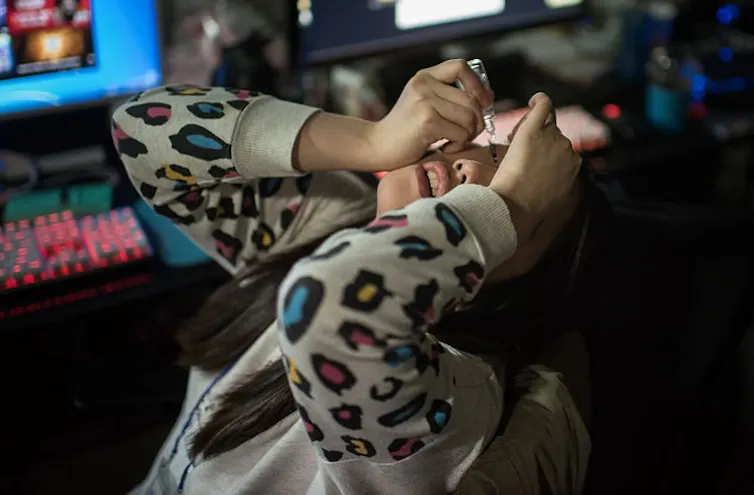
Un joueur taïwanais de l’équipe d’e-sport Flash Wolves prend des comprimés lors d’une séance d’entraînement en vue du championnat du monde de *League of Legends*, dans le cadre d’un stage intensif à Shanghai, en Chine.Chandan Khanna/AFP via Getty Images
L’ESSENTIEL
Pratiqué à haut niveau, l’e-sport peut causer des blessures physiques importantes, mais aussi des souffrances psychologiques..
À mesure que de nouvelles études sur les blessures liées à l’e-sport ont été publiées, de nouvelles stratégies de traitement et de prévention ont vu le jour, calquées sur celles des sportifs de haut niveau.
Le traitement et la prévention des blessures pourraient être améliorés en considérant plutôt les compétiteurs d’e-sport comme des musiciens et des danseurs que comme des footballeurs ou des basketteurs.
Le joueur chinois d’e-sport Jian « Uzi » Zi-hao était bien plus qu’une simple star de League of Legends : il était si talentueux que son équipe avait articulé toute sa stratégie autour de ses capacités, concentrant ses ressources sur lui et un autre coéquipier, Shi « Ming » Sen-Ming, afin que ce duo puisse mener l’équipe à la victoire. Au cours de sa carrière, il a remporté plus de 500 000 dollars américains (plus de 438 000 euros) en prix de tournois.
Et pourtant, en 2020, Jian a annoncé sa retraite, sa carrière légendaire ayant été interrompue par des blessures chroniques au poignet et au bras. Il avait 25 ans.
Les jeux vidéo ont la réputation de clouer les gens au canapé. Mais pour ceux qui affrontent les meilleurs joueurs du monde, le jeu peut s’avérer étonnamment éprouvant, tant sur le plan physique que mental.
La pression liée à la « montée dans le classement »
Les meilleurs joueurs d’e-sport ont souvent des emplois du temps très chargés. On attend d’eux qu’ils s’entraînent régulièrement, participent à des matchs d’entraînement et disputent des rencontres officielles. Même au niveau amateur, les joueurs d’e-sport évoquent le poids psychologique de leur discipline : jouer plusieurs heures par jour, tous les jours, pour perfectionner leurs compétences afin de pouvoir « grimper les échelons ».
Une étude de 2021 menée auprès de joueurs d’e-sport portugais a révélé que 37 % d’entre eux souffraient d’anxiété et de dépression, et que 45 % souffraient de troubles du sommeil. Les blessures physiques les plus courantes dans l’e-sport sont généralement des problèmes oculaires et des troubles musculo-squelettiques.
Une membre de l’équipe de jeux vidéo entièrement féminine QWER utilise des gouttes pour les yeux au centre d’entraînement de son équipe à Séoul, en Corée du Sud. Ed Jones/AFP
De nombreux joueurs d’e-sport – professionnels ou non – sont également confrontés à des douleurs aux mains et aux poignets ; le fait d’appuyer de manière répétitive sur les boutons provoque des blessures telles que le syndrome du canal carpien, des tendinites et le « pouce du joueur », qui résulte d’une surutilisation ou d’une irritation des tendons autour du pouce et du poignet. Bon nombre des blessures liées à la surutilisation observées chez les joueurs de jeux vidéo sont également familières aux ouvriers travaillant à la chaîne, dont le travail peut impliquer des mouvements tout aussi répétitifs.
Viennent ensuite les blessures au dos. Les joueurs peuvent rester assis pendant trois heures ou plus sans faire de pause, et cette position assise prolongée peut avoir des répercussions sur le bas du dos et la colonne vertébrale.
Le caractère sédentaire de l’e-sport a également conduit à une blessure moins connue – parfois mortelle – appelée thrombose veineuse profonde : un caillot sanguin, souvent dans la jambe, qui peut mettre la vie en danger s’il se déplace vers les poumons. En 2011, le joueur britannique Chris Staniforth – qui jouait parfois jusqu’à 12 heures d’affilée – est décédé des suites de cette affection.
Mesures préventives
À mesure que de nouvelles études sur les blessures liées à l’e-sport ont été publiées, de nouvelles stratégies de traitement et de prévention ont vu le jour.
Les équipes intègrent souvent des activités physiques en groupe afin de renforcer la cohésion entre les joueurs et de réduire le risque de blessures. Pendant la compétition, un bon positionnement de la colonne vertébrale et des membres est devenu une stratégie essentielle de prévention des blessures. Par exemple, choisir une chaise qui favorise une posture droite peut réduire la douleur et le risque de blessure, en particulier lorsque les joueurs associent l’ergonomie à un programme d’exercices axé sur la force fonctionnelle, la mobilité et les étirements des membres supérieurs.
Des athlètes brésiliens d’e-sport participent à une séance d’entraînement physique à Rio de Janeiro, en mai 2021. Mauro Pimentel/AFP
Regard vers la scène
Lorsque l’e-sport a commencé à gagner en popularité auprès du grand public dans les années 1990 et au début des années 2000, ses défenseurs étaient impatients d’établir des comparaisons avec les sports traditionnels et les compétitions athlétiques. Ces parallèles ont contribué à asseoir la légitimité de l’e-sport et ont offert aux non-joueurs un cadre familier pour comprendre la compétition.
À mesure que l’e-sport est devenu un secteur très lucratifet un parcours professionnel lucratif, les joueurs et les équipes ont mis en place tout un réseau de personnel d’encadrement – entraîneurs, coachs et thérapeutes – à l’image de la structure des sports professionnels. Dans cette optique, de nombreuses recherches sur les blessures en e-sport se sont inspirées des méthodes d’entraînement des sports traditionnels.
Cependant, en tant que chercheuse en sciences de l’activité physique, je pense que les stratégies de traitement et de prévention des blessures pourraient être encore améliorées en considérant les compétiteurs d’e-sport davantage comme des musiciens et des danseurs que comme des footballeurs ou des basketteurs.
La recherche sur l’optimisation des performances et les blessures chez les artistes professionnels existe depuis des siècles, et je pense qu’elle représente une ressource précieuse et inexploitée. En effet, les contraintes physiques et mentales subies lors d’une prestation musicale présentent de nombreux points communs avec les compétitions d’e-sport : de longues périodes en position assise ; des mouvements de mains précis et minutieux ; et une prestation qui se déroule sans les conseils en temps réel d’un entraîneur.
Par exemple, des recherches en biomécanique ont mis en évidence des schémas similaires de fatigue musculaire de l’avant-bras chez les joueurs d’e-sport et les pianistes. Cependant, aucune étude n’a à ce jour directement comparé ces deux groupes.
Et que se passerait-il si l’intérêt porté à l’hypermobilité articulaire ou à la taille des mains chez les artistes de scène s’appliquait aux populations d’e-sportifs ? Les exercices d’échauffement populaires pour le piano pourraient-ils être efficaces pour les e-sportifs qui utilisent un clavier ?
Même les recherches sur des sports comme la course automobile pourraient offrir des informations précieuses. Comme pour les gamers, beaucoup de gens sous-estiment à quel point la course automobile peut être exigeante physiquement – et, oui, cela inclut le fait de rester assis pendant de longues périodes.
Un membre de l’équipe d’e-sport Vitality observe une démonstration d’une machine d’entraînement des réflexes à Enstone, en Angleterre. Philippe Lopez/AFP
Les techniques de prévention et de rééducation ne cessent de s’améliorer. Même Jian, le joueur qui avait pris sa retraite en 2020, est revenu jouer pendant quelques « splits », ou saisons partielles, en 2022 et 2023.
En juillet 2023, la star de League of Legends Lee « Faker » Sang-hyeok a été relégué sur le banc en raison d’un syndrome du tunnel cubital, une blessure résultant d’une sollicitation excessive du bras et de la main.
Grâce à un programme de traitement comprenant notamment une modification de sa posture de jeu et une kinésithérapie intensive, Lee a pu reprendre la compétition à peine un mois plus tard. Il a ensuite remporté trois championnats du monde consécutifs, son équipe d’encadrement l’aidant à prévenir toute récidive de la blessure tout au long de chaque saison.
Grâce à sa rééducation, les fans de Lee pourront le suivre dans sa quête d’un quatrième titre de champion du monde de League of Legends, dont le coup d’envoi sera donné en octobre 2026 aux États-Unis.
Sienna Cinti a contribué à la recherche et à la rédaction de cet article.
Erica D. Henn ne travaille pas, ne conseille pas, ne possède pas de parts, ne reçoit pas de fonds d’une organisation qui pourrait tirer profit de cet article, et n’a déclaré aucune autre affiliation que son organisme de recherche.
Le principal problème n’est pas d’inciter les jeunes à commencer un sport, mais de les inciter à s’engager durablement.Mart Production/Pexels, CC BY
L’ESSENTIEL
Si de nombreux jeunes ont déjà pratiqué un sport, beaucoup décrochent à l’adolescence.
Les politiques sportives semblent en tenir compte et insistent de plus en plus sur la fidélisation des publics.
Mais les moyens qu’elles mobilisent répondent-ils bien à ce défi ?
Un nouveau vocabulaire s’installe dans les politiques sportives françaises. Les textes officiels parlent désormais de « décrochage », de « fidélisation » des publics et de pratique « durable » du sport, rejoignant les recherches qui ont mis en évidence le poids des abandons à l’adolescence.
Ce renouvellement lexical révèle un changement de regard. La réussite ne se mesurerait plus uniquement au nombre de jeunes conduits vers le sport, mais aussi à leur capacité à y rester engagés.
Ce déplacement semble annoncer le passage d’une politique de l’accès à différentes disciplines à une politique de la continuité des pratiques. Il a été explicitement repris par l’Office parlementaire d’évaluation des choix scientifiques et technologiques, dans son rapport « La science dans la mêlée pour une nation sportive », où il remet en cause les stratégies principalement orientées vers la promotion du sport au profit de politiques centrées sur la prévention de son abandon.
Pourtant, les mesures restent en retrait des mots employés. Elles financent surtout des créneaux et des inscriptions, beaucoup moins la transformation de la vie sportive proposée dans les clubs. L’action publique commence à penser la fidélisation, tout en consacrant encore l’essentiel de ses moyens à l’entrée dans l’activité.
Le problème du décrochage sportif
De nombreux adolescents ont déjà pratiqué un sport sans parvenir à s’inscrire dans la durée. Une grande partie d’entre eux ont déjà fréquenté un club ou exercé régulièrement une activité avant de l’abandonner. Dans une étude menée auprès de 1 149 adolescents, nous avons distingué les pratiquants réguliers, les anciens pratiquants et ceux qui ne s’étaient jamais engagés régulièrement. Ils représentaient respectivement 64,5 %, 28,1 % et seulement 4,6 % de l’échantillon. Sans les abandons, la participation aurait dépassé 90 %. Les écarts constatés entre les filles et les garçons, comme entre les milieux sociaux, tenaient largement à des dynamiques inégales de décrochage.
Attirer les jeunes vers le sport reste légitime. Comprendre pourquoi ils le quittent devient tout aussi nécessaire. C’est dans cette perspective que nous avons proposé la notion de « politique de rétention sportive ». Il ne s’agit pas de les retenir contre leur volonté, mais de réunir les conditions qui leur donnent envie de poursuivre le sport.
La pratique sportive durable ne désigne ni une activité intensive ni une présence sans interruption, mais un engagement qui consiste à conserver une place pour le sport dans l’existence en s’adaptant aux transformations du corps, aux contraintes scolaires, aux goûts et aux aspirations.
Le vocabulaire public commence à changer
L’instruction ministérielle consacrée aux « deux heures de sport en plus au collège » rend cette inflexion particulièrement visible. Le dispositif s’adresse prioritairement aux élèves éloignés de la pratique et demande aux acteurs de parvenir à les « attirer et fidéliser ».
Le choix du verbe compte. L’inscription cesse d’être l’unique résultat attendu. La durée de l’engagement devient un critère de réussite. L’évaluation comparera d’ailleurs les effectifs du début et de la fin de l’année afin de repérer les « décrochages ».
Sans employer l’expression de « politique de rétention », le texte en reprend le principe. Il reconnaît aussi les limites de l’offre existante puisqu’il demande d’en proposer une autre, plus ludique et complémentaire du modèle compétitif traditionnel.
Le pass Sport participe du même déplacement lorsqu’il affiche l’ambition de soutenir « une pratique durable au sein des structures sportives ».
Ces évolutions ne prouvent pas que les politiques publiques empruntent leurs notions aux recherches, qui ne sont pas explicitement citées. Elles attestent néanmoins que la question de l’abandon pénètre le discours institutionnel. Le jeune qui abandonne n’est plus seulement un non-pratiquant à reconquérir. Son départ devient un processus à comprendre et à prévenir.
Des réponses en retrait des intentions
Le renouvellement du vocabulaire précède celui des instruments. Les deux heures supplémentaires restent organisées hors des enseignements, sur la base du volontariat et selon les partenariats locaux. L’enveloppe nationale s’élève à deux millions d’euros, avec un financement indicatif pouvant atteindre 9 000 euros par établissement. L’ouverture à tous les collèges publics volontaires ne vaut donc pas généralisation effective.
Le pass Sport réduit un obstacle réel pour les familles modestes. Mais une aide de 50 euros agit au seuil du club. Elle ne change ni l’accueil, ni la place des débutants, ni les relations avec l’encadrement, ni le poids de la compétition. La porte s’ouvre sans que le retour du jeune soit assuré.
L’évaluation annoncée mesurera surtout l’évolution du nombre de participants. Elle comptabilisera les arrivées et les départs, sans véritablement éclairer les raisons de la persévérance ou de l’abandon. Or, compter les décrocheurs ne suffit pas à comprendre le décrochage.
Transformer l’offre plutôt que multiplier les portes d’entrée
Que l’on interroge les jeunes sur les raisons de leur abandon pour caractériser les mécanismes du drop-out ou sur ce qu’un club pourrait faire pour leur donner envie d’y rester le plus longtemps possible afin d’identifier les ressorts d’un engagement dans le temps (Geidne et Quennerstedt, 2021), trois aspects apparaissent essentiels.
Le premier est le rapport aux autres. La satisfaction d’être ensemble, le droit à l’erreur collective et le sentiment d’appartenance entretiennent l’envie de revenir. À l’inverse, la comparaison permanente, la sélection précoce et la concurrence peuvent transformer chaque séance en épreuve.
Le deuxième est le rapport à soi. Le sentiment de compétence, la perception des progrès et une image positive de son corps soutiennent l’engagement. À l’inverse, se sentir maladroit, inférieur ou continuellement exposé au jugement peut conduire à se retirer de l’activité.
Le troisième est le rapport aux contraintes rencontrées. Lorsqu’elles paraissent accessibles et porteuses de sens, elles donnent à l’effort une valeur et nourrissent l’envie de progresser. À l’inverse, des exigences jugées excessives, imposées ou sans signification personnelle peuvent alimenter le désengagement.
Empêcher que la pratique sportive produise son propre abandon suppose des modalités des pratiques modulables, ouvertes et inclusives, des passerelles entre disciplines, des formes de compétitions variées, des horaires compatibles avec la vie scolaire et la possibilité de revenir après une interruption. Les adolescents devraient aussi prendre part à l’élaboration des activités qui leur sont proposées.
L’évaluation devrait suivre les parcours, recueillir les motifs de départ et observer l’évolution du plaisir, de la confiance et du sentiment de compétence. Une politique de rétention ne maintient pas artificiellement des effectifs. Elle crée les conditions d’une participation à la fois désirable et possible.
Une pratique sportive durable ne se décrète pas. Elle se construit dans les raisons que chacun trouve d’y rester. Les mots de la rétention sont entrés dans le discours public. Reste à traduire cette ambition dans les clubs, les séances et le quotidien des pratiquants.
Maxime Travert ne travaille pas, ne conseille pas, ne possède pas de parts, ne reçoit pas de fonds d’une organisation qui pourrait tirer profit de cet article, et n’a déclaré aucune autre affiliation que son organisme de recherche.