Grandparenting from a distance: what’s lost when families are separated, and how to bridge the gap

Source: The Conversation – Africa – By Sulette Ferreira, Transnational Family Specialist and Researcher, University of Johannesburg

Becoming a grandparent is often envisioned as a deeply intimate, hands-on journey, holding a newborn, sharing first smiles, witnessing the first wobbly steps. It is traditionally grounded in physical presence, marked by spontaneous visits.

For many grandparents whose children have emigrated, however, these defining moments often unfold not in person, but through screens, filtered through time zones, digital platforms, and a lingering sense of distance.

This is true in South Africa, a country with rising emigration, especially among young families. Over a million South Africans now live abroad. This has systemic, multigenerational effects.

In a recent study I explored the impact of global emigration on the relationships between South African grandparents and their grandchildren born abroad. I examined what it means to step into their grandparent role role from afar, often for the first time, and how the absence of physical closeness reshapes intergenerational relationships.

I have published various articles on migration and intergenerational relationships in transnational families. I also run a private practice that focuses on the emotional challenges of emigration.

As part of my PhD study, I conducted in-depth interviews with 24 South African parents whose adult children had emigrated. This project laid the foundation for my broader research programme on the emotional effects of migration. This research article is based on the experiences of 44 participants.

For these grandparents, emigration represents more than just geographical separation. The familiar rhythms of hands-on grandparenting, from spontaneous visits to shared celebrations, are disrupted. With it comes a layered and ongoing sense of loss, not only of everyday interactions with their grandchildren, but also the gradual fading of a cherished role once grounded in physical presence and routine connection.

The findings show that the absence of physical proximity creates profound emotional barriers, especially during the early, most formative years of a grandchild’s life. Yet despite this distance, grandparents are finding creative and meaningful ways to remain emotionally present.

In transnational families, grandparents serve as custodians of cultural continuity and emotional support as well as active agents reshaping the meaning of grandparenthood in the context of global migration.

What grandparents had to say

The central question of my research was how distance reshaped the role of some grandparents in South African families. It further investigated how grandparents adapted and renegotiated their roles across different stages of their grandchildren’s lives.

The selection criteria included: being a South African citizen; speaking fluent English; living in South Africa; being a parent whose adult child(ren) had emigrated and lived abroad for at least one year; and being from any race, culture, gender; socio-economic status; aged between 50 and 80 years.

I supplemented interviews with qualitative surveys distributed via my online support group.

Grandparents reported various challenges,such as the loss of everyday involvement, the emotional strain of distance, and difficulties with digital communication that required ongoing adaptive strategies to sustain connection.

The study shows how distance does not necessarily weaken intergenerational bonds but requires grandparents to redefine presence.

My research made it clear that the place of birth is a pivotal factor in shaping the grandparent-
grandchild bond.

Grandparents of children who are born in South Africa and move to another country later are often involved from the beginning. They assist with daily care, celebrate milestones and enjoy spontaneous visits. These everyday interactions nurture strong emotional ties.

As Annelise, a participant, shared:

When your grandchild is born here, you know them from birth, you see them every day, you share in everything.

When these grandchildren emigrate, the rupture can be profound. Grandparents not only lose regular contact but also their role as hands-on caregivers.

When grandchildren are born abroad, a different emotional journey unfolds. Joy and excitement are often tempered by longing and sadness.

The reality of nurturing relationships across borders forces grandparents to redefine their roles.

For many families, pregnancy strengthens the bond between generations, especially between mothers and daughters. This phase is typically marked by shared rituals, which shape both maternal and grandparental identities. Rituals foster emotional connection and a sense of belonging.

But for grandparents who are separated, these moments may be replaced by screenshots and voice notes, making milestones feel distant and intangible.

This early absence can feel like an exclusion from grandparenthood itself, as if the role is denied before it has even begun. The phenomenon aligns closely with US psychologist Pauline Boss’s concept of ambiguous loss, grief without closure.

Despite this, many grandparents remain actively involved. Some grandparents become what US sociologists Judith Treas and Shampa Mazumdar call “seniors on the move”, becoming more mobile, structuring their lives around flights, visa renewals and seasonal caregiving.

But the challenges are big.

Staying close from far away

Sustaining a relationship across borders is tough.

Two key strategies emerged in my research: virtual communication and transnational visits.

All those I interviewed used technology extensively: weekly Zoom story time, recorded readings, or care “parcels” filled with letters, recipes, or handmade crafts.

In-person visits were limited by a mix of financial, logistical, emotional, and relational barriers.

The flights are just too expensive, and with my health, I don’t think I could manage the trip. It breaks my heart, but it’s just not possible. I don’t think I will ever see him again.

I also found that the role of parents was key. Through sharing photos, initiating calls, and keeping grandparents present in everyday conversations, some parents helped emotional bonds flourish.

My daughter and son-in-law are both very good at sending me photos and videos regularly … They both know how much I miss being with my two grandkids, so they keep me updated … They also phone weekly and encourage the children to be focused on our calls.

Takeaways

Transnational grandparenting challenges the traditional script of hands-on involvement. It calls for a reimagining of presence.

My research shows that grandparents are doing that through creativity, emotional elasticity and enduring love. They are forging a new kind of grandparenting across continents: one where connection transcends distance.

The Conversation

Sulette Ferreira is a research fellow at the University of Johannesburg.

ref. Grandparenting from a distance: what’s lost when families are separated, and how to bridge the gap – https://theconversation.com/grandparenting-from-a-distance-whats-lost-when-families-are-separated-and-how-to-bridge-the-gap-263279


Wheelchair basketball: what can be learned from a South African athlete’s journey to France

Source: The Conversation – Africa – By Phoebe Runciman, Associate Professor and Research Chair at the Division of Sport and Exercise Medicine, Stellenbosch University

Wheelchair basketball is one of the fastest-growing Para sports in the world. Over 100,000 athletes compete in national and international competitions and at the Paralympic Games and Commonwealth Games. In Africa, there are 26 national wheelchair basketball federations.

But the level of support and resources available for athletes with disability (Para athletes) varies greatly between the global north and south, shaped by gaps in healthcare, infrastructure and policy.

In African countries the sport is often underfunded. In 2022, for example, South Africa’s sports and recreation budget was 15 times lower than France’s.

Many Para sport athletes from the global south must pay for their own travel expenses and equipment. This limits their access to quality training and support, affecting their performance.


Read more:
The odds are stacked against athletes from poor countries in paralympic sport


But little is known about what it’s like for Para athletes to move between countries, especially from the global south to the global north.

My case study (on page 83 of the PDF) followed Sphelele Dlamini, a 29-year-old South African wheelchair basketball player who grew up in an underdeveloped area in KwaZulu-Natal province. He was born with a condition that led to the amputation of both legs below the knee.

After beginning his sporting journey in South Africa, Dlamini moved to France in 2022 to play professionally.

His experience reveals what Para athletes can expect as well as what they gain and what they leave behind when crossing borders in search of better opportunities. Dlamini’s journey highlights how cross-border moves may offer access to resources and more recognition, but also involve cultural challenges, adaptations and identity shifts.

His story can inform the support needed from organisations helping Para athletes to navigate these transitions so that they can compete at their full potential.

What must happen for athletes to shine

Dlamini’s story highlights four key factors that must be addressed to make a difference in the lives of South Africa’s Para athletes.

1. Public services

Firstly, the South African government and schools need to address the shortage of public services for people with disability. This includes creating accessible infrastructure, disability-inclusive healthcare and social support services.

Overcrowding and limited public services have been part of Dlamini’s daily life. For people with disability, townships can be especially challenging environments.

These are residential areas that were designated for Black South Africans under apartheid, South Africa’s former system of white minority rule. Townships were deliberately underdeveloped and under-resourced and they remain structurally disadvantaged today.

As Dlamini told me in an interview for my case study:

With the things that are happening in the township, it’s wild, it’s always busy.

He shared a home with 11 family members and described his upbringing as “an ever-changing environment that never settled down”.

2. Funding and promotion

Secondly, Para sport requires more financial support and promotion to build a more inclusive society – funding and competitive opportunities.

Dlamini had all but stopped playing competitively:

I spent about two years without playing. Then suddenly, I got a chance to go to France.

In France he found himself in what he called “a different type of chaos”. Training schedules were intense, and “there was hardly any free time”. Although the move was a breakthrough, the years of limited game time had caused some self-doubt for him.

This highlights the need for investment in Para sport in countries like South Africa, so that athletes can develop locally and have greater chances of international success.

3. Athlete and coach education

Thirdly, athlete and coach education is critical. Dlamini’s move to France was self-driven with no formal pathways or international exposure. He reached out to coaches directly:

I sent them emails and sometimes I would write to them on Facebook.

In much of the global south, Para sport relies on volunteer coaches with limited access to networks. Despite having no video footage, a French coach gave Dlamini a chance. In the global north, building a portfolio through documented game performance is standard, but this kind of athlete education is rarely emphasised in South Africa.

Countries like France also have established local clubs, with leagues that create pathways for regional, national and international competitions – and opportunities for professional contracts. Athletes receive a salary and games are streamed with backing from sponsors.

4. NGO support

Securing a spot on a French team didn’t mean Dlamini’s challenges were over. While his new club offered a salary, they couldn’t cover the cost of travel to France. It was Jumping Kids, a South African non-governmental organisation (NGO), that stepped in and paid for his air ticket, visa, flights and insurance.


Read more:
Why aren’t the Olympics and Paralympics combined into one Games? The reasoning goes beyond logistics


Dlamini first connected with Jumping Kids in 2014, when the organisation visited his school. He was selected to receive prosthetic legs and has remained in contact with them ever since. Today, he is one of the NGO’s ambassadors, alongside Paralympic athletes like Ntando Mahlangu and Arnu Fourie.

NGOs like this are a lifeline that need to be funded and supported, particularly in countries like South Africa where there are gaps in formal support.

Why Para sport matters

For many Para athletes, support starts at the school level. South Africa has 465 special needs schools catering to a range of disabilities. These schools often provide the first exposure to sport, as they did for Dlamini:

That’s where I saw people who were similar to my situation.

Research shows that sport gives individuals with disability a sense of belonging. This sense of inclusion, however, is difficult to achieve when environments are inaccessible.

In France, Dlamini felt that his skills were recognised and everyday life felt more navigable:

I really enjoy having the access [to public transport] and being able to move around and do things easily, without having to bother any other person.

Compared to South Africa, where players often share wheelchairs and go months without formal competition, France offered both structure and dignity.

However, in hindsight, Dlamini says he can look back at the setbacks and challenges he faced in South Africa, and view them from a different perspective:

I can never really judge it because, I may never know, maybe I was getting prepared for that journey.

Sphelele Dlamini’s story is one of resilience. Despite the odds, he created his path to play professionally. His journey highlights the determination required of athletes from the global south, and the systemic barriers they face that hinder development and progress in sport.

While NGOs continue to fill critical gaps, long-term progress in Para sport requires structural investment.


Faatima Adam, a biokineticist and PhD candidate, contributed to this article.

The Conversation

Phoebe Runciman does not work for, consult, own shares in or receive funding from any company or organisation that would benefit from this article, and has disclosed no relevant affiliations beyond their academic appointment.

ref. Wheelchair basketball: what can be learned from a South African athlete’s journey to France – https://theconversation.com/wheelchair-basketball-what-can-be-learned-from-a-south-african-athletes-journey-to-france-261593

Studying philosophy does make people better thinkers, according to new research on more than 600,000 college grads

Source: The Conversation – USA (3) – By Michael Vazquez, Teaching Assistant Professor of Philosophy, University of North Carolina at Chapel Hill

Students take a philosophy test in Strasbourg, France, on June 18, 2024. Frederick Florin/AFP via Getty Images

Philosophy majors rank higher than all other majors on verbal and logical reasoning, according to our new study published in the Journal of the American Philosophical Association. They also tend to display more intellectual virtues such as curiosity and open-mindedness.

Philosophers have long claimed that studying philosophy sharpens one’s mind. What sets philosophy apart from other fields is that it is not so much a body of knowledge as an activity – a form of inquiry. Doing philosophy involves trying to answer fundamental questions about humanity and the world we live in and subjecting proposed answers to critical scrutiny: constructing logical arguments, drawing subtle distinctions and following ideas to their ultimate – often surprising – conclusions.

It makes sense, then, that studying philosophy might make people better thinkers. But as philosophers ourselves, we wondered whether there is strong evidence for that claim.

Students who major in philosophy perform very well on tests such as the Graduate Record Examination and Law School Admission Test. Studies, including our own, have found that people who have studied philosophy are, on average, more reflective and more open-minded than those who haven’t. Yet this doesn’t necessarily show that studying philosophy makes people better thinkers. Philosophy may just attract good thinkers.

Our latest study aimed to address that problem by comparing students who majored in philosophy and those who didn’t at the end of their senior year, while adjusting for differences present at the start of their freshman year. For example, we examined students’ performance on the GRE, which they take toward the end of college, while controlling for scores on the SAT, which they take before college.

We did the same when analyzing survey data collected by the Higher Education Research Institute at the start and end of college. These surveys asked students to, for example, rate their abilities to engage with new ideas or have their own ideas challenged, and how often they explored topics raised in class on their own or evaluated the reliability of information.

All told, we looked at test and survey data from over 600,000 students. Our analysis found that philosophy majors scored higher than students in all other majors on standardized tests of verbal and logical reasoning, as well as on self-reports of good habits of mind, even after accounting for freshman-year differences. This suggests that their intellectual abilities and traits are due, in part, to what they learned in college.

Why it matters

Public trust in higher education has hit record lows in recent years, according to polling by the Lumina Foundation and Gallup. Meanwhile, the rapid advance of generative AI has threatened the perceived value of a traditional college degree, as many previously vaunted white-collar skills are at risk of being automated.

Yet now more than ever, students must learn to think clearly and critically. AI promises efficiency, but its algorithms are only as good as the people who steer them and scrutinize their output.

The stakes are more than personal. Without citizens who can reason through complex issues and discern good information from bad, democracy and civic life are at risk.

What still isn’t known

While our results point to real growth in students’ intellectual abilities and dispositions, they do not capture everything philosophers mean by “intellectual virtue.” Intellectual virtue is not just a matter of possessing certain abilities but of using those abilities well: at the right times, for the right reasons, and in the right ways.

Our measures do not tell us whether philosophy majors go on to apply their newfound abilities in the service of truth and justice or, conversely, for personal gain and glory. Settling that question would require gathering a different kind of evidence.

The Research Brief is a short take on interesting academic work.

The Conversation

The research described in this article was supported by a grant from the American Philosophical Association.

ref. Studying philosophy does make people better thinkers, according to new research on more than 600,000 college grads – https://theconversation.com/studying-philosophy-does-make-people-better-thinkers-according-to-new-research-on-more-than-600-000-college-grads-262681

Managing soil fertilization levels can make for more efficient and productive crops

Source: The Conversation – Canada – By JT Cornelis, Associate Professor, Applied Biology (Soil Science), University of British Columbia

Modern crops are often excessively fertilized, which boost yields in the short term but also harms the environment due to nutrient runoffs and greenhouse gas emissions.

Additionally, fertilizers are often inefficient because much of the applied fertilizers become bound to soil particles over the long term, making them unavailable for plants.

The application of high doses of easily soluble fertilizers may ensure crop productivity, but it comes at the cost of environmental quality and agroecosystem resilience. This fertilization strategy often results in “lazy” crops with underdeveloped root systems and reduced ability to acquire nutrients from native soil reserves.

As a pedologist (someone who studies soil formation) and biogeochemist, my research focuses on the multiscalar and interdisciplinary study of soil systems.

Improving resiliency

In Canada’s vast forests, the trees thrive in nutrient-impoverished soils because of the capacity of their deep root systems to acquire nutrients and water. In natural ecosystems, plants have evolved and developed root strategies that help to absorb nutrients.

One way they do this is by growing bigger, stronger and more active roots, which help them access more nutrients from the soil. Sometimes, they team up with soil micro-organisms to increase their capacity to access nutrients. As roots absorb nutrients, they also release certain molecules in the soil called root exudates.

These compounds contribute to breaking down organic matter and dissolving soil particles, making trapped nutrients accessible for plant root uptake. Root exudates are also a source of energy for soil microorganisms, which down the road also support soil carbon storage and enhance general soil health.

The SoilRes3 Lab at the University of British Columbia carries out interdisciplinary research on soil genesis to uncover how microscale processes shape macroscale ecosystem properties and resilience. Grounded in soil–plant feedbacks, our pedological work examines the complex relationships between land and people across diverse eco-cultural contexts, with the goal of strengthening ecosystem resilience, resistance and restoration.

Examining soil-plant feedback in natural ecosystems, we found that using a bit less fertilizer could actually benefit crops in the long run. By decreasing fertilizer, we could increase the production of root exudates. This enhances the plants’ ability to absorb nutrients on their own, rather than depending on external inputs.

By increasing microbial activity in the rhizosphere (the area surrounding plant roots) and acting as a direct carbon source into the soil, increased root exudates could also contribute to healthier soils.

plant roots in a forest
The rhizosphere is the area surrounding plant roots where the roots, soil organisms, nutrients and water interact.
(Jordan Fernandes/Unsplash), CC BY

Alternative strategies

Nitrogen and phosphorus are the two most important nutrients for plant growth, and they are the most used fertilizers around the world.

Our team of soil scientists reviewed 36 studies encompassing 30 different crops and soil contexts. We compared how plants responded under two fertilization conditions: one with the usual amount of fertilizer to maximize yield, and another with less fertilizer, especially less nitrogen and phosphorus.

We found that cutting phosphorus fertilizer by up to half boosted root exudation by 30 per cent, while only slightly reducing crop growth by just two per cent. In contrast, reducing nitrogen fertilizer raises root exudation by seven per cent, but lowers plant growth by 20 per cent.

Our findings show that optimizing phosphorus use in agriculture can stimulate more active root systems and increase exudate production.

Soil types

Optimizing phosphorus fertilizer to boost root exudation without sacrificing yield depends heavily on soil type. Soils in British Columbia differ significantly from those in Manitoba, Québec and Saskatchewan, and the impact of root exudates on nutrient uptake and carbon capture varies with soil conditions (soil pH, mineralogy, moisture, texture).

That’s why our proposed strategy — limiting fertilizers to maximize root activity — must be tested in real-world settings, with farmers, across diverse soils and crop systems.

The next step will be to examine root exudation responses and effects under varying soil physicochemical and eco-cultural contexts. Field trials are essential to tailor this approach to local conditions and ensure its effectiveness and scalability.

The Conversation

JT Cornelis works for the Faculty of Land and Food Systems at the University of British Columbia, as an Associate Professor in soil science. He receives funding from NSERC Discovery Grant, NSERC Alliance, Killam Trusts and BC Genome.

ref. Managing soil fertilization levels can make for more efficient and productive crops – https://theconversation.com/managing-soil-fertilization-levels-can-make-for-more-efficient-and-productive-crops-253298

Here’s why Canada’s parents and grandparents reunification program is problematic

Source: The Conversation – Canada – By Megan Gaucher, Associate Professor, Department of Law and Legal Studies, Carleton University

Immigration, Refugees and Citizenship Canada’s recent announcement that it’s accepting 10,000 sponsorship applications under the Parent and Grandparents Program (PGP) comes with an important caveat.

Due to persistent backlog, invitations will only be sent to the 17,860 potential sponsors who submitted an interest-to-sponsor application back in 2020.

While good news for some, it means yet another cycle of uncertainty for thousands of families who have waited years for the PGP to finally reopen.

Migrant families seek permanent reunification for reasons other than a desire to live with their parents and grandparents in the same country. Those reasons include a need for child-care support and a desire to care for their older family members as they age.

As international conventions dictate, families have a right to be together.

From permanent to temporary

Grandparents have been part of Canada’s formal “family class” pathway since 1976, but current policy favours spouses and dependent children. This makes reunification for extended family members difficult.

Grandparent admissions through the PGP have comprised around 25 per cent of total family class admissions for the past 10 years.

Unlike other family class categories, there is a predetermined cap on accepted PGP applications. The PGP has also undergone a series of program freezes to deal with an application backlog, the most recent announced in January 2025. The government’s latest update included no commitment to receive new interest-to-sponsor declarations.

As an alternative to the PGP, the government recommends the super visa, a multi-entry visa valid for up to 10 years. However, the super visa requires grandparents to reapply and meet medical inadmissibility rules every five years.

The super visa also places responsibility for financial and health care of grandparents entirely on the sponsoring children, sometimes with devastating consequences.

Most importantly, the super visa does not guarantee permanent residence upon expiration. Permanent grandparent reunification remains a lottery draw, at the mercy of sponsorship intake caps.

Celebrating, denigrating migrant grandparents

Our preliminary research on grandparent sponsorship explores how elected officials consider the place of migrant grandparents in Canadian society. We’ve so far found they regard permanent family class migration as “good for business” as it attracts economic migrants. At the same time, elected officials believe that certain dependants monopolize health and social safety nets.

Grandparents, in particular, are treated by governments as human liabilities who must be admitted “responsibly.”

Admitting grandparents to Canada is tied to their perceived ability to support their sponsors by performing unpaid domestic labour. Our research has found elected officials celebrate sponsored grandparents for the substantial unpaid care work they provide like meal preparation, child care and cleaning.

In a recent survey on grandparent sponsorship, sponsors describe the unpaid work conducted by grandparents as essential to their participation in the Canadian workforce.

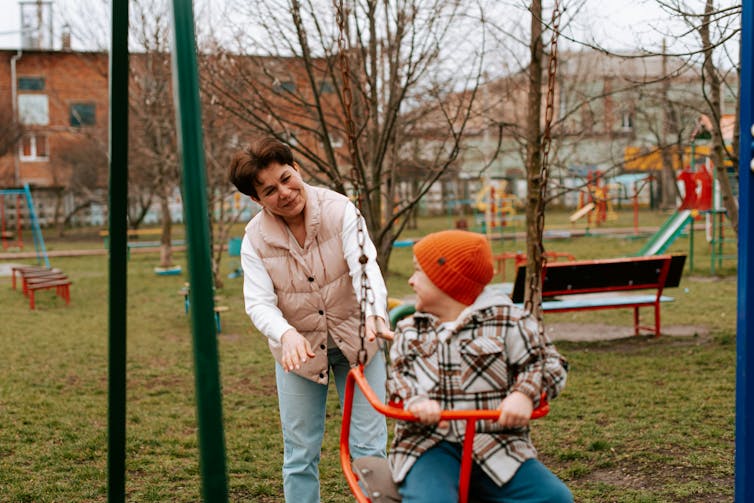
an older dark-haired woman plays with a boy at a playground
Grandparents can be key to helping younger family members become active in the Canadian workforce.
(Kateryna Hliznitsova/Unsplash)

Migrant grandparents are also positioned as providers of cultural care for their grandchildren. Our research draws attention to elected officials often invoking memories of their own migrant grandparents passing along languages, practices and values that shaped their unique cultural identities.

Despite the benefits migrant grandparents provide, sponsored grandparents are consistently suspected of taking advantage of Canada’s health care and social welfare systems. This is why the super visa is promoted as an alternative pathway.

Dependent on sponsors

Grandparents who come to Canada through the super visa are financially reliant on their sponsors. Even though the government recognizes that the number of sponsored grandparents applying for old age security is relatively small, treating migrant grandparents as economic burdens allows governments to justify caps and application pauses on PGP sponsorship.

Contrary to governments’ framing of the super visa as aligning with migrants’ families demands for temporary care, our research shows that grandparents often resort to humanitarian and compassionate applications to obtain permanent residence once their super visa has expired. In these cases, their ability to perform care work is further scrutinized.

In terms of grandparent sponsorship, care is largely understood as temporary and one-directional — in other words, migrant grandparents are welcomed when they provide care, but are seen as liabilities when they need care themselves.


Read more:
Canada halts new parent immigration sponsorships, keeping families apart


Prioritizing the needs of migrant families

How do we reconcile government claims that family reunification is a “fundamental pillar of Canadian society” with the reality that permanent grandparent reunification remains difficult to obtain?

Intake announcements like the most recent one in July allow governments to celebrate permanent grandparent migration. At the same time, the inconsistency of the PGP and solutions like the super visa keep migrant grandparents in a state of legal, political and economic precarity.

With the Liberal government announcing cuts to family class admissions over the next three years, the impact of these changes on grandparent reunification warrants attention.

Rather than temporary reforms and routes, the government needs to consider structural changes to Canada’s family class pathway that focus on the needs and interests of families seeking permanent reunification.

The Conversation

Megan Gaucher receives funding from the Social Sciences and Humanities Research Council.

Asma Atique receives funding from Mitacs and the College of Immigration and Citizenship Consultants. She is affiliated with CERC Migration and Integration and volunteers for South Asian Women and Immigrants’ Services.

Ethel Tungohan receives funding from the Social Sciences and Humanities Research Council.

Harshita Yalamarty receives funding from Social Sciences and Humanities Research Council.

ref. Here’s why Canada’s parents and grandparents reunification program is problematic – https://theconversation.com/heres-why-canadas-parents-and-grandparents-reunification-program-is-problematic-262263

Envie de plus d’orgasmes ? Optez pour une partenaire féminine

Source: The Conversation – in French – By Caroline Pukall, Professor, Department of Psychology, Queen’s University, Ontario

Être en couple avec une femme est associé à un avantage en termes d’orgasme.

(Pexels/Cottonbro)

Le fossé de l’orgasme — cette constatation constante selon laquelle les hommes ayant des rapports sexuels avec des femmes ont des orgasmes plus fréquents que les femmes ayant des rapports sexuels avec des hommes — a été démontrée dans une série d’études menées auprès de participants cisgenres hétérosexuels.

L’écart est important : d’après une étude canadienne récente, environ 60 % des femmes et 90 % des hommes ont déclaré avoir atteint l’orgasme lors de leur rapport sexuel le plus récent.

Dans des échantillons sexuellement diversifiés (comprenant également des femmes ayant des rapports sexuels avec des femmes et des hommes ayant des rapports sexuels avec des hommes), la tendance devient plus nuancée, mais confirme toujours l’existence d’un écart entre les sexes en matière d’orgasme.

Deux femmes, l’une entourant l’autre de ses bras et l’embrassant sur le front
Les recherches ont montré que les femmes ayant des rapports sexuels avec d’autres femmes connaissent une fréquence d’orgasmes plus équitable au sein de leur relation.
(Pexels/Ketut Subiyanto)

La recherche a montré que l’écart dans la fréquence des orgasmes est moins marqué chez les femmes qui ont des rapports sexuels avec des femmes (environ 75 %), et ce taux est significativement plus élevé que chez les femmes qui ont des rapports sexuels avec des hommes (environ 62 %). Toutefois, les hommes en tant que groupe —, quelle que soit la personne avec laquelle ils ont des rapports sexuels — ont toujours une fréquence d’orgasme nettement plus élevée (85 %) que les femmes en général (63 %). Ainsi, les femmes sont désavantagées sur le plan de l’orgasme lorsqu’elles ont des rapports avec des hommes.

Le fossé de l’orgasme

Quelle est l’ampleur de l’écart entre les sexes en matière d’orgasme et quels sont les facteurs susceptibles de faire obstacle à l’orgasme pour tous ? Nous — une équipe de chercheurs et de journalistes scientifiques du podcast Science Vs — avons étudié la fréquence des orgasmes dans un vaste échantillon diversifié, incluant des minorités sexuelles et de genre (comme les lesbiennes et les personnes trans), ainsi que des participants racialisés. Les analyses centrées sur l’orientation sexuelle ou l’origine ethnique n’ont toutefois pas révélé de différences marquées.

La bonne nouvelle ? Nous avons constaté que, dans l’ensemble, de nombreuses personnes avaient beaucoup d’orgasmes — environ deux tiers d’entre elles ont déclaré avoir des orgasmes presque ou à chaque fois qu’elles avaient des rapports sexuels.

La moins bonne nouvelle ? Le fossé de l’orgasme persiste : les hommes cisgenres ont rapporté la fréquence d’orgasme la plus élevée, bien devant les femmes et les personnes de genres minoritaires, qui ne présentent pas de différences marquées entre elles. De plus, nous avons observé que les participants, quel que soit leur genre, ayant des rapports sexuels avec des femmes indiquaient des orgasmes beaucoup plus fréquents que ceux ayant des rapports avec des hommes. Avoir une partenaire féminine semble donc favoriser l’orgasme.


À lire aussi :
Tout ce que vous devriez savoir sur le « fossé orgasmique »


Autre nouvelle moins réjouissante : environ 17 % des participantes ont déclaré n’avoir presque jamais ou jamais d’orgasme pendant les rapports sexuels. Pour les femmes cis, les barrières psychologiques — telles que l’insécurité, les problèmes de santé mentale et les distractions — étaient importantes, tout comme les obstacles sexuels (comme le fait de ne pas recevoir une stimulation adéquate), les difficultés inhérentes aux orgasmes (par exemple, ils prennent trop de temps et nécessitent trop d’efforts) et le fait de ne pas savoir pourquoi il leur est difficile d’avoir des orgasmes.

Combler le fossé

Pourquoi le fossé de l’orgasme persiste-t-il ? L’une des raisons principales est que les normes socioculturelles générales privilégient le plaisir sexuel des hommes par rapport à celui des femmes. En effet, ces normes découlent du scénario sexuel traditionnel (hétérosexuel, occidental) qui définit la fin de l’activité sexuelle comme étant l’orgasme masculin ; il est important de noter que l’adhésion des femmes à ce scénario a été associée à une satisfaction sexuelle moindre.

Une femme en robe jaune et un homme en chemise sombre et short kaki assis sur un lit
Le degré de familiarité des femmes avec leur partenaire s’est également révélé déterminant pour réduire l’écart.
(Unsplash/Jonathan Borba)

D’autre part, les médias grand public alimentent des récits d’attentes sexuelles fondés sur le sexe, de sorte que les représentations de femmes sont beaucoup plus acceptées que celles des hommes sans orgasme. Cette inégalité se manifeste lors des rencontres sexuelles, perpétuant le fossé et rendant moins urgente la lutte contre ce phénomène.


Déjà des milliers d’abonnés à l’infolettre de La Conversation. Et vous ? Abonnez-vous gratuitement à notre infolettre pour mieux comprendre les grands enjeux contemporains.


Mais il y a de l’espoir : la motivation des hommes hétérosexuels à amener leur partenaire à l’orgasme et l’intégration intentionnelle d’activités sexuelles qui augmentent les chances d’orgasme de leur partenaire — telles que la stimulation clitoridienne et le sexe oral — peuvent contribuer à réduire (et même à éradiquer !) l’écart. Il a également été démontré que le degré de familiarité entre les femmes et leur partenaire contribue à réduire l’écart. Une plus grande familiarité (pensez à une relation à long terme par opposition à une relation occasionnelle) a été associée à une plus grande fréquence d’orgasme.

Le simple fait de donner la priorité à l’orgasme des femmes — en adoptant des phrases simples comme « elle passe en premier » — pourrait suffire à réduire considérablement l’écart entre les sexes en matière d’orgasme.

La Conversation Canada

Caroline Pukall ne travaille pas, ne conseille pas, ne possède pas de parts, ne reçoit pas de fonds d’une organisation qui pourrait tirer profit de cet article, et n’a déclaré aucune autre affiliation que son organisme de recherche.

ref. Envie de plus d’orgasmes ? Optez pour une partenaire féminine – https://theconversation.com/envie-de-plus-dorgasmes-optez-pour-une-partenaire-feminine-261130

« Vallée du silicium » : une critique des effets des technologies sur nos vies

Source: The Conversation – in French – By Christophe Premat, Professor, Canadian and Cultural Studies, Stockholm University

Une vue d’Apple Park, siège social d’Apple, à Cupertino en Californie. La Silicon Valley, avec ses mondes virtuels et ses réseaux sociaux, incarne parfaitement cette tendance de notre époque à « l’hypervirtualisation ». (James Genchi/Unsplash), CC BY-NC

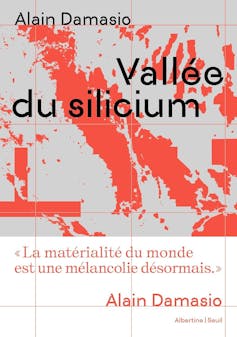
Certaines lectures marquent durablement, en offrant des clés pour désigner ce que l’on ressent confusément. Vallée du silicium, un essai d’Alain Damasio paru en 2024 aux éditions Seuil, en fait partie.

Cet article fait partie de notre série Les livres qui comptent, où des experts de différents domaines décortiquent les livres de vulgarisation scientifique les plus discutés.


Dans ce projet hybride, mêlant chroniques, journal de résidence et micro-nouvelle de science-fiction, l’auteur français de science-fiction et de littérature de l’imaginaire observe la Silicon Valley depuis son séjour à San Francisco. Alain Damasio est reconnu pour son style singulier et son exploration de formes narratives innovantes. Il a une approche multimodale de la création. Ses textes s’accompagnent souvent de prolongements sonores, musicaux ou performatifs : il collabore avec des musiciens et des artistes pour prolonger l’univers de ses récits.

Dans Vallée du silicium, il explore comment les technologies numériques reconfigurent nos existences — nos pensées, nos corps, nos relations — avec une écriture à la fois poétique, critique et philosophique.

« Pochette.
XXX, CC BY-NC

Damasio y introduit le concept de « technococon » pour désigner « un univers où la vitesse du branchage devient la garantie d’un dressage psychique et corporel ». Autrement dit, un environnement hyperconnecté, conçu pour notre confort, mais qui façonne subtilement nos comportements et notre manière de penser.

En tant que spécialiste des théories postmodernes et postcoloniales francophones, je m’intéresse notamment aux dispositifs narratifs qui permettent de penser le rapport entre identité et transformation. C’est à ce titre que j’ai souhaité lire Vallée du silicium d’Alain Damasio, dont l’œuvre explore des formes d’énonciation collectives et multimodales, ouvrant la voie à une réflexion sur le vivre-ensemble, l’hybridité et la résistance aux logiques de contrôle.

La pertinence du terme de « technococon »

Le « technococon » ne désigne pas seulement un environnement technologique. C’est une structure invisible dans nos vies : un ensemble d’interfaces, d’algorithmes et de routines numériques pensés pour réduire l’imprévu, fluidifier l’usage, et optimiser notre attention. En pratique, ce confort numérique devient une forme de dressage. À force de déléguer nos choix et nos attentions aux outils, nous perdons la capacité critique de comprendre et de questionner ces mêmes outils.

Damasio ne se contente pas de décrire ce qu’il voit, il replace ses observations dans un cadre plus large. Il s’appuie sur deux penseurs majeurs. Le premier, le sociologue et philosophe français Jean Baudrillard, a forgé l’idée que notre époque vit dans une « hypervirtualisation » : le réel est recouvert par ses images et ses représentations, au point que nous finissons par confondre ce qui existe avec ce qui est montré. La Silicon Valley, avec ses mondes virtuels et ses réseaux sociaux, incarne parfaitement cette tendance.

Le second, Gilles Deleuze, philosophe français lui aussi, a décrit ce qu’il appelait les « sociétés de contrôle » : le pouvoir ne s’exerce plus seulement par des lois ou des interdits clairs, mais de manière diffuse, en orientant en permanence nos comportements et nos choix. Les algorithmes qui décident des informations que nous voyons sur nos écrans ou qui ajustent automatiquement nos préférences en sont un exemple concret.


Déjà des milliers d’abonnés à l’infolettre de La Conversation. Et vous ? Abonnez-vous gratuitement à notre infolettre pour mieux comprendre les grands enjeux contemporains.


À partir de ces idées, Damasio part sur le terrain : il visite les sièges d’entreprises technologiques, observe les lieux de travail ultramodernes, mais aussi les quartiers de San Francisco qui restent à l’écart de cette prospérité numérique. Ce contraste alimente sa réflexion : alors que la Silicon Valley se présente comme un moteur de progrès, elle crée aussi des espaces de mise à l’écart et renforce certaines inégalités.

La science-fiction au service d’un diagnostic politique

Dans ses œuvres précédentes (La Zone du dehors en 1999, La Horde du Contrevent en 2004, ou Les Furtifs, en 2019, Damasio explorait déjà les technologies comme force sociale et politique. Avec Vallée du silicium, il fait un pas supplémentaire : au lieu de projeter un futur dystopique, il l’interroge dans le présent.

Le livre a ainsi une double fonction : documenter, par une écriture immersive et réflexive, les effets des technologies sur nos vies ; stimuler, par sa forme et son ton, une pensée critique et collective face à la tendance à l’hyperindividualisme que les plates-formes numériques renforcent.

Résister au confort anesthésiant

Damasio décrit la Silicon Valley comme l’« idéal-type d’une bureaucratie parfaite ». Tout y est automatisé, standardisé, et l’instinct humain est absorbé dans le code. Cette perfection apparente a un coût : l’érosion de notre autonomie relationnelle et politique.

Il met en garde : à force de tout aplanir, nous éliminons les zones d’imprévu où peuvent naître la créativité et la contestation. Les outils conçus pour nous « simplifier la vie » deviennent des structures qui simplifient aussi notre pensée — au sens où elles la réduisent.

L’auteur invite donc à réintroduire volontairement de la friction dans nos vies : passer par des chemins plus longs, se laisser surprendre, créer des espaces de rencontres non médiatisées par des écrans.

L’auteur introduit dans son essai le concept de « technococon » pour désigner un environnement hyperconnecté, conçu pour notre confort, mais qui façonne subtilement nos comportements et notre manière de penser.
(Chandri Anggara, sur Unsplash), CC BY-NC

Cette proposition trouve un contrepoint dans la nouvelle qui ponctue l’ouvrage et qui fonctionne comme une fable dystopique : le « technococon » y est poussé à sa limite. Elle interroge, par fiction, ce que l’enquête a montré, empêchant le lecteur de s’installer dans une posture purement analytique.

L’hyperconnexion, un non-sens anthropologique

Dans un contexte où l’intelligence artificielle, les algorithmes et les plates-formes numériques façonnent rapidement notre rapport au monde, cet essai arrive à point nommé.

Il ne s’agit pas d’un manifeste technophobe, mais d’une invitation à repenser notre façon d’habiter le numérique. Pour Damasio, l’attention, la puissance collective, le soin du lien social sont des ressources à cultiver contre le confort algorithmique.

Le livre pose ainsi une question centrale : comment vivre dans un monde hyperconnecté tout en préservant notre puissance d’agir ensemble, hors du confort du cocon technologique ?

Il serait facile de cantonner ce livre dans le rayon science-fiction. Mais la dimension journalistique et les enjeux contemporains le rendent pertinent pour tout lecteur préoccupé par le numérique.

L’essai propose un modèle littéraire stimulant : croisant théorie, enquête de terrain et micro-récit, il mobilise à la fois l’intellect et l’émotion. Construit comme un essai postmoderne, il brouille les frontières entre observation et imagination. Cela le rend puissant, sensible et urgent à lire.

Inventer d’autres manières de vivre ensemble, hors du cocon

Vallée du silicium nous invite à ressentir, penser et réagir. En forgeant le concept de « technococon », Alain Damasio propose un prisme clair pour analyser notre époque, mais il ne s’arrête pas à un simple diagnostic.

Il se lit comme une réécriture critique d’Amérique de Jean Baudrillard. Là où ce dernier, dans les années 1980, sillonnait les routes des États-Unis pour capter l’essor du simulacre et l’imaginaire du rêve américain, Damasio parcourt la Silicon Valley pour montrer comment le numérique, les algorithmes et l’intelligence artificielle façonnent un nouvel environnement mental et social.

Cette « Amérique » revisitée n’est plus celle des grands espaces et des autoroutes infinies, mais celle des campus high-tech, des open spaces aseptisés et des écrans omniprésents. Elle promet puissance et liberté individuelle, tout en tissant des réseaux invisibles qui orientent nos désirs et nos comportements. C’est un voyage où la vitesse de connexion remplace la vitesse physique, où la route devient un flux de données, et où le lien humain menace de se dissoudre dans une communication permanente.

Damasio nous appelle à inventer d’autres manières de vivre ensemble, hors du cocon. Dans un monde qui valorise la fluidité, l’immédiateté et la personnalisation à outrance, il rappelle que la liberté se niche parfois dans la lenteur, l’imprévu et la rencontre. C’est dans ces espaces non programmés, hors ligne, que peuvent renaître la puissance collective et le plaisir de construire ensemble.

La Conversation Canada

Christophe Premat est Professeur en études culturelles francophones à l’Université de Stockholm et directeur du Centre d’études canadiennes. Il a publié en 2025 l’article “Questionner le ‘technococon’ avec Alain Damasio dans la revue Mouvances Francophones (https://doi.org/10.5206/mf.v10i1.22629). Christophe Premat est actuellement membre de la CISE (Confédération Internationale Solidaire Écologiste), une association des Français de l’étranger créée en 2018. Il est également membre de l’Association Internationale des Études Québécoises depuis 2022.

ref. « Vallée du silicium » : une critique des effets des technologies sur nos vies – https://theconversation.com/vallee-du-silicium-une-critique-des-effets-des-technologies-sur-nos-vies-263392

Bruce Springsteen’s ‘Born to Run’ still speaks to a nation vacillating between hope and despair

Source: The Conversation – USA (2) – By Louis P. Masur, Distinguished Professor of American Studies and History, Rutgers University

Bruce Springsteen performs in Atlanta on Aug. 22, 1975, during the ‘Born to Run’ tour. Tom Hill/WireImage via Getty Images

I was 18 when Bruce Springsteen’s third album, “Born to Run,” was released 50 years ago, and it couldn’t have come at a better time.

I’d just finished my freshman year in college, and I was lost. My high school girlfriend had broken up with me by letter. I had no idea what I wanted to do with my life. I was stuck back in my parents’ apartment in the Bronx.

So when I dropped the record onto my Panasonic turntable and Springsteen sang, “So you’re scared and you’re thinking/That maybe we ain’t that young anymore” on the opening track, “Thunder Road,” I felt as if he were speaking directly to me.

But no song moved me more than the album’s title track, “Born to Run.” How I longed for that sort of love – and how I also felt strangled by the “runaway American dream.” The song was about getting out, but also about searching for a companion. I, too, was a “scared and lonely rider” who craved arriving at a special place. Decades later, I combined the personal and the professional and wrote a book about the making and meaning of the album.

All eyes on the Boss

The album was shaped by the times, particularly the malaise of the post-Vietnam and post-Watergate American landscape. There was an energy crisis, and it wasn’t only oil that was in short supply.

The excitement of the 1960s had passed, and rock ’n’ roll itself was in the doldrums. Elvis had become a Las Vegas lounge act; the Beatles had broken up; Bob Dylan had been a recluse since his motorcycle accident in 1966. The No. 1 hit in 1975 was “Love Will Keep Us Together,” by the Captain and Tennille. Obituaries to rock music appeared regularly.

Springsteen went into the studio feeling the pressure to produce. His first two albums had received good reviews but sold poorly. After seeing a show in Cambridge, Massachusetts, in 1974, writer Jon Landau proclaimed Springsteen “the future of rock ’n’ roll.” Springsteen wore the label uneasily, though he had more than enough ambition to try and fulfill the prophecy: He later called “Born to Run,” “my shot at the title, a 24-year-old kid aiming at the greatest rock ’n’ roll record ever.”

But in the studio, he struggled. It took him six months to record the title song. He kept rewriting the lyrics and experimenting with different sounds. He was composing epics: “Tenth Avenue Freeze Out,” “Backstreets,” “Jungleland.” And he was trying to tie it all together thematically as his characters searched for love and connection and endured disappointment and heartbreak.

When Springsteen was finally done with the album, he hated it. He even threw a test pressing into a pool. But Landau, who had come on to co-produce, convinced him to release it.

Poetry for the masses

Despite Springsteen’s apprehension, the response to “Born to Run” was remarkable. Hundreds of thousands of copies flew off the shelves.

Springsteen appeared on the covers of Newsweek and Time, where he was hailed as “Rock’s New Sensation.” Writing in Rolling Stone, critic Greil Marcus called it “a magnificent album that pays off on every bet ever placed on him.”

There was backlash from some corners: critics who resented all the hype Springsteen had received and who thought the music bombastic. But most agreed with John Rockwell of The New York Times, who praised the album’s songs as “poetry that attains universality. … You owe it to yourself to buy this record.”

An operatic drama

The album pulsates between hope and despair. Side 1 carries listeners from the elation of “Thunder Road” to the heartbreak of “Backstreets,” and Side 2 repeats the trajectory, from the exhilaration of “Born to Run” to the anguish of “Jungleland.”

I felt I knew the characters in these songs – Mary and Wendy, Terry and Eddie – and I identified with the narrator’s struggles and dreams. They all wrestled with feeling stuck. They longed for something bigger and more exciting. But what was the price to pay for taking the leap – whether for love or the open road?

These lyrical, operatic songs about freedom and fate, triumph and tragedy, still resonate, even though today’s music is more likely to emphasize beats, samples and software than extended guitar and saxophone solos. Springsteen continues to tour, and fans young and old fill arenas and stadiums to hear him because rock ’n’ roll still has something to say, still makes you shout, still makes you feel alive.

“It’s embarrassing to want so much, and to expect so much from music,” Springsteen said in 2005, “except sometimes it happens – the Sun Sessions, Highway 61, Sgt. Peppers, the Band, Robert Johnson, Exile on Main Street, Born to Run – whoops, I meant to leave that one out.”

In fall 1975, I played “Born to Run” over and over in my dorm room. I’d stare at Eric Meola’s cover photograph of a smiling Springsteen in leather jacket and torn T-shirt, his guitar pointing out and upward as he gazes toward his companion.

Who wouldn’t want to join Springsteen and his legendary saxophonist, Clarence Clemons, on their journey?

That October, I went on a first date with a girl. We’ve been married 44 years, and the stirring declaration from “Born to Run” has proven true time and again: “love is wild, love is real.”

A saxophonist and two guitar players stand side-by-side as they perform on stage.
Saxophonist Clarence Clemons, Bruce Springsteen and guitarist Steven Van Zandt perform in the U.K. during the European leg of the ‘Born to Run’ tour.
Andrew Putler/Redferns via Getty Images

The Conversation

Louis P. Masur does not work for, consult, own shares in or receive funding from any company or organization that would benefit from this article, and has disclosed no relevant affiliations beyond their academic appointment.

ref. Bruce Springsteen’s ‘Born to Run’ still speaks to a nation vacillating between hope and despair – https://theconversation.com/bruce-springsteens-born-to-run-still-speaks-to-a-nation-vacillating-between-hope-and-despair-263168

Israël commet-il un génocide à Gaza ? La justice prendra des années

Source: The Conversation – in French – By Magnus Killander, Professor, Centre for Human Rights in the Faculty of Law, University of Pretoria

En fin décembre 2023, l’Afrique du Sud a saisi la Cour internationale de justice (CIJ) de La Haye d’une plainte contre Israël, affirmant que ce dernier violait la Convention pour la prévention et la répression du crime de génocide par ses actions à Gaza et en demandant des mesures provisoires. Magnus Killander, spécialiste du droit international des droits humains, explique la procédure et les raisons de sa lenteur. En droit international, les mesures de la CIJ sont contraignantes. Mais elles ne s’appliquent pas d’elles-mêmes. Chaque État a donc la responsabilité d’y veiller.

Pourquoi faudra-t-il attendre 2028 pour obtenir une décision définitive ?

Le 5 avril 2024, la CIJ a fixé deux dates limites. Elle souhaitait recevoir les mémoires, c’est-à-dire l’ensemble des arguments relatifs au dossier de l’Afrique du Sud avant le 28 octobre 2024 et les contre-mémoires d’Israël avant le 28 juillet 2025. À la demande d’Israël, la Cour a prolongé le délai de dépôt des contre-mémoires d’Israël jusqu’au 12 janvier 2026.

Il est probable qu’Israël, dans le but de retarder la procédure, soulève des objections préliminaires, notamment concernant la compétence de la CIJ pour connaître de l’affaire. L’Afrique du Sud disposerait alors de quelques mois pour répondre. Une audience sur les objections préliminaires se tiendrait ensuite, probablement vers la fin de 2026 ou au début de 2027.

Quelques mois après l’audience, la CIJ rendrait son jugement sur les objections préliminaires. Ces objections ont peu de chances d’aboutir mais elles retarderaient encore la procédure. La CIJ fixerait ensuite un nouveau délai pour la réponse d’Israël sur le fond, qui pourrait encore être prolongé. Après cela, l’Afrique du Sud pourrait demander un droit de réplique et Israël une réplique à son tour.

La Cour devra aussi examiner les demandes d’intervention d’autres États et définir un calendrier pour leurs contributions.

À ce jour, les États suivants ont déposé une requête à des fins d’intervention : Nicaragua, Colombie, Libye, Mexique, Palestine, Espagne, Turquie, Chili, Maldives, Bolivie, Irlande, Cuba et Belize. Le Nicaragua a par la suite retiré sa demande.

Une fois les mémoires écrits déposés, la Cour organisera une audience orale. Les juges rédigeront ensuite leur jugement définitif sur le fond de l’affaire. Ce jugement sera très détaillé ( des centaines de pages d’analyse factuelle et juridique), avec des opinions séparées des seize juges impliqués : les 15 juges permanents (dont le Sud-Africain Dire Tladi) et un juge ad hoc désigné par Israël.

C’est cet arrêt définitif qui déterminera si Israël a violé la Convention sur le génocide par ses actions à Gaza.

Compte tenu de la longueur de la procédure, il est peu probable que l’arrêt définitif dans cette affaire soit rendu avant 2028.

Cela prend-il généralement autant de temps ?

Oui. L’affaire Afrique du Sud contre Israël peut être comparée à celle lancée par la Gambie contre Myanmar. En novembre 2019, la Gambie avait saisi la Cour internationale de justice (CIJ) pour se pencher sur le traitement réservé aux Rohingyas par le Myanmar, qu’elle qualifie de génocide.

La CIJ a rendu son jugement sur les exceptions préliminaires le 22 juillet 2022. L’audience sur le fond n’a pas encore été programmée. La décision finale devrait arriver en 2026.

La première affaire portée devant la CIJ en vertu de la Convention sur le génocide, Bosnie-Herzégovine contre Serbie-et-Monténégro, a été soumise en 1993. Le jugement définitif a été rendu en 2007.

La deuxième affaire, Croatie contre Serbie, a été portée devant la CIJ en 1999 et le jugement définitif a été rendu en 2015.

À ce jour, la CIJ a jugé un État responsable de génocide dans une seule affaire.

Dans son arrêt de 2007, elle a reconnu la Serbie et le Monténégro responsables du génocide de 1995 à Srebrenica. L’affaire portée devant la CIJ a eu un impact limité. Il convient toutefois de noter que Ratko Mladić, un chef militaire serbe de Bosnie, a été arrêté en Serbie en 2011 et transféré au Tribunal pénal international pour l’ex-Yougoslavie, conformément à l’arrêt de la CIJ. En 2017, il a été condamné par le tribunal pour le génocide de Srebrenica, un jugement qui a été confirmé en appel en 2021, 26 ans après le massacre de Srebrenica.

Dans les deux affaires contre la Serbie, la Cour a estimé que, mis à part le massacre de Srebrenica, la mens rea, c’est-à-dire l’intention spécifique de détruire un groupe ou une partie d’un groupe, n’avait pas été prouvée. La principale différence avec les affaires concernant le Myanmar et Israël est que l’État serbe n’a pas participé directement au conflit.

Dans les arrêts définitifs rendus dans les affaires Gambie contre Myanmar et Afrique du Sud contre Israël, le débat portera probablement sur la question de savoir si l’élément constitutif de l’intention criminelle (mens rea) sera démontré.

À mon avis, la plupart des juges de la CIJ concluront que les actes de génocide et l’incitation au génocide ont bien eu lieu.

À quoi cela sert-il alors ?

Les décisions de la CIJ sont contraignantes pour les États, mais elles sont souvent ignorées. C’est l’une des grandes limites pour faire respecter le droit international, surtout dans les domaines des droits humains et le droit international humanitaire.

En pratique, seul un rapport de forces politiques de l’extérieur et de l’intérieur d’Israël peut faire bouger Israël, puisque son gouvernement s’estime seul juge de ses actes. Quant au Conseil de sécurité de l’ONU, il ne peut rien imposer : les États-Unis, en tant que membre permanent et allié et principal fournisseur d’armes d’Israël, ont un droit de veto et refusent toute critique.

La question palestinienne a même conduit à une autre procédure : en mars 2024, le Nicaragua a attaqué l’Allemagne pour ses exportations d’armes vers Israël, en arguant qu’elles facilitaient un génocide. En avril 2024, la CIJ a refusé d’imposer des mesures provisoires, considérant que Berlin avait déjà limité ses ventes. Ce n’est toutefois qu’en août 2025 que l’Allemagne a déclaré qu’elle suspendrait l’exportation d’armes pouvant être utilisées dans la guerre à Gaza.

Une autre cour internationale basée à La Haye tente également de traduire en justice les auteurs de crimes internationaux. La Cour pénale internationale (CPI) traite de la responsabilité pénale internationale, par opposition à la responsabilité des États, qui relève de la compétence de la CIJ. Le Premier ministre israélien Benjamin Netanyahu et l’ancien ministre de la Défense Yoav Gallant ont été inculpés par la CPI. Les trois dirigeants du Hamas contre lesquels le procureur de la CPI avait demandé des inculpations ont été tués par Israël.

Il est peu probable que nous voyions Netanyahu comparaître à La Haye, car il évite de se rendre dans les pays qui sont parties au Statut de la CPI et qui seraient donc tenus de le livrer à la CPI.

Bien sûr, la CPI n’est pas la seule possibilité en matière de responsabilité pénale. Par exemple, des procureurs suédois enquêtent sur des crimes de guerre à Gaza.

Les rouages de la justice internationale avancent à un rythme extrêmement lent et ne suffiront jamais à eux seuls à apporter des véritables changements.

Quels sont les derniers développements ?

Les mesures provisoires rendues par la CIJ le 26 janvier 2024, le 28 mars 2024 et le 24 mai 2024 sont toujours en vigueur et sont contraignantes. Elles prévoyaient notamment la fourniture de

services de base et d’une aide humanitaire d’urgence.

Il est clair que cette mesure, comme d’autres, n’a pas été respectée.

L’Afrique du Sud n’a pas demandé de nouvelles mesures depuis mai 2024. Cependant, une autre procédure est en cours : à la demande de l’Assemblée générale de l’ONU, la CIJ doit rendre un avis consultatif sur les obligations d’Israël vis-à-vis des Nations unies, des organisations internationales et des États tiers dans les territoires occupés. Les audiences ont eu lieu fin avril et début mai 2025. L’avis devrait bientôt être rendu et portera surtout sur l’accès à l’aide humanitaire.

Il s’agit de la troisième procédure consultative concernant la Palestine. En décembre 2003, l’Assemblée générale des Nations unies a demandé un avis consultatif sur la construction par Israël d’un mur de séparation avec les territoires occupés de Cisjordanie. L’avis consultatif de la CIJ a été rendu le 9 juillet 2004, concluant que la construction du mur était contraire au droit international.

Le 19 janvier 2023, l’Assemblée générale des Nations unies a demandé un avis consultatif sur les conséquences juridiques des politiques et pratiques d’Israël dans le territoire palestinien occupé, y compris Jérusalem-Est. En juillet 2024, elle a confirmé que l’occupation israélienne des territoires palestiniens, y compris Jérusalem-Est, était contraire au droit international et qu’Israël devait s’en retirer.

The Conversation

Magnus Killander does not work for, consult, own shares in or receive funding from any company or organisation that would benefit from this article, and has disclosed no relevant affiliations beyond their academic appointment.

ref. Israël commet-il un génocide à Gaza ? La justice prendra des années – https://theconversation.com/israel-commet-il-un-genocide-a-gaza-la-justice-prendra-des-annees-263493

‘These people do it naturally’: President Trump’s views on immigrant farmworkers reflect a long history of how farming has been idealized and practiced in America

Source: The Conversation – USA – By Doug Sackman, Professor of History, University of Puget Sound

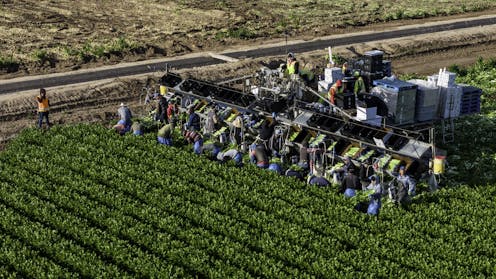
Farmworkers harvest celery on March 9, 2024, in Yuma, Ariz. John Moore/Getty Images

The Trump administration’s mass deportation campaign has not spared the U.S. agricultural industry, with agents from Immigration and Customs Enforcement frequently raiding farms across the country in search of undocumented workers.

Now, farmers are facing a crisis the administration has helped create: not enough people to pick crops.

On a recent call to CNBC, President Donald Trump said, “We can’t let our farmers not have anybody.” To assure farmers that he had their back despite the immigration raids, he sought to distinguish immigrants he called “criminals” and “murderers” from nonthreatening farm laborers who have been picking crops for years.

To do so, Trump used an old stereotype for farmworkers: “These people do it naturally, naturally.” Trump recounted asking a farmer: “What happens if they get a bad back? He said, ‘They don’t get a bad back, sir, because if they get a bad back, they die.’”

“In many ways, they’re very, very special people,” said Trump, referring to undocumented farmworkers.

Trump is labeling some of the people his administration has targeted for deportation as naturals.

As a historian of American agriculture and labor, I think the Trump administration’s contradictions on farmworkers are part of a long history of idealizing farming in America. It’s a history in which race, nature, exploitation and the very identity of America itself have all been involved.

From Jefferson to Sunkist

Thomas Jefferson, most famous for writing the Declaration of Independence, also declared, “Those who labour in the earth are the chosen people of God.”

Jefferson thought America’s true calling was to be an agrarian nation, for virtuous and independent farmers would also be perfect citizens. But Jefferson didn’t actually get his own hands dirty. He told John Quincy Adams that he “knew nothing” about farming.

The Founding Father Alexander Hamilton, in the musical “Hamilton,” crystallized the critiques against what came to be called “Jeffersonian agrarianism,” which praises agricultural life and the virtues of farmers, but fails to acknowledge it was not the planters who did the backbreaking work: “‘We plant seeds in the South. We create.’ Yeah, keep ranting: We know who’s really doing the planting.”

The image of America built up by white farmers contrasted with a reality that “those who labour in the earth” were often enslaved people. As the cotton empire expanded, so did slavery.

Apologists for this system of inequality argued that the “natural station” of Black people was to be enslaved. Black people were portrayed as natural manual laborers – and by extension, the institution of slavery itself was defended as natural, rather than an abrogation of the “natural rights” promised to all men in the Declaration of Independence.

American agricultural leaders in the early 20th century, as I document in my book “Orange Empire,” adapted these forms of “naturalization” – the process, as developed by cultural theorists, through which man-made things such as racial hierarchies are made to appear natural.

A black and white photo shows several men picking crops in a field.
Mexican migrant workers harvest crops on a California farm in 1964.
AP Photo

In this naturalizing mode, the Los Angeles Chamber of Commerce argued in 1929 that “much of California’s agricultural labor requirements consist of those tasks to which the oriental and Mexican due to their crouching and bending habits are fully adapted, while the white is physically unable to adapt himself to them.”

As I describe in my book, the president of the citrus growers cooperative Sunkist insisted in 1944 that Mexicans “are naturally adapted to agricultural work, particularly in the handling of fruits and vegetables.”

Through this naturalization, racism appeared to be made in nature. Everything in farming – all of the food grown in what author Carey McWilliams called “factories in the field” in his 1939 exposé – was carefully constructed by farmers, their lobbyists and their advertisers to appear natural. That includes the racism and labor exploitation at the heart of it.

While naturalizing workers as evolutionarily adapted to stoop labor, this system all but denied undocumented farmworkers legal access to the other kind of naturalization: becoming full citizens.

So when anti-immigrant ideology sparks ICE raids and deportations, the nation’s farms end up losing the labor they have long relied on.

Whose homeland?

On X, the U.S. Department of Homeland Security has been presenting itself as if it’s on a mission to secure a white homeland. It has posted videos of white people enjoying America’s natural wonders to the tune of Woody Guthrie’s “This Land is Your Land” and paintings that propagandize manifest destiny, the idea that the U.S. is destined to extend its dominion across North America.

Homeland Security recently posted John Gast’s 1872 painting “American Progress” as a “Heritage to be proud of.” It depicts a luminous white goddess flying west over the American landscape, with white farmers plowing the soil beneath, while petrified Native Americans, shrouded in darkness, are being chased from their homelands.

As I and others have pointed out, Homeland Security is using coded messages to affirm white supremacists’ vision of turning America into a white homeland.

On the ground in America today, nonwhite immigrants are fleeing from immigration agents, as if the Gast painting is coming to life. The United Farm Workers union, referring to “videos of agents chasing farm workers thru the field,” says that “workers are terrorized.” One worker said they are “being hunted like animals.”

‘Grounds for dreaming’

Trump told CNBC that he does not believe that “inner city” people can come to the rescue of farmers, whose source of labor has been decimated.

As Politico reports, Trump is now floating the idea of expanding an existing visa program for temporary agricultural workers and creating a new program that requires them to leave the U.S. before reentering legally. If so, he would essentially be reinventing the Bracero Program – the U.S. guest worker program with Mexico created at the behest of California growers during World War II that lasted until the 1960s.

A black and white photos shows several men standing in front of a table as a woman sits on the other side of the table.
Mexican farmworkers in 1951 register to work in the U.S. through the Bracero Program.
PhotoQuest/Getty Images

Ian Chandler is an Oregon farmer whose cherries are rotting on the trees because he’s lost the farmworkers who normally pick them. He recently told CNN that these people “are part of our community, just like my arm is connected to my body, they are part of us. So it’s not just a matter of like cutting them off … if we lose them we lose part of who we are as well.”

The Spanish word bracero roughly translates to someone who works with their arms, but the earlier guest worker program didn’t have the same inclusive meaning Chandler intends. Instead, it racialized Mexicans as natural farmworkers, as mere brawn extracted from human beings who were otherwise excluded from the community.

As historian S. Deborah Kang notes, “Sumner Welles, former under secretary of state to President Franklin Delano Roosevelt, excoriated the ‘poisoning discriminations’ faced by bracero workers and equated their experiences with the ‘Juan Crow’ racism.”

Over the course of its history, many Americans have held out hope that the U.S. would create a farming nation that lives up to the original promise of an organic democracy – the democracy Jefferson mythologized and one where all Americans are included – built from the ground up.

As historians Camille Guerin-Gonzales and Lori Flores have shown, farmworkers, whatever their official status, have worked hard to find “grounds for dreaming” in America.

Making that American dream a reality involves seeing farmworkers for who they are, I believe: vital members of the body politic who reconnect all Americans to nature through the foods they eat.

The Conversation

Doug Sackman does not work for, consult, own shares in or receive funding from any company or organization that would benefit from this article, and has disclosed no relevant affiliations beyond their academic appointment.

ref. ‘These people do it naturally’: President Trump’s views on immigrant farmworkers reflect a long history of how farming has been idealized and practiced in America – https://theconversation.com/these-people-do-it-naturally-president-trumps-views-on-immigrant-farmworkers-reflect-a-long-history-of-how-farming-has-been-idealized-and-practiced-in-america-262858