Why America still needs public schools

Source: The Conversation – USA (2) – By Sidney Shapiro, Professor of Law, Wake Forest University

While the White House’s fight with elite universities such as Columbia and Harvard has recently dominated the headlines, the feud overshadows the broader and more far-reaching assault on K-12 public education by the Trump administration and many states.

The Trump administration has gutted the Department of Education, imperiling efforts to protect students’ civil rights, and proposed billions in public education cuts for fiscal year 2026. Meanwhile, the administration is diverting billions of taxpayer funds into K-12 private schools. These moves build upon similar efforts by conservative states to rein in public education going back decades.

But the consequences of withdrawing from public education could be dire for the U.S. In our 2024 book, “How Government Built America,” we explore the history of public education, from Horace Mann’s “common school movement” in the early 19th century to the GI Bill in the 20th that helped millions of veterans go to college and become homeowners after World War II.

We found that public education has been essential for not only creating an educated workforce but for inculcating the United States’ fundamental values of liberty, equality, fairness and the common good.

In the public good

Opponents of public education often refer to public schools as “government schools,” a pejorative that seems intended to associate public education with “big government” – seemingly at odds with the small government preference of many Americans.

But, as we have previously explored, government has always been a significant partner with the private market system in achieving the country’s fundamental political values. Public education has been an important part of that partnership.

Education is what economists call a public good, which means it not only benefits students but the country as well.

Mann, an education reformer often dubbed the father of the American public school system, argued that universal, publicly funded, nonsectarian public schools would help sustain American political institutions, expand the economy and fend off social disorder.

an old greenish stamp has the face of a man in the center, with the words united states postage, 1 cent and Horace Mann
Horace Mann was a pioneer of free public schools and Massachusetts’ first secretary of education.
traveler1116/iStock via Getty Images

In researching Mann’s common schools and other educational history for our book, two lessons stood out to us.

One is that the U.S. investment in public education over the past 150 years has created a well-educated workforce that has fueled innovation and unparalleled prosperity.

As our book documents, for example, in the late 18th and early 19th centuries the states expanded public education to include high school to meet the increasing demand for a more educated citizenry as a result of the Industrial Revolution. And the GI Bill made it possible for returning veterans to earn college degrees or train for vocations, support young families and buy homes, farms or businesses, and it encouraged them to become more engaged citizens, making “U.S. democracy more vibrant in the middle of the twentieth century.”

The other, equally significant lesson is that the democratic and republican principals that propelled Mann’s vision of the common school have colored many Americans’ assumptions about public schooling ever since. Mann’s goal was a “virtuous republican citizenry” – that is, a citizenry educated in “good citizenship, democratic participation and societal well-being.”

Mann believed there was nothing more important than “the proper training of the rising generation,” calling it the country’s “highest earthly duty.”

Attacking public education

Today, Mann’s vision and all that’s been accomplished by public education is under threat.

Trump’s second term has supercharged efforts by conservatives over the past 75 years to control what is taught in the public schools and to replace public education with private schools.

Most notably, Trump has begun dismantling the Department of Education to devolve more policymaking to the state level. The department is responsible for, among other things, distributing federal funds to public schools, protecting students’ civil rights and supporting high-quality educational research. It has also been responsible for managing over a trillion dollars in student loans – a function that the administration is moving to the Small Business Administration, which has no experience in loan management.

The president’s March 2025 executive order has slashed the department’s staff in half, with especially deep cuts to the Office for Civil Rights, which, as noted, protects student from illegal discrimination.

Trump’s efforts to slash education funding has so far hit roadblocks with Congress and the public. The administration is aiming to cut education funding by US$12 billion for fiscal year 2026, which Congress is currently negotiating.

And contradicting its stance on ceding more control to states and local communities, the administration has also been mandating what can’t and must be taught in public schools. For example, it’s threatened funding for school districts that recognize transgender identities or teach about structural racism, white privilege and similar concepts. On the other hand, the White House is pushing the use of “patriotic” education that depicts the founding of the U.S. as “unifying, inspiring and ennobling.”
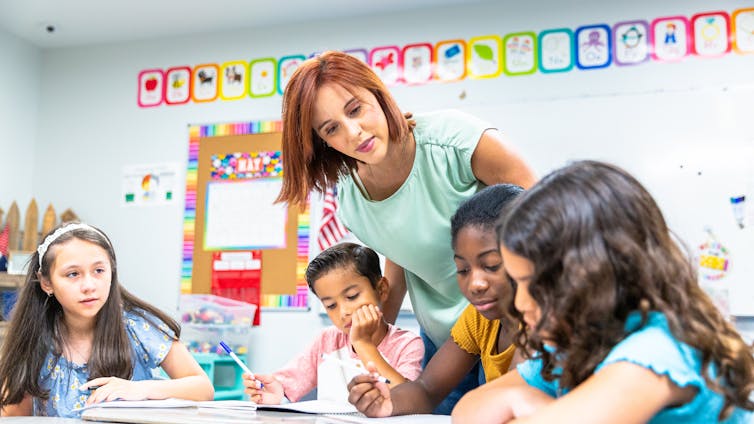
A young female teacher monitors students working on a writing lesson.
The Trump administration has been increasingly mandating what teachers can and cannot teach in their classrooms.
adamkaz/E+ via Getty Images

Promoting private education

As Trump and states have cut funding and resources to public education, they’ve been shifting more money to K-12 private schools.

Most recently, the budget bill passed by Congress in July 2025 gives taxpayers a tax credit for donations to organizations that fund private school scholarships. The credit, which unlike a deduction counts directly against how much tax someone owes, is $1,700 for individuals and double for married couples. The total cost could run into the billions, since it’s unclear how many taxpayers will take advantage.

Meanwhile, 33 states direct public money toward private schools by providing vouchers, tax credits or another form of financial assistance to parents. All together, states allocated $8.2 billion to support private school education in 2024.

Government funding of private schools diverts money away from public education and makes it more difficult for public schools to provide the quality of education that would most benefit students and the public at large. In Arizona, for example, many public schools are closing their doors permanently as a result of the state’s support for charter schools, homeschooling and private school vouchers.

That’s because public schools are funded based on how many students they have. As more students switch to private schools, there’s less money to cover teacher salaries and fixed costs such as building maintenance. Ultimately, that means fewer resources to educate the students who remain in the public school system.

Living up to aspirations

We believe the harm to the country of promoting private schools while rolling back support for public education is about more than dollars and cents.

It would mean abandoning the principle of universal, nonsectarian education for America’s children. And in so doing, Mann’s “virtuous citizenry” will be much harder to build and maintain.

America’s private market system, in which individuals are free to contract with each other with minimal government interference, has been important to building prosperity and opportunity in the U.S., as our book documents. But, as we also establish, relying on private markets to educate America’s youth makes it harder to create equal opportunity for children to learn and be economically successful, leaving the country less prosperous and more divided.

The Conversation

Sidney Shapiro is affiliated with the Center for Progressive Refrom.

Joseph P. Tomain does not work for, consult, own shares in or receive funding from any company or organization that would benefit from this article, and has disclosed no relevant affiliations beyond their academic appointment.

ref. Why America still needs public schools – https://theconversation.com/why-america-still-needs-public-schools-260368
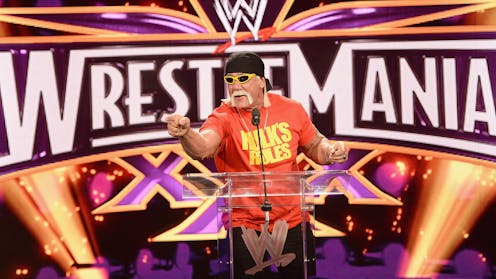
Hulk Hogan’s daughter can’t write herself out of the wrestler’s will – but she can refuse to take his money

Source: The Conversation – USA (2) – By Reid Kress Weisbord, Distinguished Professor of Law and Judge Norma Shapiro Scholar, Rutgers University – Newark

The outspoken wrestler attends a news conference in 2014. Dimitrios Kambouris/Getty Images

When professional wrestler and former reality TV star Hulk Hogan died on July 24, 2025, he left behind a grieving widow, two ex-wives, two children, two grandchildren he reportedly never met and a US$25 million fortune. He was 71 years old and died after having a heart attack.

News quickly broke that his daughter, entertainer Brooke Hogan, was estranged from her father, that she would “get nothing” from him and that she had arranged to have herself “taken out” of his will by asking Hogan’s financial manager to remove her name.

After her father, legally known as Terry Bollea, died, Brooke Hogan posted on Instagram. She said that they had shared a “quiet, sacred bond,” and it felt like part of her “spirit left with him.” But she also claimed that she had been “verbally and mentally abused since childhood.” She did not attend his funeral.

As law professors who research and write about trusts and estates, we teach courses about the transfer of property during people’s lifetimes and after they’ve died. We believe that the questions arising over who will inherit Hogan’s wealth offer important insights into how family estrangement can affect estate planning.

Making an unusual request

Journalists initially speculated about why Brooke “wrote herself out” of her father’s will, and earlier this month, she explained: Brooke was “scared” of the fighting that would come after her dad died. She said she was worried that there might be conflicts with her mother and her father’s third wife, Sky Daily.

But, to be clear, while anyone can ask to be left out of a will, they really don’t have any control over whether that ultimately happens.

A will is a document that spells out how money and other property should be distributed after someone dies.

The person who signs the will – technically known as the “testator” – is the only one with the power to change or revoke their own will. They don’t have to tell anyone what the will says.

Even the witnesses who sign it may not know who is left any property. They usually are not informed of the bequests made within the will, and some states don’t even require that witnesses know the document being signed is a will.

That means only Hulk Hogan could decide what his will said about who would get what once he died. Yes, Brooke Hogan could have asked him to exclude her from his will, but the final decision was up to him.

Refusing an inheritance

A will’s provisions only become final when someone dies.

Until then, the person can change their will multiple times. At death, the will can no longer be changed, but anyone who is named to receive property can refuse their inheritance. Refusing gifted or inherited property is known as a “disclaimer.”

Typically, when someone disclaims property, it goes to the next people in line – usually their children. If the deceased had no children at the time of death, their assets may go to their siblings or other relatives.

You might wonder why anyone would turn down an inheritance in the first place. One common situation arises when an heir is deep in debt. In these cases, disclaiming an inheritance can allow them to keep the money in the family.

This arrangement is legal in many states as long as the heir is not already in bankruptcy proceedings.

A hypothetical example

To understand how this might work, suppose an heir, whom we’re calling “Pat,” is left $4 million in his mother’s will. The timing is terrible for him because he’s deeply in debt, owing $5 million to creditors after the company he launched went belly up.

If Pat accepts that fortune, his creditors would be able to seize it. But he has a daughter, whom we’re calling “Marcy.” By refusing his inheritance, that $4 million can pass directly to Marcy. This arrangement is complicated but could leave Pat’s family better off because Marcy is free to spend her grandmother’s millions to pay off her college loans, buy a house and pay for her father’s rent – all without any risk of those assets being taken by his creditors.

Refusing an inheritance can also reduce the estate tax for the person who does so. The estate tax applies when people transfer lots of wealth at death. Under the tax reforms passed in July 2025, the first $15 million is exempt from the estate tax for individuals as of 2026, and twice that much for married couples. The exemption threshold is adjusted yearly for inflation.

The federal estate tax rate, which applies only to anything beyond the $15 million mark, is 40%, although many rich people take steps to reduce its impact through a handful of financial planning techniques. Many states have their own estate and inheritance taxes too.

Turning back to Pat’s mother, suppose that her estate was worth $100 million. If Pat accepts the inheritance, a 40% estate tax would apply. And if Pat leaves more than $15 million in 2026 dollars to his heirs without taking any steps to shield those assets, another 40% estate tax would be levied when he leaves his fortune to Marcy. But if Pat disclaims, then the government would only collect the estate tax once because his mom’s assets would skip him and go straight to Marcy.

Because Brooke Hogan asked to be disinherited before her father died, her request wasn’t a typical disclaimer. If she was not, in fact, included in Hulk Hogan’s will, as she requested, then there would be nothing for her to disclaim.

If Brooke Hogan is named in her father’s will and disclaims now that Hulk Hogan is dead, the most likely outcome is that her children, twins who were born in January 2025, would get their mother’s inheritance.

A few years after a reality TV show about the foibles of Hulk Hogan’s family began to air, he and his first wife got divorced.

Being estranged from close relatives

Estate disputes can become very contentious when members of a family are estranged, meaning that their relationships have soured or even broken off completely.

Although Brooke Hogan was reportedly concerned about avoiding litigation, given her estrangement from her father, it is usually the testator who takes action during the estate planning process to prevent disputes after they die.

That’s one reason why most wills – nearly 70% of them according to one study – include a “no contest” clause.

These clauses typically say something like “anyone who contests my will shall be disinherited from my estate.” Estate planners who recommend this technique believe that the penalty discourages unhappy heirs from filing lawsuits, which usually incur high attorney’s fees.

Fighting over money after a relative dies

What makes Brooke Hogan’s case unusual is that she asked to be disinherited to avoid a court battle over her father’s estate.

In many estranged families, the situation is the opposite: Heirs sue because they are disappointed by their share of the estate when they are either disinherited or given less than expected.

For Brooke Hogan, who says that she asked to be left out of her father’s will to avoid involving herself in any new family conflicts, the concern is understandable. Estate litigation can take an emotional toll by dragging grieving relatives into courtroom battles that are lengthy, expensive and make family rifts even worse.

The Conversation

The authors do not work for, consult, own shares in or receive funding from any company or organization that would benefit from this article, and have disclosed no relevant affiliations beyond their academic appointment.

ref. Hulk Hogan’s daughter can’t write herself out of the wrestler’s will – but she can refuse to take his money – https://theconversation.com/hulk-hogans-daughter-cant-write-herself-out-of-the-wrestlers-will-but-she-can-refuse-to-take-his-money-262560

State Department layoffs could hurt US companies’ ability to compete globally – an economist explains why

Source: The Conversation – USA (2) – By Carey Durkin Treado, Associate Teaching Professor of Economics, University of Pittsburgh

When more than 1,300 people at the U.S. State Department lost their jobs in a mass firing this summer, most headlines focused on what it meant for American diplomacy. But the layoffs are about more than embassies and foreign policy – they could also make it harder for U.S. companies to compete in global markets.

The July layoffs – part of a sweeping Trump administration reorganization effort, with more cuts still expected – eliminated the State Department’s Business and Human Rights team, which helps American businesses avoid committing human rights abuses and violating international laws.

As an economist who studies international trade, I know that BHR is an area of growing importance for both global governance and U.S. competitiveness. In addition to being an academic, I have worked at several U.S. trade agencies and the World Bank, and in 2019-20 I served as a Franklin Fellow with the State Department’s Bureau of Democracy, Human Rights and Labor. In that role, I worked closely with the BHR team and saw how critical their expertise was in helping U.S. companies navigate shifting global human rights risks and regulations.

Losing that support puts American businesses at risk of falling behind market trends and expectations.

The rise of business and human rights policy

Global norms governing business and human rights have been evolving for more than 75 years, starting with the 1948 Universal Declaration of Human Rights. While that landmark document was geared toward governments, in 2011 the United Nations Guiding Principles on Business and Human Rights and the OECD Guidelines for Multinational Enterprises represented explicit guidance from member countries – including the United States – that companies, not just governments, are responsible for respecting human rights.

This guidance means that businesses must avoid causing or contributing to human rights abuses through their operations or supply chain relationships. Potential supply chain concerns include both “upstream impacts,” such as purchasing from suppliers that use forced labor, and “downstream impacts,” such as selling products to oppressive governments.

These sorts of risks are more common than you might think. Nearly 28 million people are in forced labor globally, making products from cotton to car parts, according to the International Labour Organization. Downstream concerns have focused recently on the sale of AI and surveillance tools to authoritarian governments such as Iran. Avoiding these abuses not only reduces business risk but also helps weaken incentives for such practices.

For decades, the State Department has taken the lead within the federal government in the task of promoting U.S. human rights policies globally. Historically, its three main responsibilities in this area have included reporting on human rights conditions at the country level, providing foreign assistance to promote human rights, and engaging in diplomatic efforts to improve human rights conditions globally.

The portfolio of the BHR team fell mainly within this third area of responsibility and included providing expertise as international policies related to business and human rights continued to expand.

The rise of human rights due diligence laws

Over the past 10 years, some of the world’s largest economies have begun to enact laws that require businesses to conduct risk analyses and publicly report on their human rights impacts. These laws – known as human rights due diligence, or HRDD, laws – have been passed or proposed in the European Union, France, the Netherlands, Germany, the United Kingdom, Australia, South Korea and Thailand.

Of particular importance is the EU Corporate Sustainability Due Diligence Directive, which was adopted by the EU in July 2024 and will begin to go into effect in 2028. Its broad scope will reshape compliance for global companies across markets, industries and supply chains.


Read more:
Many global corporations will soon have to police up and down their supply chains as EU human rights ‘due diligence’ law nears enactment


Although it is too soon to measure the full impact, many companies and industry groups have endorsed human rights due diligence laws. Industry groups and associations have published statements in support of HRDD laws, which they see as leveling the playing field for responsible business activity. A 2025 survey of 1,300 German corporate decision-makers found that most believed their country’s HRDD law gave them an edge over European competitors – and 44% said it gave them an advantage over U.S. and Chinese companies as well.

The US falls behind on sustainability

U.S.-based multinational companies are subject to the HRDD laws in the countries in which they do business. Starting in 2028, these companies will need to comply with new human rights laws if they want to participate in the EU market. Although some industry groups are in support of these laws, others, such as the U.S. Chamber of Commerce, have expressed concerns about the implementation timeline and some specific requirements.

Prior to the reorganization, the State Department worked closely with multilateral and international organizations, as well as other governments, to establish clear policy frameworks for business and human rights. By eliminating the Office of Multilateral and Global Affairs, which housed the BHR team, the reorganization of the State Department has effectively eliminated this source of expertise and support for U.S. businesses operating in global markets.

In my professional experience, which stretches back to the economic boom period of the 1990s, U.S. competitiveness depends upon a clear understanding of global markets and policies. U.S. businesses must be able to work within the regulatory framework of the countries of their suppliers, partners and customers.

In addition to government regulations, U.S. corporations face pressure from their consumers and investors, who are increasingly interested in supporting corporations that can demonstrate responsible business practices. From fair-trade coffee to environmental, social and governance investment portfolios, markets are increasingly placing value on products and businesses that can demonstrate respect for human rights. Despite political controversy and backlash, market analysts continue to predict steady growth in investor demand for ESG investment opportunities, with ESG assets on track to reach $40 trillion by 2030.

In order to best position U.S. businesses to understand and navigate the emerging role of human rights issues in global markets, the U.S. government needs expertise in these issues. By jettisoning that expertise, I believe the country risks weakening its global business position.

The Conversation

I served as a Franklin Fellow with the U.S. Department of State during the 2019-2020 academic year.

ref. State Department layoffs could hurt US companies’ ability to compete globally – an economist explains why – https://theconversation.com/state-department-layoffs-could-hurt-us-companies-ability-to-compete-globally-an-economist-explains-why-262988

Parenting strategies are shifting as neuroscience brings the developing brain into clearer focus

Source: The Conversation – USA (3) – By Nancy L. Weaver, Professor of Behavioral Science, Saint Louis University

Grocery stores are a common source of tantrums and meltdowns. Cavan Images/Cavan via Getty Images

A friend offhandedly told me recently, “It’s so easy to get my daughter to behave after her birthday – there are so many new toys to take away when she’s bad!”

While there is certainly an appeal to such a powerful parenting hack, the truth is that there’s a pretty big downside to parenting with punishments.

For about the past two decades, scientists have been discovering more and more about the growing brain. This exploration of neurobiology has led to new types of trauma treatments, a deeper understanding of the nervous system and an appreciation of how environmental and genetic factors interact to shape a child’s behavior.

As the science has become increasingly actionable, more evidence-based strategies are spilling into parenting and educational programs. Research offers some useful guideposts for how parents and caregivers can change our adult ways to foster healthy child development.

It turns out that many old-school parenting and educational approaches based on outdated behavioral models are not effective, nor are they best-practice, particularly for the most vulnerable children.

Why old-school methods fall short

I don’t come to this view lightly. I’m a behavioral scientist and a professor of public health with degrees in mathematics and biostatistics. When my children were little, I read all the parenting books and applied a somewhat academic strategy to my job of parenting. I firmly endorsed conventional recommendations from authors and pediatricians: I dutifully sent my children to their rooms to think about their choices and dug in my heels to enforce consequences.

It wasn’t until my children reached middle school and high school ages that I began to see what my approach to discipline was costing us.

Parents and educators have long espoused principles gleaned from experiments by the 20th-century researcher B.F. Skinner, a behavioral psychologist who studied how rewards and punishments could change the behavior of rats, resulting in the classic carrot and stick, reward and discipline strategies. Simply put, rats that behaved the way the researchers wanted – by pressing a lever – were given a treat, and rats that did not were given a light shock.

These midcentury, rat-based experiments shaped a parenting approach that caught on in American culture and quickly became dogma. Generations of parents learned to use rewards such as sticker charts, trinkets or toys, or an extra bedtime story to reinforce the behaviors they hoped to see more of, and to use negative reinforcement such as timeouts and loss of privileges to reduce unwanted behaviors.

But beginning in the early 2000s, many high-profile authors began to theorize that these strategies were not only ineffective but also potentially harmful.

Black and white photo of B.F. Skinner at a lab desk.
B.F. Skinner primarily studied rats and pigeons to see how animals learn and modify their behavior in response to different stimuli and consequences.
Bettmann/Getty Images

The neuroscience of child behavior

We all have a built-in nervous system response that prepares us for “fight or flight” when we feel that our safety is threatened. When we sense danger for whatever reason, our heart beats faster, our palms sweat and our focus narrows. In these situations, our prefrontal cortex – the part of the brain responsible for rational decision-making and reasoning – is decommissioned while our body prepares to fend off the threat. It’s not until our threat response subsides that we can begin to think more clearly with our prefrontal cortex. This is particularly true for kids.

Unlike adults who have usually acquired some ability to regulate their nervous system states, a child has both an immature nervous system and an underdeveloped prefrontal cortex. A child may hit his friend with a toy truck because he’s unable to manage the scary feelings of being left out of the kickball game. He likely knows better, but in the face of this threat his survival brain responds with a “fight” response, and reasoning shuts down as his prefrontal cortex takes awhile to get “back online.” Because he is not yet able to verbalize his needs, caregivers need to interpret those needs by observing the behavior.

After coregulating with a calm adult – essentially syncing up with their nervous system – a young child is able to return to a calm state and then process any learning. Efforts to change a child’s behavior in a moment of stress, including by punishments and timeouts, miss an opportunity for developing emotional regulation skills and often prolong the distress.

The behaviorist models just don’t work very well for children. The growing understanding of children’s developing brains makes clear that punishing a child for a temper tantrum or for “misbehaving” by grabbing a toy from a classmate makes no more sense than lecturing a man in cardiac arrest about eating less sugar.

A father consoles his young daughter as she cries.
Neuroscience-informed parenting is more effective than traditional reprimands and builds trust, connection and emotional regulation.
Halfpoint Images/Moment via Getty Images

Curiosity is the key to connection

Scientists and parenting experts have come a long way toward understanding how brain science can inform child-raising.

While researchers may not all agree on the most effective parenting style, there is general agreement that showing curiosity about kids’ feelings, behaviors, reactions and choices can help to guide parents’ approach during stressful times. Understanding more about why a child didn’t complete their math sheet, or why a toddler threw sand at their cousin, can support real learning.

Attuning with our children by understanding their nervous system responses helps kids feel a sense of safety, which then allows them to absorb feedback. Children who feel this connection and build these skills are much less likely to throw trucks.

For instance, when your child fusses for candy in the checkout line at the grocery store, instead of taking away the afternoon trip to the park, try this instead:

  • Stay grounded. A deep breath and a pause signals to your own nervous system to be calmer, which allows you to coregulate with a fussing child.

  • Be available. Staying close gives your child the support they need to weather the difficult emotion. Validating a child’s experience can go a long way toward helping them reset to a more regulated state.

  • Hold a boundary. By not giving in to the candy purchase, you help your child practice how to handle the emotion of anger and disappointment – called “distress tolerance” – with your support.

  • Reflect on the circumstances. After everyone is calmer, you can talk about that experience and also notice the circumstances. Was your child hungry or tired, or perhaps upset about something from their day?

Parenting with the understanding of a child’s developing brain is much more effective in shaping children’s behavior and paves the way for emotional growth for everyone, as well as stronger parent-child relationships, which are enormously protective.

And that definitely feels better than taking away their birthday presents.

The Conversation

Nancy L. Weaver, PhD, MPH is the Founder and CEO of Support Over Silence, LLC and a Professor of Public Health at Saint Louis University. She has received funding from the NIH and the CDC among other agencies.

ref. Parenting strategies are shifting as neuroscience brings the developing brain into clearer focus – https://theconversation.com/parenting-strategies-are-shifting-as-neuroscience-brings-the-developing-brain-into-clearer-focus-254975

No end to the violence as Israel launches its assault on Gaza City

Source: The Conversation – UK – By Julie M. Norman, Senior Associate Fellow on the Middle East at RUSI; Associate Professor in Politics & International Relations, UCL

In Gaza City, Palestinians are fleeing a renewed Israeli [assault] to take control over the area, following days of air strikes that have killed dozens. Just days earlier in Cairo, Hamas officials announced their acceptance of a ceasefire proposal following negotiations with Qatari and Egyptian mediators – a deal now probably derailed by the assault. And across Israel, hundreds of thousands of Israelis demonstrated against Benjamin Netanyahu’s handling of the war, demanding an end to fighting and the return of hostages.

It may be tempting to view Hamas’s announcement, combined with the protests, as potential turning points. But for many in the region, and with Israel beginning a new ground offensive in Gaza, this week’s headlines look all-too familiar.

Gaza City has been pummelled repeatedly throughout the 22-month war. Hamas has initially responded positively to various ceasefire proposals over the past year that have then broken down in negotiations. And Israelis turned out for massive protests nearly a year ago against the government’s failure to reach a ceasefire-for-hostages deal. Weekly protests have continued since in both Tel Aviv and Jerusalem, to no avail.

Indeed, after spending the past month in the region, I find it hard to envisage an end to the violence any time soon. As one Israeli reservist told me: “Last year at this time, I didn’t imagine there could possibly be another year of war. Now, it’s hard to imagine there not still being a war in another year from now.” So where do things go from here?

Even before Israel’s renewed offensive, a ceasefire deal looked highly unlikely. This is despite the fact that the proposal accepted by Hamas is reportedly “98% similar” to the US-backed phased plan from July. This called for a 60-day truce, which would see about half of the hostages released while the two sides negotiate a lasting ceasefire. Hamas has also reportedly eased its demands regarding two of the major sticking points from the summer’s negotiations, namely the number of Palestinian prisoners serving life sentences to be released as part of the deal (reduced from from 200 to 150), and the size of an Israeli buffer zone along the Gaza border (increased from 800 metres to one kilometre).

But the Israeli government has said it is no longer interested in a partial or phased deal, only a comprehensive agreement that would see all the hostages freed. While Netanyahu has not formally ruled out the current offer, various members of his governing coalition have already rejected it.

Israel and Hamas remain far apart regarding what “ending the war” actually means. Hamas has long maintained that an end to the war means the withdrawal of Israeli troops from Gaza and a guarantee that any truce be permanent. Meanwhile, Israel’s security cabinet has approved a five-point plan for ending the war that, along with the return of the hostages, includes disarming Hamas, demilitarising Gaza, and taking security control of the Strip, as well as establishing “an alternative civil administration that is neither Hamas nor the Palestinian Authority”.

Aside from the hostage release, all of these points present major challenges, especially disarming Hamas and “security control”. Given Hamas’s depleted state, some argue that Hamas might be willing to decommission weapons as part of a negotiated disarmament, demobilisation and reintegration process, similar to the IRA in Northern Ireland or the Farc in Colombia. But this would require disarmament happening in the context of a broader long-term political agreement.

This was part of the logic behind a July declaration endorsed by all Arab League states, calling on Hamas to disarm to open up a pathway for a Palestinian state. But, given that the Netanyahu government has rejected any negotiations towards a two-state solution, Hamas’s leadership in Gaza is not likely to disarm if it is seen purely as surrendering.

Israel’s intention to maintain “security control” in Gaza arguably represents an even greater impasse to reaching a ceasefire. This is not a new position. Netanyahu articulated a plan for security control in February 2024, and has spoken openly of reoccupying Gaza since May 2025.

The government has also discussed plans to annex parts of Gaza, and continues to explore options for “resettling” Gazans to third countries – a move that would amount to forcible transfer under international law. And as the military moves forward this week with plans to retake Gaza City, all signs are pointing to a long-term or permanent Israeli presence inside Gaza.

Israeli opposition, Hamas division

These moves are happening on the backdrop of growing public wariness in Israel, where polls show more than 70% of Israelis supporting a negotiated end to the war to free the hostages. Furthermore, many view the plans to retake Gaza City as both endangering the remaining hostages in the short term and creating new security problems for Israel in the long term, as well as keeping thousands of reservists deployed.

In addition to this past week’s protests, a group of more than 600 Israeli security and intelligence officials wrote a letter earlier this month stating that Hamas no longer poses a strategic threat to Israel, and calling for an end to the war. Notably, the letter was sent to the US president, Donald Trump, whom most officials I spoke with agreed is the only person with the leverage to nudge Netanyahu towards a ceasefire.

Identifying external leverage for Hamas is equally difficult. There have long been internal rifts within Hamas, especially between the so-called pragmatists and ideologues. These internal divisions have multiplied over the course of the war as the group struggles to maintain a coherent vision amid the Israeli assassinations of most of its leadership and the weakening of its regional backers, Iran and Hezbollah.

As such, even when Qatari and Egyptian mediators manage to extract concessions from Hamas negotiators, they are often rebuffed by leaders and operatives in Gaza, where the group views mere survival as a form of victory. Indeed, even though Hamas’s military capabilities have been largely depleted, they maintain the capacity to sustain a long campaign of guerrilla warfare.

As both Netanyahu and Hamas prolong the war for their own survival, they appear to be locked in a mutually destructive cycle. But it’s Gaza’s civilians and the Israeli hostages who continue to bear the consequences.

The Conversation

Julie M. Norman does not work for, consult, own shares in or receive funding from any company or organisation that would benefit from this article, and has disclosed no relevant affiliations beyond their academic appointment.

ref. No end to the violence as Israel launches its assault on Gaza City – https://theconversation.com/no-end-to-the-violence-as-israel-launches-its-assault-on-gaza-city-263463

How the racist study of skulls gripped Victorian Britain’s scientists

Source: The Conversation – UK – By Elise Smith, Associate Professor in the History of Medicine, University of Warwick

Illustration of a skull, viewed from the left side, showing the principal craniometric points. From Gerrish’s Text-book of Anatomy (1902) Frederick Henry Gerrish (1845-1920), Public domain, via Wikimedia Commons

The recent publication of the University of Edinburgh’s Review of Race and History has drawn attention to its “skull room”: a collection of 1,500 human craniums procured for study in the 19th century.

Craniometry, the study of skull measurements, was widely taught in medical schools across Britain, Europe, and the United States in the 19th and early 20th centuries.

Today, the harmful and racist foundations of craniometry have been discredited. It’s long been proven that the size and shape of the head have no bearing on mental and behavioural traits in either individuals or groups.

In the 19th and early 20th century, however, thousands of skulls were amassed to enable research and instruction in scientific racism. Edinburgh’s skull room is by no means unique.

Unlike phrenology, a popular theory which linked personality traits to bumps on the head, craniometry enjoyed widespread scientific support in the 19th century because it revolved around data collection and statistics.

Craniometrists measured skulls and averaged the results for different population groups. This data was used to classify people into races based on the size and shape of the head. Craniometrical evidence was used to explain why some peoples were supposedly more civilised and evolved than others.

The vast accumulation of data drawn from skulls appealed to Victorian scientists who believed in the objectivity of numbers. It equally helped to validate racial prejudice by suggesting that differences among peoples were innate and biologically determined.

Medical history

The study of skulls was central to the development of 19th-century anthropology. But before anthropology was taught at British universities, markers of supposed racial difference were studied by anatomists skilled in identifying minute differences in skeletons. The study of skulls entered the university curriculum through medical schools, and particularly through anatomy departments.

For example, when Alexander Macalister was appointed as professor of anatomy at Cambridge in 1884, some of his first lectures were on “The Race Types of the Human Skull.”

Macalister’s annual report for 1892 in the Cambridge University Reporter describes how he had increased Cambridge’s cranial holdings from 55 to 1,402 specimens. In 1899, he reported the donation of more than 1,000 ancient Egyptian craniums from the archaeologist Flinders Petrie. Much of Macalister’s skull collection remains housed in the university’s Duckworth Laboratory, which was established in 1945.

As the prestige of craniometrical research increased, institutions had to compete for cranial collections as they went on the market. Statistical accuracy depended on vast series of craniums being measured to produce representative “types”. This created an increased demand for human remains.

In 1880, the Royal College of Surgeons purchased 1,539 skulls from the private collection of Joseph Barnard Davis. This was added to their existing cache of 1,018 craniums to create Britain’s largest craniological collection. This collection was largely destroyed in 1941 when the college building was bombed during world war two. The remaining skulls are no longer held by the Royal College of Surgeons.

Oxford’s University Museum of Natural History included rows of crania in their anatomical displays in the 19th century, as did the University of Manchester’s medical school (the medical school is no longer on the same site). This investment in skulls ensured that racial researchers had enough material to study and use in their teaching.

Catalogues kept by universities in the 19th and early 20th centuries reveal not only the size of their skull collections, but also the origin of individual specimens.

Historical trauma

Some medical schools, such as Edinburgh’s, repurposed skulls procured by phrenological societies earlier in the century to enhance their holdings. Others, including Oxford’s, made use of skulls unearthed by archaeologists to conduct racial research into the country’s past. This research attempted to trace the movements of Celts, Normans, Saxons, and Scandinavians across the British Isles.

Yet because craniologists wanted to capture the full extent of racial variation, skulls from abroad were especially prized. Medical graduates of British universities posted to the colonies sent foreign bones to their old professors.

In research for my forthcoming book on skull collections, I’ve found that Cambridge’s cranial register includes a skull sent from a former student stationed in India. He had plucked it from a cremation site in Bombay despite the outrage of gathered mourners. Brazen grave-robbing and colonial violence were central to the international network that furnished British universities’ skull rooms.

The racist ideology that spurred the collection of skulls 150 years ago has been completely discredited. However, some anthropologists believe these bones may still shed light on human origins, relations and migrations.

Yet ethical factors now equally shape institutional policies towards human remains. The Pitt Rivers Museum in Oxford took its infamous “shrunken heads” off display in 2020.

Increasingly, universities and museums have confronted the historic injustices and inter-generational trauma perpetuated by their retention of human remains. Since the 1970s, Indigenous groups from around the world have launched campaigns to repatriate their ancestors’ bones. Research institutions have become increasingly responsive to these requests.

In London, the Museum of the Royal College of Surgeons no longer displays the skeleton of Charles Byrne, the so-called “Irish Giant”. Byrne had explicitly denied consent for his remains to be dissected and mounted before he died in 1783.

The skulls in British universities are a testament to a vast theft of human remains from almost every territory on earth. Yet they have the potential to become powerful symbols of reconciliation if their discriminatory histories are acknowledged, and remedied through their return.

A spokesperson for the Duckworth Laboratory, University of Cambridge, said:

“We, like many institutions in the UK, are dealing with the legacies and past unethical practice in assembling the collections in our care. The Duckworth Collection and the Department of Archaeology are dedicated to fostering an open dialogue and building robust relationships with traditional communities and other stakeholders. This commitment is seen as an integral part of a continuous, reciprocal exchange of knowledge, perspectives, and cultural values. The aim is not only to address past inequities but also to enrich contemporary academic and cultural understanding through a respectful and equal partnership. In this vein, the Duckworth Collection is actively expanding its work with archival documentation and improving our records and database. In essence, the Duckworth Laboratory’s approach to repatriation and community engagement is marked by a commitment to openness, inclusivity, and a recognition of the need for an ongoing dialogue.”

The Conversation

Elise Smith does not work for, consult, own shares in or receive funding from any company or organisation that would benefit from this article, and has disclosed no relevant affiliations beyond their academic appointment.

ref. How the racist study of skulls gripped Victorian Britain’s scientists – https://theconversation.com/how-the-racist-study-of-skulls-gripped-victorian-britains-scientists-262280

Why empty supermarket shelves make you uneasy – even if you don’t want the missing items

Source: The Conversation – UK – By Dominik Piehlmaier, Associate Professor in Marketing, Department of Strategy and Marketing, University of Sussex

Kauka Jarvi/Shutterstock

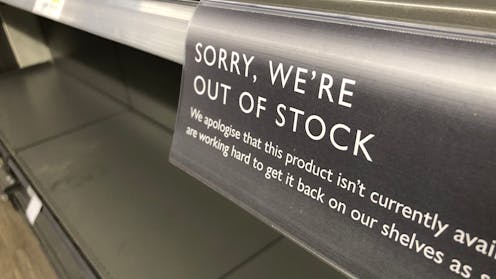
Have you ever spotted an empty supermarket shelf and felt a sudden pang of discomfort, even though you weren’t looking for that item? You’re not alone. Shocks such as COVID and cyberattacks on retailers have made empty shelves a common sight in many countries. These moments often come with media coverage of panicked shoppers and long queues.

But what happens when those shelves are empty while shopping during normal times and when you weren’t even planning to buy what’s missing?

My recent study, undertaken with my colleague Ursula Dávila Gamiño, found that empty shelves can trigger anxiety in shoppers, regardless of whether they intended to buy the missing product.

We explored how consumers react emotionally to “stockouts” (when products are unavailable or shelves are bare). The findings reveal that just the sight of empty shelves can stir up feelings of anxiety.

Our research found that shoppers’ brains may still interpret the empty space as a warning sign. It appears to be a kind of emotional conditioning: after seeing empty shelves during stressful times, consumers start to associate them with anxiety.

So even for people just browsing or picking up a few essentials, the sight of a stockout can make them feel uneasy.

One of our most striking findings is that the anxiety is not tied to the specific product. Shoppers might feel stressed when they see an empty shelf of canned soup, even if they were looking for bread. The emotional response is triggered by the visual cue itself, not the item.

Previous research has shown that media coverage alone can create a sense of urgency and fear of missing out, even when consumers aren’t directly affected by stockouts.

This means that shoppers are reacting to the idea of scarcity, not the actual inconvenience. It’s a subtle but powerful shift in how we experience retail spaces.

Different countries, different reactions

Our study also compared shopper responses in two countries – the UK and Mexico. Interestingly, UK shoppers were more likely to feel anxious when they saw empty shelves, while Mexicans were less affected.

We measured their anxiety using a method known as the state anxiety inventory by asking them to describe their current feelings either in English or Spanish towards randomly allocated images of fully stocked or empty shelves. The list of feelings covered “at ease”, “frightened”, “comfortable”, “nervous”, “worried” and “pleasant”.

We found the difference came down to their experiences. In Mexico, there was widespread reporting on severe supply chain disruptions when the country was hit hard by the 2009 swine flu outbreak.

However, over the 16 years since the outbreak occurred, the association between this traumatic event and empty supermarket shelves has weakened. This appears to have made Mexicans less likely to interpret stockouts as a sign of danger even though there were also supply chain problems during the height of the COVID pandemic.

British shoppers saw a roughly 11% increase relative to their average anxiety levels when exposed to images of empty shelves. In contrast, Mexican consumers had no detectable reaction when they were shown these photos.

mexican newspaper headline in red font detailing 236 cases of swine flu
The 2009 swine flu outbreak was an anxious time for Mexicans that ultimately led to product shortages.
Frontpage/Shutterstock

In contrast, UK shoppers, who have more recently experienced sudden and dramatic shortages as a novel phenomenon during Brexit and COVID, have a stronger emotional reaction. For them, an empty shelf might not be just a gap in inventory. It could be a reminder of the uncertainty they experienced just a few years ago – official figures show that average anxiety levels in the UK jumped rapidly over the first part of 2020.

Our environment affects us, even in subtle ways. Supermarkets are not just places to buy food, they are commercially driven spaces that influence how we feel. The layout, lighting and even the state of the shelves can shape our mood and determine if and how much we buy.

Rather than using signs to explain the shortages, one practical solution to help shoppers avoid feelings of anxiety could be for supermarkets to cover empty shelves with images of fully stocked ones.

This visual trick might help reduce anxiety and create a more pleasant shopping atmosphere. While it may sound like a small change, it could make a big difference for shoppers who are sensitive to signs of scarcity.

There is a growing body of research into how everyday experiences affect our mental and emotional wellbeing. Even routine activities such as grocery shopping can have psychological impacts, and small changes in our environment can influence how we feel.

So the next time you’re in the supermarket and the sight of an empty shelf makes your heart sink, remember it’s not just about the missing products. It’s about how your brain has learned to respond.

The Conversation

Dominik Piehlmaier does not work for, consult, own shares in or receive funding from any company or organisation that would benefit from this article, and has disclosed no relevant affiliations beyond their academic appointment.

ref. Why empty supermarket shelves make you uneasy – even if you don’t want the missing items – https://theconversation.com/why-empty-supermarket-shelves-make-you-uneasy-even-if-you-dont-want-the-missing-items-262285

Why people embrace conspiracy theories: it’s about community, not gullibility

Source: The Conversation – UK – By Robin Canniford, Professor of Markets, Business, and Society, University of Bath

TSViPhoto/Shutterstock

Psychologists have long considered how a tendency towards irrational thinking or particular personality traits might predict peoples’ interest in conspiracies. Yet these individual factors do not explain the group processes through which conspiracy theorists are extending their influence and impact.

Over five years, we sought out and got to know people on the cusp of becoming conspiracy theorists. And the results of our new study show that a sense of community activism is attracting people to these ideas.

Indeed, contrary to the stereotype of isolated keyboard warriors who have gone down the rabbit hole, conspiracy theorists are becoming organised, recruiting supporters, picketing vaccination centres and vandalising telecommunication and traffic infrastructures.

Our research examined the growing interest in conspiracy theories and how associated activism emerges. Immersive research with conspiracy theorists is rare. But revealing our status as researchers actually allowed us to build relationships with people, who shared insights into what motivates their involvement.

In particular, we spoke to people about conspiracy theories concerning 5G technology, COVID-19, 15-minute cities and low-traffic neighbourhoods. We also took part in online discussions and travelled the UK to sit in on public meetings and conferences. Ultimately, our insights revealed how people tend to follow a pathway from initial interest, to community engagement and potentially activism.

Awakenings

Belief in conspiracy theories is often initiated by traumatic life events. Job losses or the death of a loved one can trigger anger and suspicion towards public services, authority figures, and experts. This is especially so if people feel that the tragic or destructive events that affected them could have been averted. And these emotions can motivate a search for answers.

When conspiracy theories claim to explain painful personal circumstances or wider fears over COVID-19, or climate change, people can experience “awakenings”. These are moments of insight during which people come to believe that the causes of their problems lie with secretive groups which control society.

One person we spoke to described conspiracy theories as enabling him to “access the way the world really works… as if a light was switched on in my head and I could see things clearly”.

People rarely experience their awakening in isolation. In online group chats, people discover others with similar problems. In public meetings, beliefs in various theories are boosted by interactions where people discuss their suspicions over who is to blame for particular issues. In the process, these groups feed off their common emotions, building an atmosphere of energy and excitement.

The loss of traditional meeting places such as pubs and high streets, along with high levels of loneliness, may be driving people to look for new forms of connection and meaning.

QAnon protesters stand holding posters
Conspiracy theories can make people feel like they are part of something.
Mircea Moira/Shutterstock

The people we spoke to expressed surprise at the social connections they had found through these communities. As one participant put it, “there’s a lot of support out there for people who are doing their own research… there is always someone wanting to hear more, building on the work of others, giving each other support. There’s a real buzz in this community.”

Do your own research

Conspiracy theories don’t merely offer alternative explanations for events, they are resources for communities that provide identity, purpose and belonging. These benefits may explain why it is so difficult to talk people out of their beliefs in conspiracy theories.

Indeed, when conspiracy communities generate common interpretations and shared emotions, conspiracy theories can resonate powerfully, making them seem more real than they are.

This effect is compounded by the way which conspiracy theories invite believers to build on ideas by “doing their own research”. The internet serves as a vast database where conspiracy theorists can discover articles, documents and scientific reports to support their claims.

And despite the questionable quality of many such sources, contributing to conspiracy theories can provide a boost to people’s self esteem, making them feel like experts and heroic detectives. A key aspect of these communities is how they empower members to contribute.

Yet, beyond generating more theories, conspiracy communities are becoming organised networks for protest and activism. Given that conspiracy theories raise suspicion and anger over peoples’ problems, and point the blame at particular targets, we found that believers can feel compelled to take part in protests.

For example, some claim that the urban planning concept of 15-minute cities is part of secretive government scheme to limit citizens’ movement. Protesters against these and other efforts to improve urban environments are uniting under slogans such as “stop the tyranny”.

Who benefits?

Activism based on conspiracy theories can come with serious risks. Many of those involved lose contact with family and friends. Increasingly, conspiracy activists are being charged with crimes. In 2024, an anti-vaccine conspiracy theorist was sentenced to prison for five years for encouraging violence against chief medical officer for England, Chris Witty.

Moreover, when conspiracy theorists take action without tested evidence, they may misidentify targets. This can result in harm to innocent people and can undermine the very institutions needed to solve crimes.

To be sure, instances of conspiracy and foul play by powerful figures and organisations do happen. You have to wonder how much energy then, is wasted fighting imaginary enemies while actual wrongdoing is overlooked.

Perhaps the real winners here are the conspiracy entrepreneurs – people who capitalise on conspiracy theories by creating content that heightens peoples’ suspicions about problematic events. In the process, these people build attention and fame, while peddling products and services from books, merchandise and coaching, to vitamin pills and gadgets.

The Conversation

The authors do not work for, consult, own shares in or receive funding from any company or organisation that would benefit from this article, and have disclosed no relevant affiliations beyond their academic appointment.

ref. Why people embrace conspiracy theories: it’s about community, not gullibility – https://theconversation.com/why-people-embrace-conspiracy-theories-its-about-community-not-gullibility-262276

Sleep apnoea and the unlikely role of conch shells

Source: The Conversation – UK – By Jo-Anne Johnson, Head of Undergraduate Medicine, Anglia Ruskin University

AJP/Shutterstock.com

Could blowing a conch shell help treat sleep apnoea? As a doctor working in sleep medicine, this unexpected news story certainly grabbed my attention. My first reaction was scepticism – sleep specialists don’t typically prescribe natural objects found on beaches as medical therapy. But perhaps I was too hasty to dismiss the idea.

For those unfamiliar with them, a conch shell is the spiral home of a large sea snail that, when hollowed out, can be blown like a trumpet. This practice isn’t new – cultures worldwide have used conch shells for thousands of years in rituals, ceremonies and communication. What’s novel is the suggestion that it might help with a serious medical condition affecting millions.

We all know someone who snores, but not all snoring is harmless. If your partner notices you sometimes stop breathing during the night, that’s cause for concern. You may have obstructive sleep apnoea, a condition where throat muscles relax excessively during sleep, causing the airway to narrow or close completely. These breathing interruptions – called apnoeas – can happen dozens or even hundreds of times per night.

The consequences extend far beyond disturbing your partner’s sleep. Each pause in breathing jolts your brain out of deeper sleep stages, leaving you exhausted the next day. This isn’t merely inconvenient – drowsy drivers cause thousands of accidents annually. The repeated drops in oxygen also strain your heart, increasing risks of high blood pressure and heart disease if left untreated.

Standard treatments focus on keeping airways open during sleep. The gold standard is Cpap (continuous positive airway pressure), where a mask delivers steady airflow that acts like an internal splint. We also use oral devices that gently shift the jaw forward, surgical removal of enlarged tonsils or adenoids, and even newer techniques involving tiny electrical impulses to stimulate airway muscles.

Lifestyle changes matter, too. Weight loss reduces fatty tissue around the neck that can compress airways, while cutting alcohol and stopping smoking helps maintain firmer airway muscles – both substances make throat tissues floppier and worsen symptoms.

Muscles matter for sleep

So where does the conch shell fit? When you blow through any narrow opening, you’re essentially training your upper airway muscles to stay open and firm. This concept, called airway muscle training, has legitimate scientific backing. Studies show that exercises targeting the tongue, soft palate and facial muscles can improve mild to moderate sleep apnoea symptoms.

Research has even examined whether playing the didgeridoo – another wind instrument requiring sustained airway control – might benefit sleep apnoea patients. The results were promising, though limited by patient compliance. The challenge with any exercise-based treatment is maintaining daily practice long-term.

A shirtless man blows a didgeridoo.
This could help too, but might annoy your neighbours more.
Lies Ouwerkerk/Shutterstock.com

This is where the conch shell idea becomes more intriguing. For carefully selected patients with milder symptoms, it could offer an engaging, culturally rich alternative to conventional airway exercises. It’s certainly more accessible than learning the didgeridoo – and probably easier to explain to concerned neighbours.

However, let’s be clear: conch shell therapy won’t revolutionise sleep apnoea treatment. Anyone with suspected sleep apnoea needs proper medical evaluation and evidence-based treatment. Cpap therapy remains the most effective option for moderate to severe cases. But as part of a comprehensive approach – alongside weight management, lifestyle changes and conventional treatments – prescribed conch shell exercises might one day earn a place in our therapeutic toolkit.

So sleep medicine, typically obsessed with high-tech solutions, might benefit from embracing something as ancient and simple as blowing into a seashell. Of course, being sleep specialists, we’d inevitably need to give it a suitably technical name – “conchological respiratory muscle rehabilitation” has a nice ring to it, don’t you think?

The Conversation

Jo-Anne Johnson does not work for, consult, own shares in or receive funding from any company or organisation that would benefit from this article, and has disclosed no relevant affiliations beyond their academic appointment.

ref. Sleep apnoea and the unlikely role of conch shells – https://theconversation.com/sleep-apnoea-and-the-unlikely-role-of-conch-shells-263458

Quand les enfants dessinent la nature, ils représentent aussi leur classe sociale

Source: The Conversation – France (in French) – By Julien Vitores, Docteur en sociologie, Université Sorbonne Paris Nord

Dessins d’enfants collectés par le sociologue Julien Vitores dans trois écoles. Un établissement privé catholique de l’Ouest parisien, une école publique relevant d’un programme d’éducation prioritaire (REP+), et une école en zone périurbaine étendue du sud de la France. Fourni par l’auteur

Quelles visions de la nature transmettons-nous aux enfants ? Voici l’une des questions auxquelles le sociologue Julien Vitores a tâché de répondre. Il s’est pour cela rendu notamment dans trois établissements accueillant des élèves de trois à six ans. Une école catholique de l’Ouest parisien fortuné, une école publique du nord de Paris accueillant un public social très mixte, et l’école d’une zone périurbaine du sud de la France. Dans ces bonnes feuilles du livre issu de sa thèse, il raconte les réactions diverses provoquées par une question très simple posée à des enfants de 5 ans rencontrés : dessinez la nature.

Extrait de La nature à hauteur d’enfants, Socialisations écologiques et genèse des inégalités, Éditions La Découverte, collection L’Envers des faits, 256 pages.


Dans chacune des trois écoles où j’ai réalisé mon enquête, après les premiers échanges avec les enseignantes, je me suis présenté aux élèves en leur disant que je m’intéressais à « la place de la nature dans la vie des enfants » et que je venais voir « comment ça se passe à l’école ». J’ai déjà souligné l’accueil enthousiaste dans l’école maternelle privée des beaux quartiers parisiens. L’accueil que m’ont réservé les élèves des écoles aux publics plus mixtes en termes d’origine sociale mérite aussi attention. Dans ce contexte, les élèves issus des familles les plus dotées en capital culturel se sont distingués par leur vif intérêt pour le sujet, par leur connaissance du terme « nature » et par leur volonté de me le faire savoir.

Pendant ma première journée d’observation à l’école [dans le nord de Paris] Léon-Blum, quelques enfants, parmi lesquels Elena, cinq ans (mère cadre chargée de projets culturels, père musicien), et Solal, cinq ans (mère approvisionneuse, père ingénieur), mettent ainsi en avant des expériences singulières associées au thème de la nature. Lors du tour de table, Elena précise non sans fierté, juste après avoir donné son prénom : « Moi, j’ai déjà mangé des vers de terre et des criquets ! » Quelques instants plus tard, tandis que l’enseignante m’explique qu’il y a des phasmes dans la salle de classe, Solal m’observe prendre des notes, puis s’exclame, étonné : « Tu notes tout ? ! » Je lui réponds que les phasmes m’intéressent, car ils font partie de la nature. Il lance alors, en référence à ce que disait Elena plus tôt : « Ben moi, j’ai mangé du crocodile, du serpent et de la tortue. C’était en Chine ! » Peu après, je l’entends dire à Léon, cinq ans (mère galeriste, père architecte) : « Comme il aime bien la nature, il a écrit que j’avais mangé du crocodile et du serpent ! » Il continue ensuite à jeter des coups d’œil derrière lui, comme pour vérifier si je note encore. L’attitude de Solal est caractéristique des nombreuses tentatives enfantines d’attirer mon regard – et plus généralement l’attention des adultes – et de se voir valorisés par le fait que je relève leurs actions ou leurs paroles dans mon carnet.

Le fait qu’il comprenne que la nature m’intéresse et qu’il soit capable d’y associer des animaux perçus comme rares et exotiques lui donne la possibilité de surenchérir à la suite du souvenir évoqué par Elena. Pendant plusieurs mois, Solal me raconte régulièrement ses expériences personnelles en espérant que je les note, sans que je le sollicite au préalable. Très souvent, ses récits me frappent par leur adéquation avec ce que j’ai dit de mon enquête. Au-delà des nombreux détails sur son voyage en Chine, il me parle de ses cactus et plantes carnivores, de ses vacances à la plage dans la région de Bordeaux, ou encore de sa pratique de l’escalade en plein air avec son grand frère. Les enfants suffisamment familiers de la notion de « nature », sans nécessairement pouvoir la définir clairement (ce que même des adultes peinent à faire), savent qu’ils et elles peuvent y associer des récits d’expériences susceptibles de capter mon attention.

À l’inverse, de nombreux élèves issus des classes populaires ont du mal à identifier clairement les enjeux de ma recherche. Cette inégale compréhension de la notion de nature se manifeste particulièrement au cours des activités de dessin que j’organise dans les trois écoles. Je demande alors aux élèves de me dessiner « la nature », ou bien « ce qui [leur] fait penser à la nature », avant de lancer des discussions collectives à partir des dessins réalisés. Les commentaires des enfants, pendant et après la réalisation des dessins (enregistrés et retranscrits), permettent de saisir leurs interrogations sur cet atelier, mais aussi d’observer leurs tâtonnements, hésitations et efforts déployés pour donner du sens à la consigne.

De fait, ce sont presque toujours des enfants dont les parents appartiennent aux classes populaires qui expriment une incompréhension quant à mon usage du terme « nature ». En témoigne la réaction à mes consignes de Hamadou, cinq ans – dont les parents sont sans emploi et résident dans un HLM tout proche de l’école –, avant de commencer à dessiner :

Julien [Vitores] : J’aimerais bien que vous me dessiniez la nature. Est-ce que tout le monde peut me dessiner la nature ? À quoi ça vous fait penser ?

Hamadou : C’est comment la nature ?

Julien [Vitores] : Ça te fait penser à quoi quand on te dit le mot « nature » ?

Malo : À des fleurs.

Julien [de nouveau à Hamadou] : Toi, ça te fait penser à quoi ?

Hamadou : Moi, je sais pas faire des natures. Ah oui, il a réussi à faire des natures, Malo ! [En voyant que Malo a commencé à dessiner des fleurs].

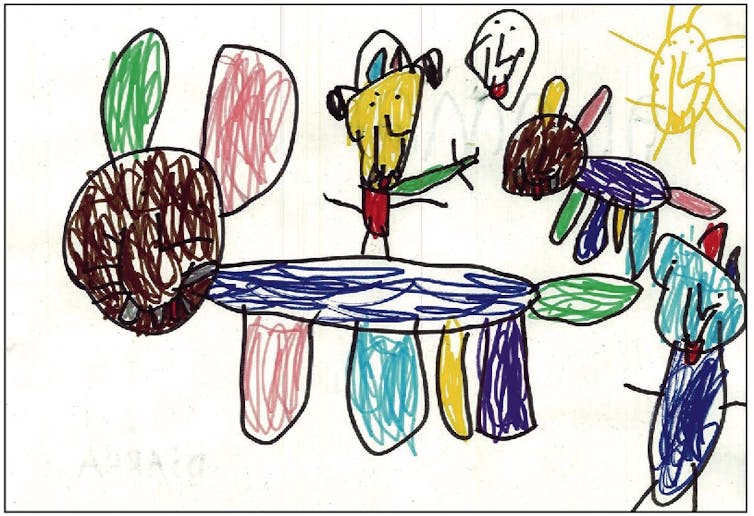
Les difficultés rencontrées par les enfants portent parfois sur leurs compétences graphiques (« je sais pas faire »), mais en partie seulement. Par exemple, Hamadou ne saisit manifestement pas à quoi renvoie le mot « nature ». N’ayant pas idée de ce qui est attendu de lui, il s’inspire de la réponse de Malo (mère assistante médicale, père architecte) et comprend « nature » comme un synonyme de « fleur », ce qui explique son usage du terme au pluriel (« des natures »). En fin de compte, un troisième garçon, Adem, cinq ans, me demande s’il peut dessiner des animaux, et Hamadou s’exclame : « Je vais dessiner tous les animaux ! » Son dessin représente finalement plusieurs fauves, qu’il désigne comme des loups. Adem rétorque : « Il est bizarre ton loup », puis affirme vouloir dessiner un lynx. Hamadou s’écrie alors : « Le loup il va manger le lynx ! »

Le dessin d’Hamadou.
Fourni par l’auteur

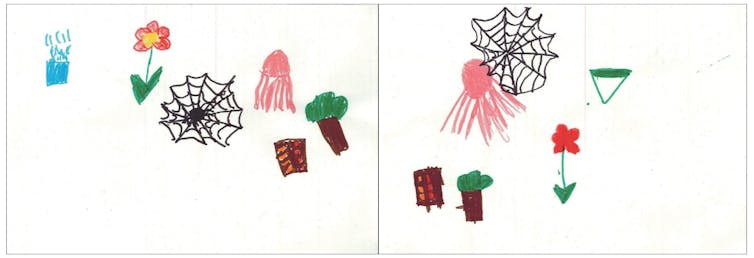
Les enfants ne sont pas égaux face à ma requête. Certains tentent de s’inspirer du dessin des voisins. Au total, 5 des 85 dessins que j’ai recueillis sont des copies quasi conformes de celui d’un ou d’une autre élèves. Les observations pendant l’activité montrent qu’il s’agit à chaque fois de dessins d’enfants issus des classes populaires imitant des enfants issus des classes moyennes ou supérieures. C’est particulièrement frappant dans le cas de Meriem, cinq ans (mère sans emploi, père chauffeur routier), qui assume ouvertement de s’inspirer du dessin d’Elena, bien plus assurée qu’elle de la pertinence de ses idées sur la nature :

Julien [Vitores] : Tu dessines quoi, Elena ?

Elena : Une méduse !

Julien [Vitores] : Et toi, Meriem, tu dessines quoi ? [Petit silence] C’est à quoi que ça te fait penser, la nature ? [Elle ne répond pas et garde les yeux baissés sur son dessin]

Elena : Tu peux faire l’océan si t’as envie !

Julien [Vitores] : Tout ce qui te fait penser à la nature.

Elena : Les humains, les trucs comme ça…

[Je ris]

Meriem : Je veux faire comme Elena. [Elle regarde le dessin d’Elena et semble hésiter] On a le droit de faire des fleurs ?

Julien [Vitores] : Oui, bien sûr, c’est dans la nature.

Elena [Quelques instants plus tard] : Julien, mais Meriem, elle me recopie !

Julien [Vitores] : C’est pas grave, si elle avait pas d’idées sur la nature.

Elena, très à l’aise avec la consigne, prend plaisir à énumérer les choses qu’elle identifie à la « nature ». Comme plusieurs autres enfants issus des familles aisées, elle semble déjà consciente du caractère extensif de ce mot, qui englobe selon elle plein de « trucs ». Au cours de l’activité, elle donne volontiers des idées à Meriem dans un premier temps (« tu peux faire l’océan »), mais sa bonne volonté s’arrête net quand elle comprend que cette dernière reproduit ses dessins à l’identique, ce qui lui ôte visiblement le privilège de l’originalité, et réduit ainsi à néant ses tentatives de mettre en valeur sa production.

Dessins d’Elena (à gauche) et de Meriem (à droite)
Dessins d’Elena (à gauche) et de Meriem (à droite). Au cours des ateliers, plusieurs enfants issus des classes populaires ne comprenaient pas à quoi renvoyait la « nature » que le sociologue Julien Vitores leur demandait de représenter. Ils imitaient alors leur camarades pour rendre un dessin jugé conforme.
Fourni par l’auteur

Cet exemple montre qu’il n’est pas possible d’analyser le contenu de ces dessins comme la simple manifestation de « représentations » que les enfants auraient de la nature. Car la pratique du dessin est de part en part une activité sociale, dans laquelle ces derniers tentent de produire un travail recevable à partir de ce qu’ils comprennent de la consigne, et de ce qu’ils sont capables de dessiner. Dès lors que mes attentes ne sont pas clairement comprises, certains élèves ont donc recours à l’imitation afin de sauver la face et d’éviter la sensation d’échouer à ce qui se présente à eux comme un exercice scolaire.

Plus fondamentalement, les interrogations suscitées par l’activité montrent que le mot « nature » lui-même n’est pas évident pour tous les enfants de cinq ans. La maîtrise (relative) de ce terme, la capacité à en faire bon usage, du moins conforme à celui qu’en font les adultes, est déjà en soi une compétence distinctive. Peu après avoir réalisé son dessin, Elena échange par exemple brièvement avec Solal sur le fait que les « humains » font partie de la nature, ce qui témoigne de leur capacité à s’interroger sur les frontières de la notion. De même, alors qu’un de ses camarades explique que les voitures ne font pas partie de la nature, Antoine, cinq ans (mère psychologue, père restaurateur), conteste vivement, en mobilisant ses propres expériences : « Si ! La nature ça peut être sur les routes. On peut se promener, par exemple, quand on est en campagne et qu’il faut partir en voiture. »

Qu’il s’agisse de la confirmer ou de la contester, les élèves les plus dotés en capital culturel ont donc conscience, même vaguement, de l’existence d’une ligne de partage entre des choses qui relèvent de la nature et des choses qui n’en relèvent pas. Mais cette frontière est loin d’être évidente ici. Certains découvrent à l’école le mot « nature », sans savoir quelles expériences personnelles y associer.

The Conversation

Julien Vitores ne travaille pas, ne conseille pas, ne possède pas de parts, ne reçoit pas de fonds d’une organisation qui pourrait tirer profit de cet article, et n’a déclaré aucune autre affiliation que son organisme de recherche.

ref. Quand les enfants dessinent la nature, ils représentent aussi leur classe sociale – https://theconversation.com/quand-les-enfants-dessinent-la-nature-ils-representent-aussi-leur-classe-sociale-263206