It’s 25 years since London got a mayor – and our polling reveals discontent

Source: The Conversation – UK – By Elizabeth Simon, Postdoctoral Researcher in British Politics, Queen Mary University of London

In 1998, British prime minister Tony Blair was bullish about his government’s vision for local democracy in London. A city-wide referendum had just firmly endorsed New Labour’s plan to give London a mayor. Though only a third of the electorate turned out, 72% of them were in favour – much healthier than the 50% of Welsh voters who ensured, by a hair’s breadth, the creation of their devolved assembly the year before.

Blair held up the UK’s capital city as a trailblazer. “Once they see how much London is benefiting from having a mayor,” he predicted, “I am confident that people in many other cities and towns of Britain will want to follow.”

Two years later, and a quarter of a century ago this year, Blair’s government created the London mayoralty, the Greater London Authority (GLA) and the London Assembly. Since then, the mayoralty has become, in the words of local government expert Tony Travers, one of the “biggest prizes in British politics”. Former prime minister Boris Johnson, who was mayor from 2008 to 2016, embodies the career-boosting potential of the office.

Coming alongside a sweep of constitutional reforms, the mayoralty, authority and assembly were supposed to address a perceived democratic deficit.

True, through Westminster, London was unquestionably the geographical centre of British political power – and dominant economically too. But after the 1986 abolition of the Greater London Council by Margaret Thatcher’s government (a council led, not coincidentally, by outspoken socialist and future inaugural mayor Ken Livingstone), one of the world’s great cities lacked its own democratically elected authority. This was a running sore. New Labour’s reforms were supposed to address it.

But 25 years on, the evidence that these institutions adequately represent the capital’s 9 million citizens is, at best, mixed.

Admittedly, as Blair predicted, more mayors have been added to the UK’s political landscape since London first took the plunge. But the UK capital’s particular institutional setup has not proven popular.

Our poll of a representative sample of adults in London shows, shockingly, that just 30% of people living in the capital feel they have “some” or “a lot” of influence over decision-making in the UK. Even when asked how much control they felt they had over decisions in London, only 31% of Londoners said “some” or “a lot”. The same figure emerged when we asked how much control they had over decisions in their constituency.

Admittedly, Londoners are slightly more trusting of local than national government to act in their interests. We found that 32% trust the mayor and nearly four in ten trust their borough council, compared with only a quarter who trust the national government. But those numbers are hardly ringing endorsements.

And it is striking that Londoners do not feel they have more influence over local than national decision-making. On existing evidence, that is not the case elsewhere in the country.

Some are particularly dissatisfied. White Londoners and those on lower social grades, with lower incomes and lower levels of educational attainment, are all less trusting than average that the government – at both local and national levels – will act in the best interests of Londoners.

We should be cautious when drawing conclusions. We cannot compare our findings with polling conducted prior to devolution, because no polls in that period asked Londoners comparable questions to those we used. And much of the dissatisfaction we pick up clearly reflects wider alienation from, and volatility in, British politics – patterns which have begun to manifest themselves in London, just as they have in other parts of the country.

Bizarre contradictions

In cities outside London, the mayor plays a “convenor” or “team captain” role for clusters of councils. But London’s unusual 32-borough structure – a reflection of its size and population density – makes this difficult. In contrast, Greater Manchester’s mayor, Andy Burnham, only has to convene ten councils.

Yet London borough leaders have recently demanded decentralising reform so the London mayoralty looks more like its counterparts. These calls may not be entirely motivated by governance concerns: frustration with perceived GLA incompetence and animosity towards the current mayor, Sadiq Khan, are also probably at play. But some advocates genuinely believe that City Hall is overpowered.

Others take a different position. Though the mayor and the GLA can make significant decisions in areas like transport (think, for example, of the congestion charge), they lack the chunky institutional and taxation powers of comparable cities such as New York and Paris.

This leads to bizarre situations. Formally, the mayor is responsible for the critical service of policing, yet cannot even appoint the commissioner for the Metropolitan Police. City Hall is caught between borough councils delivering core services and successive national governments determining budgets – including the Met’s. As declassified government papers reveal, such a situation was a worry even before the role existed: a young Pat McFadden, then political adviser to Blair, privately expressed such concerns about the draft plans in 1997.

Unfinished business

It does not appear, then, that devolution has made Londoners feel empowered over their capital’s politics. Add this to the frequent attacks on “Sadiq Khan’s London” from prominent national and international politicians, especially from the right, and it seems the future of London’s democratic institutions is as contentious as it has ever been.

A quarter of a century since the capital got its first mayor, Londoners still don’t feel as though they are adequately represented, and that they can trust their politicians to deliver for them.


Want more politics coverage from academic experts? Every week, we bring you informed analysis of developments in government and fact check the claims being made.

Sign up for our weekly politics newsletter, delivered every Friday.


The Conversation

The authors do not work for, consult, own shares in or receive funding from any company or organisation that would benefit from this article, and have disclosed no relevant affiliations beyond their academic appointment.

ref. It’s 25 years since London got a mayor – and our polling reveals discontent – https://theconversation.com/its-25-years-since-london-got-a-mayor-and-our-polling-reveals-discontent-263359
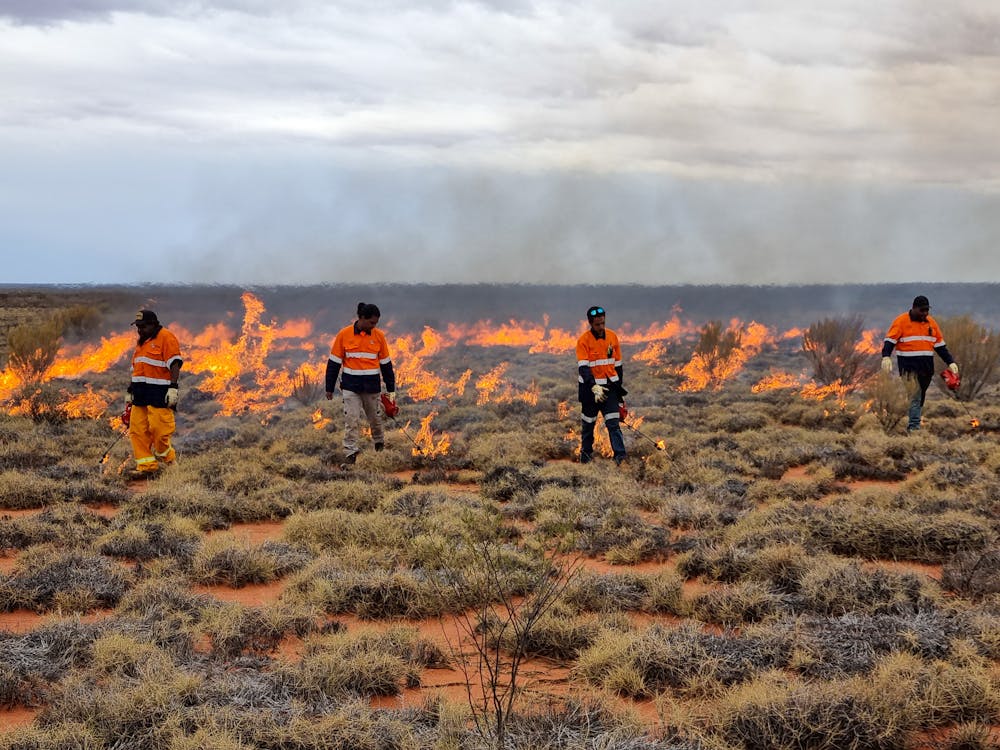
Los guardabosques están quemando el desierto en Australia para evitar que se propaguen incendios intensos y destructivos

Source: The Conversation – (in Spanish) – By Rohan Fisher, Research fellow, Charles Darwin University

KLC/Ewan Noakes, CC BY-ND

Aunque todavía es invierno, la temporada de incendios ya ha comenzado en el árido centro de Australia. Aproximadamente la mitad del Parque Nacional Tjoritja West MacDonnell, al oeste de Alice Springs, se ha quemado este año.

La propagación de la hierba Cenchrus ciliaris se considera un factor clave. Esta planta invasora ha sido clasificada como la mayor amenaza medioambiental para las culturas y comunidades indígenas australianas debido al daño que puede causar al desierto.

Las lluvias generalizadas asociadas al ciclo climático de La Niña provocan un auge en el crecimiento de esta especie vegetal. Cuando vuelven los periodos de sequía, las plantas y la hierba se secan y se convierten en combustible potencial para incendios masivos.

Estos incendios a menudo pasan desapercibidos porque casi todos los australianos viven cerca de la costa. Pero pueden ser enormes. En 2011, se quemaron más de 400 000 kilómetros cuadrados, aproximadamente la mitad del tamaño de Nueva Gales del Sur.

Después de tres años de lluvias provocadas por La Niña, nos encontramos en una situación similar, o incluso peor. Las autoridades responsables de la lucha contra incendios advierten de que hasta el 80 % del Territorio del Norte podría arder esta temporada de incendios.

Por eso, decenas de grupos de guardabosques indígenas de 12 áreas protegidas indígenas han estado trabajando duro en una colaboración sin precedentes, quemando para reducir la carga de combustible antes del calor del verano. Hasta ahora, han quemado 23 000 kilómetros cuadrados en los desiertos de Great Sandy, Tanami, Gibson y Great Victoria.

Guardabosques indígenas
Guardabosques Yilka quemando con antorchas de goteo.
Rohan Carboon/Indigenous Desert Alliance, CC BY-ND

Quema de tierras áridas

Australia cuenta actualmente con 82 áreas protegidas indígenas, que abarcan más de 87 millones de hectáreas de tierra. Eso supone la mitad de toda la reserva de territorio protegido, y está creciendo rápidamente como parte de los esfuerzos para proteger el 30 % de las tierras y aguas de Australia para 2030. Estas áreas son gestionadas por grupos indígenas, y el fuego es una parte vital de la gestión.

Esta animación muestra las quemas de controladas realizadas por guardabosques indígenas en el desierto de Tanami en 2023. North Australia Fire Information, firenorth.org.au.

El objetivo es proteger contra los devastadores incendios forestales de verano, que son más destructivos. Sin los guardabosques indígenas que gestionan de forma experta los desiertos mediante la gestión de incendios a escala paisajística, estas tierras protegidas correrían el riesgo de deteriorarse.

Como dice Braeden Taylor, coordinador de Karajarri Ranger:

Un gran incendio forestal lo destruye todo, destruye el país. El primer objetivo es quemar un poco el suelo y luego quemar desde el aire, de esa manera sabemos que todo está protegido. Con el helicóptero y el avión, podemos acceder a zonas del país a las que es difícil llegar en vehículo. Puede que no se haya quemado en mucho tiempo y podemos romper esta tendencia.

Es bueno trabajar con otros grupos. Los incendios que se inician en su lado pueden llegar hasta nosotros y los incendios en el nuestro pueden llegar hasta ellos. Trabajando juntos nos protegemos mutuamente, cuidando de nuestros vecinos.

Guardabosques indígenas
La guardabosques ngurrara Regina Thirkall y Hannah Cliff, de la Alianza Indígena del Desierto, y la guardabosques ngurrara Sumayah Surprise en Kuduarra, preparándose para la quema aérea.
Tom Montgomery/Alianza Indígena del Desierto, CC BY-ND

Entonces, ¿cómo recorren los guardabosques distancias tan largas? Estas áreas protegidas son extremadamente remotas. A menudo no hay acceso por carretera o este es muy limitado. Por lo tanto, trabajan desde el aire y, cuando es posible, desde tierra. El programa de incendios forestales de los guardabosques se basa en helicópteros y dispositivos incendiarios. Este año, han pasado 448 horas en el aire, recorriendo 58 457 kilómetros y lanzando 299 059 dispositivos incendiarios.

Cuando los incendiarios tocan el suelo, comienzan a arder. No todos los incendiarios alcanzan el lugar adecuado, por lo que se necesita tiempo para garantizar que se produzca una buena combustión. Estas tierras áridas suelen tener más hierba que árboles, por lo que los incendios se desplazan por el suelo y no alcanzan una intensidad excesiva.

quemas aéreas
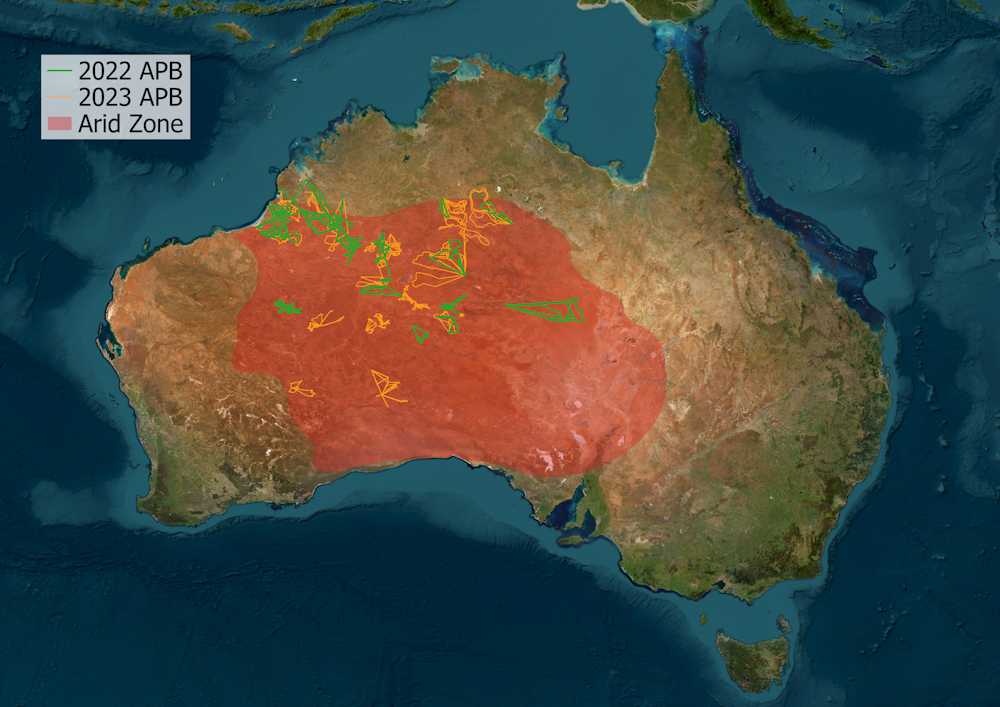
Esta imagen muestra las líneas de vuelo de las quemas aéreas prescritas (APB) en 2022 y 2023.
Indigenous Desert Alliance, CC BY-ND

Los guardabosques combinan las quemas aéreas con quemas terrestres a pequeña escala utilizando antorchas de goteo alrededor de las zonas sensibles. El objetivo es garantizar la protección de los sitios culturales y de especies amenazadas como el bilbi, el perico nocturno y el gran eslizón del desierto.

Esto es de vital importancia, dado que alrededor del 60 % de las especies de mamíferos del desierto ya se han extinguido en los últimos 250 años, mientras que muchas otras han visto reducida su área de distribución. Los cambios en los regímenes de incendios son un factor importante en estas disminuciones.

quema aérea desde un helicóptero
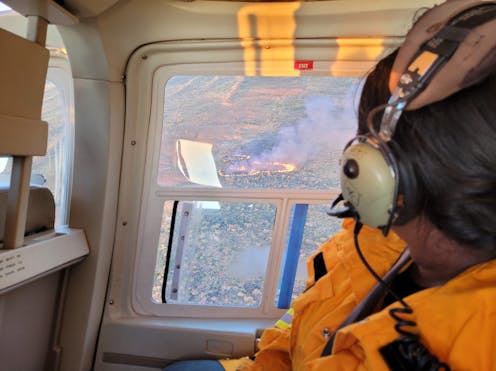
Vista desde un helicóptero durante una quema aérea planificada en Haasts Bluff Aboriginal Land Trust.
Indigenous Desert Alliance, CC BY-ND

El fuego puede forjar la comunidad

Estos proyectos de quema que abarcan todo el desierto brindan a los propietarios tradicionales la posibilidad de ver el país, compartir su cultura y transmitir sus conocimientos de generación en generación.

Como dice Ronald Hunt, guardabosques de Ngaanyatjarra:

Cuando quemamos, se limpia toda la hierba espinosa y, cuando llega la lluvia, todo vuelve a crecer fresco. Es bueno para los animales, los alimentos silvestres y todo lo demás. Es bueno usar el helicóptero para llegar a lugares de difícil acceso. Es bueno trabajar junto con otros grupos, compartir historias y cuidar el país. Ellos tienen sus historias y nosotros las nuestras, y luego nos unimos para trabajar.

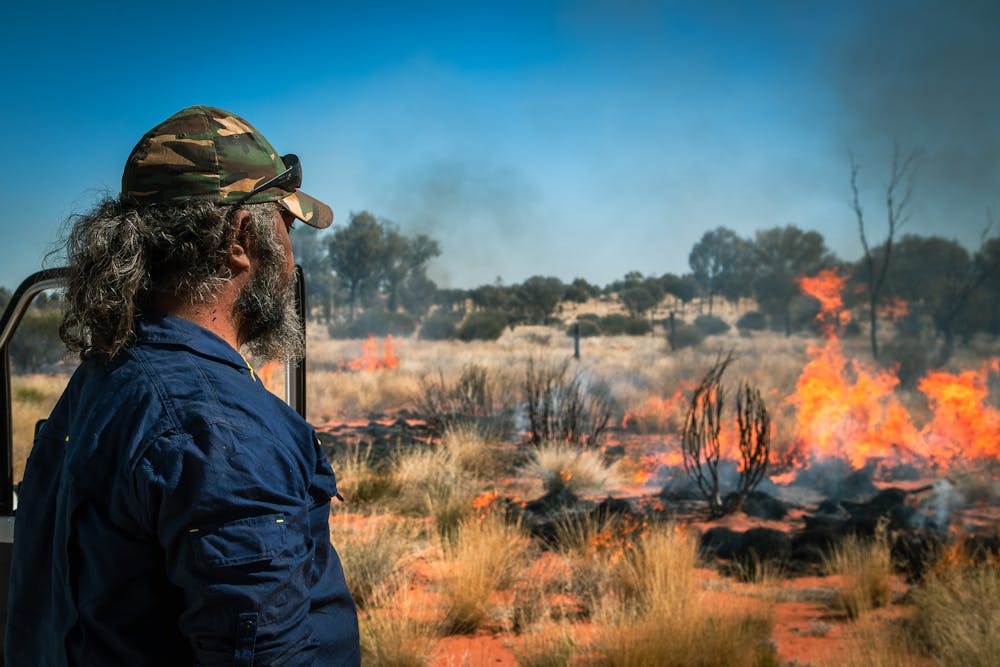
quemada de terreno en Haasts Bluff
Observando la quema desde el terreno con el guardabosques Anangu Luritjiku Preston Kelly en Haasts Bluff Aboriginal Lands Trust.
Andre Sawenko, CC BY-ND

En los últimos años, ha habido un gran interés por la gestión indígena de los incendios, especialmente tras la devastación causada por los incendios del “verano negro” de 2019-2020.

El objetivo es pasar de los incendios incontrolados, en los que se acumula combustible hasta que se producen grandes incendios forestales devastadores, a los incendios controlados, regímenes de incendios basados en la cultura y dirigidos por los propietarios tradicionales.

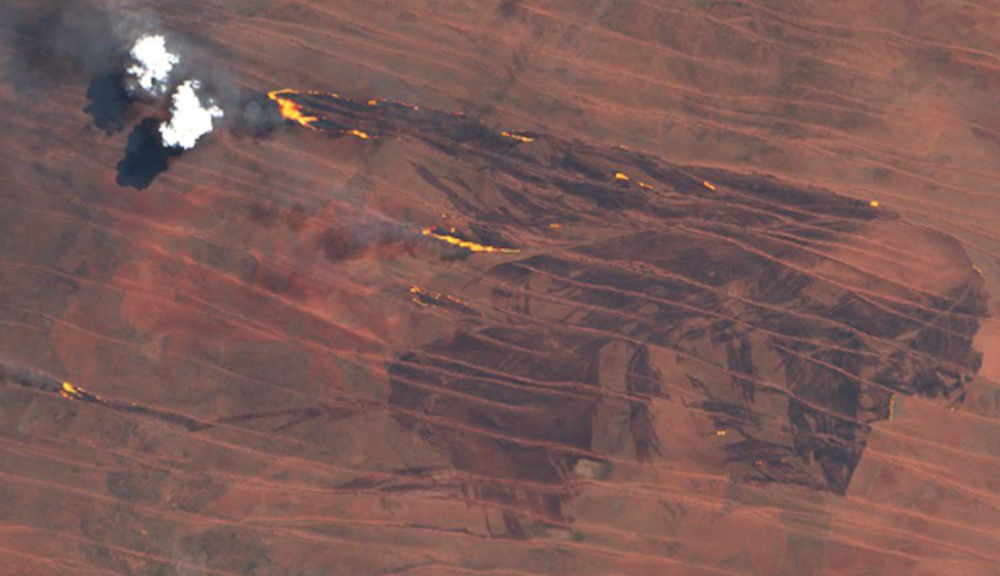
quemas vistas por satélite
Imagen satelital Sentinel 2 de las quemas en el Gran Desierto Arenoso el 21 de marzo de 2025.
Contiene datos modificados de Copernicus Sentinel (2023), procesados por EO Browser, CC BY-ND

Estos incendios se realizan con regularidad, con pequeños incendios de diversa intensidad que producen un mosaico a pequeña escala de vegetación en diferentes etapas de recuperación y mantienen la vegetación que no se ha quemado durante mucho tiempo como refugios seguros para la fauna y la flora.

Investigaciones recientes muestran que el retorno a estos regímenes de incendios adecuados a escala paisajística está teniendo un efecto real. En las zonas donde se lleva a cabo, el paisaje desértico está volviendo a un patrón complejo de quemas en mosaico, similar al que existía antes de la colonización.

Estos esfuerzos a gran escala deberían hacer que el país se mantenga saludable y a prevenir los peligrosos incendios.

The Conversation

Rohan Fisher ha sido consultor de la Alianza Indígena del Desierto.

Boyd Elson es director de la Alianza Indígena del Desierto.

ref. Los guardabosques están quemando el desierto en Australia para evitar que se propaguen incendios intensos y destructivos – https://theconversation.com/los-guardabosques-estan-quemando-el-desierto-en-australia-para-evitar-que-se-propaguen-incendios-intensos-y-destructivos-263735

The Life of Chuck: Stephen King adaptation celebrates the richness of ordinary life

Source: The Conversation – UK – By Andrew Dix, Senior Lecturer in American Literature and Film, Loughborough University

“I’m still excited when somebody makes a movie out of something that I’ve done,” Stephen King recently told The Guardian. This openness to exhilaration on King’s part is remarkable, given that he is such a widely adapted writer. To date, more than 90 of his novels and short stories have been adapted for cinema and television (and more adaptations are currently in production).

Variations in the scale of his works have proved no barrier for potential adaptors of King. The 1,100 pages of The Stand (1978) have been processed for the screen. But so too have been the 110 of Rita Hayworth and Shawshank Redemption (1982). Genre shifts across the long arc of King’s work have also been accommodated by adaptors. While early ventures in horror such as Carrie (1974) and Misery (1987) were rapidly taken up by Hollywood, equal haste has been expended recently to bring to American TV King’s crime novels featuring the likeable sleuth Holly Gibney from the Holly series.

In all of this furious adaptive activity, differences in quality are only to be expected. For every screen treatment with the lustre of Kubrick’s The Shining (1980), there is a dull or clumsy transposition such as John Power’s two-part miniseries of The Tommyknockers (1993).

Even King’s involvement in a project is not a guarantor of success. His role as executive producer failed to prevent Salem’s Lot (1975), his horrifying tale of vampires in Maine, from being defanged when it was adapted for cinema in 2024.


Read more:
Salem’s Lot: a faithful but shallow adaptation of Stephen King’s classic vampire novel


Now King is back as an executive producer, this time attached to The Life of Chuck, a film adapting one of the novellas included in his 2020 collection, If It Bleeds. Here, however, he is working alongside something of a King specialist (if not a King obsessive), the screenwriter and director Mike Flanagan. He has already adapted two novels by the author: Gerald’s Game (1992) and Doctor Sleep (2013).

Happily, The Life of Chuck proves to be a thoughtful adaptation, shot through with King’s sensibility while augmenting the original novella through its own cinematic choices.

The Life of Chuck trailer.

The Life of Chuck showcases King’s continuing interest in narrative experimentation, even in this late phase of a long writing life. Three acts, structured in reverse chronology, consider moments in the seemingly unremarkable life of Chuck Krantz (Tom Hiddleston), a New England everyman. Flanagan’s adaptation sensibly preserves this design.

There are a few instances in the film where the director appears inhibited by his source material. In his Guardian interview, King reveals himself to be pleasingly without any sense of proprietorship about the adaptative process, saying he thinks of his novels and short stories and the films made from them as “two different things, like oranges and apples”. But where Flanagan draws verbatim on the novella for sustained passages of voice-over, especially in act one, he is in danger of not sufficiently differentiating his apple from King’s orange.

Elsewhere in the film, however, Flanagan frees himself from King’s storytelling. More is done on screen than on the page to weave together the three acts, as when characters restricted in the novella to one segment only appear in other places in the film (a roller-skating girl, for example, or high school English teacher Marty Anderson, played by Chiwetel Ejiofor).

New motifs are included in one strand by Flanagan so as to prepare us, subtly, for another part of the story. Most notably, an allusion in act three to the 19th-century poet Walt Whitman, great celebrator of everyday American experience, who is an animating presence in act one.

In praise of ordinariness

Film is a mixed or “composite” medium, having at its disposal not only the visuals of photography but the resources of other forms such as architecture, dance, music and theatre. All are mobilised effectively in Life of Chuck.

A low-key score by the Newton Brothers is heard throughout, further endowing the several sections of the film with narrative continuity and atmospheric unity. The drumming that figures prominently in the middle section is echoed in act one when Chuck’s rock‘n’roll-loving grandmother bangs the rim of a saucepan.

Dance, too, is central to The Life of Chuck as a screen experience. This is not an especially kinetic film: the camera tends to move smoothly, while editing transitions are generally stately (rationing the terrifying jump cuts common elsewhere in King adaptation). But there is vivid movement in the film’s middle section.

Recalling the extended set-pieces of Fred Astaire and Ginger Rogers musicals that we catch glimpses of when characters are watching TV, the adult Chuck frees himself from the constraints of life as a be-suited accountant and spontaneously dances.

The dance is one of many moments in which The Life of Chuck celebrates the ordinary, uncovering its richness. Ordinariness has a long tradition in American writing (a field in which King, as a former English teacher, is expert). Consider John Williams’s novel Stoner (1965), perhaps, or Raymond Carver’s short story A Small, Good Thing (1983). But Flanagan has succeeded in the challenge he sets himself to bring ordinariness to a cinema screen that often, these days, is populated instead by images of the super-heroic and fantastical.


Looking for something good? Cut through the noise with a carefully curated selection of the latest releases, live events and exhibitions, straight to your inbox every fortnight, on Fridays. Sign up here.


The Conversation

Andrew Dix does not work for, consult, own shares in or receive funding from any company or organisation that would benefit from this article, and has disclosed no relevant affiliations beyond their academic appointment.

ref. The Life of Chuck: Stephen King adaptation celebrates the richness of ordinary life – https://theconversation.com/the-life-of-chuck-stephen-king-adaptation-celebrates-the-richness-of-ordinary-life-263691

With eyes on re-election, Netanyahu’s fights with world leaders aim to distract from his many political problems

Source: The Conversation – Global Perspectives – By Ran Porat, Affiliate Researcher, The Australian Centre for Jewish Civilisation, Monash University

As the longest-serving Israeli prime minister (17 years), Benjamin Netanyahu is famous for his political wizardry and survival skills. But he is also a highly controversial figure with questionable moral standards and legacy.

His latest term in office, beginning in late 2022, has been particularly challenging, thanks to the far-right radical elements of his governing coalition and the unprecedented national disaster Israel experienced at the hands of Hamas on October 7 2023.

Yet, Netanyahu has managed to neutralise almost all immediate domestic threats to his power. At times, he has done this by manoeuvring rivals and partners into postponing moves that could topple his government. Other times, he has reshuffled his Likud Party ranks or realigned with bitter foes.

Netanyahu is also facing increased criticism from the Israeli public, with hundreds of thousands of people taking part in marches in support of a hostage deal, as well as from former senior politicians and ex-security officials.

And he has clashed with Eyal Zamir, the Israel Defence Force’s (IDF) chief of staff, who argued against the plan to expand the war into Gaza City. Zamir received clear messages to fold or resign, and chose to stay.

Yet, Netanyahu chooses to ignore all of this noise, sending his entourage and loyalists to attack anyone with dissenting views. This week’s spray at Australian Prime Minister Anthony Albanese is just one example.

As a long term political survivor, he does all of this with an eye on the next Israeli elections, due at the end of 2026.

Propping up his far-right coalition

Over the past two and a half years, Israel has faced unprecedented crises that have left society deeply divided.

Under Netanyahu’s leadership, the government introduced a highly controversial judicial reform plan in early 2023, clashing with the Supreme Court and attorney general. This resulted in mass street protests against it.

Then came the Hamas attack of October 7, 2023, which triggered an ongoing multi-front war with severe long-term social, economic and humanitarian consequences.

Netanyahu has claimed credit for successes during this time, such as the 12-day war against Iran in June, while deflecting responsibility for any failures.

Though stretched in many directions, Netanyahu is at his best in such conditions, pitting the conflicting sides around him against each other and playing them.

His coalition relies on hard-right partners, especially National Security Minister Itamar Ben Gvir and Finance Minister Bezalel Smotrich. Despite the massive protests to agree to a hostage deal and international demands to end the war, Netanyahu has chosen to prioritise ensuring the stability of his coalition.

He has acceded to Ben Gvir and Smotrich’s demands to reject ceasefire agreements with Hamas, and instead ordered increased military action against the terrorist group to try to achieve what he has called a “total victory”.

Netanyahu has also indulged Ben Gvir and Smotrich’s talk of resettling Gaza and has enabled their moves to gradually expand Israeli settlements deeper into the West Bank and block any geographically feasible Palestinian state.

Proving Henry Kissinger’s famous observation that “Israel has no foreign policy, only domestic politics,” Netanyahu has also angrily rebuked the wave of Western countries recognising, or preparing to recognise, a Palestinian state.

His defiant letters to French President Emmanuel Macron and social media outbursts about Albanese are aimed less at diplomacy and more at cultivating his image as “a strong leader for Israel” among his base.

Supported by the Trump administration’s sanctions against the International Criminal Court (ICC), Netanayhu has also felt confident attacking it for issuing warrants against him.

Neutralising challenges from ultra-religious parties

The government’s biggest domestic challenge has been passing a draft law addressing the decades-long exemption of tens of thousands of ultra-Orthodox (Haredi) men from army service.

Following a Supreme Court ruling that the previous exemptions could not continue, religious parties in Netanyahu’s coalition demanded a bill to formally exempt the men from army service or they would bring down the government.

In response, Netanyahu enticed old rival Gideon Sa’ar from the opposition into joining his government, shoring up the coalition’s previously tiny majority.

Since then, he has bought time through broken promises, successfully persuading the ultra-Orthodox parties to wait until parliament’s return in October of this year. Meanwhile, he replaced Yuli Edelstein, the committee chair who had sought a strong bill with personal sanctions for draft evaders, with a more pliant loyalist, Boaz Bismuth.

Eyes on re-election

Now Netanyahu has his eye on the next general elections, officially set for late 2026 — though he would prefer they take place before the third anniversary of the October 7 attacks.

For two years, polls have consistently predicted his defeat. As such, he is working to reshape his image. He wants Israelis to forget his central role in the October 7 catastrophe, as well as the questions surrounding the war’s management.

He also hopes to continue diverting attention from his ongoing trial on bribery and breach of trust charges.

But Netanyahu faces a dramatic dilemma over the war. On the one hand, he may decide to sign a ceasefire deal with Hamas and secure the release of the hostages. This would win the cheers of most Israelis, but risk the loss of his government, given the far-right ministers’ threats to dissolve the coalition if he accepts any deal without fully conquering the strip.

On the other hand, he could proceed with the military operation in Gaza City, which may well result in the killing of the remaining hostages – either by Hamas or as a consequence of IDF attacks.

A third option would be to continue negotiations while escalating preparations for the attack, in the hope of achieving a better deal. We will soon know what direction he will take – and what it will mean for his political future.

The Conversation

Ran Porat is a research associate at The Australia/Israel & Jewish Affairs Council (AIJAC) and Research Fellow at the International Institute for Counter-Terrorism, Reichman University, Herzliya, Israel. He is affiliated with Australian Centre for Jewish Civilization, Monash University. He is also a former IDF military intelligence officer.

ref. With eyes on re-election, Netanyahu’s fights with world leaders aim to distract from his many political problems – https://theconversation.com/with-eyes-on-re-election-netanyahus-fights-with-world-leaders-aim-to-distract-from-his-many-political-problems-263523

The Trump administration wants to use the military against drug traffickers. History suggests this may backfire

Source: The Conversation – Global Perspectives – By Philip Johnson, Lecturer, College of Business, Government and Law, Flinders University

In early August, US President Donald Trump signed a not-so-secretive order to make plans for the use of US military force against specific Latin American criminal organisations.

The plans were acted upon this week. The US deployed three guided-missile destroyers to the waters off Venezuela, with the authority to interdict drug shipments.

This was not exactly a surprise move. During his inauguration in January, Trump signed an executive order designating some criminal groups as foreign terrorist organisations. At the time, he told a journalist this could lead to US special forces conducting operations in Mexico.

Weeks later, six Mexican cartels were added to the foreign terrorist list, as were two other organisations: MS-13, an El Salvadoran gang and particular focus during Trump’s first presidency, and Tren De Aragua, a Venezuelan gang and frequent target during Trump’s presidential campaign in 2024.


Read more:
What is Tren de Aragua? How the Venezuelan gang started − and why US policies may only make it stronger


In May, two Haitian groups were added to the list. Then, in July, another Venezuelan organisation known as the Cartel of the Suns was added to a similar list because of its support for other criminal groups.

Fentanyl brings a new focus on organised crime

Illicit substances have flown across the US-Mexican border for more than a century. But the emergence of the synthetic opioid fentanyl has shaken up US responses to the illicit drug trade.

Highly addictive and potent, fentanyl has caused a sharp increase in overdose deaths in the US since 2013.

Successive US governments have had little success at curbing fentanyl overdoses.

Instead, an emerging political consensus portrays fentanyl as an external problem and therefore a border problem.

When the Biden administration captured Ismael Zambada – one of Mexico’s most elusive drug barons who trafficked tonnes of cocaine into the US for 40 years – he was charged with conspiracy to distribute fentanyl. Even progressive independent Bernie Sanders has pivoted to claiming border security was the solution to the fentanyl crisis.

But focusing on border security will do little to improve or save lives within the US.

Tougher border measures have never effectively curtailed the supply of other illicit substances such as cocaine, heroin, or methamphetamine.

These measures do little to reduce harm or dependency within the US, where a largely unaccountable pharmaceutical industry first pushed synthetic opioids.

The question remains just what can be achieved by US military operations.

How to spot a cartel

While the chemical emissions from fentanyl labs are easily spotted by drones, cartels and their operatives are decidedly more difficult to identify.

Criminal organisations in Mexico tend to be loose networks of smaller factions. They don’t operate in strict hierarchies like corporations or armies.

The decentralised nature of these networks makes them extremely resilient. If one part of the chain is disrupted, the network adapts, sourcing materials from different places or pushing goods along different trafficking routes.

But US and Mexican security agencies often act as though cartels follow rigid hierarchies. The so-called “kingpin strategy” focuses on killing or arresting the leadership of criminal organisations, expecting it to render them unable to operate.

However, this strategy often exacerbates violence, as rival factions compete to take over the turf of fallen kingpins.

Combating criminal groups with the military has already been a spectacular failure in Mexico.

Former President Felipe Calderón declared war on the cartels in 2006, but his government lost credibility for leading Mexico into a war it could not win or escape.

Tens of thousands of people are now killed every year, a dramatic increase from the historically low homicide rates in the years leading up to 2006. More than 100,000 have disappeared since the beginning of the war.

Outside interventions also run the risk of increasing support for criminal groups.

In my research, I’ve found cartels sometimes market themselves as guardians of local people, successfully positioning themselves as more in touch with local people than the distant Mexican state.

Cartels can also certainly make the most of deep antipathy towards US intervention in Mexico.

All cartels are not equal

Deploying warships off the coast of Venezuela will have minimal impact on the fentanyl trade.

Fentanyl enters the US from Mexico and even from Canada – but Venezuela doesn’t feature in US threat assessments for fentanyl.

Military action against the Cartel of the Suns will also be largely ineffectual, as this group exists in name only.

Research has found this isn’t an actual cartel – rather, the name describes a loose network of competing drug-trafficking networks within the Venezuelan state. Figures in the government certainly have ties to the illicit drug trade, but they are not organised in a cartel.

In Mexico, however, the cartels do exist – albeit not as imagined by the US government.

Given the US has invaded and seized territory from Mexico in the past, US military intervention has minimal prospect of support from Mexican governments.

Current President Claudia Sheinbaum has shown a willingness to accommodate the Trump government on matters of fentanyl trafficking. She has deployed thousands of members of the National Guard to police the border and major trafficking centres, such as the state of Sinaloa.

The Mexican government has also made two mass extraditions of captured crime bosses to the US. As with the capture of Zambada by the Biden government, this is likely to be used as evidence the US is winning the battle against fentanyl.

Then again, these crime bosses could be put to other uses.

The US government recently returned an imprisoned leader of MS-13 to El Salvador, even though he was indicted for terrorism in the US.

This move was part of the deal-making between the US government and President Nayib Bukele of El Salvador.

The US government may be eager to take the fight to organised crime, but sometimes political expediency is a bigger priority.

The Conversation

Philip Johnson does not work for, consult, own shares in or receive funding from any company or organisation that would benefit from this article, and has disclosed no relevant affiliations beyond their academic appointment.

ref. The Trump administration wants to use the military against drug traffickers. History suggests this may backfire – https://theconversation.com/the-trump-administration-wants-to-use-the-military-against-drug-traffickers-history-suggests-this-may-backfire-263124

Israel opens new front in Gaza war

Source: The Conversation – UK – By Sam Phelps, Commissioning Editor, International Affairs, The Conversation

This article was first published in The Conversation UK’s World Affairs Briefing email newsletter. Sign up to receive weekly analysis of the latest developments in international relations, direct to your inbox.


The next phase of the war in Gaza has begun. Israel’s military is carrying out the early stages of an assault to capture Gaza City, with 60,000 reserve troops expected to be called up for the offensive. Hundreds of thousands of Palestinians will evacuate south.

World leaders have condemned the assault. The French president, Emmanuel Macron, said it “risks plunging the entire region into a cycle of permanent war”. Belgium’s foreign ministry added it would “lead to more death, destruction and mass displacement”.

These developments come days after Hamas officials accepted a new ceasefire proposal to pause the war. The offensive scuppers any hopes of such a deal moving forward, says Julie Norman of University College London.

Norman, associate professor in politics and international relations, sees this as an all-too familiar situation. Hamas has responded positively to various ceasefire proposals over the past year that have subsequently broken down.

Beyond a ceasefire, the two warring parties also remain far apart on what “ending the war” actually includes. There are major sticking points around the disarmament of Hamas and Israel’s intention to maintain “security control” in Gaza after the war.

So don’t expect the violence to end anytime soon, writes Norman. As one Israeli reservist told her during a recent trip to the region: “Last year at this time, I didn’t imagine there could possibly be another year of war. Now, it’s hard to imagine there not still being a war in another year from now.”


Read more:
No end to the violence as Israel launches its assault on Gaza City


The Israeli government has meanwhile approved the construction of a new settlement in the West Bank, comprised of about 3,500 new dwellings. Leonie Fleischmann, senior lecturer in international politics at City St George’s, University of London, lays out why the plan is particularly controversial.

She writes that the settlement’s construction, deemed illegal under international law, “would cut the West Bank into two separate parts, rendering it impossible to establish a contiguous Palestinian state with East Jerusalem as its capital”.

This certainly seems to be the intention of the Israeli government. Bezalel Smotrich, Israel’s hard-line finance minister, declared that the approval of construction plans “buries the idea of a Palestinian state”. He added: “Every town, every neighbourhood, every housing unit is another nail in the coffin of this dangerous idea”.


Read more:
Israel’s plan for massive new West Bank settlement would make a Palestinian state impossible


Trump the peacemaker?

Elsewhere, we have interrogated Donald Trump’s claim that he resolved six conflicts in a matter of months. We interviewed six experts on those regions to find out what Trump actually did, and whether it made a difference.

Some of Trump’s claims hold up, to an extent. In the case of Thailand and Cambodia, for example, his threat to suspend trade talks with both countries was the breakthrough that paused hostilities.

His mediation between Armenia and Azerbaijan has also resulted in the warring countries coming together to agree a possible pathway to peace after decades of conflict. But our experts were unanimous in their verdict that, ultimately, Trump’s claim doesn’t fully stand up.


Read more:
Did Trump really resolve six conflicts in a matter of months? We spoke to the experts to find out


One war Trump cannot claim to have solved is in Ukraine, which was the focus of two high-stakes summits over the past week. The first saw Trump roll out the red carpet for Vladimir Putin in Alaska. He signalled afterwards that the pair had discussed Ukraine ceding land to Russia in order to end the war.

Trump then met with Ukrainian president Volodymyr Zelensky and the leaders of some of Ukraine’s European allies at the White House a few days later. Zelensky will have left this hurriedly arranged meeting feeling a sense of relief.

There seems to have been no real pressure put on Ukraine to give land to Russia, and Trump even appeared to accept the European position that security guarantees for Kyiv will be vital if any peace deal is to stick. But the results of this meeting were still far from perfect, says Stefan Wolff.

Wolff, professor of international security at the University of Birmingham and a regular contributor to this newsletter, explains that Trump is hailing the fact that a direct meeting between Putin and Zelensky has not been ruled out as a major success of the past week’s diplomatic efforts.

However, as Wolff notes, a peace process remaining somewhat intact is a far cry from an actual peace agreement. Even then, he says, any further progress towards peace is likely to happen at a snail’s pace. Russia already looks to be dragging its feet.

Putin reportedly suggested to Trump that Zelensky could travel to Moscow for talks. This is an option Kyiv could not possibly have agreed to. Meanwhile, Russian foreign minister Sergei Lavrov has watered down hopes of any such meeting taking place, saying it would have to be prepared “gradually”.


Read more:
Transatlantic unity at the White House disguises lack of progress towards just peace for Ukraine


Security guarantees

Equally unclear are the details of security guarantees for Ukraine. Zelensky has praised Trump’s indication that the US is ready to be part of that guarantee, and says he hopes it will be “formalised in some way in the next week or ten days”. But what are the options?

One proposal includes western allies offering Ukraine what Italy’s prime minister, Giorgia Meloni, has called an “article 5-style” protection. We spoke to Mark Webber, professor of international politics also at the University of Birmingham, about what that means.

As Webber writes, Meloni was alluding to Nato’s collective defence pledge that treats an attack on one member as an attack on all. However, the route to an article 5 security guarantee through Ukrainian membership of Nato has been expressly ruled out by the Trump administration, he says.

A much more likely option is that Europeans will be “the first line of defence”, with the US instead offering intelligence, weapons and air support of some kind. Trump was clear there would be no US “boots on the ground”, writes Webber.

In any case, it remains doubtful whether a security guarantee for Ukraine can be reached. Lavrov has said discussing security guarantees without Russia’s involvement “is a road to nowhere”. He has since said proposals to deploy European troops in Ukraine would be unacceptable for Russia. In the meantime, Russia’s advance in eastern Ukraine continues to gather momentum.


Read more:
Ukraine war: what an ‘article 5-style’ security guarantee might look like


It’s from eastern Ukraine that Frank Ledwidge, a military strategist at the University of Portsmouth, has just returned from a week-long trip. He has provided this account of daily life in Ukraine’s eastern capital, Kharkiv, where air-raid sirens sound at all hours but shopping malls remain busy and bars lively.

Despite all this, Ledwidge notes, there was an abiding sense of emptiness in what has come to be known as Ukraine’s “unbreakable city”. No official figures are available, but Ledwidge estimates that more than half of Kharkiv’s pre-war population of 1.5 million have left since the war began in 2022. Many of these people may never return.


Read more:
Kharkiv: what I saw in Ukraine’s ‘unbreakable’ eastern capital


Sign up to receive our weekly World Affairs Briefing newsletter from The Conversation UK. Every Thursday we’ll bring you expert analysis of the big stories in international relations.


The Conversation

ref. Israel opens new front in Gaza war – https://theconversation.com/israel-opens-new-front-in-gaza-war-263484

Tit-for-tat gerrymandering wars won’t end soon – what happens in Texas and California doesn’t stay there

Source: The Conversation – USA – By Gibbs Knotts, Professor of Political Science, Coastal Carolina University

Congressional redistricting – the process of drawing electoral districts to account for population changes – was conceived by the Founding Fathers as a once-per-decade redrawing of district lines following the decennial U.S. census. Today it has devolved into a near-constant feature of American politics – often in response to litigation, and frequently with the intent of maintaining or gaining partisan advantage.

Polls show widespread public disapproval of manipulating political boundaries to favor certain groups, a process known as gerrymandering. However, we currently see little hope of preventing a race to the bottom, where numerous states redraw their maps to benefit one party in response to other states drawing their maps to benefit another party.

The most recent round of tit-for-tat gerrymandering began in Texas. After drawing their post-census congressional maps in 2021, Republicans in the Texas Legislature, at President Donald Trump’s behest, are advancing a new set of maps designed to increase the number of Republican congressional seats in their state. The goal is to help Republicans retain control of the U.S. House of Representatives in the 2026 midterm elections by converting five Democratic seats to ones that will likely result in a Republican victory.

In response, California Democratic Gov. Gavin Newsom is pushing to redraw his state’s map. Under Newsom’s plan, Democrats could gain five House seats in California, offsetting Republican gains in Texas. The California Legislature approved the new maps on Aug. 21 and Gov. Newsom signed the bills that day. Next, the maps will be presented to California voters on the November 2025 ballot for approval.

Newsom vows that he isn’t trying to disband the independent redistricting process that California enacted in 2021. Rather, he proposes to shift to these partisan gerrymandered maps temporarily, then return to independent, nonpartisan redistricting in 2031.

Democrats in Illinois and New York, and Republicans in Indiana, Missouri and South Carolina, have signaled that they may follow Texas and California’s leads. Based on our research on politics and elections, we don’t expect that the wave will stop there.

Gerrymandering dates back to struggles over U.S. foreign policy in the early 1800s and is named for a signer of the Declaration of Independence, Elbridge Gerry.

Rules for mapmakers

Redistricting has always been an inherently political process. But the advent of widespread, easily accessible computer technology, increasingly predictable voting patterns and tight partisan margins in Congress have turbocharged the process.

There are ways to tweak this gerrymandering run amok and perhaps block a bad map or two. But none of these approaches are likely to stop partisan actors entirely from drawing maps to benefit themselves and their parties.

The most obvious strategy would be to create guardrails for the legislators and commissions who draw the maps. Such guidelines often specify the types of data that could be used to draw the maps – for example, limiting partisan data.

Anti-gerrymandering rules could also limit the number of political boundaries, such as city or county lines, that would be split by new districts. And they could prioritize compactness, rather than allowing bizarrely-shaped districts that link far-flung communities.

These proposals certainly won’t do any harm, and might even move the process in a more positive direction, but they are unlikely to end gerrymandering.

For example, North Carolina had an explicit limitation on using partisan data in its 2021 mapmaking process, as well as a requirement that lawmakers could only draw maps in the North Carolina State Legislative Building. It was later revealed that a legislator had used “concept maps” drawn by an aide outside of the normal mapmaking process.

In a world where anyone with an internet connection can log onto free websites like Dave’s Redistricting to draw maps using partisan data, it’s hard to prevent states from incorporating nonofficial proposals into their maps.

Courts and commissions

A second way to police gerrymandering is to use the courts aggressively to combat unfair or discriminatory maps. Some courts, particularly at the state level, have reined in egregious gerrymanders like Pennsylvania’s 2011 map, which was overturned in 2018.

At the national level, however, the U.S. Supreme Court ruled in Rucho v. Common Cause in 2019 that partisan gerrymandering claims presented “political questions beyond the reach of the federal courts” and ultimately were better suited to state courts. There are still likely to be claims in federal courts about racial dilution and other Voting Rights Act violations in gerrymanders, but the door to the federal courthouse for partisanship claims appears to be closed for the time being.

A third option is for states to hand map-drawing power to an independent body. Recent studies show that independent redistricting commissions produce maps that are more competitive and fairer. For example, a nonpartisan scholarly review of the 2021-2022 congressional and state legislative maps found that commissions “generally produce less biased and more competitive plans than when one party controls the process.”

Commissions are popular with the public. In a 2024 study with political scientists Seth McKee and Scott Huffmon, we found that both Democrats and Republicans in South Carolina preferred to assign redistricting to an independent commission rather than the state Legislature, which has been in Republican control since 2000.

Studies using national polling data have also found evidence that redistricting commissions are popular, and that people who live in states that use commissions view the redistricting process more positively than residents of states where legislators draw congressional lines.

A national solution or bust

While redistricting commissions are popular and effective in states that have adopted them, current actions in California show that this strategy can fail if it is embraced by some states but not others.

Unfortunately, there is no simple solution for tit-for-tat gerrymandering. Litigation can help at the margins, and independent redistricting can make a difference, but even the best intentions can fail under political pressure.

The only wholesale solution is national reform. But even here, we are not optimistic.

A proportional representation system, in which seats are divided by the portion of the vote that goes to each party, could solve the problem. However, removing single-member districts and successfully implementing proportional representation in the United States is about as likely as finding a hockey puck on Mars.

A national ban on gerrymandering might be more politically palatable. Even here, though, the odds of success are fairly low. After all, the people who benefit from the current system would have to vote to change it, and the filibuster rule in the Senate requires not just majority but supermajority support.

So, brace for what’s about to come. As James Madison famously observed, forming factions – groups of people united by a common interest that threatens the rights of others – is “sown in the nature of man.”

Gerrymandering helps factions acquire and retain power. If U.S. leaders aren’t willing to consider a national solution, it won’t disappear anytime soon.

The Conversation

The authors do not work for, consult, own shares in or receive funding from any company or organization that would benefit from this article, and have disclosed no relevant affiliations beyond their academic appointment.

ref. Tit-for-tat gerrymandering wars won’t end soon – what happens in Texas and California doesn’t stay there – https://theconversation.com/tit-for-tat-gerrymandering-wars-wont-end-soon-what-happens-in-texas-and-california-doesnt-stay-there-262835

Los trabajos de la IA para sostener el mundo

Source: The Conversation – (in Spanish) – By Paula Alvaredo Olmos, Profesora Titular en Ciencia e Ingeniería de Materiales, Universidad Carlos III

Las inteligencias artificiales trabajan para conseguir materiales sostenibles en un mundo amenazado. Pexels, CC BY

Probablemente usted ya use ChatGPT para pedirle una receta, resolver una duda, preparar una clase o entender un tema complicado. Pero el poder de las IA generativas va mucho más allá.

En laboratorios, centros tecnológicos e industrias de todo el mundo, estamos utilizándolas para afrontar algunos de los mayores desafíos del planeta: generar energía de forma más eficiente, reducir las emisiones del transporte y diseñar materiales con menor impacto ambiental. Las IA están ayudándonos a imaginar soluciones posibles a las que los humanos no podemos llegar solos.

En mi campo de especialidad, la inteligencia artificial está dando forma conceptual a los materiales con los que construiremos un futuro que pueda ser sostenible.

Materiales en condiciones extremas

Uno de los grandes retos de la transición energética es encontrar materiales capaces de soportar condiciones extremas. Lo vemos, por ejemplo, en la energía solar de concentración, una interesante alternativa de renovables que almacena calor en sales fundidas para generar electricidad incluso cuando no hay sol.

Las torres de energía solar de concentración de Ivanpah. Es una de las mayores plantas termosolares del mundo, situada en el desierto de Mojave (California, Estados Unidos)
Wikimedia commons, CC BY

Hoy se utilizan sales de nitratos que operan hasta 560 °C, pero se investigan cloruros fundidos, capaces de trabajar a 780 °C y almacenar más energía. El problema es que a esa temperatura se vuelven altamente corrosivos, y los metales convencionales no resisten durante largos periodos.

Algo parecido ocurre en el sector de la aeronáutica. Las turbinas de los aviones funcionan a temperaturas altísimas: cuanto mayor es la temperatura, mayor la eficiencia, menos combustible se consume y menos emisiones se generan.

Pero superar los 1 000 °C exige materiales que no se deformen ni se oxiden bajo condiciones extremas. En ambos casos –turbinas y sales corrosivas– necesitamos metales que aún no existen en el mercado.

Las aleaciones de alta entropía

Aquí entran en escena las aleaciones de alta entropía, un tipo de materiales que desde 2004 ha revolucionado la metalurgia.

A diferencia de las aleaciones tradicionales, formadas en torno a un elemento principal como hierro o níquel, estas combinan cinco o más elementos en proporciones similares. Este cambio abre un espacio de diseño casi infinito abarcando un gran número de combinaciones posibles en toda la tabla periódica, lo que da lugar a propiedades diversas como gran resistencia mecánica a altas temperaturas o excelente comportamiento frente a corrosión y oxidación.

La IA permite evaluar millones de composiciones de forma rápida, identificando las más prometedoras y reduciendo el tiempo necesario para pasar de una hipótesis a un material real. Lo que antes era un laberinto inabarcable ahora se recorre con brújula.

Por ejemplo, si lo que buscamos en las centrales termosolares es una aleación capaz de resistir los cloruros fundidos a 780 °C, o si pretendemos mantener su resistencia mecánica por encima de los 1 000 °C en una turbina de un avión, la IA puede cribar el espacio de opciones y señalar los candidatos más viables.

La dependencia de China para las baterías

También en el campo de las baterías se hace evidente la urgencia de innovar en materiales, y las IAs están trabajando en ello.

La creciente electrificación del transporte y el despliegue de tecnologías de almacenamiento energético dependen hoy en gran medida de materiales críticos como el litio, el cobalto, el níquel o el grafito, empleados en baterías de iones de litio.

Sin embargo, estos elementos no solo plantean desafíos ambientales y tecnológicos, sino también geopolíticos.

La cadena de suministro está fuertemente concentrada, con China controlando buena parte del procesado y refinado global de muchos de estos materiales estratégicos, así como una influencia creciente sobre la extracción de cobalto en África Central. Esta dependencia limita la autonomía tecnológica de regiones como Europa y las expone a tensiones comerciales o restricciones de exportación, como ya ha ocurrido con otros metales clave como el galio o el germanio.

El desarrollo de nuevas composiciones que reduzcan o eliminen la necesidad de estos elementos se ha convertido en una prioridad científica e industrial.

Son esenciales nuevos materiales para electrodos o electrolitos sólidos, más abundantes, reciclables y con menor huella ambiental, para garantizar baterías más sostenibles, accesibles y resistentes a los vaivenes del contexto internacional.

Solo con IA

La inteligencia artificial, aplicada al diseño de materiales, abre una vía prometedora para identificar alternativas con propiedades funcionales similares, pero fabricadas a partir de elementos más seguros, más locales y más sostenibles.

El reto, sin embargo, es explorar ese océano de combinaciones. Con métodos tradicionales basados en ensayo y error resultaría lento y costoso.

El alimento de las inteligencias artificiales

Diseñar con inteligencia artificial no significa pulsar un botón y obtener la respuesta perfecta. Todo depende de los datos disponibles. Generar información fiable mediante experimentos, estandarizar bases de datos y compartir resultados entre centros de investigación es hoy una prioridad. Sin esa base, los modelos de IA no pueden aprender ni producir predicciones sólidas.

Cuando no se dispone de datos experimentales, otra herramienta esencial es la simulación computacional. Modelos físicos y químicos permiten anticipar cómo se comportaría un material bajo ciertas condiciones y generar datos sintéticos que alimentan a los algoritmos de IA. De este modo, el progreso no depende solo de lo ya probado en el laboratorio, sino también de lo que puede predecirse con ayuda de la física.

Descubrimientos guiados por el diseño

Este enfoque encaja con lo que se denomina design-driven discovery, o descubrimiento guiado por el diseño.

A diferencia de la lógica tradicional –llamada material-driven–, en la que se parte de un material existente y se observa qué propiedades tiene, el enfoque design-driven comienza definiendo qué propiedades necesitamos (por ejemplo, resistencia a la corrosión a 780 ⁰C en el caso de los paneles solares) para buscar después las combinaciones químicas capaces de cumplirlas.

En lugar de descubrir lo que un material puede hacer, diseñamos directamente el que necesitamos que lo haga. Y la inteligencia artificial es la herramienta que hace posible ese giro.

La IA es una aliada estratégica si queremos que el mundo se sostenga.

The Conversation

Paula Alvaredo Olmos recibe fondos de AEI Agencia Estatal de Investigación.

ref. Los trabajos de la IA para sostener el mundo – https://theconversation.com/los-trabajos-de-la-ia-para-sostener-el-mundo-263642

Colombia necesita tecnología y digitalización para consolidar la paz

Source: The Conversation – (in Spanish) – By Roberto García Alonso, Associate Professor of Political Science, Universidad de La Sabana

shutterstock

La consolidación de la paz en Colombia no solo depende del cese de las hostilidades: pasa también por la creación de un horizonte de desarrollo económico y social que promueva la inclusión y el desarrollo sostenible. En este contexto, el concepto de Tech4Peace –o tecnologías para la paz, es decir, el uso estratégico de la tecnología para apoyar los procesos de paz– adquiere un papel central.

Investigaciones recientes resaltan que la conectividad digital, la ética empresarial y el emprendimiento constituyen ejes fundamentales para el desarrollo de proyectos de desarrollo en territorios afectados por el conflicto armado.

Inclusión digital y brechas estructurales

En América Latina, la brecha digital es una barrera para el desarrollo equitativo. Al analizar los 33 países de la región, vemos que el porcentaje de personas que usan internet es un predictor más relevante que la cobertura de banda ancha del índice de desarrollo humano (IDH), el indicador desarrollado por Naciones Unidas para medir el progreso de los países en salud, educación y nivel de vida.

En Colombia, esto cobra especial relevancia en los municipios más afectados por el conflicto armado, donde el acceso a internet sigue siendo limitado y desigual. En un intento de paliar la falta de oportunidades, el Estado colombiano ha establecido en ellos el Programa de Desarrollo con Enfoque Territorial (PDET).

Estudios recientes sugieren que priorizar el uso efectivo de internet en entornos rurales –mediante ofertas diferenciadas geográficamente y acompañamiento formativo– puede generar procesos de inclusión y participación ciudadana.

Automatización y empleo

En América Latina hay un claro contraste entre el bajo nivel de adopción de las nuevas tecnologías (particularmente de la IA) en los sectores tradicionales y el alto grado de innovación de las grandes empresas.

La transformación digital es un pilar para el desarrollo económico y social de las regiones y, además, tiene implicaciones medioambientales. La adopción responsable de la inteligencia artificial requiere, además de infraestructura, formación técnica, adaptaciones en la cultura corporativa y desarrollo de marcos éticos, soberanía digital y una gran disponibilidad de energía eléctrica y agua.


Leer más:
¿Puede la IA ser peor para el planeta que los maratones de series?


Un estudio basado en encuestas a trabajadores colombianos de empresas medianas y grandes analizó el papel que juegan valores humanos como la honestidad, la colaboración y el compromiso en los avances de la digitalización industrial (Industria 4.0) y en la percepción de seguridad laboral de los trabajadores.

Frente a los discursos que avisan de los riesgos de la automatización y la IA en el futuro del trabajo, los resultados de esta investigación muestran que dichos valores funcionan como atenuantes frente al miedo al reemplazo laboral y abren la posibilidad de una adaptación tecnológica ética y sostenible.

Esta evidencia empírica respalda la necesidad de diseñar políticas públicas que fomenten la relación entre la tecnología y la ética organizacional. Colombia, a través de sus planes nacionales de desarrollo, ha priorizado la actualización del talento humano y la transformación digital como claves para la productividad en contextos digitales.


Leer más:
Cómo ayuda la inteligencia artificial en entornos laborales


Inteligencia artificial para el bien común

La aplicación de IA genera transformaciones disruptivas no solo para el sector privado sino también para el sector público. Estudios recientes indican que el uso de la IA puede mejorar la eficacia de las políticas y los procesos públicos tanto por la reducción de costes sino como por la capacidad de analizar datos, reconocer patrones sospechosos y emitir alertas a las autoridades. Así, su aplicación podría transformar las políticas públicas en países en desarrollo, como los de la región de América Latina y el Caribe.


Leer más:
Podríamos evitar la corrupción en los contratos públicos con inteligencia artificial


En medio de las preocupaciones actuales sobre la ética en la digitalización y la privacidad de los datos, el Estado colombiano ha desarrollado marcos normativos e institucionales para el uso de la IA:

  • El marco ético para la IA, que considera factores como la transparencia, la privacidad, el control humano de las decisiones, la seguridad, la responsabilidad, la no discriminación, la inclusión, la protección de los derechos de los niños, niñas y adolescentes, y el beneficio social.

  • La política nacional de inteligencia artificial.

Digitalización y emprendimiento

El emprendimiento es una herramienta eficaz para reconstruir el tejido social en zonas posconflicto. Crear empresas genera empleo y dinamiza las economías locales. Sin embargo, en un mundo cada vez más digitalizado, para que eso ocurra es clave el fortalecimiento de capacidades digitales.

Las nuevas tecnologías ofrecen a las comunidades más vulnerables una vía de inclusión económica (por ejemplo, a través del desarrollo del comercio electrónico de los productos locales: artesanías, producción agrícola, etc.). No obstante, para ello se necesita acompañamiento técnico y visibilizar el trabajo y el producto desarrollado por dichas comunidades.


Leer más:
Sostenibilidad ambiental, equidad social y satisfacción personal, bases de una alternativa al desarrollo


Una agenda para la innovación

Incorporar las tecnologías digitales en contextos posconflicto no debe ser vista solo como una apuesta por la eficiencia: es también una oportunidad para la construcción de la paz en Colombia. Con el desarrollo de políticas de conectividad y marcos éticos robustos, y el uso estratégico de las aplicaciones de IA, los desafíos estructurales se pueden transformar en oportunidades de desarrollo sostenible.

Los trabajos recientes de investigadores colombianos ofrecen datos valiosos para la formulación de políticas públicas y la implementación de proyectos de Tech4Peace en el país. En última instancia, una paz duradera requiere no solo la ausencia de violencia, sino también de saber aprovechar las oportunidades que la transformación digital ofrece para la construcción de paz en los territorios que se han visto afectados por la violencia.

The Conversation

Las personas firmantes no son asalariadas, ni consultoras, ni poseen acciones, ni reciben financiación de ninguna compañía u organización que pueda obtener beneficio de este artículo, y han declarado carecer de vínculos relevantes más allá del cargo académico citado anteriormente.

ref. Colombia necesita tecnología y digitalización para consolidar la paz – https://theconversation.com/colombia-necesita-tecnologia-y-digitalizacion-para-consolidar-la-paz-262674

5 vital leadership takeaways from the life of Chief Poundmaker

Source: The Conversation – Canada – By Andrew J. Karesa, Adjunct Professor, Indigenous Business, The King’s University Canada

Chief Poundmaker photographed outside the North-West Mounted Police barracks, Regina, 1885. (O.B. Buell, Library and Archives Canada, C-001875 /Flickr), CC BY

In the 21st century, leadership is typically framed in the position of power, strategy and authority and oftentimes considered interchangeable with management.

What if there was a different way to perceive and demonstrate our leadership in a way that empowers and supports others?

For Pitikwahanapiwiyin (Chief Poundmaker), leadership was about something more: it was about service, peace and an unwavering, relentless commitment to his people.

Throughout the late 1800s, Cree Chief Poundmaker used his unique leadership abilities to navigate political and cultural tensions while successfully advocating for the survival of his community. His legacy, while often misunderstood or unknown, has the potential to provide significant value in the leadership development of contemporary leaders globally.

Legacy of leadership, love, conciliation

Because Chief Poundmaker is a distant relative, my family often discusses him, but we lacked the intimate knowledge of his story and experiences. The pursuit of understanding my great-great-granduncle has led me to see that how we currently describe leadership is missing some important elements.

In my recent article, “Poundmaker — A Legacy of Leadership, Love and Conciliation,” I explore how considering the events of Poundmaker’s life can be used to understand how specific leadership traits give us new insights when seen against the current leadership paradigms. This is accomplished by using a two-eyed seeing (Etuaptmumk) approach, blending Indigenous and western leadership theory to make insights relevant to multiple audiences. The article is published in Indigenous Business and Public Administration.

In western society, leadership is typically viewed as either based on governance and process, or connection and collaborative relationships.

On the other hand, Indigenous leadership is a temporary “sphere of influence” that is based in our need-fulfilling roles within a community in order to ensure communal well-being.

Lesson 1: Embrace diverse perspectives

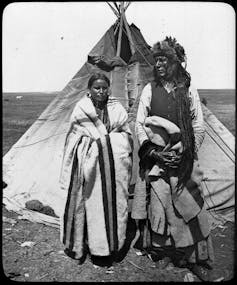
A woman and a man stand in front of a tipi
Chief Poundmaker and his wife standing in front of a tipi, wrapped up in Hudson’s Bay blankets, circa 1884.
(Library and Archives Canada/Norman Denley collection/a066596)

Before he was a chief, Poundmaker went through a process of adult adoption to become the son of Chief Crowfoot and a member of the Blackfoot Confederacy. This process of adult adoption was not uncommon, according to my community discussions, but typically happened within the same communities. Cree would adopt Cree, Blackfoot would adopt Blackfoot. In this case, the adoption of a Cree individual by a Blackfoot chief led to a historic moment politically and culturally.

This adoption set the stage for further unity between Cree and Blackfoot nations and an ability for Poundmaker to navigate multiple worldviews to make effective leadership decisions.

For a modern leader, embracing different perspectives is important. It builds team trust and fosters long-term success personally and organizationally. Effective leadership requires that an individual can step outside their comfort zone to engage with different perspectives, ensuring understanding and unity.

Lesson 2: Balance firm advocacy with strategic engagement

During the 1876 negotiation of Treaty 6 with the Crown, Poundmaker was a fierce defender of Indigenous land rights, famously stating “this is our land, not a piece of pemmican to be cut off and given in little pieces.” While he believed that his people should not have to give up any of their land, he also recognized that engagement with the Crown was necessary for the Cree’s long-term survival.

Today, leaders also face dilemmas calling for high-stakes decisions: Should we hold firm to our values or give in for a strategic reason?

Poundmaker’s example shows that strong leadership is not about all or nothing. Instead, it is about being deliberate in choosing when to push back and when it is time to engage.

Lesson 3: Prioritize peace and long-term consequences

During the Battle of Cut Knife in 1885, the attacking 325 Canadian troops fled after the unexpectedly strong defence presented by the Cree and Assiniboine camps.

As his troops were ready to chase down the retreating soldiers, Poundmaker made a choice that, while being profound, is very difficult. Instead of leading to more bloodshed, he told his warriors to stand down and prioritize peace over vengeance.

This moment of restraint is important for the modern leader. Often, our acts of retaliation or aggression lead to short-term gains but cause long-term losses.

Regardless of the industry or space, choosing de-escalation over conflict, while difficult, can prevent lasting damage and open doors for future reconciliation.

Two men seated, one with short hair and one with long hair.
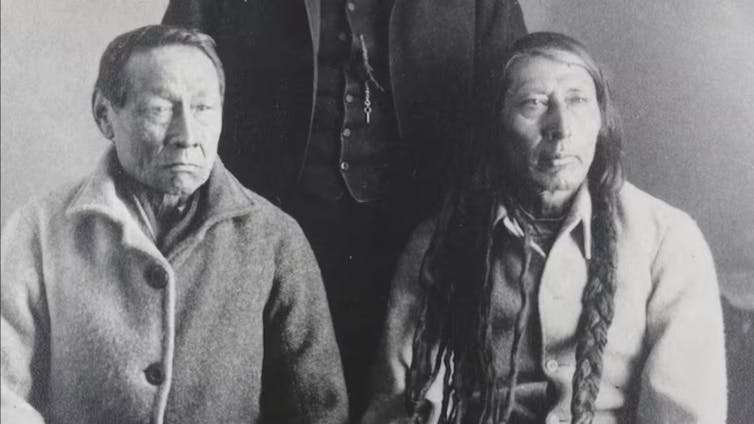
Chief Poundmaker (right) at Stony Mountain Penitentiary after being arrested for felony treason circa 1886. The photo also includes Chief Big Bear (left).
(Archives of Manitoba/Big Bear 3/N16092).

Lesson 4: Lead with compassion and community focus

Poundmaker’s leadership was rooted in service to his community and the overall well-being of his people. During the North-West Resistance, he sought food relief for the starving Cree communities instead of participating in a violent rebellion. This was further emphasized during his trial on felony treason charges for his actions at the Battle of Cut Knife, when he maintained: “Everything I could do was done to stop bloodshed.”

Modern leaders are often pressured to focus on financial or political gains instead of the benefit of their people. Poundmaker’s leadership is a reminder that sustainable success comes from putting our people first. Through a compassionate, community-centred approach, you can create loyalty, resilience and long-term success.

Painting of a group of people in a circle, some seated and some standing, in front of a seated soldier in uniform.
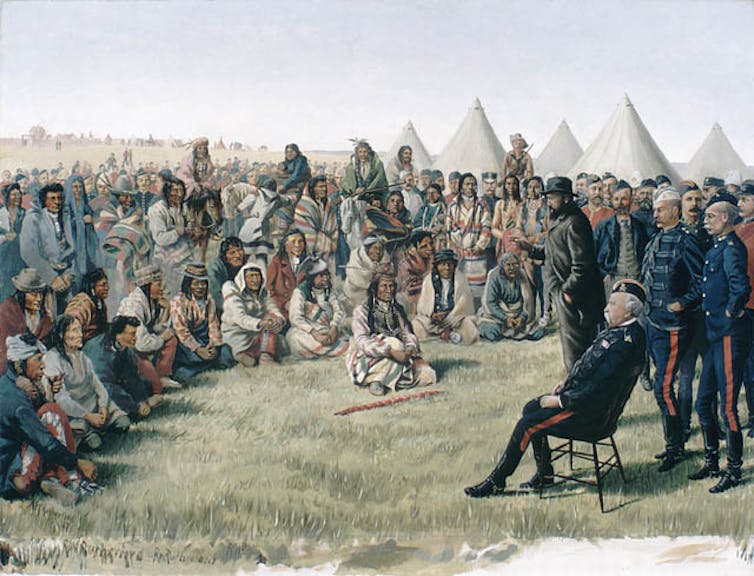
‘The Surrender of Poundmaker to Major-General Middleton at Battleford, Saskatchewan,’ painting by Robert William Rutherford, 1887.
(Library and Archives Canada, MIKAN 2837188, 2895893/Flickr), CC BY

Lesson 5: Stand firm in principles for lasting impact

Poundmaker was wrongly convicted of felony treason and sentenced to three years in prison. He accepted this punishment knowing that his people were safe. Ultimately, the poor prison conditions contributed to his worsening health, in part leading to his death a few months later.

In 2019, the Canadian government formally exonerated Chief Poundmaker and recognized the injustices he faced.

Group of men standing in a line focused on one man in the centre.
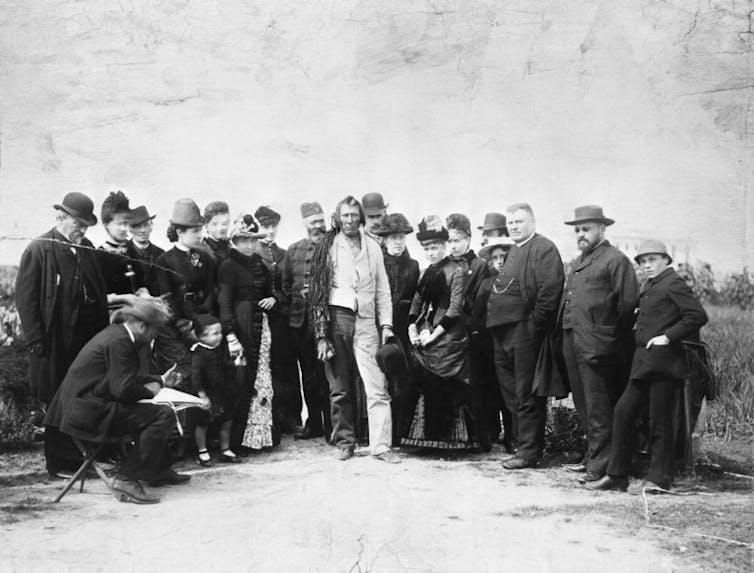
In 1886, French journalists visited Chief Poundmaker (centre) at the Stony Mountain Penitentiary.
(CU1124754/Glenbow Archives, University of Calgary)

While it took more than a century, his story proves that principled leadership outlasts momentary defeats.

Today, leaders can be inspired by this. When we choose to stand firm in our values, we may not see immediate victories. We may see struggles, but what’s important is doing what’s right. Regardless of whether this relates to social justice, ethical business practices or organizational change, leaders must be prepared to hold their ground when it matters most.

Chief Poundmaker’s leadership was rooted in love, reconciliation and an unwavering commitment to his people. His ability to unify nations, navigate high-stakes negotiations and prioritize peace over conflict offers timeless leadership lessons for the modern leader.

In our world, which is often divided by power struggles and short-term thinking, Poundmaker’s legacy should challenge us to lead differently — with humility, courage and a focus on the greater good.

The question we as leaders must ask ourselves is: what kind of leader do we want to be? Poundmaker’s example gives us a path forward.

The Conversation

Andrew J. Karesa does not work for, consult, own shares in or receive funding from any company or organisation that would benefit from this article, and has disclosed no relevant affiliations beyond their academic appointment.

ref. 5 vital leadership takeaways from the life of Chief Poundmaker – https://theconversation.com/5-vital-leadership-takeaways-from-the-life-of-chief-poundmaker-249343