Basket féminin : le Nigeria est sur une lancée victorieuse, mais comment aller plus loin ?

Source: The Conversation – in French – By Michael Gbemisola Aina, Senior Lecturer , University of Ilorin

L’équipe féminine de basket-ball du Nigeria, les D’Tigress, a remporté son cinquième titre consécutif lors du championnat FIBA Afrobasket 2025 à Abidjan, en Côte d’Ivoire, le 3 août. The Conversation Africa a interrogé Michael Gbemisola Aina, commissaire technique de la Fédération nigériane de basket-ball qui a mené des recherches sur l’évolution du basket au Nigeria, sur la signification de cette victoire et sur les mesures à prendre pour améliorer le niveau de ce sport au Nigeria.


Que signifie cette victoire pour le Nigeria ?

L’Afrobasket féminin de la FIBA est la principale compétition de basket-ball féminin en Afrique.Elle est organisée par le bureau régional africain. La compétition a débuté en 1966 et a lieu tous les deux ans. Elle regroupe 16 équipes nationales réparties en quatre groupes de quatre équipes.

La victoire du Nigeria en 2025 a plusieurs implications pour le pays.

Il s’agit de la cinquième victoire consécutive de l’équipe au titre de l’Afrobasket, surpassant le record du Sénégal avec quatre titres consécutifs.

Cette réussite consolide la domination du pays dans le basket-ball féminin africain. Elle renforce la réputation de l’équipe, met en valeur les prouesses athlétiques du pays et promeut une image positive à l’échelle mondiale, d’autant plus qu’elle coïncide avec la récente victoire de l’équipe féminine de football nigériane, les Super Falcons, lors du Championnat d’Afrique des nations de football.

Cette victoire garantit la participation du Nigéria aux tournois de qualification pour la Coupe du monde féminine de basket-ball FIBA 2026 en Allemagne. Elle offre l’occasion de se mesurer aux meilleures équipes du monde.

Elle améliorera le classement mondial du pays en basket-ball féminin et en basket-ball en général. Elle a aussi propulsé le Nigéria de la 11e à la 8e place mondiale qu’il occupait depuis depuis février 2025. Les D’Tigress du Nigeria demeurent la seule équipe africaine à avoir intégré le top 10.

Le succès des D’Tigress peut inspirer et donner confiance aux femmes sportives, en particulier les filles au Nigéria et au-delà. Leurs performances ont montré que la participation et la réussite dans le sport ne sont pas réservées aux hommes.

Le succès de l’équipe pourrait se traduire par plus de soutien, de financements plus importants et de nouvelles opportunités pour le basket-ball au Nigeria. Ce qui pourrait contribuer à développer davantage ce sport.

Le basket-ball est-il bien développé au Nigeria ?

Le basket-ball au Nigeria s’est développé au fil des ans. D’un sport modeste à ses débuts, il est devenu l’un des sports les plus populaires du pays, juste derrière le football à mon avis.

Les basketteurs nigérians se sont illustrés sur la scène internationale, avec de nombreux joueurs évoluant dans la National Basketball Association (NBA), la Women’s National Basketball Association (WNBA) et les principales ligues du monde entier. Osaretin Evelyn Akhator et Onome Akinbode-James en sont quelques exemples. Des académies et des camps de basket-ball amateurs voient le jour dans tout le pays, formant de jeunes talents et promouvant ce sport. La plupart de ces académies ne sont ni enregistrées ni documentées, ce qui rend difficile l’estimation de leur nombre exact.

Mais le basket-ball nigérian reste confronté à des défis : manque de financement, d’infrastructures, surtout en zone rurale, problèmes administratifs. La Zenith Bank Women Basketball League, la plus grande compétition féminine de basket-ball, manque de fonds. Les arbitres se sont mis en grève en 2023 pour obtenir le paiement de leurs indemnités.

Pourquoi tant de joueuses des D’Tigress sont-elles basées à l’étranger ?

En tant que dirigeant sportif, j’y vois à la fois des défis et des opportunités pour le développement du basket-ball dans le pays. D’un côté ça freine le développement du sport, car tout le monde veut partir à l’étranger pour jouer. De l’autre, celles qui jouent mettent à contribution leur notoriété et leur expérience lorsqu’elles jouent pour le Nigeria.

L’absence de ligues professionnelles et d’opportunités compétitives au Nigeria pousse les joueuses talentueuses à chercher de meilleures perspectives à l’étranger. (Il n’existe pas de base de données permettant d’estimer leur nombre.) L’absence d’infrastructures et de ressources de classe mondiale dans le pays freine la progression du basket, poussant les joueuses à chercher de meilleures conditions à l’étranger. Le fait que de nombreuses joueuses des D’Tigress ont été formées à l’étranger met en évidence la nécessité d’investir dans les infrastructures locales, la formation et des ligues compétitives afin de développer les talents au niveau national.

La conséquence la plus inquiétante est le découragement que cela pourrait entraîner chez les joueurs locaux, qui pourraient penser que personne ne peut intégrer l’équipe nationale sans jouer à l’étranger. Ce n’était pas le cas dans les années 1970 et 1980, lorsque les équipes nationales de basket-ball étaient composées d’étudiants issus d’universités locales. Des compétitions étaient organisées pour repérer et former ces étudiants.

La plupart des joueuses de l’équipe nationale ne sont jamais allées au Nigeria, sauf dans des situations particulières, comme récemment lorsqu’elles ont été reçues par le président. Certaines sont nées de parents immigrés nigérians. J’ai vu un joueur de l’équipe masculine D’Tiger qui a représenté son pays à trois reprises sans jamais avoir mis les pieds au Nigeria. L’équipe s’est entraînée à l’étranger, a joué à l’étranger et puis chacun est retourné directement vers son pays de résdidence.

Nigeria vs Mali – Temps forts.

Que faut-il faire pour rendre le basket-ball plus populaire au Nigeria ?

Les stratégies suivantes devraient être envisagées.

Le pays devrait investir dans des terrains et des infrastructures de basket modernes et accessibles dans les écoles, les communautés et les zones urbaines afin d’offrir aux jeunes des espaces pour jouer et regarder des matchs.

Le pays devrait mettre en place des stages et des camps pour enseigner les techniques, promouvoir ce sport et repérer les jeunes joueurs talentueux.

Le gouvernement devrait financer de manière appropriée et suffisante les ligues professionnelles afin d’offrir aux joueurs locaux la possibilité de développer leurs compétences, de se faire connaître et de participer à des compétitions de haut niveau. Les 200 000 dollars américains accordés à seulement deux joueuses des D’Tigress en récompense de leur victoire suffiraient à financer toutes nos ligues locales pendant une saison entière.

Les médias devraient être encouragés à diffuser des matchs de basket-ball, des émissions spéciales et des programmes d’analyse afin de sensibiliser le public et de susciter l’intérêt pour ce sport.

Les campagnes de sponsoring devraient être encouragées comme autre source de financement pour soutenir les équipes nationales de basket-ball et inspirer les jeunes et les supporters.

La nation, les académies, les établissements d’enseignement et les autres organisations sportives privées devraient collaborer avec des organismes sportifs internationaux tels que la NBA, la FIBA et les fédérations internationales de basket-ball afin d’accéder aux ressources, à l’expertise et au financement nécessaires pour soutenir le développement du basket-ball au Nigeria.

Je vois un grand avenir pour le basket-ball si le gouvernement s’engage résolument à développer le sport amateur comme il le faisait autrefois. Les pays développés ont mis en place des programmes sportifs pour leur population dès l’enfance.

The Conversation

Michael Gbemisola Aina does not work for, consult, own shares in or receive funding from any company or organisation that would benefit from this article, and has disclosed no relevant affiliations beyond their academic appointment.

ref. Basket féminin : le Nigeria est sur une lancée victorieuse, mais comment aller plus loin ? – https://theconversation.com/basket-feminin-le-nigeria-est-sur-une-lancee-victorieuse-mais-comment-aller-plus-loin-263470

A straight face, with a wink – the subtle humor of deadpan photography

Source: The Conversation – USA (2) – By Emilia Mickevicius, Norton Family Assistant Curator of Photography, University of Arizona

Installation view of ‘Funny Business: Photography and Humor,’ Phoenix Art Museum, 2025. Katie Jones-Weinert, CC BY-SA

Deadpan is not so much a type of joke as a mode of delivery, a manner of address to an audience that often provokes nervous laughter.

Comedian Nathan Fielder’s persona is marked by deadpan. In his hit HBO comedy series “The Rehearsal,” he maintains a blank facial expression as he listens to contestants fumble their auditions for “Wings of Voice,” his fake reality singing competition. He takes the task of donning the guise of an adult-size infant very seriously, in order to relive the childhood of heroic pilot Sully Sullenberger. His voice is steady and monotone as he converses with a male pilot who cluelessly describes the egregious behavior he’s displayed toward women colleagues.

What makes deadpan feel so off, so destabilizing, so dryly funny?

One reason is that performers – particularly comedians – are expected to be expressive and over the top, or even hint to the audience that they’re supposed to chuckle, similar to a sitcom laugh track.

As I recently organized an exhibition on photography’s relationship to humor, I found myself thinking about how deadpan works in photography. A still, deadpan image might seem like a paradox: Don’t you need a real, live performance? But exploring how photographers have deployed deadpan sheds light on just how powerful and incisive this form of humor can be.

Are you not entertained?

“Pan” was slang for “face” in the 19th century. The genre of deadpan humor was popularized in movies by actor Buster Keaton, whose expressionless, blunt and stilted presence before the camera inspired his nickname, “the Great Stone Face.”

Sprung upon an audience, deadpan can yield a reaction that reveals what philosopher Ted Cohen has described as the “conditional” nature of humor – that it plays into assumptions, expectations and prior knowledge precisely to disrupt them.

Puzzled by the unmet promise of a clear emotion or narrative, the audience laughs uncomfortably at their own bewilderment. The performer’s restraint registers as absurd.

The opposite of postcard perfect

As a medium, photography has historically been burdened by debates over its ability to convey ideas or expression. To early critics, a photograph seemed “mechanical” because it appeared only to reproduce the world, rather than express something new. Compared to drawing or painting, they reasoned, the camera could merely copy.

But I would argue that for these very reasons, photography is a rich lens to explore how deadpan works visually. In photography, deadpan doesn’t even need to involve people.

Take the work of Californian photographer Henry Wessel Jr. Known for his decades-long documentation of everyday life in California, Wessel was one of 10 photographers featured in the watershed 1975 exhibition “New Topographics” at the George Eastman Museum in Rochester, New York, which trained a lens on landscapes altered by humans rather than nature alone – think gas stations, parking lots and tract homes instead of national parks.

Yet the shift Wessel and the other photographers initiated did not simply concern subject matter, but the manner in which they presented it: coolly, at least by the standards of iconic landscape. Previously, photographers such as Ansel Adams had infused their pictures with drama and contrast to provoke the same reverence that they felt toward nature’s beauty. Museumgoers were accustomed to seeing these kinds of landscapes: picturesque and sublime, featuring sprawling mountain ranges and billowing clouds rendered in dramatic tonal ranges.

By contrast, Wessel photographed suburbia in the American West – and with irreverent affection. He composed his images with mock casualness and printed in a narrow tonal range, as if yielding to the leveling quality of the bright sunlight on the stucco and concrete.

This was puzzling; Wessel’s pictures seemed worlds away from fine art landscape photography. They resisted awe and transcendence in favor of dry bemusement. By 1970s standards, his subject matter and aesthetic were equivalents of deadpan’s monotone. Who in their right mind would make the effort to take such a plain picture of a humdrum house?

Yet by adopting this style, Wessel encouraged audiences to pay greater attention to their immediate surroundings: to read front porches, carports and landscaping as evidence of people’s lifestyles and values. His photographs demonstrate the wealth of information that lurks in the mundane.

To Wessel, the seemingly mundane was brimming with intrigue.

Why so serious?

Other photographers have marshaled deadpan to explore themes of identity and belonging.

Tseng Kwong Chi was a prominent personality in the East Village art scene in the 1980s and a friend of pop artist Keith Haring. In his landmark series of proto-selfies, “East Meets West,” the Hong Kong-born artist used a funny personal experience as the point of departure.

Dining at Windows on the World, the restaurant atop the North Tower of the World Trade Center, Tseng decided to wear a Zhongshan suit, or “Mao suit,” as it was known in the West, due to its association with the former Chinese leader Mao Zedong.

The restaurant’s staff treated him as a dignitary, inspiring Tseng to embark upon what ultimately became over 100 self-portraits in which he appeared in this guise of an “ambiguous ambassador.” In the series, Tseng appears in front of popular tourist destinations – Disneyland, Mount Rushmore, Cape Canaveral, Paramount Studios – but never cracks a smile. Goofy hams it up for the camera as Tseng’s suit and serious expression subvert the conventions of tourist snapshots.

In doing so, “East Meets West” deploys deadpan to tell a broader story about the search for belonging as an immigrant and a queer person of color.

Similarly, in his series “Entering Zig’s Indian Reservation,” Zig Jackson adopts a caricature-like persona to both mock and resist Native American stereotypes.

Jackson was the first member of his family to leave their reservation in North Dakota. He spent time in various western states before enrolling as a photography student at the San Francisco Art Institute in the early 1990s.

Early in his time there, as he went for a jog in the city’s sprawling Golden Gate Park, he heard grunting bison from the nearby paddock, a beloved San Francisco landmark since 1892. Jackson felt simultaneously at home and homesick, like he was “among relatives.”

Wearing a war bonnet, or feathered headdress – an item of regalia that is often appropriated by white people “playing Indian” – he returned to the site to “claim the buffalo as my own,” as he explained to me in an email.

In the image, Jackson meets the camera with an expressionless gaze, sitting next to a sign he made to mark his fictive reservation. This and other works from this series are deadpan: Jackson’s headdress registers as jarring with his street clothes, and the rules spelled out on the sign – including “NO PICTURE TAKING” and “NEW AGERS PROHIBITED” – read as tongue in cheek. But the photographs are also melancholy visualizations of feeling out of place.

The matter with fact

Sometimes I find myself wondering whether photography itself is inherently deadpan. It possesses a built-in bluntness that registers as absurd or confusing in certain contexts.

For her series “Skirts,” British conceptual artist Clare Strand rented banquet tables from a commercial catering company, covered them with linens and photographed them one by one. She then presented the images as a grid, as if they were specimens.

The viewer might initially assume that there is some sort of overarching narrative: Are they for a party? An award ceremony?

But Strand provides no answers. All dressed up with nowhere to go, the tables show that to photograph something is to transform it: In anointing an object, person or scene as worthy of being singled out, the photographer confers importance on it. From there, the viewer is left to fill in the blanks.

Scholar Heather Diack has argued that conceptual artists have subverted photography’s purported straightforwardness by making photographs that don’t simply copy or “capture” reality. Their work shows how photographs are anything but natural, literal or transparent.

Yet because people tend to associate photography with objectivity, it renders the medium ripe for deadpan humor – for crafting the appearance of a “straight face,” but with a wink.

The Conversation

Emilia Mickevicius does not work for, consult, own shares in or receive funding from any company or organization that would benefit from this article, and has disclosed no relevant affiliations beyond their academic appointment.

ref. A straight face, with a wink – the subtle humor of deadpan photography – https://theconversation.com/a-straight-face-with-a-wink-the-subtle-humor-of-deadpan-photography-258454

Misunderstood Malthus: The English thinker whose name is synonymous with doom and gloom has lessons for today

Source: The Conversation – USA (3) – By Roy Scranton, Associate Professor of English, University of Notre Dame

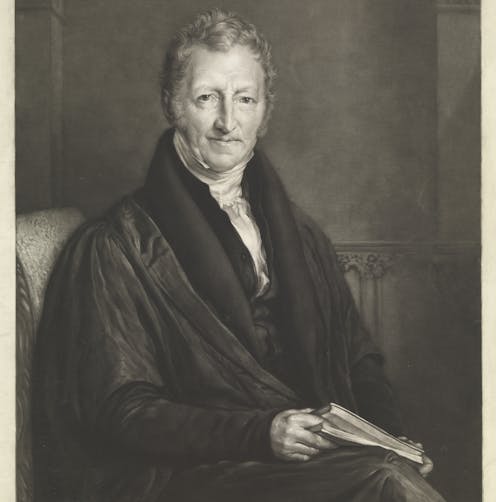
A portrait of Thomas Malthus by John Linnell. Wellcome Collection via Wikimedia Commons, CC BY

No one uses “Malthusian” as a compliment. Since 1798, when the economist and cleric Thomas Malthus first published “An Essay on the Principles of Population,” the “Malthusian” position – the idea that humans are subject to natural limits – has been vilified and scorned. Today, the term is lobbed at anyone who dares question the optimism of infinite progress.

Unfortunately, almost everything most people think they know about Malthus is wrong.

The story goes like this: Once upon a time, an English country parson came up with the idea that population increases at a “geometrical” rate, while food production increases at an “arithmetical” rate. That is, population doubles every 25 years, while crop yields increase much more slowly. Over time, such divergence must lead to catastrophe.

But Malthus identified two factors that reduced reproduction and held off disaster: moral codes, or what he called “preventative checks,” and “positive checks,” such as extreme poverty, pollution, war, disease and misogyny. In the all-too-common caricature, Malthus was a narrow-minded clergyman who was bad at math and thought the only solution to hunger was to keep poor people poor so they had fewer babies.

Understanding Malthus in a broader context reveals a very different character. As I discuss in my 2025 book “Impasse: Climate Change and the Limits of Progress,” Malthus was an innovative and insightful thinker. Not only was he one of the founding figures of environmental economics, but he also turned out to be a prophetic critic of the belief that history tends toward human improvement, which we call progress.

God and science

On the topic of progress, Malthus knew what he was talking about.

He was raised and educated by dissenters: progressivist English Protestants who advocated the separation of church and state. He was taught by the radical abolitionist Gilbert Wakefield, and his father was a friend and admirer of the Enlightenment philosopher Jean-Jacques Rousseau, whose ideas helped inspire the French Revolution.

Despite struggling with a cleft palate, Malthus distinguished himself at Cambridge, where he studied applied math, history and geography. Going into the clergy was a common choice for educated young men of middling means, and Malthus was able to secure a parsonage in Wotton, Surrey. But that didn’t mean giving up his interest in social science.

An Essay on the Principle of Population” was shaped by Malthus’ theological views, but it is also a deeply empirical work and became more so as he revised it in later editions. His argument about geometrical and arithmetical growth rates, for instance, was based on the rapid population growth witnessed in the American Colonies.

A painting in muted colors of a handful of people working in a grain field, as a man sits on a horse nearby.
‘Reapers,’ by 18th-century British artist George Stubbs.
Tate Britain/Yorck Project via Wikimedia Commons

It was also based on what he saw happening around him in Britain. Over the final decades of the 18th century, Britain was wracked by repeated food shortages and riots. The population rose from 5.9 million to 8.7 million, an increase of almost 50%, while agricultural production lagged. In 1795, hungry Londoners mobbed King George III’s coach demanding bread.

Boundless optimism

But why was Malthus talking about population in the first place? As Malthus himself explains, his essay was inspired by an argument with a friend about the journalist and novelist William Godwin – best known today as the father of Mary Shelley, author of “Frankenstein.”

Malthus and Godwin had similar backgrounds. Both came from dissenting middle-class families, were educated in progressive schools and began their careers as ministers. But Godwin’s extreme radicalism put him at odds even with his fellow dissenters, and he soon left the pulpit to take up the pen.

The book that made Godwin’s name and provoked Malthus was “An Enquiry Concerning Political Justice,” published in 1793. Today, it is considered a founding text of philosophical anarchism. Originally, however, Godwin’s “Enquiry” was seen as a thunderous articulation of Enlightenment progressivism.

A dark, painted portrait of a brown-haired man, seen from the side.
A portrait of William Godwin by James Northcote, now in the National Portrait Gallery in London.
Dea Picture Library/De Agostini via Getty Images

Godwin argued that all social problems could be eliminated by reason’s proper application. He advocated abolishing marriage, redistributing property and eliminating government. What’s more, he asserted that progress led inevitably to a utopian world, where humans will no longer have to reproduce because we’ll be immortal:

“There will be no war, no crimes, no administration of justice as it is called, and no government. … But beside this, there will be no disease, no anguish, no melancholy and no resentment. Every man will seek with ineffable ardour the good of all.”

Such things would come about in due time, Godwin assured his readers, solely through the spread of rational discussion.

From his poverty-stricken parsonage in Wotton, Malthus saw things differently. Historian Robert Mayhew describes Wotton at the time as an industrial wasteland afflicted by “agrarian poverty … high birth rates and short life spans.” Studying history led Malthus to conclude that societies moved not in an ever-ascending line of progress but in cycles of expansion and decline. Godwin’s utopian story didn’t seem to match the evidence.

Reform – within reason

Malthus aimed to puncture Godwin’s grandiloquent progressivism. But he wasn’t saying positive change was impossible, only that it was limited by the laws of nature.

“An Essay on the Principles of Population” was his attempt to ascertain where some of those limits might lie, so that policy could respond to social problems effectively, rather than exacerbating them by trying to achieve the impossible. As a writer and active member of the Whig Party, Malthus was a reformer who advocated free national education, the extension of suffrage, the abolition of slavery and free medical care for the poor, among other programs.

Since then, science and industry have made incredible advances, leading to changes Malthus would have scarcely found credible. When his essay was published, the global human population was around 800 million. Today it is over 8 billion, a tenfold increase in little more than two centuries.

Over that time, proponents of progress have scorned the idea that humans are subject to natural limits and denigrated anyone who questioned the fantasy of infinite growth
as “Malthusian.” Yet Malthus remains important because his pessimistic account of society so clearly articulates an insight that refuses to be repressed: The laws of nature apply to human society.

Indeed, “the Great Acceleration” in human development and impact over the past 80 years may have pushed society to the breaking point. Scientists warn that we’ve exceeded six of the nine boundary conditions for sustainable human life on Earth and are close to exceeding a seventh.

One of those conditions is a stable climate. Global warming threatens to not only raise sea levels, increase wildfires and supercharge storms, but also amplify drought and disrupt global agriculture.

Malthus may not have foreseen the developments that fueled human growth over the past two centuries. But his fundamental insight into the limits of growth has only become more relevant. As we face accelerating global ecological crisis, it may be time to revisit the pessimistic idea that we live in a world with limits. Reconsidering what we mean by “Malthusian” might be a good place to start.

The Conversation

Roy Scranton received funding from the John Simon Guggenheim Memorial Foundation.

ref. Misunderstood Malthus: The English thinker whose name is synonymous with doom and gloom has lessons for today – https://theconversation.com/misunderstood-malthus-the-english-thinker-whose-name-is-synonymous-with-doom-and-gloom-has-lessons-for-today-263101

Trump’s Epstein problem is real: New poll shows many in his base disapprove of his handling of the files, and some supporters are having second thoughts about electing him

Source: The Conversation – USA – By Tatishe Nteta, Provost Professor of Political Science and Director of the UMass Amherst Poll, UMass Amherst

Pollsters found that 47% of 2024 Trump voters disapprove of Trump’s handling of the Epstein controversy. These supporters are at a rally in Doral, Fla., on July 9, 2024. Giorgio Viera/AFP via Getty Images

Has President Donald Trump survived the latest and most serious firestorm of controversy over the Epstein scandal? Or has the Trump administration’s handling of the release of information concerning the prosecution of Jeffrey Epstein, a convicted child sex trafficker and Trump’s former friend, hurt the president?

A number of journalists, pointing to recent public opinion polls, have claimed that the scandal has hurt Trump. Others have argued that the public has largely moved on and the Epstein controversy no longer presents a political liability for Trump.

But both of these conclusions are based on limited polling about the Epstein controversy and thus may be premature.

Our recent University of Massachusetts Amherst national poll includes particularly detailed questions about the Epstein controversy and attitudes toward Trump, and thus provides fresh insights on how the controversy has affected public support for Trump.

We find that Trump’s handling of the Epstein controversy has done significant damage to his standing, particularly among his core supporters.

Trump ‘fumbling the matter’

Americans are paying close attention to the prolonged Epstein controversy. Our polling finds that 3 in 4 respondents have heard, read or seen “a lot” or “some” about Epstein.

Moreover, most believe that Trump is fumbling the matter.

Seven in 10 Americans believe that Trump is handling the matter “not well.” This includes pluralities of Trump’s most loyal supporters, 43% of Republicans, 43% of conservatives, and 47% of those who voted for him in 2024.

When we drill down on the 47% of 2024 Trump voters who disapprove of Trump’s handling of the Epstein controversy, we find significant cracks in the MAGA facade. Among members of this group, 28% now disapprove of Trump as president.

When we take demographics, ideology, partisanship and assessments of the economy into account, disapproval of Trump’s handling of the release of the Epstein files is still associated with an increase in disapproval of Trump.

Two men and two women pose at a party.
From left, Donald Trump, his future wife Melania Knauss, Jeffrey Epstein and Ghislaine Maxwell at the Mar-a-Lago club in Palm Beach, Fla., on Feb. 12, 2000.
Davidoff Studios/Getty Images

Voter regret

Even more significantly, we find that among 2024 Trump voters, negative views of Trump’s handling of the Epstein files are associated with an increased desire to make a different choice if the 2024 election could be rerun.

More specifically, among Trump voters who believe that the president has mishandled the release of the Epstein files, more than one quarter – 26% – indicate that they would not vote for Trump if they had the opportunity to vote again in the 2024 election.

While there are no election do-overs, it is clear that the Epstein scandal has hurt Trump among his base of voters.

Much can happen between now and the midterm elections in November 2026, of course.

But if Trump fails to satisfy his political base, perceptions among Trump voters that he has mishandled the controversy could reduce enthusiasm and participation in the elections. Even if the share of Republicans alienated by the Epstein controversy is relatively small, this could hurt Republicans in close contests.

With over a year to go, the facts on the ground will likely change. But as of today, the controversy over the release of the Epstein files remains relevant. Whether the president responds in a manner that satisfies his voters is a question that could have important political consequences.

The Conversation

Jesse Rhodes receives funding from the National Science Foundation, the Spencer Foundation, and Demos. He is a member of the American Civil Liberties Union.

Adam Eichen, Alexander Theodoridis, Raymond La Raja, and Tatishe Nteta do not work for, consult, own shares in or receive funding from any company or organization that would benefit from this article, and have disclosed no relevant affiliations beyond their academic appointment.

ref. Trump’s Epstein problem is real: New poll shows many in his base disapprove of his handling of the files, and some supporters are having second thoughts about electing him – https://theconversation.com/trumps-epstein-problem-is-real-new-poll-shows-many-in-his-base-disapprove-of-his-handling-of-the-files-and-some-supporters-are-having-second-thoughts-about-electing-him-263662

A Detroit street is named in honor of Vincent Chin – his death mobilized Asian American activists nationwide

Source: The Conversation – USA – By Jennifer Ho, Professor of Asian American Studies, University of Colorado Boulder

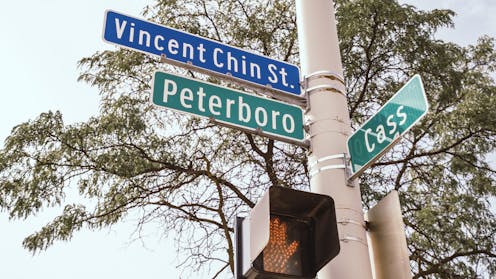
Peterboro Street was recently renamed Vincent Chin Street in his memory. Valaurian Waller/The Conversation, CC BY-ND

The legacy of Vincent Chin has recently been commemorated in a street sign bearing his name on the corner of Cass Avenue and Peterboro Street in Detroit’s historic Chinatown.

I was glad to see it. Watching the 1987 documentary “Who Killed Vincent Chin?” and learning about his life and Asian American activism changed my life.

I was 18 and taking my first Asian American studies class at the University of California, Santa Barbara. The film made me realize two things: Asian Americans are targets of racial violence, and Asian Americans across the ethnic spectrum could join together to fight for civil rights. This led to my passion for social justice.

I’m proud to now be a professor of Asian American studies and critical race theory who teaches my students about Vincent Chin.

So who was Chin, and why did his death catalyze an Asian American civil rights movement?

A fatal brawl

Chin, an Oak Park resident, was 27 years old on the night of his bachelor party, June 19, 1982. He got into a fight with two white men – Ronald Ebens, a Chrysler car plant supervisor, and Michael Nitz, an unemployed autoworker and Ebens’ stepson.

A young Asian man wearing glasses, a jacket and a tie. His hair is fairly long and parted on the side
Vincent Chin.
Bettmann Archive/via Getty Images

According to Racine Colwell, a dancer at the Fancy Pants Club in the Detroit area, Ebens shouted, “It’s because of you little motherf–kers that we’re out of work.” Detroit in the early 1980s was in an automotive slump. People blamed Japanese auto imports and the Japanese people, in general, for the economic downturn. The assailants didn’t seem to understand or care that Chin was actually Chinese.

After the fight between Chin and Nitz and Ebens, Chin and his friends ran out of the club. Ebens and Nitz ran after them, with Nitz grabbing a baseball bat from his car. When they found Chin outside a McDonald’s on Woodward Avenue, Nitz held Chin while Ebens beat his body and head with the bat. They were stopped by two off-duty police officers who had been inside the fast-food restaurant.

After the attack, Jimmy Choi, a member of the bachelor party, cradled Chin in his arms. He said that Chin’s last words were “It’s not fair.” Chin died four days later.

Ebens and Nitz were charged with second-degree murder, but their lawyers pleaded the charge down to manslaughter. At the end of the trial, Judge Charles Kaufman fined them US$3,000 each and sentenced each to three years’ probation, explaining: “These weren’t the kind of people you send to prison. … You don’t make the punishment fit the crime. You make the punishment fit the criminal.”

Asian Americans organize for legal justice

The sentencing enraged Chin’s friends, family and the greater Chinese and Asian American community of Detroit.

Activists of various Asian ethnicities and their non-Asian allies created American Citizens for Justice, an organization that pressured the Justice Department to investigate the violation of Chin’s civil rights and to see Ebens and Nitz imprisoned for Chin’s murder. Lily Chin, Vincent’s mother, was a key advocate in the pursuit of justice for her son, showing up to rallies and interviews to remind people of Vincent’s death for nearly a decade.

A middle-aged Asian woman throws her head back and wails. Two woman and a young man with spiked hair stand with her and support her.
Lily Chin leaves a courtroom in Detroit’s City-County Building in June 1982.
Bettmann archives/via Getty images

While there were other moments, such as the anti-eviction fight for the I-Hotel in San Francisco, that brought Asian Americans of all ethnicities together to fight for civil rights, Chin’s murder sparked a broad awareness. Asian Americans realized that what happened to Chin could happen to them.

American Citizens for Justice held press conferences and gained support from local African American activists in Michigan and national Black leaders like Jesse Jackson, whose presence helped bring more attention to the Chin tragedy.

Activists were successful in forcing the FBI to open an investigation. The resulting 1984 federal trial was the first time the Justice Department had argued that the civil rights of an Asian American person had been violated. Nitz was found not guilty on two counts. Ebens was found guilty and sentenced to 25 years in prison. However, a 1986 federal appeals court ruling overturned the conviction, freeing Ebens.

A civil suit filed against Ebens and Nitz on behalf of Lily Chin was settled out of court in 1987. Nitz agreed to pay $50,000 and Ebens $1.5 million – the projected income that Chin would have made had he lived.

Nitz fulfilled his debt, but Ebens made only a few payments. By 1987, Ebens had been unemployed for five years. He stopped making payments after he moved to Nevada. Estimates in 2016 place Ebens’ debt to the Chin estate at over $8 million, including accumulated interest.

Chin’s death had a profound impact on the criminal justice system in Michigan and nationally. Michigan made it harder to plead down murder charges to manslaughter and required prosecutors to be present at sentencings to face victims. Nationally, victim impact statements are now commonplace. Victims and their families now have more of a voice in the justice system.

Chin’s death spurred Pan-Asian American activism across the U.S., leading to the eventual founding of organizations like Asian Americans Advancing Justice in 1991 and Stop Asian American Pacific Islander Hate in 2020. During the COVID-19 pandemic, Stop AAPI Hate recorded violence against Asians happening in the U.S. and educated people about anti-Asian racism.

Today, Asian Americans fight for social justice through organizations like these and 18 Million Rising, a group that advocates for racial justice for Asian Americans and all marginalized people.

This is the lasting legacy of Vincent Chin.

The Conversation

Jennifer Ho does not work for, consult, own shares in or receive funding from any company or organization that would benefit from this article, and has disclosed no relevant affiliations beyond their academic appointment.

ref. A Detroit street is named in honor of Vincent Chin – his death mobilized Asian American activists nationwide – https://theconversation.com/a-detroit-street-is-named-in-honor-of-vincent-chin-his-death-mobilized-asian-american-activists-nationwide-262033

Why Japanese American memories of US internment during the second world war are stirring up protests in 2025

Source: The Conversation – UK – By Rachel Pistol, Senior Research Fellow, University of Southampton

The recent opening of an immigration centre in El Paso, Texas, has reignited protests of the Trump administration’s tough immigration plans from Japanese Americans. The internment camp, which opened in August 2025, is on the site of a military base that was used to intern Japanese Americans during the war.

In the past few months hundreds of Japanese Americans have been protesting the construction of new immigration centres and plans to detain thousands of people by the US Immigration and Customs Enforcement unit (Ice), because it stirs up memories of how their families were rounded up during the second world war.

The US government has also invoked the 1798 Alien and Enemies Act, last used in the second world war, to increase the powers of Ice to detain individuals.

Much of the basis for the internment of Japanese Americans during the war was derived from the 1798 act, which allows the detention and deportation of foreign “enemies”.

Dublin prison, near San Francisco, was closed in 2024 but Ice is seeking to reopen it – and many other detention sites – to keep up with Donald Trump’s ambitious plan to arrest large numbers of immigrants.

The Japanese American community came out to protest in July around Dublin, outlining fears that the recent Ice raids are a repeat of the history that led to the incarceration of more than 120,000 Japanese Americans between 1942 and 1946. One internal Ice estimate suggests there are currently 60,000 immigrants held in detention throughout the US.

Latino neighbourhoods are being targeted, according to civil rights groups, although the Department of Homeland Security has denied it is targeting groups based on their skin colour or ethnicity.

One protester, Lynn Yamashita, said to ABC News: “I’m here because the Japanese were interned, my father was interned, and it can’t happen again – but it is happening, it’s shameful.” Douglas Yoshida, another protester, said: “There’s no invasion, but Trump has cited the Alien Enemies Act to detain and deport people without any due process.”

The Japanese American community in California has been quick to draw comparisons between the alleged targeting of Latino communities by Ice and their own treatment during the second world war. This attracted particular national attention when scores of masked and armed federal agents turned up and arrested a person outside the Japanese American National Museum (JANM) in Los Angeles, during a speech by California’s governor, Gavin Newsom.

This is a highly symbolic site, as it is where Japanese American families were forced to board buses to American concentration camps in 1942. JANM has posted pictures comparing the cramped conditions in those WWII camps to the cages being used in Ice detention facilities. In both cases, families were ripped apart, causing huge amounts of trauma.

What is the history?

In the decades before the second world war, various pieces of legislation were passed to halt both Chinese and Japanese immigration to the US, and there was significant racism directed at Asian immigrants.

Many businesses run by white Americans refused to serve Asians or let them use leisure facilities such as swimming pools. They were also reluctant to allow anyone who looked Asian to rent or buy properties in white neighbourhoods. Despite these challenges, Asian immigrants worked hard to establish businesses and farms, as well as working in many American factories.

Today, immigrants from the Latino and Hispanic populations make up around 19% of the American workforce, yet regularly experience racism in the US.

Forcibly displaced and incarcerated

During the second world war, with the US and Japan on opposite sides, people of Japanese ancestry living in the US were forcibly displaced and incarcerated. The basis of their treatment was signed into being as executive order 9066 by President Franklin D. Roosevelt in February 1942.

EO9066 authorised the forced removal of any person who might be a threat to national security from the west coast of the US. Although no mention was made of any specific group, the order was used almost exclusively to target individuals of Japanese ancestry – not just Japanese citizens but their US-born children.

The history of Japanese immigration to the US includes internment during WWII.

Much of the argument for detention both then and now is to rid the country of “undesirables” – be they defined as “looking like the enemy” (then) or “violent criminals or illegal immigrants” (now). However, recent data shows large numbers of arrests are being made of people without criminal charges or convictions, and of some US citizens. This suggests Ice is very focused on meeting its alleged quota of arresting 3,000 migrants per day. The White House has denied this quota exists.


Read more:
Masked and armed agents are arresting people on US streets as aggressive immigration enforcement ramps up


Since Trump’s return to office, some people have reportedly been arrested during routine naturalisation appointments for errors as small as forgetting to submit a relevant form. Even when someone has entered the US legally, this is not necessarily protection from the new powers enacted under the Trump presidency.

Hundreds are being detained in hastily constructed detention camps in isolated areas. During the second world war, this was what happened with the ten so-called “relocation centres”, or internment camps, that were built across the west and south of the US for Japanese Americans, who were then denied habeas corpus – meaning they had no right to defend themselves in a court of law and could be detained indefinitely without a fair hearing.

In June this year, there were suggestions from the Trump administration that it was discussing suspending habeas corpus. If this happens, it could mean there is no limit for how long people can be detained in these camps, and that they no longer have a right to a fair hearing.

In 1988, the US accepted it had carried out a “grave injustice” against people of Japanese ancestry, and that these actions during the second world war were motivated by racial prejudice and “war hysteria”. It’s not clear what, if any, lessons have been learned from this history – and if so, why are they being ignored?

The Conversation

Rachel Pistol has received funding from the British Association for American Studies with the Tuna Canyon Detention Station Coalition for a travelling exhibition in 2026 about Japanese American incarceration.

ref. Why Japanese American memories of US internment during the second world war are stirring up protests in 2025 – https://theconversation.com/why-japanese-american-memories-of-us-internment-during-the-second-world-war-are-stirring-up-protests-in-2025-261989

Tiny Bookshop: why gamers are choosing to spend their free time simulating work – according to philosophy

Source: The Conversation – UK – By Owen Brierley, Course Leader in the Department of Creative Industries, Kingston University

In the recently released game Tiny Bookshop you are invited to “leave everything behind and open a tiny bookshop by the sea”. Tiny Bookshop has been described as an ambient narrative management game, which has a cosy and calming feel.

From Zoo Tycoon to SimCity and now Tiny Bookshop, computer games have made work feel like play. But the recent explosion of “cosy work simulators” reveals something profound about modern labour and why we’re seeking meaning in the most unexpected places.

Critics and fans have loved Tiny Bookshop, where players spend hours organising shelves, recommending novels and chatting with customers. Meanwhile, 15 million people have bought Euro Truck Simulator 2 to drive virtual trucks on digital motorways. Stardew Valley has sold over 20 million copies, letting players escape to virtual farms where they grow turnips and milk cows.

This isn’t just escapism. It’s something philosophers have been trying to explain for decades.

Research has shown that video games are as powerful as morphine. Other researchers have commented that gamification of work is pacifying workers who should be demanding better conditions. There’s truth here. It’s easier to download Tiny Bookshop than to quit your corporate job and start a real shop.

The romanticisation of small businesses also ignores that bookshop owners often earn little and have no benefits. You can quit playing a game and return to it when you feel like it. That’s not so easy with real jobs.

But dismissing these games as mere escapism misses something crucial. As political theorist Kathi Weeks argues, they function as “laboratories for post-work imagination”. Players aren’t escaping bad work. They are rehearsing better work. They are experiencing what labour could feel like if it served human needs rather than capital accumulation.

Beyond escape: reimagining labour

Johan Huizinga, the Dutch historian who invented game studies, had this concept called the “magic circle”. When we enter a game, we step into a special space with its own rules. Inside this circle, mundane activities become meaningful because we’ve chosen to be there.

Think about it: washing dishes is tedious. But washing dishes in the game Unpacking is meditative. Filing paperwork is soul crushing. But processing immigration documents in Papers, Please becomes a moral thriller. The difference? Agency and consent. We’ve voluntarily entered these spaces, transforming obligation into play.

Karl Marx would have had a field day with this. His theory of “alienation from work” argued that industrial capitalism separated workers from what they produce, how they produce it, and why they’re producing it. In real jobs, you might never see the finished product, never control the process, never understand the purpose.

But in Tiny Bookshop? You choose the stock, stack the shelves and sell to customers who thank you. The entire cycle is visible, controllable and meaningful. You’re experiencing what Marx described as work where you control the means of production and see direct results.

Work as play, play as work

Humans have always blurred these boundaries. Children, for instance, instinctively play house or play shop, rehearsing adult work through voluntary recreation.

What’s shifted is scale and context. The explosion of cosy work simulators around 2020 wasn’t coincidental. As research shows, these games attracted entirely new demographics, particularly women and older adults, who’d never identified as “gamers”. They weren’t seeking escape from reality but rather a different version of it.

The Korean game Work Time Fun (originally released as Baito Hell 2000) made this explicit, parodying meaningless labour by having players cap pens for virtual pennies. Critics called it “deliberately boring”. Yet people played it obsessively, suggesting something deeper than entertainment was at work.

The academic and game designer Ian Bogost’s concept of “procedural rhetoric” explains how games make arguments through their systems rather than stories. When Euro Truck Simulator rewards careful driving and timely delivery, it’s making a claim about what makes work satisfying. When Tiny Bookshop connects every sale to a customer’s happiness, it argues that commerce can be personal and meaningful.

This connects to what the Hungarian-American psychologist
Mihaly Csikszentmihalyi calls “flow” – a state where time disappears because you’re perfectly balanced between challenge and skill. Real jobs rarely create flow: feedback is delayed, goals are unclear and difficulty spikes randomly. But games are flow machines, carefully calibrated to keep you in that sweet spot where work feels effortless.

The anthropologist David Graeber’s theory of “bullshit jobs” adds another layer. He argued that up to 40% of workers secretly believe their jobs are pointless, what he called “box-tickers”, “flunkies”, and “taskmasters” who exist only to manage other managers. These jobs violate something fundamental about human nature: our need to feel useful.

Virtual work offers the opposite. Every customer in Coffee Talk has a story. Every crop in Stardew Valley feeds someone. Even in Papers, Please, a game about bureaucracy, your decisions determine life and death. These games provide what philosopher Byung-Chul Han warns we’ve lost: clear connections between effort and outcome.

The shift from SimCity to Tiny Bookshop reflects changing aspirations. We’re less interested in managing systems and more interested in human-scale interactions. Less excited by efficiency and more drawn to meaning. The fact that millions choose to spend free time on virtual labour that mirrors real work but with agency, purpose and visible impact is itself a form of critique.

These games reveal the gap between what work is and what it could be. They show us that the problem isn’t work itself, but work stripped of autonomy, meaning and connection. In Huizinga’s magic circle, we glimpse what Marx imagined: labour that develops rather than diminishes us.

The next time someone questions why you’re wasting time managing a virtual bookshop, remind them you’re not escaping work. You’re experiencing what work could be. Voluntary. Meaningful. Genuinely productive. The fact that we have to find this in games rather than our own jobs isn’t a gaming problem. It’s a work problem.

And millions of us, controller in hand, are imagining solutions.


Looking for something good? Cut through the noise with a carefully curated selection of the latest releases, live events and exhibitions, straight to your inbox every fortnight, on Fridays. Sign up here.


The Conversation

Owen Brierley does not work for, consult, own shares in or receive funding from any company or organisation that would benefit from this article, and has disclosed no relevant affiliations beyond their academic appointment.

ref. Tiny Bookshop: why gamers are choosing to spend their free time simulating work – according to philosophy – https://theconversation.com/tiny-bookshop-why-gamers-are-choosing-to-spend-their-free-time-simulating-work-according-to-philosophy-263646

Even if Trump succeeds in bringing Putin and Zelenskyy together, don’t expect wonders − their only previous face-to-face encounter ended in failure

Source: The Conversation – Global Perspectives – By Anna Batta, Associate Professor of International Security Studies, Air University

Russian President Vladimir Putin and Ukrainian President Volodymyr Zelenskyy arrive at the Elysee Palace in Paris in 2019. Ian Langsdon/Pool Photo via AP

Donald Trump has raised the prospect of directs talks between Presidents Vladimir Putin of Russia and Volodymyr Zelenskyy of Ukraine, in what would be the first such encounter in more than three years of war between the two countries.

In a social media post on Aug. 18, 2025, the U.S. president announced that he had begun “the arrangements for a meeting, at a location to be determined.”

Whether the proposed meeting does go ahead given the animosity between the two men remains to be seen. Previous speculation earlier in 2025 that Putin and Zelenskyy might engage in face-to-face talks led nowhere.

But should Trump succeed in bringing Putin and Zelenkyy together, it would not be the first time they have met.

In Paris in 2019, the two men sat down together as part of what was known as the Normandy Format talks. As a scholar of international relations, I have interviewed people involved in the talks. Some five years on, the way the talks floundered and then failed can offer lessons about the challenges today’s would-be mediators now face.

Initial hopes

The Normandy Format talks started on the sidelines of events in June 2014 commemorating the 70th anniversary of the D-Day landings. The aim was to try to resolve the ongoing conflict between Ukrainian forces and pro-Russian separatist groups in the country’s Donbas region in the east. That conflict had recently escalated, with pro-Russian separatists seizing key towns in the Donetsk and Luhansk after Russia illegally annexed the peninsula of Crimea in February 2014.

The talks continued periodically until 2022, when Russia launched its full-scale invasion of Ukraine. Until that point, most of the discussion was framed by two deals, the Minsk accords of 2014 and 2015, which set out the terms for a ceasefire between Kyiv and the Moscow-armed rebel groups and the conditions for elections in Donetsk and Luhansk.

By the time of the sixth meeting in December 2019, the only time Zelenkyy and Putin have met in person, some still hoped that the Minsk accords could form a framework for peace.

Under discussion

Zelenskyy was only a few months into his presidency. He arrived in Paris with fresh energy and a desire to find peace.

His electoral campaign had centered on the promise of putting an end to the unrest in Donbas, which had been rumbling on for years. The increasing role of Russia in the conflict, through supporting rebels financially and with volunteer Russian soldiers, had complicated and escalated fighting, and many Ukrainians were weary of the impact of internally displaced people that it caused.

By all accounts, Zelenskyy went into Paris believing that he could make a deal with Putin.

“I want to return with concrete results,” Zelenskyy said just days before meeting Putin. By then, the Ukrainian president’s only contact with Putin had been over the phone. “I want to see the person and I want to bring from Normandy understanding and feeling that everybody really wants gradually to finish this tragic war,” Zelenskyy said, adding, “I can feel it for sure only at the table.”

One of Putin’s main concerns going into the talks was the lifting of Western sanctions imposed in response to the annexation of Crimea.

But the Russian president also wanted to keep Russia’s smaller neighbor under its influence. Ukraine gained independence after the fall of the Soviet Union in 1991. But in the early years of the new century, Russia began to exert increasing influence over the politics of its neighbor. This ended in 2014, when a popular revolution ousted pro-Russian Ukrainian President Viktor Yanukovych and ushered in a pro-Western government.

More than anything, Russia wanted to arrest this shift and keep Ukraine out of the European Union and NATO.

Those desires – Ukraine’s to end the war in Donbas, and Russia’s to curb the West’s involvement in Ukraine – formed the parameters for the Normandy talks.

And for some time, there appeared to be momentum to find compromise. French President Emmanuel Macron said that the 2019 Paris talks had broken years of stalemate and relaunched the peace process. Putin’s assessment was that the peace process was “developing in the right direction.” Zelenskyy’s view was a little less enthusisastic: “Let’s say for now it’s a draw.”

Talking past each other

Yet the Putin-Zelenskyy meeting in 2019 ultimately ended in failure. In retrospect, both sides were talking past each other and could not reach agreement on the sequencing of key parts of the peace plan.

Zelenskyy wanted the security provisions of the Minsk accords, including a lasting ceasefire and the securing of Ukraine’s border with Russia, in place before proceeding with regional elections on devolving autonomy to the regions. Putin was adamant that the elections come first.

The success of the Normandy talks were also hindered by Putin’s refusal to acknowledge that Russia was a party to the conflict. Rather, he framed the Donbas conflict as a civil war between the Ukrainian government and the rebels. Russia’s role was simply to push the rebels to the negotiating table in this take – a view that was greeted with skepticism by Ukraine and the West.

As a result, the Normandy talks stalled. And then in February 2022, Russian launched its full-scale invasion of Ukraine.

Way forward today?

So what are the chances of success should Trump secure a second face-to-face meeting between Putin and Zelenskyy?

Many of the same challenges remain. The talks still revolve around the issues of security, the status of Donetsk and Luhansk.

But there are major differences – not least, 3½ years of actual direct war. Russia can no longer deny that it is a party of the conflict, even if Moscow frames the war as a special military operation to “denazify” and demilitarize Ukraine.

And three years of war have changed how the questions of Crimea and the Donbas are framed.

In the Normandy talks, there was no talk of recognizing Russian control over any Ukrainian territory. But recent U.S. efforts to negotiate peace have included a “de-jure” U.S. recognition of Russian control in Crimea, plus “de-facto recognition” of Russia’s occupation of nearly all of Luhansk oblast and the occupied portions of Donetsk, Kherson and Zaporizhzhia.

Another major difference between the negotiation process then and now is who is mediating.

The Normandy negotiations were led by European leaders – German Chancellor Angela Merkel and President Macron of France. Throughout the whole Normandy talks process, only Germany, France, Ukraine and Russia were involved as active participants.

Today, it is the United States taking the lead.

And this suits Putin. A constant issue for Putin of the Normandy talks was that Germany and France were never neutral mediators.

In President Donald Trump, Putin has found a U.S. leader who, at least at first, appeared eager to take on the mantle from Europe.

But like the Europeans involved in the Normandy talks, Trump may also encounter similar barriers to any meaningful progress.

A group of men sit at a desk behind which various flags are seen.
Members of Ukrainian and Russian delegations attend peace talks on June 2, 2025, in Istanbul.
Turkish Ministry of Foreign Affairs via Getty Images

Despite his recent high-profile summit with Putin and follow-up meeting with Zelenksyy, Trump has made little progress toward ending the conflict in Ukraine. And neither Zelenskyy nor Putin has shown any inclination to compromise on their goals: Zelenskyy has ruled out land swaps, while Putin insists that any peace deal address “root causes.”

Getting the leaders of Ukraine and Russia into the same room is already a massive challenge; getting them to agree to a lasting agreement may be as elusive now as it was when Putin and Zelenskyy met in 2019.

This is an updated version of an article that was first published in The Conversation on June 2, 2025.

The Conversation

The views expressed in this article represent the personal views of the author and are not necessarily the views of the Department of Defense or of the Department of the Air Force.

ref. Even if Trump succeeds in bringing Putin and Zelenskyy together, don’t expect wonders − their only previous face-to-face encounter ended in failure – https://theconversation.com/even-if-trump-succeeds-in-bringing-putin-and-zelenskyy-together-dont-expect-wonders-their-only-previous-face-to-face-encounter-ended-in-failure-263509

Why losing weight or cutting alcohol isn’t always best after illness strikes

Source: The Conversation – UK – By Justin Stebbing, Professor of Biomedical Sciences, Anglia Ruskin University

Grinny/Shutterstock.com

The health advice that keeps you from getting sick might actually harm you once you’re already ill. This counterintuitive medical reality has a new name: “Cuomo’s paradox”, coined by Professor Raphael Cuomo at UC San Diego School of Medicine after analysing findings across numerous studies.

The paradox describes how behaviour long considered unhealthy – carrying extra weight, drinking moderate amounts of alcohol, having elevated cholesterol – sometimes correlates with better survival in people who already have cancer or heart disease. It’s a phenomenon that challenges the one-size-fits-all approach to medical advice.

This doesn’t mean throwing prevention guidelines out the window. Rather, it suggests nutrition should be treated as stage-specific medicine. Before diagnosis, the goal is clear: reduce your risk of getting sick. After diagnosis, the priorities shift dramatically to preserving strength, tolerating harsh treatments and avoiding dangerous complications.

The distinction matters enormously for the millions living with advanced cancer or heart disease. Too often, doctors apply prevention-focused advice – lose weight, eliminate alcohol, slash cholesterol levels – to patients whose immediate battle is surviving chemotherapy or managing frailty. These competing goals can point to entirely different dietary strategies.

Cuomo argues for personalised nutrition after diagnosis rather than copying prevention guidance. What keeps a healthy 40-year-old disease-free may not help a 70-year-old cancer patient get through treatment.

The pattern isn’t entirely new. Researchers have long documented the obesity paradox in cardiovascular and cancer care, where heavier patients sometimes survive longer once they’re ill. These observations have sparked years of debate, with critics pointing to measurement timing, unintentional weight loss from illness, and statistical quirks that might explain the findings.

Although careful study design can reduce some paradoxical signals, they don’t always disappear. Cuomo’s contribution is connecting these recurring reversals across multiple factors – weight, alcohol, cholesterol – and multiple diseases, creating a unified framework for stage-specific nutrition.

The findings don’t negate established science. Obesity and alcohol clearly increase cancer risk and worsen heart health. But once illness strikes, the survival equations change, and rigid prevention targets may not suit every patient undergoing treatment.

The paradox in practice

Why might extra weight help cancer survival? The answer lies in the brutal reality of cancer treatment. Chemotherapy, radiation and surgery are physically punishing, breaking down muscle and tissue. Patients with greater reserves – both fat and crucially, muscle mass – may be able to weather these assaults better and resist the rapid weight loss that signals declining health.

When a person was last weighed matters too. A person who is underweight now – at diagnosis – may have been overweight before they became ill, but is at a higher risk of death compared with an overweight person for the reasons stated above.

Similar patterns appear with alcohol. Although drinking clearly increases cancer risk in proportion to consumption and duration, some studies suggest light-to-moderate drinkers show better or equivalent post-diagnosis outcomes compared to non-drinkers. The interpretation remains murky – light drinkers may have different social or health behaviour, while some may quit alcohol due to illness, skewing comparisons.

A person offering a drink and another refusing the drink.
Some people quit alcohol when they become ill, but before their diagnosis.
Pormezz/Shutterstock.com

Cholesterol presents another puzzle. In advanced heart disease, extremely low cholesterol sometimes signals broader health problems: inflammation, malnutrition and liver dysfunction. In these cases, low cholesterol is more likely to reflect underlying illness rather than directly cause poor outcomes, meaning that sicker patients often show low levels. This creates a U-shaped pattern where both very high and very low cholesterol are linked to an increased risk of death.

Cuomo’s message isn’t that “high cholesterol is good” but that aggressively pursuing prevention targets in frail patients might not improve survival and could conflict with maintaining strength and quality of life. Treatment decisions require individualisation and careful monitoring.

For doctors, this means separating prevention from survival goals. Before diagnosis, standard guidance applies: maintain healthy weight, limit alcohol, manage cholesterol. After diagnosis, targets should reflect disease stage, treatment plans, body composition and other health conditions. The focus shifts to avoiding unintentional weight loss while maintaining muscle and energy during active treatment.

Cuomo’s paradox doesn’t upend health advice. It emphasises context. The behaviour that prevents disease isn’t always that which best supports survival once serious illness arrives. That’s not permission for unhealthy habits – it’s a call for individualised care that balances survival, strength and quality of life through careful medical oversight.

The Conversation

Justin Stebbing does not work for, consult, own shares in or receive funding from any company or organisation that would benefit from this article, and has disclosed no relevant affiliations beyond their academic appointment.

ref. Why losing weight or cutting alcohol isn’t always best after illness strikes – https://theconversation.com/why-losing-weight-or-cutting-alcohol-isnt-always-best-after-illness-strikes-263315

Zone zero: the rise of effortless exercise

Source: The Conversation – UK – By Tom Brownlee, Associate Professor, Sport and Exercise Science, University of Birmingham

It can look almost too easy: athletes gliding along on a bike, runners shuffling at a pace slower than most people’s warm-up, or someone strolling so gently it barely seems like exercise at all. Yet this kind of effortless movement is at the heart of what’s becoming known as zone zero exercise.

The idea runs counter to the “push yourself” culture of gyms and fitness apps. Instead of breathless effort, zone zero exercise is all about moving slowly enough that you could chat very comfortably the whole time. For some people, it might mean a gentle stroll. For others, it could be easy yoga, a few stretches while the kettle boils, or even pottering about the garden. The point is that your heart rate stays low; lower even than what many fitness trackers label as zone 1.

In the language of endurance training, zone 1 usually means about 50-60% of your maximum heart rate. Zone zero dips beneath that. In fact, not all scientists agree on what to call it, or whether it should be counted as a separate training zone at all. But in recent years, the term has gained traction outside research circles, where it has become shorthand for very light activity, with surprising benefits.

One of those benefits is accessibility. Exercise advice often leans towards intensity: the sprint intervals, the high-intensity classes, the motivational “no pain, no gain”. For anyone older, unwell, or returning to movement after injury, this can feel impossible. Zone zero exercise offers an alternative starting point.

The quiet power of easy effort

Studies have found that even very light activity can improve several health markers including circulation, help regulate blood sugar, and support mental wellbeing. A daily walk at a gentle pace, for example, can lower the risk of cardiovascular disease.

There’s also the question of recovery. High-level athletes discovered long ago that they couldn’t train hard every day. Their bodies needed space to repair. That’s where easy sessions came in. They aren’t wasted time, but essential recovery tools.

The same applies to people juggling work, family and stress. A zone zero session can reduce tension without draining energy. Instead of collapsing on the sofa after work, a quiet half-hour walk can actually restore it.

A woman lies on the floor, balancing her daughter on her shins.
Every bit counts.
PH888/Shutterstock.com

Mental health researchers have pointed to another benefit: consistency. Many people give up on exercise plans because they set the bar too high. A routine based on zone zero activities is easier to sustain. That’s why the gains – better sleep, a brighter mood, and lower risk of chronic illness – keep adding up over months and years.

There are limits, of course. If your goal is to run a marathon or significantly increase fitness levels, gentle movement alone won’t get you there. The body needs higher-intensity challenges to grow stronger. But the “all or nothing” mindset, either training hard or not at all, risks missing the point. Zone zero can be the base on which other activity is built, or it can simply stand on its own as a health-boosting habit.

The fact that researchers are still debating its definition is interesting in itself. In sports science, some prefer to talk about “below zone 1” or “active recovery” instead of zone zero. But the popular name seems to have stuck, perhaps because it captures the spirit of effortlessness. The idea of a “zero zone” strips away pressure. You don’t need fancy equipment or the latest wearable. If you can move without strain, you’re doing it.

That simplicity may explain its appeal. Public health messages about exercise can sometimes feel overwhelming: how many minutes per week, what heart rate, how many steps. Zone zero cuts through that noise. The message is: do something, even if it’s gentle. It still counts.

And in a world where many people sit for long stretches at screens, it might be more powerful than it sounds. Evidence shows that long sedentary periods raise health risks even in people who exercise vigorously at other times. Building more light, frequent movement into the day may matter just as much as the occasional intense workout.

Zone zero exercise, then, isn’t about chasing personal bests. It’s about redefining what exercise can look like. It’s not a test of willpower but a way to keep moving, to stay connected to your body, and to build habits that last. Whether you’re an elite cyclist winding down after a race or someone looking for a manageable way back into movement, the same principle applies: sometimes, the gentlest pace is the one that gets you furthest.

The Conversation

Tom Brownlee does not work for, consult, own shares in or receive funding from any company or organisation that would benefit from this article, and has disclosed no relevant affiliations beyond their academic appointment.

ref. Zone zero: the rise of effortless exercise – https://theconversation.com/zone-zero-the-rise-of-effortless-exercise-263365