Housebuyers hate stamp duty. Why hasn’t it been reformed before now?

Source: The Conversation – UK – By Paul Cheshire, Professor Emeritus of Economic Geography, London School of Economics and Political Science

David G40/Shutterstock

For years, academic economists have argued that council tax and stamp duty are deeply flawed. Politicians from all corners, as well as various thinktanks, also seem to agree. Back in 1976, the UK even had a royal commission recommending radical reform, but it was never implemented.

But now the UK government is said to be considering a change to stamp duty so that it is only paid on houses selling for more than £500,000. This could be big news, especially since it would be paid by sellers rather than buyers as at present. Due to higher house prices, it would hit people in London and the south-east the hardest.

Stamp duty is one of the UK’s oldest taxes, introduced in 1694, but its rules and rates have changed over time. Particularly since 2010, rates have increased and a range of complex exemptions (for first-time buyers, for example), “holidays” and higher rates for second homes have come and gone. Scotland and Wales now have their own systems.

Phasing these changes in and out has increased cyclical fluctuations in housing markets. For example, when a reduced stamp duty rate (introduced in 2022) was phased out three years later, house prices slumped.

But the main problem with stamp duty is that it is a tax on buying and selling houses – so on moving. It is a barrier to both downsizing for the old, and upsizing for the growing family. As such, it penalises moves to use the UK’s scarce housing stock more efficiently.

It may also act as a barrier to labour market adjustment (and so damage productivity growth) by impeding people’s ability to move for better jobs. A 2017 study concluded that a two percentage point stamp duty increase reduced mobility by 37%. This mobility reduction, however, seems mainly confined to short-distance moves.

Having to pay stamp duty makes it more difficult for people to find houses better suited to their tastes. The lower impact on long-distance moves (typically associated with labour market adjustment), however, does not provide much comfort.

The same 2017 study found that for every £100 in revenue the Treasury gained from a stamp duty increase, given the extra costs and problems encountered in finding a suitable house, households would need £84 to keep them at the same level of wellbeing.

Stamp duty is a progressive tax – the richer you are, the more you are likely to pay because it is related to the price of the house. But the relationship is complicated, with total exemption if the house price is under £125,000. This rises to 12% for all of the price above £1.5 million.

To this is added a further discount for first-time buyers and a premium for second home buyers. In fact, since the regional variation in house prices is much greater than the regional variation in incomes, stamp duty is super-progressive and penalises those living in London and the south-east.

cityscape of newcastle in england
Properties in Newcastle and the north-east of England sell for a fraction of the price of those in London and the surrounding areas.
jan kranendonk/Shutterstock

In September 2024, the median house price in London was, at £525,000, 3.3 times that in the cheapest region, the north-east. But Londoners’ median earnings were only 1.4 times those in the north-east.

Why does stamp duty still exist?

For governments, the attractive aspect of stamp duty is that it is cheap and easy to collect. And, like any property tax, it is difficult to avoid. It may also be the case that it is a politically easier tax to impose than, say, council tax. This is because it is seen to be avoidable or voluntary.

If you do not want to pay it, you can just not buy a house. After all, it is the buyer who is responsible for paying it. But of course, it may not really be as simple as that. The tax burden will in fact be split between buyers and sellers – and everyone has to to live somewhere, so rents will still reflect an element of stamp duty paid by landlords.

Reforming stamp duty surely should be high on the agenda of a good government with a long-term view. But the apparent focus on stamp duty seems to be more the result of the government’s revenue shortfall crisis and the Labour party’s commitment not to increase taxes on “working people”.

Crucially, there is an overwhelming case for a fully thought-through reform of stamp duty and council tax in combination. A strategic vision would add our system of local government finance to that agenda. Many think council tax is a far worse tax than stamp duty. It is the product of another crisis: the need to put something – anything – in place in a hurry after the collapse of the Thatcher government’s poll tax in the early 1990s.

It would be a tragedy if the UK were to get a rushed, short-term change to stamp duty in a bid to raise revenue in an emergency, rather than address the serious, long-term problems of how we tax property and fund local government. If stamp duty is changed, it must not endanger such a real, long-term and valuable reform.

The Conversation

Paul Cheshire is affiliated with the London School of Economics; Centre for Economic Performance; Labour Party member.

ref. Housebuyers hate stamp duty. Why hasn’t it been reformed before now? – https://theconversation.com/housebuyers-hate-stamp-duty-why-hasnt-it-been-reformed-before-now-263747

What your neck size reveals about your health

Source: The Conversation – UK – By Ahmed Elbediwy, Senior Lecturer in Clinical Biochemistry / Cancer Biology, Kingston University

Nick NA/Shutterstock.com

Doctors have long relied on measurements like body mass index (BMI) and waist-to-hip ratios to assess health risks. However, researchers are increasingly focusing their attention on an unexpected indicator: neck circumference.

A thick neck might project strength, like that of heavyweight boxers or rugby players, but studies suggest it could signal a concerning health issue.

BMI, which divides weight by height to estimate body fat, doesn’t always tell the complete story. A competitive bodybuilder might have a high BMI, but clearly isn’t obese. This is where neck circumference offers additional insight.

Research shows that people with larger necks relative to their body size face increased risks of several serious health conditions. The connection lies in what neck size reveals about fat distribution, particularly in the upper body.

This fat around your upper body releases fatty acids into your blood, which can interfere with how your body manages cholesterol, blood sugar and heart rhythm. Essentially, neck circumference serves as a proxy for visceral fat – the harmful fat that wraps around your organs.

The evidence linking neck size to health problems is striking. People with thicker necks show increased rates of several cardiovascular diseases, including hypertension, atrial fibrillation and heart failure.

Atrial fibrillation is particularly concerning. This condition causes irregular heartbeat and blood flow, potentially leading to blood clots and stroke. The electrical imbalance in the heart can eventually progress to heart failure.

Neck circumference also correlates with coronary heart disease, where the main arteries to the heart narrow and restrict oxygen-rich blood flow.

But cardiovascular problems aren’t the only concern. Larger neck circumference increases the risk of developing type 2 diabetes and gestational diabetes. Diabetes can lead to serious long-term complications, including vision loss and limb amputations.

There’s also a connection to sleep disorders. Thick necks have been linked to obstructive sleep apnoea, where breathing repeatedly stops and starts during sleep. This condition causes extreme daytime fatigue and strains the cardiovascular system. People with sleep apnoea face higher risks of car accidents due to their exhaustion.

So what constitutes a risky neck size? For men, 17 inches (43cm) or greater increases health risks. For women, the threshold is 14 inches (35.5cm) or greater.

Perhaps most surprisingly, these risks persist even in people with normal BMI. You could have a healthy weight according to traditional measures, but still face elevated health risks due to neck circumference.

And for each additional centimetre of neck circumference beyond these thresholds, death rates and hospitalisation rates increase.

What this means for you

If your neck measures above these thresholds, it’s not cause for panic – but it is worth taking seriously. Neck size represents just one piece of your overall health picture, but it’s an important one that’s often overlooked.

The good news is that neck circumference can change with lifestyle modifications. Cardiovascular exercise and weight training can help reduce upper-body fat. Quality sleep supports metabolic regulation and recovery. A balanced diet rich in pulses, fruits, and vegetables provides essential nutrients without excess calories.

Measuring your neck takes seconds with a tape measure. Simply wrap it around the narrowest part of your neck, ensuring the tape is snug but not tight.

This simple measurement could provide valuable insight into health risks that traditional metrics might miss. While neck circumference shouldn’t replace other health assessments, it offers another tool for understanding your cardiovascular and metabolic health.

In an era where we’re constantly seeking better ways to predict and prevent disease, sometimes the answers are literally right in front of us. Your neck might be revealing more about your health than you realise – and it’s worth paying attention.

The Conversation

The authors do not work for, consult, own shares in or receive funding from any company or organisation that would benefit from this article, and have disclosed no relevant affiliations beyond their academic appointment.

ref. What your neck size reveals about your health – https://theconversation.com/what-your-neck-size-reveals-about-your-health-263483

What will happen to the legal status of ‘sinking’ nations when their land is gone?

Source: The Conversation – UK – By Avidan Kent, Professor of Law, University of East Anglia

Some small island states, such as Tuvalu, are at risk of losing their land to rising seas. Romaine W / Shutterstock

Small island nations such as Tuvalu, Kiribati, the Maldives and Marshall Islands are particularly vulnerable to climate change. Rising seas, stronger storms, freshwater shortages and damaged infrastructure all threaten their ability to support life.

Some islands even face the grim possibility of being abandoned or sinking beneath the ocean. This raises an unprecedented legal question: can these small island nations still be considered states if their land disappears?

The future status of these nations as “states” matters immensely. Should the worst happen, their populations will lose their homes and sources of income. They will also lose their way of life, identity, culture, heritage and communities.

At the same time, the loss of statehood could strip these nations of control over valuable natural resources and even cost them their place in international organisations such as the UN. Understandably, they are working hard to make sure this outcome is avoided.

Losing land means losing a way of life.

Tuvalu, for example, has signed a treaty with Australia to ensure it will be recognised as a state, regardless of the impact climate change has on the islands.

Beyond affirming that “the statehood and sovereignty of Tuvalu will continue … notwithstanding the impact of climate change-related sea-level rise”, Australia has committed to accepting Tuvaluan citizens who seek to emigrate and start their lives afresh on safer ground.

Facing the threat of physical disappearance, Tuvalu has also begun digitising itself. This has involved moving its government services online, as well as recreating its land and archiving its culture virtually.

The aim is for Tuvalu to continue existing as a state even when climate change has forced its population into exile and rising seas have done away with its land. It says it will be the world’s first digital nation.

Elsewhere, in the Maldives, engineering solutions are being tested. These include raising island heights artificially to withstand the disappearance of territory. Other initiatives, such as the Rising Nations Initiative, are seeking to safeguard the sovereignty of Pacific island nations in the face of climate threats.

But how will the future statehood of small island nations be determined legally?

International law’s position

Traditionally, international law requires four elements for a state to exist. These are the existence of population, territory, an effective and independent government and the capacity to engage in international relations.

With climate change threatening to render the land of small island nations unliveable or rising seas covering them entirely, both population and territory will be lost. Effective and independent government will also become inoperative. On the face of it, all the elements required for statehood would cease to exist.

But international law does recognise that once a state is established it continues to exist even if some of the elements of statehood are compromised. For instance, so-called failed states such as Somalia or Yemen are still regarded as states despite lacking an effective government – one of the core elements required under international law.

However, the threats posed to the statehood of small island nations by climate change are unprecedented and severe. They are also very likely to be permanent. This makes it unclear whether international law can extend this flexibility to sinking island nations.

A man in a yellow rain coat walking across a flooded street.
Flooding in Malé, the capital of the Maldives, in April 2024.
azmeeali / Shutterstock

The International Court of Justice (ICJ) recently issued its advisory opinion on the obligations of states in respect of climate change. The ICJ addressed a wide range of issues concerning the legal obligations of states in the context of climate change. This included the future statehood of small island nations.

In this regard, the ICJ acknowledged that climate change could threaten the existence of small islands and low-lying coastal states. But it concluded its discussion with a single, rather cryptic sentence: “once a state is established, the disappearance of one of its constituent elements would not necessarily entail the loss of its statehood.”

What exactly did the court mean by this remark? Unfortunately, the answer is not entirely clear. On the one hand, the decision seems to confirm the traditional flexible approach of international law to statehood.

In their separate opinions, some of the court’s judges interpreted this sentence as extending the flexibility previously applied in other contexts – such as failed states – also to the situation of sinking island nations. In other words, a state could retain its legal existence even if it disappears beneath rising seas.

At the same time, a closer reading of the decision suggests that the court stopped short of explicitly confirming that the flexibility of the term “statehood” could be stretched so far as to mean a state could exist even if completely submerged under the seas.

The court noted only that the disappearance of “one element … would not necessarily” result in the loss of statehood. But in the case of sinking island nations it is likely that all key elements – population, territory, government and ability to enter into international relations – would disappear.

For now, the ICJ has left the matter open. The decision points to flexibility, but it avoids the definitive statement that many vulnerable nations had hoped for. The legal future of sinking islands remains uncertain.

The Conversation

The authors do not work for, consult, own shares in or receive funding from any company or organisation that would benefit from this article, and have disclosed no relevant affiliations beyond their academic appointment.

ref. What will happen to the legal status of ‘sinking’ nations when their land is gone? – https://theconversation.com/what-will-happen-to-the-legal-status-of-sinking-nations-when-their-land-is-gone-263559

Les fossiles de dinosaures offrent des données scientifiques uniques et ne devraient pas être vendus aux enchères

Source: The Conversation – in French – By Jessica M. Theodor, Professor of Biological Sciences, University of Calgary

L’an passé, un Stegosaurus surnommé Apex a été vendu aux enchères pour 40,5 millions de dollars américains. Le mois dernier, un Ceratosaurus juvénile l’a été pour 30,5 millions de dollars.

Les partisans de ces ventes considèrent qu’elles sont sans conséquences, voire bénéfiques pour la science. D’autres comparent les fossiles à des objets d’art, louant leur beauté ou leur charme historique.

En tant que paléontologues, nous tenons à affirmer que ces personnes ont tort.

Les fossiles ne sont ni des objets d’art ni des trophées. Ils contiennent des données scientifiques qui fournissent des traces tangibles de l’histoire lointaine de la Terre. Ce sont des outils essentiels pour comprendre l’évolution, l’extinction, les changements climatiques, ainsi que l’origine et la disparition des écosystèmes.

Leur véritable valeur réside dans ce qu’ils nous enseignent, et non dans leur prix. Bien sûr, certains fossiles sont magnifiques. Tout comme le sont les rhinocéros blancs, une espèce menacée, et personne ne suggère pour autant que ces animaux soient vendus aux enchères au plus offrant. La valeur d’un fossile ne se définit pas par sa beauté, mais par son accessibilité scientifique permanente.

Science VS propriété

Les paléontologues sont des historiens du temps profond qui étudient la vie sur des millions d’années. Notre science repose sur les mêmes principes fondamentaux que toutes les autres disciplines scientifiques. Les données doivent être transparentes, accessibles, reproductibles et vérifiables. Pour que cela soit possible en paléontologie, les spécimens fossiles doivent être conservés dans des institutions publiques disposant de collections permanentes.

Pour que la recherche paléontologique soit scientifique, il faut que les spécimens étudiés soient répertoriés dans des lieux qui en garantissent l’accès à perpétuité, afin que d’autres chercheurs puissent régulièrement examiner, évaluer et réévaluer les données qu’ils contiennent.

Ainsi, la vente aux enchères du spécimen de Tyrannosaurus rex surnommé Sue, qui a eu lieu en 1997, se distingue des ventes actuelles. Bien que Sue ait été cédée dans le cadre d’une vente privée, c’est un consortium public-privé, comprenant le Musée d’histoire naturelle de Chicago (FMNH), Walt Disney, McDonald’s et des donateurs privés, qui l’a acquise. Le squelette de Sue a immédiatement été placé dans le domaine public au FMNH, un musée accrédité, et a été dûment catalogué.

Sue n’a pas disparu dans la collection privée d’un acheteur anonyme. Au contraire, le T. rex est devenu une ressource scientifique accessible aux chercheurs et au grand public. C’est précisément ce qui devrait arriver à tous les fossiles d’importance scientifique.

De plus en plus de fossiles remarquables finissent entre les mains de collectionneurs privés. Même lorsque les propriétaires les prêtent temporairement à des musées, comme dans le cas du Stegosaurus Apex, ces fossiles ne peuvent être utilisés pour des études scientifiques sérieuses.

Un accès permanent

Les principales revues scientifiques ne publient pas les recherches qui étudient de tels spécimens pour une raison bien simple : la science exige un accès permanent.

La paléontologie repose sur la transparence, la reproductibilité et la celle des données. Un fossile appartenant à un particulier, aussi spectaculaire soit-il, peut devenir inaccessible à tout moment selon le bon vouloir de son propriétaire. Cette incertitude rend impossible toute garantie quant à la possibilité de vérifier les découvertes, de répéter les analyses ou d’utiliser de nouvelles technologies ou méthodes sur le matériel original à l’avenir.

Comparez cela aux fossiles conservés dans le domaine public, comme le T. rex Sue. Le squelette de Sue est exposé depuis près de 20 ans et a fait l’objet de nombreuses études. À mesure que la technologie évolue, de nouvelles questions scientifiques sont abordées concernant les vestiges anciens, et notre compréhension du passé lointain s’approfondit d’une recherche à l’autre.

L’importance des normes

Il peut être tentant de justifier le commerce des fossiles en citant l’exemple des films et des jouets sur le thème des dinosaures, comme si la culture populaire était l’équivalent de la science. C’est comme affirmer que les tableaux exécutés par la peinture à numéros peuvent remplacer des œuvres d’art au Louvre. Les ventes très médiatisées induisent le public en erreur en lui faisant croire que l’importance d’un fossile ne dépend que de sa taille ou de son intégralité.

La Société de paléontologie des vertébrés, la plus grande organisation mondiale de paléontologues professionnels, a élaboré des directives éthiques reflétant les normes professionnelles en matière de recherche. Toutefois, ces règles sont jugées trop strictes par certains, qui estiment qu’elles devraient être « assouplies ». Mais les assouplir reviendrait à abandonner le principe même de la méthode scientifique pour favoriser la convenance et le profit.

Il est contraire à l’éthique de vendre des fossiles humains ou des artefacts culturels à des collectionneurs privés. La même règle devrait s’appliquer aux dinosaures et autres fossiles de vertébrés. Qu’ils soient communs ou spectaculaires et rares, les fossiles constituent un témoignage précieux de l’histoire de notre planète.

La science en héritage

La science ne devrait pas être mise en vente. Nous suggérons aux millionnaires et milliardaires passionnés de fossiles d’investir leur argent là où il pourra contribuer à changer les choses. Au lieu d’acheter un squelette, nous les encourageons à soutenir la recherche, les musées, les étudiants et les sociétés scientifiques qui redonnent vie aux ossements anciens.

Le prix d’un seul fossile pourrait financer des années de découvertes révolutionnaires, d’éducation et d’expositions. C’est un héritage qui mérite d’être légué, surtout à une époque où le financement de la science est en déclin.

La Conversation Canada

Jessica M. Theodor reçoit des fonds du Conseil de recherches en sciences naturelles et en génie du Canada. Elle est l’ancienne présidente de la Society of Vertebrate Paleontology.

Kenshu Shimada est président du comité des affaires gouvernementales de la Society of Vertebrate Paleontology.

Kristi Curry Rogers est vice-présidente de la Society of Vertebrate Paleontology.

Stuart Sumida est président de la Society of Vertebrate Paleontology.

ref. Les fossiles de dinosaures offrent des données scientifiques uniques et ne devraient pas être vendus aux enchères – https://theconversation.com/les-fossiles-de-dinosaures-offrent-des-donnees-scientifiques-uniques-et-ne-devraient-pas-etre-vendus-aux-encheres-264102

J.D. Vance is wrong about history – here’s why this matters for Ukraine

Source: The Conversation – UK – By Chris Smith, Course Director, History, Coventry University

In a recent Meet the Press interview, the vice-president of the US, J.D. Vance, argued in relation to Russia’s illegal invasion of Ukraine: “This is how wars ultimately get settled. If you go back to world war two, if you go back to world war one, if you go back to every major conflict in human history, they all end with some kind of negotiation.”

Vance was responding to a question from the NBC news anchor, Kristen Weller, who asked: “If Russia is allowed to keep any of the territory that it illegally seized, what message does that send to China? Does it give China a green light to invade Taiwan? Does it give Russia a green light to invade other European countries, which is what your European allies are concerned about?”

Vance’s response was clearly his way of saying that the war in Ukraine would have to end in a negotiation, with the suggestion that some sort of territorial concessions on Ukraine’s part would naturally flow from that process.

But he was wrong. In fact, few major wars in recent history have ended in negotiation. Let’s take Vance’s two examples. The second world war in Europe ended with the Soviet capture of Berlin and Germany’s dictator dosing himself with cyanide and putting a bullet in his own brain. The war against Japan ended with Hirohito’s empire on the verge of famine, its infrastructure destroyed by American fire. The Soviets had invaded Manchuria, Sakhalin and the Kuril Islands, and were threatening to invade Hokkaido. To cap it all, the Americans were also threatening to invade Kyushu and then Honshu. But before that came to pass, the US deployed superweapons. Japan surrendered just days after the atomic bombings and the Soviet intervention.

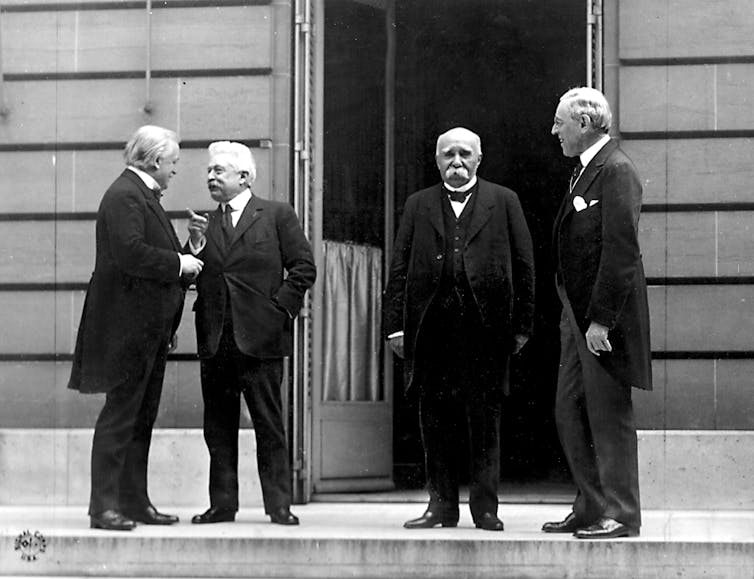
As for the first world war, that ended with an armistice on November 11 1918 following the collapse of the German armed forces. The peace treaty, the Treaty of Versailles, was later signed in 1919. The Germans were not invited to those negotiations and the terms of the treaty were imposed upon them. This led to the partition of Germany, the loss of its empire, its military reduced to a rump, and a reparations bill of 20 billion gold marks (£6.6 billion).

The 'Big Four' at the Versailles conference: Britain's David Lloyd George, Vittorio Orlando of Italy, Georges Clemenceau of France and US president Woodrow Wilson.
The ‘Big Four’ at the Versailles conference: Britain’s David Lloyd George, Vittorio Orlando of Italy, Georges Clemenceau of France and US president Woodrow Wilson.
Edward N. Jackson (US Army Signal Corps)

So, which major wars does Vance mean? Contrary to his pronouncements, clearly not the first or second world wars. If we look at the major wars a century prior, do we see what he is talking about?

The Napoleonic wars came to an end with coalition forces engaged in a full-scale invasion of France and entering Paris on March 30 1814. Napoleon abdicated on April 6 and was exiled to Elba. He escaped in 1815, returned to arms and was defeated at Waterloo. He was exiled again, even further away, to Saint Helena. Meanwhile after the French capitulation, a treaty was signed in Paris in November 1815, imposing a large fine, a foreign occupation and the loss of territory. So presumably Vance wasn’t referring to these conflicts.

Perhaps Vance was thinking of some of the rather smaller 19th-century wars which ended with, at least nominal, negotiated settlements.

Illustration showing French foreign minister, Jules Favre signing the Treaty of Frankfurt in 1871 as German chancellor Otto von Bismarck looks on.
Watched by German chancellor Otto von Bismarck, the French foreign minister, Jules Favre, puts his seal on the Treaty of Frankfurt.
Cliche Manuel priz chez Falise/Wikimedia Commons

The Crimean war ended with another Treaty of Paris in 1856 and involved Russia agreeing to the neutrality of the Black Sea and the loss of the territories it had captured from the Ottoman empire.

The Franco-Prussian war of 1870-71 ended with the Treaty of Frankfurt in 1871, which saw France lose territory in Alsace and Lorraine. Ultimately, these wars ended with negotiated capitulation.

Negotiation or capitulation?

“Negotiation” is what Vance says regarding Russia and Ukraine. But the administration he serves has already suggested that any negotiation will involve Ukraine giving up land. President Donald Trump came away from the recent summit in Alaska talking about Ukraine giving up its territory, despite the fact that territory is not something that can simply be negotiated away over the heads of the Ukrainian people. This all sounds rather more like Ukrainian “capitulation” rather than a “negotiation”.

A friend from the Ukrainian diaspora said to me recently: Ukraine will be “forced to erase itself to make Russia happy, and that has been happening for hundreds of years”. They, as she noted, have always refused. Contrary to Vladimir Putin or Vance’s plans, the Ukrainians have their own ideas about their national destiny.

Vance is wrong for another reason. Ukraine’s defeat would represent perhaps the greatest US foreign policy disaster since the Vietnam war. In 2025 the US still claims to be the world’s only true superpower; its support and weaponry has helped keep Russia from the gates of Kyiv without firing a shot or placing a single US soldier on the ground.

Russia, by contrast – long a rival for the superpower mantle – has endured multiple recent foreign policy setbacks. Not least of these is the failure to dismantle Ukraine, which was supposed to take a matter of days. But also, the collapse of its client regime in Syria and Israel’s humiliation of Iran, another longstanding ally.

Things do not need to be as they are. Trump and Vance could assist Ukraine securing the just peace its president, Volodymyr Zelensky, is calling for. They could allay European fears about Russia by making it clear to Putin that aggression will not be rewarded. But from everything they’ve said, this is not the path they want to take. Instead, while Vance misinterprets history, Ukraine continues to bleed.

The Conversation

Chris Smith does not work for, consult, own shares in or receive funding from any company or organisation that would benefit from this article, and has disclosed no relevant affiliations beyond their academic appointment.

ref. J.D. Vance is wrong about history – here’s why this matters for Ukraine – https://theconversation.com/j-d-vance-is-wrong-about-history-heres-why-this-matters-for-ukraine-263951

White mold fungi split their genome across several nuclei, with implications for future gene editing

Source: The Conversation – Canada – By Xin Li, Professor, Botany, University of British Columbia

A view of the mold _Sclerotinia sclerotiorum_ seen under a microscope. (Mushroom Observer/Wikimedia Commons), CC BY-SA

Genomes contain the complete library of information required to build and maintain a living organism — the figurative blueprints of life. In eukaryotes, genomes are stored in the nuclei, where they are organized into chromosomes. A eukaryote is an organism whose cells have a nucleus surrounded by a membrane: plants, animals, fungi and many microbes are eukaryotes.

The human genome, for example, is organized in 23 chromosomes, each containing a portion of the complete genetic code. Until recently, it has always been assumed that each nucleus contains at least a complete set of chromosomes, and thus the “one nucleus, one full genome” rule.

However, our research has revealed that in two species of fungi, their genomes can be split across multiple nuclei, with each nucleus receiving only part of the total chromosomes.

A surprising discovery

white mold growing on a plant
Sclerotinia sclerotiorum causes stem rot in plants.
(Rasbak/Wikimedia Commons), CC BY-SA

Our laboratory at the University of British Columbia studies the fungus Sclerotinia sclerotiorum, which is a soil-borne pathogen causing stem rot or white mold in various crop plants, including canola, soybean and sunflower.

Despite its impact on cash crops, S. sclerotiorum‘s genetics and cell biology are not well understood.

While trying to better understand the biology of this fungus, our laboratory made a startling discovery about the organization of S. sclerotiorum’s 16 chromosomes during cell division and reproduction.

Most eukaryotic cells are diploid, meaning the nucleus contains two copies of each different chromosome. In many fungi, such as baker’s yeast, reproduction begins with a parent diploid cell dividing to form haploid spore cells with one nucleus housing one copy of each chromosome.

However, S. sclerotiorum spores, known as ascospores, each contain two separate nuclei. Previously, it was assumed that each nucleus was haploid, containing the full suite of 16 chromosomes. This would mean that each ascospore contains a total of 32 chromosomes, similar to a diploid cell.

Using fluorescent microscopy, we were able to directly count the number of chromosomes present in a single ascospore. Remarkably, we consistently observed only 16 chromosomes per ascospore, in conflict with the 32 predicted by the current “one nucleus, one full genome” theory.

Additionally, we used fluorescent probes to label specific chromosomes, and found that the two nuclei in an ascospore contain distinct chromosomes. Ascospores contain one set of 16 chromosomes divided across two nuclei, rather than each nucleus containing a complete set of chromosomes.

An irregular manner

The next question we asked was whether the 16 chromosomes are randomly assorted between the two nuclei, or whether this genomic division follows a regular pattern.

To answer this, we separated individual nuclei and determined which chromosomes were present through polymerase chain reaction (PCR) analysis. We found that chromosome composition varies among nuclei, suggesting the division of chromosomes between nuclei is in an irregular manner.

Intrigued, we sought to investigate whether similar phenomenon occurs in other fungi. Botrytis cinerea is another species of plant pathogenic fungi in the same family as S. sclerotiorum.

B. cinerea produces conidial spores typically with four to six nuclei, rather than the two regularly observed in ascospores of S. sclerotiorum. Using similar methods, we found that the 18 chromosomes in the B. cinerea genome are similarly split across nuclei, with each nucleus generally carrying three to eight chromosomes.

This observation showed that haploid genome “splitting” across nuclei occurs in multiple plant pathogenic fungi. However, whether this phenomenon is wider spread across fungal families, or even other eukaryotes, requires further study.

An unknown mechanism

The observation that the S. sclerotiorum and B. cinerea haploid genomes are divided across nuclei raises questions about how this separation plays a role in the rest of the fungal life cycle.

In order to produce the next generation, these fungi need to reform a diploid cell with the full suite of chromosomes, from which new ascospores can be produced. Presumably, this requires the fusion of nuclei with complementary chromosomes to reunite the genome. So how do these fungi ensure that the correct nuclei fuse?

Perhaps the simplest explanation would be one of viability selection: nuclei may fuse randomly, but only those with a complete genome would produce viable ascospores. This seems inefficient, and a more attractive scenario would involve some structure or mechanism to keep complementary nuclei together after the initial division, allowing them to easily reassemble later in the fungal life cycle.

We hope our future work will provide answers to these fascinating questions, and help broaden our understanding of the fundamental dynamics of nuclei and their genomes. This improved understanding will enable dramatic revolutions in gene editing, allowing researchers to manipulate chromosomes and nuclei at will.

The Conversation

Xin Li receives funding from the Natural Sciences and Engineering Research Council of Canada.

Edan Jackson receives funding from Natural Sciences and Engineering Research Council of Canada.

Josh Li receives funding from Natural Sciences and Engineering Research Council of Canada.

ref. White mold fungi split their genome across several nuclei, with implications for future gene editing – https://theconversation.com/white-mold-fungi-split-their-genome-across-several-nuclei-with-implications-for-future-gene-editing-260699

Talking about sex isn’t always easy for teachers in South Africa. Here’s what they told us

Source: The Conversation – Africa – By Vhothusa Edward Matahela, Associate Professor: Health Sciences Education, University of South Africa

Young people in rural Limpopo, the South African province bordering Botswana, Zimbabwe and Mozambique, face high risks of HIV, unplanned pregnancy, and other societal challenges.

One reason is that they aren’t always getting sexuality education that connects with their lived realities. Schools provide lessons on reproduction, HIV prevention and relationships. But too often, what’s taught in class doesn’t match what learners are experiencing outside, leading
to unsafe sexual practices.

We are part of the University of South Africa community engagement project focusing on HIV prevention among learners in Limpopo province. To understand the gaps, we ran a three-day workshop with 19 teachers (16 of them women) from rural schools near Musina. This border town is on a busy trade route, where high mobility, transactional sex and the risk of trafficking shape the everyday lives of learners.

Our goal was to hear directly from teachers about how they navigate sexuality education and to explore ways to make it more effective.

Talking about sex at school

The 19 teachers came from eight public primary and secondary schools. They all taught the Life Orientation curriculum, a mandatory subject in South African schools, which covers life skills, sexuality education and HIV prevention for learners from grades 4 to 12 (ages 9 to 18). It
covers topics such as health and well-being, including sexuality education. Teachers are expected to deliver these lessons in an age-appropriate, participatory way.

Teachers told us they often struggle with this part of the curriculum. Talking about sex in the classroom is not straightforward. Some learners giggle, others stay silent, and some challenge the teacher’s authority. Teachers admitted that their own discomfort, shaped by cultural and religious beliefs, sometimes made it even harder to engage openly.

What the teachers said

During the workshop, teachers spoke candidly about the barriers they face.

  • Cultural and religious taboos: Many communities expect adults, especially women, not to discuss sex openly. Teachers worried about being judged by parents or community leaders if they spoke too frankly with learners. They are held back by cultural taboos, personal discomfort, and local realities – like families depending on relationships between girls and older men.

Traditional beliefs and stigma surrounding HIV in Limpopo make it hard for teachers, parents, and learners to talk openly
about prevention. Educators teaching Life Orientation are sometimes
referred to as thitshere wa u funza zwavhudzimu – “the teacher who teaches forbidden topics”. This silence allows myths and misunderstandings to persist.


Read more:
Let’s talk about sex education: race and shame in South Africa


  • Limited training and resource constraints: Teachers said they had not received
    sufficient preparation for teaching sexuality education. Some relied only on textbooks, which they felt did not address the realities learners face, such as early sexual debut, peer pressure, or access to social media.

Teachers often feel alone. Some said they had not received enough training or materials to teach about HIV, sexual health, or sensitive issues. Sexuality is still seen as a private matter in this cultural context.

When we were brought up, it was taboo to talk about sexuality with kids. Some
parents think we’re teaching forbidden things.

Some teachers have over 60 learners in a class, making it hard to give everyone attention. And, with learners speaking
different languages, some important messages get lost.

Videos, posters and teaching aids are rare. Teachers have to rely mostly on talking, which does not always work for difficult topics such as sexuality.

Despite these challenges, teachers also shared how they try to adapt. Some use storytelling, role play, or small group discussions to make learners more comfortable. Others bring in health professionals to talk about sensitive topics. These approaches, despite the challenges, can make lessons more engaging while respecting local norms and working with limited resources.

What teachers can do differently

During our workshops, teachers discussed what they believed would be effective ways to deliver culturally relevant sexuality education in rural schools.

1.) Small group discussions: Teachers felt that learners are more comfortable sharing in small groups.

Learners open up more and learn from each other.

2.) Drama and role play: They suggested that acting out real-life situations, such as handling peer pressure or supporting a friend with HIV, could make lessons more real and memorable.


Read more:
We used performing arts to map out gender violence in Sierra Leone. What we found


3.) Using videos: Short, simple videos made by the experts about HIV and relationships would help explain tough topics.


Read more:
Social media for sex education: South African teens explain how it would help them


4.) Demonstrations: They saw value in showing, not just telling, how to use condoms (male and female), for example, to build practical skills.

5.) Storytelling and case studies: Teachers believed that sharing stories, whether true or made up, would help learners connect lessons to their own lives.

Children remember stories better. They see themselves or their families in them.

6.) Peer teaching and games: They recommended letting learners or other teachers lead parts of the lesson, and using local games and songs to keep things fun and engaging.

These suggestions by the teachers match approaches used in successful sexuality
education programmes in South Africa and beyond.

Overall, the teachers’ ideas reflect proven strategies from other successful programmes and could be highly effective if adapted for rural Limpopo.

What teachers need

The Department of Basic Education reports that Life Orientation teachers receive sexuality education content during initial teacher training. The department has also developed scripted lesson plans to improve teacher confidence and curriculum consistency. In-service training is offered sporadically through
workshops linked to the Life Skills and HIV/AIDS Education Programme, but these sessions are not consistently available across all provinces, creating gaps in teacher preparedness.

Studies highlight that many Life Orientation teachers still feel under-prepared, especially when dealing with learners’ trauma or sexual violence. Many teachers rely on self-study, peer networks, and NGO-supported
programmes to strengthen their skills in sexuality education.


Read more:
Why sexuality education in schools needs a major overhaul


The teachers we spoke to wanted to know more about HIV, sexual health and new treatments. They needed to know how to support children who might not fit traditional gender roles. They asked for training in how to counsel and support learners facing problems. And they called for support from other teachers, principals, and the community.

Workshops like ours can help teachers build confidence, share strategies, and support each other. The teachers told us they valued the space to reflect on their own beliefs and to practise new approaches.

What’s clear is that teachers cannot carry the burden alone. Training programmes must equip them with practical tools, not just theory. Parents, community leaders and health workers need to be engaged too, so that sexuality education is reinforced beyond the classroom.

We’ll also be tracking how these methods affect learners’ knowledge, attitudes
and behaviour over time.

The Conversation

The authors do not work for, consult, own shares in or receive funding from any company or organisation that would benefit from this article, and have disclosed no relevant affiliations beyond their academic appointment.

ref. Talking about sex isn’t always easy for teachers in South Africa. Here’s what they told us – https://theconversation.com/talking-about-sex-isnt-always-easy-for-teachers-in-south-africa-heres-what-they-told-us-260462

World maps get Africa’s size wrong: cartographers explain why fixing it matters

Source: The Conversation – Africa (2) – By Jack Swab, Assistant Professor Department of Geography & Sustainability, University of Tennessee

The African Union has endorsed the #CorrectTheMap Campaign, a call for the United Nations and the wider global community to use a different kind of world map. The campaign currently has over 4,500 signatures.

The map most commonly used is called the Mercator projection. Map projections are how cartographers (map makers) “flatten” the three-dimensional Earth into a two-dimensional map.

The Mercator projection was created over 450 years ago, designed for colonial exploration and maritime trade. But, over the centuries, it has become an “all purpose” projection for many governments, educators and companies.

That flat drawing inflates the size of countries closer to the North or South Pole. It exaggerates the area of North America and Eurasia while under-representing the size of much of South America and Africa. As the largest continent in the global south, Africa is a victim of this cartographic inequity.

The #CorrectTheMap campaign calls for a move to the Equal Earth map projection, developed in 2018 by an international team of cartographers. It addresses the distortions found in the Mercator projection.

Controversies over map projections are not new. Since the 1970s cartographers have discussed how certain projections distort how the Earth looks and how people imagine their place in that world.

At the heart of the debates about maps are tensions about what sort of power maps have in the world.

A change in map projections, for the African Union, is about more than correcting a technical flaw. It’s also a chance to influence how current and future map users view, talk about and value Africa.

The call is a demand for Africans to be represented on their own terms, rather than through cartographic traditions that have long diminished their scale and significance.

As cartographers, we pay attention to the social and communicative power of maps.

Given that maps help shape how we make sense of the world, the simplest decisions that go into crafting a map can have major geopolitical consequences.

Maps are not neutral

There are over 200 major projections of the world map. Each one warps the image of the Earth in different ways, making the choice of projection a consequential and complicated decision rather than a neutral one.

For example the Dymaxion projection, developed by the American engineer Buckminster Fuller, was designed to challenge ideas of the north and the south. Others, like the Lambert conformal conic projection, are used extensively in aviation to aid in flight planning.

Maps are a form of storytelling, as well as an information source. Even the lines, colours, symbols and size of regions depicted on maps communicate social meaning. They subtly but powerfully educate people, from schoolchildren to world leaders, about who and what matters.

US president Donald Trump’s recent interest in the US buying Greenland, citing its large size, was likely influenced by map distortion. The Mercator projection shows Greenland as nearly the same size as Africa, when in reality Africa is about 14 times larger.

Other projections do a better job at more accurately representing the true size of continents. Some projections are better than others for this specific task; for example the Gall-Peters projection has been used in the past as an alternative to the Mercator projection.

Cartography as a tool of control

Cartography has been a powerful tool of control throughout Africa’s history. Topographers and surveyors participated in the European conquest and colonisation of Africa, regularly accompanying military expeditions. Map-makers in Europe framed Africa as a landscape to be exploited by populating maps with trade routes, resources and blank spaces ready for development – all while often ignoring the mapping traditions and geographic knowledge of indigenous Africans.

The Berlin Conference of 1885, where European powers assembled with no African representation, was one of the pinnacles of this cartographic and colonial grab and partitioning of the continent.

The Mercator projection is joined by other kinds of western storytelling – found across popular culture, the news and diplomatic circles – that have stereotyped, degraded and undersized Africa’s place in the world.

Viewed in this light, the public reckoning over the Mercator projection can be interpreted as not just about the visual accuracy of a map, also the restoration of dignity and autonomy.

Why changing the world map is difficult

Bringing about changes won’t be easy.

Firstly, global map production is not governed by a single authority. Even if the United Nations were to adopt the Equal Earth projection, world maps could still be drawn in other projections. Cartographers are frequently commissioned to update world maps to reflect changes to names and borders. But the changes don’t always find quick acceptance. For example, cartographers changed English-language world maps after the Czech Republic adopted the name “Czechia” as its English name in 2016. While making the change was not difficult, broader acceptance has been harder to achieve.

A person’s mental image of the world is solidified at a young age. The effects of a shift to the Equal Earth projection may take years to materialise. Previous efforts to move away from Mercator projection, such as by Boston Public Schools in 2017, upset cartographers and parents alike.

Given the African Union’s larger goals, supporting the Equal Earth projection is the first step in pushing the global community to see the world more fairly and reframing how the world values Africa. Mobilising social support for the new projection through workshops with educators, diplomatic advocacy, forums with textbook publishers, journalists, and Africa’s corporate partners could help move the world away from the Mercator projection for everyday use.

Shifting to the Equal Earth projection alone will not undo centuries of distorted representations or guarantee more equitable global relations. But it’s a step towards restoring Africa’s rightful visibility on the world stage.

The Conversation

The authors do not work for, consult, own shares in or receive funding from any company or organisation that would benefit from this article, and have disclosed no relevant affiliations beyond their academic appointment.

ref. World maps get Africa’s size wrong: cartographers explain why fixing it matters – https://theconversation.com/world-maps-get-africas-size-wrong-cartographers-explain-why-fixing-it-matters-263833

Déléguer la lecture à l’IA : quels savoirs et plaisirs sacrifions-nous ?

Source: The Conversation – in French – By Naomi S. Baron, Professor Emerita of Linguistics, American University

Des solutions pour éviter de lire un livre de la première à la dernière page existent depuis des décennies, mais l’IA générative les porte à de nouveaux sommets. dem10/E+ via Getty Images

Depuis plusieurs décennies, le temps consacré à la lecture diminue. L’arrivée de l’intelligence artificielle, capable de « lire » et de synthétiser des livres ou des articles en quelques secondes, accentue cette tendance. Si ces outils séduisent par leur efficacité, ils soulèvent une question cruciale : que perdons-nous quand nous laissons la machine lire à notre place ?


Une tempête se lève sur la lecture. Lorsque l’intelligence artificielle (IA) a commencé à se diffuser, on observait déjà, chez les enfants comme chez les adultes, un recul du temps consacré à la lecture par rapport aux décennies précédentes.

Comme linguiste, j’étudie la façon dont la technologie influence les manières de lire, d’écrire et de penser des individus. Cela inclut l’influence de l’IA, qui transforme en profondeur notre rapport aux livres et aux différents types d’écrits, qu’ils soient prescrits dans un cadre scolaire, mobilisés pour la recherche ou choisis pour le plaisir de lire.

Je crains que l’IA ne précipite l’évolution, déjà en cours, de la place que les gens accordent à la lecture comme activité propre à l’humain.

Tout sauf un livre ?

Les compétences rédactionnelles de l’IA ont déjà fait couler beaucoup d’encre. Les chercheurs et les enseignants commencent seulement à s’intéresser de près à la capacité de l’IA à lire d’énormes ensembles de données, puis à produire des résumés, des analyses ou des comparaisons raisonnées d’ouvrages, d’essais et d’articles.

Aujourd’hui, un étudiant à qui l’on demande de lire un roman peut se contenter d’un résumé généré par l’IA, présentant l’intrigue et les principaux thèmes. Une telle alternative, qui tend à réduire la motivation à lire soi-même, m’a conduit à écrire un ouvrage sur les avantages et les limites d’une délégation de la lecture à l’IA.

Se décharger voire se défausser de la tâche de résumer ou d’analyser des textes n’a rien de nouveau. CliffsNotes (petits guides états-uniens pour étudiants, proposant des fiches de lecture, des résumés de l’intrigue et des analyses des personnages et du style) existe depuis la fin des années 1950. Des siècles plus tôt, la Royal Society of London a commencé à produire des résumés d’articles scientifiques publiés dans son volumineux ouvrage, Philosophical Transactions. Au milieu du XXe siècle, les résumés sont devenus la norme dans les articles scientifiques. Les lecteurs potentiels pouvaient désormais parcourir le résumé avant de décider de lire l’article dans son intégralité.

Des possibilités inédites de contournement

Internet a multiplié les moyens de contourner la lecture traditionnelle. Blinkist, par exemple, est une application qui propose principalement des résumés de livres de non-fiction d’environ quinze minutes – appelés des blinks – disponibles en format texte et audio.

L’IA générative porte ces solutions de contournement à un niveau inédit. BooksAI est une plateforme qui utilise l’IA pour générer des résumés de livres et offrir des recommandations personnalisées. Parallèlement, BookAI permet aux utilisateurs de discuter avec n’importe quel livre, simplement à partir de son titre et du nom de son auteur — aucune version numérique du livre n’est nécessaire. Nul besoin là encore, de lire vous-même les livres.

Pour un étudiant chargé de procéder à une analyse comparative de romans d’apprentissage, tels que les Aventures de Huckleberry Finn, de Mark Twain, et l’Attrape-cœurs, de J. D. Salinger, les CliffsNotes s’avèrent d’une utilité limitée. Ils fournissent bien des résumés synthétiques, mais le travail effectif de la comparaison revient à l’étudiant.

Or, grâce à de grands modèles de langage (LLM) ou à des outils spécialisés, tels que Google NotebookLM, l’IA se charge à la fois de la lecture et de la comparaison. Et elle génère même des questions intelligentes à poser en classe.

L’inconvénient tient au fait que l’on se prive d’un bénéfice fondamental de la lecture d’un roman initiatique : l’opportunité de développer sa réflexion personnelle en s’appropriant, par procuration, les épreuves vécues par le protagoniste.

Dans le monde de la recherche universitaire, des offres d’IA telles que SciSpace, Elicit et Consensus combinent la puissance des moteurs de recherche et des grands modèles linguistiques. Elles localisent les articles pertinents, puis les résument et les synthétisent, réduisant ainsi considérablement le temps nécessaire à la réalisation de bibliographies. Sur son site web, Elsevier’s ScienceDirect AI se réjouit :

« Adieu le temps perdu à lire. Bonjour la pertinence. »

Peut-être. Mais ce processus ne permet pas de se faire une opinion à soi ni d’aiguiser son esprit critique.

Bien avant que l’IA générative se répande, on constatait déjà un recul de la lecture de livres, aussi bien à des fins de loisir que d’apprentissage.

État des lieux de la lecture

Aux États-Unis, l’évaluation nationale des progrès scolaires (National Assessment of Educational Progress) a révélé que le nombre d’élèves de CM 1 (ce qui correspond à la 4e année aux États-Unis) – qui lisent pour le plaisir de façon quasi quotidienne est passé de 53 % en 1984 à 39 % en 2022. Et qu’en est-il pour les élèves de 4ᵉ au collège (la 8e année aux États-Unis) ? Le pourcentage a chuté de 35 % en 1984 à 14 % en 2023. L’enquête 2024 du National Literacy Trust au Royaume-Uni montre que seul un enfant de 8 ans à 18 ans sur trois déclare aimer lire pendant son temps libre, soit une baisse de près de 9 points de pourcentage par rapport à l’année précédente.

Des tendances similaires existent chez les élèves plus âgés. Dans une enquête menée en 2018 auprès de 600 000 jeunes de 15 ans dans 79 pays, 49 % ont déclaré ne lire que lorsqu’ils y étaient obligés. Ils étaient 36 % environ dix ans plus tôt.

La situation n’est guère plus réjouissante chez les étudiants. Une série d’articles récents a fait état du peu de temps consacré à la lecture dans l’enseignement supérieur américain. Mon travail avec la chercheuse en alphabétisation Anne Mangen montre que les enseignants donnent souvent moins de textes à lire à leurs élèves ou étudiants qu’avant, tout simplement parce que ces derniers ne les lisent pas.

Cette anecdote du journaliste du New York Times David Brooks illustre le cœur du problème :

« Le jour de remise de diplôme dans une université prestigieuse, j’ai demandé à un groupe d’étudiants quel livre avait changé leur vie au cours des quatre dernières années. Il y eut un long silence gêné. Finalement, un étudiant a répondu : “Vous devez comprendre, nous ne lisons pas comme ça. Nous ne lisons que quelques pages de chaque livre pour réussir les examens.”. »

Passons aux adultes… Selon YouGov, seuls 54 % des Américains ont lu au moins un livre en 2023. La situation est encore plus sombre en Corée du Sud, où seulement 43 % des adultes ont déclaré avoir lu au moins un livre en 2023, contre près de 87 % en 1994. Au Royaume-Uni, The Reading Agency a observé une baisse de la lecture chez les adultes et a donné une piste pour l’expliquer. En 2024, 35 % des adultes se sont déclarés « lecteurs occasionnels » : alors qu’ils lisaient régulièrement auparavant, ils ne le font plus. Parmi eux, 26 % ont indiqué avoir arrêté de lire en raison du temps passé sur les réseaux sociaux.

Le terme « lecteur occasionnel » pourrait désormais s’appliquer à toute personne qui ne donne plus la priorité à la lecture, que ce soit par manque d’intérêt, parce qu’elle consacre plus de temps aux réseaux sociaux ou parce qu’elle laisse l’IA lire à sa place.

Tout ce qui est perdu, manquant et oublié

Pourquoi lire ? Pour une infinité de raisons.

Pour le plaisir de lire tout simplement ou parce que la lecture a un effet bénéfique sur le stress, nous permet d’élargir nos connaissances ou d’apprendre à mieux nous connaître nous-mêmes.

Il a été établi qu’il existe des corrélations entre la lecture et le développement cérébral chez les enfants, mais aussi le bonheur, la longévité et le ralentissement du déclin cognitif.

La question du déclin cognitif revêt une pertinence particulière à une époque où les individus délèguent de plus en plus de tâches cognitives à l’IA, un phénomène qualifié de décharge cognitive. Des recherches ont montré que ce phénomène est en augmentation et qu’il n’est pas sans effet : les personnes qui comptent sur l’IA pour faire leur travail ont l’impression de moins réfléchir.

Une étude utilisant des mesures EEG (électroencéphalogramme qui permet de mesurer et d’enregistrer l’activité électrique du cerveau) a révélé des schémas de connectivité cérébrale différents lorsque les participants faisaient appel à l’IA pour les aider à rédiger un essai et lorsqu’ils le rédigeaient seuls.

Il reste prématuré de mesurer les effets à long terme de l’IA sur notre capacité à penser par nous-mêmes. Jusqu’ici, les recherches se sont surtout intéressées aux tâches d’écriture ou à l’usage global des outils d’IA, plutôt qu’à la lecture elle-même. Or, si nous perdons l’habitude de lire, d’analyser et de construire nos propres raisonnements, ces aptitudes risquent de s’éroder.

Ce ne sont pas seulement nos capacités cognitives qui s’appauvrissent lorsque nous laissons l’IA lire à notre place. Nous nous privons aussi de l’essence même du plaisir de lire : l’émotion d’un dialogue, la beauté d’une phrase, l’attachement à un personnage.

L’efficacité offerte par l’IA est séduisante. Mais elle risque de compromettre les avantages de la littératie, notre aptitude à lire, comprendre et utiliser l’information écrite dans notre vie quotidienne.

The Conversation

Naomi S. Baron ne travaille pas, ne conseille pas, ne possède pas de parts, ne reçoit pas de fonds d’une organisation qui pourrait tirer profit de cet article, et n’a déclaré aucune autre affiliation que son organisme de recherche.

ref. Déléguer la lecture à l’IA : quels savoirs et plaisirs sacrifions-nous ? – https://theconversation.com/deleguer-la-lecture-a-lia-quels-savoirs-et-plaisirs-sacrifions-nous-263282

Assemblées citoyennes sur le climat : un bilan mitigé pour les jeunes militants

Source: The Conversation – in French – By Yanina Welp, Researchear, Political Science, Graduate Institute – Institut de hautes études internationales et du développement (IHEID)

Les jeunes, majoritaires dans les luttes écologiques, se désengagent peu à peu des formes traditionnelles d’action politique et se tournent de plus en plus vers des options alternatives antisystème. Face à ce constat, et sur le modèle de la convention citoyenne pour le climat annoncée par Emmanuel Macron en 2019, les assemblées citoyennes sur le climat souhaitent inclure les jeunes dans des initiatives institutionnelles. Cet article repose sur une étude de l’activité de ces assemblées dans quatre villes (Bologne, Paris, Barcelone et Genève) entre 2020 et 2021.


Depuis les grèves pour le climat de 2019, la vague de mobilisations environnementales menées par des jeunes en France et à travers toute la planète a été exceptionnelle par son ampleur et sa durée. Toutefois, s’ils envahissaient hier les rues du monde entier, aujourd’hui ces jeunes militants pour le climat se désengagent toujours davantage de la politique traditionnelle. Dans le même temps, le taux de participation électorale des jeunes continue de baisser dans les démocraties occidentales, et leur méfiance à l’égard des partis politiques ne cesse de croître.

Dans ce contexte, et au sein de sociétés pluralistes, les villes sont devenues des arènes cruciales pour répondre aux demandes des citoyens. L’une des réponses institutionnelles les plus visibles à ces pressions a été la montée en puissance des assemblées citoyennes sur le climat (ACC) – des forums délibératifs où des habitants sélectionnés au hasard sont invités à cocréer des politiques ad hoc. Celles-ci sont souvent présentées comme un remède à la désillusion démocratique, en particulier chez les jeunes engagés dans la lutte contre le changement climatique. Mais fonctionnent-elles réellement comme prévu ?

Une fenêtre d’opportunité pour la démocratie

Le cadre théorique de l’économiste Albert O. Hirschman (1915-2012), intitulé « Exit, Voice and Loyalty », traduit en français comme « Défection et prise de parole », permet d’explorer la façon dont les manifestations climatiques menées par les jeunes peuvent ouvrir des « fenêtres d’opportunité » démocratiques.

Dans cette approche fondée sur trois dimensions de l’engagement citoyen, la protestation est considérée comme une forme de « prise de parole » (« Voice »), qui pousse les institutions à réagir, symboliquement et concrètement, par le biais d’innovations démocratiques telles que les ACC. Celles-ci offrent des lieux formels de délibération, susceptibles de renforcer la « loyauté » (« Loyalty ») envers les systèmes démocratiques. Toutefois, lorsque les réponses institutionnelles sont perçues comme insuffisantes ou uniquement symboliques, les jeunes militants peuvent opter pour la « défection » (« Exit ») – un phénomène qui s’exprime par le désengagement électoral, l’apathie ou le soutien à des alternatives anti-système.

En ce sens, la perception de la réponse institutionnelle joue un rôle clé : si les jeunes considèrent que les résultats de leur mobilisation sont significatifs, leur loyauté peut s’accroître. Dans le cas contraire, la confiance dans la démocratie peut s’éroder.

Leçons tirées de l’examen d’assemblées citoyennes pour le climat dans quatre villes européennes

Entre 2021 et 2023, nous avons étudié l’engagement des jeunes en faveur du climat dans quatre villes européennes – Barcelone, Bologne, Paris et Genève – en examinant la manière dont les jeunes militants passaient de la protestation à la participation institutionnelle. Chaque ville offrait un contexte civique spécifique : la démocratie directe de Genève, l’activisme impulsé par les mouvements sociaux à Bologne, les réformes participatives à Barcelone et la culture contestataire à Paris.

Ces quatre villes ont accueilli d’importantes mobilisations pour le climat et ont expérimenté les ACC, offrant ainsi un terrain fertile pour évaluer leur rôle dans l’engagement démocratique. Nous nous sommes concentrées sur deux mouvements transnationaux : Fridays for Future et Extinction Rebellion.

À travers 71 entretiens, trois ateliers et de nombreuses observations sur le terrain, nous avons exploré la manière dont les jeunes militants percevaient les ACC : répondaient-elles à leurs attentes ? Avaient-ils participé à leur élaboration ? Se sentaient-ils écoutés ? Nous avons également recueilli les points de vue de représentants publics et analysé les résultats concrets et formels des ACC.

Démobilisation, désobéissance civile et loyauté : le contexte compte, les procédures aussi

Nos recherches ont révélé des frontières floues entre protestation et participation, ainsi que des sentiments mitigés quant à l’inclusivité et à l’impact des ACC.

À Barcelone, l’enthousiasme initial suscité par des mouvements tels que Fridays for Future a laissé place à la méfiance et à la démobilisation. Malgré les efforts des autorités locales, les ACC ont été jugées inefficaces, ne répondant pas aux attentes en matière d’influence réelle. Les jeunes militants ont préféré les manifestations de rue à l’engagement institutionnel, percevant les assemblées comme déconnectées et symboliques, ce qui a conduit à une démobilisation générale et à une réorientation vers des actions très locales et spécifiques pour quelques militants.

À Bologne, les militants, en particulier ceux d’Extinction Rebellion, ont réussi à influencer la conception d’une ACC, ce qui a conduit à l’élaboration conjointe de règles et à un processus participatif. Celui-ci a donné un rôle actif aux mouvements environnementaux à Bologne, et a ainsi répondu à leurs attentes dans cette phase. Toutefois, bien qu’un tiers des propositions de l’assemblée aient été pleinement adoptées, la communication limitée autour des travaux de l’assemblée et le processus de mise en œuvre, complexe et long, ont affaibli la perception de son impact. Les personnes que nous avons interrogées ont insisté sur le fait que l’administration municipale devrait être beaucoup plus active en matière d’information des citoyens et d’approfondissement de sa capacité de communication sur l’existence d’espaces de participation tels que l’Assemblée.

Genève a apporté une réponse institutionnelle forte à travers un forum inclusif et intergénérationnel, le « Forum Citoyen », qui a généré plus de 100 propositions, dont certaines ont été mises en œuvre. Les jeunes militants ont salué cette approche, mais ont réclamé un changement systémique plus profond et une plus grande influence dans les espaces de décision. Pour reprendre la typologie hirschmanienne, le cas de Genève peut être considéré comme se situant entre « prise de parole » et « loyauté » : au lieu de faire défection ou de s’écarter des structures démocratiques, les jeunes militants pour le climat cherchent à ancrer leur message au sein de celles-ci. Ils plaident notamment pour une plus grande participation des jeunes à la prise de décision et à l’élaboration des politiques, estimant que cela est essentiel pour maximiser l’efficacité des outils tels que les ACC dans la réponse aux revendications des jeunes en matière de climat sur le terrain.

À Paris, le mouvement a abouti à l’adoption d’un projet de loi rédigé par des citoyens. La Convention citoyenne, pensée à l’origine comme une réponse à la crise des gilets jaunes plutôt qu’aux mobilisations climatiques, a laissé de nombreux militants déçus, plusieurs de ses propositions ambitieuses ayant été édulcorées ou abandonnées. Beaucoup de jeunes se sont alors tournés vers la désobéissance civile, dénonçant la lenteur des réformes, l’usage des consultations pour canaliser plutôt que transformer, et un rétrécissement de l’espace civique marqué par des restrictions et poursuites accrues.

Ils soulignent aussi un décalage entre les moyens d’action de la ville de Paris, compétente sur la mobilité, l’aménagement ou l’énergie locale, et le rôle décisif du gouvernement national, ce qui renforce leur sentiment d’impuissance. La décision du mouvement Youth for Climate de passer d’une forme de mobilisation fondée sur la protestation à la désobéissance civile en 2022 reflète cette situation, tout comme la perception des jeunes militants selon laquelle la répression policière à l’égard du militantisme s’est intensifiée ces dernières années au niveau national.

La mobilisation en France restant forte, il est difficile de déterminer s’il s’agit d’une tendance à la « défection » ou si la désobéissance civile peut être comprise comme une forme de « prise de parole ». La désobéissance n’était pas considérée comme antidémocratique par les jeunes militants : au contraire, ils sont nombreux à avoir déclaré dans les entretiens qu’ils souhaitaient sensibiliser leurs concitoyens et de faire évoluer l’opinion publique sur le climat par leurs actions, afin d’influencer le résultat des élections.

Les assemblées citoyennes peuvent-elles canaliser l’énergie des jeunes mobilisés ?

Les inquiétudes généralisées quant à l’avenir influencent les priorités, les actions et les aspirations des citoyens, les jeunes étant les plus durement touchés par ces défis. En rejoignant les mouvements pour le climat, les jeunes citoyens expriment leur anxiété et leur appel urgent à l’action. Ce sentiment d’urgence influence inévitablement la manière dont ils perçoivent la réponse apportée par les institutions. Dans cette perspective, les quatre ACC analysées ici ont été accueillies de manière plutôt critique par les jeunes militants pour le climat, car elles n’ont que très partiellement répondu à leur demande d’une voix plus audible dans les espaces démocratiques formels.

La prise de conscience des possibilités offertes par les instruments de la démocratie délibérative a également façonné les attentes. Dans un contexte où des formes de démocratie semi-directe sont bien établies, le Forum citoyen de Genève a suscité des perceptions plus positives parmi les personnes interrogées que les initiatives mises en œuvre dans les trois autres villes.

Il y était considéré comme l’un des nombreux instruments de consultation. Les personnes interrogées dans nos études de cas ne perçoivent qu’un impact faible, parfois même minime ou inexistant, des ACC sur les résultats politiques effectifs dans leurs villes. Elles considèrent donc les ACC comme des mécanismes générant une influence politique limitée. Comme on le voit à Barcelone, le décalage entre les réponses institutionnelles et les attentes des militants peut conduire à la méfiance, à la démobilisation, voire au désengagement. En ce sens, la possibilité de s’exprimer peut conduire au renouveau des espaces démocratiques, mais aussi à la désaffection par rapport au système.

Nos conclusions suggèrent que si les ACC peuvent être un outil d’inclusion, leur impact sur la participation à long terme des jeunes dépend de leur capacité à s’intégrer dans les structures institutionnelles et les cultures politiques existantes. La conception des politiques devrait tenir compte non seulement des aspects procéduraux des ACC, mais aussi de leur capacité à générer la confiance, à assurer la continuité et à relier la démocratie délibérative aux processus décisionnels. Ces éléments sont essentiels pour concevoir des politiques qui intègrent efficacement la participation des jeunes et répondent à leurs attentes.

Dans cette perspective, pour tenir leurs promesses, les mini-publics tels que les ACC devraient être présentés et communiqués comme le point de départ d’un processus d’engagement plus long et plus large. Ils doivent être suivis et complétés par des actions tant à l’intérieur qu’à l’extérieur des espaces démocratiques formels. Cela est essentiel pour que leurs résultats soient perçus et efficaces, non seulement par les jeunes militants, mais aussi, plus largement, par l’ensemble des citoyens.

The Conversation

Yanina Welp a reçu un financement de la Fondation Salvia pour les projets “Protest and Engagement, from the Global to the Local: Mapping the Forms of Youth Participation in Europe” et “Youth Climate Activism and Local Institutions: Reframing Democratic Spaces at a Time of Polarisation”.

Christine Lutringer a reçu un financement de la Fondation Salvia pour les projets “Protest and Engagement, from the Global to the Local: Mapping the Forms of Youth Participation in Europe” et “Youth Climate Activism and Local Institutions: Reframing Democratic Spaces at a Time of Polarisation”.

Laura Bullon-Cassis a reçu un financement de la Fondation Salvia pour les projets “Protest and Engagement, from the Global to the Local: Mapping the Forms of Youth Participation in Europe” et “Youth Climate Activism and Local Institutions: Reframing Democratic Spaces at a Time of Polarisation”.

Maria Mexi a reçu un financement de la Fondation Salvia pour les projets “Protest and Engagement, from the Global to the Local: Mapping the Forms of Youth Participation in Europe” et “Youth Climate Activism and Local Institutions: Reframing Democratic Spaces at a Time of Polarisation”

ref. Assemblées citoyennes sur le climat : un bilan mitigé pour les jeunes militants – https://theconversation.com/assemblees-citoyennes-sur-le-climat-un-bilan-mitige-pour-les-jeunes-militants-261797