Les ultrasons en psychiatrie : pour mieux diagnostiquer et pour traiter, demain, les troubles en santé mentale

Source: The Conversation – in French – By Jean-Michel Escoffre, Chargé de Recherche – Inserm, Inserm

En psychiatrie, les travaux de recherche se multiplient pour évaluer l’intérêt des ultrasons afin d’améliorer le diagnostic comme la prise en charge de la dépression, des troubles obsessionnels compulsifs et d’autres pathologies en santé mentale. Les ultrasons présentent l’avantage de permettre une exploration et un traitement des aires du cerveau de manière non invasive.


Les ultrasons, ou ondes ultrasonores, sont des ondes mécaniques (comme le son qui est composé d’ondes sonores) qui engendrent des oscillations dans les milieux qu’elles traversent. Ces ondes ultrasonores peuvent être exploitées à des fins médicales.

En effet, les ultrasons sont une technologie non invasive très largement exploitée en médecine pour le diagnostic et le traitement de nombreuses pathologies. Leur potentielle application en psychiatrie est un sujet de recherche émergent qui ouvre de nouvelles perspectives pour la prise en charge des maladies psychiatriques.

Bien que les ultrasons soient principalement associés à l’imagerie biomédicale, leur utilisation en psychiatrie, comme modalité d’exploration fonctionnelle du cerveau ou comme technique de neuromodulation cérébrale, est de plus en plus explorée.

Cette révolution technologique promet de transformer radicalement le diagnostic et le traitement des troubles psychiatriques en proposant des solutions plus ciblées et moins invasives.

Portabilité, non invasivité et coûts limités des ultrasons

Le développement de marqueurs objectifs, pour le diagnostic et le pronostic des maladies psychiatriques, tels que les troubles bipolaires, la schizophrénie, la dépression, l’autisme, etc., est l’un des défis majeurs en psychiatrie.


À lire aussi :
Santé mentale : attention à l’effet de mode et à la banalisation


À ce jour, l’essentiel du diagnostic de ces troubles repose sur des critères cliniques et comportementaux. L’imagerie cérébrale conventionnelle, comme l’imagerie de résonance magnétique (IRM) et la tomographie par émission de positons, permet de visualiser les structures cérébrales impliquées dans ces troubles et leur métabolisme. Cependant, ces modalités d’imagerie médicale demeurent coûteuses et fréquemment limitées en termes de disponibilité et d’accessibilité.

En revanche, les ultrasons présentent des avantages uniques pour le diagnostic des maladies psychiatriques, notamment du fait de leur portabilité (diagnostic au lit du patient ou à domicile), de leur non invasivité et de leur coût. Ainsi, grâce à des techniques d’imagerie cérébrale qui font appel aux ultrasons, il est désormais possible de visualiser des dysfonctionnements, au niveau du cerveau, qui sont associés à certains troubles psychiatriques.

Vers le diagnostic « ultrasonore »

Aujourd’hui, une des applications prometteuses des ultrasons en psychiatrie concerne l’imagerie fonctionnelle cérébrale. L’imagerie ultrasonore fournit, en effet, des informations sur les propriétés mécaniques du tissu cérébral qui peuvent se révéler précieuses pour caractériser des situations pathologiques en santé mentale.

Un ensemble d’études a montré, par exemple, que la dépression était associée à des amplitudes de battements cérébraux excessives, dans cette population connue pour son surrisque de lésions cérébrales et d’accidents vasculaires cérébraux.

De plus, de nos travaux récents menées sur le long terme montrent que les mouvements naturels du cerveau observés par imagerie ultrasonore ont tendance à revenir à la normale lorsque les personnes souffrant de dépression commencent à aller mieux.

Autrement dit, on observe une sorte de « réactivation » du cerveau en même temps qu’une amélioration de l’état mental.

Ces mouvements pourraient donc servir d’indicateur utile pour savoir si un traitement contre la dépression fonctionne, notamment dans le cas du protoxyde d’azote médical, un gaz parfois utilisé pour ses effets antidépresseurs.

Quand les ultrasons soigneront des maladies psychiatriques

Outre leur potentiel diagnostique, les ultrasons sont également explorés pour, à terme, traiter diverses maladies psychiatriques résistantes aux traitements pharmacologiques ou à la psychothérapie.

Parmi les technologies les plus prometteuses, nous en citerons trois.

  • Les ultrasons focalisés de faible intensité, qui permettent de moduler spécifiquement l’activité électrique de régions cérébrales, ou encore de délivrer des molécules thérapeutiques au niveau du cerveau (ultrasons combinés à des microbulles de gaz) sous le contrôle de l’IRM ou par neuronavigation.

  • Les ultrasons focalisés de haute intensité, qui concentrent cette fois les ondes ultrasonores dans une zone précise du cerveau afin d’induire sa destruction sélective et irréversible par un procédé thermique (ultrasons focalisés de haute intensité) ou mécanique (histotripsie ultrasonore), réduisant ainsi l’activité anormale de cette région.

Cette modalité est en cours d’évaluation clinique pour le traitement de la dépression et des troubles obsessionnels compulsifs résistants aux médicaments traditionnels.

Une étude a montré l’efficacité et l’innocuité de cette approche pour traiter les troubles obsessionnels compulsifs en ciblant une zone spécifique du cerveau appelée la capsule interne. Elle a permis d’améliorer les symptômes obsessionnels compulsifs, dépressifs et anxieux chez les patients souffrant de troubles obsessionnels compulsifs, sans induire d’effets indésirables graves.

  • La neuromodulation ultrasonore, qui consiste à focaliser les ultrasons sur des régions cérébrales impliquées dans des troubles psychiatriques, sans les détruire.

Contrairement à d’autres techniques de neurostimulation, cette stimulation mécanique permet de moduler l’activité électrique des régions superficielles et profondes du cerveau, de manière non invasive. Une récente étude a révélé que la neuromodulation ultrasonore d’une zone précise du cerveau de patients souffrant de dépression a amélioré leurs symptômes dépressifs.

Aujourd’hui, de nombreuses études précliniques et cliniques évaluent le potentiel thérapeutique de cette modalité ultrasonore pour le traitement de la schizophrénie, de la dépression, ou encore de l’autisme.

Demain, faciliter la délivrance de médicaments dans le cerveau ?

Les ultrasons pourraient également être utilisés pour faciliter la délivrance ciblée de médicaments dans le cerveau. Cette méthode, appelée « sonoporation », associe des ondes ultrasonores avec des microbulles de gaz pour augmenter la perméabilité des vaisseaux sanguins, afin de mieux faire pénétrer des médicaments dans les tissus cérébraux irrigués par ces vaisseaux.

Cette approche pourrait améliorer l’efficacité des traitements médicamenteux pour les troubles psychiatriques, en permettant aux médicaments d’atteindre plus efficacement les zones cérébrales concernées.

À ce jour, cette modalité ultrasonore fait uniquement l’objet d’études précliniques dans des modèles animaux de maladies psychiatriques telles que l’autisme, l’addiction aux drogues et la dépression.

Améliorer à terme la qualité de vie des malades

Les perspectives offertes par les ultrasons ouvrent un champ d’innovations diagnostiques et thérapeutiques qui pourrait améliorer considérablement la qualité de vie des personnes atteintes de troubles psychiatriques.

Bien que cette technologie soit encore en phase de développement, ses applications potentielles sont vastes et pourraient transformer la manière dont les troubles psychiatriques sont diagnostiqués et traités.

De l’imagerie cérébrale fonctionnelle à la neuromodulation, en passant par l’administration ciblée de médicaments, les ultrasons offrent des moyens innovants pour mieux comprendre et pour traiter des maladies psychiatriques.

Toutefois, bien que ces technologies soient prometteuses, leur pratique courante en psychiatrie requiert des études cliniques et des validations additionnelles, qui incluent la détermination de leur efficacité à long terme, la sécurité des procédures ainsi que leur accessibilité pour les patients.

The Conversation

Jean-Michel Escoffre est chargé de mission auprès de l’Institut Thématique Technologies pour la Santé de l’Inserm. Il est trésorier de Centre-Sciences. Il a reçu des financements de l’Agence nationale de la recherche, l’Inserm, l’université de Tours, la Région Centre-Val de Loire, la Ligue contre le cancer et de la Fondation pour l’Audition.

Thomas Desmidt a reçu des financements de DGOS PHRC Protobrain,2017.

ref. Les ultrasons en psychiatrie : pour mieux diagnostiquer et pour traiter, demain, les troubles en santé mentale – https://theconversation.com/les-ultrasons-en-psychiatrie-pour-mieux-diagnostiquer-et-pour-traiter-demain-les-troubles-en-sante-mentale-262755

Déléguer la lecture à l’IA : quels savoirs et plaisirs sacrifions-nous ?

Source: The Conversation – in French – By Naomi S. Baron, Professor Emerita of Linguistics, American University

Des solutions pour éviter de lire un livre de la première à la dernière page existent depuis des décennies, mais l’IA générative les porte à de nouveaux sommets. dem10/E+ via Getty Images

Depuis plusieurs décennies, le temps consacré à la lecture diminue. L’arrivée de l’intelligence artificielle, capable de « lire » et de synthétiser des livres ou des articles en quelques secondes, accentue cette tendance. Si ces outils séduisent par leur efficacité, ils soulèvent une question cruciale : que perdons-nous quand nous laissons la machine lire à notre place ?


Une tempête se lève sur la lecture. Lorsque l’intelligence artificielle (IA) a commencé à se diffuser, on observait déjà, chez les enfants comme chez les adultes, un recul du temps consacré à la lecture par rapport aux décennies précédentes.

Comme linguiste, j’étudie la façon dont la technologie influence les manières de lire, d’écrire et de penser des individus. Cela inclut l’influence de l’IA, qui transforme en profondeur notre rapport aux livres et aux différents types d’écrits, qu’ils soient prescrits dans un cadre scolaire, mobilisés pour la recherche ou choisis pour le plaisir de lire.

Je crains que l’IA ne précipite l’évolution, déjà en cours, de la place que les gens accordent à la lecture comme activité propre à l’humain.

Tout sauf un livre ?

Les compétences rédactionnelles de l’IA ont déjà fait couler beaucoup d’encre. Les chercheurs et les enseignants commencent seulement à s’intéresser de près à la capacité de l’IA à lire d’énormes ensembles de données, puis à produire des résumés, des analyses ou des comparaisons raisonnées d’ouvrages, d’essais et d’articles.

Aujourd’hui, un étudiant à qui l’on demande de lire un roman peut se contenter d’un résumé généré par l’IA, présentant l’intrigue et les principaux thèmes. Une telle alternative, qui tend à réduire la motivation à lire soi-même, m’a conduit à écrire un ouvrage sur les avantages et les limites d’une délégation de la lecture à l’IA.

Se décharger voire se défausser de la tâche de résumer ou d’analyser des textes n’a rien de nouveau. CliffsNotes (petits guides états-uniens pour étudiants, proposant des fiches de lecture, des résumés de l’intrigue et des analyses des personnages et du style) existe depuis la fin des années 1950. Des siècles plus tôt, la Royal Society of London a commencé à produire des résumés d’articles scientifiques publiés dans son volumineux ouvrage, Philosophical Transactions. Au milieu du XXe siècle, les résumés sont devenus la norme dans les articles scientifiques. Les lecteurs potentiels pouvaient désormais parcourir le résumé avant de décider de lire l’article dans son intégralité.

Des possibilités inédites de contournement

Internet a multiplié les moyens de contourner la lecture traditionnelle. Blinkist, par exemple, est une application qui propose principalement des résumés de livres de non-fiction d’environ quinze minutes – appelés des blinks – disponibles en format texte et audio.

L’IA générative porte ces solutions de contournement à un niveau inédit. BooksAI est une plateforme qui utilise l’IA pour générer des résumés de livres et offrir des recommandations personnalisées. Parallèlement, BookAI permet aux utilisateurs de discuter avec n’importe quel livre, simplement à partir de son titre et du nom de son auteur — aucune version numérique du livre n’est nécessaire. Nul besoin là encore, de lire vous-même les livres.

Pour un étudiant chargé de procéder à une analyse comparative de romans d’apprentissage, tels que les Aventures de Huckleberry Finn, de Mark Twain, et l’Attrape-cœurs, de J. D. Salinger, les CliffsNotes s’avèrent d’une utilité limitée. Ils fournissent bien des résumés synthétiques, mais le travail effectif de la comparaison revient à l’étudiant.

Or, grâce à de grands modèles de langage (LLM) ou à des outils spécialisés, tels que Google NotebookLM, l’IA se charge à la fois de la lecture et de la comparaison. Et elle génère même des questions intelligentes à poser en classe.

L’inconvénient tient au fait que l’on se prive d’un bénéfice fondamental de la lecture d’un roman initiatique : l’opportunité de développer sa réflexion personnelle en s’appropriant, par procuration, les épreuves vécues par le protagoniste.

Dans le monde de la recherche universitaire, des offres d’IA telles que SciSpace, Elicit et Consensus combinent la puissance des moteurs de recherche et des grands modèles linguistiques. Elles localisent les articles pertinents, puis les résument et les synthétisent, réduisant ainsi considérablement le temps nécessaire à la réalisation de bibliographies. Sur son site web, Elsevier’s ScienceDirect AI se réjouit :

« Adieu le temps perdu à lire. Bonjour la pertinence. »

Peut-être. Mais ce processus ne permet pas de se faire une opinion à soi ni d’aiguiser son esprit critique.

Bien avant que l’IA générative se répande, on constatait déjà un recul de la lecture de livres, aussi bien à des fins de loisir que d’apprentissage.

État des lieux de la lecture

Aux États-Unis, l’évaluation nationale des progrès scolaires (National Assessment of Educational Progress) a révélé que le nombre d’élèves de CM 1 (ce qui correspond à la 4e année aux États-Unis) – qui lisent pour le plaisir de façon quasi quotidienne est passé de 53 % en 1984 à 39 % en 2022. Et qu’en est-il pour les élèves de 4ᵉ au collège (la 8e année aux États-Unis) ? Le pourcentage a chuté de 35 % en 1984 à 14 % en 2023. L’enquête 2024 du National Literacy Trust au Royaume-Uni montre que seul un enfant de 8 ans à 18 ans sur trois déclare aimer lire pendant son temps libre, soit une baisse de près de 9 points de pourcentage par rapport à l’année précédente.

Des tendances similaires existent chez les élèves plus âgés. Dans une enquête menée en 2018 auprès de 600 000 jeunes de 15 ans dans 79 pays, 49 % ont déclaré ne lire que lorsqu’ils y étaient obligés. Ils étaient 36 % environ dix ans plus tôt.

La situation n’est guère plus réjouissante chez les étudiants. Une série d’articles récents a fait état du peu de temps consacré à la lecture dans l’enseignement supérieur américain. Mon travail avec la chercheuse en alphabétisation Anne Mangen montre que les enseignants donnent souvent moins de textes à lire à leurs élèves ou étudiants qu’avant, tout simplement parce que ces derniers ne les lisent pas.

Cette anecdote du journaliste du New York Times David Brooks illustre le cœur du problème :

« Le jour de remise de diplôme dans une université prestigieuse, j’ai demandé à un groupe d’étudiants quel livre avait changé leur vie au cours des quatre dernières années. Il y eut un long silence gêné. Finalement, un étudiant a répondu : “Vous devez comprendre, nous ne lisons pas comme ça. Nous ne lisons que quelques pages de chaque livre pour réussir les examens.”. »

Passons aux adultes… Selon YouGov, seuls 54 % des Américains ont lu au moins un livre en 2023. La situation est encore plus sombre en Corée du Sud, où seulement 43 % des adultes ont déclaré avoir lu au moins un livre en 2023, contre près de 87 % en 1994. Au Royaume-Uni, The Reading Agency a observé une baisse de la lecture chez les adultes et a donné une piste pour l’expliquer. En 2024, 35 % des adultes se sont déclarés « lecteurs occasionnels » : alors qu’ils lisaient régulièrement auparavant, ils ne le font plus. Parmi eux, 26 % ont indiqué avoir arrêté de lire en raison du temps passé sur les réseaux sociaux.

Le terme « lecteur occasionnel » pourrait désormais s’appliquer à toute personne qui ne donne plus la priorité à la lecture, que ce soit par manque d’intérêt, parce qu’elle consacre plus de temps aux réseaux sociaux ou parce qu’elle laisse l’IA lire à sa place.

Tout ce qui est perdu, manquant et oublié

Pourquoi lire ? Pour une infinité de raisons.

Pour le plaisir de lire tout simplement ou parce que la lecture a un effet bénéfique sur le stress, nous permet d’élargir nos connaissances ou d’apprendre à mieux nous connaître nous-mêmes.

Il a été établi qu’il existe des corrélations entre la lecture et le développement cérébral chez les enfants, mais aussi le bonheur, la longévité et le ralentissement du déclin cognitif.

La question du déclin cognitif revêt une pertinence particulière à une époque où les individus délèguent de plus en plus de tâches cognitives à l’IA, un phénomène qualifié de décharge cognitive. Des recherches ont montré que ce phénomène est en augmentation et qu’il n’est pas sans effet : les personnes qui comptent sur l’IA pour faire leur travail ont l’impression de moins réfléchir.

Une étude utilisant des mesures EEG (électroencéphalogramme qui permet de mesurer et d’enregistrer l’activité électrique du cerveau) a révélé des schémas de connectivité cérébrale différents lorsque les participants faisaient appel à l’IA pour les aider à rédiger un essai et lorsqu’ils le rédigeaient seuls.

Il reste prématuré de mesurer les effets à long terme de l’IA sur notre capacité à penser par nous-mêmes. Jusqu’ici, les recherches se sont surtout intéressées aux tâches d’écriture ou à l’usage global des outils d’IA, plutôt qu’à la lecture elle-même. Or, si nous perdons l’habitude de lire, d’analyser et de construire nos propres raisonnements, ces aptitudes risquent de s’éroder.

Ce ne sont pas seulement nos capacités cognitives qui s’appauvrissent lorsque nous laissons l’IA lire à notre place. Nous nous privons aussi de l’essence même du plaisir de lire : l’émotion d’un dialogue, la beauté d’une phrase, l’attachement à un personnage.

L’efficacité offerte par l’IA est séduisante. Mais elle risque de compromettre les avantages de la littératie, notre aptitude à lire, comprendre et utiliser l’information écrite dans notre vie quotidienne.

The Conversation

Naomi S. Baron ne travaille pas, ne conseille pas, ne possède pas de parts, ne reçoit pas de fonds d’une organisation qui pourrait tirer profit de cet article, et n’a déclaré aucune autre affiliation que son organisme de recherche.

ref. Déléguer la lecture à l’IA : quels savoirs et plaisirs sacrifions-nous ? – https://theconversation.com/deleguer-la-lecture-a-lia-quels-savoirs-et-plaisirs-sacrifions-nous-263282

Arts participatifs : des œuvres en quête de reconnaissance

Source: The Conversation – in French – By Nathalie Poisson-Cogez, Professeure d’Enseignement Artistique, ESA / École Supérieure d’Art / Dunkerque – Tourcoing

À la croisée de l’expérience esthétique et de l’engagement citoyen, les œuvres participatives, pour lesquelles des artistes professionnels et des personnes « non-artistes » créent ensemble au cœur des territoires, bousculent les codes. Porteuses d’ambitions fortes, reliant l’art et la vie quotidienne, ces démarches sont pourtant toujours en quête de reconnaissance, tant de la part des institutions que des mondes de l’art.


Il arrive que des personnes non professionnelles de l’art soient invitées à prendre part à la conception et/ou à la réalisation d’œuvres. Cet art dit participatif couvre un large éventail de pratiques. Nous avons par exemple étudié des projets d’art citoyen portant sur des expérimentations inscrites dans un temps long (deux à quatre ans), investissant des lieux a priori non dédiés à l’art, générant – au fil de processus ouverts et évolutifs – des réalisations singulières qui bousculent la notion d’œuvre : un Fol Inventaire de toutes les plantes de la Terre, la carte sensible d’un quartier populaire, des impromptus de poésie à 2 mi-mots, un café-œuvre ou encore une immense robe avec soixante poches garnies d’objets insolites…

La notion d’œuvre artistique en question

L’artiste Pablo Helguera distingue les créations prétendument participatives se bornant en réalité à un apport limité, dans le cadre d’un projet prédéterminé, et celles où les personnes associées dès la genèse d’une œuvre sont susceptibles de la (re)modeler. Dans cette lignée, deux concepts ont été récemment élaborés : celui d’art en commun par l’historienne de l’art Estelle Zhong Mengual et celui de co-création par l’artiste chercheuse Marie Preston. Désacralisant la posture d’auteur (l’auctorialité), ces notions invitent à reconnaître le potentiel créatif de chaque personne et même à envisager qu’une œuvre puisse être cosignée par les différentes parties prenantes. Cette approche peut donner lieu, dans certains cas, assez rares, à une répartition des éventuels bénéfices financiers, au-delà de la seule rétribution symbolique (reconnaissance, sentiment de fierté, etc.).

Très souvent, les initiateurs d’actions participatives insistent sur la primauté du mode de faire sur le « résultat » final, ce qui tend à laisser dans l’ombre l’étendue et la valeur artistique des formes créées, lesquelles sont tantôt tangibles ou immatérielles, uniques ou reproductibles, pérennes ou éphémères, spectaculaires ou furtives. Par ailleurs, la documentation recueillie au fil du processus (un blog, une édition, un film, etc.) constitue parfois, outre sa fonction d’archive, un objet-trace doté d’un statut d’œuvre à part entière.

Ces réflexions concernent les pratiques artistiques contemporaines dans leur ensemble (participatives ou non) où, en réaction aux logiques productivistes, la notion d’œuvre, sa matérialité sont interrogées, et même son bien-fondé, certains artistes revendiquant sa disparition. Le critique d’art Stephen Wright évoque même « un art sans œuvre, sans auteur et sans spectateur ».

Tisser ambition artistique et droits culturels

Nées d’une immersion à l’occasion de temps de résidence, certaines propositions participatives découlent d’un travail dit situé qui fait possiblement de l’artiste un « passeur de territoire ». S’affranchissant des logiques classiques de diffusion, elles s’inscrivent davantage dans une démarche d’infusion. Pour « tenter de réduire, à défaut de pouvoir les abolir, les distances métriques, mais aussi culturelles, linguistiques et cognitives », les artistes déploient différents moyens : marches sensibles ; déplacements en triporteur ou avec un âne ; bureau mobile installé sur la place du marché ; moments de convivialité autour d’un banquet…

Au-delà du seul déplacement physique, l’enjeu est de renouveler les liens entre art et société. Remontant aux années 1970, identifiées dans un rapport emblématique paru en 2001 : Les Nouveaux territoires de l’art du sociologue Fabrice Lextrait, de telles initiatives font écho aux concepts d’esthétique relationnelle et de créations en contexte forgés respectivement par les historiens de l’art Nicolas Bourriaud et Paul Ardenne. Un certain nombre d’entres-elles se sont fédérées au sein de l’association Autre(s) pARTs. Fondées idéalement sur la réciprocité et l’horizontalité, ces démarches participatives résonnent également avec les théories de « l’aller-vers » du champ social.

Outre le fait qu’elles associent souvent plusieurs disciplines artistiques (arts visuels, spectacle vivant…), ces propositions composent également avec d’autres pratiques (cuisine, jardinage, bricolage…) et d’autres champs (travail social, santé, écologie…) que celui de l’art. Élargissant ainsi sa définition même, elles rejoignent les analyses de l’historien de l’art Maurice Fréchuret autour du rapprochement entre l’art et la vie et incarnent la notion d’art comme expérience élaborée par le philosophe John Dewey. Brouillant les frontières, elles donnent naissance à des formes hybrides, parfois déroutantes.

Comme le note le sociologue Pascal Nicolas-Le Strat :

« L’art apparaît désormais comme une pratique diffuse, articulée aux autres activités sociales, en prise avec de nombreuses dimensions de l’existence. »

Signes des tensions persistantes entre exigence artistique et dimension sociale, dans leur immense majorité, les financements (publics ou privés) des pratiques participatives relèvent davantage d’enveloppes consacrées à l’action culturelle et non à la création. Généralement centrées sur des critères quantitatifs, les subventions peuvent générer des situations d’instrumentalisation des démarches de création et/ou des personnes sollicitées ou encore des risques d’injonction à la participation, comme le pointe le sociologue Loïc Blondiaux.

En l’absence de dispositifs adaptés, les créations partagées émergent grâce à l’inventivité le plus souvent d’associations, mais également des quelques institutions qui leur accordent de la considération. Plutôt que de les corseter par des modes de soutien trop contraignants, il s’agirait d’accepter la part d’indétermination inhérente à ces projets en leur accordant « une avance de confiance », et en corollaire, comme pour toute autre création artistique, un droit à l’erreur.

Vers une reconnaissance des mondes de l’art et des politiques publiques ?

La visibilité des œuvres participatives, censées être « vécues de l’intérieur », devrait-elle rester cantonnée, comme c’est souvent le cas, aux contextes singuliers dont elles sont issues ? Pourquoi ne pourraient-elles pas, sous réserve de l’accord des principaux intéressés, rencontrer une plus large audience ? En effet, au-delà des enjeux d’émancipation et de « vivre ensemble » classiquement invoqués, les créations partagées avec une réelle diversité de personnes recèlent un potentiel pour déranger les écritures contemporaines et contribuer ainsi au renouvellement des formes et pratiques artistiques. Face aux limites de la démocratisation culturelle, elles représentent une piste pour faire vivre une véritable démocratie culturelle.

À Sevran (Seine-Saint-Denis), depuis 2018, le Théâtre de la Poudrerie, scène conventionnée « art et territoire » les met en lumière à travers sa Biennale de la création participative. La toute récente Fédération des arts participatifs invite à les considérer « comme une composante essentielle et légitime de la création contemporaine ». Pour sa part, le chercheur Philippe Henry appelle à un soutien public renforcé à des initiatives en mesure de « construire une démocratie artistique et culturelle vraiment digne de ce nom ». Cette reconnaissance garantirait à ces projets complexes de meilleures conditions matérielles et humaines de réalisation, tout en actant une interdépendance entre éthique et esthétique.


Cet article est publié dans le cadre de la série « Regards croisés : culture, recherche et société », publiée avec le soutien de la Délégation générale à la transmission, aux territoires et à la démocratie culturelle du ministère de la culture.

The Conversation

Nathalie Poisson-Cogez a reçu des financements de la fondation Daniel et Nina Carasso pour effectuer un travail d’évaluation des projets d’art citoyen évoqués au début de l’article.

Réjane Sourisseau a reçu des financements de la fondation Daniel et Nina Carasso pour effectuer un travail d’évaluation des projets d’art citoyen évoqués au début de l’article.

ref. Arts participatifs : des œuvres en quête de reconnaissance – https://theconversation.com/arts-participatifs-des-oeuvres-en-quete-de-reconnaissance-262169

La Californie, un colosse économique, mais un creuset d’inégalités (en dix graphiques)

Source: The Conversation – in French – By Julien Pillot, Enseignant-Chercheur en Economie, INSEEC Grande École

De la ruée vers l’or à la génération hippie, sans oublier la révolution informatique, la Californie ne semble pas avoir volé son surnom d’État en or ou Golden State, en VO. Mais qu’en est-il réellement, alors que les anicroches entre le président Trump et le gouverneur démocrate de Californie Gavin Newsom se multiplient. Quel est le poids réel de cet État au plan fédéral ? Décryptage de la puissance économique californienne et… de ses faiblesses.


Avec un PIB de 4 103 milliards de dollars, la Californie s’est hissée, en 2024, au 4e rang des économies les plus prospères et même au 3e rang si on exclut les États-Unis dont elle fait partie intégrante. Seules la Chine, la « manufacture de la planète », forte de ses 1,4 milliard d’habitants, et l’Allemagne, qui compte 2,12 fois plus d’habitants, présentent un PIB supérieur au Golden State qui, décidément, n’a jamais aussi bien porté son nom (Graphique 1).

Petite radiographie de l’économie californienne à partir de dix graphiques et indicateurs clés qui mettent l’accent à la fois sur l’excellence productive de cet État, mais aussi sur certaines inégalités sociales et territoriales qui se creusent rapidement.

Graphique 1 : PIB annuel des principales économies mondiales (en dollars USD courants, 2024)


Fourni par l’auteur

Une économie prospère…

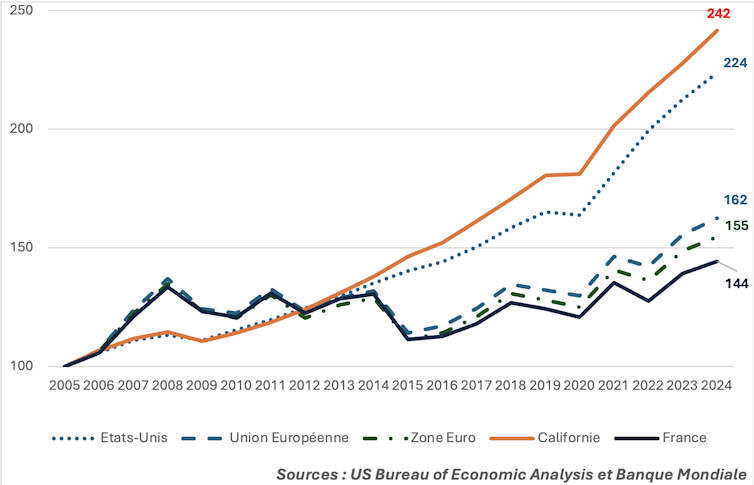
Entre 2005 et 2024, l’économie californienne a connu un taux de croissance sensiblement supérieur à la moyenne nationale. Quant aux économies européennes, elles ne soutiennent pas la comparaison (Graphique 2). Parmi les dix économies les plus développées de la planète, seules la Chine et l’Inde ont fait mieux sur la même période, tandis que le Brésil faisait jeu égal.

Graphique 2 : Évolution du PIB 2005-2024 (base 100 en 2005 / en dollars USD courants)


Fourni par l’auteur

C’est bien simple : depuis 2005, le taux de croissance de la Californie n’a été inférieur à la moyenne nationale qu’en 2009 et 2010 – en plein cœur de la crise financière des subprimes – et, en 2022 et en 2023 (en raison d’une inflation de près de 9 % qui a frappé plus durement la Californie que le reste du territoire américain). À ce rythme, il n’y a rien d’anormal à voir le 31e État des États-unis prendre toujours plus de poids dans l’économie fédérale, jusqu’à peser désormais plus de 14 % de son PIB (Graphique 3). Loin devant le Texas et l’État de New York qui, avec 9,3 % et 7,9 % respectivement, complètent le podium.

Graphique 3 : Évolution de la part de la Californie dans le PIB des États-Unis (en dollars USD courants)

Échelle de gauche (en dollars USD courants) : PIB des États-Unis. Échelle de droite (en %) : part de la Californie dans le PIB états-unien.
Fourni par l’auteur

Un secteur privé particulièrement productif

Si la croissance de l’économie californienne a été si soutenue au long de ce dernier quart de siècle, c’est qu’elle repose sur quelques secteurs d’activité qui ont le vent en poupe : la finance, l’immobilier, la tech et les services aux entreprises, l’industrie (notamment défense, aéronautique, automobile, biotech…) et la santé (Graphique 4). Le secteur privé lucratif compte ainsi pour 90 % du PIB californien.

Graphique 4 : Contribution au PIB californien par secteur d’activité en 2023 (en %)


Fourni par l’auteur

L’autre moteur de l’économie californienne repose sur le dynamisme des investissements en recherche et développement. En 2022, l’Unesco estimait que la Californie représentait plus de 28 % des dépenses de recherche et développement (R&D) réalisées par les entreprises états-uniennes. Il faut bien admettre que tout concourt à attirer de tels investissements tant la Californie dispose d’un écosystème favorable à l’innovation : finance dynamique, pôles universitaires de renom, travailleurs qualifiés, industries de pointe, et politiques incitatives.


À lire aussi :
Trump face à la Californie : affrontement à haute tension


Là encore, il n’y a guère de mystère à ce que cet État figure parmi les économies les plus pourvoyeuses d’emplois très qualifiés dans la recherche, dans l’ingénierie et dans l’innovation. En 2021, la Californie concentrait à elle seule plus de 21 % des emplois en R&D de l’ensemble de l’économie fédérale, dont près d’un quart des emplois du secteur privé lucratif (Graphique 5).

Graphique 5 : Part des emplois en recherche et développement (R&D) en Californie, par secteurs d’activité en 2021


Fourni par l’auteur

De bons niveaux de vie

La prospérité de l’économie californienne se traduit par un PIB par tête sans commune mesure avec les autres économies développées (Graphique 6). Exprimé en dollars courants, un Californien est ainsi en moyenne 1,8 fois plus riche qu’un Allemand, 2,2 fois plus qu’un Français, et même 7,6 fois plus qu’un Chinois.

Graphique 6 : PIB par tête (2023, dollars USD courants)


Fourni par l’auteur

Le coût de la vie en Californie est cependant très élevé, et réaliser une comparaison internationale des niveaux de vie nécessite un traitement en termes réels, c’est-à-dire exprimé en parité de pouvoir d’achat (Graphique 7).

Les écarts, s’ils restent conséquents, s’en trouvent significativement réduits. Par exemple, l’écart avec la France n’est plus que de 1,42 et avec l’Allemagne, de seulement 1,2. Plus intéressant encore, la Californie présente un niveau de vie similaire à la moyenne américaine.

Graphique 7 : PIB par tête, PPA (2023, dollar international courant)


Fourni par l’auteur

Des inégalités qui croissent

Car, à y regarder de plus près, la croissance économique du Golden State est loin de profiter de façon homogène aux quelque 39,2 millions de Californiens.

En effet, il existe en Californie de très importantes disparités territoriales et si la Bay Area – la région de San Francisco, qui abrite la fameuse Silicon Valley – a effectivement connu une explosion de ses revenus, elle fait figure d’exception et tire, à elle seule, une grande part de la croissance californienne.

Avec un PIB par tête de 131 000 dollars en 2023, la Bay Area pèse plus du double de certains comtés moins dynamiques, tels que la Central Valley (hors Sacramento), l’Inland Empire (Riverside, San Bernardino…), et le Northern California (Shasta, Gold Country…). A titre de comparaison, l’écart de PIB/tête intracalifornien n’était jamais supérieur à 32 000 dollars en 1998 (Graphique 8).

Graphique 8 : PIB par tête par région (en dollars USD courants de 2023)


Fourni par l’auteur

Bien évidemment, cette explosion des inégalités territoriales s’explique essentiellement par la croissance dans la tech et dans les services aux entreprises, qui a particulièrement profité aux 7,8 millions de résidents de la Bay Area et, à un degré moindre, aux comtés de San Diego, Orange et Los Angeles.

De telles disparités se ressentent naturellement sur les salaires. Pour bien s’en rendre compte, il suffit de comparer le salaire médian de la Bay Area (34 dollars USD de l’heure) avec celui d’autres comtés tels que celui de San Diego (28 dollars de l’heure), Inland Empire (22 dollars de l’heure) ou encore la Sierra et la Central Valley (21 dollars de l’heure).

Graphique 9 : Taux de chômage par État en 2024 (en %)


Fourni par l’auteur

Recrudescence des travailleurs pauvres

Deux autres indicateurs montrent les fragilités internes à l’économie californienne : le taux de chômage et le taux de travailleurs pauvres. Le taux de chômage en Californie est, en effet, structurellement supérieur à la moyenne nationale (Graphique  9).

L’État paie ainsi ses grandes disparités régionales, mais aussi une dépendance à des secteurs volatils, ainsi qu’un déclin démographique (une perte de 600 000 habitants entre 2020 et 2022), essentiellement imputable à un coût de la vie devenu rédhibitoire, qui entame la demande intérieure et l’ajustement du marché du travail.

Plus inquiétante encore est la recrudescence de « travailleurs pauvres », c’est-à-dire de personnes en emploi, mais dont les revenus ne permettent pas de franchir le seuil de pauvreté (fixé, en 2023, à 43 990 dollars (USD) pour un foyer de deux adultes en âge de travailler et de deux enfants à charge. Ce seuil est une moyenne nationale, avec des ajustements régionaux selon le coût de la vie. Il est, par exemple, de 50 380 dollars (USD) dans le secteur de Bay Area et de 36 280 dollars (USD) dans celui de Central Valley.

Arte, 2024.

Un coût de la vie préoccupant

Le coût de la vie, et notamment du logement, explique cette situation préoccupante où, en 2023, 9,8 % des travailleurs californiens âgés de 25 ans à 64 ans vivaient dans la pauvreté. Soit un contingent de près de 1,5 million de personnes auquel il faut ajouter 2,3 millions de travailleurs (14,7 %) en situation précaire (foyer dont le revenu est compris entre 1 et 1,5 fois le seuil de pauvreté).

Sans grande surprise, ce sont les régions où le coût de la vie est le plus élevé et où la main-d’œuvre moins qualifiée peine à s’insérer et à trouver des salaires permettant de vivre décemment de son travail qui sont concernées au premier chef (Graphique 10). Le taux de travailleurs pauvres atteint des sommets dans l’agriculture (24,6 %), dans le BTP (24,2 %), dans la restauration (22,4 %) et dans les services à la personne (20,8 %).

Graphique 10 : Part des travailleurs californiens sous le seuil de pauvreté en 2023 (en %)


Fourni par l’auteur

Si le Golden State n’a jamais aussi bien porté son nom, force est de constater que la ruée vers l’or est loin d’avoir profité à l’ensemble de la population et des territoires.

La Bay Area en général et, en particulier, la Silicon Valley sont des poches de richesse dans un État en proie à de véritables préoccupations socio-économiques : trop grande dépendance à certains secteurs d’activité, difficultés d’insertion des travailleurs non qualifiés, explosion du coût de la vie et du nombre de travailleurs pauvres, déclin démographique…

« Il n’y a pas de classes sociales en Californie, il y a des échelles de salaire et des barreaux qui manquent »,

écrit, en 1986, le Québécois Jacques Godbout dans son roman Une histoire américaine. Pouvait-il imaginer à quel point l’histoire lui donnerait raison ?

The Conversation

Julien Pillot ne travaille pas, ne conseille pas, ne possède pas de parts, ne reçoit pas de fonds d’une organisation qui pourrait tirer profit de cet article, et n’a déclaré aucune autre affiliation que son organisme de recherche.

ref. La Californie, un colosse économique, mais un creuset d’inégalités (en dix graphiques) – https://theconversation.com/la-californie-un-colosse-economique-mais-un-creuset-dinegalites-en-dix-graphiques-263544

Sun dogs, rainbows and glories are celestial wonders – and they may appear in alien skies too

Source: The Conversation – UK – By Peter Berthelemy, PhD Candidate in Atmospheric Physics , University of Bath

Earth may not be the only planet with sun dogs, as shown here in a wintry landscape. Guozongxia/Shutterstock

Every once in a while, you may look up towards the Sun and see strange bright lights on either side of it. Or perhaps you’ll be sitting in an aircraft, looking out the window at its shadow and see a circle of light, like a halo below (known as glories). Or, if you’re really adventurous, maybe you’ll even be out on a midnight walk with a full moon lighting your way, and see what appears to be a rainbow encircling the moon.

These are all beautiful examples of atmospheric optical phenomena. And a new paper has suggested they may appear in alien skies too.

These celestial wonders can tell us a lot about the state of the atmosphere at home on Earth as well as on other planets. Rainbows, for instance, the most well-known of these phenomena, can only form when light passes through spherical liquid droplets, like our normal rain on Earth. Therefore, there must be spherical liquid droplets in the atmosphere where the rainbows are observed.

Most planet atmospheres have some kind of crystalline aerosols (clouds of tiny particles) in them, from sodium chloride in Io (one of Jupiter’s moons), to carbon dioxide crystals in Mars. On Earth, these are generally ice crystals, often found in clouds as snowflakes. The orientation of these crystals, and how they change the light, dictates the type of optical phenomena you can see.

Pillars of coloured light
Light pillars over London, Ontario Canada.
Ray Majoran/Wikimedia, CC BY-SA

Sun dogs are another of these phenomena, where bright lights appear on either side of the Sun, sometimes even splitting white light into the colours of the rainbow. They form because of the light being bent by horizontally oriented hexagonal ice crystals high up in the atmosphere. If you want the best chance of seeing these, you should try to be at the same latitudes as Europe or Argentina during wintertime. Look for high altitude wispy clouds that are in front of the Sun, and you might get lucky.

Horizontal ice crystals can also create light pillars in extremely cold conditions, which look like coloured beams of light trailing to clouds over head. Vertical crystals form parhelic circles – a circle of light at the same height as the Sun. And crystals aligned with the electric fields above thunderstorms create crown flashes.

The new paper proposes that, from what we know of our own atmosphere, we can presume that similar optical phenomena happen on planets outside of our solar system (called exoplanets). It’s just a matter of spotting them and finding out why they occur.

Previous studies have shown that on many exoplanets the crystalline aerosols in their atmospheres are moved around and oriented in a multitude of different ways, much like on Earth.

Magnetic fields swirl around the planet, as they do on Earth, pushing and pulling along field lines. On Earth, this can be seen as the northern lights phenomena. Radiation pressure from a planet’s parent star pushes the crystals using the power of light, much like how the wind pushes boats. And the wind, often much faster than anywhere on Earth, speeds around the exoplanet, rushing from the hot, star-facing side of the exoplanet to the colder space-facing side as the planet spins.

A special type of exoplanet, hot Jupiters (so named because they’re huge, gassy and very hot) generally have incredibly fast winds (up to 18,000km/h) and high densities of crystalline aerosols, much like an incredibly fast-moving sandstorm.

This means that the main way that the crystals are oriented is through the superfast winds spinning around the planet. Imagine a fleet of boats all randomly turned around in a patch of ocean, then a massive gust of wind comes, turning them all so that they’re facing the same direction.

The researchers on the new paper previously used the James Webb Space Telescope (JWST) to find evidence for tiny quartz crystals in the high altitude clouds of a hot Jupiter 1,300 light years away from Earth (WASP-17 b). These crystals have an elongated shape, like boats, so are more likely to be oriented with the wind. This led them to think about what optical properties could be seen with the wind-aligned crystals.

The optical phenomena that come from the crystals being oriented the same way cannot be seen by normal cameras. But scientists can use instruments such as those on the JWST to observe these effects.

We have already gained valuable information about faraway atmospheres from looking at their optical phenomena using the JWST. For example on Venus, rainbows and glories have been used by scientists to decipher the mysteries of Venus’ extreme heats and yellow colour.

A similar technique of observing glories has been used to detect the presence of long-lasting clouds on the exoplanet WASP-76b. The new knowledge of these clouds gives us insight into the exoplanet’s atmosphere. Now we know that there can be conditions for a stable temperature, which surprised scientists as half of the planet is hot enough to melt iron.

An artist’s impression of glory on exoplanet WASP-76b.
ESA, CC BY-SA

We can also guess what optical effects might occur on planets where we know what the atmosphere is made of. For example, in the high atmospheres of Jupiter and Saturn, where a special type of ammonia crystals are concentrated, we would expect to observe four separate sun dogs. Alas, on Earth, we can only ever see two at a time due to the shape of our atmospheric ice crystals.

Who knows what other wondrous phenomena we may see on other worlds. Who’s to say whether there couldn’t be a planet surrounded by continual rainbows? There is much more to learn about so many exoplanets. Optical phenomena such as sun dogs can tell us huge amounts about their atmospheres, which could help us in the search for habitable planets in the future.

The Conversation

Peter Berthelemy does not work for, consult, own shares in or receive funding from any company or organisation that would benefit from this article, and has disclosed no relevant affiliations beyond their academic appointment.

ref. Sun dogs, rainbows and glories are celestial wonders – and they may appear in alien skies too – https://theconversation.com/sun-dogs-rainbows-and-glories-are-celestial-wonders-and-they-may-appear-in-alien-skies-too-263360

Champion tennis player Monica Seles has myasthenia gravis – what is it and how does it affect sufferers?

Source: The Conversation – UK – By Adam Taylor, Professor of Anatomy, Lancaster University

The tennis legend revealed recently that three years ago she was diagnosed with the rare autoimmune condition. lev radin/ Shutterstock

Former tennis star Monica Seles has revealed she has been diagnosed with myasthenia gravis, a rare autoimmune condition that affects how the muscles work. The multiple Grand Slam champion says she was actually diagnosed three years ago after experiencing trouble with her vision and weakness in her arms and legs.

It is estimated that myasthenia gravis affects between three and 12 in every 100,000 people and occurs when the body attacks the neuromuscular junction – a specialised connection between the muscles and the body’s neurons (nerve cells). This reduces the ability to transmit neurotransmitters (chemical messengers) across the junction, affecting the way the muscles contract and function.

The most common signs of the condition are weakness of the muscles that move the eyes, drooping of one or both eyelids and blurred or double vision. Less common ocular symptoms include dry eyes, pain and tearing.

Cardiac changes are also commonly seen and arrhythmia (abnormal heart beat) is also common. The condition also weakens the facial muscles, making it more difficult to physically express emotions.

Other voluntary movements can be affected, too – particularly when moving the arms and legs. This weakness can make regular daily tasks more difficult. This symptom often worsens the more activity you do, while improving with rest.

Myasthenia gravis can affect people of any age, though in women it tends to emerge between the ages of 20 and 40. In men it tends to occur over the age of 60. It’s not considered an inherited condition, so it can occur even in people with no family history of the condition.

The condition is extremely rare in infants, though there’s a form of the myasthenia gravis that can be passed from the mother to her foetus. This causes the unborn child to acquire antibodies across the placenta, which can temporarily lead to symptoms for a few months after birth. It affects up to 30% of children whose mothers have myasthenia gravis.

Symptoms occur between three and 72 hours after birth and can include poor sucking, respiratory difficulty, facial muscle weakness or paralysis and weak muscle tone.

In the past 20 years, there has been a rise in the incidence of myasthenia gravis – particularly in over 65s. It’s unclear what factors are driving this increase. It could be due to improved diagnostics, longer life expectancy and the natural deterioration of the immune system that occurs with ageing.

A drawing depicting the neuromuscular junction.
The condition affects the neuromuscular junction, changing how the muscles function.
ALIOUI Mohammed Elamine7/ Shutterstock

While most people with myasthenia gravis have a near normal lifespan, some research suggests the condition may lead to premature death – potentially due to the effect that the condition has on the muscles needed for breathing and swallowing.

It is estimated that 20% of people with myasthenia gravis will experience a respiratory crisis. This typically happens within the first two years of diagnosis.

Managing muscle symptoms

It isn’t entirely clear what causes myasthenia gravis, but the thymus gland, located in the chest, is believed to be involved in the condition. This gland is largest in childhood, as it plays a role in forming new immune cells, but shrinks with age.

The thymus gland is believed to produce the antibodies which attack the neuromuscular junction – leading to myasthenia gravis. Adding strength to this theory are findings that patient with myasthenia gravis have better health outcomes and lower risk of premature death after having their thymus removed.

There’s currently no cure for the myasthenia gravis. Available treatments focus on reducing muscle weakness which can help to improve quality of life – particularly when symptoms worsen.

Pyridostigmine is often the first-line treatment. This medication improves communication between the nerves and the muscles by preventing the breakdown of the neurotransmitter acetylcholine that is found in the neuromuscular junction.

Corticosteroids, such as prednisolone, are also often used when pyridostigmine doesn’t work or when symptoms worsen. These steroids reduce inflammation and lower the immune system’s ability to damage the body’s tissues. Only low doses of these types of drugs are used as long-term use can have side-effects such as bone thinning (osteoporosis), increased blood sugar levels and fatigue.

Immunosuppressants can also be beneficial as they decrease the body’s attacks on its tissues and reduce symptoms.

During symptom flare-ups, treatments such as monoclonal antibodies or complement inhibitors can help, by reducing the body’s natural processes for fighting infections. In autoimmune diseases this process is overactive, leading to inflammation and tissue damage.

This is one reason why these treatments don’t come without risks. For instance, complement inhibitors can increase the risk of certain bacterial infections such as Neisseria meningitidis, which can result in meningitis.

Therapeutic plasma exchange has also been shown to reduce the number of harmful antibodies circulating in the blood. This treatment works by removing the plasma from a sample of a person’s blood using a machine, and replacing it with donated plasma or sterile fluid. This has a significant and positive impact on the severity of symptoms.

Seles isn’t the first famous person to talk about her diagnosis in the hope of educating people about the disease. Actors Sir Laurence Olivier and Suzanne Rogers, US Olympian James Carter and Christopher Milne – son of Winnie the Pooh author AA Milne – were all diagnosed with the condition. Walt Disney apparently also based Sleepy, one of the seven dwarves, on his friend who suffered from the condition.

With increasing awareness and better diagnostics, treatment options for myasthenia gravis are improving, making it easier for people who suffer with this incurable condition to lead full and active lives.

The Conversation

Adam Taylor does not work for, consult, own shares in or receive funding from any company or organisation that would benefit from this article, and has disclosed no relevant affiliations beyond their academic appointment.

ref. Champion tennis player Monica Seles has myasthenia gravis – what is it and how does it affect sufferers? – https://theconversation.com/champion-tennis-player-monica-seles-has-myasthenia-gravis-what-is-it-and-how-does-it-affect-sufferers-263242

Cigarette filters do nothing for smokers’ health and just create plastic pollution – they should be banned

Source: The Conversation – UK – By Jonathan Livingstone-Banks, Lecturer & Senior Researcher in Evidence-Based Healthcare, University of Oxford

Kristine Rad/Shutterstock.com

Cigarette filters were widely introduced in the 1950s, ostensibly to make smoking less harmful. With growing public concern about lung cancer and other smoking-related diseases, the tobacco industry responded not by making cigarettes safer, but by making them seem safer. Filters were the perfect innovation – not for health, but for public relations.

Over 70 years later, we know that filters don’t reduce harm. In fact, they may exacerbate some risks. By softening smoke and making it easier to inhale deeply, filters may actually raise the risk of lung cancer. In the early 1950s, one popular filter type even contained asbestos. Despite this, most smokers today still believe filters make cigarettes safer.

Beyond the health deception, cigarette filters create an environmental disaster. They’re made of a plastic called cellulose acetate. They don’t biodegrade but break down into microplastics, polluting our rivers and oceans.

And there are a lot of them. Cigarette butts are the single most littered item on the planet. An estimated 4.5 trillion are discarded each year, and roughly 800,000 metric tonnes of this plastic waste enters the environment annually. While legislation has restricted other single-use plastics like bottles, bags and straws, cigarette filters have largely escaped such regulatory attention.

Under pressure, some tobacco companies now market “biodegradable” filters made from new materials. But these are a false solution. Even so-called biodegradable filters offer no health benefit and continue to pollute ecosystems. They serve the industry by creating an illusion of environmental responsibility, all while maintaining the false perception that filters themselves are benign or necessary.

So why not ban cigarette filters outright?

Cigarette filters are among the most harmful single-use plastics still in global circulation. And unlike many other pollutants, they serve no essential purpose. The WHO Framework Convention on Tobacco Control already advises against measures that sustain the perception of reduced harm, and cigarette filters fall squarely into that category.

Banning cigarette filters would remove the illusion of safety from filtered cigarettes. It could reduce smoking prevalence, as unfiltered cigarettes are generally harsher and less palatable. And it would eliminate one of the most widespread sources of plastic pollution, preventing hundreds of thousands of tonnes of plastic waste each year.

If we can ban plastic straws, surely we can ban cigarette filters. In fact, it’s already been done. Santa Cruz in California voted to ban cigarette filters in 2024.

People cleaning litter on a beach. One holds a handful of plastic straws.
We managed to ban plastic straws, so why not cigarette filters?
David Pereiras/Shutterstock

Now is the perfect time to act. Plastics are on the global conscience. This month in Geneva, world leaders negotiated what could become the first legally binding UN treaty addressing plastic pollution from production to disposal. This treaty is a rare opportunity to tackle the root causes of plastic waste globally.

The current draft of the treaty includes cigarette filters, but only partially. Plastic cigarette filters are listed in Annex X, a category concerned with voluntary or mandatory restrictions. This leaves room for continued use, including so-called “eco” filters, and does not mandate a total phase-out.

If all cigarette filters (not just plastic ones) were listed in Annex Y, they would be set for a complete and mandatory ban. August negotiations continued without a final agreement, and negotiations will continue at a later date, meaning there is still time to act.

Health and environmental groups, including the World Health Organization, Action on Smoking and Health, and the Stop Tobacco Pollution Alliance, are calling for strong commitments on cigarette filters. What could be stronger than an outright ban?

Banning filters won’t end smoking overnight or eliminate plastic pollution. But it would be a meaningful and symbolic step toward aligning environmental and public health goals. It would remove a harmful and misleading product from the market, reduce pollution and make cigarettes more honest.

The Conversation

Jonathan Livingstone-Banks has received funding from the US National Institutes of Health (NIH), the National Institute for Health and Care Research (NIHR) and Cancer Research UK (CRUK).

Jamie Hartmann-Boyce receives research (including research consultancy) funding from groups involved in tobacco control, including the Truth Initiative, Cancer Research UK, and the US Food and Drug Administration.

ref. Cigarette filters do nothing for smokers’ health and just create plastic pollution – they should be banned – https://theconversation.com/cigarette-filters-do-nothing-for-smokers-health-and-just-create-plastic-pollution-they-should-be-banned-263374

Air conditioning isn’t the only answer

Source: The Conversation – UK – By Will de Freitas, Environment + Energy Editor, The Conversation

Keeping cool in Manchester, England. Iordanis / shutterstock

I recently returned from visiting family in America and was struck by how hot I felt back home in London, despite the temperatures being lower. Partly, this was down to humidity: London is sticky in summer, while Utah, where my uncle lives, is very dry.

But it’s also down to the buildings. My brick house absorbs and retains heat while every building I went to in America was either well ventilated or had air conditioning blasting away.

That contrast got me thinking: as the UK warms, can it keep its homes and workplaces comfortable without relying solely on air-con?

Jesus Lizana, Nicole Miranda and Radhika Khosla at the University of Oxford say that northern Europe is dangerously unprepared for the heat of the near future.

They looked at the coming demand for cooling using the concept of “cooling degree days”, which essentially assesses how often people will need to take extra measures, like switching the air-conditioning on, to keep themselves cool.

They found countries like Nigeria and Chad will see the biggest absolute rise in cooling degree days. “A clear indication that Africa is shouldering the burden of a problem it did not create”, they note.

But they also found that countries in northern latitudes will face the greatest relative increase in uncomfortably hot days.

“Of the top ten countries with the most significant relative change in cooling degree days as global warming exceeds 1.5°C and reaches 2°C, eight are located in northern Europe.”

It gets worse. “Buildings in the northern hemisphere”, they write, “are primarily designed to withstand cold seasons by maximising solar gains and minimising ventilation – like greenhouses.”

The solution seems obvious: let’s all get air-con.


Read more:
Northern Europe faces biggest relative increase in uncomfortable heat and is dangerously unprepared – new research


Coal-powered air-con?

But Mehri Khosravi says it isn’t that simple. An energy researcher at the University of East London, she warns that:

“Cooling requires huge amounts of energy at the exact moments when demand is already high. In 2022 and 2023, the UK had to briefly restart a coal power plant to keep the lights – and the air conditioners – on.”

Khosravi says the UK and similar countries should instead focus on reducing demand for cooling.

In winter, she says, we rightly focus on better insulation to reduce heating demand, as “it’s a lot harder to warm a house than it is to stop heat escaping in the first place.”

So how do we stop a northern European brick house from heating up in the first place?

Khosravi suggests we look to southern Europe for inspiration, where 35°C summers were common long before climate change. Her suggestions include shading and shutters to block sunlight before it enters a building, natural ventilation to let heat escape in cooler hours, and reflective or light-coloured buildings that reflect sunlight.

White wall, blue shutters, black cat
Mediterranean cooling tactics. Cat optional.
Natalia Dobryanskaya / shutterstock

It’s hard to imagine Scarborough being turned into Santorini any time soon. But while we wait to adapt our buildings for the new normal, Khosravi says we should adapt our behaviour too.

In Spain, the hottest hours are for siestas. Outdoor activities are paused, and people are more active in the mornings and evenings. Culturally, they understand that keeping curtains closed during the day and opening windows at night can prevent homes from overheating.

In the UK, heat is still culturally framed as “good weather”. Sunny weekends trigger beach trips, barbecues and more outdoor activity, even when it’s dangerously hot. This mismatch between perception and risk is a major public health challenge.


Read more:
How Britain can beat the heat without becoming addicted to air conditioning


Smarter cooling

Perhaps there are smarter ways to cool down. Academics in Australia recently published research suggesting a “fan first” approach, even when air-conditioning is installed.

“The approach is simple”, they write: “use electric fans as your first cooling strategy, and only turn on air conditioning when the indoor temperature exceeds 27°C.”

These fans use only a tiny fraction of the electricity used to run air conditioning, but “can make you feel up to 4°C cooler”. In their research, the Australian team increased an office’s air conditioning set-point from 24 to 26.5°C, with supplementary air movement from desk and ceiling fans. This “reduced energy consumption by 32%, without compromising thermal comfort”.


Read more:
Tempted to turn on the aircon? Science says use fans until it’s 27°C


Air conditioning doesn’t have to mean the typical rows of humming white boxes. Heat pumps – already central to Britain’s low-carbon heating plans – can also keep homes cool in summer.

Essentially, they’re able to act like reversible air conditioners: in winter, they draw warmth into a building, and in summer they can run in reverse to push heat out.

Crucially, they do so with far greater efficiency than traditional systems. Theresa Pistochini, an engineer at UC Davis in California, points out that heat pumps can be “anywhere from 200% to 400% efficient”, meaning they move more than twice as much energy (heat) than the energy required to operate them.

Her analysis found that “buying a heat pump today will reduce global-warming impact in almost all geographical locations.”


Read more:
Heat pumps will cool your home during the hottest of summers and reduce your global warming impact


For households, this could mean one appliance that covers both heating and cooling, slashes energy bills, and avoids the climate-damaging lock-in of conventional air conditioning. For policymakers, heat pumps may offer a way to meet surging cooling demand without blowing the carbon budget.

But heat pumps aren’t a perfect fix. Installation is costly, many older homes will still need upgrades, and there aren’t enough trained engineers. They’ll need further support if they’re to become a mainstream alternative to air-con.

Nonetheless, together with simple measures like fans and shutters, heat pumps point to a smarter approach to cooling. And it could be made even more sustainable if paired with clean energy from rooftop solar.

Homes equipped with solar panels can generate electricity during the hottest parts of the day – exactly when air conditioners or heat pumps are working hardest.

Tom Rogers and colleagues at Nottingham Trent University say solar will play a “pivotal role” in “addressing summer cooling demand and enhancing climate resilience”. They analysed satellite images to estimate that rooftop solar could provide “nearly one third” of the city’s electricity demand.


Read more:
Rising temperatures mean more air conditioning which means more electricity is needed – rooftop solar is a perfect fit


The UK is warming, and staying comfortable in hotter summers is a must. But there’s more than one way to cool down. Simple measures like fans, efficient heat pumps and rooftop solar – combined with smarter building design and passive cooling – could keep homes safe, energy use low and emissions in check.


This roundup of The Conversation’s climate coverage comes from our award-winning weekly climate action newsletter. Every Wednesday, The Conversation’s environment editor writes Imagine, a short email that goes a little deeper into just one climate issue. Join the 45,000+ readers who’ve subscribed.


The Conversation

ref. Air conditioning isn’t the only answer – https://theconversation.com/air-conditioning-isnt-the-only-answer-264063

Netflix’s ‘Mo’ delivers humour and heartache as it explores Israel-Gaza war, Palestinian and Mexican migrant life in the U.S.

Source: The Conversation – Canada – By Faiza Hirji, Associate Professor, Department of Communication Studies and Media Arts, McMaster University

I recently watched both seasons of the Netflix drama-comedy Mo (2022-25), expecting a good laugh, since the show is headlined and written by funny and smart comedian Mohammed Amer.

Mo does provoke a lot of laughter, but it also stirs deep emotions, including despair, loneliness and helplessness, as the episodes explore life in America for people on the margins.

Mo is a semi-autobiographical depiction of Amer’s life. He’s a Palestinian who grew up in Houston, Texas, immigrating to that city when he was nine years old by way of Kuwait.

In the series, Amer plays Mo Najjar as he navigates a complex balancing act between the different cultures that have shaped his life. Mo undergoes struggles to obtain asylum status in the United States as a “stateless person” with no passport.

Amer uses elements of a situation comedy to introduce increasingly troubling sociopolitical themes, leavening an existential darkness with the love and laughter of the main character’s friends and family.

The comedy-drama format allows Mo to address difficult and divisive issues, such as immigration in America and the Israel-Gaza war, in non-threatening ways.

Amer’s comedic writing also serves to humanize his characters. This is particularly important accomplishment in the case of Palestinians, both at home and in the diaspora — and more broadly for Muslims globally — given the long history of misrepresentation of Islam in western discourse.

Comedy tackles erasure of Palestine

In his writing on the first Gulf War, Canadian researcher Karim H. Karim explains how western war propaganda attempted to dehumanize their enemy. He cites comments from the U.S. army members during the Gulf War as examples. They described Iraqis as non-human and animals: “fish in a barrel,” “cockroaches” and part of a “turkey shoot,” alongside the use of longstanding stereotypes about Arabs and Muslims

Dehumanizing techniques can also be seen in today’s conflicts in the Middle East.

For example, Israeli Finance Minister Bezalel Smotrich delivered a speech in October 2024 in which he said: “There is no such thing as a Palestinian nation. There is no Palestinian history. There is no Palestinian language.” Israeli Defense Minister Yoav Gallant also said: “We are fighting human animals and we act accordingly.”


Read more:
How colonialist depictions of Palestinians feed western ideas of eastern ‘barbarism’


Mo counters these types of messages repeatedly as features representations of strong women, respectful men and loving families, instead of the angry terrorists or oppressed women depicted in western imaginings.

Several researchers have previously documented such stereotypes, including Edward Said, Leila Ahmed, Yasmin Jiwani, Karim Karim and Ross Perigoe and Mahmoud Eid.

Comedy is non-threatening

Viewers get to know Mo’s family, the Najjars, and their quirks and idiosyncracies, as well as the complicated path they tread.

During the family’s asylum hearing, an opposing lawyer raises an objection to their claim, saying the U.S. does not recognize Palestine as a state. The statement is brief and the moment passes quickly, but the viewer is now aware of this kind of daily erasure of Palestinian people.

Over the course of the show, viewers see the many ways Mo protests the general erasure of Palestinian culture, including a recurring argument over the origin of hummus (made with chickpeas, garlic, tahini and olive oil).

Building that statement into a comedy is less likely to attract negative attention than a high-profile drama or documentary. For example, Hamdan Ballal, one of the directors of the Oscar-winning Israel-Palestine documentary, No Other Land, was injured in an attack by masked settlers and then arrested by the Israel Defence Forces in the West Bank. Israel’s culture minister said changes had been made to public funding rules to help prevent similar films from being made in future..

Comedy as simultaneous defusion and resistance is also practised by the Palestinian-Canadian comedian Eman el Husseini, whose stand-up routine touches on the idea that Arabs are perceived to be dangerous while painting a picture of her own family as affectionate, overbearing and harmless.

The strategic use of comedy to make characters relatable is a technique that has proven successful with racialized comedians tackling difficult issues, both for stand-ups like Russell Peters and situation comedy formats like Black-ish.

Crushing challenges

Humour may seem like an odd response to the characters’ crushing challenges. At one point, while in negotiation with a criminal who is threatening to amputate the foot of his friend, Mo suggests cutting off just a pinkie instead, hissing to his outraged friend, “Hey, you don’t wear pinkie rings, anyway!”

But in this series, humour becomes the coping mechanism for Mo‘s characters, however fraught or fragile the issue, from a lighthearted chuckle to the darkness of gallows humour.

At times, Mo’s mother, Yusra (Farah Bsaiso), seems utterly consumed by stories of dispossession taking place back in Palestine, while Mo becomes increasingly angry about examples of appropriation and erasure.

His sister, Nadia (Cherien Dabis), trying to forge a way forward, urges her mother to pull herself away from stories of tragedy back home and resist oppression finding moments of happiness. She insists:

“We’re more than our pain and suffering.”

Ultimately, it is Yusra who summarizes what it means to smile through one’s pain, telling Mo:

“The world will always try to tear us down. And when they do…we smile. Because we know who we are.”

Resilience

In Season 2, Mo, still undocumented in Texas, gets accidentally trapped in Mexico after unwittingly crossing the border. His Mexican fiancée leaves him in frustration and loneliness.

Throughout this season, Mo’s anger at the American immigration system grows as he repeatedly tries — and fails — to get home. He seems to be engaging in constant self-sabotage, in which he simply cannot accept the process that his lawyer and the bureaucracy have outlined for him.

Yet, as the depth of the dehumanization experienced by Mo and his family becomes more and more apparent, Mo’s simmering, ever-present anger starts to seem less dysfunctional. Instead, the world’s indifference becomes spotlighted.

During these episodes, Mo begins to learn how to live with — but never accept — injustice.

However, this is still a sitcom, and some things do work out for Mo. At the end of Season 2, Mo and his family get their U.S. passports and so can finally visit their family in Palestine.

As Mo is getting ready to return to Texas, after a joyful and also heartbreaking visit with his relatives, he is harassed by an Israeli border guard. At this moment, Mo realizes he must develop the same inner strength and resolve embodied by his mother, earned after years of having to bear such harassment.

Although Mo is consumed by anger and sadness at the unjust actions towards him by the guard, against all his instincts, he thanks the border guard, smiles and walks on.

The Conversation

Faiza Hirji receives funding from the Social Sciences and Humanities Research Council of Canada.

ref. Netflix’s ‘Mo’ delivers humour and heartache as it explores Israel-Gaza war, Palestinian and Mexican migrant life in the U.S. – https://theconversation.com/netflixs-mo-delivers-humour-and-heartache-as-it-explores-israel-gaza-war-palestinian-and-mexican-migrant-life-in-the-u-s-249684

Forcing Zelensky to hand Putin Ukraine’s ‘fortress belt’ in Donetsk will lose it the war

Source: The Conversation – UK – By Rod Thornton, Senior Lecturer in International Studies, Defence and Security., King’s College London

In the recent summit talks in Alaska designed to halt the Russia-Ukraine war, Vladimir Putin demanded that Kyiv cede control of the entirety of its Donetsk oblast (region) to Russia. But this would effectively be tantamount to an acceptance of overall defeat for Ukraine.

In giving up this region, Kyiv would also be giving up its principal defensive barrier against further Russian encroachment into the whole of Ukraine – that is, it will lose its “fortress belt”. This is the name given (by the Russians themselves) to a series of fortified Ukrainian-held cities, towns and settlements in the west of the Donetsk region. This belt roughly links the city of Slovyansk in the north to Kostyantynivka, some 50 km to the south.

The current situation on the battlefield needs to be viewed with a certain context in mind – that of geography. The state that we now call Russia (which has included Ukraine for much of its existence) has been subject to many invasions throughout its long history. Foreign invaders – whether coming from the east, south or west – were generally able to make rapid initial progress in their invasions, not least because Russia had few natural barriers that could act as defensive lines.

In particular, the open steppe lands, lacking hilly or mountainous terrain, have represented an open invitation to invaders. This issue still pertains. But today, ironically, these largely indefensible steppe lands are Ukrainian territory that is under threat from Russian forces.

In light of this, Kyiv cannot rely on terrain to form defensive lines. It has to rely on creating urban barriers. Towns and cities are notoriously difficult to capture or to fight through. Buildings, especially large ones, provide ideal cover and fire points for defenders. Getting into urban areas is difficult because of the channelling effect of the road systems. Obvious routes can be well defended with mines, obstacles and covering fire. Rubble also makes movement difficult. Urban scenarios very much favour the defender.

The normal tactic for an assaulting force would be to try and outflank and surround such urban areas and to then to essentially lay siege to them to prevent their resupply and thus force their surrender. This is what happened, but on a smaller scale, with the capture of Mariupol by Russian forces early in the war.

The other alternative has been to “squeeze out” Ukrainian forces from any town they are holding. In such scenarios, towns have been enveloped on three sides by Russian troops. This has then forced the under-pressure Ukrainians to withdraw though the only remaining egress routes. Russian forces then occupy the abandoned town.

This is what happened at towns that Ukrainian forces lost earlier in the Donbas region: Avdiivka, Bakhmut and Soledar.

But both of these forms of attack on urban areas are currently being denied to Russian forces. This is because of the complex series of Ukrainian defensive lines that have been established now between the series of towns and cities in the Donetsk fortress belt. These make use of minefields, anti-tank obstacles, enfilading fire (firing along the enemy line to inflict maximum casualties) provided by tube artillery and copious drone use.

Because the Russians have largely been unable to break through these lines they have been prevented from surrounding or enveloping any of the major urban areas within the fortress belt.

Last line of defence

It is strategically vital for the Ukrainians that this belt continues to hold back the Russians. It appears that one of the main aims of the 2025 summer offensive by Moscow (according to Russian officers captured by the Ukrainians) has been to break through this belt. It was said to represent the “poslednii ryvok” (the “final push”) that would settle the war’s outcome in Russia’s favour.

ISW map showing the potential for a rapid Russian advance west of the Donetsk oblast.
Handing over the remainder of the Donetzk oblast, with its ‘fortress belt’ of fortified cities, would clear the way for a rapid Russian advance into central Ukraine.
Institute for the Study of War

But this has not happened and looks unlikely to happen anytime soon. Indeed, as the Institute for the Study of War put it recently, Russian forces “are engaged in an effort … to seize [the ‘fortress belt’] that would likely take several years to complete”.

Hence, it becomes easier to understand why Putin needed to make the demand that he did at Anchorage. What cannot be achieved on the ground in terms of breaking through the fortress belt he is trying to achieve via a peace deal brokered with US assistance.

Gaining control of the west of the Donetsk region is the key to winning the war. Putin knows this. If Donetsk and its fortress belt are given up, then the open steppe land to the west would be exposed to Russian advances. Great swaths of Ukrainian territory would rapidly fall.

As one Russian source put it this week, the fortress belt “is the last serious line of defence for the Ukrainian Armed Forces. Beyond it, Kyiv has no other prepared lines of defence to Zaporizhzhia and the Dnipropetrovsk region … [and] … the Russian army can … advance to the Dnieper River”.

If Russian forces came to be camped on this part of the Dnieper, then it’s hard to imagine that Ukraine would not then have to accede to yet further, strategically damaging, territorial demands from Moscow. With such a scenario in mind, the future course of the whole war hinges on Ukraine not giving up its fortress belt in western Donetsk.

Perhaps an irony in Putin’s demand that the whole of the Donetsk region be handed over is that it could be seen as coming from a position of what appears to be weakness and not strength. He cannot wait the years it may take to seize the cities and towns that form the fortress belt. Russia cannot remain on a war footing for too much longer, according to reliable reports on the state of its economy.

But even so, Kyiv may have to accede to Putin’s demands because it will potentially come under pressure from the Trump administration, which itself does not want to wait years to see a resolution to this conflict. If Kyiv does accede, though, then this may amount to Ukraine accepting its overall defeat. It may, indeed, lose the war.

The Conversation

The authors do not work for, consult, own shares in or receive funding from any company or organisation that would benefit from this article, and have disclosed no relevant affiliations beyond their academic appointment.

ref. Forcing Zelensky to hand Putin Ukraine’s ‘fortress belt’ in Donetsk will lose it the war – https://theconversation.com/forcing-zelensky-to-hand-putin-ukraines-fortress-belt-in-donetsk-will-lose-it-the-war-263980