Eight seconds and dropping? How to make the most of short attention spans

Source: The Conversation – UK – By Barbara Jacquelyn Sahakian, Professor of Clinical Neuropsychology, University of Cambridge

We are regularly bombarded with information about a steep drop in attention spans. Based on its own data in 2015, Microsoft reported that the average attention span had dropped from about 12 seconds for millennials to eight seconds for gen Z.

And as the new Premier League season kicked off, UEFA introduced a new “eight seconds rule” stating a goalkeeper cannot hold the ball for more than eight seconds or the opposing team wins a corner kick. Coincidence? The rule was introduced to avoid time wasting. It may be that the mean length of attention needed to kick the ball is on average eight seconds. And perhaps this is also how long viewers can pay attention when nothing’s happening.

But how does attention really work? How can we improve it?

Attention is crucial. Who hasn’t experienced getting distracted in the middle of a conversation and suddenly forgot what they were saying. However, what is sometimes missed is that there are many forms of attention, and not all of them are necessarily diminishing.

The football rule is more closely related to a type of attention called visual scanning. For a goalkeeper, this can be scanning the field to work out who to pass the ball to. There are many studies on visual scanning in football, though not so much on goalkeepers.

One paper studied scanning and performance in English Premier League football players. They found using a ten-second scan time gave players a small but positive performance advantage.
Other studies have shown that within elite football players, the best players, spend more time scanning than others, unless there is an opponent player in close proximity.

avid de Gea of Manchester pictured during the 2018/19 Premier League game between Tottenham Hotspur and Manchester United
Goalkeepers have to scan before they kick the ball.
Cosmin Iftode/Shutterstock

Scanning is a form of attention that allows the footballer to take advantage of a time-limited opportunity, where decisions of who to pass to or where to run to on the field have to be made very rapidly.

This is a type of “hot cognition” – a social and emotional way of thinking, a bit like a gut instinct. It is very different to the “cold” or “rational” cognition involved in the decision making that footballers do with their managers and coaches off the field, where videos of plays are analysed.

In such situations, we are more likely to use “sustained attention”, which is paying attention to something for a sustained period of time. This ultimately requires mental concentration.

Similarly there are other forms of attention, for example “divided attention” or “alternating attention” which involve shifting attention between different things over a sustained period of time. These are typically also used for more cold decisions.

Different parts of the brain are at work when we use different kinds of attention. Hot decisions involve a brain network that includes the ventromedial prefrontal or orbitofrontal cortex, which support emotional regulation and decision making. Cold decisions, on the other hand, involves a different neural network that includes dorsolateral prefrontal cortex, supporting executive functions such as controlling or inhibitions or short-term memory.

Another time we make hot, rapid decisions is with first impressions. Again, the attention used is a type of immediate gut instinct. Unsurprisingly therefore, the dorsomedial prefrontal cortex is an important brain region associated with first impressions.

When we see or meet someone for the first time, we implicitly form an impression of their attractiveness and possibly other traits as well. We may adjust that initial immediate impression later, using more sustained or divided types of attention, as we learn more about the person.

A great example of this is given by Mr Darcy and Elizabeth Bennet in Jane Austen’s Pride and Prejudice, where negative first impressions form immediately. Only later are they corrected to positive impressions as more knowledge is gained about the two protagonists.

Positive first impressions tend to stick with people. Also, if very positive first impressions are accurate, they have been shown to lead long-term relationships, which in some cases may be the “love at first sight” effect.

Motivation improves attention

All this means there isn’t a single brain region involved in “attention” in general. It is possible to get better at one form of attention and worse at another.

For example, Gen Z has the highest daily screen time with many spending 2.5 hours per day on social media – which does require some sustained attention. The eight seconds is therefore more likely to be visual scanning or surfing for something interesting. Young people also spend long periods of time listening to podcasts and are increasingly consuming audiobooks, suggesting they can focus for long periods of time, but may prefer outlets that allow them to multitask. So, if the content is interesting, motivation can improve sustained attention.

I have been told several times by mothers of children and adolescents with attention deficit hyperactivity disorder (ADHD) that they don’t understand why their kids cannot concentrate on their schoolwork when they can spend hours playing computer games. The answer is motivation. When enjoying yourself, time goes by quickly and it is easy to sustain your attention over a long period of time.

This also suggests a solution to improving attention spans. We have to make tasks that require attention more motivating or fun.

Sustained attention

That said, it isn’t just scanning attention that appears to be reducing. There have been a number of studies on how sustained attention is decreasing too. Some psychologists therefore argue that lectures to students should be shorter.

However, a study of medical students found that information presented between 15 and 30 minutes was recalled best, whereas material presented during the first 15 min had the worst retention. So it is possible to hack people’s attention and design lectures in a way that makes them remember the content better?

Interestingly, where the student sat in the lecture hall also had impact on retention. Tests were given immediately following the lecture to students sitting at the front, middle, and back of the lecture hall. They remembered 80%, 71.6%, and 68.1%, respectively. However, where you chose to sit could also reflect your natural motivation for the lecture topic.

Biophysics researcher Neil Bradbury makes a compelling case that students’ motivation and teacher enthusiasm and passion, combined with good quality content and illustrations, are key factors in determining how long a lecturer is able to hold the audience’s attention. Perhaps allowing students to shift attention between listening, viewing and writing could also be useful.

Selecting the content should not be all about cold decision making, you also need to consider hot cognition in putting yourself in the minds of the audience and considering what might interest them the most.

The Conversation

Barbara Jacquelyn Sahakian receives funding from the Wellcome Trust. Her research work is conducted within the NIHR Cambridge Biomedical Research Centre (BRC) Mental Health and Neurodegeneration Themes.

ref. Eight seconds and dropping? How to make the most of short attention spans – https://theconversation.com/eight-seconds-and-dropping-how-to-make-the-most-of-short-attention-spans-263461

Zack Polanski becomes Green party leader – what happens next?

Source: The Conversation – UK – By Louise Thompson, Senior Lecturer in Politics, University of Manchester

Zack Polanski is the new leader of the Green party in England and Wales after winning a leadership election promising a programme of “eco-populism”. Polanski beat incumbent leader Adrian Ramsay and his partner on the ticket, Ellie Chowns.

It’s been just over a year since the party celebrated its best ever results in the most recent general election. In July 2024, it doubled its vote share and quadrupled its representation in the House of Commons to four MPs.

The same election saw terrible results for the Conservatives and even for Labour, despite its win, raising questions about whether two-party politics was well and truly over. Since then, as professor John Curtice has vividly described, things have started to look even shakier.

This year’s local election saw a “record-breaking” fragmentation of the vote in which less than a quarter of local council seats went to the two main parties. The Greens now hold over 800 seats in more than 170 different councils, adding to their electoral portfolio – which also includes two members of the House of Lords and three London Assembly members.

While Polanski will be celebrating today, party members will look to him to raise their electoral fortunes even further. The electoral challenge for the Greens in England and Wales is two-pronged.

First, the party needs to maintain its position in the seats it has already secured. Its four MPs have fairly comfortable majorities, the smallest being Chowns’ 5,800 majority in North Herefordshire. Second, and perhaps most importantly, it needs to maximise its success in the 40 constituencies where it came second. All but one of these constituencies were won by Labour, which makes Labour voters the prime targets.

My research has shown how the Green party has followed a policy of “total engagement” in recent years. It takes its parliamentary work very seriously, using any and every opportunity to get its message across, even in lower-priority policy areas.

The goal here is to build credibility with the electorate. Small parties tend to want voters to think they are bigger than they are, so they can present themselves as realistic contenders for taking on the heavy work and responsibility of government. Caroline Lucas did a fantastic job of this, punching well above her weight as the party’s only MP between 2010 and 2024.

Together, the Green MPs have made over 380 contributions in the House of Commons. Chowns in particular has been a prolific backbencher, making 161 contributions, while the previous co-leaders Carla Denyer and Ramsay have been much quieter.

With Polanski sitting in the London Assembly rather than the House of Commons, this will inevitably change. The four Green MPs will collectively have more time on their hands and, with the right direction from their new leader, will have the space to be more strategic in their parliamentary activities.

Outsiders

But the Greens have always acted as something of an atypical party too, keeping one foot outside Westminster. Lucas was regularly involved in activism, joining protesters campaigning against tuition fee increases and fracking and to support refugees, to name just a few. She was even arrested in 2013 after joining a protest against energy firm Cuadrilla in Sussex (she was later cleared of all charges in court).

The new Green MPs have continued in this vein, with Sian Berry joining a peaceful protest against far-right agitators in Brighton last year and Chowns pressing the government to water down anti-protest laws.

The new leadership will need to decide whether this strategy enhances their electoral appeal. Does it highlight the Greens’ distinctiveness from the establishment parties, or does it imply they aren’t responsible enough to manage being a party of significant size? The answer depends on who you ask. Polanski has participated in several protests in the past, so chances are this activism will continue to be a core feature of Green party politics.

An added complication for the Greens is that two other parties are also chasing left-leaning voters. One of these is Reform UK. Although associated with rightwing views on social issues, the party came second in many Labour seats in 2024 and needs to appeal to both sides of the political spectrum.

This may explain why the Greens have focused their efforts on highlighting Reform’s failures. Berry, for instance, recently challenged Nigel Farage and his colleagues to publish a log of all their meetings since entering the Commons, arguing that it would be in the public interest.

The other outside threat is Jeremy Corbyn and Zarah Sultana’s new and currently nameless party of the left. While we know little about this party’s policy platform right now, it seems to be veering towards a similarly bottom-up democratic model of organisation which has long been favoured by the Greens – possibly even with co-leaders.

The challenge for the Greens will be to better establish their niche on the left, to ensure they capture voters who are disillusioned with Keir Starmer’s wobbly start. Part of the solution could be to focus on a handful of key policy areas which go beyond the Green party’s niche of environmental issues. At the moment, its MPs take something of a scattergun approach in the Commons, contributing on everything from local buses and universal credit to Ukraine and the Middle East.

Some of the most recent questions asked during Prime Minister’s Questions by Greens hint at the options they might pursue. Ramsay has pushed for a wealth tax on the super rich, and an end to the two-child benefit cap. Both Corbyn and Sultana have, of course, been outspoken on these issues in the past.

If the Greens can’t forge a different path to this new left party, they may have no choice but to consider an electoral pact to avoid splitting the anti-Labour vote right down the middle.

The Conversation

Louise Thompson has previously received funding from the ESRC for research on small political parties.

ref. Zack Polanski becomes Green party leader – what happens next? – https://theconversation.com/zack-polanski-becomes-green-party-leader-what-happens-next-262846

À la ménopause, savez-vous que le risque cardiovasculaire augmente ? L’activité physique peut aider

Source: The Conversation – France in French (3) – By Carina Enea, Maitresse de Conférences en physiologie de l’exercice – Faculté des Sciences du Sport, Université de Poitiers

La ménopause représente une période critique à partir de laquelle le risque cardiovasculaire (AVC, infarctus du myocarde…) augmente. Mais beaucoup de femmes l’ignorent. En prévention, une activité physique régulière peut se révéler bénéfique.


En France, les maladies cardiovasculaires représentent la première cause de mortalité chez les femmes, bien loin devant le cancer du sein.

Chaque année, elles emportent plus de 75 000 femmes, les décès par accidents vasculaires cérébraux (AVC) étant les plus fréquents. Pourtant, ces risques demeurent largement sous-estimés, tant par les femmes elles-mêmes que par une partie du corps médical.

L’une des périodes les plus critiques dans l’évolution du risque cardiovasculaire chez les femmes est la périménopause (période pendant laquelle les règles commencent à devenir irrégulières), ainsi que les années qui suivent la ménopause (arrêt des règles depuis plus de douze mois) et que l’on nomme « postménopause ».

Périménopause et postménopause, fenêtres de vulnérabilité cardiométabolique majeure

Trop souvent réduites à leurs symptômes les plus connus (bouffées de chaleur, troubles du sommeil, irritabilité), ces périodes sont en réalité des fenêtres de vulnérabilité cardiométabolique majeure pour les femmes.

En effet, les œstrogènes (hormones principalement produites par les ovaires) ont un effet protecteur sur le système cardiovasculaire et leur déclin progressif dès la périménopause impacte directement la santé cardiovasculaire. Conséquence : la pression artérielle tend à s’élever, le profil lipidique se détériore, la résistance à l’insuline (une hormone impliquée dans la régulation de la glycémie, ndlr) augmente, et la graisse abdominale s’installe plus facilement.

Autant de changements défavorables qui augmentent à moyen terme le risque d’événements cardiovasculaires chez les femmes.

Malgré l’importance du sujet, les femmes restent encore aujourd’hui sous-représentées dans les études cliniques portant sur les maladies cardiovasculaires et cérébrovasculaires. Ainsi, selon une étude récente publiée dans la revue scientifique Neurology, les femmes ne représentent qu’un tiers des participants dans les essais cliniques sur les AVC, ce qui limite la compréhension de cette pathologie chez elles et l’efficacité des stratégies de prévention et de traitement.

Le dispositif « Mon bilan prévention » à partir de 45 ans

La prévention du risque cardiovasculaire chez les femmes reste encore trop souvent tardive, alors que la ménopause devrait constituer un moment clé pour effectuer un bilan de santé global.

Ce besoin a, d’ailleurs, été souligné dans le Plan interministériel pour l’égalité entre les femmes et les hommes 2023-2027 qui intègre, pour la première fois, un objectif spécifique de prévention cardiovasculaire féminine, notamment à travers l’initiative « Mon bilan prévention ». Ce dispositif, destiné aux femmes à partir de 45 ans, viserait à détecter précocement les facteurs de risque cardiovasculaire, en tenant compte des spécificités liées au sexe et à l’âge.

C’est également une des propositions phares du rapport de la mission parlementaire sur la ménopause en France, publié en avril 2025, qui recommande explicitement d’inscrire la ménopause comme un moment stratégique pour renforcer la prévention cardiométabolique chez les femmes.

Des outils conçus pour les hommes, qui sous-évaluent le risque des femmes

Néanmoins, les outils actuellement utilisés pour estimer le risque cardiovasculaire reposent majoritairement sur des cohortes masculines. Ils ne prennent pas suffisamment en compte des facteurs spécifiques aux femmes, tels que la ménopause précoce, les symptômes vasomoteurs sévères (bouffées de chaleur, sueurs nocturnes), ou encore certains antécédents obstétricaux (prééclampsie, diabète gestationnel) ou gynécologiques (endométriose, syndrome des ovaires polykystiques).


À lire aussi :
Syndrome des ovaires polykystiques SOPK : une piste impliquant l’hormone œstradiol pour mieux comprendre cette maladie


Plus grave, les femmes sont plus sensibles que les hommes à plusieurs facteurs de risque traditionnels, comme l’hypertension artérielle, le diabète ou le tabagisme. Ces biais de conception des outils d’évaluation mènent à une sous-estimation du risque réel chez les femmes, ce qui peut entraîner des retards de diagnostic et de prise en charge.

Une récente initiative française, les « Bus du cœur des femmes », a d’ailleurs proposé un dépistage gratuit auprès de 4 300 femmes (âge médian : 54 ans), issues de 20 villes françaises, en prenant en compte ces différents facteurs de risque.

Les données récoltées montrent que plus de 70 % d’entre elles n’avaient jamais eu de consultation de prévention du risque cardiovasculaire au préalable, alors que 90,2 % présentaient au moins deux facteurs de risque cardiométabolique et 48,9 % des antécédents obstétricaux et/ou gynécologiques.

L’exercice physique : une intervention non médicamenteuse aux multiples bénéfices

En prévention, l’activité physique régulière peut se révéler extrêmement précieuse si elle est pratiquée conformément aux recommandations (cf. l’infographie de l’Observatoire national de l’activité physique et de la sédentarité [Onaps], ci-dessous).

Ses bénéfices sont multiples : amélioration de la composition corporelle (augmentation de la masse musculaire, réduction de la graisse abdominale), optimisation du profil lipidique sanguin, diminution de l’inflammation chronique de bas grade (mécanisme physiopathologique intracellulaire qui se développe à bas bruit, ndlr) et soutien à la santé mentale, notamment par la réduction des symptômes anxieux et dépressifs.

Nos travaux de recherche ont ainsi montré que les femmes ménopausées très actives physiquement n’ont pas de marqueurs de santé cardiométabolique altérés, contrairement à ce qui est généralement observé chez les femmes inactives (qui ne respectent pas les recommandations). Par ailleurs, certaines études suggèrent que l’activité physique régulière pourrait également atténuer les symptômes vasomoteurs, tels que les bouffées de chaleur ou les sueurs nocturnes, bien que ces effets restent à confirmer par des recherches complémentaires.

Les bénéfices du renforcement musculaire

Au sein du laboratoire Mobilité, vieillissement et exercice, nous avons également cherché à déterminer les modalités d’exercice les plus efficaces pour préserver la santé cardiovasculaire et les performances cognitives. Nos résultats indiquent que les exercices de renforcement musculaire, comme le gainage, la méthode Pilates ou les séances de type cuisses-abdos-fessiers, s’avèrent particulièrement bénéfiques pour la régulation de la pression artérielle, plus encore que les activités (dites « d’endurance ») qui sollicitent davantage le système cardiorespiratoire, comme la course à pied ou le vélo.

Les exercices de renforcement musculaire permettent notamment une réduction significative de la pression artérielle nocturne, un facteur de protection reconnu contre les événements cardiovasculaires.

Sur le plan cognitif, si l’effet immédiat de l’exercice sur les performances est relativement limité, nos données révèlent une augmentation de l’oxygénation du cortex préfrontal, une région clé pour la mémoire, l’attention et les fonctions exécutives. Cet effet est d’autant plus marqué chez les femmes présentant une bonne condition cardiorespiratoire, ce qui souligne l’importance d’un entraînement régulier et bien ciblé pour préserver la santé cérébrale à cette étape de la vie.

Ainsi, chez les femmes très actives (c’est-à-dire qui dépassent les recommandations), la ménopause ne s’accompagne pas d’une baisse des performances cognitives globales.

Prendre en compte les symptômes pour mieux prescrire l’activité physique

Autre enseignement important de ces études : les femmes présentant des symptômes vasomoteurs modérés à sévères tireraient un bénéfice accru de l’activité physique et notamment des exercices de renforcement musculaire. En effet, leur pression artérielle nocturne baisse de façon plus marquée après ce type d’exercices.

De plus, ces femmes ont tendance à moins pratiquer d’activité physique de loisir que celles dont les symptômes sont légers ou absents, un constat qui renforce la nécessité d’un accompagnement ciblé.

Vers une médecine préventive adaptée aux femmes

Nos résultats soulignent l’importance de repenser la prévention cardiovasculaire chez les femmes à la ménopause : elle ne peut plus se limiter à des messages généraux. Il s’agit d’intégrer pleinement l’activité physique comme un outil thérapeutique à part entière, avec une prescription adaptée au statut hormonal, mais également au profil symptomatique de chaque femme.

La ménopause ne devrait plus être considérée comme une étape dite « hormonale », mais comme une chance unique de prévention et de dépistage du risque cardiovasculaire des femmes.

L’exercice physique, simple, efficace et accessible, pourrait en être le pilier.


Pour aller plus loin :
Écoutez le podcast
Bienvenue en Ménopausamie de l’association DisDameDonc.

The Conversation

Carina ENEA a reçu des financements de l’Université de Poitiers (financement UP-SQUARED), de la Chaire Sport Santé de l’Université de Poitiers et de la Région Nouvelle Aquitaine.

Morgane Le Bourvellec a reçu des financements de la Chaire Sport Santé de l’Université de Poitiers et de La Région Nouvelle Aquitaine.

Nathalie Delpech a reçu des financements de la Chaire Sport Santé de l’Université de Poitiers et de la Région Nouvelle-Aquitaine

ref. À la ménopause, savez-vous que le risque cardiovasculaire augmente ? L’activité physique peut aider – https://theconversation.com/a-la-menopause-savez-vous-que-le-risque-cardiovasculaire-augmente-lactivite-physique-peut-aider-263379

¿Por qué ha sido tan mortífero el terremoto de Afganistán?

Source: The Conversation – (in Spanish) – By Iftekhar Ahmed, Associate Professor in Construction Management/Disaster Resilience, University of Newcastle

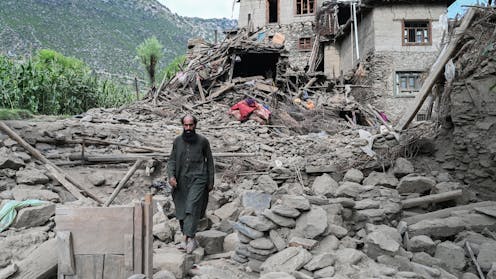
Wakil Kohsar/AFP via Getty images

El número de víctimas mortales tras el reciente terremoto en Afganistán sigue aumentando. Las autoridades sanitarias lideradas por los talibanes afirman ahora que al menos 800 personas han perdido la vida y 2 000 han resultado heridas.

El terremoto se produjo poco antes de la medianoche del domingo en una región montañosa cerca de la ciudad de Jalalabad, junto a la frontera oriental con Pakistán. Tuvo una magnitud relativamente baja, de 6,0. Sin embargo, su epicentro fue poco profundo, a 8 kilómetros bajo tierra, lo que provocó fuertes sacudidas en la superficie y una serie de réplicas.

La mayoría de las víctimas dormía en sus casas en el momento del terremoto y quedó sepultada por el derrumbe de los edificios. Debido a la lejanía de las zonas afectadas y al bloqueo de las redes de carreteras por los deslizamientos de tierra provocados por el terremoto, es posible que se tarde mucho tiempo en conocer el número exacto de fallecidos.

Una región propensa a los terremotos

Las montañas del Himalaya y el Hindu Kush, y sus estribaciones, donde se encuentra la zona afectada en Afganistán, son sísmicamente activas debido a la fricción continua entre las placas tectónicas euroasiática e india.

Esto ha provocado algunos de los terremotos más devastadores de la región, como el de Gorkha de 2015 en Nepal y el de Cachemira de 2005 en Pakistán.

Afganistán también sufre una buena cantidad de seísmos, especialmente en la región actualmente afectada. En octubre de 2023, un terremoto mató a más de 1 500 personas. El año anterior, más de mil personas murieron a causa de otro de estos eventos.

El terremoto de 2011 en Christchurch, Nueva Zelanda, fue de una magnitud similar y se produjo a una profundidad menor que el más reciente en Afganistán. Sin embargo, a pesar de que afectó a una ciudad densamente poblada, solo murieron 185 personas.

Los cientos de fallecidos en aldeas rurales dispersas de Afganistán presentan un marcado contraste.

Los terremotos no matan a las personas, los edificios sí

Una frase muy citada, “los terremotos no matan a las personas, los edificios sí”, ayuda a comprender los factores que contribuyen al elevado número de víctimas mortales causado por este terremoto y otros anteriores en Afganistán.

Las comunidades rurales no pueden permitirse materiales de construcción resistentes y manufacturados. Por ello, construyen sus viviendas con materiales naturales disponibles en la zona, como tierra, piedra y madera en bruto.

Estos edificios no siguen los diseños de ingeniería, los códigos de construcción ni las normas profesionales formales que evitan que se produzcan daños sustanciales en los países más ricos.

Una forma típica de construcción en las zonas rurales afganas son las paredes hechas de ladrillos de barro o mampostería de piedra. Esto se conoce como construcción “monolítica”.

Este tipo de edificación no es capaz de resistir los fuertes movimientos laterales causados por un terremoto. Como resultado, los edificios se derrumban fácilmente y aplastan a las personas. Informes de aparición de escombros donde antes había edificios están surgiendo ampliamente en Afganistán, como también ocurrió en seísmos anteriores.

Un detonante para el cambio en el diseño

Los ejemplos de otros países de la región demuestran que se puede lograr un mejor nivel de diseño de edificios resistentes a los terremotos en condiciones socioeconómicas similares.

Después del seísmo de Cachemira de 2005 en Pakistán, el Gobierno creó la Autoridad para la Reconstrucción y Rehabilitación tras el Terremoto, que ayudó a las personas afectadas a construir viviendas más seguras mediante un programa comunitario respaldado por orientación técnica.

En Nepal, tras los terremotos de Gorkha de 2015, el Gobierno estableció las normas mínimas de su Código Nacional de Construcción, que permiten que las reglas generales cumplan con un nivel básico de resistencia a los terremotos.

Hace más de 25 años, el ingeniero indio Anand Arya, pionero en su enfoque para reducir el riesgo sísmico en edificios “no diseñados”, incorporó la suma de bandas continuas en las paredes y refuerzos en las esquinas de un edificio y a lo largo de puertas y ventanas, lo que puede proporcionar resistencia a los edificios tradicionales de mampostería.

Estos ejemplos demuestran que no siempre se necesita mucho dinero para mejorar la resistencia a los terremotos. Un cierto grado de apoyo técnico e institucional puede lograr la seguridad de manera rentable.

Es cierto que estos edificios no estarían totalmente a prueba de terremotos. Sin embargo, seguirían aportando un nivel de resistencia que podría reducir los daños y, lo que es más importante, salvar vidas.

Cabe esperar que el seísmo afgano sea el detonante de una iniciativa de este tipo en el país, de modo que un proceso de “reconstrucción mejorada” pueda ayudar a las comunidades afectadas a ser más resilientes ante futuros movimientos de tierra.

The Conversation

Iftekhar Ahmed no recibe salario, ni ejerce labores de consultoría, ni posee acciones, ni recibe financiación de ninguna compañía u organización que pueda obtener beneficio de este artículo, y ha declarado carecer de vínculos relevantes más allá del cargo académico citado.

ref. ¿Por qué ha sido tan mortífero el terremoto de Afganistán? – https://theconversation.com/por-que-ha-sido-tan-mortifero-el-terremoto-de-afganistan-264376

Qué es lo extraño en 3I/ATLAS, el objeto interestelar más observado del mundo

Source: The Conversation – (in Spanish) – By Josep M. Trigo Rodríguez, Investigador Principal del Grupo de Meteoritos, Cuerpos Menores y Ciencias Planetarias, Instituto de Ciencias del Espacio (ICE – CSIC)

Vista superior de la Vía Láctea que muestra las órbitas del Sol (líneas punteadas amarillas) y la del cometa 3I/ATLAS (líneas discontinuas rojas). M. Hopkins/Ōtautahi-Oxford team ESA/Gaia/DPAC, CC BY-SA

Mucho se ha escrito en prensa durante las últimas semanas del cometa 3I/ATLAS, sobre la supuesta incertidumbre en su naturaleza. El seguimiento realizado con todo tipo de instrumentación lo convierten en el objeto interestelar mejor observado hasta la fecha. Y, pese a las muchas elucubraciones vertidas, tanto las imágenes como los espectros de reflexión apuntan claramente a su naturaleza cometaria. No es en ningún caso un extravagante objeto desconocido para la ciencia.

De hecho, nuestro grupo de investigación sobre Asteroides, Cometas y Meteoritos en el ICE-CSIC/IEEC le ha seguido la pista desde los primeros días, midiendo su posición y obteniendo precisas medidas fotométricas. Ya en imágenes obtenidas el 5 de julio con el Telescopio Robótico Joan Oró podía apreciarse su coma, característica de los cometas.

Más parecido a un asteroide que a un cometa

En un nuevo trabajo, liderado por la profesora Bin Yang de la Universidad Diego Portales de Chile, publicado en ArXiv, se ha empleado instrumentación puntera en los telescopios Gemini-S/GMOS y NASA IRTF/SpeX. Los días 5 y 14 de julio de 2025 obtuvieron espectros del objeto tras su descubrimiento, tanto en la banda visible como en el infrarrojo cercano.

Esas observaciones se realizaron al poco de ser detectado, evitando así que la actividad del cometa asociada a la sublimación de hielos apantallase otros aspectos de su naturaleza.

Sin espacio para la duda, ambos espectros apuntan a que el objeto interestelar es un cometa.

En el rango óptico, 3I/ATLAS muestra una pendiente enrojecida que lo asemeja al de ciertos asteroides de nuestro sistema solar de clase espectral D. Se trata de asteroides muy oscuros (albedo bajo), con un espectro muy rojo y una composición rica en carbono. Son raros y tienen poca reflectividad.

El espectro en la ventana del infrarrojo cercano de 3I/ATLAS se aplana significativamente, aproximadamente a una tasa de 0.9 a 1.5 micrones, similar al comportamiento espectral de grandes granos de hielo de agua en la coma de los cometas.

Los autores del trabajo, entre los que se encuentra la prestigiosa astrobióloga Karen J. Meech, modelaron el comportamiento espectral del cometa 3I/ATLAS. Emplearon una mezcla de polvo al 70 % del del meteorito (condrita carbonácea) Tagish Lake y un 30 % de hielo de agua con un tamaño medio de 10 micras. De hecho, esa fracción de hielo del ~30% obtenida podría interpretarse como una estimación aproximada de la composición de la coma.

En general, todos los estudios y observaciones realizadas hasta la fecha apuntan a que es un cometa interestelar activo que contiene abundante hielo de agua, con una composición de polvo más similar a la de los asteroides tipo D que a la de los objetos transneptunianos. Esto podría ser consistente con la idea de que se formase en una región interior de un sistema planetario, siendo expulsado por un tirón gravitacional experimentado en su encuentro con un planeta. En cualquier caso los escenarios permanecen abiertos pues cabrá esperar a las observaciones que realicen diversas sondas espaciales del intruso, siendo la misión Psyche de la NASA la major situada.

La coma del cometa 3I/ATLAS

También se ha especulado con la idea de que el 3I/ATLAS no presenta una coma extendida como otros cometas, pero esa idea es falsa. Básicamente, siendo un objeto cuyo diámetro es de pocos kilómetros, no lo hubiéramos descubierto sin haber presentado esa envoltura que llamamos coma y que lo hace visible a miles de millones de kilómetros.

La coma posee una composición que sería representativa del material sublimado pero quizás no del interior mismo del objeto. La componente gaseosa de la coma está dominada por dióxido de carbono, produciendo una envoltura de unos 350.000 km alrededor del núcleo cometario.

Dicha envoltura además del gas contiene partículas de polvo de tamaño micrométrico que se desprenden del cometa debido a la sublimación de los hielos. El polvo está embebido entre los materiales helados que son calentados en su acercamiento al Sol. En el caso de un cometa interestelar deberíamos esperar un manto irradiado por rayos cósmicos a lo largo de los miles de millones de años que lleva circulando por la Vía Láctea. Quizás por esa razón su actividad cometaria aparezca aletargada y restringida en volátiles.

Las observaciones infrarrojas muestran que la componente sólida de la coma, desprendida por la presión hacia afuera del gas sublimado aparece dominada por pequeñas partículas de hielo de agua y polvo que se asemeja a una clase de meteorito asociado a las condritas carbonáceas, procedentes de un tipo de objetos llamados transicionales: a mitad de camino entre un asteroide y un cometa.

Así pues 3I/ATLAS no tiene nada de extraño, salvo que se trata de un material que nos resulta familiar pese a haberse formado necesariamente en un lejano sistema planetario.

The Conversation

Josep M. Trigo Rodríguez recibe fondos del proyecto del Plan Nacional de Astronomía y Astrofísica PID2021-128062NB-I00 financiado por el MICINN y la Agencia Estatal de Investigación.

ref. Qué es lo extraño en 3I/ATLAS, el objeto interestelar más observado del mundo – https://theconversation.com/que-es-lo-extrano-en-3i-atlas-el-objeto-interestelar-mas-observado-del-mundo-264219

Donald Trump was once India’s best friend. How did it all go wrong?

Source: The Conversation – Global Perspectives – By Ian Hall, Professor of International Relations, Griffith University

Just months into President Donald Trump’s second term in office, one of the United States’ most important strategic partnerships is in crisis.

Relations between the US and India are at their lowest ebb in a quarter of a century. Things are so bad that Indian Prime Minister Narendra Modi has reportedly refused to accept calls from Trump for more than two months.

In recent days, Trump labelled trade ties with India a “totally one-sided disaster” and a report emerged that he is no longer planning to visit India later this year for a summit of the Quad partners (India, the US, Australia and Japan).

So bad, so quickly

Things were not meant to happen this way. Many in New Delhi were delighted when Trump won the election last year. Modi congratulated his “friend” on X, along with pictures of the two embracing and holding hands.

India’s foreign minister, S. Jaishankar, told journalists that while other countries might be “nervous” about Trump’s return, India was not.

Feeling confident, Modi went to Washington to meet Trump days after his return to office. The encounter did not go well.

On the eve of the meeting, Modi was embarrassed by distressing images of Indian nationals, handcuffed and shackled, being deported from the US on a military aircraft.

In the Oval Office, he promised to buy more US arms, oil and gas, and asked that Trump not impose punitive tariffs on India. Modi failed to get that commitment.

A few weeks later, Trump announced India would be hit with a 27% tariff – far higher than the 10% imposed on China – unless it could negotiate something better.

Crisis in Kashmir

Begrudgingly, New Delhi began to talk trade. US Vice President JD Vance visited India in late April and both sides made positive noises about a deal. But while Vance was in town, India was engulfed in a new crisis.

On April 22, terrorists killed 26 people – mostly Hindu tourists – in Kashmir, long the site of simmering conflict between India and Pakistan. The Modi government pledged to respond with force, as it had done in the past after similar incidents.

On May 7, India bombed what it claimed were militant camps in Pakistan and Pakistan-administered Kashmir. A rapidly escalating, unpredictable conflict followed, as both sides used drones and missiles to attack one another.

Alarmed, governments around the world urged the two nuclear-armed states to end hostilities before matters got out of control. Early in the morning on May 10, they did, and agreed to a ceasefire.

Trump anoints himself peacemaker

Before either the Indian or Pakistani governments had a chance to say anything, Trump stepped in to take credit.

On social media, he announced both sides had agreed a deal. The next day he claimed they would soon sit down with him as mediator and find a solution to the Kashmir conflict.

Islamabad was jubilant at this outcome. New Delhi, meanwhile, was furious.

India’s longstanding view is that the Kashmir dispute must be settled bilaterally, without third-party involvement. The US has accepted this position for more than 20 years. Now it appeared Trump was taking a different view.

This put Modi in a bind. Keen to maintain a mutually beneficial partnership and avoid punitive tariffs, he did not wish to upset Trump.

But he could not acknowledge Trump’s claims without setting aside a fundamental principle of Indian policy. So, Modi called Washington and explained he would not accept mediation over Kashmir.

The final straw

Meanwhile, Pakistan saw an opportunity to win favour in Washington and drive a wedge between the US and India.

Recognising that Trump covets a Nobel Peace Prize, Islamabad nominated him for his supposed role in ending the conflict.

Enthused, Trump called Modi on June 17 and asked him to do the same. Worse still, Trump requested Modi stop in Washington on the way back from the G7 summit in Canada, and meet with Pakistan’s military chief, Asim Munir.

According to a recent report, that was the final straw for Modi. He flatly refused both requests. The two men reportedly haven’t spoken since.

Piqued, Trump responded by punishing India for continuing to buy Russian oil by lifting its tariff rate to 50% and postponing trade talks.

New Delhi’s dilemma

Trump’s actions have ordinary Indians seething and demanding action, but the Modi government does not have good options.

Giving in to coercion would make Modi – dubbed by political opponents “Narender Surrender” – look weak. Yet, no other major power can offer India what it needs in terms of markets, investment, technology, weapons and diplomatic support.

With US-India relations strained, New Delhi has been working hard to stabilise its relationship with China, which has been tense since bloody border clashes between the two in 2020.

Modi went to China for the first time in seven years on August 31 to further that aim, shaking hands with President Xi Jinping. But although Xi emphasised the need for amicable ties – he said the “elephant and dragon should dance together” – there is little trust between India and China at present.

Modi has more faith in Russia. In China, Modi and Russian President Vladimir Putin reportedly spoke for nearly an hour in Putin’s limousine. And Modi will host the Russian leader for more talks in India later this year. However, Russia remains a pariah in Europe, with limited means to help.

Other countries, like Japan, where Modi stopped off on his way to China, could also help India navigate the current crisis. But they do not have the clout to resolve it.

Unless Modi can find a way to win Trump back, India’s next few years could be very difficult.

The Conversation

Ian Hall has received funding from the Australian Research Council, Department of Defence, and Ministry of Foreign Affairs of Japan. He is an honorary Academic Fellow of the Australia India Institute.

ref. Donald Trump was once India’s best friend. How did it all go wrong? – https://theconversation.com/donald-trump-was-once-indias-best-friend-how-did-it-all-go-wrong-264272

Trump’s tariffs are headed to the US Supreme Court, prolonging the chaos on trade

Source: The Conversation – Global Perspectives – By Felicity Deane, Professor of Trade Law and Taxation, Queensland University of Technology

Trading partners of the United States are facing a fresh period of uncertainty after a US federal appeals court ruled President Donald Trump’s “reciprocal” tariffs were illegal.

In a 7-4 majority, the judges ruled Trump had exceeded his power by invoking emergency powers to impose tariffs of “unlimited duration on nearly all goods from nearly every country in the world”, upholding an earlier court decision.

The ruling will throw into disarray the strategies of trading partners still in negotiations with the US, who may decide to wait and see the outcome of the legal battle.

Although there are different options available to challenge the decision, Trump has made it clear the next stop will be the Supreme Court.

The US Court of Appeals for the Federal Circuit said the tariffs would remain in place until October 14, to allow time for further appeals.

The power to tax rests with Congress

The ruling tested the limits of executive power under the International Emergency Economic Powers Act (IEEPA) from 1977. Trump is the first president to use this act to impose tariffs, setting the stage for a test of executive power. At least for now, it is a test the administration appears to have failed. The judges rejected Trump’s interpretation, which they said would place no limit on the president to raise revenue without any authorisation from Congress.

Citing Article 1, section 8, of the US Constitution, the majority judgement unequivocally stated that “tariffs are a tax” and the power to tax under the Constitution rests with Congress.

In upholding an earlier decision by the Court of International Trade, the appeals court majority noted:

if the President can declare an emergency to cut the deficit by raising taxes in whatever way he wishes, not much remains of Congressional authority over taxation.

The tariffs are still in place

There were two important outcomes from this latest decision. First, the “liberation day” tariffs are (currently) deemed illegal. Second, these “illegal” tariffs will temporarily stay in place to allow for the appeal options to be explored.

Revenue will continue to be collected under the executive orders in question. Should the tariffs be deemed illegal on appeal, that revenue may need to be returned.

This ruling does not apply to all tariffs. It doesn’t cover specific sector tariffs such as those on aluminium and steel. However, other tariffs imposed during the first Trump presidency have already been ruled illegal under World Trade Organization rules and are currently the subject of appeal under the multilateral dispute settlement system.

The latest ruling would not reverse the decision to suspend the de minimis exception that caused global postage chaos. However, if the ruling is upheld, the rate of tariffs on low-value goods would revert back to pre-“liberation day” percentages. In many instances, this would mean back to zero.

What about the deals?

Trading partners initially responded with panic to the unveiling of Trump’s chaotic tariff agenda in April. There was a rush to meet with the president and make so-called deals. So what should governments of trading partners do now?

The most logical response might be to wait out the US legal process, because there may be no point in making deals if the tariffs are upheld to be illegal.

Unfortunately, this means continued uncertainty for business. On one hand, the courts may determine the tariffs are unlawful and must therefore be revoked. But Congress could subsequently move to reimpose tariffs with fresh legislation, or Trump could try other legal avenues.

The Constitution vs loyalty to Trump

If the administration does decide to appeal to the Supreme Court, the important test will not necessarily be about tariffs but whether the US Constitution will continue to support the separation of powers.

The appeals court decision argues the IEEPA does not support the introduction of tariffs of the magnitude of the “liberation day” tariffs. What the IEEPA does allow is for the president to “regulate […] importation”. However, the court suggested this phrase is nothing more than

a wafer-thin reed on which to rest such sweeping power.

Although the appeals court noted that such arguments have been rejected by the Supreme Court in the past, we will have to wait and see whether it is a “wafer-thin reed” that will become doctrine.

The Supreme Court has a conservative majority, with six of nine judges appointed by Republicans, including three in Trump’s first term.

The Supreme Court has already granted the president immunity from prosecution in some circumstances. If the majority decides to allow these widespread and indefinite tariffs, they may be one step closer to creating an American monarch.

The Conversation

Felicity Deane does not work for, consult, own shares in or receive funding from any company or organisation that would benefit from this article, and has disclosed no relevant affiliations beyond their academic appointment.

ref. Trump’s tariffs are headed to the US Supreme Court, prolonging the chaos on trade – https://theconversation.com/trumps-tariffs-are-headed-to-the-us-supreme-court-prolonging-the-chaos-on-trade-264249

China may not invade Taiwan, but rather blockade it. How would this work, and could it be effective?

Source: The Conversation – Global Perspectives – By Claudio Bozzi, Lecturer in Law, Deakin University

US officials believe Chinese President Xi Xinping has set a deadline for his military to be capable of invading Taiwan by 2027 – the centennial anniversary of the founding of the People’s Liberation Army (PLA).

US Secretary of Defense Pete Hegseth mentioned this date at a security conference in Singapore in May, warning of the “imminent threat” China poses to Taiwan.

The PLA has invested heavily in expanding and modernising its operations in recent years. Since 2015, it has built the world’s largest navy and coast guard.

But rather than threaten an invasion of Taiwan, China seems increasingly likely to pressure the self-governing, democratically ruled island with an extended blockade to force it to capitulate.

In preparation for such a possible action, China has developed a new command structure enabling it to coordinate its air, sea and land-based weapons systems to enact a strategy of lianhe fengkong (联合封控), or joint blockade. This would effectively cut Taiwan off from the outside world.

In late July, the Centre for Strategic and International Studies (CSIS) produced a report on 26 simulated war games it conducted to determine what a Chinese blockade of Taiwan would look like.

Taiwan’s natural gas supplies were predicted to run out after ten days of a blockade. Coal and oil supplies would run out in a matter of weeks. If Taiwan’s electricity was reduced to 20% of its pre-blockade levels, all manufacturing would cease. Casualties were expected to be in the thousands.

Taiwan is particularly vulnerable to a blockade. It relies more than any other developed nation on port calls relative to the size of its economy. Its biggest ports are on its west coast, facing mainland China. The island also has limited emergency food and fuel reserves.


What is a blockade under the law?

Imposing a naval blockade during armed conflict is an established right under customary international law. Blockades are not illegal per se, but they must comply with the laws of war. It’s a complicated and controversial area of the law.

To be legal, a blockade must first be effective. That is, the blockading power must maintain a force that prevents access to the enemy’s coast.

Other nations must be notified of the instigation of the blockade and its geographical extent.

A blockade must be enforced impartially against all vessels, except neutral vessels in distress. Any vessel breaching the blockade would be subject to being stopped, captured or fired upon.

Lastly, a blockade cannot prevent access to neutral ports or the delivery of humanitarian assistance to civilians.

Blockade strategies

China may use one of several blockade strategies against Taiwan. In contrast to an invasion, blockades can be scaled up or back, or reversed, depending on the unfolding security situation.

For instance, China may attack merchant shipping vessels seeking to enter Taiwanese waters to deliver essential cargo, coercing Taiwan to submit to China’s takeover. This is known as a kinetic blockade.

Alternatively, it may implement its preferred strategy of “winning without fighting”. Given the sheer size of its navy, coastguard and maritime militia, China could simply encircle the island and block access to its ports.

This could isolate Taiwan from the global economy to the point of forcing it to surrender, or weaken it sufficiently to enable an invasion, without engaging in open hostilities. This is a non-kinetic blockade.

Other ways of impeding naval passage

China may also use measures that fall short of a blockade, but have similar effects. It has passed a suite of domestic laws that legitimise military and non-military aggression of this kind.

For example, the navy or coast guard may:

  • lay mines in the sea without declaring a formal blockade
  • establish maritime danger or exclusion zones for foreign ships, and
  • intercept, detain and regulate foreign vessels.

These tactics would only be effective because China’s domestic laws have exploited ambiguities in jurisdiction over its surrounding waters.

For example, China has passed laws requiring notification from foreign vessels if they enter waters it considers its own and under its control, and allowing its ships to alter or suspend maritime traffic for security or military purposes.

Those powers, however, are inconsistent with international law. China, for example, considers the Taiwan Strait as Chinese territory. Under the UN Convention on the Law of the Sea, however, the strait is considered international waters, which enables freedom of navigation for all vessels.

Also, creating an unstable security environment around Taiwan (similar to what Houthi forces have done in the Red Sea), or threatening penalties and sanctions for failing to comply, may in effect be tantamount to a blockade.

How to counter a blockade

It is not clear how other nations would respond to a Chinese invasion or blockade.

In recent years, China has attempted to project its naval power by establishing no-go zones in its neighbourhood, such as turning the South China Sea into its own fortified waters.

One way to oppose China, then, would be a counter-blockade. This would entail allied naval forces, likely led by the United States, closing the choke points, such as the Malacca Strait, on which Chinese seaborne trade with global markets depends.

However, counter-blockades are problematic, too. The impact on the world economy would be huge, as a blockade of the Malacca Strait, for example, could impact all trade between Asia and the rest of the world. China has also stockpiled domestic resources and expanded its land-based trade routes in recent years.

The best option, then, might be supporting Taiwan to survive a long blockade, forcing China to back down.

This means helping Taiwan become more resilient by increasing its food, fuel and medicine stockpiles, developing robust communication and cyber defences, and strengthening its port and energy infrastructure.

If the US built up its naval capacity in the Pacific, it could also use frigates to escort convoys of merchant ships to break a Chinese blockade, though the CSIS war games indicated this could come at a considerable cost of lives and ships – and increase the potential for all-out war.

The Conversation

Claudio Bozzi does not work for, consult, own shares in or receive funding from any company or organisation that would benefit from this article, and has disclosed no relevant affiliations beyond their academic appointment.

ref. China may not invade Taiwan, but rather blockade it. How would this work, and could it be effective? – https://theconversation.com/china-may-not-invade-taiwan-but-rather-blockade-it-how-would-this-work-and-could-it-be-effective-257731

What chaos at the US CDC could mean for the rest of the world

Source: The Conversation – Global Perspectives – By Michael Toole, Associate Principal Research Fellow, Burnet Institute

Ever since Robert F Kennedy (RFK) Jr was appointed United States Secretary of Health and Human Services, the Centers for Disease Control and Prevention (CDC) has been under pressure to abandon its traditional evidence-based approach to public health in America and across the world.

That pressure came to a head last week with the sacking of recently appointed CDC director Susan Monarez. According to her lawyers, the longtime government scientist, who had been in the role less than a month, was targeted after she refused to “rubber-stamp unscientific, reckless directives”.

Monarez will be replaced by Jim O’Neill, deputy director of the Department of Health and Human Services. Critics note he has no medical or scientific training.

On the same day as Monarez’s firing, three senior officials resigned. They included the CDC’s chief medical officer, and two others with leadership roles in areas including vaccines and emerging diseases.

I worked at the CDC between 1986 and 1995. Almost all of my work was with activities overseas.

While the CDC is a key institution overseeing and funding public health in the US, it’s also instrumental in global health. Consequently, turmoil at the CDC could have an impact not just in the US, but around the world.

Vaccine scepticism: a threat to public health

Soon after the inauguration of US President Donald Trump for the second time in January 2025, threats to American public health became clear. RFK Jr was confirmed as the Secretary of Health and Human Services in February, with authority over the CDC.

By April, 25% of CDC staff had been fired and its contract spending was cut by 35%. Cancelled CDC programs included those focused on the prevention of lead poisoning in children, environmental health, and sexually transmitted infections including HIV.

Notably, RFK Jr has a long history of vaccine scepticism.

In 2019–20, more than 5,700 people became infected when a measles outbreak ravaged the island nation of Samoa. Some 83 people died, most of them children.

In the lead up, a number of ads spread vaccine misinformation on Facebook, sowing doubt about safety of the measles vaccine. Some were found to have been funded by Children’s Health Defense, an organisation founded by RFK Jr.

RFK Jr’s department has dismissed and replaced the 17 expert members of the Advisory Committee on Immunization Practices with eight new people – a number of whom have reportedly expressed anti-vaccination views.

During RFK Jr’s tenure so far, his department has:

RFK Jr is arguably the most important figure overseeing health in the US. It’s difficult to overestimate the harm his actions will do to vaccine confidence and uptake in America and around the world.

A long history of international aid

While the CDC had long provided advice to the World Health Organization (WHO) on malaria control, the first major overseas initiative was as an active partner in the WHO’s successful global smallpox eradication program. Along with the Soviet Union, the CDC initially focused on West Africa in the 1960s and then India and Bangladesh in the 1970s.

The CDC’s first international emergency health response occurred during the Biafra conflict, which led to widespread famine in the Eastern part of Nigeria. In 1968, at the request of the International Committee of the Red Cross, the CDC mobilised staff to monitor nutrition and design programs to combat malnutrition.

The agency’s largest ever overseas intervention began in March 2014 when an Ebola outbreak occurred in Guinea, Sierra Leone and Liberia. By July 2015, the CDC had allocated 3,000 staff to Ebola, with 1,200 on the ground in West Africa, including neighbouring countries such as Nigeria and Senegal. CDC staff provided technical advice on strengthening laboratory diagnosis, contact tracing and surveillance.

Following the Ebola outbreak, the Global Health Security Agenda was established as a coordinated epidemic preparedness initiative with members from more than 60 countries, United Nations agencies and non-governmental organisations. The Obama administration funded US involvement generously with the CDC leading US contributions.

Threats to global health

The first sign of a US withdrawal from global health came soon after Trump’s inauguration when he signed executive orders cancelling US membership of the WHO and suspending all US foreign development assistance.

This led to the cancellation of large programs to prevent and treat HIV and AIDS, malaria, tuberculosis and hepatitis.

Soon after, CDC officials were ordered to cease all communications with the WHO, leading to CDC experts leaving global advisory committees, among other things.

The dismantling of the US Agency for International Development (USAID) has led to a loss of 83% of its programs and the cancellation of 5,200 contracts. This has stymied its ability to effectively deliver lifesaving aid, including in countries devastated by conflict and famine, such as Sudan. One study predicted the cuts in USAID funding could lead to 14 million extra deaths by 2030.

Budget and staff cuts have seriously reduced the CDC’s capacity to engage in global initiatives. For example, the Maternal and Child Health Branch was shut down and all 22 staff terminated. This branch helped low- and middle-income countries implement programs to prevent HIV in pregnant women and their babies.

The loss of financial resources and a large number of expert staff means the agency faces an uncertain future. Interference in its procedures to develop science-based health policies will gravely affect its ability to carry out its mandate both domestically and globally. The CDC has lost the trust of the American people and is no longer regarded as the preeminent public health agency in the world.

Governments, research institutes and health development agencies around the world must unite to decry this loss of global health expertise. Millions of lives depend on forceful action.

The Conversation

Michael Toole receives funding from the National Health and Medical Research Council. He worked for the US CDC between 1986 and 1995. The content of this article represents the views of the author and not those of the Burnet Institute.

ref. What chaos at the US CDC could mean for the rest of the world – https://theconversation.com/what-chaos-at-the-us-cdc-could-mean-for-the-rest-of-the-world-264188

80 years since the end of World War II, a dangerous legacy lingers in the Pacific

Source: The Conversation – Global Perspectives – By Stacey Pizzino, Lecturer, School of Public Health, The University of Queensland

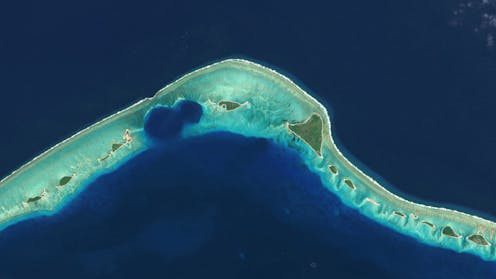
Aerial view of Enewetak Atoll showing nuclear test craters. Gallo Images/Orbital Horizon/Copernicus Sentinel Data 2021

On September 2, 1945, the second world war ended when Japan officially surrendered. Today, on the 80th anniversary, the physical legacy of the conflict remains etched into land and sea.

Nowhere is this more evident than in the Pacific. There, fierce battles left behind sunken warships, aircraft and unexploded bombs. These remnants are not only historical artefacts but toxic time capsules.

They leak fuel, heavy metals and other hazardous substances into fragile ecosystems, threatening biodiversity and, potentially, human health.

This problem is a reminder of the enduring environmental harms of conflict. Toxic remnants of war can damage ecosystems and communities long after the fighting stops.

The Pacific as a dumping ground

World War II in the Pacific involved four years of conflict between Japan and Allied forces. The war began in the region in December 1941 when Japan attacked a United States naval base at Pearl Harbour, Hawaii.

The Pacific conflict included the Battle of the Coral Sea, the Battle of Midway and the Guadalcanal campaign in the Solomon Islands.

Pacific islands became staging grounds for battles. Weapons were stockpiled and hazardous material discarded. Ships and aircraft were sunk. When the war ended, much of this material was simply left behind.

Among the remains are an estimated 3,800 wrecks still lying on the Pacific Ocean floor.

An environmental hazard

As remnants of war degrade, they often leach toxic pollutants into nearby waters and soils. These can build up in marine life, enter the food chain and pose serious risks to both biodiversity.

At Palau, a WWII Japanese ship sank in Koror Harbour and became known as the Helmet Wreck. It contains Japanese depth charges leaking acid into surrounding waters.

Researchers have shown the long-term environmental impacts in the Baltic Sea of unexploded WWII ordnance – bombs, shells and grenades that failed to detonate. An estimated 3000kg of dissolved ammunition chemicals have been found.

Coral reefs and mangroves, which are vital for coastal protection, are especially vulnerable to both chemical exposure and physical damage.

For example, researchers examined the effects off Puerto Rico of unexploded ordnance. They found nearby sea animals contained potentially toxic compounds leaking from the ordnance, which meant the substances had entered the food web.

Human communities on high alert

Unexploded ordnance continues to endanger communities. Just last year, for example, more than 200 bombs were found buried beneath a school in the Solomon Islands.

In places such as Palau, Papua New Guinea and the Solomon Islands, these dangers are unearthed regularly. They can be found by farmers working their land, children playing or fisherman working.

Buried bombs, sunken ships and downed aircraft often contain fuel and heavy metals. This includes lead and cadmium which can interfere with the body’s hormone system and cause serious health issues.

Research into the human health impacts of war remains is limited – especially in the Pacific. But existing studies suggest exposure is linked to serious consequences.

For example, parental exposure to wartime contaminants has been linked to birth defects in Gaza and Vietnam.

And a study of Britsh Army ammunition technicians released earlier this year found significantly higher rates of bladder cancer than the general population. This suggests occupational exposure to explosive compounds may pose long-term health risks.

Climate change is increasing the risk

As Earth’s climate warms, extreme weather events are worsening and seas are rising. This is exacerbating the dangers posed by wartime remnants.

For example Cyclone Pam, in March 2015, exposed unexploded WWII ordnance in Kiribati and Tuvalu. Further investigations revealed remnants including high explosive projectiles, mortars and 5,300 rounds of ammunition.

In 2020, a visiting fisherman found an unexploded bomb near Lord Howe Island. Then-Environment Minister Sussan Ley suggested the device may have been shifted by a cyclone or ocean currents.

Similarly, floods and landslides can move these hazards over significant distances, increasing uncertainty around their locations and complicating clearance efforts.

Rising sea levels are threatening to breach one of the Pacific’s most toxic legacies – the Runit Dome in the Marshall Islands. This concrete structure was built in the late 1970s to contain radioactive waste from US nuclear testing decades earlier.

Research shows extreme storms could increase radioactive sediments in the area to up to 84 times higher than normal. There are also concerns cracks in the dome’s surface could lead to contamination of surrounding waters.

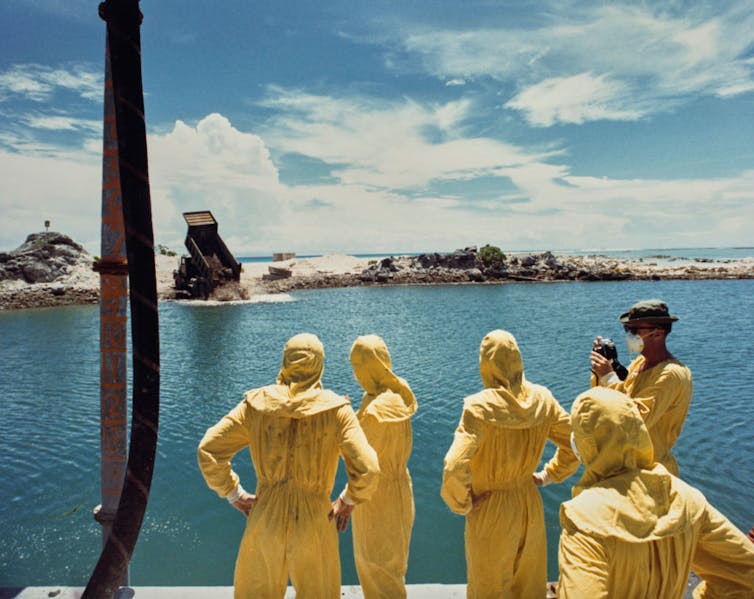
Five people in yellow protective clothing stand near the water.
In this 1978 photo from Runit Island, military personnel in protective clothing watch as concrete and soil is used to cover up a crater left by the US after it conducted nuclear tests decades earlier.
Department of Defense/US Army/FPG/Archive Photos/Getty Images

Reflecting on war’s toxic legacy

Despite the risks to people and health in the Pacific, remediation has been slow. The 80th anniversary of WWII offers an opportunity to reflect on the toxic legacy of war – and to act.

The scale of the problem demands coordinated, well-funded action. The work should not just remove dangerous materials, but restore damaged ecosystems and monitor long-term health impacts.

Some support has been offered. It includes Operation Render Safe, a program to remove war remnants led by the Australian Defence Force. But more is needed.

Regional partners – including Australia, New Zealand, Japan and the United States – have a chance to lead. This means investing in environmental cleanup, supporting affected communities and acknowledging historical responsibility.

It also means listening to Pacific voices, who have long called for greater attention to the war’s toxic legacy. Their knowledge, resilience and lived experience must be central to any response.


The authors acknowledge Nixon Panda for his contribution to this article.

The Conversation

The authors do not work for, consult, own shares in or receive funding from any company or organisation that would benefit from this article, and have disclosed no relevant affiliations beyond their academic appointment.

ref. 80 years since the end of World War II, a dangerous legacy lingers in the Pacific – https://theconversation.com/80-years-since-the-end-of-world-war-ii-a-dangerous-legacy-lingers-in-the-pacific-264127