How is paint made?

Source: The Conversation – USA (2) – By Dawn Rogala, Paintings Conservator and Program Manager, Smithsonian Institution

Protective paint sprayed onto a steel plate in a factory will have a different recipe than paint used in an art class. gilaxia/E+ via Getty Images

Curious Kids is a series for children of all ages. If you have a question you’d like an expert to answer, send it to curiouskidsus@theconversation.com.


How is paint made? – Atharva, age 11, Bengaluru, India


Did you ever mix dirt and water when you were playing outside? You made a paint. Did you draw shapes on the ground with your muddy hands? You made a painting.

Paint is made by combining a colorful substance – a pigment – with another material that binds the color together and helps spread that color onto surfaces such as paper, fabric or wood. Pigments can be found everywhere – in rocks and minerals, plants or insects. Some colors are made by scientists in laboratories.

Long ago, artists made their own paints by mixing pigments with natural materials such as water, oil or egg yolk to hold the colors together in a paste. Artists today can still make their own paints, or they can order them from factories that mix, package and ship paint all over the world. Paint companies use large, industrial machines to grind pigments and binders together; these commercial paints include synthetic materials and preservatives to control the paint’s behavior and to help paint last longer in tubes or cans.

Paints and coatings do many jobs beyond just coloring paper in an artist’s studio. They are also used as protective coatings to shield houses and cars from the sun or the cold, or as a barrier between boats and the water that surrounds their wood, metal or plastic parts. Where and how a paint will be used influence how it’s made and with what ingredients.

an open box of watercolor paints with splatters of color on the case
Watercolor sets like this one used by artist Alma Thomas can be found in art classrooms around the world.
Anacostia Community Museum, Smithsonian Institution, Gift of David Driskell, CC BY

Choosing the right materials

A lot of questions need to be answered before materials are chosen for a paint.

  • Who will use the paint? An artist, a house painter, an armadillo, a robot at an assembly plant?
  • Why is the paint being used? For museum paintings and sculptures? In designs for furniture or mailboxes?
  • How will the paint be applied? By brush, by spray, or some other way?
  • Where and when will the paint be used? Does it need to dry quickly or slowly? Will the painted surface get really cold or hot? Is the paint safe for kids to use at home or school?
  • What should the paint look like? Should the dried paint be shiny or matte? Should the surface be lumpy, or should it flatten and level out? Should the colors be bright or dull? Should the paint layers be opaque, transparent or almost clear? Does the paint need to hold up against scuffs and stains?

There are many different companies that design and make the wide range of paints used around the world for all these various applications. Experts at each manufacturer understand their special type of paint, how the paint materials are measured and mixed, and the best ways to store and apply the paint. A single factory can make tens of thousands of gallons of paint each day, and paint companies produce millions of tubes of paint every year.

two boards with various colors of paint dried on them along with multiple paint brushes
Artist Thomas Moran’s palettes and brushes illustrate the way an artist mixes different paints to find just the desired qualities.
Smithsonian American Art Museum, Bequest of Miss Ruth B. Moran

Using paint to learn about the past

We work at the Smithsonian’s Museum Conservation Institute, where we study and conserve the diverse collection of painted objects at the Smithsonian – from planes and spacecraft to portraits of presidents and maps covered in abstract swirls of color. Bright coatings are part of everything from the painted clothing and cultural items of Native peoples to the pots and pans used by chef Julia Child.

Art conservators and conservation scientists like us work together to study and preserve cultural heritage such as paintings and painted objects. Studying paint helps us learn about the past and protect this history for future generations.

The paint colors used on large, traditional Indian paintings called “pichwai,” for example, include pigments gathered from around the world. They can reveal information about ancient manufacturing and how communities that lived far apart exchanged goods and knowledge.

There are many techniques to investigate artwork, from looking at small pieces of paint under a microscope to using more complicated equipment to analyze materials exposed to different types of energy. For example, we can use X-ray, infrared or ultraviolet imaging to identify different pigments in a painting.

three side by side images of the same painting, but one looks very dark, one is colorful, and one is grey and white
Conservation scientists will image the same work of art, such as this Indian pichwai, using ultraviolet fluorescence (left), visible light (middle) and infrared light (right).
National Museum of Asian Art, Smithsonian Institution, Gift of Karl B. Mann, S1992.28, Department of Conservation and Scientific Research, Orthomosaics and UV Fluorescence

Research on an Alaskan Tlingit crest hat made in the 1800s looked at the molecules in paint binders, combined with 3D scanning, to help clan members replicate the hat for ceremonial use.

Unusual uses bring conservation challenges

Artists use all sorts of materials in their artwork that were designed for other purposes. Some 19th- and early 20th-century sculptures were painted with laundry bluing – a material that used blue pigment to brighten clothes during washing. In the 1950s, artists started using thin, quick-drying house paint in their paintings.

When paints are used in a way that was not part of their design, strange things can happen. Paints made to be applied in thin layers but instead are used in thick layers can wrinkle and pucker as they dry. Paints designed to stick to rough wood can curl or lift away from slick surfaces. The colors and ingredients in paint can also fade or darken over time. Some artists want these different effects in their artwork; some artists are surprised when paints don’t behave the way they expected.

Art conservators and conservation scientists use information about artists and their paints to understand why artworks are faded, broken or acting in surprising ways, and they use that knowledge to slow or stop the damage. We can even clean some kinds of damage with lasers.

The more we know about paint, the more we learn about the past lives of painted objects and how to keep those objects around for a long, long time.


Hello, curious kids! Do you have a question you’d like an expert to answer? Ask an adult to send your question to CuriousKidsUS@theconversation.com. Please tell us your name, age and the city where you live.

And since curiosity has no age limit – adults, let us know what you’re wondering, too. We won’t be able to answer every question, but we will do our best.

The Conversation

The authors do not work for, consult, own shares in or receive funding from any company or organization that would benefit from this article, and have disclosed no relevant affiliations beyond their academic appointment.

ref. How is paint made? – https://theconversation.com/how-is-paint-made-245905

Young people in England and Australia are supposedly poor at learning languages – our research shows this isn’t true

Source: The Conversation – UK – By Abigail Parrish, Lecturer in Languages Education, University of Sheffield

Rawpixel.com/Shutterstock

Australia and England are both multicultural countries where hundreds of languages are spoken. However, in both, levels of language learning at school are worryingly low.

Australia has seen a major downturn in language learning. In 2021, fewer than 10% of students in year 12 – the final year of compulsory education – were studying a language.

Exam entry figures for England show the numbers of young people taking languages at GCSE is stabilising to some degree. However, since 2004, when a language subject was made optional after the age of 16, there has been a decrease of 35%.

In both countries, the lack of a strong language learning culture contributes to low enrolment and achievement rates in foreign language education. That both countries are English-speaking also leads to the idea that there is limited use in learning additional languages, because English is so widely spoken worldwide.

This has resulted in the perception that inhabitants of both Australia and England are poor language learners.

Appetite to learn

Our research suggests this is not necessarily true. There is an appetite for language learning among young people in both countries, along with support from their parents. However, challenges such as harsh grading and teacher recruitment problems have meant this doesn’t always translate into full classrooms.

As fewer young people take languages after the ages of 14 and 16, there is a knock-on effect at degree level and beyond. This affects the supply of new language teachers.

Australian educators consistently argue that making language learning compulsory for longer is vital to increasing participation in language subjects. However, research by one of us (Abigail) in England indicates that students who choose to study a language are more motivated than those for whom it is compulsory.

European languages have traditionally dominated language teaching in both countries. However, in England, Wales and Northern Ireland, GCSE entries in “other modern languages” – any language other than French, German, Irish, Spanish and Welsh – are rising. In Wales, government initiatives are attempting to secure the Welsh language learning pipeline from early years all the way to university, in addition to making Welsh more visible in media and daily life.

Numerous attempts have been made to improve Australia’s Asian language capacities, in an effort to strengthen regional ties. Despite over $337 million AUD (adjusted for inflation) of investment in government programs, the past 20 years have seen a continued decline in numbers studying Asian languages there. Only Korean has seen any growth – but this can mostly be attributed to the rise of K-pop, rather than any Australian government initiative.

Students round a table
Focusing on what interests students could be a successful strategy.
Rawpixel.com/Shutterstock

This musical phenomenon, along with other cultural exports such as the Netflix series Squid Game and the film Parasite, has seen interest in the Korean language grow globally.

Both England and Australia could use these successes to capitalise on language learning potential. Some Australian schools are already making the most of this wave of Korean popularity, called hallyu, to entice as many students as possible to the subject – but the language is not available as a school subject in England.

Australia is also taking steps to revitalise the teaching of Indigenous languages and to ensure their survival with future generations. Prior to colonisation, more than 250 Indigenous languages and 800 dialects were spoken throughout Australia. But a 2013 survey found only approximately 123 were in use, with only 12 being considered “strong”.


Read more:
‘It’s about making our children feel proud’: how schools can learn about local Indigenous language and culture


Australian primary students in particular have expressed a desire to learn Indigenous languages. This desire was also reflected in Louisa’s PhD data collection, with one university student saying: “If we have a look [at the languages spoken] internally, before we look externally, I think we’ll find a lot more answers, because there’s a wealth of resources here.”

This reflects a growing appetite among young people in Australia to learn Aboriginal and Torres Strait Islander languages as part of a more locally grounded education.

Through our work, we feel strongly that educators should listen more closely to what students are saying they want, rather than taking the well-worn route of telling them to learn a language for economic or strategic reasons.

By listening more closely to the interests and goals of young people in schools, we can start to provide teaching which supports their need for autonomy – even if, in the short-to-medium term, systemic problems such as the supply of teachers and resources also need to be addressed.

Students need to see the benefits of learning a language for themselves, and have the opportunity to connect with a language on their own terms. Louisa’s PhD thesis asked language students in Australia about improving language participation. As one participant answered, students need to realise “what a cool life they’re going to have from knowing a language”.

The Conversation

The authors do not work for, consult, own shares in or receive funding from any company or organisation that would benefit from this article, and have disclosed no relevant affiliations beyond their academic appointment.

ref. Young people in England and Australia are supposedly poor at learning languages – our research shows this isn’t true – https://theconversation.com/young-people-in-england-and-australia-are-supposedly-poor-at-learning-languages-our-research-shows-this-isnt-true-237249

Russia has provided fresh evidence of its territorial ambitions in Ukraine

Source: The Conversation – UK – By Jennifer Mathers, Senior Lecturer in International Politics, Aberystwyth University

After a meeting hosted by the French president, Emmanuel Macron on September 4, 26 countries have pledged to create a “reassurance force” to provide security guarantees for Ukraine in the event that a peace agreement with Russia is reached. The Russian president reacted by saying that Russia would target any European troops deployed in Ukraine.

He said if they appeared in Ukraine while Russia’s “military operation” was still underway, “we proceed from the fact that these will be legitimate targets for destruction”. And if a peace deal were eventually agreed, he added: “I simply do not see any sense in their presence on the territory of Ukraine, full stop.”

Russia is maintaining its demand that any peace deal should involve Ukraine ceding the regions it has occupied or part occupied: Crimea, Donetsk, Luhansk, Kherson and Zaporizhzhia.

But new evidence has come to light suggesting that Putin’s territorial ambitions in Ukraine go well beyond those regions.

A map, spotted in the background during a briefing given by Russia’s chief of the general staff, Valery Gerasimov, in August, shows the two countries divided by a thick black line. On the Russian side of the line are not only the five publicly claimed regions of Ukraine but also the territories of Odesa and Mykolaiv.

These areas, which hug the coastline of the Black Sea, are of considerable geostrategic significance. Russian occupation of Odesa and Mykolaiv would go a long way towards fulfilling one of Russia’s longstanding ambitions: domination of the Black Sea region.

Control of this territory would give Russia a land corridor to Transnistria, a breakaway region in eastern Moldova with strong pro-Russian sympathies. The leaders of Transnistria declared independence from Moldova following a civil war in the early 1990s. In a 2006 referendum, 97% of respondents supported Transnistria joining Russia. Russia currently has approximately 1,500 troops stationed there, and the territory has long been discussed in the west as a possible platform for a Russian invasion of Moldova.

Like Ukraine, Moldova was formerly part of the Soviet Union but is now orienting itself more towards western Europe and is currently seeking EU membership.

In addition to putting Russia in a strong position to exert pressure on Moldova, a more significant Russian presence in the Black Sea would increase Moscow’s ability to project power in neighbouring regions. This includes the Mediterranean, the Middle East and Africa.

Black Sea strategy

The Black Sea is also a vital site for east-west transport and communications. So much so that the European Union announced a Black Sea strategy in May 2025. The strategy recognises the region’s significance for different forms of security, including its importance for the environment, access to energy and other forms of trade and economic links. The EU plans to address these security issues by developing mutually beneficial partnerships with countries in the region.

Russian control of Ukraine’s Black Sea coast would be disastrous for Ukraine. It would mean the loss of Ukraine’s naval assets, which make extensive and effective use of maritime drones to target Russian ships and targets in occupied Crimea.

Being cut off from direct access to the Black Sea would also severely restrict Ukraine’s ability to export agricultural produce, an important source of income for an economy that has been hit hard by the war. Re-establishing and expanding Ukraine’s role as a producer of food for the world also forms the centrepiece of Kyiv’s efforts to build stronger relationships with Africa and other developing regions.

Putin’s hunger for ‘Novorossiya’

In addition to its strategic importance, these regions along Ukraine’s Black Sea coast also have special historical and symbolic significance for Putin’s Russia. Putin himself has described Odesa as a “Russian city” and claimed that the entire coastal area rightfully belongs to Russia as spoils of its war with Turkey in the 18th century.

The Black Sea coast also plays an important role in Putin’s use of Russian imperial history to justify his war against Ukraine. Empress Catherine the Great significantly expanded the Russian empire into southern Ukraine and Crimea. For more than a decade, Putin has presented his own actions in Ukraine as a continuation of Catherine’s legacy in increasing the territory controlled by Russia.

An important example of this practice came in April 2014, just weeks after Russia’s annexation of Crimea, when Putin used the phrase “Novorossiya” on Russian television. This is a term dating from Catherine the Great’s reign that refers to a large part of southern Ukraine, including Crimea. By invoking this historical term, Putin was signalling his intention to follow in the footsteps of the 18th century ruler and claim these lands for Russia.

In 2014, Moscow not only made a rhetorical claim on the city of Odesa and its surrounding region – it took active steps to turn that claim into reality. In the spring of that year, Russia used disinformation to persuade local people in eastern parts of Ukraine that the government in Kyiv did not have their best interests at heart and even posed a danger to them. At the same time, Russia provided money, weapons and training to local militant groups looking to stir up trouble.

These efforts were not limited to areas of the Donbas region, where they met with some success. They were also attempted in Odesa, where they were rebuffed.

More than a decade later, a map on the walls of Russia’s ministry of defence showing Odesa region as part of Russia demonstrates that Moscow has not abandoned its ambition to gather up lands that were once part of the Russian empire. As Kyiv’s European allies debate the extent of their involvement in providing security guarantees for Ukraine, there are still plenty of unanswered questions about the precise nature of the reassurance force being planned by the “coalition of the willing”.

But there is no question about the need for Ukraine’s international supporters to provide Kyiv with the strongest possible security guarantees.

The Conversation

Jennifer Mathers does not work for, consult, own shares in or receive funding from any company or organisation that would benefit from this article, and has disclosed no relevant affiliations beyond their academic appointment.

ref. Russia has provided fresh evidence of its territorial ambitions in Ukraine – https://theconversation.com/russia-has-provided-fresh-evidence-of-its-territorial-ambitions-in-ukraine-264592

Labubu is not the only Chinese cultural icon to be making a big hit in 2025

Source: The Conversation – UK – By Tom Harper, Lecturer in International Relations, University of East London

While Beijing has been showing off its latest military hardware to an array of international leaders, Chinese cultural icons are making their mark with a very different audience.

At Naomi Osaka’s opening match at the US Open, she had a Labubu attached to her racket bag as she walked on to court which attracted a lot of attention. After the match she told reporters that the doll was a tribute to Billie Jean King (it has big BJK trademark glasses and she calls it Billie Jean Bling).

One of the most notable symbols of the increasing global reach of China’s popular culture is the popularity of the Labubu, a collectable toy with rabbit ears and a grin. Rihanna, David Beckham and Blackpink’s Lisa are among the celebrities photographed with a Labubu doll.

While the doll has been on the market for a few years, sales really took off in 2025. The doll’s Chinese manufacturer, Pop Mart, saw toys from The Monsters franchise, primarily the character Labubu, create US$670 million (£498 million) in revenue in the first six months of 2025, a 668% increase compared to the same period in 2024. And about 40% of its toy sales were outside China.

There have even been fights over the doll in the UK, which led to Pop Mart temporarily suspending sales of the doll at its UK stores.

Xinhua, the Chinese state news agency, said that Labubu “shows the appeal of Chinese creativity, quality and culture in a language the world can understand”.

Chinese pop culture is also starting to be more influential in the video game industry. For instance, Black Myth Wukong, a retelling of the classic Chinese novel Journey to the West, sold 10 million copies within three days of its 2024 launch. A follow up, Black Myth Zhong Kui, was quickly announced by developer Game Science.

Changing global images

The popularity of these cultural trends could have benefits for China’s soft power, a theory of how countries can influence other nations, or change their international image, by using culture, rather than military power or conflict.

This concept was first detailed by the late US academic Joseph Nye in the late 1980s. China may be looking to follow in the footsteps of soft power titans such as Japan and South Korea, which have had some success creating a different, more modern international image by exporting their pop culture.

Since 2010, the Japanese government has encouraged the spread of its pop culture outside its national borders under the “Cool Japan” initiative. A particular style of Japanese comics (manga) and stylised cartoons (anime) gained international popularity, spreading a different image of what modern Japan was, while delivering significant economic benefits.

These kinds of modern icons went some way to creating a more attractive image of the country, moving it away from the western concept of Japan, often based on its role as a hostile power in the second world war.

Soft power superstars

South Korea, another Asian soft power superstar, has been exporting its popular culture since the removal of censorship in the 1980s allowed for greater creativity in its cultural industries. The most notable examples have been the global popularity of K-pop, with streams of K-pop songs (online listens) exceeding 90 billion in 2023.

South Korea has also used its K-pop music in its relationship with North Korea, with artists such as Girls’ Generation and Bigbang gaining popularity in the communist state through recordings smuggled over the border.

Meanwhile, South Korean dramas, such as Squid Game, won large worldwide audiences, with the first season receiving 265 million views.

These initiatives have allowed Japan and South Korea to increase their influence in global affairs, to connect with huge audiences and to reshape and modernise their national image.

What’s changed?

Labubu and Black Myth Wukong have marked a break with more traditional forms of Chinese soft power influence, such as its programme to lend its pandas to zoos around the world.


Read more:
Panda diplomacy: what China’s decision to send bears to the US reveals about its economy


Meanwhile, the share of people with a favourable view of China has increased since last year in 15 of the 25 countries surveyed by Pew Research. Overall 54% still have an unfavourable opinion (down from 61% in 2024), compared with 36% having a favourable view (31% in 2024).

Other Pew data shows that younger Americans (aged 18 to 29) are less likely to view China as an enemy (19%), compared to those aged 65 and older (47%). Overall, the percentage of Americans who see China as an enemy has fallen to 33% in 2025 from 42% in 2024.

What this means for Taiwan

Chinese pop culture is also making inroads into the self-governing island of Taiwan, which China sees as part of its territory.

Taiwanese pop culture was popular in mainland China in the 1990s and early 2000s, with music from Jay Chou and S.H.E. being regularly featured on Chinese radio. More recently, the Chinese dance craze Subject Three, inspired by a traditional Chinese wedding dance, took off in Taiwan as well as on global TikTok and YouTube. There is also growing use of Chinese social media platforms, such as Douyin and Xiaohongshu, among younger Taiwanese.

The Section Three dance craze.

This has coincided with a wider push by Beijing to make China more attractive to younger Taiwanese people, including offering them financial incentives to move to China to work.

2025 was the year that Chinese pop culture reached big new audiences. China’s most successful exports, such as Labubu, may now join anime and K-pop as enduring global phenomena with lasting cultural influence.

The Conversation

Tom Harper does not work for, consult, own shares in or receive funding from any company or organisation that would benefit from this article, and has disclosed no relevant affiliations beyond their academic appointment.

ref. Labubu is not the only Chinese cultural icon to be making a big hit in 2025 – https://theconversation.com/labubu-is-not-the-only-chinese-cultural-icon-to-be-making-a-big-hit-in-2025-263872

Les cobots, des collègues de travail comme les autres ?

Source: The Conversation – in French – By Thierry Colin, Professeur des universités en Sciences de gestion, Université de Lorraine

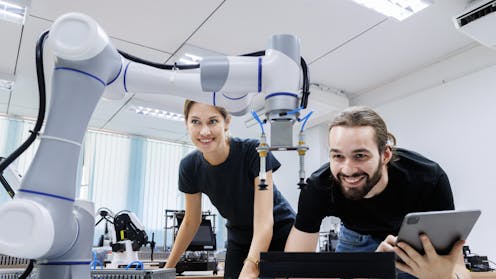
Le concept de cobot a été inventé par l’industrie automobile. L’objectif : créer des robots capables de travailler aux côtés des humains, sans risque d’insécurité. Gumpanat/Shutterstock

Les robots collaboratifs, ou cobots, ne remplacent pas seulement les humains : ils peuvent travaillent avec eux. Quel est leur impact sur la division du travail ?


Les robots sont omniprésents dans la production industrielle. Leur diffusion a toujours été au cœur d’enjeux humains, sociaux, économiques et en management, entraînant très tôt de nombreux questionnements.

Une nouvelle interrogation émerge aujourd’hui avec l’apparition des cobots. Capables de travailler non seulement à la place, mais aussi avec les humains au sein des ateliers, les robots collaboratifs sont-ils en train de devenir des collègues comme les autres ? Légers, flexibles, relativement accessibles et conviviaux… sont-ils susceptibles de remettre en cause les codes de la division du travail ?

Nos recherches récentes, basées sur des études de cas comprenant des entretiens et des observations en situation, ont permis de repérer quatre types d’usage des cobots : configuration simultanée, alternée, flexible ou coexistence. Elles rentrent dans le cadre du projet Impact « C-Shift » (Cobots in the Service of Human activity at work) qui vise à étudier l’impact de la mise en œuvre de dispositifs collaboratifs intelligents tels que les cobots dans le cadre des défis de l’industrie du futur.

Qu’est-ce qu’un cobot ?

Le terme cobot est créé par la contraction des termes anglais « collaborative » et « robot ». La paternité en est attribuée à des universitaires états-uniennes qui cherchent à la fois à limiter les troubles musculosquelettiques et à améliorer la productivité dans des usines de production automobile – Ford et General Motors.

Un robot collaboratif est un robot qui peut être installé dans le même espace de travail que les opérateurs humains, sans barrière de protection physique. Ils sont équipés de capteurs et de programmes déclenchant un ralentissement du mouvement ou un arrêt complet si un risque de collision est détecté. Ils sont capables de réaliser la plupart des opérations industrielles – visser, percer, poncer, souder.

Les cobots ne sont pas conçus pour des usages prédéfinis. Ils sont caractérisés avant tout par leur flexibilité. Facilement programmables grâce à des interfaces accessibles sur des tablettes, ils sont faciles à déplacer. Ils peuvent aussi bien mettre des produits cosmétiques dans des cartons, que faire du contrôle qualité à l’aide d’une caméra en bout de chaîne de production ou souder des pièces métalliques.

Marché multiplié par quatre d’ici 2030

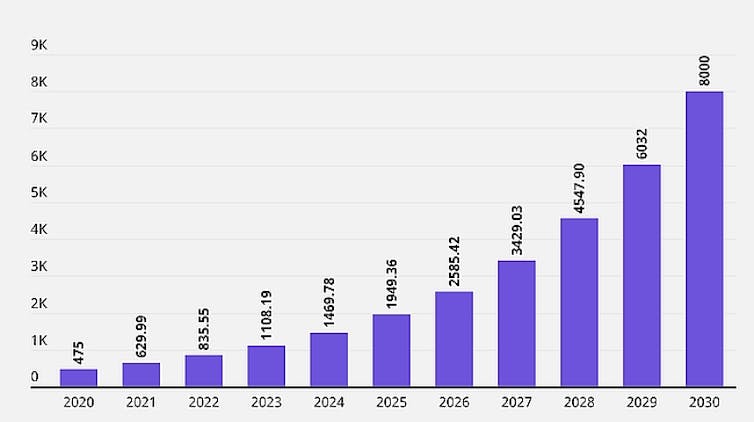
Les cobots ne sont plus de simples prototypes de laboratoire. Ils sont désormais couramment utilisés dans des usines de toutes tailles et dans divers secteurs – automobile, logistique, santé, agroalimentaire –, bien que leur adoption reste encore loin d’être généralisée. La part des cobots dans les ventes mondiales de robots serait de l’ordre de 3 % et, selon ABI research, le marché des cobots pourrait être multiplié par quatre d’ici 2030.

Courbe
Prévision de croissance du marché mondial des robots collaboratifs (cobots) de 2020 à 2030 en millions de dollars états-uniens. »
Statista et ABI Research, FAL

Les cobots ne visent pas à remplacer les robots traditionnels en raison de plusieurs limitations :

  • Leur charge utile est réduite : leur légèreté et leur petite taille les empêchent de manipuler des objets lourds.

  • Leur vitesse d’exécution est volontairement limitée pour garantir la sécurité des humains qui travaillent autour. Cela freine leur productivité et les rend peu adaptés aux productions à très grande échelle.

  • Installés dans les mêmes espaces que les humains, les cobots soulèvent des problèmes de sécurité lorsqu’ils sont équipés d’outils dangereux – outil coupant ou torche de soudage.

Leur potentiel réside avant tout dans de nouveaux usages et une approche différente de l’automatisation. Ainsi, dans une PME spécialisée dans la tôlerie qui a fait l’objet d’une étude de cas, les soudures sont effectuées par un robot de soudure traditionnel pour les grandes séries récurrentes. Pour les séries de taille moyenne et par des soudeurs pour les petites séries ou des soudures trop complexes, elles sont effectuées par des cobots.

Quatre usages des cobots en usine

Si par définition les cobots ont la possibilité de travailler dans le même espace que des opérateurs humains, leurs usages ne sont pas nécessairement collaboratifs et nos recherches nous ont permis de distinguer quatre configurations.

Projet C-SHIFT, cobots et industrie du futur, de l’Université de Lorraine.
Université de Lorraine, Fourni par l’auteur

Coexistence avec l’humain

À un extrême, les cobots viennent se substituer aux opérateurs pour prendre en charge les gestes les plus pénibles et/ou gagner en productivité. On qualifie cet usage de coexistence, car il n’y a aucune interaction directe avec les humains.

Dans l’industrie automobile, des cobots vissent des pièces sous les véhicules, là où les positions sont particulièrement difficiles pour les opérateurs.


À lire aussi :
Comment rendre les robots plus adaptables aux besoins de leurs collaborateurs humains ?


Configuration simultanée

Dans la configuration simultanée, cobots et opérateurs travaillent ensemble en adaptant mutuellement leurs mouvements, côte à côte ou face à face. Si cette configuration est largement réalisable en laboratoire, elle est assez rare en condition réelle. La raison : le temps nécessaire à sa mise au point et sa certification sécurité obligatoire.

Chez un équipementier, le cobot positionne une colonne de direction pour automobile avec précision, évitant le port de charges et les chocs, et l’opérateur effectue des tâches de vissage sur la pièce.

Configuration alternée

La configuration alternée correspond à une situation où l’opérateur utilise le cobot, mais n’interagit pas directement avec lui. Il le programme pour une série de tâches, et le laisse travailler seul, dans un espace différent. Cette configuration garantit une meilleure sécurité pour l’opérateur humain. Ce dernier optimise la répartition du travail entre ce qu’il confie au cobot et ce qu’il continue de faire lui-même.

Chez un fabricant d’échangeurs thermiques pour la production de gaz industriels, les soudeurs délèguent aux cobots les soudures les plus simples et se concentrent sur des soudures plus complexes ou moins répétitives.

Configuration flexible

Dans la configuration flexible, la répartition du travail entre humains et cobots évolue au cours du temps, en fonction du plan de charge. Une fois la technologie maîtrisée, les cobots peuvent être réaffectés à différentes activités en fonction des exigences du moment. Le même cobot peut être utilisé pendant une période pour une activité de chargement de machines, puis réoutillé, il peut servir pour du ponçage, puis des opérations de peinture, etc.

L’efficacité réside dans la capacité des opérateurs, des techniciens et des ingénieurs à travailler ensemble pour inventer constamment de nouveaux usages. Cette configuration semble particulièrement adaptée à des PME dans lesquelles les séries sont courtes et variables.

Cobots et IA

Les cobots font partie d’un vaste mouvement technologique. Le contexte de l’industrie 5.0 et l’utilisation croissante de l’IA permettront aux cobots d’être encore plus adaptables, voire capables d’improvisation. Ils pourront être intégrés dans des « systèmes cyberphysiques de production », c’est-à-dire des systèmes très intégrés dans lesquels l’informatique contrôle directement les outils de production.

Cette intégration n’est pas évidente à ce stade. Si elle est possible, on peut penser que c’est la capacité à « combler les trous » de l’automatisation traditionnelle qui sera dominante, reléguant la flexibilité et l’aspect collaboratif au second plan. Inversement, le recours à l’intelligence artificielle peut aider au développement de configuration flexible misant sur la collaboration au sein des collectifs de travail.

Si ces évolutions technologiques ouvrent de nombreux possibles, elles laissent ouverte la question des usages en contexte réel. Les tendances futures dépendront des choix qui seront faits en termes de division du travail et de compétences.

Les configurations dites coexistence et activité simultanée ont finalement peu d’implications sur l’évolution des compétences ou de modalités de collaboration entre ingénieurs, techniciens et opérateurs. À l’inverse, le choix des configurations flexible ou activité alternée suppose que les opérateurs développent de nouvelles compétences, notamment en programmation, et que de nouvelles formes de collaboration verticales se développent.

En d’autres termes, les cobots redistribuent moins les cartes en matière de collaboration homme-machine qu’ils n’invitent à revoir les logiques de collaborations entre humains au sein des organisations.

The Conversation

Thierry Colin a bénéficié d’une aide de l’Initiative d’Excellence Lorraine (LUE) au titre du programme France 2030, portant la référence ANR-15-IDEX-04-LUE. Il a aussi bénéficié d’une aide de l’ANACT dans le cadre de son AMI “Prospective pour accompagner la transition des systèmes de travail”

Benoît Grasser a bénéficié d’une aide de l’Initiative d’Excellence Lorraine (LUE) au titre du programme France 2030, portant la référence ANR-15-IDEX-04-LUE. Il a aussi bénéficié d’une aide de l’ANACT dans le cadre de son AMI « Prospective pour accompagner la transition des systèmes de travail ».

ref. Les cobots, des collègues de travail comme les autres ? – https://theconversation.com/les-cobots-des-collegues-de-travail-comme-les-autres-260231

Pourquoi certains (ex-)employés publient des avis employeurs en ligne

Source: The Conversation – in French – By Chloé Guillot-Soulez, Professeure des Universités en Sciences de Gestion, iaelyon School of Management – Université Jean Moulin Lyon 3

Orientées vers soi, vers les autres ou vers l’entreprise, les motivations pour publier son avis employeurs en ligne sont légion. Elles soulignent que l’expérience de travail, bonne ou mauvaise, constitue un enjeu clé des politiques de ressources humaines.


Les plateformes d’avis employeurs comme Glassdoor, Indeed ou Choosemycompany sont devenues une source d’information privilégiée pour les candidats à l’embauche qui les considèrent généralement comme plus crédibles que la communication émanant de l’entreprise.

Selon une étude d’Hello Work publiée en 2024, 73 % des Français consulteraient régulièrement des avis employeurs en ligne mais les lecteurs les plus assidus sont plus particulièrement les jeunes travailleurs (88 %), les profils en reconversion professionnelle (88 %) et les personnes en recherche active de poste (85 %).

Alors même que ces sites ont progressivement gagné en popularité et en influence, l’analyse des motivations des individus à publier un avis employeurs en ligne reste un angle mort : pourquoi certains employés ou ex-employés prennent-ils le temps de partager leur expérience, qu’elle soit positive ou négative ?

Trois logiques à l’œuvre

Dans le cadre de notre recherche, nous avons interrogé 22 individus ayant déposé un avis employeurs en ligne. Onze motivations regroupées en trois grandes catégories ressortent : orientées vers soi, vers les autres et vers l’entreprise.

Des motivations orientées vers soi

  • L’utilitarisme lié aux contraintes techniques des plateformes : « J’ai posté cet avis uniquement pour débloquer des avis » (R21) ;

  • L’hédonisme qui correspond à un plaisir autocentré associé à la publication de l’avis : « Quand je laisse un avis négatif, oui c’est important mais pas pour l’entreprise, pour moi. Par exemple, si je laisse un avis sur cette entreprise-là, je m’en fiche que cette entreprise sache que j’ai laissé l’avis ou pas » (R16) ;

  • La valorisation de soi liée à la fierté et à un sentiment de valorisation de l’estime de soi en ayant travaillé pour un bon employeur : « Après avoir posté l’avis, j’étais contente de partager cette expérience et la fierté de travailler dans cette entreprise » (R7) ;

  • L’évacuation de sentiments négatifs (mécontentement, colère, vengeance…) liée à une mauvaise expérience de travail : « J’ai eu envie de poster cet avis pour montrer mon mécontentement. C’était plus qu’un mécontentement, je dirais du dégoût déjà, parce que je trouve que ce n’est pas une façon de traiter les gens » (R8).

Des motivations orientées vers les autres

Le dépôt d’un avis employeurs est ensuite orienté vers les autres, en particulier les personnes en recherche d’emploi plus susceptibles de consulter les avis :

  • Le désir d’aider les autres : « Après avoir posté l’avis, honnêtement, je me suis senti vraiment “aidante”, je me suis sentie bien, parce que j’ai aidé des gens » (R6) ;

  • La réciprocité car les auteurs ont le sentiment d’appartenir à une communauté qui s’entraide : « Ce qui me motive à déposer des avis en ligne c’est de me dire que j’aimerais que les gens fassent pareil. J’aimerais trouver l’information donc je vais la donner de mon côté aussi » (R9) ;

  • La volonté de renseigner sur l’expérience de travail pour permettre aux personnes qui consultent de savoir s’il s’agit d’un bon ou d’un mauvais employeur : « Je me suis dit que ça pourrait servir à d’autres personnes, de voir comment les RH et l’employeur se sont comportés dans cette entreprise, comment ça s’était réellement passé ». (R8).

Des motivations orientées vers l’entreprise

  • La rédaction d’un avis en réponse à une demande de l’entreprise : « J’étais dans une société et, à la fin de mon stage, il y a un des membres de la société qui m’a demandé de poster, de donner mon avis sur l’entreprise et sur comment ça s’était passé » (R5)

  • Le désir d’aider l’entreprise quand celle-ci est confrontée à des difficultés de recrutement : « Je me suis dit, ils utilisent Indeed je vais mettre un bon avis sur leur page comme ça au moins les autres gens le verront et ça aidera peut-être ma gérante à trouver plusieurs employés » (R6)

  • La volonté d’influencer, positivement ou négativement, l’image et la notoriété en particulier quand il s’agit de petites entreprises : « C’est une entreprise qui n’est pas trop connue du public et du coup je pense que ce genre d’avis peut pousser des gens qui ne connaissent pas forcément à postuler » (R7)

  • Le souhait de faire un retour à l’entreprise. Celui-ci peut être positif : « Je voulais le partager avec tous les membres de l’entreprise, leur faire passer un message pour leur dire comme quoi c’était agréable de travailler avec eux » (R18). Mais il peut aussi être négatif avec l’objectif de pousser l’entreprise à évoluer : « Ce manager était impoli avec les clients et désagréable donc vraiment je voulais faire remonter ça à la direction pour qu’ils comprennent qu’il y avait un sérieux problème » (R13).

L’expérience de travail

Cette recherche souligne l’importance de l’expérience, bonne ou mauvaise, comme élément déclencheur du dépôt d’un avis employeurs en ligne en ligne.

Aligner promesse et réalité

Les plateformes d’avis employeurs sont un moyen de témoigner de l’expérience de travail vécue et un outil d’évaluation du contrat psychologique en lien avec la promesse employeur formulée par l’entreprise.


À lire aussi :
Quand les avis en ligne des salariés prennent à contre-pied la communication des employeurs


Les avis employeurs s’intègrent au bouche-à-oreille sur les employeurs. Le respect (ou non) du contrat psychologique détermine l’évaluation de l’expérience de travail et influence l’action de publier un avis. Au-delà du simple fait de témoigner du respect du contrat psychologique, les répondants ont conscience que les candidats à l’embauche se renseignent sur les employeurs avant de postuler. Ils consultent les avis employeurs en plus des messages et signaux envoyés par l’entreprise.

Réaliser un travail de veille sur les avis employeurs

Les entreprises ont tout intérêt à réaliser un travail de veille sur les avis employeurs afin d’évaluer la qualité de l’expérience de travail et sa cohérence par rapport à la promesse employeur. En cas d’avis positifs, l’enjeu sera de maintenir ces bonnes évaluations dans la durée. À l’inverse, de mauvais avis sont utiles pour identifier les dysfonctionnements, améliorer la politique de ressources humaines (RH) et éviter le partage d’informations négatives.

Encourager les avis positifs (sans les acheter)

L’action de déposer un avis employeurs apparaît comme un acte à la fois volontaire et altruiste déterminé par l’expérience de travail vécue. Alors que certaines entreprises se demandent si elles auraient intérêt à inciter leurs employés à déposer des avis en ligne, notre recherche permet d’identifier que des incitations financières seraient contreproductives alors que des incitations prosociales peuvent être envisagées.

Les avis employeurs apparaissent aujourd’hui comme un levier d’employee empowerment. Ils s’intègrent pleinement à l’économie de l’expérience qui donne une place centrale aux expériences des individus. Face à cette situation, les entreprises ne sont pas démunies mais la qualité de l’expérience de travail offerte demeure la clé des « bons employeurs ».

The Conversation

Chloé Guillot-Soulez ne travaille pas, ne conseille pas, ne possède pas de parts, ne reçoit pas de fonds d’une organisation qui pourrait tirer profit de cet article, et n’a déclaré aucune autre affiliation que son organisme de recherche.

ref. Pourquoi certains (ex-)employés publient des avis employeurs en ligne – https://theconversation.com/pourquoi-certains-ex-employes-publient-des-avis-employeurs-en-ligne-264403

Pourquoi le flou des « savoir-être » ne doit rien au hasard

Source: The Conversation – in French – By Jean Pralong, Professeur de Gestion des Ressources Humaines, EM Normandie

Mais de quoi les « savoir-être » sont-ils le nom ? Souvent mal définis et renvoyant à des notions floues, ils sont peut-être, d’abord, le révélateur de ce qu’est vraiment le process de recrutement : une négociation entre manager et recruteur et un moment de cristallisation des besoins en compétences de l’organisation.


Les savoir-être sont devenus essentiels pour recruter. Pourtant, personne ne sait vraiment les définir. Cette imprécision, souvent interprétée comme une faiblesse méthodologique, est en réalité le symptôme d’un déséquilibre politique. Dans les organisations, les recruteurs évaluent, mais les managers décident. Et tant que cette relation restera asymétrique, les savoir-être resteront flous.

Les savoir-être se sont fait une place de choix dans notre imaginaire du travail. Dans un monde incertain, changeant et interconnecté, les savoir-faire ne suffisent plus ; il faut d’autres compétences pour analyser, concevoir ou coopérer, entre autres déclinaisons du changement, de l’innovation ou du leadership. Mais quelles sont donc ces compétences ?

Une absence de définition claire

Une revue systématique de la littérature scientifique montre que seulement 11 % des articles publiés dans les revues de management entre 2014 et 2019 proposent une définition claire des soft skills (ou savoir-être). Près de la moitié ne mobilise aucun cadre théorique, les autres s’éparpillant sur cinquante théories différentes. Du côté des entreprises, les compétences comportementales sont rarement définies et décrites avec précision. Leur évaluation est majoritairement livrée à des appréciations subjectives, quand elle n’est pas confiée, pire, à un test de personnalité.

On en vient rapidement à suspecter les savoir-être d’être la vitrine de discriminations selon des critères de comportements, d’éducation et donc d’origine sociale. Sans éliminer cette thèse, nous voudrions ici proposer une autre lecture issue de l’enquête « SAV du recrutement », parue fin juin.


À lire aussi :
Le physique de l’emploi n’est pas qu’une expression : avoir le « bon physique » peut être un atout


Des savoir-être à double face

Les compétences sont souvent assimilées à un stock individuel de caractéristiques internes et stables. Ces caractéristiques déterminent des comportements et des performances en situation de travail. La stabilité des compétences rend possible une évaluation standardisée ; elle donne aux recruteurs un sentiment d’objectivité et fonde leur légitimité professionnelle. Mais les compétences sont aussi des constructions sociales. Elles émergent et prennent leur sens dans une configuration singulière de vocabulaire, de normes et d’attentes.

C’est cette matrice qui donne un sens à « s’adapter », « être proactif » ou « être organisé ». Le processus adopté par l’entreprise, qui cadre les étapes et les modalités de la sélection, est aussi une fabrique des compétences. On lui attribue le rôle d’objectiver les différences interindividuelles et donc de produire des décisions rationnelles. En réalité, le processus de recrutement et ses différentes séquences produisent des consensus plutôt que des choix rationnels. Les compétences sont autant construites par le process que préexistantes : il les nomme, les quantifie et, donc, les promulgue.

Manager, recruteur : l’un décide, l’autre exécute

L’évaluation des savoir-être s’inscrit dans une négociation entre deux acteurs : le recruteur et le manager. Mais ces deux acteurs n’ont pas le même pouvoir. Le manager a la maîtrise de décision. Il fixe les besoins, valide les profils et tranche en dernier ressort : il est le client du recrutement. Son autorité repose sur sa position hiérarchique, son contrôle budgétaire et sa connaissance du terrain.

Le recruteur apporte des outils, des méthodes et une expertise technique. Mais il ne maîtrise ni les critères d’évaluation finaux ni le cadre dans lequel s’inscrivent les décisions. Sa fonction est d’aider le manager à formuler ses besoins sans les contester. Il doit se montrer suffisamment précis pour apparaître compétent, mais jamais trop rigide, sous peine d’entrer en conflit avec les attentes implicites du décideur.

L’intérêt supérieur de l’entreprise avant tout

Dans ces conditions, le recruteur peut mobiliser deux stratégies. Il peut tenter d’être le « maïeuticien » des besoins du manager, ce qui est le rôle qui lui est dévolu. Il va alors le forcer à clarifier ses attentes, au risque de faire émerger des critères discriminants auxquels il ne pourra pas s’opposer. Les verbatims recueillis pendant l’étude montrent que les managers avancent souvent l’intérêt supérieur de l’entreprise sur la morale ou la loi :

« Une femme de 35 ans, c’est évident qu’elle a eu ou qu’elle aura des enfants rapidement. Si elle n’en a pas encore deux ou trois, le risque est qu’elle en fasse. Il faut donc a minima savoir où elle en est. (..) C’est une question d’entreprise » (manager, distribution, 29 ans).

« Un trou sur un CV, une expérience courte, ça ne peut pas rester dans le vague. Il faut savoir. Il n’y a ni bonne ou ni mauvaise raison, je peux tout entendre à condition de le savoir. Mais il n’y a pas de hasard et malheureusement l’expérience m’a prouvé que fermer les yeux, c’est reculer pour mieux sauter » (manager, commerce BtoB, 35 ans).

Le recruteur a donc tout intérêt à maintenir une certaine ambiguïté. Des termes flous lui permettent de préserver une apparence de neutralité, tout en évitant de figer des critères qu’il se refuse à utiliser.

Une diplomatie du recrutement

Le travail réel du recruteur consiste alors à orchestrer un subtil équilibre entre des exigences contradictoires. Son expertise ne réside pas tant dans l’application mécanique de grilles d’évaluation que dans sa capacité à traduire, filtrer et reformuler les demandes managériales. Il devient un interprète des tensions organisationnelles. Il doit décoder les attentes implicites du manager tout en préservant le cadre légal et éthique du recrutement.

Cette gymnastique professionnelle l’amène à développer un savoir-faire particulier dans la gestion des paradoxes : maintenir une façade d’objectivité tout en intégrant des critères subjectifs, satisfaire des besoins business parfois problématiques sans compromettre sa responsabilité professionnelle.

FNEGE Media 2022.

Les savoir-être flous deviennent ainsi les outils privilégiés de cette diplomatie du recrutement, permettant de dire sans dire, d’évaluer sans discriminer explicitement, et de préserver la cohésion d’un processus fondamentalement traversé par des logiques contradictoires.

Vers une profession à part entière

Le flou des savoir-être n’est pas une simple question de vocabulaire. C’est le révélateur d’un déséquilibre professionnel durable entre ceux qui décident et ceux qui évaluent. C’est aussi la manifestation du savoir-faire des recruteurs et de leur capacité à faire face, avec leurs compétences et leurs convictions, aux contraintes qui pèsent sur eux.

Pour les dépasser, il faut reconnaître que recruter est un métier, au sens plein du terme : une activité dotée de normes, de règles, de savoirs spécifiques et d’une responsabilité propre. C’est à cette condition seulement que le recrutement pourra s’ériger en profession à part entière, capable de définir ses propres critères d’excellence et de garantir la qualité de ses pratiques. Il ne s’agit pas d’imposer un jargon technique, mais de construire collectivement une science de l’évaluation des compétences humaines – une science qui serve enfin à la fois les organisations, les recruteurs… et les candidats.

The Conversation

Les auteurs ne travaillent pas, ne conseillent pas, ne possèdent pas de parts, ne reçoivent pas de fonds d’une organisation qui pourrait tirer profit de cet article, et n’ont déclaré aucune autre affiliation que leur organisme de recherche.

ref. Pourquoi le flou des « savoir-être » ne doit rien au hasard – https://theconversation.com/pourquoi-le-flou-des-savoir-etre-ne-doit-rien-au-hasard-259175

La responsabilité sociale des entreprises, un outil pour court-circuiter les syndicats ?

Source: The Conversation – in French – By Nicolas Poussing, Researcher, Université de Rennes 1 – Université de Rennes

La responsabilité sociale des entreprises est souvent perçue comme un levier pour améliorer les relations de travail, en renforçant le lien direct entre employeurs et salariés. Mais ce dialogue direct ne conduit-il pas à contourner les représentants du personnel et/ou les syndicats, allant jusqu’à affaiblir la place de ces derniers ?


Depuis 2001, la Commission européenne définit la responsabilité sociale des entreprises (RSE) comme un engagement volontaire allant au-delà des obligations légales, destiné à répondre aux attentes des parties prenantes : actionnaires, clients, fournisseurs, ONG, territoires… Mais parmi tous ces acteurs, un consensus émerge pour estimer que les salariés restent la partie prenante la plus centrale, car ils conditionnent directement la crédibilité et l’efficacité des stratégies RSE.

Pour répondre à leurs attentes, les entreprises investissent dans des actions très concrètes : rémunération, santé et sécurité, conditions de travail, qualité des relations professionnelles, négociation collective, respect de la dignité au travail, lutte contre les discriminations, communication interne ou encore droits des salariés. Loin d’une logique descendante et unidirectionnelle de la RSE, ces pratiques encouragent une participation plus active et directe des employés, en les tenant informés, en les consultant et en les impliquant dans la vie de l’entreprise… et capables dès lors de co-construire la RSE.


À lire aussi :
Pourquoi la RSE devient incontournable pour fixer la rémunération des dirigeants


Deux voies pour dialoguer avec les salariés

Dans l’entreprise, le dialogue avec les salariés prend aujourd’hui deux formes. La première, la plus ancienne, passe par leurs représentants élus, un héritage de la révolution industrielle et de l’essor du syndicalisme. La seconde, plus récente, qui se renforce dans le cadre de la RSE, privilégie une relation directe, à base d’enquêtes internes, de boîtes à idées, de groupes de discussion ou encore de réunions avec la direction.

Avec le numérique, ce dialogue s’est élargi grâce aux intranets, messageries et plates-formes collaboratives. Ces dispositifs participatifs traduisent une volonté d’associer davantage les salariés aux décisions qui concernent leur quotidien de travail.

Multiples frictions

Face à la montée des stratégies de responsabilité sociale des entreprises (RSE), les syndicats adoptent une attitude prudente, parfois méfiante. Rappelons le contexte : les interactions directes entre employeurs et salariés progressent alors même que les syndicats voient leur influence reculer. Les représentants des salariés sont de plus en plus affaiblis et, selon l’Organisation de coopération et de développement économiques (OCDE), le taux de syndicalisation diminue dans bon nombre de pays.

Toutefois, leur légitimité demeure forte sur les enjeux sociaux et salariaux, mais beaucoup moins sur les questions environnementales, pourtant centrales dans la RSE. Cette dernière couvre un éventail très large de sujets, qui, traditionnellement, ne sont pas traités par les syndicats. En outre, les syndicats défendent avant tout les salariés au niveau local ou national, quand la RSE invite à élargir la focale aux chaînes mondialisées de fournisseurs ou de sous-traitants.

Les représentants du personnel court-circuités

Un dernier point de friction réside dans le fait que les organisations syndicales redoutent que les engagements volontaires de la RSE ne viennent se substituer aux réglementations contraignantes de l’État. Certaines refusent aussi d’être considérées comme une partie prenante « parmi d’autres », au même niveau que les consommateurs ou les ONG.

Dans ce contexte, la montée en puissance de la RSE pose une question centrale : les représentants du personnel risquent-ils d’être court-circuités ? Face à une RSE qui encourage des échanges plus directs entre employeurs et salariés, les entreprises pourraient être tentées de privilégier ces canaux participatifs, au détriment des instances représentatives traditionnelles. Derrière cette évolution se joue un enjeu démocratique : la place des représentants élus dans le dialogue social est-elle appelée à se réduire ?

Ce que montrent les données

Pour répondre à cette question, une étude basée sur plus de 1 000 entreprises et de leurs représentants du personnel a été menée au Luxembourg. La législation luxembourgeoise impose la représentation des salariés dans les entreprises, et les syndicats continuent d’exercer une influence sur la prise de décision. Les syndicats représentatifs disposent, entre autres, du droit de conclure des conventions collectives à différents niveaux, y compris au niveau de l’entreprise.

Dans les entreprises de plus de 15 salariés, des élections doivent être organisées tous les cinq ans pour désigner une délégation du personnel, ces élections récurrentes constituant également un moyen pour les syndicats d’affirmer leur présence. Selon l’article L. 414-2 du Code du travail, la mission des représentants du personnel est de « sauvegarder et défendre les intérêts des salariés ». Les employeurs ont l’obligation d’informer les représentants du personnel sur divers sujets, notamment les stratégies de l’entreprise, sa situation économique et son évolution prévisible. Les pratiques de dialogue social varient fortement selon les secteurs et les entreprises, comme le reflète le taux de couverture des conventions collectives.

Les résultats montrent que l’adoption d’une stratégie RSE transforme en profondeur les relations sociales. Les entreprises engagées dans la RSE multiplient les échanges directs avec leurs salariés : réunions plus fréquentes, espaces d’expression facilités, possibilité accrue de poser des questions. Dans le même temps, elles entretiennent aussi davantage de contacts avec les représentants du personnel… mais privilégient aussi la consultation plutôt que la négociation.

Un dialogue social à deux vitesses ?

En clair, la RSE favorise à la fois l’intensification des relations directes avec les salariés et certaines formes d’échanges avec leurs représentants, sans pour autant que les unes remplacent les autres. Toutefois, si les relations directes et indirectes ne sont pas en concurrence, la nature de ces interactions diverge et la différence est de taille : participatives avec les salariés, largement unidirectionnelles avec leurs représentants. Ce « dialogue social à deux vitesses » pourrait donc, à terme, affaiblir le rôle des syndicats, relégués en dehors d’une communication bilatérale et de solutions véritablement négociées.

Ministère du travail, 2024.

Ce risque est d’autant plus grand au sein des PME, où la représentation syndicale est relativement moins nombreuse que dans les plus grandes entreprises. Ce type d’entreprises présente également des ressources limitées qui peuvent les conduire à prioriser un type de relation (ici, direct avec leurs salariés). Des effets sectoriels sont également à noter : les entreprises industrielles ont moins de contacts avec les syndicats mais recherchent davantage de solutions négociées que celles du commerce.

Comment expliquer ce dialogue social à deux vitesses ? Doit-on voir ici la marque du scepticisme des représentants du personnel et des syndicats à l’égard de la RSE et une volonté de rester dans leur zone de confort ? En clair, une volonté de ne pas prendre part à des négociations sur des sujets hors de leur périmètre traditionnel. Au contraire, ce résultat est-il l’expression de l’opportunisme des employeurs qui chercheraient volontairement à réduire la voix des syndicats et limiter leurs rôles dans de nouveaux champs stratégiques, notamment environnementaux. Enfin, nous pouvons aussi faire l’hypothèse que les salariés ont moins confiance dans leurs représentants et préfèrent une communication plus directe, sans intermédiaire.

Si nos résultats ne permettent pas de trancher définitivement sur la responsabilité qui est en cause (celle des syndicats et/ou celle des employeurs), ils montrent l’importance de la RSE comme un levier clé du dialogue social à condition qu’il intègre pleinement employeurs, salariés et syndicats pour co-créer les solutions d’avenir. Pour y parvenir, une communication bilatérale avec les syndicats ainsi que des solutions véritablement négociées restent à mettre en place dans les entreprises.

The Conversation

Les auteurs ne travaillent pas, ne conseillent pas, ne possèdent pas de parts, ne reçoivent pas de fonds d’une organisation qui pourrait tirer profit de cet article, et n’ont déclaré aucune autre affiliation que leur organisme de recherche.

ref. La responsabilité sociale des entreprises, un outil pour court-circuiter les syndicats ? – https://theconversation.com/la-responsabilite-sociale-des-entreprises-un-outil-pour-court-circuiter-les-syndicats-261390

The hard truth about the circular economy – real change will take more than refillable bottles

Source: The Conversation – UK – By Jonatan Pinkse, Professor of Sustainable Business, Centre for Sustainable Business, King’s College London

hurricanehank/Shutterstock

We extract more than 100 billion tonnes of raw materials from Earth each year, then throw most of them away. The “circular economy” offers a different approach: instead of the linear “take-make-waste” model, we could reuse, repair and recycle materials. But despite growing enthsiasm for a circular lifestyle, we’re actaully moving backwards – and using more virgin resources than ever.

Over the past decade, the idea of a circular economy gained significant traction, inspiring some to aim for a zero-waste lifestyle. It has become a cornerstone of the broader transition to net zero, as the production of oil-based plastics continues to generate waste and carbon emissions.

The reality paints a far less optimistic picture. According to the latest Circularity Gap report, the use of “secondary” materials like recycled plastic or reclaimed wood is declining, while reliance on virgin resources continues to rise.

This raises the question why – with all the enthusiasm for a circular economy – are we still struggling to make meaningful progress towards it?

In our recent research, my colleagues and I argue that progress is being held back by two distinct narratives. One paints a utopian vision – arguing that, with enough innovation, we can eliminate waste and regenerate ecosystems, all while continuing to grow the economy.

The opposite narrative is less hopeful and fixates on the obstacles – high costs, consumer resistance and the lack of government support. It concludes that meaningful change is simply unrealistic.

Trapped between these extremes of utopia and paralysis, people may often find themselves unable to move forward. Our research explores the roots of this impasse and identifies three reasons people struggle to adopt more circular lifestyles – too much talk, too little support and the hard limits of physics.

Beyond recycling

It’s easier to talk about circularity than to practise it. While consumers may embrace the idea of circularity in principle, they often stop short of making the fundamental changes to their consumption habits that it requires.

Part of the appeal lies in its simplicity as a concept. But achieving it is anything but simple.

For example, to jumpstart recycling in the UK plastics sector, the idea of One Bin to Rule Them All was introduced as a trial project in 2021. The framework outlined a single collection system for all plastic waste. While the vision was bold and appealing in its simplicity, research showed that many industry representatives viewed it as idealistic and disconnected from people’s daily realities.

The initiative struggled to gain traction due to concerns about its feasibility in practice. It would require changing the entire waste collection system and investing in digital tracking for plastic waste. Industry support remained limited, as companies were reluctant to invest beyond trials without clearer guidance from the government on legal requirements.

Building a circular economy requires collective effort. To offer another example, some fashion brands have begun to offer to collect clothes for recycling. It’s a promising initiative, but the support systems are not always in place. Even when items are returned, much of what is collected cannot be recycled because the materials are difficult to identify.

To make recycling effective, product labels would need to be standardised to state clearly the composition of each item. Yet many brands have been slow to embrace full transparency.

And some of the problem comes down to our changing shopping habits, which are also affecting efforts to reduce waste. When the UK introduced a 5p charge for single-use plastic bags in 2015 (later increased to a 10p minimum), their usage steadily declined.

But in England, this progress has recently reversed, with the shift blamed on more people shopping for groceries online or ordering food from delivery apps. In the push for convenience, people seem to have less support for initiatives to reduce plastic waste.

pile of plastic bags for recycling
Plastic bag sales are on the rise again in the UK.
nelo2309/Shutterstock

Ultimately, the limits of circularity are grounded in the laws of physics. The concept of a circular economy assumes that materials can be reused indefinitely without any degradation. Terms like “upcycling” may sound promising, but for many products this simply isn’t realistic.

Materials naturally degrade over time. While we might value an upcycled product for its vintage appeal, the underlying materials may be of lower technical quality. In other words, circularity faces a fundamental challenge. It’s possible to slow down material degradation, but it’s not possible to eliminate it.

While circular economy efforts often fall short, there are ways to move forward. The first lesson is simple – less talk, more action. Consumers shouldn’t just opt for recycled or refurbished products when it’s convenient. They should critically examine everything they use in daily life and look for products that are easier to repair, recycle or upgrade. Clearly, lots of people just don’t have this kind of knowledge, so support from government and industry in helping them make better purchases will be essential.

But people also need to be more realistic about what circularity can achieve. Even with the best intentions, items cannot be recycled indefinitely. Still, we can be more ambitious. There’s nothing wrong with starting small, as long as things keep moving in the right direction. Most people can do more than they think. Reusing, repairing and developing habits that gradually reduce waste can have a meaningful impact over time. Circularity isn’t about perfection, it’s about consistent progress.

The Conversation

Jonatan Pinkse does not work for, consult, own shares in or receive funding from any company or organisation that would benefit from this article, and has disclosed no relevant affiliations beyond their academic appointment.

ref. The hard truth about the circular economy – real change will take more than refillable bottles – https://theconversation.com/the-hard-truth-about-the-circular-economy-real-change-will-take-more-than-refillable-bottles-261810

Jane Austen: why are adaptations of Mansfield Park and Northanger Abbey so rare?

Source: The Conversation – UK – By Amy Wilcockson, Research Assistant, Scottish Literature, University of Glasgow

More than two centuries after her death, Jane Austen is one of the most adapted authors of all time, her life and novels dramatised for film and television from every angle imaginable. Despite the plethora of Pride and Prejudice adaptations, Netflix is making its own version, starring Emma Corrin, Jack Lowden and Olivia Colman.

Sense and Sensibility is being rehashed too, with Daisy Edgar-Jones as Elinor Dashwood. On the small screen, the BBC released the hit documentary Jane Austen: Rise of a Genius alongside an adaptation of Gill Hornby’s novel Miss Austen that centres on Austen’s sister Cassandra (plus a forthcoming sequel). A dramatisation of Janice Hadlow’s novel The Other Bennet Sister which takes up the story of Mary, the dowdy younger sister of Lizzy, has also commenced filming.

Emma got a smart and entertaining do-over in 2020 starring Anya Taylor-Joy as the arrogant but well-meaning matchmaker. And of course Carrie Cracknell’s Persuasion got its Fleabag moment in 2022 starring Dakota Johnson as a wine-swigging heartbroken Anne Elliot whispering acerbic asides to the audience.


This article is part of a series commemorating the 250th anniversary of Jane Austen’s birth. Despite having published only six books, she is one of the best-known authors in history. These articles explore the legacy and life of this incredible writer.


So far so good, say Austen fans, who rejoice in these continued adaptations as they celebrate the 250th anniversary of her birth this year. Yet it is the same stories being told.

Given the packed cinemas for the 20th anniversary screenings of the 2005 Pride and Prejudice film starring Keira Knightley as Lizzy, plus the enduring appeal of that wet-shirted Mr Darcy moment from the BBC series in 1995, it is clear this novel is Austen’s most enduring work. But do we need another adaptation? Or another “alternative” view of Austen or Lizzy Bennet’s lives?

I’m the first to admit that I’m an Austen fan. Her stories have timeless appeal. They focus on romance and class, alongside larger issues of the Regency period such as power, the role of women and even slavery – although the representation of slavery and empire in Austen’s work is long contested.

So what of the “forgotten”, less-adapted novels: Northanger Abbey and Mansfield Park? These are the two of Austen’s novels that bring wider issues into focus. Why are film-makers happy to leave these stories be? Are their narratives less compelling or have we been brainwashed by Mr Darcy and his breeches?

Northanger Abbey was last adapted in 2007 for ITV, starring Felicity Jones as the heroine Catherine Morland. Its previous iteration premiered in 1987 with Katharine Schlesinger in the lead role. There has never been a film version.

Written in 1798-99, Northanger Abbey was not published until six months after Austen’s death in December 1817. It is a gothic pastiche, satirising the melodramatic plots and moody locations of popular novels at the time. It also offers a harsh criticism of the conventions of marriage, wealth and social status faced by young women.

Influenced by her sensational gothic reading material, Catherine Morland initially believes General Tilney, with whom she is staying, is guilty of killing his wife. While not a murderer, General Tilney does treat Catherine callously.

After learning that she is not a wealthy heiress, he declares her unsuitable to marry his son, Henry, turfs her out of Northanger Abbey, and leaves her facing a long journey home alone – a fate perilous to any proper young lady. Snobbishness and gender conventions combine as Austen ridicules class and social ambition.

Published in 1814, Mansfield Park was Austen’s third novel. Long considered to be the odd one out of Austen’s works, it was adapted as a TV series in 1983, with film versions released in 1999 and 2007.

In Mansfield Park, Austen examines bigger issues, including infidelity, gambling and most problematically of all, the fact that Sir Thomas Bertram (the uncle of the heroine Fanny Price) owns a plantation in Antigua.

Bringing up the slavery question

Fanny asks her uncle about the slave trade, but is ignored. By positioning a key character as a plantation owner, many scholars – myself included – argue that Austen was trying to draw attention to this debate in her novel. There is also plenty of circumstantial evidence that Mansfield Park is named for Lord Mansfield, a judge who played an important role in ending slavery in England.

Recent research examining Austen’s family demonstrates that three of her brothers were engaged in anti-slavery activism, her letters share that she was “much in love” with the abolitionist Thomas Clarkson, and some critics posit the view that Austen herself supported abolition. Mansfield Park and Emma both feature discussions on the slave trade.

At the very least, Austen was interested in questions of slavery and race. While it is impossible to definitively decipher her personal views from her literary works, it is clear that important issues such as slavery feature in her novels, albeit subtly.

Perhaps it is this serious and timely subject matter, so unlike the usual Austen narrative, that puts off film-makers. But Northanger Abbey and Mansfield Park deserve their time in the limelight.

Rather than iterations of Austen’s afterlives or Lizzy’s family members, powerful and original adaptations of these two novels would invigorate new generations of readers and filmgoers. Who wouldn’t want to watch Greta Gerwig’s Northanger Abbey? It is a serious travesty that a film version has never been released.

Perhaps big studios simply haven’t got around to commissioning a new Northanger Abbey or Mansfield Park. But in doing so, they are neglecting a third of Austen’s published novels.

They represent Austen’s most nuanced works, focusing not just on romance (although both heroines get their happy endings) but on society’s wider issues. Crucially, they demonstrate that their author was not just a writer of fluffy romance, but an informed observer of politics and society and the structures that underpinned them.

Even more radically, film-makers could offer a different perspective by adapting one of her contemporaries’ novels – Austen was not the only female author writing during this period.

Scottish novelist Susan Ferrier admired Austen’s work, yet was a hugely successful author in her own right, outselling Austen in the 1800s. Any of her three novels – Marriage; The Inheritance; and Destiny, would be sure-fire Regency hits. Or Gothic pioneer Ann Radcliffe whose tale The Mysteries of Udolpho, one of the Gothic novels Catherine Morland so enjoys, is ripe for the big screen.

Audiences would perhaps see film versions of her fellow authors’ works as a way to honour Austen’s legacy too, offering viewers something familiar yet different.

The Conversation

Amy Wilcockson does not work for, consult, own shares in or receive funding from any company or organisation that would benefit from this article, and has disclosed no relevant affiliations beyond their academic appointment.

ref. Jane Austen: why are adaptations of Mansfield Park and Northanger Abbey so rare? – https://theconversation.com/jane-austen-why-are-adaptations-of-mansfield-park-and-northanger-abbey-so-rare-262739