The UK has a regional inequality problem – levelling the playing field for entrepreneurs could help

Source: The Conversation – UK – By Colin Mason, Emeritus Professor of Entrepreneurship and Honorary Senior Research Fellow, Adam Smith Business School, University of Glasgow

Monster Ztudio/Shutterstock

Regional inequality is a long-standing problem in the UK that successive governments haven’t been able to get to grips with. The Labour government is aiming for economic growth, but this will only happen by boosting the UK’s regions and nations along with London and south-east England.

The UK’s economy is the most regionally imbalanced in the industrialised world. This has a damaging effect on productivity and economic performance, both key enablers of rising living standards.

Although “levelling up” is not part of the government’s vocabulary, reducing the wide economic divide between London and the rest of the UK remains high on its agenda. However, levelling-up policies have been criticised for being fragmented and lacking coherence, particularly because of the emphasis on large infrastructure investments. Infrastructure is only one of many factors that play into the long-term productivity differences in the UK.

Entrepreneurship and innovation are also central to regional economic competitiveness. But business start-up and scale-up rates are significantly higher in London and the south of England, particularly along the M4 and M3 corridors. These geographical variations are persistent over time.

The lack of high-growth start-ups in the rest of the UK is particularly important. These businesses are mainly located in and around London, with only a thin spread across the rest of the country. In a list of the UK’s 100 fastest-growing companies, 36 are in London, with a further 15 in south-east England.

These rapidly growing companies make a disproportionate contribution to job creation, innovation and economic growth. A 2009 report found that 6% of high-growth firms create more than 50% of jobs. This proportion has remained stable over the years, even during times of recession.

Entrepreneurship needs the right environment to thrive – places that offer a “fertile soil” with support, talent, finance, markets and connections to start and grow companies. As such, entrepreneur-led levelling up needs an approach that develops these “ecosystems” in the parts of the UK that have fallen behind more prosperous areas.

Entrepreneurial ecosystems are environments that bring together not only those who want to start businesses but also the people and institutions who support them. They need mentors with expertise and experience, employees with the right skills, investors who take calculated risks and intermediaries who can make connections.

Nurturing new businesses

So what does it take to build all of this? Our research on the emergence and maturing of ecosystems offers some important lessons.

It needs foundations. Particularly important are educational institutions that equip students with an entrepreneurial mindset. They support enterprise creation and companies that attract and nurture skilled employees – the kind of people who may be future entrepreneurs or early hires in high-growth companies.

But it takes time. The foundations of today’s successful ecosystems were laid more than a decade ago. Progress is often slow and hard to measure because elements in the ecosystem interact and evolve in unpredictable ways. As such, it is important to focus on long-term indicators of success. This includes those that are difficult to capture – things like willingness to pursue business opportunities despite the risk of failure, for example.

Thriving entrepreneurial ecosystems are characterised by virtuous circles, with success creating the ingredients that drive further success. Successful entrepreneurs, managers and investors frequently reinvest their wealth and experience in their local ecosystem as serial entrepreneurs, business angels, mentors or board members.

And even business failures can have positive effects on the ecosystem. Failures can trigger a recycling process as former employees are hired by other local companies.

Recognising that it takes an ecosystem to raise a start-up means that collaboration is vital. Outcomes will be limited if ecosystem players – companies, investors, experienced entrepreneurs, support organisations and so on – focus only on their own narrow interests. But if they connect and work together for the wider benefit of the ecosystem then everyone can gain from the successes.

a group of people chatting and networking
Connecting with others is a vital part of building entrepreneurial ecosystems.
Rawpixel.com/Shutterstock

Many of the features that underpin successful ecosystems are about building culture and relationships. This includes events, mentoring and networks that enable peer-to-peer learning and celebrate role models.

And it’s not always about having a local focus. Some activities to support high-growth entrepreneurs benefit from being delivered at the national or regional level. For example, public sector venture capital funds (government money that’s invested in start-ups that might struggle to source private investment) are more effective if delivered at scale. Ecosystems also need to develop links with other locations to tap into their knowledge, skills and resources.

As successful ecosystems are typically based around large cities, it is essential that they develop strong connections with the smaller communities around them to prevent inequalities emerging within regions.

Ultimately, building ecosystems requires government funding but not government management. For example, the Scottish government’s Ecosystem Fund provides financial support for grassroots initiatives that may otherwise struggle to get off the ground.

Successful systems are built from the ground up, with community members – typically successful entrepreneurs – taking on the leadership role. The role of government should be funding it, not running it. Public funding can give ecosystems momentum to drive the growth that narrows the UK’s regional inequalities.

The Conversation

Colin Mason received funding from The Regional Studies Association to undertake some of the research on Atlantic Canada’s entrepreneurial ecosystem.

Dr Michaela Hruskova has previously received funding from the Economic and Social Research Council for research underpinning insights in this article.

ref. The UK has a regional inequality problem – levelling the playing field for entrepreneurs could help – https://theconversation.com/the-uk-has-a-regional-inequality-problem-levelling-the-playing-field-for-entrepreneurs-could-help-261822

How different mushrooms learned the same psychedelic trick

Source: The Conversation – UK – By Fabrizio Alberti, Associate Professor in Life Sciences, University of Warwick

Cannabis_Pic/Shutterstock

Magic mushrooms have been used in traditional ceremonies and for recreational purposes for thousands of years. However, a new study has found that mushrooms evolved the ability to make the same psychoactive substance twice. The discovery has important implications for both our understanding of these mushrooms’ role in nature and their medical potential.

Magic mushrooms produce psilocybin, which your body converts into its active form, psilocin, when you ingest it. Psilocybin rose in popularity in the 1960s and was eventually classed as a Schedule 1 drug in the US in 1970, and as a Class A drug in 1971 in the UK, the designations given to drugs that have high potential for abuse and no accepted medical use. This put a stop to research on the medical use of psilocybin for decades.

But recent clinical trials have shown that psilocybin can reduce depression severity, suicidal thoughts and chronic anxiety. Given its potential for medical treatments, there is renewed interest in understanding how psilocybin is made in nature and how we can produce it sustainably.

The new study, led by pharmaceutical microbiology researcher Dirk Hoffmeister, from Friedrich Schiller University Jena, discovered that mushrooms can make psilocybin in two different ways, using different types of enzymes. This also helped the researchers discover a new way to make psilocybin in a lab.

Based on the work led by Hoffmeister, enzymes from two types of unrelated mushrooms under study appear to have evolved independently from each other and take different routes to create the exact same compound.

This is a process known as convergent evolution, which means that unrelated living organisms evolve two distinct ways to produce the same trait. One example is that of caffeine, where different plants including coffee, tea, cacao and guaraná have independently evolved the ability to produce the stimulant.

This is the first time that convergent evolution has been observed in two organisms that belong to the fungal kingdom. Interestingly, the two mushrooms in question have very different lifestyles. Inocybe corydalina, also known as the greenflush fibrecap and the object of Hoffmeister’s study, grows in association with the roots of different kinds of trees. Psilocybe mushrooms, on the other hand, traditionally known as magic mushrooms, live on nutrients that they acquire by decomposing dead organic matter, such as decaying wood, grass, roots, or dung.

Mushrooms on brown leaves
Inocybe corydalina.
jimmiev/Wikimedia, CC BY-SA

The observation that mushrooms that inhabit two different niches make the same psychedelic compound raises questions regarding the ecological role of this molecule. A possible explanation as to why both mushrooms produce psilocybin could be that it is intended to deter predators, such as insects, that may be tempted to eat their fruiting bodies. This would be similar to the role of caffeine, which is also known to act as a natural pesticide, deterring insects and other pests from feeding on certain plants.

Turning discovery into opportunity

This study may provide scientists with additional tools to produce psilocybin to use for medical purposes. Mushrooms tend to grow slowly both in nature and in the laboratory. Psilocybe (magic mushrooms) take about two months to grow from spores to mature mushrooms.

If large amounts of psilocybin are needed for testing in clinical trials or for future medical use, quick and sustainable ways of producing it should be investigated. Currently, psilocybin is produced using synthetic material because it is faster than extracting the compound from mushrooms and has higher yields. This has its drawbacks though. The current synthetic extraction methods that scientists use generate hazardous waste and include key steps that can only be carried out on a small scale.

In a separate study published in April 2025, Hoffmeister and his coworkers came up with a new approach to produce psilocybin. His team used enzymes derived from fungi to catalyse the reactions to make psilocybin, rather than a fully synthetic approach, which uses lab-made materials and catalysts. This approach can be carried out on a larger scale than the usual, fully synthetic method. The immobilised enzymes they used are also reusable, making the process more sustainable.

Enzymes are inherently more sustainable than non-biological catalysts because they generally operate in mild conditions (such as low temperature and neutral pH) and are easier to purify, which reduces energy consumption and waste. Also, enzymes are biodegradable, which helps decrease the environmental impact of industrial processes.

Hoffmeisters’ most recent work provides the scientific community with additional enzymes that can be used to make psilocybin.

While we can only speculate as to why different mushrooms would come
up with alternative ways of making the same psychedelic compound, this discovery
opens new avenues for the large-scale production of a promising candidate drug.

The Conversation

Fabrizio Alberti receives funding from UKRI through grants MR/V022334/1, BB/X018369/1 and EP/X039587/1, and from the British Council through grant 1203466293.

ref. How different mushrooms learned the same psychedelic trick – https://theconversation.com/how-different-mushrooms-learned-the-same-psychedelic-trick-266401

An AI tool is trying to predict your risk of getting many diseases years in advance – here’s how it works

Source: The Conversation – UK – By Natalia Levina, Professor, Department of Information Systems Management & Analytics, Warwick Business School, University of Warwick; New York University

The Delphi-2M model seeks to predict a person’s next health event, and when it will happen in the next 20 years. Nan_Got/ Shutterstock

Being able to instantly and accurately predict the trajectory of a person’s health in the years to come has long been seen as the pinnacle of medicine. This kind of information would have a profound effect on healthcare systems as a whole – shifting care from treatment to prevention.

According to the findings of a recently published paper, researchers are promising just that. Using cutting-edge artificial intelligence (AI) technology, the researchers built Delphi-2M. This tool is seeking to predict a person’s next health event and when it’s likely to happen in the next 20 years. The model does this for a thousand different diseases including cancer, diabetes and heart disease.

To develop Delphi-2M, the European research team used data from nearly 403,000 people from the UK Biobank as an input into the AI model.

In the final trained AI model, Delphi-2M predicted the next disease and when it would occur based on a person’s sex at birth, their body mass index, whether they smoked or drank alcohol, and their timeline of prior diseases.

It was able to make these predictions with a 0.7 AUC (area under the curve). AUC aggregates false positive and false negative rates, so can be used as a proxy for accuracy in a theoretical setting. This means the model’s predictions could be interpreted to have about 70% accuracy across all disease categories – although the accuracy of these predictions have not yet been tested in terms of real-world outcomes.

They then applied the model to Danish Biobank data to see whether it was still effective. It was able to predict health outcomes with similar theoretical accuracy rates.

AI tools

The purpose of the paper wasn’t to suggest the Delphi-2M is ready to be used by doctors or in the medical field. Rather, it was to illustrate the power of the team’s proposed AI architecture, and the benefit it could have in analysing medical data.

Delphi-2M uses a “transformer network” to make its predictions. This is the same technology architecture that powers ChatGPT. The researchers modified the GPT2 transformer architecture to use time and disease features to predict when and what will happen.

Although other health prediction models have used transformer networks in the past, these were only designed to make predictions about a person’s risk of developing a single disease. Plus, they were primarily used on smaller-scale hospital record data.

But transformer networks are particularly well-suited for predicting a person’s risk of multiple diseases. This is because they can adapt their focus easily and are able to work out complex interactions between many different diseases from multiple distinct data points.

Delphi-2M has also proven to be slightly more accurate than other multi-disease prediction models which use a different architecture.

For example, Milton uses a combination of standard machine learning techniques and applied them to the same UK Biobank data. This model showed somewhat lower predictive power for most diseases compared with Delphi-2M – and needed to use more data to do so.

Moreover, non-transformer models are hard for others to improve by adding more data layers. This means these models cannot be as easily adapted and improved upon as transformer models for use in different contexts and studies.

A person writes on a tablet using a stylus. There is an anatomical human body popping out from the tablet.
The model can be adapted to other contexts by using different data.
raker/ Shutterstock

What’s special about the Delphi-2M model is that it can be released to the public as an open-source model without compromising patients’ privacy. The authors were able to create synthetic data that mimics the UK Biobank data while removing personally identifiable information – all without a significant drop in predictive power. Moreover, Delphi-2M requires less computing resources to train than typical AI transformer models.

This will allow other researchers to train the model from scratch and possibly tailor the model and information for their needs. This is important for the advancement of open science and is generally difficult to do in medical settings.

Still too early

Whether or not Delphi-2M becomes the foundation model for AI tools that are designed to predict a patient’s future health risks, it demonstrates that models such as this are on the way.

Due to its layered architecture and open-source nature, future models similar to Delphi-2M will continue to evolve by incorporating even richer data – such as electronic health records, medical images, wearable technologies and location data. This would improve its predictive powers and accuracy over time.

But while the ability to prevent diseases and provide early diagnosis holds great promise, there are a few key caveats when it comes to this predictive tool.

First, there are numerous data-related concerns associated with such tools. As we have written before, the quality of data and training that an AI tool receives makes or breaks its predictions.

The UK Biobank dataset used to create Delphi-2M didn’t have sufficient data on diverse races and ethnic groups to allow for in-depth training and performance analysis.

While some analysis was performed by the Delphi-2M researchers to show that adding ethnicity and race didn’t sway the results too much, there was still insufficient data in many categories to even conduct the assessment.

If ever used in the real world, personal healthcare data will probably be used and layered on top of foundation models such as Delphi-2M. While the inclusion of this personal data will improve prediction accuracy, it also comes with risks – for example, around personal data security and out-of-context use of the data.

It may also be difficult to scale the model to countries whose healthcare systems differ from those that are used to design the dataset. For instance, it may be harder to apply Delphi-2M to the US context, where healthcare data is spread around multiple hospital systems and private clinics.

At present, it’s too early for Delphi-2M to be used by patients or doctors. While Delphi-2M provided generalised predictions based on the data that was used to train it, it’s too early to use these predictions for personalised health recommendations for an individual patient.

But hopefully, with continued investment into researching and building Delphi-2M-style models, it will someday be possible to input a patient’s personal health data into the model and get a personalised prediction.

The Conversation

The authors do not work for, consult, own shares in or receive funding from any company or organisation that would benefit from this article, and have disclosed no relevant affiliations beyond their academic appointment.

ref. An AI tool is trying to predict your risk of getting many diseases years in advance – here’s how it works – https://theconversation.com/an-ai-tool-is-trying-to-predict-your-risk-of-getting-many-diseases-years-in-advance-heres-how-it-works-265909

As Hamas considers a peace deal, the man most Palestinians want to lead them sits in an Israeli jail

Source: The Conversation – UK – By Leonie Fleischmann, Senior Lecturer in International Politics, City St George’s, University of London

Since the White House released Donald Trump’s plan to end the Gaza conflict on September 29, the chances of an end to Israel’s war on Gaza is as high as they have ever been. If it succeeds, the idea of a Palestinian state being established alongside Israel will also be on the table for the first time in decades.

Palestinians were notably excluded from drafting the plan, and no measures exist to hold Israel accountable for the destruction it has caused. But the 20-point plan includes clauses that could eventually lead to Palestinian self-determination.

Under the terms of the plan, Palestinians will be allowed to remain in Gaza and there will be an amnesty for militants who commit to peaceful coexistence once the deal is agreed. Israel has committed not to occupy or annex Gaza. The plan also acknowledges the Palestinian people’s aspiration for self-determination and statehood and says a pathway to achieve that may be achievable under certain conditions.

Israeli prime minister Benjamin Netanyahu has said he supports the plan. But on his return to Israel, he said Palestinian statehood was not written into the agreement and that Israel would “forcibly resist” the establishment of a Palestinian state. The US president’s deal will have to be approved in a vote of Netanyahu’s cabinet. It has already come in for severe criticism from at least one cabinet member: Bezalel Smotrich. Smotrich described the deal as a “resounding diplomatic failure” that will “end in tears”.


Read more:
Where does the Arab and Muslim world stand on Trump’s Gaza peace plan? Expert Q&A


For Hamas, too, the plan crosses a number of red lines. Reports suggest that Hamas faces an existential dilemma. On one hand the plan explicitly removes any role for Hamas in the future governance of Gaza. On the other, the US president has said that a Hamas rejection would give Israel the green light to continue their military onslaught.

So, whether the next steps are a ceasefire or the continued destruction of Gaza, what has become clear is that time is running out for Hamas as rulers of the Palestinian people in Gaza. This raises the question of who could take over the reins of government for Palestinians.

The obvious answer is the Palestinian Authority (PA), which holds leadership of the Palestinians in the West Bank. The PA was formed by the Oslo Accords to administer the West Bank and Gaza. Since 2005 it has been led by Mahmoud Abbas of Fatah. In 2007, a brief civil war between Fatah and Hamas left Hamas in power in Gaza, creating a deep division between the two parties and the Palestinian people.

While the PA argues it should be the sole governing authority in Gaza, Fatah and Abbas are deeply unpopular among Palestinians. In a recent poll conducted by the Palestinian Centre for Policy and Survey Research, just 6% of Palestinians said they would vote for Abbas in an election.

The waning legitimacy of the current PA leadership puts into question its ability to rule. Corruption, lack of democracy and Abbas’s age has led for calls for someone new to lead the Palestinians into the next chapter of their history. One name has resounding popularity: Marwan Barghouti.

‘Palestinian Mandela’

Barghouti has long been seen as the key to uniting the Palestinian factions and achieving Palestinian statehood. He was described in a 2009 article in Foreign Policy magazine as “Palestine’s best hope”. More recently, in July 2024, The Economist described him as “the world’s most important prisoner”.

Despite being imprisoned in Israel since 2002, Barghouti has consistently topped polls of potential future PA leaders. His supporters have named him the “Palestinian Nelson Mandela” in the hope that he can emulate the South Africa leader by transitioning from political prisoner to the man who can unify a divided people.

Born in the West Bank in 1959, Barghouti rose to prominence as a youth leader in the years leading up to the first intifada and was elected to the Palestinian Legislative Council in 1996. But in 2002 he was arrested by the Israeli security services at the height of the second intifada and convicted in 2004 for involvement in the murder of five people. Barghouti refused to recognise the authority of the Israeli court and offered no defence at trial. He was subsequently handed five life sentences.

Barghouti’s appeal lies in his ability to garner broad support among different stakeholders – Palestinian, Israeli and international.

He gained respect from militant Palestinian factions for his armed resistance and his incarceration. Hamas reportedly placed him at the top of previous potential prisoner swap deals. Alongside this, his declared preference for unarmed resistance and his vision for democratic Palestinian governance garner him support from the Palestinians who have grown tired of PA corruption.

He is supported by Israeli peace activists as the Palestinian solution to ending the cycle of violence. Veteran activist, Gershon Baskin, explained in the Times of Israel, in April 2025, that Barghouti is “still committed to Palestinian Israeli peace based on the two-state solution”.

Voices in Israel’s security establishment also see the value of Barghouti as the Palestinian leader. Ami Ayalon, the former chief of Israel’s Shin Bet intelligence organisation, argued in January 2024 that it was time to release Barghouti and initiate negotiations with him as the popular leader of the Palestinians.

But it has been reported that PA leaders, mindful of the political threat Barghouti poses to them, have consistently opposed his release as part of potential Israel-Hamas prisoner swaps.

Unsurprisingly, for different reasons, Netanyahu is vehemently opposed to his release, stating in 2017 in response to an opinion piece by Barghouti published by the New York Times that “calling imprisoned Fatah leader, Marwan Barghouti, a Palestinian leader and parliamentarian is like calling Syrian president, Bashar Assad, a paediatrician”.

Barghouti could be an important missing piece in the unfolding puzzle towards Palestinian statehood. And it should be up to the Palestinian people who leads them. But it seems the keys to his cell are held by people who don’t want to see the Palestinian Mandela set free.

The Conversation

Leonie Fleischmann does not work for, consult, own shares in or receive funding from any company or organisation that would benefit from this article, and has disclosed no relevant affiliations beyond their academic appointment.

ref. As Hamas considers a peace deal, the man most Palestinians want to lead them sits in an Israeli jail – https://theconversation.com/as-hamas-considers-a-peace-deal-the-man-most-palestinians-want-to-lead-them-sits-in-an-israeli-jail-266492

What the gut microbiome of the world’s oldest person can tell us about ageing

Source: The Conversation – UK – By Rachel Woods, Senior Lecturer in Physiology, University of Lincoln

When María Branyas Morera died in 2024 at the age of 117, she left more than memories. She left science a gift: samples of her microbiome.

Researchers discovered her gut was as diverse as someone decades younger: rich in beneficial bacteria linked to resilience and longevity. Her daily yoghurt habit and Mediterranean diet may have helped. While we can’t all inherit “lucky genes”, nurturing our microbiome may be one way to support lifelong health.

In a recent paper in Cell Reports Medicine, researchers presented what may be the most detailed scientific investigation of a supercentenarian (a person aged 110 or older). Before her death, Branyas agreed to participate in research aimed at uncovering how she lived such a long and healthy life.


Read more:
Centenarian blood tests give hints of the secrets to longevity


When scientists compared her samples with those of people who had not reached such exceptional ages, the genetic results were unsurprising: Branyas carried protective variants that guard against common diseases. But they also looked at something over which we have more control – the gut microbiome.

This microbiome is the vast community of bacteria, fungi and other microorganisms that live in the intestines. They help digest food, produce vitamins, influence our immune system and even communicate with the brain. While our genes play only a small role in shaping our microbiome, diet and lifestyle are far more important.

Normally, as people age, gut microbiomes lose diversity – the variety of microbial species – and beneficial microbes such as Bifidobacterium decline. This reduction in diversity has been linked to frailty.

Branyas’s gut told a different story. Her microbiome was as diverse as that of a much younger adult and was especially rich in the bacterial family Bifidobacteriaceae, including the genus Bifidobacterium. In most older people these bacteria decline, but Branyas’s levels matched previous reports of elevated Bifidobacterium in other centenarians and supercentenarians. The researchers concluded that this unusually youthful microbiome may have supported her gut and immune health, contributing to her extraordinary longevity.

Bifidobacteria are among the first microbes to colonise an infant’s gut and are generally considered beneficial throughout life. Studies link them to supporting immune function, protecting against gastrointestinal disorders and helping regulate cholesterol.

Her diet offered a clue to why she maintained such high levels of Bifidobacterium. Branyas reported eating three yoghurts every day, each containing live bacteria that are known to support the growth of Bifidobacterium. She also followed a largely Mediterranean diet, a pattern of eating consistently linked to gut microbiome diversity and good health.

Other foods that encourage Bifidobacterium include kefir, kombucha and fermented vegetables such as kimchi and sauerkraut. These contain probiotics – live bacteria that can settle in the gut and confer health benefits. But probiotics need fuel. Prebiotics – dietary fibres we can’t digest but that our microbes thrive on – are found in foods like onions, garlic, leeks, asparagus, bananas, oats and legumes. Together, probiotics and prebiotics help maintain a balanced microbiome.

Of course, this was a study of a single individual, and the scientists are not claiming that her microbiome alone explains her long life. Her extraordinary longevity was almost certainly the result of many interwoven factors: protective genes, efficient metabolism, low inflammation – and, quite possibly, the support of a diverse gut microbiome.

Microbiome research is advancing rapidly, but no one yet knows what the “perfect” microbiome looks like. Greater diversity is generally associated with better health, but there is no single recipe for a long life. Even so, Branyas’s case reinforces a growing consensus: nurturing a diverse, beneficial microbiome is linked to better health and resilience.

While we cannot choose our genes, we can support our gut microbes. Simple steps include eating fermented foods, such as live yoghurts, kefir, kimchi and sauerkraut, as well as fruit, vegetables, legumes and whole grains, which supply the prebiotics that healthy microbes need.

Following a Mediterranean-style diet – built around vegetables, fruits and whole grains, with olive oil as the main fat, fish and legumes eaten regularly, and red meat, processed foods and added sugars kept to a minimum – has been repeatedly linked to both microbiome diversity and reduced disease risk.

These habits will not guarantee a lifespan beyond 110, but they are associated with lower risks of cancer, type 2 diabetes and cardiovascular disease.

María Branyas Morera’s life is a reminder that longevity depends on a delicate balance of genetics, lifestyle and biology. We cannot control every factor, but tending to our gut microbiome is one meaningful step toward lasting health.

The Conversation

Rachel Woods does not work for, consult, own shares in or receive funding from any company or organisation that would benefit from this article, and has disclosed no relevant affiliations beyond their academic appointment.

ref. What the gut microbiome of the world’s oldest person can tell us about ageing – https://theconversation.com/what-the-gut-microbiome-of-the-worlds-oldest-person-can-tell-us-about-ageing-266161

Caravaggio’s Medusa: why we need to look the Gorgon in the eye

Source: The Conversation – UK – By Marie-Louise Crawley, Assistant Professor in Dance and Cultural Engagement, Coventry University

Caravaggio’s Medusa (1597-1598). Uffizi Gallery/Canva

The image is stark and shocking. A decapitated head, her eyes open, her mouth agape in a silent scream, her hair a nest of still-hissing snakes. Blood pours out from her severed neck. She is not quite alive, but she is not yet dead either.

Michelangelo Merisi da Caravaggio’s Head of Medusa (1597) remains one of the most memorable images of Italian baroque art. Now in Florence’s Uffizi gallery, it tells the story of the “monster” Medusa, the snake-headed Gorgon whose stare turns whoever dares look at her to stone.

In classical mythology, it is the dashing young hero Perseus who manages to slay the monster, avoiding her deadly gaze by using his shield as a mirror and beheading her in one fell swoop. Caravaggio’s Head of Medusa portrays the moment just after the beheading, Medusa’s eyes wide in anguish, her brows furrowed, still seemingly in disbelief at her death.

What is clever about the painting is that Medusa’s gaze is cast slightly downwards, so that she does not look directly at the viewer and turn us to stone. Rather, we are the ones given the power to look at her.

Intriguingly, Caravaggio’s work is also reputed to be a self-portrait. In this way, Caravaggio – like the viewer – manages to escape the Gorgon’s fatal gaze, and the painting itself becomes a meditation not only on violence but also on the artist’s power of immortality – his features frozen in time forever.


This article is part of Rethinking the Classics. The stories in this series offer insightful new ways to think about and interpret classic books and artworks. This is the canon – with a twist.


In a feat of technical prowess, Caravaggio painted Medusa onto an actual shield, the very object of her own demise. Its convex surface means that, as you walk around it, you see different angles. Depending on your viewpoint, some elements are hidden while others are revealed.

This choice echoes the layers of the Medusa story. This fictional femicide tells more than the simple story of man kills monster and saves the day.

As the Roman poet Ovid tells it in book four of his epic poem Metamorphoses (where it is, in fact, Perseus who gets to tell her story, the man speaking for the woman as he brandishes her impotent head around for all to see), Medusa was transformed into a monster as a punishment. Her crime? That she was raped by the sea god Poseidon. The woman punished for her own rape, deemed monstrous, while the male perpetrator gets off scot-free. It’s the ancient equivalent of “she was asking for it”.

Unmasking Medusa

It was Medusa’s own story – the face of the woman behind the monster’s mask – that I aimed to re-collect and re-frame in my dance piece Likely Terpsichore? (Fragments), which I made for the Ashmolean Museum in Oxford in 2018.

This performance work forms part of my wider research investigating the radical power and potential of dance in the museum as an innovative way of reading, viewing and understanding ancient history and culture differently. It’s something I term “radical archaeology”.

The author’s dance performance.

Medusa has been appropriated by both psychoanalysis and feminism (see, for example, French second-wave feminist Helene Cixous’ powerful 1975 essay The Laugh of the Medusa). She is, as classics scholar Helen Lovatt puts it, “a pin-up for female objectification”. Medusa is monstrous and petrifying, but also raped and objectified.

Her story continues to resonate in our post-MeToo times. In her book Women and Power (2017), classicist Mary Beard points to Medusa’s decapitated head as a defining image of the radical separation – real, cultural and imaginary – between women and power in western history.

Beard brings the image up to date with an exploration of how it is still used today to separate women from political power. She cites, as one example, the nastier merchandise on offer to supporters of Donald Trump during the US election campaign of 2016. Mugs and T-shirts bore the image of Trump as Perseus brandishing the dripping head of Hillary Clinton as Medusa.

Beard also points to the occasion when Dilma Rousseff, a former president of Brazil, opened a major Caravaggio show in São Paolo. She was asked to stand in front of the Medusa at a photo opportunity the baying press could simply not resist.

Interestingly, Medusa’s head was itself popularly represented in antiquity on an object known as a gorgoneion – an amulet designed to avert evil. It was a powerful image, one of protection, able to ward off danger.

I believe it’s time to reclaim this symbolism – to see Medusa as a symbol of female empowerment, of legitimate rage and resistance. So take another look at Medusa – dare to look her in the eyes and perhaps even, like Caravaggio, let her face take on your own features.

Beyond the canon

As part of the Rethinking the Classics series, we’re asking our experts to recommend a book or artwork that tackles similar themes to the canonical work in question, but isn’t (yet) considered a classic itself. Here is Marie-Louise Crawley’s suggestion:

Readers wanting to know more about Medusa might enjoy Natalie Haynes’ novel Stone Blind (2022).

A classicist and comedian, Haynes can often be found “standing up” for the classics as part of her lively BBC Radio 4 series of the same name, here offers an energetic feminist retelling of the Medusa and Perseus story.

Pointing to the male violence at the centre of the story, Haynes’ novel bitingly flips the question of who is the hero and who is the real monster.


Looking for something good? Cut through the noise with a carefully curated selection of the latest releases, live events and exhibitions, straight to your inbox every fortnight, on Fridays. Sign up here.


This article features references to books that have been included for editorial reasons, and may contain links to bookshop.org. If you click on one of the links and go on to buy something from bookshop.org The Conversation UK may earn a commission.

The Conversation

Marie-Louise Crawley receives funding from the British Council (‘Kinaesthetic Heritage’ Springboard Project 2025).

ref. Caravaggio’s Medusa: why we need to look the Gorgon in the eye – https://theconversation.com/caravaggios-medusa-why-we-need-to-look-the-gorgon-in-the-eye-255800

Une agriculture 100% bio en France est-elle possible ?

Source: The Conversation – in French – By Michel Duru, Directeur de recherche honoraire, UMR AGIR (Agroécologie, innovations et territoires), Inrae

Les mangeurs bio étant moins exposés aux pesticides, il s’en suit une réduction du risque de développer des maladies chroniques non-transmissibles via l’alimentation. C’est particulièrement démontré pour le cancer du sein chez la femme ménopausée. Elina Mark, CC BY

Une agriculture française 100 % bio serait meilleure pour notre santé et celle de l’environnement. On pourrait arriver à cette généralisation du bio si l’on réduisait notre consommation de viande. Ce qui aurait également des effets bénéfiques pour notre santé.


Pour notre santé comme pour celle des écosystèmes, l’agriculture biologique apporte des bienfaits qui ne sont plus à prouver. Ses détracteurs aiment cependant dire qu’il serait impossible de la généraliser, car sa production par hectare étant souvent moindre, notre dépendance aux importations s’accroîtrait, assurent-ils.

C’est une vision parcellaire de notre système alimentaire. En effet, des études observationnelles, tout comme des scénarios de systèmes alimentaires, montrent qu’une généralisation de l’agriculture biologique serait possible si l’on réduisait en même temps notre consommation de produits animaux. Cela permettrait, d’une part, de libérer des terres arables pouvant compenser ces rendements moindres et, d’autre part, de produire ce dont notre alimentation manque cruellement pour notre santé et que, de plus, nous importons : fruits, légumes et légumineuses. Notre santé comme notre environnement s’en porteraient mieux.

Santé et environnement : des enjeux cruciaux et interdépendants

Commençons par un constat : notre système alimentaire actuel est fort coûteux. Il présente notamment une série de dépenses bien souvent invisibles pour le consommateur. On parle de coûts cachés. Il s’agit des dépenses faites ou qu’il faudrait faire pour corriger les conséquences sanitaires et environnementales de pratiques inadaptées comme :

  • l’utilisation excessive d’engrais azotés et de pesticides de synthèse, qui rendent la France très dépendante des importations et qui, du moins pour ce qui concerne la plupart des pesticides, sont nocifs pour la santé humaine et celle de l’environnement ;

  • la surconsommation de produits ultra-transformés et de produits animaux, en particulier de viande rouge et de charcuterie, qui contribuent au développement de maladies chroniques ;

  • le développement d’élevages très intensifs en intrants, souvent concentrés géographiquement, nécessitant beaucoup d’achats d’aliments pour nourrir les animaux, avec comme conséquences des nuisances graves sur les écosystèmes, comme le montre, par exemple, le problème des algues vertes en Bretagne.

Mises bout à bout, toutes ces dépenses équivalent presque aujourd’hui au prix total des denrées alimentaires consommées en France, soit 170 milliards d’euros.

La bonne nouvelle, c’est que l’agriculture et l’alimentation bio permettraient de réduire ces dépenses, car elles n’utilisent pas d’intrants de synthèse, sont plus exigeantes pour les modes d’élevage et plus restrictives quant aux additifs autorisés dans la fabrication des aliments. En outre, le bio comporte de nombreux bienfaits qui plaident en faveur de sa généralisation.

Meilleure pour la santé

L’alimentation bio est, avant tout, meilleure pour la santé. Ainsi, les produits biologiques ont en moyenne des teneurs un peu supérieures en micronutriments d’intérêt pour la santé, notamment des antioxydants, mais leur atout principal est de contenir bien moins de résidus de pesticides, à l’exception du spinosad, un insecticide naturel. Les mangeurs bio étant moins exposés aux pesticides, il s’en suit une réduction du risque de développer des maladies chroniques non transmissibles par l’alimentation, comme l’ont montré des études épidémiologiques et quelques études cliniques. C’est particulièrement démontré pour le cancer du sein chez la femme ménopausée.

Des effets contrastés sur l’environnement

L’agriculture bio a également nombre d’atouts pour le sol et pour la biodiversité qui sont bien documentés. En élevage, les vaches utilisent peu de terres labourables et elles pâturent dès que les conditions le permettent, si bien que leur alimentation entre peu en compétition avec la nôtre. Les achats de fourrages et de compléments sont également limités.

Les élevages de porcs et de volailles ont une moindre densité d’animaux par mètre carré et ont accès à des parcours, ce qui est mieux pour le bien-être animal. La plus faible densité d’animaux permet aussi d’utiliser les fumiers avec moins de risque de pollution, car plus d’hectares sont disponibles pour leur épandage. Toutes ces caractéristiques font qu’on parle d’élevage « avec lien au sol ».

Les émissions de gaz à effet de serre qui contribuent au réchauffement climatique, bien que très variables selon les études, sont, lorsqu’exprimées par kilogramme de produit, en moyenne un peu plus élevées en bio si les rendements des cultures sont plus faibles et les temps d’élevage sont plus longs. Il en est de même des pertes de nitrates à l’origine, par exemple du problème des algues vertes en Bretagne. Un autre point négatif parfois pointé est celui du cuivre et du soufre qu’utilisent certains vignerons ou maraîchers bio pour lutter contre les maladies et qui ne sont pas sans impact sur les sols.

Mais la principale faiblesse de l’agriculture bio provient des rendements de cultures moindres qu’en agriculture conventionnelle d’environ 25 % en moyenne ; les différences les plus fortes étant observées pour les céréales et pour les pommes de terre (jusqu’à 35 %) et les plus faibles pour le tournesol, pour les fruits et légumes (20 %). Pour les productions animales, les différences moyennes sont de 15 %.

De façon générale, il faut plus de surfaces pour obtenir une même quantité de produits. C’est d’ailleurs la raison pour laquelle il a été montré par modélisation au Royaume-Uni qu’une généralisation de l’alimentation bio n’est pas possible.

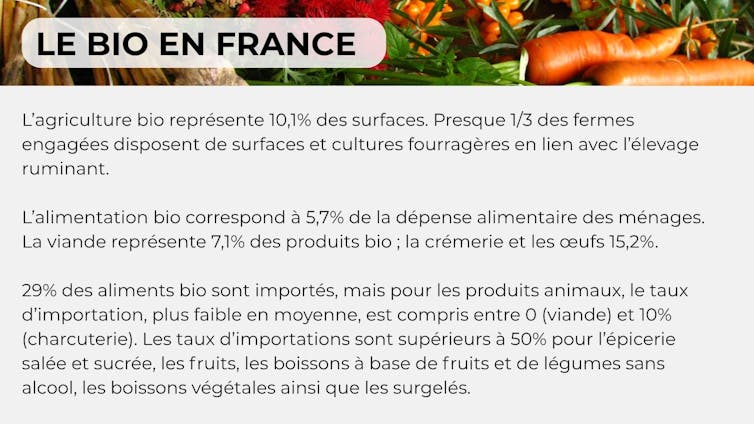
En France, une agriculture totalement bio est encore loin d’advenir, vu que l’agriculture conventionnelle représente aujourd’hui 90 % des terres agricoles et qu’elle reste à l’origine de 94 % des dépenses alimentaires des ménages.

De ce fait, cela peut sembler ironique quand on entend les craintes de dépendance aux importations que soulèvent les sceptiques du bio, car l’agriculture française est déjà aujourd’hui très dépendante des produits importés, avec 2 millions de tonnes d’engrais azotés de synthèse et 3,5 millions de tonnes de tourteaux de soja pour l’agriculture conventionnelle, auxquels il faut ajouter l’équivalent de 680 000 hectares de fruits et légumes.

D’où la question : est-il possible de consommer plus de produits bio, globalement bénéfiques pour la santé et pour l’environnement, malgré des productions agricoles plus faibles ?

Diminuer la viande dans l’assiette pour généraliser le bio

La réponse est oui, si l’on diminue notre consommation de produits animaux, et donc la surface agricole réservée à l’élevage pour en consacrer plus aux productions végétales. Pour évaluer quelle diminution serait bénéfique à la fois pour la santé et pour l’environnement, commençons par regarder quelles sont les recommandations sur la part de protéines végétales et animales que l’on devrait avoir dans notre alimentation.

Notre consommation moyenne de protéines totales (1,4 g/jour de protéines par kilogramme de poids corporel) excède aujourd’hui les recommandations d’environ 30 % et les besoins de 70 % (0,83 g/jour de protéines par kilogramme de poids corporel). Un régime plus végétalisé demeure meilleur pour la santé. Il serait même possible d’utiliser jusqu’à 80 % de protéines végétales tout en assurant nos besoins en micronutriments essentiels, comme la vitamine B12, pour apporter suffisamment de protéines, à condition d’associer des céréales aux légumineuses de façon à avoir un apport équilibré en acides aminés.

Ces données scientifiques permettent de définir un ordre de grandeur pour une baisse sans risque de la consommation de produits carnés, qui serait de l’ordre de 50 % en moyenne pour respecter les limites planétaires, notamment pour le climat et pour l’azote, sans augmenter la dépendance aux importations.

Moins manger de viande n’est d’ailleurs pas aberrant du tout d’un point de vue historique, car, si certains associent un régime très carné à des traditions culturelles, les Français mangeaient en réalité moitié moins de viande il y a cent ans.

Les produits laitiers sont également surconsommés aujourd’hui, au regard des recommandations nutritionnelles, avec une consommation moyenne de 70 grammes de fromage par jour lorsqu’il est conseillé de ne pas dépasser 40 grammes.

Une alimentation plus bio est donc possible en végétalisant l’assiette, car diminuer la consommation de produits animaux réduirait bien plus la surface pour se nourrir que la généralisation d’une alimentation bio ne l’augmenterait.

Ainsi, réduire la consommation de produits animaux permet de diviser par deux cette surface (de 8,3 m²/jour pour ceux qui mangent moins de 50 grammes de viande par jour à 16,8 m²/j pour ceux qui en mangent plus de 100 grammes par jour), alors que consommer bio ne l’augmenterait que de 30 %. De cette façon, il serait possible de libérer au moins 4 millions d’hectares de cultures utilisées par l’élevage et de les affecter à des productions végétales cultivées en bio, compensant ainsi des rendements inférieurs, notamment pour les céréales.

Quel type d’élevage favoriser ?

Reste la question de savoir quels types d’élevage il faudrait en priorité diminuer et ceux qui, au contraire, sont à favoriser.

Les élevages de ruminants (bovins, ovins) à soutenir sont ceux où l’alimentation des animaux provient principalement des prairies pâturées ou récoltées. De tels élevages sont plus faciles à mettre en œuvre en bio. Ils sont meilleurs pour l’environnement car ils génèrent moins de pollutions azotées et utilisent bien moins ou pas de pesticides. En outre, le lait et la viande sont plus riches en acides gras insaturés à fonction anti-inflammatoire.

En conséquence, la réduction des productions animales devrait surtout concerner les élevages les plus intensifs en intrants de synthèse, et/ou concentrés géographiquement, qui utilisent le plus de terres labourables et sont le plus dépendants d’importations de concentrés (soja) pour l’alimentation des animaux. Une partie des terres labourables – 3,8 millions d’hectares pour l’élevage des ruminants et 3,9 millions d’hectares pour les porcs et les volailles – serait alors utilisée pour des productions végétales en bio.

Les scénarios conçus à l’échelle de l’Union européenne et de la France montrent que la mise en œuvre de pratiques agroécologiques ne permet pas à elle seule d’atteindre les objectifs de politiques publiques en matière de climat et d’émissions d’azote. Cela nécessite donc de végétaliser l’assiette, en complément du développement massif des légumineuses, qui ont l’immense intérêt de ne pas exiger d’apport en engrais azotés, de réduire de moitié le gaspillage alimentaire, et de recycler une partie de nos urines naturellement riches en azote. En effet, un point faible de l’agriculture biologique est souvent le manque d’azote, nécessaire à la croissance des plantes.

La bio étant une forme emblématique, mais perfectible, de l’agroécologie, le progrès des connaissances pour développer une agriculture, dite biorégénératrice, fondée sur les processus écologiques permettrait de réduire les différences de production avec l’agriculture conventionnelle. Cela suppose d’activer de nombreux leviers agronomiques : la diversification végétale, les pratiques améliorant la santé du sol ainsi que des modes d’alimentation des animaux fondés sur l’herbe pour les ruminants et sur la complémentation en lin pour les monogastriques.

Ignorant ces données scientifiques quant à nos besoins en protéines animales et leurs impacts sur l’environnement, le débat sur le bio est souvent mal posé.

The Conversation

Membre du Conseil scientifique de PADV (Pour une Agriculture du Vivant)

ref. Une agriculture 100% bio en France est-elle possible ? – https://theconversation.com/une-agriculture-100-bio-en-france-est-elle-possible-263394

Dams for development? Unpacking tensions in the World Bank’s hydropower policies

Source: The Conversation – Africa – By Barnaby Joseph Dye, Lecturer, King’s College London

Dams have been emblematic of the World Bank’s approach to development for many decades. From the bank’s early years in the 1960s and 1970s, large-scale infrastructure projects such as dams, power plants and transport networks were central to its strategy for economic growth and poverty reduction. This reflected a top-down modernisation paradigm.

But the controversial social, economic and environmental impacts of dams sparked widespread criticism. This prompted internal scrutiny and a reduction in funding by the 1990s. Notable examples included the bank’s withdrawal from India’s Narmada Dam and Nepal’s Arun III hydropower project. Both followed large-scale protests.

From 2007, the bank’s support for dams began to rise again, reflected in an increasing portfolio of projects. There were two main drivers. Hydropower gained renewed appeal as a low-carbon energy source. And infrastructure-led economic growth regained prominence in development policy. Yet, earlier debates were not erased: questions about social, environmental and political consequences continued to influence decision-making.

This begs the question of whether anything has changed. Does the World Bank approach dams differently today? Did past protests and policy reforms have a longer-lasting effect?

We are researchers examining the politics of development, with a focus on dam decision-making in Africa and South Asia. In a recent book chapter we show that debates over dams are far from settled. Reforms have strengthened planning, impact assessment and mitigation. But change has been gradual, contested and layered, reflecting the deeply political nature of large-scale infrastructure projects.

In the book chapter we trace how the World Bank’s approach to dams has shifted over decades. We ask whether reforms have genuinely altered how dams are built and their impacts.

The answer is nuanced. Reforms have improved planning, impact assessment and mitigation. These changes have indeed reduced negative social and environmental effects. But they have been introduced gradually, in layers, without fully replacing older practices.

Some negative impacts continue to be overlooked, and compensation schemes are often inadequate. The balance of trade-offs has shifted. Yet decades of reform have not resolved the tensions surrounding dam-building. These remain hotly debated both within and outside the bank.

This reveals the World Bank as a dynamic institution, shaped by debates and contestations. These take place within the organisation and from governments, communities and civil society. Policy-making and implementation are inherently contested processes. Both require careful negotiation, oversight and engagement.

Our findings highlight the importance of critical engagement and independent research to influence how large-scale infrastructure projects are planned and executed. And to bring alternative perspectives into institutional decision-making.

The evolution of dam-building

In the mid- to late 20th century, the World Bank championed large dam projects as engines of economic growth. The bank supported hydropower and irrigation infrastructure across Asia, Africa and Latin America. These projects often prioritised technical and financial feasibility over social and environmental issues.

The consequences were significant: widespread displacement, ecological damage and resistance from affected communities and advocacy groups.

Civil society, academic research and internal bank discussions increasingly criticised this approach. By the 1990s, development thinking began to shift. Greater emphasis was placed on participation, environmental safeguards, and social inclusion. Concepts such as sustainable livelihoods, social capital, and community-driven development gained traction. Participatory development approaches became more prominent.

The bank increasingly positioned itself as a “knowledge bank”. It began to emphasise data collection and local consultation alongside financing.

New mechanisms were introduced to embed participation and safeguard considerations. These included social and environmental impact assessments and stakeholder consultations. Yet these processes often operated within existing frameworks that continued to prioritise economic and engineering objectives. The result was that technical and financial considerations largely remained central.

Participation or performance?

In theory, local consultation and stakeholder engagement have become integral to the World Bank’s approach to dam development. In practice, however, these processes often serve more as legitimising tools than as genuine mechanisms for power redistribution.

For example, in Nepal, the World Bank’s subsidiary, the International Finance Corporation, promotes sustainable hydropower through stakeholder-based discussions and training programmes. Yet these initiatives frequently exclude key local actors. The focus instead remains on government agencies, industry representatives and international donors.

Similarly, at the Rusumo Falls Dam in Tanzania, resettlement action committees comprising affected communities were established to liaise with project authorities and advise on compensation. The committees provided a formal avenue for local input. But they had limited power to challenge national governments or alter major financial and infrastructural decisions.

In essence the bank co-opts critical voices while proceeding with its own priorities. Local communities can voice concerns. But their influence over the trajectory of development projects remains constrained.

Where change comes from

Scholars have often attributed shifts in World Bank policy to external pressures. These include civil society advocacy, intellectual debates on development and evolving global norms.

These factors certainly play a role. But our research highlights the importance of internal dynamics within the institution.

Competing factions within the bank generate tensions that drive both reform and continuity. For example, financiers focus on lending targets. Engineers prioritise large-scale infrastructure. Others advocate for social and environmental protections.

This internal contestation helps explain why new World Bank dam policies often fail to produce the expected outcomes. Policy evolution is gradual. New priorities layered onto existing frameworks. The result is a mixture of change and continuity.

Far from being a monolith, the World Bank is an institution shaped by ongoing internal debate. Different interests, factions and ideas rise and fall in influence over time.

Rethinking participation

Dams are a microcosm of broader development debates. They demand political choices and trade-offs between infrastructure needs, financing, environmental sustainability, social equity and economic impact.

The World Bank reflects these tensions internally, with competing priorities and factions shaping how decisions are made.

For those interested in meaningful reform, the challenge is to embed more inclusive governance and decision-making. Participation must go beyond token consultation. It should involve genuine power-sharing with affected communities, stronger accountability mechanisms and real influence over project outcomes.

The Conversation

Barnaby Joseph Dye has received multilple grants and a scholarship from the UK’s Research Councils (mainly Economic and Social Science Research Council) and the British Academy. He is a member of the British Labour Party.

Udisha Saklani received funding from the UK Research and Innovation Economic and Social Research Council (ESRC) under grant number ES/P011373/1, as part of the Global Challenges Research Fund. She also acknowledges support from the Margaret Anstee Studentship awarded by Newnham College, University of Cambridge.

ref. Dams for development? Unpacking tensions in the World Bank’s hydropower policies – https://theconversation.com/dams-for-development-unpacking-tensions-in-the-world-banks-hydropower-policies-260947

Ce que nous apprend l’histoire du féminisme au Québec

Source: The Conversation – in French – By Adeline Vasquez-Parra, Maître de conférences, Université Lumière Lyon 2

Retour sur la longue histoire du féminisme québécois, sur ses figures marquantes et sur la relation entre ce mouvement, lui-même hétérogène, et diverses autres structures, qu’il s’agisse de partis politiques ou d’organisations de défense des droits des peuples autochtones.


Un sondage effectué en juillet 2025 montre que plus de 56 % de la jeune génération québécoise (18–34 ans) soutient l’indépendance du Québec. Pourtant, cette même génération se mobilise avant tout pour des luttes mondiales telles que l’écologie, la justice sociale et le féminisme. Comment comprendre ce paradoxe apparent ?

L’histoire du mouvement féministe au Québec offre une clé de lecture : elle montre comment, depuis plus d’un siècle, les luttes féministes se sont entremêlées, parfois harmonieusement, parfois plus douloureusement, avec divers projets d’émancipation politique, dont celui de la souveraineté du Québec.

Aux origines

Dès le début du XXe siècle, le féminisme québécois s’inscrit dans un double héritage : celui de l’implication des femmes dans les paroisses catholiques et celui des réseaux atlantiques. Ces réseaux comprennent des échanges et des circulations de personnes et d’idées entre l’Europe et l’Amérique du Nord depuis le XVIIIe siècle. C’est à partir de ces espaces que certaines prennent la parole et portent dans la sphère publique des questions liées aux inégalités sociales et politiques, comme l’absence de suffrage universel ou les écarts salariaux.

En 1902, la militante féministe Robertine Barry fonde le magazine bimensuel le Journal de Françoise, qui promeut les droits des femmes. Trois ans plus tard, elle participe avec une autre journaliste, Éva Circé-Côté, à la création de l’Association des femmes journalistes canadiennes françaises, qui regroupe des militantes engagées dans les combats progressistes de l’époque.

Circé-Côté publie dans le journal les Débats jusqu’à la condamnation de celui-ci par l’archevêque de Montréal en 1903, condamnation certes morale mais très influente dans la société québécoise de l’époque. Elle y défend l’accès à la culture pour les francophones privés de bibliothèques publiques, ainsi que l’éducation laïque.

Dans les décennies suivantes, le féminisme québécois s’allie avec le militantisme syndical, ce qui lui permet de toucher davantage les classes populaires.

Des militantes syndicales comme Léa Roback s’illustrent dans la grève des Midinettes de 1937, qui rassemble 5 000 ouvrières mobilisées pour de meilleures conditions de travail. Le syndicalisme féminin devient un vecteur de revendications, déjà portées par la Fédération nationale Saint-Jean-Baptiste et ses figures de proue telles que Marie Gérin-Lajoie et Caroline Dessaulles-Béique, militantes pour l’accès des femmes au marché de l’emploi et à la protection sociale.

Féminisme et souverainisme

Le mouvement se complexifie dans les années 1960, lorsque le féminisme croise l’indépendantisme et les luttes socialistes.

Le Front de libération des femmes (FLF), fondé en 1969, relie explicitement émancipation féminine et indépendance du Québec, adoptant le slogan « Pas de libération du Québec sans libération des femmes ». Il critique l’impérialisme états-unien et le capitalisme, dans lesquels il voit des sources d’exploitation économique et symbolique, et refuse toute influence linguistique ou idéologique du féminisme anglophone, qu’il soit états-unien ou canadien, lui-même accusé d’impérialisme.

La langue, pense-t-on, forge seule les concepts, impose une vision du monde et donc, trace les frontières du commun. Malgré des actions spectaculaires et la publication d’un journal, le FLF se dissout en 1971.

« Québecoises deboutte ! », brochure publiée en 1972.
Réseau québecois en études féministes

Le Centre des femmes, créé en 1971, prolonge cet héritage mais élargit ses priorités aux questions sociétales – avortement, reconnaissance économique du travail domestique – tout en diminuant la perspective nationale.

Face à l’influence du Parti québécois (PQ), formation indépendantiste fondée en 1968, qui exprime une conception conservatrice du rôle social des femmes, le mouvement féministe québécois finit par progressivement se détourner de la question nationale à la fin des années 1970. Il ne disparaît toutefois pas du paysage politique et revendique un féminisme ancré dans son contexte, attentif à l’articulation entre l’exploitation du corps des femmes et celle du territoire, problématique approfondie par la politologue Diane Lamoureux dès les années 1980.

Le féminisme autochtone

Parallèlement au développement de ce féminisme lié à la cause souverainiste (la volonté de faire du Québec un État souverain), les femmes autochtones du Québec mènent des luttes qui articulent genre, décolonisation et justice sociale.

Mary Two-Axe Earley, militante kanien’kehá :ka (mohawk), incarne cet engagement. Dans les années 1960 et 1970, elle s’attaque à l’alinéa 12(1)  b de la Loi fédérale sur les Indiens (1876), qui prive les femmes autochtones mariées à des non-Autochtones de leurs droits fonciers et communautaires, alors que les hommes transmettent leur statut sans restriction. Militante infatigable, elle parcourt le Québec et le monde pour faire entendre la voix des femmes autochtones et réclamer l’égalité des droits au sein de leurs communautés.

En 1974, Mary Two-Axe cofonde Femmes autochtones du Québec, organisation qui défend l’émancipation et les droits fonciers des femmes autochtones, tout en mettant en lumière les discriminations spécifiques qu’elles subissent, notamment le sexisme et le racisme.

Ellen Gabriel, porte-parole de la nation mohawk de Kanehsatà :ke, prolonge cette lutte jusqu’aux Nations unies en 2009, en dénonçant la continuité de politiques fédérales et provinciales qui favorisent l’exploitation des ressources naturelles par des multinationales au détriment des besoins des communautés vivant sur des terres autochtones.

Cette dénonciation renvoie à la crise d’Oka de 1990, évènement que l’on pourrait qualifier de « refoulé », tant il exerce toujours une pression latente sur la société québécoise sans être ouvertement débattu ou discuté. La crise d’Oka a opposé en 1990 la communauté mohawk de Kanehsatà :ke aux autorités québécoises et canadiennes après l’annonce de l’extension d’un terrain de golf sur un bois sacré et un cimetière ancestral. Le conflit, marqué par des confrontations tendues avec la Sûreté du Québec puis l’armée canadienne, a duré 78 jours et symbolise une première forme de résistance politique autochtone contemporaine.

Des hommes et des femmes du territoire mohawk de Tyendinaga (Ontario) bloquent le pont Skyway qui enjambe la baie de Quinte, septembre 1990.
Chris Malette/Belleville Intelligencer

Ces luttes trouvent un prolongement contemporain dans l’Enquête nationale sur les femmes et les filles autochtones disparues et assassinées, mise sur pied en 2016. Celle-ci révèle l’existence d’une violence structurelle envers les femmes autochtones, en la rattachant à l’histoire coloniale et juridique du Canada. Aujourd’hui encore, les femmes autochtones courent un risque beaucoup plus élevé d’être victimes de violences conjugales, sans que ces violences soient signalées. Les conclusions de l’enquête rappellent ainsi que les droits des femmes ne peuvent être pleinement garantis sans la reconnaissance des droits des peuples autochtones.

La perspective décoloniale

Le croisement entre luttes autochtones, féminisme décolonial et projet d’indépendance du Québec est aujourd’hui incarné par la politologue Dalie Giroux. Dans son pamphlet l’Œil du maître (2021), elle interroge les liens entre souveraineté traditionnelle, exploitation du territoire et présence des peuples autochtones au Québec. Elle propose de « décoloniser la décolonisation » québécoise en soulignant que l’émancipation de la nation francophone doit se penser en dialogue avec les luttes autochtones, antiracistes, écologiques et féministes.

Par ailleurs, pour Giroux, l’héritage historique de l’interaction entre mouvement souverainiste et féminisme demeure ambivalent car le mouvement souverainiste n’est pas toujours jugé suffisamment inclusif.

Comme le souligne la sociologue Leïla Benhadjoudja, le Québec occupe une position singulière dans l’histoire du colonialisme, car placé sous la domination de deux régimes coloniaux distincts – français, puis britannique. La conquête britannique de 1760, qui va induire un rapport colonial entre francophones dépossédés et colonisateurs anglophones, constitue en cela un traumatisme politique durable pour les habitants canadiens francophones.

Ce passé explique une discrimination spécifique de la population canadienne francophone, mais il ne saurait être mis sur un pied d’égalité avec l’expérience coloniale subie par les peuples autochtones ou l’esclavage des populations africaines.

Enfin, la philosophe Mélissa Thériault a elle aussi analysé comment appliquer une pensée décoloniale dans ce contexte francophone nord-américain complexe. Elle insiste sur la nécessité de transformer le regard intellectuel sur les rapports sociaux afin de rééquilibrer les relations entre peuples autochtones, populations colonisées et descendants des colonisateurs européens. Selon elle, une critique féministe et décoloniale située est essentielle pour comprendre l’impact des rapports de domination à l’œuvre sur le territoire québécois, lui aussi par ailleurs qualifié par certains de « victime » du « colonialisme » de l’État canadien.

Adeline Vasquez-Parra a récemment publié Histoire du Québec. Des origines à nos jours (2025).
Éditions Tallandier

Ainsi, le féminisme autochtone et décolonial du Québec s’inscrit dans une logique de justice sociale globale depuis des enjeux plus restreints. Il ne s’agit pas seulement de droits des femmes, mais de droits collectifs, de reconnaissance territoriale et de transformation des rapports de pouvoir hérités de l’histoire coloniale occidentale.

Ce cadre offre une perspective complémentaire au féminisme québécois historique, permettant (peut-être) de concevoir un féminisme québécois hybride, à la fois national, autochtone et décolonial, capable de dépasser les modèles hégémoniques actuels.

Des leçons pour aujourd’hui

Aujourd’hui, les féminismes québécois se distinguent par leur originalité : enracinés dans un combat à la fois pour la reconnaissance politique et pour une nouvelle ouverture aux voix marginalisées, notamment celles des femmes autochtones, migrantes, allophones et réfugiées.

Ce double héritage, bien que partiel et inachevé car ne constituant pas un seul et même mouvement, constitue tout de même une richesse pour comprendre les débats contemporains sur la diversité. Reconnaître cette histoire permet de mieux comprendre les tensions actuelles entre universalisme et spécificités, luttes collectives et expériences locales.

The Conversation

Adeline Vasquez-Parra ne travaille pas, ne conseille pas, ne possède pas de parts, ne reçoit pas de fonds d’une organisation qui pourrait tirer profit de cet article, et n’a déclaré aucune autre affiliation que son organisme de recherche.

ref. Ce que nous apprend l’histoire du féminisme au Québec – https://theconversation.com/ce-que-nous-apprend-lhistoire-du-feminisme-au-quebec-263871

Urbaniser sans artificialiser : le potentiel caché du sous-sol

Source: The Conversation – in French – By Jean-Philippe Antoni, Professeur de géographie et d’urbanisme, Université Bourgogne Europe

La loi « visant à faciliter la mise en œuvre des objectifs de lutte
contre l’artificialisation des sols et à renforcer l’accompagnement des élus locaux » (2003) entend limiter l’artificialisation des sols d’ici 2050. Pour concilier développement urbain et sobriété foncière, l’urbanisme souterrain apparaît comme une solution intéressante. Il permet de préserver les terres agricoles et les paysages tout en intégrant infrastructures, commerces ou transports sous la surface.


Dans le cadre d’un aménagement durable lié à la lutte contre le changement climatique, la loi dite « Zéro artificialisation nette » (ZAN), adoptée en 2023, suscite de nombreux débats. Pour atteindre une sobriété foncière devenue nécessaire face à l’ampleur de l’étalement urbain, elle prévoit la fin probable de toute artificialisation d’ici 2050, c’est-à-dire l’interdiction de construire sans compensation sur des espaces qui ne sont pas déjà bâtis. La loi ZAN est de ce fait perçue par certains comme une atteinte historique à la propriété privée, mais également comme un frein à l’autonomie des communes, dont le développement économique et résidentiel serait mis sous cloche. Pour s’y préparer, de nombreux projets envisagent une requalification et une densification du bâti existant, mais rares sont ceux qui proposent de mieux exploiter le sous-sol. Or, l’urbanisme souterrain est une solution déjà ancienne dont les expériences récentes confirment l’efficacité, en particulier dans les zones les plus peuplées.

L’utilisation des sous-sols est souvent mal connue du grand public pour une raison simple qui constitue aussi son principal avantage : son invisibilité. C’est généralement seulement lors des travaux de voirie que l’on découvre dans le sous-sol un foisonnement technique très divers qui regroupe autant des réseaux d’eau, de communication et d’énergie, que des caves ou des espaces de stockage, voire des équipements de transports. La majorité, sans intérêt esthétique, y ont été enfouis pour y être cachés ou pour dégager un espace équivalent à leur volume, laissant la place en surface à des espaces ouverts ou végétalisés. Cette idée a fait l’objet de plusieurs approches théoriques qui ont montré son intérêt pour les villes d’aujourd’hui.

Un nouveau rôle pour le sous-sol

Au début du XXe siècle, l’urbaniste Eugène Hénard est parmi les premiers à imaginer des rues à étages multiples pour rationaliser l’usage du sol et rendre la ville plus salubre. Son idée repose sur le constat qu’au fil du temps, l’accumulation anarchique des réseaux dans les égouts de Paris a rendu leur fonctionnement difficile à gérer et empêche, par sa complication, toute possibilité d’évolution. Il propose alors de réserver systématiquement un espace en sous-sol pour les équipements nécessaires. Les rues seraient comme « dupliquées » : circulation des personnes et des véhicules légers en surface, réseaux techniques et transport lourd en souterrain. Cette proposition préfigure l’urbanisme de dalle, tel qu’il a par exemple été mis en œuvre dans les années 1960 à Barbican Estate (Londres) ou à la Défense (Paris), un quartier d’affaires dont l’aménagement devrait bientôt s’étendre en sous-sol.

Au milieu du XXe siècle, l’architecte Édouard Utudjian (1905-1975) a proposé une théorie de l’urbanisme souterrain plus complète, partant du principe que « les rues seront toujours trop étroites, les distances trop grandes, les constructions trop entassées, les fumées trop nombreuses ». Reste alors le sous-sol, qui apparaît selon lui comme « l’une des chances de demain ». Il y voit en effet plusieurs avantages, notamment la préservation des espaces verts en surface, le doublement des voies de circulation sans croisement, ou la protection du vent et des incendies. Il n’est évidemment pas question « d’enterrer l’habitat humain, mais seulement certains organes de la ville qui encombrent la surface de leur masse inerte », dans lesquels l’homme ne vivra que périodiquement.

La « ville souterraine » de Montréal (Québec, Canada) en 2017.
Lee Jung Tak

La ville souterraine de Montréal (Québec, Canada) concrétise aujourd’hui cette idée. Avec plus de 30 km de galeries souterraines piétonnières reliant près de 2 000 commerces et restaurants éclairés par des puits de lumière au milieu d’œuvres d’art et d’architecture remarquables, elle protège les habitants des intempéries hivernales. La lutte contre le froid et la chaleur est en effet un argument majeur pour justifier les constructions souterraines. Le climat est souvent l’une des premières motivations pour un enfouissement qui réduit les variations de température, à Montréal comme à Abou Dabi, où, pour limiter le recours à la climatisation, la ville laboratoire de Masdar City intègre des galeries et des équipements souterrains, avec à terme, un système de transport individuel et automatique innovant en sous-sol.

Ensuite, c’est la lutte contre la congestion qui justifie les projets souterrains. Le sous-sol permet d’organiser les flux de circulation, de réduire le trafic en surface, et donc la congestion qu’il génère, en augmentant le nombre de voies et en les séparant pour plus de sécurité. Bien connu dans les grandes métropoles, l’efficacité du métro réside dans l’enfouissement de tunnels en ligne droite et en site propre, qui permettent d’éviter l’encombrement et la circulation des rues pour un transport urbain parmi les plus rapides et les plus sûrs au monde.

Enfin, c’est la pénurie d’espace et la préservation des paysages qui invitent à enterrer certains bâtiments ou certaines infrastructures. Cette translation vers le sous-sol libère d’autant l’occupation du sol à l’air libre et ne laisse visible que le patrimoine architectural ou paysager qui doit être mis en valeur. À Naoshima au Japon, le musée de Chichū a par exemple été conçu en souterrain pour faciliter les jeux de lumière mettant l’art en valeur, mais aussi pour conserver une vue sur le paysage de collines environnant, faisant de la qualité du site naturel un atout revendiqué du projet.

Stratégies de sobriété souterraine

Le sous-sol apparaît donc comme une solution possible pour concilier développement urbain et sobriété foncière. La question reste de savoir ce qui pourrait être enterré, et à quelle profondeur, pour que l’ensemble reste viable et vivable. Les propositions déjà anciennes de l’aménageur québécois Daniel J. Boivin y répondent partiellement en découpant le sous-sol en trois strates selon leur accessibilité.

La première, « immédiatement sous nos pieds », est épaisse d’une dizaine de mètres et contient déjà des câbles et des conduites diverses. Elle pourrait aussi accueillir de nombreuses activités commerciales qui nécessitent peu de lumière naturelle directe (supermarchés, discothèques, cinémas, restaurants). Jusqu’à 200 mètres, la deuxième strate pourrait contenir des éléments d’industrie légère, des voies de transport et de stationnement, des entrepôts, des centres de recherche, des studios d’enregistrement ou des installations de chauffage urbain. Enfin, les grandes profondeurs (en dessous de 200 mètres) pourraient être réservées aux équipements lourds comme les centrales électriques, le stockage des déchets industriels, ou les réservoirs d’eau et d’énergie.

Par ailleurs, l’urbanisme souterrain se connecte sans difficulté majeure au système de transport urbain pour y apporter une valeur ajoutée. À Tokyo, par exemple, le développement des galeries marchandes souterraines s’est appuyé sur le métro pour capter sa clientèle, ce qui a permis de compenser directement le prix de l’investissement en sous-sol par un bénéfice commercial augmenté. On retrouve donc ici une idée bien connue des urbanistes d’aujourd’hui : le transit-oriented development (TOD). Théorisé par l’architecte américain Peter Caltorpe, le TOD vise à créer des quartiers accessibles autour des pôles de transport (gares ou stations métro/tramway) avec une haute densité bâtie, une grande mixité fonctionnelle et une déambulation piétonnière qui pourraient être largement favorisées par des projets souterrains.

La question est de savoir à quels coûts de tels projets sont envisageables. Si le montant des investissements nécessaires ne peut être estimé qu’au cas par cas, il est structurellement bien plus important que pour une construction classique. On ne peut donc envisager sa rentabilité que dans le long terme, dans le cadre de partenariats avec les acteurs publics, fondés sur une volonté politique durable de sobriété foncière. Les enjeux sont importants, notamment dans les périphéries des grandes villes sujettes à l’étalement urbain. En enfouissant autant que possible l’architecture sans fenêtres caractéristique des zones commerciales périurbaines, un urbanisme souterrain aurait l’avantage de ne plus consommer d’espaces agricoles et de ne plus nuire aux paysages des entrées de villes qui, plutôt que d’offrir une véritable vitrine aux agglomérations, sont souvent décriées pour leur hétérogénéité et leur manque d’harmonie.

Dans un contexte culturel où le monde souterrain a longtemps été associé à la peur ou à la science-fiction, il reste également à savoir comment de tels projets peuvent être perçus en termes d’ambiance et de confort. Mais c’est d’ores et déjà une question que les usagers du métro ne se posent plus vraiment, et les projets existants montrent par leur fréquentation que le sous-sol peut être exploité à son avantage dans des espaces valorisés par l’éclairage indirect. Il est fort probable que l’acceptabilité de projets de plus grande échelle réside dans un traitement architectural réussi, qui organise avec harmonie la transition entre la surface et le sous-sol. Urbaniser en souterrain n’est donc pas seulement un enjeu pour l’environnement et pour le le climat. C’est aussi un défi pour les architectes de demain.

The Conversation

Jean-Philippe Antoni a reçu des financements de l’Agence de la transition écologique (ADEME) et de l’Agence nationale de la recherche (ANR).

ref. Urbaniser sans artificialiser : le potentiel caché du sous-sol – https://theconversation.com/urbaniser-sans-artificialiser-le-potentiel-cache-du-sous-sol-263367