Adoptar a un mayor de edad para dejarle la herencia: el fraude para no pagar impuestos

Source: The Conversation – (in Spanish) – By Juan Carlos Velasco-Perdigones, Profesor Dr. de Derecho Civil. Investigador del Instituto para el Desarrollo Social Sostenible. Magistrado Suplente de la Audiencia Provincial de Cádiz, Universidad de Cádiz

BearFotos/Shutterstock

La adopción de personas mayores de edad es más frecuente de lo que podríamos pensar. Una de las razones para llevarlo a cabo no tiene nada que ver con lazos emocionales o afectivos sino con cuestiones más prácticas y pecuniarias: el ahorro fiscal.

La adopción de un mayor de edad en muchas ocasiones tiene por finalidad el ahorro fiscal en el momento de la sucesión del adoptante, ya que el adoptado se beneficiaría de una carga impositiva muy exigua a la hora de recibir la herencia de sus adoptantes. Al fallecer el adoptante o adoptantes, la hija o el hijo adoptivo puede heredar con importantes reducciones fiscales, dependiendo de cada región. Porque para el fisco no es lo mismo que los herederos sean descendientes a que no tengan vínculos con el fallecido o sean parientes más lejanos, como los sobrinos.

Recientemente se ha desarrollado una investigación sobre el fraude de ley en el proceso de adopción del mayor de edad, poniendo de relieve la situación fraudulenta con la normativa actual y las posibles soluciones.

El ordenamiento jurídico vigente habilita a la adopción de mayores de edad de forma simplificada, con menos trámites que cuando se trata de un menor. Pero queda configurada por el ordenamiento como algo excepcional y solo cuando, inmediatamente antes de la mayoría de edad, la persona candidata a la adopción haya vivido acogida en la familia de los adoptantes o haya existido una convivencia estable con ellos de, al menos, un año.

El acogimiento previo tiene su sentido si se tiene en cuenta que el entonces menor ha participado en la vida familiar de la futura familia adoptante. El problema se plantea con la acreditación de esa previa convivencia estable del mayor de edad, en la que los promotores del expediente pretenden acreditar una apariencia de convivencia cuando realmente no trasciende más allá de los lazos normales entre los candidatos a adoptante y adoptado.

La distinta carga impositiva

Pongamos un ejemplo: un sobrino cercano a los 40 años –con buena relación con sus padres, todavía vivos– pretende ser adoptado por su tía de 70, soltera y sin hijos. Cuando la señora muere, el sobrino convertido en hijo adoptivo hereda su patrimonio con una carga impositiva menor al encontrarse en el grupo de descendientes y adoptados, y no en los grados de parentesco más distantes como sería el de tío-sobrino.

Porque la tributación del impuesto de sucesiones se establece en virtud de la relación de la persona heredera o legataria, es decir, una relación de parentesco más cercana con el causante (descendientes o adoptados) tendrá menos carga fiscal que una relación más lejana (tío-sobrino o tercero extraño).

Una persona adoptada que herede se considera como un descendiente (Grupo I y II), y en ese caso el impuesto de sucesiones está reducido o bonificado en una gran mayoría de comunidades autónomas (Madrid, Andalucía, Murcia, Galicia, Castilla y León, Extremadura, Canarias). Así, la cuota tributaria a pagar quedará reducida al mínimo, en algunos casos, a cero euros.

Al estar transferido el Impuesto de Sucesiones y Donaciones, cada comunidad autónoma (en materia sucesoria) aplica su propio régimen impositivo y de reducciones fiscales. Por ejemplo, en Andalucía, en el supuesto de herencias o legados a descendientes y adoptados valoradas en hasta un millón de euros, los herederos directos quedarían exentos del pago del impuesto.

Por el contrario, las herencias o legados recibidos por parientes colaterales, como puede ser un sobrino respecto de su tío, solo suponen una reducción fiscal de 10 000 euros, y los extraños –sin relación de parentesco– no tienen reducción alguna. Es decir, cuando no existe tal vínculo adoptivo y la relación es de tío-sobrino, en un caudal hereditario de un millón de euros, el impuesto podría rondar los 500 000 euros, dependiendo de las reducciones fiscales de cada comunidad.

En países con una carga fiscal importante, como España, la adopción de mayores de edad puede servir para transferir bienes y derechos entre individuos de una forma menos costosa desde el punto de vista fiscal. Mientras que otros países de la Unión Europea han apostado por la supresión del impuesto de sucesiones, España se convierte en uno de los lugares en los que sale más caro heredar

Cómo evitar este fraude

Con la regulación actual del art. 175 del Código Civil es fácil constituir una relación adoptiva simulada, ya que sólo se precisa acreditar una convivencia estable de al menos un año del candidato a la adopción con los eventuales adoptantes. Incluso, en caso de denegación de la adopción, el adoptante podría volver a solicitarla ante un tribunal distinto si cambia de domicilio, ya que no produce efectos de cosa juzgada y el Ministerio Fiscal, que es quien vela por la legalidad, es muy probable que sea distinto y desconozca del proceso fraudulento previo.

La solución a este problema pasa necesariamente por una reforma legal en la que se reformule la adopción del mayor de edad y se establezcan unos presupuestos claros que pongan coto a este tipo de fraudes.

Podría sustanciarse en la recuperación del artículo 175 del Código Civil, previo a la reforma del 2015, cuya redacción solo preveía la adopción del mayor de edad cuando hubiese existido una situación acreditada de acogimiento o convivencia ininterrumpida, iniciada antes de que el adoptando hubiese cumplido catorce años de edad. A ello habría que añadir una limitación a determinados supuestos.

Ahora, como ya se ha mencionado, solo se exige la prueba de la situación de acogimiento con los futuros adoptantes o de convivencia estable con ellos de, al menos, un año.

The Conversation

Juan Carlos Velasco-Perdigones no recibe salario, ni ejerce labores de consultoría, ni posee acciones, ni recibe financiación de ninguna compañía u organización que pueda obtener beneficio de este artículo, y ha declarado carecer de vínculos relevantes más allá del cargo académico citado.

ref. Adoptar a un mayor de edad para dejarle la herencia: el fraude para no pagar impuestos – https://theconversation.com/adoptar-a-un-mayor-de-edad-para-dejarle-la-herencia-el-fraude-para-no-pagar-impuestos-243321


La ‘variante Frankenstein’ del covid: ¿amenaza real o exageración mediática?

Source: The Conversation – (in Spanish) – By Daniel Sepúlveda Crespo, Investigador Miguel Servet, Instituto de Salud Carlos III

Desde hace unas semanas, la llamada “variante Frankenstein” del SARS-CoV-2 ocupa titulares en periódicos y televisiones. La imagen es potente: un virus que mezcla fragmentos de otros para escapar a nuestro sistema inmunitario. ¿Hay razones para la alarma? Desde la investigación, lo esencial es separar la evidencia de la especulación. A continuación, aclararemos qué sabemos y qué dudas persisten.

¿Qué es la variante XFG?

El nombre científico de la llamada variante Frankenstein es XFG, también conocida como Stratus. Es un linaje recombinante: surge cuando dos variantes coinciden en un mismo huésped y combinan parte de su material genético.

En este caso, XFG proviene de la mezcla de dos sublinajes de ómicron: LF.7 y LP.8.1.2. La Organización Mundial de la Salud (OMS) la incorporó como variante bajo monitoreo el 25 de junio de 2025, tras detectarse la primera muestra en enero de 2025. Esto significa que requiere vigilancia, pero no hay pruebas concluyentes de que represente un mayor riesgo.

Lo que sabemos hasta ahora

  1. Presencia global, impacto desigual. Según la OMS, XFG se ha identificado en más de 35 países. No obstante, su distribución es desigual: en muchos lugares sigue siendo minoritaria. En España, Andalucía confirmó sus primeros casos en julio, y en Madrid continúa la vigilancia activa en hospitales y laboratorios.

  2. Ventaja de crecimiento moderada. La OMS estima que XFG podría transmitirse algo más rápido que otras variantes, pero esto no implica automáticamente más gravedad o ingresos hospitalarios. Una publicación reciente apoya esta observación con matices: aunque sus mutaciones le dan cierta ventaja frente al sistema inmunitario, su unión al receptor ACE2 (la “puerta de entrada” a nuestras células) parece menos eficiente.

  3. Síntomas. Algunos medios han destacado un posible signo diferencial: la ronquera o voz áspera. No obstante, esta observación procede de reportes clínicos aislados. Los estudios publicados en The Lancet Infectious Diseases e Infectious diseases, así como un estudio en fase de prepublicación, coinciden en que no se han identificado síntomas diferentes a los de variantes recientes. De momento, no hay evidencia científica robusta que respalde un patrón clínico característico.

  4. Vacunas y protección. Los datos preliminares indican que las vacunas actuales, especialmente las basadas en JN.1 (la subvariante de ómicron dominante en 2024), siguen protegiendo frente a XFG: aunque muestran que la neutralización por anticuerpos se reduce moderadamente (aproximadamente a la mitad), esta no desaparece. Incluso en vacunados recientes con preparados de ARN mensajero, el riesgo de hospitalización continúa siendo bajo.

Lo que todavía no sabemos

La variante Frankenstein plantea varias preguntas que guiarán la investigación en los próximos meses:

  1. ¿Qué ventaja real de transmisión tiene frente a otras variantes?

  2. ¿Hasta qué punto escapa a la inmunidad previa por vacunas o infecciones?

  3. ¿Provoca más complicaciones en grupos de riesgo?

  4. ¿Es la ronquera un síntoma fiable o solo una coincidencia?

  5. ¿Seguirá predominando o será reemplazada por nuevas variantes?

  6. ¿Podría originar linajes aún más complejos?

Responder a estas preguntas requiere más secuenciación genómica, estudios de neutralización y registros clínicos. Sin embargo, la vigilancia ha disminuido en muchos países, lo que genera “puntos ciegos” justo cuando más datos necesitamos.

Más ciencia, menos Frankenstein

El apodo “Frankenstein” cumple su función de atraer atención, pero también puede inducir miedo innecesario. Los coronavirus llevan millones de años recombinando su genoma; lo que ocurre con XFG no es tan excepcional.

La diferencia es que hoy podemos detectar esas recombinaciones casi en tiempo real gracias a la secuenciación masiva y compartirlas en bases de datos globales. Eso permite vigilar, comparar y anticipar.


Leer más:
Cinco años después, ¿estamos mejor preparados para una pandemia?


De hecho, XFG no es el primer recombinante observado. Variantes como XE, XD o XF aparecieron en años anteriores y no llegaron a ser dominantes globalmente. La historia sugiere prudencia: no todas las recombinaciones generan amenazas mayores.

Por qué sí importa investigarla

Aunque no debamos alarmarnos en exceso, hay razones de peso para estudiar a XFG: no solo refuerza la vigilancia internacional y la capacidad de reaccionar ante cambios potencialmente críticos, sino que también ayuda a validar la eficacia de las vacunas actuales y a decidir si conviene actualizarlas. Además, mejora la comunicación pública, distinguiendo entre variantes con impacto real y aquellas que solo generan titulares inquietantes.

En otras palabras, XFG recuerda que el virus sigue evolucionando y que nuestra mejor defensa no es el miedo, sino la ciencia.

Aunque la llamada “variante Frankenstein” es real, no es un monstruo. Hasta ahora no hay evidencias de que cause enfermedad más grave ni de que supere la inmunidad de forma preocupante. Lo que sí ofrece es una oportunidad para aprender: mejorar la vigilancia, compartir datos y reforzar la investigación.

La mejor forma de convivir con titulares llamativos no es dejarnos arrastrar por ellos, sino transformarlos en conocimiento útil que nos prepare para lo que pueda venir.

The Conversation

Las personas firmantes no son asalariadas, ni consultoras, ni poseen acciones, ni reciben financiación de ninguna compañía u organización que pueda obtener beneficio de este artículo, y han declarado carecer de vínculos relevantes más allá del cargo académico citado anteriormente.

ref. La ‘variante Frankenstein’ del covid: ¿amenaza real o exageración mediática? – https://theconversation.com/la-variante-frankenstein-del-covid-amenaza-real-o-exageracion-mediatica-266390

La neurociencia revela que los músicos sienten el dolor de forma diferente

Source: The Conversation – (in Spanish) – By Anna M. Zamorano, Assistant Professor, Aarhus University

Irek Pod/Shutterstock.com

Es bien sabido que aprender a tocar un instrumento puede reportar beneficios que van más allá de la simple habilidad musical. De hecho, las investigaciones demuestran que es una actividad excelente para el cerebro y que puede mejorar nuestras habilidades motoras finas, la adquisición del lenguaje, el habla y la memoria. Incluso puede ayudar a mantener nuestro cerebro más joven.

Después de trabajar durante años con músicos y ser testigo de cómo siguen ensayando a pesar del dolor que les causa realizar miles de movimientos repetitivos, empecé a preguntarme: si la formación musical puede remodelar el cerebro de tantas maneras, ¿también puede cambiar la forma en que los músicos sienten el dolor? Para responder la pregunta, mis colegas y yo hemos realizado un estudio.

Así nos cambia el dolor

Los científicos sabemos que el dolor activa varias reacciones en el cuerpo y el cerebro, modificando nuestra capacidad de atención y los pensamientos, así como nuestra forma de movernos y comportarnos. Si tocamos una sartén caliente, por ejemplo, el dolor nos hace retirar la mano antes de que nos quememos gravemente.

También cambia nuestra actividad cerebral. De hecho, suele reducir la actividad en la corteza motora, el área que controla los movimientos, lo que ayuda a evitar que utilicemos en exceso una parte del cuerpo lesionada.

Estas reacciones contribuyen a prevenir daños mayores si sufrimos una lesión. Pero si la molestia continúa durante más tiempo y el cerebro sigue enviando las señales de “no te muevas” durante demasiado tiempo, las cosas pueden salir mal.

Por ejemplo, si nos torcemos el tobillo y dejamos de usarlo durante semanas, eso puede disminuir nuestra movilidad y alterar la actividad cerebral en las regiones relacionadas con el control del dolor, lo cual puede aumentar el sufrimiento a largo plazo.

Las investigaciones también han descubierto que el dolor persistente puede reducir lo que se conoce como el “mapa corporal”, que es desde donde el cerebro envía órdenes sobre qué músculos mover y cuándo. Y esta merma, a su vez, está relacionada con un aumento del dolor.

Pero, aunque está claro que algunas personas experimentan más dolor cuando se reduce su mapa corporal, no todo el mundo se ve afectado de la misma manera. Algunas personas soportan mejor el dolor y sus cerebros son menos sensibles a él. Los científicos aún no comprenden del todo por qué ocurre esto.

Los músicos y el dolor

En nuestro estudio, queríamos analizar si la formación musical y todos los cambios cerebrales que provoca podrían influir en cómo los músicos sienten y afrontan el dolor. Para ello, se lo provocamos deliberadamente en las manos durante varios días tanto a músicos como a no músicos para ver si había alguna diferencia en cómo respondían.

Para imitar de forma segura las molestias musculares, utilizamos un compuesto llamado factor de crecimiento nervioso. Se trata de una proteína que normalmente mantiene los nervios sanos, pero cuando se inyecta en los músculos de la mano, provoca dolor durante varios días, especialmente al moverla. Es segura, temporal y no causa ningún daño.

Luego utilizamos una técnica llamada estimulación magnética transcraneal (EMT) para medir la actividad cerebral. La EMT envía pequeños pulsos magnéticos al cerebro que utilizamos para crear el mapa cerebral de la mano en cada participante del estudio.

Creamos estos mapas antes de la inyección y luego los medimos de nuevo dos días después y ocho días después, para ver si el dolor cambiaba el funcionamiento del cerebro.

Un hombre recibiendo terapia de estimulación magnética transcraneal.
La estimulación magnética transcraneal consiste en enviar pequeños pulsos eléctricos al cerebro.
Yiistocking/Shutterstock.com

Una diferencia sorprendente

Cuando comparamos los cerebros de los músicos y los no músicos, las diferencias fueron sorprendentes. Incluso antes de inducir el dolor, los primeros mostraban un mapa de la mano más preciso en el cerebro. Cuanto más tiempo habían dedicado a practicar, más refinado resultaba ese mapa.

Después de inducir el dolor, los músicos informaron de que sentían menos molestias que los no músicos. Y mientras que el mapa de la mano en los cerebros de los no músicos se redujo dos días después de sufrir el dolor, los de los músicos permanecieron sin cambios; sorprendentemente, cuantas más horas habían entrenado, menos dolor sentían.

Aunque en el estudio participaron solo 40 personas, los resultados mostraron claramente que los cerebros de los músicos respondían de forma diferente al dolor. Su entrenamiento parece haberles proporcionado una especie de amortiguador contra los efectos negativos habituales, tanto en la intensidad de las molestias que sentían como en la reacción de las áreas motoras de su cerebro.

Por supuesto, no implica que la música sea una cura para el dolor crónico, pero sí nos muestra que el entrenamiento y la experiencia a largo plazo pueden moldear la forma en que percibimos el dolor. Esto podría ayudarnos a comprender por qué algunas personas son más resistentes al dolor que otras, además de cómo podemos diseñar nuevos tratamientos para quienes viven con él.

Nuestro equipo está llevando a cabo más investigaciones para determinar si el entrenamiento musical también puede protegernos de la alteración de la atención y la cognición durante el dolor crónico. A partir de ahí, esperamos poder diseñar nuevas terapias que “reentrenen” el cerebro de las personas que sufren ese dolor persistente.

Para mí, esta es la parte más emocionante: la idea de que, como músico, lo que aprendes y practicas cada día no solo hace mejorar una habilidad, sino que puede, literalmente, reconfigurar nuestro cerebro de manera que cambie nuestra forma de experimentar el mundo, incluso algo tan fundamental como el dolor.

The Conversation

Anna M. Zamorano ha recibido financiación de la Fundación Lundbeck y de la Fundación Nacional Danesa para la Investigación a través del Centro para la Neuroplasticidad y el Dolor (CNAP).

ref. La neurociencia revela que los músicos sienten el dolor de forma diferente – https://theconversation.com/la-neurociencia-revela-que-los-musicos-sienten-el-dolor-de-forma-diferente-266495

¿Es posible convivir con las lluvias torrenciales en el Mediterráneo?

Source: The Conversation – (in Spanish) – By Daniel Jato Espino, Investigador Sénior / Profesor en Ingeniería y Gestión Ambiental, Universidad Internacional de Valencia

Carretera inundada por las recientes lluvias en la Comunidad Valenciana. RTVE

Las lluvias torrenciales han vuelto a golpear el litoral mediterráneo. En solo unas horas, se han registrado hasta 246 l/m² en Amposta y 356,8 l/m² en Gandía. En Cullera, las precipitaciones alcanzaron “cifras históricas”, provocando desprendimientos y cortes de carreteras.

Estos episodios de intensas precipitaciones propios del principio del final del verano y principios del otoño no son nuevos. Sin embargo, su frecuencia e intensidad han aumentado en las últimas décadas debido al cambio climático. A pesar de ello, las lluvias no deberían considerarse el problema principal.

El verdadero desafío radica en cómo se ha construido y gestionado el territorio en estas zonas, que lo hace vulnerable a los efectos de las precipitaciones.

¿Se pueden evitar todos los daños?

El riesgo cero no existe. No obstante, sí es posible reducir significativamente las consecuencias si se adoptan medidas adecuadas.

Algunos daños son inevitables, especialmente cuando la lluvia supera cualquier capacidad de absorción o evacuación estimada. Muchos otros son recurrentes, pero evitables, ya que se deben a la construcción en zonas inundables, la falta de mantenimiento de infraestructuras o la urbanización sin drenaje adecuado. En estos casos, existen estrategias eficaces para reducir los daños provocados por las lluvias intensas.

1. Más infraestructura verde

Una de las medidas más relevantes es el fomento de la infraestructura verde. Elementos como parques inundables, jardines de lluvia o cubiertas vegetales permiten absorber el agua y disminuir la escorrentía. Estas soluciones también mejoran la calidad ambiental y social de los espacios públicos.

La renaturalización de espacios urbanos favorece la infiltración del agua en el suelo. En ciudades como Alcoy, se están restaurado barrancos como corredores ecológicos. Estas intervenciones conectan espacios naturales y reducen el riesgo de inundación, además de aportar valor paisajístico y ecológico.

2. Planificación territorial

La planificación territorial resulta clave. Evitar nuevas construcciones en zonas de riesgo es esencial para prevenir desperfectos y peligros para la población.

Asimismo, revisar los planes urbanísticos existentes e incorporar criterios de resiliencia (por ejemplo, prohibir nuevas construcciones en zonas inundables o exigir superficies permeables en nuevos desarrollos) permite anticiparse a futuros episodios extremos. Esta planificación debe ir acompañada de una gestión adecuada del drenaje urbano.

3. Sistemas de drenaje

Los sistemas de drenaje sostenible ofrecen una alternativa eficaz a los modelos convencionales. En lugar de canalizar el agua rápidamente hacia el alcantarillado, estos sistemas la retienen, filtran y liberan de forma controlada. Se trata de soluciones que imitan el ciclo natural del agua, como zanjas de infiltración, pavimentos permeables o depósitos de retención temporales.

Estos sistemas no vienen a sustituir a las redes convencionales de drenaje, sino que debe favorecerse la integración de ambas soluciones y enfatizar su mantenimiento. Muchos colectores presentan obstrucciones o no están adaptados a la nueva intensidad de las lluvias, lo que limita su eficacia. Los sistemas de drenaje sostenible, por su parte, ofrecen una mayor capacidad de adaptación y pueden integrarse fácilmente en entornos urbanos.


Leer más:
Imitar a la naturaleza para evitar inundaciones en las ciudades


4. Educación para la ciudadanía

Por último, la educación y la gobernanza son factores determinantes. La coordinación entre administraciones y la participación ciudadana fortalecen la capacidad de respuesta. Las alertas tempranas permiten actuar con rapidez y evitar consecuencias graves.


Leer más:
¿Cómo funciona el sistema de alerta de emergencias ES_ALERT utilizado en la dana de Valencia?


Ciudades esponja para convivir con el agua

El modelo de “ciudad esponja” ha dejado de ser experimental para convertirse en una estrategia urbana global frente al cambio climático. Estas ciudades no luchan contra el agua, sino que la integran en su diseño. Mediante soluciones basadas en la naturaleza, absorben, almacenan y reutilizan el agua de lluvia, reduciendo el riesgo de inundaciones y mejorando la calidad de vida urbana.

China ha liderado esta transformación. Ciudades como Shenzhen, Wuhan y Shanghai han incorporado humedales, superficies permeables y jardines de lluvia en su planificación. El objetivo nacional es que el 80 % de las áreas urbanas capten el 70 % del agua de lluvia para 2030.

En Europa, Alemania destaca por la magnitud de sus iniciativas. La instalación de cubiertas y fachadas verdes se ha promovido por los municipios. En 2019, dos tercios de las ciudades exigían cubiertas verdes en sus planes de desarrollo. Como resultado, en quince urbes con más de 500 000 habitantes, el 10 % de las cubiertas se clasifica como verdes (equivalente a alrededor de 0,8 m² por habitante).

En África, Beira (Mozambique) inició su transición tras el ciclón Idai en 2019. Se han incorporado sistemas de drenaje sostenible, vegetación urbana y restauración de humedales. El objetivo es aumentar la resiliencia frente a futuros eventos extremos.

Jakarta, en Asia, enfrenta un doble desafío: inundaciones y hundimiento del terreno por extracción de aguas subterráneas. La ciudad ha comenzado a rediseñar su infraestructura. Se prioriza la expansión de espacios verdes, el drenaje vertical y los pozos de infiltración.

Estos ejemplos muestran que no existe una única fórmula. Cada ciudad adapta las soluciones a su contexto climático, social y económico. Lo que comparten es una visión común: convivir con el agua en lugar de combatirla.

Hacia una cultura del agua adaptativa

Incluso con todas estas medidas, algunos daños seguirán produciéndose. Por ello, además de prevenir, conviene prepararse para responder. Esto implica contar con planes de emergencia, sistemas de alerta eficaces y una ciudadanía informada.

La resiliencia no consiste solo en soluciones técnicas. También es un asunto social, institucional y cultural.

Aprender a convivir con las lluvias no implica resignación. Necesitamos dejar de ver el agua como una amenaza y empezar a verla como un recurso y trabajar para transformar las ciudades para que sean más seguras, verdes y habitables.

The Conversation

Daniel Jato Espino no recibe salario, ni ejerce labores de consultoría, ni posee acciones, ni recibe financiación de ninguna compañía u organización que pueda obtener beneficio de este artículo, y ha declarado carecer de vínculos relevantes más allá del cargo académico citado.

ref. ¿Es posible convivir con las lluvias torrenciales en el Mediterráneo? – https://theconversation.com/es-posible-convivir-con-las-lluvias-torrenciales-en-el-mediterraneo-266408

Why a quick compromise to the first government shutdown in nearly 7 years seems unlikely

Source: The Conversation – USA – By Charlie Hunt, Associate Professor of Political Science, Boise State University

The Capitol is seen in Washington, D.C., on Sept. 25, 2025. AP Photo/J. Scott Applewhite

Congress failed to meet an Oct. 1 deadline to adopt a spending measure and keep the federal government open, resulting in the first government shutdown in nearly seven years. With both Democrats and Republicans seemingly prepared for a long fight, Alfonso Serrano, a politics editor at The Conversation, interviewed Charlie Hunt, a congressional expert at Boise State University, about the prospects of a compromise and what’s at stake for both parties.

Both sides appear to be dug in. Do you see a path to a quick compromise?

Not at this point. The Democrats have made clear at least what their stated sticking point is: these health care subsidies that are set to expire at the end of this year that were part of the Obamacare legislation. Politically speaking, this is part of a larger tactic of pushing back broadly and finally having some point of leverage against the Trump administration. The Democrats are going to use this moment to draw attention to what they see as abuses in the administration.

There have been a number of incidents like the spectacle at the Department of Defense (on Sept. 30), the use of the military in cities, and a lot of the other uses or abuses of the Justice Department or the Trump administration. Even though those all are technically separate from the shutdown issue, it’s impossible to talk about the Democrats’ strategy without making reference to those as things that a lot of folks of the left are really upset about. And this is a vehicle by which the Democrats can push back politically and actually use some of their power to stop momentum and draw attention to what the administration is doing.

But on the Republican side of things, they have a pretty simple argument, which is they want to continue funding the government at current levels and the Democrats do not. Until those dynamics change, or until enough Democratic senators get nervous about the optics of what is going on, no, I don’t see a pathway out.

How does the White House’s power over government spending, in the form of impoundment, affect negotiations?

The process of impoundment is basically the executive branch declining to spend money that Congress has appropriated. Technically speaking, that is not legal under the Impoundment Act that was passed following Richard Nixon practicing this method in the 1970s. If you’re the Democrats and you’re trying to negotiate for some kind of spending, for instance on these health care subsidies, and say you win a concession from the Republicans, then the Democrats might rightfully say, “Why would we even agree to this when we think there’s a chance that you’re either going to impound these funds that we’re appropriating for these subsidies, or you’re just going to have another rescissions package and the Republican-led Congress, with a simple majority, is just going to take these funds back? And then we haven’t won any concessions.”

Who are key players and groups of senators and representative who might decide how long this shutdown lasts?

You have people like GOP Sen. Rand Paul who are sort of the Tea Party or Freedom Caucus wing of the party, who want to see less government spending overall, and on principal tend to oppose these continuing resolutions. He was the only Republican who voted against the GOP bill last night. I have the feeling that if Republicans like the Senate Majority Leader John Thune manage to peel off a few more Democrats, and Rand Paul ends up being the deciding vote, they might be able to get him on board to pass this package.

In terms of the Senate, the real sticking points are the Democrats. You’ve got a shrinking number of moderate Democrats who could end up joining the Republicans on future votes to pass their spending bill. (You have) John Fetterman of Pennsylvania, who has been a bit of a wild card for the Democrats ever since he took office in 2023. Then you’ve got other more moderate Democrats from middle-of-the-road states. People like Catherine Cortez Masto in Nevada and others from states like Arizona or Pennsylvania, or maybe Wisconsin. But, for the most part, the Democrats have held the line.

To me, at the end of the day it’s a question of how much leadership in these two parties can hold together their caucus. I think both Chuck Schumer and Hakeem Jeffries, the Democratic leaders in the Senate and House, respectively, have faced a ton of blowback from Democratic voters, who have made it really clear that their strategy last time was not something the left supported. So I think there’s a lot more political pressure on them this time. And (Schumer and Jeffries) are going to sort of use that pressure a lot more with their caucus members than they did last time.

The dome of the U.S. Capitol is seen surrounded by U.S. flags.
The dome of the U.S. Capitol is seen before dawn on Wednesday, Oct. 1, 2025, in Washington.
AP Photo/Mark Schiefelbein

Which party stands to lose more from the political backlash of the shutdown?

It’s perfectly possible that we end up having this fight and there are no winners. A lot of times in these negotiations it ends up being who can save the most face. Who can get away from the fight without having lost the respect of their own supporters.

I have the feeling that most Democratic senators understand that Republicans are not going to suddenly give in on these health care subsidies, or that Donald Trump is going to suddenly say, “You know what, you’re right. We shouldn’t use the military in American cities.” Or that (Director of the Office of Management and Budget) Russell Vought is suddenly going to say, “You’re right. The executive branch should really stop impounding funds and we’re just going to give you what you want.” The Democrats understand that, but they are trying to demonstrate to their voters that they are going to do some kind of fighting and use whatever small leverage they do have.

I think there is more on a policy basis for the Democrats to lose just based on their ideological principles. There are plenty of Republicans that, frankly, are happy to see the government shut down, to demonstrate to the American people that “hey, look, you don’t need this much government, you can get away with less, this is a good opportunity maybe to cut a bunch of government programs, do mass firings of federal workers, as the OMB director has suggested.” Whereas the Democrats favor more robust social safety net programs and more government spending to achieve their goals.

So the longer the government stays shut down, the less funding those programs are going to get. In that sense, the Democrats have more to lose. On the other hand, the Republicans can lose a lot in terms of public relations because of who is leading their party.

I think Donald Trump demonstrated in the last shutdown, back in 2018-2019, that he has a great deal of difficulty not making these fights all about him, at least from a public perspective. That doesn’t tend to go well for him because he’s a pretty unpopular president, because he tends to bite off more than he can chew in fights like these. And that’s something the Democrats can use to their advantage from a public relations or communications perspective, in terms of talking to their voters.

But the question is going to be: How much of that is worth the losses that are going to be incurred if we’re talking about a government that is shut down for weeks or even months? That’s going to be a lot of pain for Americans. Then it just turns to who ends up getting the blame. And I don’t think we know enough yet.

The Conversation

Charlie Hunt does not work for, consult, own shares in or receive funding from any company or organization that would benefit from this article, and has disclosed no relevant affiliations beyond their academic appointment.

ref. Why a quick compromise to the first government shutdown in nearly 7 years seems unlikely – https://theconversation.com/why-a-quick-compromise-to-the-first-government-shutdown-in-nearly-7-years-seems-unlikely-266450

The man who could lead an independent Palestine

Source: The Conversation – UK – By Jonathan Este, Senior International Affairs Editor, Associate Editor, The Conversation

This article was first published in The Conversation UK’s World Affairs Briefing email newsletter. Sign up to receive weekly analysis of the latest developments in international relations, direct to your inbox.


As the world waits for what remains of the Hamas leadership to respond to Donald Trump’s 20-point peace deal – which the US president says they had better accept or “pay in hell” – it’s important to remember that there’s no certainty that the deal, as published this week, will make it past Netanyahu’s cabinet either.

Trump announced on September 29 that the Israeli prime minister, Benjamin Netanyahu, had agreed to the terms of the deal, which includes what on the face of it appears to be a highly conditional reference to Palestinian self-determination. “While Gaza re-development advances and when the PA reform programme is faithfully carried out, the conditions may finally be in place [my italics] for a credible pathway to Palestinian self-determination and statehood, which we recognise as the aspiration of the Palestinian people.”

As they thrash out each clause of this, Hamas negotiators will be mindful of the fact that, on his return to Israel, Netanyahu said he had not agreed to a Palestinian state. He posted on social media saying that a promise of statehood was not written anywhere in the agreement and that Israel would “forcibly resist” such an outcome.

They will also note that according to the terms of the deal, their organisation is supposed to disband and disarm and they will be excluded, as representative of Hamas at least, from taking any further part in the governance of Gaza or indeed a Palestinian state.

Meanwhile, in the West Bank, Hamas’s counterpart Fatah, which runs the Palestinian Authority (PA), has lost the support of most Palestinians (a recent poll found just 6% would vote for Fatah leader Mahmoud Abbas, the PA president). Abbas is 89 years old and has surrounded himself with elderly supporters. The PA has been dogged by corruption scandals for years.

It’s clear that to have any chance of forming a coherent and credible government for a future Palestinian state, a new generation of leaders will be needed. The man who many think should lead that government is currently serving five life sentences in an Israeli jail.

Marwan Barghouti has been called “Palestine’s Mandela”. This is clearly partly for his lengthy spell of incarceration. But it’s also a reference to his preference for peaceful resistance – although, to be clear, he has not renounced violence as a means to political ends, either. Barghouti is respected by both Palestinian secularists and Islamist leaders, many of whom he has become friendly with in prison. Last year, the former head of the Israeli intelligence agency Shin Bet, Ami Ayalon, said releasing Barghouti would be a meaningful step towards constructive negotiations.

But as Leonie Fleischmann notes, powerful people want to keep him locked up. Fleischmann, an expert in Middle East conflict from City St Georges, University of London, says that the PA leadership has repeatedly opposed his release in prisoner swaps. And Netanyahu said, in response to an op-ed by Barghouti that was printed by the New York Times, that: “Calling imprisoned Fatah leader, Marwan Barghouti, a Palestinian leader and parliamentarian is like calling Syrian president, Bashar Assad, a paediatrician.”


Read more:
As Hamas considers a peace deal, the man most Palestinians want to lead them sits in an Israeli jail


It was interesting that, while the peace deal was largely pulled together in the fringes of the recent United Nations general assembly meeting in New York, representatives of the Palestinian authority were not there as the US had cancelled their US visas.

It’s not the first time that the US has undermined the ability of the PA to represent its people. And the irony, as Anne Irfan points out, is that the PA was actually set up as part of the Oslo Accords, the settlement famously signed at the White House by PLO chief Yasser Arafat and Israeli prime minister Yitzhak Rabin, with Bill Clinton presiding.

US president Bill Clinton holds his hands wide as  Israeli prime minister Yitzhak Rabin and Palestinian leader Yasser Arafat shake hands.
US president Bill Clinton with Israeli prime minister Yitzhak Rabin and Palestinian leader Yasser Arafat at the Oslo Accords signing ceremony on 13 September 1993.
Vince Musi/The White House

As Irfan, a historian of the Middle East from UCL, observes that not only did the accords favour Israel, giving Palestinians limited scope for self-governance, the summit that followed at Camp David was stage-managed to ensure a failure to reach an agreement. Successive US administrations, says Irfan, have undermined the ability of the PA to exercise leadership.


Read more:
How America helped create the Palestinian Authority – only to undermine it ever since


Still, the deal as presented – flawed as it is – does offer Palestinians some significant concessions. The violence will stop and the flow of aid into Gaza will resume – significantly, overseen by the UN and the Red Crescent rather than the widely discredited Gaza Humanitarian Foundation (GHF). The GHF has been running the system of aid distribution, which has seen so many Palestinians killed as they wait to get food for their families.

Israel has pledged not to annex Gaza or the West Bank. Nobody will be forced to leave. And the deal offers amnesty to Hamas members who give up their weapons and renounce violence. Julie Norman believes Hamas would be well advised to accept the deal. First, if they don’t, Trump has given the green light to Israel to “finish the job” in Gaza.

Norman, an expert in the Middle East and National Security at UCL and the Royal United Services Institute, also believes this is the best offer Hamas is going to get. As she observes: “Gazans are desperate for the devastation to end.” They may not react well to Hamas prolonging the violence for its own ends.


Read more:
Trump’s 20-point plan for Gaza is deeply flawed but it may be the best offer Hamas can expect


A regional perspective

A big factor in all this is what appears to be an enthusiastic buy-in from Israel’s Arab neighbours. As Scott Lucas says, they also want the killing to stop. There is a considerable economic upside in ending the conflict and pushing for further normalisation with Israel. There will also be money to be made in the reconstruction of post-war Gaza.

But at the same time, they will be aware of the need not to antagonise their own people, who are largely sympathetic to the Palestinian cause. Bringing an end to the violence in Gaza will ease those tensions while at the same time offering the chance to restore a measure of calm to a region that has been riddled with violence over the past two years.

Lucas, an expert in Middle East politics at University College Dublin, thinks that it will take time and the rebuilding of trust for normalisation to resume. But there is no chance of that at all while the killing continues in Gaza.


Read more:
Where does the Arab and Muslim world stand on Trump’s Gaza peace plan? Expert Q&A


Good news from Moldova

There were serious concerns ahead of last weekend’s election in Moldova that Russian interference might affect the result of the poll, which pitted pro-EU president, Maia Sandu, against the pro-Russian Patriotic Electoral Bloc led by Igor Dodon.

In the end, despite reports of widespread attempts to sway voters towards Russia (including recruiting Russian Orthodox clergy to try to persuade their flock to cast their votes for Dodon) it wasn’t even close. Sandu’s Party of Action (PAS) and Solidarity won with more than 50% of the votes cast, compared to the Patriotic Electoral Bloc’s 28.14%.

Stefan Wolff, an expert in international security at the University of Birmingham, pointed to the low turnout and the fact that the vast majority of votes cast by Moldova’s sizeable diaspora in Europe were for PAS is an indication of how deeply divided the country remains over its future direction.


Read more:
Moldova: pro-EU party wins majority in election dominated by Russian interference


Maga’s Viking obsession

There’s been a degree of hilarity over words uttered by the FBI boss, Kash Patel, at a press conference to announce that a suspect in the shooting of the rightwing influencer Charlie Kirk had been apprehended. Assuring Kirk that his work would continue, Patel signed off with the words: “I’ll see you in Valhalla.”

Some of those commenting thought it weird to eulogise a Christian nationalist with a reference to a pagan afterlife. Others pointed out that Viking mythology has long been an obsession with far-right movements and was an important part of Nazi iconography.

Tom Birkett, a professor of Old English and Old Norse at University College Cork, explains where the idea of Valhalla fits within Nordic myth systems and recounts the way it has subsequently been colonised by the far-right. He believes it’s far more likely that Patel was using the reference to elevate Kirk to hero warrior status than sending any kind of coded message to America’s far-right extremists.


Read more:
‘See you in Valhalla’: how the FBI director waded into the far-right’s obsession with the Vikings


Sign up to receive our weekly World Affairs Briefing newsletter from The Conversation UK. Every Thursday we’ll bring you expert analysis of the big stories in international relations.


The Conversation

ref. The man who could lead an independent Palestine – https://theconversation.com/the-man-who-could-lead-an-independent-palestine-266523

Cellphones in schools – more states are taking action to reduce student distraction without eliminating tech access

Source: The Conversation – USA (2) – By Kui Xie, Dean of College of Education and Human Development, University of Missouri-Columbia

States including Michigan and Colorado are restricting the ways students can use digital devices in school. Jim Watson/AFP via Getty Images

Across the United States, more schools are implementing policies restricting cellphones as concerns about digital distraction, mental health and academic performance rise.

The scale of the issue is significant. According to a 2023 report from Common Sense Media, 97% of students between the ages of 11 and 17 use their cellphones at least once during the school day. These students spend a median of 43 minutes online each day during school hours. Social media, YouTube and gaming were the students’ top cellphone uses.

Schools have already begun taking action. Data from the National Center for Education Statistics published in 2025 shows that 77% of public schools ban cellphones during classes. Thirty-eight percent of schools have cellphone policies that restrict use outside of class as well – including during free periods, between classes or during extracurricular activities.

Policymakers in different states and educators in school districts across the country are putting into place a variety of solutions. Some rely on partial restrictions, while others enforce complete bans.

Many are still searching for the balance between technology access and minimizing distraction.

What is clear, however, is that cellphones have become one of the central issues shaping today’s classroom environment.

The role of technology in the classroom

As researchers and professors who study the integration of technology for teaching and learning – and who are also parents of school-aged children – we firmly believe that digital technologies are no longer optional add-ons. They have become indispensable in modern classrooms, acting as versatile instruments for instruction, collaboration and student engagement.

Take, for example, the ongoing shift from traditional paper textbooks to digital ones. This transformation has broadened access and created new opportunities for interactive, personalized learning. Abundant evidence demonstrates the positive effects of technology in supporting students’ engagement in class and their academic performance.

Students’ access to digital devices has improved significantly as schools across the United States continue investing in technology infrastructure. A 2023 report from the National Center for Education Statisitics indicates that 94% to 95% of public schools now provide devices to students who need them – although disparities exist between states.

A growing number of districts are adopting 1:1 initiatives, ensuring that every student has access to a personal device such as a laptop or tablet. These initiatives accelerated after the COVID-19 pandemic made clear the need for reliable access to learning technologies in schools for all students. They highlight the central role technology now plays in shaping everyday classroom instruction.

These technologies hold great educational potential. Yet, when not integrated thoughtfully and regulated effectively, they can inadvertently reduce focus and undermine learning.

Our recent systematic review on digital distraction in classrooms, which synthesized 26 empirical studies, finds three main drivers of distraction among students:

  • Technology-related factors included constant social networking, texting and cellphone addiction. These accounted for over half of the reported distractions.

  • Personal needs, such as entertainment, made up more than one-third.

  • Instructional environment, including classroom instruction that isn’t engaging, poor classroom management and difficult course content, accounted for the rest.

To address these challenges, the authors of the papers we reviewed suggested strategies such as teaching students how to control their own behavior and focus, silencing notifications, issuing clear device policies or banning devices.

The studies in our review also drew a clear distinction between school-provided and personally owned mobile devices. Devices provided by schools are typically equipped for instructional purposes, enhanced with stronger security and designed to restrict distracting uses. Personal devices are far less regulated and more prone to off-task use.

As schools increasingly provide devices designed for learning, the role of personal cellphones in classrooms becomes harder to justify as they present more risks of distraction than educational benefits.

Laws and policies regarding cellphone use

Several states in the U.S. have passed laws banning or restricting cellphone use in schools, with some notable differences.

States vary in how they define wireless communication devices. In Michigan, Senate Bill 234, passed in May 2025, describes a wireless communication device as an “electronic device capable of, but not limited to, text messaging, voice communication, entertainment, navigation, accessing the internet, or producing email.”

While most of the states have several technology types listed under wireless communication devices, a Colorado bill passed in May 2025 clearly identified that laptops and tablets did not fall under the list of restricted wireless communication devices.

A white teen sits outside absorbed in her phone. She is wearing black clothing, glasses and headphones.
A high school student in Lafayette, Colo., checks her phone.
Hyoung Chang/The Denver Post via Getty Images

Most state laws don’t specify whether the bans apply to both personally owned devices and school-owned devices. One exception is the bill Missouri passed in July 2025, which clearly specifies its ban refers only to personal devices.

North Carolina made exceptions in a bill approved in July 2025, allowing students to use wireless communication devices for instructional purposes. Other exceptions in the North Carolina bill include an emergency, when students’ individual education programs call for it, and a documented medical condition.

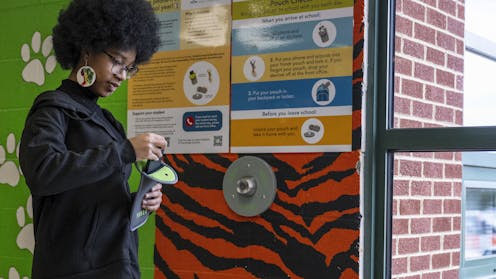
In their bills, most states provide recommendations for school districts to create cellphone use policy for their students. To take one typical example, the policy for Wake County in North Carolina, one of the state’s largest school districts, specifically refers to personal wireless communication devices. For elementary and middle school students, they must be silenced and put away between morning and afternoon bells, either in a backpack or locker. For high school students, teachers may allow them to be used for lessons, but they must otherwise be silenced and put away during instructional time. They can be used on school buses with low volume and headphones.

The Conversation

The authors do not work for, consult, own shares in or receive funding from any company or organization that would benefit from this article, and have disclosed no relevant affiliations beyond their academic appointment.

ref. Cellphones in schools – more states are taking action to reduce student distraction without eliminating tech access – https://theconversation.com/cellphones-in-schools-more-states-are-taking-action-to-reduce-student-distraction-without-eliminating-tech-access-256968

Jane Goodall, the gentle disrupter whose research on chimpanzees redefined what it meant to be human

Source: The Conversation – USA (2) – By Mireya Mayor, Director of Exploration and Science Communication, Florida International University

Jane Goodall appears on stage at 92NY in New York on Oct. 1, 2023. Charles Sykes/Invision/AP

Anyone proposing to offer a master class on changing the world for the better, without becoming negative, cynical, angry or narrow-minded in the process, could model their advice on the life and work of pioneering animal behavior scholar Jane Goodall.

Goodall’s life journey stretches from marveling at the somewhat unremarkable creatures – though she would never call them that – in her English backyard as a wide-eyed little girl in the 1930s to challenging the very definition of what it means to be human through her research on chimpanzees in Tanzania. From there, she went on to become a global icon and a United Nations Messenger of Peace.

Until her death at age 91, Goodall retained a charm, open-mindedness, optimism and wide-eyed wonder that are more typical of children. I know this because I have been fortunate to spend time with her and to share insights from my own scientific career. To the public, she was a world-renowned scientist and icon. To me, she was Jane – my inspiring mentor and friend.

Despite the massive changes Goodall wrought in the world of science, upending the study of animal behavior, she was always cheerful, encouraging and inspiring. I think of her as a gentle disrupter. One of her greatest gifts was her ability to make everyone, at any age, feel that they have the power to change the world.

Jane Goodall documented that chimpanzees not only used tools but make them – an insight that altered thinking about animals and humans.

Discovering tool use in animals

In her pioneering studies in the lush rainforest of Tanzania’s Gombe Stream Game Reserve, now a national park, Goodall noted that the most successful chimp leaders were gentle, caring and familial. Males that tried to rule by asserting their dominance through violence, tyranny and threat did not last.

I also am a primatologist, and Goodall’s groundbreaking observations of chimpanzees at Gombe were part of my preliminary studies. She famously recorded chimps taking long pieces of grass and inserting them into termite nests to “fish” for the insects to eat, something no one else had previously observed.

It was the first time an animal had been seen using a tool, a discovery that altered how scientists differentiated between humanity and the rest of the animal kingdom.

Renowned anthropologist Louis Leakey chose Goodall to do this work precisely because she was not formally trained. When she turned up in Leakey’s office in Tanzania in 1957, at age 23, Leakey initially hired her as his secretary, but he soon spotted her potential and encouraged her to study chimpanzees. Leakey wanted someone with a completely open mind, something he believed most scientists lost over the course of their formal training.

Because chimps are humans’ closest living relatives, Leakey hoped that understanding the animals would provide insights into early humans. In a predominantly male field, he also thought a woman would be more patient and insightful than a male observer. He wasn’t wrong.

Six months in, when Goodall wrote up her observations of chimps using tools, Leakey wrote, “Now we must redefine tool, redefine Man, or accept chimpanzees as human.”

Goodall spoke of animals as having emotions and cultures, and in the case of chimps, communities that were almost tribal. She also named the chimps she observed, an unheard-of practice at the time, garnering ridicule from scientists who had traditionally numbered their research subjects.

One of her most remarkable observations became known as the Gombe Chimp War. It was a four-year-long conflict in which eight adult males from one community killed all six males of another community, taking over their territory, only to lose it to another, bigger community with even more males.

Confidence in her path

Goodall was persuasive, powerful and determined, and she often advised me not to succumb to people’s criticisms. Her path to groundbreaking discoveries did not involve stepping on people or elbowing competitors aside.

Rather, her journey to Africa was motivated by her wonder, her love of animals and a powerful imagination. As a little girl, she was entranced by Edgar Rice Burroughs’ 1912 story “Tarzan of the Apes,” and she loved to joke that Tarzan married the wrong Jane.

When I was a 23-year-old former NFL cheerleader, with no scientific background at that time, and looked at Goodall’s work, I imagined that I, too, could be like her. In large part because of her, I became a primatologist, co-discovered a new species of lemur in Madagascar and have had an amazing life and career, in science and on TV, as a National Geographic explorer.
When it came time to write my own story, I asked Goodall to contribute the introduction. She wrote:

“Mireya Mayor reminds me a little of myself. Like me she loved being with animals when she was a child. And like me she followed her dream until it became a reality.”

In a 2023 interview, Jane Goodall answers TV host Jimmy Kimmel’s questions about chimpanzee behavior.

Storyteller and teacher

Goodall was an incredible storyteller and saw it as the most successful way to help people understand the true nature of animals. With compelling imagery, she shared extraordinary stories about the intelligence of animals, from apes and dolphins to rats and birds, and, of course, the octopus. She inspired me to become a wildlife correspondent for National Geographic so that I could share the stories and plights of endangered animals around the world.

Goodall inspired and advised world leaders, celebrities, scientists and conservationists. She also touched the lives of millions of children.

Two women face each other, smiling and holding a book
Jane Goodall and primatologist Mireya Mayor with Mayor’s book ‘Just Wild Enough,’ a memoir aimed at young readers.
Mireya Mayor, CC BY-ND

Through the Jane Goodall Institute, which works to engage people around the world in conservation, she launched Roots & Shoots, a global youth program that operates in more than 60 countries. The program teaches children about connections between people, animals and the environment, and ways to engage locally to help all three.

Along with Goodall’s warmth, friendship and wonderful stories, I treasure this comment from her: “The greatest danger to our future is our apathy. Each one of us must take responsibility for our own lives, and above all, show respect and love for living things around us, especially each other.”

It’s a radical notion from a one-of-a-kind scientist.

The Conversation

Mireya Mayor does not work for, consult, own shares in or receive funding from any company or organization that would benefit from this article, and has disclosed no relevant affiliations beyond their academic appointment.

ref. Jane Goodall, the gentle disrupter whose research on chimpanzees redefined what it meant to be human – https://theconversation.com/jane-goodall-the-gentle-disrupter-whose-research-on-chimpanzees-redefined-what-it-meant-to-be-human-205909

Childhood wealth and social status can help people get leadership roles in adulthood

Source: The Conversation – Canada – By Steve Granger, Assistant Professor, John Molson School of Business, Concordia University

Consider two teenagers searching for summer work. One is offered an opportunity to assist a project manager at their uncle’s construction company. The other submits a dozen retail applications, hoping for a call back. Who is more likely to hold a formal leadership position in their 20s?

Stories like this play out across families of different economic backgrounds every day. Our recent research shows that pathways to leadership often begin much earlier than many assume, and are shaped by social capital that accumulates throughout childhood and adolescence.

We studied more than 6,700 people born in the same week in April 1970 across Great Britain, tracked from birth to age 26 through the British Cohort Study.

Rather than measuring socioeconomic status at just one point in time, we were able to capture it repeatedly: at birth, and ages 5, 10 and 16. This gave us a rare opportunity to see how persistent exposure to either wealth or adversity shaped who went on to take up formal leadership roles as young adults and who did not.

Affluence versus adversity

Our findings revealed a striking pattern. Children who grew up in persistent wealth — whose parents consistently held managerial or professional occupations — were more likely to occupy leadership roles by their mid-20s.

Conversely, those who grew up in persistent adversity — whose parents consistently worked in lower-skilled or semi-skilled occupations, such as routine service, manual or support roles as defined in the U.K. National Statistics Socio-economic Classification — were less likely to hold similar leadership positions.

But what makes these findings particularly revealing is that persistent exposure to wealth or adversity isn’t simply being on opposite ends of one continuum. Instead, they represent two very different paths that result in distinct socialization experiences.

On one hand, persistent wealth creates cumulative benefits by providing repeated access to resources, enriching experiences and better-connected social networks. On the other hand, persistent adversity can compound barriers, limiting opportunities for skill development, access to quality education and early exposure to professional environments.

Both paths land young people at very different career starting points that either open or close doors to leadership opportunities.

Pathways through social networks

For children from affluent families, leadership pathways often run through social networks. Access to what we call “nepotistic opportunities” — job connections through family and friends — partially explained why these children were more likely to emerge as leaders later on.

This isn’t always blatant favouritism. Instead, it reflects how affluent families more easily provide access to “weak ties” — the kinds of looser connections that open doors to new information and opportunities.

Consider again the teenager whose uncle arranges a summer job on a construction site. They don’t just earn money; they also learn about co-ordinating teams in professional environments and they form relationships. These encounters build social capital that can shape their path to leadership.

Not just a lack of connections

By contrast, we expected that children from disadvantaged backgrounds would show the mirror image of this pattern: that missing out on opportunities to build their social network would explain their lower odds of becoming leaders.

But our data told a different story.

Persistent early life adversity was linked to fewer leadership roles in adulthood, but not simply because of missed social opportunities. The teenager cold-applying to retail jobs does indeed face barriers to later leadership, but more complex and deeper-rooted factors are likely at play.

The disadvantages of growing up in persistent adversity may be rooted in other factors not measured in our study, such as reduced access to non-parental mentors, lower quality schooling or the toll of long-term economic stress on well-being.

What organizations can do

Addressing disadvantage requires tackling the deeper, systemic ways persistent economic wealth and adversity shape development. Employers can help level the playing field.

Acknowledging that social class differences exist in organizations is a crucial first step. This lays the groundwork for reducing bias in leadership recruitment, selection, retention efforts and improving access to leadership development.

Recruiting more widely through non-traditional networks and providing employer-sponsored preparation opportunities can make pathways into formal leadership positions more accessible. Dispelling myths about social class, for example through training, can also help reduce bias in selection and improve retention.

Finally, creating developmental networks and mentorship programs can provide the kind of career guidance and connections that affluent families often provide informally.

Leadership isn’t predetermined

The influence of childhood conditions can have lasting effects on career trajectories. In our study, the effects of early socioeconomic status conditions were still visible when participants reached their mid-20s, long after they had finished school and entered the workforce.

Addressing leadership diversity requires not just workplace interventions, but also early investment in supporting childhood development across all socioeconomic backgrounds.

Investments in quality education, mentorship programs and opportunities for young people to build professional networks is crucial for creating more equitable pathways to leadership.

While our findings highlight advantages for affluent youth and barriers for disadvantaged youth, they don’t dictate destiny. Among those who experienced at least some persistent adversity, 34 per cent still rose to leadership positions (compared to 46 per cent of those who experienced at least some persistent wealth).

What our research identifies is how socioeconomic status advantages and disadvantages compound over time, widening the disparity in social experiences that generate leadership opportunities.

Recognizing the distinction between these cumulative effects can help motivate us to create more equitable family and organizational systems where leadership potential is nurtured no matter where you start.

The Conversation

Steve Granger receives funding from the Social Sciences and Humanities Research Council of Canada.

Julian Barling receives funding from the Social Sciences and Humanities Research Council of Canada and the Borden Chair of Leadership.

Nick Turner receives research funding from Cenovus Energy Inc., Haskayne School of Business’s Future Fund, Mitacs, and the Social Sciences and Humanities Research Council of Canada (SSHRC).

ref. Childhood wealth and social status can help people get leadership roles in adulthood – https://theconversation.com/childhood-wealth-and-social-status-can-help-people-get-leadership-roles-in-adulthood-265457

The overlooked service that could make plans for a library in every primary school in England a reality

Source: The Conversation – UK – By Lucy Taylor, Lecturer in Education, University of Leeds

Rawpixel.com/Shutterstock

In a speech delivered at the Labour party conference, Chancellor Rachel Reeves committed to “providing a library in every single primary school in England by the end of this parliament”.

This new scheme should help to achieve the goal set by the Libraries for Primaries campaign, established in 2021, to ensure that every primary school in the UK has a library or dedicated library space.

This is a welcome development. Our research focuses on the value well-stocked libraries can provide to schools and pupils.

School libraries are a vital resource for enriching learning across the curriculum. They provide graduated texts to support learners from the very start of their reading journeys and give children access to a wealth of information, ideas, perspectives and stories.

This investment comes at a time when reading for pleasure is rapidly decreasing. According to a 2025 survey by the National Literacy Trust, only a third of children aged eight to 18 enjoy reading in their free time. Government data shows that 25% of pupils leave primary school unable to read at the level expected.

Some school libraries are very well stocked and are inviting spaces for children to read and share books. However, these spaces need constant investment to keep them up to date and relevant with high-quality texts. Doing so can be difficult for many schools whose budgets are tight.

School library services

To keep pace with developments in children’s book publishing is a substantial undertaking. Schools need to ensure that within their staff team there is sufficient knowledge and expertise to manage and maintain a vibrant library collection. It is also important that school libraries are aligned with the curriculum. Libraries should be an inclusive resource for communities of children with diverse cultural and linguistic backgrounds and learning needs.

Many people don’t know that school libraries can draw on the resources and expertise of local School Library Services to keep their stock up to date and changing on a regular basis. They are typically funded and run by local authorities and employ trained librarians who can help schools run their own libraries. However, our research has shown that they are not available in all areas of England, and they are not financially secure in the long term.

School libraries can be refreshed every term by new stock borrowed from the School Library Services, curated by expert librarians. For example, the Leeds School Library Service serves 180 primary schools. It delivered 9,514 boxes of resources throughout the academic year 2022–23.

School Library Services have a wider range of books and resources than a single school could hold. As items borrowed from School Library Services are returned after a set period and then shared with other schools, they offer a model of library resourcing that is more sustainable that a single investment in a school library stock update. One teacher we spoke to said: “You don’t want 30 books to store, you want to use them and send them back and get 30 different ones. I think that’s a huge benefit.”

Some School Library Services help schools to set up their libraries, reorganise them and select great quality texts so that their libraries are current, appealing and easy to manage. School Library Services typically employ specialist children’s librarians with an understanding of the local area, and in some instances can even provide artefacts such as objects and costumes to further stimulate learning. Investment is needed in these services to ensure that they can replenish stock and train new school library specialists.

Boy in wheelchair looking at titles in library
Finding a book they connect with is really important for young readers.
AnnGaysorn/Shutterstock

The wide choice of reading material a library provides gives children more opportunity to find a book they connect with than, for instance, a classroom reading corner. Being able to find a book that they want to read is important to becoming an engaged reader.

Some children will want to read about their favourite video game, others may be more interested in sport, and some will relish the opportunity to delve into a fantasy world of imagination. Talking about the children in their class, a teacher we interviewed said that a good choice of books “spurred some of them on to actually start reading”. Another teacher reported that school libraries “helped promote reading in school because kids have had more access to books”.

The renewed focus on school libraries is long overdue and we look forward to seeing the benefits that schools will reap from this new funding. But in addition to investment directly in primary school libraries in the short term, financial commitment to strengthening School Library Services will also pay dividends for future generations of child readers.

The Conversation

Lucy Taylor has received funding from UK Literacy Association, and the Association of Senior Education Librarians (ASCEL) via Arts Council England (ACE) for projects related to this topic.

Paula Clarke has previously received funding from the UK Literacy Association, and the Association of Senior Education Librarians (ASCEL) via Arts Council England (ACE), for projects related to this topic.

ref. The overlooked service that could make plans for a library in every primary school in England a reality – https://theconversation.com/the-overlooked-service-that-could-make-plans-for-a-library-in-every-primary-school-in-england-a-reality-266394