Why can’t we feel the Earth moving?

Source: The Conversation – USA – By Nilakshi Veerabathina, Professor of Physics Instruction, University of Texas at Arlington

The Earth’s rotation makes the stars look like they’re moving. Qu Yubao/Xinhua News Agency via Getty Images

Curious Kids is a series for children of all ages. If you have a question you’d like an expert to answer, send it to CuriousKidsUS@theconversation.com.


Why can’t we feel the Earth moving? – Dave H., age 12, Atlanta


Right now, you’re zooming through space at incredible speeds. As just one of all the living creatures on Earth, you’re along for the ride as our planet constantly moves in two major ways.

First, consider that the Earth spins around like a top. It’s rotating around the imaginary line that runs from the North Pole to the South Pole through the center of our planet. Earth completes one full rotation every 24 hours, with a speed of about 1,000 miles per hour at the equator (1,670 km/h).

Earth spins on its axis, taking one day to make a full rotation.

While Earth is spinning on its axis, it’s also traveling around the Sun. It takes a year to finish the journey – that is, to make one full revolution and wind up back where we started. Earth hurtles along its path with a whopping average speed of 67,000 miles per hour (107,000 kmh).

These speeds are way faster than any vehicle you’ve ever traveled in. So why aren’t you dizzy or flying off into space? Why don’t you even feel the Earth moving?

It’s this kind of question that lit a desire in me as a child to understand the universe and our place in it. Now I have a Ph.D. in astronomy and teach college students some of the same physics principles that explain why you can’t feel Earth’s motion as it zips through space.

No jerks or bumps

Think about a time when you do feel motion, such as on a carousel ride at an amusement park. When it speeds up, slows down or turns quickly, your body notices because the motion isn’t smooth.

Illustration showing the Earth's elliptical orbit and different seasons through the year
The Earth revolves in an oval-shaped orbit around the Sun while spinning on its slightly tilted axis.
Angela Cini/iStock via Getty Images Plus

In contrast, the Earth’s motion is remarkably steady. It has been spinning on its axis and orbiting the Sun at nearly the same speeds for billions of years, with no sudden jolts or stops. As Earth travels its slightly oval-shaped path around the Sun, its speed does change to be a bit faster when it’s closer to the Sun and a bit slower when it’s farther away. But the changes happen so gradually and smoothly that you don’t feel them at all.

Imagine you’re flying on an airplane that has reached cruising altitude. The engines are humming, you’re soaring through the sky at hundreds of miles per hour – but everything inside feels calm and still. You can walk around, relax and forget you’re traveling at all. That’s because the plane, you and everything else inside it are moving at the same speed, in the same direction.

Just as passengers don’t feel the plane’s speed while smoothly cruising, we don’t feel Earth’s movement because we’re traveling at the same speed as our planet. You, your chair, the trees, buildings, oceans – everything is moving together with the Earth.

There’s no difference in motion for your body to detect unless Earth were to suddenly speed up, slow down or change direction – and, thankfully, that doesn’t happen.

Very small ants on a very big ball

Imagine holding a huge beach ball in your hands. Picture a tiny ant crawling on the surface of that ball.

Now, think about us on Earth. We are like that ant, but the ball we’re crawling on is almost 8,000 miles (almost 13,000 kilometers) wide at the equator. That’s about the distance you’d travel driving from New York to Los Angeles and back to New York.

Because the Earth is so humongous, any movement feels very slow and gentle to our comparatively minuscule bodies as we stand on its surface.

Another reason you don’t notice Earth’s motion is that there are no nearby “landmarks” in space to act as reference points. When you’re in a car on the highway, you see trees, signs or telephone poles rushing by. Those fixed points help your brain register motion. But in space, the stars are so far away that they appear completely still, even though we’re moving relative to them at thousands of miles per hour.

Luckily, these high speeds don’t fling us off into space thanks to gravity. Gravity is an invisible force of attraction. It pulls everything on the surface of the planet toward the Earth’s center. It’s like the Earth is giving us a giant, constant hug, keeping us safely grounded.

starry sky over horizon with some constellations marked
Big clues that the Earth is in motion come from changes visible in the night sky.
lixu/iStock via Getty Images Plus

How do we know the Earth is actually moving?

Even though we don’t feel the Earth moving, people long ago figured out that it really is by watching the sky carefully.

Start with day and night. The Sun appears to rise and set because Earth makes one full rotation on its axis every 24 hours. If Earth weren’t spinning, one side would always face the Sun, and the other would be in darkness.

Then there are the seasons. Earth is tilted on the axis it spins around. Over the course of its orbit of the Sun, Earth’s tilt causes different parts of the planet to get more or less sunlight. That’s why we have summer, winter and everything in between.

At night, stars and constellations seem to move across the sky as Earth rotates. And their positions in the sky change with the seasons. Our view of the stars changes as we move along our yearly path around the Sun. If everything stayed still, the night sky would never change.

Surface of the moon and a small part of the Earth above it
The crescent Earth rises above the horizon of the Moon, evidence of Earth’s movement as seen from the Apollo 17 spacecraft.
NASA/Flickr

By seeing Earth spinning and orbiting, satellites and space telescopes have confirmed what astronomers have long deduced. We may not feel it, and we can’t see any obvious landmarks rushing by, but the clues are everywhere. Earth is on the move.

And it’s not just Earth – the Sun itself rotates and moves around the center of our Milky Way galaxy at hundreds of thousands of miles per hour. Nothing in the universe is truly standing still. Everything is in motion, from planets and stars to galaxies themselves.


Hello, curious kids! Do you have a question you’d like an expert to answer? Ask an adult to send your question to CuriousKidsUS@theconversation.com. Please tell us your name, age and the city where you live.

And since curiosity has no age limit – adults, let us know what you’re wondering, too. We won’t be able to answer every question, but we will do our best.

The Conversation

Nilakshi Veerabathina does not work for, consult, own shares in or receive funding from any company or organization that would benefit from this article, and has disclosed no relevant affiliations beyond their academic appointment.

ref. Why can’t we feel the Earth moving? – https://theconversation.com/why-cant-we-feel-the-earth-moving-256964
TikTok sale puts app’s algorithm in the spotlight – a social media expert explains how the For You Page works and what changes are in store

Source: The Conversation – USA – By Kelley Cotter, Assistant Professor of Information Sciences and Technology, Penn State

TikTok appears to be changing hands, but what that means for users is up in the air. Stefani Reynolds/AFP via Getty Images

President Donald Trump announced on Sept. 19, 2025, a preliminary agreement for the sale of a majority stake in TikTok from Chinese tech giant ByteDance to a group of U.S. investors following Trump’s negotiation with Chinese leader Xi Jinping.

The deal would create a new U.S.-only version of the app, bringing it into compliance with a law signed by former President Joe Biden on April 23, 2024, and upheld by the Supreme Court on Jan. 17, 2025. Specifics of the deal remain to be hammered out, and left unresolved is the fate of the video sharing app’s core algorithm – and what that means for TikTok’s millions of U.S. users.

The Chinese government has indicated it will not permit ByteDance to sell the algorithm, because it is classified as a controlled technology export, per Chinese law. Meanwhile, U.S. tech industry executives and some lawmakers say compliance with the law requires the algorithm to be under American control. The deal as proposed includes licensing the algorithm so that it remains Chinese intellectual property while the U.S. version of the app continues to use the technology.

TikTok’s For You Page algorithm is widely considered the most important part of the app. As one analyst put it: “Buying TikTok without the algorithm would be like buying a Ferrari without the engine.”

The algorithm’s value lies in its uncanny capacity to anticipate users’ content preferences. Many users claim it knows them better than they know themselves — a sentiment that has evolved into a curious mix of spiritual belief and conspiracy theorizing, as my colleagues and I have documented. Other scholars have similarly noted that users feel more intimately seen and known by TikTok’s algorithm than those powering other popular platforms.

I have studied social media algorithms for nearly a decade, exploring how our relationships with them have evolved as they become increasingly entwined with daily life. As both a social media scholar and TikTok devotee, I want to shed some light on how the algorithm works and how the app might change in the wake of its sale.

How the TikTok algorithm works

In some ways, the TikTok algorithm does not differ significantly from other social media algorithms. At their core, algorithms are merely a series of steps used to accomplish a specific goal. They perform mathematical computations to optimize output in service of that goal.

There are two layers to the TikTok algorithm. First, there is the abstract layer that defines the outcome developers wish to accomplish. An internal document shared with The New York Times specified that TikTok’s algorithm optimizes for four goals: “user value,” “long-term user value,” “creator value” and “platform value.”

But how do you turn these goals into math? What does an abstract concept like “user value” even mean? It’s not practical to ask users whether they value their experience every time they visit the site. Instead, TikTok relies on proxy signals that translate abstract outcomes into quantifiable measures — specifically, likes, comments, shares, follows, time spent on a given video and other user behavior data. These signals then become part of an equation to predict two key concrete outcomes: “retention,” or the likelihood that a user will return to the site, and “time spent” on the app.

The TikTok For You Page algorithm relies on machine learning for predicting retention and time spent. Machine learning is a computational process in which an algorithm learns patterns in a dataset, with little or no human guidance, to produce the best equation to predict an outcome. Through learning patterns, the algorithm determines how much individual data signals matter for coming up with a precise prediction.

A Wall Street Journal investigation found that the amount of time users spend watching each video plays a large role in how the algorithm chooses videos it suggests to users. Using the equation it has generated to predict retention and time spent, the algorithm assigns a score to each video and ranks possible videos that could be shown to the user by this score. The higher the score for an individual user, the more likely the video will appear in their feed.

Of course, content characteristics and other users additionally inform recommendations, and there are other subprocesses folded into the equation. This step is where algorithmic moderation usually comes in. If a video looks like engagement bait or has excessive gore, for example, the content’s score will be penalized.

Here are the basics of how TikTok’s algorithm works.

What’s likely to change for US users

The sale has not been finalized, and what happens to the algorithm is unresolved. However, it’s fairly certain that TikTok will change. I see two key reasons for change.

First, the proposed app’s U.S.-only user population will alter the makeup of the underlying dataset informing algorithmic recommendations on an ongoing basis. As the kinds of content and users come to reflect American cultural preferences, values and behaviors, the algorithm may be slightly different as it “learns” new patterns.

Moreover, not all users will choose to join the new app, especially if it is seen as under the control of Trump’s allies. The current deal reportedly would give an 80% share to U.S. investors, including 50% to new investors Oracle, Silver Lake and Andreessen Horowitz. These investors’ have connections to Trump, and an apparent provision of the deal allows the U.S. government to select one board member. This may result in a user population – and data – reflective of a narrower realm of interests and ideologies.

Second, it’s possible that the majority share owners of the new app will decide to adjust the algorithm, particularly when it comes to content moderation. The new owners may wish to modify TikTok’s Community Guidelines according to their view of acceptable and unacceptable speech.

For example, TikTok’s current Community Guidelines prohibit misinformation and work with independent fact-checkers to assess the accuracy of content. While Meta used to follow a similar approach for Instagram and Facebook, in January 2025 announced that it would end Meta’s relationships with independent fact-checkers and loosen content restrictions. YouTube has similarly relaxed its content moderation this year.

The bottom line is algorithms are highly sensitive to context. They reflect the interest, values and worldviews of the people who build them, the preferences and behaviors of people whose data informs their models and the legal and economic contexts they operate within.

This means that while it’s difficult to predict exactly what a U.S.-only TikTok will be like, it’s safe to assume it will not be a perfect mirror image of the current app.

The Conversation

Kelley Cotter has received funding from the National Science Foundation.

ref. TikTok sale puts app’s algorithm in the spotlight – a social media expert explains how the For You Page works and what changes are in store – https://theconversation.com/tiktok-sale-puts-apps-algorithm-in-the-spotlight-a-social-media-expert-explains-how-the-for-you-page-works-and-what-changes-are-in-store-265658

A Great Lakes oil pipeline faces 3 controversies with no speedy resolutions

Source: The Conversation – USA (2) – By Mike Shriberg, Professor of Practice & Engagement, School for Environment & Sustainability; Director of the University of Michigan Water Center, University of Michigan

A section of Enbridge’s Line 5 runs along the bottom of the Straits of Mackinac in Michigan. Michigan Department of Environment, Great Lakes and Energy via AP

For more than a decade, controversy over an oil pipeline that passes directly through a Native American reservation and then across a sensitive waterway that is also a key shipping lane has brewed in Wisconsin and Michigan.

Since taking office in January 2025, the Trump administration has joined an already complex fray, with policy decisions and legal filings as well as administrative and judicial appointments that have shifted the strategies and potential outcomes of the situation. The changes affect not just pipeline operator Enbridge but also the environmental, Indigenous and political leaders working to shut down the pipeline, known as Line 5.

Part of the dispute is slated to come before the U.S. Supreme Court in the coming months, but that will not deliver the final resolution of the situation.

I am a water policy and politics analyst and a former gubernatorial appointee to Michigan’s Pipeline Safety Advisory Board. I see these controversies raising critical questions about the environmental and economic future of the Great Lakes region and serving as a proxy for wider national battles over water policy, Indigenous rights and the role of fossil fuels in the nation’s future.

Scrutiny of the pipeline

Built in 1953, Enbridge’s Line 5 oil pipeline carries petroleum products mostly from western Canada’s tar sands to refineries in eastern Canada, using the Great Lakes as a shortcut. It traverses 645 miles (1,040 km) through Wisconsin and Michigan and transports approximately 23 million gallons of oil and natural gas liquids per day from Superior, Wisconsin, to Marysville, Michigan, and then across the Saint Clair River to Sarnia, Ontario.

The pipeline has been the subject of intense scrutiny since soon after a 2010 oil spill into the Kalamazoo River in Michigan from another Enbridge pipeline with a similar start and endpoint. The 2012 publication of Sunken Hazard, a report from the National Wildlife Federation about the potential for a spill from Line 5, fomented public concern and launched an advocacy movement that began with questions about Line 5’s safety and has led to calls for its complete shutdown.

While the entire pipeline is being scrutinized, there are two primary areas of concern. In Wisconsin, the pipeline runs for 12 miles (19 km) across the reservation of the Bad River Band of Lake Superior Chippewa. And when it crosses from Michigan’s Upper Peninsula to its Lower Peninsula, the line splits into two parallel pipes that run along the bottom of the Straits of Mackinac, which connect Lake Michigan and Lake Huron.

Shutting down Line 5 in Michigan

In 2021, Michigan Gov. Gretchen Whitmer revoked Enbridge’s easement to operate the pipeline across the Straits of Mackinac. The governor asserted that Enbridge “repeatedly violated the 1953 easement and that the continued operation of the dual pipelines violates the state’s solemn duty to protect the Great Lakes.”

Some of her concerns exist because the pipeline sits in the open water of the Great Lakes and has been damaged multiple times by ship’s anchors, is subject to corrosion, and has been found to be bent and deformed by the extremely powerful currents in the Straits of Mackinac.

Enbridge refused to comply with the shutdown order and has taken the battle into the courts while continuing to send petroleum products through the pipeline across the straits. The Trump administration – through a Sept. 19, 2025, court filing – is supporting Enbridge’s claim that the pipeline is not subject to state regulation and oversight.

There has been a long back-and-forth about whether state courts have jurisdiction, as state officials argued, or whether federal courts should handle it, as Enbridge claimed. In June 2025 the trial was set for a state court when the U.S. Supreme Court unexpectedly stepped in at Enbridge’s request. The case has not yet been scheduled for oral arguments before the court, but they – and a potential ruling – are expected sometime between October 2025 and June 2026.

The state court has said it will continue its proceedings without waiting for a Supreme Court decision. But the ground is set for the continuation of an extended and complicated legal battle.

The Great Lakes tunnel

While Enbridge is fighting the shutdown of its existing pipeline, the company is seeking state and federal permission to build a replacement, by digging a new tunnel below the Straits of Mackinac.

The company needs both federal and state permits before construction can begin. The federal permits are expected to come quickly as a result of a Trump administration policy.

On the first day of his second term, Trump declared a “national energy emergency.” In general, the policy is being used to try to slow the transition away from fossil fuels and toward clean energy sources, and to remove climate change as a factor in environmental reviews and permitting.

For Line 5, the most consequential provisions of the order are those that call for “emergency approvals” and “expediting the Delivery of Energy Infrastructure.” The tunnel is on the Army Corps of Engineers’ list of projects eligible for fast-track approval.

However, Enbridge still needs state permits, which many groups are opposing based on potential environmental damage to the shoreline, the safety of the tunnel and the need to address climate change by slowing down oil extraction.

In addition, all of the federally recognized tribal governments in Michigan oppose Line 5’s continued existence, contending that Indigenous fishing rights in the Straits of Mackinac are at risk from the pipeline both ecologically and culturally. Their position, expressed in a state-court challenge to the tunnel, could end up testing the power of their rights under treaties with the U.S. government.

Bad River Band’s effort

In addition to both of those disputes, a Native American tribe in Wisconsin undertook its own efforts to reduce the risk of environmental damage from the pipeline on its land and the surrounding watershed.

In 2013, the Bad River Band declined to renew Enbridge’s pipeline easement through its territory, which is sometimes referred to as the “Everglades of the Great Lakes” because of its extensive and pristine wetlands. In 2017 the tribe voted to require Enbridge to remove the line from its land.

Enbridge refused to comply and has contested the validity of the Bad River Band’s decision, inherently challenging the tribe’s sovereignty. At the same time, the company is attempting to reroute the pipeline around the reservation – though still within the Bad River watershed.

In 2019 the tribe sued Enbridge to force the removal and ultimately won a federal judge’s ruling that the company must remove the pipeline by June 2026 and pay US$5.15 million for ongoing trespassing. Enbridge has appealed, and many observers expect that case to also come to the Supreme Court.

As that process unfolds, Enbridge is seeking expedited state and federal permits for the reroute. Environmental advocates, tribe members and others have asked a court to decide whether state permits that were granted in late 2024 were given without following the proper procedure. Hearings on that question continue.

Pipeline opponents are also asking the Army Corps of Engineers, which must issue its own permits, to reject the application for the new route, effectively cutting off the pipeline. However, this federal permit is also subject to Trump’s “national energy emergency,” and so it is unlikely to be stopped by federal agencies and is expected by the end of 2025.

A convoluted puzzle

On all three parallel fronts, the Trump administration’s shaping of policy and the judiciary has put advocates on the defensive.

The state of Michigan is concerned that its autonomy over its portion of the Great Lakes is at risk if the federal government and courts can overrule its revocation of Enbridge’s easement to operate.

Native American governments are concerned that their treaty-guaranteed fishing and land rights will be sacrificed in service of an energy company’s interests.

And, of course, Line 5 has major implications for Great Lakes protection and mitigating climate change, where the Trump administration has tilted the playing field in favor of fossil fuels and away from clean energy and environmental protection.

Yet the outcomes are not at all clear, and Enbridge would likely have to win on all fronts to avoid the pipeline being shut down, since it cannot operate the pipeline if any segment is inoperable. I expect the implications of Line 5’s ultimate fate to reverberate across the country for years to come.

The Conversation

Mike Shriberg previously served as a gubernatorial appointee to the Michigan Pipeline Safety Advisory Board and as the Great Lakes Regional Executive Director for the National Wildlife Federation, which is referenced in this article and has taken positions on Line 5. He currently has no formal affiliation with this organization.

ref. A Great Lakes oil pipeline faces 3 controversies with no speedy resolutions – https://theconversation.com/a-great-lakes-oil-pipeline-faces-3-controversies-with-no-speedy-resolutions-264105

How Squishmallow collecting helped me cope with grief, make new enemies and find ‘villains’ worth studying

Source: The Conversation – USA (2) – By Danielle Hass, Ph.D. Candidate, Department of Marketing, West Virginia University

I was one of the millions of people who lost someone to the COVID-19 pandemic. Despite the nonstop news about the “new normal,” my grief felt invisible. I took shallow solace in my phone and turned to social media to numb me from the reality that I now lived in: a world without my dad.

One day, while mindlessly scrolling, I came across the r/Squishmallow subreddit, where a girl had posted her collection of more than 100 round plush toys. They were called Squishmallows – round stuffed animals invented in 2017 that have become one of the most popular toy lines in the world, with more than 100 million sold each year.

I was hypnotized. I expected that my dive into the Squishmallow phenomenon would be the usual two-hour rabbit hole, but spending time in that community was the first joy I’d felt in months.

After scrolling through endless photos of Squishmallow hauls, I worked up the courage to post. I asked if there was a cardinal Squishmallow, since that bird was my dad’s symbol for his own father. I was bombarded with compassion; even though cardinal Squishmallows were rare at the time, someone sent me theirs for free. That single act of generosity started my collection.

Stumbling into the Squishmallow world

But alongside kindness and joy, I encountered a darker side of the community: resellers. Finding the most coveted Squishmallows could turn into a fierce competition.

This wasn’t just my personal frustration. As a doctoral candidate in marketing, I wanted to understand how communities like this function when outsiders exploit their passion for profit. That became the focus of my dissertation — the first study to examine resellers’ psychological and emotional impact on brand communities.

That research – which my colleagues and I published in one of the field’s top journals – echoed what I had lived through as a collector: Resellers are one of the most consistent sources of pain for members of brand communities.

A Squishmallow reseller discusses his technique.

For example, when I heard that my local Hot Topic would be selling two Reshmas, the coveted strawberry cow Squishmallow, I, like any rational adult, found myself outside of a mall at 6:30 in the morning. When the doors finally opened at 11 a.m., I sprinted to the storefront – only to find that I had been beaten by some people who had dressed as mall employees to sneak in early. I left devastated and cowless.

Later that day, I saw the same people gloating in local Squishmallow Facebook groups, trying to resell the cow for more than 10 times the retail price. I was heartbroken and angry; I swore I’d never collect again. And I wasn’t the only one to feel that way: Across social media, you’ll find countless collectors venting about resellers.

What is a brand community?

I didn’t know it then, but I had joined my first brand community: a group of consumers who form strong, meaningful connections through their shared admiration of a product. Brand communities range from giant online hubs with more than 100,000 members to tiny local groups that host trading parties in empty lots.

You might be in a brand community without realizing it. These communities can be created by a company – like Harley-Davidson, Lego and Hot Wheels – or emerge organically from fans, like the Facebook group “Walt Disney World Tips and Tricks.”

And they aren’t just about buying and selling. They’re creative ecosystems, full of posts showing collections, inventive displays and even goodbye messages when someone “rehomes” an item to another loving collector. Community members help each other solve problems, share leads on hard-to-find items and sometimes even mail strangers a plush toy because they know it will make them smile.

But while collectors use these communities to exchange information, so do resellers.

The reseller paradox: A shared enemy can unite a community

Resellers are outsiders who buy the most sought-after items and flip them online for a profit. They scout inventory tips, track hot products and plan their shelf-clearing strategies accordingly. And they infuriate collectors like me. Nothing sours the thrill of the hunt faster than seeing a shelf cleared by someone who only wants to use your sacred collectibles for profit.

After feeling emotional pain myself, I wanted to understand why resellers bothered me so much, and what they meant for the communities that had become my lifeline. That frustration became the spark for my research. What I found surprised me.

As a collector, nothing frustrates me more than to say: According to my research, resellers paradoxically strengthen brand communities. Yes, you read that right. Resellers help communities, but not because they try to help members acquire their desired items. In fact, my findings indicate that resellers inflict heartbreak on community members – which was in line with what I saw and experienced.

Resellers help brand communities because they create a common enemy that the community can rally against. When resellers grab all the stock from a store shelf, collectors turn to each other. They vent. They strategize. They share tips on where to find certain items, offer to pick up extras for strangers and organize trades to help each other avoid inflated resale prices. Ironically, the people causing the most frustration also increase community engagement.

Brand communities are real communities

These communities reminded me that you are never truly alone in your darkest moments. Joining a niche community, whether for sneakers, trading cards, cars or even Squishmallows, can enrich your life far beyond the products themselves. It wasn’t the Squishmallows that helped me heal from loss; it was the connection that lived in threads, comments and group chats.

I even came to appreciate the “villains” of the community – resellers – for their role in bringing people together. Although I still think I deserve that strawberry cow more than they did.

The Conversation

Danielle Hass does not work for, consult, own shares in or receive funding from any company or organization that would benefit from this article, and has disclosed no relevant affiliations beyond their academic appointment.

ref. How Squishmallow collecting helped me cope with grief, make new enemies and find ‘villains’ worth studying – https://theconversation.com/how-squishmallow-collecting-helped-me-cope-with-grief-make-new-enemies-and-find-villains-worth-studying-264569

How Philly anarcho-punks blended music, noise and social justice in the 1990s and 2000s

Source: The Conversation – USA (2) – By Edward Avery-Natale, Professor of Sociology, Mercer County Community College

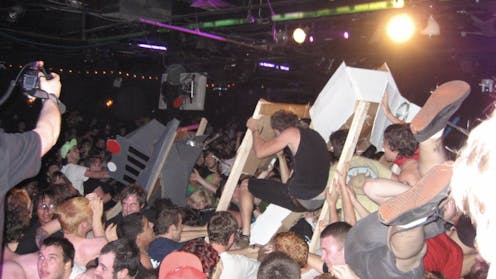
A scene from R.A.M.B.O.’s last-ever show in Philadelphia (before a reunion in 2024) at Starlight Ballroom on May 27, 2007. Joseph A. Gervasi/LOUD! FAST! PHILLY!

While New York City is commonly considered the birthplace of American punk rock, just 100 miles south of the famous CBGB club where the Ramones and other early punk bands got their start is Philadelphia, which has had its own vibrant punk rock scene since at least 1974 – and it has persisted through the present day.

I am a professor of sociology at Mercer County Community College in New Jersey, lead editor of a forthcoming edited volume titled “Being and Punk,” and author of the 2016 book “Ethics, Politics, and Anarcho-Punk Identifications: Punk and Anarchy in Philadelphia.”

I’ve been a fan of punk rock music since I was 15 years old and have been an active member of punk scenes in Philadelphia and Fargo, North Dakota. I still attend punk shows and participate in the scene whenever I can.

Though the “birth” of punk is always a contentious subject, it is fair to say that, with the Ramones forming in 1974 and releasing the “Blitzkrieg Bop” single in February 1976 in the U.S., and the Sex Pistols performing their first show in November 1975 in the U.K., punk is at least 50 years old.

Given this milestone, I believe it’s worth looking back at the heyday of the anarchist-inflected punk scene in Philly in the 1990s and 2000s, and how the political ideology and activism – encouraging opposition to capitalism, government, hierarchy and more – is still influential today.

Man with face painted holds microphone and stands between two guitar players while fans scream and dance behind him
Philly hardcore punk band Ink & Dagger performs at the First Unitarian Church, circa late 1990s.
Justin Moulder

‘Not your typical rebellion’

In Philadelphia, and especially in West Philly, a number of collectively organized squats, houses and venues hosted shows, political events and parties, along with serving as housing for punks, in the 1990s and 2000s. In some cases, the housing itself was a form of protest – squatting in abandoned buildings and living cooperatively was often seen as a political action.

There was the Cabbage Collective booking shows at the Calvary Church at 48th and Baltimore Avenue. Stalag 13 near 39th and Lancaster Avenue is where the famous Refused played one of their final shows, and The Killtime right next door is where Saves the Day played in 1999 before becoming famous. The First Unitarian Church, an actual church in Center City, still regularly puts on shows in its basement.

These largely underground venues became central to the Philadelphia punk scene, which had previously lacked midsized spaces for lesser known bands.

Many Philly punks during this era mixed music subculture with social activism. As one anarcho-punk – a subgenre of punk rock that emphasizes leftist, anarchist and socialist ideals – I interviewed for my book told me:

“My mom … said, ‘I thought you were going to grow out of it. I didn’t understand it, and your dad and I were like, ‘What are we doing? She’s going out to these shows! She’s drinking beer!’ But then we’d be like, ‘She’s waking up the next morning to help deliver groceries to old people and organize feminist film screenings!’ We don’t know what to do, we don’t know how to deal with this; it’s not your typical rebellion.’”

Black-and-white photo of two male tattooed musicians singing and playing guitar while young men watch
Philly punk band R.A.M.B.O. performs in January 2006, with Tony
Joseph A. Gervasi/LOUD! FAST! PHILLY!

This quote captures the complex and ambiguous rebellion at the heart of anarcho-punk. On the one hand, it is a form of rebellion, often beginning in one’s teenage years, that contains the familiar trappings of youth subcultures: drug and alcohol consumption, loud music and unusual clothing, hairstyles, tattoos and piercings.

However, unlike other forms of teenage rebellion, anarcho-punks also seek to change the world through both personal and political activities. On the personal level, and as I showed in my book, many become vegan or vegetarian and seek to avoid corporate consumerism.

“I do pride myself on trying to not buy from sweatshops, trying to keep my support of corporations to a minimum, though I’ve loosened up over the years,” another interviewee, who was also vegan, said. “You’ll drive yourself crazy if you try to avoid it entirely, unless you … go live with [British punk band] Crass on an anarcho-commune.”

Love and rage in the war against war

Philly’s punk activists of that era spread their anarchist ideals through word and deed.

Bands like R.A.M.B.O., Mischief Brew, Flag of Democracy, Dissucks, Kill the Man Who Questions, Limp Wrist, Paint it Black, Ink and Dagger, Kid Dynamite, Affirmative Action Jackson and The Great Clearing Off, The Sound of Failure, and countless others, sang about war, capitalism, racism and police violence.

For example, on its 2006 single “War-Coma,” Witch Hunt reflected on the ongoing wars in Iraq and Afghanistan, laying blame on voters, government and religion:

24 years old went away to war / High expectations of what the future holds / Wore the uniform with pride a rifle at hand / Bringing democracy to a far away land / Pregnant wife at home awaiting his return / Dependent on faith, will she ever learn? / Ignore the consequences have faith in the Lord / Ignorance is bliss until reality sets in / Never wake up again

During live performances, bands would commonly discuss what the songs were about. And at merchandise tables, they sold T-shirts and records along with zines, books, patches and pins, all of which commonly contained political images or slogans.

Some bands became meta-critics of the punk scene itself, encouraging listeners to recognize that punk is about more than music.

In “Preaching to the Converted,” Kill The Man Who Questions critiqued the complaints bands would receive for becoming too preachy at shows:

“Unity” the battle cry / Youth enraged but don’t ask why / They just want it fast and loud, with nothing real to talk about / 18 hours in a dying van / Proud to be your background band.

In West Philadelphia, punks also staffed the local food cooperative and organized activist spaces – like the former A-Space on Baltimore Avenue and LAVA Zone on Lancaster Avenue where groups such as Food Not Bombs and Books Through Bars, among others, would operate. I personally organized a weekend gathering of the Northeastern Anarchist Network at LAVA in 2010.

Young adults wearing black clothes and bandannas and holding protest signs
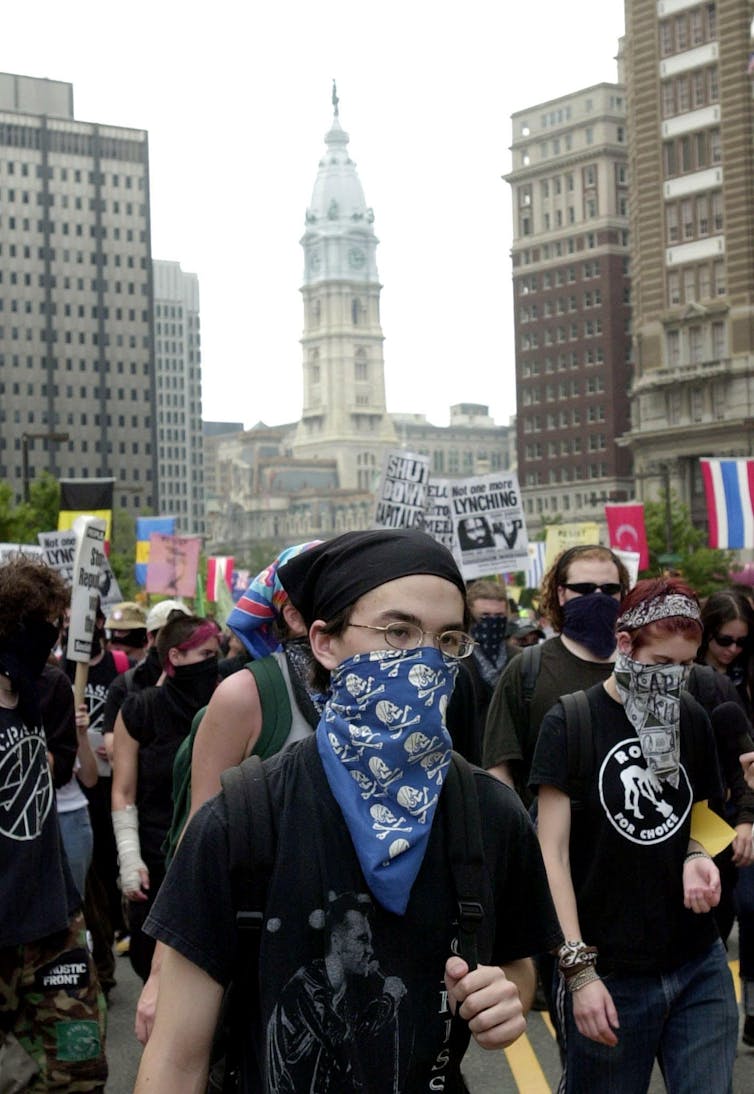
Masked protesters walk away from City Hall after a march on July 30, 2000, a day before the start of the Republican National Convention in Philadelphia.
Roberto Schmidt/AFP via Getty Images

Punks raised money for charities and showed up to local protests against capitalist globalization and countless other causes. At the Republican National Convention in Philadelphia in the summer of 2000, black-clad punks whose faces were hidden behind masks marched in the streets along with an enormous cadre of local community organizations.

Punk not dead in Philly

Since punk’s earliest days, people have bemoaned that “punk is dead.”

In Philadelphia, I’ve seen how the anarcho-punk scene of the 1990s and 2000s has changed, but also how it continues to influence local bands and the values of punk rock broadly.

Many former and current members of the Philly anarcho-punk scene are still activists in various personal and professional ways. Among those I interviewed between 2006 and 2012 were social workers, labor organizers, teachers and professors, and school and drug counselors. For many, their professional lives were influenced by the anarchist ethics they had developed within the punk rock scene.

And many local punks showed up at the Occupy Philly camp and protests outside City Hall in 2011, and later marched in the streets during Black Lives Matter protests following the murder of George Floyd and killing of Breonna Taylor in 2020. They also participated in the homeless encampment on the Benjamin Franklin Parkway, also in 2020. And local punks I know continue to participate in grassroots campaigns like Decarcerate PA.

Anarchism and punk rock open up avenues for disaffected youth – in Philadelphia or anywhere else – to dream of a world without capitalism, coercive authorities, police and all forms of injustice.

In the words of R.A.M.B.O., one of the better known hardcore punk bands of the era and who released their latest Defy Extinction album in 2022: “If I can dream it, then why should I try for anything else?”

American flag on ground painted over with rainbow-filled anarchist symbol
Protesters alter a flag at the Occupy I.C.E. Philly encampment at City Hall in 2018.
Cory Clark/NurPhoto via Getty Images

Read more of our stories about Philadelphia, or sign up for our Philadelphia newsletter.

The Conversation

Edward Avery-Natale does not work for, consult, own shares in or receive funding from any company or organization that would benefit from this article, and has disclosed no relevant affiliations beyond their academic appointment.

ref. How Philly anarcho-punks blended music, noise and social justice in the 1990s and 2000s – https://theconversation.com/how-philly-anarcho-punks-blended-music-noise-and-social-justice-in-the-1990s-and-2000s-264178

Vaccine mandates misinformation: 2 experts explain the true role of slavery and racism in the history of public health policy – and the growing threat ignorance poses today

Source: The Conversation – USA (3) – By Lauren MacIvor Thompson, Assistant Professor of History and Interdisciplinary Studies, Kennesaw State University

Vaccination rates in Florida schools have dipped below the threshold for immunity to certain preventable diseases. Suzi Media Production/iStock via Getty Images Plus

On Sept. 3, 2025, Florida announced its plans to be the first state to eliminate vaccine mandates for its citizens, including those for children to attend school.

Current Florida law and the state’s Department of Health require that children who attend day care or public school be immunized for polio, diphtheria, rubeola, rubella, pertussis and other communicable diseases. Dr. Joseph Ladapo, Florida’s surgeon general and a professor of medicine at the University of Florida, has stated that “every last one” of these decades-old vaccine requirements “is wrong and drips with disdain and slavery.”

As experts on the history of American medicine and vaccine law and policy, we took immediate note of Ladapo’s use of the word “slavery.”

There is certainly a complicated history of race and vaccines in the United States. But, in our view, invoking slavery as a way to justify the elimination of vaccines and vaccine mandates will accelerate mistrust and present a major threat to public health, especially given existing racial health disparities. It also erases Black Americans’ key work in centuries of American public health initiatives, including vaccination campaigns.

What’s clear: Vaccines and mandates save human lives

Evidence and data show that vaccines work, as do mandates, in keeping Americans healthy. The World Health Organization reported in a landmark 2024 study that vaccines have saved more than 154 million lives globally in just the past 50 years.

In the United States, vaccines for children are one of the top public health achievements of the 20th century. Rates of eight of the most common vaccine-preventable diseases in school-age children dropped by 97% or more from pre-vaccine levels, preventing an estimated 1,129,000 deaths and resulting in direct savings of US$540 billion and societal savings of $2.7 trillion.

History of vaccine mandates in the United States

Vaccine mandates in the United States date to the Colonial period and have a complex history. George Washington required his troops be inoculated, the predecessor of vaccination, against smallpox during the American Revolution.

To prevent outbreaks of this debilitating, disfiguring and deadly disease, state and local governments implemented smallpox inoculation and vaccination campaigns into the early 1900s. They targeted various groups, including enslaved people, immigrants, people living in tenement and other crowded housing conditions, manual laborers and others, forcibly vaccinating those who could not provide proof of prior vaccination.

Although religious exemptions were not recognized by law until the 1960s, some resisted these vaccination campaigns from the beginning, and 19th-century anti-vaccination societies urged the rollback of state laws requiring vaccination.

By the turn of the 20th century, however, the U.S. Supreme Court also began to intervene in matters of public health and vaccination. The court ultimately upheld vaccine mandates in Jacobson v. Massachusetts in 1905, in an effort to strike a balance between individual rights with the need to protect the public’s health. In Zucht v. King in 1922, the court also ruled in favor of vaccine mandates, this time for school attendance.

Vaccine mandates expanded by the middle of the 20th century to include vaccines for many dangerous childhood diseases, such as polio, measles, rubella and pertussis. When Jonas Salk’s polio vaccine became available, families waited in long lines for hours to receive it, hoping to prevent their children from having to experience paralysis or life in an iron lung.

Scientific studies in the 1970s demonstrated that state declines in measles cases were correlated with enforcement of school vaccine mandates. The federal Childhood Immunization Initiative launched in the late 1970s helped educate the public on the importance of vaccines and encouraged enforcement. All states had mandatory vaccine requirements for public school entry by 1980, and data over the past several decades continues to demonstrate the importance of these laws for public health.

Most parents also continue to support school mandates. A survey conducted in July and August 2025 by The Washington Post and the Kaiser Family Foundation finds that 81% of parents support laws requiring vaccines for school.

Black Americans’ long fight for public health equity

Despite the proven success of vaccines and the importance of vaccine mandates in maintaining high vaccination rates, there is a vocal anti-vaccine minority in the U.S. that has gained traction since the COVID-19 pandemic.

Misinformation proliferates both online and off. Some of the misinformation originates in the historical realities of vaccines and social policy in the United States.

When Ladapo, the Florida surgeon general, invoked the term “slavery” to refer to vaccine mandates, he may have been referring to the history of racism in the medical field, such as the U.S. Public Health Service Untreated Syphilis Study at Tuskegee. The study, which started in 1932 and spanned four decades, involved hundreds of Black men who were recruited without their knowledge or consent so that researchers could study the effects of untreated syphilis. Investigators misled the participants about the nature of the study and actively withheld treatment – including penicillin, which became the standard therapy in the late 1940s – in order to study the effects of untreated syphilis on the men’s bodies.

Today, the study is remembered as one of the most egregious instances of racism and unethical experimentation in American medicine. Its participants had enrolled in the study because it was advertised as a chance to receive expert medical care but, instead, were subjected to lies and painful “treatments.”

Three men standing shoulder to shoulder in long-sleeve shirts.
The 40-year untreated syphilis study at Tuskegee ended in 1972.
National Archives Catalog/Centers for Disease Control and Prevention

Despite these experiences in the medical system, Black Americans have long advocated for better health care, connecting it to the larger struggle for racial equality.

Vaccination is no exception. Despite the fact that they were often the subject of forced innoculation, enslaved people helped to lead the first American public health initiatives around epidemic disease. Historians’ research on smallpox and slavery, for example, has found that inoculation was widely accepted and practiced by West Africans by the early 1700s, and that enslaved people brought the practice to the Colonies.

Although his role is often downplayed, an African man known as Onesimus introduced his enslaver Cotton Mather to inoculation.

Throughout the next century, enslaved people often continued to inoculate each other to prevent smallpox outbreaks, and enslaved and free people of African descent played critical roles in keeping their own communities as healthy as possible in the face of violence, racism and brutality. The modern Civil Rights Movement explicitly drew on this history and centered health equity for Black Americans as one of its key tenets, including working to provide access to vaccines for preventable diseases.

In our view, Ladapo’s reference to vaccines as “slavery” ignores this important and nuanced history, especially Black Americans’ role in the history of preventing communicable disease with vaccines.

Black and white scanned engraving of colonialist Cotton Mather.
Puritan slave owner Cotton Mather learned about smallpox inoculation from one of his slaves, an African man named Onesimus.
benoitb/DigitalVision Vectors via Getty Images

Lessons to learn from Tuskegee

Ladapo’s word choice also runs the risk of perpetuating the rightful mistrust that continues to exist in communities of color about vaccines and the American health system more broadly. Studies show that lingering effects of Tuskegee and other instances of medical racism have had real consequences for the health and vaccination rates of Black Americans.

A large body of evidence shows the existence of persistent health disparities for Black people in the United States compared with their white counterparts, leading to shorter lifespans, higher rates of maternal and infant mortality and higher rates of communicable and chronic diseases, with worse outcomes.

Eliminating vaccine mandates in Florida and expanding exemptions in other states will continue to widen these already existing disparities that stem from past public health wrongs.

There is an opportunity here, however, for health officials, not just in Florida but across the nation, to work together to learn from the past in making American public health better for everyone.

Rather than weakening vaccine mandates, national, state and local public health guidance can focus on expanding access and communicating trustworthy information about vaccines for all Americans. Policymakers can acknowledge the complicated history of vaccines, public health and race, while also recognizing how advancements in science and medicine have given us the opportunity to eradicate many of these diseases in the United States today.

The Conversation

The authors do not work for, consult, own shares in or receive funding from any company or organization that would benefit from this article, and have disclosed no relevant affiliations beyond their academic appointment.

ref. Vaccine mandates misinformation: 2 experts explain the true role of slavery and racism in the history of public health policy – and the growing threat ignorance poses today – https://theconversation.com/vaccine-mandates-misinformation-2-experts-explain-the-true-role-of-slavery-and-racism-in-the-history-of-public-health-policy-and-the-growing-threat-ignorance-poses-today-265175

Jusqu’où peut aller l’espionnage des télétravailleurs ?

Source: The Conversation – France (in French) – By Caroline Diard, Professeur associé – Département Droit des Affaires et Ressources Humaines, TBS Education

Dans son rapport 2023, plus de 1 000 plaintes ont été déposées à la Commission nationale de l’informatique et des libertés (Cnil) concernant des systèmes de vidéoprotection ou de vidéosurveillance mis en place sans information adéquate ni respect de la vie privée des personnes concernées. Mike_Shots/Shutterstock

Le contrat de travail donne à l’employeur un pouvoir de direction, incluant le contrôle des tâches effectuées en contrepartie d’une rémunération. Mais peut-on vraiment surveiller les télétravailleurs à leur insu ?


La généralisation du télétravail a modifié le lieu d’exercice du travail – en mode nomade, à domicile, en tiers-lieu – et provoqué une imbrication des temps et espaces de vie.

La banque états-unienne Wells Fargo a licencié une dizaine de collaborateurs au motif que ses salariés utilisaient un simulateur de mouvement de souris pour contrer le logiciel installé par leur employeur pour contrôler leur activité. Le géant bancaire brésilien Itaú a, quant à lui, tranché la question de la productivité de ses salariés en télétravail de façon radicale avec le licenciement de 1 000 salariés.

Ces deux affaires très médiatisées interrogent sur la possibilité de surveiller les salariés en télétravail et sur le droit à la preuve.

Alors que certains outils technologiques, comme les webcams, sont régulièrement convoqués dans l’espace personnel, créant l’opportunité d’un « espionnage » des télétravailleurs, peut-on vraiment surveiller ces derniers à leur insu ? Quelles limites sont posées par la réglementation et la jurisprudence récente ? Quels sont les facteurs d’acceptabilité sociale et éthique de ces technologies ?

La notion de contrôle, largement évoquée dans la littérature académique, est inhérente à toute situation professionnelle. Grâce à une étude qualitative dans le secteur bancaire, nos travaux ont permis de conclure au renforcement de plusieurs formes de contrôle en télétravail : par les comportements, les résultats, les inputs (ou, intrants) et la technologie.

Ce que dit le droit

Le contrôle est un concept juridique encadré, en droit français.

Le salariat implique l’existence d’un contrat de travail et d’un lien de subordination. Il confère à l’employeur un pouvoir de direction qui inclut le contrôle des tâches effectuées en contrepartie d’une rémunération. En vertu de ce pouvoir de direction, il est possible de déployer des dispositifs de contrôle.

L’entreprise peut mettre en place un système de contrôle des horaires ou un système de vidéoprotection dans les locaux de l’entreprise. Les conditions : respecter les contraintes réglementaires et ne pas utiliser le dispositif pour contrôler le salarié sans information préalable.

Surveillance ponctuelle

Toute surveillance doit rester ponctuelle, justifiée par la nature de la tâche à accomplir, et proportionnée au but recherché, comme le précise le Code du travail. L’article L. 1121-1 du code du travail précise :

« Nul ne peut apporter aux droits des personnes et aux libertés individuelles et collectives de restrictions qui ne seraient pas justifiées par la nature de la tâche à accomplir ni proportionnées au but recherché. »

Selon l’article L. 1222-4, aucune information personnelle concernant un salarié ne peut être collectée sans que ce dernier en ait été informé au préalable.

L’utilisation de ces dispositifs de contrôle doit faire l’objet d’une consultation des représentants du personnel. La surveillance au travail nécessite de traiter des données personnelles à des fins diverses, dont certaines peuvent présenter des risques pour les droits et libertés, comme le respect du droit à l’image ou le secret de la correspondance.

Mille plaintes déposées

La mise en place de technologies de contrôle sur le lieu de travail est autorisée à condition de respecter les libertés individuelles et la vie privée des collaborateurs. L’installation d’un tel dispositif ne doit pas conduire à une mise sous surveillance généralisée et permanente du personnel, selon la délibération n°2014-307 du 17 juillet 2014 de la Commission nationale de l’informatique et des libertés (Cnil), décision du Conseil d’État du 18 novembre 2015.


À lire aussi :
Le télétravail est-il devenu le bouc émissaire des entreprises en difficulté ?


La Cnil rappelle régulièrement le droit au respect de la vie privée des salariés au travail en matière de vidéoprotection. Dans son rapport 2023, plus de 1 000 plaintes ont été déposées concernant des systèmes de vidéoprotection ou de vidéosurveillance, mis en place sans information adéquate ni respect de la vie privée des personnes concernées.

Activation des caméras en visioconférence

Concernant l’activation des caméras en visioconférences, la Cnil indiquait dès mars 2020, soit durant le premier confinement, sur son site :

« Lorsqu’il n’est pas possible ou souhaitable de recourir à un dispositif de floutage, l’employeur ne peut pas imposer systématiquement l’activation de leur caméra aux salariés en télétravail qui participent à des visioconférences. Son activation doit donc en principe être laissée à l’appréciation des salariés dans la mesure où, dans la plupart des cas, une participation via le micro est suffisante. »

Il était de jurisprudence constante depuis l’arrêt Néocel (Cass. soc., 20 novembre 1991, n° 88-43120), il y a trente ans, de considérer irrecevables les preuves déloyales (surveillance à l’insu des salariés). La cour de cassation considérait jusqu’alors que le salarié soumis à une surveillance constante et que les enregistrements issus de dispositifs clandestins étaient attentatoires à la vie personnelle du salarié et disproportionnés. Ces dispositifs n’étaient pas opposables au salarié.

Droit de la preuve

La cour de cassation vient d’opérer un important revirement de jurisprudence. Elle a récemment rendu plusieurs arrêts remarqués concernant la surveillance au travail qui ne manquent pas d’inquiéter.

Elle invite le juge à évaluer si une preuve même déloyale est indispensable à l’exercice du droit à la preuve, et si l’atteinte à l’équité du procès ou aux droits des parties demeure proportionnée.

« Le licenciement pour faute grave d’une salariée fondée sur le visionnage d’une vidéosurveillance de sécurité est justifié malgré la clandestinité du procédé dès lors que cette preuve est indispensable à l’exercice du droit à la preuve de l’employeur et proportionnée au but poursuivi »,

précise l’arrêt n° 22-23.073 du 14 février 2024. Dans un nouvel arrêt n° 23-22.216 du 22 janvier 2025, la cour de cassation se prononce à nouveau sur la recevabilité comme preuve des données d’un logiciel de gestion des appels. Les salariés n’ayant pas été informés de son utilisation comme outil de surveillance, elle admet que les données du logiciel servent le licenciement pour faute.

Ce revirement pourrait susciter des débats concernant le contrôle, notamment par les webcams en situation de télétravail. Un tel dispositif pourrait permettre de constituer une preuve recevable justifiant un licenciement pour faute à condition que l’objectif soit proportionné.

Intériorisation de la surveillance

À l’opposé du contrôle hiérarchique classique, qui se manifeste principalement dans l’espace physique de l’entreprise, l’autodiscipline et l’autocontrôle propres à l’hybridation viennent s’ajouter à une surveillance électronique potentielle, comparable à un dispositif panoptique. Cette image illustre un mécanisme d’intériorisation de la surveillance. Se sentant de façon constante potentiellement observé, le télétravailleur est incité à respecter les attentes et les règles du collectif.

La mise en place d’un système de contrôle ne peut être envisagée en dehors de son contexte social, parce qu’il est imposé par un règlement, ou une norme liée au métier ou à l’activité. C’est le cas du « reporting » pour des activités commerciales, des caméras dans les banques et aux caisses des supermarchés, de la géolocalisation des livreurs.

L’influence sociale de la communauté de travail peut aussi donner à la webcam la dimension d’un outil collaboratif. Activer sa caméra peut devenir une pratique commune, un usage partagé. Une information transparente permet également une meilleure acceptation par les salariés lorsqu’ils comprennent l’intérêt de la technologie de contrôle et la perçoivent comme adaptée à leur environnement de travail.

The Conversation

Les auteurs ne travaillent pas, ne conseillent pas, ne possèdent pas de parts, ne reçoivent pas de fonds d’une organisation qui pourrait tirer profit de cet article, et n’ont déclaré aucune autre affiliation que leur organisme de recherche.

ref. Jusqu’où peut aller l’espionnage des télétravailleurs ? – https://theconversation.com/jusquou-peut-aller-lespionnage-des-teletravailleurs-265110

Le PSG, du club de football à la marque culturelle mondiale

Source: The Conversation – France (in French) – By Fatima Regany, Maître de conférences, Université de Lille

Un tournant est pris pour le PSG avec la victoire tant attendue, le 31 mai 2025, en Ligue des champions. Charnsitr/Shutterstock

Depuis sa victoire en Ligue des champions, le PSG souhaite faire évoluer son image et son influence. Cette ambition dépasse le simple cadre sportif. Il s’agit pour la direction du club de faire du PSG l’une des plus grandes marques sportives au monde, capable de refléter les valeurs de la ville de Paris et de rassembler en dehors du stade, en dehors du football.


Dans le but d’associer le PSG aux valeurs que symbolise la ville de Paris, le président du club Nasser Al-Khelaifi affichait depuis 2011 son ambition :

« Paris est une des villes les plus incroyables du monde, et mon objectif en tant que président a été de lui donner le club qu’elle mérite. »

Depuis sa victoire en Ligue des champions, comment cette marque peut-elle faire évoluer son image et son influence en devenant une marque culturelle ?

Pour répondre à cette question, nous avons mené une recherche qualitative avec des responsables marketing du PSG – brand activation, le digital et les réseaux sociaux, le sponsoring, partenariats et merchandising –, des consommateurs et associations de supporters, et quantitative en analysant les données des campagnes de communication du club.

« Branding »

Devenir une marque est un long et incertain processus de développement qu’il faut alimenter. Ce processus est nommé en marketing branding. Il renvoie à l’ensemble des actions marketing mises en place pour valoriser une marque tant au niveau matériel – produit, services –, qu’immatériel – identité, valeurs et promesse.

Le professeur de marketing Benoît Heilbrunn rappelle que

« les marques ne sont pas uniquement des systèmes de communication, elles ont plus généralement une fonction de transmission culturelle et idéologique en modifiant de façon significative une chaîne d’éléments structurels de l’environnement socio-économique – système de croyance, règles de comportements, rituels, etc. ».

Par son symbolisme, elle devient un outil rassemblant les communautés, qui entre en résonance avec la vie des individus et la société au sens large. Elle produit des ressources culturelles et identitaires que les individus et les groupes sociaux s’approprient, selon le professeur en marketing Douglas Holt dans son essai Comment des marques deviennent-elles iconiques.

L’appui du « sportainment »

La marque PSG s’est appuyée sur le sportainment pour créer une marque capable d’offrir, au-delà de la consommation d’un produit ou d’un service, une expérience source de valeur hédonique et sociale. La marque, comme le sport, repose sur des rituels, eux aussi moteurs de la construction communautaire, qui renforcent l’adhésion et l’engagement des supporters.

De nombreux supporters à travers le monde suivent le PSG : 65,3 millions d’abonnés sur Instagram, 53 millions sur Facebook, 49,2 millions sur TikTok ou 15,3 millions sur X.

Le PSG mise sur l’expérience du match en développant un spectacle de sport associé au Parc des Princes, lieu de destination qu’elle rend mythique. Durant la saison 2024/2025, son taux de remplissage était de 99 %, avec 47 656 spectateurs par match en moyenne. Les animations comme le Stadium Tour participent à renforcer l’expérience de stade en générant un sentiment d’appartenance au club et admirer le récent trophée de la Ligue des champions.

Des joueurs devenus stars interplanétaires

Pour développer sa capacité émotionnelle et affective, la marque PSG s’appuie sur le brand embodiment, en associant l’histoire de joueurs célèbres à son identité. Mais certains supporters expriment un désengagement envers la marque causée par la présence trop importante de joueurs stars médiatisés. Selon un répondant à notre étude,

« le PSG est devenu une machine stratosphérique avec des stars interplanétaires et peut-être que c’était difficile de s’identifier justement à ce club ».

Kylian Mbappé et Neymar da Silva Santos Júnior
Kylian Mbappé et Neymar da Silva Santos Júnior, lors du match du PSG contre l’Étoile rouge de Belgrade le 11 décembre 2018.
StefanUgljevarevic/Shutterstock

La marque PSG est au cœur de contradictions culturelles. Elle s’adresse à des audiences ayant une relation différente au club et une sociologie hétérogène. « Dans un club, il y a toujours cette dualité-là entre le concret de la ville, parce que c’est là que vous rencontrez les gens. […] Et la virtualité de l’international où vous savez que vous avez un impact très fort via la télévision et via le réseau, mais avec des gens qui n’interagissent pas physiquement » souligne un répondant.

Les abonnés historiques (supporters très fidèles ancrés localement) qui suivent l’aspect sportif du club se distinguent des nouveaux fans arrivés après 2011 intéressés par l’aspect culturel et lifestyle de la marque.

Supporters du PSG
Supporters du virage Auteuil.
VictorVelter/Shutterstock

Plus de 3,1 millions d’euros pour la Fondation

Compte tenu de sa notoriété et de son influence, la marque PSG possède-t-elle la capacité d’avoir un impact sociétal ? Elle l’inscrirait dans la catégorie des marques iconiques.

Notre analyse souligne une attente d’engagement de toutes parts :

« Même pour les supporters se dire que mon club soutient des causes, comme les personnes en situation de handicap, c’est extrêmement important »,

selon l’un des répondants. D’après l’un des responsables du marketing répondants, le PSG opère le choix volontaire de rendre les actions de la Fondation PSG For Communities peu visibles afin d’éviter tout risque d’accusation de récupération. Cela augmente le risque d’être perçu comme une marque inactive. Le montant de la fondation s’élève à plus de 3,1 millions d’euros pour la saison 2023/2024.

« Rêvons plus grand »

D’après nos résultats, la marque PSG cristallise des tensions entre le local et le global chez les supporters. Une autre tension irrésolue réside dans la contradiction entre une identité élitiste de la marque associée à l’image de Paris et une identité urbaine, populaire. Sur nos quatre supporters répondants, trois disent la percevoir comme élitiste depuis 2011, en contradiction avec la culture urbaine et populaire.

Le schéma ci-dessous, pensé par le professeur en marketing Douglas Holt, est appliqué pour cette recherche aux particularités de la marque PSG. Il montre comment le PSG tente de résoudre des contradictions socioculturelles en s’appuyant sur des récits identitaires.

Le club a construit pendant plus d’une décennie une mise en récit fondée sur le rêve, « rêvons plus grand » la grandeur et la conquête, sans toutefois avoir une image de vainqueur. Aujourd’hui, le rêve s’est concrétisé avec la victoire tant attendue le 31 mai 2025 en Ligue des champions.

Vítor Machado Ferreira, surnommé Vitinha, et Ousmane Dembélé, deux des grands artisans de la victoire du PSG en Ligue des champions de l’UEFA
Vítor Machado Ferreira, surnommé Vitinha, et Ousmane Dembélé, deux des grands artisans de la victoire du PSG en Ligue des champions de l’UEFA.
ErreRoberto/Shutterstock

Notre analyse soulève les défis pour faire évoluer la marque à savoir : quel récit la marque PSG peut-elle incarner à présent ? Quel impact aura le repositionnement sportif du club sur la marque ? Elle change en effet de statut sportif avec sa victoire et, dans le même temps, elle se repositionne comme « club de la nouvelle génération ». Elle doit construire une relation authentique avec ses consommateurs et une identité nouvelle pour l’amener à résoudre les tensions culturelles liées à son statut de marque paradoxe. Autant de défis qui font de cette marque un cas d’école dans le champ du branding culturel.


Cet article a été co-rédigé avec Clémence Delhaye (IEP Lille), d’après son travail de recherche « Le branding culturel d’un club international de football : le cas de la marque Paris Saint-Germain ».

The Conversation

Fatima Regany ne travaille pas, ne conseille pas, ne possède pas de parts, ne reçoit pas de fonds d’une organisation qui pourrait tirer profit de cet article, et n’a déclaré aucune autre affiliation que son organisme de recherche.

ref. Le PSG, du club de football à la marque culturelle mondiale – https://theconversation.com/le-psg-du-club-de-football-a-la-marque-culturelle-mondiale-260255

Qu’est-ce qu’un « bon employeur » ? Une approche par la notion d’« employeurabilité »

Source: The Conversation – France (in French) – By Frédéric Faure, Chercheur associé, Université Rennes 2

Comment expliquer qu’avec un taux de chômage élevé, des postes de travail restent non pourvus ? Les commentaires font souvent porter la responsabilité sur des salariés peu enclins à s’adapter. Et si les employeurs devaient aussi faire leur part du chemin en améliorant leur « employeurabilité » ? Coup de projecteur sur une notion qui explique une bonne partie du paradoxe de l’emploi.


France Travail a diffusé en avril 2025 son enquête annuelle auprès des employeurs sur leurs besoins en main-d’œuvre. Malgré une diminution significative des projets d’embauche dans tous les secteurs d’activité (-12,5 % par rapport à l’année précédente) et une moindre anticipation de difficultés de recrutement (-7 points), près de 40 % des employeurs ayant effectivement cherché à recruter déclarent, malgré tout, avoir rencontré des difficultés. 70 % d’entre eux imputent ces difficultés de recrutement à un trop faible nombre – voire une inexistence – de candidatures et à une inadéquation de ces candidatures à leurs attentes (manque d’expérience, de motivation, de compétences).

La même enquête révèle que près de 20 % de ces employeurs ayant cherché à recruter ont également rencontré des difficultés pour garder leur personnel. Cette situation peut sembler paradoxale au regard du taux de chômage qui reste élevé en France et du fait que plus de 2 millions de personnes y sont durablement éloignées de l’emploi.

La responsabilité des employeurs

Mais alors ce déséquilibre sur le marché de l’emploi est-il essentiellement lié à une inadaptation de l’offre de travail à la demande des employeurs, autrement dit à un problème d’employabilité d’une partie de la main-d’œuvre ? Ne peut-on pas également questionner la capacité des employeurs à être suffisamment attractifs, à recruter convenablement, à s’adapter à la main-d’œuvre disponible localement, à proposer des conditions de travail acceptables, à former, motiver et ainsi conserver leur personnel, à gérer la relation d’emploi de manière efficace et durable ? C’est en référence à cette seconde approche que le terme d’« employeurabilité » a été forgé, en miroir de celui d’employabilité. Il s’agissait de pointer la part de responsabilité des employeurs et d’esquisser, d’une certaine manière, le profil du « bon employeur ».


À lire aussi :
Quand les avis en ligne des salariés prennent à contre-pied la communication des employeurs


Apparue pour la première fois en France en 1999 sous la plume d’un consultant en ressources humaines, reprise et approfondie ensuite par quelques rares économistes, ce n’est qu’à partir de 2018 que la notion d’employeurabilité a connu un relatif essor en France, particulièrement portée par la diffusion du rapport Borello sur l’inclusion professionnelle, par le projet employeurabilité du Pacte civique ainsi que le rapport de préfiguration de France Travail.

Confusion dans les notions

Peu traitée par la recherche académique, la notion d’employeurabilité pâtit d’une insuffisance de caractérisation conceptuelle. Ce flou dans les contours de la notion est accentué par des recouvrements avec d’autres notions proches parmi lesquelles la marque employeur, la responsabilité sociale d’entreprise (RSE), ou encore la qualité de l’emploi.

Il est vrai que la manière dont une entreprise communique sur ses leviers d’attractivité, la force de ses engagements sociétaux et la qualité des emplois qu’elle propose va significativement influer sur sa capacité à recruter. Mais certains écrits sur la notion d’employeurabilité en présentent d’autres facettes. L’inclusion dans et par l’emploi est une facette essentielle. Il s’agit de la capacité des entreprises à sortir des sentiers battus en termes de recrutement, à s’ouvrir à la diversité plutôt que rester sur un profil de « candidat idéal », tout autant recherché par les entreprises concurrentes, à faire l’effort d’intégrer des personnes éloignées de l’emploi, voire d’en faire le but même de l’entreprise.

Recenser les pratiques

Au-delà du recrutement et de l’intégration, l’employeurabilité peut également être envisagée comme la capacité des employeurs à mettre en place des conditions – organisationnelles, managériales et RH – favorables au développement de l’employabilité interne comme externe de leurs salariés. On rejoint ici les notions d’employabilité supportée ou d’employabilité durable.

Face à la multiplicité des approches de l’employeurabilité, il nous a semblé utile d’en faire un recensement et un examen systématique afin d’y voir plus clair et de mieux caractériser cette notion. À partir d’une analyse lexicale puis thématique d’un corpus de 75 textes académiques et non académiques (articles de presse, rapports d’organisations publiques, articles émanant du monde associatif ou syndical) faisant nommément référence à l’employeurabilité, nous avons abouti à une représentation synthétique des enjeux et pratiques associées.

Note de lecture : 34 % des enjeux évoqués dans les textes du corpus concernent « la capacité des employeurs à gérer la relation d’emploi » et 45 % des pratiques d’employeurabilité évoquées dans ces mêmes textes relèvent de l’appui externe à l’employeur.

Qui sont les bons employeurs ?

À partir des associations d’enjeux et de pratiques d’employeurabilité les plus fortement corrélées, cette recherche nous a finalement permis d’envisager trois types de réponse à la question « Qu’est ce qu’un bon employeur ? »

  • Un employeur qui est en mesure de mobiliser les outils et méthodes de gestion adaptés (RH, organisation, management) pour attirer et fidéliser les talents dont il a besoin dans un objectif final de maximisation de l’efficacité de l’entreprise. Les pratiques liées à l’amélioration de la qualité de l’emploi déjà citées font partie de cette catégorie, de même qu’une communication réaliste des éléments d’attractivité d’une offre d’emploi.
Xerfi 2024.
  • Un employeur qui, au-delà de sa fonction d’entrepreneur, est capable de gérer de façon équilibrée et durable la relation d’emploi, y compris, si besoin, en faisant appel à un appui externe ou à travers de la mutualisation. Par exemple, le recours à une aide externe par les TPE et PME peu outillées sur le plan RH, peut contribuer à faire émerger auprès des employeurs novices une identité d’employeur, centrée sur la capacité d’écoute et d’accompagnement du salarié vers son autonomie, et sur l’anticipation de ses besoins.

  • Un employeur qui, s’éloignant de recherches de rentabilité financière directe) ou d’habillage social), déploie une responsabilité sociale élargie dans le champ de l’emploi à travers des pratiques d’inclusion et de développement de l’employabilité de ses salariés. Certaines pratiques d’embauche et de développement du pouvoir d’agir de publics particulièrement éloignés de l’emploi entrent dans ce cadre.

Une question de taille

La notion d’employeurabilité invite, finalement, à dépasser la dimension morale que revêt le mot « bon » accolé à celui d’employeur pour réfléchir de manière factuelle et différenciée, selon la taille des employeurs.

Pour ce qui est des petites structures employeuses (à but lucratif ou non) : comment mieux former les entrepreneurs au rôle d’employeur, les accompagner dans leurs premiers recrutements, renforcer l’appui des intermédiaires de l’emploi, développer les solutions de mutualisation de l’emploi ?

Pour les employeurs de taille intermédiaire : comment améliorer l’offre de conseil RH adaptée à leurs moyens et problématiques spécifiques ? Enfin, pour les grandes entreprises, comment les inciter, ou les contraindre par la loi, à adopter des comportements s’inscrivant dans un esprit de « stakeholder » et non pas seulement de « shareholder » ?

The Conversation

Frédéric Faure travaille pour France Travail.

Alain Cucchi a reçu des financements de France 2030 dans le cadre du projet eNSEMBLE

Jennifer Urasadettan a reçu des financements de l’ANR dans le cadre d’une recherche sur les tiers-lieux ruraux

ref. Qu’est-ce qu’un « bon employeur » ? Une approche par la notion d’« employeurabilité » – https://theconversation.com/quest-ce-quun-bon-employeur-une-approche-par-la-notion-d-employeurabilite-263482

Dirigeantes sous pression : comment le féminisme néolibéral alimente le syndrome de l’imposteur

Source: The Conversation – France (in French) – By Zuzanna Staniszewska, Assistant Professor in the Management Department at Kozminski University; Research Associate, ESCP Business School

Les dirigeantes d’aujourd’hui sont célébrées comme des « girlboss » capables de tout concilier : carrière, famille et ambition personnelle. Mais derrière cette façade se cache une pression invisible : le féminisme néolibéral impose l’auto-optimisation et la performance sans répit, donnant naissance à un nouveau « syndrome de l’imposteur » où jamais rien n’est assez. Enquête auprès de femmes qui occupent des postes à responsabilité dans le secteur du luxe en France.

De nos jours, les médias célèbrent souvent la « girlboss », cette entrepreneuse qui travaille 80 heures par semaine pour développer sa marque et réussir, tandis que des campagnes publicitaires montrent des femmes qui « s’imposent » dans les salles de réunion et dont la vie de famille est réglée comme du papier à musique. Ces représentations culturelles créent l’illusion que les femmes occupant des postes de direction sont plus autonomes que jamais. Pourtant, nos recherches révèlent que certaines se disent épuisées, enfermées dans des attentes et poussées à incarner un idéal qui ne tolère guère la vulnérabilité. Cette tension renvoie à une forme de féminisme relativement récente, qui n’est sans doute pas aussi libératrice qu’elle le suggère.

Le féminisme néolibéral

L’expression féminisme néolibéral a été introduit pour la première fois en 2013 par Catherine Rottenberg, spécialiste des médias et des études culturelles.

Rottenberg l’a utilisé pour décrire la fusion progressive d’un certain type de féminisme centré sur les libertés individuelles, et la rationalité néolibérale. Le néolibéarlisme étant défini, selon la théoricienne politique Wendy Brown, comme un ordre de la raison normative qui « reconfigure tous les aspects de l’existence en termes économiques »

Ce courant du féminisme reconnaît la persistance des inégalités entre les sexes, en particulier dans le monde du leadership dominé par les hommes, mais attribue la responsabilité de les surmonter aux femmes elles-mêmes, les exhortant à devenir la version la plus performante d’elle-même et à affirmer constamment leur valeur. Mais derrière cette responsabilité se cache une nouvelle forme de pression : celle de ne pas seulement affirmer leur valeur auprès des hommes, mais aussi auprès des autres femmes. Cette pression ne provient pas du patriarcat traditionnel, mais des préjugés intériorisés par les femmes. Elle alimente ce que nous appelons, en combinant des termes issus de la littérature populaire et académique, le « phénomène de l’imposture de la superwoman » : un sentiment d’insuffisance causé par des attentes contradictoires et irréalistes.

Enquête dans le secteur du luxe en France

Pour explorer ce phénomène, nous avons mené 20 entretiens approfondis entre 2022 et 2023 avec des femmes occupant des postes de direction dans le secteur du luxe en France, un environnement qui incarne les attentes fondamentales de la féminité néolibérale : les femmes doivent diriger, inspirer et avoir une apparence parfaite, le tout dans un contexte de leadership dominé par les hommes. Nous avons interrogé nos participantes sur la manière dont elles construisent leur image de marque personnelle, leurs routines quotidiennes en matière de leadership, les types de pressions auxquelles elles sont confrontées et la manière dont elles concilient leurs attentes professionnelles et personnelles.

Pour analyser les réponses des participantes, nous avons adopté une approche qualitative combinant analyse thématique et analyse du discours, en utilisant une logique abductive qui allait et venait entre les données et la théorie. L’analyse thématique nous a aidés à identifier des schémas récurrents dans les récits des participantes. L’analyse du discours a replacé ces récits dans un contexte social plus large. Elle a montré comment les idéaux culturels de féminité et de leadership influencent la manière dont les femmes parlent de leurs expériences.

Dans les conclusions préliminaires de notre étude, qui est actuellement en cours d’examen par des pairs, certaines participantes décrivent des sentiments de fierté et d’accomplissement. D’autres évoquent plutôt la fatigue, un sentiment d’isolement et la pression de devoir se montrer à la hauteur d’un idéal impossible à atteindre.

Une nouvelle version du syndrome de l’imposteur

Le syndrome de l’imposteur désigne un sentiment persistant de doute de soi : la conviction que l’on ne mérite pas vraiment son succès. On peut attribuer ses réalisations à la chance, à un bon timing ou à l’aide d’autrui, plutôt qu’à ses propres compétences.**

Ce terme a été inventé à la fin des années 1970 par les psychologues Pauline Clance et Suzanne Imes, sur la base de leurs travaux auprès de femmes très performantes. Bon nombre des femmes interrogées par Clance et Imes avaient obtenu un doctorat et occupaient des postes à responsabilité, mais se sentaient néanmoins comme des imposteurs. Elles craignaient d’avoir été admises par erreur dans des programmes d’études supérieures ou que leurs collègues les aient en quelque sorte surestimées.

Depuis lors, le phénomène de l’imposteur est largement reconnu (et souvent appelé « syndrome de l’imposteur »). Particulièrement fréquent chez les femmes, il se caractérise généralement par trois aspects : le sentiment d’être une imposteur, la peur d’être démasquée et la difficulté à croire en sa réussite personnelle, même lorsqu’on travaille dur pour la maintenir.

Mais quelque chose a changé

Aujourd’hui, les difficultés et les craintes des femmes occupant des postes de direction ne concernent plus seulement le fait de « mériter leur place », mais aussi celui d’« être tout à la fois » : une dirigeante visionnaire, une mère parfaite, une partenaire solidaire, une mentor inspirante, une marathonienne soucieuse de sa santé, une collaboratrice qui se démarque tout en s’intégrant à l’équipe. Ce qui est frappant, c’est que la pression ne vient pas toujours des hommes. Le plus souvent, les femmes nous ont confié qu’elles craignaient le jugement des autres femmes.

Derrière ce que nous considérons comme une nouvelle version du syndrome de l’imposteur, il existe un nombre croissant de recherches montrant que le doute de soi chez les femmes est façonné par la compétition intra-genre. Par exemple, des études universitaires sur le concept de « syndrome de la reine des abeilles », la misogynie féminine et la micro-violence parmi les femmes de l’élite révèlent comment les femmes occupant des postes de direction peuvent se désolidariser des autres femmes ou imposer des normes masculines.

Cela est particulièrement pertinent lorsque l’on considère comment l’internalisation de la féminité néolibérale transforme le phénomène de l’imposteur en quelque chose de plus complexe. Promu dans des ouvrages tels que « En avant toutes : les femmes, le travail et le pouvoir », le livre publié en 2013 par l’ancienne cadre de Facebook Sheryl Sandberg, le féminisme néolibéral présente l’inégalité comme un problème à résoudre par l’initiative individuelle des femmes, la confiance en soi et l’auto-optimisation.

En conséquence, les femmes craignent non seulement d’être incompétentes, mais aussi de ne pas incarner la superwoman – toujours compétente, toujours ambitieuse et toujours maîtresse d’elle-même – et ressentent la pression des autres femmes qui incarnent et appliquent les mêmes principes.

Derrière les apparences

Ce qui rend le féminisme néolibéral, ainsi que le phénomène de l’imposture de la superwoman, particulièrement insidieux, c’est qu’il se dissimule sous le masque de l’émancipation. En apparence, « tout avoir » semble être un objectif ambitieux. Mais derrière cette façade se cache une fatigue chronique. Plusieurs femmes avec lesquelles nous avons discuté nous ont confié qu’elles travaillaient tard le soir, non pas parce qu’on l’attendait d’elles, mais parce qu’elles estimaient devoir le faire pour prouver leur valeur. Une cadre a décrit ainsi ses premières expériences de leadership : « Je n’ai pas demandé de ressources, car je voulais prouver que je pouvais y arriver toute seule… ce qui était une énorme erreur. » C’est ainsi que fonctionne l’idéal de la superwoman : comme un manager intérieur que l’on s’impose à soi-même. Ce manager exige non seulement la réussite, mais qu’elle soit accomplie sans effort apparent, sans plainte, sans solliciter d’aide et sans laisser transparaître la moindre vulnérabilité.

En ce qui concerne la surveillance entre personnes du même sexe à l’intérieur même d’une entreprise, une tension importante que nous avons observée concernait la maternité : les femmes qui revenaient d’un congé maternité n’étaient pas jugées par les hommes, mais par leurs collègues féminines qui remettaient en question leur ambition et leur engagement. Une femme a déclaré : « J’ai souffert d’une forme de discrimination après mon retour de congé maternité, mais c’était de la part d’une femme, ma responsable, qui m’a dit : “Je suis revenue au bout de trois mois. Si vous êtes sérieuse, vous rattraperez votre retard. » Je me suis sentie jugée parce que je ne m’étais pas remise assez vite. »_

Les femmes avec lesquelles nous avons discuté ont déclaré se sentir peu soutenues par leurs collègues féminines, être témoins de concurrence plutôt que de solidarité, et lutter pour tout faire sans jamais montrer leur vulnérabilité. Comme l’a dit une femme : « Les femmes ne soutiennent pas les autres femmes parce qu’elles ont peur… de perdre leur poste au profit de quelqu’un de plus jeune ou de plus intelligent. » Pour reprendre un terme couramment utilisé, c’est ce que nous appelons le dilemme de la sororité : le conflit interne entre le désir de voir davantage de femmes accéder à des postes de direction et le sentiment de menace que cela suscite. Il ne s’agit pas seulement d’un manque de solidarité. C’est le résultat de la rareté des postes à responsabilité, du perfectionnisme et de la pression à la performance.

Un appel à de nouveaux récits

Nous ne pouvons pas résoudre le phénomène de l’imposture des superwomen en apprenant aux femmes à avoir davantage confiance en elles, car le problème n’est pas un manque de confiance, mais l’exigence impossible d’être toujours compétente et de prouver continuellement sa valeur. Ce qu’il faut repenser, c’est la culture qui fait que les femmes se sentent comme des imposteurs. Cela signifie prendre conscience que nous n’avons pas besoin de modèles parfaits. Nous avons besoin de modèles authentiques.

Le débat doit passer de « comment les femmes peuvent-elles avoir davantage confiance en elles ? » à « pourquoi la confiance en soi est-elle nécessaire en premier lieu, et qui décide à quoi elle doit ressembler ? » Nous avons besoin de lieux de travail où les femmes peuvent être à la fois vulnérables, authentiques et visibles. Comme nous l’a dit une cadre supérieure, « il faut porter une sorte de masque. Mais que se passe-t-il si je veux l’enlever ? »

Il est temps de la laisser faire.

The Conversation

Zuzanna Staniszewska est affiliée à l’université Kozminski et à l’ESCP Business School.

Géraldine Galindo ne travaille pas, ne conseille pas, ne possède pas de parts, ne reçoit pas de fonds d’une organisation qui pourrait tirer profit de cet article, et n’a déclaré aucune autre affiliation que son organisme de recherche.

ref. Dirigeantes sous pression : comment le féminisme néolibéral alimente le syndrome de l’imposteur – https://theconversation.com/dirigeantes-sous-pression-comment-le-feminisme-neoliberal-alimente-le-syndrome-de-limposteur-265616