International aid groups are dealing with the pain of slashed USAID funding by cutting staff, localizing and coordinating better

Source: The Conversation – USA (2) – By Sarah Stroup, Professor of Political Science, Middlebury College
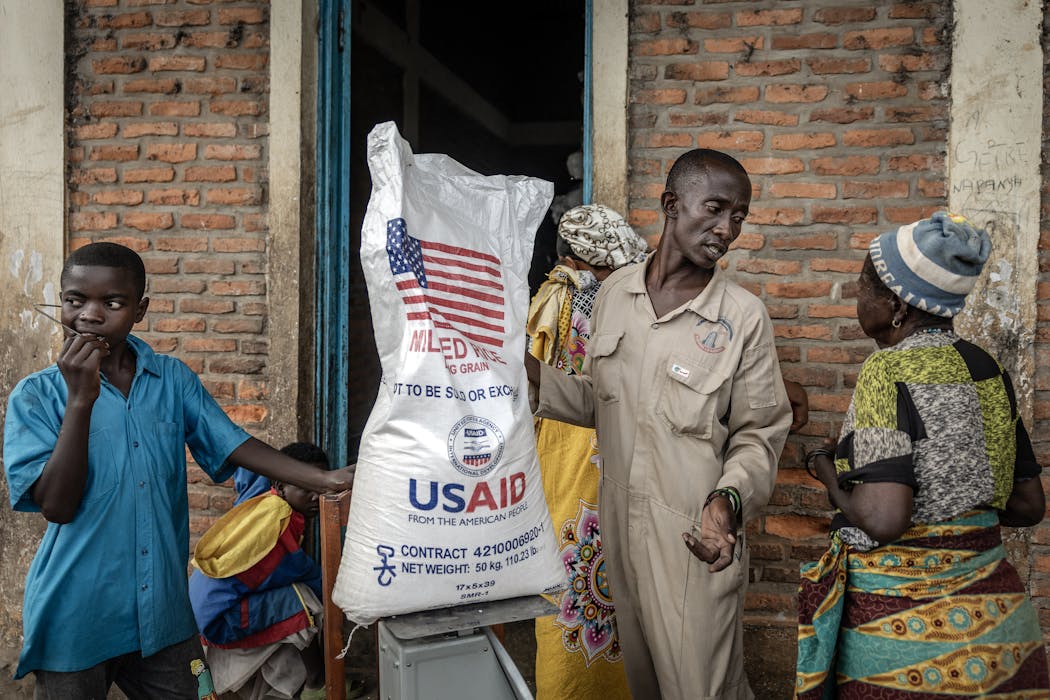
A Burundian official holds up a sack of rice from the final batches delivered by USAID before the agency’s closure. Luis Tato/AFP via Getty Images

Since Jan. 20, 2025, the first day of his second term in office, President Donald Trump has slashed U.S. foreign aid spending. It began with a stop-work order that paused spending on everything from treating tropical diseases in Mali to providing nutrition support in Nepal.

By early February 2025, billionaire Elon Musk announced that the U.S. Agency for International Development, the lead foreign aid agency, had been fed “into the wood chipper.” By July 1, USAID had ceased to exist, 83% of its programs had been canceled, and remaining aid programs were moved into the State Department – where it was unclear how they would be managed. Congress clawed back billions in previously approved aid spending, at Trump’s request, in July.

These developments rattled nongovernmental organizations around the world because about half of USAID’s funding was channeled through nongovernmental organizations prior to this upheaval. According to Tom Hart, who heads a coalition of U.S.-based NGOs, “We’re in a pivot moment, a massive transition, and things aren’t clear.”

Favoring government-to-government spending

According to the official foreignassistance.gov website, the U.S. spent US$32 billion on foreign aid in 2025, less than half of the $68 billion it spent in 2024. These figures include all of USAID’s budget.

The Trump administration is seeking to continue these cuts in its proposed budget for 2026. For example, its proposed $3.8 billion global health budget would mark a 60% decrease from actual 2025 spending.

But the budget the House of Representatives passed in January 2026 would spend $50 billion on international diplomacy and foreign aid, including $9.4 billion for global health and $5.5 billion for humanitarian aid.

The Trump administration has shown a clear preference for distributing U.S. foreign aid to other governments. That means most future aid is likely to be channeled bilaterally rather than contracted out through NGOs or private companies.

We, two scholars of international NGOs, have observed several strategies they are following to keep operating and meeting their missions.

Two former USAID employees explain how they have sought to maintain some of the services the programs they used to run provided.

Struggling to adapt

The first is simply scaling back.

Save the Children US had one-third of its funding frozen, restricting the humanitarian, health and education support it provides to kids in over 100 countries.

Eighty percent of Freedom House’s activities to promote human rights and democracy, which include everything from supporting judicial integrity in Moldova to enhancing media reporting on human rights in Uganda, were terminated.

World Vision, the world’s largest evangelical humanitarian organization, lost 10% of its budget, laid off as many as 3,000 employees and cut programs engaged in HIV/AIDS prevention and child health care and malnutrition in countries like Bangladesh, Kenya and Rwanda.

Search for Common Ground lost $23 million overnight – a 40% cut to its conflict resolution and peacebuilding efforts around the world.

Shifting from shocked to strategic

Once nongovernmental organizations overcame their initial shock, their leadership teams began to respond to USAID’s demise. Three strategies have emerged: reducing operations to focus on activities that support core missions, searching for new sources of reliable funding, and transforming the size and scope of their organizations.

Regardless how they’ve responded, NGOs have had to scale back. As of April 2025, 81 NGOs had closed at least one office. This includes streamlining activities, laying off staff, encouraging their early retirement and cutting pay.

These changes have allowed most NGOs to continue at least minimal operations. But doing more with less may simply not be sustainable for an exhausted workforce over the long term.

Tapping philanthropy and social enterprises

Philanthropy may fill some gaps. However, foundations and individual donors are also facing economic and political uncertainty. Charitable giving to international affairs has been on the rise, but the $35 billion in giving to international causes in 2024 would have to more than double to make up for the reduction in government spending.

Social entrepreneurship combines for-profit models with the mission orientation of nonprofits, and this approach, used by the Bangladesh Rural Advancement Committee and others, is often mentioned as a model for NGOs seeking to provide local services.

But building social enterprises takes time. And there do not seem to be any quick fixes that might restore funding for international NGOs to pre-2025 levels.

PBS NewsHour and the Pulitzer Center reported in 2025 on the impacts of USAID cuts in Africa.

Envisioning new models

The Trump administration has asserted that NGOs had become too dependent on government aid. Secretary of State Marco Rubio, whom Trump named USAID’s acting administrator until the agency was shuttered, has derided this relationship as the “NGO industrial complex.”

While scholars tend to be less dismissive, they have long highlighted that depending on powerful donors, including governments, can limit innovation and distract organizations from their missions.

USAID’s dissolution has expedited experts’ re-envisioning of the NGO model – the idea of private charitable organizations based in rich nations providing services in poor countries.

One push has been to move decision-making and resources to residents of the communities where NGOs are delivering goods and services, through a process development experts call “localization.”

For example, U.K.-based Christian Aid announced in April 2025 that it would close its own offices and instead work with established partner organizations in the countries where it works.

It has halved its staff in a year when revenues dropped by 14% due to the Trump administration’s slashing of its contributions to the U.N. World Food Program.

Losing so much funding has also made cooperation more necessary.

As a book that one of us (Hadden) wrote with University of Pennsylvania professor Sarah Bush shows, the NGO field had become more crowded and competitive since the mid-2010s.

Janti Soeripto, Save the Children’s chief executive officer, has said that in 2025 her organization began cooperating more extensively with MercyCorps and CARE to increase their collective “surge capacity,” or ability to respond to disasters in a quick, effective and efficient manner.

Some NGOs have also reportedly begun discussions about mergers to streamline costs and maintain valuable programs. Although mergers can be challenging when organizations have different values or workplace cultures, we believe that there will be fewer international NGOs in the years ahead.

Moving toward an uncertain future

A leaner, more financially diversified, more localized and better coordinated NGO sector could have positive consequences in the long run.

But we’re certain that the transition will be rocky, both for the people who benefit from the work of NGOs and for the experts and staff members who have built their careers around global poverty alleviation and improving public health in low-income countries.

Funding cuts shuttered many long-standing development and humanitarian programs, with devastating consequences. According to expert estimates, the dismantling of USAID could result in more than 14 million deaths by 2030, including over 4 million children under 5 years old in countries like Uganda, the Democratic Republic of Congo and Colombia.

The Trump administration’s new foreign aid plan cuts out NGOs to fund local governments, but those partner governments may not be able or willing to spend aid money better than their NGO counterparts.

It’s now up to NGO leaders to chart a new course.

According to Essi Lindstedt, a climate and development adviser, there is “a lot of agreement that the ‘old aid’ wasn’t right,” but we have “not yet seen a transition into something better.”

The Conversation

During her 2025-26 sabbatical year, Sarah Stroup has received funding from the Marion and Jasper Whiting Foundation. She is currently academic-in-residence at CMI-Martti Ahtisaari Foundation, a global peace mediation group.

Jennifer Hadden received funding from the National Science Foundation under grant No. 1758755.

ref. International aid groups are dealing with the pain of slashed USAID funding by cutting staff, localizing and coordinating better – https://theconversation.com/international-aid-groups-are-dealing-with-the-pain-of-slashed-usaid-funding-by-cutting-staff-localizing-and-coordinating-better-273184


Colorado ranchers and consumers can team up to make beef supply chains more sustainable

Source: The Conversation – USA (2) – By Jordan Kraft Lambert, Director of Ag Innovation and Partnerships, College of Business, Colorado State University

Beef production provides a valuable contribution to human health while also impacting the natural environment. Brandee Gillham courtesy of the Colorado Department of Agriculture., CC BY

Cowboys guided a herd of longhorn cattle through downtown Denver to celebrate the opening of the annual National Western Stock Show on Jan. 8, 2026. As ranchers bring their best cattle to compete for blue ribbons over the course of this month, it’s a good time to consider whether beef production can be part of a circular economy.

A herd of longhorn cattle fills a downtown street, guided by cowboys on horseback, with the Union Station building and sign in the distance.
Longhorn cattle are herded through downtown Denver in a parade marking the beginning of the National Western Stock Show on Jan. 8, 2026.
John Eisele, CSU Photography, CC BY

Circularity is an economic model where raw materials are responsibly sourced, waste products are put to best use and the system maximizes ecosystem functioning and human well-being.

As with most human activities, beef production provides a valuable contribution to human health while also impacting the natural environment, sometimes in negative ways.

We are innovators and researchers who live in Colorado and study the beef supply chain. Our work broadly focuses on investigating ways to make beef production more circular and sustainable.

Kim Stackhouse-Lawson and Sara Place are experts in cow burps and technologies to mitigate the methane associated with them. Jennifer Martin is an expert in meat processing and supply chains for byproducts like organ meats. Jordan Kraft Lambert is an expert in commercializing technologies that help farmers and ranchers steward the environment while feeding the world.

Beef is a source of complete protein. It has the full complement of amino acids humans need to build muscle and is a rich source of vitamin B12, which is necessary to ensure nervous system function and red blood cell formation. Beef produced in the U.S. each year meets the total protein needs of 40 million people and provides enough B12 to meet the needs of 137 million people, according to research.

In 2019, U.S. beef cattle production comprised about 3.7% of the country’s greenhouse gas emissions. Beef cattle production is also responsible for approximately 5% of U.S. water withdrawn from surface or groundwater, and 0.7% of the nation’s fossil fuel energy use.

Cows eating in a sun-drenched field. Black cows dot the golden field.
Cows can process waste that other animals and humans can’t, making them an important part of a circular economy.
Matthew Staver, CC BY

New tech to reduce environmental impact

Cows are able to digest tough, fibrous plant material that humans, pigs and chickens can’t. This makes them an important part of a circular economy because they can digest what would otherwise be considered waste from other industries, like the grain left over from making beer and almond hulls from almond milk. By using these ingredients to feed cattle instead of letting it rot in landfills, U.S. feedlots decreased the amount of human-edible feeds required to produce more beef protein.

When cattle are being fed waste products like almond hulls and spent grain, it’s easy for producers to include feed additives, like herbs and custom-made molecules. These additions may reduce the cows’ methane production by changing how the microbes in their stomachs process carbohydrates.

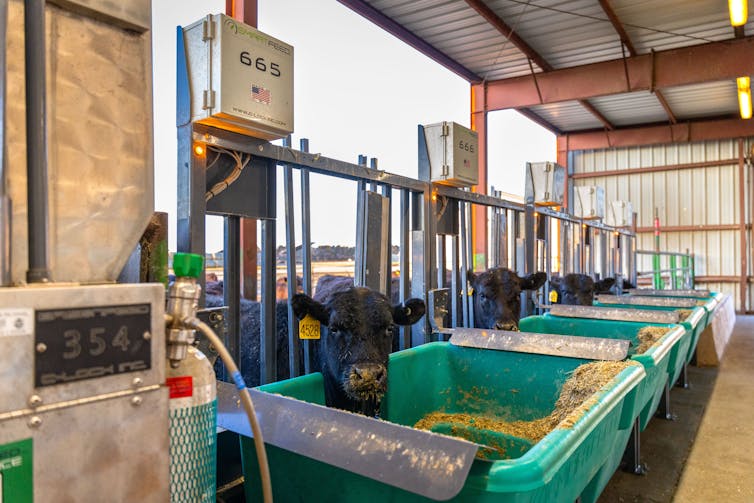
Cows with black hair and orange tags in their ears lean in between metal slats in a barnlike structure to a green tub with feed inside.
Cattle getting their burps measured at the Colorado State University Fort Collins Agricultural Research, Development and Education Center.
CSU AgNext, CC BY

For the same reason that cows can digest what would otherwise be considered waste, cows are able to eat grass. Grazing is important in dry regions like the mountains and high plains of Colorado. If the grass isn’t removed via grazing, it dries and becomes tinder for wildfire. In addition, many of these mountainous areas are too cold, rocky and steep to grow crops. Grazing can turn land that would otherwise be difficult to farm into food-producing land.

Until now, grazing required physical fences, which are costly to maintain and limit wildlife movement. But new technologies like virtual fencing allow Western Slope ranchers to use their smartphones to set digital boundaries. A collar on the cow beeps and buzzes to tell the cows where to go. Virtual boundaries are easy to change and visible only to the cow; thus, they support more environmentally-friendly grazing practices, protect streams and wildlife habitat and reduce wildfire fuel in dry seasons. While our recent research shows that this technology needs more development, it could be an important tool for beef’s role in a circular economy.

Cows out on a sunlit pasture that are wearing a green device the size of a phone around their necks.
Cattle in a pasture with virtual fence collars on the Central Plains Experimental Range near Nunn, Colo., within the larger Pawnee National Grasslands area.
CSU AgNext, CC BY

Beyond steak: Organ meats, pet treats and leather

In our experience, many U.S. consumers rarely eat cuts beyond steaks and ground beef — often due to a bad first experience with organ meats, like liver, or unfamiliarity with how to cook lesser-known cuts, like heart.

When customers won’t buy these cuts, Colorado’s beef producers who sell online or at farmers markets have to send them to the landfill. That costs the producer money and wastes the water, land and feed used to make these cuts.

Studies show that these cuts are among the most nutrient-dense parts of the animal, providing high levels of iron, B vitamins, choline and and other micronutrients. Making use of these lesser-known cuts can reduce emissions by using more of the animal and keep edible meat out of landfills, where it would otherwise rot, releasing greenhouse gases.

This does not mean anyone has to suffer through a meal of rubbery liver to save the planet. Many cultures globally value organ dishes, and U.S. tastes are expanding to include foods like lengua tacos made from beef tongue. Meanwhile, cooking tools such as sous vide can improve tenderness and juiciness by holding meat at precise temperatures for longer times.

Pets also benefit from eating organ meats, so these cuts are a key ingredient in pet foods and treats.

Consumer fashion choices matter too. About 270 million bovine hides are produced globally each year, and about 70% are turned into leather. Due to insufficient demand, remaining hides are burned or sent to the landfill, both of which release greenhouse gases.

Rather than letting these hides rot, they can be turned into leather, a durable, breathable and biodegradable high-performance material. When consumers choose to buy genuine leather boots, belts and car seats, they’re engaging in the circular economy.

For these reasons, Colorado State University is hosting Future Cowboy on Jan. 25, 2026, at the National Western Stock Show. It’s an event that lets Colorado foodies, fashionistas and cattle producers come together to explore circularity firsthand. The event will feature a leather fashion show, a ranch technology showcase and an opportunity try chef-prepared bison tongue and beef heart.

The Conversation

Jordan Kraft Lambert receives funding from the Small Business Association, Conscience Bay, Colorado Beef, Halter, and American Farm Credit.

Jennifer Martin has received research funding from the USDA, USDA-AMS, JBS, National Cattlemen’s Beef Association, Fats and Protein Research Foundation, Colorado Beef Council, and the National Pork Board She is currently serves as a board member for the Colorado Pork Producers Council and on various livestock boards.

Kim Stackhouse-Lawson has received funding from the Conscience Bay Research Foundation, USDA-NRCS, Cargill, DairyMax., CO-WY NSF Ascend Engine, Gerstner Philanthropies, Elanco Animal Health, Zoetis, Merck Animal Heath and Colorado Department of Agriculture.

Sara Place has received funding from the Grantham Foundation, USDA-NRCS, Cargill, Dairy Management Inc., CO-WY NSF Ascend Engine, Gerstner Philanthropies, Elanco Animal Health, Zoetis, Colorado Department of Agriculture, California Department of Food and Agriculture, and the American Hereford Association.

ref. Colorado ranchers and consumers can team up to make beef supply chains more sustainable – https://theconversation.com/colorado-ranchers-and-consumers-can-team-up-to-make-beef-supply-chains-more-sustainable-272582

New variant of the flu virus is driving surge of cases across the US and Canada

Source: The Conversation – USA (3) – By Zachary W. Binder, Associate Professor of Pediatrics, UMass Chan Medical School

The 2025-2026 flu season seems to be affecting children more severely than usual. Renphoto/iStock via Getty Images

After a sharp uptick in flu cases in mid-December 2025, flu activity across the U.S. and Canada remains high.

Although cases are trending downward in Canada as of Jan. 9, 2026, the season has yet to peak in the U.S., according to data from the Centers for Disease Control and Prevention.

As an emergency room pediatrician in central Massachusetts, I’m seeing a tremendous amount of flu over the past few weeks. I’m hearing from colleagues in emergency rooms across the country that they are experiencing a similar explosion of flu cases.

In early January, New York state recorded the highest number of flu cases in a single week on record. Several other states, such as Colorado, are also experiencing record flu levels, and 44 out of 55 states and other jurisdictions are reporting high or very high flu activity, according to the CDC.

The spike in flu cases – widely referred to in media reports as a “superflu” – is largely driven by a newly identified subtype of the virus called subclade K.

What’s different about the current flu season?

Flu seasons vary every year. In 2024-2025, influenza cases rose fast beginning in October 2024. In contrast, the 2025-2026 season started out slow, but then it’s as if a switch was flipped in early to mid-December.

In the last week of December, throughout the United States, over 8% of doctors visits were for flu symptoms – the highest weekly rate since 2005. Emergency department visit rates for flu are spiking throughout the country, most notably in the South and Northeast, where rates exceeded the national average.

Over this same time period, more than 26% of flu tests taken throughout Canada were positive for influenza.

As of Jan. 15, the CDC estimates that flu has caused 15 million illnesses, 180,000 hospitalizations and 7,400 deaths this season. One small saving grace is that the flu this season hasn’t come on concurrently with either a respiratory syncytial virus – RSV – or COVID-19 surge, as it often does.

Public health experts expect flu rates to remain high for several more weeks.

Traditionally, the flu is most dangerous for people over 65 or those with underlying health conditions, with young children experiencing more mild symptoms. But this year’s strain is hitting kids harder. They are arriving in the emergency room after having had a high fever of more than 104 degrees for 5-7 days, or with flu complications including febrile seizures, croup or severe dehydration.

An especially high number of children is currently being hospitalized for flu, the CDC reports. As of Jan. 9, the U.S. had seen 17 deaths of children due to flu so far during the 2025-2026 season.

In 2024-2025, the deadliest year on record for kids, flu caused 289 pediatric deaths.

What is subclade K?

Every year, the subvariants of the influenza virus that are the most pervasive change slightly.

This year, the most prevalent variant is subclade K, which is a subtype of influenza H3N2. Subclade K was first detected in Australia in July 2025. It’s driving 91.5% of infections in the U.S. so far this season and is also responsible for the peak in Canada.

Subclade K has proved itself to be a particularly infectious variant, based on how quickly the volume of flu cases has surged. Its dominance may be driven by mutations that make it different from previous strains. Some scientists speculate that H3 influenza viruses have circulated at relatively low levels the past few years, which may have led to lower levels of immunity in the general population.

In my emergency department, we’re also seeing particularly high spiking fevers of 104 or 105 degrees, compared with more usual lower grade fevers. That in itself is not dangerous, but for young children it does result in more instances of febrile seizures and dehydration.

A child's intubated arm
Children are currently being hospitalized for flu at an especially high rate.
picture/iStock via Getty Images

How late is too late to get vaccinated?

Generally speaking, I recommend people get the flu shot, in line with guidelines by the American Academy of Pediatrics. Getting vaccinated for the flu has proved to decrease the risk of serious illness, hospitalization and death. People who get the vaccine are more likely to have milder cases.

For people still considering getting the flu shot for this season, I strongly recommend doing so sooner rather than later. Waiting longer would limit the window in which the vaccine is most effective. That’s because it takes a couple of weeks for the flu shot to impart its maximal benefits. Vaccination in mid-January would mean peak protection in late January and early February.

Flu season generally peaks in December through February in North America.

One thing to note, however, is that the strains that were chosen to be included in the 2025-2026 flu vaccine weren’t a great match for the predominantly circulating subclave K. Still, evidence suggests that this year’s vaccine does provide protection.

Should you take an at-home flu test?

In my opinion, in most cases home testing for flu is not especially useful.

Many people seek out flu tests to determine whether they should get antiviral therapies like Tamiflu. But while those therapies might decrease your symptoms slightly, they aren’t particularly effective, and they come with their own risks, such as upset stomach, vomiting and diarrhea. Most of my colleagues in the emergency department, myself included, rarely recommend them.

Whether you have the flu or a flu-like illness such as RSV, COVID-19 or rhinovirus, the recommendations for treating and managing the illness at home as well as the point at which I’d suggest someone seek care are no different.

Because of that, being able to put a label on the disease isn’t all that important. With the high levels of flu circulating now, if you’re feeling unwell and have signs of fever and upper respiratory symptoms, you can almost assume it’s the flu.

One exception is for people with underlying health conditions such as heart disease or severe asthma. For them, as for people who are hospitalized for flu, antiviral therapy may be recommended and thus testing for the flu can be helpful.

Basic precautions can protect you and your community

The same precautions apply for all flu-like illnesses, but it’s worth being particularly mindful of just how contagious subclade K seems to be.

It’s important to protect yourself and your community. Washing your hands frequently can minimize exposure to flu-containing droplets. Even more importantly, people who feel unwell – particularly if they have a fever – should stay home from work, school or activities, if possible, until they are fever-free for 24 hours.

The Conversation

Zachary W. Binder does not work for, consult, own shares in or receive funding from any company or organization that would benefit from this article, and has disclosed no relevant affiliations beyond their academic appointment.

ref. New variant of the flu virus is driving surge of cases across the US and Canada – https://theconversation.com/new-variant-of-the-flu-virus-is-driving-surge-of-cases-across-the-us-and-canada-273556

Thecla, the beast fighter: The saint who faced down lions and killer seals is one of many ‘leading ladies’ in early Christian texts

Source: The Conversation – USA (3) – By Christy Cobb, Associate Professor of Christianity, University of Denver

A relic said to be part of Saint Thecla’s arm has been kept in the Cathedral of Tarragona, Spain for centuries. Gaspar Ros/Wikimedia Commons, CC BY-SA

The Bible is filled with brave and courageous women.

Deborah, the judge who fought a war to protect her people. The widow Ruth, who wittingly convinces a man to marry her in order to continue the lineage of her mother-in-law, Naomi. Esther, who boldly stands up to an evil politician, Haman, in order to save the Jewish people from death. Judith, who beheads an opposing general in order to save her community.

The stories of these confident women are found in the Hebrew Bible, the sacred text of Judaism, which also forms half of the Christian Bible. But when it comes to the New Testament, where are the “leading ladies” of Christianity?

A small statue shows a woman wearing a crown as she puts one arm around a pillar and the other around a lion.
A reliquary of St. Thecla dating to the 15th or 16th century shows her with the lioness who defended her.
Daderot/Wikimedia Commons

While a few important women are mentioned – such as Mary, the mother of Jesus; and Mary Magdalene, who discovers his empty tomb – no women are the stars of their own books in this half of the Bible. Instead, one must look to the Christian apocrypha: texts that are not found in the New Testament but were written by early Christians. One example of a prominent woman in these writings is Thecla, venerated for her persistence, courage and influence.

Thecla makes frequent appearances in my research and teaching, which focus on gender and early Christian literature. Her story is memorable not only for its dramatic miracles but Thecla’s persistence as a woman who felt called to preach, teach and baptize.

Facing down fires and seals

Thecla’s story is told in a second-century text titled the Acts of Thecla, or the Acts of Paul and Thecla. The story begins when the apostle Paul, who spread Jesus’ gospel more than any other follower in early Christianity, visits the city of Iconium, in modern-day Turkey. Paul’s teachings there highlight celibacy, and he blesses the bodies of virgins, which he says are pleasing to God.

Thecla listens intently while sitting in her home by the window. She is so drawn to Paul’s voice that she refuses to move, eat or drink for three days and nights. Even though she is engaged to be married, she longs to be pure like the virgins Paul celebrates. Thecla’s mother and fiancé are troubled by this, and they convince the leaders of the city to arrest Paul.

An ornate carving depicts a woman, stripped to the waist, who holds out her arms as she seems to stand atop flames.
The altarpiece of the Cathedral of Tarragona shows Thecla miraculously surviving the flames.
Amadalvarez/Wikimedia Commons, CC BY

Thecla gains entry to the prison by trading her bracelets and sits with Paul and kisses his chains. During his trial, Thecla is questioned and refuses to answer. Her own mother calls for her to be burned because of her refusal to marry. Thecla is stripped naked and placed on a pyre, but no flames touch her. A miraculous storm erupts, the fire is extinguished, and Thecla survives.

Afterward, she cuts off her hair and dresses as a man in order to follow Paul in disguise. Thecla also asks that he baptize her. Paul asks instead that she have patience and takes her to the city of Antioch.

Thecla’s beauty attracts unwanted attention there, and a man named Alexander immediately falls in love with her. Rather than come to Thecla’s aid, Paul denies knowing her, and Alexander attempts to rape her. Thecla humiliates him by ripping his robe and tearing the wreath off his head. Alexander brings her to the governor of Antioch, who condemns her to face the beasts in the arena.

A circular stone with carvings of a bound woman flanked by two lions.
A relief of Thecla in the arena with wild beasts, now in the Nelson-Atkins Museum of Art.
R. Huggins/IslandsEnd via Wikimedia Commons, CC BY

The scene is terrifying and vivid. Thecla is stripped naked and thrown into the arena, where lions and bears are waiting to attack her. But a lioness walks over to Thecla, lies at her feet and protects her from the other animals.

In the midst of this danger, Thecla stands, reaches out her hands and prays to God. When she opens her eyes, she sees a pool of water filled with killer seals, yet throws herself in to baptize herself. Immediately after, lightning strikes and the seals are killed.

The governor finally releases Thecla and provides her with clothes. She goes immediately to Paul, who finally blesses her and commissions her to teach the gospel.

Women preaching

Many Christians in the ancient world viewed Thecla as an inspiration and an example for leadership. Yet not everyone approved of women teaching and preaching, including a second-century church father named Tertullian. He discouraged Christians from reading the Acts of Thecla and claimed that it was a forgery, since he did not think Paul – who wrote that women should be silent in church – would affirm a woman’s right to teach and baptize.

Tertullian’s warnings reflect controversies surrounding women’s leadership and imply that some women claimed Thecla’s example as justification for preaching.

Later Christians remembered Thecla through artwork as well as texts. For example, a fresco of Thecla – along with her mother and Paul – is depicted in a fifth- or sixth-century grotto just outside of Ephesus, an important city both in the Roman Empire and in early Christianity. The painter imagined Thecla looking out her window, just as the beginning of the Acts of Thecla describes.

In Egypt, a round, carved plate was discovered depicting Thecla with the lions at her feet. This fifth-century artistic depiction demonstrates how far the story of Thecla’s perseverance in the arena with the beasts had spread.

People in white pants and teal shirts form a human pyramid in front of a cathedral with a large, circular stained-glass window.
People form a ‘castell’ during celebrations for St. Thecla’s feast day in 2008.
Ferran Llorens/Flickr via Wikimedia Commons, CC BY-SA

Today, Thecla is the patron saint of the city of Tarragona, Spain, where the cathedral is named after her and images of Thecla decorate the altarpiece. Each year on Sept. 23, the feast day of St. Thecla, this Spanish city celebrates her story through parades, music, dancing and human towers called “castells.” A relic of her arm is processed through the city and displayed in the cathedral so that devotees can view it and pray for blessings.

Just as Thecla listened through her open window to Paul’s message, today Thecla’s story echoes to those who desire to hear the stories of courageous early Christian women.

The Conversation

Christy Cobb does not work for, consult, own shares in or receive funding from any company or organization that would benefit from this article, and has disclosed no relevant affiliations beyond their academic appointment.

ref. Thecla, the beast fighter: The saint who faced down lions and killer seals is one of many ‘leading ladies’ in early Christian texts – https://theconversation.com/thecla-the-beast-fighter-the-saint-who-faced-down-lions-and-killer-seals-is-one-of-many-leading-ladies-in-early-christian-texts-270346

Las negociaciones entre Estados Unidos y Groenlandia se han estancado: tres formas en que podría terminar la crisis

Source: The Conversation – (in Spanish) – By Michele Testoni, Professor of International Relations, IE University

Rokas Tenys/Shutterstock

Persiste un “desacuerdo fundamental”. Este fue el único resultado concreto de la reunión celebrada en la Casa Blanca entre representantes estadounidenses, daneses y groenlandeses el 14 de enero, ya que cada parte mantuvo su posición original sobre la soberanía de Groenlandia. La Administración Trump argumentó que Estados Unidos debe asumir el control directo de la isla, mientras que los dirigentes daneses y groenlandeses rechazaron firmemente la idea.

Quizás esto era de esperar. La recientemente publicada Estrategia de Seguridad Nacional de EE. UU. dejó una cosa muy clara: la política exterior estadounidense se define ahora por un enfoque asertivo hacia todo el hemisferio occidental. Washington reclama el derecho a intervenir en los asuntos internos de otros países, incluso militarmente si es necesario, con el fin de garantizar los intereses estratégicos y corporativos de Estados Unidos.

Esta nueva “doctrina Donroe” es una versión renovada de la diplomacia de las cañoneras que configuró la política exterior estadounidense hacia América Latina (y la región Asia-Pacífico) a principios del siglo XX.

Trump quiere Groenlandia

Trump ha dicho en repetidas ocasiones que Estados Unidos necesita asumir el control directo de Groenlandia por razones de “seguridad nacional”. Las redes sociales de la Casa Blanca ahora publican regularmente mensajes sobre el control de la isla por parte de Estados Unidos, pero Trump lleva tiempo haciendo alarde de su poderío militar: “La conseguiremos, de una forma u otra”, afirmó en un discurso ante el Congreso en febrero de 2025. Su nombramiento del actual gobernador de Luisiana, Jeff Landry, como enviado especial para Groenlandia en diciembre de 2025 confirmó esta línea de actuación.

Para Trump, Groenlandia es estratégicamente vital. Aunque escasamente poblada, la isla es potencialmente rica en materias primas, incluidos minerales críticos de tierras raras. Esto la convierte en un objetivo para los gigantes tecnológicos estadounidenses.


Leer más:
El talón de Aquiles de Europa: las tierras raras dejan a la UE expuesta a las condiciones de negocio impuestas por China


También encaja perfectamente en su idea de unos Estados Unidos imperiales, junto con la extraña propuesta de convertir a Canadá en el 51.º estado de EE. UU. y el controvertido cambio de nombre del golfo de México por el de “golfo de América”.

Como parte de su retórica sobre seguridad nacional, Trump ha afirmado que los barcos chinos y rusos están “por todas partes” en Groenlandia. Sin embargo, altos funcionarios nórdicos con acceso a la inteligencia de la OTAN han declarado pública y explícitamente que no hay registros de ello en los últimos años.

Geográficamente, Groenlandia es la puerta de entrada de América del Norte al Ártico. El cambio climático ha hecho que la región sea cada vez más fácil de navegar, y se espera que se convierta en un escenario de fuerte competencia entre las mayores potencias mundiales.


Leer más:
Estos son los motivos por los que las grandes potencias mundiales se están disputando Groenlandia


Respuesta danesa y europea

Los responsables políticos europeos han empezado a tomarse en serio las palabras de Trump, y con razón: en este segundo mandato está demostrando que quiere –y, en ocasiones, es capaz– de alinear sus palabras (incluso las más radicales y extremas) con la acción política. A pesar de formar parte de Dinamarca, que es aliada de la OTAN y miembro de la Unión Europea, Groenlandia parece una presa fácil.

El Gobierno autónomo de Groenlandia ha declarado en repetidas ocasiones, tanto antes como después de la reunión del 14 de enero, que no quiere ser anexionado por Estados Unidos.

Tras un largo periodo de mediación y un enfoque discreto, el primer ministro danés también ha adoptado una postura firme, ahora respaldada por otros socios europeos y el Reino Unido.

Por su parte, la Comisión Europea se ha mostrado indecisa, expresando su solidaridad con Dinamarca y Groenlandia, pero siendo decepcionantemente ambigua en lo que respecta a compromisos concretos en materia de seguridad. Por el contrario, el Gobierno danés ha optado por ampliar su presencia militar en la región. Ha puesto en marcha la Operación Resistencia Ártica en estrecha colaboración con aliados como Francia, Alemania, Noruega y Suecia. Finlandia y los Países Bajos aún están evaluando la propuesta danesa.

Desde una perspectiva militar, se trata en gran medida de una medida simbólica, pero políticamente tiene una enorme relevancia, ya que supone un nuevo mínimo histórico en las relaciones transatlánticas. Las tropas europeas están ahora desembarcando en Groenlandia para defenderla de una amenaza real que no proviene de Rusia ni de China, sino de Estados Unidos, su socio en materia de seguridad desde hace décadas.

Tres posibles resultados

Dadas las circunstancias actuales, parece que hay tres posibles formas de superar este punto muerto.

La primera es que Trump dé marcha atrás, renuncie a su plan de “conseguir Groenlandia” y respete el statu quo. Esto es muy improbable: la escalada verbal del presidente ya ha llegado a un punto sin retorno, y ahora se encuentra en la posición de tener que vender la cuestión de Groenlandia a su electorado como una victoria histórica.

La segunda opción es, por lo tanto, la ocupación militar. Esto se rige por la lógica de la teoría de juegos del “juego del gallina”. Las fuerzas armadas estadounidenses son más numerosas, están mucho más preparadas para luchar y cuentan con el apoyo de una Administración que ya ha demostrado que puede utilizar la fuerza de forma deliberada y unilateral, con o sin la aprobación del Congreso, tal y como prescribe la Constitución de los Estados Unidos. En el momento de la verdad, Trump puede pensar que los europeos se asustarán y se retirarán.

Este es el peor de los escenarios, que podría conducir al fin de la OTAN. También podría desencadenar un efecto dominó de deterioro de las relaciones, lo que podría amenazar la unidad de la UE.

Es cierto que Trump puede verse tentado a continuar con su enfoque errático de “la fuerza hace el derecho” (que algunos analistas han bautizado de forma pintoresca como la estrategia Fuck Around and Find Out (“juega y descúbrelo”). Sin embargo, también podría verse frenado por las crecientes preocupaciones dentro de su propio partido, como las expresadas recientemente por el poderoso senador republicano Mitch McConnell.

La tercera posibilidad es negociar un compromiso que beneficie a ambas partes. Estados Unidos y Dinamarca podrían revisar su acuerdo bilateral de 1951 y, de esta manera, proporcionar a Washington una mayor presencia militar en la isla (como, por ejemplo, el permiso para construir una base para submarinos nucleares estadounidenses) junto con una concesión especial para los derechos mineros. Al mismo tiempo, Dinamarca y otros aliados de la OTAN se comprometerían a aumentar su presencia militar en Groenlandia y en todo el Ártico.

Se dice que el secretario general de la OTAN, Mark Rutte, está trabajando activamente para lograr este resultado. Sería una solución beneficiosa para todas las partes y muy bienvenida.

The Conversation

Michele Testoni no recibe salario, ni ejerce labores de consultoría, ni posee acciones, ni recibe financiación de ninguna compañía u organización que pueda obtener beneficio de este artículo, y ha declarado carecer de vínculos relevantes más allá del cargo académico citado.

ref. Las negociaciones entre Estados Unidos y Groenlandia se han estancado: tres formas en que podría terminar la crisis – https://theconversation.com/las-negociaciones-entre-estados-unidos-y-groenlandia-se-han-estancado-tres-formas-en-que-podria-terminar-la-crisis-273720

Rapatriement ou restitution des biens culturels africains ? Les mots que nous utilisons ont leur importance

Source: The Conversation – in French – By Victoria Gibbon, Professor in Biological Anthropology, Division of Clinical Anatomy and Biological Anthropology, University of Cape Town

Les musées et les universités du monde entier possèdent d’immenses collections d’objets culturels, d’œuvres d’art, de biens matériels et même de restes ancestraux. Beaucoup d’entre eux n’ont pas été offerts librement, mais ont été arrachés pendant la période coloniale, par la force, la manipulation, le vol ou la violence. Pendant des décennies, ils ont été entreposés et exposés dans des vitrines. Ils ont été classés dans des catégories telles que l’anthropologie, l’histoire naturelle ou l’ethnologie, séparés des personnes et des communautés auxquelles ils appartenaient autrefois.

Ces dernières années, on reconnaît de plus en plus que ces collections sont porteuses d’un héritage douloureux.

Les appels à leur restitution font désormais partie d’un débat mondial sur la décolonisation, la justice et la guérison. En 2018, le président français Emmanuel Macron a publié un rapport appelant à une nouvelle éthique de l’humanité, suscitant une nouvelle volonté de restituer les œuvres d’art et la culture matérielle africaines. Mais les appels africains à la restitution ont été lancés au moins cinq décennies plus tôt à la suite du discours de l’ancien président de la République démocratique du Congo, Mobutu Sese Seko, devant l’ONU.

Dans tous ces débats, deux mots sont souvent utilisés : rapatriement et restitution.

À première vue, ils semblent avoir la même signification et impliquent tous deux la restitution de quelque chose. Mais en tant que chercheurs sud-africains travaillant dans les domaines de l’histoire, des études muséales et de la biologie humaine, nous affirmons que la différence entre ces termes n’est pas seulement sémantique. Le choix des mots reflète des enjeux politiques plus profonds liés à la justice, à la reconnaissance et à la réparation.

Dans notre récent article, nous avons expliqué comment nous percevons cette différence et pourquoi le travail de restitution redonne aux personnes le pouvoir sur leur avenir et leur donne un sentiment d’autonomie. Nous soutenons que, pour sa part, le rapatriement est devenu une notion moins centrée sur reconstruction des communautés. Il renvoie davantage à un exercice administratif et logistique. A l’inverse, la restitution renvoie directement à la justice.

Rapatriement : le langage du retour

Le mot « rapatriement » vient du latin patria, qui signifie « patrie ». Traditionnellement, il désigne le retour d’une personne ou de ses restes mortels dans son pays d’origine. Les gouvernements utilisent souvent ce terme pour désigner le transfert logistique et juridique de personnes, d’œuvres d’art ou de restes ancestraux à travers les frontières nationales.

Dans les pays qui ont été colonisés, comme les États-Unis, le Canada, l’Australie et la Nouvelle-Zélande, le terme « rapatriement » est devenu le terme dominant. Cela s’explique en partie par des lois et des cadres spécifiques. Aux États-Unis, par exemple, la loi sur la protection et le rapatriement des sépultures amérindiennes (Native American Graves Protection and Repatriation Act) oblige les musées à restituer de manière proactive les restes humains et les objets culturels aux communautés autochtones.

En Nouvelle-Zélande, le musée national Te Papa joue un rôle central dans le rapatriement des restes ancestraux maoris et morioris provenant d’institutions étrangères avant de les restituer aux communautés locales. En Australie, le choix du rapatriement par les militants, les communautés et les universitaires visait également à établir un lien stratégique avec le retour des restes des soldats tombés au combat.

Dans ces contextes, le rapatriement est souvent présenté comme un processus de restitution. Les États ou les musées prennent l’initiative, et les communautés reçoivent.

Certains universitaires et militants autochtones ont contesté cette formulation, soulignant ses connotations patriarcales et étatistes.

Ils ont introduit le concept de « rematriation », qui désigne un retour à la « Terre Mère » ancré dans les perspectives féministes autochtones, la spiritualité et l’équilibre communautaire.

En Afrique du Sud également, le terme « rapatriement » a été utilisé, en particulier lorsque l’État a organisé le retour de restes humains depuis l’étranger, comme dans le cas du retour de Sarah Baartman depuis la France.

Baartman était une femme khoï (autochtone sud-africaine) du XIXe siècle exposée dans des spectacles de monstres en Europe. Son corps a ensuite été disséqué par des scientifiques dans le cadre de la science raciale et intégré aux systèmes de collecte et d’exposition du Musée de l’Homme à Paris. Après être devenue un symbole international de l’oppression des femmes noires, Baartman a également été au centre des revendications de restitution formulées par les Khoï et d’autres militants et mouvements sociaux en Afrique du Sud.

Le rapatriement a également été utilisé pour la restitution des dépouilles d’anciens combattants et d’autres patriotes.

Mais un malaise a commencé à se faire sentir. Ce langage était-il adapté au travail profond de justice et de guérison que les communautés réclamaient ? Ou était-il davantage axé sur le prestige national que sur la restauration de la communauté ?

Restitution : la politique de la justice au-delà de la transaction

La restitution consiste à rendre quelque chose à son propriétaire légitime, et non pas simplement à transférer un bien, mais comme un acte de reconnaissance, de réparation et de guérison.

La restitution n’est pas seulement un événement, comme la remise d’un objet d’art lors d’une cérémonie. C’est un processus qui prend du temps, qui est émotionnel et souvent douloureux. Elle implique des recherches sur la manière dont les objets ont été acquis, des conversations avec les communautés descendantes et des décisions sur la manière de prendre soin ou d’honorer ce qui a été restitué. Elle reconnaît que les biens pris n’étaient pas seulement des curiosités ou des objets, mais qu’ils étaient liés à la communauté, à la langue, aux cérémonies et à l’identité.


Read more:
Restituer les biens culturels à l’Afrique : idée d’avenir ou dépassée ?


Dans de nombreux cas, les restes ancestraux ont été classés et objectivés comme restes humains et spécimens, dépouillés de leur humanité. La restitution, en revanche, leur rend leur dignité et leur autonomie en tant qu’ancêtres.

Le travail de restitution : guérison et reconnexion

Notre recherche utilise l’expression « travail de restitution » pour décrire l’ensemble des efforts nécessaires. Ce travail va bien au-delà de la diplomatie, de la logistique et du transport. Il comprend :

  • La reconnaissance de l’injustice : il s’agit d’admettre que les objets ont été pris à tort, que ce soit par la violence, la coercition ou le vol.

  • La désobjectivation : traiter les restes ancestraux et les biens culturels non pas comme des restes humains et des objets de musée, mais comme des ancêtres ou des trésors culturels.

  • L’implication de la communauté : veiller à ce que les groupes de descendants et les communautés locales décident de ce qui se passera après le retour, en concertation avec les musées et les gouvernements nationaux.

  • Processus de guérison : créer des espaces pour le deuil, les cérémonies et le rituel de passage.

  • Nouvelles perspectives : considérer la restitution non seulement comme une réconciliation avec le passé, mais aussi comme une ouverture vers le renouveau culturel et la justice sociale.


Read more:
Débat : la restitution d’oeuvres d’art africain ravive les ambiguïtés d’une relation inéquitable


Par exemple, le programme de restitution des terres en Afrique du Sud a montré que la restitution ne consiste pas simplement à rétablir ce qui existait autrefois. Il s’agit de créer les conditions nécessaires à la justice aujourd’hui et de possibilités pour demain.

De même, la restitution culturelle ne consiste pas tant à « remettre les choses à leur place d’origine » qu’à donner aux communautés les moyens de renouer avec leur patrimoine d’une manière pertinente et vivante aujourd’hui.

Pourquoi le choix des mots est-il important ?

La distinction entre rapatriement et restitution n’est pas un débat académique abstrait. Les mots influent sur les rapports de pouvoir. Si le retour est présenté comme un rapatriement, l’accent est souvent mis sur celui qui donne, celui qui rend, l’État ou le musée, qui accorde quelque chose en retour. S’il est présenté comme une restitution, l’accent est mis sur le demandeur, sur la communauté qui fait valoir ses droits et exige justice.

La restitution ne consiste pas à retrouver un passé perdu. Ce passé ne peut être restauré tel qu’il était. Il s’agit plutôt de créer un nouvel avenir fondé sur la justice, la dignité et le respect. Pour les communautés du monde entier qui vivent encore avec l’héritage de la spoliation coloniale, cette distinction est très importante.

The Conversation

Victoria Gibbon bénéficie d’un financement de la Fondation nationale sud-africaine pour la recherche (NRF). Les opinions exprimées et les conclusions formulées sont celles des auteurs et ne reflètent pas nécessairement celles de la NRF.

Ciraj Rassool bénéficie d’un financement de la Fondation Volkswagen et a précédemment reçu des fonds de la Fondation Andrew W. Mellon et des Fondations Open Society. Les opinions exprimées et les conclusions formulées sont celles des auteurs.

ref. Rapatriement ou restitution des biens culturels africains ? Les mots que nous utilisons ont leur importance – https://theconversation.com/rapatriement-ou-restitution-des-biens-culturels-africains-les-mots-que-nous-utilisons-ont-leur-importance-273302

The Insurrection Act is one of at least 26 legal loopholes in the law banning the use of the US military domestically

Source: The Conversation – USA – By Jennifer Selin, Associate Professor of Law, Arizona State University

Federal law enforcement agents confront anti-ICE protesters during a demonstration outside the Bishop Whipple Federal Building in Minneapolis, Minnesota, on January 15, 2026. Octavio Jones / AFP via Getty Images

As protesters and federal law enforcement clashed in Minneapolis in the wake of a second shooting of a civilian on Jan. 14, 2026 by federal agents, President Donald Trump threatened to invoke the Insurrection Act to send troops to Minnesota in response to protests.

This is not the first time Trump has invoked the act.

Is Trump’s warning just bluster? Does the president have the authority to send the military into American cities?

The answer to this question involves a web of legal provisions that help define the president’s constitutional roles as commander in chief and chief executive of the country and that simultaneously try to balance presidential power with the power of state leaders.

A social media post from January 15, 2026 by President Donald Trump, threatening to use the Insurrection Act to send U.S. military to Minneapolis.
Truth Social Donald Trump account

‘Protect states in times of violence’

Tracing back to the Magna Carta, the British charter of liberty signed in 1215, there is a longstanding tradition against military involvement in civilian affairs.

However, the U.S. Constitution guarantees that the national government will protect the states in times of violence and permits Congress to enact laws that enable the military to aid in carrying out the law.

Almost immediately after the Constitution’s enactment in 1787, Congress passed a law that allowed the president to use the military to respond to a series of citizen rebellions.

Troops serving as what’s called “posse comitatus,” which translates roughly to “attendants with the capacity to act,” could be called to suppress insurrections and help carry out federal laws.

Following the Civil War, the national government used troops in this capacity to aid in Reconstruction efforts, particularly in states that had been part of the Confederacy.

The use of troops in this manner may even have influenced the outcome of the 1876 presidential election of Republican Rutherford B. Hayes. That happened when, in return for agreeing to withdraw federal troops from the South, Democrats informally agreed to the election of Hayes when the disputed election was thrown to a congressional commission.

Two years later, Hayes signed into law the Posse Comitatus Act, which prohibited the use of the military in civilian matters.

The Posse Comitatus Act has not changed much since that time. The law prohibits the use of the military in civilian matters but, over time, Congress has passed at least 26 exemptions to the act that allow the president to send troops into states.

The exemptions range from providing military personnel to protect national parks to helping states in carrying out state quarantine and health laws.

Military troops arrive in Los Angeles to restore order after rioting occurred in the wake of the verdict in the Rodney King case in 1992.
Peter Turnley/Corbis/VCG via Getty Images

Insurrection Act

One of these exemptions is the Insurrection Act, which governs certain circumstances when the president can use the military. Signed by Thomas Jefferson in 1807, Congress originally passed the law in order to help fight citizen rebellions against federal taxes.

Over time, the law has evolved to allow the use of troops in other circumstances. For example, Presidents Eisenhower, Kennedy and Johnson used the Insurrection Act in the 1950s and 1960s to send the military to enforce court desegregation orders and to protect civil rights marchers.

It was last invoked by President George H.W. Bush in 1992, when he ordered 4,500 troops to Los Angeles after rioting erupted in response to the acquittal of police officers charged with beating Rodney King.

The Insurrection Act says that the president may use the armed forces to subdue an insurrection or rebellion and take such measures as he considers necessary to suppress violence.

But before doing so, he must issue a proclamation ordering insurgents to disperse and return to their homes.

While state governors and legislatures also have the legal authority to ask the president to use troops in this manner, the states have preferred to rely on a combination of local law enforcement and the National Guard, which is under state command, not federal.

Not only does this strategy enable governors to maintain authority over their states, but it also keeps things more straightforward legally and politically.

After President Trump’s threat in 2020 to send troops to quell violence, Illinois Gov. J.B. Pritzker, middle, told CNN ‘I reject the notion that the federal government can send troops into the state of Illinois.’
Chris Sweda-Pool via Getty Images

In December 2025, the Supreme Court refused to let President Trump deploy the National Guard in response to protests against ICE in Illinois. Yet in a concurring opinion, Justice Brett Kavanagh noted, “As I read it, the Court’s opinion does not address the President’s authority under the Insurrection Act.”

Authority uncertain

Reliance on the Insurrection Act raises a host of legal, political and practical questions about who is in charge when the military sends troops into a state.

For example, despite the fact that the act was invoked in response to the Rodney King riots, the military actually was not used as directed. The Joint Task Force Commander in control of the mission appears to have been confused regarding how the Insurrection Act worked alongside the provisions of the Posse Comitatus Act. He issued an order prohibiting troops from directly supporting law enforcement and that led to numerous denials of requests for assistance.

Questions about the federal government’s authority in the wake of the 2005 Hurricane Katrina in Louisiana raised similar concerns.

The administration of President George W. Bush determined that it had authority under the Insurrection Act to send federal troops to the area, despite the fact that Louisiana’s governor was opposed to military assistance.

For political reasons, President Bush did not end up deploying troops but, in 2006, Congress amended the law to address concerns that the military was unable to provide effective assistance to states in emergency situations.

The amendment was later repealed when all 50 state governors raised objections to what they perceived as a grant of unilateral power to the president.

These examples suggest a real difficulty balancing governmental responses to domestic crises. States need the flexibility and authority to respond as they see fit to the needs of their citizens.

But the federal government can and often does serve as a supplemental resource. As the events of the past week illustrate, striking an effective balance is rarely a straightforward thing.

This story is an update to a story originally published on June 2, 2020.

The Conversation

Jennifer Selin does not work for, consult, own shares in or receive funding from any company or organization that would benefit from this article, and has disclosed no relevant affiliations beyond their academic appointment.

ref. The Insurrection Act is one of at least 26 legal loopholes in the law banning the use of the US military domestically – https://theconversation.com/the-insurrection-act-is-one-of-at-least-26-legal-loopholes-in-the-law-banning-the-use-of-the-us-military-domestically-273649

Global power struggles over the ocean’s finite resources call for creative diplomacy

Source: The Conversation – USA (2) – By Jonas Gamso, Associate Professor and Deputy Dean of Knowledge Enterprise for the Thunderbird School of Global Management, Arizona State University

Oceans shape everyday life in powerful ways. They cover 70% of the planet, carry 90% of global trade, and support millions of jobs and the diets of billions of people. As global competition intensifies and climate change accelerates, the world’s oceans are also becoming the front line of 21st-century geopolitics.

How policymakers handle these challenges will affect food supplies, the price of goods and national security.

Right now, international cooperation is under strain, but there are many ways to help keep the peace. The tools of diplomacy range from formal international agreements, like the High Seas Treaty for protecting marine life, which goes into effect on Jan. 17, 2026, to deals between countries, to efforts led by companies, scientists and issue-focused organizations.

Examples of each can be found in how the world is dealing with rising tensions over Arctic shipping, seafloor mining and overfishing. As researchers in international trade and diplomacy at Arizona State University in the Thunderbird School of Global Management’s Ocean Diplomacy Lab, we work with groups affected by ocean pressures like these to identify diplomatic tools – both inside and outside government – that can help avoid conflict.

Arctic shipping: New sea lanes, new risks

As the Arctic Ocean’s sea ice cover diminishes, shipping routes that were once impassable most of the year are opening up.

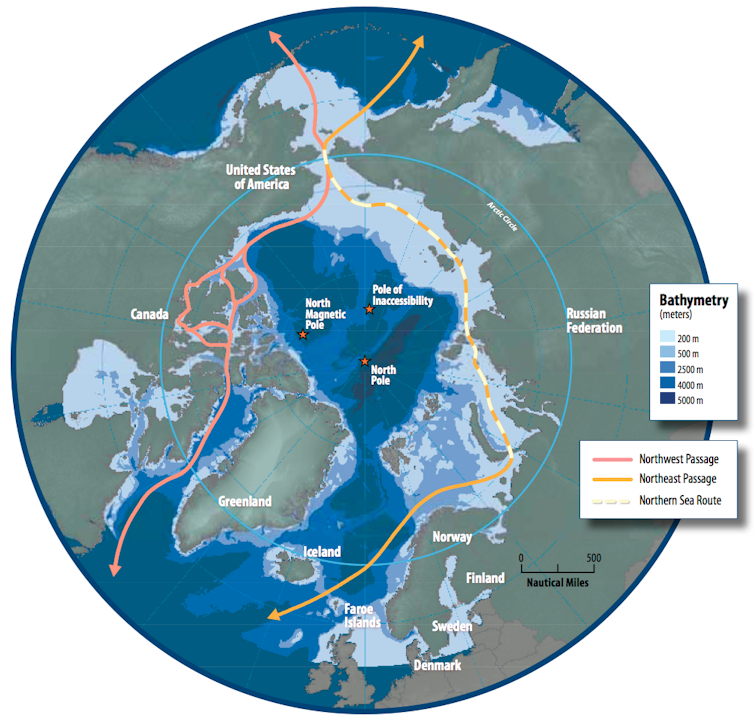
For companies, these routes – such as the Northern Sea Route along Russia’s coast and the Northwest Passage through Canada’s Arctic Archipelago – promise shorter transit times, lower fuel costs and fewer choke points than traditional passages.

However, Arctic shipping also raises complex challenges.

Declining sea ice is opening two shipping routes to greater use: the Northern Sea Route, off the Russian coast, and the Northwest Passage, along Alaska’s coast and through the Canadian islands.
Susie Harder/Arctic Council

The U.S., Russia, China and several European countries have each taken steps to establish an economic and military presence in the Arctic Ocean, often with overlapping claims and competing strategic aims. For example, Russia closed off access to much of the Barents Sea while it conducted missile tests near Norway in 2025. NATO has also been patrolling the same sea.

Geopolitical tensions compound the practical dangers in Arctic waters that are poorly charted, where emergency response capacity is limited and where extreme weather is common.

As more commercial vessels move through these waters, a serious incident – whether triggered by a political confrontation or weather – could be difficult to contain and costly for marine ecosystems and global supply chains.

A fleet of military ships at dusk with mountains in the background.
German Naval vessels sail near Harstad, Norway, during Arctic exercises on Oct. 13, 2025.
Sean Gallup/Getty Images

The Arctic Council is the region’s primary official forum for the Arctic countries to work together, but it is explicitly barred from addressing military and security issues – the very pressures now reshaping Arctic shipping.

The council went dormant for over a year starting in 2022 after Russia, then the Arctic Council president, invaded Ukraine. While meetings and projects involving the remaining countries have since resumed, the council’s influence has been undercut by unilateral moves by the Trump administration and Russia, and bilateral arrangements between countries, including Russia and China, often involving access to oil, gas and critical mineral deposits.

In this context, Arctic countries can strengthen cooperation through other channels. An important one is science.

For decades, scientists from the U.S., Europe, Russia and other countries collaborated on research related to public safety and the environment, but Russia’s invasion of Ukraine disrupted those research networks.

Going forward, countries could share more data on ice thaw, extreme weather and emergency response to help prevent accidents in a rapidly opening shipping corridor.

An image of the Arctic shows sea ice concentrations in 2025 were less than the 20-year average, and much less than the 20 years before then.
Arctic sea ice has been declining, with less multiyear ice and less coverage. The map shows the Arctic sea ice at its minimum extent in 2025, in September.
NOAA and CIRES/University of Colorado Boulder.

Critical minerals: Control over the seabed

The global transition to clean energy is driving demand for critical minerals, such as nickel, cobalt, manganese and rare earth elements, that are essential for everything from smartphones and batteries to fighter jets. Some of the world’s largest untapped deposits lie deep below the ocean’s surface, in places like the Clarion-Clipperton Zone near Hawaii in the Pacific. This has sparked interest from governments and corporations in sea floor mining.

Harvesting critical minerals from the seabed could help meet demand at a time when China controls much of the global critical mineral supply. But deep-sea ecosystems are poorly understood, and disruptions from mining would have unknown consequences for ocean health. Forty countries now support either a ban or a pause on deep sea mining until the risks are better understood.

These concerns sit alongside geopolitical tensions: Most deep-sea minerals lie in international waters, where competition over access and profits could become another front in global rivalry.

A map shows one area where companies are interested in mining.
A map of the Pacific Ocean between Mexico and Hawaii shows exploration targets for mining seafloor nodules that contain critical minerals in the Clarion-Clipperton Zone. National waters are shown in blue. The striped APEI squares are protected areas.
KA McQuaid, MJ Attrill, MR Clark, A Cobley, AG Glover, CR Smith and KL Howell, 2020, CC BY

The International Seabed Authority was created under the United Nations Convention on the Law of the Sea to manage seabed resources, but its efforts to establish binding mining rules have stalled. The U.S. never ratified the convention, and the Trump administration is now trying to fast-track its own permits to circumvent the international process and accelerate deep-sea mining in areas that are outside national jurisdictions.

Against this backdrop, a loose coalition of issue-focused groups and companies have joined national governments in calling for a pause on deep-sea mining. At the same time, some insurers have declined to insure deep-sea mining projects.

A visualization of deep-sea mining and the debris clouds created that could harm sea life.

Pressure from outside groups will not eliminate competition over seabed resources, but it can shape behavior by raising the costs of moving too quickly without carefully evaluating the risks. For example, Norway recently paused deep-sea mining licenses until 2029, while BMW, Volvo and Google have pledged not to purchase metals produced from deep-sea mines until environmental risks are better understood.

Overfishing: When competition outruns cooperation

Fishing fleets have been ranging farther and fishing longer in recent decades, leading to overfishing in many areas. For coastal communities, the result can crash fish stocks, threatening jobs in fishing and processing and degrading marine ecosystems, which makes coastal areas less attractive for tourism and recreation. When stocks decline, seafood prices also rise.

Unlike deep-sea mining or Arctic shipping, overfishing is prompting cooperation on many levels.

In 2025, a critical mass of countries ratified the High Seas Treaty, which sets out a legal framework for creating marine protected areas in international waters that could give species a chance to recover. Meanwhile, several countries have arrangements with their neighbors to manage fishing together.

For example, the European Union and U.K. are finalizing an agreement to set quotas for fleets operating in waters where fish stocks are shared. Likewise, Norway and Russia have established annual quotas for the Barents Sea to try to limit overfishing. These government-led efforts are reinforced by other forms of diplomacy that operate outside government.

Market-based initiatives like the Marine Stewardship Council certification set common sustainability standards for fishing companies to meet. Many major retailers look for that certification when making purchases. Websites like Global Fishing Watch monitor fishing activity in near real time, giving governments and advocacy groups data for action.

Collectively, these efforts make it harder for illegal fishing to hide.

How well countries are able to work together to update quotas, share data and enforce rules as warming oceans shift where fish stocks are found and demand continues to grow will determine whether overfishing can be stopped.

Looking Ahead

At a time when international cooperation is under strain, agreements between countries and pressure from companies, insurers and issue-focused groups are essential for ensuring a healthy ocean for the future.

The Conversation

The authors do not work for, consult, own shares in or receive funding from any company or organization that would benefit from this article, and have disclosed no relevant affiliations beyond their academic appointment.

ref. Global power struggles over the ocean’s finite resources call for creative diplomacy – https://theconversation.com/global-power-struggles-over-the-oceans-finite-resources-call-for-creative-diplomacy-272320

El ‘Blue Monday’ no existe, pero la tristeza sí (y cumple una función clave en la infancia)

Source: The Conversation – (in Spanish) – By Paola Alexandria Pinto de Magalhães, Investigador – Facultad de Enfermería – Desarrollo Positivo de Niños y Adolescentes, Universidad de Navarra

PeopleImages

Enero suele llegar a España envuelto en una mezcla de ilusión y agotamiento. Tras la magia de la Navidad y los Reyes Magos –uno de los momentos más esperados por niños y niñas–, el regreso a la rutina se vive, a menudo, con un cierto bajón emocional. En este contexto surge una pregunta recurrente: ¿son realmente más tristes los días de enero?

La idea ganó fuerza en 2005, cuando el psicólogo británico Cliff Arnall anunció haber identificado, mediante una supuesta ecuación, el día más triste del año. En su fórmula incluía elementos como el clima invernal, las deudas después de las fiestas y la falta de motivación para cumplir los propósitos de Año Nuevo.

Sin embargo, la comunidad científica desestimó rápidamente aquella propuesta por no estar apoyado por evidencia científica. La ecuación, lejos de ser un hallazgo psicológico, se reveló como una herramienta promocional diseñada para una agencia de viajes que impulsaba el mensaje de que la mejor forma de combatir la tristeza era comprar unas vacaciones.

La tristeza no es un evento programado

El término Blue Monday continúa reapareciendo cada enero en los medios de comunicación y en campañas publicitarias, pese a que no existe evidencia que relacione un día concreto del calendario con un aumento generalizado del malestar emocional.

La tristeza es una respuesta humana compleja, no un evento programado. Y si bien las condiciones climáticas propias del invierno pueden influir en el estado de ánimo, el entramado comercial que se ha construido alrededor del concepto busca un impacto en la conducta, invitando a consumir objetos o experiencias.

Algunas marcas han convertido la tristeza en un recurso emocional rentable, presentando productos o experiencias como supuestas soluciones a este malestar que ellas mismas contribuyen a amplificar. Se aprovechan de que fomentar la vivencia del “día más triste del año” podría influir en el comportamientos de consumo.

Por si fuera poco, este tipo de publicidad puede influir en la dinámica emocional de muchos hogares: crea expectativas difíciles de sostener, fomenta el materialismo, genera tensiones entre adultos y niños y, en ocasiones, alimenta sentimientos de infelicidad.

Pero existe un riesgo añadido cuando estos mensajes llegan a la infancia. Si a los menores se les transmite la idea de que las emociones “negativas” deben combatirse con compras, distracciones o euforia artificial y digital, se debilita su capacidad para reconocer, comprender y gestionar lo que sienten. De ahí la importancia de reflexionar sobre el impacto de este discurso mediático en la educación emocional de los niños y niñas.

El papel de la tristeza en el desarrollo

La tristeza, lejos de ser un obstáculo, cumple un papel fundamental en el desarrollo del niño. Desde muy pequeños, los niños descubren que expresar tristeza puede facilitar el apoyo de padres, madres y cuidadores. Esta emoción, en muchos casos, es más eficaz que otras para recibir atención y consuelo.

Además, la tristeza ayuda a reajustar metas tras un fracaso, lo que les permite modificar sus estrategias y expectativas ante situaciones adversas.


Leer más:
Resiliencia en casa: cómo ayudar a los niños a crecer fuertes día a día


La tristeza impulsa procesos de introspección que permiten a los niños reflexionar sobre lo que sienten, sobre sus valores y sobre la forma en que se relacionan con los demás. Experimentar tristeza también contribuye al crecimiento moral.

A través de emociones ligadas a la pérdida, la decepción o la injusticia, los niños construyen su sentido de lo correcto, desarrollan sensibilidad hacia el sufrimiento ajeno y fortalecen su empatía. De hecho, estudios recientes han encontrado una relación positiva entre la experiencia de tristeza y la capacidad de ponerse en el lugar del otro.

La respuesta adulta a la tristeza

Sin embargo, la forma en que los adultos responden a esta emoción influye decisivamente en cómo los niños aprenden a manejarla. Un entorno familiar cálido, sensible y afectivo favorece el desarrollo emocional, mientras que interacciones tensas, frías o críticas pueden dificultarlo. Las dinámicas familiares –los modelos emocionales que observan la calidad de, las conversaciones y la disponibilidad de apoyo– dan forma a su manera de interpretar y expresar la tristeza.

El contexto escolar y social también juega un papel clave. Los niños que se sienten acompañados y respaldados no solo viven la tristeza con menor intensidad, sino que desarrollan mayor confianza para afrontarla.


Leer más:
Cómo ayudar a los niños a comprender y aceptar la muerte


Acompañar a los niños en el reconocimiento y manejo de la tristeza es una manera de ayudarlos a desarrollar resiliencia. Cuando aprenden estrategias para afrontar emociones difíciles –hablar, pedir ayuda, poner en palabras lo que sienten, identificar lo que necesitan– adquieren recursos internos que les permitirán afrontar retos futuros con mayor seguridad. Esa resiliencia se traduce en autoestima más sólida y en una percepción más realista y confiada de sus propias capacidades.

Diferencias culturales en la vivencia de la tristeza

Los valores y creencias de cada cultura, por su parte, determinan qué manifestaciones de tristeza son aceptadas, cuáles suelen reprimirse y cuáles se consideran “apropiadas”. Esto explica que la expresión y regulación de la tristeza varíen significativamente entre entornos culturales y sociales.

Entender estas diferencias permite acompañar mejor a los niños en sus procesos emocionales y evitar interpretaciones erróneas sobre su comportamiento.

Una mirada crítica hacia la felicidad publicitaria

Por ello, frente a los mensajes comerciales como el del Blue Monday, los adultos debemos reconocer que esta emoción forma parte natural del crecimiento (no solo un día del año) y ofrecer a los niños espacios de escucha, acompañamiento y comprensión.

The Conversation

Las personas firmantes no son asalariadas, ni consultoras, ni poseen acciones, ni reciben financiación de ninguna compañía u organización que pueda obtener beneficio de este artículo, y han declarado carecer de vínculos relevantes más allá del cargo académico citado anteriormente.

ref. El ‘Blue Monday’ no existe, pero la tristeza sí (y cumple una función clave en la infancia) – https://theconversation.com/el-blue-monday-no-existe-pero-la-tristeza-si-y-cumple-una-funcion-clave-en-la-infancia-272966

Comme au mondial junior ou aux JO de Milan-Cortina, les hockeyeurs québécois sont plus absents que jamais dans la LNH

Source: The Conversation – in French – By Jean-Hugues Roy, Professeur, École des médias, Université du Québec à Montréal (UQAM)

Ils fondent comme glace au soleil. Aux Jeux olympiques de Milan-Cortina, en février, aucun joueur québécois ne portera l’uniforme de l’équipe nationale canadienne. Un fait inédit, qui s’inscrit dans un déclin beaucoup plus large : jamais, en plus de cent ans d’histoire, les joueurs du Québec n’ont été aussi peu nombreux, et aussi peu dominants, dans la Ligue nationale de hockey (LNH) que ces dernières années.

C’est ce qui ressort d’une analyse de la totalité de la base de données de la LNH qui couvre ses 108 années d’histoire. Cette analyse fait écho aux inquiétudes, relayées récemment dans plusieurs médias, sur la raréfaction des joueurs québécois dans le hockey masculin. Le déclin est multi-factoriel : popularité d’autres sports chez les jeunes et coût de plus en plus important pour progresser font partie des causes probables rapportées.

Quatre « équipes »

Pour mesurer l’évolution de la place des joueurs québécois, je les ai regroupés selon leur lieu de naissance en quatre ensembles : Québec, reste du Canada, États-Unis et reste du monde.

Sur les 7826 patineurs ayant disputé au moins un match dans l’histoire de la LNH, moins d’un sur dix est né au Québec. Un simple décompte sous-estime toutefois leur contribution réelle : des légendes comme Ray Bourque, qui a joué 1612 matches en saison régulière pendant 23 saisons, ou Luc Robitaille, qui a participé à 1431 parties en 19 saisons, valent autant que George McNaughton, Stéphane Brochu ou les 26 autres n’ayant joué qu’une seule partie en carrière. Ce n’est pas juste.

C’est pour cela que j’ai compté le nombre de fois que chaque joueur apparaît dans l’alignement de chacune des parties de l’histoire de la ligue. Cela permet de pondérer les données en calculant presque le temps de glace de tout le monde.

Les Québécois jouent plus et « scorent » plus

En faisant ce calcul, on obtient un total de 2,2 millions de « présences par parties ». Plus de 223 000 l’ont été par des joueurs québécois, une proportion de 10 %. Cela signifie que les attaquants et défenseurs du Québec ont été mis sur la glace relativement souvent par rapport aux autres.

Autrement dit, chaque Québécois a joué plus souvent que la moyenne : près de 299 matches en carrière. Le joueur moyen de la LNH en a joué 15 de moins, comme le montre le tableau ci-dessous.

Non seulement les joueurs du Québec ont-ils davantage joué, mais ils ont aussi marqué un plus grand nombre de points chacun. Un peu plus d’un million de points ont été enregistrés dans l’histoire de la LNH (buts et assistances). Plus de 115 000 l’ont été par des attaquants ou des défenseurs du Québec. C’est 11,1 % de l’ensemble, ce qui signifie que les Québécois ont été les hockeyeurs les plus productifs de l’histoire de la ligue avec 154 points en carrière chacun, en moyenne, contre 132 pour le joueur lambda.

Un lent déclin

Mais ce portrait flatteur appartient de plus en plus au passé. Saison après saison, la proportion de joueurs québécois, leur temps de jeu et leur contribution offensive déclinent.

En un coup d’œil, que la nostalgie peut rendre humide, on voit que les saisons 1955-56 à 1975-76 ont été l’âge d’or du hockey québécois. Grâce aux Maurice Richard, Guy Lafleur et autres compatriotes, la Sainte-Flanelle a gagné 12 des 20 coupes Stanley en jeu dans cette période.

En 1957-58, des joueurs du Québec ont marqué près de 29 % de tous les points dans la Ligue nationale, alors qu’ils ne représentaient que 18 % des troupes.

Depuis cette glorieuse époque, cependant, la proportion québécoise pour le nombre de joueurs, de parties auxquelles ils participent, de points qu’ils marquent ou de temps qu’ils passent sur la glace diminue inexorablement.

La débandade depuis la pandémie

Examinons de plus près les 20 dernières années, après le lockout de 2004-05.

Si on se concentre sur la ligne rouge (nombre de points), on s’aperçoit que jusqu’en 2012, les hockeyeurs d’ici ont tout de même continué de s’inscrire souvent au pointage par rapport à leur nombre sur la patinoire. La proportion de points marqués par des Québécois (entre 7 % et 9 % de tous les points marqués dans la LNH) est supérieure à la proportion de joueurs québécois dans les alignements et sur la glace (autour de 6 %).

En d’autres mots, ils étaient peut-être peu présents, mais ils étaient bons !

À partir de la pandémie, par contre, c’est la débandade. Les joueurs du Québec ne marquent plus que 4 % à 5 % des points dans la ligue, un pourcentage inférieur à leur place dans les alignements et sur la glace.

Dans la première moitié de la saison actuelle, seulement 3,8 % des points marqués dans le circuit Bettman l’ont été par des hockeyeurs québécois. Jamais leur productivité n’a été aussi faible de toute l’histoire de la LNH.

Productivité anémique

À partir de la décennie 1980, la LNH a accueilli de plus en plus de joueurs européens. Il est donc normal que la place des joueurs du Québec ait diminué à partir de cette époque. Mais la productivité des hockeyeurs québécois a-t-elle baissé pour autant ?

Pour le mesurer, j’ai utilisé le nombre de points comptés par partie. L’ensemble des joueurs depuis 1917 a compté en moyenne 0,46 point à chaque partie. On trouve 75 joueurs qui ont même enregistré plus d’un point dans chacune des parties auxquelles ils ont participé. Wayne Gretzy est le champion, à ce chapitre, avec 2857 points en 1487 matches, ou 1,92 point par match en moyenne !

Le Québec (ligne en bleu) est souvent le groupe le plus productif. C’est le cas, et de loin, au cours des années 1950. Ce l’est également à quelques reprises dans les années 1970 et 1980.

Mais le graphique ci-dessous, qui se concentre sur les 20 dernières années, montre que les joueurs québécois dans la LNH ont été les plus productifs entre 2010-11 et 2012-13, ainsi qu’au cours des saisons 2015-16 et 2018-19.

Il montre aussi que la dernière saison et l’actuelle sont les moins productives de l’histoire de la LNH pour les hockeyeurs du Québec.

Et les gardiens ?

Le constat est similaire chez les gardiens. Bien que le Québec ait fourni une proportion élevée de gardiens à la LNH, leur efficacité moyenne est désormais inférieure à celle de leurs homologues américains et européens. Et ils sont passablement utilisés. Dans près d’une partie sur cinq, de toute l’histoire de la Ligue nationale de hockey, il y avait un Québécois dans les buts.

Chez un gardien, une mesure de l’efficacité est la proportion de tirs au buts qu’il parvient à arrêter. Feu Ken Dryden, n’a accordé que 1230 buts, ce qui signifie qu’il a arrêté plus de 92,2 % des lancers dirigés contre lui, un des meilleurs taux de l’histoire. La moyenne de tous les gardiens ayant joué dans la LNH est de 89,1 %.

Les gardiens québécois ont une efficacité à peine supérieure. Qui plus est, ils se font dépasser par les gardiens américains et par les gardiens du reste du monde.

Le pays qui a fourni les meilleurs gardiens ? Le Kazakhstan ! Ses cinq cerbères ont eu un taux d’efficacité de 91,2 % dans les 972 parties au cours lesquelles ils ont été placés devant les filets.

Conclusion : les joueurs québécois qui évoluent dans la LNH, qu’ils soient attaquants, défenseurs ou gardiens de but, n’ont jamais été aussi mauvais qu’en cette première moitié de la saison 2025-2026.

La Conversation Canada

Jean-Hugues Roy ne travaille pas, ne conseille pas, ne possède pas de parts, ne reçoit pas de fonds d’une organisation qui pourrait tirer profit de cet article, et n’a déclaré aucune autre affiliation que son organisme de recherche.

ref. Comme au mondial junior ou aux JO de Milan-Cortina, les hockeyeurs québécois sont plus absents que jamais dans la LNH – https://theconversation.com/comme-au-mondial-junior-ou-aux-jo-de-milan-cortina-les-hockeyeurs-quebecois-sont-plus-absents-que-jamais-dans-la-lnh-273063