Supreme Court is set to rule on constitutionality of Trump tariffs – but not their wisdom

Source: The Conversation – USA (2) – By Kent Jones, Professor Emeritus, Economics, Babson College
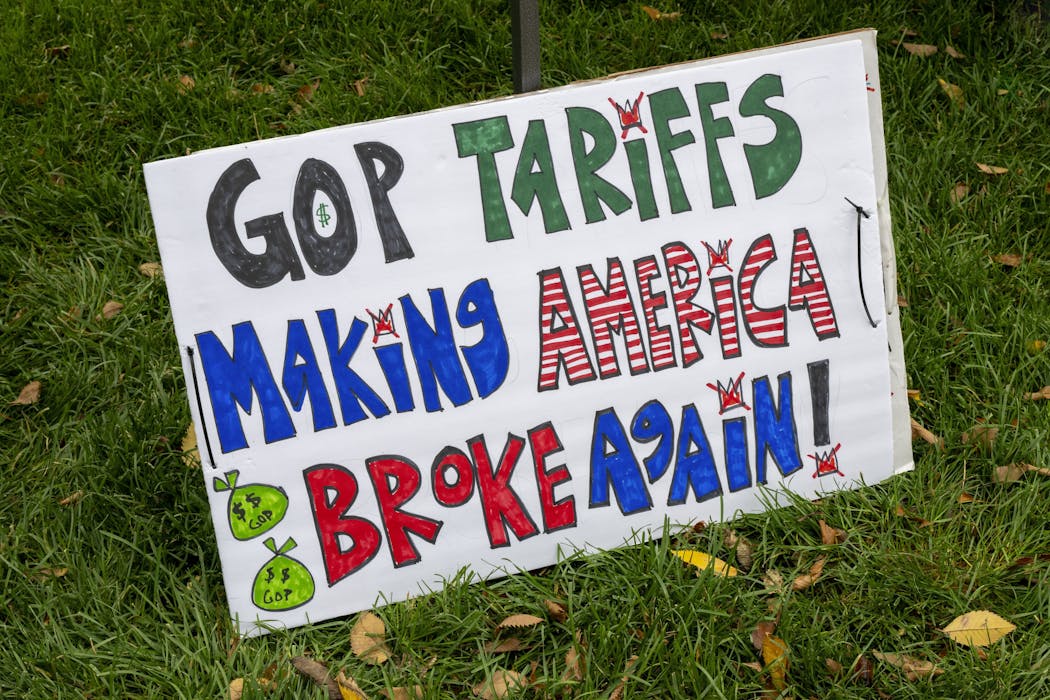
An anti-tariffs placard during a protest in St. Paul, Minnesota, on Oct. 25, 2025. Michael Siluk/UCG/Universal Images Group via Getty Images

The future of many of Donald Trump’s tariffs are up in the air, with the Supreme Court expected to hand down a ruling on the administration’s global trade barriers any day now.

But the question of whether a policy is legal or constitutional – which the justices are entertaining now – isn’t the same as whether it’s wise. And as a trade economist, I worry that Trump’s tariffs also pose a threat to “economic democracy” – that is, the process of decision-making that incorporates the viewpoints of everyone affected by the decision.

Founders and economic democracy

In many ways, the U.S. founders were supporters of economic democracy. That’s why, in the U.S. Constitution, they gave tariff- and tax-making powers exclusively to Congress.

And for good reason. Taxes can often represent a flash point between a government and its people. Therefore, it was deemed necessary to give this responsibility to the branch most closely tied to rule of, and by, the governed: an elected Congress. Through this arrangement, the legitimacy of tariffs and taxes would be based on voters’ approval – if the people weren’t happy, they could act through the ballot box.

To be fair, the president isn’t powerless over trade: Several times over the past century, Congress has passed laws delegating tariff-making authority to the executive branch on an emergency basis. These laws gave the president more trade power but subject to specific constitutional checks and balances.

The stakes for economic democracy

At issue before the Supreme Court now is Trump’s interpretation of one such emergency measure, the International Emergency Economic Powers Act of 1977.

Back in April 2025, Trump interpreted the law – which gives the president powers to respond to “any unusual and extraordinary threat” – to allow him to impose tariffs of any amount on products from nearly every country in the world.

Yet the act does not include any checks and balances on the president’s powers to use tariffs and does not even mention tariffs among its remedies. Trump’s unrestrained use of tariffs in this way was unprecedented in any emergency action ever taken by a U.S. president.

Setting aside the constitutional and legal issues, the move raises several concerns for economic democracy.

The first danger is in regards to a concentration of power. One of the reason tariffs are subjected to congressional debate and voting is that it provides a transparent process that balances competing interests. It prevents the interests of a single individual – such as a president who might substitute his own interests for that of the wider public interest – from controlling complete power.

Instead it subjects any proposed tariffs to the open competition of ideas among elected politicians.

Compare this to the way Trump’s tariffs were made. They were determined in large part by the president’s own political score-settling with other countries, and an ideological preference for trade surpluses. And they were not authorized by Congress. In fact, they bypassed the role of Congress as a check and balance – and this is not good for economic democracy in my view.
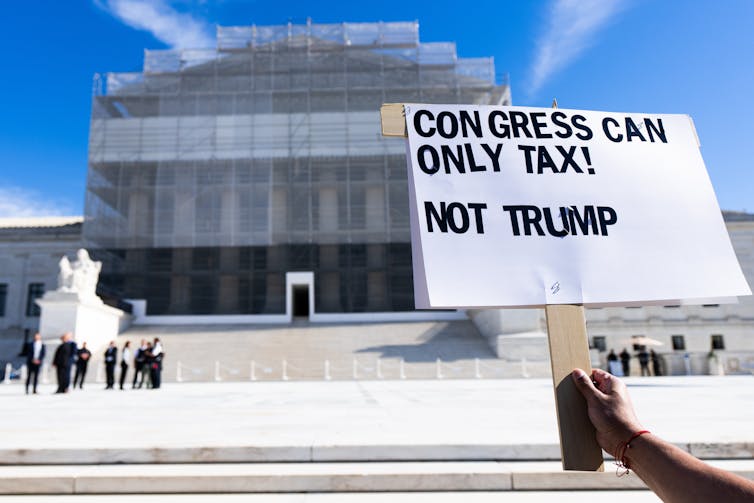
A building behind scaffolding and tarpaulin.
A protester holds a sign as the U.S. Supreme Court hears arguments on President Donald Trump’s tariffs on Nov. 5, 2025.
Bill Clark/CQ-Roll Call, Inc via Getty Images

The second danger is uncertainty. Unlike congressional tariffs, tariffs rolled out through the International Emergency Economic Powers Act under Trump have been altered many times and can continue to change in the future.

While supporters of the president have argued that this unpredictability gives the U.S. a bargaining advantage over competitor nations, many economists have noted that it severely compromises any goal of revitalizing American industries.

This is because both domestic and foreign investment in U.S.-based industries depends on stable and predictable import market access. Investors are unwilling to make large capital expenditures over several years and hire new workers if they think tariff rates might change at any time.

Even in the first year of the Trump tariffs, there is evidence of large-scale reductions in hiring and capital investment in the manufacturing sector due to this uncertainty.

The third danger concerns that lack of accountability involved in circumventing Congress. This can lead to using tariffs as a stealth way of increasing taxes on a population.

Importing companies generate revenue for the government through the additional levies they pay on goods from overseas. These costs are typically borne by domestic consumers, through increased prices, and importing companies, through lower profit margins.

Either way, Trump’s International Emergency Economic Powers Act interpretation has allowed him to use tariffs in a way that would – if allowed to stand – bring in additional government revenue of more than US$2 trillion over a 10-year period, according to estimates.

Trump frames the revenue his tariffs have raised as a windfall of foreign-paid duties. But in fact, the revenue is extracted from domestic consumer pockets and producer profit margins. And that amounts to a tax on both.

Corruption concerns

Finally, the way Trump’s used the act to roll out unilateral and changeable tariffs creates an incentive for political favoritism and even bribery.

This is down to what economists call “rent seeking” – that is, the attempt by companies or individuals to get extra money or value out of a policy through influence or favoritism.

As such, Trump can, should he wish, play favorites with “priority” industries in terms of tariff exemptions. In fact, he has already done this with major U.S. companies that import cell phones and other electronics products. They asked for special exemptions for the products they imported, a favor not granted to other companies. And there is nothing stopping recipients of the exemptions offering, say, to contribute to the president’s political causes or his renovations to the White House.

Smaller and less politically influential U.S. businesses do not have the same clout to lobby for tariff relief.

And this tariff-by-dealmaking goes beyond U.S. companies looking for relief. It extends into the world of manipulating governments to bend to Washington’s will. Unlike congressional tariffs under World Trade Organization rules, International Emergency Economic Powers Act tariffs discriminate from country to country – even on the same products.

And this allows for trade deals that focus on extracting bilateral deals that take place without considering broader U.S. interests. In the course of concluding bilateral Trump trade deals, some foreign governments such as Switzerland and Korea have even offered Trump special personal gifts, presumably in exchange for favorable terms. Presidential side deals and gift exchanges with individual countries are, as many scholars of good international governance have noted, not the best way to conduct global affairs.

The harms of having a tariff system that eschews the normal checks and balances of the American system are nothing new, or at least shouldn’t be.

Back in the late 1700s, with the demands of a tyrannical and unaccountable king at the front of their minds, the founders built a tariff order aimed at maintaining democratic legitimacy and preventing the concentration of power in a single individual’s hands.

A challenge to that order could have worrisome consequences for democracy as well as the economy.

The Conversation

Kent Jones does not work for, consult, own shares in or receive funding from any company or organization that would benefit from this article, and has disclosed no relevant affiliations beyond their academic appointment.

ref. Supreme Court is set to rule on constitutionality of Trump tariffs – but not their wisdom – https://theconversation.com/supreme-court-is-set-to-rule-on-constitutionality-of-trump-tariffs-but-not-their-wisdom-273092
Les États-Unis ont passé des décennies à faire pression pour mettre la main sur le pétrole vénézuélien

Source: The Conversation – France in French (3) – By James Trapani, Associate Lecturer of History and International Relations, Western Sydney University

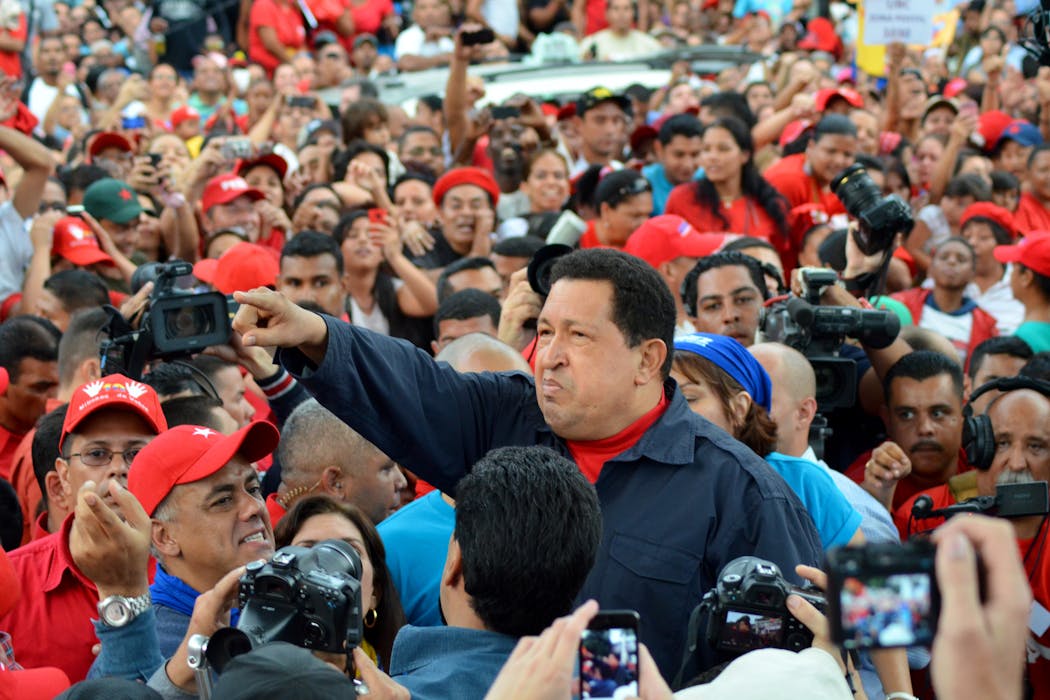
En 2007, Hugo Chavez affirmait que « le pétrole appartient à tous les Vénézuéliens ». Luisarismendi/Shutterstock

Hugo Chavez et Nicolas Maduro ont longtemps résisté aux tentatives des États-Unis d’exercer le contrôle des réserves pétrolières du Venezuela. Car ce pays d’Amérique du Sud, ayant joué un rôle clé dans la création de l’Organisation des pays exportateurs de pétrole (Opep), possède plus de 300 milliards de barils de pétrole.


Après que les forces spéciales des États-Unis ont fait irruption à Caracas pour exfiltrer le président vénézuélien Nicolas Maduro et renverser son gouvernement, Donald Trump déclare que les États-Unis vont désormais « diriger le Venezuela » , y compris ses abondantes ressources pétrolières.

Les entreprises états-uniennes sont prêtes à investir des milliards pour moderniser les infrastructures pétrolières vénézuéliennes en ruine, a-t-il dit, et « commencer à faire de l’argent pour le pays ». Le Venezuela possède les plus grandes réserves de pétrole mondiales – devançant l’Arabie saoudite – avec 303 milliards de barils, soit environ 20 % des réserves mondiales.

Si cela se réalise – et c’est un très grand « si » –, cela marquerait la fin d’une relation conflictuelle qui a commencé il y a près de trente ans.

Oui, l’action militaire de l’administration Trump au Venezuela a été à bien des égards sans précédent. Mais cela n’est pas surprenant, compte tenu de l’immense richesse pétrolière du pays et des relations historiques entre les États-Unis et le Venezuela, sous les mandats de l’ancien président Hugo Chavez et ceux de Nicolas Maduro.

Une longue histoire d’investissement états-unien

Le Venezuela est une république d’environ 30 millions d’habitants située sur la côte nord de l’Amérique du Sud, soit environ deux fois la taille de la Californie. Pendant une grande partie du début du XXᵉ siècle, il était considéré comme le pays le plus riche d’Amérique du Sud en raison de ses réserves pétrolières.

Les entreprises étrangères, y compris les états-uniennes, ont beaucoup investi dans la croissance du pétrole vénézuélien et joué un rôle important dans sa politique. Face à l’opposition de l’Oncle Sam, les dirigeants vénézuéliens ont commencé à exercer un contrôle accru sur leur principale ressource d’exportation. Le Venezuela a joué un rôle clé dans la création de l’Organisation des pays exportateurs de pétrole (Opep) en 1960, et a nationalisé une grande partie de son industrie pétrolière en 1976 (sous la présidence de Carlos Andrés Pérez, ndlr).

Cela a eu un impact négatif sur des entreprises comme ExxonMobil et a alimenté les récentes affirmations de l’administration Trump selon lesquelles le Venezuela aurait « volé » le pétrole américain.

Mais la plupart des Vénézuéliens ne profitent pas de cette prospérité économique. La mauvaise gestion de l’industrie pétrolière conduit à une crise de la dette et à l’intervention du Fonds monétaire international (FMI) en 1988. Des manifestations éclatent à Caracas en février 1989 et le gouvernement (du président Pérez qui vient d’être réélu, ndlr) envoie l’armée pour écraser le soulèvement. On estime que 300 personnes sont tuées, mais le nombre de morts pourrait être dix fois plus élevé.

Par la suite, la société vénézuélienne se divise davantage entre les riches, qui veulent travailler avec les États-Unis, et la classe ouvrière, qui cherche à obtenir l’autonomie vis-à-vis des États-Unis. Cette division définit la politique vénézuélienne depuis lors.

L’ascension de Chavez au pouvoir

Hugo Chavez débute sa carrière comme officier militaire. Au début des années 1980, il fonde le Mouvement révolutionnaire bolivarien-200 au sein de l’armée et donne des conférences passionnées contre le gouvernement.

Puis, après les émeutes de 1989, Chavez planifie le renversement du gouvernement vénézuélien. En février 1992, il organise un coup d’État, raté, contre le président pro-américain Carlos Andrés Pérez. Pendant son emprisonnement, son parti organise une autre tentative de coup d’État qui échoue également. Chavez est condamné à deux ans de prison, mais devient le principal candidat à la présidence en 1998, réunissant les courants socialistes révolutionnaires.

Hugo Chavez devient un géant de la politique vénézuélienne et latino-américaine. Sa révolution évoque la mémoire de Simon Bolívar (1783-1830), le grand libérateur de l’Amérique du Sud face au colonialisme espagnol. Non seulement Chavez est populaire au Venezuela pour son utilisation des revenus pétroliers, subventionnant les programmes gouvernementaux en matière d’alimentation, de santé et d’éducation, mais il est respecté, grâce à sa générosité, par des régimes partageant les mêmes idées dans la région.

Plus particulièrement, Hugo Chavez fournit à Cuba des milliards de dollars de pétrole en échange de dizaines de milliers de médecins cubains travaillant dans des cliniques de santé vénézuéliennes. Il établit un précédent en s’opposant aux États-Unis et au FMI lors des forums mondiaux, appelant le président états-unien de l’époque George W. Bush « le diable » à l’Assemblée générale de l’ONU en 2006.

Les États-Unis accusés d’avoir fomenté un coup d’État

Sans surprise, les États-Unis n’étaient pas fans d’Hugo Chavez.

Après que des centaines de milliers de manifestants de l’opposition descendent dans la rue en avril 2002, Chavez est brièvement renversé lors d’un coup d’État par des officiers militaires dissidents et des figures de l’opposition. Ces derniers installent un nouveau président, l’homme d’affaires Pedro Carmona. Chavez est arrêté, l’administration Bush reconnaît Carmona comme président, et le New York Times célébre la chute d’un « dictateur en devenir ».

Chavez revient au pouvoir seulement deux jours plus tard, grâce à des légions de partisans qui remplissent les rues. L’administration Bush doit se justifier pour son possible rôle dans le coup d’État avorté.

Bien que les États-Unis nient toute implication, les allégations persistent pendant des années sur le fait que Washington ait eu connaissance au préalable du coup d’État et ait tacitement soutenu sa destitution. En 2004, des documents nouvellement classifiés montrent que la CIA était au courant du complot, et il n’est pas clair dans quelle mesure les responsables des États-Unis ont prévenu Chavez.

La pression américaine continue sur Maduro

Nicolas Maduro, syndicaliste, est élu à l’Assemblée nationale en 2000 et rejoint le cercle rapproché de Hugo Chavez. Il accède au poste de vice-président en 2012 et, après la mort de Chavez l’année suivante, remporte sa première élection avec une courte avance.

Maduro n’est pas Chavez. Il ne bénéficie pas du même niveau de soutien parmi la classe ouvrière, l’armée ou dans son pays. La situation économique du Venezuela se détériore et l’inflation explose.

Nicolas Maduro en 2017.
StringerAL/Shutterstock

Les administrations états-uniennes successives continuent d’exercer des pressions sur Nicolas Maduro. Le Venezuela subit des sanctions à la fois sous la présidence de Barack Obama et lors de la première présidence Trump. Les États-Unis et leurs alliés refusent de reconnaître la victoire de Maduro lors des élections de 2018 et de nouveau en 2024.

Isolé d’une grande partie du monde, le gouvernement de Nicolas Maduro devient dépendant de la vente de pétrole à la Chine.

Maduro affirme avoir déjoué plusieurs tentatives de coups d’État et d’assassinats impliquant les États-Unis et l’opposition intérieure, notamment en avril 2019 et en mai 2020 durant le premier mandat de Trump.

Les responsables états-uniens nient toute implication dans tous les complots potentiels ; les rapports n’ont également trouvé aucune preuve de l’implication américaine dans le coup d’État raté de 2020.

Aujourd’hui, Donald Trump a réussi à évincer Nicolas Maduro dans une opération bien plus audacieuse, sans aucune tentative de déni. Il reste à voir comment les Vénézuéliens et les autres nations latino-américaines réagiront aux actions états-uniennes, mais une chose est certaine : l’implication américaine dans la politique vénézuélienne continuera tant qu’elle aura des intérêts financiers dans le pays.

The Conversation

James Trapani ne travaille pas, ne conseille pas, ne possède pas de parts, ne reçoit pas de fonds d’une organisation qui pourrait tirer profit de cet article, et n’a déclaré aucune autre affiliation que son organisme de recherche.

ref. Les États-Unis ont passé des décennies à faire pression pour mettre la main sur le pétrole vénézuélien – https://theconversation.com/les-etats-unis-ont-passe-des-decennies-a-faire-pression-pour-mettre-la-main-sur-le-petrole-venezuelien-273521

D’Adophe Thiers à Édouard Balladur, à qui ont profité les grands emprunts ?

Source: The Conversation – in French – By Éric Pichet, Professeur et directeur du Mastère Spécialisé Patrimoine et Immobilier, Kedge Business School

En France, un grand emprunt pourrait-il sauver la situation financière de l’État ? D’un côté, un endettement qui ne cesse de croître, de l’autre, des ménages qui épargnent toujours plus. Et si la solution était de demander aux seconds de financer plus ou moins volontairement le premier. Sur le papier, l’idée semble alléchante d’autant que le grand emprunt occupe une place particulière dans l’imaginaire français. Tentant lorsque l’épargne des ménages est une mesure de précaution pour se protéger des conséquences de l’endettement du secteur public.


L’incapacité récurrente des pouvoirs publics en France à ramener le déficit dans les critères de Maastricht a été aggravée par les deux grandes crises récentes, celle des subprimes en 2008 et celle du Covid en 2020. Cette dérive s’est encore accentuée avec l’incapacité de l’Assemblée nationale issue de la dissolution de juin 2024 à s’accorder pour voter une loi de finances qui réduirait ce déficit. En conséquence, ce dernier est attendu à 5,4 % du PIB en 2025 et encore vers 5 % en 2026, soit le plus important de la zone euro relativement au PIB, quel que soit le sort de la loi de finances pour 2026 toujours en suspens, soit très loin du seuil de 3 % fixé par le Pacte de stabilité et de croissance.

Quant à la dette publique, partie de 20 % du PIB en 1980, dernière année d’équilibre des comptes publics, elle culmine à 116 % à la fin de 2025, soit près du double du seuil du Pacte fixé à 60 % du PIB. Ce faisant, elle se situe juste après celle de la Grèce et de l’Italie.

L’inquiétante envolée de la charge de la dette

La longue période de taux d’intérêt très bas voire négatifs auxquels empruntait l’État de 2009 à 2022 était la conséquence directe de l’action inédite des grandes banques centrales pour éviter une dépression mondiale à la suite de la crise des subprimes de 2008. Ce volontarisme monétaire exceptionnel s’est achevé brutalement avec la hausse brutale des taux des banques centrales en 2022-2023 pour juguler la forte inflation qui a suivi l’invasion de l’Ukraine.


À lire aussi :
De Chirac à Macron, comment ont évolué les dépenses de l’État


En conséquence, les taux d’émission des obligations françaises à dix ans sont passés de 1 % en 2022 à 3,6 % début 2026, soit à des niveaux supérieurs au Portugal et à l’Espagne et même à la Grèce. Plus grave, la charge de la dette publique (les intérêts versés chaque année aux créanciers des organismes publics) passera de 50 milliards d’euros en 2022 à 75 milliards en 2026 (dont 60 milliards pour le seul État).


Fourni par l’auteur

Source : Programme de stabilité de 2024, charge d’intérêts en comptabilité nationale, Finances publiques et économie (Fipeco).

Le précédent de l’emprunt obligatoire

Face à l’Himalaya diagnostiqué de la dette (avec raison mais un peu tard…) par François Bayrou quand il était premier ministre, les députés socialistes ont repris, au moment des débats sur l’instauration de taxe Zucman l’idée d’un emprunt forcé sur les plus riches en référence à une initiative du premier ministre Pierre Mauroy en 1983. Émis à un taux de 11 % (contre 14 % sur le marché à l’époque) celui-ci avait contraint 7 millions de contribuables à prêter 13,4 milliards de francs (soit environ 5 milliards d’euros) à hauteur de 10 % de leur impôt sur le revenu et de 10 % de leur impôt sur la fortune. Prévu pour trois ans, mais très impopulaire, car touchant également la classe moyenne supérieure, il fut remboursé par anticipation au bout de deux ans et ne fit jamais école.

Si cette idée d’un emprunt forcé a été rejetée par le gouvernement et l’Assemblée nationale le 26 novembre 2025, la piste d’un grand emprunt agite toujours les esprits d’autant que le contexte actuel rappelle celui des précédents historiques, en temps de guerre ou face à des crises budgétaires aiguës, et qu’ils ont toujours été couronnés de succès à l’émission.

L’emprunt de Thiers ou la naissance du mythe

Après la cuisante défaite de la guerre franco-prussienne de 1870-1871, le traité de Francfort du 10 mai 1871 impose à la France, outre la cession de l’Alsace-Lorraine, une indemnité de 5 milliards de francs-or (soit 70 milliards d’euros). Adolphe Thiers, le chef de l’exécutif de l’époque, émet alors un emprunt d’État au taux de 5 % sur cinquante ans garanti sur l’or.

L’engouement des épargnants a permis de payer l’indemnité allemande dès 1873 avec deux ans d’avance mettant ainsi fin à l’occupation militaire. Surtout, le succès de l’emprunt a assis la crédibilité de la toute jeune IIIe République. Puissant symbole de la résilience du pays il inspira d’autres emprunts de sorties de guerre, comme l’emprunt dit de la Libération de 1918 et celui de 1944.

L’emprunt Pinay 1952-1958 ou les délices de la rente

Premier grand emprunt du temps de paix, la rente Pinay – du nom du ministre de l’économie et des finances sous la quatrième et la cinquième République – de 1952 était destinée à sortir le pays des crises alimentaires et du logement de l’après-guerre. L’équivalent de 6 milliards d’euros a été alors levé avec un taux d’intérêt plutôt faible de 3,5 %,, mais assorti d’une indexation de son remboursement sur le napoléon en 1985 (date à laquelle l’emprunt a été complètement remboursé) et surtout une exonération d’impôt sur le revenu et sur les droits de succession.

Cette gigantesque niche fiscale pour les plus riches était d’ailleurs discrètement mise en avant par les agents de change qui conseillaient aux héritiers de « mettre leur parent en Pinay avant de le mettre en bière » pour éviter les droits de succession entraînant au passage de cocasses quiproquos familiaux lorsque le moribond reprenait des forces…

Le succès de la rente Pinay fut tel que de Gaulle, revenant au pouvoir, lui demanda de récidiver avec le Pinay/de Gaulle de 1958 destiné à sauver les finances publiques, restaurer la crédibilité de l’État et accompagner la réforme monétaire qui allait aboutir au nouveau franc de 1960.

L’emprunt Giscard, un grand emprunt coûteux pour l’État

Portant le nom du ministre des finances du président Pompidou, cet emprunt émis en 1973 rapportait 7 % et a levé l’équivalent d’environ 5,6 milliards d’euros sans avantage fiscal mais une obscure sous-clause du contrat, qui prévoyait une indexation automatique sur le lingot d’or en cas d’inflation.

L’or s’étant envolé avec la fin des accords de Bretton Woods de 1971-1974, cet emprunt coûta finalement en francs constants au moment de son remboursement en 1988 près de cinq fois ses recettes.

1993, le dernier grand emprunt

Après la crise des subprimes de 2008, Nicolas Sarkozy avait envisagé l’émission d’un grand emprunt de 22 milliards d’euros pour financer cinq grandes priorités : l’enseignement supérieur, la recherche, l’industrie, le développement durable et l’économie numérique. Il opta finalement pour un financement classique sur les marchés au motif – pertinent – qu’il aurait fallu allécher les particuliers par un taux d’intérêt supérieur.

Le dernier grand emprunt national est donc toujours aujourd’hui l’emprunt Balladur de mai 1993 rapportant 6 % sur quatre ans et destiné à mobiliser l’épargne des Français les plus aisés pour financer l’accès au travail des jeunes et la relance des travaux publics et du bâtiment. Initialement fixé à 40 milliards de francs, son succès fut tel qu’il récolta 110 milliards de francs (30 milliards d’euros) grâce à la souscription de 1,4 million d’épargnants. Le gouvernement Balladur s’étant engagé à accepter toutes les souscriptions des particuliers, il ne put satisfaire les investisseurs institutionnels.

BFM Business, 2025.

Pas (encore) de problèmes de financement pour l’État

Un grand emprunt pourrait-il être la solution dans le contexte actuel pour financer les déficits, comme on l’entend parfois ?

Malgré la dérive des comptes publics, en France, l’État reste crédible avec une note de A+ attribuée par Standard & Poors et par Fitch, et de Aa3 par Moody’s (soit l’équivalent de 16 ou 17/20). Par ailleurs, le Trésor n’a aucune difficulté à emprunter 300 milliards d’euros par an (la moitié pour financer le déficit de l’année et l’autre pour rembourser les emprunts arrivant à échéance), si ce n’est à un taux d’intérêt supérieur de 80 points de base (0,8 %) au taux d’émission des obligations allemandes à dix ans (3,6 % contre 2,8 %). Aujourd’hui la dette publique française s’élève à environ 3 500 milliards d’euros et 55 % de la dette négociable est détenue par les non-résidents.

En France, les particuliers financent environ 10 % de cette dette publique soit 350 milliards d’euros via l’assurance-vie en euros, mais cette niche fiscale est coûteuse et régressive car elle favorise les gros patrimoines. Ainsi, selon le Conseil d’analyse économique, le manque à gagner en recettes fiscales lié à l’assurance-vie au titre des successions serait de l’ordre de 4 à 5 milliards d’euros par an.

Un grand emprunt utile en 2026 ?

Aujourd’hui, les ménages semblent se conformer à la théorie de l’économiste David Ricardo : inquiets de la situation financière du pays, ils augmentent leur taux d’épargne passé de 15 % de leurs revenus en moyenne avant la crise à 18,4 % en 2025. Et leur épargne financière, qui représente 10 % de leurs revenus, culmine à 6 600 milliards d’euros, un niveau bien supérieur à la totalité de la dette publique.

C’est pourquoi un grand emprunt national proposé par un gouvernement stable disposant d’une majorité solide rencontrerait sans doute un grand succès. Il aurait le mérite de redonner confiance au pays et de conjurer ce que The Economist identifie dans un tout récent article publié le 11 janvier 2026 comme le principal problème économique mondial : le pessimisme.

The Conversation

Éric Pichet ne travaille pas, ne conseille pas, ne possède pas de parts, ne reçoit pas de fonds d’une organisation qui pourrait tirer profit de cet article, et n’a déclaré aucune autre affiliation que son organisme de recherche.

ref. D’Adophe Thiers à Édouard Balladur, à qui ont profité les grands emprunts ? – https://theconversation.com/dadophe-thiers-a-edouard-balladur-a-qui-ont-profite-les-grands-emprunts-273372

12 ways the Trump administration dismantled civil rights law and the foundations of inclusive democracy in its first year

Source: The Conversation – USA – By Spencer Overton, Professor of Law, George Washington University

The second Trump administration has weakened federal civil rights law and is shredding the foundations of America’s racially inclusive democracy. imagedepotpro, iStock/Getty Images Plus

One year after Donald Trump’s second inauguration, a pattern emerges. Across dozens of executive orders, agency memos, funding decisions and enforcement changes, the administration has weakened federal civil rights law and the foundations of the country’s racially inclusive democracy.

From the start, the U.S. was not built to include everyone equally. The Constitution protected and promoted slavery. Most states limited voting to white men. Congress restricted naturalized citizenship to “free white persons.” These choices were not accidents. They shaped who could belong and who could exercise political power, and they entrenched a racial political majority that lasted for generations.

That began to change in the 1960s. After decades of protest and pressure, Congress enacted laws that prohibited discrimination in employment, education, voting, immigration and housing.

Federal agencies were charged with enforcing those laws, collecting data to identify discrimination and conditioning public funds on compliance. These choices reshaped U.S. demographics and institutions, with the current Congress “the most racially and ethnically diverse in history,” according to the Pew Research Center. The laws did not eliminate racial inequality, but they made exclusion easier to see and harder to defend.

The first year of the second Trump administration marks a sharp reversal.

In a March 2025 speech to Congress, Trump spoke of dismantling DEI programs.

Cumulative retreat

Rather than repealing civil rights statutes outright, the administration has focused on disabling the mechanisms that make those laws work.

Drawing on over two decades of teaching and writing about civil rights and my experience directing a GW Law project on inclusive democracy, I believe this pattern reflects not isolated administrative actions but a cumulative retreat from the federal government’s role as an enforcer of civil rights law.

Over the past year, the president and his administration have taken a series of connected actions:

• On its first day in office, announced the end of all federal diversity, equity and inclusion programs, including diversity officers, equity plans and related grants and contracts.

• Shut down or sharply cut funding for federal programs aimed at reducing inequality, including offices focused on minority health, minority-owned businesses, fair federal contracting, environmental justice and closing the digital divide in broadband.

• Warned schools that diversity programs could jeopardize their federal funding, opened investigations into colleges offering scholarships to students protected under DACA – the Obama-era policy providing deportation protection for undocumented immigrants who came to the U.S. as children – and signaled that colleges risk losing federal student aid if their accrediting agencies consider diversity.

• Revoked security clearances and access to federal buildings for employees at law firms with diversity policies. The FCC investigated media companies for promoting diversity and threatened to block mergers by companies with similar programs, leading several companies to drop their initiatives.

• Issued a government-wide memo labeling common best practices in hiring, admissions and other selection and evaluation processes – such as compiling diverse applicant pools, valuing cultural competence, considering first-generation or low-income status and seeking geographic and demographic representation – as potentially legally suspect. The memo warned that federal funding could be cut to schools, employers and state and local governments using such practices. Federal prosecutors reportedly investigated federal contractors that consider diversity, characterizing such initiatives as fraud.

• Weakened enforcement against discrimination by ordering agencies to stop using disparate impact analysis. That kind of analysis identifies disparities in outcomes, assesses whether they are justified by legitimate objectives, and intervenes when they are not. The Department of Justice, the EEOC, the National Credit Union Administration and other agencies complied and dropped disparate impact analysis. Because algorithmic systems typically operate without explicit intent, eliminating disparate impact analysis reduces federal agencies’ ability to detect and address discriminatory outcomes produced by increasingly automated government and private-sector decision-making.

Rescinded an executive order that barred discrimination by federal contractors, required steps to ensure nondiscriminatory hiring and employment, and subjected contractors to federal compliance reviews and record-keeping. This weakened a key mechanism used since 1965 to detect and remedy workplace discrimination.

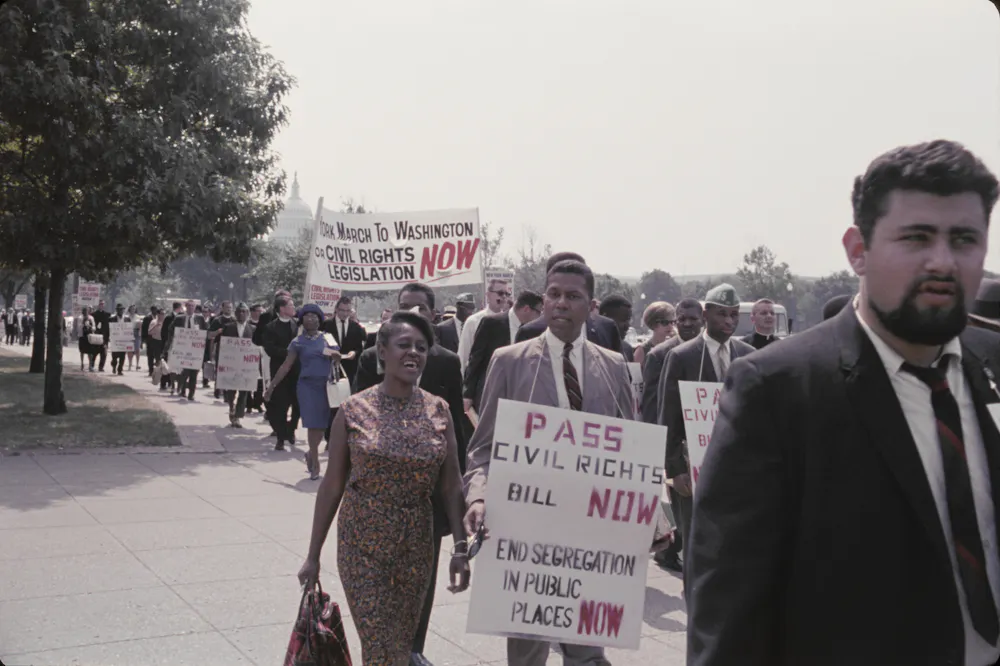
A large group of people marching with signs urging passage of a civil rights bill.
Civil rights, union and religious leaders board a dedicated Pennsylvania Railroad train from New York to Washington, D.C., to march in support of the bill that would become the Civil Rights Act of 1964.
Bob Parent/Getty Images

• Eliminated data used to track inequality, including rolling back guidance encouraging schools to collect data on racial disparities in discipline and special education. The administration also removed data used to identify racial disparities in environmental harms.

• Dismantled or sharply reduced civil rights offices across federal agencies, including the Department of Homeland Security, the Social Security Administration and the Department of Education. About three-quarters of lawyers in the Justice Department’s Civil Rights Division left.

Pressured the Smithsonian to remove exhibits about racial injustice, restored Confederate monuments and military base names, and barred schools and teacher training programs from including material the administration labeled divisive, such as unconscious bias.

• Declared English the nation’s only official language, repealed a requirement that federal agencies provide meaningful access to government programs and services for people with limited English proficiency, and prompted the General Services Admininistration and the departments of Justice, Education and other agencies to scale back language-assistance requirements and services.

Attempted to limit birthright citizenship guaranteed by the 14th Amendment, and adopted practices that treat ethnicity and non-English accents as legitimate reasons for immigration stops.

The pattern is hard to miss

Taken together, these shifts have practical consequences.

When agencies stop collecting data on racial disparities, discrimination becomes harder to detect. When disparate impact analysis is abandoned, unfair practices with no legitimate purpose go unchallenged. When diversity programs are chilled through investigations and funding threats, institutions respond by narrowing opportunity. When history and language are recast as threats to unity, truth and freedom of speech and thought are suppressed and undermined.

A crowd of people gathered at the base of the Statue of Liberty.
Lyndon Johnson at the base of the Statue of Liberty on Oct. 3, 1965, before signing the Immigration and Nationality Act, which prohibited racial discrimination in the immigration process and repealed quotas heavily favoring immigration from northern and western Europe.
LBJ Library

Administration officials argue that these steps are needed to prevent discrimination against white people, promote unity, ensure “colorblind equality” and comply with a Supreme Court decision that struck down affirmative action in college admissions. But that ruling did not ban awareness of racial inequality, or neutral policies aimed at reducing it. Many of the administration’s actions rely on broad claims of illegality without providing specific violations.

The selective nature of enforcement is also telling.

Books about racism and civil rights were removed from military libraries, while books praising Nazi ideas or claiming racial intelligence differences were left untouched. The administration suspended admissions of refugees – over 90% of whom have been from Africa, Asia and Latin America in recent years – but then reopened the refugee program for white South Africans.

One year in, the pattern is hard to miss.

The administration is not simply applying neutral rules. It is dismantling the systems that once helped the U.S. move toward a more open and equal democracy. It is replacing them with policies that selectively narrow access to economic, cultural and educational participation.

The result is not simply a change in policy, but a fundamental shift in the trajectory of American democracy.

The Conversation

Spencer Overton is the faculty director of a program at GW Law that receives grants from non-profit foundations like the David & Lucile Packard Foundation, Democracy Fund, and the Rockefeller Brothers Fund.

ref. 12 ways the Trump administration dismantled civil rights law and the foundations of inclusive democracy in its first year – https://theconversation.com/12-ways-the-trump-administration-dismantled-civil-rights-law-and-the-foundations-of-inclusive-democracy-in-its-first-year-273433

Quand les plateformes numériques fragmentent la société pour maximiser leurs profits

Source: The Conversation – in French – By Sérgio Amadeu da Silveira, Professor associado, Universidade Federal do ABC (UFABC)

La violence, les exagérations, la diffusion de fake news et les mensonges sont les bienvenus sur les plateformes numériques. Il s’agit de maximiser la visibilité des contenus et, ainsi, les profits des Big Tech. Soutenus par Donald Trump, les milliardaires qui détiennent les plateformes refusent tout contrôle au nom de la liberté d’expression.


Jamais dans l’histoire un si petit groupe d’entreprises n’avait réussi à s’immiscer dans les relations des individus à une telle échelle – celle du monde. Les fameuses « Big Tech » sont devenues des médiateurs actifs des relations sociales grâce aux technologies numériques. Or il n’est pas inutile de rappeler que les médiateurs ne sont pas neutres. Les Big Tech influencent les opinions en modulant l’attention et en produisant des réactions chez leurs millions d’utilisateurs.

Au sein des réseaux sociaux et de leurs variantes, leurs contrôleurs opèrent en capturant les données de chaque mouvement, de chaque clic, en somme, des actions qui permettent à leurs algorithmes d’extraire des modèles de comportement, des informations fondamentales pour alimenter les réseaux neuronaux artificiels qui proposeront des contenus dans le but de prévoir nos désirs et nos besoins afin de prédire nos actions. Cela peut se résumer par l’expression « monétisation totale de la vie sociale ».

Fonctionnant de manière invisible pour leurs utilisateurs, ces plateformes ont concentré les budgets publicitaires de presque toutes les sociétés, à partir de la gestion algorithmique des regards et de l’attention. D’où leur logique fondée sur la spectacularisation de tout.

Pour ces plateformes, une bonne information est celle qui génère de l’engagement, celle qui est spectaculaire, celle qui permet de monétiser les interactions. L’engagement que les Big Tech prétendaient avoir envers la qualité de l’information n’était que rhétorique. Le nombre de clics, les réplications, les attaques mutuelles, les exagérations, les mensonges et la diffusion de fake news sont les bienvenus sur les plateformes des Big Tech.

Liberté asymétrique

Récemment, avec le retour de Donald Trump à la Maison Blanche, Musk a pris la tête de la lutte contre la réglementation des plateformes. Pour ce faire, il diffuse l’idée que réglementer équivaut à censurer. La notion de liberté de Musk est fondée sur la force.

Alors que la liberté démocratique repose sur la symétrie, c’est-à-dire sur le droit égal de tous et toutes à être libres, la proposition de liberté de l’extrême droite se traduit par des asymétries. Le puissant n’est libre que s’il peut exercer tout son pouvoir. Le milliardaire n’est libre que s’il peut utiliser sans limites tout ce que sa richesse lui permet. Cette conception s’apparente à une légitimation de la violence, loin de l’idée que chacun a le même droit de s’exprimer.

Sur les plateformes, ce n’est pas la liberté d’expression qui prévaut. C’est le pouvoir de l’argent qui règne. La monétisation de toutes les relations dans une architecture informationnelle verticale, limitée et extrêmement surveillée par ses propriétaires. La gestion totalement opaque des réseaux sociaux en ligne est assurée par des systèmes algorithmiques qui appliquent les règles et les lois de leurs propriétaires. Cette exécution est totalement arbitraire, décidée de manière monocratique par la direction de ces entreprises, modifiée sans préavis, sans débat, sans considération pour leurs utilisateurs, en suivant uniquement deux logiques : celle de leur rentabilité et celle de favoriser l’expansion du pouvoir de leur vision du monde.

Qui croit que les systèmes algorithmiques de la plateforme d’Elon Musk seront neutres dans les conflits entre l’extrême droite et les forces démocratiques de certains pays ? Qui pense que les plateformes du groupe Meta ne favoriseront pas les discours des groupes qui partagent des idées de Trump ? Qui croit que ces structures ne sont pas ploutocratiques, que l’argent n’y fait pas la loi ?

Les élites rompent avec la démocratie

L’un des grands leaders d’extrême droite des Big Tech, Peter Thiel, affirmait déjà en 2009 :

« Je ne crois plus que la liberté et la démocratie soient compatibles. »

Face au manque de perspectives catastrophique du système capitaliste, une grande partie des élites défendant les solutions néolibérales ont rompu avec la démocratie et adhéré au réactionnarisme, c’est-à-dire aux solutions de l’extrême droite. Si nous ne comprenons pas cela, nous ne serons pas en mesure de défendre la démocratie. Le philosophe Michel Foucault nous a suggéré que le pouvoir est aussi une stratégie. Fondamentalement, la destruction du débat rationnel fondé sur les faits est devenue la principale stratégie de l’extrême droite. La lutte contre la réalité, contre l’information factuelle, contre la science, est liée à une stratégie visant à propager de la confusion intellectuelle et à autoriser la violence grâce à une fausse idée de la liberté.

Dans ce contexte, il est bon de rappeler la perspective du sociologue Georg Simmel, qui nous enseignait que le conflit est un élément inhérent et nécessaire à la vie sociale. Le conflit et la coopération sont complémentaires dans la vie sociale. Mais Simmel avertissait qu’il existe des situations dans lesquelles l’absence de formes sociales régulatrices, le rejet absolu de l’autre, la fragmentation de la société sans canaux de médiation sont destructrices et extrêmement dangereuses.

Simmel n’a pas connu le monde hyperconnecté d’aujourd’hui, où les gens sont constamment exposés à des vagues de désinformation et de discours haineux modulés par des systèmes algorithmiques afin de maximiser l’extraction d’argent et la destruction des droits. Mais en travaillant à partir de ses analyses, nous constatons qu’il est indispensable de réglementer ces oligopoles géants et de garantir la qualité et l’intégrité de l’information.

The Conversation

Sérgio Amadeu da Silveira ne travaille pas, ne conseille pas, ne possède pas de parts, ne reçoit pas de fonds d’une organisation qui pourrait tirer profit de cet article, et n’a déclaré aucune autre affiliation que son organisme de recherche.

ref. Quand les plateformes numériques fragmentent la société pour maximiser leurs profits – https://theconversation.com/quand-les-plateformes-numeriques-fragmentent-la-societe-pour-maximiser-leurs-profits-263769

Avant le pétrole vénézuelien, il y a eu les bananes du Guatemala…

Source: The Conversation – France in French (3) – By Aaron Coy Moulton, Associate Professor of Latin American History, Stephen F. Austin State University

Dans les années 1950 déjà, les États-Unis intervenaient contre un gouvernement démocratiquement élu au nom d’une menace idéologique, tout en protégeant des intérêts économiques majeurs. Mais si les ressorts se ressemblent, les méthodes et le degré de transparence ont profondément changé.


Dans la foulée de la frappe militaire américaine qui a conduit à l’arrestation du président vénézuélien Nicolás Maduro le 3 janvier 2026, l’administration Trump a surtout affiché son ambition d’obtenir un accès sans entrave au pétrole du Venezuela, reléguant au second plan des objectifs plus classiques de politique étrangère comme la lutte contre le trafic de drogue ou le soutien à la démocratie et à la stabilité régionale.

Lors de sa première conférence de presse après l’opération, le président Donald Trump a ainsi affirmé que les compagnies pétrolières avaint un rôle important à jouer et que les revenus du pétrole contribueraient à financer toute nouvelle intervention au Venezuela.

Peu après, les animateurs de « Fox & Friends » ont interpelé Trump sur ces prévisions :

« Nous avons les plus grandes compagnies pétrolières du monde », a répondu Trump, « les plus importantes, les meilleures, et nous allons y être très fortement impliqués ».

En tant qu’historien des relations entre les États-Unis et l’Amérique latine, je ne suis pas surpris de voir le pétrole, ou toute autre ressource, jouer un rôle dans la politique américaine à l’égard de la région. Ce qui m’a en revanche frappé, c’est la franchise avec laquelle l’administration Trump reconnaît le rôle déterminant du pétrole dans sa politique envers le Venezuela.

Comme je l’ai détaillé dans mon livre paru en 2026, Caribbean Blood Pacts: Guatemala and the Cold War Struggle for Freedom (NDT : livre non traduit en français), les interventions militaires américaines en Amérique latine ont, pour l’essentiel, été menées de manière clandestine. Et lorsque les États-Unis ont orchestré le coup d’État qui a renversé le président démocratiquement élu du Guatemala en 1954, ils ont dissimulé le rôle qu’avaient joué les considérations économiques dans cette opération.

Un « poulpe » puissant

Au début des années 1950, le Guatemala était devenu l’une des principaux fournisseurs de bananes pour les Américains, comme c’est d’ailleurs toujours le cas aujourd’hui.

La United Fruit Company possédait alors plus de 220 000 hectares de terres guatémaltèques, en grande partie grâce aux accords conclus avec les dictatures précédentes. Ces propriétés reposaient sur le travail intensif d’ouvriers agricoles pauvres, souvent chassés de leurs terres traditionnelles. Leur rémunération était rarement stable, et ils subissaient régulièrement des licenciements et des baisses de salaire.

Basée à Boston, cette multinationale a tissé des liens avec des dictateurs et des responsables locaux en Amérique centrale, dans de nombreuses îles des Caraïbes et dans certaines régions d’Amérique du Sud afin d’acquérir d’immenses domaines destinés aux chemins de fer et aux plantations de bananes.

Les populations locales la surnommaient le « pulpo » – « poulpe » en espagnol – car l’entreprise semblait intervenir dans la structuration de la vie politique, de l’économie et de la vie quotidienne de la région. En Colombie, le gouvernement a par exemple brutalement réprimé une grève des travailleurs de la United Fruit en 1928, faisant des centaines de morts. Cet épisode sanglant de l’histoire colombienne a d’ailleurs servi de base factuelle à une intrigue secondaire de « Cent ans de solitude », le roman épique de Gabriel García Márquez, lauréat du prix Nobel de littérature en 1982.

L’influence apparemment sans limites de l’entreprise dans les pays où elle opérait a nourri le stéréotype des nations d’Amérique centrale comme des « républiques bananières ».

United Fruit possédait notamment la marque de bananes Chiquita, qu’elle a largement promue, y compris à travers cette publicité produite dans les années 1940.

La révolution démocratique guatémaltèque

Au Guatemala, pays historiquement marqué par des inégalités extrêmes, une vaste coalition s’est formée en 1944 pour renverser la dictature répressive lors d’un soulèvement populaire. Inspirée par les idéaux antifascistes de la Seconde Guerre mondiale, cette coalition ambitionnait de démocratiser le pays et de rendre son économie plus équitable.

Après des décennies de répression, les nouveaux dirigeants ont offert à de nombreux Guatémaltèques leur premier contact avec la démocratie. Sous la présidence de Juan José Arévalo, élu démocratiquement et en fonction de 1945 à 1951, le gouvernement a mis en place de nouvelles protections sociales ainsi qu’un code du travail légalisant la création et l’adhésion à des syndicats, et instaurant la journée de travail de huit heures.

En 1951, lui a succédé Jacobo Árbenz, lui aussi président démocratiquement élu.

Sous Árbenz, le Guatemala a mis en œuvre en 1952 un vaste programme de réforme agraire, attribuant des parcelles non exploitées aux ouvriers agricoles sans terre. Le gouvernement guatémaltèque affirmait que ces politiques permettraient de bâtir une société plus équitable pour la majorité indigène et pauvre du pays.

United Fruit a dénoncé ces réformes comme le produit d’une conspiration mondiale. L’entreprise affirmait que la majorité des syndicats du pays étaient contrôlés par des communistes mexicains et soviétiques, et présentait la réforme agraire comme une manœuvre visant à détruire le capitalisme.

Pression sur le Congrès pour une intervention

Au Guatemala, United Fruit a cherché à rallier le gouvernement américain à son combat contre les politiques menées par Árbenz. Si ses dirigeants se plaignaient bien du fait que les réformes guatémaltèques nuisaient à ses investissements financiers et alourdissaient ses coûts de main-d’œuvre, ils présentaient aussi toute entrave à leurs activités comme faisant partie d’un vaste complot communiste.

L’entreprise a mené l’offensive à travers une campagne publicitaire aux États-Unis et en exploitant la paranoïa anticommuniste dominante de l’époque.

Dès 1945, les dirigeants de la United Fruit Company ont commencé à rencontrer des responsables de l’administration Truman. Malgré le soutien d’ambassadeurs favorables à leur cause, le gouvernement américain ne semblait pas disposé à intervenir directement dans les affaires guatémaltèques. L’entreprise s’est alors tournée vers le Congrès, recrutant les lobbyistes Thomas Corcoran et Robert La Follette Jr., ancien sénateur, pour leurs réseaux politiques.

Dès le départ, Corcoran et La Follette ont fait pression auprès des républicains comme des démocrates, dans les deux chambres du Congrès, contre les politiques guatémaltèques – non pas en les présentant comme une menace pour les intérêts commerciaux de United Fruit, mais comme les éléments d’un complot communiste visant à détruire le capitalisme et les États-Unis.

Les efforts de la compagnie bananière ont porté leurs fruits en février 1949, lorsque plusieurs membres du Congrès ont dénoncé les réformes du droit du travail au Guatemala comme étant d’inspiration communiste. Le sénateur Claude Pepper a qualifié le code du travail de texte « manifestement et intentionnellement discriminatoire à l’égard de cette entreprise américaine » et d’« une mitrailleuse pointée sur la tête » de la United Fruit Company.

Deux jours plus tard, le membre de la Chambre des représentants John McCormack a repris mot pour mot cette déclaration, utilisant exactement les mêmes termes pour dénoncer les réformes. Les sénateurs Henry Cabot Lodge Jr., Lister Hill et le représentant Mike Mansfield ont eux aussi pris position publiquement, en reprenant les éléments de langage figurant dans les notes internes de la United Fruit.

Aucun élu n’a prononcé un mot sur les bananes.

Lobbying et campagnes de propagande

Ce travail de lobbying, nourri par la rhétorique anticommuniste, a culminé cinq ans plus tard, lorsque le gouvernement américain a orchestré un coup d’État qui a renversé Árbenz lors d’une opération clandestine.

L’opération a débuté en 1953, lorsque l’administration Eisenhower a autorisé la CIA à lancer une campagne de guerre psychologique destinée à manipuler l’armée guatémaltèque afin de renverser le gouvernement démocratiquement élu. Des agents de la CIA ont alors soudoyé des membres de l’armée guatémaltèque tandis que des émissions de radio anticommunistes étaient diffusées et un discours, porté par les religieux et dénonçant un prétendu projet communiste visant à détruire l’Église catholique du pays, se propageait dans tout le Guatemala.

Parallèlement, les États-Unis ont armé des organisations antigouvernementales à l’intérieur du Guatemala et dans les pays voisins afin de saper davantage encore le moral du gouvernement Árbenz. La United Fruit a également fait appel au pionnier des relations publiques Edward Bernays pour diffuser sa propagande, non pas au Guatemala mais aux États-Unis. Bernays fournissait aux journalistes américains des rapports et des textes présentant le pays d’Amérique centrale comme une marionnette de l’Union soviétique.

Ces documents, dont un film intitulé « Why the Kremlin Hates Bananas », ont circulé grâce à des médias complaisants et à des membres du Congrès complices.

La volonté de la United Fruit de renverser le gouvernement démocratiquement élu du Guatemala a été renforcée par ce film de propagande anticommuniste.

Détruire la révolution

En définitive – et les archives le démontrent –, l’action de la CIA a conduit des officiers de l’armée à renverser les dirigeants élus et à installer un régime plus favorable aux États-Unis, dirigé par Carlos Castillo Armas. Des Guatémaltèques opposés aux réformes ont massacré des responsables syndicaux, des responsables politiques et d’autres soutiens d’Árbenz et Arévalo. Selon des rapports officiels, au moins quarante-huit personnes sont mortes dans l’immédiat après-coup, tandis que des récits locaux font état de centaines de morts supplémentaires.

Pendant des décennies, le Guatemala s’est retrouvé aux mains de régimes militaires. De dictateur en dictateur, le pouvoir a réprimé brutalement toute opposition et instauré un climat de peur. Ces conditions ont contribué à des vagues d’émigration, comprenant d’innombrables réfugiés, mais aussi certains membres de gangs transnationaux.

Le retour de bâton

Afin d’étayer l’idée selon laquelle ce qui s’était produit au Guatemala n’avait rien à voir avec les bananes — conformément au discours de propagande de l’entreprise — l’administration Eisenhower a autorisé une procédure antitrust contre United Fruit, procédure qui avait été temporairement suspendue pendant l’opération afin de ne pas attirer davantage l’attention sur la société.

Ce fut le premier revers d’une longue série qui allait conduire au démantèlement de la United Fruit Company au milieu des années 1980. Après une succession de fusions, d’acquisitions et de scissions, ne demeure finalement que l’omniprésent logo de Miss Chiquita, apposé sur les bananes vendues par l’entreprise.

Et, selon de nombreux spécialistes des relations internationales, le Guatemala ne s’est jamais remis de la destruction de son expérience démocratique, brisée sous la pression des intérêts privés.

The Conversation

Les recherches d’Aaron Coy Moulton ont bénéficié de financements du Truman Library Institute, de Phi Alpha Theta, de la Society for Historians of American Foreign Relations, du Roosevelt Institute, de l’Eisenhower Foundation, de la Massachusetts Historical Society, de la Bentley Historical Library, de l’American Philosophical Society, du Dirksen Congressional Center, de la Hoover Presidential Foundation et du Frances S. Summersell Center for the Study of the South.

ref. Avant le pétrole vénézuelien, il y a eu les bananes du Guatemala… – https://theconversation.com/avant-le-petrole-venezuelien-il-y-a-eu-les-bananes-du-guatemala-273713

Iran’s latest internet blackout extends to phones and Starlink

Source: The Conversation – USA – By Amanda Meng, Senior Research Scientist, College of Computing, Georgia Institute of Technology

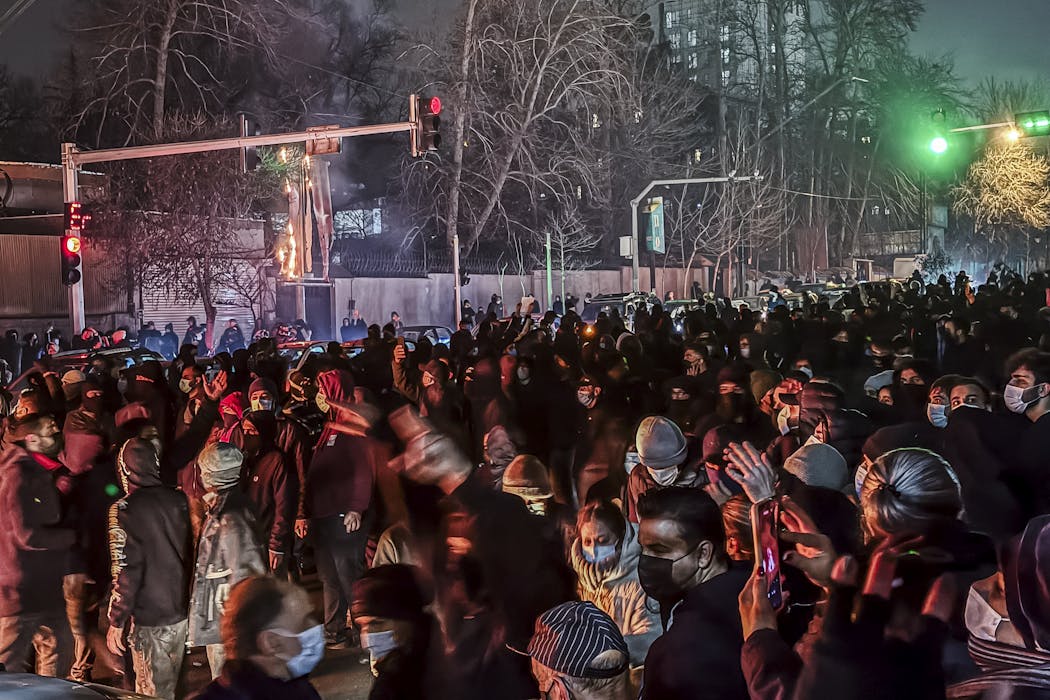
Protesters have filled the streets in Iranian cities, but the regime’s internet shutdown means little news gets in or out of the country. MAHSA/Middle East Images/AFP via Getty Images

The Iranian regime’s internet shutdown, initiated on Jan. 8, 2026, has severely diminished the flow of information out of the country. Without internet access, little news about the national protests that flared between Dec. 30, 2025, and Jan. 13, 2026, and the regime’s violent crackdown has reached the world. Many digital rights and internet monitoring groups have assessed the current shutdown to be the most sophisticated and most severe in Iran’s history.

We are a social scientist and two computer scientists at the Georgia Institute of Technology’s Internet Intelligence Lab who study internet connectivity.

Through the Internet Outage Detection and Analysis project, we have been measuring internet connectivity globally since 2011. The project was motivated by the internet shutdowns during the Arab Spring mass protests that began in December 2010 against Middle Eastern and North African regimes.

The project provides a public dashboard of internet connectivity measurements. Its long view of global internet connectivity offers insight into the Iranian regime’s developing sophistication in controlling information and shutting down the internet in the country.

Our measurements show that Iran has been in a complete internet shutdown since Jan. 8. This is longer than the 48½-hour shutdown in June 2025 during the Israel-Iran war and surpasses the duration of the November 2019 shutdown that lasted almost seven days. Compared to the two weeks of nightly mobile phone network shutdowns in September to October of 2022 during the Women, Life, Freedom protests, this shutdown is more complete by also closing down fixed-line connectivity.

Measuring internet connectivity

The Internet Outage Detection and Analysis project measures global internet connectivity through three signals related to internet infrastructure: routing announcements, active probing and internet background noise.

Core routers, unlike the router in your home, are responsible for directing traffic to and from networks. Routing announcements are how they communicate with each other. If a nation’s network of routers stop making these announcements, the network will disappear from the global internet.

We also measure the responsiveness of networks through probing. To create the probing signal, we continuously ping devices in millions of networks around the globe. Most devices are designed to automatically respond to these pings by echoing them back to the sender. We collect these responses and label networks as “connected/active.”

A tool we use dubbed “network telescope” captures internet background noise – traffic generated by hundreds of thousands of internet hosts worldwide. A drop in this signal can indicate an outage.

A history of shutdowns

The first nationwide shutdown that the Internet Outage Detection and Analysis project observed in Iran was during the “Bloody November” uprising that happened in 2019. During that shutdown, the primary method the regime used was turning off routing announcements, which stopped all traffic between routers. This is a blunt force tool that makes the internet essentially go dark; no connectivity is possible for affected networks.

However, our measurement reporting showed differences in signal-drop patterns among the three data sources we track. These patterns demonstrate the regime’s adoption of diverse disconnection mechanisms and large differences in the timing of disconnection by various Iranian internet service providers (ISPs).

This reporting also showed evidence that the 2019 blackout was not complete and some people were able to circumvent it. Nevertheless, as documented by Amnesty International, the internet darkness created a “web of impunity” that allowed the regime to violate international human rights law without any accountability.

In September 2022, the Women, Life, Freedom protests erupted after the killing of Mahsa Amini in state custody. To suppress the nationwide mobilization without exacting a high cost, the Iranian regime implemented nightly shutdowns affecting only mobile networks. Keeping fixed-line internet connections online limited the impact of these shutdowns to mitigate the economic, political and social costs.

These nightly internet curfews lasted about two weeks. During this time the regime implemented other forms of censorship, specifically blocking applications to further control the information environment and to prevent access to technologies for circumventing censorship.

In June 2025, the Israel-Iran war began and we observed initial degradation in internet connectivity, which often occurs during times of conflict, when internet and power infrastructure are affected by missile attacks. The Iranian regime shut down the internet over four days, citing national security as its rationale.

That time, the regime did not use routing announcements to implement the shutdown. Our measurement data shows that routing announcements were largely unaffected. Instead, the Iranian regime implemented the shutdown by interfering with key protocols that allow the internet to function, including transport layer security and the domain name system.

The regime used these techniques to shut off Iran’s connectivity with the global internet while allowing specific, sanctioned access in a policy called whitelisting. This strategy shows an increased sophistication in how the Iranian regime implements shutdowns and controls the flow of information.

Organizations that support digital human rights in Iran report that some Iranians were able to circumvent the shutdown using virtual private networks and various censorship-resilient technologies such as peer-to-peer networks.

The Iranian regime has targeted Starlink satellite internet service in its internet shutdown.

Jan. 8, 2026

On Dec. 30, 2025, the Internet Outage Detection and Analysis project team received reports of internet disruptions amid the start of nationwide protests. At 8 p.m. Iran Standard Time on Jan. 8, 2026, the Iranian regime shut down the internet. Our measurements show a nominal amount of responsiveness to our active probing, about 3%. This small amount could be an artifact of our measurements or lingering connectivity for whitelisted access, for example for Iranian government officials and services.

Outside of very limited whitelisted connectivity, digital human rights groups reported severely limited access to the internet both internationally and domestically. According to digital rights group Project Ainita, the Iranian regime implemented the shutdown by interfering with transport layer security and the domain name system. In addition, landline phone calls have been only intermittently available.

Aside from these more sophisticated techniques, this shutdown evokes the Bloody November shutdown of 2019 in that it has been ordered during a time of protest with mass civilian casualties.

Jammed satellites

Since Russia’s full-scale invasion of Ukraine in 2022, low Earth orbit satellite services, such as Starlink, can help people maintain internet connectivity during outages and government-ordered shutdowns. These satellite services can allow users to bypass damaged or state-censored terrestrial internet infrastructure.

However, accessing the internet via satellite services during a shutdown is not without risk. User terminals communicate with satellites via radio frequency links that can be detected through surveillance, for example from planes or drones, potentially exposing users’ locations and putting them at risk of being identified. Currently, the Iranian regime is using jammers to degrade the Starlink connection.

One of the most significant barriers to connecting users in Iran to satellite services is a logistical one. Providing connectivity via Starlink’s service would require distributing a large number of user terminals within the country, a feat that would be difficult because the devices are likely to be considered illegal contraband by the government. This severely limits the scale at which such services can be adopted.

Recent technological developments, however, may partially mitigate this challenge. Starlink’s direct-to-cell capability, which aims to provide LTE cellular connectivity directly to ordinary cellphones, could reduce dependence on specialized hardware. If they become widely available, such systems would allow users to connect using common devices already in circulation, sidestepping one of the most difficult barriers to providing connectivity.

Like other radio-based communications, however, direct-to-cell connectivity would remain vulnerable to signal jamming and other forms of electronic interference by the government.

For the time being, the Iranian regime controls the country’s internet infrastructure, which means it still has a virtual off switch.

The Conversation

Amanda Meng receives funding from the State Department.

Alberto Dainotti receives funding from the U.S. National Science Foundation. IODA was initially built with funding from the National Science Foundation and the Department of Homeland Security Science & Technology Directorate. A large body of IODA work was also funded by the U.S. State Department and by the Open Technology Fund.

Zachary Bischof receives funding from the State Department.

ref. Iran’s latest internet blackout extends to phones and Starlink – https://theconversation.com/irans-latest-internet-blackout-extends-to-phones-and-starlink-273439

Raccoons break into liquor stores, scale skyscrapers and pick locks – studying their clever brains can clarify human intelligence, too

Source: The Conversation – USA – By Kelly Lambert, Professor of Behavioral Neuroscience, University of Richmond

The moment you look away from those adorable eyes, these mischievous creatures will sneak out of your lab. Joshua J. Cotten/Unsplash, CC BY-SA

When a curious raccoon broke into an Ashland, Virginia, liquor store in December 2025, sampled the stock and passed out on the bathroom floor, the story went viral within minutes. The local animal shelter’s Facebook post was picked up by national and international outlets and quickly inspired raccoon-themed cocktails, “trashed panda” merchandise and even a cameo on “Saturday Night Live.”

For me, the story hit close to home. The store that hosted this inebriated bandit sits just blocks from the small behavioral neuroscience laboratory where I began investigating raccoon brains about 15 years ago. Although the so-called drunken raccoon made questionable decisions after breaking into the liquor store, the species – Procyon lotor – is known for its impressive intelligence, curiosity and problem-solving skills.

Despite being one of the most intriguing mammals living alongside humans, raccoons have avoided the scientific spotlight. Why aren’t more neuroscientists and psychologists studying raccoons? What have researchers missed about the mammalian brain by focusing on rodents instead?

Someone had a good time.

Why raccoons aren’t lab staples

In the U.S., it is estimated that laboratories use more than 100 million rodents, including mice and rats, each year. Rodents are ideal for research because they reproduce easily and adapt well to confinement. Scientists have tailored extensive research tools to study them. Long before rats dominated psychology labs, raccoons were actually a leading candidate for animal models of problem-solving and intelligence.

That ended when scientists realized they’d met their cognitive match. In one study, researchers reported that all raccoon participants escaped through the laboratory ventilation system.

Unsurprisingly, scientists promptly shifted to rodents. Practicality – not scientific suitability – ultimately crowned the rat as king of the laboratory. I have studied rats for decades, and I can confirm that none have ever disappeared into the ceiling.

Neither pet nor pest

Humans have an ambivalent relationship with raccoons. They appear too wild to be domesticated, too endearing to be treated purely as pests and too ubiquitous to be considered exotic wildlife. Even President Calvin Coolidge, who famously received a raccoon intended for the dinner table from a supporter in Mississippi, ended up keeping it as a beloved White House pet.

And the role confusion continues today with glimpses of humanlike behaviors in raccoons as they enter our living spaces. One report described raccoons interacting with playground equipment at a child care center on Canada’s west coast in ways similar to human children, and even breaking into classrooms as if they were auditing the morning lesson.

Raccoon climbing a metal ladder
Raccoons know how to get around.
RLO’Leary/Moment Open

Inspired by Montessori education principles, I visited a raccoon rehabilitation center in Saskatoon, Canada, called Bandit Ranch Rehab a few years ago. After introducing young raccoons to slinkies, puzzles and blocks, I sat in awe as they interacted with these objects with the focused enthusiasm of preschoolers on a mission.

This interspecies confusion seems to be mutual. Recent evidence suggests that urban raccoons are becoming increasingly tolerant of humans, especially when it suits them. But they are quick to leave when curiosity or opportunity calls.

Raccoon imagination

The drunken Ashland raccoon captured global attention because it fit the narrative people have projected onto the species: mischievous, opportunistic, clever and more than a little humanlike. But their sophisticated brains and mental capacities, aligning more with primates than other mammals, are even more intriguing.

Early behavioral research suggested that raccoons can learn a task, walk away and later return to solve it accurately – as if having mentally rehearsed the solution. In contrast, other species, including dogs and rats, needed to maintain continuous focus. Scientists have speculated that raccoons have mental imagery capabilities similar to humans.

Person kneeling on ground holding notebook, while a raccoon stands on its hind legs to also look at the notebook
Raccoons had some notes for the author’s student, too.
Kelly Lambert, CC BY-NC-SA

When a rogue raccoon scaled a 25-story skyscraper in Minneapolis several years ago, I couldn’t help but wonder what that animal was anticipating at the top. Do raccoons form internal representations of future outcomes? And if so, how much agency and foresight do they bring to their decisions?

To answer these questions, I have collaborated with wildlife biologists, veterinarians and neuroscientists around the country to study what may be one of the most underestimated and understudied brains in the animal kingdom.

What’s going on inside the raccoon brain?

Working with neuroscientist Suzana Herculano-Houzel, my laboratory at the University of Richmond has found that raccoons pack an astonishing number of neurons – an amount comparable to primates – into their brains. Scaled up to size, a raccoon brain would contain roughly the same number of neurons as a human brain.

We also found that raccoons possess specialized fast-conducting brain cells known as von Economo neurons, which are also found in humans, other great apes and a few additional large-brained mammals. In apes, these neurons appear in both the insula – a part of the brain important for processing internal body states – and the anterior cingulate, which plays a key role in emotional regulation. In raccoons, these neurons are present only in the insula and not in the anterior cingulate.

This neural arrangement may help explain the species’ striking combination of clever problem-solving and rapid decision-making during exploration – frequently leading to risky behaviors that can have unfortunate consequences. These findings raise the possibility that raccoon neuroscience could offer useful insights into the neural foundations of impulse control and distracted attention.

Two sets of raccoon paws held in a human hand
The dexterity of raccoon hands enables their humanlike escapades.
Zocha_K/iStock via Getty Images Plus

In collaboration with ecologist Sara Benson-Abram’s research team, we also found that raccoons with more sophisticated cognitive abilities had more neural cells in the hippocampus, reinforcing the idea that their learning and memory capacities map onto similar brain systems as those in people. Taxi drivers in London, who frequently use their knowledge of the 25,000 streets in London, also have a larger hippocampal area.

In addition to their impressive brains, raccoons’ dexterous hands play a key role in their cognitively creative escapades. Indeed, researchers have found that raccoon forepaws are mapped onto their cerebral cortex – the outer layer of the brain – in a similar manner as human hands. Both take up a lot of real estate in the brain. As journalist Carl Zimmer wrote, “The hand is where the mind meets the world.”

What raccoons can teach us about the human brain

As I argue in my upcoming book “Wild Brains,” understanding raccoon intelligence requires observing them in the environments they choose – not confining them to the small, simple spaces that suit rats and mice. So-called living laboratories that monitor wildlife without restricting their behavior may be scientists’ best chance at unlocking the secrets of this species’ remarkable mind.

In my graduate training, I was taught to avoid anthropomorphizing animal research subjects – to resist the temptation to project human thoughts and emotions onto nonhuman minds, because human brains likely contribute to uniquely human cognitive and emotional experiences. But primatologist Frans de Waal later introduced the useful counterpoint of anthropodenial: the mistaken assumption that animals cannot share emotional or cognitive capacities with humans simply because they are not human.

The drunken Ashland raccoon captured global attention not just because the story was funny, but because it felt familiar. People recognized something of themselves in this curious, impulsive, problem-solving animal navigating a very human environment. A willingness to lean away from anthropodenial – while remaining grounded in rigorous science – may open new paths for understanding raccoon intelligence and, ultimately, the wonderfully complex human brain.

The Conversation

Kelly Lambert received funding from the NIH and NSF.

ref. Raccoons break into liquor stores, scale skyscrapers and pick locks – studying their clever brains can clarify human intelligence, too – https://theconversation.com/raccoons-break-into-liquor-stores-scale-skyscrapers-and-pick-locks-studying-their-clever-brains-can-clarify-human-intelligence-too-272487

American farmers, who once fed the world, face a volatile global market with diminishing federal backing

Source: The Conversation – USA (2) – By Peter Simons, Lecturer in History, Hamilton College

American farmers face a changing future for their businesses. Roberto Schmidt/AFP via Getty Images

President Donald Trump appears to have upended an 85-year relationship between American farmers and the United States’ global exercise of power. But that link has been fraying since the end of the Cold War, and Trump’s moves are just another big step.

During World War II, the U.S. government tied agriculture to foreign policy by using taxpayer dollars to buy food from American farmers and send it to hungry allies abroad. This agricultural diplomacy continued into the Cold War through programs such as the Marshall Plan to rebuild European agriculture, Food for Peace to send surplus U.S. food to hungry allies, and the U.S. Agency for International Development, which aimed to make food aid and agricultural development permanent components of U.S. foreign policy.

During that period, the United States also participated in multinational partnerships to set global production goals and trade guidelines to promote the international movement of food – including the U.N.’s Food and Agriculture Organization, the International Wheat Agreement and the General Agreement on Tariffs and Trade.

When U.S. farmers faced labor shortfalls, the federal government created guest-worker programs that provided critical hands in the fields, most often from Mexico and the Caribbean.

At the end of World War II, the U.S. government recognized that farmers could not just rely on domestic agricultural subsidies, including production limits, price supports and crop insurance, for prosperity. American farmers’ well-being instead depended on the rest of the world.

Since returning to office in January 2025, Trump has dismantled the U.S. Agency for International Development. His administration has also aggressively detained and deported suspected noncitizens living and working in the U.S., including farmworkers. And he has imposed tariffs that caused U.S. trading partners to retaliate, slashing international demand for U.S. agricultural products.

Trump’s actions follow diplomatic and agricultural transformations that I research, and which began with the fall of the Soviet Union in 1991.

Feed the world, save the farm

Even before the nation’s founding, farmers in what would become the United States staked their livelihood on international networks of labor, plants and animals, and trade.

Cotton was the most prominent early example of these relationships, and by the 19th century wheat farmers depended on expanding transportation networks to move their goods within the country and overseas.

A drawing of people on foot and on horseback gathering cattle into a wooden pen.
Workers load cattle on a train for shipment to market in the late 19th century.
Bettmann via Getty Images

But fears that international trade could create economic uncertainty limited American farmers’ interest in overseas markets. The Great Depression in the 1930s reinforced skepticism of international markets, which many farmers and policymakers saw as the principal cause of the economic downturn.

World War II forced them to change their view. The Lend-Lease Act, passed in March 1941, aimed to keep the United States out of the war by providing supplies, weapons and equipment to Britain and its allies. Importantly for farmers, the act created a surge in demand for food.

And after Congress declared war in December 1941, the need to feed U.S. and allied troops abroad pushed demand for farm products ever higher. Food took on a significance beyond satisfying a wartime need: The Soviet Union, for example, made special requests for butter. U.S. soldiers wrote about the special bond created by seeing milk and eggs from a hometown dairy, and Europeans who received food under the Lend-Lease Act embraced large cans of condensed milk with sky-blue labels as if they were talismans.

Ropes hoist large boxes aboard a ship.
Crates of American hams, supplied through the Lend-Lease Act, are loaded on a ship bound for Britain in 1941.
Bettmann via Getty Images

Another war ends

But despite their critical contribution to the war, American farmers worried that the familiar pattern of postwar recession would repeat once Germany and Japan had surrendered.

Congress fulfilled farmers’ fears of an economic collapse by sharply reducing its food purchases as soon as the war ended in the summer of 1945. In 1946, Congress responded weakly to mounting overseas food needs.

Large bags are stacked in a pile, each with a tag on it saying it came from the U.S. to help Europe.
Bags of Marshall Plan flour wait in New York for shipment to Austria in 1948.
Ann Ronan Picture Library/Photo12/Universal Images Group via Getty Images

More action waited until 1948, when Congress recognized communism’s growing appeal in Europe amid an underfunded postwar reconstruction effort. The Marshall Plan’s more robust promise of food and other resources was intended to counter Soviet influence.

Sending American food overseas through postwar rehabilitation and development programs caused farm revenue to surge. It proved that foreign markets could create prosperity for American farmers, while food and agriculture’s importance to postwar reconstruction in Europe and Asia cemented their importance in U.S. foreign policy.

Farmers in the modern world

Farmers’ contribution to the Cold War shored up their cultural and political importance in a rapidly industrializing and urbanizing United States. The Midwestern farm became an aspirational symbol used by the State Department to encourage European refugees to emigrate to the U.S. after World War II.

American farmers volunteered to be amateur diplomats, sharing methods and technologies with their agricultural counterparts around the world.

By the 1950s, delegations of Soviet officials were traveling to the Midwest, including Soviet premier Nikita Khrushchev’s excursion to Iowa in 1959. U.S. farmers reciprocated with tours of the Soviet Union. Young Americans who had grown up on farms moved abroad to live with host families, working their properties and informally sharing U.S. agricultural methods. Certain that their land and techniques were superior to those of their overseas peers, U.S. farmers felt obligated to share their wisdom with the rest of the world.

The collapse of the Soviet Union undermined the central purpose for the United States’ agricultural diplomacy. But a growing global appetite for meat in the 1990s helped make up some of the difference.

U.S. farmers shifted crops from wheat to corn and soybeans to feed growing numbers of livestock around the world. They used newly available genetically engineered seeds that promised unprecedented yields.

Expecting these transformations to financially benefit American farmers and seeing little need to preserve Cold War-era international cooperation, the U.S. government changed its trade policy from collaborating on global trade to making it more of a competition.

In a large auditorium, people sit at a long table on a stage and sign papers.
World leaders sign the Marrakesh Agreement, creating the World Trade Organization, in 1994.
Jacques Langevin/Sygma/Sygma via Getty Images

The George H.W. Bush and Clinton administrations crafted the North American Free Trade Agreement and the World Trade Organization to replace the general agreement on trade and tariffs. They assumed American farmers’ past preeminence would continue to increase farm revenues even as global economic forces shifted.

But U.S. farmers have faced higher costs for seeds and fertilizer, as well as new international competitors such as Brazil. With a diminished competitive advantage and the loss of the Cold War’s cooperative infrastructure, U.S. farmers now face a more volatile global market that will likely require greater government support through subsidies rather than offering prosperity through commerce.

That includes the Trump administration’s December 2025 announcement of a US$12 billion farmer bailout. As Trump’s trade wars continue, they show that the U.S. government is no longer fostering a global agricultural market in which U.S. farmers enjoy a trade advantage or government protection – even if they retain some cultural and political significance in the 21st century.

The Conversation

Peter Simons does not work for, consult, own shares in or receive funding from any company or organization that would benefit from this article, and has disclosed no relevant affiliations beyond their academic appointment.

ref. American farmers, who once fed the world, face a volatile global market with diminishing federal backing – https://theconversation.com/american-farmers-who-once-fed-the-world-face-a-volatile-global-market-with-diminishing-federal-backing-271369

Deep reading can boost your critical thinking and help you resist misinformation – here’s how to build the skill

Source: The Conversation – USA (2) – By JT Torres, Director of the Harte Center for Teaching and Learning, Washington and Lee University

Just slowing down gives you time to question and reflect. Morsa Images/DigitalVision via Getty Images

The average American checks their phone over 140 times a day, clocking an average of 4.5 hours of daily use, with 57% of people admitting they’re “addicted” to their phone. Tech companies, influencers and other content creators compete for all that attention, which has incentivized the rise of misinformation.

Considering this challenging information landscape, strong critical reading skills are as relevant and necessary as they’ve ever been.

Unfortunately, literacy continues to be a serious concern. Reading comprehension scores have continued to decline. The majority of Gen Z parents are not reading aloud to their young children because they view it as a chore. Many college students cannot make it through an entire book.

With their endless scrolling and easy reposting and sharing of content, social media platforms are designed to encourage passive engagement that people use to relieve boredom and escape stress.

As a cognitive scientist and a literacy expert, we research the ways people process information through reading. Based on our work, we believe that deep reading can be an effective way to counter misinformation as well as reduce stress and loneliness. It can be tough to go deeper than a speedy skim, but there are strategies you can use to strengthen important reading skills.

woman sits on end of bed holding head in hand while looking at phone
Counterintuitively, social media can make you feel more bored and lonely.
Dmitrii Marchenko/Moment via Getty Images

Deep reading versus doomscrolling

People use smartphones and social media for a variety of reasons, such as to relieve boredom, seek attention, make connections and share news. The infinite amount of information available at your fingertips can lead to information overload, interfering with how you pay attention and make decisions. Research from cognitive science helps to explain how scrolling trains your brain to think passively.

To keep people engaged, social media algorithms feed people content similar to what they’ve already engaged with, reinforcing users’ beliefs with similar posts. Repeated exposure to information increases its believability, especially if different sources repeat the information, an effect known as illusory truth.

Deep reading, on the other hand, refers to the intentional process of engaging with information in critical, analytical and empathetic ways. It involves making inferences, drawing connections, engaging with different perspectives and questioning possible interpretations.

Deep reading does require effort. It can trigger negative feelings like irritation or confusion, and it can very often feel unpleasant. The important question, then: Why would anyone choose the hard work of deep reading when they can just scroll and skim?

Motivating mental effort

Mindless scrolling may come with unintended consequences. Smartphone and social media use is associated with increased boredom and loneliness. And doomscrolling is related to higher levels of existential anxiety and misanthropy.

In contrast, attention and effort, despite being exhausting, can deepen your sense of purpose and strengthen social connection. People also feel motivated to complete tasks that help them pursue personal goals, especially when these tasks are recognized by others. For these reasons, sharing books may be one tool to promote deep reading.

One example is a teacher who guides students through longer texts, like novels, paired with active discussions about the books to reinforce comprehension and interpretation. While the debate over the ongoing practice of assigning excerpts over full books in schools continues, evidence does suggest that sustained reading in social settings can promote lifelong enjoyment in reading.

With social connection in mind, social media can actually be used as a positive tool. BookTok is a popular online community of people who use TikTok to discuss and recommend books. Fans post in-depth analyses of “K-Pop Demon Hunters” and other movies or shows, demonstrating that close analysis still has a place in the endless scroll of social media.

three people laughing together at a table, with books open in front of them
Talking about what you’ve read can add a social dimension to what can be a solitary activity.
Alfonso Soler/iStock via Getty Images Plus

Slowing yourself down to read deeply

There are steps you can take to meaningfully engage with the constant stream of information you encounter. Of course, this process can be taxing, and people only have so much effort and attention to expend. It’s important to both recognize your limited cognitive resources and be intentional about how you direct those resources.

Simply being aware of how digital reading practices shape your brain can encourage new attitudes and habits toward how you consume information. Just pausing can reduce susceptibility to misinformation. Taking a few extra seconds to consciously judge information can counteract illusory truth, indicating that intentionally slowing down even just a bit can be beneficial.

Reading deeply means being able to intentionally choose when to read at different speeds, slowing down as needed to wrestle with difficult passages, savor striking prose, critically evaluate information, and reflect on the meaning of a text. It involves entering into a dialogue with the text rather than gleaning information.

Awareness does not mean that you never doomscroll at the end of a long day. But it does mean becoming conscious of the need to also stick with a single text more frequently and to engage with different perspectives.

You can start small, perhaps with poems, short stories or essays, before moving up to longer texts. Partner with a friend or family member and set a goal to read a full-length novel or nonfiction book. Accomplish that goal in small chunks, such as reading one chapter a day and discussing what you read with your reading buddy. Practicing deep reading, such as reading novels, can open you up to new perspectives and ideas that you can explore in conversation with others, in person or even on TikTok.

The Conversation

The authors do not work for, consult, own shares in or receive funding from any company or organization that would benefit from this article, and have disclosed no relevant affiliations beyond their academic appointment.

ref. Deep reading can boost your critical thinking and help you resist misinformation – here’s how to build the skill – https://theconversation.com/deep-reading-can-boost-your-critical-thinking-and-help-you-resist-misinformation-heres-how-to-build-the-skill-268082